Outline
© Copyright 1992–2004 by Deitel & Associates, Inc. and
1
PATNA UNIVERSITY
PATNA COLLEGE PATNA
CC2 PRESENTATION
Operators
2
BY GROUP NO -03
GOOD MORNNG TO ALL OF YOU
MY TOPIC IS OPERATOR IN ‘C’
Contents
◦ Arithmetic operators
◦ Relational operators
◦ Logical operators
◦ Assignment operators
◦ Increment and decrement operators
◦ Conditional operators
◦ Special operators
3
Introduction
 An operator is a symbol that tells the computer to
perform certain manipulations.
 C operators can be classified into a number of
categories.
◦ Arithmetic operators
◦ Relational operators
◦ Logical operators
◦ Assignment operators
◦ Increment and decrement operators
◦ Conditional operators
◦ Special operators
4
Arithmetic operators
 The arithmetic operators in C
Operator meaning
+ Addition or unary plus
- Subtraction or unary minus
* Multiplication
/ Division
% modulo division
5
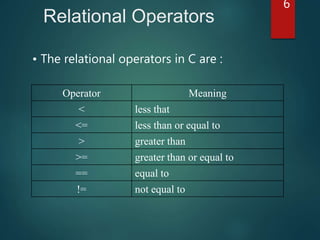
Relational Operators
Operator Meaning
< less that
<= less than or equal to
> greater than
>= greater than or equal to
== equal to
!= not equal to
6
• The relational operators in C are :
Logical operators
 C has the following three logical operators
 && meaning logical and
 || meaning logical or
 ! meaning logical not ( unary operator )
7
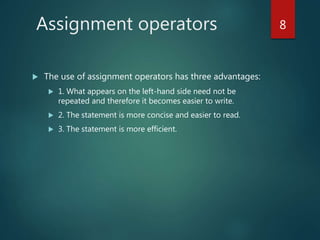
Assignment operators
 The use of assignment operators has three advantages:
 1. What appears on the left-hand side need not be
repeated and therefore it becomes easier to write.
 2. The statement is more concise and easier to read.
 3. The statement is more efficient.
8
Increment and decrement
operators
 C provides two unusual operators for incrementing
and decrementing variables.
 The increment operator ++ adds 1 to its operand,
while the decrement operator -- subtracts 1.
 The unusual aspect is that ++ and -- may be used
either as prefix operators (before the variable, as in
++n), or postfix operators (after the variable: n++).
 In both cases, the effect is to increment n. But the
expression ++n increments n before its value is used,
while n++ increments n after its value has been used.
9
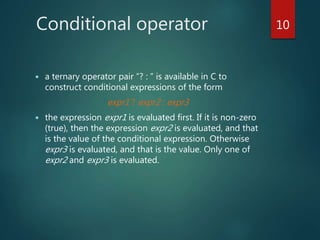
Conditional operator
 a ternary operator pair “? : ” is available in C to
construct conditional expressions of the form
expr1 ? expr2 : expr3
 the expression expr1 is evaluated first. If it is non-zero
(true), then the expression expr2 is evaluated, and that
is the value of the conditional expression. Otherwise
expr3 is evaluated, and that is the value. Only one of
expr2 and expr3 is evaluated.
10
Special operators
 1. The Comma Operator
 The comma operator can be used to link the related
expressions together. A comma-linked list of
expressions is evaluated left to right and the value of
right-most expression is the value of the combined
expression.
11
 THANKS
12

Operator in C language

  • 1.
    Outline © Copyright 1992–2004by Deitel & Associates, Inc. and 1 PATNA UNIVERSITY PATNA COLLEGE PATNA
  • 2.
    CC2 PRESENTATION Operators 2 BY GROUPNO -03 GOOD MORNNG TO ALL OF YOU MY TOPIC IS OPERATOR IN ‘C’
  • 3.
    Contents ◦ Arithmetic operators ◦Relational operators ◦ Logical operators ◦ Assignment operators ◦ Increment and decrement operators ◦ Conditional operators ◦ Special operators 3
  • 4.
    Introduction  An operatoris a symbol that tells the computer to perform certain manipulations.  C operators can be classified into a number of categories. ◦ Arithmetic operators ◦ Relational operators ◦ Logical operators ◦ Assignment operators ◦ Increment and decrement operators ◦ Conditional operators ◦ Special operators 4
  • 5.
    Arithmetic operators  Thearithmetic operators in C Operator meaning + Addition or unary plus - Subtraction or unary minus * Multiplication / Division % modulo division 5
  • 6.
    Relational Operators Operator Meaning <less that <= less than or equal to > greater than >= greater than or equal to == equal to != not equal to 6 • The relational operators in C are :
  • 7.
    Logical operators  Chas the following three logical operators  && meaning logical and  || meaning logical or  ! meaning logical not ( unary operator ) 7
  • 8.
    Assignment operators  Theuse of assignment operators has three advantages:  1. What appears on the left-hand side need not be repeated and therefore it becomes easier to write.  2. The statement is more concise and easier to read.  3. The statement is more efficient. 8
  • 9.
    Increment and decrement operators C provides two unusual operators for incrementing and decrementing variables.  The increment operator ++ adds 1 to its operand, while the decrement operator -- subtracts 1.  The unusual aspect is that ++ and -- may be used either as prefix operators (before the variable, as in ++n), or postfix operators (after the variable: n++).  In both cases, the effect is to increment n. But the expression ++n increments n before its value is used, while n++ increments n after its value has been used. 9
  • 10.
    Conditional operator  aternary operator pair “? : ” is available in C to construct conditional expressions of the form expr1 ? expr2 : expr3  the expression expr1 is evaluated first. If it is non-zero (true), then the expression expr2 is evaluated, and that is the value of the conditional expression. Otherwise expr3 is evaluated, and that is the value. Only one of expr2 and expr3 is evaluated. 10
  • 11.
    Special operators  1.The Comma Operator  The comma operator can be used to link the related expressions together. A comma-linked list of expressions is evaluated left to right and the value of right-most expression is the value of the combined expression. 11
  • 12.