Working with Suppliers
What this topic is all about

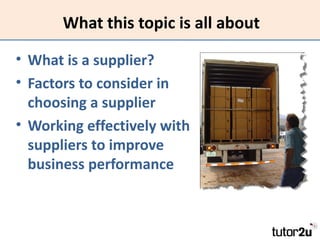
• What is a supplier?
• Factors to consider in
  choosing a supplier
• Working effectively with
  suppliers to improve
  business performance
What is a Supplier?

A business or individual
that provides goods and
  services to another
        business
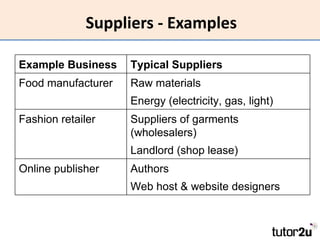
Suppliers - Examples

Example Business    Typical Suppliers
Food manufacturer   Raw materials
                    Energy (electricity, gas, light)
Fashion retailer    Suppliers of garments
                    (wholesalers)
                    Landlord (shop lease)
Online publisher    Authors
                    Web host & website designers
The Supply Chain – Simple Example


                Indian     Customers
              Restaurant
The Supply Chain – Complex Example
                              Publishing a Newspaper
Origination                    Publishing           Manufacture          Distribution Retail

Primary Activities

Originating of         Commission and       Printing and         Warehousing,        Purchasing
content                acquisition of       reproduction         stock control and
                                                                                     Stock Management
                       content                                   delivery to the
                                                                 points of sale      POS, display and
                       Co-ordination of
                                                                 (“POS”)             marketing
                       design production
                       and promotion
                       Control of content
                       rights

Support Activities
Procurement: Editorial management; sourcing writers
Human Resources: Recruiting, rewarding, developing, firing
Technology: Publishing design software & associated hardware; maintenance of content archive; online
Infrastructure: Organisational design, finance, general management
Why Suppliers are Important
• For a business to meet the needs and wants
  of customers, it needs an effective “supply
  chain”
• Suppliers determine many of the costs of a
  business (e.g. raw materials, distribution)
• Suppliers are closely linked to product quality
• Suppliers can be an important source of
  finance to a business (trade credit)
• For businesses that use lean production
  techniques, effective relationships with key
  suppliers are essential
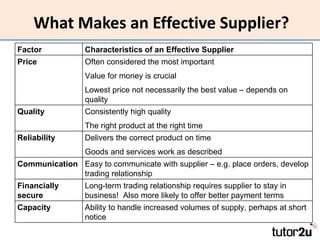
What Makes an Effective Supplier?
Factor           Characteristics of an Effective Supplier
Price            Often considered the most important
                 Value for money is crucial
                 Lowest price not necessarily the best value – depends on
                 quality
Quality          Consistently high quality
                 The right product at the right time
Reliability      Delivers the correct product on time
                 Goods and services work as described
Communication Easy to communicate with supplier – e.g. place orders, develop
              trading relationship
Financially      Long-term trading relationship requires supplier to stay in
secure           business! Also more likely to offer better payment terms
Capacity         Ability to handle increased volumes of supply, perhaps at short
                 notice
The Importance of Supplier Price
• Textbooks like to emphasise importance of
  non-price factors (e.g. reliability, quality,
  location)
• But suppliers must offer a competitive price
  (value for money)
• Supplier prices can be pushed lower by:
  – Grouping purchases with fewer suppliers (use
    bargaining power to get lower price)
  – Ensuring suppliers compete against each other for
    regular orders
Strategic versus Commodity Suppliers
• Some suppliers are strategically crucial to a
  business
• Strategic = the business cannot succeed
  without maintaining an effective supplier
  relationship. These goods and services are
  crucial to business success
• Other suppliers can be regarded as
  “Commodity Suppliers” – they provide goods
  and services that can easily be bought
  elsewhere and which are not hugely
  important to the business.
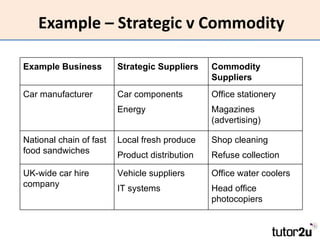
Example – Strategic v Commodity

Example Business         Strategic Suppliers    Commodity
                                                Suppliers
Car manufacturer         Car components         Office stationery
                         Energy                 Magazines
                                                (advertising)

National chain of fast   Local fresh produce    Shop cleaning
food sandwiches          Product distribution   Refuse collection

UK-wide car hire         Vehicle suppliers      Office water coolers
company                  IT systems             Head office
                                                photocopiers
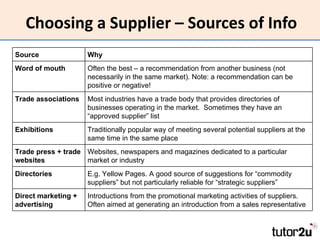
Choosing a Supplier – Sources of Info
Source               Why
Word of mouth        Often the best – a recommendation from another business (not
                     necessarily in the same market). Note: a recommendation can be
                     positive or negative!
Trade associations   Most industries have a trade body that provides directories of
                     businesses operating in the market. Sometimes they have an
                     “approved supplier” list
Exhibitions          Traditionally popular way of meeting several potential suppliers at the
                     same time in the same place
Trade press + trade Websites, newspapers and magazines dedicated to a particular
websites            market or industry
Directories          E.g. Yellow Pages. A good source of suggestions for “commodity
                     suppliers” but not particularly reliable for “strategic suppliers”
Direct marketing +   Introductions from the promotional marketing activities of suppliers.
advertising          Often aimed at generating an introduction from a sales representative
Contracting with a Supplier
• Relationships with strategic suppliers are often
  formalised in terms of a supply contract
• Contract sets out how a business and its supplier will
  work together
• Key contents of a Service Agreement:
   – What is to be provided (the product or service) – precise
     description required, including quality standards to be met
   – When – delivery timetable (including milestones where
     appropriate)
   – How much – pricing & payment terms
   – Source of supply – any restrictions on materials to be used (e.g.
     ethically sourced)
   – Disputes – procedure for disputes and how they will be resolved
   – Termination – how & when a supply contract will be terminated
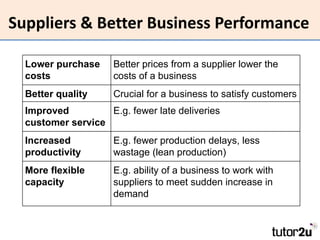
Suppliers & Better Business Performance

  Lower purchase     Better prices from a supplier lower the
  costs              costs of a business
  Better quality     Crucial for a business to satisfy customers
  Improved         E.g. fewer late deliveries
  customer service
  Increased          E.g. fewer production delays, less
  productivity       wastage (lean production)
  More flexible      E.g. ability of a business to work with
  capacity           suppliers to meet sudden increase in
                     demand
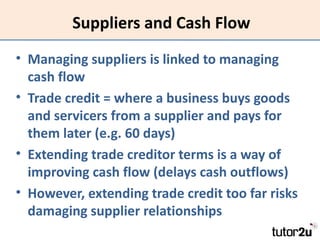
Suppliers and Cash Flow
• Managing suppliers is linked to managing
  cash flow
• Trade credit = where a business buys goods
  and servicers from a supplier and pays for
  them later (e.g. 60 days)
• Extending trade creditor terms is a way of
  improving cash flow (delays cash outflows)
• However, extending trade credit too far risks
  damaging supplier relationships
Test Your Understanding


http://www.tutor2u.net/business/quiz/workingwithsuppliers/quiz.html
Working with Suppliers

Operations - Working with Suppliers

  • 1.
  • 2.
    What this topicis all about • What is a supplier? • Factors to consider in choosing a supplier • Working effectively with suppliers to improve business performance
  • 3.
    What is aSupplier? A business or individual that provides goods and services to another business
  • 4.
    Suppliers - Examples ExampleBusiness Typical Suppliers Food manufacturer Raw materials Energy (electricity, gas, light) Fashion retailer Suppliers of garments (wholesalers) Landlord (shop lease) Online publisher Authors Web host & website designers
  • 5.
    The Supply Chain– Simple Example Indian Customers Restaurant
  • 6.
    The Supply Chain– Complex Example Publishing a Newspaper Origination Publishing Manufacture Distribution Retail Primary Activities Originating of Commission and Printing and Warehousing, Purchasing content acquisition of reproduction stock control and Stock Management content delivery to the points of sale POS, display and Co-ordination of (“POS”) marketing design production and promotion Control of content rights Support Activities Procurement: Editorial management; sourcing writers Human Resources: Recruiting, rewarding, developing, firing Technology: Publishing design software & associated hardware; maintenance of content archive; online Infrastructure: Organisational design, finance, general management
  • 7.
    Why Suppliers areImportant • For a business to meet the needs and wants of customers, it needs an effective “supply chain” • Suppliers determine many of the costs of a business (e.g. raw materials, distribution) • Suppliers are closely linked to product quality • Suppliers can be an important source of finance to a business (trade credit) • For businesses that use lean production techniques, effective relationships with key suppliers are essential
  • 8.
    What Makes anEffective Supplier? Factor Characteristics of an Effective Supplier Price Often considered the most important Value for money is crucial Lowest price not necessarily the best value – depends on quality Quality Consistently high quality The right product at the right time Reliability Delivers the correct product on time Goods and services work as described Communication Easy to communicate with supplier – e.g. place orders, develop trading relationship Financially Long-term trading relationship requires supplier to stay in secure business! Also more likely to offer better payment terms Capacity Ability to handle increased volumes of supply, perhaps at short notice
  • 9.
    The Importance ofSupplier Price • Textbooks like to emphasise importance of non-price factors (e.g. reliability, quality, location) • But suppliers must offer a competitive price (value for money) • Supplier prices can be pushed lower by: – Grouping purchases with fewer suppliers (use bargaining power to get lower price) – Ensuring suppliers compete against each other for regular orders
  • 10.
    Strategic versus CommoditySuppliers • Some suppliers are strategically crucial to a business • Strategic = the business cannot succeed without maintaining an effective supplier relationship. These goods and services are crucial to business success • Other suppliers can be regarded as “Commodity Suppliers” – they provide goods and services that can easily be bought elsewhere and which are not hugely important to the business.
  • 11.
    Example – Strategicv Commodity Example Business Strategic Suppliers Commodity Suppliers Car manufacturer Car components Office stationery Energy Magazines (advertising) National chain of fast Local fresh produce Shop cleaning food sandwiches Product distribution Refuse collection UK-wide car hire Vehicle suppliers Office water coolers company IT systems Head office photocopiers
  • 12.
    Choosing a Supplier– Sources of Info Source Why Word of mouth Often the best – a recommendation from another business (not necessarily in the same market). Note: a recommendation can be positive or negative! Trade associations Most industries have a trade body that provides directories of businesses operating in the market. Sometimes they have an “approved supplier” list Exhibitions Traditionally popular way of meeting several potential suppliers at the same time in the same place Trade press + trade Websites, newspapers and magazines dedicated to a particular websites market or industry Directories E.g. Yellow Pages. A good source of suggestions for “commodity suppliers” but not particularly reliable for “strategic suppliers” Direct marketing + Introductions from the promotional marketing activities of suppliers. advertising Often aimed at generating an introduction from a sales representative
  • 13.
    Contracting with aSupplier • Relationships with strategic suppliers are often formalised in terms of a supply contract • Contract sets out how a business and its supplier will work together • Key contents of a Service Agreement: – What is to be provided (the product or service) – precise description required, including quality standards to be met – When – delivery timetable (including milestones where appropriate) – How much – pricing & payment terms – Source of supply – any restrictions on materials to be used (e.g. ethically sourced) – Disputes – procedure for disputes and how they will be resolved – Termination – how & when a supply contract will be terminated
  • 14.
    Suppliers & BetterBusiness Performance Lower purchase Better prices from a supplier lower the costs costs of a business Better quality Crucial for a business to satisfy customers Improved E.g. fewer late deliveries customer service Increased E.g. fewer production delays, less productivity wastage (lean production) More flexible E.g. ability of a business to work with capacity suppliers to meet sudden increase in demand
  • 15.
    Suppliers and CashFlow • Managing suppliers is linked to managing cash flow • Trade credit = where a business buys goods and servicers from a supplier and pays for them later (e.g. 60 days) • Extending trade creditor terms is a way of improving cash flow (delays cash outflows) • However, extending trade credit too far risks damaging supplier relationships
  • 16.
  • 17.