eCompliance: A game changer that can scale
TB care internationally and prevent MDR TB

© Operation ASHA

1
India- the emerging superpower?

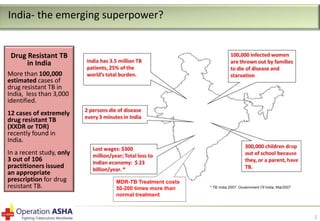
Drug Resistant TB
in India
More than 100,000
estimated cases of
drug resistant TB in
India, less than 3,000
identified.
12 cases of extremely
drug resistant TB
(XXDR or TDR)
recently found in
India.
In a recent study, only
3 out of 106
practitioners issued
an appropriate
prescription for drug
resistant TB.

MDR-TB Treatment costs
50-200 times more than
normal treatment

2
100% DOTS coverage?
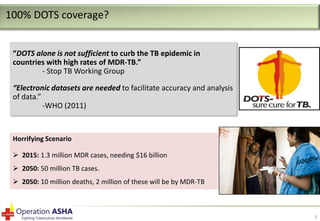
“DOTS alone is not sufficient to curb the TB epidemic in
countries with high rates of MDR-TB.”
- Stop TB Working Group

“Electronic datasets are needed to facilitate accuracy and analysis
of data.”
-WHO (2011)

Horrifying Scenario
 2015: 1.3 million MDR cases, needing $16 billion
 2050: 50 million TB cases.
 2050: 10 million deaths, 2 million of these will be by MDR-TB

3
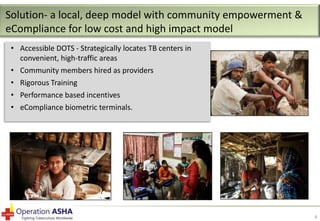
Solution- a local, deep model with community empowerment &
eCompliance for low cost and high impact model
• Accessible DOTS - Strategically locates TB centers in
convenient, high-traffic areas
• Community members hired as providers
• Rigorous Training
• Performance based incentives
• eCompliance biometric terminals.

4
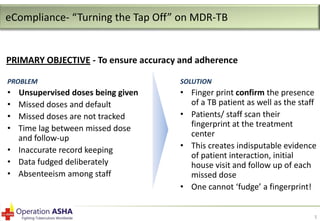
eCompliance- “Turning the Tap Off” on MDR-TB

PRIMARY OBJECTIVE - To ensure accuracy and adherence
PROBLEM

SOLUTION

•
•
•
•

• Finger print confirm the presence
of a TB patient as well as the staff
• Patients/ staff scan their
fingerprint at the treatment
center
• This creates indisputable evidence
of patient interaction, initial
house visit and follow up of each
missed dose
• One cannot ‘fudge’ a fingerprint!

Unsupervised doses being given
Missed doses and default
Missed doses are not tracked
Time lag between missed dose
and follow-up
• Inaccurate record keeping
• Data fudged deliberately
• Absenteeism among staff

5
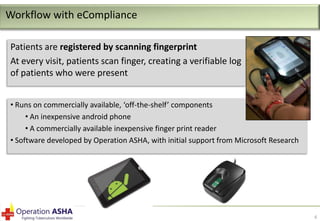
Workflow with eCompliance
Patients are registered by scanning fingerprint
At every visit, patients scan finger, creating a verifiable log
of patients who were present
• Runs on commercially available, ‘off-the-shelf’ components
• An inexpensive android phone
• A commercially available inexpensive finger print reader
• Software developed by Operation ASHA, with initial support from Microsoft Research

6
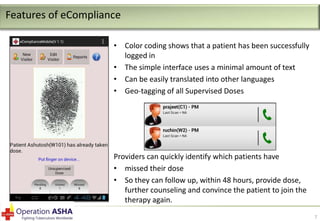
Features of eCompliance
• Color coding shows that a patient has been successfully
logged in
• The simple interface uses a minimal amount of text
• Can be easily translated into other languages
• Geo-tagging of all Supervised Doses

Providers can quickly identify which patients have
• missed their dose
• So they can follow up, within 48 hours, provide dose,
further counseling and convince the patient to join the
therapy again.
7
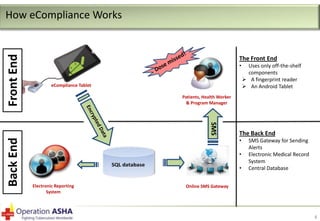
Front End

How eCompliance Works

The Front End
•
eCompliance Tablet
Patients, Health Worker
& Program Manager

SMS

Back End

Uses only off-the-shelf
components
 A fingerprint reader
 An Android Tablet

The Back End
•

•
•
Electronic Reporting
System

SMS Gateway for Sending
Alerts
Electronic Medical Record
System
Central Database

Online SMS Gateway

8
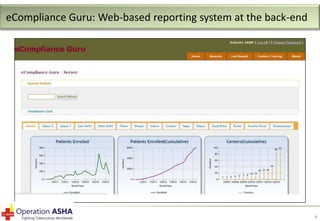
eCompliance Guru: Web-based reporting system at the back-end

9
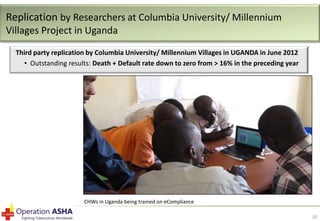
Replication by Researchers at Columbia University/ Millennium
Villages Project in Uganda
Third party replication by Columbia University/ Millennium Villages in UGANDA in June 2012
• Outstanding results: Death + Default rate down to zero from > 16% in the preceding year

CHWs in Uganda being trained on eCompliance
10
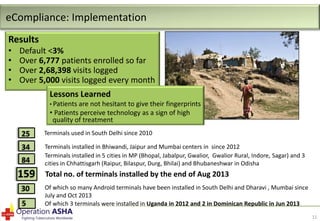
eCompliance: Implementation
Results
•
•
•
•

Default <3%
Over 6,777 patients enrolled so far
Over 2,68,398 visits logged
Over 5,000 visits logged every month
Lessons Learned
• Patients are

not hesitant to give their fingerprints
• Patients perceive technology as a sign of high
quality of treatment

25

Terminals used in South Delhi since 2010

34

Terminals installed in Bhiwandi, Jaipur and Mumbai centers in since 2012
Terminals installed in 5 cities in MP (Bhopal, Jabalpur, Gwalior, Gwalior Rural, Indore, Sagar) and 3
cities in Chhattisgarh (Raipur, Bilaspur, Durg, Bhilai) and Bhubaneshwar in Odisha

84

159
30
5

Total no. of terminals installed by the end of Aug 2013
Of which so many Android terminals have been installed in South Delhi and Dharavi , Mumbai since
July and Oct 2013
Of which 3 terminals were installed in Uganda in 2012 and 2 in Dominican Republic in Jun 2013
11
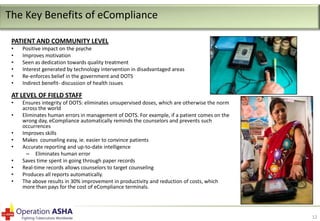
The Key Benefits of eCompliance
PATIENT AND COMMUNITY LEVEL
•
•
•
•
•
•

Positive impact on the psyche
Improves motivation
Seen as dedication towards quality treatment
Interest generated by technology intervention in disadvantaged areas
Re-enforces belief in the government and DOTS
Indirect benefit- discussion of health issues

AT LEVEL OF FIELD STAFF
•
•
•
•
•
•
•
•
•

Ensures integrity of DOTS: eliminates unsupervised doses, which are otherwise the norm
across the world
Eliminates human errors in management of DOTS. For example, if a patient comes on the
wrong day, eCompliance automatically reminds the counselors and prevents such
occurrences
Improves skills
Makes counseling easy, ie. easier to convince patients
Accurate reporting and up-to-date intelligence
– Eliminates human error
Saves time spent in going through paper records
Real-time records allows counselors to target counseling
Produces all reports automatically.
The above results in 30% improvement in productivity and reduction of costs, which
more than pays for the cost of eCompliance terminals.

12
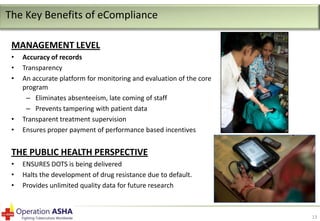
The Key Benefits of eCompliance
MANAGEMENT LEVEL
•
•
•

•
•

Accuracy of records
Transparency
An accurate platform for monitoring and evaluation of the core
program
– Eliminates absenteeism, late coming of staff
– Prevents tampering with patient data
Transparent treatment supervision
Ensures proper payment of performance based incentives

THE PUBLIC HEALTH PERSPECTIVE
•
•
•

ENSURES DOTS is being delivered
Halts the development of drug resistance due to default.
Provides unlimited quality data for future research

13
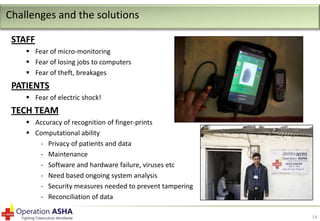
Challenges and the solutions
STAFF
 Fear of micro-monitoring
 Fear of losing jobs to computers
 Fear of theft, breakages

PATIENTS
 Fear of electric shock!

TECH TEAM
 Accuracy of recognition of finger-prints
 Computational ability
- Privacy of patients and data
- Maintenance
- Software and hardware failure, viruses etc
- Need based ongoing system analysis
- Security measures needed to prevent tampering
- Reconciliation of data
14
Cost Effectiveness
Component

Cost

Android Tablet

$ 140 (Rs. 8,500)

Fingerprint Reader

$ 65 (Rs. 4,000)

Internet Plan (per year) $ 40 (Rs. 2,400)
Total cost of each eCompliance terminal = $245 (Rs. 14,900)
Cost per patient = $2.66 (Rs. 162), which is more than offset by increased
productivity (each unit will treat 92 patients over 2 years: average at OpASHA)

15
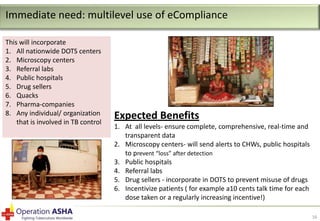
Immediate need: multilevel use of eCompliance
This will incorporate
1. All nationwide DOTS centers
2. Microscopy centers
3. Referral labs
4. Public hospitals
5. Drug sellers
6. Quacks
7. Pharma-companies
8. Any individual/ organization
that is involved in TB control

Expected Benefits
1. At all levels- ensure complete, comprehensive, real-time and
transparent data
2. Microscopy centers- will send alerts to CHWs, public hospitals
to prevent “loss” after detection
3. Public hospitals
4. Referral labs
5. Drug sellers - incorporate in DOTS to prevent misuse of drugs
6. Incentivize patients ( for example a10 cents talk time for each
dose taken or a regularly increasing incentive!)
16
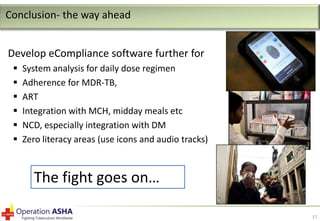
Conclusion- the way ahead
Develop eCompliance software further for







System analysis for daily dose regimen
Adherence for MDR-TB,
ART
Integration with MCH, midday meals etc
NCD, especially integration with DM
Zero literacy areas (use icons and audio tracks)

The fight goes on…
17

Shurti Ahuja, Operation ASHA

  • 1.
    eCompliance: A gamechanger that can scale TB care internationally and prevent MDR TB © Operation ASHA 1
  • 2.
    India- the emergingsuperpower? Drug Resistant TB in India More than 100,000 estimated cases of drug resistant TB in India, less than 3,000 identified. 12 cases of extremely drug resistant TB (XXDR or TDR) recently found in India. In a recent study, only 3 out of 106 practitioners issued an appropriate prescription for drug resistant TB. MDR-TB Treatment costs 50-200 times more than normal treatment 2
  • 3.
    100% DOTS coverage? “DOTSalone is not sufficient to curb the TB epidemic in countries with high rates of MDR-TB.” - Stop TB Working Group “Electronic datasets are needed to facilitate accuracy and analysis of data.” -WHO (2011) Horrifying Scenario  2015: 1.3 million MDR cases, needing $16 billion  2050: 50 million TB cases.  2050: 10 million deaths, 2 million of these will be by MDR-TB 3
  • 4.
    Solution- a local,deep model with community empowerment & eCompliance for low cost and high impact model • Accessible DOTS - Strategically locates TB centers in convenient, high-traffic areas • Community members hired as providers • Rigorous Training • Performance based incentives • eCompliance biometric terminals. 4
  • 5.
    eCompliance- “Turning theTap Off” on MDR-TB PRIMARY OBJECTIVE - To ensure accuracy and adherence PROBLEM SOLUTION • • • • • Finger print confirm the presence of a TB patient as well as the staff • Patients/ staff scan their fingerprint at the treatment center • This creates indisputable evidence of patient interaction, initial house visit and follow up of each missed dose • One cannot ‘fudge’ a fingerprint! Unsupervised doses being given Missed doses and default Missed doses are not tracked Time lag between missed dose and follow-up • Inaccurate record keeping • Data fudged deliberately • Absenteeism among staff 5
  • 6.
    Workflow with eCompliance Patientsare registered by scanning fingerprint At every visit, patients scan finger, creating a verifiable log of patients who were present • Runs on commercially available, ‘off-the-shelf’ components • An inexpensive android phone • A commercially available inexpensive finger print reader • Software developed by Operation ASHA, with initial support from Microsoft Research 6
  • 7.
    Features of eCompliance •Color coding shows that a patient has been successfully logged in • The simple interface uses a minimal amount of text • Can be easily translated into other languages • Geo-tagging of all Supervised Doses Providers can quickly identify which patients have • missed their dose • So they can follow up, within 48 hours, provide dose, further counseling and convince the patient to join the therapy again. 7
  • 8.
    Front End How eComplianceWorks The Front End • eCompliance Tablet Patients, Health Worker & Program Manager SMS Back End Uses only off-the-shelf components  A fingerprint reader  An Android Tablet The Back End • • • Electronic Reporting System SMS Gateway for Sending Alerts Electronic Medical Record System Central Database Online SMS Gateway 8
  • 9.
    eCompliance Guru: Web-basedreporting system at the back-end 9
  • 10.
    Replication by Researchersat Columbia University/ Millennium Villages Project in Uganda Third party replication by Columbia University/ Millennium Villages in UGANDA in June 2012 • Outstanding results: Death + Default rate down to zero from > 16% in the preceding year CHWs in Uganda being trained on eCompliance 10
  • 11.
    eCompliance: Implementation Results • • • • Default <3% Over6,777 patients enrolled so far Over 2,68,398 visits logged Over 5,000 visits logged every month Lessons Learned • Patients are not hesitant to give their fingerprints • Patients perceive technology as a sign of high quality of treatment 25 Terminals used in South Delhi since 2010 34 Terminals installed in Bhiwandi, Jaipur and Mumbai centers in since 2012 Terminals installed in 5 cities in MP (Bhopal, Jabalpur, Gwalior, Gwalior Rural, Indore, Sagar) and 3 cities in Chhattisgarh (Raipur, Bilaspur, Durg, Bhilai) and Bhubaneshwar in Odisha 84 159 30 5 Total no. of terminals installed by the end of Aug 2013 Of which so many Android terminals have been installed in South Delhi and Dharavi , Mumbai since July and Oct 2013 Of which 3 terminals were installed in Uganda in 2012 and 2 in Dominican Republic in Jun 2013 11
  • 12.
    The Key Benefitsof eCompliance PATIENT AND COMMUNITY LEVEL • • • • • • Positive impact on the psyche Improves motivation Seen as dedication towards quality treatment Interest generated by technology intervention in disadvantaged areas Re-enforces belief in the government and DOTS Indirect benefit- discussion of health issues AT LEVEL OF FIELD STAFF • • • • • • • • • Ensures integrity of DOTS: eliminates unsupervised doses, which are otherwise the norm across the world Eliminates human errors in management of DOTS. For example, if a patient comes on the wrong day, eCompliance automatically reminds the counselors and prevents such occurrences Improves skills Makes counseling easy, ie. easier to convince patients Accurate reporting and up-to-date intelligence – Eliminates human error Saves time spent in going through paper records Real-time records allows counselors to target counseling Produces all reports automatically. The above results in 30% improvement in productivity and reduction of costs, which more than pays for the cost of eCompliance terminals. 12
  • 13.
    The Key Benefitsof eCompliance MANAGEMENT LEVEL • • • • • Accuracy of records Transparency An accurate platform for monitoring and evaluation of the core program – Eliminates absenteeism, late coming of staff – Prevents tampering with patient data Transparent treatment supervision Ensures proper payment of performance based incentives THE PUBLIC HEALTH PERSPECTIVE • • • ENSURES DOTS is being delivered Halts the development of drug resistance due to default. Provides unlimited quality data for future research 13
  • 14.
    Challenges and thesolutions STAFF  Fear of micro-monitoring  Fear of losing jobs to computers  Fear of theft, breakages PATIENTS  Fear of electric shock! TECH TEAM  Accuracy of recognition of finger-prints  Computational ability - Privacy of patients and data - Maintenance - Software and hardware failure, viruses etc - Need based ongoing system analysis - Security measures needed to prevent tampering - Reconciliation of data 14
  • 15.
    Cost Effectiveness Component Cost Android Tablet $140 (Rs. 8,500) Fingerprint Reader $ 65 (Rs. 4,000) Internet Plan (per year) $ 40 (Rs. 2,400) Total cost of each eCompliance terminal = $245 (Rs. 14,900) Cost per patient = $2.66 (Rs. 162), which is more than offset by increased productivity (each unit will treat 92 patients over 2 years: average at OpASHA) 15
  • 16.
    Immediate need: multileveluse of eCompliance This will incorporate 1. All nationwide DOTS centers 2. Microscopy centers 3. Referral labs 4. Public hospitals 5. Drug sellers 6. Quacks 7. Pharma-companies 8. Any individual/ organization that is involved in TB control Expected Benefits 1. At all levels- ensure complete, comprehensive, real-time and transparent data 2. Microscopy centers- will send alerts to CHWs, public hospitals to prevent “loss” after detection 3. Public hospitals 4. Referral labs 5. Drug sellers - incorporate in DOTS to prevent misuse of drugs 6. Incentivize patients ( for example a10 cents talk time for each dose taken or a regularly increasing incentive!) 16
  • 17.
    Conclusion- the wayahead Develop eCompliance software further for       System analysis for daily dose regimen Adherence for MDR-TB, ART Integration with MCH, midday meals etc NCD, especially integration with DM Zero literacy areas (use icons and audio tracks) The fight goes on… 17

Editor's Notes

  • #12 148 + Dharavi – 11 android tablets (icon-based)