OpenStack Open source software to build public and private clouds Austin Cloud User Group, December 2010 Anne Gentle  [email_address]   Chuck Thier  [email_address]
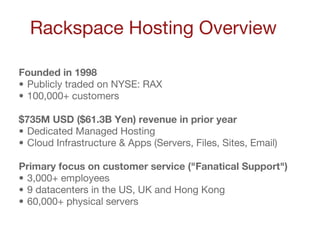
Rackspace Hosting Overview Founded in 1998 Publicly traded on NYSE: RAX 100,000+ customers $735M USD ($61.3B Yen) revenue in prior year Dedicated Managed Hosting Cloud Infrastructure & Apps (Servers, Files, Sites, Email) Primary focus on customer service ("Fanatical Support") 3,000+ employees 9 datacenters in the US, UK and Hong Kong 60,000+ physical servers
What is OpenStack?
+
+ Community
Community +
Community Technology +
creating open source software to build public and private clouds
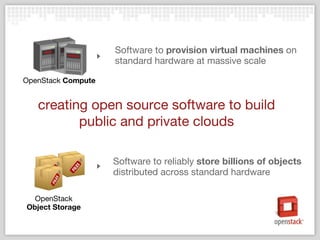
Software to  provision virtual machines  on standard hardware at massive scale Software to reliably  store billions of objects  distributed across standard hardware OpenStack  Compute   OpenStack  Object Storage   creating open source software to build public and private clouds
OpenStack Mission “ To produce the  ubiquitous  open source cloud computing platform that will meet the needs of public and private cloud providers regardless of size, by being  simple to implement  and  massively scalable. ”
Why is OpenStack important? Open  eliminates vendor lock-in Working  together , we all go faster Freedom  to federate, or move between clouds
OpenStack Founding Principles Apache 2.0 license (OSI), no paid ‘enterprise’ version Open design process, 2x year public Design Summits Publicly available source code repository All community processes documented and transparent Commitment to drive and adopt open standards Modular design for deployment flexibility via APIs
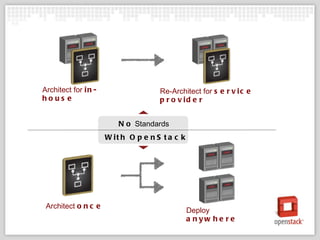
Architect for  in-house Re-Architect for  service provider Architect  once Deploy  anywhere No  Standards With  OpenStack
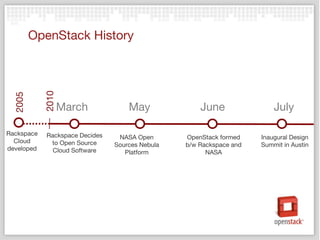
OpenStack History Rackspace Decides to Open Source Cloud Software March NASA Open Sources Nebula Platform May June July OpenStack formed b/w Rackspace and NASA Inaugural Design Summit in Austin 2010 2005 Rackspace Cloud developed
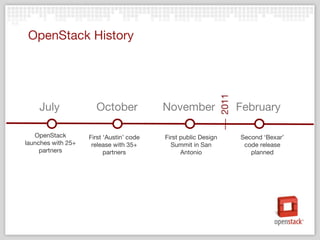
OpenStack History OpenStack launches with 25+ partners July First ‘Austin’ code release with 35+ partners October November February First public Design Summit in San Antonio Second ‘Bexar’ code release planned 2011
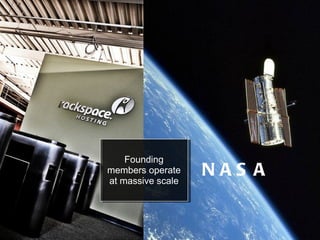
But do we really have to choose? NASA Founding members operate at massive scale
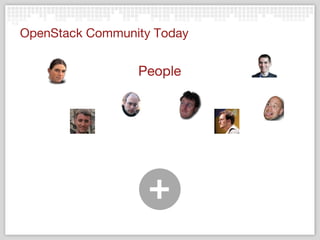
OpenStack Community Today People +
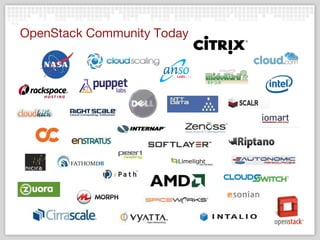
OpenStack Community Today
HOW TO:  Turn Racks of Standard Hardware Into a Cloud with OpenStack
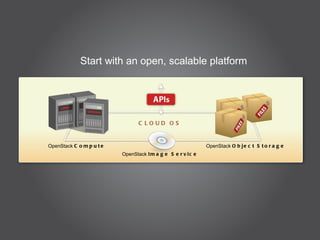
Start with an open, scalable platform OpenStack  Compute OpenStack  Object Storage CLOUD OS OpenStack  Image Service
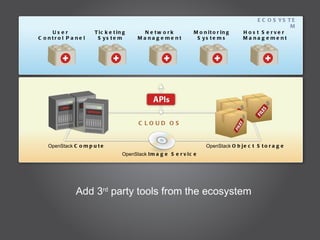
User  Control Panel Ticketing System Network Management Monitoring Systems Host Server Management ECOSYSTEM OpenStack  Compute OpenStack  Object Storage CLOUD OS OpenStack  Image Service Add 3 rd  party tools from the ecosystem
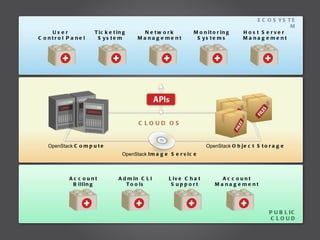
User  Control Panel Ticketing System Network Management Monitoring Systems Host Server Management Account Billing Admin CLI Tools Live Chat Support Account Management ECOSYSTEM PUBLIC CLOUD OpenStack  Compute OpenStack  Object Storage CLOUD OS OpenStack  Image Service
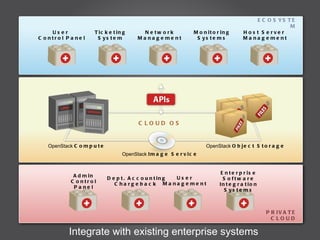
User  Control Panel Ticketing System Network Management Monitoring Systems Host Server Management ECOSYSTEM Admin Control Panel Dept. Accounting Chargeback  User Management Enterprise Software Integration Systems PRIVATE CLOUD OpenStack  Compute OpenStack  Object Storage CLOUD OS OpenStack  Image Service Integrate with existing enterprise systems
OpenStack Compute Details Software to provision virtual machines on standard hardware at massive scale.
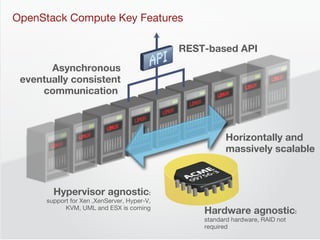
Asynchronous eventually consistent communication  REST-based API Horizontally and massively scalable Hypervisor agnostic :  support for Xen ,XenServer, Hyper-V, KVM, UML and ESX is coming Hardware agnostic :  standard hardware, RAID not required OpenStack Compute Key Features
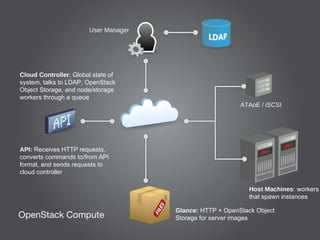
API :  Receives HTTP requests, converts commands to/from API format, and sends requests to cloud controller Cloud Controller : Global state of system, talks to LDAP, OpenStack Object Storage, and node/storage workers through a queue User Manager ATAoE / iSCSI Host Machines : workers that spawn instances Glance :  HTTP + OpenStack Object Storage for server images OpenStack Compute
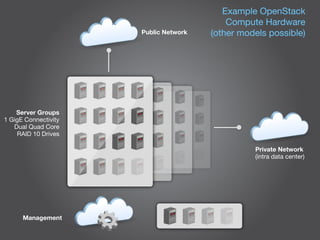
Server Groups 1 GigE Connectivity Dual Quad Core RAID 10 Drives Public Network Private Network (intra data center) Management Example OpenStack Compute Hardware (other models possible)
OpenStack Object Storage Details Software to reliably store billions of objects distributed across standard hardware
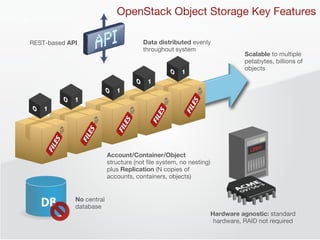
REST-based  API Data distributed  evenly throughout system Hardware agnostic:  standard hardware, RAID not required OpenStack Object Storage Key Features No  central database Scalable  to multiple petabytes, billions of objects Account/Container/Object  structure (not file system, no nesting) plus  Replication  (N copies of accounts, containers, objects) 
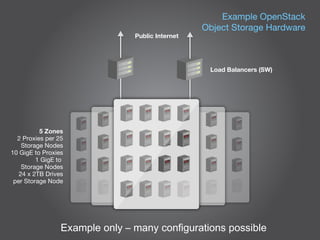
5 Zones 2 Proxies per 25 Storage Nodes 10 GigE to Proxies 1 GigE to  Storage Nodes 24 x 2TB Drives per Storage Node Public Internet Example OpenStack Object Storage Hardware Load Balancers (SW) Example only – many configurations possible
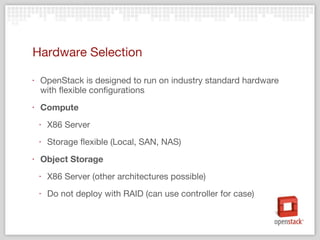
Hardware Selection OpenStack is designed to run on industry standard hardware with flexible configurations Compute X86 Server Storage flexible (Local, SAN, NAS) Object Storage X86 Server (other architectures possible) Do not deploy with RAID (can use controller for case)
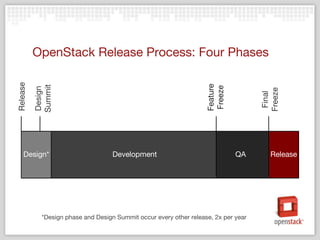
OpenStack Release Process: Four Phases Design* Development QA Release *Design phase and Design Summit occur every other release, 2x per year
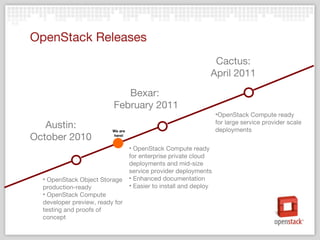
OpenStack Releases Cactus: April 2011 Bexar:  February 2011 Austin: October 2010 OpenStack Object Storage production-ready OpenStack Compute developer preview, ready for testing and proofs of concept OpenStack Compute ready for enterprise private cloud deployments and mid-size service provider deployments Enhanced documentation Easier to install and deploy OpenStack Compute ready for large service provider scale deployments We are here!
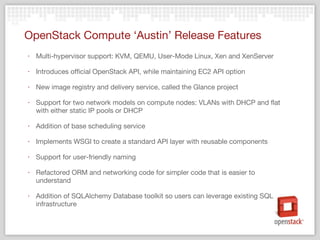
OpenStack Compute ‘Austin’ Release Features Multi-hypervisor support: KVM, QEMU, User-Mode Linux, Xen and XenServer Introduces official OpenStack API, while maintaining EC2 API option New image registry and delivery service, called the Glance project Support for two network models on compute nodes: VLANs with DHCP and flat with either static IP pools or DHCP Addition of base scheduling service Implements WSGI to create a standard API layer with reusable components Support for user-friendly naming Refactored ORM and networking code for simpler code that is easier to understand Addition of SQLAlchemy Database toolkit so users can leverage existing SQL infrastructure
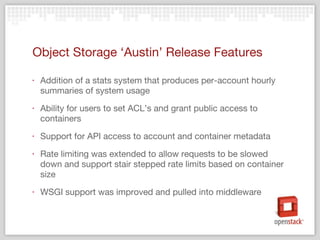
Object Storage ‘Austin’ Release Features Addition of a stats system that produces per-account hourly summaries of system usage Ability for users to set ACL’s and grant public access to containers Support for API access to account and container metadata Rate limiting was extended to allow requests to be slowed down and support stair stepped rate limits based on container size WSGI support was improved and pulled into middleware
Join Us Team:  [email_address]   [email_address]   [email_address]   [email_address]   [email_address]   [email_address]   [email_address]  - contact us! Developers & Testers http://launchpad.net/openstack http://wiki.openstack.org   Writers:  http://wiki.openstack.org/Documentation Blog:  http://openstack.org/blog   Twitter:  http://twitter.com/openstack   Jobs:  http://openstack.org/jobs
 

OpenStack Overview for Austin Cloud User Group

  • 1.
    OpenStack Open sourcesoftware to build public and private clouds Austin Cloud User Group, December 2010 Anne Gentle [email_address] Chuck Thier [email_address]
  • 2.
    Rackspace Hosting OverviewFounded in 1998 Publicly traded on NYSE: RAX 100,000+ customers $735M USD ($61.3B Yen) revenue in prior year Dedicated Managed Hosting Cloud Infrastructure & Apps (Servers, Files, Sites, Email) Primary focus on customer service ("Fanatical Support") 3,000+ employees 9 datacenters in the US, UK and Hong Kong 60,000+ physical servers
  • 3.
  • 4.
  • 5.
  • 6.
  • 7.
  • 8.
    creating open sourcesoftware to build public and private clouds
  • 9.
    Software to provision virtual machines on standard hardware at massive scale Software to reliably store billions of objects distributed across standard hardware OpenStack Compute OpenStack Object Storage creating open source software to build public and private clouds
  • 10.
    OpenStack Mission “To produce the ubiquitous open source cloud computing platform that will meet the needs of public and private cloud providers regardless of size, by being simple to implement and massively scalable. ”
  • 11.
    Why is OpenStackimportant? Open eliminates vendor lock-in Working together , we all go faster Freedom to federate, or move between clouds
  • 12.
    OpenStack Founding PrinciplesApache 2.0 license (OSI), no paid ‘enterprise’ version Open design process, 2x year public Design Summits Publicly available source code repository All community processes documented and transparent Commitment to drive and adopt open standards Modular design for deployment flexibility via APIs
  • 13.
    Architect for in-house Re-Architect for service provider Architect once Deploy anywhere No Standards With OpenStack
  • 14.
    OpenStack History RackspaceDecides to Open Source Cloud Software March NASA Open Sources Nebula Platform May June July OpenStack formed b/w Rackspace and NASA Inaugural Design Summit in Austin 2010 2005 Rackspace Cloud developed
  • 15.
    OpenStack History OpenStacklaunches with 25+ partners July First ‘Austin’ code release with 35+ partners October November February First public Design Summit in San Antonio Second ‘Bexar’ code release planned 2011
  • 16.
    But do wereally have to choose? NASA Founding members operate at massive scale
  • 17.
  • 18.
  • 19.
    HOW TO: Turn Racks of Standard Hardware Into a Cloud with OpenStack
  • 20.
    Start with anopen, scalable platform OpenStack Compute OpenStack Object Storage CLOUD OS OpenStack Image Service
  • 21.
    User ControlPanel Ticketing System Network Management Monitoring Systems Host Server Management ECOSYSTEM OpenStack Compute OpenStack Object Storage CLOUD OS OpenStack Image Service Add 3 rd party tools from the ecosystem
  • 22.
    User ControlPanel Ticketing System Network Management Monitoring Systems Host Server Management Account Billing Admin CLI Tools Live Chat Support Account Management ECOSYSTEM PUBLIC CLOUD OpenStack Compute OpenStack Object Storage CLOUD OS OpenStack Image Service
  • 23.
    User ControlPanel Ticketing System Network Management Monitoring Systems Host Server Management ECOSYSTEM Admin Control Panel Dept. Accounting Chargeback User Management Enterprise Software Integration Systems PRIVATE CLOUD OpenStack Compute OpenStack Object Storage CLOUD OS OpenStack Image Service Integrate with existing enterprise systems
  • 24.
    OpenStack Compute DetailsSoftware to provision virtual machines on standard hardware at massive scale.
  • 25.
    Asynchronous eventually consistentcommunication  REST-based API Horizontally and massively scalable Hypervisor agnostic : support for Xen ,XenServer, Hyper-V, KVM, UML and ESX is coming Hardware agnostic : standard hardware, RAID not required OpenStack Compute Key Features
  • 26.
    API : Receives HTTP requests, converts commands to/from API format, and sends requests to cloud controller Cloud Controller : Global state of system, talks to LDAP, OpenStack Object Storage, and node/storage workers through a queue User Manager ATAoE / iSCSI Host Machines : workers that spawn instances Glance : HTTP + OpenStack Object Storage for server images OpenStack Compute
  • 27.
    Server Groups 1GigE Connectivity Dual Quad Core RAID 10 Drives Public Network Private Network (intra data center) Management Example OpenStack Compute Hardware (other models possible)
  • 28.
    OpenStack Object StorageDetails Software to reliably store billions of objects distributed across standard hardware
  • 29.
    REST-based APIData distributed evenly throughout system Hardware agnostic: standard hardware, RAID not required OpenStack Object Storage Key Features No central database Scalable to multiple petabytes, billions of objects Account/Container/Object structure (not file system, no nesting) plus Replication (N copies of accounts, containers, objects) 
  • 30.
    5 Zones 2Proxies per 25 Storage Nodes 10 GigE to Proxies 1 GigE to Storage Nodes 24 x 2TB Drives per Storage Node Public Internet Example OpenStack Object Storage Hardware Load Balancers (SW) Example only – many configurations possible
  • 31.
    Hardware Selection OpenStackis designed to run on industry standard hardware with flexible configurations Compute X86 Server Storage flexible (Local, SAN, NAS) Object Storage X86 Server (other architectures possible) Do not deploy with RAID (can use controller for case)
  • 32.
    OpenStack Release Process:Four Phases Design* Development QA Release *Design phase and Design Summit occur every other release, 2x per year
  • 33.
    OpenStack Releases Cactus:April 2011 Bexar: February 2011 Austin: October 2010 OpenStack Object Storage production-ready OpenStack Compute developer preview, ready for testing and proofs of concept OpenStack Compute ready for enterprise private cloud deployments and mid-size service provider deployments Enhanced documentation Easier to install and deploy OpenStack Compute ready for large service provider scale deployments We are here!
  • 34.
    OpenStack Compute ‘Austin’Release Features Multi-hypervisor support: KVM, QEMU, User-Mode Linux, Xen and XenServer Introduces official OpenStack API, while maintaining EC2 API option New image registry and delivery service, called the Glance project Support for two network models on compute nodes: VLANs with DHCP and flat with either static IP pools or DHCP Addition of base scheduling service Implements WSGI to create a standard API layer with reusable components Support for user-friendly naming Refactored ORM and networking code for simpler code that is easier to understand Addition of SQLAlchemy Database toolkit so users can leverage existing SQL infrastructure
  • 35.
    Object Storage ‘Austin’Release Features Addition of a stats system that produces per-account hourly summaries of system usage Ability for users to set ACL’s and grant public access to containers Support for API access to account and container metadata Rate limiting was extended to allow requests to be slowed down and support stair stepped rate limits based on container size WSGI support was improved and pulled into middleware
  • 36.
    Join Us Team: [email_address] [email_address] [email_address] [email_address] [email_address] [email_address] [email_address] - contact us! Developers & Testers http://launchpad.net/openstack http://wiki.openstack.org Writers: http://wiki.openstack.org/Documentation Blog: http://openstack.org/blog Twitter: http://twitter.com/openstack Jobs: http://openstack.org/jobs
  • 37.

Editor's Notes

  • #2 Introduce me and Chuck, explain that we work at Rackspace. Next slide talks about Rackspace.
  • #4 The next couple of slides define OpenStack and what it means to us.
  • #6 Next slide shows the partners and headshots
  • #8 We’re both a community and a cloud technology with associated projects
  • #9 OpenStack is doing this: Next slide shows how we create open source software.
  • #10 Next we’ll talk about our mission – all this rolls into the mission of OpenStack
  • #11 With that big of a mission, what makes us think we’re so important?
  • #12 Ok, this is why we think we’re important. How do you know what we were founded on? Next are the founding principles.
  • #14 Linux companies: SUSE, Red Hat, Canonical Open Handset Alliance made up of 34 companies including HTC, Motorola, Samsung, Google, Qualcomm, ARM OpenStack community can have the same successful community 
  • #16 Next, who founded OpenStack in the first place?
  • #17 Rackspace has been in the cloud business for 5 years. We had to build it ourselves because we have never find anything that fit our needs. There is a lot that can be learned from what we have done right and wrong. We are now running 10s of thousands of VMs for over 100,000 customers. Rackspace has over 60,000 physical servers. NASA is the largest collector of data in human history. NASA collects data from Mars rovers, satellites, and other cutting edge tools including cameras with exapixel scale. When data is lost, a rocket has to be launched into space, so “mission critical” is not just a slogan with NASA. NASA faced a similar issue. They built their own solution because they could not find the right pieces in the market. They are serving a scientific community with very high purpose -- to run NASA missions, to analyze data from satellites and telescopes, and to look for ET. Think of it this way: 1. They have telescopes that collect Exapixel images. I am not even sure how big that it, but it requires a lot of storage and processing capability. 2. Losing data is expensive. They have to launch another rocket! Or wait 80 years for a comet to return. This is mission critical stuff. But we still have to make this stuff into “products” -- much like enterprises do. At Rackspace, it has to power our hosting offer. At NASA, it has to serve the scientific community. By deploying OpenStack, enterprises get the benefit of our experience including successes and failures.
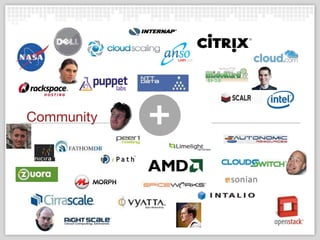
  • #18 More than 35 technology industry leaders officially support the OpenStack community. Enterprise technology providers like Citrix are basing their technology offerings on OpenStack; hardware providers like Dell and Cirrascale and testing OpenStack to determine the best reference architecture; professional services CloudScaling,
  • #19 More than 35 technology industry leaders officially support the OpenStack community. Enterprise technology providers like Citrix are basing their technology offerings on OpenStack; hardware providers like Dell and Cirrascale and testing OpenStack to determine the best reference architecture; professional services CloudScaling,
  • #20 So back to the mission. We want to make IT easier. To abstract from the hardware environment to a standardized software environment.
  • #21 These are straightforward. Without them, you don’t have a cloud.
  • #22 Add 3 rd party tools to complete the solution, and integrate into your existing systems, using APIs. The modular design of OpenStack is key.
  • #23 Add 3 rd party tools to complete the solution, and integrate into your existing systems, using APIs. The modular design of OpenStack is key.
  • #24 Add 3 rd party tools to complete the solution, and integrate into your existing systems, using APIs. The modular design of OpenStack is key.