OpenStack
Introduction
Victor Morales & Geronimo Orozco
March, 31st 2014
INTEL CONFIDENTIAL Intel Information Technology, FOR INTERNAL USE ONLY
Cloud 101
2
History – Business Drivers
Capacity planning - Involves ensuring that an organization
has the right infrastructure, resources and services to
support their business and customer base in the future.
Operating Overhead - Reducing the up-front cost of
acquiring new IT infrastructure and the on-going cost of
owning and maintaining said infrastructure.
Operational Agility - The ability of a business to respond to
change by being able to scale its IT resources.
History – Technology Innovations
 Grid Computing Technology - Way to provide
computing resources on demand and on a pay-as-you
go basis.
 Clustering Technology - Create a failover system that
employs multiple similar IT resources together to
provide greater availability and reliability.
 Virtualization Technology - Enables physical IT resources
to provide multiple virtual images of themselves.
Definition
 Cloud computing is a specialized form of distributed
computing that introduces utilization models for remotely
provisioning scalable and measured IT resources.
Characteristics:
• On-Demand Usage
• Ubiquitous Access
• Multi-tenancy and Resourcing Pooling.
• Elasticity
• Measured Usage
• Resiliency
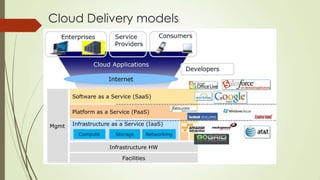
Cloud Delivery models
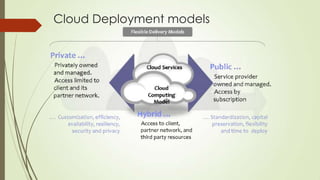
Cloud Deployment models
INTEL CONFIDENTIAL Intel Information Technology, FOR INTERNAL USE ONLY8
OpenStack is…
 An open source software that allows any company to build
their own public or private cloud
 Sits above the hypervisor and is hypervisor agnostic
 KVM, Xen, Hyper-V, ESX, LXC.
 Think of it as: “software that powers Amazon’s ECS+S3”
 Its mission is to produce the ubiquitous open source cloud
computing platform that will meet the needs of public and
private cloud providers regardless of size, by being simple to
implement and massively scalable.
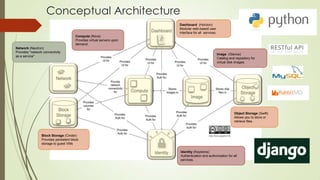
Conceptual Architecture
Network (Neutron)
Provides "network connectivity
as a service"
Block Storage (Cinder)
Provides persistent block
storage to guest VMs
Compute (Nova)
Provides virtual servers upon
demand.
Dashboard (Horizon)
Modular web-based user
interface for all services.
Image (Glance)
Catalog and repository for
virtual disk images.
Object Storage (Swift)
Allows you to store or
retrieve files.
Identity (Keystone)
Authentication and authorization for all
services.
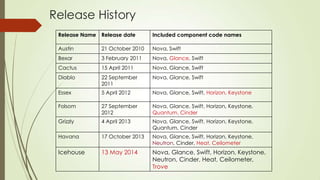
Release History
Release Name Release date Included component code names
Austin 21 October 2010 Nova, Swift
Bexar 3 February 2011 Nova, Glance, Swift
Cactus 15 April 2011 Nova, Glance, Swift
Diablo 22 September
2011
Nova, Glance, Swift
Essex 5 April 2012 Nova, Glance, Swift, Horizon, Keystone
Folsom 27 September
2012
Nova, Glance, Swift, Horizon, Keystone,
Quantum, Cinder
Grizzly 4 April 2013 Nova, Glance, Swift, Horizon, Keystone,
Quantum, Cinder
Havana 17 October 2013 Nova, Glance, Swift, Horizon, Keystone,
Neutron, Cinder, Heat, Ceilometer
Icehouse 13 May 2014 Nova, Glance, Swift, Horizon, Keystone,
Neutron, Cinder, Heat, Ceilometer,
Trove
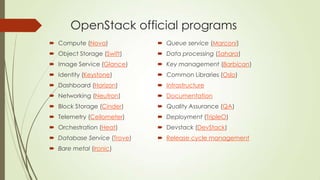
OpenStack official programs
 Compute (Nova)
 Object Storage (Swift)
 Image Service (Glance)
 Identity (Keystone)
 Dashboard (Horizon)
 Networking (Neutron)
 Block Storage (Cinder)
 Telemetry (Ceilometer)
 Orchestration (Heat)
 Database Service (Trove)
 Bare metal (Ironic)
 Queue service (Marconi)
 Data processing (Sahara)
 Key management (Barbican)
 Common Libraries (Oslo)
 Infrastructure
 Documentation
 Quality Assurance (QA)
 Deployment (TripleO)
 Devstack (DevStack)
 Release cycle management
INTEL CONFIDENTIAL Intel Information Technology, FOR INTERNAL USE ONLY13
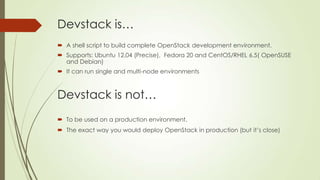
Devstack is…
 A shell script to build complete OpenStack development environment.
 Supports: Ubuntu 12.04 (Precise), Fedora 20 and CentOS/RHEL 6.5( OpenSUSE
and Debian)
 It can run single and multi-node environments
Devstack is not…
 To be used on a production environment.
 The exact way you would deploy OpenStack in production (but it’s close)
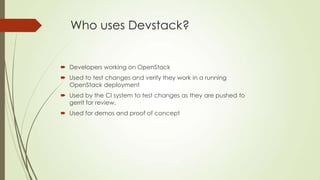
Who uses Devstack?
 Developers working on OpenStack
 Used to test changes and verify they work in a running
OpenStack deployment
 Used by the CI system to test changes as they are pushed to
gerrit for review.
 Used for demos and proof of concept
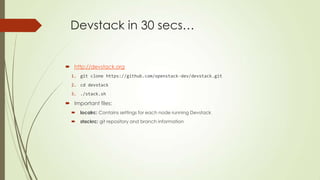
Devstack in 30 secs…
 http://devstack.org
1. git clone https://github.com/openstack-dev/devstack.git
2. cd devstack
3. ./stack.sh
 Important files:
 localrc: Contains settings for each node running Devstack
 stackrc: git repository and branch information
localrc Sample
[[local|localrc]]
FIXED_RANGE=10.254.1.0/24
NETWORK_GATEWAY=10.254.1.1
LOGDAYS=1
LOGFILE=$DEST/logs/stack.sh.log
SCREEN_LOGDIR=$DEST/logs/screen
ADMIN_PASSWORD=quiet
DATABASE_PASSWORD=$ADMIN_PASSWORD
RABBIT_PASSWORD=$ADMIN_PASSWORD
SERVICE_PASSWORD=$ADMIN_PASSWORD
SERVICE_TOKEN=a682f596-76f3-11e3-b3b2-e716f9080d50
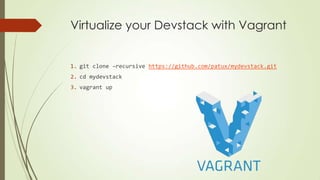
Virtualize your Devstack with Vagrant
1. git clone –recursive https://github.com/patux/mydevstack.git
2. cd mydevstack
3. vagrant up
INTEL CONFIDENTIAL Intel Information Technology, FOR INTERNAL USE ONLY
Q & A
19
INTEL CONFIDENTIAL Intel Information Technology, FOR INTERNAL USE ONLY
Demo
20

GDL OpenStack Community - Openstack Introduction

  • 1.
    OpenStack Introduction Victor Morales &Geronimo Orozco March, 31st 2014
  • 2.
    INTEL CONFIDENTIAL IntelInformation Technology, FOR INTERNAL USE ONLY Cloud 101 2
  • 3.
    History – BusinessDrivers Capacity planning - Involves ensuring that an organization has the right infrastructure, resources and services to support their business and customer base in the future. Operating Overhead - Reducing the up-front cost of acquiring new IT infrastructure and the on-going cost of owning and maintaining said infrastructure. Operational Agility - The ability of a business to respond to change by being able to scale its IT resources.
  • 4.
    History – TechnologyInnovations  Grid Computing Technology - Way to provide computing resources on demand and on a pay-as-you go basis.  Clustering Technology - Create a failover system that employs multiple similar IT resources together to provide greater availability and reliability.  Virtualization Technology - Enables physical IT resources to provide multiple virtual images of themselves.
  • 5.
    Definition  Cloud computingis a specialized form of distributed computing that introduces utilization models for remotely provisioning scalable and measured IT resources. Characteristics: • On-Demand Usage • Ubiquitous Access • Multi-tenancy and Resourcing Pooling. • Elasticity • Measured Usage • Resiliency
  • 6.
  • 7.
  • 8.
    INTEL CONFIDENTIAL IntelInformation Technology, FOR INTERNAL USE ONLY8
  • 9.
    OpenStack is…  Anopen source software that allows any company to build their own public or private cloud  Sits above the hypervisor and is hypervisor agnostic  KVM, Xen, Hyper-V, ESX, LXC.  Think of it as: “software that powers Amazon’s ECS+S3”  Its mission is to produce the ubiquitous open source cloud computing platform that will meet the needs of public and private cloud providers regardless of size, by being simple to implement and massively scalable.
  • 10.
    Conceptual Architecture Network (Neutron) Provides"network connectivity as a service" Block Storage (Cinder) Provides persistent block storage to guest VMs Compute (Nova) Provides virtual servers upon demand. Dashboard (Horizon) Modular web-based user interface for all services. Image (Glance) Catalog and repository for virtual disk images. Object Storage (Swift) Allows you to store or retrieve files. Identity (Keystone) Authentication and authorization for all services.
  • 11.
    Release History Release NameRelease date Included component code names Austin 21 October 2010 Nova, Swift Bexar 3 February 2011 Nova, Glance, Swift Cactus 15 April 2011 Nova, Glance, Swift Diablo 22 September 2011 Nova, Glance, Swift Essex 5 April 2012 Nova, Glance, Swift, Horizon, Keystone Folsom 27 September 2012 Nova, Glance, Swift, Horizon, Keystone, Quantum, Cinder Grizzly 4 April 2013 Nova, Glance, Swift, Horizon, Keystone, Quantum, Cinder Havana 17 October 2013 Nova, Glance, Swift, Horizon, Keystone, Neutron, Cinder, Heat, Ceilometer Icehouse 13 May 2014 Nova, Glance, Swift, Horizon, Keystone, Neutron, Cinder, Heat, Ceilometer, Trove
  • 12.
    OpenStack official programs Compute (Nova)  Object Storage (Swift)  Image Service (Glance)  Identity (Keystone)  Dashboard (Horizon)  Networking (Neutron)  Block Storage (Cinder)  Telemetry (Ceilometer)  Orchestration (Heat)  Database Service (Trove)  Bare metal (Ironic)  Queue service (Marconi)  Data processing (Sahara)  Key management (Barbican)  Common Libraries (Oslo)  Infrastructure  Documentation  Quality Assurance (QA)  Deployment (TripleO)  Devstack (DevStack)  Release cycle management
  • 13.
    INTEL CONFIDENTIAL IntelInformation Technology, FOR INTERNAL USE ONLY13
  • 14.
    Devstack is…  Ashell script to build complete OpenStack development environment.  Supports: Ubuntu 12.04 (Precise), Fedora 20 and CentOS/RHEL 6.5( OpenSUSE and Debian)  It can run single and multi-node environments Devstack is not…  To be used on a production environment.  The exact way you would deploy OpenStack in production (but it’s close)
  • 15.
    Who uses Devstack? Developers working on OpenStack  Used to test changes and verify they work in a running OpenStack deployment  Used by the CI system to test changes as they are pushed to gerrit for review.  Used for demos and proof of concept
  • 16.
    Devstack in 30secs…  http://devstack.org 1. git clone https://github.com/openstack-dev/devstack.git 2. cd devstack 3. ./stack.sh  Important files:  localrc: Contains settings for each node running Devstack  stackrc: git repository and branch information
  • 17.
  • 18.
    Virtualize your Devstackwith Vagrant 1. git clone –recursive https://github.com/patux/mydevstack.git 2. cd mydevstack 3. vagrant up
  • 19.
    INTEL CONFIDENTIAL IntelInformation Technology, FOR INTERNAL USE ONLY Q & A 19
  • 20.
    INTEL CONFIDENTIAL IntelInformation Technology, FOR INTERNAL USE ONLY Demo 20

Editor's Notes

  • #4 Business Drivers:Capacity planning (Involves ensuring that an organization has the right infrastructure, resources and services to support their business and customer base in the future)IT infrastructure be plannedEstimating usage load fluctuations.Balance peak usage requirements without unnecessary over-spending on IT infrastructure.Operating Overhead (Reducing the up-front cost of acquiring new IT infrastructure and the on-going cost of owning and maintaining said infrastructure)Actual cost of ownership needs to be consideredUnderutilized - Unpredictable usage requirementsThe administration demands can unnecessary increase operating costs(IT department itself more of a burden upon the organization)Operational Agility (The ability of a business to respond to change by being able to scale its IT resources)Responsiveness of an organization in the face of business change.Being able to scale its IT resourcesIT resources be more available and/or reliable
  • #5 Technology Innovations:Grid Computing Technology (Way to provide computing resources on demand and on a pay-as-you go basis)"computing as a networked utility"You could plug into a pool of shared computing power"pay-as-you-go" computing and further formed the basis of "elasticity"Clustering Technology (Create a failover system that employs multiple similar IT resources together to provide greater availability and reliability)Back-end technology architectures that evolved in support of Web-based applications introduced load balancing, server farms, clustered servers, clustered databases.Virtualization Technology (Enables physical IT resources to provide multiple virtual images of themselves)It has enabled hardware owners to repeatedly leverage physical servers.Helped realize the notion of "server elasticity"(allowing one physical server to host a variable number of "virtual" servers).Key technology in modern cloud computing environments.
  • #6 Terms:IT Resource - Physical or virtual IT-related artifact(physical server, software program, virtual server, service, storage device, network device)Virtualization - Physical IT resources to provide multiple virtual images of themselvesScaling in / Scaling out - Scaling represents the ability of the IT resource to gracefully handle increased or decreased usage demands.Cloud - Remote IT environment designed for the purpose of remotely provisioning IT resourcesOn-Premise - IT resource that is not remotely accessible via a cloud.Service - It's a software program that can be remotely invoked via a published technical interface.Cloud Service - Any remotely accessible IT resource is classified as a service.Service Agent - An event-driven program capable of transparently intercepting and processing messages sent to or from services.Characteristics:On-Demand Usage(the freedom to self-provision IT resources)Ubiquitous Access(widely accessible - support for a range of devices, transport protocols, interfaces, and security technologies.)Multi-tenancy and Resourcing Pooling.(IT resources shared by multiple users/tenants)Elasticity (ability of a cloud to gracefully and transparently scale IT resources)Measured Usage (Keep track of the usage of its IT resources by cloud consumers, pay for use monitoring mechanism)Resiliency (failover system)
  • #7 Cloud delivery models Represents a specific combination of IT resources offered by a cloud provider. Infrastructure-as-a-Service(IaaS) - Provides a self-contained IT environment comprised of infrastructure-centric IT resources. Example AWSPlatform-as-a-Service(PaaS) - Provides a ready-made environment that comes with a set of pre-packaged products and tools. Example Salesforce.Software-as-a-Service(SaaS) - Represents a software product that exists as a shared cloud service offered by a cloud provider to cloud consumers. Example Office365
  • #8 Cloud deployment models Represents a specific type of cloud environment, primarily distinguished by ownership and size. Public Cloud - It's publically accessible cloud environment owned by a third-party cloud provider.Community Cloud - It's either a public cloud with limited access to the members of a particular group.Private Cloud - It's privately owned and managed by a single organization for their internal customers.Hybrid Cloud - Two or more different cloud deployment models.
  • #11 How I Explained REST to My Wifehttp://www.looah.com/source/view/2284