Sustainable and Efficient GIS? Open Source it.
Introduction Within the context of a weak economy and slashed IT budgets, open source technologies would appear to offer a panacea for many of our GIS needs.  However, as many have discovered, the theory of an Open Source GIS nirvana is a far cry from the minefield of Open Source GIS implementation realities. I believe sustainable and efficient GIS systems are not only possible within this context but arguably better off in terms of sustainability.
Who is this Guy? Brendan Sheehy [email_address] Work for  Mallon Technology . I’m  not  a GIS expert.  I’m a software developer. Working for company with lots of expertise in  GIS and mapping technologies.
The Goal Our goal was to develop a relatively inexpensive online Generic GIS Solution that would allow us to do three things: Serve spatial data to end users via the internet. Web Map Service (WMS) Web Feature Service (WFS) Allow users to  view  and  edit  the spatial data. Store the spatial data for analysis.
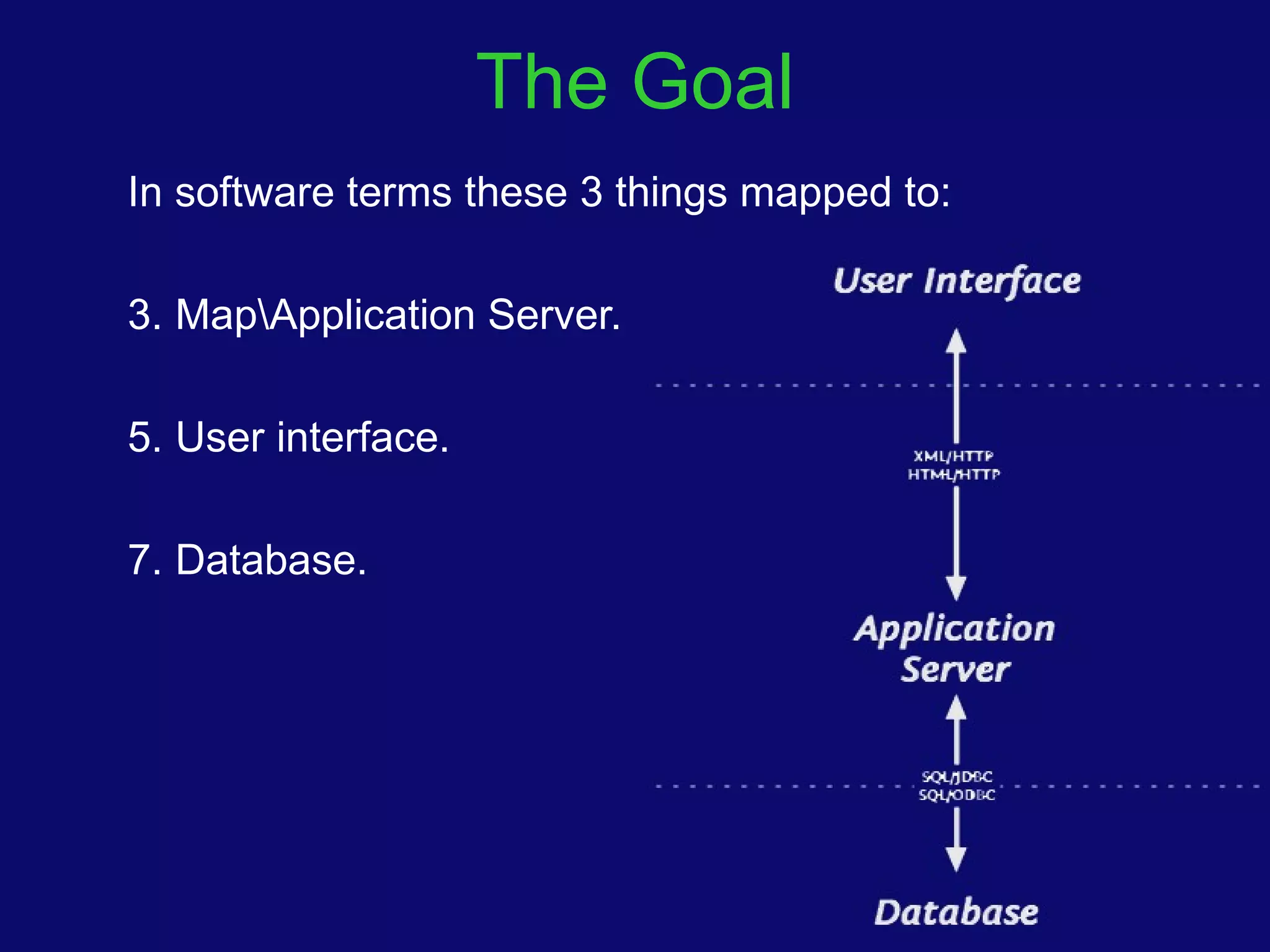
The Goal In software terms these 3 things mapped to: Map\Application Server. User interface. Database.
What is Open Source? There are a hundred different interpretations of Open Source, but what  we  wanted from Open Source was: Free redistribution.  Source code must be included.  Must allow modifications and derived works.  A single license must apply to all users.  License must be technology-neutral. From a GIS perspective the promise of open source is  better quality ,  higher reliability ,  more flexibility ,  lower cost  and an  end to predatory vendor  lock-in .
Is Open Source mandatory? Ireland is a relatively IT savvy country however there is no Irish Government policy on Open Source.  Are we falling behind? Putin order Government to go Open Source . UK government backs open source  Government Cost-Cutting Plan Embraces Open Source Guardian newspaper moves to OpenOffice There are positive moves for example The Office of Public Works (OPW) and Galway City Council has moved away from Microsoft Office to use  OpenOffice .
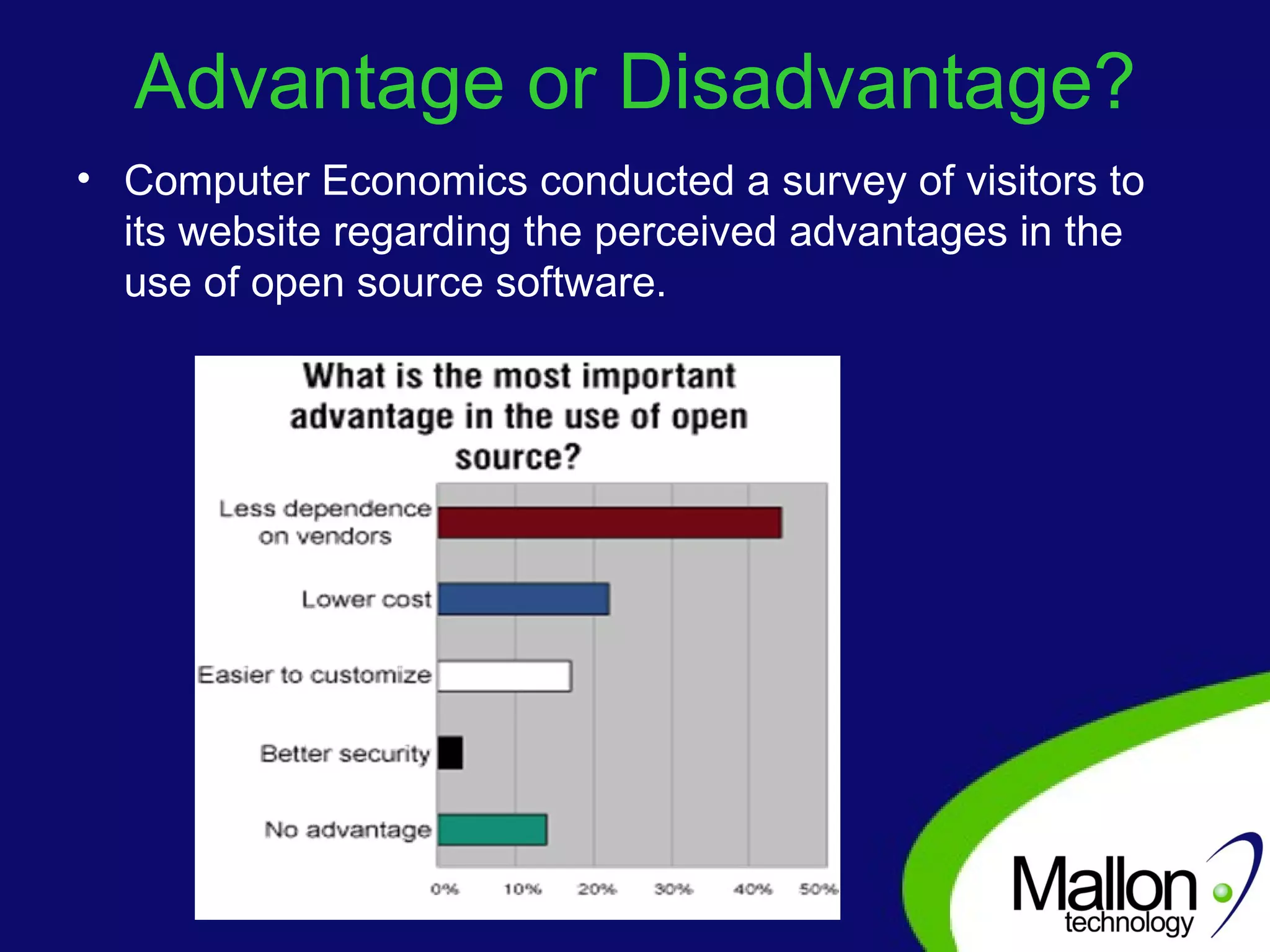
Advantage or Disadvantage? Computer Economics conducted a survey of visitors to its website regarding the perceived advantages in the use of open source software.
Advantage or Disadvantage? Opponents of Open Source argue that any of the perceived advantages could equally be disadvantages, and it’s true...  Open Source is a graveyard of poorly conceived and badly developed\supported software. Which isn’t any different to the realities of commercial software ventures. In this context we decided upon some  advantages we wanted  the Open Source software to have.
The Advantages We Wanted Open Standards This was key for us.  There are so many different formats in GIS. Some are no longer supported and others are very tightly integrated with one specific vendor. Reducing vendor lock-in and consequent monopoly pricing Reliability and Robustness Evidence that bugs are regularly fixed by viewing past releases and forum activity. Are reputable companies using the software?  Is the software well established or still  in it's infancy?
The Advantages We Wanted Cost Possibly zero purchase price Potentially no need to account for copies in use. Free upgrades. Support Are there regular updates, patches and new features?  Is the documentation complete and coherent?  Availability of source code Provides greater continuity and security  against collapse of vendors or a  product line.
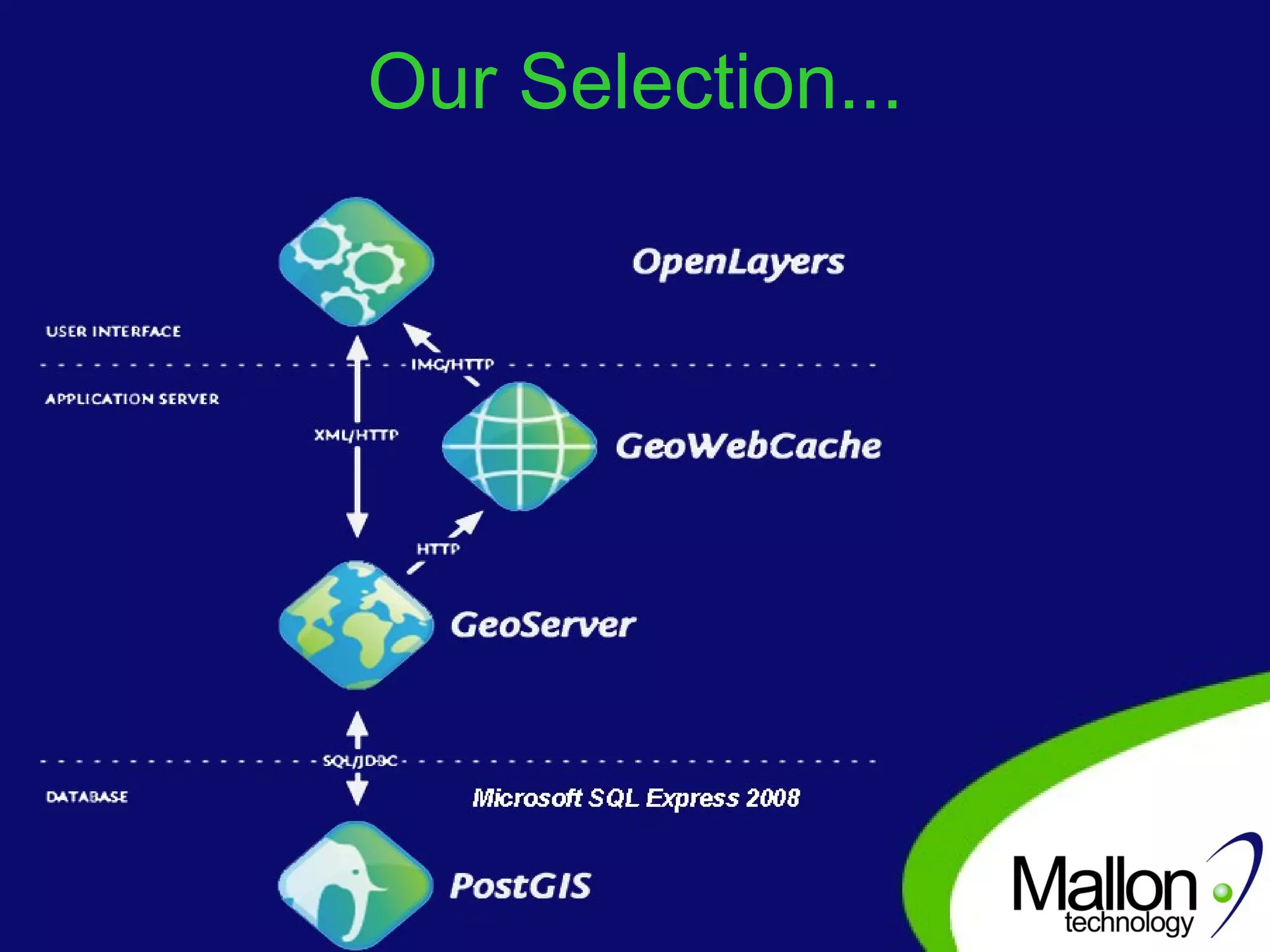
Our Selection... We needed 3 things: A Map Server. GeoServer The Client User interface. OpenLayers The backend data store\database. SQL Server 2008 Express Yes we cheated here but it is free
Our Selection...
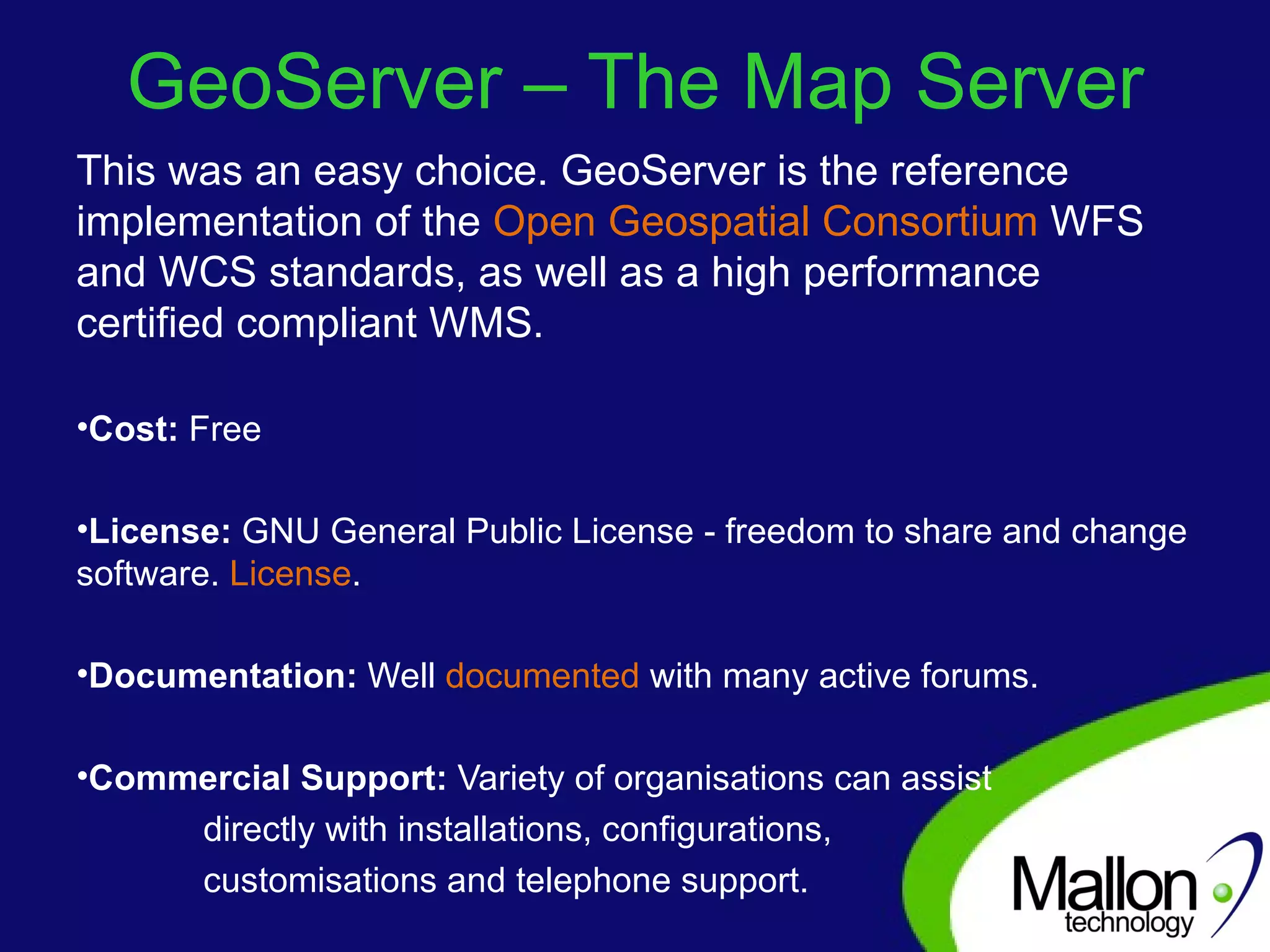
GeoServer – The Map Server This was an easy choice. GeoServer is the reference implementation of the  Open Geospatial Consortium  WFS and WCS standards, as well as a high performance certified compliant WMS.  Cost:  Free License:  GNU General Public License - freedom to share and change software.  License . Documentation:  Well  documented  with many active forums. Commercial Support:  Variety of organisations can assist  directly with installations, configurations,  customisations and telephone support.
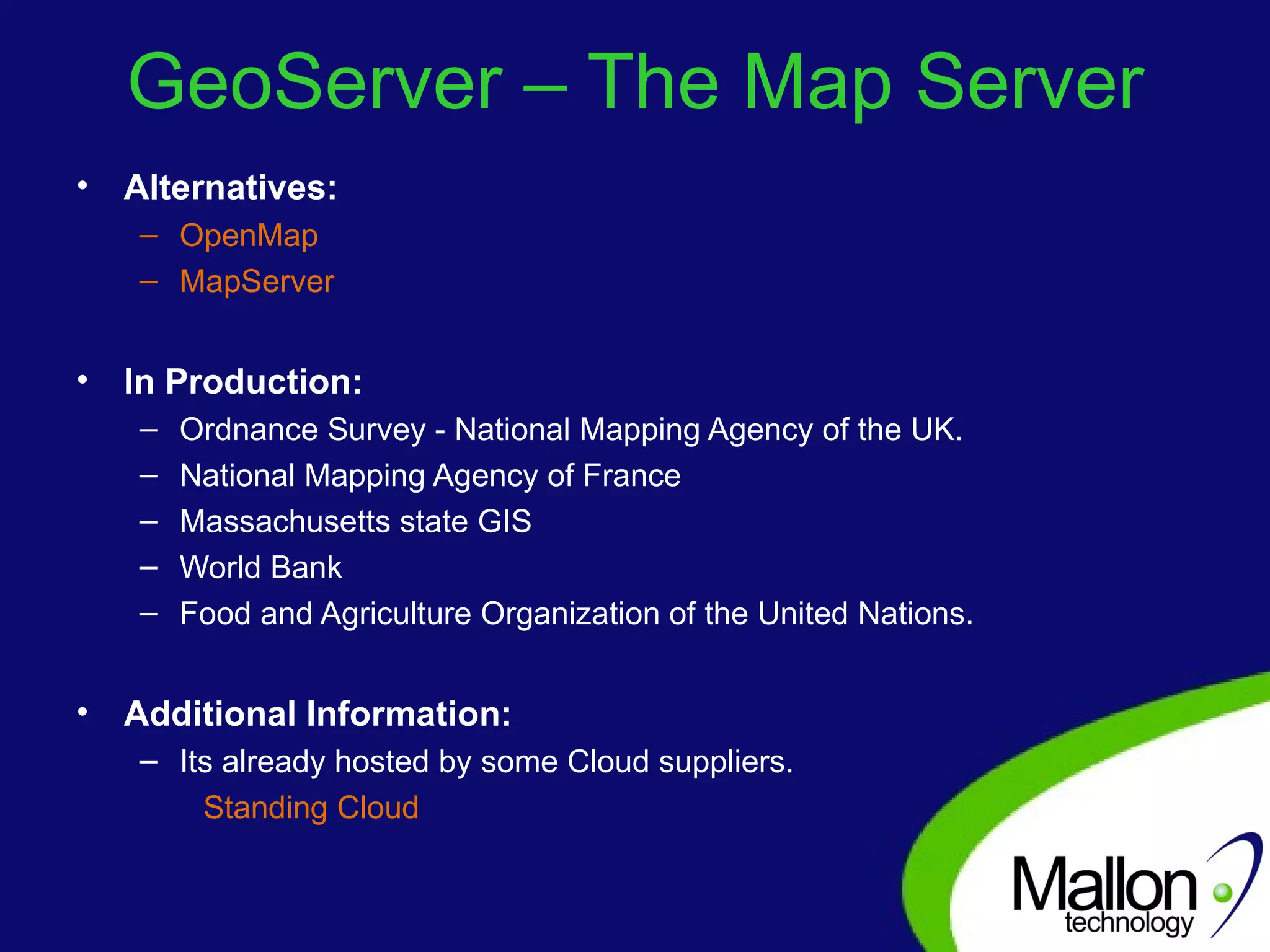
GeoServer – The Map Server Alternatives:  OpenMap MapServer In Production: Ordnance Survey - National Mapping Agency of the UK. National Mapping Agency of France Massachusetts state GIS World Bank Food and Agriculture Organization of the United Nations. Additional Information: Its already hosted by some Cloud suppliers. Standing Cloud
OpenLayers – The User interface OpenLayers  is a generic mapping component- designed to consume spatial data from numerous sources and display in a web browser. It is not tied to a particular map source and allows users to view and edit spatial data.  Cost:  Free License:  FreeBSD - Redistribution and use in source and binary forms, with or without modification are permitted.
OpenLayers – The User interface Documentation:  Well  documented  with many active forums. Implementation:  OpenLayers is a purely javascript client library – it requires no download of Active X controls and works with all popular browsers. In Production  used in the following sites: Nasa MapServer OpenStreetMap Where Is Alternatives: MapGuide Open Source Google Earth
SQL Server 2008 Express We cheated and used Microsoft SQL Express 2008. Mainly because we have experience using SQL Server and many  customers already store data in it. Cost:  Free License;  Free to install and use commercially. Documentation:  Excellent documentation Commercial Support: Microsoft Any number of software companies... Alternatives:  PostGIS MySQL
Demo – The GeoApp Builder http://maptesting.mallontechnology.com/MallonsGeoApp/Default.aspx

Sustainable and Efficient GIS? Open Source it.

  • 1.
    Sustainable and EfficientGIS? Open Source it.
  • 2.
    Introduction Within thecontext of a weak economy and slashed IT budgets, open source technologies would appear to offer a panacea for many of our GIS needs. However, as many have discovered, the theory of an Open Source GIS nirvana is a far cry from the minefield of Open Source GIS implementation realities. I believe sustainable and efficient GIS systems are not only possible within this context but arguably better off in terms of sustainability.
  • 3.
    Who is thisGuy? Brendan Sheehy [email_address] Work for Mallon Technology . I’m not a GIS expert. I’m a software developer. Working for company with lots of expertise in GIS and mapping technologies.
  • 4.
    The Goal Ourgoal was to develop a relatively inexpensive online Generic GIS Solution that would allow us to do three things: Serve spatial data to end users via the internet. Web Map Service (WMS) Web Feature Service (WFS) Allow users to view and edit the spatial data. Store the spatial data for analysis.
  • 5.
    The Goal Insoftware terms these 3 things mapped to: Map\Application Server. User interface. Database.
  • 6.
    What is OpenSource? There are a hundred different interpretations of Open Source, but what we wanted from Open Source was: Free redistribution. Source code must be included. Must allow modifications and derived works. A single license must apply to all users. License must be technology-neutral. From a GIS perspective the promise of open source is better quality , higher reliability , more flexibility , lower cost and an end to predatory vendor lock-in .
  • 7.
    Is Open Sourcemandatory? Ireland is a relatively IT savvy country however there is no Irish Government policy on Open Source. Are we falling behind? Putin order Government to go Open Source . UK government backs open source Government Cost-Cutting Plan Embraces Open Source Guardian newspaper moves to OpenOffice There are positive moves for example The Office of Public Works (OPW) and Galway City Council has moved away from Microsoft Office to use OpenOffice .
  • 8.
    Advantage or Disadvantage?Computer Economics conducted a survey of visitors to its website regarding the perceived advantages in the use of open source software.
  • 9.
    Advantage or Disadvantage?Opponents of Open Source argue that any of the perceived advantages could equally be disadvantages, and it’s true... Open Source is a graveyard of poorly conceived and badly developed\supported software. Which isn’t any different to the realities of commercial software ventures. In this context we decided upon some advantages we wanted the Open Source software to have.
  • 10.
    The Advantages WeWanted Open Standards This was key for us. There are so many different formats in GIS. Some are no longer supported and others are very tightly integrated with one specific vendor. Reducing vendor lock-in and consequent monopoly pricing Reliability and Robustness Evidence that bugs are regularly fixed by viewing past releases and forum activity. Are reputable companies using the software? Is the software well established or still in it's infancy?
  • 11.
    The Advantages WeWanted Cost Possibly zero purchase price Potentially no need to account for copies in use. Free upgrades. Support Are there regular updates, patches and new features? Is the documentation complete and coherent? Availability of source code Provides greater continuity and security against collapse of vendors or a product line.
  • 12.
    Our Selection... Weneeded 3 things: A Map Server. GeoServer The Client User interface. OpenLayers The backend data store\database. SQL Server 2008 Express Yes we cheated here but it is free
  • 13.
  • 14.
    GeoServer – TheMap Server This was an easy choice. GeoServer is the reference implementation of the Open Geospatial Consortium WFS and WCS standards, as well as a high performance certified compliant WMS. Cost: Free License: GNU General Public License - freedom to share and change software. License . Documentation: Well documented with many active forums. Commercial Support: Variety of organisations can assist directly with installations, configurations, customisations and telephone support.
  • 15.
    GeoServer – TheMap Server Alternatives: OpenMap MapServer In Production: Ordnance Survey - National Mapping Agency of the UK. National Mapping Agency of France Massachusetts state GIS World Bank Food and Agriculture Organization of the United Nations. Additional Information: Its already hosted by some Cloud suppliers. Standing Cloud
  • 16.
    OpenLayers – TheUser interface OpenLayers is a generic mapping component- designed to consume spatial data from numerous sources and display in a web browser. It is not tied to a particular map source and allows users to view and edit spatial data. Cost: Free License: FreeBSD - Redistribution and use in source and binary forms, with or without modification are permitted.
  • 17.
    OpenLayers – TheUser interface Documentation: Well documented with many active forums. Implementation: OpenLayers is a purely javascript client library – it requires no download of Active X controls and works with all popular browsers. In Production used in the following sites: Nasa MapServer OpenStreetMap Where Is Alternatives: MapGuide Open Source Google Earth
  • 18.
    SQL Server 2008Express We cheated and used Microsoft SQL Express 2008. Mainly because we have experience using SQL Server and many customers already store data in it. Cost: Free License; Free to install and use commercially. Documentation: Excellent documentation Commercial Support: Microsoft Any number of software companies... Alternatives: PostGIS MySQL
  • 19.
    Demo – TheGeoApp Builder http://maptesting.mallontechnology.com/MallonsGeoApp/Default.aspx

Editor's Notes

  • #15 GeoServer is the reference implementation of the Open Geospatial Consortium (OGC) Web Feature Service (WFS) and Web Coverage Service (WCS) as well as a high performance certified compliant Web Map Service (WMS).
  • #17 OpenLayers is a generic mapping component, designed to consume spatial data and maps from numerous sources and display that data in a web browser. Unlike Google Maps or Microsoft Virtual Earth, OpenLayers is not tied to a particular map source. It has controls that allow the users to view and edit spatial data. OpenLayers is a project of the Open Source Geospatial Foundation and is the foundation that many commercial GIS online interfaces are built upon.
  • #19 We sort of cheated here and used Microsoft SQL Express 2008. Our main reasons here are that we have lots of experience using SQL Server and lots of our customers already store data in it. Geoserver can integrate fully with it. However, GeoServer comes packaged with PostGIS - a full open sourced spatially aware database.