Industry Cloud
Playbook
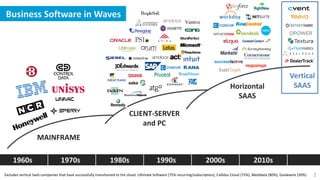
1960s 1970s 1980s 1990s 2000s 2010s
MAINFRAME
Vertical
SAAS
2
CLIENT-SERVER
and PC
Excludes vertical SaaS companies that have successfully transitioned to the cloud: Ultimate Software (75% recurring/subscription), Callidus Cloud (75%), Medidata (80%), Guidewire (50%)
Business Software in Waves
Horizontal
SAAS
Consumerization of
enterprise software and
mobility (generational
shift)
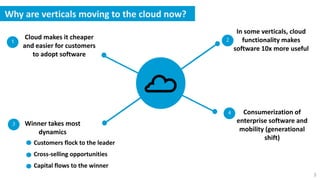
Cloud makes it cheaper
and easier for customers
to adopt software
Winner takes most
dynamics
In some verticals, cloud
functionality makes
software 10x more useful
Why are verticals moving to the cloud now?
1 2
3
4
3
Customers flock to the leader
Capital flows to the winner
Cross-selling opportunities
Enterprise Value 2014E Revenue
4
*If Dealer.com is included, DealerTrack’s 2014E revenue guidance is $819m.
As of June 5, 2014.
Large Companies Can Be Built
$1.7bn $443m
$3.1bn $574m
$3.2bn $282m
$2.9bn $341m
$1.3bn $229m
+18%
+19%
+34%
+13%
+29%
$838m $119m +26%
*
Plays Currently
in Use
6
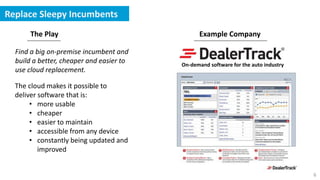
Replace Sleepy Incumbents
The Play Example Company
Find a big on-premise incumbent and
build a better, cheaper and easier to
use cloud replacement.
On-demand software for the auto industry
The cloud makes it possible to
deliver software that is:
• more usable
• cheaper
• easier to maintain
• accessible from any device
• constantly being updated and
improved
7
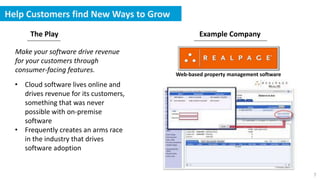
Help Customers find New Ways to Grow
The Play Example Company
Make your software drive revenue
for your customers through
consumer-facing features.
Web-based property management software
• Cloud software lives online and
drives revenue for its customers,
something that was never
possible with on-premise
software
• Frequently creates an arms race
in the industry that drives
software adoption
8
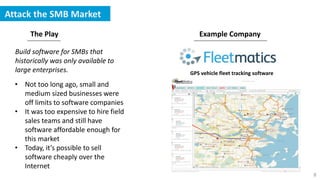
Attack the SMB Market
The Play Example Company
Build software for SMBs that
historically was only available to
large enterprises. GPS vehicle fleet tracking software
• Not too long ago, small and
medium sized businesses were
off limits to software companies
• It was too expensive to hire field
sales teams and still have
software affordable enough for
this market
• Today, it’s possible to sell
software cheaply over the
Internet
9
Tap into Data at Cloud Scale
The Play Example Company
Use the cloud to tap into massive
data sets and leverage data in novel
ways. Software for to the utility industry
• Customer data used to be siloed
in a company's data center.
• The cloud now makes it possible
to aggregate data across users
• We expect to see an increasing
number of software businesses
utilize shared data to drive
insights for their customers
10
Build a Platform
The Play Example Company
Drive value and lock-in customers by
becoming the center of a larger
ecosystem of industry applications.
Ecommerce software platform
• Cloud connectivity & APIs allow
IC companies to become
platforms with an ecosystem of
applications around them
• Building a platform drives long-
term customer lock-in
• If your customers rely on you to
act as the hub for other critical
applications, it is very difficult for
competitors to replace you
Plays of the
Future
12
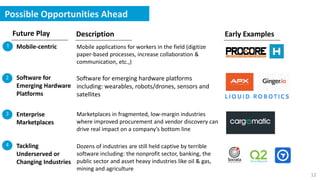
Possible Opportunities Ahead
Future Play Description
Mobile-centric Mobile applications for workers in the field (digitize
paper-based processes, increase collaboration &
communication, etc.,)
Software for
Emerging Hardware
Platforms
Software for emerging hardware platforms
including: wearables, robots/drones, sensors and
satellites
Enterprise
Marketplaces
Marketplaces in fragmented, low-margin industries
where improved procurement and vendor discovery can
drive real impact on a company’s bottom line
Tackling
Underserved or
Changing Industries
Dozens of industries are still held captive by terrible
software including: the nonprofit sector, banking, the
public sector and asset heavy industries like oil & gas,
mining and agriculture
Early Examples
1
2
3
4
What we look
For
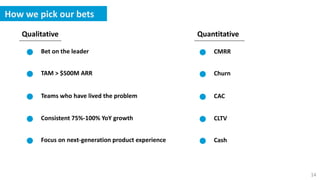
TAM > $500M ARR
Bet on the leader
Consistent 75%-100% YoY growth
Focus on next-generation product experience
Teams who have lived the problem
14
How we pick our bets
Qualitative Quantitative
Churn
CMRR
CLTV
Cash
CAC
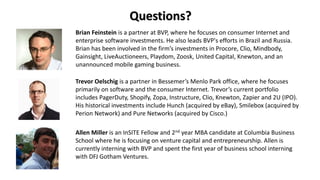
Questions?
Brian Feinstein is a partner at BVP, where he focuses on consumer Internet and
enterprise software investments. He also leads BVP's efforts in Brazil and Russia.
Brian has been involved in the firm’s investments in Procore, Clio, Mindbody,
Gainsight, LiveAuctioneers, Playdom, Zoosk, United Capital, Knewton, and an
unannounced mobile gaming business.
Trevor Oelschig is a partner in Bessemer’s Menlo Park office, where he focuses
primarily on software and the consumer Internet. Trevor’s current portfolio
includes PagerDuty, Shopify, Zopa, Instructure, Clio, Knewton, Zapier and 2U (IPO).
His historical investments include Hunch (acquired by eBay), Smilebox (acquired by
Perion Network) and Pure Networks (acquired by Cisco.)
Allen Miller is an InSITE Fellow and 2nd year MBA candidate at Columbia Business
School where he is focusing on venture capital and entrepreneurship. Allen is
currently interning with BVP and spent the first year of business school interning
with DFJ Gotham Ventures.

Industry Cloud Playbook

  • 1.
  • 2.
    1960s 1970s 1980s1990s 2000s 2010s MAINFRAME Vertical SAAS 2 CLIENT-SERVER and PC Excludes vertical SaaS companies that have successfully transitioned to the cloud: Ultimate Software (75% recurring/subscription), Callidus Cloud (75%), Medidata (80%), Guidewire (50%) Business Software in Waves Horizontal SAAS
  • 3.
    Consumerization of enterprise softwareand mobility (generational shift) Cloud makes it cheaper and easier for customers to adopt software Winner takes most dynamics In some verticals, cloud functionality makes software 10x more useful Why are verticals moving to the cloud now? 1 2 3 4 3 Customers flock to the leader Capital flows to the winner Cross-selling opportunities
  • 4.
    Enterprise Value 2014ERevenue 4 *If Dealer.com is included, DealerTrack’s 2014E revenue guidance is $819m. As of June 5, 2014. Large Companies Can Be Built $1.7bn $443m $3.1bn $574m $3.2bn $282m $2.9bn $341m $1.3bn $229m +18% +19% +34% +13% +29% $838m $119m +26% *
  • 5.
  • 6.
    6 Replace Sleepy Incumbents ThePlay Example Company Find a big on-premise incumbent and build a better, cheaper and easier to use cloud replacement. On-demand software for the auto industry The cloud makes it possible to deliver software that is: • more usable • cheaper • easier to maintain • accessible from any device • constantly being updated and improved
  • 7.
    7 Help Customers findNew Ways to Grow The Play Example Company Make your software drive revenue for your customers through consumer-facing features. Web-based property management software • Cloud software lives online and drives revenue for its customers, something that was never possible with on-premise software • Frequently creates an arms race in the industry that drives software adoption
  • 8.
    8 Attack the SMBMarket The Play Example Company Build software for SMBs that historically was only available to large enterprises. GPS vehicle fleet tracking software • Not too long ago, small and medium sized businesses were off limits to software companies • It was too expensive to hire field sales teams and still have software affordable enough for this market • Today, it’s possible to sell software cheaply over the Internet
  • 9.
    9 Tap into Dataat Cloud Scale The Play Example Company Use the cloud to tap into massive data sets and leverage data in novel ways. Software for to the utility industry • Customer data used to be siloed in a company's data center. • The cloud now makes it possible to aggregate data across users • We expect to see an increasing number of software businesses utilize shared data to drive insights for their customers
  • 10.
    10 Build a Platform ThePlay Example Company Drive value and lock-in customers by becoming the center of a larger ecosystem of industry applications. Ecommerce software platform • Cloud connectivity & APIs allow IC companies to become platforms with an ecosystem of applications around them • Building a platform drives long- term customer lock-in • If your customers rely on you to act as the hub for other critical applications, it is very difficult for competitors to replace you
  • 11.
  • 12.
    12 Possible Opportunities Ahead FuturePlay Description Mobile-centric Mobile applications for workers in the field (digitize paper-based processes, increase collaboration & communication, etc.,) Software for Emerging Hardware Platforms Software for emerging hardware platforms including: wearables, robots/drones, sensors and satellites Enterprise Marketplaces Marketplaces in fragmented, low-margin industries where improved procurement and vendor discovery can drive real impact on a company’s bottom line Tackling Underserved or Changing Industries Dozens of industries are still held captive by terrible software including: the nonprofit sector, banking, the public sector and asset heavy industries like oil & gas, mining and agriculture Early Examples 1 2 3 4
  • 13.
  • 14.
    TAM > $500MARR Bet on the leader Consistent 75%-100% YoY growth Focus on next-generation product experience Teams who have lived the problem 14 How we pick our bets Qualitative Quantitative Churn CMRR CLTV Cash CAC
  • 15.
    Questions? Brian Feinstein isa partner at BVP, where he focuses on consumer Internet and enterprise software investments. He also leads BVP's efforts in Brazil and Russia. Brian has been involved in the firm’s investments in Procore, Clio, Mindbody, Gainsight, LiveAuctioneers, Playdom, Zoosk, United Capital, Knewton, and an unannounced mobile gaming business. Trevor Oelschig is a partner in Bessemer’s Menlo Park office, where he focuses primarily on software and the consumer Internet. Trevor’s current portfolio includes PagerDuty, Shopify, Zopa, Instructure, Clio, Knewton, Zapier and 2U (IPO). His historical investments include Hunch (acquired by eBay), Smilebox (acquired by Perion Network) and Pure Networks (acquired by Cisco.) Allen Miller is an InSITE Fellow and 2nd year MBA candidate at Columbia Business School where he is focusing on venture capital and entrepreneurship. Allen is currently interning with BVP and spent the first year of business school interning with DFJ Gotham Ventures.