Open Services for Lifecycle Collaboration (OSLC)
Introduction into open standards
for the integration of ALM, PLM, and more
CONTACT Open World 2019
Axel Reichwein, Koneksys
June 27, 2019
1
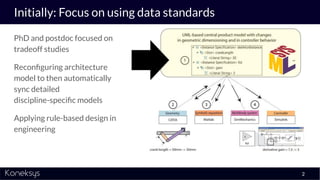
Initially: Focus on using data standards
PhD and postdoc focused on
tradeoff studies
Reconfiguring architecture
model to then automatically
sync detailed
discipline-specific models
Applying rule-based design in
engineering
2
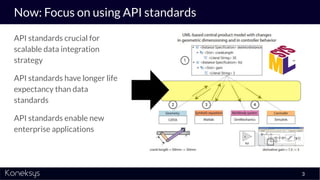
Now: Focus on using API standards
API standards crucial for
scalable data integration
strategy
API standards have longer life
expectancy than data
standards
API standards enable new
enterprise applications
3
Koneksys Consulting Services
Connecting data using standards
● Custom software development
for organizations and vendors
● Research projects
4
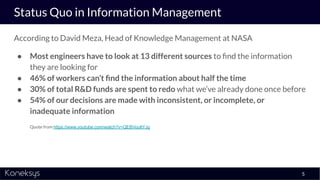
Status Quo in Information Management
According to David Meza, Head of Knowledge Management at NASA
● Most engineers have to look at 13 different sources to find the information
they are looking for
● 46% of workers can’t find the information about half the time
● 30% of total R&D funds are spent to redo what we’ve already done once before
● 54% of our decisions are made with inconsistent, or incomplete, or
inadequate information
Quote from https://www.youtube.com/watch?v=QEBVoultYJg
5
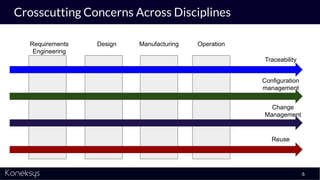
Crosscutting Concerns Across Disciplines
6
Requirements
Engineering
Design Manufacturing Operation
Traceability
Configuration
management
Change
Management
Reuse
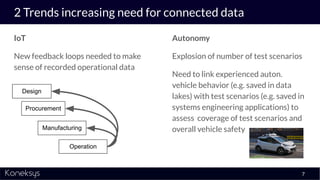
2 Trends increasing need for connected data
IoT
New feedback loops needed to make
sense of recorded operational data
Autonomy
Explosion of number of test scenarios
Need to link experienced auton.
vehicle behavior (e.g. saved in data
lakes) with test scenarios (e.g. saved in
systems engineering applications) to
assess coverage of test scenarios and
overall vehicle safety
Design
Procurement
Manufacturing
Operation
7
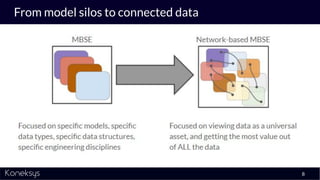
From model silos to connected data
8
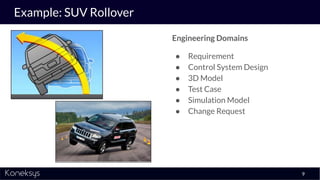
Example: SUV Rollover
Engineering Domains
● Requirement
● Control System Design
● 3D Model
● Test Case
● Simulation Model
● Change Request
9
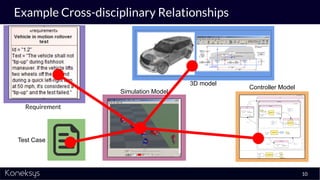
Example Cross-disciplinary Relationships
10
Requirement
3D model
Simulation Model
Controller Model
Test Case
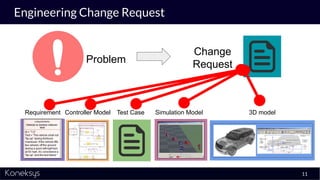
Engineering Change Request
11
Requirement 3D modelSimulation Model
Change
RequestProblem
Test CaseController Model
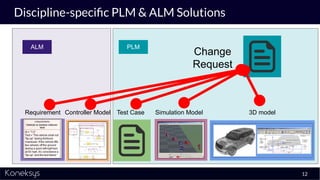
Discipline-specific PLM & ALM Solutions
12
Requirement 3D modelSimulation Model
Change
Request
Test CaseController Model
ALM PLM
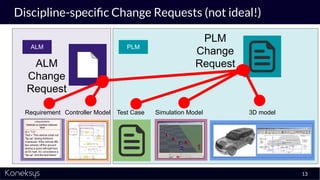
Discipline-specific Change Requests (not ideal!)
13
Requirement 3D modelSimulation ModelTest CaseController Model
PLM
Change
RequestALM
Change
Request
ALM PLM
Example ALM/PLM Integrations (based on OSLC)
Linking PLM Parts with ALM requirements
Linking PLM Engineering Change Requests
(ECR) with ALM work items
Integration from Sodius between
PTC Windchill and IBM CLM:
Integration from Siemens between
Siemens Teamcenter and Polarion
https://docs.plm.automation.siemens.com/data_services/reso
urces/polarion/17.3/help/common/en_US/graphics/fileLibrary/
17_3_pdfs/Teamcenter_Polarion_Integration_Installation.pdf
OSLC API for Contact Elements
● Reference implementation in Python
released as open-source soon
● OSLC API for Contact Elements can be
used to connect PLM/ALM artifacts and
more
14
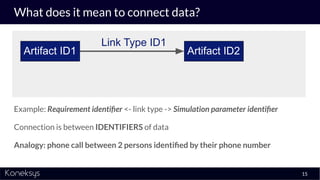
What does it mean to connect data?
Example: Requirement identifier <- link type -> Simulation parameter identifier
Connection is between IDENTIFIERS of data
Analogy: phone call between 2 persons identified by their phone number
15
Artifact ID1 Artifact ID2
Link Type ID1
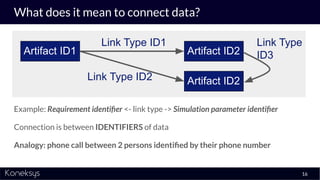
What does it mean to connect data?
Example: Requirement identifier <- link type -> Simulation parameter identifier
Connection is between IDENTIFIERS of data
Analogy: phone call between 2 persons identified by their phone number
16
Artifact ID1 Artifact ID2
Link Type ID1
Artifact ID2Link Type ID2
Link Type
ID3
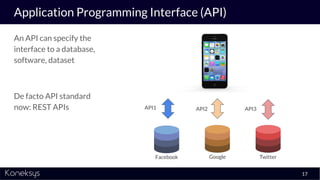
Application Programming Interface (API)
An API can specify the
interface to a database,
software, dataset
De facto API standard
now: REST APIs
17
Facebook Google Twitter
API1 API2 API3
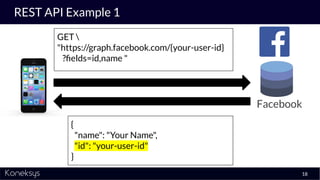
REST API Example 1
18
Facebook
GET 
"https://graph.facebook.com/{your-user-id}
?fields=id,name "
{
"name": "Your Name",
"id": "your-user-id"
}
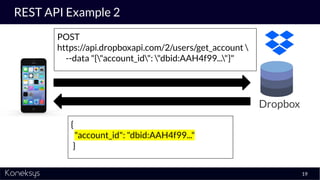
REST API Example 2
19
Dropbox
POST
https://api.dropboxapi.com/2/users/get_account 
--data "{"account_id": "dbid:AAH4f99..."}"
{
"account_id": "dbid:AAH4f99..."
}
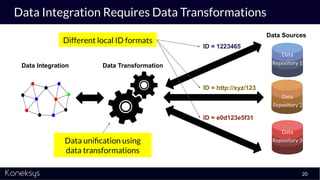
Data Integration Requires Data Transformations
20
Data
Repository 1
Data
Repository 2
Data
Repository 3
Data Integration Data Transformation
Data Sources
ID = 1223465
ID = http://xyz/123
ID = e0d123e5f31
Different local ID formats
Data unification using
data transformations
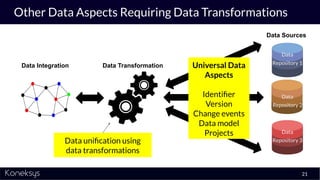
Other Data Aspects Requiring Data Transformations
21
Data
Repository 1
Data
Repository 2
Data
Repository 3
Data Integration Data Transformation
Data Sources
Universal Data
Aspects
Identifier
Version
Change events
Data model
Projects
Data unification using
data transformations
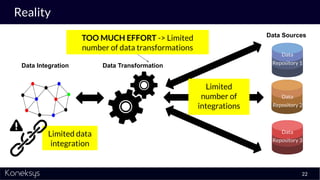
Reality
22
Data
Repository 1
Data
Repository 2
Data
Repository 3
Data Integration Data Transformation
Data Sources
Limited
number of
integrations
TOO MUCH EFFORT -> Limited
number of data transformations
Limited data
integration
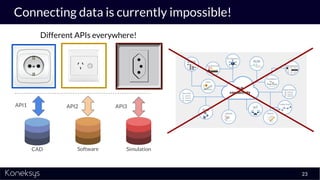
Connecting data is currently impossible!
Full
connectivity
CAD Software Simulation
API1 API2 API3
Different APIs everywhere!
23
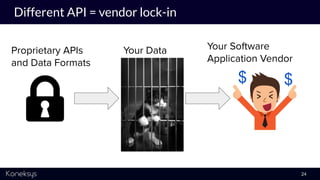
Different API = vendor lock-in
Your Data Your Software
Application Vendor
Proprietary APIs
and Data Formats
$ $
24
Once Upon a Time - Before the Web
Different protocols to access documents on the internet (Gopher, WAIS, etc...)
No connected documents (hierarchical document structure, no hyperlinks)
Not many persons used the internet
Hypertext existed since 1965, 25 years before the invention of the Web
Lack of standards for Hypertext hindered adoption of Hypertext - no compatibility
between different Hypertext systems
25
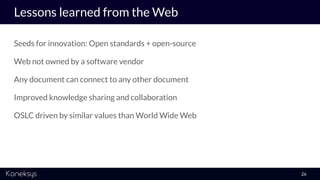
Lessons learned from the Web
Seeds for innovation: Open standards + open-source
Web not owned by a software vendor
Any document can connect to any other document
Improved knowledge sharing and collaboration
OSLC driven by similar values than World Wide Web
26
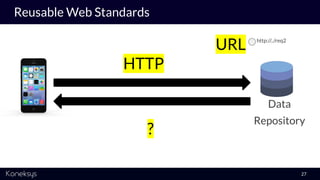
Reusable Web Standards
27
Data
Repository
HTTP
?
URL http://../req2
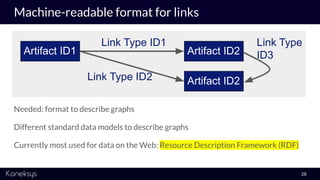
Machine-readable format for links
28
Needed: format to describe graphs
Different standard data models to describe graphs
Currently most used for data on the Web: Resource Description Framework (RDF)
Artifact ID1 Artifact ID2
Link Type ID1
Artifact ID2Link Type ID2
Link Type
ID3
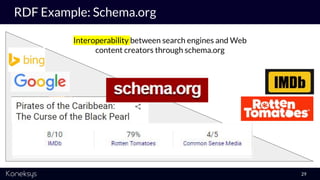
RDF Example: Schema.org
29
Interoperability between search engines and Web
content creators through schema.org
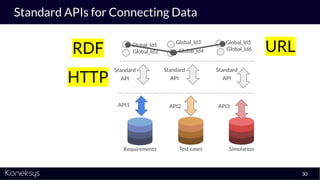
Standard APIs for Connecting Data
30
Requirements Test cases Simulation
API1 API2 API3
Global_Id1
Global_Id2
Global_Id3
Global_Id4
Global_Id5
Global_Id6
Standard
API
Standard
API
Standard
APIHTTP
URLRDF
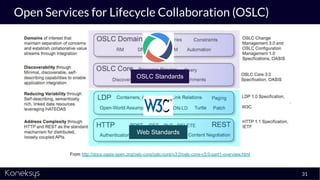
Open Services for Lifecycle Collaboration (OSLC)
31
From http://docs.oasis-open.org/oslc-core/oslc-core/v3.0/oslc-core-v3.0-part1-overview.html
Web Standards
OSLC Standards
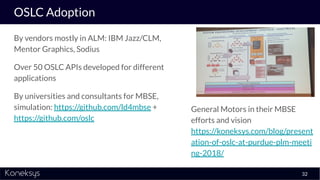
OSLC Adoption
By vendors mostly in ALM: IBM Jazz/CLM,
Mentor Graphics, Sodius
Over 50 OSLC APIs developed for different
applications
By universities and consultants for MBSE,
simulation: https://github.com/ld4mbse +
https://github.com/oslc
General Motors in their MBSE
efforts and vision
https://koneksys.com/blog/present
ation-of-oslc-at-purdue-plm-meeti
ng-2018/
32
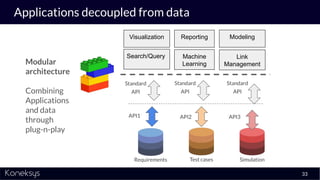
Applications decoupled from data
33
Requirements Test cases Simulation
API1 API2 API3
Visualization
Search/Query
Reporting
Modular
architecture
Combining
Applications
and data
through
plug-n-play
Standard
API
Standard
API
Standard
API
Machine
Learning
Link
Management
Modeling
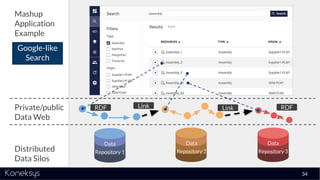
Private/public
Data Web
Distributed
Data Silos
Mashup
Application
Example
Google-like
Search
34
Data
Repository 1
Data
Repository 2
Data
Repository 3
RDF Link Link RDF
Discipline-specific vs. Universal Data Management
Currently, we have discipline-specific data management: Simulation Data
Management (SDM), Product Lifecycle Management (PLM), Application Lifecycle
Management (ALM) etc., and NO Data connectivity
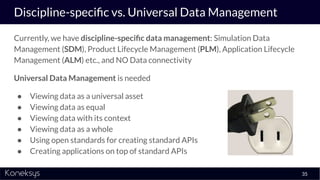
Universal Data Management is needed
● Viewing data as a universal asset
● Viewing data as equal
● Viewing data with its context
● Viewing data as a whole
● Using open standards for creating standard APIs
● Creating applications on top of standard APIs
35
What now?
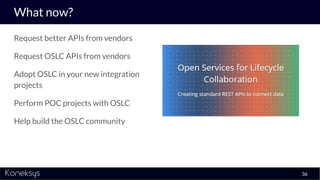
Request better APIs from vendors
Request OSLC APIs from vendors
Adopt OSLC in your new integration
projects
Perform POC projects with OSLC
Help build the OSLC community
36
Thanks and get in touch!
axel.reichwein@koneksys.com

Open Services for Lifecycle Collaboration (OSLC)

  • 1.
    Open Services forLifecycle Collaboration (OSLC) Introduction into open standards for the integration of ALM, PLM, and more CONTACT Open World 2019 Axel Reichwein, Koneksys June 27, 2019 1
  • 2.
    Initially: Focus onusing data standards PhD and postdoc focused on tradeoff studies Reconfiguring architecture model to then automatically sync detailed discipline-specific models Applying rule-based design in engineering 2
  • 3.
    Now: Focus onusing API standards API standards crucial for scalable data integration strategy API standards have longer life expectancy than data standards API standards enable new enterprise applications 3
  • 4.
    Koneksys Consulting Services Connectingdata using standards ● Custom software development for organizations and vendors ● Research projects 4
  • 5.
    Status Quo inInformation Management According to David Meza, Head of Knowledge Management at NASA ● Most engineers have to look at 13 different sources to find the information they are looking for ● 46% of workers can’t find the information about half the time ● 30% of total R&D funds are spent to redo what we’ve already done once before ● 54% of our decisions are made with inconsistent, or incomplete, or inadequate information Quote from https://www.youtube.com/watch?v=QEBVoultYJg 5
  • 6.
    Crosscutting Concerns AcrossDisciplines 6 Requirements Engineering Design Manufacturing Operation Traceability Configuration management Change Management Reuse
  • 7.
    2 Trends increasingneed for connected data IoT New feedback loops needed to make sense of recorded operational data Autonomy Explosion of number of test scenarios Need to link experienced auton. vehicle behavior (e.g. saved in data lakes) with test scenarios (e.g. saved in systems engineering applications) to assess coverage of test scenarios and overall vehicle safety Design Procurement Manufacturing Operation 7
  • 8.
    From model silosto connected data 8
  • 9.
    Example: SUV Rollover EngineeringDomains ● Requirement ● Control System Design ● 3D Model ● Test Case ● Simulation Model ● Change Request 9
  • 10.
    Example Cross-disciplinary Relationships 10 Requirement 3Dmodel Simulation Model Controller Model Test Case
  • 11.
    Engineering Change Request 11 Requirement3D modelSimulation Model Change RequestProblem Test CaseController Model
  • 12.
    Discipline-specific PLM &ALM Solutions 12 Requirement 3D modelSimulation Model Change Request Test CaseController Model ALM PLM
  • 13.
    Discipline-specific Change Requests(not ideal!) 13 Requirement 3D modelSimulation ModelTest CaseController Model PLM Change RequestALM Change Request ALM PLM
  • 14.
    Example ALM/PLM Integrations(based on OSLC) Linking PLM Parts with ALM requirements Linking PLM Engineering Change Requests (ECR) with ALM work items Integration from Sodius between PTC Windchill and IBM CLM: Integration from Siemens between Siemens Teamcenter and Polarion https://docs.plm.automation.siemens.com/data_services/reso urces/polarion/17.3/help/common/en_US/graphics/fileLibrary/ 17_3_pdfs/Teamcenter_Polarion_Integration_Installation.pdf OSLC API for Contact Elements ● Reference implementation in Python released as open-source soon ● OSLC API for Contact Elements can be used to connect PLM/ALM artifacts and more 14
  • 15.
    What does itmean to connect data? Example: Requirement identifier <- link type -> Simulation parameter identifier Connection is between IDENTIFIERS of data Analogy: phone call between 2 persons identified by their phone number 15 Artifact ID1 Artifact ID2 Link Type ID1
  • 16.
    What does itmean to connect data? Example: Requirement identifier <- link type -> Simulation parameter identifier Connection is between IDENTIFIERS of data Analogy: phone call between 2 persons identified by their phone number 16 Artifact ID1 Artifact ID2 Link Type ID1 Artifact ID2Link Type ID2 Link Type ID3
  • 17.
    Application Programming Interface(API) An API can specify the interface to a database, software, dataset De facto API standard now: REST APIs 17 Facebook Google Twitter API1 API2 API3
  • 18.
    REST API Example1 18 Facebook GET "https://graph.facebook.com/{your-user-id} ?fields=id,name " { "name": "Your Name", "id": "your-user-id" }
  • 19.
    REST API Example2 19 Dropbox POST https://api.dropboxapi.com/2/users/get_account --data "{"account_id": "dbid:AAH4f99..."}" { "account_id": "dbid:AAH4f99..." }
  • 20.
    Data Integration RequiresData Transformations 20 Data Repository 1 Data Repository 2 Data Repository 3 Data Integration Data Transformation Data Sources ID = 1223465 ID = http://xyz/123 ID = e0d123e5f31 Different local ID formats Data unification using data transformations
  • 21.
    Other Data AspectsRequiring Data Transformations 21 Data Repository 1 Data Repository 2 Data Repository 3 Data Integration Data Transformation Data Sources Universal Data Aspects Identifier Version Change events Data model Projects Data unification using data transformations
  • 22.
    Reality 22 Data Repository 1 Data Repository 2 Data Repository3 Data Integration Data Transformation Data Sources Limited number of integrations TOO MUCH EFFORT -> Limited number of data transformations Limited data integration
  • 23.
    Connecting data iscurrently impossible! Full connectivity CAD Software Simulation API1 API2 API3 Different APIs everywhere! 23
  • 24.
    Different API =vendor lock-in Your Data Your Software Application Vendor Proprietary APIs and Data Formats $ $ 24
  • 25.
    Once Upon aTime - Before the Web Different protocols to access documents on the internet (Gopher, WAIS, etc...) No connected documents (hierarchical document structure, no hyperlinks) Not many persons used the internet Hypertext existed since 1965, 25 years before the invention of the Web Lack of standards for Hypertext hindered adoption of Hypertext - no compatibility between different Hypertext systems 25
  • 26.
    Lessons learned fromthe Web Seeds for innovation: Open standards + open-source Web not owned by a software vendor Any document can connect to any other document Improved knowledge sharing and collaboration OSLC driven by similar values than World Wide Web 26
  • 27.
  • 28.
    Machine-readable format forlinks 28 Needed: format to describe graphs Different standard data models to describe graphs Currently most used for data on the Web: Resource Description Framework (RDF) Artifact ID1 Artifact ID2 Link Type ID1 Artifact ID2Link Type ID2 Link Type ID3
  • 29.
    RDF Example: Schema.org 29 Interoperabilitybetween search engines and Web content creators through schema.org
  • 30.
    Standard APIs forConnecting Data 30 Requirements Test cases Simulation API1 API2 API3 Global_Id1 Global_Id2 Global_Id3 Global_Id4 Global_Id5 Global_Id6 Standard API Standard API Standard APIHTTP URLRDF
  • 31.
    Open Services forLifecycle Collaboration (OSLC) 31 From http://docs.oasis-open.org/oslc-core/oslc-core/v3.0/oslc-core-v3.0-part1-overview.html Web Standards OSLC Standards
  • 32.
    OSLC Adoption By vendorsmostly in ALM: IBM Jazz/CLM, Mentor Graphics, Sodius Over 50 OSLC APIs developed for different applications By universities and consultants for MBSE, simulation: https://github.com/ld4mbse + https://github.com/oslc General Motors in their MBSE efforts and vision https://koneksys.com/blog/present ation-of-oslc-at-purdue-plm-meeti ng-2018/ 32
  • 33.
    Applications decoupled fromdata 33 Requirements Test cases Simulation API1 API2 API3 Visualization Search/Query Reporting Modular architecture Combining Applications and data through plug-n-play Standard API Standard API Standard API Machine Learning Link Management Modeling
  • 34.
  • 35.
    Discipline-specific vs. UniversalData Management Currently, we have discipline-specific data management: Simulation Data Management (SDM), Product Lifecycle Management (PLM), Application Lifecycle Management (ALM) etc., and NO Data connectivity Universal Data Management is needed ● Viewing data as a universal asset ● Viewing data as equal ● Viewing data with its context ● Viewing data as a whole ● Using open standards for creating standard APIs ● Creating applications on top of standard APIs 35
  • 36.
    What now? Request betterAPIs from vendors Request OSLC APIs from vendors Adopt OSLC in your new integration projects Perform POC projects with OSLC Help build the OSLC community 36
  • 37.
    Thanks and getin touch! axel.reichwein@koneksys.com