Achieving the digital thread through PLM
and ALM integration using OSLC
Purdue PLM Meeting Spring 2018
Axel Reichwein
March 29, 2018
Koneksys
Axel Reichwein
● Developer of multiple data integration
solutions based on Open Services for
Lifecycle Collaboration (OSLC)
● Background in aerospace engineering
● Since PhD, focus on data integration
● Since Koneksys, focus on OSLC
● Previously involved in standardization
efforts related to SysML (Systems
Modeling Language)
● Presented OSLC at multiple conferences:
INCOSE, OMG, SAE International
Automotive, North American Modelica
Users Group, IBM InterConnect, IBM
Innovate, NoMagic World Conference,
CIMdata Systems Engineering Workshop
2
Status Quo of Collaboration
According to David Meza, Head of Knowledge Management at NASA
“Most engineers have to look at 13 different sources to find the information they
are looking for”
“46% of workers can’t find the information about half the time”
“30% of total R&D funds are spent to redo what we’ve already done once before”
“54% of our decisions are made with inconsistent, or incomplete, or inadequate
information”
https://www.youtube.com/watch?v=QEBVoultYJg
3
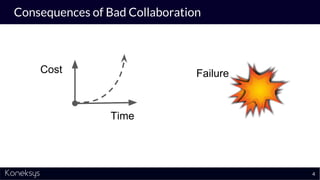
Consequences of Bad Collaboration
4
FailureCost
Time
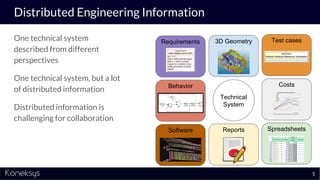
Distributed Engineering Information
One technical system
described from different
perspectives
One technical system, but a lot
of distributed information
Distributed information is
challenging for collaboration
5
Software
Costs
SpreadsheetsReports
Test casesRequirements 3D Geometry
Behavior
Technical
System
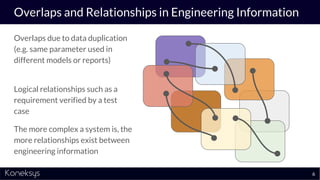
Overlaps and Relationships in Engineering Information
Overlaps due to data duplication
(e.g. same parameter used in
different models or reports)
Logical relationships such as a
requirement verified by a test
case
The more complex a system is, the
more relationships exist between
engineering information
6
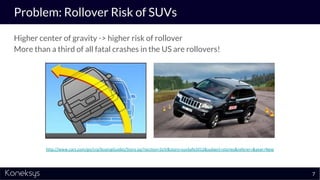
Problem: Rollover Risk of SUVs
Higher center of gravity -> higher risk of rollover
More than a third of all fatal crashes in the US are rollovers!
http://www.cars.com/go/crp/buyingGuides/Story.jsp?section=SUV&story=suvSafe2012&subject=stories&referer=&year=New
7
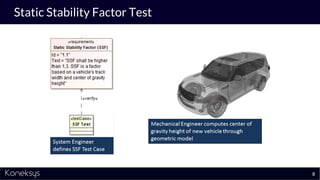
Static Stability Factor Test
8
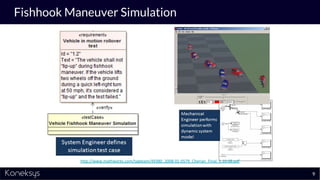
Fishhook Maneuver Simulation
http://www.mathworks.com/tagteam/49380_2008-01-0579_Cherian_Final_1.10.08.pdf
9
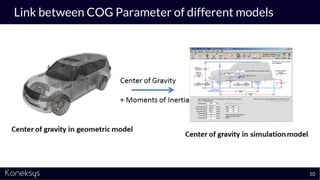
Link between COG Parameter of different models
10
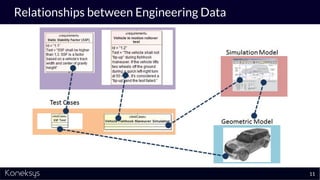
Relationships between Engineering Data
11
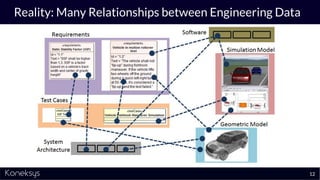
Reality: Many Relationships between Engineering Data
12
Example Digital Thread of PLM vendor
13
Requirements
Engineering
Design Manufacturing Operation Problems
● Limited
integration of
specific disciplines
and software
applications
● No mix-n-match as
needed by your
organization (No
ad-hoc integration)
● Custom
integration
development is
expensive
● Locked in by
vendor
Parts
CAD
docu-
ments
Require-
ments
Archi-
tecture
Process
Plan
MBOM Diagnosis
Software
Operatio-
nal Data
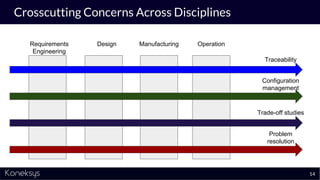
Crosscutting Concerns Across Disciplines
14
Requirements
Engineering
Design Manufacturing Operation
Traceability
Configuration
management
Trade-off studies
Problem
resolution
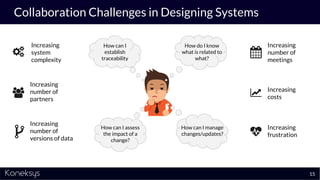
Collaboration Challenges in Designing Systems
15
Increasing
system
complexity
Increasing
number of
meetings
Increasing
costs
Increasing
number of
partners
Increasing
number of
versions of data
Increasing
frustration
How can I assess
the impact of a
change?
How can I
establish
traceability
How do I know
what is related to
what?
How can I manage
changes/updates?
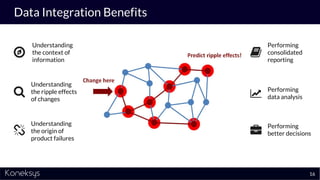
Data Integration Benefits
16
Understanding
the context of
information
Performing
consolidated
reporting
Performing
data analysis
Understanding
the ripple effects
of changes
Understanding
the origin of
product failures
Performing
better decisions
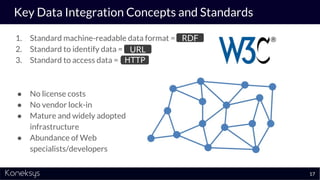
Key Data Integration Concepts and Standards
1. Standard machine-readable data format = RDF
2. Standard to identify data = URL
3. Standard to access data = HTTPHTTP
RDF
URL
● No license costs
● No vendor lock-in
● Mature and widely adopted
infrastructure
● Abundance of Web
specialists/developers
17
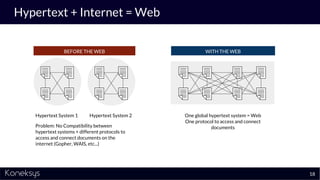
Hypertext + Internet = Web
18
Hypertext System 1 Hypertext System 2
Problem: No Compatibility between
hypertext systems + different protocols to
access and connect documents on the
internet (Gopher, WAIS, etc...)
BEFORE THE WEB
One global hypertext system = Web
One protocol to access and connect
documents
WITH THE WEB
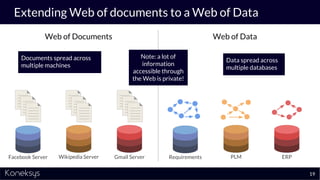
Extending Web of documents to a Web of Data
Requirements PLM ERPFacebook Server Wikipedia Server Gmail Server
Note: a lot of
information
accessible through
the Web is private!
Documents spread across
multiple machines
Data spread across
multiple databases
Web of Documents Web of Data
19
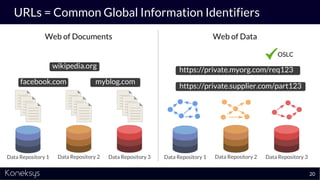
URLs = Common Global Information Identifiers
Data Repository 1 Data Repository 2 Data Repository 3
wikipedia.org
facebook.com
https://private.myorg.com/req123
https://private.supplier.com/part123
Data Repository 1 Data Repository 2 Data Repository 3
myblog.com
Web of Documents Web of Data
OSLC
20
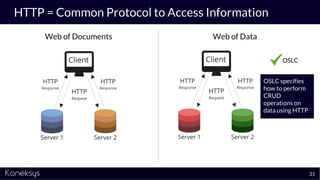
HTTP = Common Protocol to Access Information
OSLC specifies
how to perform
CRUD
operations on
data using HTTP
Web of Documents Web of Data
OSLC
21
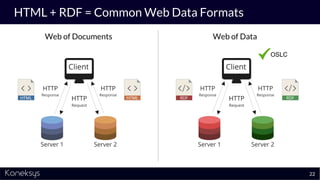
HTML + RDF = Common Web Data Formats
OSLC
Web of Documents Web of Data
22
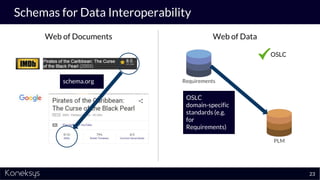
Schemas for Data Interoperability
schema.org Requirements
PLM
OSLC
domain-specific
standards (e.g.
for
Requirements)
OSLC
Web of Documents Web of Data
23
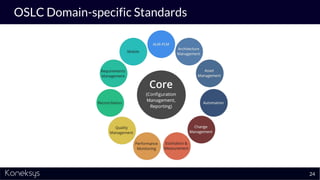
OSLC Domain-specific Standards
24
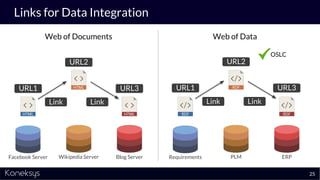
Links for Data Integration
URL1
URL2
URL3
OSLC
Requirements PLM ERPFacebook Server Wikipedia Server Blog Server
Link Link
Web of Documents Web of Data
URL1
URL2
URL3
Link Link
25
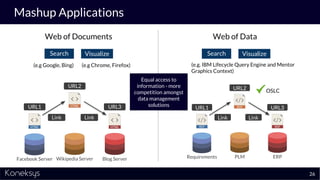
Mashup Applications
Equal access to
information - more
competition amongst
data management
solutions
Search Visualize
(e.g Google, Bing) (e.g Chrome, Firefox) (e.g. IBM Lifecycle Query Engine and Mentor
Graphics Context)
Web of Documents Web of Data
26
URL1
URL2
URL3
Facebook Server Wikipedia Server Blog Server
Link Link
OSLC
Requirements PLM ERP
URL1
URL2
URL3
Link Link
Search Visualize
Private/public
Data Web
Distributed
Data Silos
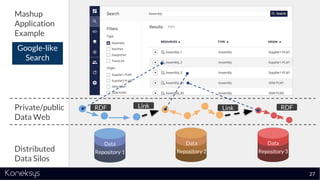
Mashup
Application
Example
Google-like
Search
27
Data
Repository 1
Data
Repository 2
Data
Repository 3
RDF Link Link RDF
28
Private/public
Data Web
Distributed
Data Silos
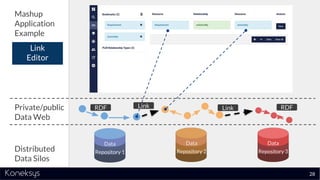
Mashup
Application
Example
Link
Editor
Data
Repository 1
Data
Repository 2
Data
Repository 3
RDF Link Link RDF
Private/public
Data Web
Distributed
Data Silos
Data
Repository 1
Data
Repository 2
Data
Repository 3
RDF Link Link RDF
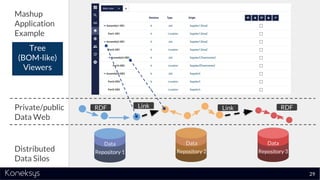
Mashup
Application
Example
Tree
(BOM-like)
Viewers
29
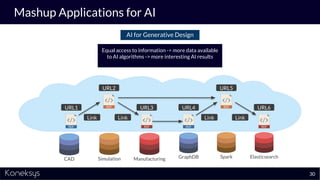
Mashup Applications for AI
Equal access to information -> more data available
to AI algorithms -> more interesting AI results
AI for Generative Design
30
CAD Simulation Manufacturing GraphDB Spark Elasticsearch
URL4
URL5
URL6
Link Link
URL1
URL2
URL3
Link Link
Private/public
Data Web
Distributed
Data Silos
Data
Repository 1
Data
Repository 2
Data
Repository 3
RDF Link Link RDF
Mashup
Application
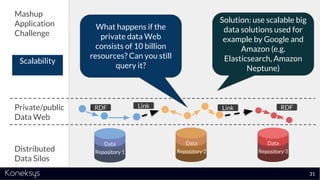
Challenge
Scalability
31
What happens if the
private data Web
consists of 10 billion
resources? Can you still
query it?
Solution: use scalable big
data solutions used for
example by Google and
Amazon (e.g.
Elasticsearch, Amazon
Neptune)
Private/public
Data Web
Distributed
Data Silos
Data
Repository 1
Data
Repository 2
Data
Repository 3
RDF Link Link RDF
Mashup
Application
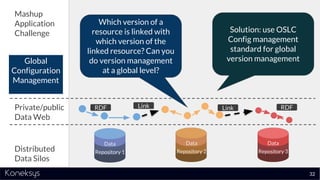
Challenge
Global
Configuration
Management
32
Which version of a
resource is linked with
which version of the
linked resource? Can you
do version management
at a global level?
Solution: use OSLC
Config management
standard for global
version management
Private/public
Data Web
Distributed
Data Silos
Data
Repository 1
Data
Repository 2
Data
Repository 3
RDF Link Link RDF
Mashup
Application
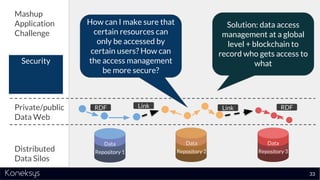
Challenge
Security
33
How can I make sure that
certain resources can
only be accessed by
certain users? How can
the access management
be more secure?
Solution: data access
management at a global
level + blockchain to
record who gets access to
what
We offer consulting services:
● Create OSLC APIs for software applications and data stores not supporting
OSLC natively
● Create integrations for OSLC-enabled applications (e.g. IBM DNG)
● Create mashup applications for OSLC data
● Offer OSLC training to developers and project managers
What does Koneksys do?
34
We perform internal research to address the challenges of future OSLC-based
mashup applications:
● Running queries on OSLC data with Spark GraphFrames
(https://github.com/koneksys/SPARQL_to_GraphFrames )
● Configuration management of OSLC data
(https://github.com/koneksys/Git4RDF )
● Managing information in the blockchain using smart contracts
(https://github.com/koneksys/Blockchain4LinkedData )
What does Koneksys do?
35
We help grow the OSLC community:
● Releasing open-source OSLC solutions (https://github.com/ld4mbse +
https://github.com/oslc/ )
● Creating new OSLC web site (http://oslc.co/ )
● Promoting OSLC at conferences (https://koneksys.com/blog/ )
What does Koneksys do?
36
Koneksys
Koneksys helps organizations create
data integration solutions using
● Linked Data
● Open Services for Lifecycle
Collaboration (OSLC)
● Big Data frameworks
● Graph Databases
Located in San Francisco. In business
since 2012.
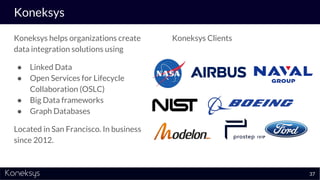
Koneksys Clients
37
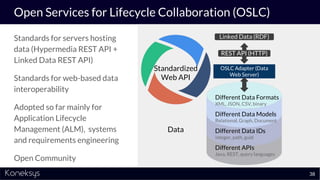
Open Services for Lifecycle Collaboration (OSLC)
Standards for servers hosting
data (Hypermedia REST API +
Linked Data REST API)
Standards for web-based data
interoperability
Adopted so far mainly for
Application Lifecycle
Management (ALM), systems
and requirements engineering
Open Community
38
Data
OSLC Adapter (Data
Web Server)
REST API (HTTP)
Linked Data (RDF)
Different Data Formats
XML, JSON, CSV, binary
Different Data Models
Relational, Graph, Document
Different Data IDs
integer, path, guid
Different APIs
Java, REST, query languages
Standardized
Web API
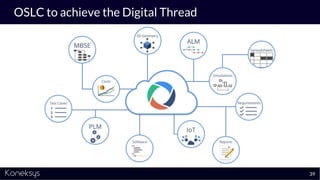
OSLC to achieve the Digital Thread
39
We need you to help promote OSLC!
New OSLC Web site: http://oslc.co/
Adding your company logo to the list of supporters on the web site helps the OSLC
community grow
If end user organizations show support for OSLC, then vendors, consultants, and
developers will offer more support for OSLC
40
Thanks and get in touch!
axel.reichwein@koneksys.com

Achieving the digital thread through PLM and ALM integration using oslc

  • 1.
    Achieving the digitalthread through PLM and ALM integration using OSLC Purdue PLM Meeting Spring 2018 Axel Reichwein March 29, 2018 Koneksys
  • 2.
    Axel Reichwein ● Developerof multiple data integration solutions based on Open Services for Lifecycle Collaboration (OSLC) ● Background in aerospace engineering ● Since PhD, focus on data integration ● Since Koneksys, focus on OSLC ● Previously involved in standardization efforts related to SysML (Systems Modeling Language) ● Presented OSLC at multiple conferences: INCOSE, OMG, SAE International Automotive, North American Modelica Users Group, IBM InterConnect, IBM Innovate, NoMagic World Conference, CIMdata Systems Engineering Workshop 2
  • 3.
    Status Quo ofCollaboration According to David Meza, Head of Knowledge Management at NASA “Most engineers have to look at 13 different sources to find the information they are looking for” “46% of workers can’t find the information about half the time” “30% of total R&D funds are spent to redo what we’ve already done once before” “54% of our decisions are made with inconsistent, or incomplete, or inadequate information” https://www.youtube.com/watch?v=QEBVoultYJg 3
  • 4.
    Consequences of BadCollaboration 4 FailureCost Time
  • 5.
    Distributed Engineering Information Onetechnical system described from different perspectives One technical system, but a lot of distributed information Distributed information is challenging for collaboration 5 Software Costs SpreadsheetsReports Test casesRequirements 3D Geometry Behavior Technical System
  • 6.
    Overlaps and Relationshipsin Engineering Information Overlaps due to data duplication (e.g. same parameter used in different models or reports) Logical relationships such as a requirement verified by a test case The more complex a system is, the more relationships exist between engineering information 6
  • 7.
    Problem: Rollover Riskof SUVs Higher center of gravity -> higher risk of rollover More than a third of all fatal crashes in the US are rollovers! http://www.cars.com/go/crp/buyingGuides/Story.jsp?section=SUV&story=suvSafe2012&subject=stories&referer=&year=New 7
  • 8.
  • 9.
  • 10.
    Link between COGParameter of different models 10
  • 11.
  • 12.
    Reality: Many Relationshipsbetween Engineering Data 12
  • 13.
    Example Digital Threadof PLM vendor 13 Requirements Engineering Design Manufacturing Operation Problems ● Limited integration of specific disciplines and software applications ● No mix-n-match as needed by your organization (No ad-hoc integration) ● Custom integration development is expensive ● Locked in by vendor Parts CAD docu- ments Require- ments Archi- tecture Process Plan MBOM Diagnosis Software Operatio- nal Data
  • 14.
    Crosscutting Concerns AcrossDisciplines 14 Requirements Engineering Design Manufacturing Operation Traceability Configuration management Trade-off studies Problem resolution
  • 15.
    Collaboration Challenges inDesigning Systems 15 Increasing system complexity Increasing number of meetings Increasing costs Increasing number of partners Increasing number of versions of data Increasing frustration How can I assess the impact of a change? How can I establish traceability How do I know what is related to what? How can I manage changes/updates?
  • 16.
    Data Integration Benefits 16 Understanding thecontext of information Performing consolidated reporting Performing data analysis Understanding the ripple effects of changes Understanding the origin of product failures Performing better decisions
  • 17.
    Key Data IntegrationConcepts and Standards 1. Standard machine-readable data format = RDF 2. Standard to identify data = URL 3. Standard to access data = HTTPHTTP RDF URL ● No license costs ● No vendor lock-in ● Mature and widely adopted infrastructure ● Abundance of Web specialists/developers 17
  • 18.
    Hypertext + Internet= Web 18 Hypertext System 1 Hypertext System 2 Problem: No Compatibility between hypertext systems + different protocols to access and connect documents on the internet (Gopher, WAIS, etc...) BEFORE THE WEB One global hypertext system = Web One protocol to access and connect documents WITH THE WEB
  • 19.
    Extending Web ofdocuments to a Web of Data Requirements PLM ERPFacebook Server Wikipedia Server Gmail Server Note: a lot of information accessible through the Web is private! Documents spread across multiple machines Data spread across multiple databases Web of Documents Web of Data 19
  • 20.
    URLs = CommonGlobal Information Identifiers Data Repository 1 Data Repository 2 Data Repository 3 wikipedia.org facebook.com https://private.myorg.com/req123 https://private.supplier.com/part123 Data Repository 1 Data Repository 2 Data Repository 3 myblog.com Web of Documents Web of Data OSLC 20
  • 21.
    HTTP = CommonProtocol to Access Information OSLC specifies how to perform CRUD operations on data using HTTP Web of Documents Web of Data OSLC 21
  • 22.
    HTML + RDF= Common Web Data Formats OSLC Web of Documents Web of Data 22
  • 23.
    Schemas for DataInteroperability schema.org Requirements PLM OSLC domain-specific standards (e.g. for Requirements) OSLC Web of Documents Web of Data 23
  • 24.
  • 25.
    Links for DataIntegration URL1 URL2 URL3 OSLC Requirements PLM ERPFacebook Server Wikipedia Server Blog Server Link Link Web of Documents Web of Data URL1 URL2 URL3 Link Link 25
  • 26.
    Mashup Applications Equal accessto information - more competition amongst data management solutions Search Visualize (e.g Google, Bing) (e.g Chrome, Firefox) (e.g. IBM Lifecycle Query Engine and Mentor Graphics Context) Web of Documents Web of Data 26 URL1 URL2 URL3 Facebook Server Wikipedia Server Blog Server Link Link OSLC Requirements PLM ERP URL1 URL2 URL3 Link Link Search Visualize
  • 27.
  • 28.
  • 29.
    Private/public Data Web Distributed Data Silos Data Repository1 Data Repository 2 Data Repository 3 RDF Link Link RDF Mashup Application Example Tree (BOM-like) Viewers 29
  • 30.
    Mashup Applications forAI Equal access to information -> more data available to AI algorithms -> more interesting AI results AI for Generative Design 30 CAD Simulation Manufacturing GraphDB Spark Elasticsearch URL4 URL5 URL6 Link Link URL1 URL2 URL3 Link Link
  • 31.
    Private/public Data Web Distributed Data Silos Data Repository1 Data Repository 2 Data Repository 3 RDF Link Link RDF Mashup Application Challenge Scalability 31 What happens if the private data Web consists of 10 billion resources? Can you still query it? Solution: use scalable big data solutions used for example by Google and Amazon (e.g. Elasticsearch, Amazon Neptune)
  • 32.
    Private/public Data Web Distributed Data Silos Data Repository1 Data Repository 2 Data Repository 3 RDF Link Link RDF Mashup Application Challenge Global Configuration Management 32 Which version of a resource is linked with which version of the linked resource? Can you do version management at a global level? Solution: use OSLC Config management standard for global version management
  • 33.
    Private/public Data Web Distributed Data Silos Data Repository1 Data Repository 2 Data Repository 3 RDF Link Link RDF Mashup Application Challenge Security 33 How can I make sure that certain resources can only be accessed by certain users? How can the access management be more secure? Solution: data access management at a global level + blockchain to record who gets access to what
  • 34.
    We offer consultingservices: ● Create OSLC APIs for software applications and data stores not supporting OSLC natively ● Create integrations for OSLC-enabled applications (e.g. IBM DNG) ● Create mashup applications for OSLC data ● Offer OSLC training to developers and project managers What does Koneksys do? 34
  • 35.
    We perform internalresearch to address the challenges of future OSLC-based mashup applications: ● Running queries on OSLC data with Spark GraphFrames (https://github.com/koneksys/SPARQL_to_GraphFrames ) ● Configuration management of OSLC data (https://github.com/koneksys/Git4RDF ) ● Managing information in the blockchain using smart contracts (https://github.com/koneksys/Blockchain4LinkedData ) What does Koneksys do? 35
  • 36.
    We help growthe OSLC community: ● Releasing open-source OSLC solutions (https://github.com/ld4mbse + https://github.com/oslc/ ) ● Creating new OSLC web site (http://oslc.co/ ) ● Promoting OSLC at conferences (https://koneksys.com/blog/ ) What does Koneksys do? 36
  • 37.
    Koneksys Koneksys helps organizationscreate data integration solutions using ● Linked Data ● Open Services for Lifecycle Collaboration (OSLC) ● Big Data frameworks ● Graph Databases Located in San Francisco. In business since 2012. Koneksys Clients 37
  • 38.
    Open Services forLifecycle Collaboration (OSLC) Standards for servers hosting data (Hypermedia REST API + Linked Data REST API) Standards for web-based data interoperability Adopted so far mainly for Application Lifecycle Management (ALM), systems and requirements engineering Open Community 38 Data OSLC Adapter (Data Web Server) REST API (HTTP) Linked Data (RDF) Different Data Formats XML, JSON, CSV, binary Different Data Models Relational, Graph, Document Different Data IDs integer, path, guid Different APIs Java, REST, query languages Standardized Web API
  • 39.
    OSLC to achievethe Digital Thread 39
  • 40.
    We need youto help promote OSLC! New OSLC Web site: http://oslc.co/ Adding your company logo to the list of supporters on the web site helps the OSLC community grow If end user organizations show support for OSLC, then vendors, consultants, and developers will offer more support for OSLC 40
  • 41.
    Thanks and getin touch! axel.reichwein@koneksys.com