Open Science & Altmetrics
Professor Dr. Isabella Peters, Web Science
MOTIVATION
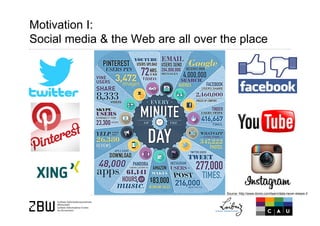
Motivation I:
Social media & the Web are all over the place
Source: http://www.domo.com/learn/data-never-sleeps-2
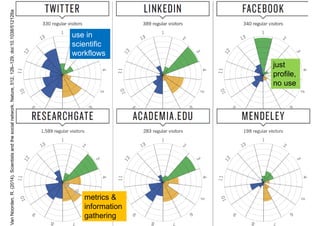
Allgemeine und berufliche
Nutzung von Online-Toolsn
use in
scientific
workflows
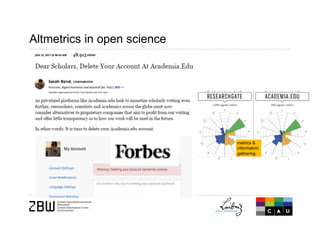
metrics &
information
gathering
just
profile,
no use
VanNoorden,R.(2014).Scientistsandthesocialnetwork.Nature,512,126–129.doi:10.1038/512126a
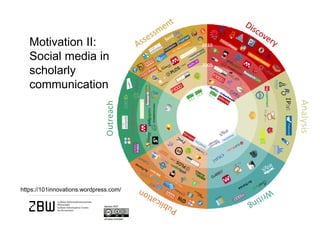
Motivation II:
Social media in
scholarly
communication
https://101innovations.wordpress.com/
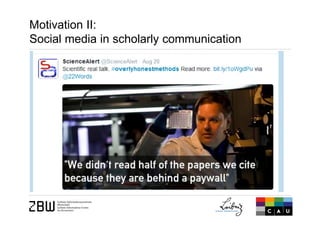
Motivation II:
Social media in scholarly communication
OPEN SCIENCE
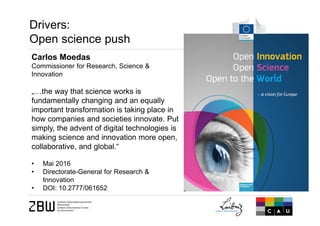
Drivers:
Open science push
Carlos Moedas
Commissioner for Research, Science &
Innovation
„:the way that science works is
fundamentally changing and an equally
important transformation is taking place in
how companies and societies innovate. Put
simply, the advent of digital technologies is
making science and innovation more open,
collaborative, and global.“
• Mai 2016
• Directorate-General for Research &
Innovation
• DOI: 10.2777/061652
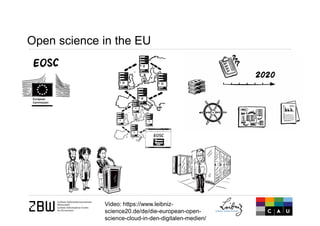
Open science in the EU
Video: https://www.leibniz-
science20.de/de/die-european-open-
science-cloud-in-den-digitalen-medien/
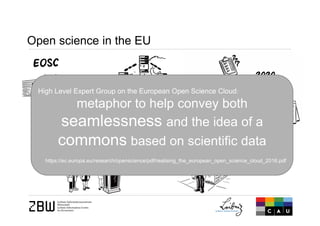
Open science in the EU
High Level Expert Group on the European Open Science Cloud:
metaphor to help convey both
seamlessness and the idea of a
commons based on scientific data
https://ec.europa.eu/research/openscience/pdf/realising_the_european_open_science_cloud_2016.pdf
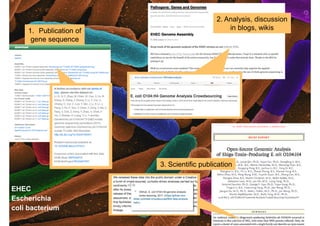
2. Analysis, discussion
in blogs, wikis1. Publication of
gene sequence
3. Scientific publication
EHEC
Escherichia
coli bacterium
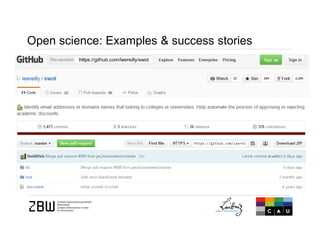
Open science: Examples & success stories
http://punkish.org/
A-lawyer-a-
scientist-and-a-kid
https://github.com/leereilly/swot
Open science: Examples & success stories
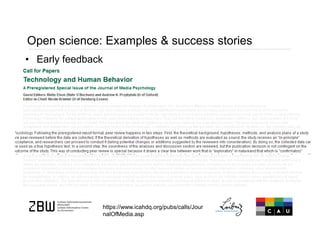
• Early feedback
https://www.icahdq.org/pubs/calls/Jour
nalOfMedia.asp
Open science: Examples & success stories
Page 14
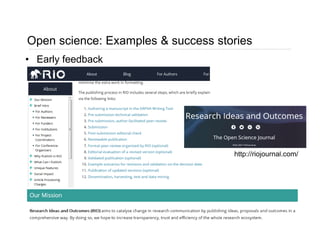
• Early feedback
http://riojournal.com/
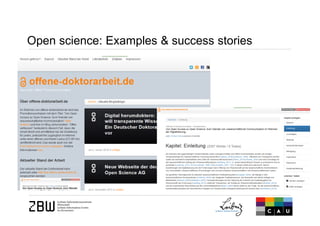
Open science: Examples & success stories
EC, 2016, DOI: 10.2777/061652
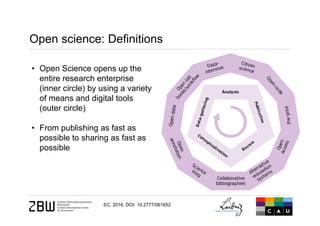
Open science: Definitions
• Open Science opens up the
entire research enterprise
(inner circle) by using a variety
of means and digital tools
(outer circle)
• From publishing as fast as
possible to sharing as fast as
possible
Open science: Definition
The Open Definition (http://opendefinition.org)
• Relates to open source software
• Knowledge is open if anyone is free to access, use, modify, and
share it — subject, at most, to measures that preserve provenance and
openness.
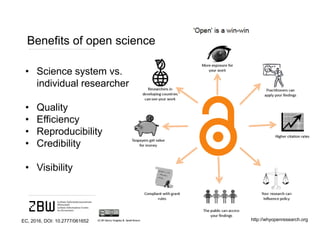
Benefits of open science
• Science system vs.
individual researcher
• Quality
• Efficiency
• Reproducibility
• Credibility
• Visibility
http://whyopenresearch.orgEC, 2016, DOI: 10.2777/061652
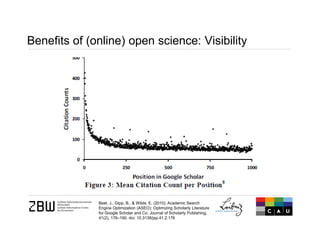
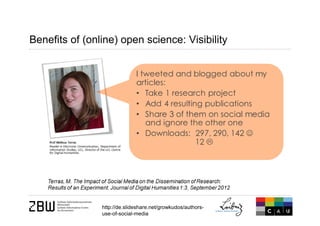
Benefits of (online) open science: Visibility
Beel, J., Gipp, B., & Wilde, E. (2010). Academic Search
Engine Optimization (ASEO): Optimizing Scholarly Literature
for Google Scholar and Co. Journal of Scholarly Publishing,
41(2), 176–190. doi: 10.3138/jsp.41.2.176
Benefits of (online) open science: Visibility
Page 20
http://de.slideshare.net/growkudos/authors-
use-of-social-media
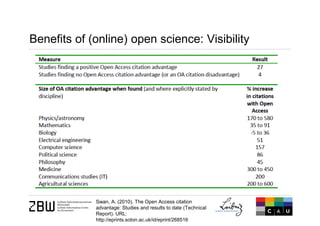
Benefits of (online) open science: Visibility
Page 21
Swan, A. (2010). The Open Access citation
advantage: Studies and results to date (Technical
Report). URL:
http://eprints.soton.ac.uk/id/eprint/268516
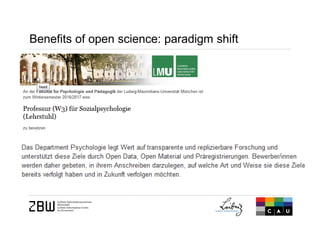
Benefits of open science: paradigm shift
Risks (?) of open science
• Blogging is a waste of precious time that could be spent on “legitimate”
publishing
• Because it’s a form of self-publishing that lacks peer review, blogging
isn’t usually viewed as a legitimate form of scholarship
• Dismissal of my work because it’s online [and] criticisms that my work
isn’t good enough to be published anywhere else.
• Sometimes blogging is even seen as disseminating one’s ideas too
freely. In a competitive academic field, research ideas could be
“scooped” from a blog, while established journals may not want to
publish work that’s available in some form online.
http://blogs.lse.ac.uk/impactofsocialsciences/2011/11/3
0/should-you-enter-the-academic-blogosphere/
ALTMETRICS
Doom of metrics: Academia fights back
San Francisco Declaration of Research Assessment
(http://am.ascb.org/dora)
• “The declaration intends to halt the practice of correlating the
journal impact factor to the merits of a specific scientist's
contributions. [:] this practice creates biases and inaccuracies
when appraising scientific research. [:] the impact factor is not
to be used as a substitute ‘measure of the quality of individual
research articles, or in hiring, promotion, or funding decisions’”
Altmetrics Manifesto (http://altmetrics.org/manifesto)
• “Altmetrics expand our view of what impact looks like, but also of
what’s making the impact. [:] Unlike citation metrics, altmetrics
will track impact outside the academy, impact of influential but
uncited work, and impact from sources that aren’t peer-reviewed.
[:] The speed of altmetrics presents the opportunity to create
real-time recommendation and collaborative filtering systems”
Altmetrics in open science
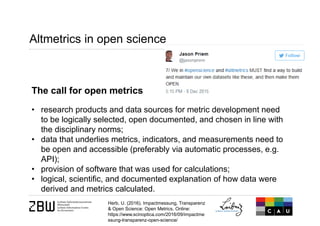
The call for open metrics
• research products and data sources for metric development need
to be logically selected, open documented, and chosen in line with
the disciplinary norms;
• data that underlies metrics, indicators, and measurements need to
be open and accessible (preferably via automatic processes, e.g.
API);
• provision of software that was used for calculations;
• logical, scientific, and documented explanation of how data were
derived and metrics calculated.
Herb, U. (2016). Impactmessung, Transparenz
& Open Science: Open Metrics. Online:
https://www.scinoptica.com/2016/09/impactme
ssung-transparenz-open-science/
CONCLUSIONS
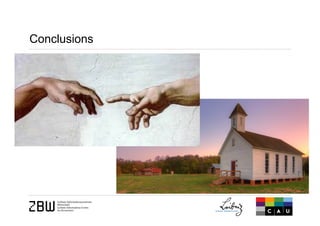
Conclusions
Conclusions
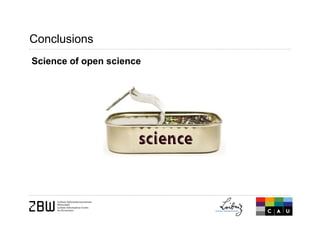
Science of open science
Conclusion
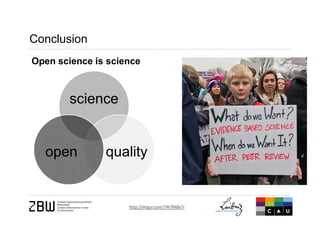
Open science is science
http://imgur.com/74I7MBx?r
science
qualityopen
Seite 32
Conclusions
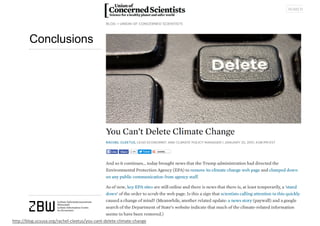
http://blog.ucsusa.org/rachel-cleetus/you-cant-delete-climate-change
Professor Dr. Isabella Peters
ZBW – Leibniz Information Center for
Economics & Kiel University
i.peters@zbw.eu
Thank you!
• Gillet, D., El Helou, S., Joubert, M., & Sutherland, R. (2009). Science
2.0: Supporting a Doctoral Community of Practice in Technology
Enhanced Learning using Social Software. In Science2.0 for TEL,
Workshop at the 4th European Conference on Technology-Enhanced
Learning (ECTEL’09), Nice, France.
• Shneiderman, B. (2008). COMPUTER SCIENCE: Science 2.0. Science,
319(5868), 1349-1350. doi: 10.1126/science.1153539
• Underwood, J., Luckin, R., Smith, H., Walker, K., Rowland, D.,
Fitzpatrick, G., Good, J., Benford, S. (2009): Reflections on Participatory
Science for TELSci2.0, In: Science2.0 for TEL, Workshop at the 4th
European Conference on Technology-Enhanced Learning (ECTEL’09),
Nice, France.
• Waldrop, M. M. (2008). Science 2.0. Scientific American, 298(5), 68.
References

Open Science & Altmetrics

  • 1.
    Open Science &Altmetrics Professor Dr. Isabella Peters, Web Science
  • 2.
  • 3.
    Motivation I: Social media& the Web are all over the place Source: http://www.domo.com/learn/data-never-sleeps-2
  • 4.
    Allgemeine und berufliche Nutzungvon Online-Toolsn use in scientific workflows metrics & information gathering just profile, no use VanNoorden,R.(2014).Scientistsandthesocialnetwork.Nature,512,126–129.doi:10.1038/512126a
  • 5.
    Motivation II: Social mediain scholarly communication https://101innovations.wordpress.com/
  • 6.
    Motivation II: Social mediain scholarly communication
  • 7.
  • 8.
    Drivers: Open science push CarlosMoedas Commissioner for Research, Science & Innovation „:the way that science works is fundamentally changing and an equally important transformation is taking place in how companies and societies innovate. Put simply, the advent of digital technologies is making science and innovation more open, collaborative, and global.“ • Mai 2016 • Directorate-General for Research & Innovation • DOI: 10.2777/061652
  • 9.
    Open science inthe EU Video: https://www.leibniz- science20.de/de/die-european-open- science-cloud-in-den-digitalen-medien/
  • 10.
    Open science inthe EU High Level Expert Group on the European Open Science Cloud: metaphor to help convey both seamlessness and the idea of a commons based on scientific data https://ec.europa.eu/research/openscience/pdf/realising_the_european_open_science_cloud_2016.pdf
  • 11.
    2. Analysis, discussion inblogs, wikis1. Publication of gene sequence 3. Scientific publication EHEC Escherichia coli bacterium
  • 12.
    Open science: Examples& success stories http://punkish.org/ A-lawyer-a- scientist-and-a-kid https://github.com/leereilly/swot
  • 13.
    Open science: Examples& success stories • Early feedback https://www.icahdq.org/pubs/calls/Jour nalOfMedia.asp
  • 14.
    Open science: Examples& success stories Page 14 • Early feedback http://riojournal.com/
  • 15.
    Open science: Examples& success stories
  • 16.
    EC, 2016, DOI:10.2777/061652 Open science: Definitions • Open Science opens up the entire research enterprise (inner circle) by using a variety of means and digital tools (outer circle) • From publishing as fast as possible to sharing as fast as possible
  • 17.
    Open science: Definition TheOpen Definition (http://opendefinition.org) • Relates to open source software • Knowledge is open if anyone is free to access, use, modify, and share it — subject, at most, to measures that preserve provenance and openness.
  • 18.
    Benefits of openscience • Science system vs. individual researcher • Quality • Efficiency • Reproducibility • Credibility • Visibility http://whyopenresearch.orgEC, 2016, DOI: 10.2777/061652
  • 19.
    Benefits of (online)open science: Visibility Beel, J., Gipp, B., & Wilde, E. (2010). Academic Search Engine Optimization (ASEO): Optimizing Scholarly Literature for Google Scholar and Co. Journal of Scholarly Publishing, 41(2), 176–190. doi: 10.3138/jsp.41.2.176
  • 20.
    Benefits of (online)open science: Visibility Page 20 http://de.slideshare.net/growkudos/authors- use-of-social-media
  • 21.
    Benefits of (online)open science: Visibility Page 21 Swan, A. (2010). The Open Access citation advantage: Studies and results to date (Technical Report). URL: http://eprints.soton.ac.uk/id/eprint/268516
  • 22.
    Benefits of openscience: paradigm shift
  • 23.
    Risks (?) ofopen science • Blogging is a waste of precious time that could be spent on “legitimate” publishing • Because it’s a form of self-publishing that lacks peer review, blogging isn’t usually viewed as a legitimate form of scholarship • Dismissal of my work because it’s online [and] criticisms that my work isn’t good enough to be published anywhere else. • Sometimes blogging is even seen as disseminating one’s ideas too freely. In a competitive academic field, research ideas could be “scooped” from a blog, while established journals may not want to publish work that’s available in some form online. http://blogs.lse.ac.uk/impactofsocialsciences/2011/11/3 0/should-you-enter-the-academic-blogosphere/
  • 24.
  • 25.
    Doom of metrics:Academia fights back San Francisco Declaration of Research Assessment (http://am.ascb.org/dora) • “The declaration intends to halt the practice of correlating the journal impact factor to the merits of a specific scientist's contributions. [:] this practice creates biases and inaccuracies when appraising scientific research. [:] the impact factor is not to be used as a substitute ‘measure of the quality of individual research articles, or in hiring, promotion, or funding decisions’” Altmetrics Manifesto (http://altmetrics.org/manifesto) • “Altmetrics expand our view of what impact looks like, but also of what’s making the impact. [:] Unlike citation metrics, altmetrics will track impact outside the academy, impact of influential but uncited work, and impact from sources that aren’t peer-reviewed. [:] The speed of altmetrics presents the opportunity to create real-time recommendation and collaborative filtering systems”
  • 26.
  • 27.
    Altmetrics in openscience The call for open metrics • research products and data sources for metric development need to be logically selected, open documented, and chosen in line with the disciplinary norms; • data that underlies metrics, indicators, and measurements need to be open and accessible (preferably via automatic processes, e.g. API); • provision of software that was used for calculations; • logical, scientific, and documented explanation of how data were derived and metrics calculated. Herb, U. (2016). Impactmessung, Transparenz & Open Science: Open Metrics. Online: https://www.scinoptica.com/2016/09/impactme ssung-transparenz-open-science/
  • 28.
  • 29.
  • 30.
  • 31.
    Conclusion Open science isscience http://imgur.com/74I7MBx?r science qualityopen
  • 32.
  • 33.
    Professor Dr. IsabellaPeters ZBW – Leibniz Information Center for Economics & Kiel University i.peters@zbw.eu Thank you!
  • 34.
    • Gillet, D.,El Helou, S., Joubert, M., & Sutherland, R. (2009). Science 2.0: Supporting a Doctoral Community of Practice in Technology Enhanced Learning using Social Software. In Science2.0 for TEL, Workshop at the 4th European Conference on Technology-Enhanced Learning (ECTEL’09), Nice, France. • Shneiderman, B. (2008). COMPUTER SCIENCE: Science 2.0. Science, 319(5868), 1349-1350. doi: 10.1126/science.1153539 • Underwood, J., Luckin, R., Smith, H., Walker, K., Rowland, D., Fitzpatrick, G., Good, J., Benford, S. (2009): Reflections on Participatory Science for TELSci2.0, In: Science2.0 for TEL, Workshop at the 4th European Conference on Technology-Enhanced Learning (ECTEL’09), Nice, France. • Waldrop, M. M. (2008). Science 2.0. Scientific American, 298(5), 68. References