Conference “Electronic Invoicing in Europe”


Is the UN/CEFACT Cross Industry Invoice standard meeting user
requirements?


Stakeholders’ perspective on the CII


Liliana Fratini Passi

Secretary General - CBI Consortium
Member of the EC Expert Group on Electronic Invoicing


                                                        Madrid, 28th April 2010
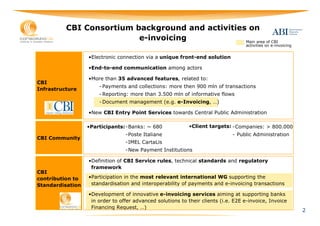
CBI Consortium background and activities on
                          e-invoicing             Main area of CBI
                                                                                   activities on e-invoicing


                  •Electronic connection via a unique front-end solution

                  •End-to-end communication among actors

                  •More than 35 advanced features, related to:
CBI
                      - Payments and collections: more then 900 mln of transactions
Infrastructure
                      - Reporting: more than 3.500 mln of informative flows
                      - Document management (e.g. e-Invoicing, …)

                  •New CBI Entry Point Services towards Central Public Administration

                  •Participants: -Banks: ~ 680              •Client targets: -Companies: > 800.000
                                 -Poste Italiane                              - Public Administration
CBI Community
                                 -IMEL CartaLis
                                 -New Payment Institutions

                  •Definition of CBI Service rules, technical standards and regulatory
                   framework
CBI
contribution to   •Participation in the most relevant international WG supporting the
Standardisation    standardisation and interoperability of payments and e-invoicing transactions

                  •Development of innovative e-invoicing services aiming at supporting banks
                   in order to offer advanced solutions to their clients (i.e. E2E e-invoice, Invoice
                   Financing Request, …)
                                                                                                               2
The CII v2 at work
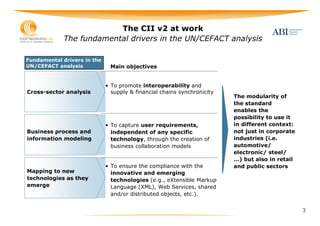
             The fundamental drivers in the UN/CEFACT analysis

Fundamental drivers in the
UN/CEFACT analysis            Main objectives


                             • To promote interoperability and
Cross-sector analysis          supply & financial chains synchronicity
                                                                         The modularity of
                                                                         the standard
                                                                         enables the
                                                                         possibility to use it
                             • To capture user requirements,             in different context:
Business process and           independent of any specific               not just in corporate
information modeling           technology, through the creation of       industries (i.e.
                               business collaboration models             automotive/
                                                                         electronic/ steel/
                                                                         …) but also in retail
                             • To ensure the compliance with the         and public sectors
Mapping to new                 innovative and emerging
technologies as they           technologies (e.g., eXtensible Markup
emerge                         Language (XML), Web Services, shared
                               and/or distributed objects, etc.).


                                                                                                 3
The CII v2 at work
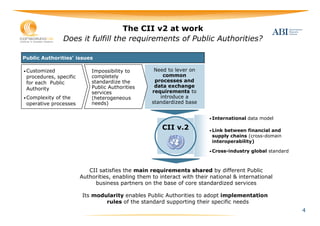
               Does it fulfill the requirements of Public Authorities?

Public Authorities’ issues

• Customized                Impossibility to        Need to lever on
 procedures, specific       completely                 common
 for each Public            standardize the         processes and
                            Public Authorities      data exchange
 Authority
                            services               requirements to
• Complexity of the         (heterogeneous            introduce a
 operative processes        needs)                 standardized base


                                                                         • International data model

                                                       CII v.2           • Link between financial and
                                                                          supply chains (cross-domain
                                                                          interoperability)

                                                                         • Cross-industry global standard


                           CII satisfies the main requirements shared by different Public
                        Authorities, enabling them to interact with their national & international
                             business partners on the base of core standardized services

                        Its modularity enables Public Authorities to adopt implementation
                                rules of the standard supporting their specific needs
                                                                                                            4
The CII v2 at work
                The flexibility of the standard ensures compliance
                   with the business needs of different actors


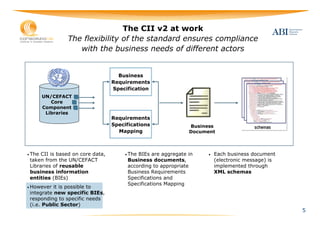
                                     Business
                                   Requirements
                                   Specification
        UN/CEFACT
           Core
        Component
         Libraries
                                   Requirements
                                   Specifications              Business
                                     Mapping                   Document


• The CII is based on core data,       • TheBIEs are aggregate in    •   Each business document
 taken from the UN/CEFACT               Business documents,              (electronic message) is
 Libraries of reusable                  according to appropriate         implemented through
 business information                   Business Requirements            XML schemas
 entities (BIEs)                        Specifications and
                                        Specifications Mapping
• However  it is possible to
 integrate new specific BIEs,
 responding to specific needs
 (i.e. Public Sector)
                                                                                                   5
Supply and Financial Chain integration
                              Does the CII v2 accelerate the
                            order/invoice/payment integration?


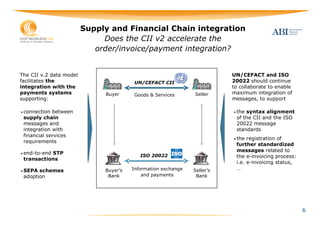
The CII v.2 data model                                                    UN/CEFACT and ISO
facilitates the                          UN/CEFACT CII                    20022 should continue
integration with the                                                      to collaborate to enable
payments systems              Buyer     Goods & Services       Seller     maximum integration of
supporting:                                                               messages, to support

• connection between                                                      • thesyntax alignment
 supply chain                                                              of the CII and the ISO
 messages and                                                              20022 message
 integration with                                                          standards
 financial services
                                                                          • the registration of
 requirements
                                                                           further standardized
                                                                           messages related to
• end-to-end
           STP
                                           ISO 20022                       the e-invoicing process:
 transactions
                                                                           i.e. e-invoicing status,
• SEPA schemes                Buyer’s   Information exchange   Seller’s    …
 adoption                      Bank         and payments        Bank


                                                                                                      6
“If you want to go fast, walk alone.
If you want to go far, walk together“
                                     (African Saying)


            Thank you
             l.fratinipassi@abi.it
                www.cbi-org.eu


                                                        7

E invoicing, stakeholders’ perspective on the cii

  • 1.
    Conference “Electronic Invoicingin Europe” Is the UN/CEFACT Cross Industry Invoice standard meeting user requirements? Stakeholders’ perspective on the CII Liliana Fratini Passi Secretary General - CBI Consortium Member of the EC Expert Group on Electronic Invoicing Madrid, 28th April 2010
  • 2.
    CBI Consortium backgroundand activities on e-invoicing Main area of CBI activities on e-invoicing •Electronic connection via a unique front-end solution •End-to-end communication among actors •More than 35 advanced features, related to: CBI - Payments and collections: more then 900 mln of transactions Infrastructure - Reporting: more than 3.500 mln of informative flows - Document management (e.g. e-Invoicing, …) •New CBI Entry Point Services towards Central Public Administration •Participants: -Banks: ~ 680 •Client targets: -Companies: > 800.000 -Poste Italiane - Public Administration CBI Community -IMEL CartaLis -New Payment Institutions •Definition of CBI Service rules, technical standards and regulatory framework CBI contribution to •Participation in the most relevant international WG supporting the Standardisation standardisation and interoperability of payments and e-invoicing transactions •Development of innovative e-invoicing services aiming at supporting banks in order to offer advanced solutions to their clients (i.e. E2E e-invoice, Invoice Financing Request, …) 2
  • 3.
    The CII v2at work The fundamental drivers in the UN/CEFACT analysis Fundamental drivers in the UN/CEFACT analysis Main objectives • To promote interoperability and Cross-sector analysis supply & financial chains synchronicity The modularity of the standard enables the possibility to use it • To capture user requirements, in different context: Business process and independent of any specific not just in corporate information modeling technology, through the creation of industries (i.e. business collaboration models automotive/ electronic/ steel/ …) but also in retail • To ensure the compliance with the and public sectors Mapping to new innovative and emerging technologies as they technologies (e.g., eXtensible Markup emerge Language (XML), Web Services, shared and/or distributed objects, etc.). 3
  • 4.
    The CII v2at work Does it fulfill the requirements of Public Authorities? Public Authorities’ issues • Customized Impossibility to Need to lever on procedures, specific completely common for each Public standardize the processes and Public Authorities data exchange Authority services requirements to • Complexity of the (heterogeneous introduce a operative processes needs) standardized base • International data model CII v.2 • Link between financial and supply chains (cross-domain interoperability) • Cross-industry global standard CII satisfies the main requirements shared by different Public Authorities, enabling them to interact with their national & international business partners on the base of core standardized services Its modularity enables Public Authorities to adopt implementation rules of the standard supporting their specific needs 4
  • 5.
    The CII v2at work The flexibility of the standard ensures compliance with the business needs of different actors Business Requirements Specification UN/CEFACT Core Component Libraries Requirements Specifications Business Mapping Document • The CII is based on core data, • TheBIEs are aggregate in • Each business document taken from the UN/CEFACT Business documents, (electronic message) is Libraries of reusable according to appropriate implemented through business information Business Requirements XML schemas entities (BIEs) Specifications and Specifications Mapping • However it is possible to integrate new specific BIEs, responding to specific needs (i.e. Public Sector) 5
  • 6.
    Supply and FinancialChain integration Does the CII v2 accelerate the order/invoice/payment integration? The CII v.2 data model UN/CEFACT and ISO facilitates the UN/CEFACT CII 20022 should continue integration with the to collaborate to enable payments systems Buyer Goods & Services Seller maximum integration of supporting: messages, to support • connection between • thesyntax alignment supply chain of the CII and the ISO messages and 20022 message integration with standards financial services • the registration of requirements further standardized messages related to • end-to-end STP ISO 20022 the e-invoicing process: transactions i.e. e-invoicing status, • SEPA schemes Buyer’s Information exchange Seller’s … adoption Bank and payments Bank 6
  • 7.
    “If you wantto go fast, walk alone. If you want to go far, walk together“ (African Saying) Thank you l.fratinipassi@abi.it www.cbi-org.eu 7