Download to read offline


![Open Data Landscape :
User, Actors and Practices
[IT Geeks, Government Agency,Parliament,
Tax Biro, Oversight Body/Investigators, Anti-
Corruption and Law Authority/Law Enforcer,
Journalist, Researcher/Academician, NGOs,
Communities and other citizen]](https://image.slidesharecdn.com/opendata-maryati-melearnmalaysia-160512070507/85/Open-Data-and-Anti-Corruption-A-Great-Fit-5-320.jpg)
![Civil Society Engagement
[with KPK – MEMR – Local Government on GN SDA & EITI]
Mining License
Audited
Mining License
Audited
Production & Revenue
State (Tax, Royalties,
etc) – collaboration
with EITI
Production & Revenue
State (Tax, Royalties,
etc) – collaboration
with EITI
Environmental
Protection (Forest and
land use, rehabilitation
& post-mining funds,
etc)
Environmental
Protection (Forest and
land use, rehabilitation
& post-mining funds,
etc)
* Contract
Renegotiation &
Downstream
Development
* Contract
Renegotiation &
Downstream
Development](https://image.slidesharecdn.com/opendata-maryati-melearnmalaysia-160512070507/85/Open-Data-and-Anti-Corruption-A-Great-Fit-11-320.jpg)


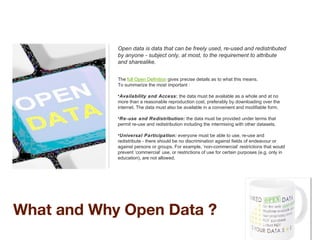
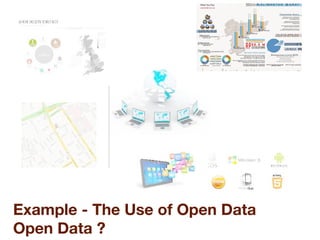
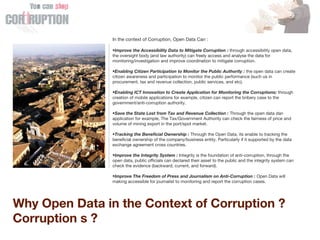
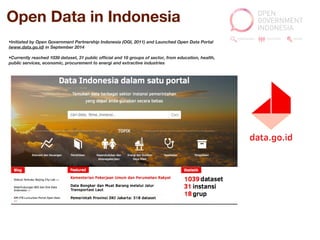
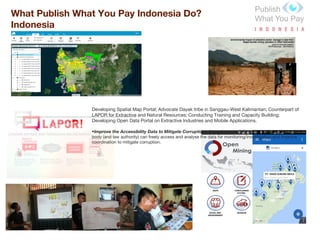
This document discusses how open data can help reduce corruption. It defines open data as data that can be freely used, shared, and redistributed, subject to attribution. Open data improves accessibility for oversight bodies to monitor for corruption. It also enables citizen participation in monitoring public authorities and creates applications to report corruption. Open data can help track beneficial ownership, improve integrity declarations, and allow journalists to investigate corruption cases. Indonesia has launched an open data portal with over 1000 datasets from various sectors. The Publish What You Pay Indonesia group develops spatial maps and mobile apps on extractive industries data and advocates for transparency in mining regions.


