Local Open Data: A perspective from 
local government in England 
Gesche Schmid 
Programme Manager Transparency, LGA 
Brussels, 3 December 2014 
Gesche.schmid@local.gov.uk, @GescheSchmid 
www.local.gov.uk/local-transparency
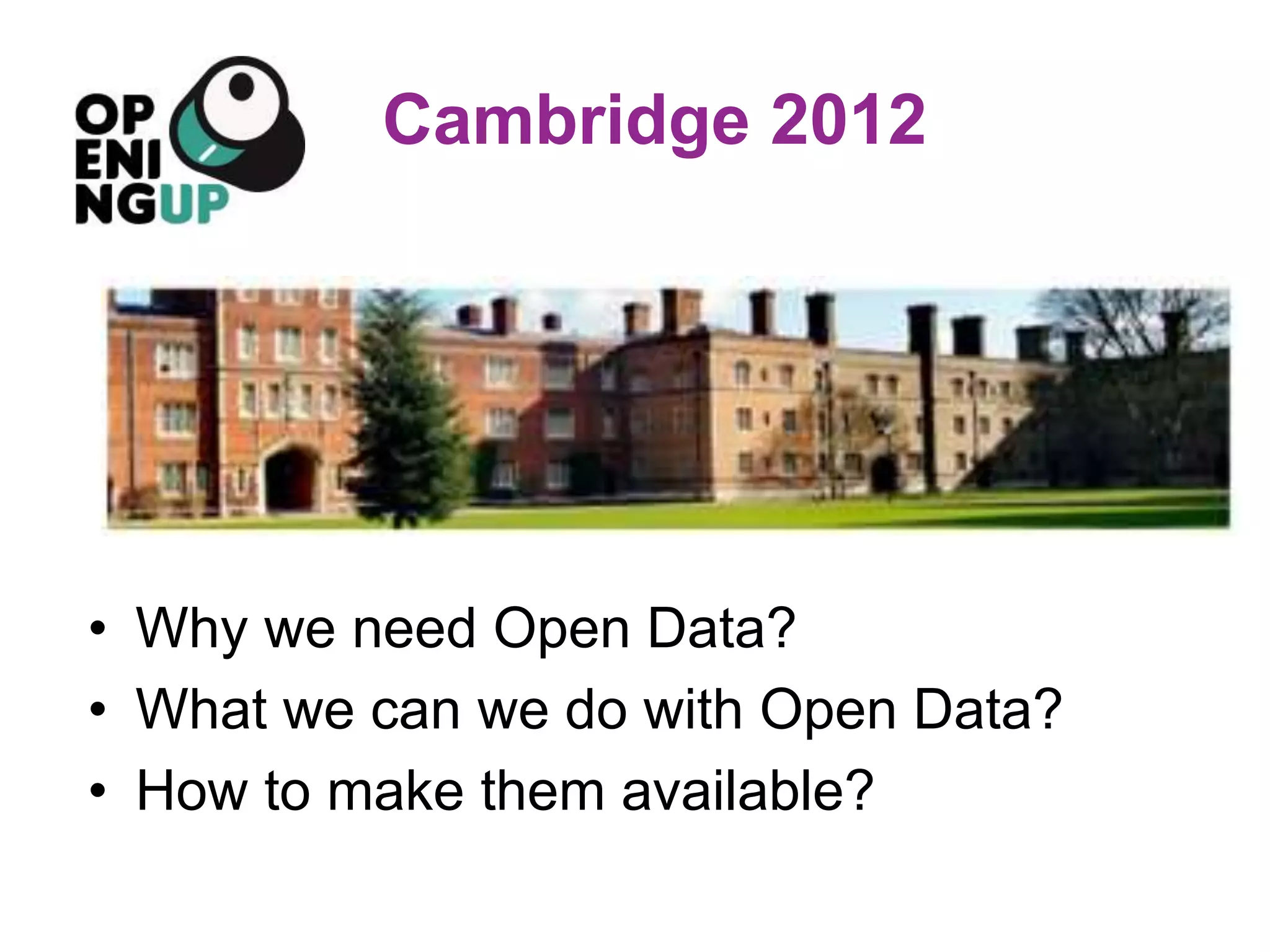
Cambridge 2012 
• Why we need Open Data? 
• What we can we do with Open Data? 
• How to make them available?
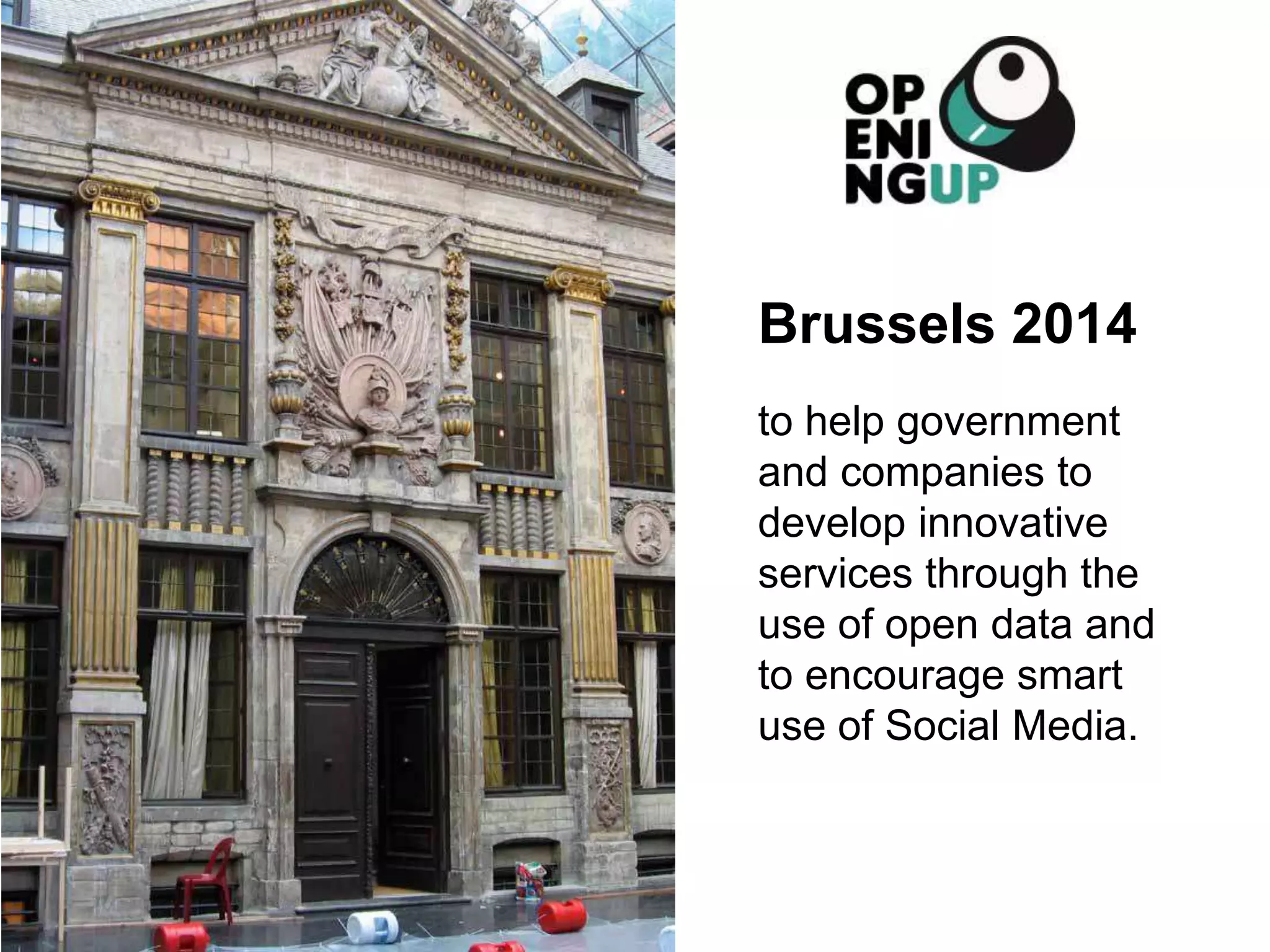
Brussels 2014 
to help government 
and companies to 
develop innovative 
services through the 
use of open data and 
to encourage smart 
use of Social Media.
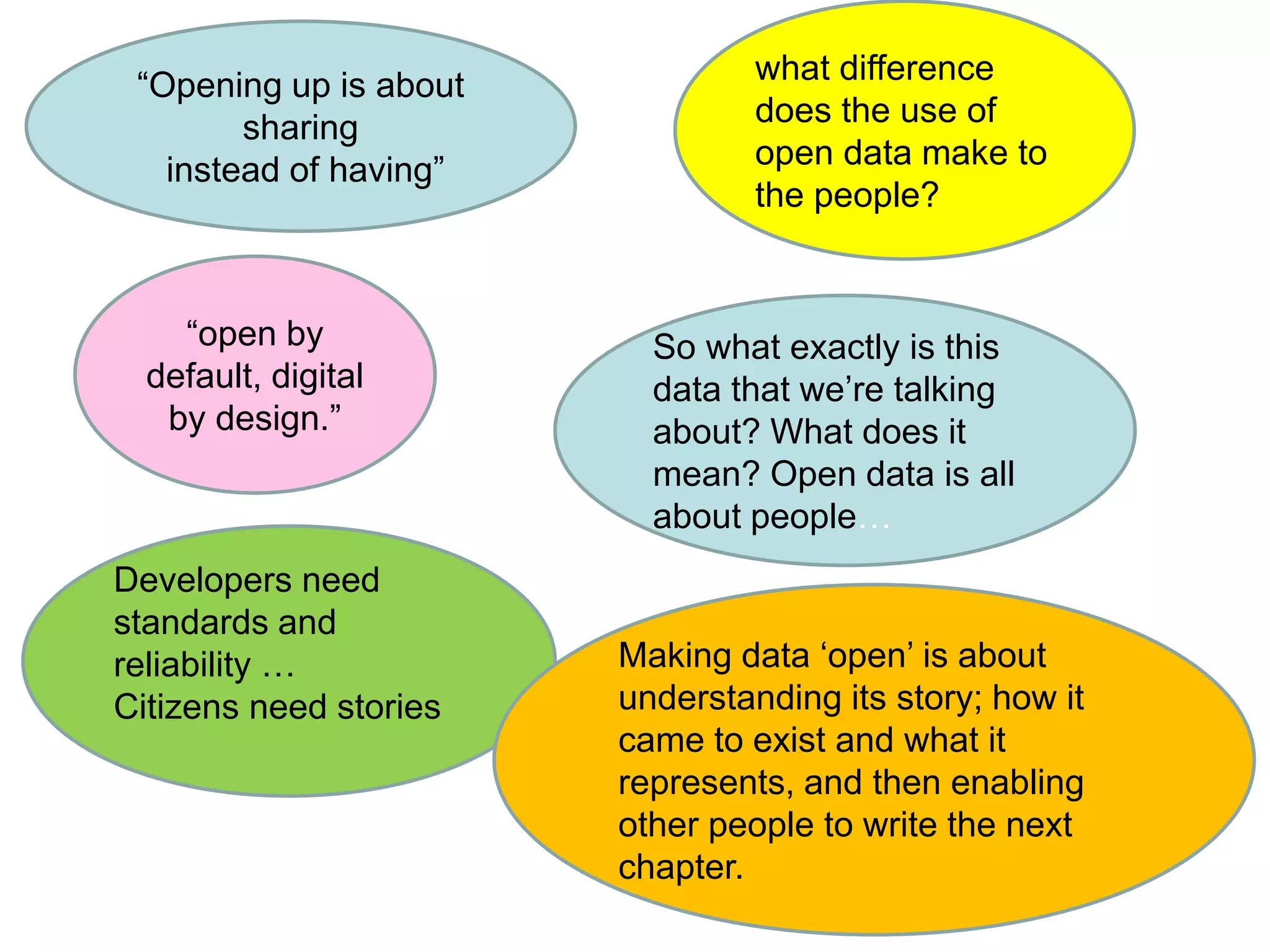
“Opening up is about 
sharing 
instead of having” 
“open by 
default, digital 
by design.” 
what difference 
does the use of 
open data make to 
the people? 
So what exactly is this 
data that we’re talking 
about? What does it 
mean? Open data is all 
about people… 
Developers need 
standards and 
reliability … 
Citizens need stories 
Making data ‘open’ is about 
understanding its story; how it 
came to exist and what it 
represents, and then enabling 
other people to write the next 
chapter.
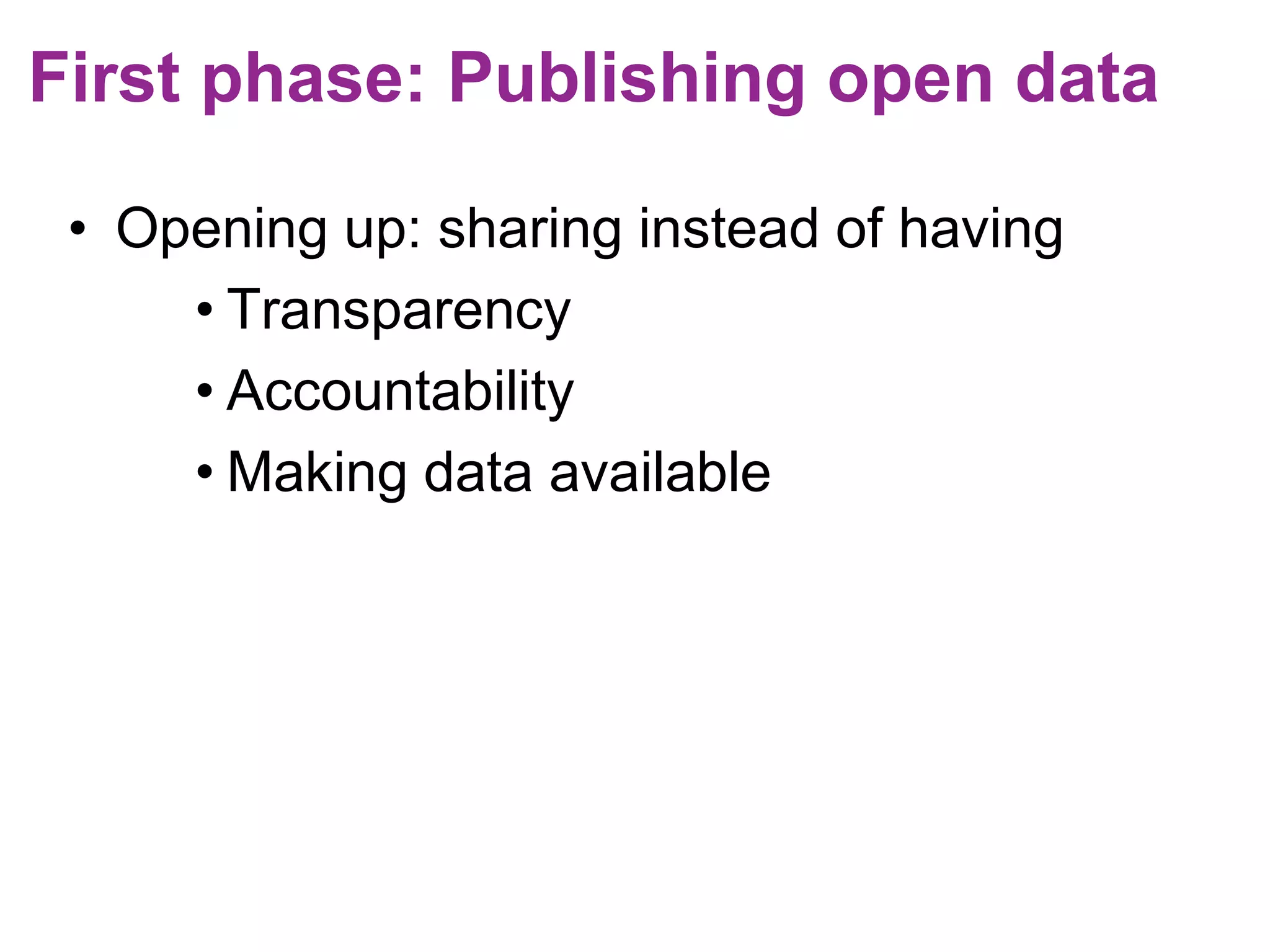
First phase: Publishing open data 
• Opening up: sharing instead of having 
• Transparency 
• Accountability 
• Making data available
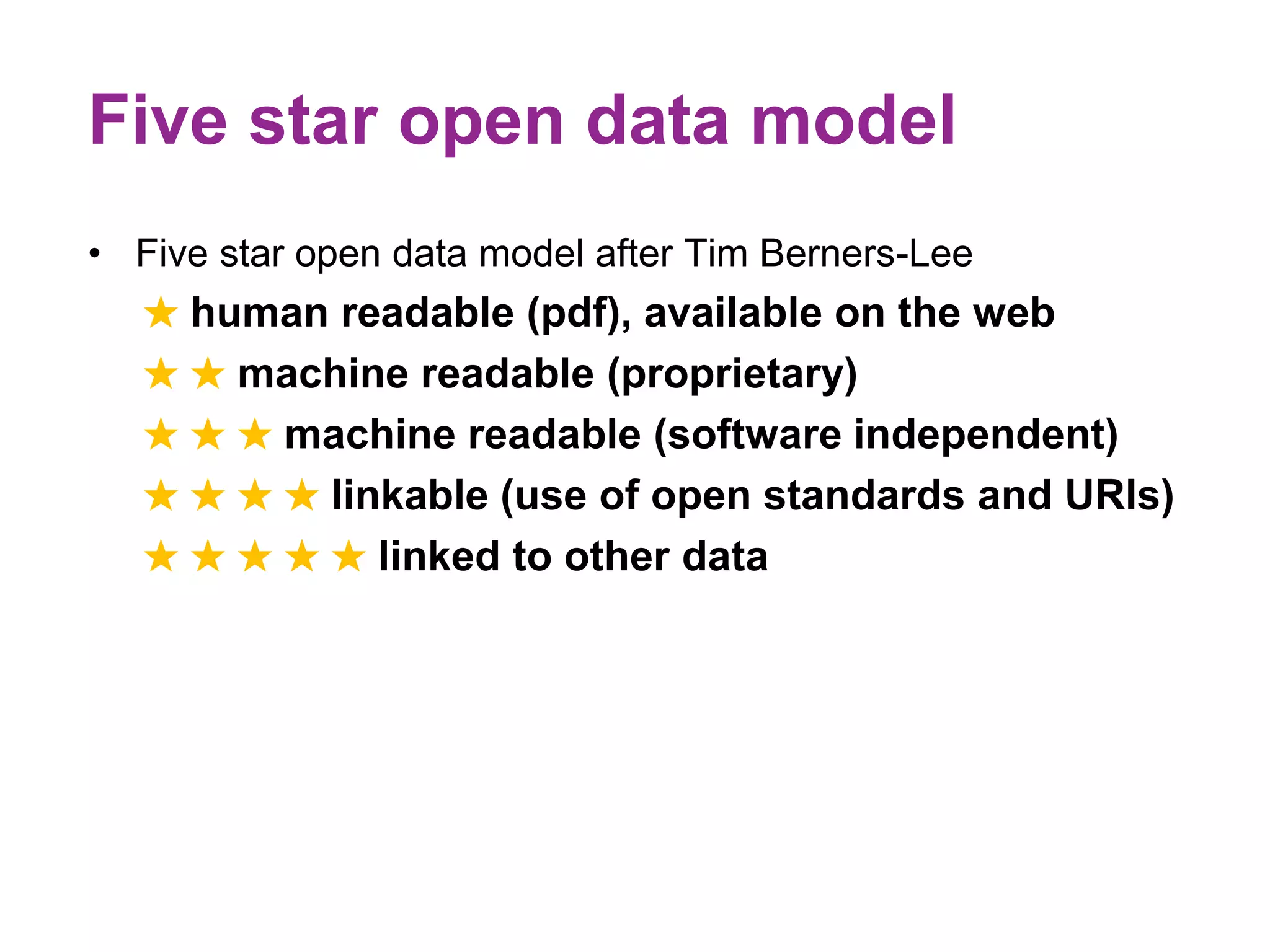
Five star open data model 
• Five star open data model after Tim Berners-Lee 
★ human readable (pdf), available on the web 
★ ★ machine readable (proprietary) 
★ ★ ★ machine readable (software independent) 
★ ★ ★ ★ linkable (use of open standards and URIs) 
★ ★ ★ ★ ★ linked to other data
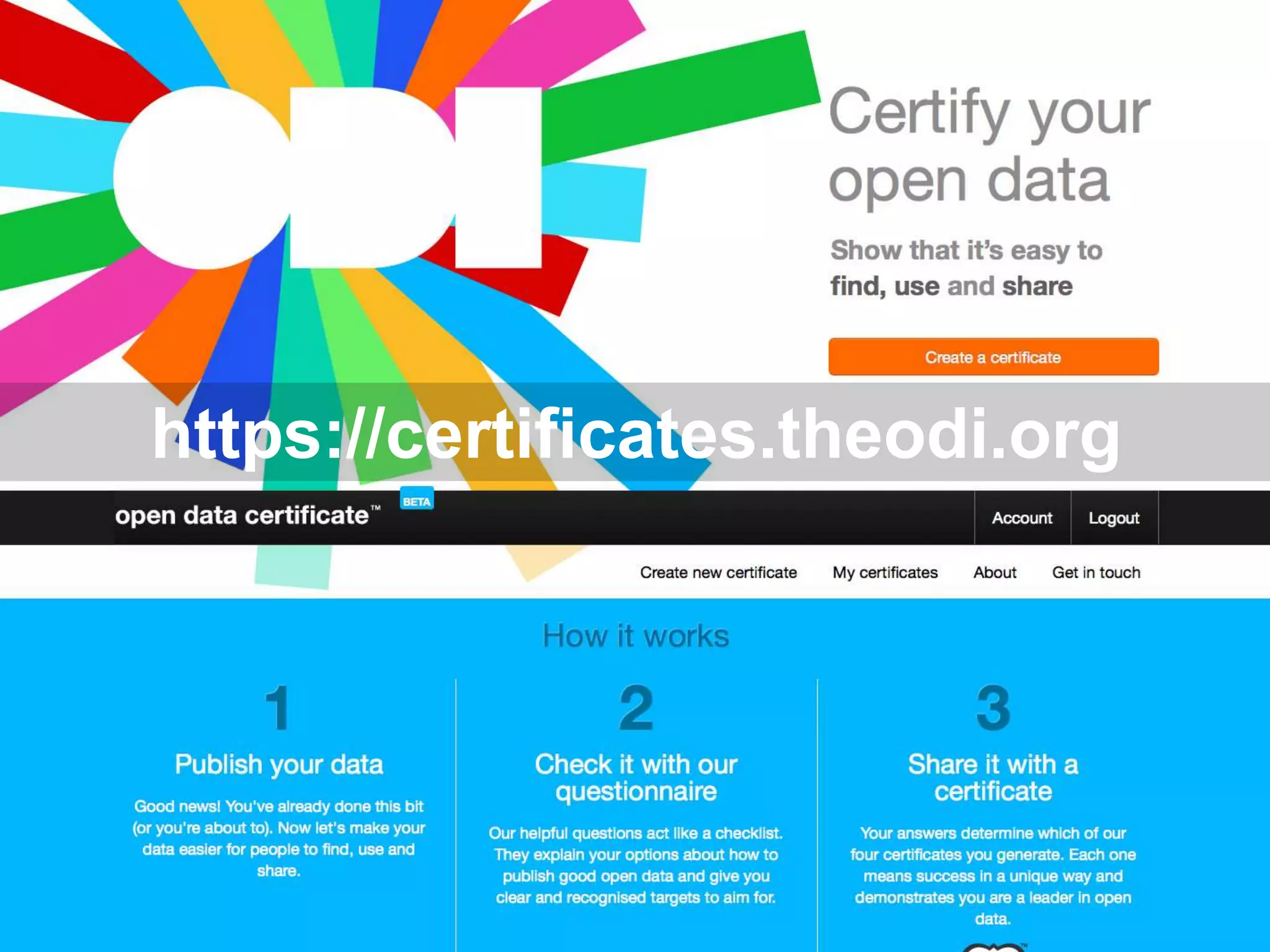
https://certificates.theodi.org
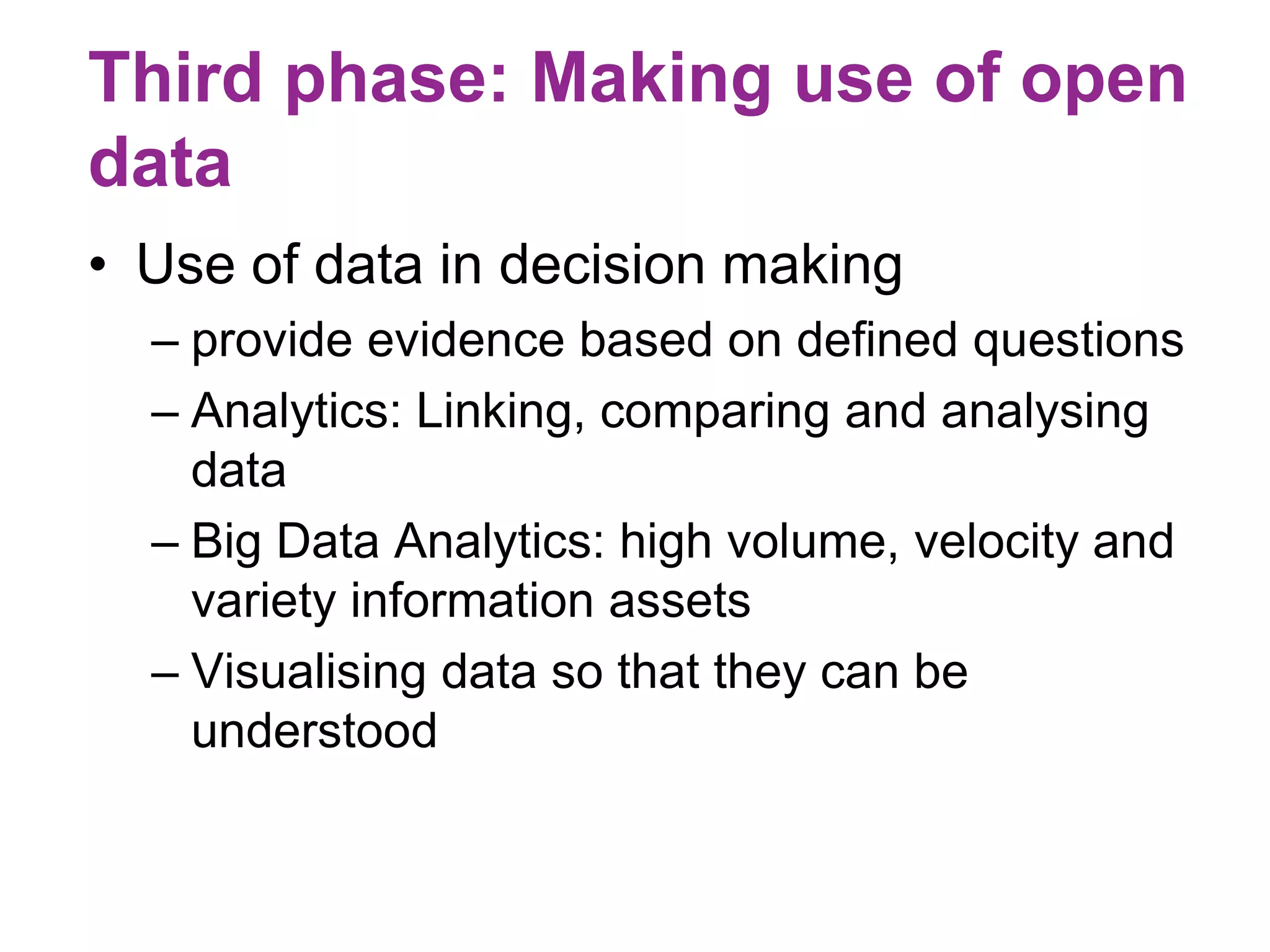
Second phase: 
standardising data 
• Open by default, digital by design 
• Developers need standards and reliability 
• Local information infrastructures 
– Meta data (inventories) 
– Classification 
– Standards 
– Core reference data, URIs 
– Schemas 
– Ontologies
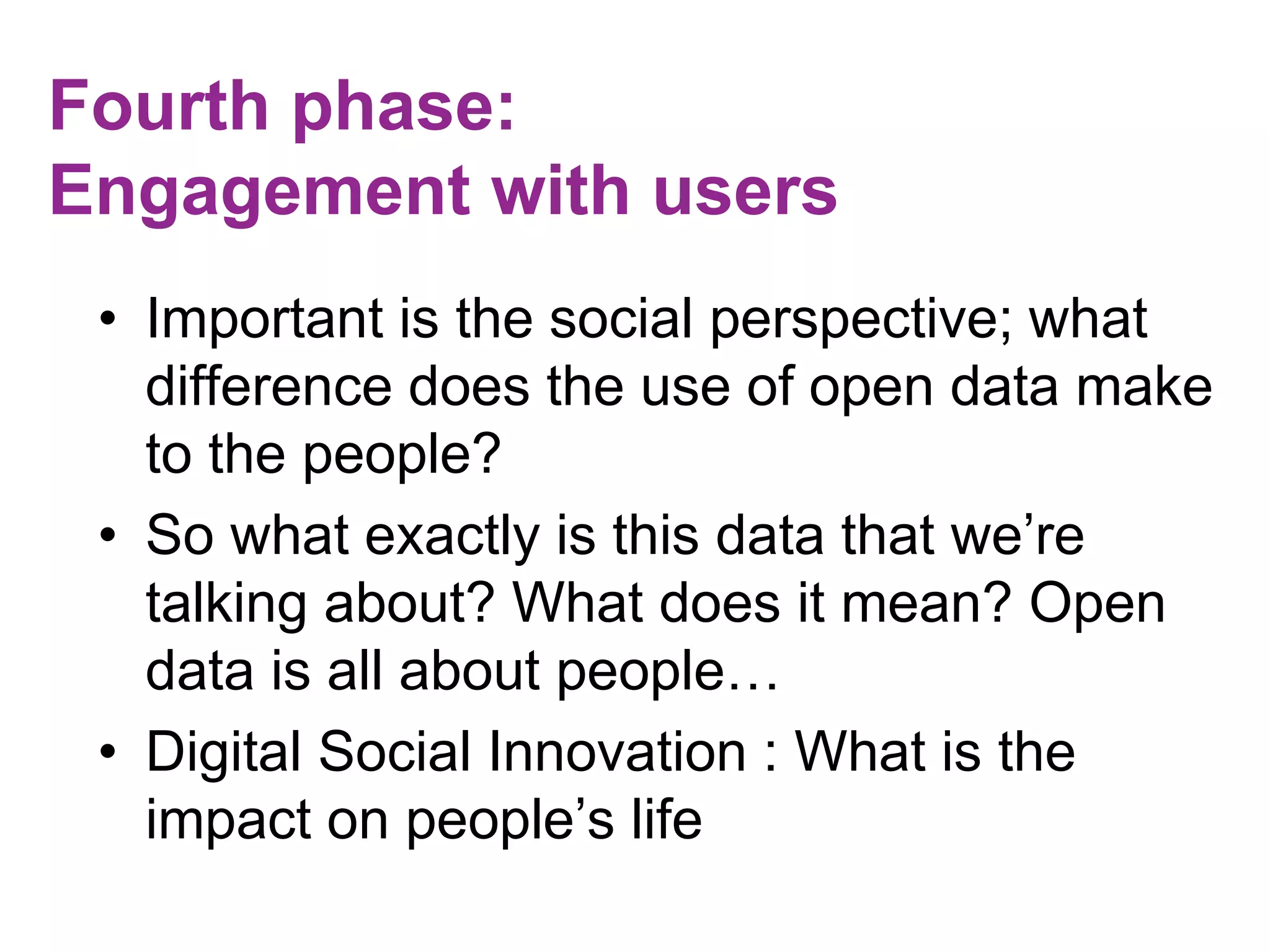
Third phase: Making use of open 
data 
• Use of data in decision making 
– provide evidence based on defined questions 
– Analytics: Linking, comparing and analysing 
data 
– Big Data Analytics: high volume, velocity and 
variety information assets 
– Visualising data so that they can be 
understood
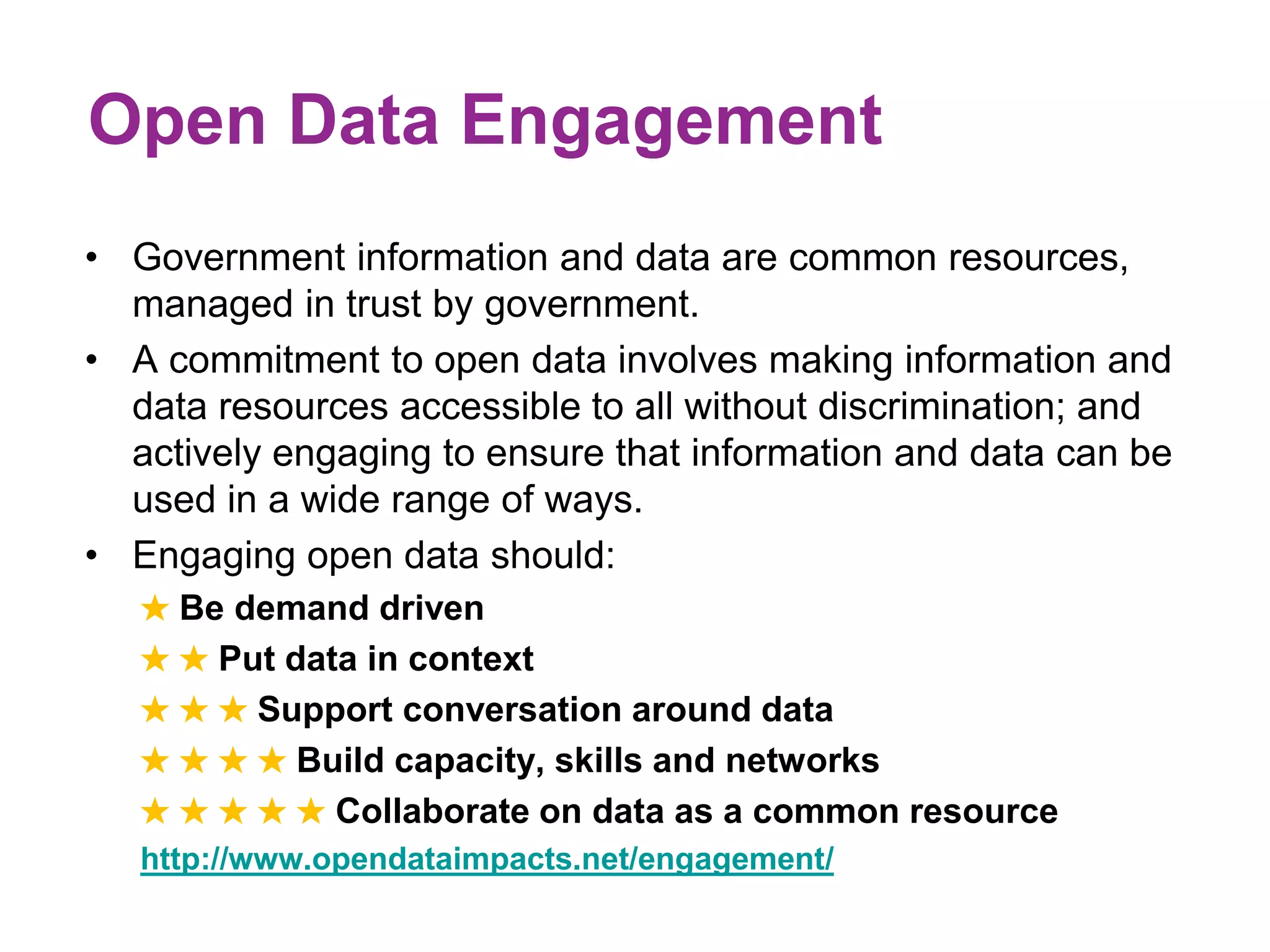
Fourth phase: 
Engagement with users 
• Important is the social perspective; what 
difference does the use of open data make 
to the people? 
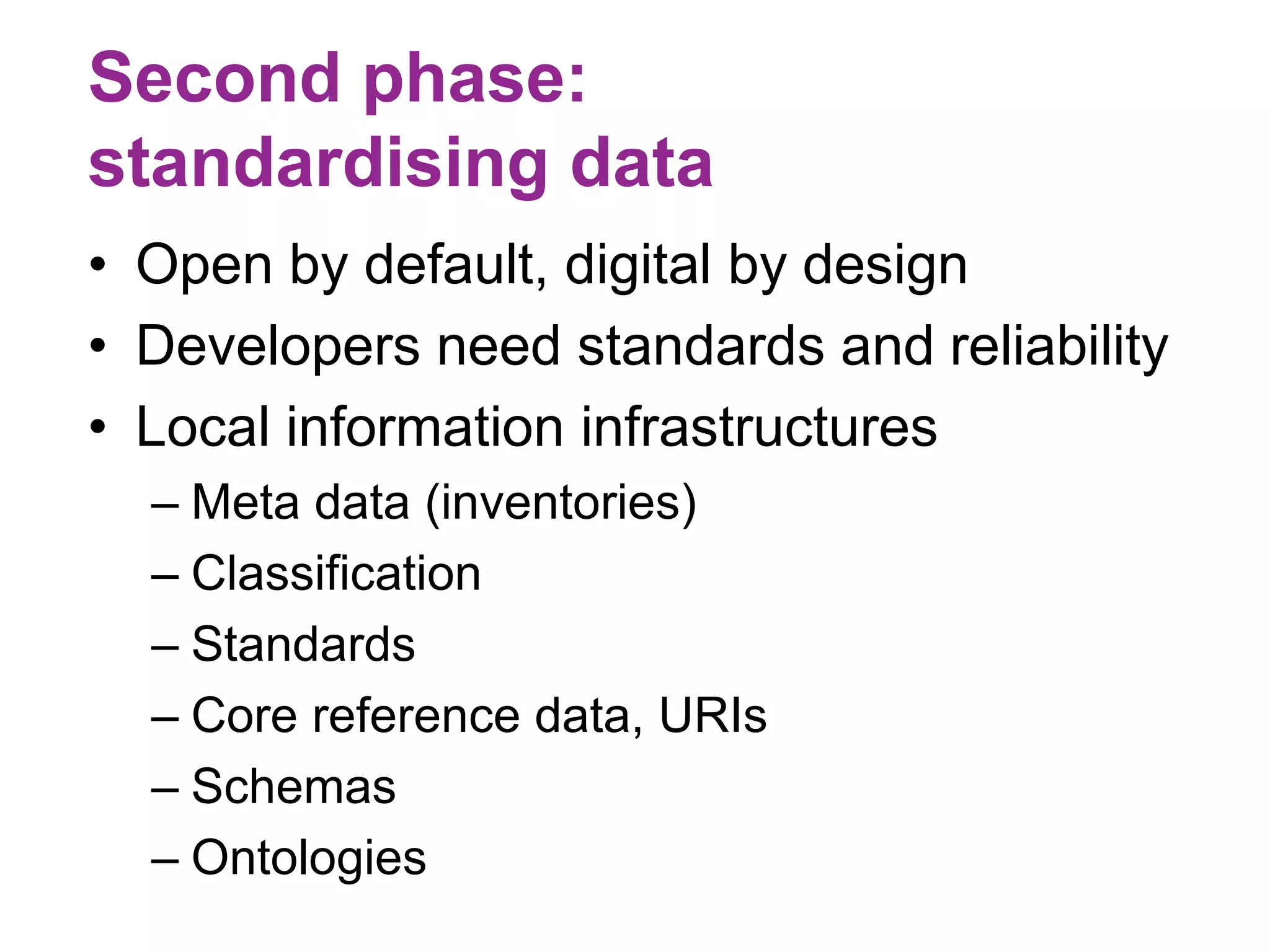
• So what exactly is this data that we’re 
talking about? What does it mean? Open 
data is all about people… 
• Digital Social Innovation : What is the 
impact on people’s life
Open Data Engagement 
• Government information and data are common resources, 
managed in trust by government. 
• A commitment to open data involves making information and 
data resources accessible to all without discrimination; and 
actively engaging to ensure that information and data can be 
used in a wide range of ways. 
• Engaging open data should: 
★ Be demand driven 
★ ★ Put data in context 
★ ★ ★ Support conversation around data 
★ ★ ★ ★ Build capacity, skills and networks 
★ ★ ★ ★ ★ Collaborate on data as a common resource 
http://www.opendataimpacts.net/engagement/
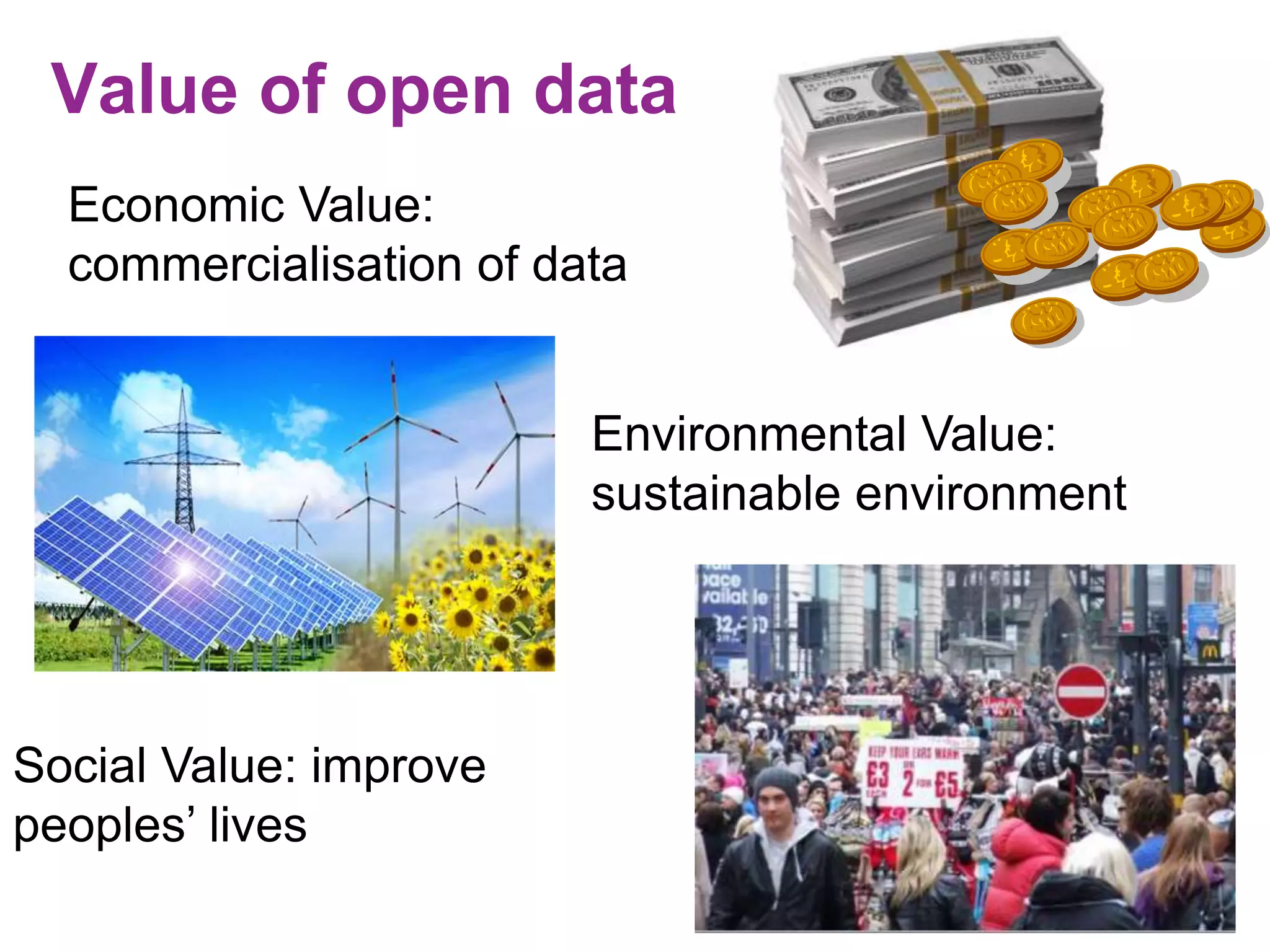
Value of open data 
Economic Value: 
commercialisation of data 
Environmental Value: 
sustainable environment 
Social Value: improve 
peoples’ lives
Local Transparency 
(England) 
• Local government supports a 
presumption in favour of 
transparency and open data 
• transparency fosters greater accountability and 
democracy 
• ready access and meaningful use of open data 
– Innovates and transforms local public services 
– Empowers citizen, business, community 
groups 
• The pace of the transition from closed to open 
data is based on local needs and demand 
Social, environmental and economic
Opportunities for the use of open 
data 
• Accountability and accessibility (legal) 
• Efficiencies (austerity) 
• Engagement (internal and external) 
• Self service (customer expectation) 
• Business and customer insight 
• Service integration across organisations 
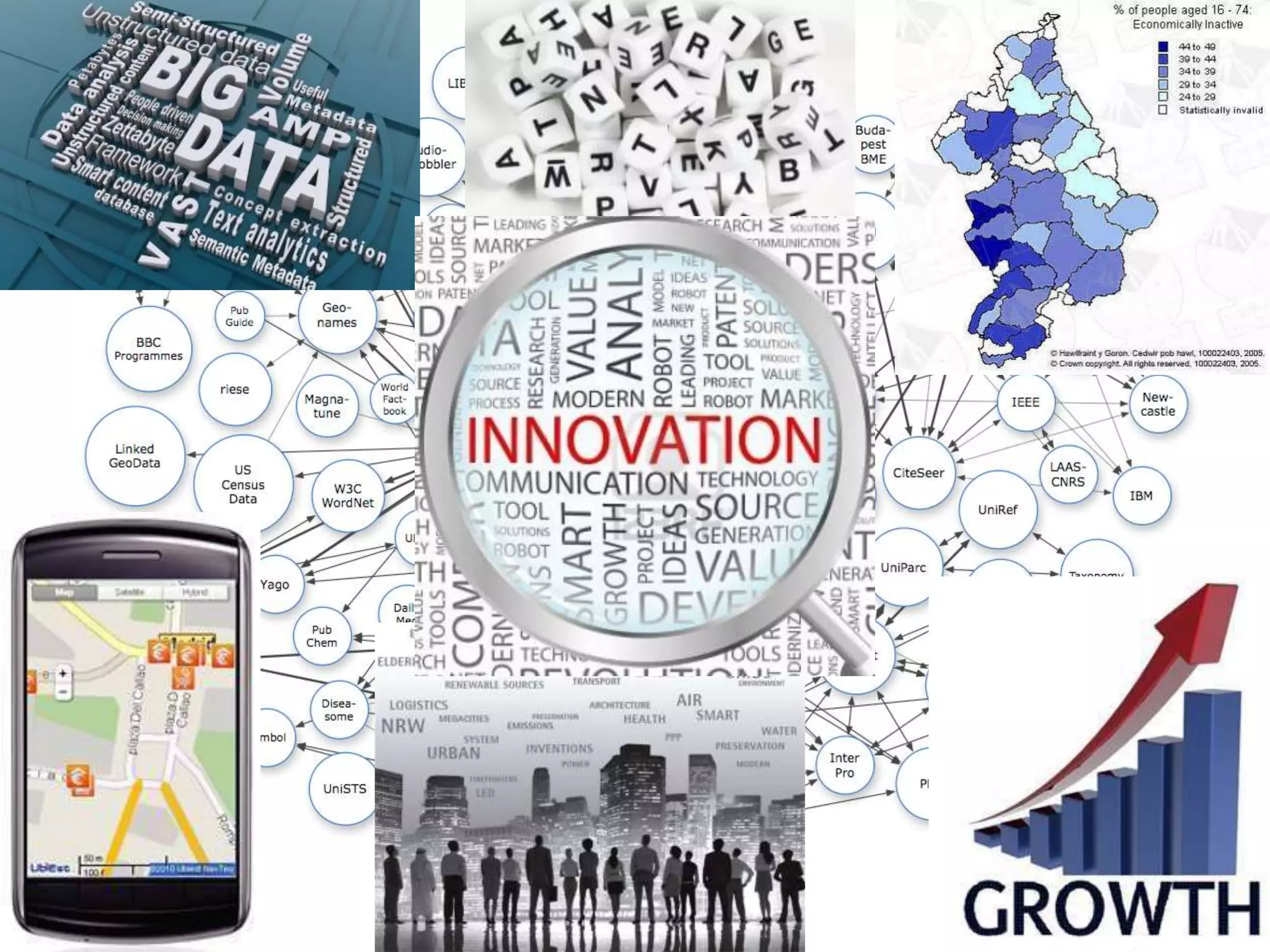
• Innovation (smart cities and communities) 
• Economic growth (business opportunities)
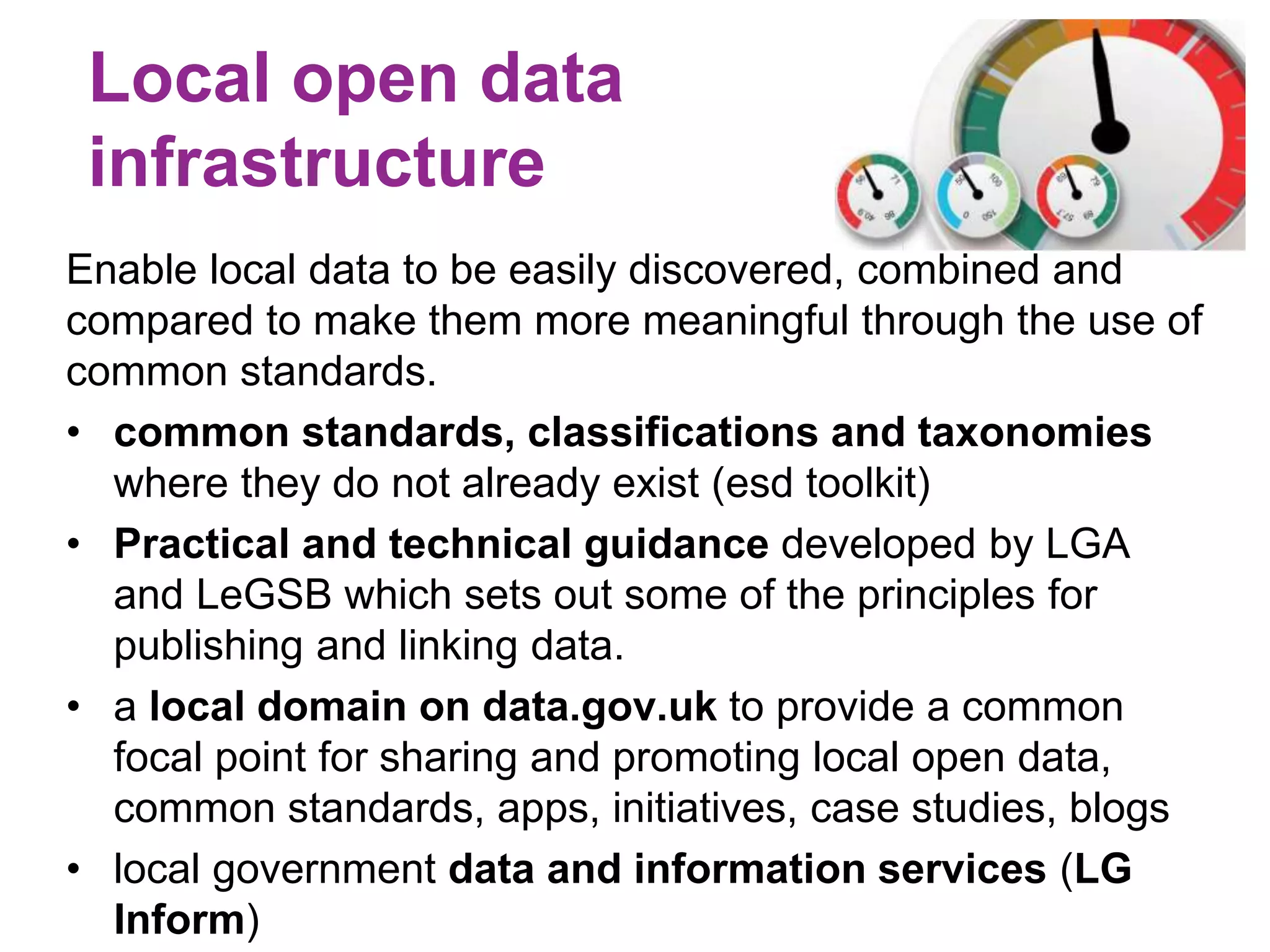
Local open data 
infrastructure 
Enable local data to be easily discovered, combined and 
compared to make them more meaningful through the use of 
common standards. 
• common standards, classifications and taxonomies 
where they do not already exist (esd toolkit) 
• Practical and technical guidance developed by LGA 
and LeGSB which sets out some of the principles for 
publishing and linking data. 
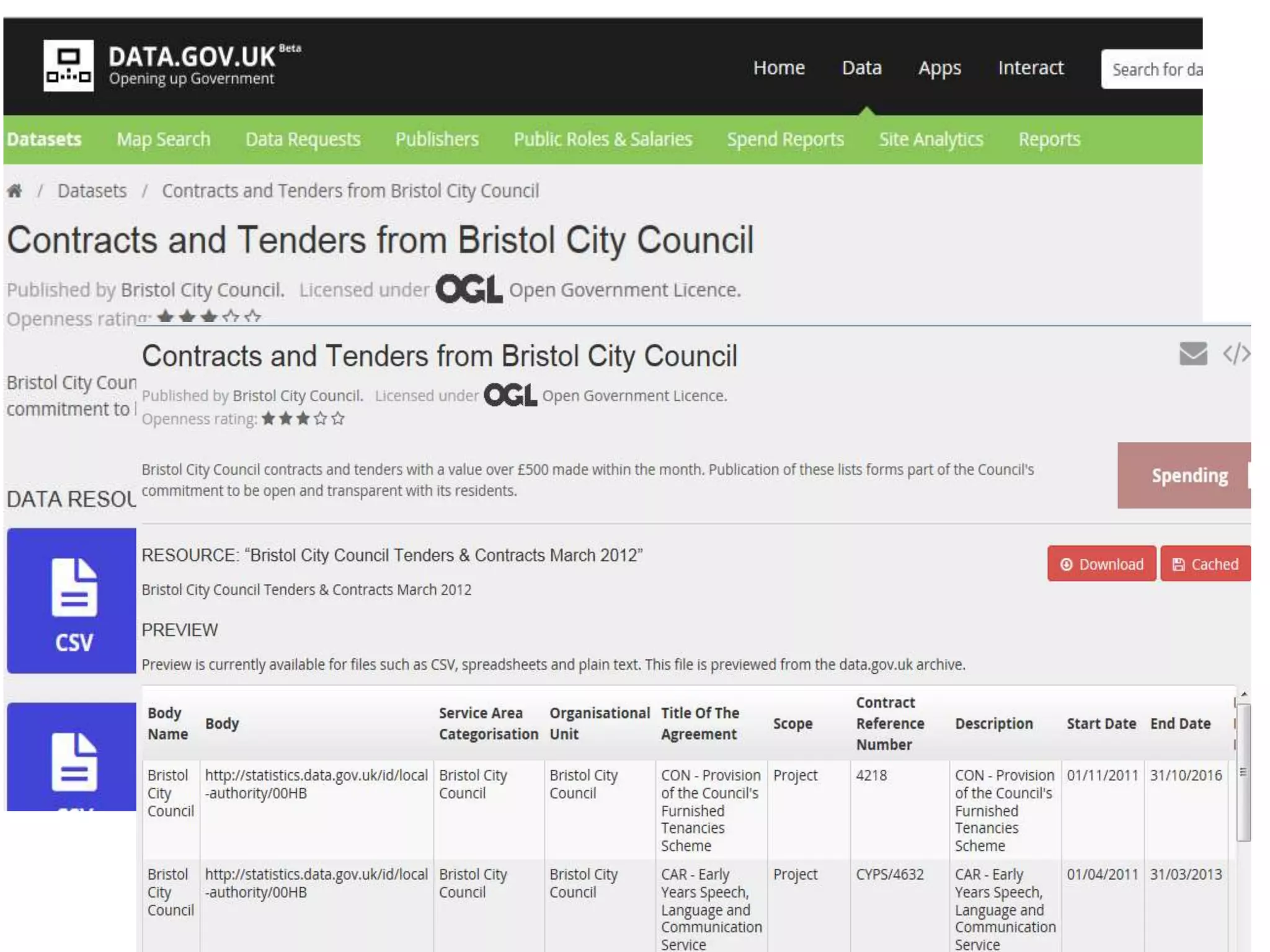
• a local domain on data.gov.uk to provide a common 
focal point for sharing and promoting local open data, 
common standards, apps, initiatives, case studies, blogs 
• local government data and information services (LG 
Inform)
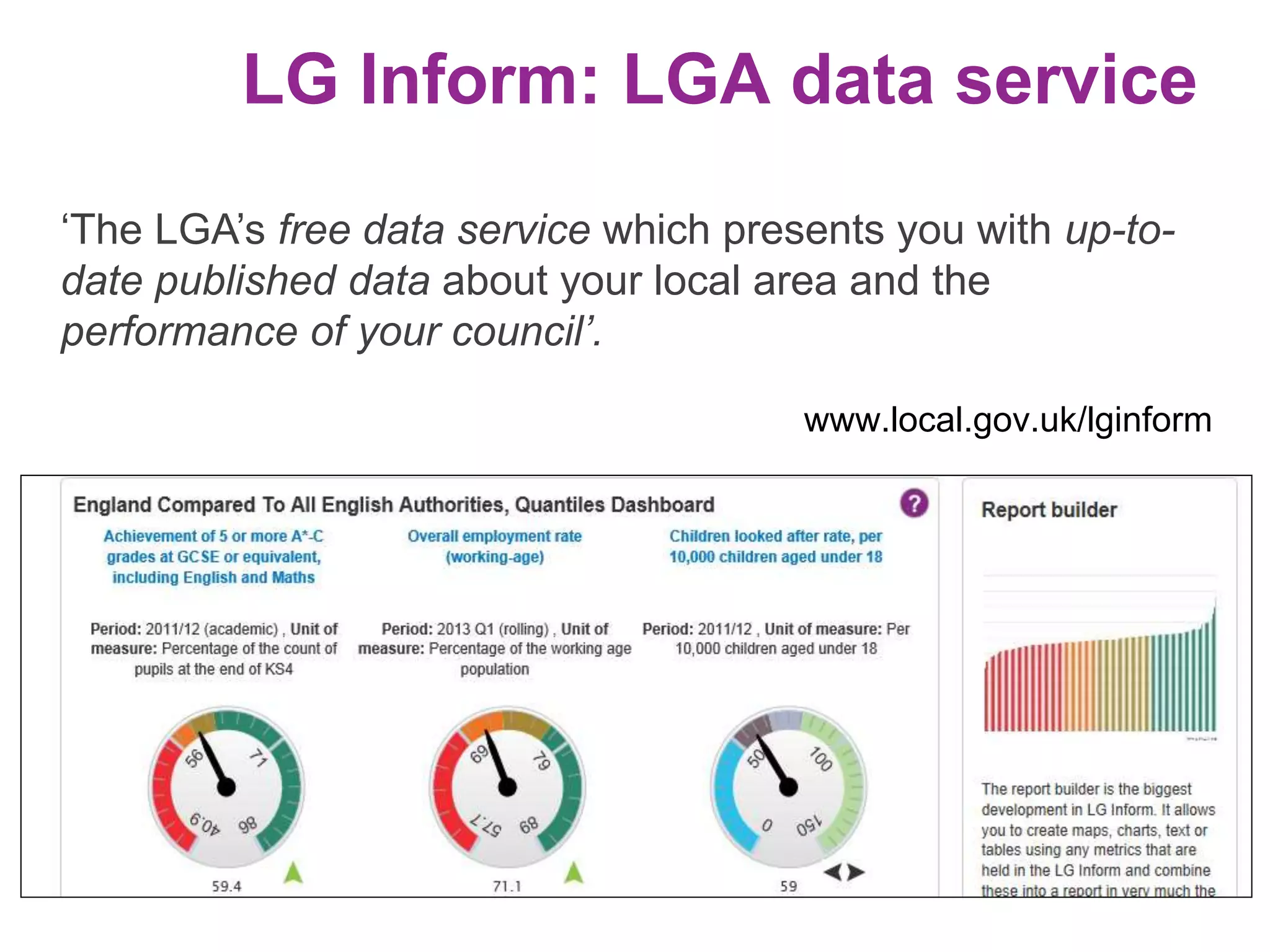
LG Inform: LGA data service 
‘The LGA’s free data service which presents you with up-to-date 
published data about your local area and the 
performance of your council’. 
www.local.gov.uk/lginform
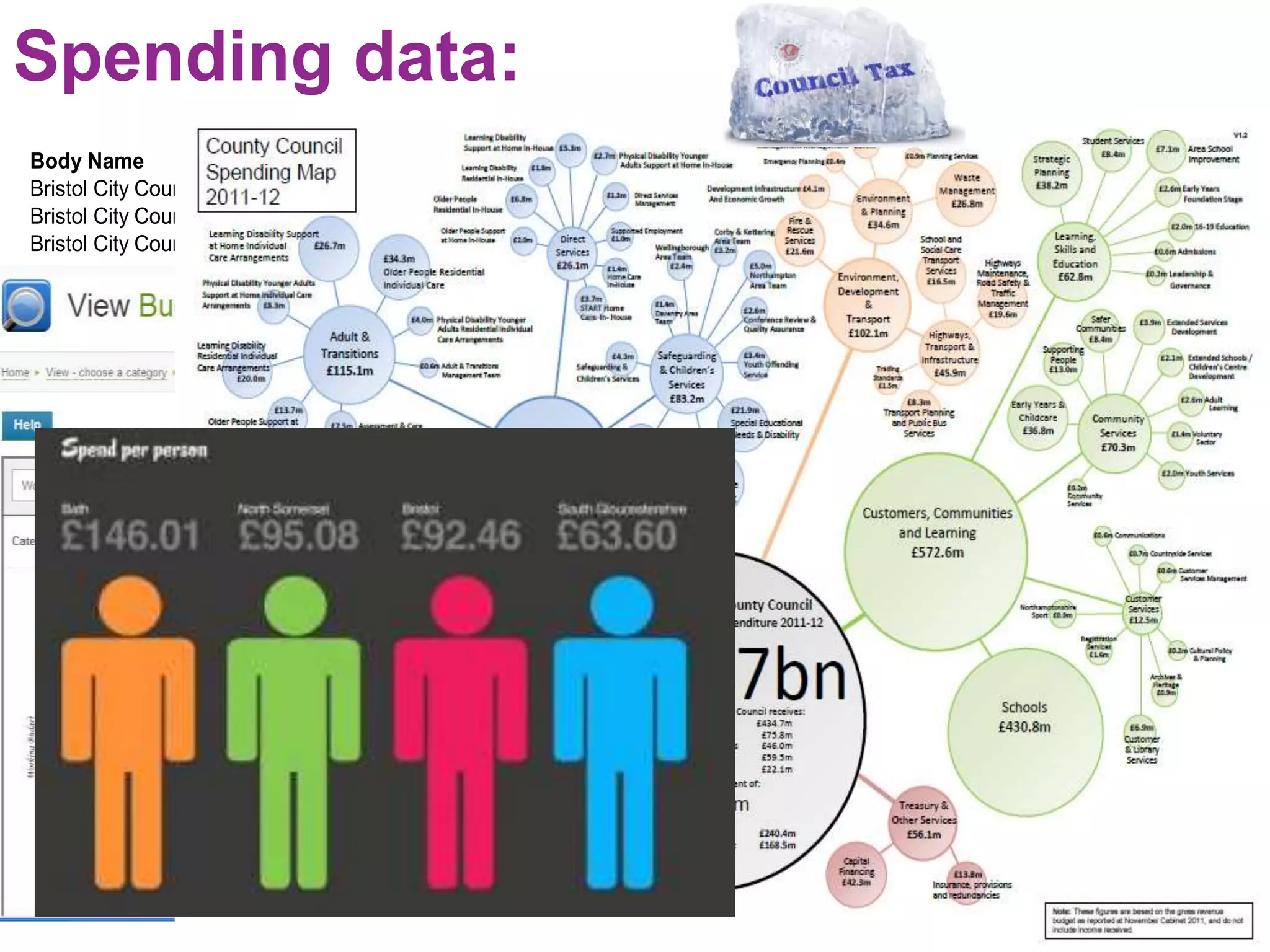
Spending data: 
Body Name Body Name Amount Pay Date Description 1 Description Bristol City Council http://statistics.data.gov.u @SYMESk /HidA/loRcTaCl-aLuIFthFoEr i&ty /W00IHTHBYWO5O9D0 COMM30U/0N8IT/2Y0 1P2ARETMNPELROSYHEIEP TRAINING COOSRTGSANISATION Bristol City Council http://statistics.da@taS.gYoMv.EuSk /HidA/loRcTaCl-aLuIFthFoEr i&ty /W00IHTHBYW9O6O2D.5 COMM16U/0N8IT/2Y0 1P2ARETMNPELROSYHEIEP TRAINING COOSRTGSANISATION Bristol City Council http://statistics.da1t0a .SgQovU.uAkR/iEd/Dlo cLaIMl-aITuEthDority/00HB 922.5 29/08/2012 EQUIPMENT, FURNITUREN &U RMSAETREYR
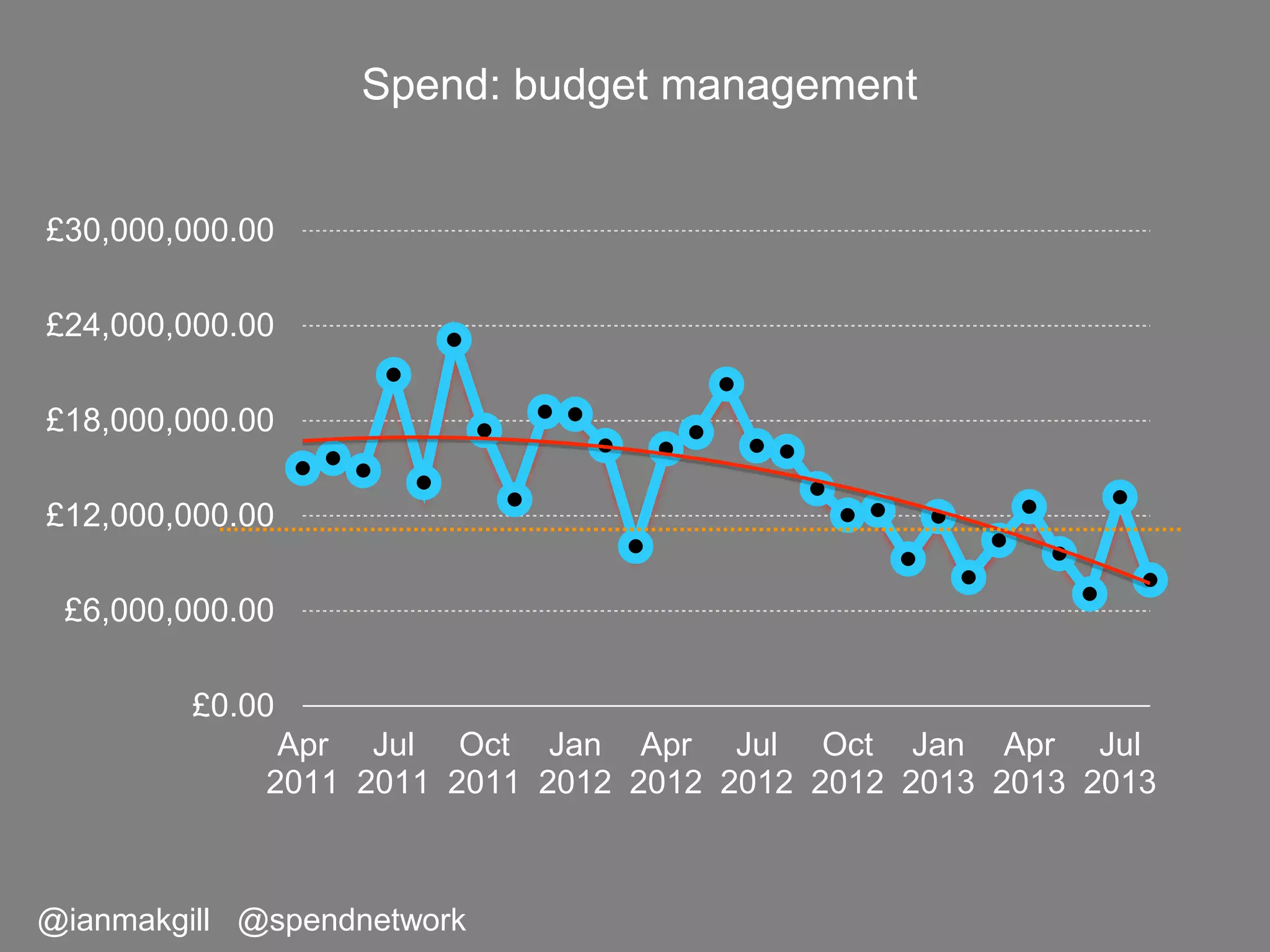
Spend: budget management 
£30,000,000.00 
£24,000,000.00 
£18,000,000.00 
£12,000,000.00 
£6,000,000.00 
£0.00 
Apr 
2011 
Jul 
2011 
Oct 
2011 
@ianmakgill @spendnetwork 
Jan 
2012 
Apr 
2012 
Jul 
2012 
Oct 
2012 
Jan 
2013 
Apr 
2013 
Jul 
2013
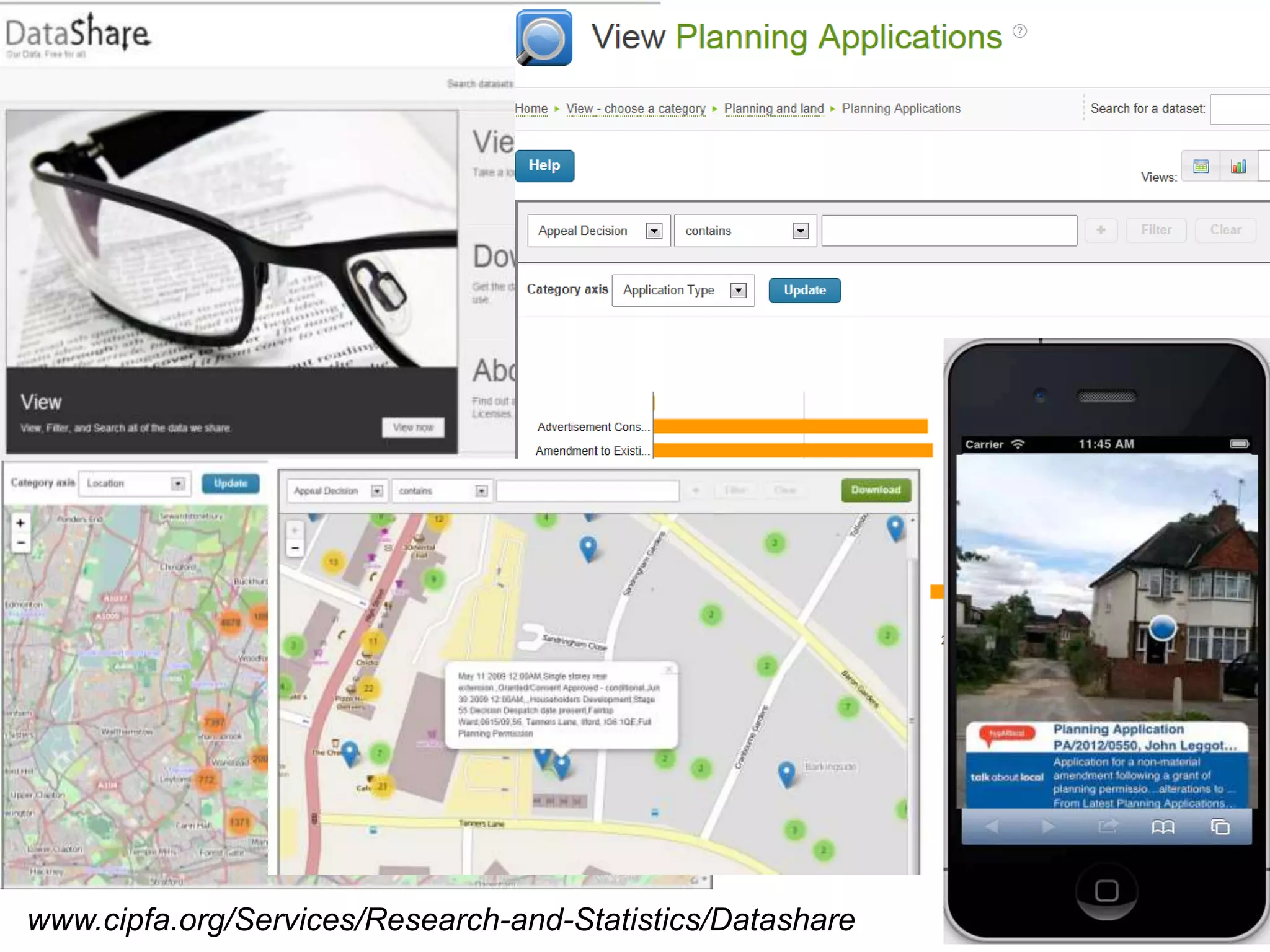
www.cipfa.org/Services/Research-and-Statistics/Datashare
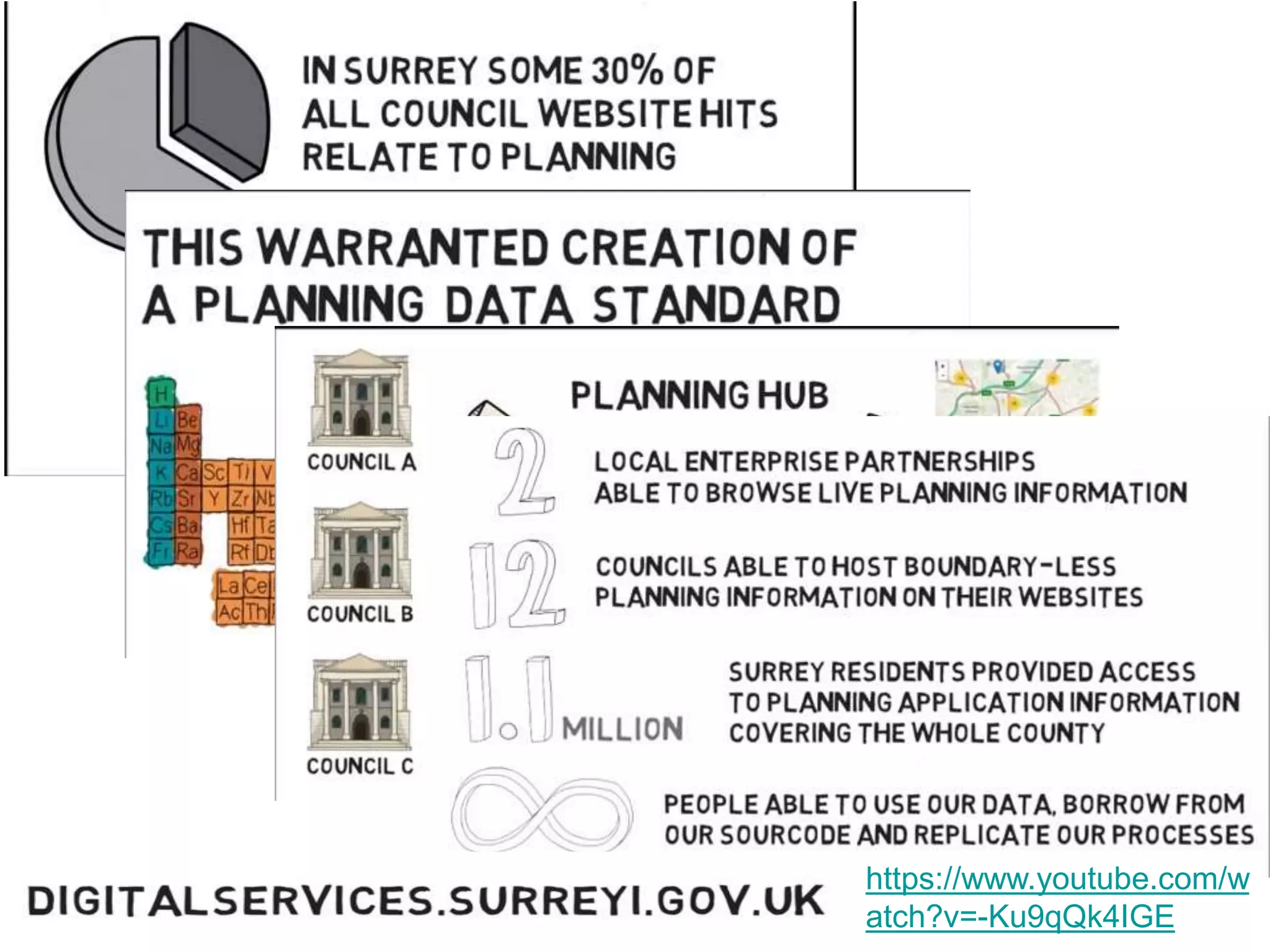
https://www.youtube.com/w 
atch?v=-Ku9qQk4IGE
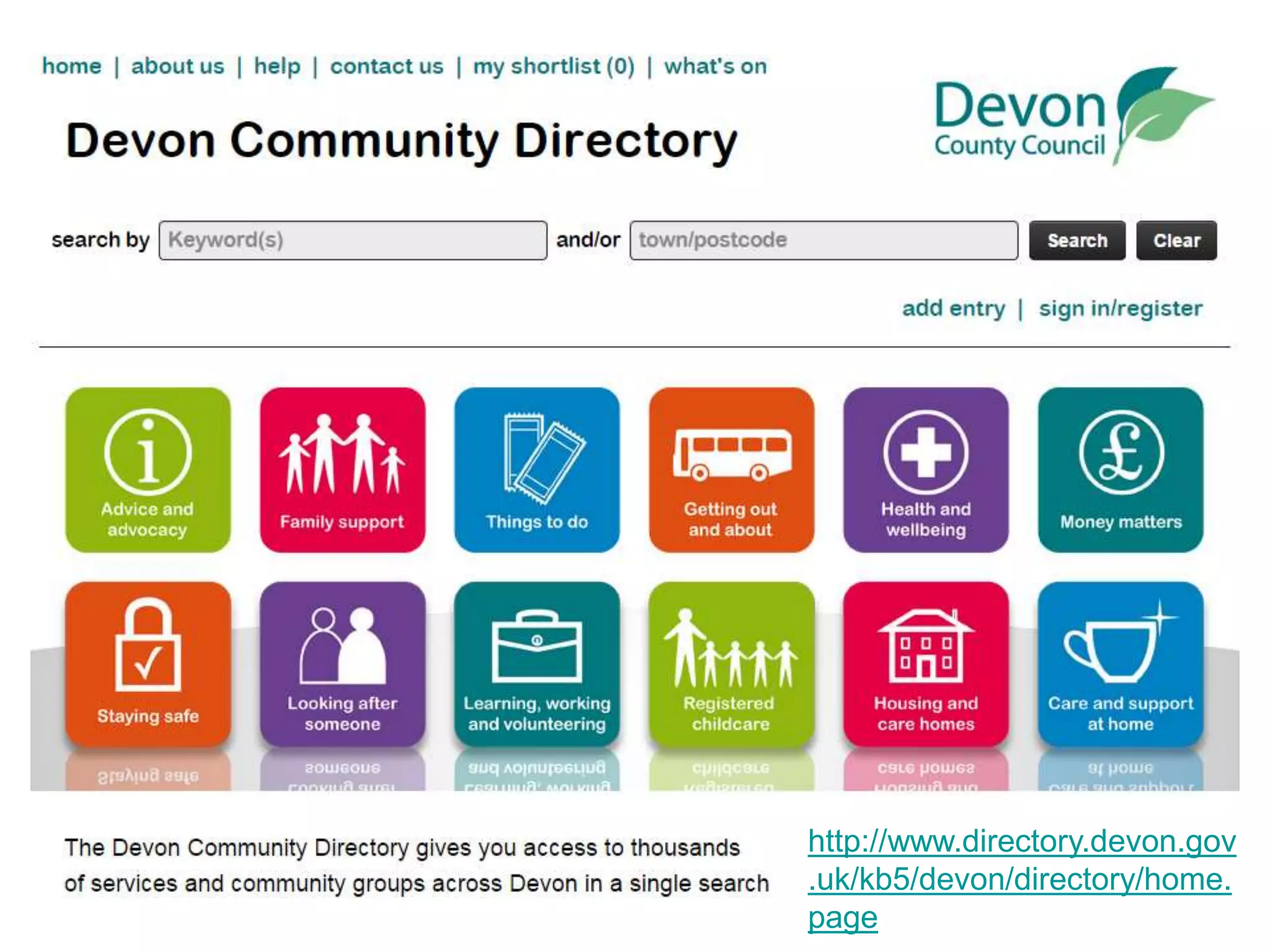
http://www.directory.devon.gov 
.uk/kb5/devon/directory/home. 
page
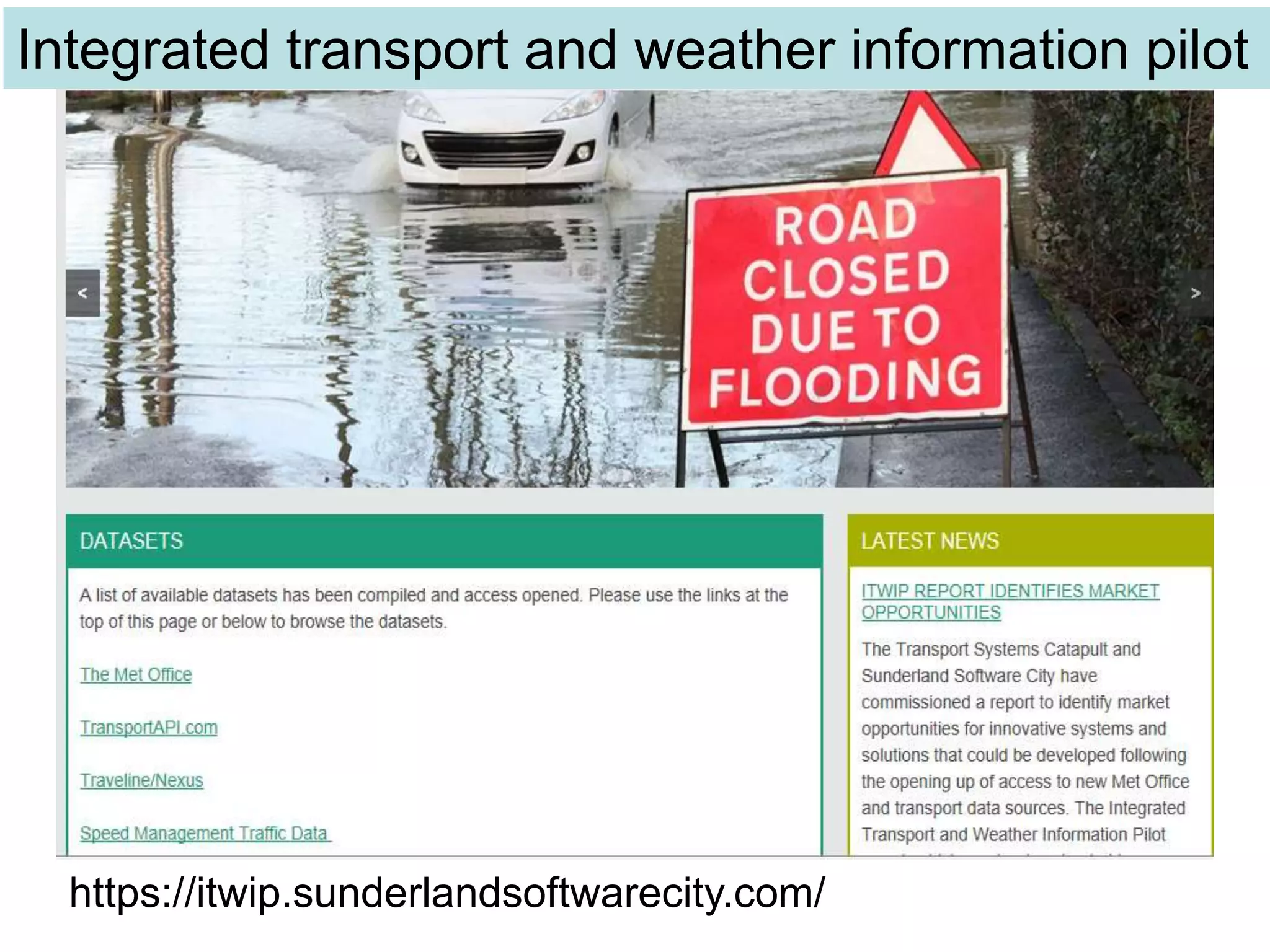
Integrated transport and weather information pilot 
https://itwip.sunderlandsoftwarecity.com/
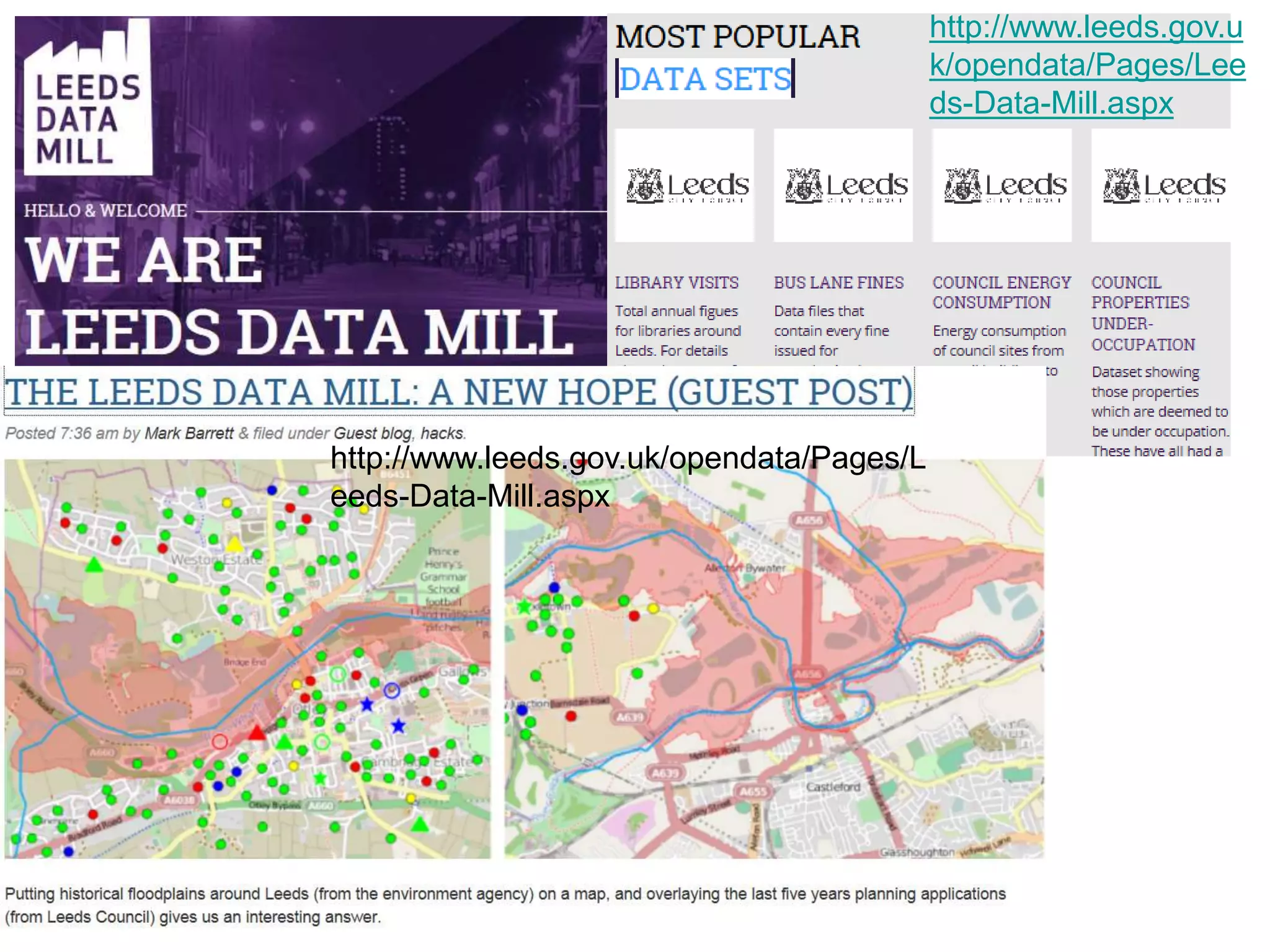
http://www.leeds.gov.uk/opendata/Pages/L 
eeds-Data-Mill.aspx 
http://www.leeds.gov.u 
k/opendata/Pages/Lee 
ds-Data-Mill.aspx
Benefits from open data 
publication and use 
• Councils know what data they own, reduces 
duplication, 
• Greater opportunity from data sharing and 
breaking down silos between departments 
• Making data available and using them raised the 
profile of data as an asset 
• Easier and faster data analysis from standardised 
and linkable data 
• Greater insight into customer needs and demands 
due to better analytics 
• Improved skills as people make more use of data
Engagement 
• But, little take up of the data elsewhere. 
• Why? 
– People don’t know what to do with the data 
– Lack of skills and understanding.
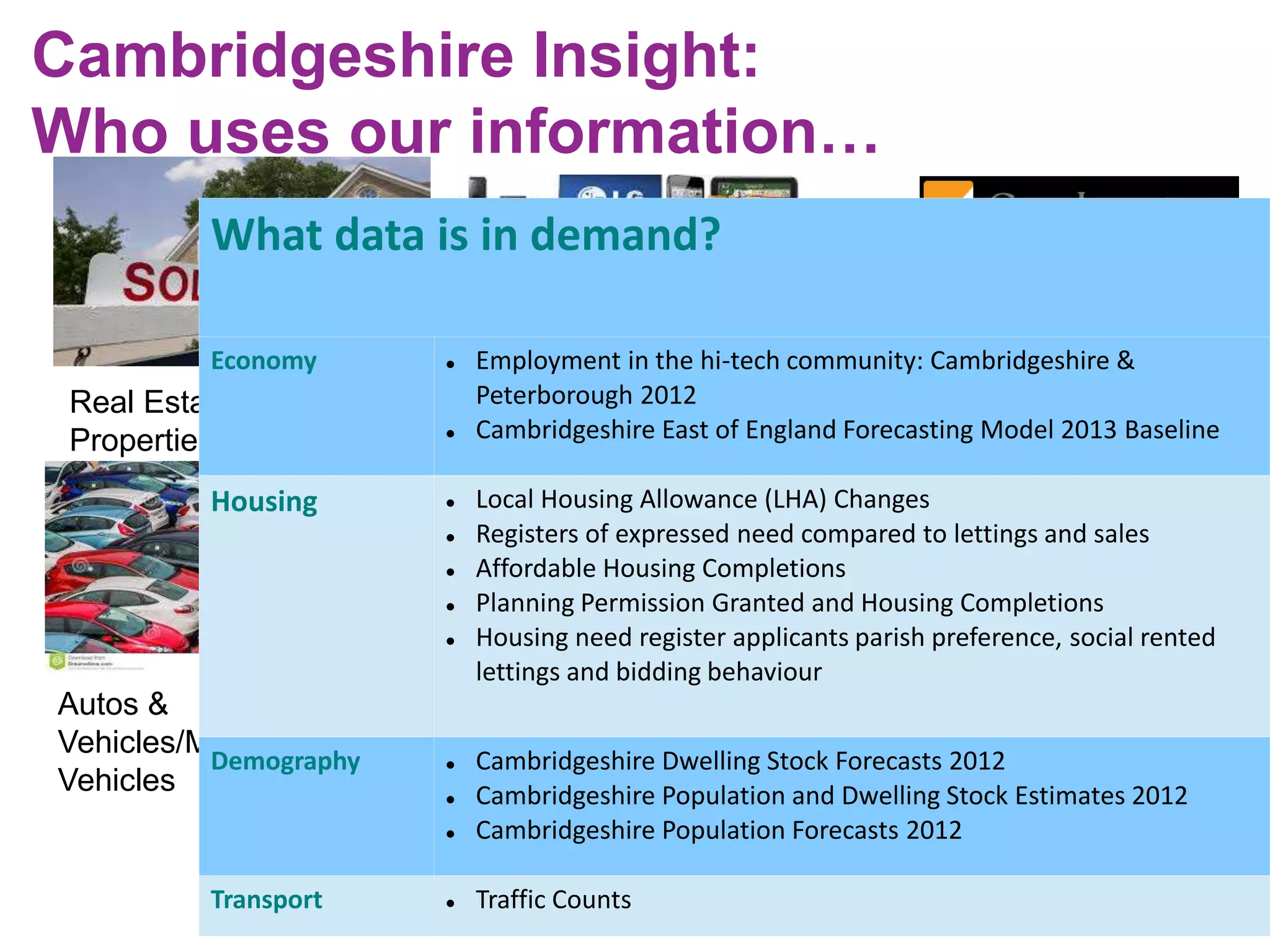
Cambridgeshire Insight: 
Who uses our information… 
Real Estate/Residential 
Properties 
Consumer 
Electronics/Mobile 
Phones 
Home & Garden/Home 
Improvement 
51.9% are repeat visitors 
Autos & 
Vehicles/Motor 
Vehicles 
Financial 
Services/Investment 
Services 
In-Market 
Segments 
What data is in demand? 
Economy  Employment in the hi-tech community: Cambridgeshire & 
Peterborough 2012 
 Cambridgeshire East of England Forecasting Model 2013 Baseline 
Housing  Local Housing Allowance (LHA) Changes 
 Registers of expressed need compared to lettings and sales 
 Affordable Housing Completions 
 Planning Permission Granted and Housing Completions 
 Housing need register applicants parish preference, social rented 
lettings and bidding behaviour 
Demography  Cambridgeshire Dwelling Stock Forecasts 2012 
 Cambridgeshire Population and Dwelling Stock Estimates 2012 
 Cambridgeshire Population Forecasts 2012 
Transport  Traffic Counts
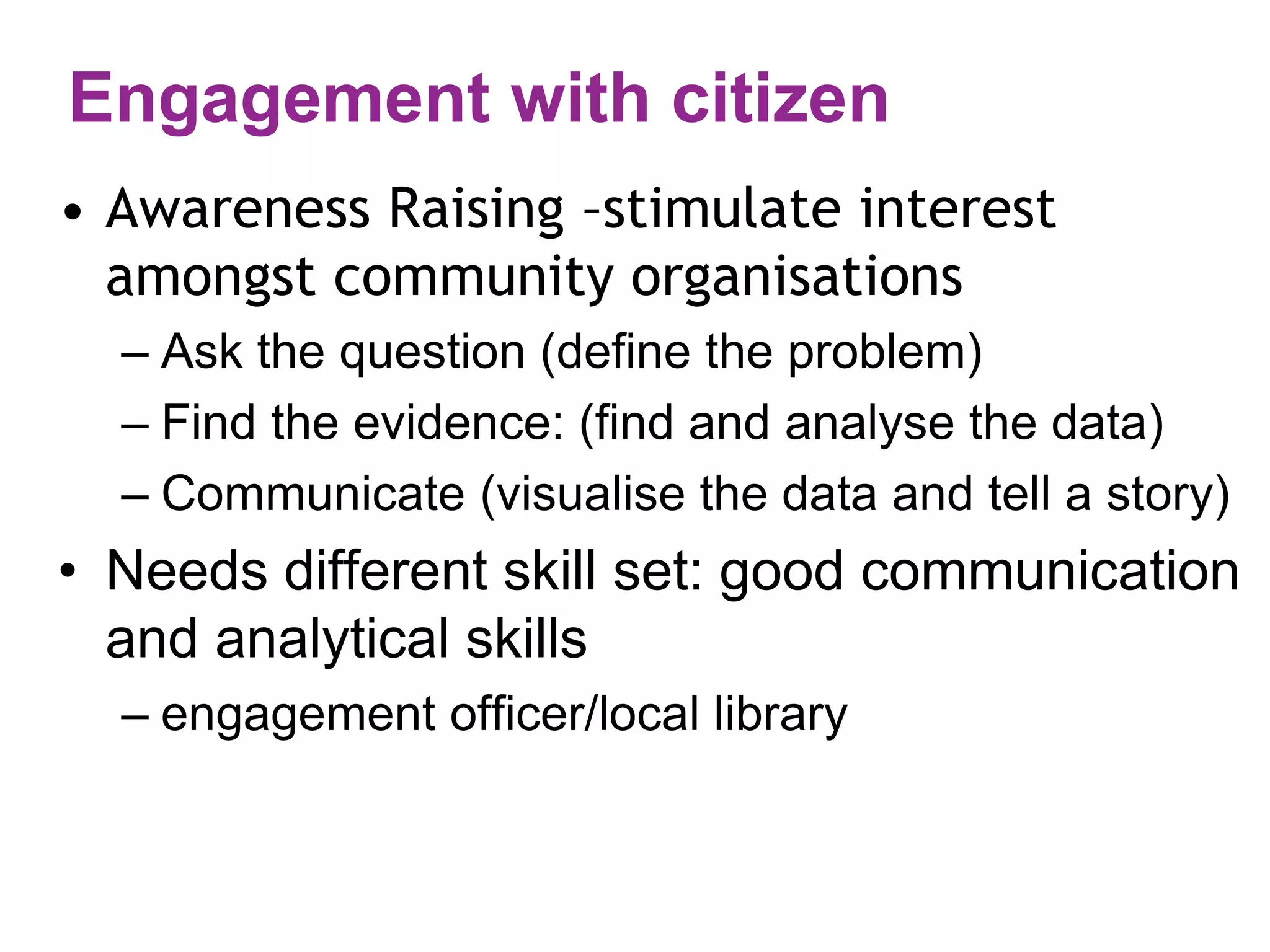
Engagement with citizen 
• Awareness Raising –stimulate interest 
amongst community organisations 
– Ask the question (define the problem) 
– Find the evidence: (find and analyse the data) 
– Communicate (visualise the data and tell a story) 
• Needs different skill set: good communication 
and analytical skills 
– engagement officer/local library
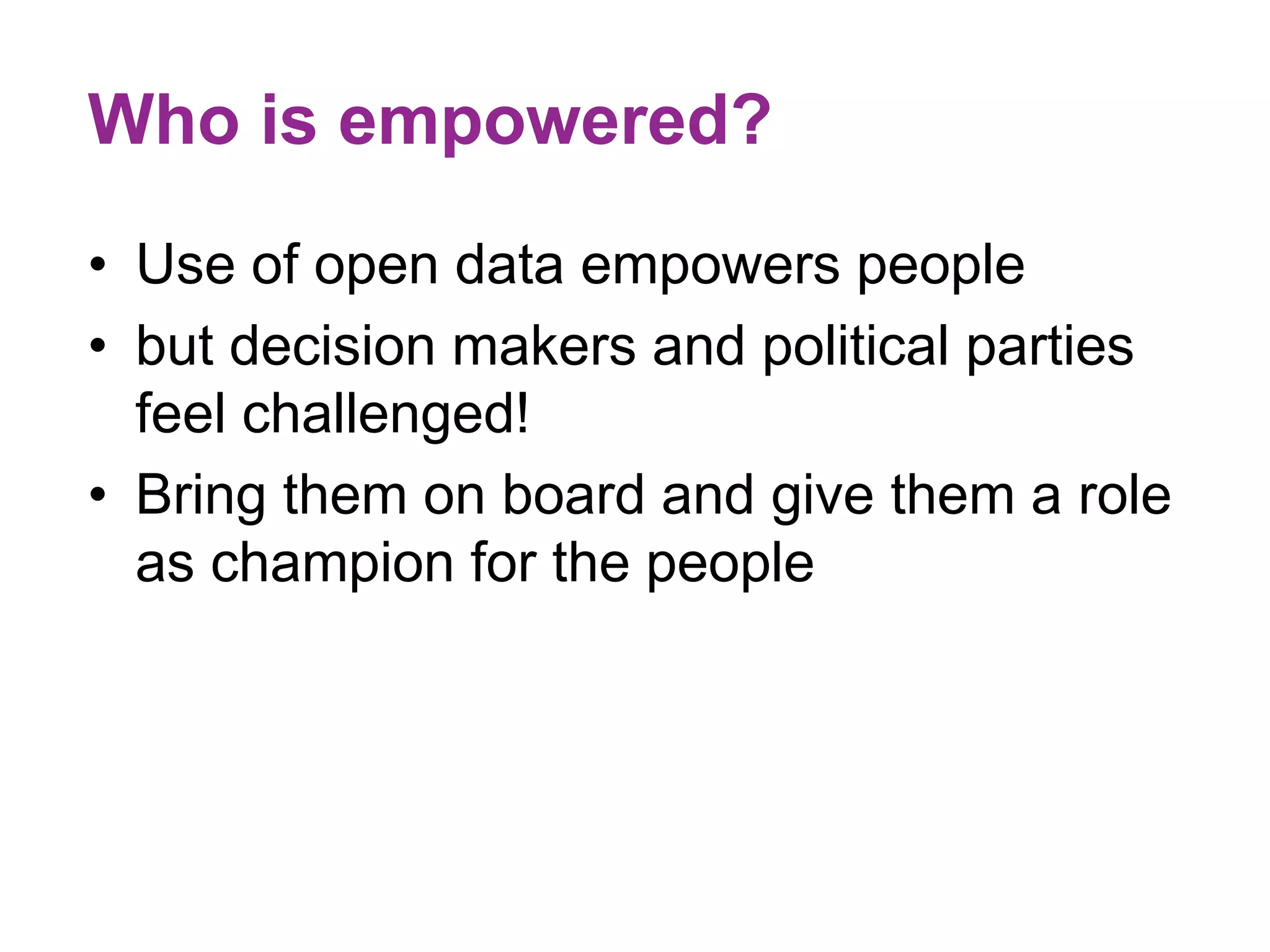
Who is empowered? 
• Use of open data empowers people 
• but decision makers and political parties 
feel challenged! 
• Bring them on board and give them a role 
as champion for the people
Value of open data 
• The value of open data is derived through 
its use 
• To add value….. 
promote the use of data through 
– digital technology 
– stories and engagement

Local Open Data: a perspective from local government in England 2014

  • 1.
    Local Open Data:A perspective from local government in England Gesche Schmid Programme Manager Transparency, LGA Brussels, 3 December 2014 Gesche.schmid@local.gov.uk, @GescheSchmid www.local.gov.uk/local-transparency
  • 2.
    Cambridge 2012 •Why we need Open Data? • What we can we do with Open Data? • How to make them available?
  • 3.
    Brussels 2014 tohelp government and companies to develop innovative services through the use of open data and to encourage smart use of Social Media.
  • 4.
    “Opening up isabout sharing instead of having” “open by default, digital by design.” what difference does the use of open data make to the people? So what exactly is this data that we’re talking about? What does it mean? Open data is all about people… Developers need standards and reliability … Citizens need stories Making data ‘open’ is about understanding its story; how it came to exist and what it represents, and then enabling other people to write the next chapter.
  • 5.
    First phase: Publishingopen data • Opening up: sharing instead of having • Transparency • Accountability • Making data available
  • 6.
    Five star opendata model • Five star open data model after Tim Berners-Lee ★ human readable (pdf), available on the web ★ ★ machine readable (proprietary) ★ ★ ★ machine readable (software independent) ★ ★ ★ ★ linkable (use of open standards and URIs) ★ ★ ★ ★ ★ linked to other data
  • 7.
  • 9.
    Second phase: standardisingdata • Open by default, digital by design • Developers need standards and reliability • Local information infrastructures – Meta data (inventories) – Classification – Standards – Core reference data, URIs – Schemas – Ontologies
  • 10.
    Third phase: Makinguse of open data • Use of data in decision making – provide evidence based on defined questions – Analytics: Linking, comparing and analysing data – Big Data Analytics: high volume, velocity and variety information assets – Visualising data so that they can be understood
  • 11.
    Fourth phase: Engagementwith users • Important is the social perspective; what difference does the use of open data make to the people? • So what exactly is this data that we’re talking about? What does it mean? Open data is all about people… • Digital Social Innovation : What is the impact on people’s life
  • 12.
    Open Data Engagement • Government information and data are common resources, managed in trust by government. • A commitment to open data involves making information and data resources accessible to all without discrimination; and actively engaging to ensure that information and data can be used in a wide range of ways. • Engaging open data should: ★ Be demand driven ★ ★ Put data in context ★ ★ ★ Support conversation around data ★ ★ ★ ★ Build capacity, skills and networks ★ ★ ★ ★ ★ Collaborate on data as a common resource http://www.opendataimpacts.net/engagement/
  • 13.
    Value of opendata Economic Value: commercialisation of data Environmental Value: sustainable environment Social Value: improve peoples’ lives
  • 14.
    Local Transparency (England) • Local government supports a presumption in favour of transparency and open data • transparency fosters greater accountability and democracy • ready access and meaningful use of open data – Innovates and transforms local public services – Empowers citizen, business, community groups • The pace of the transition from closed to open data is based on local needs and demand Social, environmental and economic
  • 15.
    Opportunities for theuse of open data • Accountability and accessibility (legal) • Efficiencies (austerity) • Engagement (internal and external) • Self service (customer expectation) • Business and customer insight • Service integration across organisations • Innovation (smart cities and communities) • Economic growth (business opportunities)
  • 17.
    Local open data infrastructure Enable local data to be easily discovered, combined and compared to make them more meaningful through the use of common standards. • common standards, classifications and taxonomies where they do not already exist (esd toolkit) • Practical and technical guidance developed by LGA and LeGSB which sets out some of the principles for publishing and linking data. • a local domain on data.gov.uk to provide a common focal point for sharing and promoting local open data, common standards, apps, initiatives, case studies, blogs • local government data and information services (LG Inform)
  • 18.
    LG Inform: LGAdata service ‘The LGA’s free data service which presents you with up-to-date published data about your local area and the performance of your council’. www.local.gov.uk/lginform
  • 19.
    Spending data: BodyName Body Name Amount Pay Date Description 1 Description Bristol City Council http://statistics.data.gov.u @SYMESk /HidA/loRcTaCl-aLuIFthFoEr i&ty /W00IHTHBYWO5O9D0 COMM30U/0N8IT/2Y0 1P2ARETMNPELROSYHEIEP TRAINING COOSRTGSANISATION Bristol City Council http://statistics.da@taS.gYoMv.EuSk /HidA/loRcTaCl-aLuIFthFoEr i&ty /W00IHTHBYW9O6O2D.5 COMM16U/0N8IT/2Y0 1P2ARETMNPELROSYHEIEP TRAINING COOSRTGSANISATION Bristol City Council http://statistics.da1t0a .SgQovU.uAkR/iEd/Dlo cLaIMl-aITuEthDority/00HB 922.5 29/08/2012 EQUIPMENT, FURNITUREN &U RMSAETREYR
  • 20.
    Spend: budget management £30,000,000.00 £24,000,000.00 £18,000,000.00 £12,000,000.00 £6,000,000.00 £0.00 Apr 2011 Jul 2011 Oct 2011 @ianmakgill @spendnetwork Jan 2012 Apr 2012 Jul 2012 Oct 2012 Jan 2013 Apr 2013 Jul 2013
  • 21.
  • 22.
  • 24.
  • 25.
    Integrated transport andweather information pilot https://itwip.sunderlandsoftwarecity.com/
  • 27.
  • 30.
    Benefits from opendata publication and use • Councils know what data they own, reduces duplication, • Greater opportunity from data sharing and breaking down silos between departments • Making data available and using them raised the profile of data as an asset • Easier and faster data analysis from standardised and linkable data • Greater insight into customer needs and demands due to better analytics • Improved skills as people make more use of data
  • 31.
    Engagement • But,little take up of the data elsewhere. • Why? – People don’t know what to do with the data – Lack of skills and understanding.
  • 33.
    Cambridgeshire Insight: Whouses our information… Real Estate/Residential Properties Consumer Electronics/Mobile Phones Home & Garden/Home Improvement 51.9% are repeat visitors Autos & Vehicles/Motor Vehicles Financial Services/Investment Services In-Market Segments What data is in demand? Economy  Employment in the hi-tech community: Cambridgeshire & Peterborough 2012  Cambridgeshire East of England Forecasting Model 2013 Baseline Housing  Local Housing Allowance (LHA) Changes  Registers of expressed need compared to lettings and sales  Affordable Housing Completions  Planning Permission Granted and Housing Completions  Housing need register applicants parish preference, social rented lettings and bidding behaviour Demography  Cambridgeshire Dwelling Stock Forecasts 2012  Cambridgeshire Population and Dwelling Stock Estimates 2012  Cambridgeshire Population Forecasts 2012 Transport  Traffic Counts
  • 34.
    Engagement with citizen • Awareness Raising –stimulate interest amongst community organisations – Ask the question (define the problem) – Find the evidence: (find and analyse the data) – Communicate (visualise the data and tell a story) • Needs different skill set: good communication and analytical skills – engagement officer/local library
  • 36.
    Who is empowered? • Use of open data empowers people • but decision makers and political parties feel challenged! • Bring them on board and give them a role as champion for the people
  • 37.
    Value of opendata • The value of open data is derived through its use • To add value….. promote the use of data through – digital technology – stories and engagement