Introduction to C++


Noppadon Kamolvilassatian

Department of Computer Engineering
Prince of Songkla University
                                     1
Contents

s   1. Introduction
s   2. C++ Single-Line Comments
s   3. C++ Stream Input/Output
s   4. Declarations in C++
s   5. Creating New Data Types in C++
s   6. Reference Parameters
s   7. Const Qualifier
s   8. Default Arguments
s   9. Function Overloading             2
1. Introduction

s   C++ improves on many of C’s features.
s   C++ provides object-oriented programming
    (OOP).
s   C++ is a superset to C.
s   No ANSI standard exists yet (in 1994).


                                               3
2. C++ Single-Line Comments

s  In C,
/* This is a single-line comment. */
s In C++,

// This is a single-line comment.


                                       4
3. C++ Stream Input/Output

s   In C,
    printf(“Enter new tag: “);
    scanf(“%d”, &tag);
    printf(“The new tag is: %dn”, tag);
s   In C++,
    cout << “Enter new tag: “;
    cin >> tag;
    cout << “The new tag is : “ << tag << ‘n’;

                                                  5
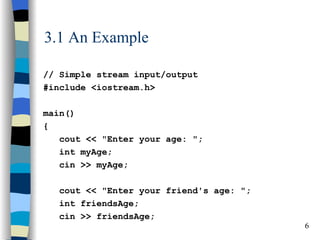
3.1 An Example

// Simple stream input/output
#include <iostream.h>

main()
{
   cout << "Enter your age: ";
   int myAge;
   cin >> myAge;

  cout << "Enter your friend's age: ";
  int friendsAge;
  cin >> friendsAge;
                                         6
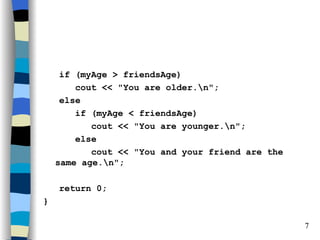
if (myAge > friendsAge)
        cout << "You are older.n";
     else
        if (myAge < friendsAge)
           cout << "You are younger.n";
        else
           cout << "You and your friend are the
    same age.n";

    return 0;
}

                                                  7
4. Declarations in C++

s   In C++, declarations can be placed anywhere
    (except in the condition of a while, do/while, f
    or or if structure.)
s   An example
cout << “Enter two integers: “;
int x, y;
cin >> x >> y;
cout << “The sum of “ << x << “ and “ << y
     << “ is “ << x + y << ‘n’;


                                                   8
s   Another example

for (int i = 0; i <= 5; i++)
    cout << i << ‘n’;


                               9
5. Creating New Data Types in C++

struct Name {
     char first[10];
     char last[10];
};
s   In C,
struct Name stdname;
s   In C++,
Name stdname;
s   The same is true for enums and unions
                                            10
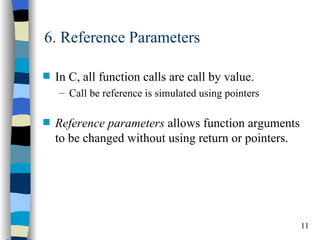
6. Reference Parameters

s   In C, all function calls are call by value.
    – Call be reference is simulated using pointers

s   Reference parameters allows function arguments
    to be changed without using return or pointers.


                                                      11
6.1 Comparing Call by Value, Call by Reference
with Pointers and Call by Reference with References

#include <iostream.h>

int sqrByValue(int);
void sqrByPointer(int *);
void sqrByRef(int &);

main()
{
   int x = 2, y = 3, z = 4;

   cout <<   "x = " << x << " before sqrByValn"
        <<   "Value returned by sqrByVal: "
        <<   sqrByVal(x)
        <<   "nx = " << x << " after sqrByValnn";
                                                 12
cout << "y = " << y << " before sqrByPointern";
    sqrByPointer(&y);
    cout << "y = " << y << " after sqrByPointernn";


     cout << "z = " << z << " before sqrByRefn";
    sqrByRef(z);
    cout << "z = " << z << " after sqrByRefn";

    return 0;
}


                                                    13
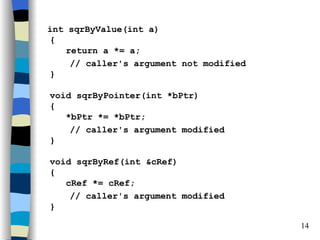
int sqrByValue(int a)
{
   return a *= a;
    // caller's argument not modified
}

void sqrByPointer(int *bPtr)
{
   *bPtr *= *bPtr;
    // caller's argument modified
}

void sqrByRef(int &cRef)
{
   cRef *= cRef;
    // caller's argument modified
}

                                        14
Output

$ g++ -Wall -o square square.cc

$ square
x = 2 before sqrByValue
Value returned by sqrByValue: 4
x = 2 after sqrByValue

y = 3 before sqrByPointer
y = 9 after sqrByPointer

z = 4 before sqrByRef
z = 16 after sqrByRef
                                  15
7. The Const Qualifier

s   Used to declare “constant variables” (instead of
    #define)
    const float PI = 3.14156;


s   The const variables must be initialized when
    declared.


                                                       16
8. Default Arguments

s   When a default argument is omitted in a function
    call, the default value of that argument is automati
    cally passed in the call.
s   Default arguments must be the rightmost (trailing)
    arguments.


                                                      17
8.1 An Example

// Using default arguments
#include <iostream.h>

// Calculate the volume of   a box
int boxVolume(int length =   1, int width = 1,
              int height =   1)
   { return length * width   * height; }


                                                 18
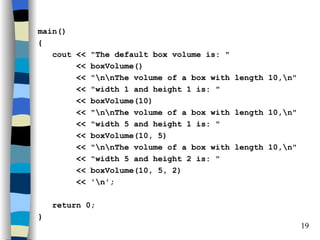
main()
{
   cout <<   "The default box volume is: "
        <<   boxVolume()
        <<   "nnThe volume of a box with length 10,n"
        <<   "width 1 and height 1 is: "
        <<   boxVolume(10)
        <<   "nnThe volume of a box with length 10,n"
        <<   "width 5 and height 1 is: "
        <<   boxVolume(10, 5)
        <<   "nnThe volume of a box with length 10,n"
        <<   "width 5 and height 2 is: "
        <<   boxVolume(10, 5, 2)
        <<   'n';

    return 0;
}
                                                           19
Output
$ g++ -Wall -o volume volume.cc

$ volume
The default box volume is: 1

The volume of a box with length 10,
width 1 and height 1 is: 10

The volume of a box with length 10,
width 5 and height 1 is: 50


The volume of a box with length 10,
width 5 and height 2 is: 100          20
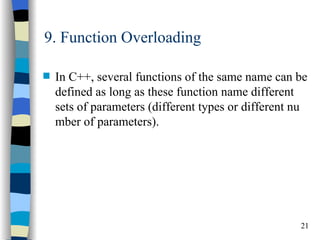
9. Function Overloading

s   In C++, several functions of the same name can be
    defined as long as these function name different
    sets of parameters (different types or different nu
    mber of parameters).


                                                     21
9.1 An Example
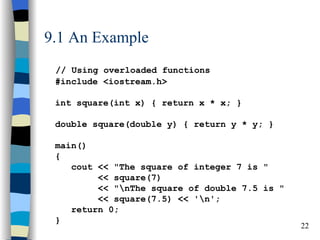
 // Using overloaded functions
 #include <iostream.h>

 int square(int x) { return x * x; }

 double square(double y) { return y * y; }

 main()
 {
    cout << "The square of integer 7 is "
         << square(7)
         << "nThe square of double 7.5 is "
         << square(7.5) << 'n';
    return 0;
 }
                                               22
Output

$ g++ -Wall -o overload overload.cc

$ overload
The square of integer 7 is 49
The square of double 7.5 is 56.25


                                      23

Oop1

  • 1.
    Introduction to C++ NoppadonKamolvilassatian Department of Computer Engineering Prince of Songkla University 1
  • 2.
    Contents s 1. Introduction s 2. C++ Single-Line Comments s 3. C++ Stream Input/Output s 4. Declarations in C++ s 5. Creating New Data Types in C++ s 6. Reference Parameters s 7. Const Qualifier s 8. Default Arguments s 9. Function Overloading 2
  • 3.
    1. Introduction s C++ improves on many of C’s features. s C++ provides object-oriented programming (OOP). s C++ is a superset to C. s No ANSI standard exists yet (in 1994). 3
  • 4.
    2. C++ Single-LineComments s In C, /* This is a single-line comment. */ s In C++, // This is a single-line comment. 4
  • 5.
    3. C++ StreamInput/Output s In C, printf(“Enter new tag: “); scanf(“%d”, &tag); printf(“The new tag is: %dn”, tag); s In C++, cout << “Enter new tag: “; cin >> tag; cout << “The new tag is : “ << tag << ‘n’; 5
  • 6.
    3.1 An Example //Simple stream input/output #include <iostream.h> main() { cout << "Enter your age: "; int myAge; cin >> myAge; cout << "Enter your friend's age: "; int friendsAge; cin >> friendsAge; 6
  • 7.
    if (myAge >friendsAge) cout << "You are older.n"; else if (myAge < friendsAge) cout << "You are younger.n"; else cout << "You and your friend are the same age.n"; return 0; } 7
  • 8.
    4. Declarations inC++ s In C++, declarations can be placed anywhere (except in the condition of a while, do/while, f or or if structure.) s An example cout << “Enter two integers: “; int x, y; cin >> x >> y; cout << “The sum of “ << x << “ and “ << y << “ is “ << x + y << ‘n’; 8
  • 9.
    s Another example for (int i = 0; i <= 5; i++) cout << i << ‘n’; 9
  • 10.
    5. Creating NewData Types in C++ struct Name { char first[10]; char last[10]; }; s In C, struct Name stdname; s In C++, Name stdname; s The same is true for enums and unions 10
  • 11.
    6. Reference Parameters s In C, all function calls are call by value. – Call be reference is simulated using pointers s Reference parameters allows function arguments to be changed without using return or pointers. 11
  • 12.
    6.1 Comparing Callby Value, Call by Reference with Pointers and Call by Reference with References #include <iostream.h> int sqrByValue(int); void sqrByPointer(int *); void sqrByRef(int &); main() { int x = 2, y = 3, z = 4; cout << "x = " << x << " before sqrByValn" << "Value returned by sqrByVal: " << sqrByVal(x) << "nx = " << x << " after sqrByValnn"; 12
  • 13.
    cout << "y= " << y << " before sqrByPointern"; sqrByPointer(&y); cout << "y = " << y << " after sqrByPointernn"; cout << "z = " << z << " before sqrByRefn"; sqrByRef(z); cout << "z = " << z << " after sqrByRefn"; return 0; } 13
  • 14.
    int sqrByValue(int a) { return a *= a; // caller's argument not modified } void sqrByPointer(int *bPtr) { *bPtr *= *bPtr; // caller's argument modified } void sqrByRef(int &cRef) { cRef *= cRef; // caller's argument modified } 14
  • 15.
    Output $ g++ -Wall-o square square.cc $ square x = 2 before sqrByValue Value returned by sqrByValue: 4 x = 2 after sqrByValue y = 3 before sqrByPointer y = 9 after sqrByPointer z = 4 before sqrByRef z = 16 after sqrByRef 15
  • 16.
    7. The ConstQualifier s Used to declare “constant variables” (instead of #define) const float PI = 3.14156; s The const variables must be initialized when declared. 16
  • 17.
    8. Default Arguments s When a default argument is omitted in a function call, the default value of that argument is automati cally passed in the call. s Default arguments must be the rightmost (trailing) arguments. 17
  • 18.
    8.1 An Example //Using default arguments #include <iostream.h> // Calculate the volume of a box int boxVolume(int length = 1, int width = 1, int height = 1) { return length * width * height; } 18
  • 19.
    main() { cout << "The default box volume is: " << boxVolume() << "nnThe volume of a box with length 10,n" << "width 1 and height 1 is: " << boxVolume(10) << "nnThe volume of a box with length 10,n" << "width 5 and height 1 is: " << boxVolume(10, 5) << "nnThe volume of a box with length 10,n" << "width 5 and height 2 is: " << boxVolume(10, 5, 2) << 'n'; return 0; } 19
  • 20.
    Output $ g++ -Wall-o volume volume.cc $ volume The default box volume is: 1 The volume of a box with length 10, width 1 and height 1 is: 10 The volume of a box with length 10, width 5 and height 1 is: 50 The volume of a box with length 10, width 5 and height 2 is: 100 20
  • 21.
    9. Function Overloading s In C++, several functions of the same name can be defined as long as these function name different sets of parameters (different types or different nu mber of parameters). 21
  • 22.
    9.1 An Example // Using overloaded functions #include <iostream.h> int square(int x) { return x * x; } double square(double y) { return y * y; } main() { cout << "The square of integer 7 is " << square(7) << "nThe square of double 7.5 is " << square(7.5) << 'n'; return 0; } 22
  • 23.
    Output $ g++ -Wall-o overload overload.cc $ overload The square of integer 7 is 49 The square of double 7.5 is 56.25 23