OOP Concepts Copyright: Beta Soft Systems
Abstraction Abstraction  refers to the act of representing essential features without including the background details or explanations.
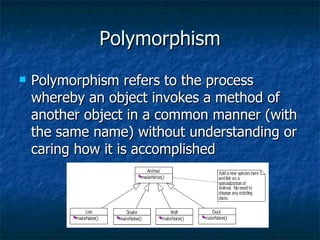
Polymorphism Polymorphism refers to the process whereby an object invokes a method of another object in a common manner (with the same name) without understanding or caring how it is accomplished
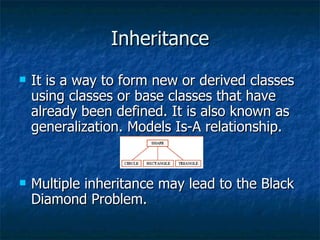
Inheritance It is a way to form new or derived classes using classes or base classes that have already been defined. It is also known as generalization. Models Is-A relationship. Multiple inheritance may lead to the Black Diamond Problem.
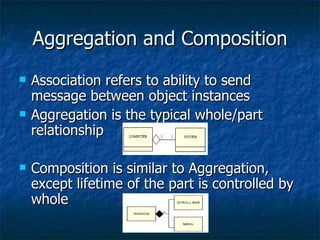
Aggregation and Composition Association refers to ability to send message between object instances Aggregation is the typical whole/part relationship  Composition is similar to Aggregation, except lifetime of the part is controlled by whole
Encapsulation Encapsulation refers to hiding implementation details such as object’s behaviors and attributes It is also known as Separation of Concerns or Information Hiding It reduces risk by shifting code’s dependency on well defined interfaces
Modularity Modularity is closely tied with encapsulation; think of modularity as a way of mapping encapsulated abstractions into real, physical modules It allows breaking up of something complex into manageable pieces
Association An association represents an object of one class making use of an object of another class
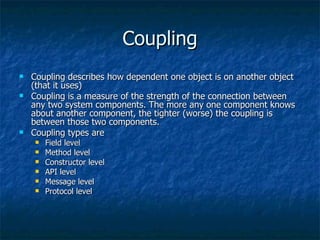
Coupling Coupling describes how dependent one object is on another object (that it uses) Coupling is a measure of the strength of the connection between any two system components. The more any one component knows about another component, the tighter (worse) the coupling is between those two components.  Coupling types are Field level Method level Constructor level API level Message level Protocol level
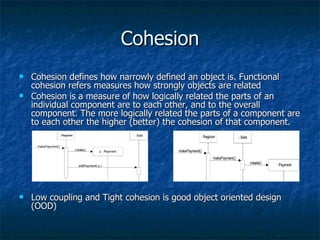
Cohesion Cohesion defines how narrowly defined an object is. Functional cohesion refers measures how strongly objects are related Cohesion is a measure of how logically related the parts of an individual component are to each other, and to the overall component. The more logically related the parts of a component are to each other the higher (better) the cohesion of that component.  Low coupling and Tight cohesion is good object oriented design (OOD)
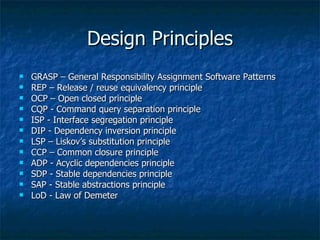
Design Principles GRASP – General Responsibility Assignment Software Patterns REP – Release / reuse equivalency principle  OCP – Open closed principle CQP - Command query separation principle ISP - Interface segregation principle DIP - Dependency inversion principle LSP – Liskov’s substitution principle CCP – Common closure principle ADP - Acyclic dependencies principle SDP - Stable dependencies principle SAP - Stable abstractions principle LoD - Law of Demeter
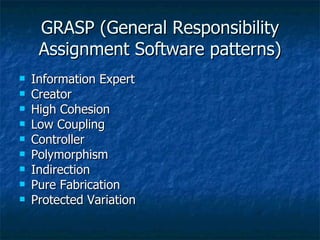
GRASP (General Responsibility Assignment Software patterns) Information Expert Creator High Cohesion Low Coupling Controller Polymorphism Indirection Pure Fabrication Protected Variation
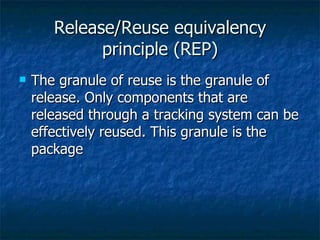
Release/Reuse equivalency principle (REP) The granule of reuse is the granule of release. Only components that are released through a tracking system can be effectively reused. This granule is the package
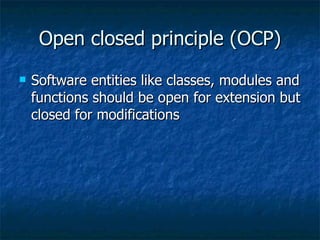
Open closed principle (OCP) Software entities like classes, modules and functions should be open for extension but closed for modifications
Command Query separation principle Every method should either be a command that performs an action, or a query that returns data to the caller, but not both
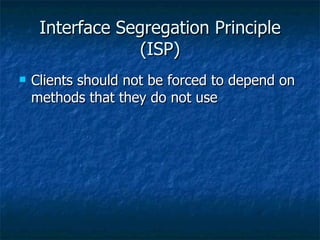
Interface Segregation Principle (ISP) Clients should not be forced to depend on methods that they do not use
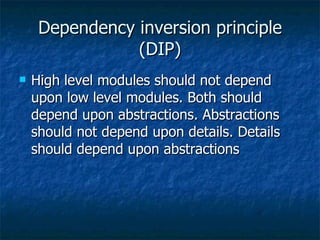
Dependency inversion principle (DIP) High level modules should not depend upon low level modules. Both should depend upon abstractions. Abstractions should not depend upon details. Details should depend upon abstractions
Liskov’s Substitution Principle (LSP) In class hierarchies, it should be possible to treat a specialized object as if it were a base class object
Common Closure Principle (CCP) Classes that change together, belong together
Common Reuse Principle Classes that aren't reused together should not be grouped together
Acyclic Dependencies Principle The dependency structure for released components must be a directed acyclic graph. There can be no cycles
Stable Dependencies principle Dependencies between released categories must run in the direction of stability. The dependee must be more stable than the depender
Stable Abstractions Principle The more stable a class category is, the more it must consist of abstract classes. A completely stable category should consist of nothing but abstract classes
Law of Demeter An object should avoid invoking methods of a member object returned by another method  It is also known as Principle of Least Knowledge
Design best practices Pick nouns or noun phrases as classes Method names should contain a verb Delegate to helper class Use declarative configuration, don’t hardcode Modular design Divide code into framework and abstraction
Analysis & Design approaches Nouns and noun sentence analysis : Identify the nouns and verbs in Use Cases. Nouns are classes and verbs are methods Domain analysis  : Identify objects using business domain knowledge CRC  (Class Responsibility Collaborator) : This technique uses cards to identify objects Robustness analysis  : Identify the control, entity and boundary objects
Design tradeoffs Flexibility vs. Simplicity Dynamicity vs. Runtime type safety Time vs. space Flexibility vs. Efficiency Ease of use vs. Normalization
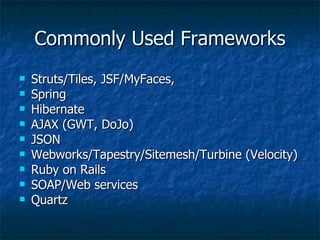
Commonly Used Frameworks Struts/Tiles, JSF/MyFaces,  Spring Hibernate AJAX (GWT, DoJo) JSON Webworks/Tapestry/Sitemesh/Turbine (Velocity) Ruby on Rails SOAP/Web services Quartz
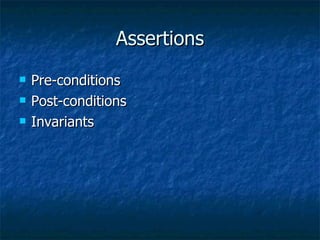
Assertions Pre-conditions Post-conditions Invariants

Oop concepts

  • 1.
    OOP Concepts Copyright:Beta Soft Systems
  • 2.
    Abstraction Abstraction refers to the act of representing essential features without including the background details or explanations.
  • 3.
    Polymorphism Polymorphism refersto the process whereby an object invokes a method of another object in a common manner (with the same name) without understanding or caring how it is accomplished
  • 4.
    Inheritance It isa way to form new or derived classes using classes or base classes that have already been defined. It is also known as generalization. Models Is-A relationship. Multiple inheritance may lead to the Black Diamond Problem.
  • 5.
    Aggregation and CompositionAssociation refers to ability to send message between object instances Aggregation is the typical whole/part relationship Composition is similar to Aggregation, except lifetime of the part is controlled by whole
  • 6.
    Encapsulation Encapsulation refersto hiding implementation details such as object’s behaviors and attributes It is also known as Separation of Concerns or Information Hiding It reduces risk by shifting code’s dependency on well defined interfaces
  • 7.
    Modularity Modularity isclosely tied with encapsulation; think of modularity as a way of mapping encapsulated abstractions into real, physical modules It allows breaking up of something complex into manageable pieces
  • 8.
    Association An associationrepresents an object of one class making use of an object of another class
  • 9.
    Coupling Coupling describeshow dependent one object is on another object (that it uses) Coupling is a measure of the strength of the connection between any two system components. The more any one component knows about another component, the tighter (worse) the coupling is between those two components. Coupling types are Field level Method level Constructor level API level Message level Protocol level
  • 10.
    Cohesion Cohesion defineshow narrowly defined an object is. Functional cohesion refers measures how strongly objects are related Cohesion is a measure of how logically related the parts of an individual component are to each other, and to the overall component. The more logically related the parts of a component are to each other the higher (better) the cohesion of that component. Low coupling and Tight cohesion is good object oriented design (OOD)
  • 11.
    Design Principles GRASP– General Responsibility Assignment Software Patterns REP – Release / reuse equivalency principle OCP – Open closed principle CQP - Command query separation principle ISP - Interface segregation principle DIP - Dependency inversion principle LSP – Liskov’s substitution principle CCP – Common closure principle ADP - Acyclic dependencies principle SDP - Stable dependencies principle SAP - Stable abstractions principle LoD - Law of Demeter
  • 12.
    GRASP (General ResponsibilityAssignment Software patterns) Information Expert Creator High Cohesion Low Coupling Controller Polymorphism Indirection Pure Fabrication Protected Variation
  • 13.
    Release/Reuse equivalency principle(REP) The granule of reuse is the granule of release. Only components that are released through a tracking system can be effectively reused. This granule is the package
  • 14.
    Open closed principle(OCP) Software entities like classes, modules and functions should be open for extension but closed for modifications
  • 15.
    Command Query separationprinciple Every method should either be a command that performs an action, or a query that returns data to the caller, but not both
  • 16.
    Interface Segregation Principle(ISP) Clients should not be forced to depend on methods that they do not use
  • 17.
    Dependency inversion principle(DIP) High level modules should not depend upon low level modules. Both should depend upon abstractions. Abstractions should not depend upon details. Details should depend upon abstractions
  • 18.
    Liskov’s Substitution Principle(LSP) In class hierarchies, it should be possible to treat a specialized object as if it were a base class object
  • 19.
    Common Closure Principle(CCP) Classes that change together, belong together
  • 20.
    Common Reuse PrincipleClasses that aren't reused together should not be grouped together
  • 21.
    Acyclic Dependencies PrincipleThe dependency structure for released components must be a directed acyclic graph. There can be no cycles
  • 22.
    Stable Dependencies principleDependencies between released categories must run in the direction of stability. The dependee must be more stable than the depender
  • 23.
    Stable Abstractions PrincipleThe more stable a class category is, the more it must consist of abstract classes. A completely stable category should consist of nothing but abstract classes
  • 24.
    Law of DemeterAn object should avoid invoking methods of a member object returned by another method It is also known as Principle of Least Knowledge
  • 25.
    Design best practicesPick nouns or noun phrases as classes Method names should contain a verb Delegate to helper class Use declarative configuration, don’t hardcode Modular design Divide code into framework and abstraction
  • 26.
    Analysis & Designapproaches Nouns and noun sentence analysis : Identify the nouns and verbs in Use Cases. Nouns are classes and verbs are methods Domain analysis : Identify objects using business domain knowledge CRC (Class Responsibility Collaborator) : This technique uses cards to identify objects Robustness analysis : Identify the control, entity and boundary objects
  • 27.
    Design tradeoffs Flexibilityvs. Simplicity Dynamicity vs. Runtime type safety Time vs. space Flexibility vs. Efficiency Ease of use vs. Normalization
  • 28.
    Commonly Used FrameworksStruts/Tiles, JSF/MyFaces, Spring Hibernate AJAX (GWT, DoJo) JSON Webworks/Tapestry/Sitemesh/Turbine (Velocity) Ruby on Rails SOAP/Web services Quartz
  • 29.