Advanced OOP Laws   Principles  Idioms Clint Edmonson
what is oop?
abstraction encapsulation inheritance polymorphism
structural
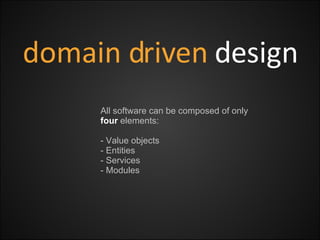
domain driven   design All software can be composed of only  four  elements: - Value objects  - Entities - Services - Modules
separation   of  concerns Every class and method should have a  single responsibility . All its functionality should be narrowly aligned with that responsibility.
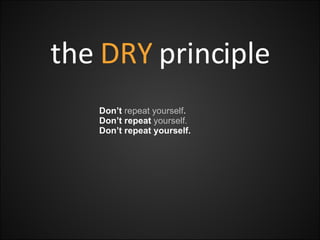
the  DRY  principle Don’t  repeat yourself . Don’t repeat  yourself. Don’t repeat yourself.
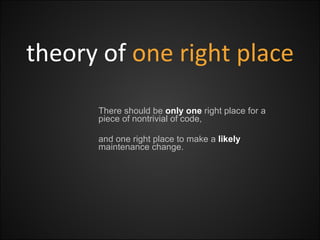
theory of  one right place There should be  only one  right place for a piece of nontrivial of code, and one right place to make a  likely  maintenance change.
unit   of  work Define entity families around transactional boundaries.
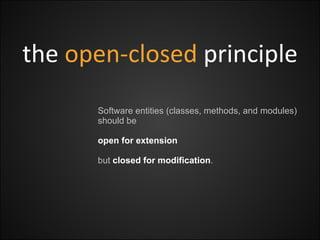
the  open-closed   principle Software entities (classes, methods, and modules) should be  open for extension but  closed for modification .
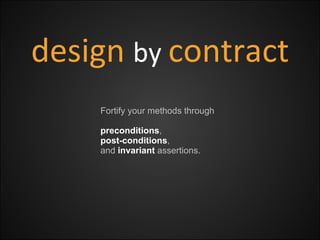
design   by  contract Fortify your methods through  preconditions ,  post-conditions ,  and  invariant  assertions.
creational
declarative   programming Use attributes to describe  what  you want to happen and leverage a framework will take care of the  how .
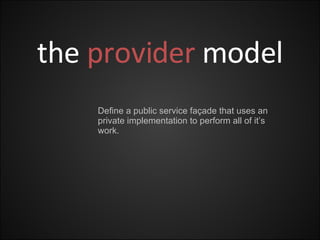
the  provider   model Define a public service façade that uses an private implementation to perform all of it’s work.
inversion   of   control Leverage configuration files to automatically create objects as they are needed.
dependency   injection Declaratively describe dependencies between classes and an IOC framework can automatically instantiate all of them.
object : relational   mapping Leverage IOC and dependency injection to automatically load entities from your database.
behavioral
principle of  scenario driven design All functionality should be driven by usage scenarios.
occam ’ s razor The  simplest  solution is usually the  best .
the  pareto  principle For many phenomena,  80%  of the consequences stem from  20%  of the causes
the  law  of  demeter “ Don’t talk to your neighbor’s neighbor!” An object should  only  call methods and properties belonging to: - Itself - Any parameters passed in - Objects it creates - Child components
principle of  least resource usage The minimal amount of computational resources should be used to solve a particular need.
principle of  least privilege Provide the minimal level of access necessary for consumers to do their job. Combined with the previous principle… Classes and methods should be as  static  and  private  as possible.
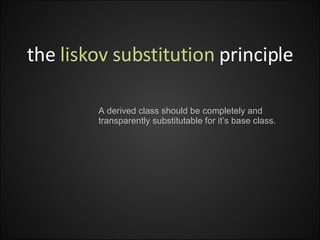
the  liskov substitution  principle A derived class should be completely and transparently substitutable for it’s base class.
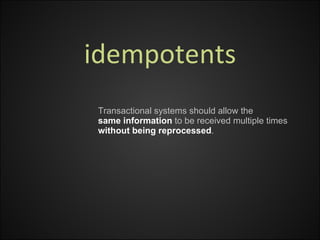
idempotents Transactional systems should allow the same information  to be received multiple times  without being reprocessed .
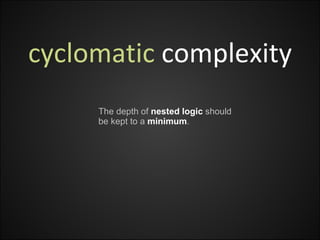
cyclomatic  complexity The depth of  nested logic  should be kept to a  minimum .
What are  your   principles?
 
 
Questions  &   Discussion
Books Code Complete - McConnell Effective C# - Wagner Framework Design Guidelines – Cwalina & Abrams Writing Solid Code - Maguire Links Application Architecture for .NET OO Design Principles Principles of Object Oriented Design Separation of Concerns (Wikipedia) References
Clint Edmonson [email_address] http://www.notsotrivial.net
© 2008 Microsoft Corporation. All rights reserved. This presentation is for informational purposes only. Microsoft makes no warranties, express or implied, in this information.

Advanced OOP - Laws, Principles, Idioms

  • 1.
    Advanced OOP Laws Principles Idioms Clint Edmonson
  • 2.
  • 3.
  • 4.
  • 5.
    domain driven design All software can be composed of only four elements: - Value objects - Entities - Services - Modules
  • 6.
    separation of concerns Every class and method should have a single responsibility . All its functionality should be narrowly aligned with that responsibility.
  • 7.
    the DRY principle Don’t repeat yourself . Don’t repeat yourself. Don’t repeat yourself.
  • 8.
    theory of one right place There should be only one right place for a piece of nontrivial of code, and one right place to make a likely maintenance change.
  • 9.
    unit of work Define entity families around transactional boundaries.
  • 10.
    the open-closed principle Software entities (classes, methods, and modules) should be open for extension but closed for modification .
  • 11.
    design by contract Fortify your methods through preconditions , post-conditions , and invariant assertions.
  • 12.
  • 13.
    declarative programming Use attributes to describe what you want to happen and leverage a framework will take care of the how .
  • 14.
    the provider model Define a public service façade that uses an private implementation to perform all of it’s work.
  • 15.
    inversion of control Leverage configuration files to automatically create objects as they are needed.
  • 16.
    dependency injection Declaratively describe dependencies between classes and an IOC framework can automatically instantiate all of them.
  • 17.
    object : relational mapping Leverage IOC and dependency injection to automatically load entities from your database.
  • 18.
  • 19.
    principle of scenario driven design All functionality should be driven by usage scenarios.
  • 20.
    occam ’ srazor The simplest solution is usually the best .
  • 21.
    the pareto principle For many phenomena, 80% of the consequences stem from 20% of the causes
  • 22.
    the law of demeter “ Don’t talk to your neighbor’s neighbor!” An object should only call methods and properties belonging to: - Itself - Any parameters passed in - Objects it creates - Child components
  • 23.
    principle of least resource usage The minimal amount of computational resources should be used to solve a particular need.
  • 24.
    principle of least privilege Provide the minimal level of access necessary for consumers to do their job. Combined with the previous principle… Classes and methods should be as static and private as possible.
  • 25.
    the liskovsubstitution principle A derived class should be completely and transparently substitutable for it’s base class.
  • 26.
    idempotents Transactional systemsshould allow the same information to be received multiple times without being reprocessed .
  • 27.
    cyclomatic complexityThe depth of nested logic should be kept to a minimum .
  • 28.
    What are your principles?
  • 29.
  • 30.
  • 31.
    Questions & Discussion
  • 32.
    Books Code Complete- McConnell Effective C# - Wagner Framework Design Guidelines – Cwalina & Abrams Writing Solid Code - Maguire Links Application Architecture for .NET OO Design Principles Principles of Object Oriented Design Separation of Concerns (Wikipedia) References
  • 33.
    Clint Edmonson [email_address]http://www.notsotrivial.net
  • 34.
    © 2008 MicrosoftCorporation. All rights reserved. This presentation is for informational purposes only. Microsoft makes no warranties, express or implied, in this information.