Group 14: Artificial Intelligence(Dr. Pushpak Bhattacharya)
Aliabbas Petiwala
Ajay Nandoriya
Pramendra Singh Rajput
ONTOLOGY ENGINEERING
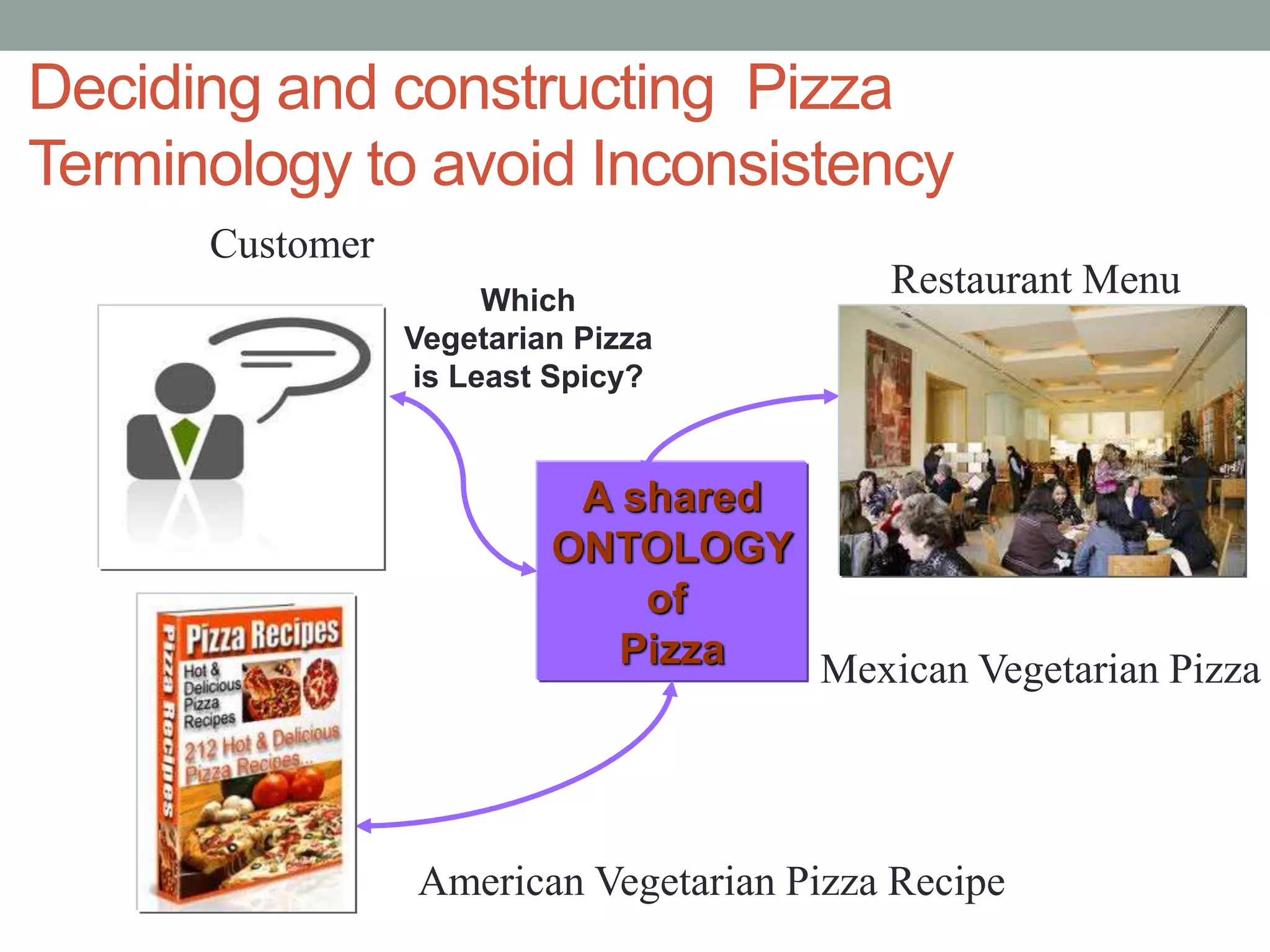
Which
Vegetarian Pizza
is Least Spicy?
A shared
ONTOLOGY
of
Pizza
Restaurant Menu
Customer
Deciding and constructing Pizza
Terminology to avoid Inconsistency
Mexican Vegetarian Pizza
American Vegetarian Pizza Recipe
Outline
• What is ontology Engineering?
• Ontology Engineering versus
Object-Oriented Modeling
• Why develop an ontology?
• Developing an ontology
• Going deeper: Common problems and solutions
• Ontologies in the Semantic Web languages
• Current research issues in ontology engineering
What Is “Ontology Engineering”?
Ontology Engineering:
• Ontology engineering is a set of tasks related to the
development of ontologies for a particular domain.
• Defining terms in the domain and relations among them
• Defining concepts in the domain (classes)
• Arranging the concepts in a hierarchy (subclass-superclass
hierarchy)
• Defining which attributes and properties (slots) classes can have
and constraints on their values
• Defining individuals and filling in property values
• Ontology Engineering analogous to OO Database Design?
Ontology Engineering versus
Object-Oriented Modeling
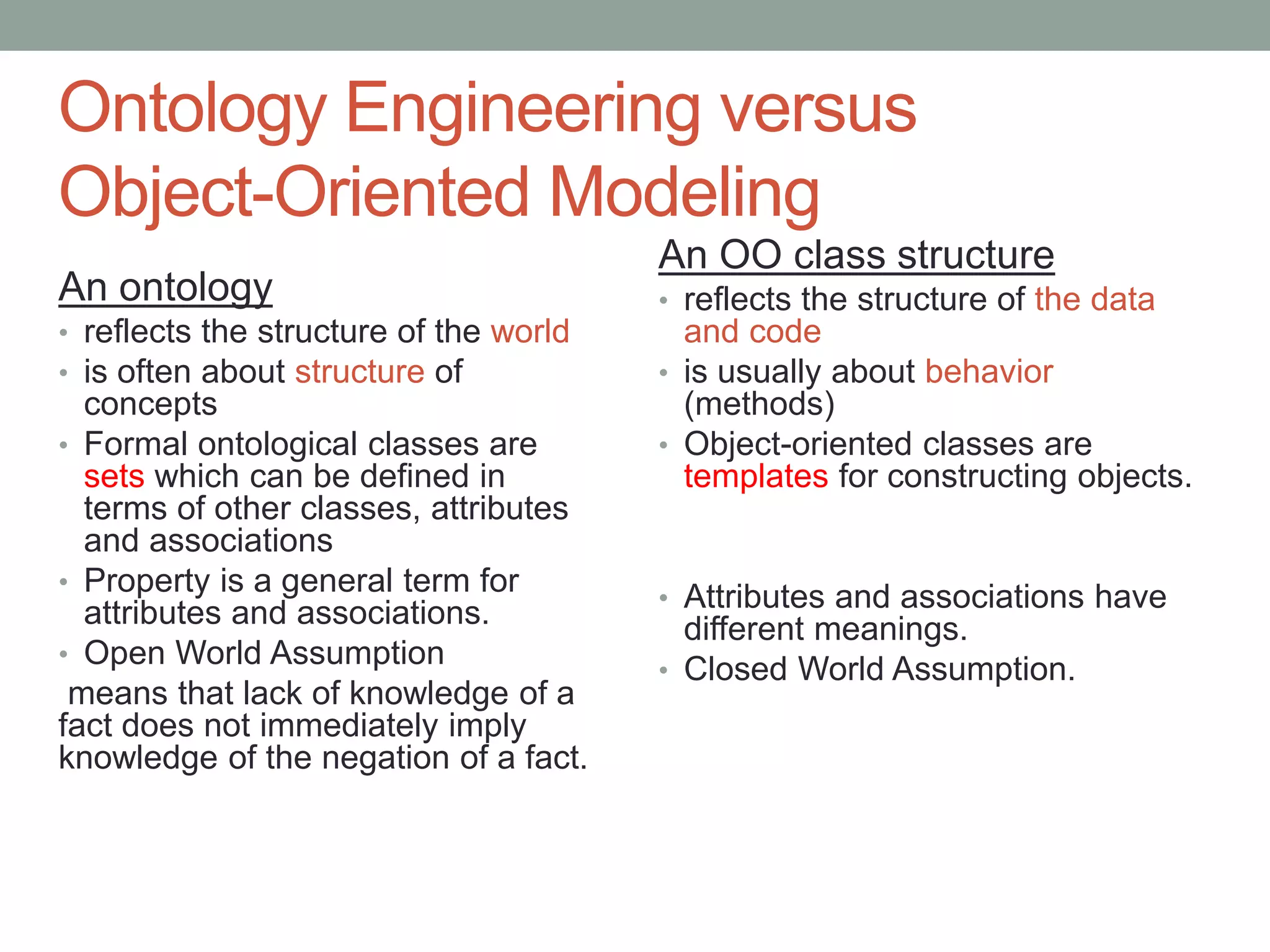
An ontology
• reflects the structure of the world
• is often about structure of
concepts
• Formal ontological classes are
sets which can be defined in
terms of other classes, attributes
and associations
• Property is a general term for
attributes and associations.
• Open World Assumption
means that lack of knowledge of a
fact does not immediately imply
knowledge of the negation of a fact.
An OO class structure
• reflects the structure of the data
and code
• is usually about behavior
(methods)
• Object-oriented classes are
templates for constructing objects.
• Attributes and associations have
different meanings.
• Closed World Assumption.
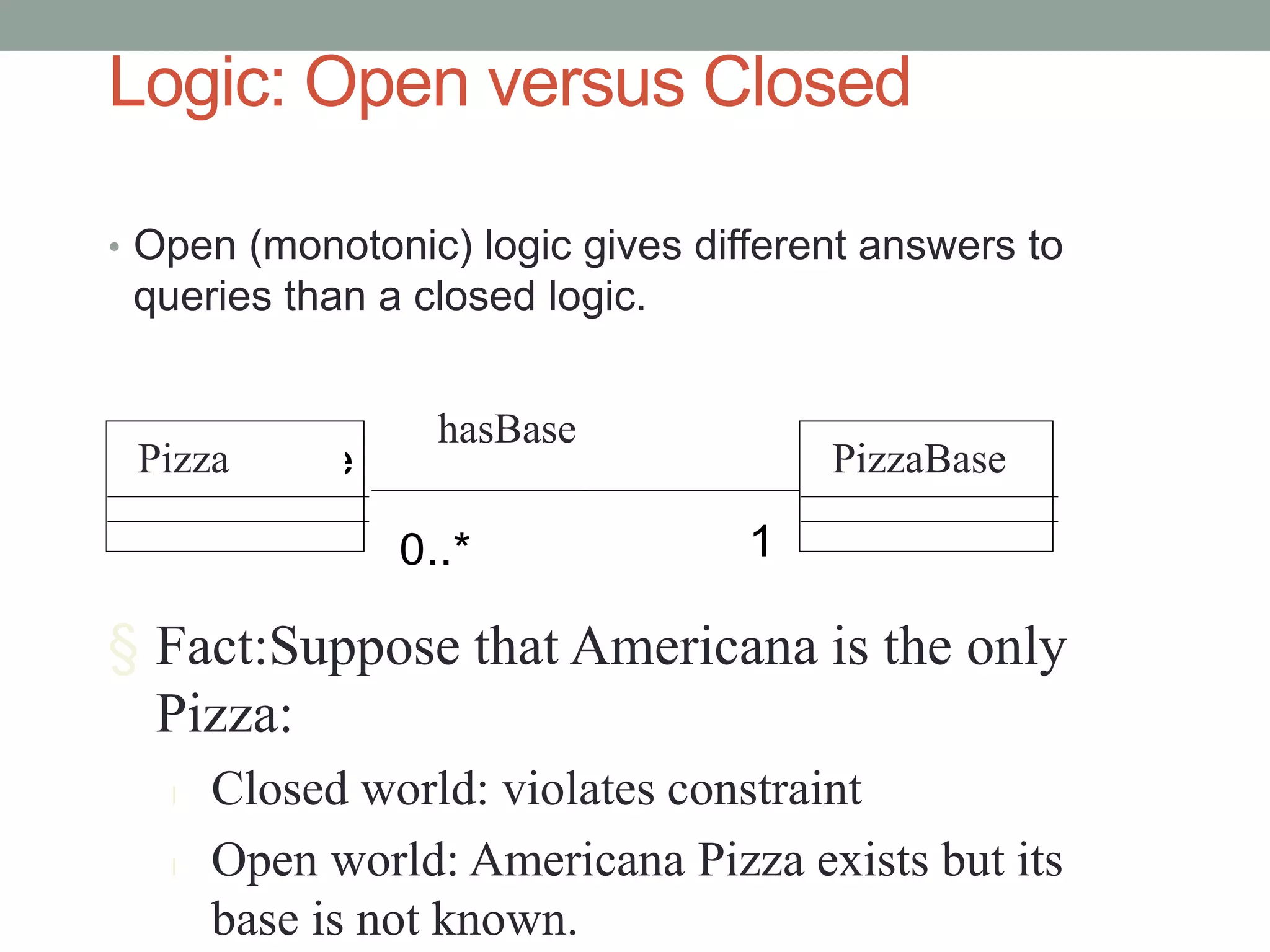
Logic: Open versus Closed
• Open (monotonic) logic gives different answers to
queries than a closed logic.
Employee Company
1
0..* 1
0..*
works for
§ Fact:Suppose that Americana is the only
Pizza:
l Closed world: violates constraint
l Open world: Americana Pizza exists but its
base is not known.
Pizza
hasBase
PizzaBase
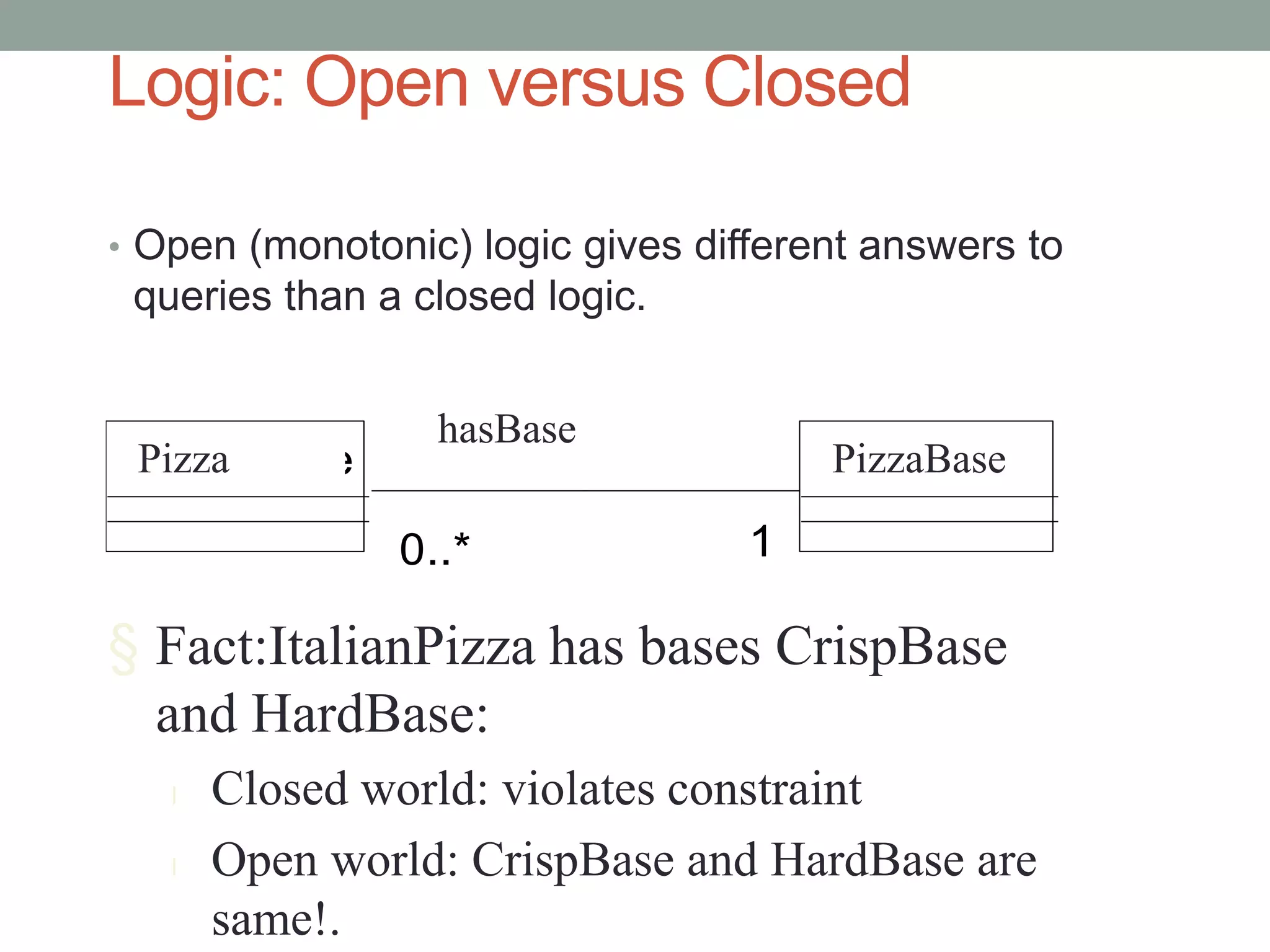
Logic: Open versus Closed
• Open (monotonic) logic gives different answers to
queries than a closed logic.
Employee Company
1
0..* 1
0..*
works for
§ Fact:ItalianPizza has bases CrispBase
and HardBase:
l Closed world: violates constraint
l Open world: CrispBase and HardBase are
same!.
Pizza
hasBase
PizzaBase
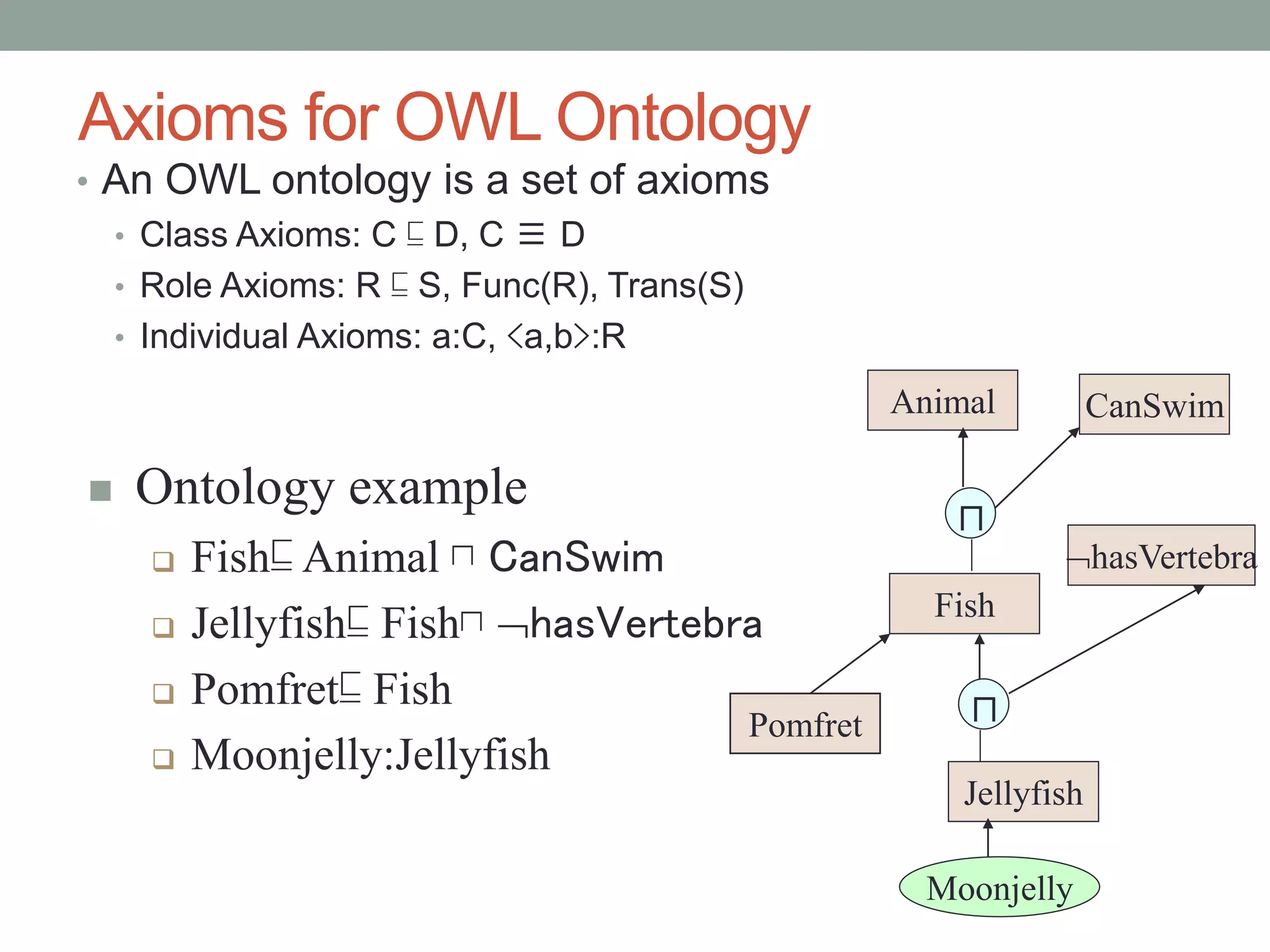
Axioms for OWL Ontology
• An OWL ontology is a set of axioms
• Class Axioms: C ⊑ D, C ≡ D
• Role Axioms: R ⊑ S, Func(R), Trans(S)
• Individual Axioms: a:C, <a,b>:R
Animal
Fish
CanSwim
⊓
⊓
Jellyfish
Pomfret
Moonjelly
 Ontology example
 Fish⊑ Animal ⊓ CanSwim
 Jellyfish⊑ Fish⊓ hasVertebra
 Pomfret⊑ Fish
 Moonjelly:Jellyfish
hasVertebra
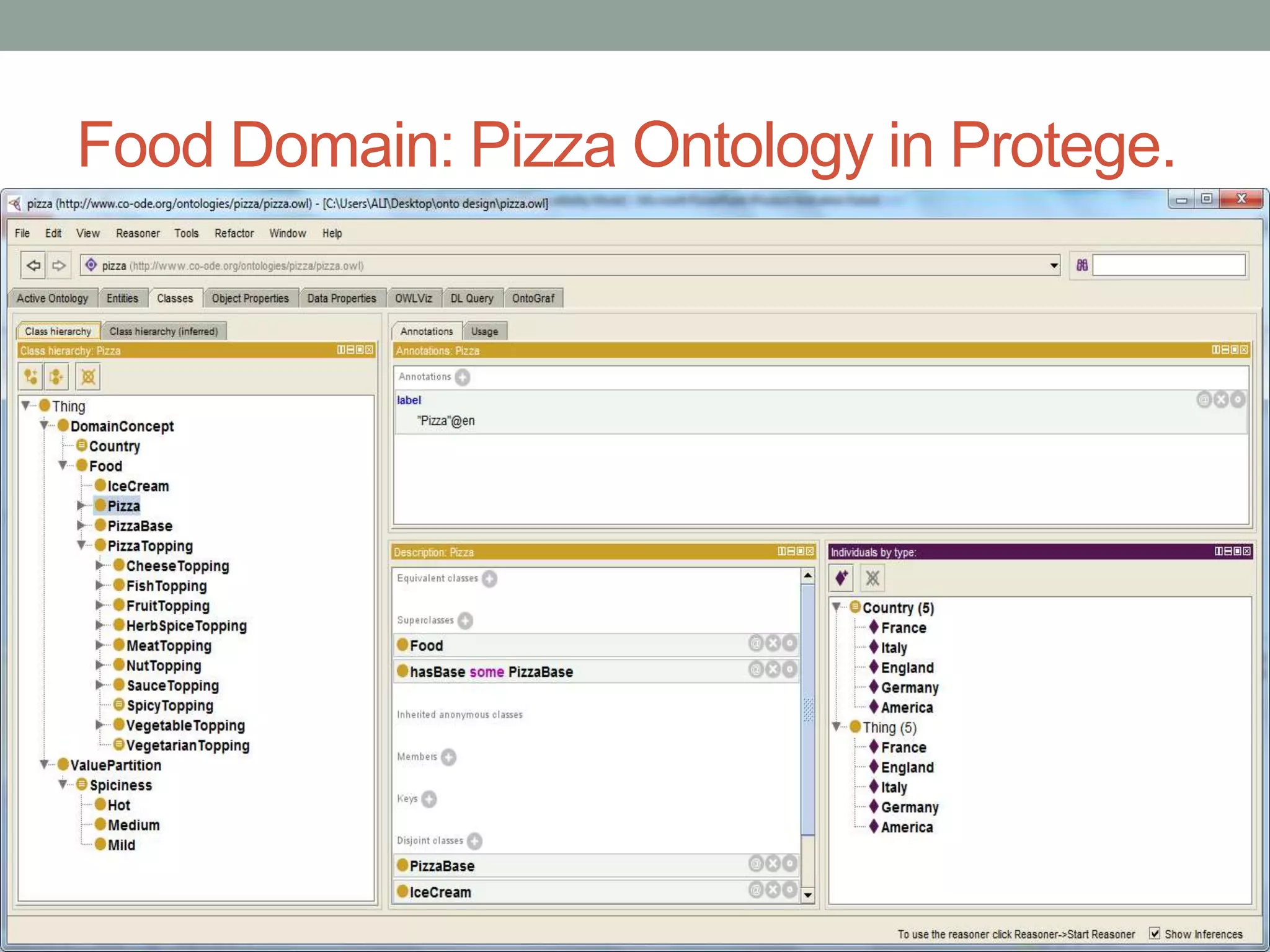
Food Domain: Pizza Ontology in Protege.
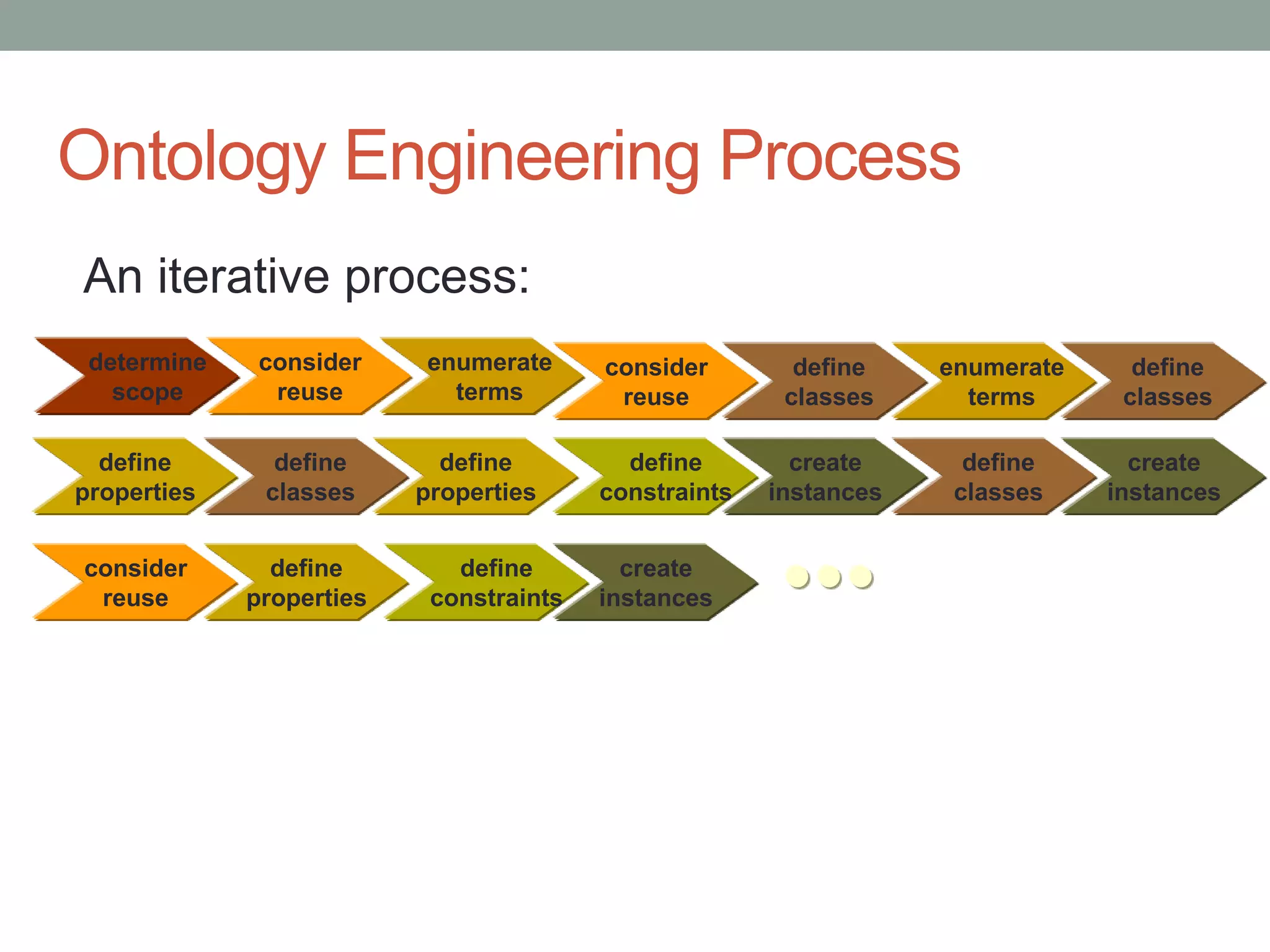
Ontology Engineering Process
An iterative process:
determine
scope
consider
reuse
enumerate
terms
define
classes
consider
reuse
enumerate
terms
define
classes
define
properties
create
instances
define
classes
define
properties
define
constraints
create
instances
define
classes
consider
reuse
define
properties
define
constraints
create
instances
Ontology Engineering Tools
• Protégé, which:
• is a graphical ontology-development tool
• supports a rich knowledge model
• is open-source and freely available
(http://protege.stanford.edu)
• Some other available tools:
• Ontolingua and Chimaera
• OntoEdit
• OilEd
• DOGMA
• DogmaModeler
• KAON
• OntoClean
• OnToContent
• HOZO
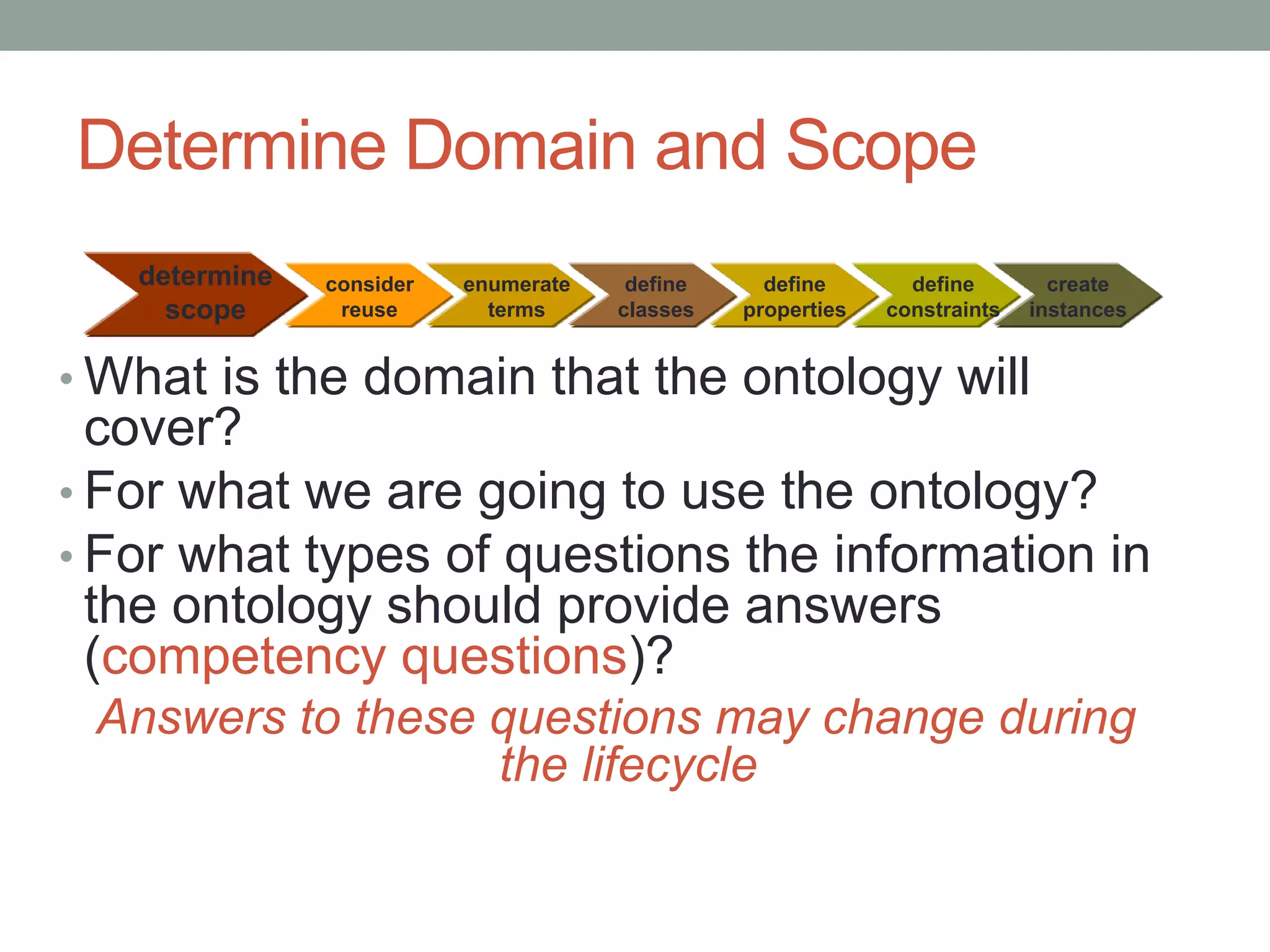
Determine Domain and Scope
• What is the domain that the ontology will
cover?
• For what we are going to use the ontology?
• For what types of questions the information in
the ontology should provide answers
(competency questions)?
Answers to these questions may change during
the lifecycle
determine
scope
consider
reuse
enumerate
terms
define
classes
define
properties
define
constraints
create
instances
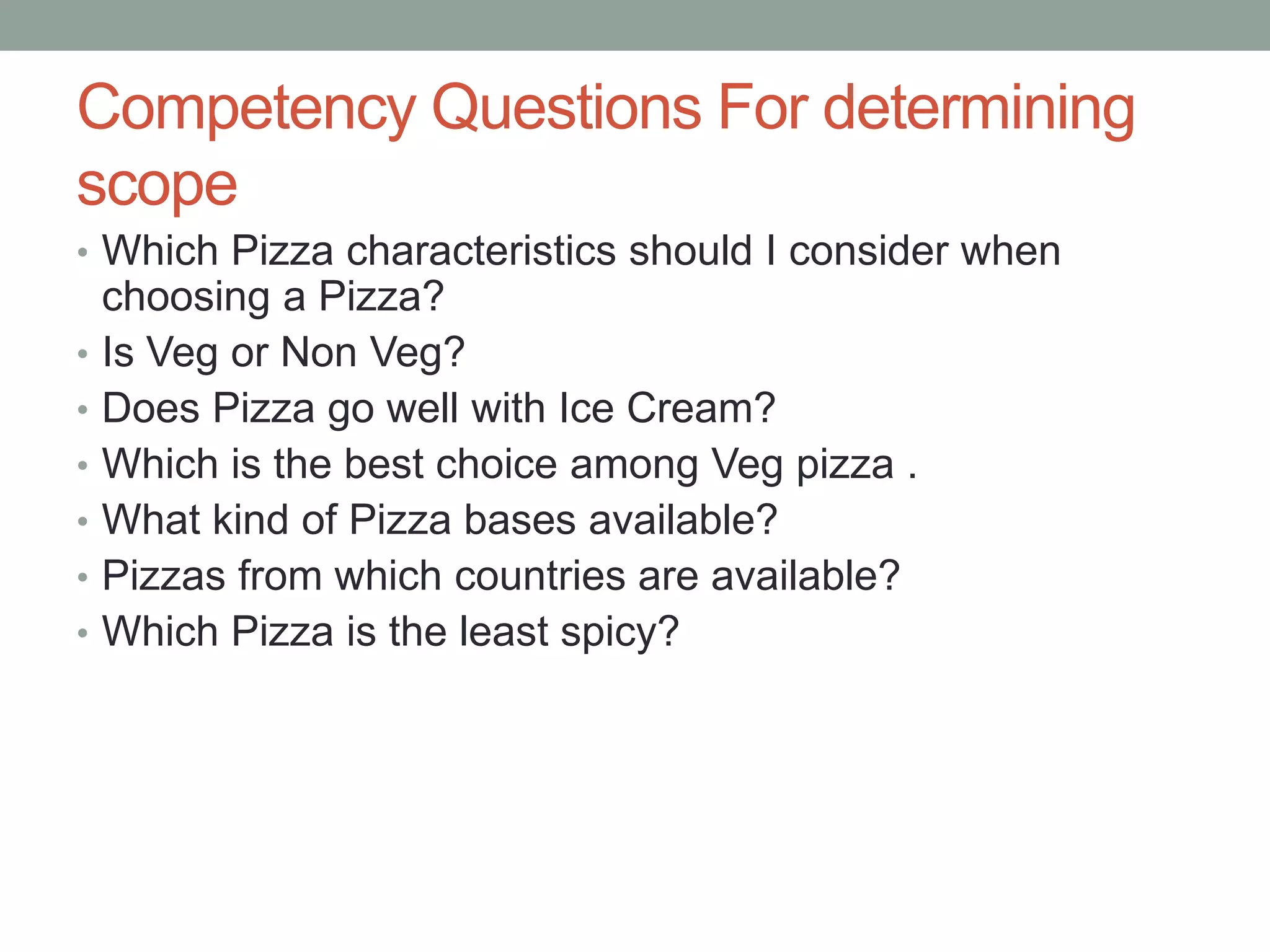
Competency Questions For determining
scope
• Which Pizza characteristics should I consider when
choosing a Pizza?
• Is Veg or Non Veg?
• Does Pizza go well with Ice Cream?
• Which is the best choice among Veg pizza .
• What kind of Pizza bases available?
• Pizzas from which countries are available?
• Which Pizza is the least spicy?
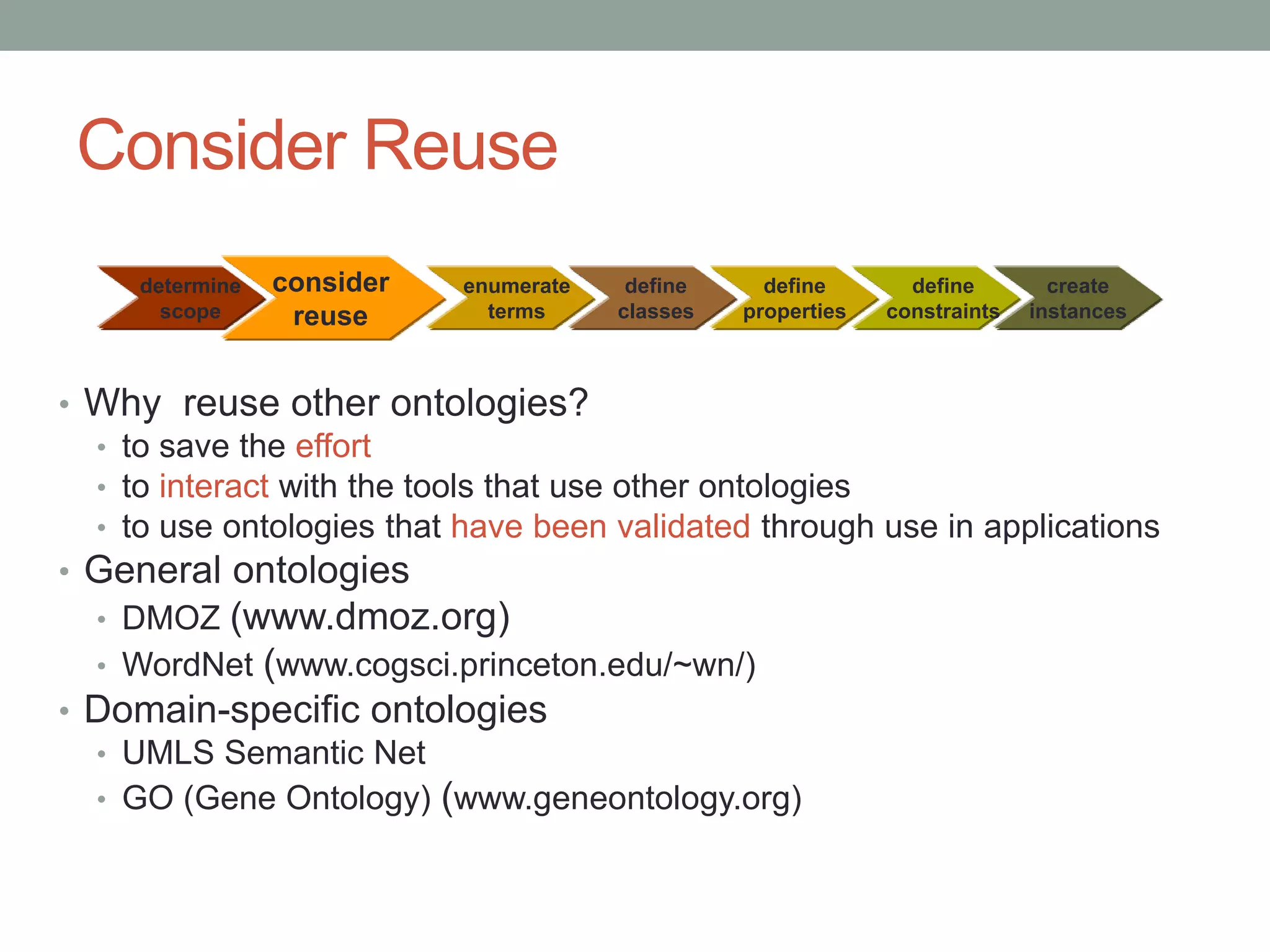
Consider Reuse
• Why reuse other ontologies?
• to save the effort
• to interact with the tools that use other ontologies
• to use ontologies that have been validated through use in applications
• General ontologies
• DMOZ (www.dmoz.org)
• WordNet (www.cogsci.princeton.edu/~wn/)
• Domain-specific ontologies
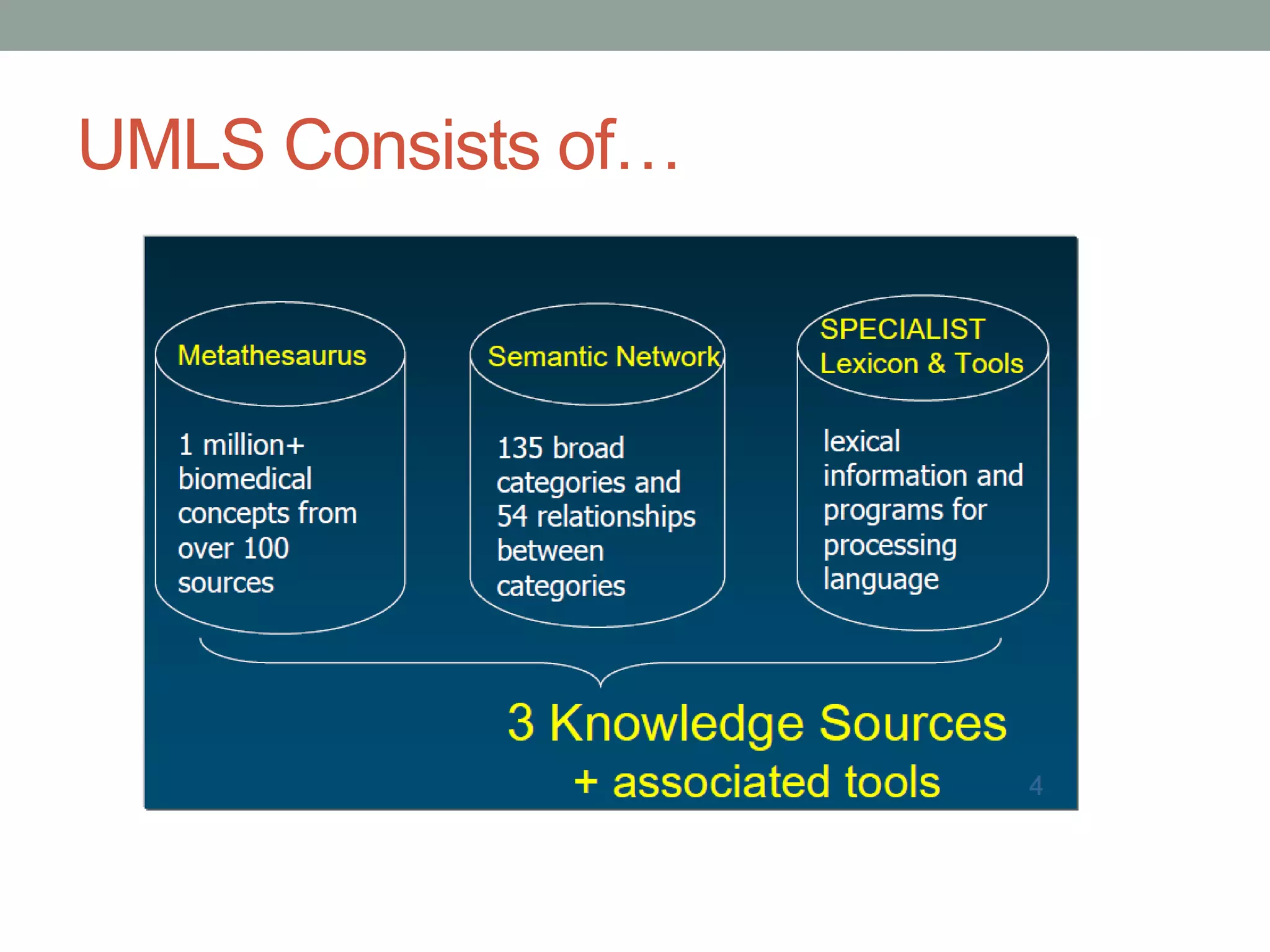
• UMLS Semantic Net
• GO (Gene Ontology) (www.geneontology.org)
determine
scope
consider
reuse
enumerate
terms
define
classes
define
properties
define
constraints
create
instances
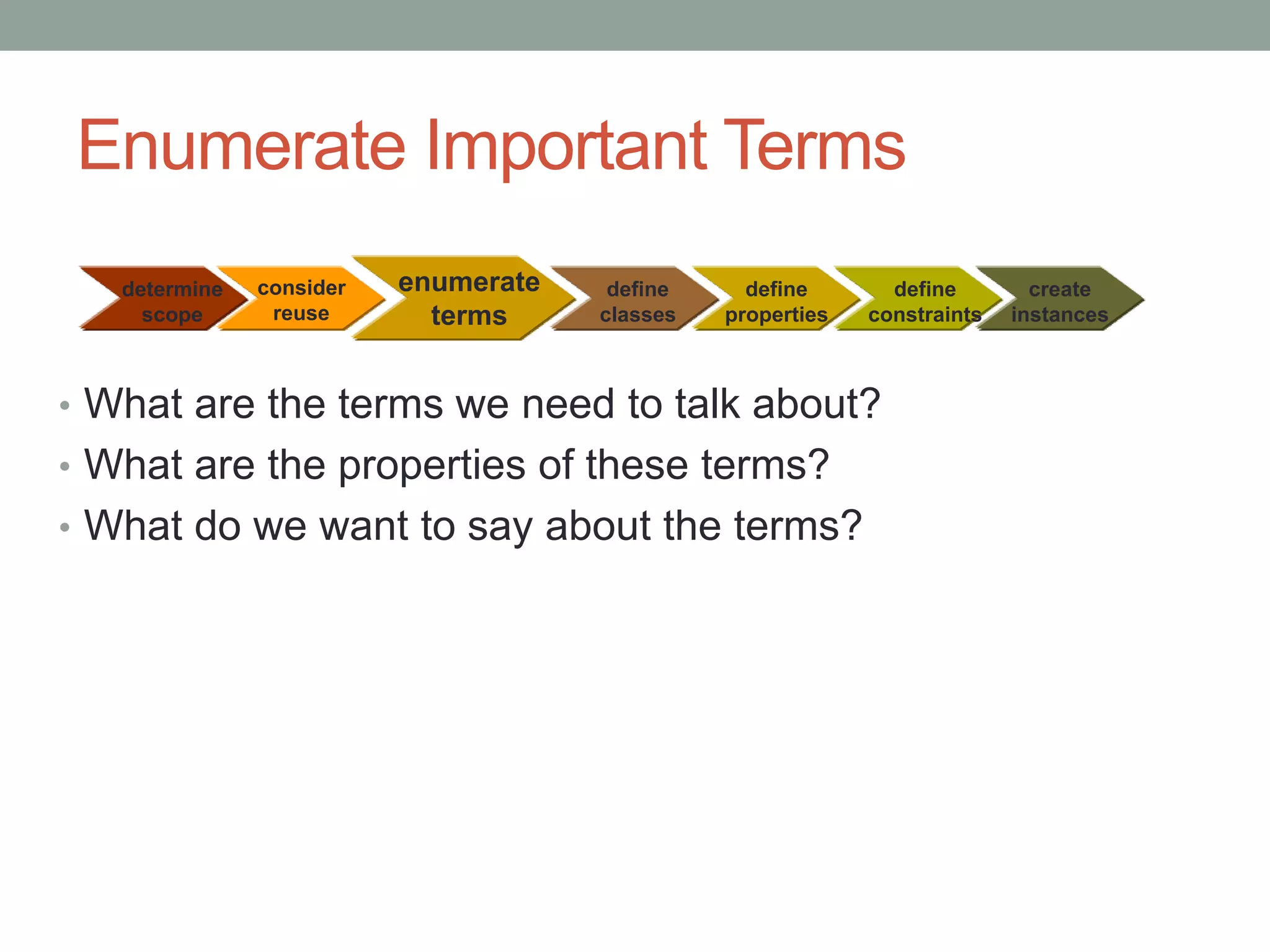
Enumerate Important Terms
• What are the terms we need to talk about?
• What are the properties of these terms?
• What do we want to say about the terms?
consider
reuse
determine
scope
enumerate
terms
define
classes
define
properties
define
constraints
create
instances
Enumerating Terms - The Pizza
Ontology
Pizza, Cheese , Toppings , Mexican , Sauce , Pizza Base,
Crispy…
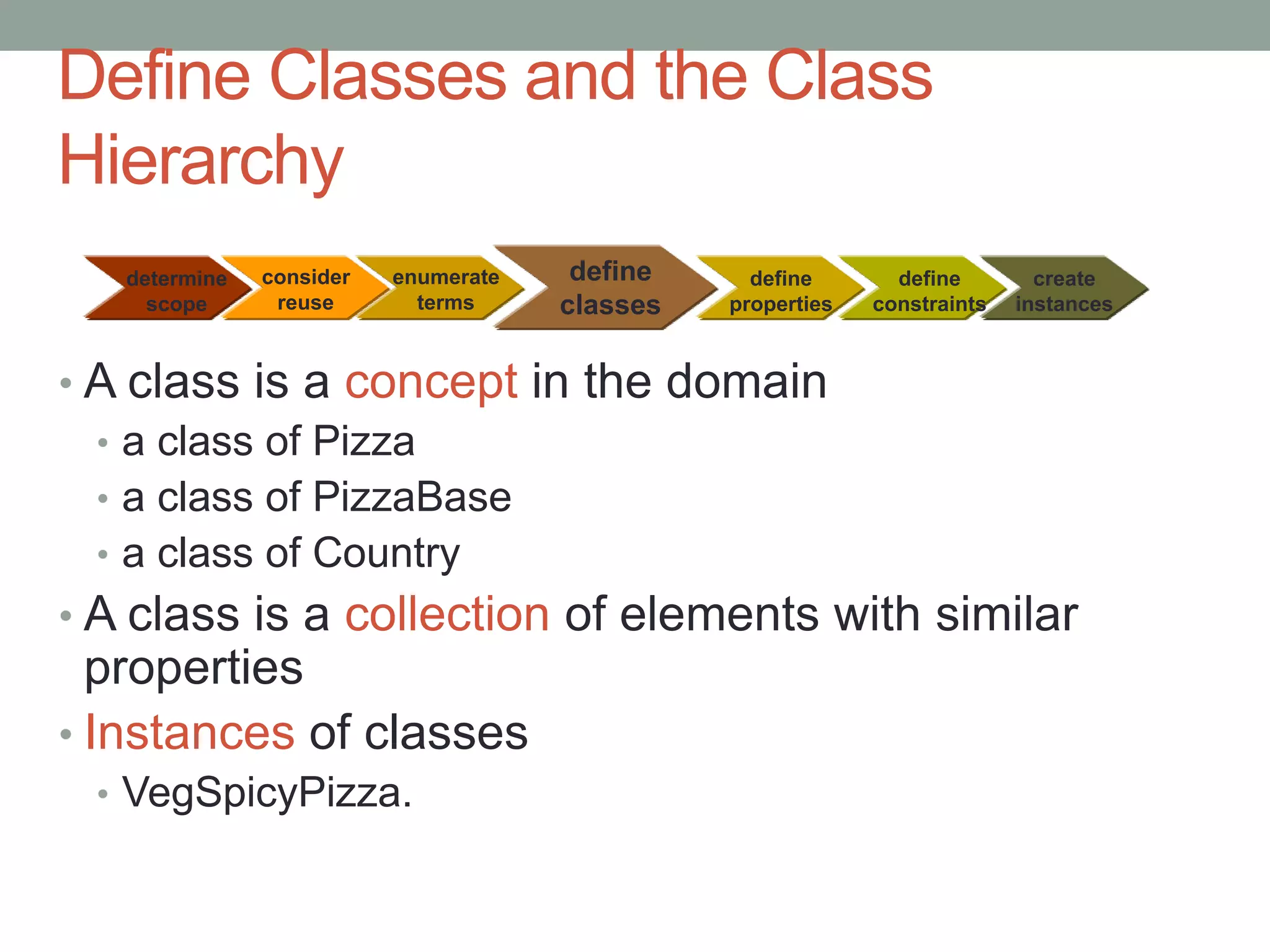
Define Classes and the Class
Hierarchy
• A class is a concept in the domain
• a class of Pizza
• a class of PizzaBase
• a class of Country
• A class is a collection of elements with similar
properties
• Instances of classes
• VegSpicyPizza.
consider
reuse
determine
scope
define
classes
define
properties
define
constraints
create
instances
enumerate
terms
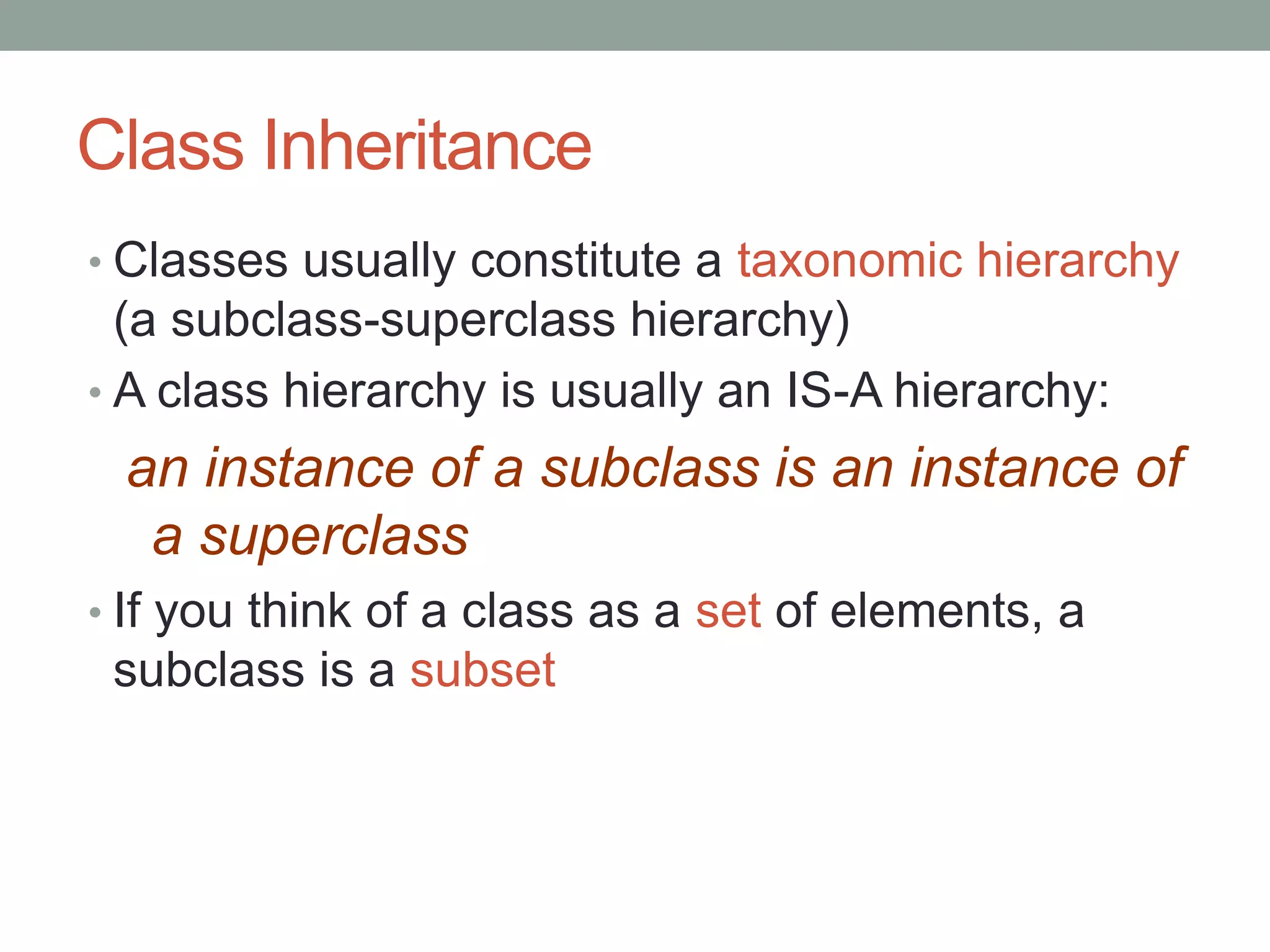
Class Inheritance
• Classes usually constitute a taxonomic hierarchy
(a subclass-superclass hierarchy)
• A class hierarchy is usually an IS-A hierarchy:
an instance of a subclass is an instance of
a superclass
• If you think of a class as a set of elements, a
subclass is a subset
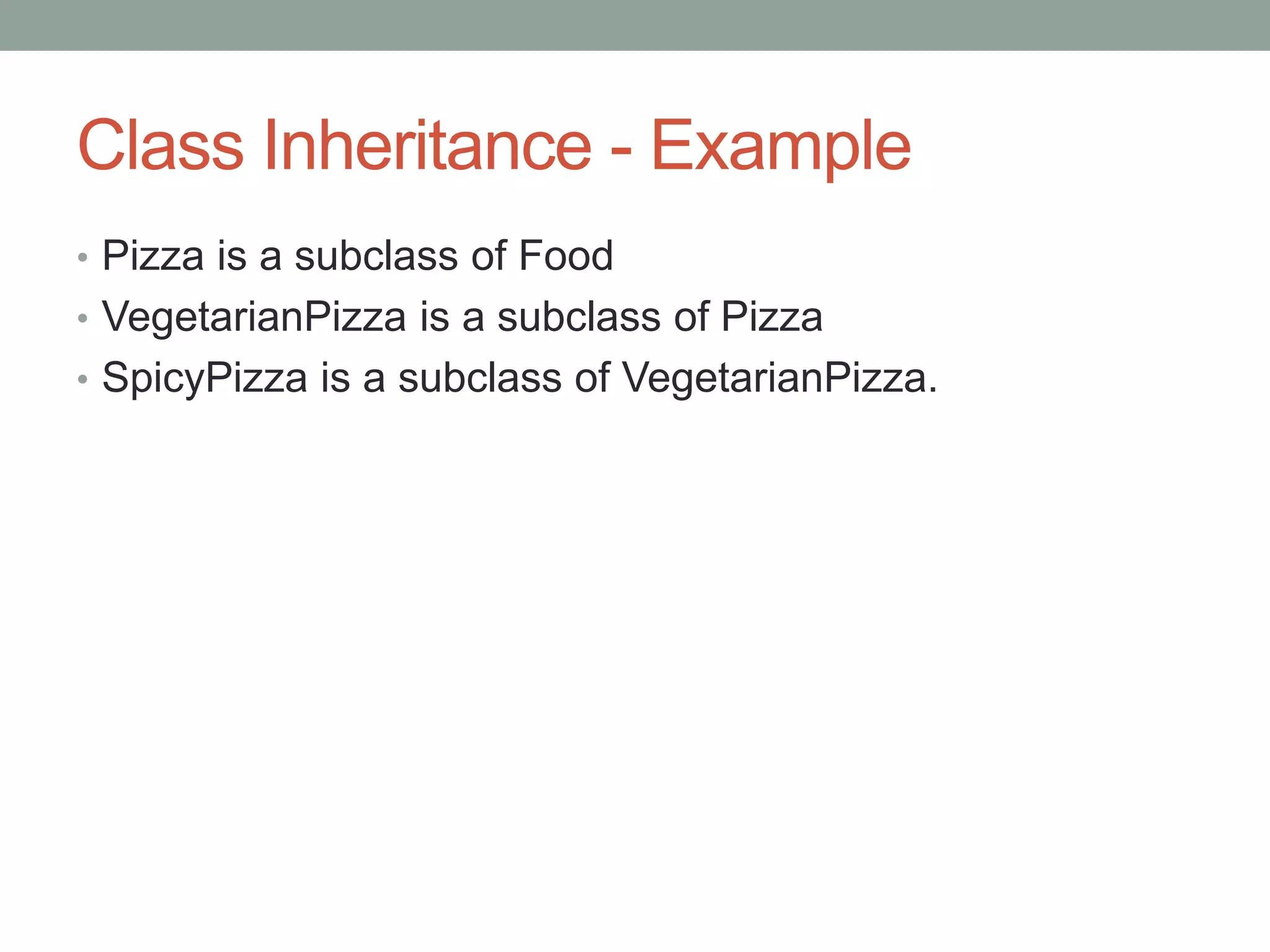
Class Inheritance - Example
• Pizza is a subclass of Food
• VegetarianPizza is a subclass of Pizza
• SpicyPizza is a subclass of VegetarianPizza.
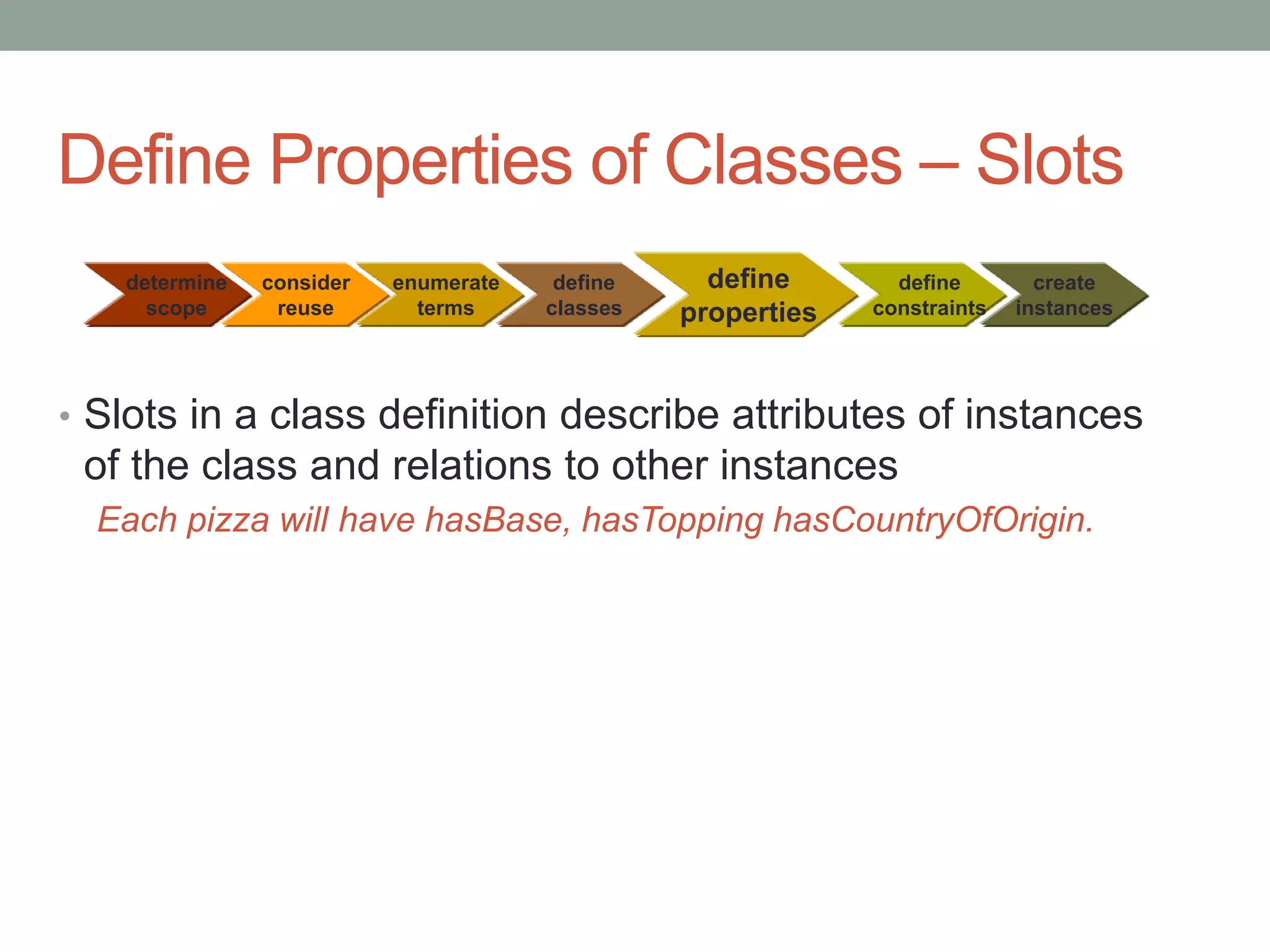
Define Properties of Classes – Slots
• Slots in a class definition describe attributes of instances
of the class and relations to other instances
Each pizza will have hasBase, hasTopping hasCountryOfOrigin.
consider
reuse
determine
scope
define
constraints
create
instances
enumerate
terms
define
classes
define
properties
Properties (Slots)
• Types of properties
• Simple and complex properties
• simple properties (attributes): contain primitive values
(strings, numbers)
• complex properties: contain (or point to) other objects
(e.g., a Pizza instance)
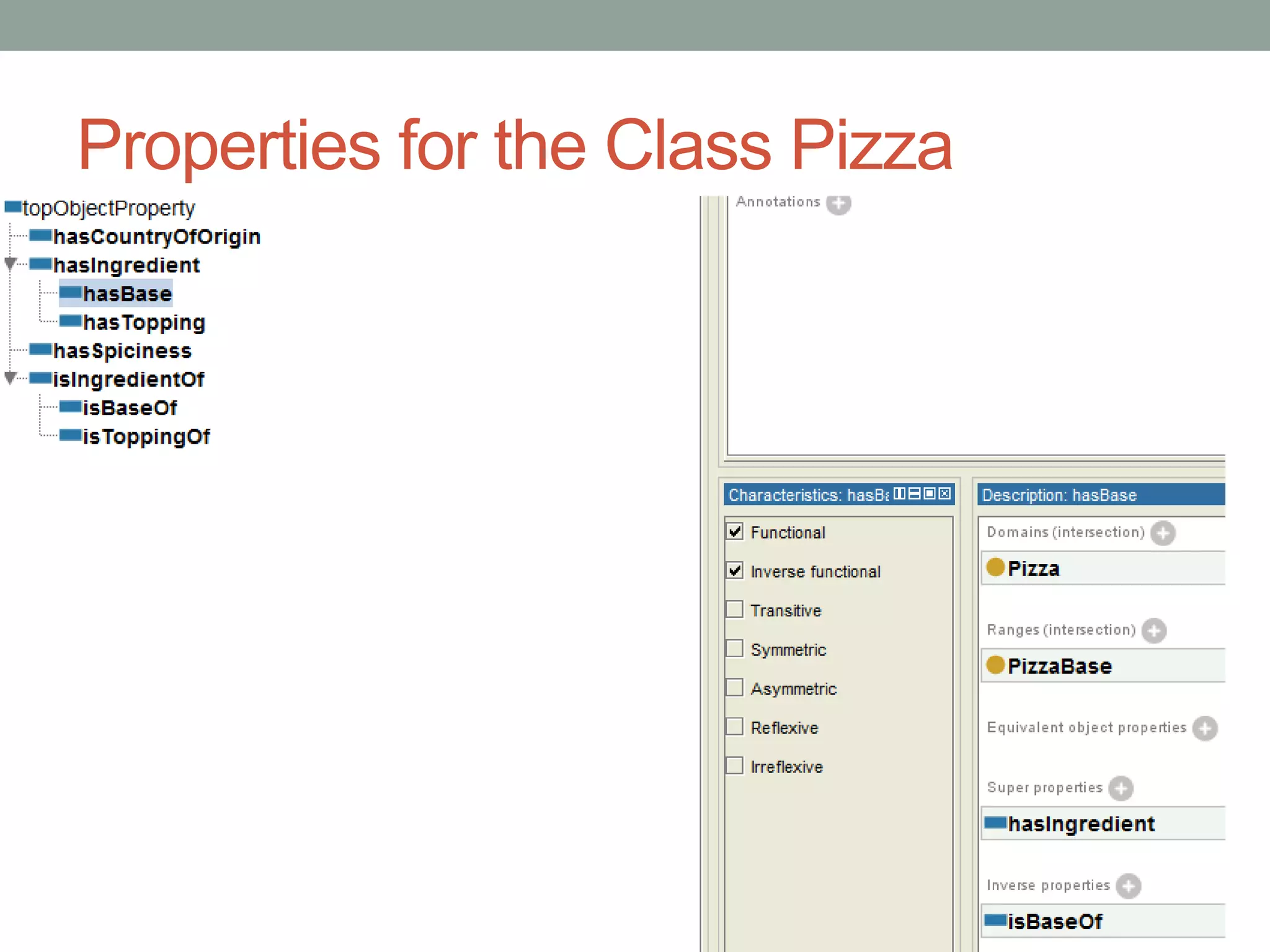
Properties for the Class Pizza
(in Protégé-2000)
property and Class Inheritance
• A subclass inherits all the propertys from the superclass
If a Pizza has a name and flavor, a AmericanPizza also
has a name and flavor
• If a class has multiple superclasses, it inherits properties
from all of them.
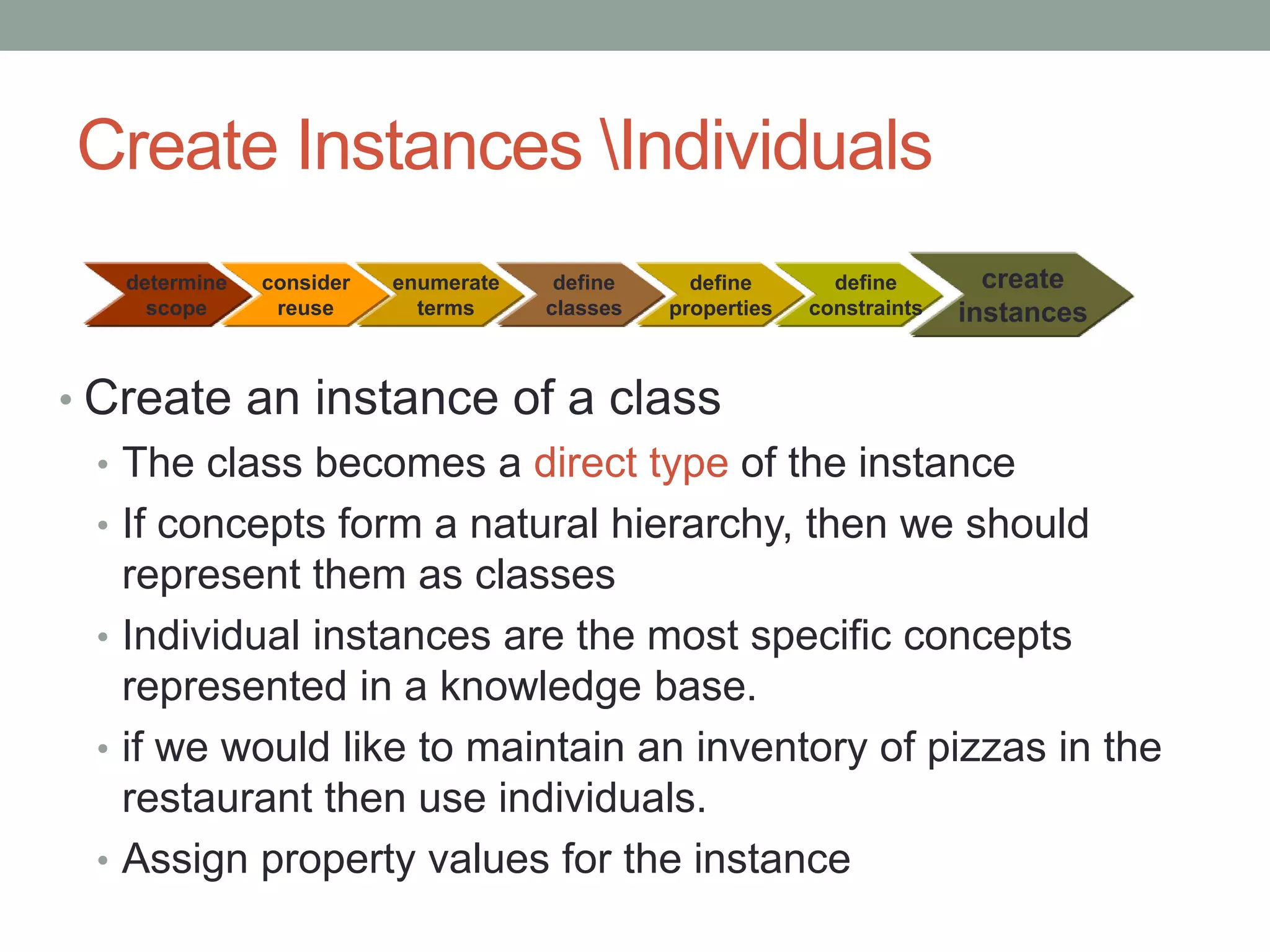
Create Instances Individuals
• Create an instance of a class
• The class becomes a direct type of the instance
• If concepts form a natural hierarchy, then we should
represent them as classes
• Individual instances are the most specific concepts
represented in a knowledge base.
• if we would like to maintain an inventory of pizzas in the
restaurant then use individuals.
• Assign property values for the instance
consider
reuse
determine
scope
create
instances
enumerate
terms
define
classes
define
properties
define
constraints
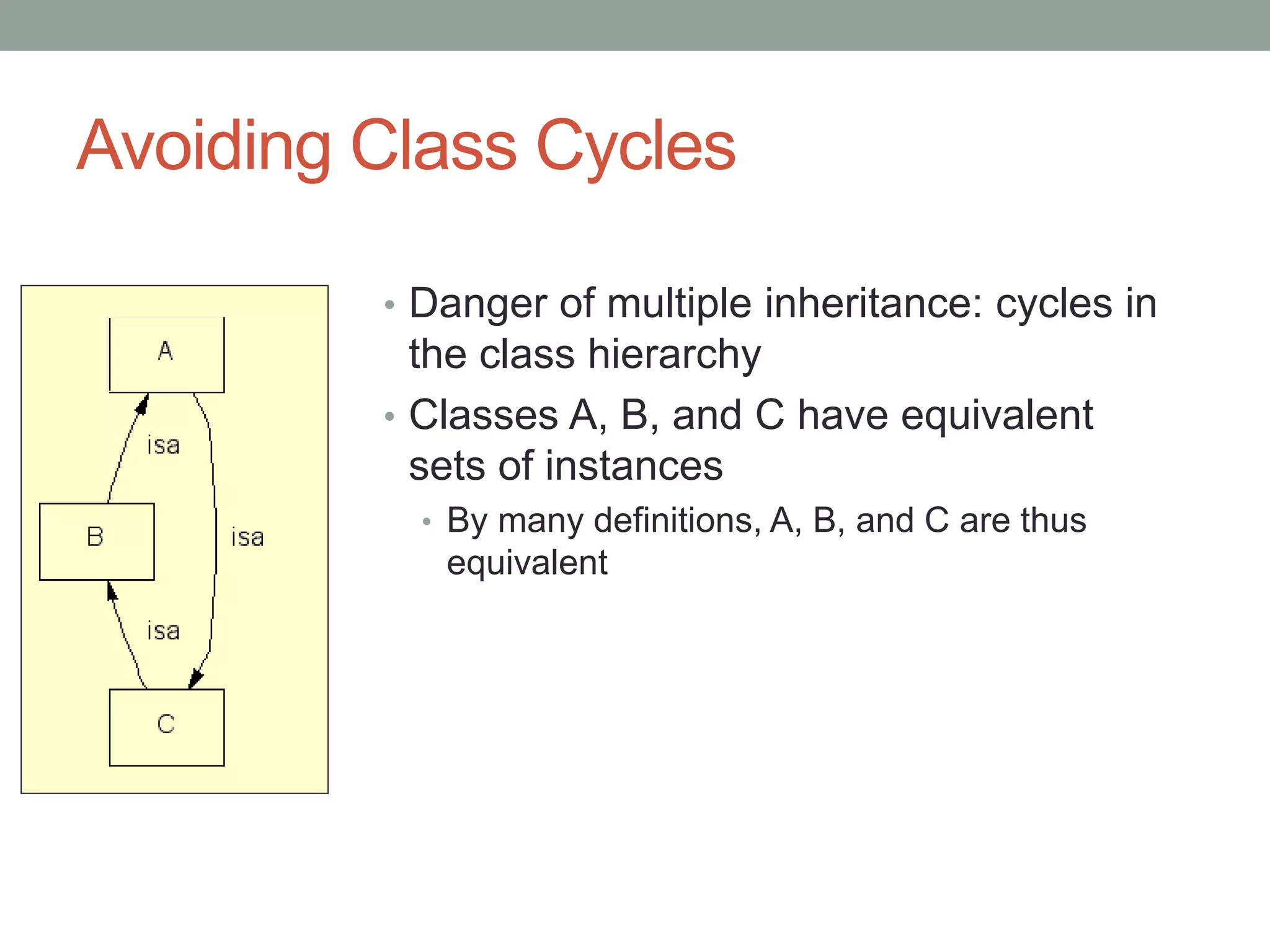
Avoiding Class Cycles
• Danger of multiple inheritance: cycles in
the class hierarchy
• Classes A, B, and C have equivalent
sets of instances
• By many definitions, A, B, and C are thus
equivalent
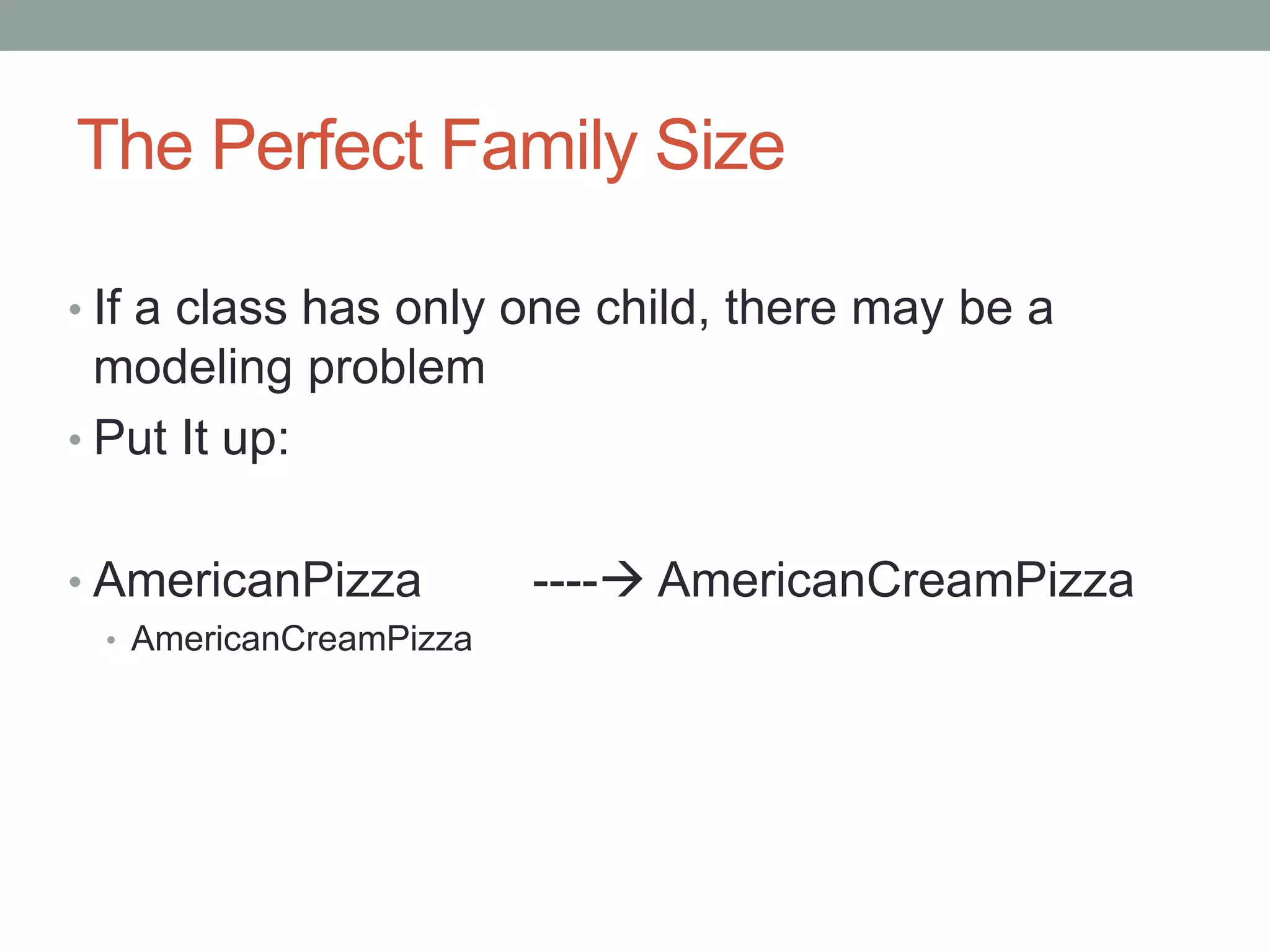
The Perfect Family Size
• If a class has only one child, there may be a
modeling problem
• Put It up:
• AmericanPizza ---- AmericanCreamPizza
• AmericanCreamPizza
Single and Plural Class Names
• A “Pizza” is not a kind-of “Pizzas”
• Class names should be either
• all singular
• all plural
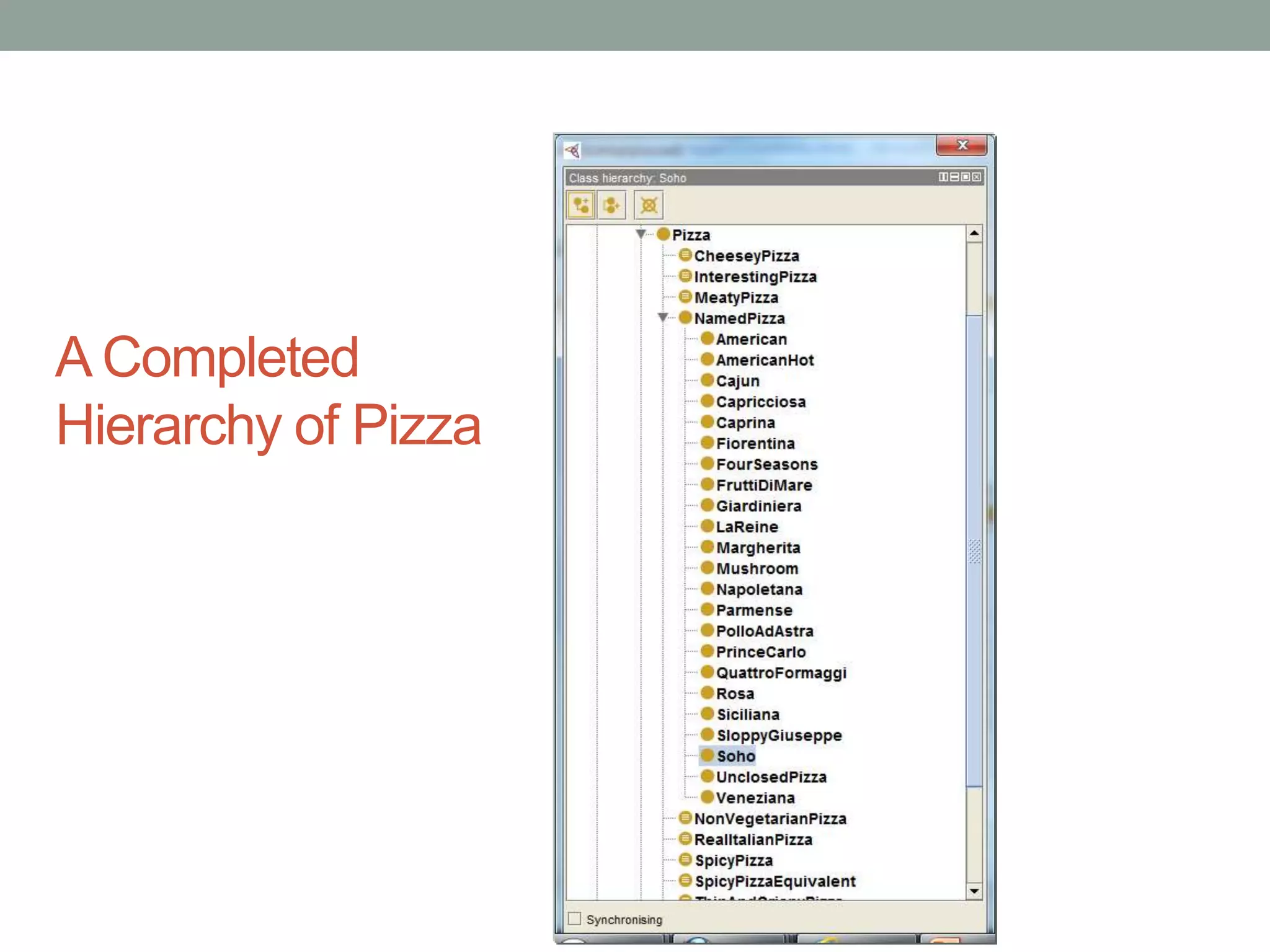
A Completed
Hierarchy of Pizza
Outline
• What is ontology Engineering?
• Ontology Engineering versus
Object-Oriented Modeling
• Why develop an ontology?
• Step-By-Step: Developing an ontology
• Ontologies in the Semantic Web languages
• Current research issues in ontology engineering
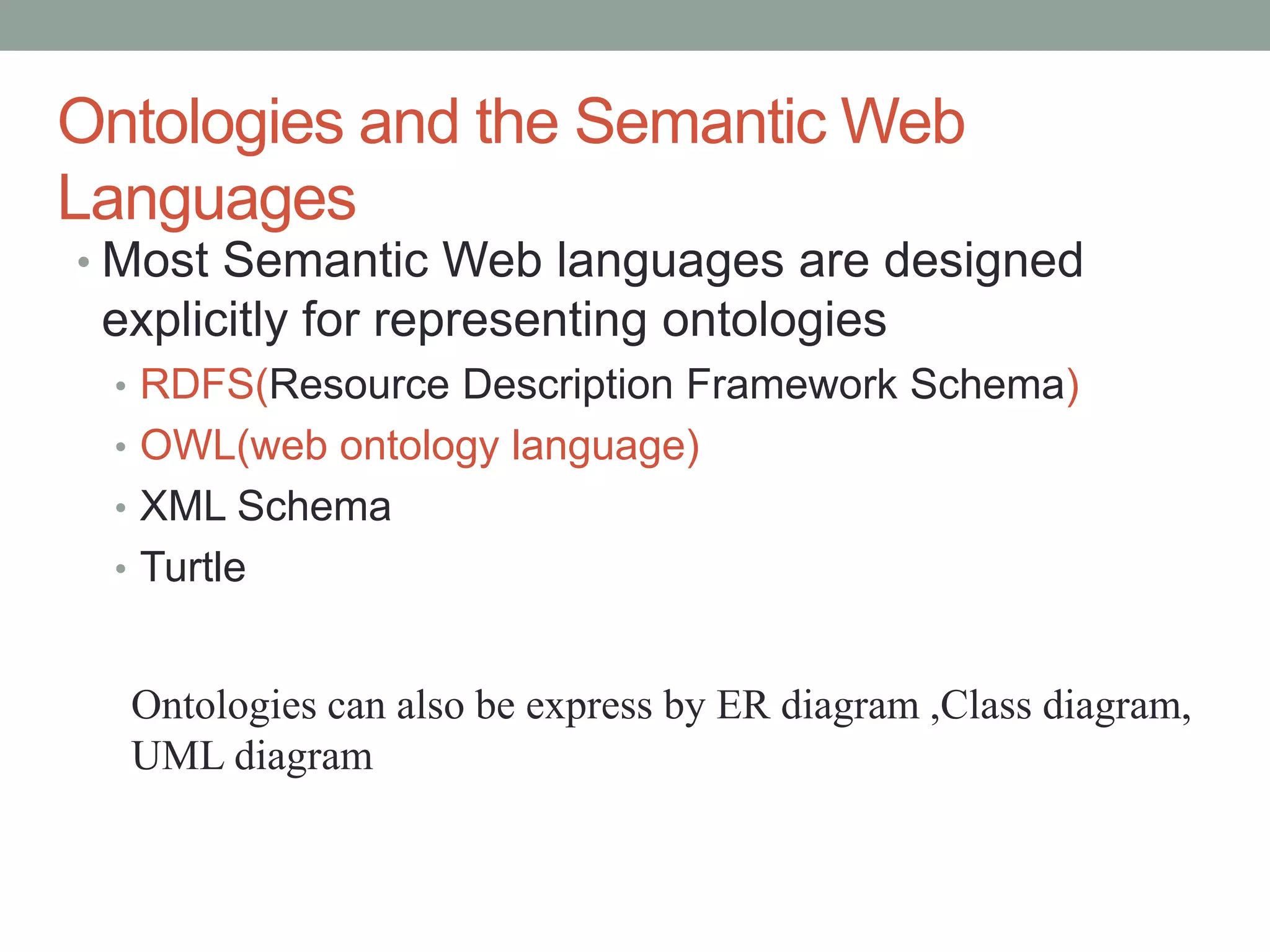
Ontologies and the Semantic Web
Languages
• Most Semantic Web languages are designed
explicitly for representing ontologies
• RDFS(Resource Description Framework Schema)
• OWL(web ontology language)
• XML Schema
• Turtle
Ontologies can also be express by ER diagram ,Class diagram,
UML diagram
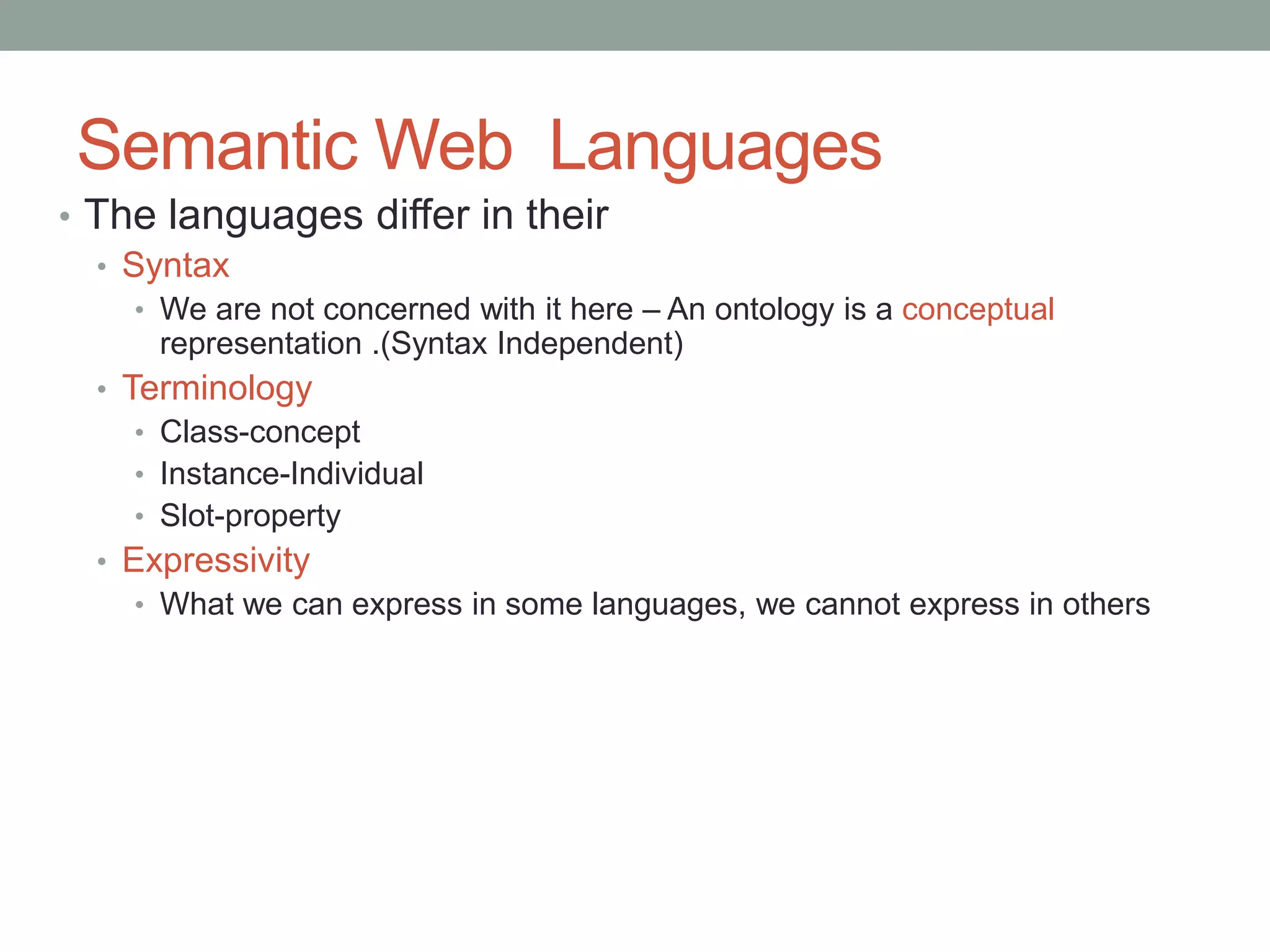
Semantic Web Languages
• The languages differ in their
• Syntax
• We are not concerned with it here – An ontology is a conceptual
representation .(Syntax Independent)
• Terminology
• Class-concept
• Instance-Individual
• Slot-property
• Expressivity
• What we can express in some languages, we cannot express in others
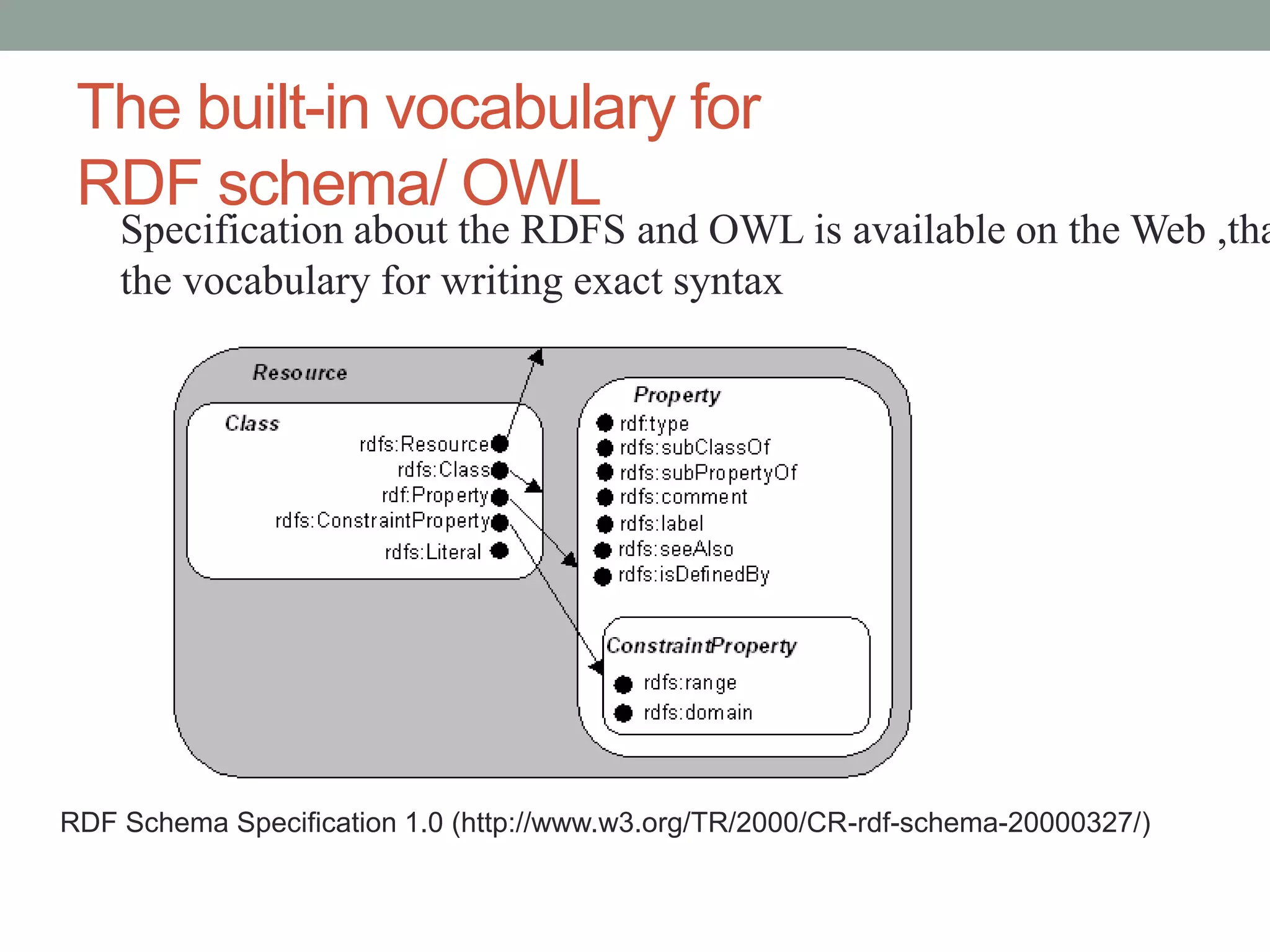
The built-in vocabulary for
RDF schema/ OWL
RDF Schema Specification 1.0 (http://www.w3.org/TR/2000/CR-rdf-schema-20000327/)
Specification about the RDFS and OWL is available on the Web ,tha
the vocabulary for writing exact syntax
RDFS  OWL Terminology and
Semantics
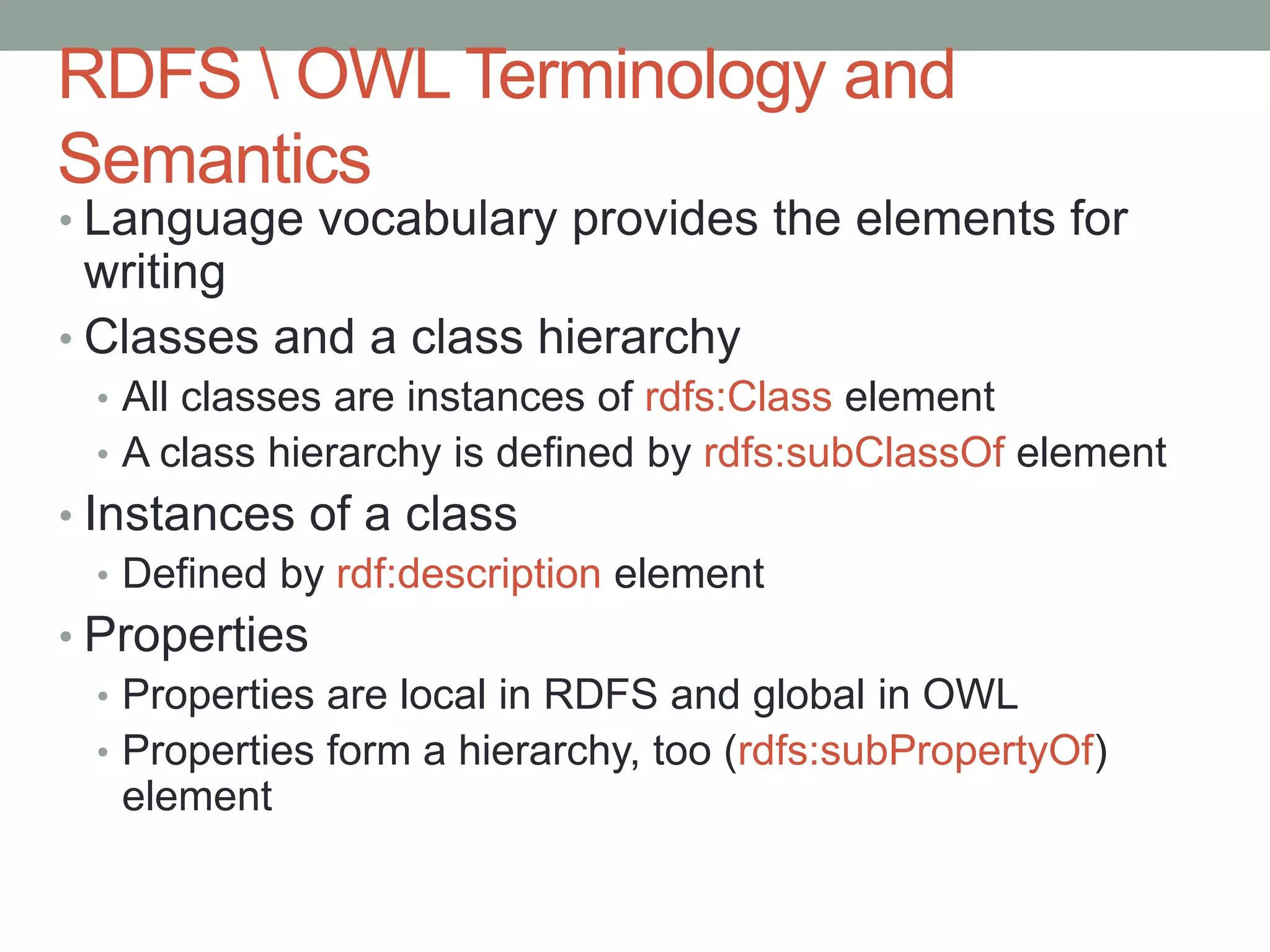
• Language vocabulary provides the elements for
writing
• Classes and a class hierarchy
• All classes are instances of rdfs:Class element
• A class hierarchy is defined by rdfs:subClassOf element
• Instances of a class
• Defined by rdf:description element
• Properties
• Properties are local in RDFS and global in OWL
• Properties form a hierarchy, too (rdfs:subPropertyOf)
element
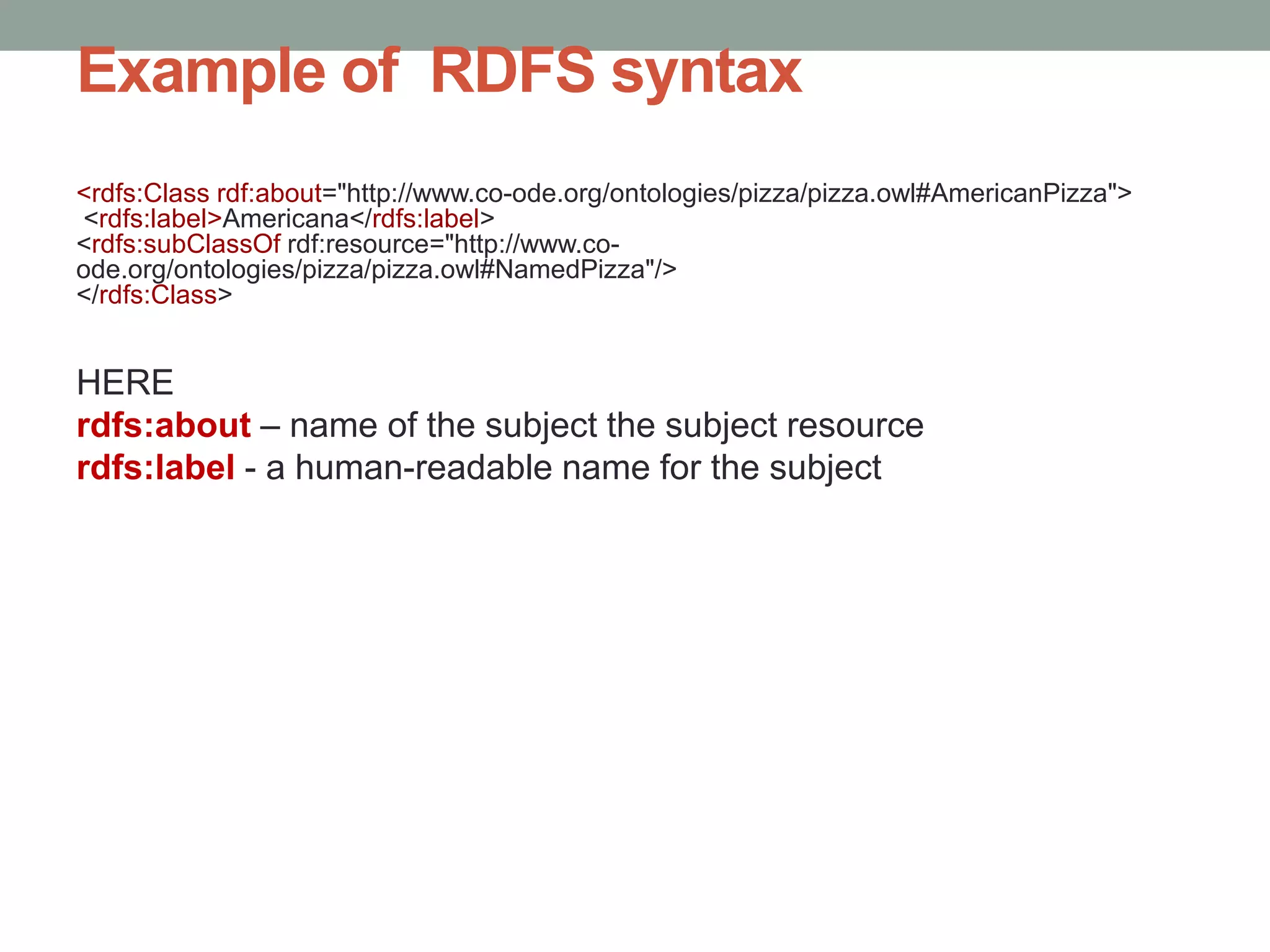
Example of RDFS syntax
<rdfs:Class rdf:about="http://www.co-ode.org/ontologies/pizza/pizza.owl#AmericanPizza">
<rdfs:label>Americana</rdfs:label>
<rdfs:subClassOf rdf:resource="http://www.co-
ode.org/ontologies/pizza/pizza.owl#NamedPizza"/>
</rdfs:Class>
HERE
rdfs:about – name of the subject the subject resource
rdfs:label - a human-readable name for the subject
0WL
• It builds upon the RDFS specification.
• More expressive than RDFS
• Disjointness (owl:disjointWith)
• Equivalence (owl:equivalentClass)
• Also property are more expessive.
• Example showing OWL syntax
<owl:Class rdf:about="http://www.co-
ode.org/ontologies/pizza/pizza.owl#NonVegetarianPizza">
<owl:disjointWith rdf:resource="http://www.co-
ode.org/ontologies/pizza/pizza.owl#VegetarianPizza"/>
</owl:Class>
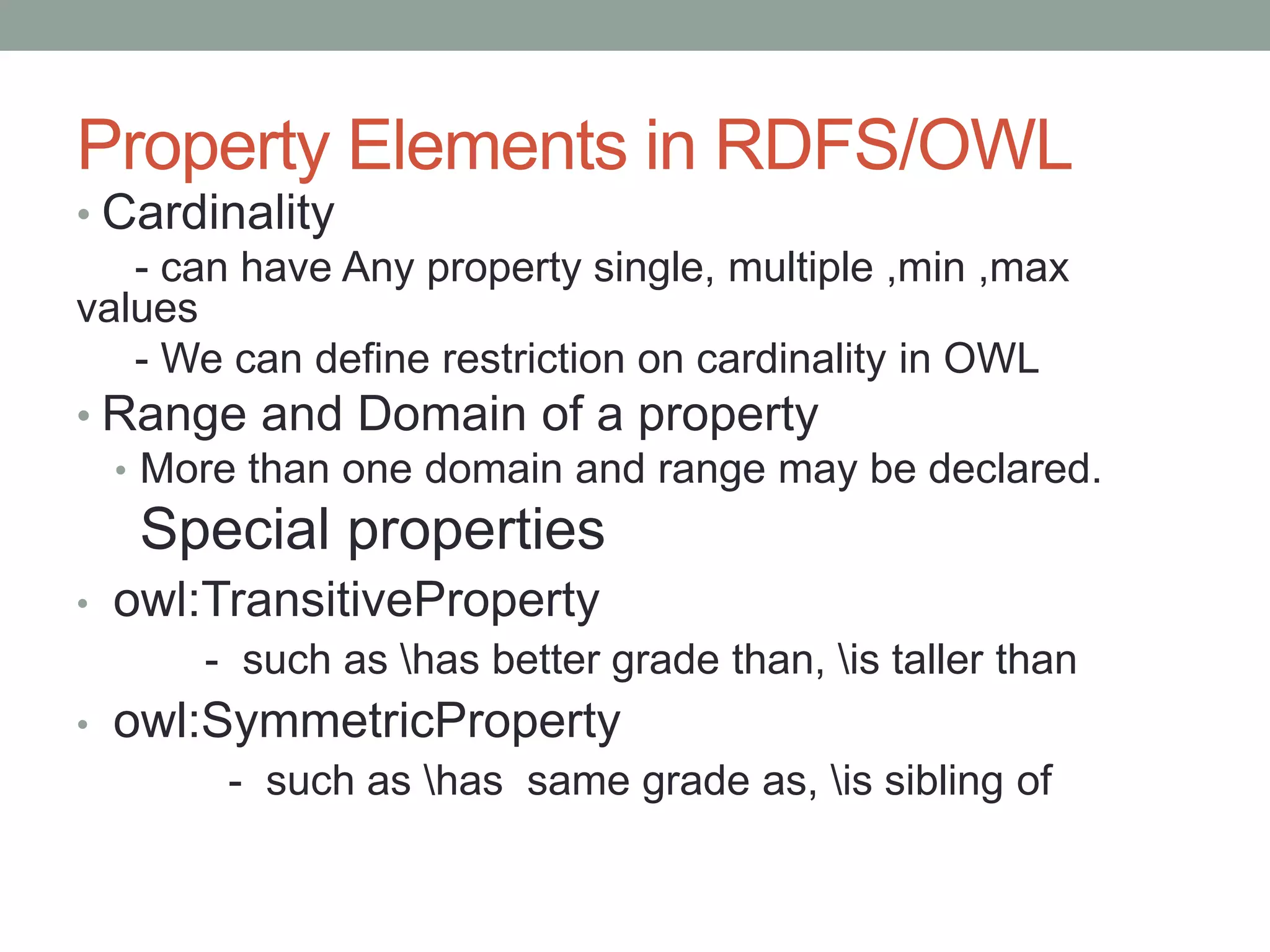
Property Elements in RDFS/OWL
• Cardinality
- can have Any property single, multiple ,min ,max
values
- We can define restriction on cardinality in OWL
• Range and Domain of a property
• More than one domain and range may be declared.
Special properties
• owl:TransitiveProperty
- such as has better grade than, is taller than
• owl:SymmetricProperty
- such as has same grade as, is sibling of
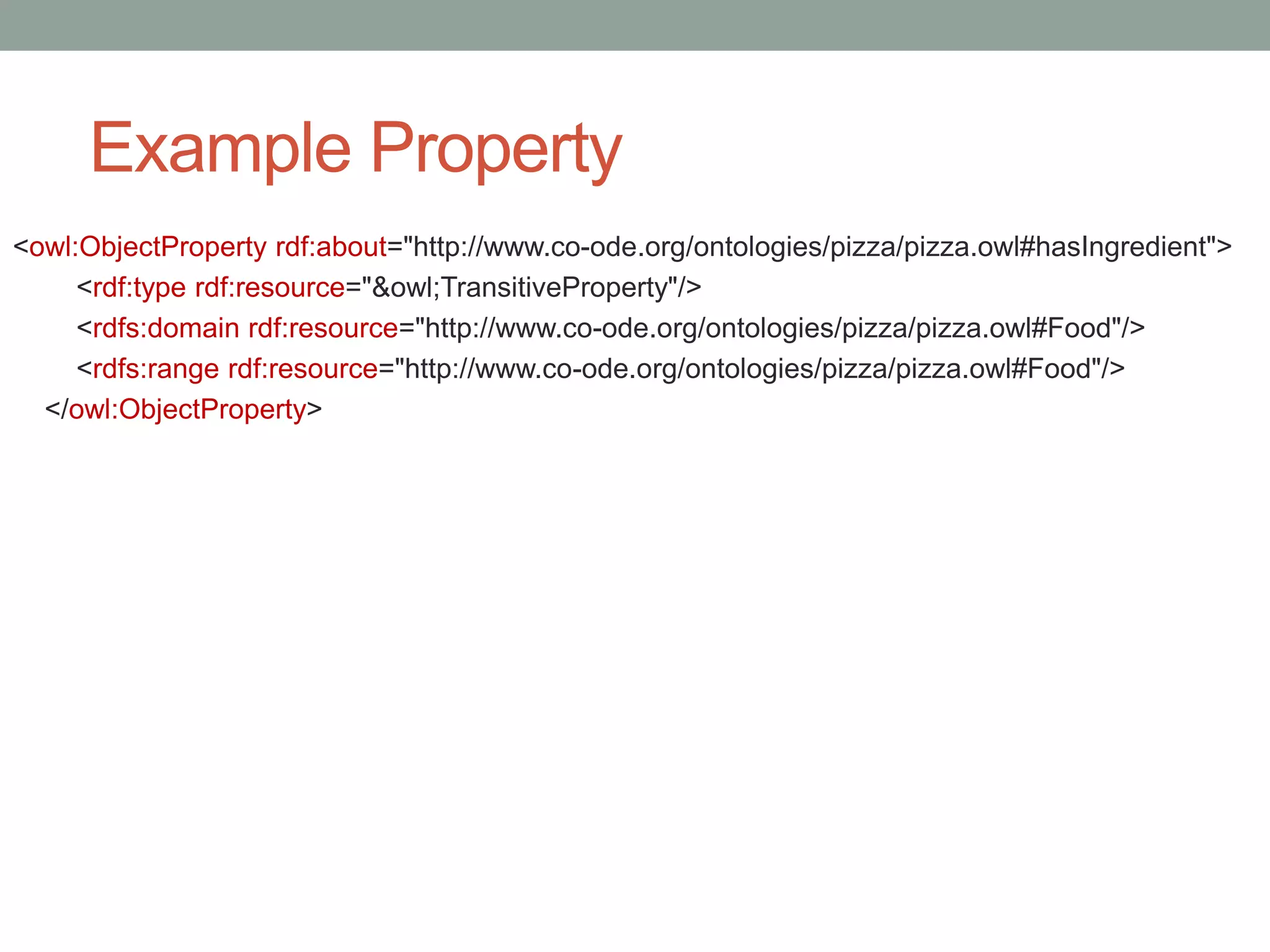
Example Property
<owl:ObjectProperty rdf:about="http://www.co-ode.org/ontologies/pizza/pizza.owl#hasIngredient">
<rdf:type rdf:resource="&owl;TransitiveProperty"/>
<rdfs:domain rdf:resource="http://www.co-ode.org/ontologies/pizza/pizza.owl#Food"/>
<rdfs:range rdf:resource="http://www.co-ode.org/ontologies/pizza/pizza.owl#Food"/>
</owl:ObjectProperty>
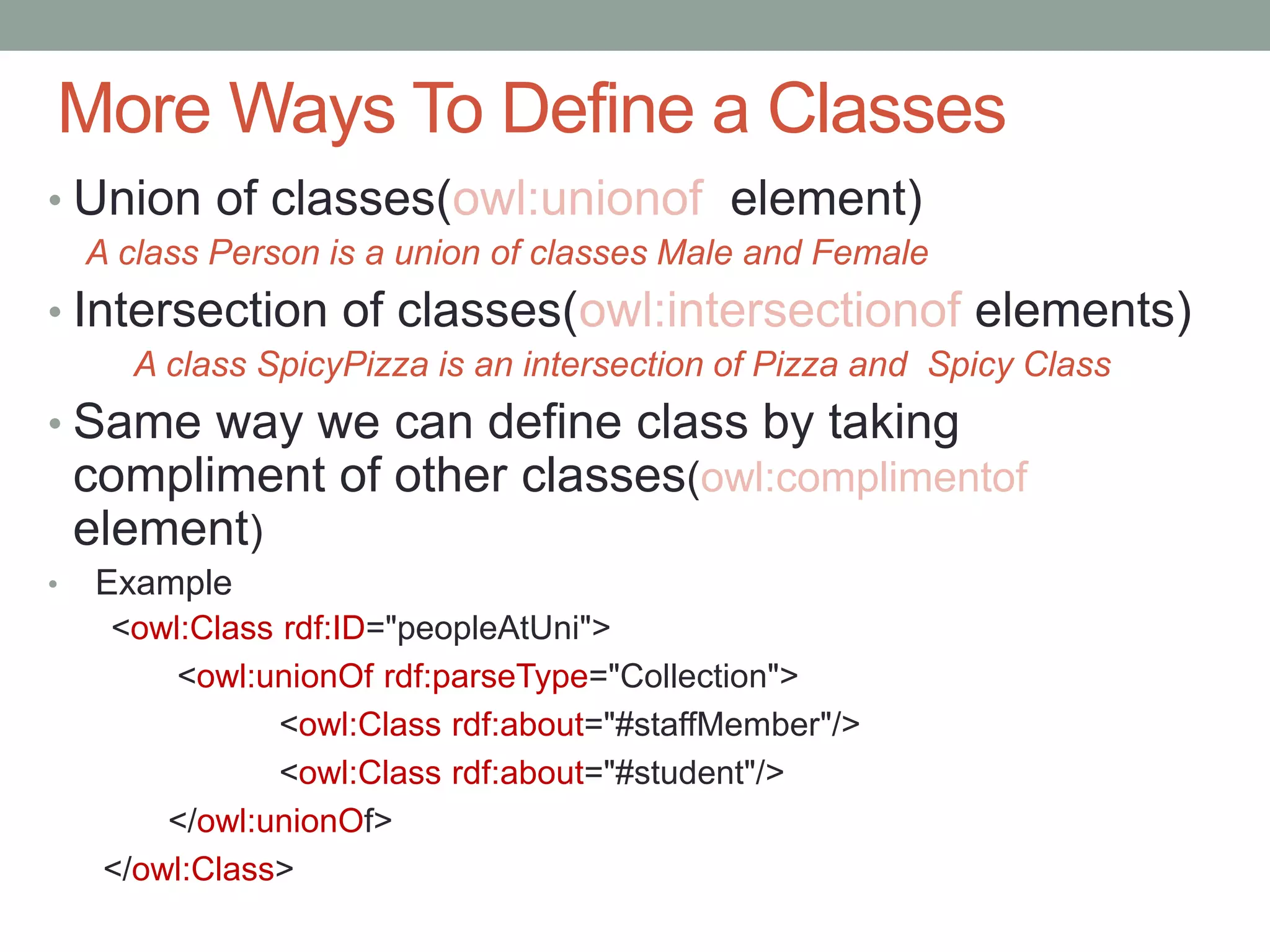
More Ways To Define a Classes
• Union of classes(owl:unionof element)
A class Person is a union of classes Male and Female
• Intersection of classes(owl:intersectionof elements)
A class SpicyPizza is an intersection of Pizza and Spicy Class
• Same way we can define class by taking
compliment of other classes(owl:complimentof
element)
• Example
<owl:Class rdf:ID="peopleAtUni">
<owl:unionOf rdf:parseType="Collection">
<owl:Class rdf:about="#staffMember"/>
<owl:Class rdf:about="#student"/>
</owl:unionOf>
</owl:Class>
Research Issues in Ontology Engineering
 Content Acquisition
 Analysis and evaluation
 Maintenance
 Ontology Merging
Evaluation
 One of the hardest problems in ontology design
 Ontology design is subjective
 What does it mean for an ontology to be correct
(objectively)?
 The best test is the application for which the ontology
was designed(for e.g pizza selling agent for e-
commerce website)
Evalution Approach
 Gold Standards: by comparing the ontology with a “gold
standard”;
 Application-based: by using the ontology with an
application and evaluating the results;
 Data-driven: by comparing the ontology with a source of
data from the domain to be covered ;
 Assessment by domain experts
Structural Evaluation Method
 Class Match Measure
 Full Match & partial Match
 Density Measure
 n.o. of subclass,attribute,siblings etc
 Betweenness Measure
 Betweenness value
 More Central classes?
 Semantic Similarity Measure
 calculates how close the classes that matches the
search terms
 Min no. of links between two concepts
Ontology Maintenance
 Ontology merging
 Having two or more overlapping ontology, create a new one
 Ontology mapping
 Create a mapping between ontologies
 Versioning and evolution
 Compatibility between different versions of the same ontology
 Compatibility between versions of an ontology and instance
data
Case Study : UMLS Ontology
UMLS Consists of…
Conclusion
• there is no single correct ontology for any domain.
• Ontology design is a creative process and no two
ontologies designed by different people would be the
same.
• The potential applications of the ontology and the
designer’s understanding and view of the domain will
undoubtedly affect ontology design choices.
• we can assess the quality of our ontology only by using it
in applications for which we designed it.
Bibliography
Baclawski, K., M. Kokar, P. Kogut, L. Hart, J. Smith, W. Holmes, J. Letkowski, and M. Aronson. 2001. “Extending
UML to support ontology engineering for the semantic web.” «UML» 2001—The Unified Modeling Language.
Modeling Languages, Concepts, and Tools: 342–360.
Booch, G., Rumbaugh, J. and Jacobson, I. (1997). The Unified Modeling Language user guide: Addison-Wesley.
Braun, S., A. Schmidt, A. Walter, G. Nagypal, and V. Zacharias. 2007. Ontology maturing: a collaborative web 2.0
approach to ontology engineering. In Proceedings of the Workshop on Social and Collaborative Construction of
Structured Knowledge at the 16th International World Wide Web Conference (WWW 07), Banff, Canada.
Cimiano, P., J. Völker, and R. Studer. 2006. “Ontologies on Demand? A Description of the State-of-the-Art,
Applications, Challenges and Trends for Ontology Learning from Text.”
Dellschaft, K., and S. Staab. 2008. Strategies for the evaluation of ontology learning. In Proceeding of the 2008
conference on Ontology Learning and Population: Bridging the Gap between Text and Knowledge, 253–272.
Guarino, N. 1997. “Understanding, building and using ontologies.” International Journal of Human Computer
Studies 46: 293–310.
Guarino, N., and Istituto (Roma) Consiglio nazionale delle ricerc. 1998. Formal ontology in information systems.
Citeseer.
Guarino, N., and P. Giaretta. 1995. “Ontologies and knowledge bases: Towards a terminological clarification.”
Towards Very Large Knowledge Bases Knowledge Building and Knowledge Sharing 1 (9): 25–32.
Jarrar, M., J. Demey, and R. Meersman. 2003. “On using conceptual data modeling for ontology engineering.”
Journal on Data Semantics: 185–207.
Cont’d
Maedche, A., and S. Staab. 2001. “Ontology learning for the semantic web.”
Intelligent Systems, IEEE 16 (2): 72–79.
Natalya F. Noy, “Ontology Development 101: A Guide to Creating Your First
Ontology.”
National Library of Medicine and N. L. of Medicine, “UMLS Reference
Manual,U.S. National Library of Medicine, National Institutes of Health, 2009.
Protege (2000). The Protege Project. http://protege.stanford.edu
Spyns, P., R. Meersman, and M. Jarrar. 2002. “Data modelling versus ontology
engineering.” ACM SIGMOD Record 31 (4): 12–17.
Uschold, M. and Gruninger, M. (1996). Ontologies: Principles, Methods and
Applications. Knowledge Engineering Review 11(2).
Welty, C., and N. Guarino. 2001. “Supporting ontological analysis of taxonomic
relationships.” Data & Knowledge Engineering 39 (1): 51–74.
OntologyEngineering.ppt

OntologyEngineering.ppt

  • 1.
    Group 14: ArtificialIntelligence(Dr. Pushpak Bhattacharya) Aliabbas Petiwala Ajay Nandoriya Pramendra Singh Rajput ONTOLOGY ENGINEERING
  • 2.
    Which Vegetarian Pizza is LeastSpicy? A shared ONTOLOGY of Pizza Restaurant Menu Customer Deciding and constructing Pizza Terminology to avoid Inconsistency Mexican Vegetarian Pizza American Vegetarian Pizza Recipe
  • 3.
    Outline • What isontology Engineering? • Ontology Engineering versus Object-Oriented Modeling • Why develop an ontology? • Developing an ontology • Going deeper: Common problems and solutions • Ontologies in the Semantic Web languages • Current research issues in ontology engineering
  • 4.
    What Is “OntologyEngineering”? Ontology Engineering: • Ontology engineering is a set of tasks related to the development of ontologies for a particular domain. • Defining terms in the domain and relations among them • Defining concepts in the domain (classes) • Arranging the concepts in a hierarchy (subclass-superclass hierarchy) • Defining which attributes and properties (slots) classes can have and constraints on their values • Defining individuals and filling in property values • Ontology Engineering analogous to OO Database Design?
  • 5.
    Ontology Engineering versus Object-OrientedModeling An ontology • reflects the structure of the world • is often about structure of concepts • Formal ontological classes are sets which can be defined in terms of other classes, attributes and associations • Property is a general term for attributes and associations. • Open World Assumption means that lack of knowledge of a fact does not immediately imply knowledge of the negation of a fact. An OO class structure • reflects the structure of the data and code • is usually about behavior (methods) • Object-oriented classes are templates for constructing objects. • Attributes and associations have different meanings. • Closed World Assumption.
  • 6.
    Logic: Open versusClosed • Open (monotonic) logic gives different answers to queries than a closed logic. Employee Company 1 0..* 1 0..* works for § Fact:Suppose that Americana is the only Pizza: l Closed world: violates constraint l Open world: Americana Pizza exists but its base is not known. Pizza hasBase PizzaBase
  • 7.
    Logic: Open versusClosed • Open (monotonic) logic gives different answers to queries than a closed logic. Employee Company 1 0..* 1 0..* works for § Fact:ItalianPizza has bases CrispBase and HardBase: l Closed world: violates constraint l Open world: CrispBase and HardBase are same!. Pizza hasBase PizzaBase
  • 8.
    Axioms for OWLOntology • An OWL ontology is a set of axioms • Class Axioms: C ⊑ D, C ≡ D • Role Axioms: R ⊑ S, Func(R), Trans(S) • Individual Axioms: a:C, <a,b>:R Animal Fish CanSwim ⊓ ⊓ Jellyfish Pomfret Moonjelly  Ontology example  Fish⊑ Animal ⊓ CanSwim  Jellyfish⊑ Fish⊓ hasVertebra  Pomfret⊑ Fish  Moonjelly:Jellyfish hasVertebra
  • 9.
    Food Domain: PizzaOntology in Protege.
  • 10.
    Ontology Engineering Process Aniterative process: determine scope consider reuse enumerate terms define classes consider reuse enumerate terms define classes define properties create instances define classes define properties define constraints create instances define classes consider reuse define properties define constraints create instances
  • 11.
    Ontology Engineering Tools •Protégé, which: • is a graphical ontology-development tool • supports a rich knowledge model • is open-source and freely available (http://protege.stanford.edu) • Some other available tools: • Ontolingua and Chimaera • OntoEdit • OilEd • DOGMA • DogmaModeler • KAON • OntoClean • OnToContent • HOZO
  • 12.
    Determine Domain andScope • What is the domain that the ontology will cover? • For what we are going to use the ontology? • For what types of questions the information in the ontology should provide answers (competency questions)? Answers to these questions may change during the lifecycle determine scope consider reuse enumerate terms define classes define properties define constraints create instances
  • 13.
    Competency Questions Fordetermining scope • Which Pizza characteristics should I consider when choosing a Pizza? • Is Veg or Non Veg? • Does Pizza go well with Ice Cream? • Which is the best choice among Veg pizza . • What kind of Pizza bases available? • Pizzas from which countries are available? • Which Pizza is the least spicy?
  • 14.
    Consider Reuse • Whyreuse other ontologies? • to save the effort • to interact with the tools that use other ontologies • to use ontologies that have been validated through use in applications • General ontologies • DMOZ (www.dmoz.org) • WordNet (www.cogsci.princeton.edu/~wn/) • Domain-specific ontologies • UMLS Semantic Net • GO (Gene Ontology) (www.geneontology.org) determine scope consider reuse enumerate terms define classes define properties define constraints create instances
  • 15.
    Enumerate Important Terms •What are the terms we need to talk about? • What are the properties of these terms? • What do we want to say about the terms? consider reuse determine scope enumerate terms define classes define properties define constraints create instances
  • 16.
    Enumerating Terms -The Pizza Ontology Pizza, Cheese , Toppings , Mexican , Sauce , Pizza Base, Crispy…
  • 17.
    Define Classes andthe Class Hierarchy • A class is a concept in the domain • a class of Pizza • a class of PizzaBase • a class of Country • A class is a collection of elements with similar properties • Instances of classes • VegSpicyPizza. consider reuse determine scope define classes define properties define constraints create instances enumerate terms
  • 18.
    Class Inheritance • Classesusually constitute a taxonomic hierarchy (a subclass-superclass hierarchy) • A class hierarchy is usually an IS-A hierarchy: an instance of a subclass is an instance of a superclass • If you think of a class as a set of elements, a subclass is a subset
  • 19.
    Class Inheritance -Example • Pizza is a subclass of Food • VegetarianPizza is a subclass of Pizza • SpicyPizza is a subclass of VegetarianPizza.
  • 20.
    Define Properties ofClasses – Slots • Slots in a class definition describe attributes of instances of the class and relations to other instances Each pizza will have hasBase, hasTopping hasCountryOfOrigin. consider reuse determine scope define constraints create instances enumerate terms define classes define properties
  • 21.
    Properties (Slots) • Typesof properties • Simple and complex properties • simple properties (attributes): contain primitive values (strings, numbers) • complex properties: contain (or point to) other objects (e.g., a Pizza instance)
  • 22.
    Properties for theClass Pizza (in Protégé-2000)
  • 23.
    property and ClassInheritance • A subclass inherits all the propertys from the superclass If a Pizza has a name and flavor, a AmericanPizza also has a name and flavor • If a class has multiple superclasses, it inherits properties from all of them.
  • 24.
    Create Instances Individuals •Create an instance of a class • The class becomes a direct type of the instance • If concepts form a natural hierarchy, then we should represent them as classes • Individual instances are the most specific concepts represented in a knowledge base. • if we would like to maintain an inventory of pizzas in the restaurant then use individuals. • Assign property values for the instance consider reuse determine scope create instances enumerate terms define classes define properties define constraints
  • 25.
    Avoiding Class Cycles •Danger of multiple inheritance: cycles in the class hierarchy • Classes A, B, and C have equivalent sets of instances • By many definitions, A, B, and C are thus equivalent
  • 26.
    The Perfect FamilySize • If a class has only one child, there may be a modeling problem • Put It up: • AmericanPizza ---- AmericanCreamPizza • AmericanCreamPizza
  • 27.
    Single and PluralClass Names • A “Pizza” is not a kind-of “Pizzas” • Class names should be either • all singular • all plural
  • 28.
  • 29.
    Outline • What isontology Engineering? • Ontology Engineering versus Object-Oriented Modeling • Why develop an ontology? • Step-By-Step: Developing an ontology • Ontologies in the Semantic Web languages • Current research issues in ontology engineering
  • 30.
    Ontologies and theSemantic Web Languages • Most Semantic Web languages are designed explicitly for representing ontologies • RDFS(Resource Description Framework Schema) • OWL(web ontology language) • XML Schema • Turtle Ontologies can also be express by ER diagram ,Class diagram, UML diagram
  • 31.
    Semantic Web Languages •The languages differ in their • Syntax • We are not concerned with it here – An ontology is a conceptual representation .(Syntax Independent) • Terminology • Class-concept • Instance-Individual • Slot-property • Expressivity • What we can express in some languages, we cannot express in others
  • 32.
    The built-in vocabularyfor RDF schema/ OWL RDF Schema Specification 1.0 (http://www.w3.org/TR/2000/CR-rdf-schema-20000327/) Specification about the RDFS and OWL is available on the Web ,tha the vocabulary for writing exact syntax
  • 33.
    RDFS OWLTerminology and Semantics • Language vocabulary provides the elements for writing • Classes and a class hierarchy • All classes are instances of rdfs:Class element • A class hierarchy is defined by rdfs:subClassOf element • Instances of a class • Defined by rdf:description element • Properties • Properties are local in RDFS and global in OWL • Properties form a hierarchy, too (rdfs:subPropertyOf) element
  • 34.
    Example of RDFSsyntax <rdfs:Class rdf:about="http://www.co-ode.org/ontologies/pizza/pizza.owl#AmericanPizza"> <rdfs:label>Americana</rdfs:label> <rdfs:subClassOf rdf:resource="http://www.co- ode.org/ontologies/pizza/pizza.owl#NamedPizza"/> </rdfs:Class> HERE rdfs:about – name of the subject the subject resource rdfs:label - a human-readable name for the subject
  • 35.
    0WL • It buildsupon the RDFS specification. • More expressive than RDFS • Disjointness (owl:disjointWith) • Equivalence (owl:equivalentClass) • Also property are more expessive. • Example showing OWL syntax <owl:Class rdf:about="http://www.co- ode.org/ontologies/pizza/pizza.owl#NonVegetarianPizza"> <owl:disjointWith rdf:resource="http://www.co- ode.org/ontologies/pizza/pizza.owl#VegetarianPizza"/> </owl:Class>
  • 36.
    Property Elements inRDFS/OWL • Cardinality - can have Any property single, multiple ,min ,max values - We can define restriction on cardinality in OWL • Range and Domain of a property • More than one domain and range may be declared. Special properties • owl:TransitiveProperty - such as has better grade than, is taller than • owl:SymmetricProperty - such as has same grade as, is sibling of
  • 37.
    Example Property <owl:ObjectProperty rdf:about="http://www.co-ode.org/ontologies/pizza/pizza.owl#hasIngredient"> <rdf:typerdf:resource="&owl;TransitiveProperty"/> <rdfs:domain rdf:resource="http://www.co-ode.org/ontologies/pizza/pizza.owl#Food"/> <rdfs:range rdf:resource="http://www.co-ode.org/ontologies/pizza/pizza.owl#Food"/> </owl:ObjectProperty>
  • 38.
    More Ways ToDefine a Classes • Union of classes(owl:unionof element) A class Person is a union of classes Male and Female • Intersection of classes(owl:intersectionof elements) A class SpicyPizza is an intersection of Pizza and Spicy Class • Same way we can define class by taking compliment of other classes(owl:complimentof element) • Example <owl:Class rdf:ID="peopleAtUni"> <owl:unionOf rdf:parseType="Collection"> <owl:Class rdf:about="#staffMember"/> <owl:Class rdf:about="#student"/> </owl:unionOf> </owl:Class>
  • 39.
    Research Issues inOntology Engineering  Content Acquisition  Analysis and evaluation  Maintenance  Ontology Merging
  • 40.
    Evaluation  One ofthe hardest problems in ontology design  Ontology design is subjective  What does it mean for an ontology to be correct (objectively)?  The best test is the application for which the ontology was designed(for e.g pizza selling agent for e- commerce website)
  • 41.
    Evalution Approach  GoldStandards: by comparing the ontology with a “gold standard”;  Application-based: by using the ontology with an application and evaluating the results;  Data-driven: by comparing the ontology with a source of data from the domain to be covered ;  Assessment by domain experts
  • 42.
    Structural Evaluation Method Class Match Measure  Full Match & partial Match  Density Measure  n.o. of subclass,attribute,siblings etc  Betweenness Measure  Betweenness value  More Central classes?  Semantic Similarity Measure  calculates how close the classes that matches the search terms  Min no. of links between two concepts
  • 43.
    Ontology Maintenance  Ontologymerging  Having two or more overlapping ontology, create a new one  Ontology mapping  Create a mapping between ontologies  Versioning and evolution  Compatibility between different versions of the same ontology  Compatibility between versions of an ontology and instance data
  • 44.
    Case Study :UMLS Ontology
  • 45.
  • 46.
    Conclusion • there isno single correct ontology for any domain. • Ontology design is a creative process and no two ontologies designed by different people would be the same. • The potential applications of the ontology and the designer’s understanding and view of the domain will undoubtedly affect ontology design choices. • we can assess the quality of our ontology only by using it in applications for which we designed it.
  • 47.
    Bibliography Baclawski, K., M.Kokar, P. Kogut, L. Hart, J. Smith, W. Holmes, J. Letkowski, and M. Aronson. 2001. “Extending UML to support ontology engineering for the semantic web.” «UML» 2001—The Unified Modeling Language. Modeling Languages, Concepts, and Tools: 342–360. Booch, G., Rumbaugh, J. and Jacobson, I. (1997). The Unified Modeling Language user guide: Addison-Wesley. Braun, S., A. Schmidt, A. Walter, G. Nagypal, and V. Zacharias. 2007. Ontology maturing: a collaborative web 2.0 approach to ontology engineering. In Proceedings of the Workshop on Social and Collaborative Construction of Structured Knowledge at the 16th International World Wide Web Conference (WWW 07), Banff, Canada. Cimiano, P., J. Völker, and R. Studer. 2006. “Ontologies on Demand? A Description of the State-of-the-Art, Applications, Challenges and Trends for Ontology Learning from Text.” Dellschaft, K., and S. Staab. 2008. Strategies for the evaluation of ontology learning. In Proceeding of the 2008 conference on Ontology Learning and Population: Bridging the Gap between Text and Knowledge, 253–272. Guarino, N. 1997. “Understanding, building and using ontologies.” International Journal of Human Computer Studies 46: 293–310. Guarino, N., and Istituto (Roma) Consiglio nazionale delle ricerc. 1998. Formal ontology in information systems. Citeseer. Guarino, N., and P. Giaretta. 1995. “Ontologies and knowledge bases: Towards a terminological clarification.” Towards Very Large Knowledge Bases Knowledge Building and Knowledge Sharing 1 (9): 25–32. Jarrar, M., J. Demey, and R. Meersman. 2003. “On using conceptual data modeling for ontology engineering.” Journal on Data Semantics: 185–207.
  • 48.
    Cont’d Maedche, A., andS. Staab. 2001. “Ontology learning for the semantic web.” Intelligent Systems, IEEE 16 (2): 72–79. Natalya F. Noy, “Ontology Development 101: A Guide to Creating Your First Ontology.” National Library of Medicine and N. L. of Medicine, “UMLS Reference Manual,U.S. National Library of Medicine, National Institutes of Health, 2009. Protege (2000). The Protege Project. http://protege.stanford.edu Spyns, P., R. Meersman, and M. Jarrar. 2002. “Data modelling versus ontology engineering.” ACM SIGMOD Record 31 (4): 12–17. Uschold, M. and Gruninger, M. (1996). Ontologies: Principles, Methods and Applications. Knowledge Engineering Review 11(2). Welty, C., and N. Guarino. 2001. “Supporting ontological analysis of taxonomic relationships.” Data & Knowledge Engineering 39 (1): 51–74.