•
•
•
I
Electrical
Published by the Institution of Engineering and Technology, London, United Kingdom
The Institution of Engineering and Technology is registered as a Charity in England & Wales
(no. 211014) and Scotland (no. SC038698).
The Institution of Engineering and Technology is the institution
formed by the joining together of the lEE (The Institution of
Electrical Engineers) and the liE (The Institution of Incorporated
Engineers).
© 1992, 1995, 1998, 2002, 2004 The Institution of Electrical Engineers
© 2008, 2011, 2015, 2018 The Institution of Engineering and Technology
First published 1992 (0 85296 537 0)
Reprinted (with amendments) May 1993
Reprinted (with amendments to Appendix 9) July 1993
Reprinted (with amendments) 1994
Revised edition (incorporating Amendment No. 1 to BS 7671:1992) 1995
Reprinted (with new cover) 1996
Revised edition (incorporating Amendment No.2 to BS 7671:1992) 1998
Second edition (incorporating Amendment No. 1 to BS 7671:2001
) 2002 (0 85296 987 2)
Reprinted (with new cover) 2003
Third edition (incorporating Amendment No.2 to BS 7671:2001
) 2004 (0 86341 374 9)
Fourth edition (incorporating BS 7671:2008) 2008 (978-0-86341-854-9)
Reprinted (with amendments) October 2008
Fifth edition (incorporating Amendment No. 1 to BS 7671 :2008) 2011 (978-1-84919-287-3)
Reprinted 2012
Reprinted (with minor corrections) 2013
Reprinted 2014
Sixth edition (incorporating Amendment No.3 to BS 7671:2008) 2015 (978-1-84919-887-5)
Reprinted (with minor corrections) 2015
Seventh Edition (incorporating 18th Edition to BS 7671:201 8) 2018 (978-1-78561-442-2)
This publicationis copyright underthe Berne Conventionand the Universal CopyrightConvention.All
rights reserved. Apart from any fair dealing for the purposes of research or private study, or criticism
or review, as permitted underthe Copyright, Designs and Patents Act, 1988, this publication may be
reproduced, stored or transmitted, in any form or by any means, only with the prior permission in
writing of the publishers, or in the case of reprographic reproduction in accordance with the terms of
licences issued by the Copyright Licensing Agency. Enquiries concerning reproduction outside those
terms should be sent to the publishers at The Institution of Engineering and Technology, Michael
Faraday House, Six Hills Way, Stevenage, SGl 2AY, United Kingdom.
Copies of this publication may be obtained from:
PO Box 96, Stevenage, SGl 2SD, UK
Tel: +44 (0)1438 767328
Email: sales@theiet.org
www.theiet.org/wiringbooks
While the author, publisher and contributors believe that the information and guidance given in
this work are correct, all parties must rely upon their own skill and judgement when making use of
them. The author, publisher and contributors do not assume any liabifity to anyone for any loss or
damage caused by any error or omission in the work, whether such an error or omission is the result
of negligence or any other cause. Where reference is made to legislation it is not to be considered
as legal advice. Any and all such liability is disclaimed.
ISBN 978-1-78561-442-2 (wiro bound)
ISBN 978-1-78561-443-9 (electronic)
Typeset in the UK by the Institution of Engineering and Technology, Stevenage
Printed in the UK by A Mclay and Company Ltd, Longwood Drive, Forest Farm, Cardiff, CF14 7ZB
Published by the Institution of Engineering and Technology, London, United Kingdom
The Institution of Engineering and Technology is registered as a Charity in England & Wales
(no. 211014) and Scotland (no. SC038698).
The Institution of Engineering and Technology is the institution
formed by the joining together of the lEE (The Institution of
Electrical Engineers) and the liE (The Institution of Incorporated
Engineers).
© 1992, 1995, 1998, 2002, 2004 The Institution of Electrical Engineers
© 2008, 2011, 2015, 2018 The Institution of Engineering and Technology
First published 1992 (0 85296 537 0)
Reprinted (with amendments) May 1993
Reprinted (with amendments to Appendix 9) July 1993
Reprinted (with amendments) 1994
Revised edition (incorporating Amendment No. 1 to BS 7671:1992) 1995
Reprinted (with new cover) 1996
Revised edition (incorporating Amendment No.2 to BS 7671:1992) 1998
Second edition (incorporating Amendment No. 1 to BS 7671:2001
) 2002 (0 85296 987 2)
Reprinted (with new cover) 2003
Third edition (incorporating Amendment No.2 to BS 7671:2001
) 2004 (0 86341 374 9)
Fourth edition (incorporating BS 7671:2008) 2008 (978-0-86341-854-9)
Reprinted (with amendments) October 2008
Fifth edition (incorporating Amendment No. 1 to BS 7671 :2008) 2011 (978-1-84919-287-3)
Reprinted 2012
Reprinted (with minor corrections) 2013
Reprinted 2014
Sixth edition (incorporating Amendment No.3 to BS 7671:2008) 2015 (978-1-84919-887-5)
Reprinted (with minor corrections) 2015
Seventh Edition (incorporating 18th Edition to BS 7671:201 8) 2018 (978-1-78561-442-2)
This publicationis copyright underthe Berne Conventionand the Universal CopyrightConvention.All
rights reserved. Apart from any fair dealing for the purposes of research or private study, or criticism
or review, as permitted underthe Copyright, Designs and Patents Act, 1988, this publication may be
reproduced, stored or transmitted, in any form or by any means, only with the prior permission in
writing of the publishers, or in the case of reprographic reproduction in accordance with the terms of
licences issued by the Copyright Licensing Agency. Enquiries concerning reproduction outside those
terms should be sent to the publishers at The Institution of Engineering and Technology, Michael
Faraday House, Six Hills Way, Stevenage, SGl 2AY, United Kingdom.
Copies of this publication may be obtained from:
PO Box 96, Stevenage, SGl 2SD, UK
Tel: +44 (0)1438 767328
Email: sales@theiet.org
www.theiet.org/wiringbooks
While the author, publisher and contributors believe that the information and guidance given in
this work are correct, all parties must rely upon their own skill and judgement when making use of
them. The author, publisher and contributors do not assume any liabifity to anyone for any loss or
damage caused by any error or omission in the work, whether such an error or omission is the result
of negligence or any other cause. Where reference is made to legislation it is not to be considered
as legal advice. Any and all such liability is disclaimed.
ISBN 978-1-78561-442-2 (wiro bound)
ISBN 978-1-78561-443-9 (electronic)
Typeset in the UK by the Institution of Engineering and Technology, Stevenage
Printed in the UK by A Mclay and Company Ltd, Longwood Drive, Forest Farm, Cardiff, CF14 7ZB
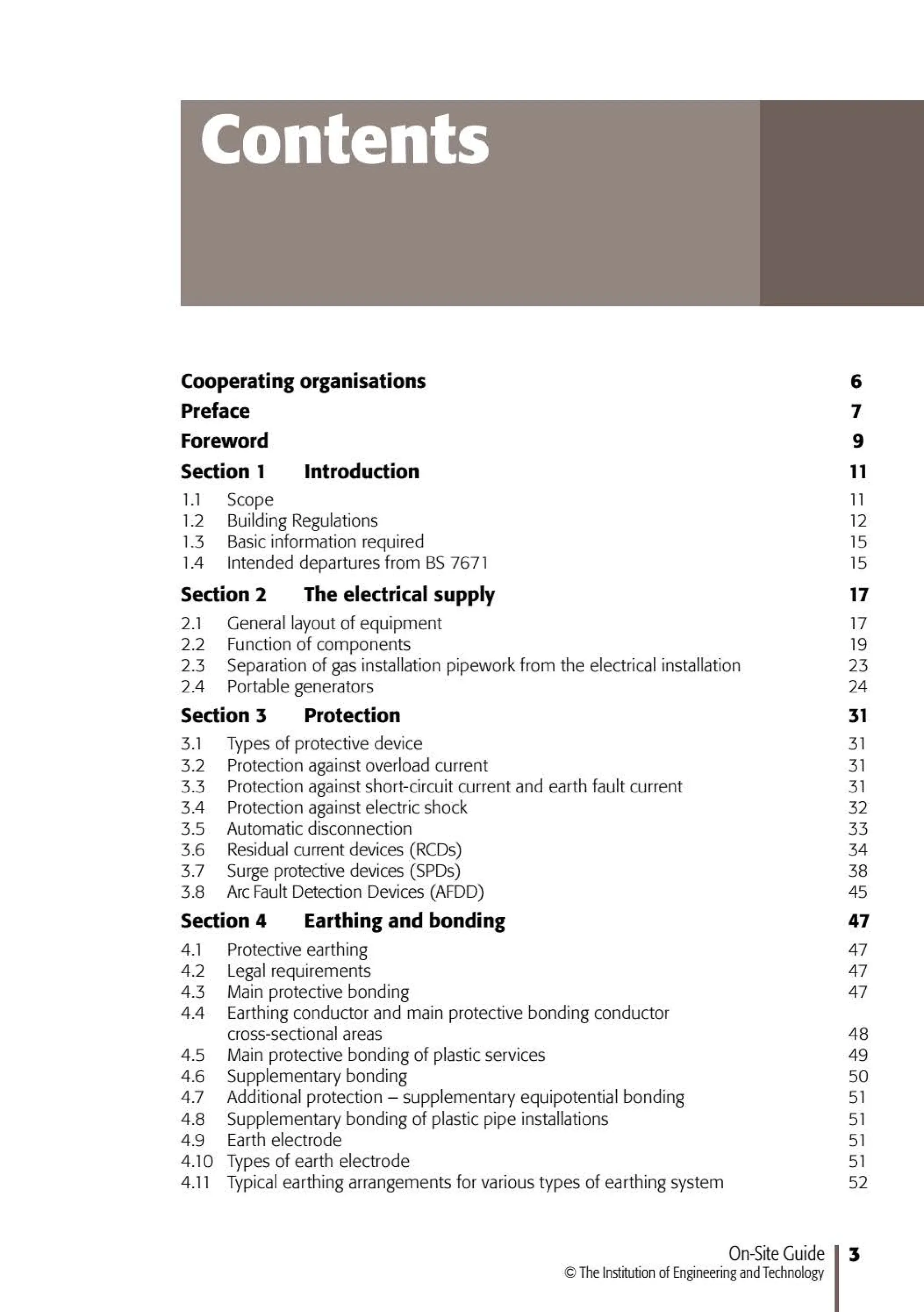
Cooperating organisations 6
Preface 7
Foreword 9
Section 1 Introduction 11
1.1 Scope 11
1.2 Building Regulations 12
1.3 Basic information required 15
1.4 Intended departures from BS 7671 15
Section 2 The electrical supply 17
2.1 General layout of equipment 17
2.2 Function of components 19
2.3 Separation of gas installation pipework from the electrical installation 23
2.4 Portable generators 24
Section 3 Protection 31
3.1 Types of protective device 31
3.2 Protection against overload current 31
3.3 Protection against short-circuit current and earth fault current 31
3.4 Protection against electric shock 32
3.5 Automatic disconnection 33
3.6 Residual current devices (RCDs) 34
3.7 Surge protective devices (SPDs) 38
3.8 Arc Fault Detection Devices (AFDD) 45
Section 4 Earthing and bonding 47
4.1 Protective earthing 47
4.2 Legal requirements 47
4.3 Main protective bonding 47
4.4 Earthing conductor and main protective bonding conductor
cross-sectional areas 48
4.5 Main protective bonding of plastic services 49
4.6 Supplementary bonding 50
4.7 Additional protection -supplementary equipotential bonding 51
4.8 Supplementary bonding of plastic pipe installations 51
4.9 Earth electrode 51
4.10 Types of earth electrode 51
4.11 Typical earthing arrangements for various types of earthing system 52
On-SiteGuide 3
©The Institution of Engineering andT
echnology
The Institution of Engineering and Technology acknowledges the invaluable contribution
made by the following individuals in the preparation of the On-Site Guide:
Institution of Engineering and Technology
J. Bradley BSc CEng FIET FCIBSE
S. Devine MIET
Eur lng Leon Markwell MSc, BSc(Hons), CEng,
MIET, MCIBSE, LCGI
G.D. Cranshaw CEng FIET G. Gundry MIET
P.E. Donnachie BSc CEng FIET
Special thanks to:
.,.. A Samad Khan MEng (Hons) CEng MIET, MIEEE PEL 37/1, GEL 81
.,.. John Peckham - Stroma Certification
.,.. Bob Cairney - SELECT
We would like to thank the following organisations for their continued support:
British Cables Association
British Electrotechnical &Allied Manufacturers Association Ltd
British Gas
British Standards Institution
Certsure trading as NICEIC and Elecsa
Ministry of Housing, Communities &Local Government
ECA
Electrical Contractors' Association of Scotland t/a SELECT
ENA
NEC Ltd
Revised, compiled and edited
ERATechnology Ltd
ElectricaI Safety First
Health and Safety Executive
IHEEM
NAPIT
The Safety Assessment Federation (SAFed)
UHMA
Society for PublicArchitecture,
Construction, Engineering and Surveying
M. Coles BEng(Hons) MIET, The Institution of Engineering and Technology, 2018
6 On-Site Guide
©The Institution of Engineering and Technology
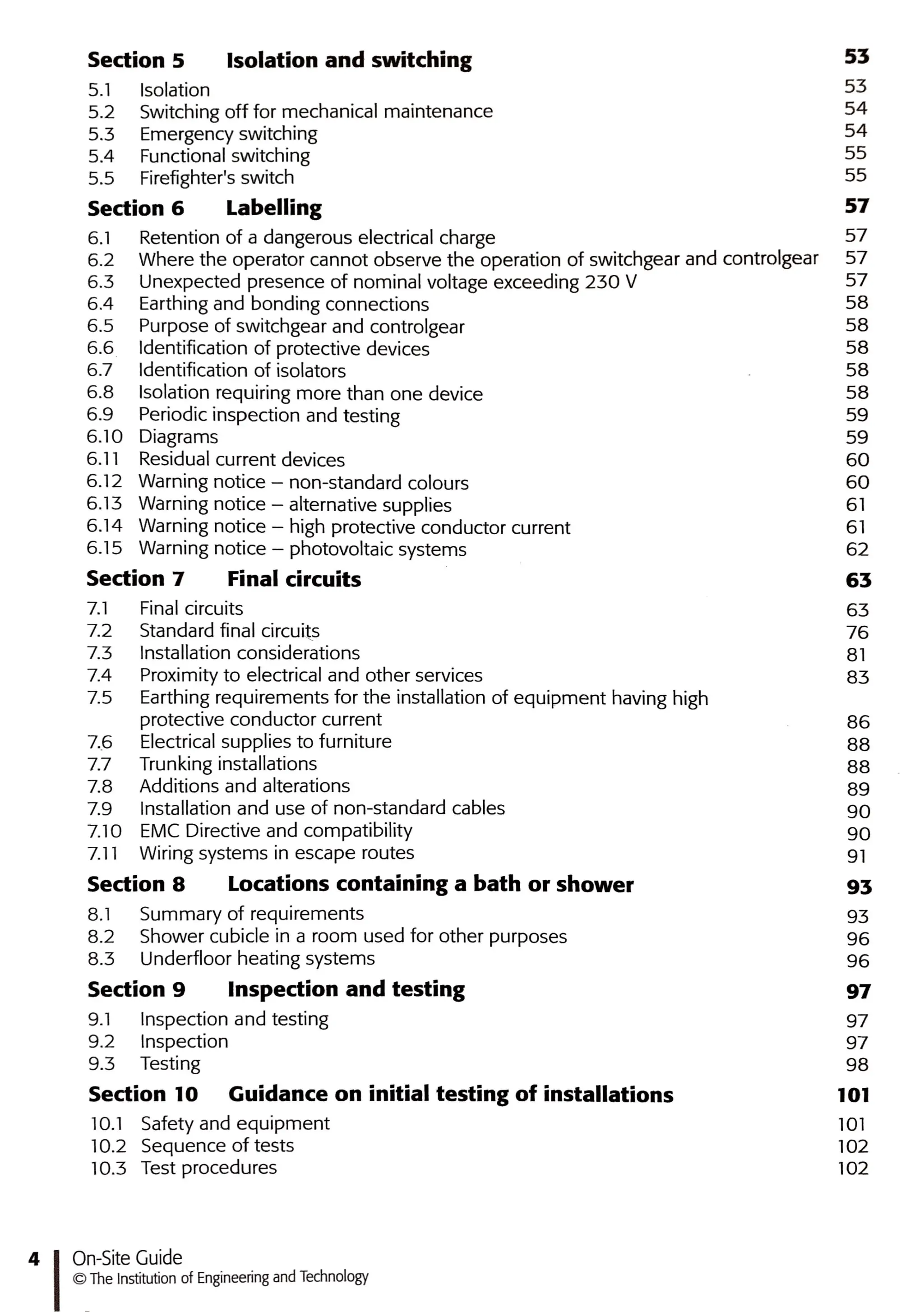
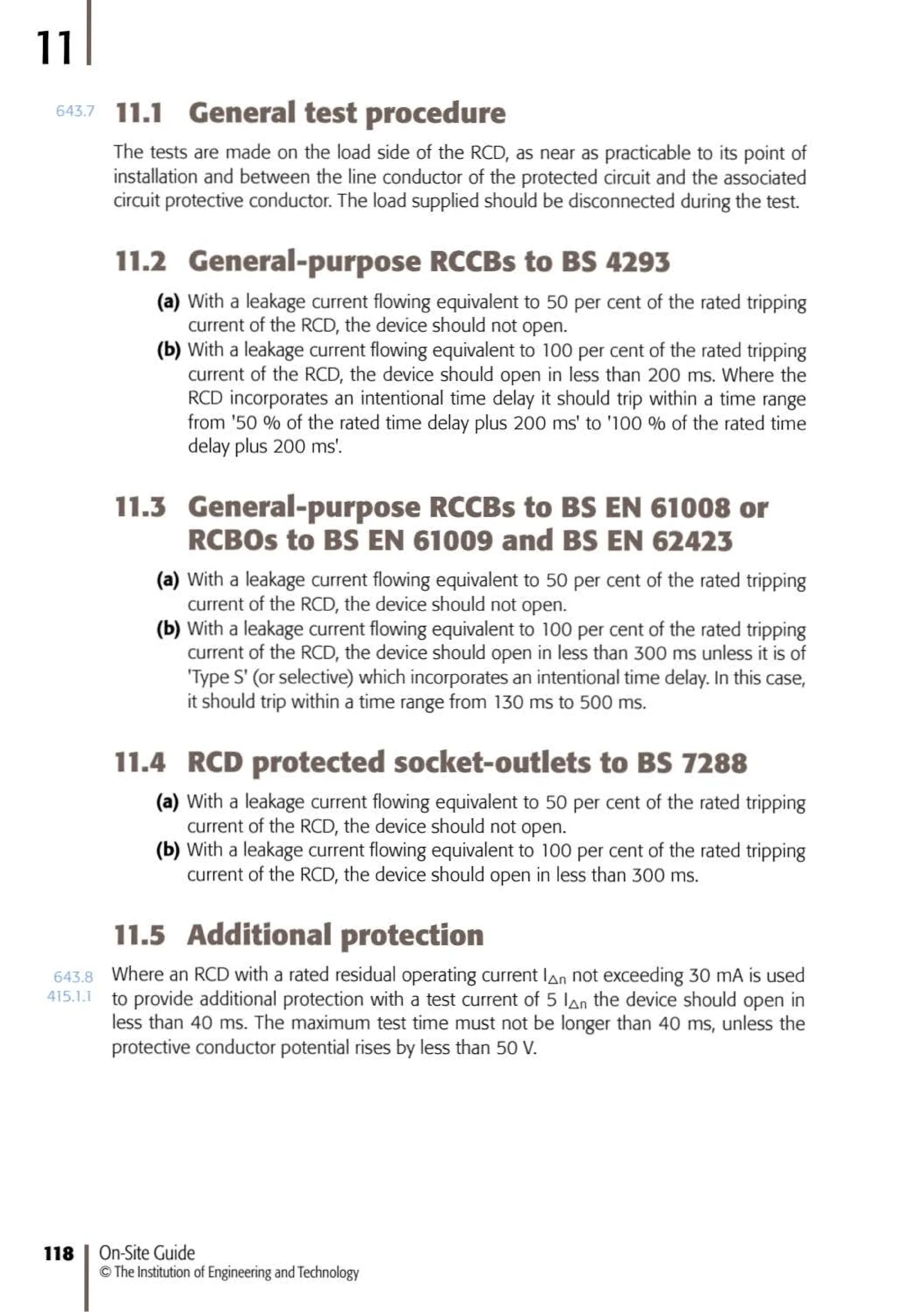
Section 11 Operation of RCDs 117
11.1 General test procedure 118
11.2 General-purpose RCCBs to BS 4293 118
11.3 General-purpose RCCBs to BS EN 61008 or RCBOs to BS EN 61009 and
BS EN 62423 118
11.4 RCD protected socket-outlets to BS 7288 118
11.5 Additional protection 118
11.6 Integral test device 119
11.7 Multipole RCDs 119
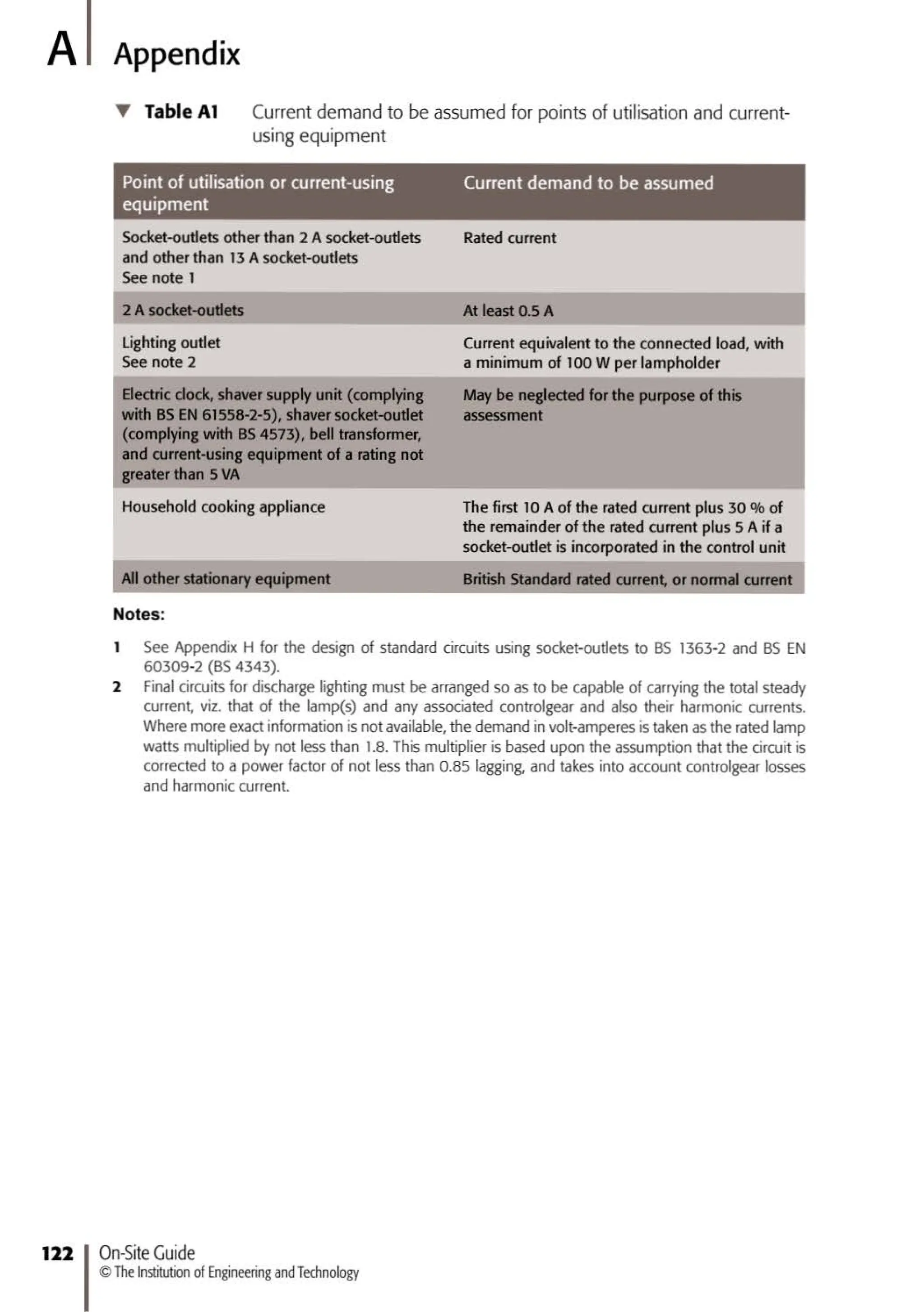
Appendix A Maximum demand and diversity 121
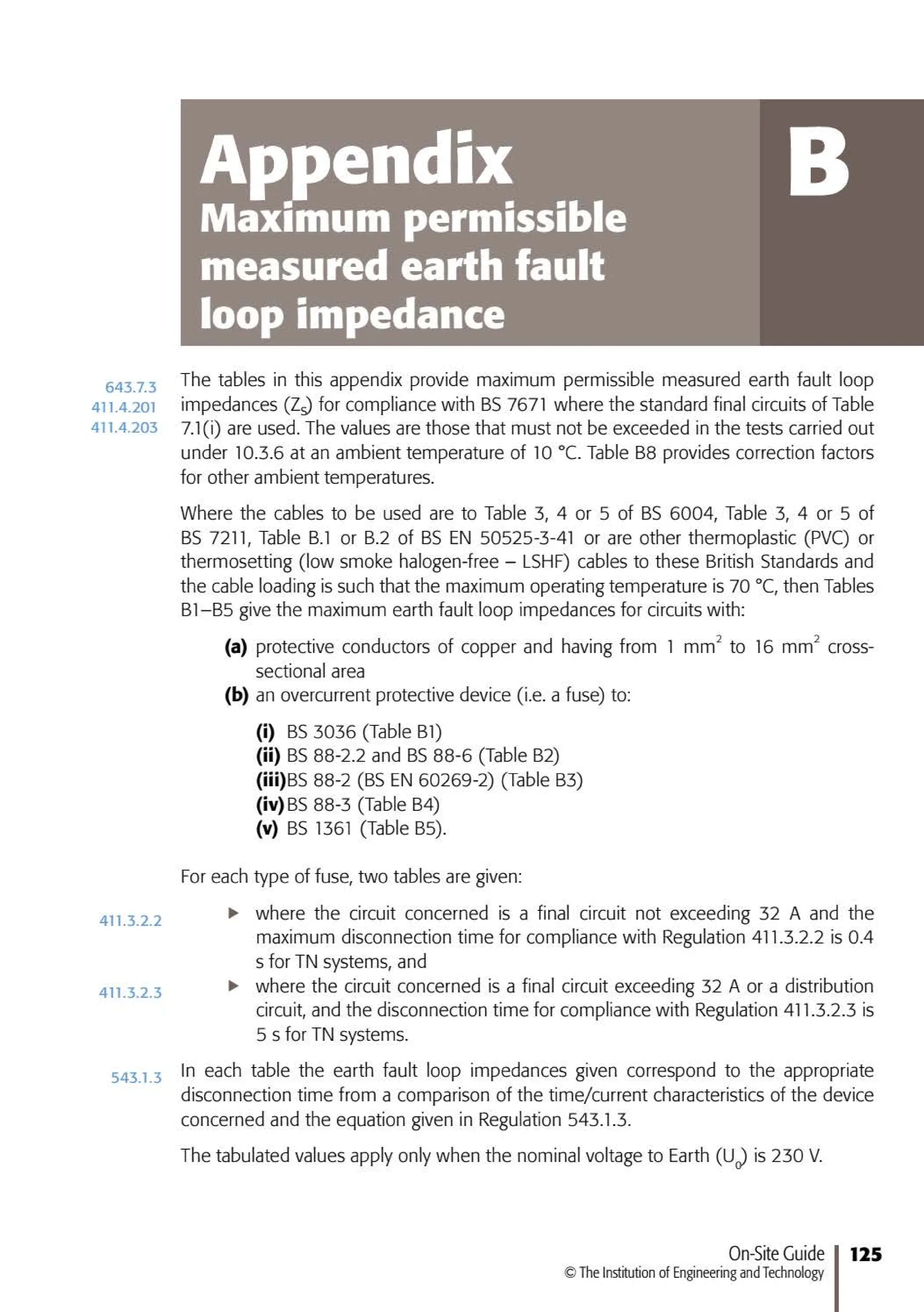
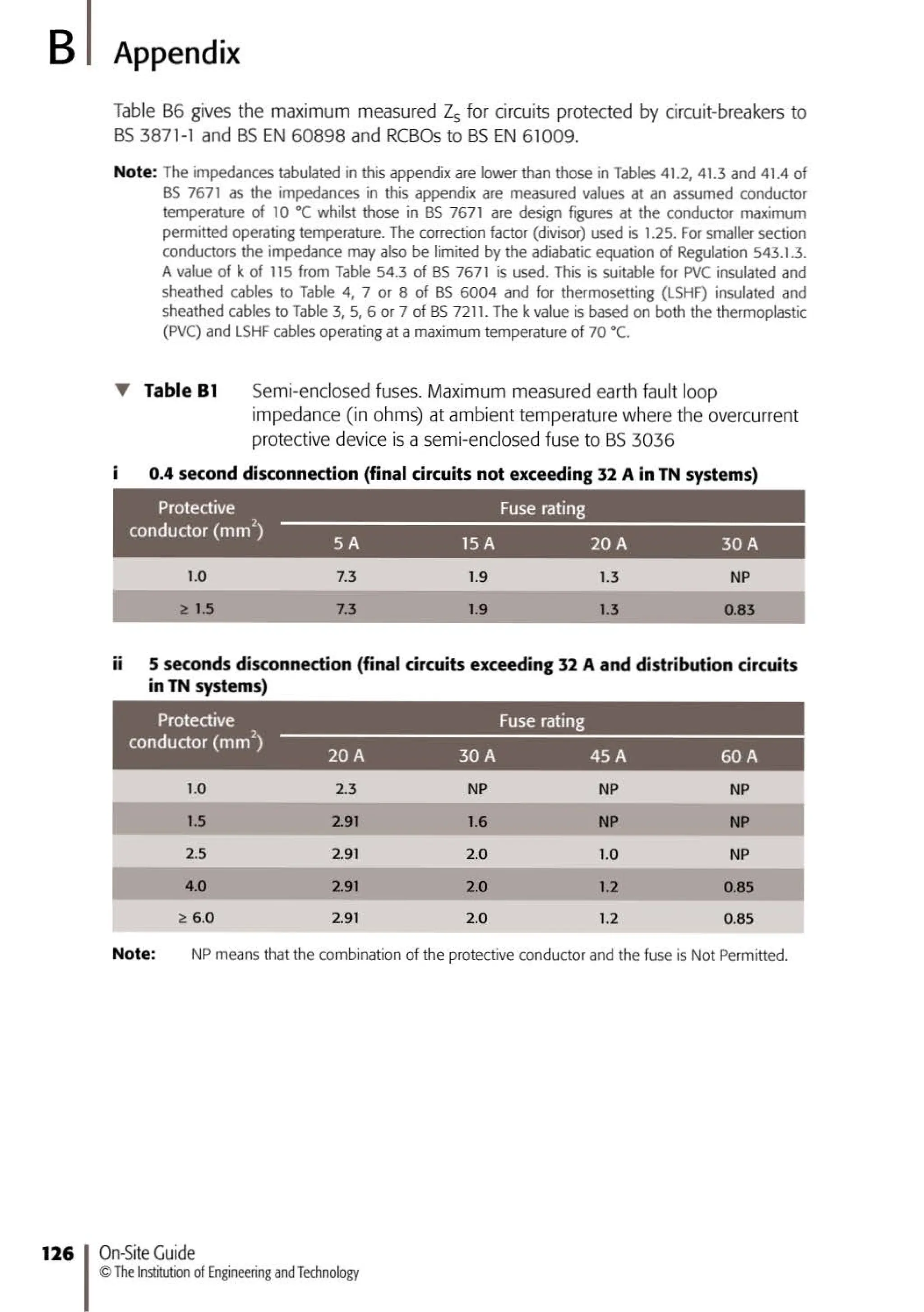
Appendix B Maximum permissible measured earth fault loop
impedance 125
Appendix C Selection of types of cable for particular uses and
external influences 133
Appendix D Methods of support for cables, conductors and
wiring systems 139
Appendix E Cable capacities of conduit and trunking 145
Appendix F Current-carrying capacities and voltage drop for copper
conductors 151
Appendix G Cert.ification and reporting 163
Appendix H Standard circuit arrangements for household and similar
installations 187
Appendix I Resistance of copper and aluminium conductors 195
Appendix J Selection of devices for isolation and switching 199
Appendix K Identification of conductors 201
Appendix L Degrees of protection provided by enclosures
(IP code) 207
Index 209
On-Site Guide 5
© The Institution of Engineering andTechnology
The Institution of Engineering and Technology acknowledges the invaluable contribution
made by the following individuals in the preparation of the On-Site Guide:
Institution of Engineering and Technology
J. Bradley BSc CEng FIET FCIBSE
S. Devine MIET
Eur lng Leon Markwell MSc, BSc(Hons), CEng,
MIET, MCIBSE, LCGI
G.D. Cranshaw CEng FIET G. Gundry MIET
P.E. Donnachie BSc CEng FIET
Special thanks to:
.,.. A Samad Khan MEng (Hons) CEng MIET, MIEEE PEL 37/1, GEL 81
.,.. John Peckham - Stroma Certification
.,.. Bob Cairney - SELECT
We would like to thank the following organisations for their continued support:
British Cables Association
British Electrotechnical &Allied Manufacturers Association Ltd
British Gas
British Standards Institution
Certsure trading as NICEIC and Elecsa
Ministry of Housing, Communities &Local Government
ECA
Electrical Contractors' Association of Scotland t/a SELECT
ENA
NEC Ltd
Revised, compiled and edited
ERATechnology Ltd
ElectricaI Safety First
Health and Safety Executive
IHEEM
NAPIT
The Safety Assessment Federation (SAFed)
UHMA
Society for PublicArchitecture,
Construction, Engineering and Surveying
M. Coles BEng(Hons) MIET, The Institution of Engineering and Technology, 2018
6 On-Site Guide
©The Institution of Engineering and Technology
The On-Site Guide is one of a number of publications prepared by the lET to provide
guidance on certain aspects of BS 7671 :2018 Requirements for Electrical Installations,
lET Wiring Regulations, 18th Edition. BS 7671 is ajoint publication ofthe British Standards
Institution and the Institution of Engineering and Technology.
110.1 The scope generally follows that of BS 7671 .The Guide includes material not included in
BS 7671, it provides background to the intentions of BS 7671 and gives other sources of
information. However, it does not ensure compliance with BS 7671 . It is a simple guide
to the requirements of BS 7671; electrical installers should always consult BS 7671 to
satisfy themselves of compliance.
It is expected that persons carrying out work in accordance with this guide will be
competent to do so.
HSR25, EWR Electrical installations in the United Kingdom which comply with the lET Wiring
Regulation 16 Regulations, BS 7671, must comply with all relevant statutory regulations, such as the
Electricity at Work Regulations 1989, the Building Regulations and, where relevant, the
Electricity Safety, Quality and Continuity Regulations 2002, as amended.
114.1 It cannot be guaranteed that BS 7671 complies with all relevant statutory regulations.
115.1 It is, therefore, essential to establish which statutory and other appropriate regulations
apply and to install accordingly. For example, an installation in licensed premises may
have requirements which differ from or are additional to those of BS 7671, and these
will take precedence.
On-Site Guide 7
©The Institution of Engineering and T
echnology
8 On-Site Guide
e The Institution of Engineering and Technology
Part 1 This Guide is concerned with limited application of BS 7671 in accordance with paragraph
1.1: Scope.
BS 7671 and the On-Site Guide are not design guides.
It is essential to prepare a design and/or schedule of the work to be done prior to
commencement or alteration of an electrical installation and to provide all necessary
information and operating instructions of any equipment supplied to the user on
completion.
Any specification should set out the detailed design and provide sufficient information to
enable competent persons to carry out the installation and commissioning.
The specification must provide for all the commissioning procedures that will be required
and for the production of any operation and maintenance manual and building logbook.
The persons or organisations who may be concerned in the preparation of the
specification include the:
Ill> Designer(s)
Ill> lnstaller(s)
Ill> Electricity Distributor
Ill> Installation Owner and/or User
Ill> Architect
Ill> Local Building Control Authority/Standards Division or Approved Inspector
Ill> Fire Prevention Officer
Ill> CDM Coordinator
Ill> BIM Coordinator
Ill> Regulatory Authorities
Ill> Licensing Authority (where necessary)
Ill> Health and Safety Executive.
In producing the specification, advice should be sought from the installation owner and/
or user as to the intended use. Often, such as in a speculative building, the detailed
intended use is unknown. In those circumstances the specification and/or the operation
and maintenance manual and building logbook must set out the basis of use for which
the installation is suitable.
On-Site Guide 9
©The Institution of Engineering and T
echnology
Precise details of each item of equipment should be obtained from the manufacturer
and/or supplier and compliance with appropriate standards confirmed.
The operation and maintenance manual must include a description of how the installed
system is to operate and must include all commissioning records. The manual should also
include manufacturers' technical data for all items of switchgear, luminaires, accessories,
etc. and any special instructions that may be needed.
Building Regulations 2010, Part L 2013 (Amended 2016) of England, for example,
requires that building owners or operators are provided with summary information
relating to a new or refurbished building which includes building services information
and the maintenance requirements in a buildinglogbook. Information on how to develop
and assemble a building logbook can be obtained from CIBSE:
Tel.:
Website:
Address:
020 8675 5211
www.cibse.org
CIBSE
222 Balham High Road
London
SW12 985
The Health and Safety at Work etc. Act 1974 Section 6 and The Construction (Design
and Management) Regulations 2015 are concerned with the provision of information.
Guidance on the preparation of technical manuals is given in BS EN 82079-1:2012
Preparation of instructions for use. Structuring, content and presentation General
principles and detailed requirements and BS 4940 series (1994) Technical information
on construction products and services. The size and complexity of the installation will
dictate the nature and extent of the manual.
10 On-Site Guide
© The Institution of Engineering and Technology
1.1 Scope
This Guide is for installers (for simplicity, the term installer has been used for electricians
and electrical installers). It covers the following installations:
Part 7 Note:
(a) domestic and similar installations, including off-peak supplies, supplies to
associated garages, outbuildings and the like; and
(b) small industrial and commercial single- and three-phase installations.
Special Installations or Locations (Part 7 of BS 7671) are generally excluded from this Guide.
Advice, however, is given on installations in locations containing a bath or shower and
underfloor heating installations.
This Guide is restricted to installations:
313.1 (a) at a supply frequency of 50 Hz
(b) at a nominal voltage of 230 V AC single-phase or 400/230 V AC three-phase
(c) supplied through a distributor's cut-out having a fuse or fuses rated at 100 A or
less to one of the following standards:
- BS 88-2
- BS 88-3
- BS 88-6
- BS 1361 Type II
Note: BS 1361 was withdrawn in March 2010 and replaced by BS 88-3; BS 88-2.2 and BS 88-6 were
withdrawn in March 2010 and replaced by BS 88-2 (BS EN 60269-2) but fuses complying with
these withdrawn standards will be found in existing installations for many years to come.
(d) typical maximum values of earth fault loop impedance, Ze, for TN earthing
arrangements outside the consumer's installation commonly quoted by
distributors are as follows:
ll> TN-C-S arrangement - 0.35 0, see Figure 2.1 (i)
ll> TN-S arrangement - 0.8 0, see Figure 2.1(ii)
Note: The values of 0.35 0 and 0.8 0 are typical maximum values as quoted by distributors of
electricity upon enquiry which will aid, for example, designs for new-build installations.
Table 41.5 For a TT arrangement, 21 0 is the usual stated maximum resistance of the
542.2.4 distributor's earth electrode at the supply transformer. The resistance of the
consumer's installation earth electrode should be as low as practicable and an
On-Site Guide 11
©The Institution of Engineering and T
echnology
1
earth electrode resistance or Ze measurement exceeding 200 0 may not be
stable due to environmental changes, i.e. drying out in summer and freezing in
winter.
Appx E This Guide also contains information which may be required in general installation work,
for example, conduit and trunking capacities, bending radii of cables, etc.
The Guide introduces the use of standard circuits, which are discussed in Section 7.
However, because of simplification, this Guide may not give the most economical result.
This Guide is not a replacement for BS 7671, which should always be consulted.
Defined terms according to Part 2 of BS 7671 are used.
In compliance with the definitions of BS 7671, throughout this Guide the term line
conductor is used instead of phase conductorand live part is used to refer to aconductor
or conductive part intended to be energised in normal use, includinga neutral conductor.
The terminals of electrical equipment are identified by the letters L, N and E(or PE).
Further information is available in the series of Guidance Notes published by the lET:
Ill> GN 1 Selection &Erection
Ill> GN 2 Isolation & Switching
Ill> GN 3 Inspection &Testing
Ill> GN 4 Protection Against Fire
Ill> GN 5 Protection Against Electric Shock
Ill> GN 6 Protection Against Overcurrent
Ill> GN 7 Special Locations
Ill> GN 8 Earthing &Bonding
Notes:
For clarification:
.,. the distributor of electricity is deemed to be the organisation owning or operating the electrical
supply equipment, and
.,. the supplier of electricity is the organisation from whom electricity is purchased.
1.2 Building Regulations
Refer to the lET publication Electrician's Guide to the Building Regulations for more in-
depth guidance on electrical installations in dwellings.
1.2.1 England - The Building Regulations 2010
Persons carrying out electrical work in dwellings must comply with the Building
Regulations of England, in particular Part P (Electrical safety - dwellings).
Persons responsible for work within the scope of Part Pof the Building Regulations may
also be responsible for ensuring compliance with other Parts of the Building Regulations,
where relevant, particularly if there are no other parties involved with the work. Building
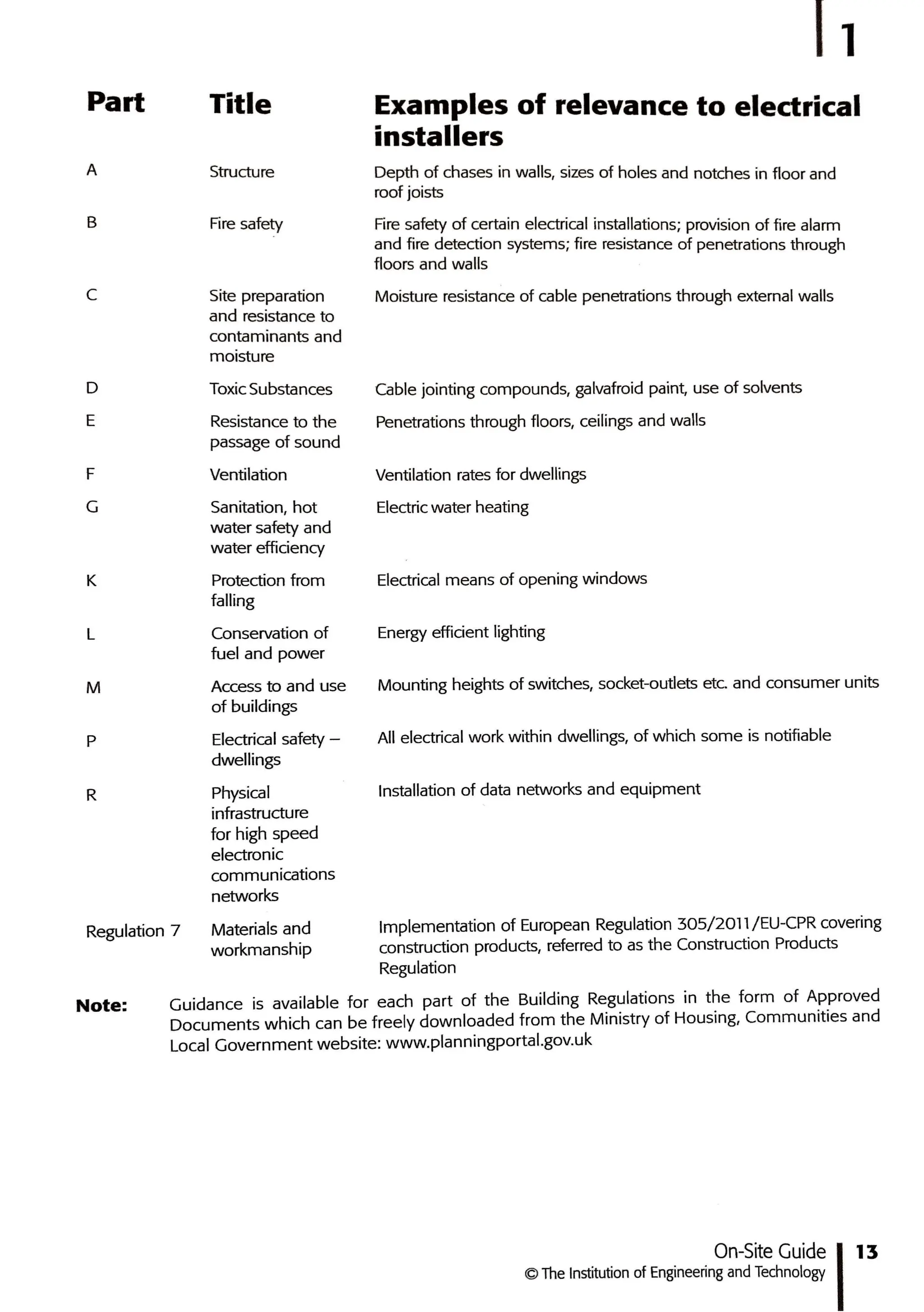
Regulations requirements relevant to installers carrying out electrical work include:
12 On-Site Guide
© The Institution of Engineering and Technology
1
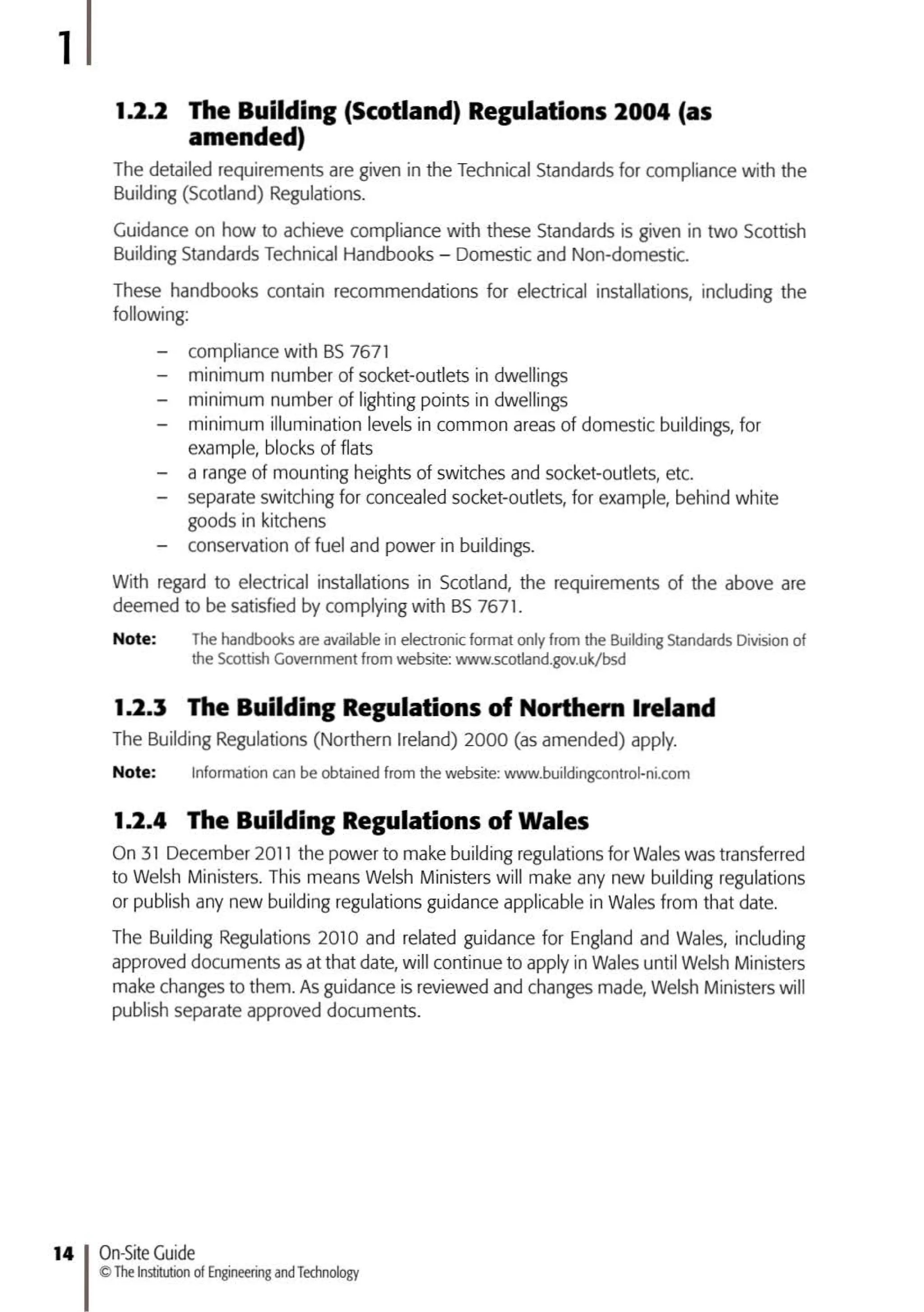
1.2.2 The Building (Scotland) Regulations 2004 (as
amended)
The detailed requirements are given in the Technical Standards for compliance with the
Building (Scotland) Regulations.
Guidance on how to achieve compliance with these Standards is given in two Scottish
Building Standards Technical Handbooks- Domestic and Non-domestic.
These handbooks contain recommendations for electrical installations, including the
following:
- compliance with BS 7671
- minimum number of socket-outlets in dwellings
- minimum number of lighting points in dwellings
- minimum illumination levels in common areas of domestic buildings, for
example, blocks of flats
- a range of mounting heights of switches and socket-outlets, etc.
- separate switching for concealed socket-outlets, for example, behind white
goods in kitchens
- conservation of fuel and power in buildings.
With regard to electrical installations in Scotland, the requirements of the above are
deemed to be satisfied by complying with BS 7671.
Note: The handbooks are available in electronic format only from the Building Standards Division of
the Scottish Government from website: www.scotland.gov.uk/bsd
1.2.3 The Building Regulations of Northern Ireland
The Building Regulations (Northern Ireland) 2000 (as amended) apply.
Note: Information can be obtained from the website: www.buildingcontrol-ni.com
1.2.4 The Building Regulations of Wales
On 31 December 2011 the power to make building regulations for Wales was transferred
to Welsh Ministers. This means Welsh Ministers will make any new building regulations
or publish any new building regulations guidance applicable in Wales from that date.
The Building Regulations 2010 and related guidance for England and Wales, including
approved documents as at that date, will continue to apply in Wales until Welsh Ministers
make changes to them. As guidance is reviewed and changes made, Welsh Ministers will
publish separate approved documents.
14 On-Site Guide
©The Institution of Engineering and Technology
1
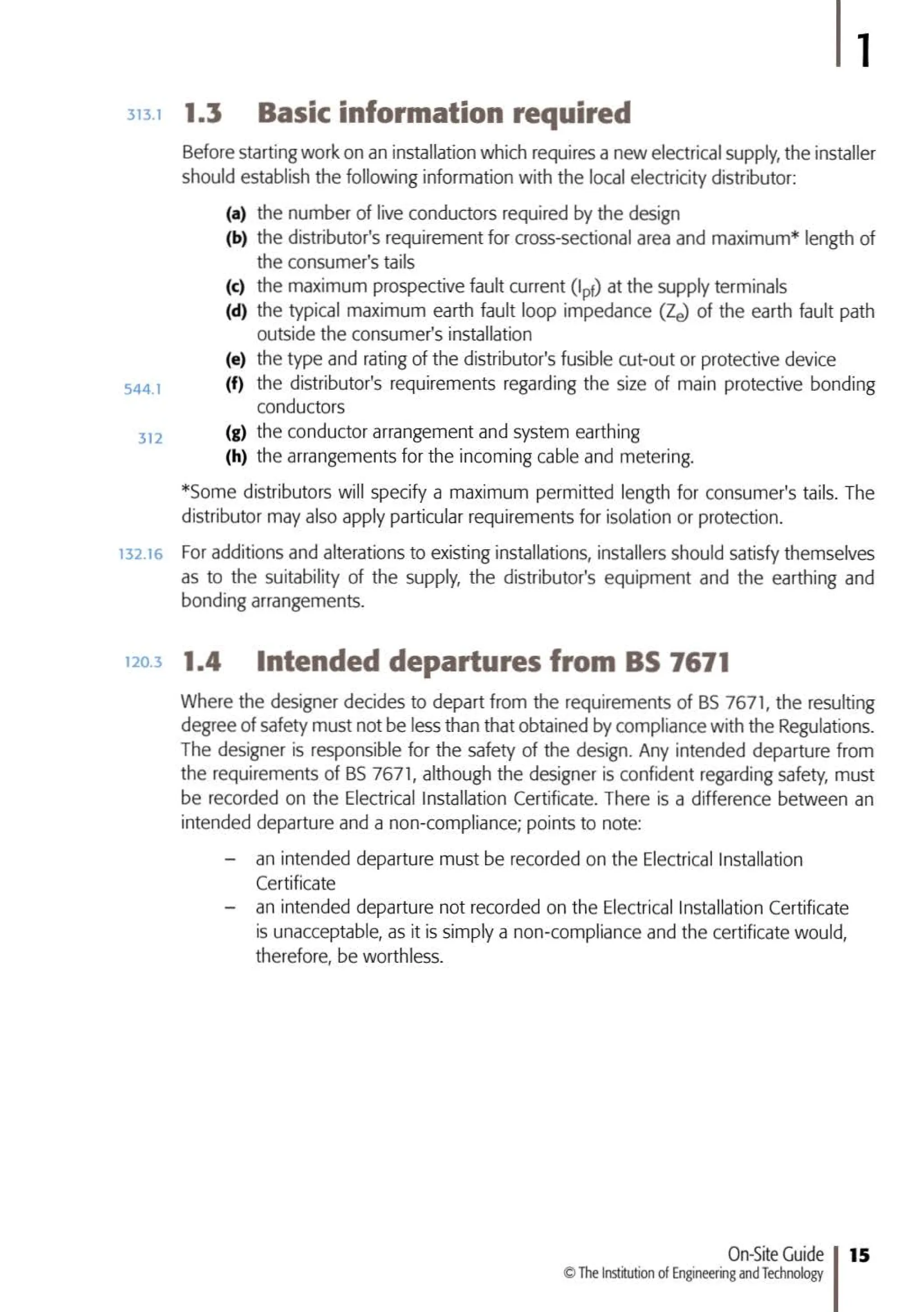
313.1 1.3 Basic information required
544.1
312
Before starting work on an installation which requires a new electrical supply, the installer
should establish the following information with the local electricity distributor:
(a) the number of live conductors required by the design
(b) the distributor's requirement for cross-sectional area and maximum* length of
the consumer's tails
(c) the maximum prospective fault current (lpf) at the supply terminals
(d) the typical maximum earth fault loop impedance (Ze) of the earth fault path
outside the consumer's installation
(e) the type and rating of the distributor's fusible cut-out or protective device
(f) the distributor's requirements regarding the size of main protective bonding
conductors
(g) the conductor arrangement and system earthing
(h) the arrangements for the incoming cable and metering.
*Some distributors will specify a maximum permitted length for consumer's tails. The
distributor may also apply particular requirements for isolation or protection.
132.16 For additions and alterations to existing installations, installers should satisfy themselves
as to the suitability of the supply, the distributor's equipment and the earthing and
bonding arrangements.
120.3 1.4 Intended departures from BS 7671
Where the designer decides to depart from the requirements of BS 7671, the resulting
degree of safety must not be less thanthat obtained by compliance with the Regulations.
The designer is responsible for the safety of the design. Any intended departure from
the requirements of BS 7671, although the designer is confident regarding safety, must
be recorded on the Electrical Installation Certificate. There is a difference between an
intended departure and a non-compliance; points to note:
- an intended departure must be recorded on the Electrical Installation
Certificate
- an intended departure not recorded on the Electrical Installation Certificate
is unacceptable, as it is simply a non-compliance and the certificate would,
therefore, be worthless.
On-Site Guide 15
© The Institution of Engineering andTechnology
1
16 On-Site Guide
e The Institution of Engineering and Technology
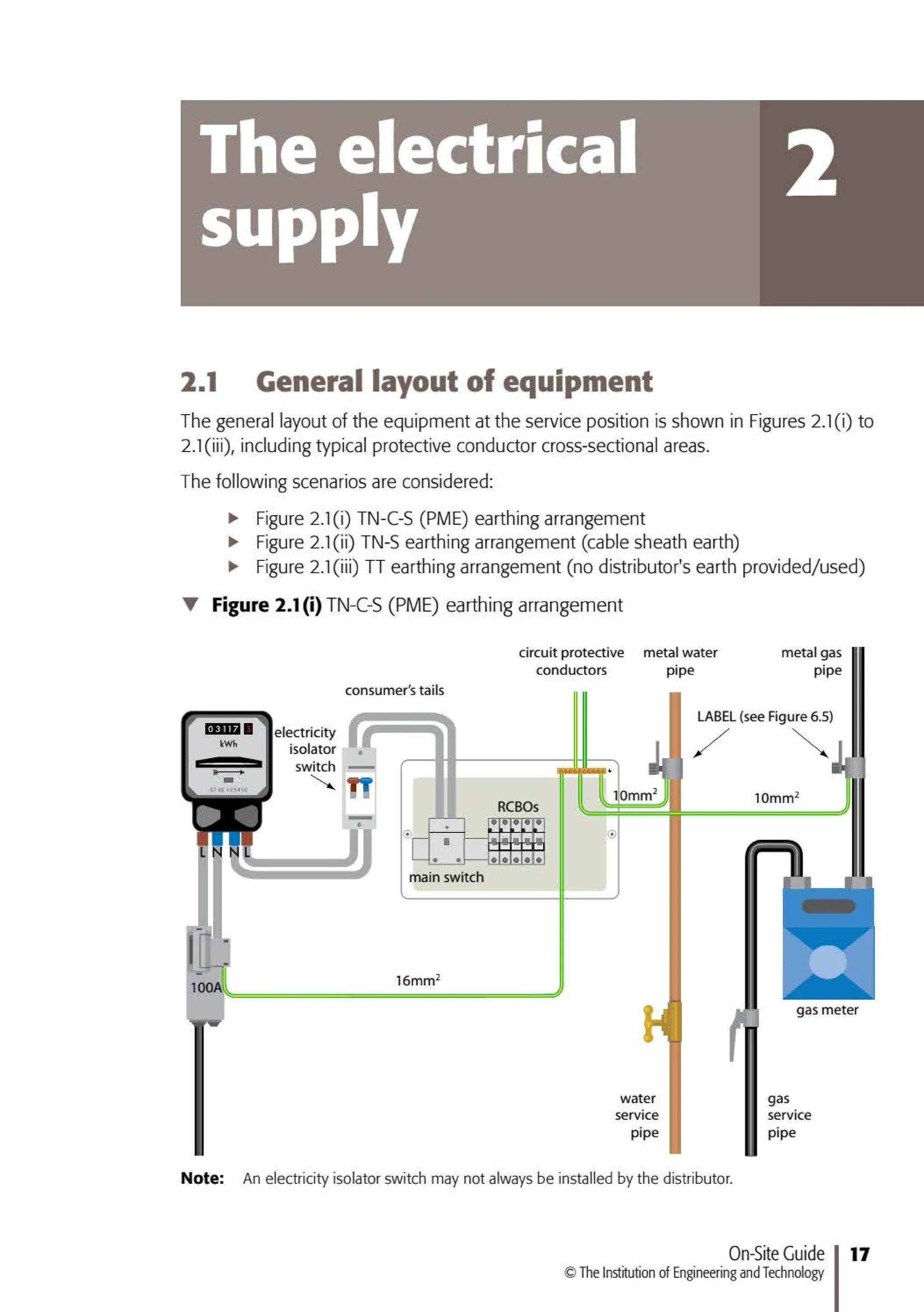
2.1 General layout of equipment
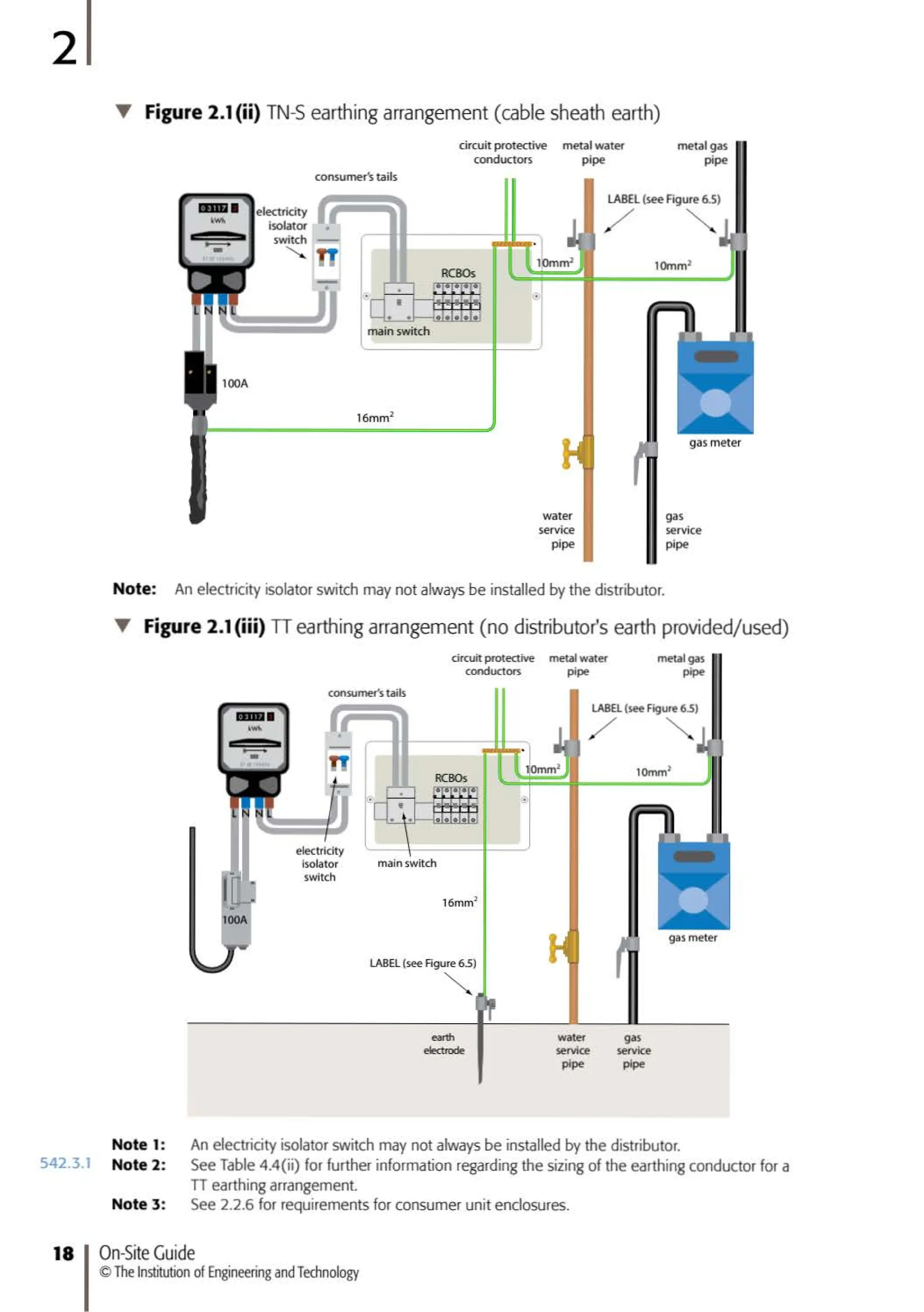
The general layout of the equipment at the service position is shown in Figures 2.1 (i) to
2.1(iii), including typical protective conductor cross-sectional areas.
The following scenarios are considered:
..,._ Figure 2.1 (i) TN-C-S (PME) earthing arrangement
..,._ Figure 2.1 (ii) TN-S earthing arrangement (cable sheath earth)
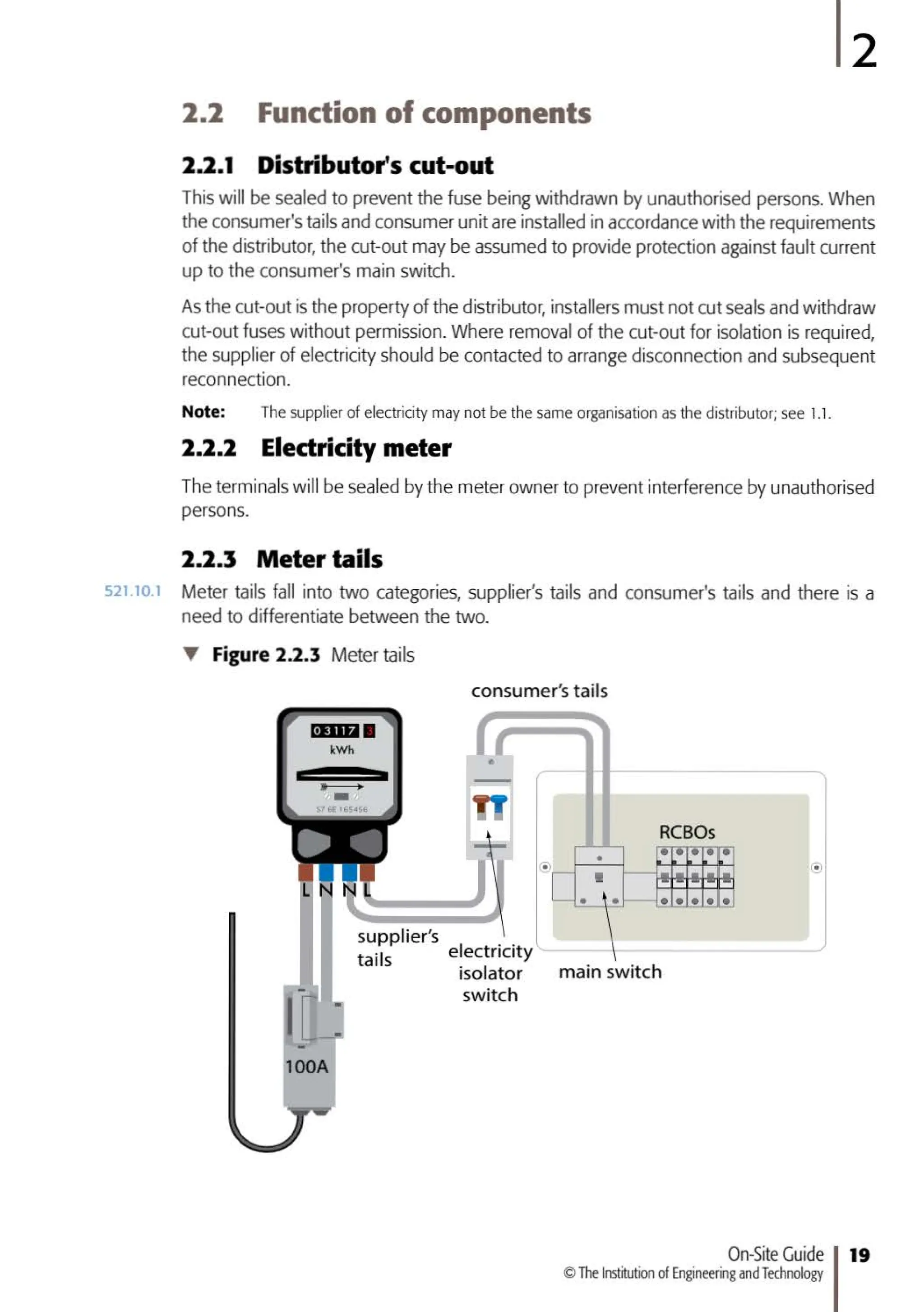
..,._ Figure 2.1 (iii) TT earthing arrangement (no distributor's earth provided/used)
T Figure 2.1 (i) TN-C-S (PME) earthing arrangement
•·••••41
kWh
consumer's tails
isolator
switch -
~ n
-
•
main switch
circuit protective metal water
conductors pipe
metal gas
pipe
LABEL (see Figure 6.5)
RCBOs
water
service
pipe
/ ~
gas
service
pipe
Note: An electricity isolator switch may not always be installed by the distributor.
On-Site Guide 17
©The Institution of Engineeringand T
echnology
2
T Figure 2.1(ii) TN-S earthing arrangement (cable sheath earth)
isolator
switch
consumer's tails
.
t •I •
main switch
16mm2
circuit protective metal water
conductors pipe
metal gas
pipe
LABEL (54!e Figure6.5)
/
lOmm'
RCBOs
water
lOmm'
gas meter
gas
service
pipe
Note: An electricity isolator switch may not always be installed by the distributor.
T Figure 2.1(iii) n earthing arrangement (no distributor's earth provided/used)
IOOA
circuit protective metal water
conductors pipe
metal gas
pipe
consumer's tails
"
electricity
isolator
switch
RCBOs
main switch
16mm'
LABEL (see Rgure 6.5)
~
earth
decbode
LABEL(see Figure 65)
/
water
service
pipe
IOmm'
gas
service
pipe
gas meter
Note 1: An electricity isolator switch may not always be installed by the distributor.
542.3.1 Note 2: See Table 4.4{ii) for further information regarding the sizing of the earthing conductor for a
TT earthing arrangement.
Note 3: See 2.2.6 for requirements for consumer unit enclosures.
18 On-Site Guide
©The Institution of Engineering and Technology
2.2 Function of components
2.2.1 Distributor's cut-out
2
This will be sealed to prevent the fuse being withdrawn by unauthorised persons. When
the consumer's tails and consumer unit are installed in accordance with the requirements
of the distributor, the cut-out may be assumed to provide protedion against fault current
up to the consumer's main switch.
As the cut-out is the property of the distributor, installers must not cut seals and withdraw
cut-out fuses without permission. Where removal of the cut-out for isolation is required,
the supplier of electricity should be contacted to arrange disconnection and subsequent
reconnection.
Note: The supplier of electricity may not be the same organisation as the distributor; see 1.1.
2.2.2 Eledricity meter
The terminalswill be sealed by the meter owner to prevent interference by unauthorised
persons.
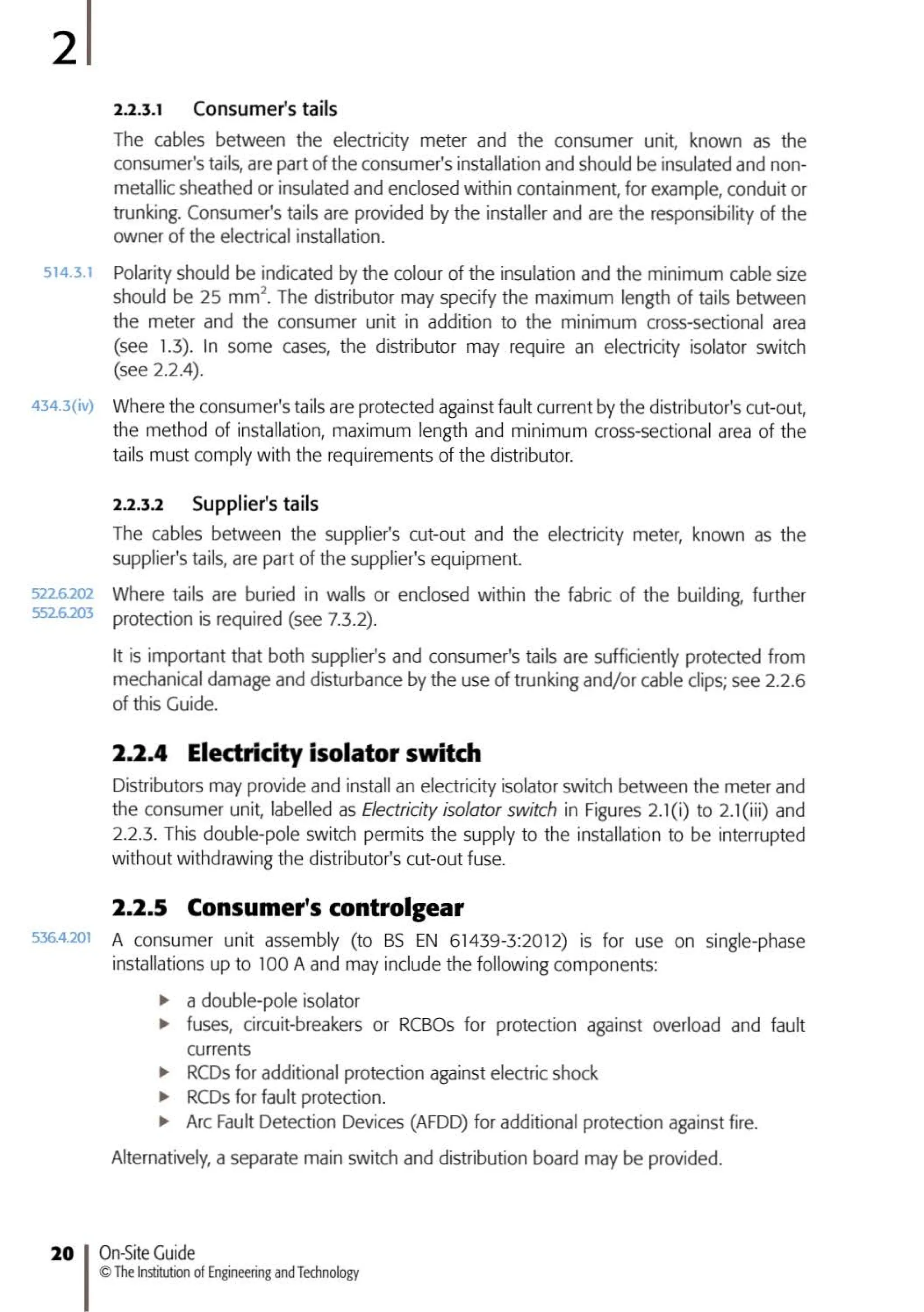
2.2.3 Meter tails
521.10.1 Meter tails fall into two categories, supplier's tails and consumer's tails and there is a
need to differentiate between the two.
T Figure 2.2.3 Meter tails
consumer's tails
RCBOs
• •
supplier's
tails electricity
isolator main switch
-
l OOA
switch
On-Site Guide 19
© The Institution of EngineeringandTechnology
2
2.2.3.1 Consumer'stails
The cables between the electricity meter and the consumer unit, known as the
consumer's tails, are part of the consumer's installation and should be insulated and non-
metallic sheathed or insulated and enclosed within containment, for example, conduit or
trunking. Consumer's tails are provided by the installer and are the responsibility of the
owner of the electrical installation.
514.3.1 Polarity should be indicated by the colour of the insulation and the minimum cable size
should be 25 mm2
• The distributor may specify the maximum length of tails between
the meter and the consumer unit in addition to the minimum cross-sectional area
(see 1.3). In some cases, the distributor may require an electricity isolator switch
(see 2.2.4).
434.3(iv) Where the consumer's tails are protected against fault current by the distributor's cut-out,
the method of installation, maximum length and minimum cross-sectional area of the
tails must comply with the requirements of the distributor.
5226202
5526.203
2.2.3.2 Supplier's tails
The cables between the supplier's cut-out and the electricity meter, known as the
supplier's tails, are part of the supplier's equipment.
Where tails are buried in walls or enclosed within the fabric of the building, further
protection is required (see 7.3.2).
It is important that both supplier's and consumer's tails are sufficiently protected from
mechanical damage and disturbance by the use of trunking and/or cable clips; see 2.2.6
of this Guide.
2.2.4 Eledricity isolator switch
Distributors may provide and install an electricity isolator switch between the meter and
the consumer unit, labelled as Electricity isolator switch in Figures 2.1(i) to 2.1(iii) and
2.2.3. This double-pole switch permits the supply to the installation to be interrupted
without withdrawing the distributor's cut-out fuse.
2.2.5 Consumer's cont.rolgear
536.4.201 A consumer unit assembly (to BS EN 61439-3:2012) is for use on single-phase
installations up to 100 Aand may include the following components:
Jilt- a double-pole isolator
Jilt- fuses, circuit-breakers or RCBOs for protection against overload and fault
currents
Jilt- RCDs for additional protection against electric shock
Jilt- RCDs for fault protection.
Jilt- Arc Fault Detection Devices (AFDD) for additional protection against fire.
Alternatively, a separate main switch and distribution board may be provided.
20 On-Site Guide
© The Institution of Engineering and Technology
421.1.201
421.1.201
531.3.5.3.2.
201
2
All devices and components shall only be those declared suitable according to the
assembly manufacturer's instructions or literature. The scope of BS EN 61439-3 includes
distribution boards with an incoming rated current not exceeding 250 A and outgoing
circuits not exceeding 125 A. They are intended to be operated by ordinary persons.They
can be used in domestic and commercial single and three-phase installations up to 100
Awithin the scope of this guide.
See lET Guidance Note 1 -Selection and Erection and BEAMA guide Overload protection
of an RCCB or switch in an LV assembly to BS EN 61439-3 available at http://www.
beama.org.uk/resource-library.html.
2.2.6 Consumer unit assemblies
Where a consumer unit assembly is installed in domestic (household)
domestic garages and outbuildings, one of the following applies:
.
prem1
ses,
..,. the enclosure is to be manufactured from non-combustible material; or
..,. the consumer unit is enclosed in a cabinet constructed from non-combustible
material.
Ferrous metal, i.e. steel, is deemed to be an example of a non-combustible material.
Plastic enclosures manufactured from 960 degree glow-wire rated material would not be
classified as 'non-combustible' in the context of this regulation.
Where a steel consumer unit is installed in an installation forming part of a n system,
the earth fault loop impedance, 4, is likely to be much higher than the maximum that
is permitted for use of the overcurrent protective device, i.e. cut-out, in order to provide
fault protection. Should the consumer's tails become loose or damaged and make
contact with the metal enclosure, it is likely that the overcurrent device will not operate
within the maximum permitted time of 5 s.
The lET's Wiring Regulations Policy Committee, therefore, advises the following:
(a) AClass I metal consumer unit is installed and each outgoing circuit is protected
by an RCBO
(b) A split, Class I metal consumer unit is installed, where the double-pole main
switch of the consumer unit should incorporate an S type (time delayed)
RCCB, e.g. 100 mA S-type RCCB.
Note: In cases where RCBOs protect each outgoing circuit, the risk of the solid busbar (connecting
the supply side of each RCBO) making contact with the ferrous enclosure is minimal. In
split consumer units, where two or three RCCBs protect multiple circuits through individual
circuit-breakers, the risk of the single-insulated conductors (connecting the load side of the
double-pole main switch to the supply side of the RCCBs) making contact with the ferrous
enclosure due to vibration and/or abrasion or being damaged is far higher. In essence, where
the construction and layout of the consumer unit is such that the risk of live conductors making
contact with the ferrous enclosure is minimal, then the double-pole main switch need not
incorporate an S-type RCCB.
On-Site Guide 21
©The Institution of EngineeringandTechnology
2
412.2.4.1
531.3.5.3.
2.201
522.8.1
In all cases:
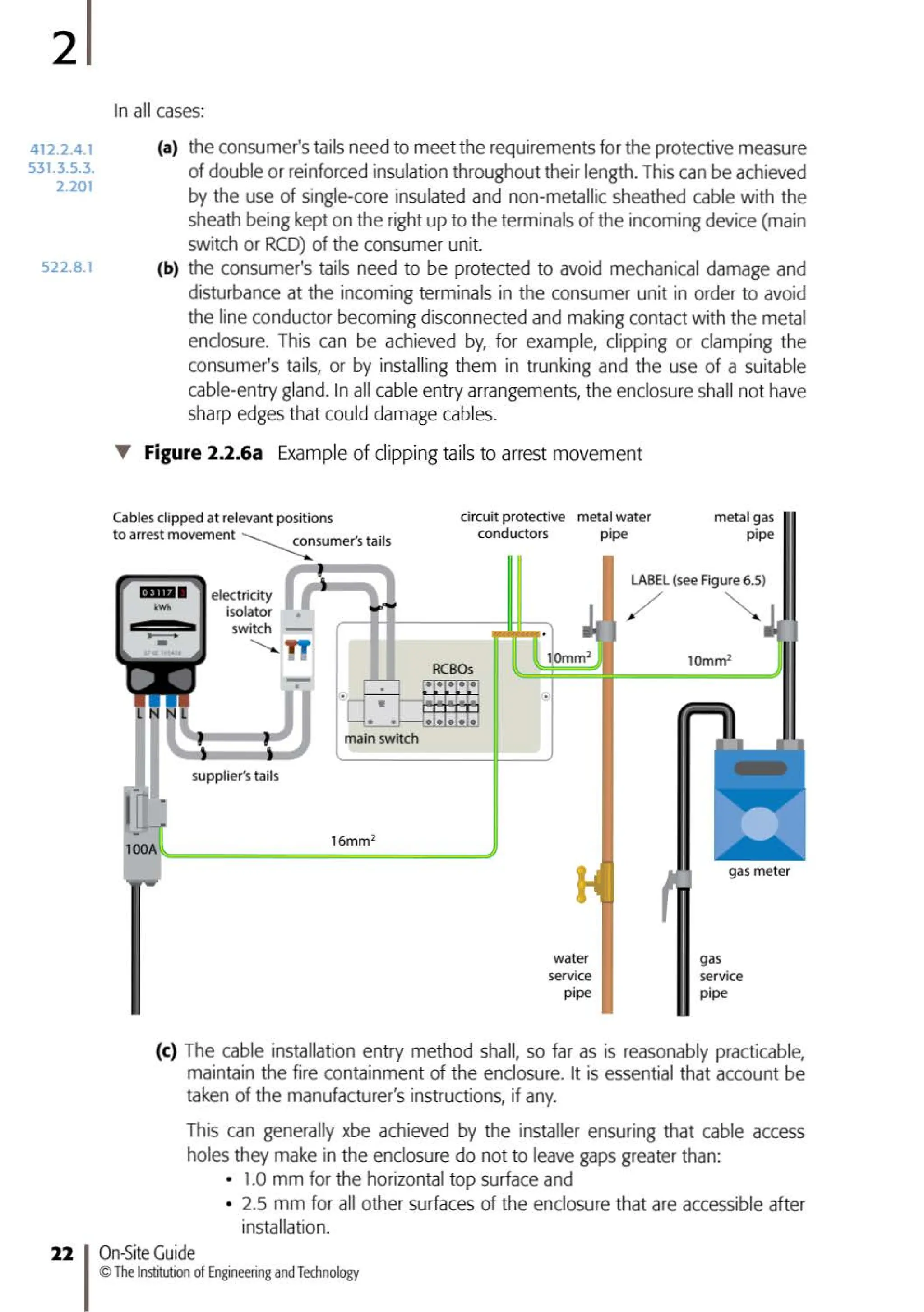
(a) the consumer's tails need to meet the requirements for the protective measure
of double or reinforced insulation throughout their length. This can be achieved
by the use of single-core insulated and non-metallic sheathed cable with the
sheath being kept on the right up to the terminals of the incoming device (main
switch or RCD) of the consumer unit.
(b) the consumer's tails need to be protected to avoid mechanical damage and
disturbance at the incoming terminals in the consumer unit in order to avoid
the line conductor becoming disconnected and making contact with the metal
enclosure. This can be achieved by, for example, clipping or clamping the
consumer's tails, or by installing them in trunking and the use of a suitable
cable-entry gland. In all cable entry arrangements, the enclosure shall not have
sharp edges that could damage cables.
T Figure 2.2.6a Example of clipping tails to arrest movement
Cables clipped at relevant positions circuit protective metal water
to arrest movement ~sumer's tails conductors pipe
metal gas
pipe
LABEL (see Figure 6.5)
electricity
isolator
switch
supplier's tails
- RCBOs
•
main switch
16mm2
lOOA~----------==================?
water
service
pipe
/
gas
service
pipe
(c) The cable installation entry method shall, so far as is reasonably practicable,
maintain the fire containment of the enclosure. It is essential that account be
taken of the manufacturer's instructions, if any.
This can generally xbe achieved by the installer ensuring that cable access
holes they make in the enclosure do not to leave gaps greater than:
• 1.0 mm for the horizontal top surface and
• 2.5 mm for all other surfaces of the enclosure that are accessible after
installation.
22 On-Site Guide
© The Institution of Engineering and Technology
522.8.1
521.5.1
2
The installer could for example, select as they deem appropriate; trunking,
conduit, cable gland or cable entry accessories to minimise the opening around
the cables.
(d) the consumer's tails also need to be protected to avoid any foreseeable damage
and, where entering a ferrous enclosure, do so through the same entry point.
A non-combustible enclosure includes base, cover, door and any components, e.g.
hinges, covers, screws and catches necessary to maintain fire containment. Devices and
blanks are contained within the non-combustible enclosure and, therefore do not have
to be manufactured from a non-combustible material, e.g. steel. However, the use of
non-combustible blanks is not precluded.
Note: Information on consumer units kindly provided by BEAMA. This and more can be found here:
http://www.beama.org.uk/en/publications/technical-bulletins.cfm
Where the consumer unit is to be located in an external non-habitable building, e.g. a
garage or shed, which is not in close proximity to a dwelling, consideration could still be
given to installing a consumer unit of non-ferrous construction. The term "not in close
proximity" is always a moot point and the decision to install a non-ferrous enclosure
must be supported by a documented risk assessment, which must be appended to the
Electrical Installation Certificate.
2.3 Separation of gas installation pipework
from the electrical installation
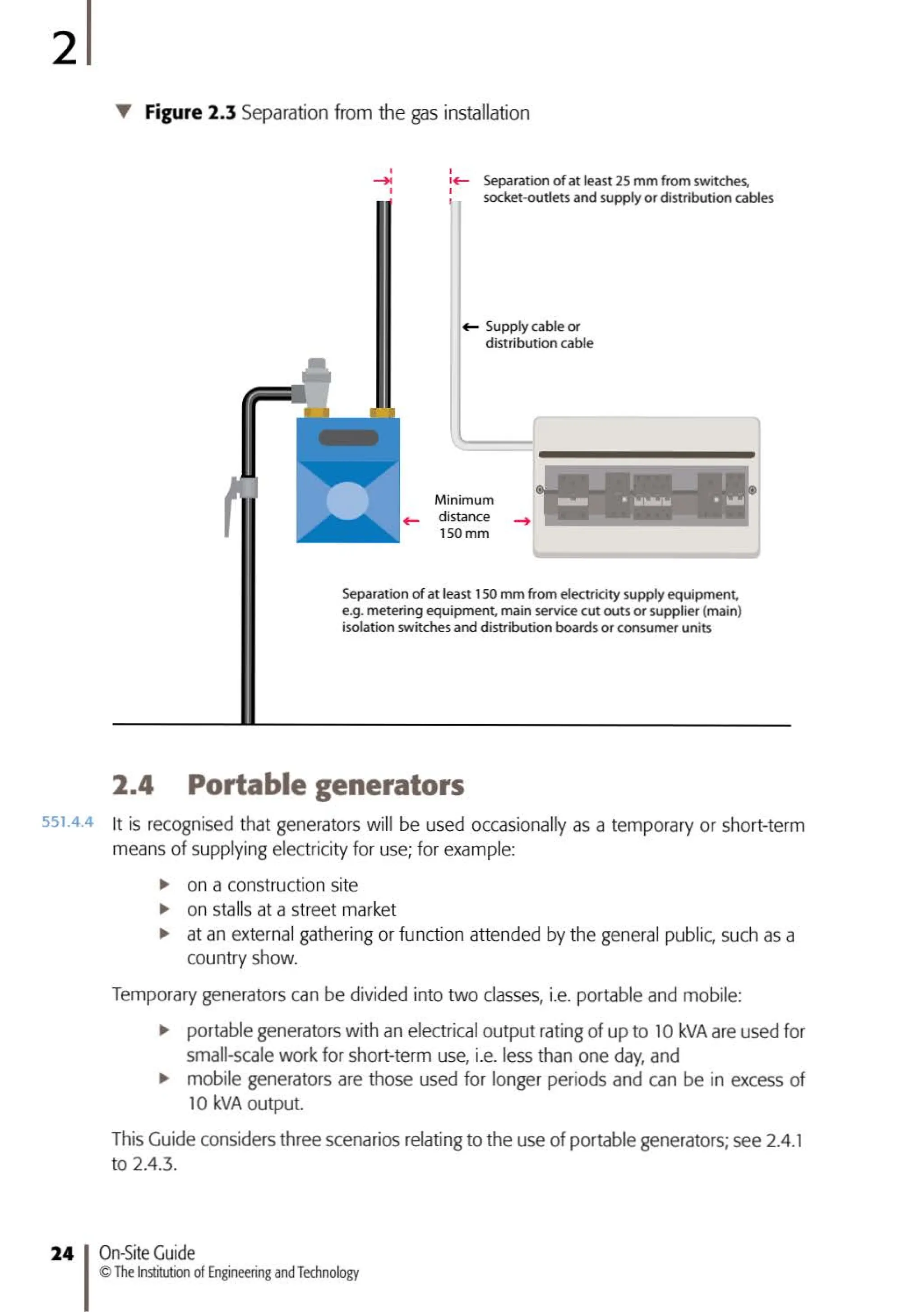
Where gas installation pipework is not separated from electrical equipment or cables
by an insulating enclosure, dividing barrier, trunking, or conduit, the following separation
distances shall be followed:
(a) at least 150 mm away from electricity supply equipment, such as metering
equipment, main service cut-outs or supplier (main) isolation switches and
distribution boards or consumer units;
(b) at least 25 mm away from electrical switches, sockets and electricity supply
and distribution cables.
The installation pipeworkshall not be positioned in a manner that prevents the operation
of any electrical accessory, i.e. a switch or socket-outlet.
Note: Where these spacing requirements are impracticable the pipework should either be sheathed
with an electric insulating material rated at 230 V or more, or a panel of electrical insulating
material should be interposed.
The cited distances are quoted within BS 6891:2015 Specification for the installation
and maintenance of low pressure gas installation pipework of up to 35 mm (R1114) on
premises, clause 8.4.2.
On-Site Guide 23
© The Institution of Engineering andTechnology
2
T Figure 2.3 Separation from the gas installation
'
-I
'~...- Separation of at least 25 mm from switches,
I
I I socket-outlets and supply or distribution cables
- Supply cable or
distribution cable
Minimum
- distance
150mm
Separation of at least 1SO mm from electricity supply equipment,
e.g. metering equipment, main service cut outs or supplier (main)
isolation switches and distribution boards or consumer units
2.4 Portable generators
551.4.4 It is recognised that generators will be used occasionally as a temporary or short-term
means of supplying electricity for use; for example:
ll> on a construction site
.,.. on stalls at a street market
ll> at an external gathering or function attended by the general public, such as a
country show.
Temporary generators can be divided into two classes, i.e. portable and mobile:
ll> portable generators with an electrical output rating of up to 10 kVA are used for
small-scale work for short-term use, i.e. less than one day, and
.,.. mobile generators are those used for longer periods and can be in excess of
10 kVA output.
This Guide considers three scenarios relating to the use of portable generators; see 2.4.1
to 2.4.3.
24 On-Site Guide
© The Institution of Engineering and Technology
2
551 For information relating to the permanent use of generators see lET Guidance Notes 5
and 7 and Section 551 of BS 7671:2018.
551.4.4
413
418.3
Where generators are used to supply concession vehicles, such as burger vans, see
Section 717 Mobile and Transportable Units of BS 7671:2018 and lET Guidance Note 7.
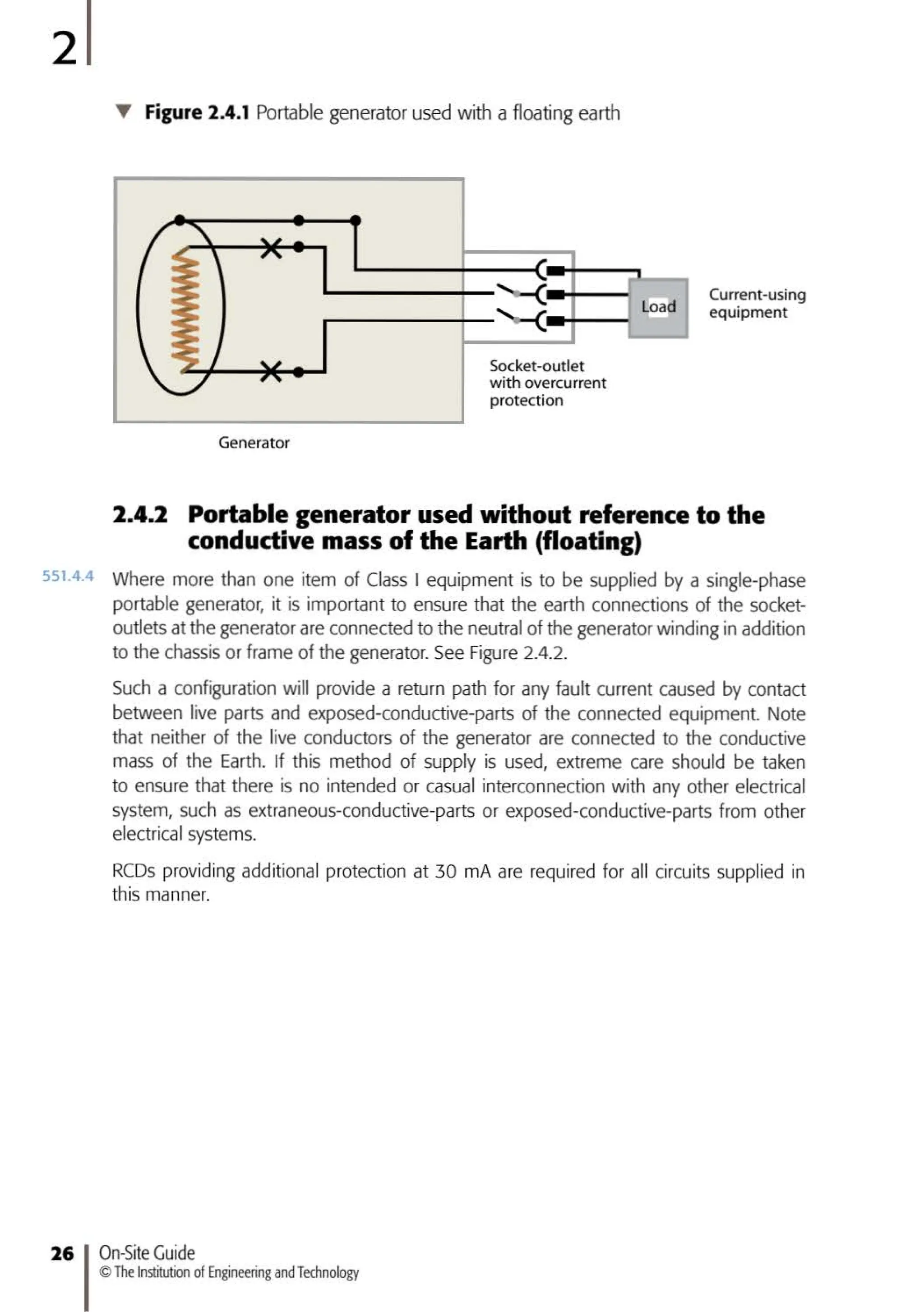
1.4.1 Portable generator isolated from earth
Portable generators ranging in output from 0.2 kVA to 10 kVA single-phase are often
isolated from Earth, i.e. there is no connection between the chassis and/or earth
connection of socket-outlet(s) of the unit and the neutral of the generator winding and
Earth. The ends of the generator winding are brought out to one or more three-pin
socket-outlets which should conform to BS EN 60309-2. The earth socket-tube of the
socket-outlet(s) is usually connected internally to the frame of the generator only; see
Figure 2.4.1.
This arrangement is a form of electrical separation, where basic protection is provided
by basic insulation of live parts or by barriers and enclosures, and fault protection is
provided by simple separation of the separated circuit from other circuits and from Earth.
The requirements for electrical separation can be found in Section 413 of BS 7671
where one item of equipment is supplied and Regulation 418.3 where more than one
item of equipment is supplied by the separated circuit. However, the requirements of
Regulation 418.3 could prove difficult or impracticable to meet in a typical application of
a portable generator.
It is extremely important to note that a portable generator isolated from earth should
only be used to supply equipment in the following permutations:
..,. one or more items of Class II equipment
..,. one item of Class I equipment
..,. one or more items of Class II and one item of Class I equipment.
The supply of only Class II equipment, however, is preferable.
No more than one item of Class I equipment should be supplied at any time as faults can
be presented as voltages and operatives can provide a path for current flowing between
exposed-conductive-parts of faulty electrical equipment.
On-Site Guide 25
© The Institution of Engineering andTechnology
2
T Figure 2.4.1 Portable generator used with a floating earth
Generator
~------~-~~--~
~------~-~-*--~
Socket-outlet
with overcurrent
protection
Load
Current-using
equipment
2.4.2 Portable generator used without reference to the
condudive mass of the Earth (floating)
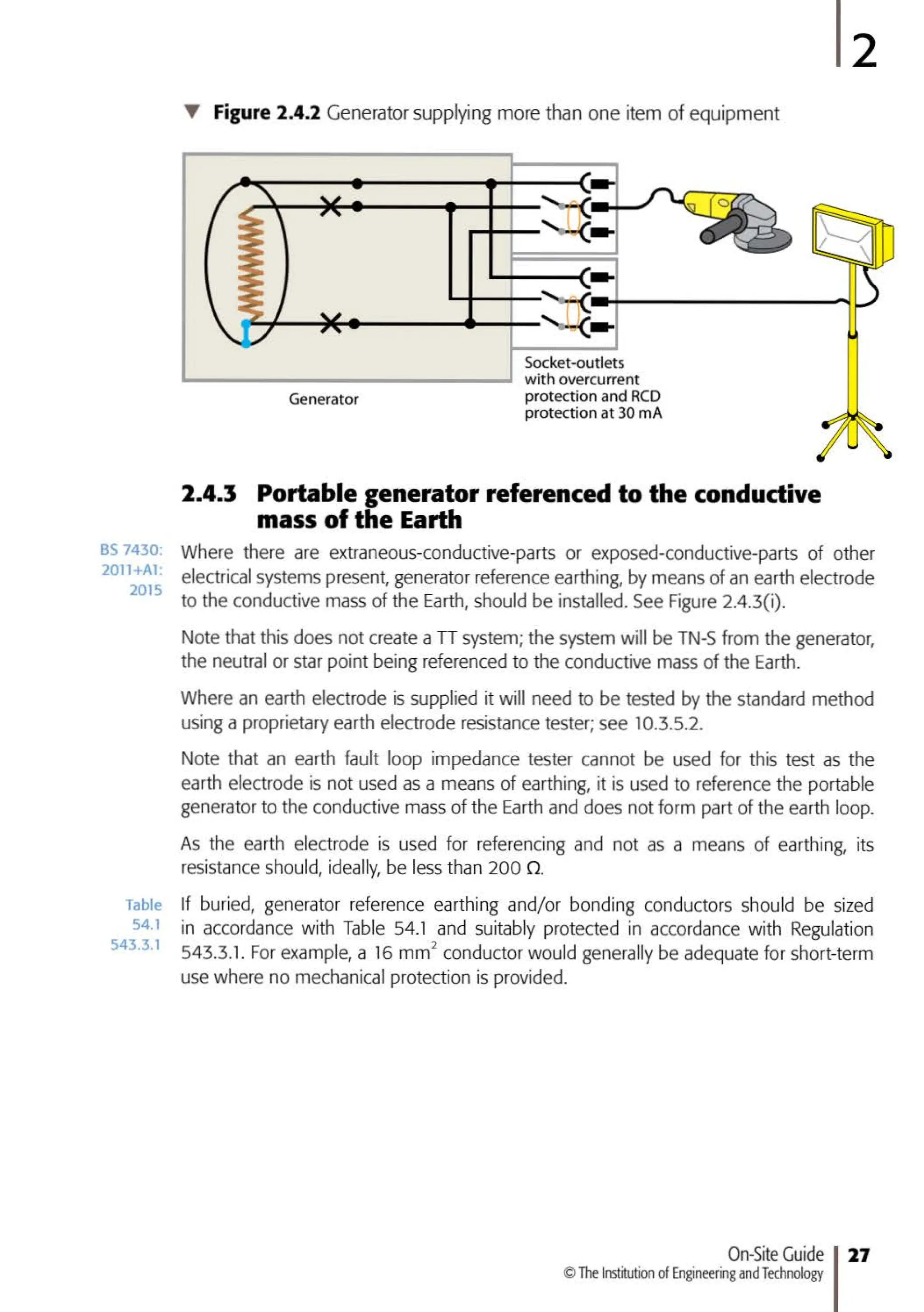
551.4.4 Where more than one item of Class I equipment is to be supplied by a single-phase
portable generator, it is important to ensure that the earth connections of the socket-
outlets at the generator are connected to the neutral of the generator winding in addition
to the chassis or frame of the generator. See Figure 2.4.2.
Such a configuration will provide a return path for any fault current caused by contact
between live parts and exposed-conductive-parts of the connected equipment. Note
that neither of the live conductors of the generator are connected to the conductive
mass of the Earth. If this method of supply is used, extreme care should be taken
to ensure that there is no intended or casual interconnection with any other electrical
system, such as extraneous-conductive-parts or exposed-conductive-parts from other
electrical systems.
R
CDs providing additional protection at 30 rnA are required for all circuits supplied in
this manner.
26 On-Site Guide
© The Institution of Engineering and Technology
BS 7430:
2011+A1:
2015
Table
54.1
543.3.1
T Figure 2.4.2 Generator supplying more than one item of equipment
Generator
Socket-outlets
with overcurrent
protection and RCD
protection at 30 mA
1.4.3 Portable generator referenced to the condudive
mass of the Earth
2
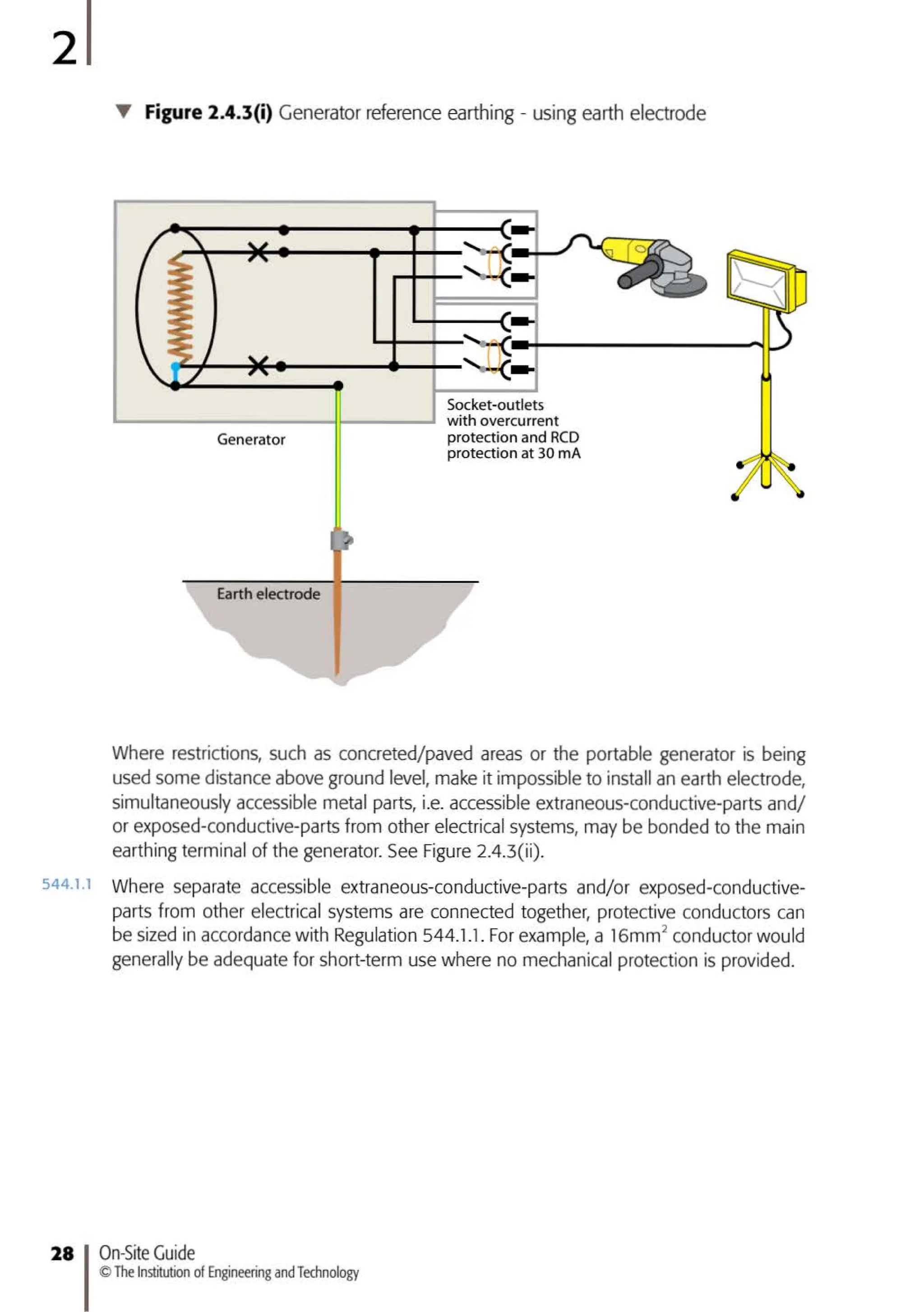
Where there are extraneous-conductive-parts or exposed-conductive-parts of other
electrical systems present, generator reference earthing, by means of an earth electrode
to the conductive mass of the Earth, should be installed. See Figure 2.4.3(i).
Note that this does not create a n system; the system will be TN-Sfrom the generator,
the neutral or star point being referenced to the conductive mass of the Earth.
Where an earth electrode is supplied it will need to be tested by the standard method
using a proprietary earth electrode resistance tester; see 10.3.5.2.
Note that an earth fault loop impedance tester cannot be used for this test as the
earth electrode is not used as a means of earthing, it is used to reference the portable
generator to the conductive mass of the Earth and does not form part of the earth loop.
As the earth electrode is used for referencing and not as a means of earthing, its
resistance should, ideally, be lessthan 200 0.
If buried, generator reference earthing and/or bonding conductors should be sized
in accordance with Table 54.1 and suitably protected in accordance with Regulation
543.3.1. For example, a 16 mm
2
conductor would generally be adequate for short-term
use where no mechanical protection is provided.
On-Site Guide 27
©The Institution of EngineeringandTechnology
2
T Figure 2.4.3(i) Generator reference earthing - using earth electrode
I
I
Generator
Earth electrode
Socket-outlets
with overcurrent
protection and RCD
protection at 30 rnA
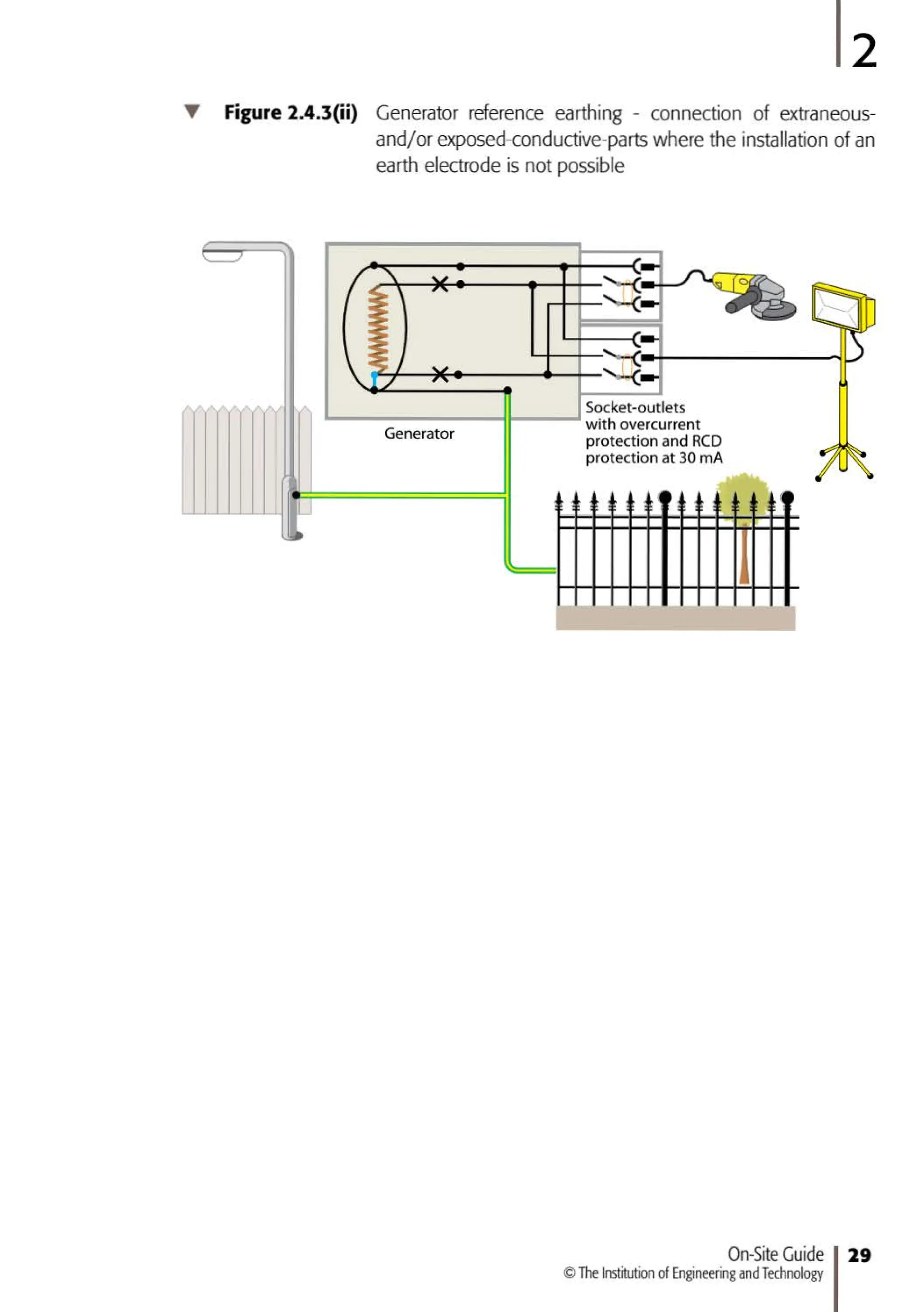
Where restrictions, such as concreted/paved areas or the portable generator is being
used some distance above ground level, make it impossible to install an earth electrode,
simultaneously accessible metal parts, i.e. accessible extraneous-conductive-parts and/
or exposed-conductive-partsfrom other electrical systems, may be bonded to the main
earthing terminal of the generator. See Figure 2.4.3(ii).
544.1.1 Where separate accessible extraneous-conductive-parts and/or exposed-conductive-
parts from other electrical systems are connected together, protective conductors can
be sized in accordance with Regulation 544.1.1. For example, a l6mm2
conductor would
generally be adequate for short-term use where no mechanical protection is provided.
28 On-Site Guide
©The Institution of Engineering and Technology
2
Figure 2.4.3(ii) Generator reference earthing - connection of extraneous-
and/or exposed-conductive-parts where the installation of an
earth electrode is not possible
' ~
:; ,,
:;
:;
:;
.. ~
-
"
'/ ,,
0
Generator
rlll
lJ
•
~~
....
....~:
~,- '-._,
<- p
.. ' ·
... ·?~
...
Socket-outlets
with overcurrent
protection and RCD
l~
protection at 30 mA
'
On-Site Guide 29
© The Institution of Engineering andTechnology
2
30 On-Site Guide
e The Institution of Engineering and Technology
433
434
411.3.2
415.1
421.1.7
3.1 Types of protective device
The consumer unit (or distribution board) may contain devices providing:
(a) protection against overload current
(b) protection against short-circuit current and earth fault current
(c) automatic disconnection in case of a fault (fault protection)
(d) additional protection (electric shock protection): RCD(s) 30 mA.
(e) additional protection against fire may also be included (AFDD)
Functions (a) and (b) are usually carried out by one device, i.e. a fuse or circuit-breaker.
434 Function (c) is usually carried out by the device performing function (b), except where
a high value of earth fault loop impedance makes the use of a fuse or circuit-breaker for
function (c) impracticable (such as a TT system), in which case an RCD has to be used.
434 An RCBO, being a unit with a combined circuit-breaker and RCD, will carry out functions
411 (a) to (d).
Appx3 3.2
533.1
Protection against overload current
Protection against overload current will be provided by the use of any of the following
devices:
..,.. fuses to BS 88-2, (BS EN 60269-2) BS 88-3, BS 88-6, BS 1361 and BS 3036
..,.. miniature circuit-breakers to BS 3871-1 types 1, 2 and 3
..,.. circuit-breakers to BS EN 60898 types B, C and D, and
..,.. residual current circuit-breakers with integral overcurrent protection (RCBOs) to
BS EN 61009 series and BS EN 62423.
3.3 Protection against short-circuit current and
earth fault current
When a consumer unit to BS EN 61439-3:2012 or BS 5486: Part 13 or a fuseboard
having fuselinks to BS 88-2 (BS EN 60269-2) or BS 88-6 or BS 1361 is used, then
protection against short-circuit current and earth fault current will be provided by that
particular overcurrent protective device.
Note: For other protective devices the breaking capacity must be adequate for the prospective fault
current at their point of installation.
On-Site Guide 31
©The Institution of Engineering and T
echnology
3
3.4 Protection against electric shock
3.4.1 Automatic disconnection of supply
411 Automatic disconnection of supply (ADS
) isthe most the common method of protection
411.1 against electric shock. There are two elements to automatic disconnection of supply,
basic protection and fault protection.
411.2
411.1
416
416.1
416.2
521.10.1
415.1.1
415.1.2
3.4.1.1 Basic protection
Basic protection is the physical barrier between persons/livestock and a live part.
Examples of basic protection are:
..,. electrical insulation
ll> enclosures and barriers.
It follows that single-core non-sheathed insulated conductors must be protected by
conduit or trunking and be terminated within a suitable enclosure.
A 30 rnA RCD may be provided to give additional protection against contact with live
parts but must not be used as primary protection.
411.3 3.4.1.2 Fault protection
411.1
411.3.1.1
411.3.1.2
411.3.2
Fault protection comprises:
..,. protective earthing,
ll> protective equipotential bonding, and
ll> automatic disconnection in case of a fault.
Fault protection works by limiting the magnitude and duration ofvoltages that may appear
under earth fault conditions between simultaneously accessible exposed-conductive-
parts of equipment and between them and extraneous-conductive-parts or earth.
3.4.2 other methods of protedion against eledric shock
410.3.3 In addition to automatic disconnection of supply, BS 7671 recognises other methods of
protection against electric shock.
414 3.4.3 SELV and PELV
414.3
414.4.1
32
SELV
Separated extra-low voltage (SELV) systems:
ll> are supplied from isolated safety sources such as a safety isolating transformer
to BS EN 61558-2-6 orBSEN 61558-2-8
ll> have no live part connected to earth or the protective conductor of another
system
ll> have basic insulation from other SELV and PELV circuits
ll> have double or reinforced insulation or basic insulation plus earthed metallic
screening from LV circuits
On-Site Guide
© The Institution of Engineering and Technology
414.4.4
414.4.1
414.4.5
3
ll> have no exposed-conductive-parts connected to earth or to exposed-
conductive-parts or protective conductors of another circuit.
PELV
Protective extra-low voltage (PELV) systems must meet all the requirements for SELV,
except that the circuits are not electrically separated from earth.
For SELV and PELV systems, basic protection need not be provided if voltages do not
exceed those given in Table 3.4.3.
T Table 3.4.3 SELV and PEL
V basic protection voltage limits
Location SELV and PELV
Dry areas
Immersed equipment
Locations containing a bath or shower,
swimming pools, saunas
Other areas
25 V AC or 60 V DC
Further protection required at all voltages
12VAC or 30V DC
411 3.5 Automatic disconnection
3.5.1 Standard circuits
For the standard final circuits given in Section 7 of this Guide, the correct disconnection
time is obtained for the protective devices by limiting the maximum circuit lengths.
Table 41.1 3.5.2 Disconnection times -TN systems
411.3.2.2 A disconnection time of not more than 0.4 s is required for final circuits:
ll> 63 A with one or more socket-outlets
ll> 32 A when supplying only fixed equipment
411.3.2.3 A disconnection time of not more than 5 s is permitted for:
ll> final circuits exceeding 32 A, and
ll> distribution circuits.
Table 41.1 3.5.3 Disconnection times- TT systems
411.3.2.2 The required disconnection times for installations forming part of a TT system can,
except in the most exceptional circumstances outside the scope of this Guide, only be
achieved by protecting every circuit with an RCD, hence, a time of not more than 0.2 s
is required for final circuits:
ll> 63 A with one or more socket-outlets
ll> 32 A when supplying only fixed equipment.
On-Site Guide 33
©The Institution of Engineering andTechnology
3
411.3.2.4 A disconnection time of not more than 1 s is permitted for:
111> final circuits exceeding 32 A, and
411.4
411.5
411.3.3
(i)
411.3.4
701.411.
3.3
701.411.
3.3
411.3.3
(ii)
522.6.
202
522.6.
203
111> distribution circuits.
3.6 Residual current devices (RCDs)
RCD is the generic term for a device that operates when the residual current in the circuit
reaches a predetermined value. The RCD is, therefore, the main component in an RCCB
(residual current operated circuit-breaker without integral overcurrent protection) or
one of the functions of an RCBO (residual current operated circuit-breaker with integral
overcurrent protection).
3.6.1 Protedion by RCDs
R
CDs are required for:
(a) fault protection where the earth fault loop impedance is too high to meet
the required disconnection time, for example, where the distributor does not
provide a connection to a means of earthing, i.e. TT earthing arrangement
(b) additional protection for socket-outlets not exceeding 32 A
(c) additional protection for lighting circuits in domestic (household) premises
(d) additional protection for all low voltage circuits serving locations containing a
bath or shower
(e) additional protection for all low voltage circuits passing through zones 1 and 2
of locations containing a bath or shower but not serving equipment within the
location
(f) additional protection for circuits supplying mobile equipment not exceeding 32
Afor use outdoors
(g) additional protection for cables without earthed metallic covering installed in
walls or partitions at a depth of less than 50 mm and not protected by earthed
steel conduit, earthed trunking or earthed ducting
(h) additional protection for cables without earthed metallic covering installed in
walls or partitions with metal parts (not including screws or nails) and not
protected by earthed steel conduit or the like.
3.6.2 Omission of RCD protedion
411.3.3 3.6.2.1 Specific cases
411.4
411.5
34
RCDs for additional requirements for socket-outlets can be omitted in non-domestic
premises, where a documented risk assessment determines that RCD protection is not
necessary. The risk assessment must be appended to the certificate issued for the work.
See 3.6.2.2.
Cables installed on the surface do not specifically require RCD protection; however, RCD
protection may be required for other reasons, for example, for fault protection where the
earth fault loop impedance is such that the disconnection time for an overcurrent device
cannot be met.
On-Site Guide
© The Institution of Engineering and Technology
3
411.3.3 3.6.2.2 Risk assessment and the omission of additional requirements by RCDs for
socket-outlets
In non-domestic premises, BS 7671:2018 permits RCDs, where usually provided
for additional protection to socket-outlets, to be omitted where a documented risk
assessment determines that the risk to users and those in the vicinity is sufficiently low
and, hence, RCD protection is not necessary.
411.3.3 The Management of Health and Safety at Work Regulations 1999 puts the responsibility
Note 2 for carrying out risk assessments onto (as applicable) the persons responsible for the
operations or work activity. The risk assessment should consider the frequency of use,
the environment, the equipment to be connected, the skill level of the person using the
equipment and the socket-outlet and the persons who will have access to the area when
the equipment is in operation, amongst many other factors.
The intention is that the omission of RCDs for additional protection to socket-outlets
should be only as a last resort and certainly notfor implementation in domesticpremises.
Note that the risk assessment, like all risk assessments, will need to be revisited at
pertinent intervals to assess any change in circumstances, i.e. change of use/change of
ownership or when a periodic inspection is undertaken and must be appended to the
Electrical Installation Certificate EICR.
3.6.3 Applications of RCDs
314 Installations are required to be divided into circuits to avoid hazards and minimize
inconvenience in the event of a fault and to take account of danger that might arise from
the failure of a single circuit, such as a lighting circuit.
The following scenarios show different methods of providing RCD protection within
installations. Note that, for clarity, earthing and bonding connections are not shown.
On-Site Guide 35
© The Institution of Engineering andTechnology
3
3.6.3.1 Examples of RCDs within installations
In each case, refer to 2.2.6 of this Guide.
T Figure 3.6.3(i) Consumer unit with RCBOs, suitable for all installations
(TN and TT)
final circuits
• •
•
.. •
30mARCBOs
labelled main switch
'Main switch' (isolator)
Single RCBOs protect each outgoing circuit and the risk of the busbar (connecting
the supply side of each RCBO) becoming loose and making contact with the ferrous
enclosure is minimal. The use of RCBOs will minimize inconvenience in the event of a
fault and is applicable to all systems.
T Figure 3.6.3(ii) Split consumer unit with separate main switch and two 30 rnA
RCCBs
final circuits final circuits
• • • •
main switch 30 mA 30 mA
(isolator) RCCB RCCB
labelled
'Main switch'
36 On-Site Guide
© The Institution of Engineering and Technology
3
The division of an installation into two parts with separate 30 mA RCCBs will ensure
that part of the installation will remain on supply in the event of a fault. Generally, this
is not suitable for an installation forming part of a TT system as there is insufficient fault
protection of the single insulated conductors which connect the load side of the double-
pole main switch to the supply side of the RCCBs.
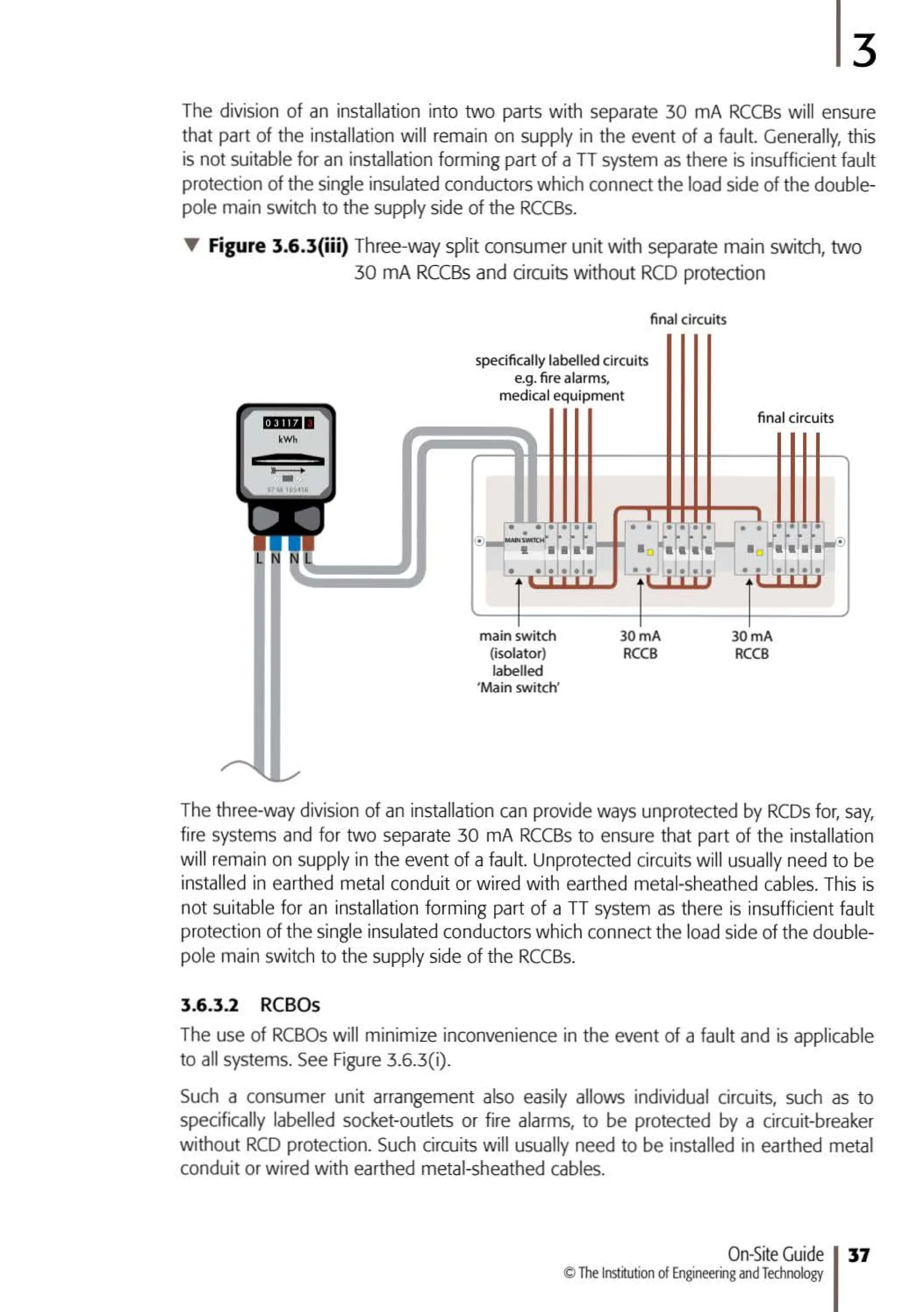
'Y Figure 3.6.3(iii) Three-way split consumer unit with separate main switch, two
30 mA RCCBs and circuits without RCD protection
ltllltj•
kWh
specifically labelled circuits
e.g. fire alarms,
medical equipment
final circuits
main switch
(isolator)
labelled
'Main switch'
30mA
RCCB
final circuits
30mA
RCCB
The three-way division of an installation can provide ways unprotected by RCDs for, say,
fire systems and for two separate 30 mA R
CCBs to ensure that part of the installation
will remain on supply in the event of a fault. Unprotected circuits will usually need to be
installed in earthed metal conduit or wired with earthed metal-sheathed cables. This is
not suitable for an installation forming part of a TT system as there is insufficient fault
protection of the single insulated conductors which connect the load side of the double-
pole main switch to the supply side of the RCCBs.
3.6.3.2 RCBOs
The use of RCBOs will minimize inconvenience in the event of a fault and is applicable
to all systems. See Figure 3.6.3(i).
Such a consumer unit arrangement also easily allows individual circuits, such as to
specifically labelled socket-outlets or fire alarms, to be protected by a circuit-breaker
without RCD protection. Such circuits will usually need to be installed in earthed metal
conduit or wired with earthed metal-sheathed cables.
On-Site Guide 37
© The Institution of Engineering andTechnology
3
3.6.3.3 Split board with two 30 rnA RCDs
The division of an installation into two parts with separate 30 rnA RCCBs will ensure that
part of the installation will remain on supply in the event of a fault, see Figure 3.6.3(ii).
3.6.3.4 Three-way split board with two 30 rnA RCDs
The three-way division of an installation can provide ways unprotected by RCDs for, say,
fire systems and for two separate 30 rnA RCCBs to ensure that part of the installation
will remain on supply in the event of a fault. Unprotected circuits will usually need to
be installed in earthed metal conduit or wired with earthed metal-sheathed cables, see
Figure 3.6.3(iii).
534 3.7 Surge protective devices (SPDs)
3.7.1 Overview
131.6.2 Electrical installations and connected equipment can be severely affected by lightning
activity during thunderstorms or from electrical switching events.
GN 1 For more information, see lET Guidance Note 1.
443.6.2 Damage can occur when the surge or transient overvoltage, as the result of lightning or
Table electrical switching, exceeds the impulse withstand voltage rating of electrical equipment
443.2 - the levels of which are defined in Table 443.2 of BS 7671:2018.
443
534
Surges from electrical switching events are created when large inductive loads, such as
motors or air conditioning units, switch off and release stored energy which dissipates as
a transient overvoltage. Switching surges are, in general, not as severe as lightning surges
but are more repetitive and can reduce equipment lifespan.
Overvoltages of atmospheric origin, i.e. created by lightning events, in particular, can
present a risk of fire and electric shock owing to a dangerous flashover.
.,. Section 443 of BS 7671:2018 has requirements for the protection of persons,
livestock and propertyfrom injury and damage as aconsequence of overvoltage
.,. Section 534 has requirements for the selection and installation of surge
protective devices.
Note: Section 534 applies to AC power circuits only. When the need for power SPDs is identified,
additional SPDs on other services such as telecommunications lines and equipment is also
recommended. See BS EN 62305 and BS EN 61643.
Note: Some electronic equipment may have protection levels lower than Category I of Table 443.2.
Note: BS 7671:2018 does not specify requirements for protection against transient overvoltages
due to direct or nearby lightning strokes on the structure. For risk management for protection
against transient overvoltages due to direct or nearby lightning strokes on the structure, see BS
EN 62305-2.
38 On-Site Guide
©The Institution of Engineering and Technology
3
3.7.2 Arrangements for protedion against overvoltages
443 Protection according to Section 443 can only be achieved if transient overvoltages are
534 limited to values lower than those given in Table 443.2, requiring the correct selection
and installation of suitable SPDs.
443.1
Table 443.2
443.4
443.4
3.7.2.1 Where SPD protection may not be required
Protection against overvoltages of atmospheric origin is not required in the following
circumstance but the rated impulse withstand voltage of equipment must meet the
requirements of Table 443.2 of BS 7671:2018:
ll> for single dwelling units where the total value of the installation and equipment
therein, does not justify such protection and the consequential losses are
tolerable.
3.7.2.2 Where SPD protection is required
Protection against transient overvoltages shall be provided where the consequence
caused by overvoltage:
(a) results in serious injury to, or loss of, human life, (e.g. hospitals, care homes,
home dialysis equipment)
(b) results in interruption of public services and/or damage to cultural heritage,
(e.g. data centres, heritage status buildings like museums and castles)
(c) results in interruption of commercial or industrial activity (e.g. banks, hotels,
supermarkets, industrial plants, farms)
(d) affects a large number of collocated individuals (e.g. offices, universities,
schools, residential tower blocks)
For all other cases than above a risk assessment to determine the Calculated Risk
Level CRL shall be conducted to 443.5 (see Appendix lET Guidance Note 1 for further
information).
Note: BS EN 62305·2 Protection against lightning risk assessment method must be used for high
risk installations such as nuclear or chemical sites where the consequences of transient
overvoltages could lead to explosions, harmful chemical or radioactive emissions thus
affecting the environment.
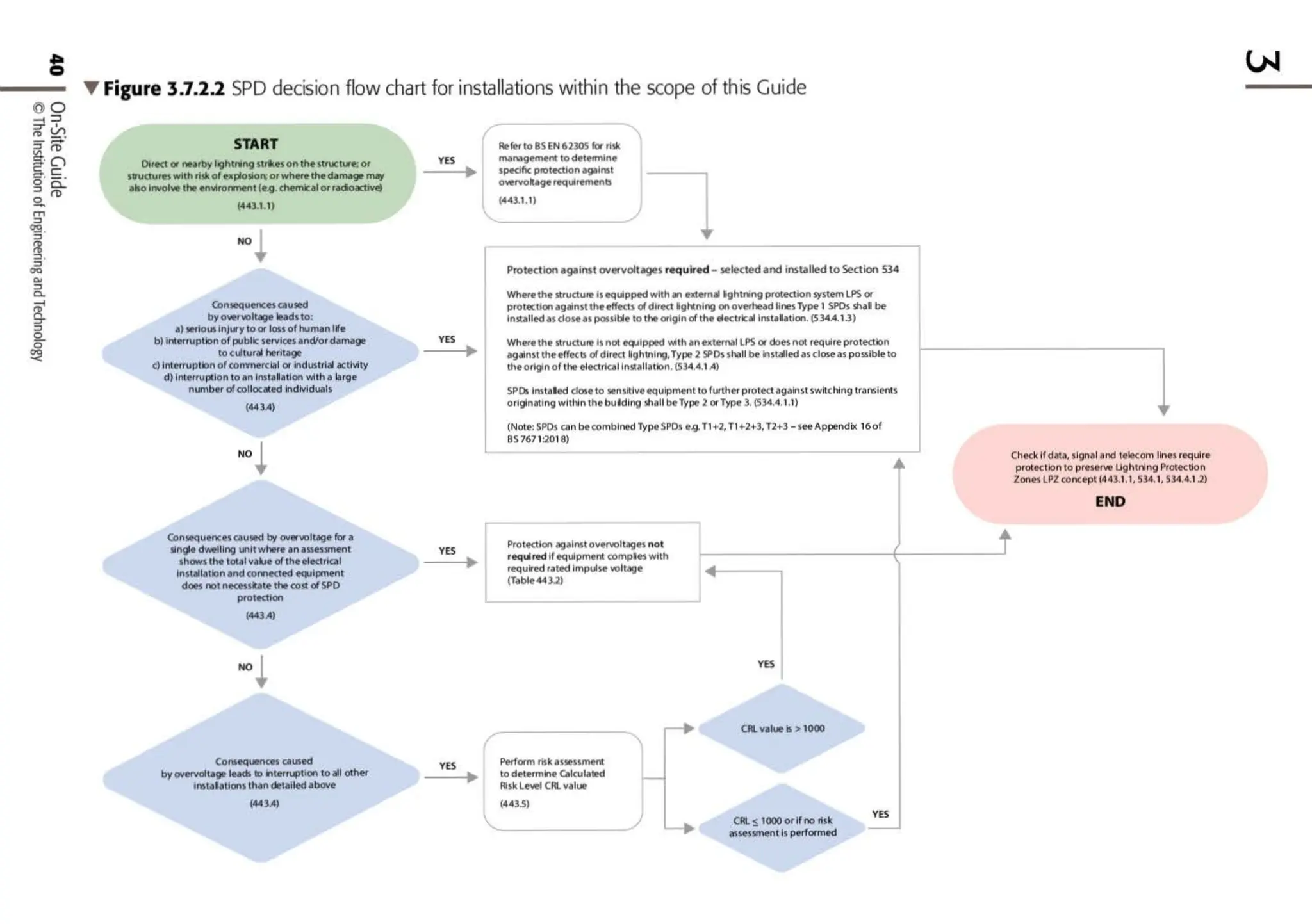
The flow chart in Figure 3.7.2.2 will aid the decision-making process for electrical
installations within the scopeof thisGuide.See lET Guidance Note 1formore information.
On-Site Guide 39
© The Institution of Engineering andTechnology
-
Q
@0
-t::l
::rv-,
~ - ·
--
::::J (1)
;:!:. C)
C:c::
:::::r. _,
oa..
::::Jro
Q..
g'
<>:9.
~
::::! .
~
"'
5.
~
:::r
::::J
!2.
~
'Y Figure 3.7.2.2 SPD decision flow chart for installations within the scope of this Guide
START
Olrtct Of ntarbylightning strikeson the structtxe;or
structures withrisk of explosion;or where the damage may
alsolrwofw the envlrorvnent(e.g. chemic:illorriitcioactivej
(443.1.1)
NO~
Consequ~es caused
by o~Jerwltage teadsto:
a) se<louslnjvry 100< loss ofhuman !We
b) lnlerrupllon ofpublic services and/ordamage
to cultural heritage
c) Interruptionofcommercial or industrial activity
d) Interruption to an Installation with a large
number ofcollocaled Individuals
(443A)
NO~
Consequences caused by overYOitage for a
single dwelling unitwhere an assessment
shows the tOUII value of theelectrlcal
Installation and connected equipment
d~s norne<essltate the cost of SPO
protection
(443A)
NO~
Consequences caused
by 011ervoltage leads 1D Interruption to oil other
lnstalatlons than detailed above
(443A)
YES
~
....
YES
~
....
YES
~
....
YES
~
....
R.!for to BSEN 62305 fO< rl!k
management to determine
specific protectionagainst

owrvotagerequirtments )
(443.1.1)
_~------
Protectionagainst011ervoltages required- selectedand installedtoSection 534
Where the strudu"' Isequipped with an extemlll ightring protection system LPS 0<
protection against theeffects ofdirect ightnlng on ovorhead lines Type I SPDs shal be
Installedas dose as possible to tho or'lgln ofthe <lectr1clll lnstalatlon. (534.4.13)
Where the structure Is not equipped with an external LPS or does not require protection
against theeffects ofdirect lightning,Typo 2 SPDsshall be Installed ascloseas possible to
theorigin of the electrical Installation. (534.4.1 A)
SPDs Installed closeto sensitiveequipment to further protect against switching transients
originating within the building sl>oll beTypo 2 ortype 3. (534.4.1.1)
(Nole: SPDs can be combined Type SPDs e.g. Tl+2, Tl+2+3, T2+3 -see Appendix 16of _j
85 7671:2018)
'--
(
Prote-ction againstovei''Oitages not
required Ifequipment complies with
required rated Impulse voltage
(Tablo443l)
PerfOfm risk assessment
to determine Calculated
Risk Level CRL value
(443.5)
YES
CRt value k >1000
CRL ~ 1000orif no risk
assessmentIs performed
YES
Check Ifdata, signal and telecom lines require
protection to preserve Lightning Protection
Zones LPZ concept (443.1.1, 534.1, 534.4.1.2)
END
l.N
534.1
534.4
3
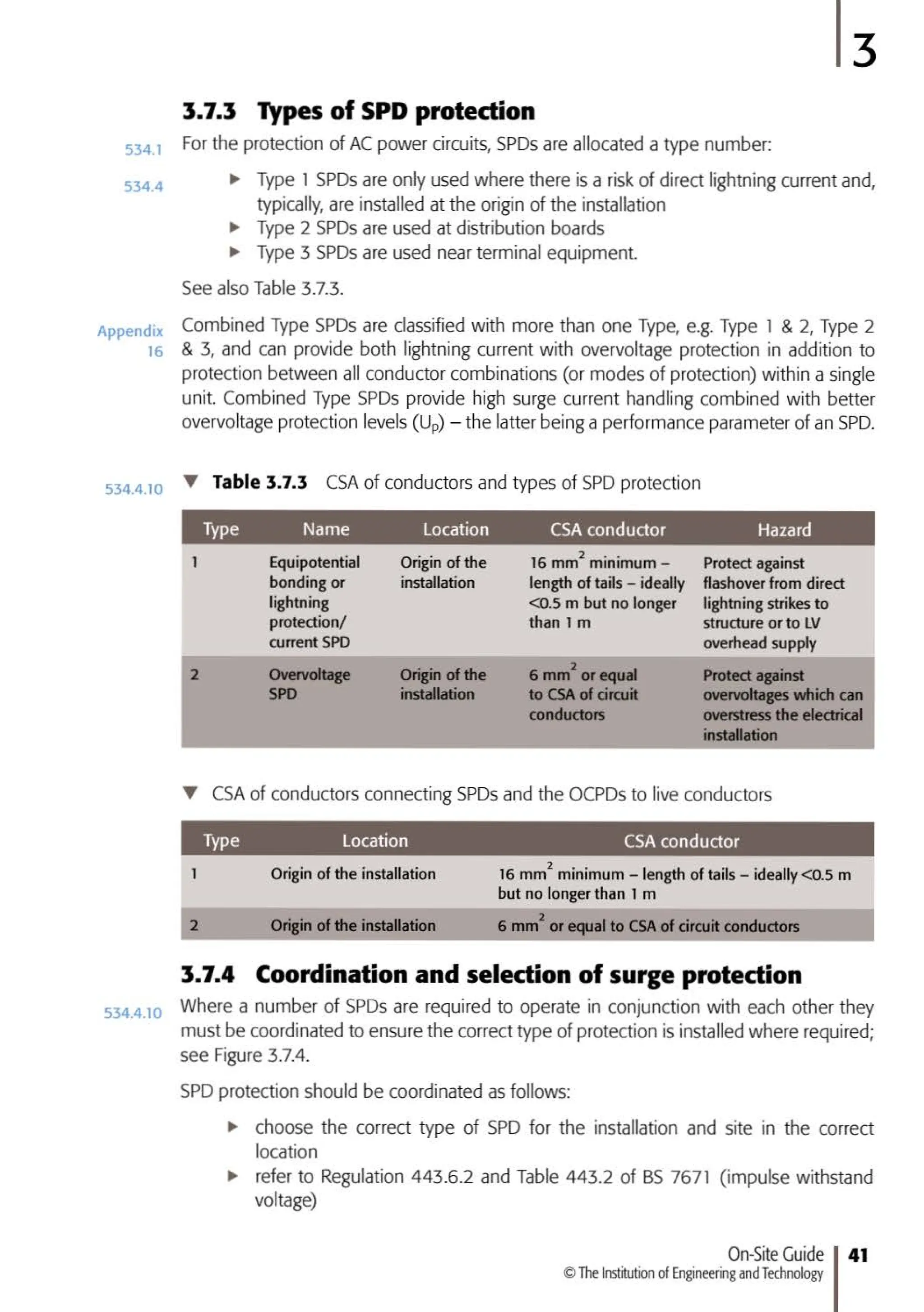
3.7.3 Types of SPD protedion
For the protection of AC power circuits, SPDs are allocated a type number:
Ji> Type 1 SPDs are only used where there is a risk of direct lightning current and,
typically, are installed at the origin of the installation
Ji> Type 2 SPDs are used at distribution boards
Ji> Type 3 SPDs are used near terminal equipment.
See also Table 3.7.3.
Appendix Combined Type SPDs are classified with more than one Type, e.g. Type 1 & 2, Type 2
16 & 3, and can provide both lightning current with overvoltage protection in addition to
protection between all conductor combinations (or modes of protection) within a single
unit. Combined Type SPDs provide high surge current handling combined with better
overvoltage protection levels (Up) - the latter being a performance parameter of an SPD.
T Table 3.7.3 CSA of conductors and types of SPD protection
534.4.10
534.4.10
Type Name Location CSA conductor Hazard
1 Equipotential Origin of the 16 mm
2
minimum - Protect against
bonding or installation length of tails - ideally flashover from direct
lightning <0.5 m but no longer lightning strikes to
protection/ than 1m structure orto LV
current SPD overhead supply
2 <Mrvoltage Origin ofthe
2
6 mm or equal Protect against
SPD installation to CSA of circuit overvoltages which can
conductoiS overstress the electrical
installation
T CSA of conductors connecting SPDs and the OCPDs to live conductors
1
2
Type Location CSA conductor
Origin of the installation
16 mm
2
minimum - length of tails - ideally <O.S m
but no longer than 1m
6 mm
2
or equal to CSA of circuit conductoiS
3.7.4 Coordination and seledion of surge protedion
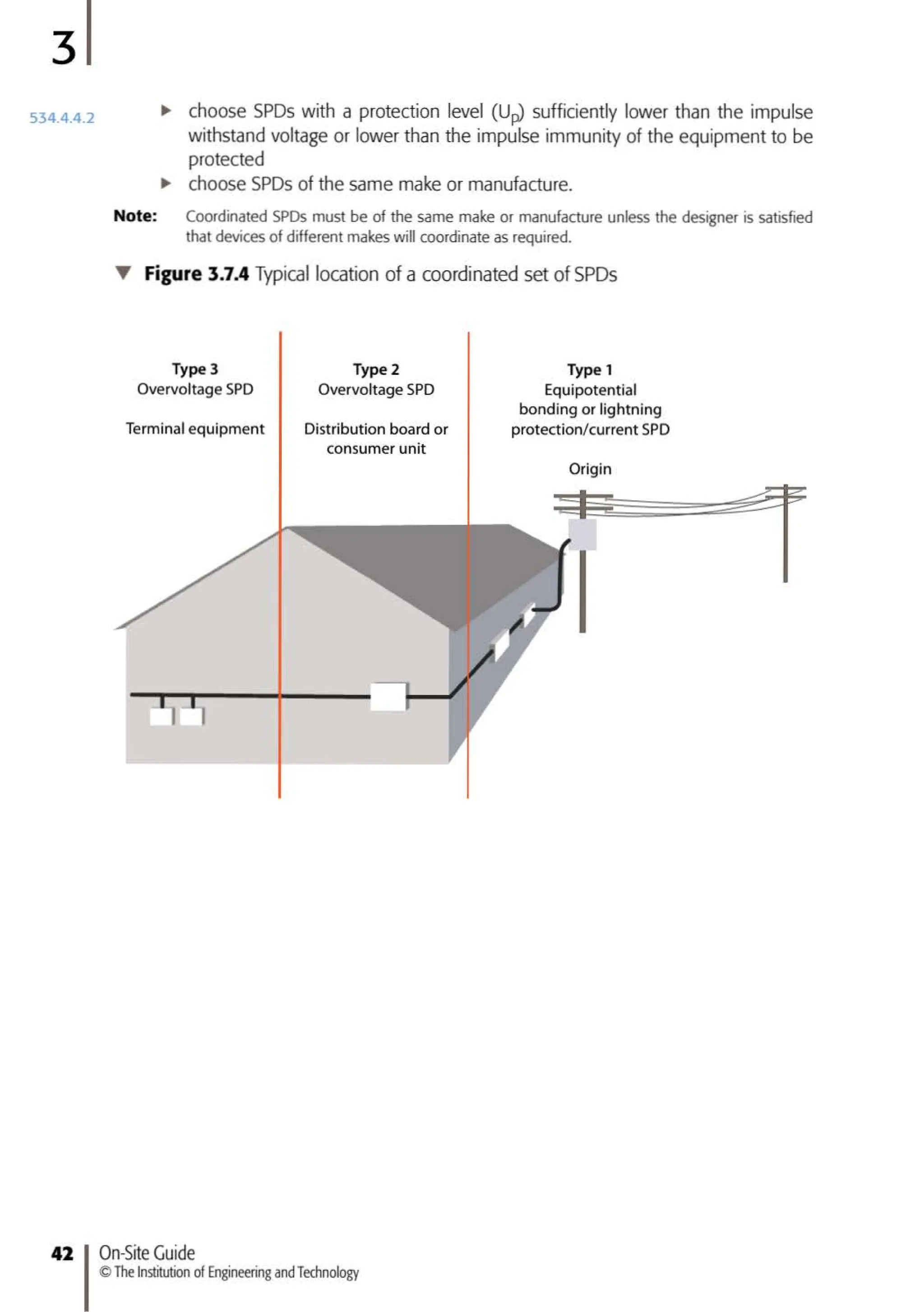
Where a number of SPDs are required to operate in conjunction with each other they
must be coordinated to ensurethe correct type of protection is installed where required;
see Figure 3.7.4.
SPD protection should be coordinated as follows:
Ji> choose the correct type of SPD for the installation and site in the correct
location
Ji> refer to Regulation 443.6.2 and Table 443.2 of BS 7671 (impulse withstand
voltage)
On-Site Guide 41
© The Institution of Engineering andTechnology
3
534.4.4.2 Ill> choose SPDs with a protection level (Up) sufficiently lower than the impulse
withstand voltage or lower than the impulse immunity of the equipment to be
protected
Ill> choose SPDs of the same make or manufacture.
Note: Coordinated SPDs must be of the same make or manufacture unless the designer is satisfied
that devices of different makes will coordinate as required.
..- Figure 3.7.4 Typical location of a coordinated set of SPDs
Type3
Overvoltage SPD
Terminal equipment
1
42 On-Site Guide
Type2
Overvoltage SPD
Distribution board or
consumer unit
©TheInstitution of Engineering and Technology
Type 1
Equipotential
bonding or lightning
protection/current SPD
Origin
534.4.8
3
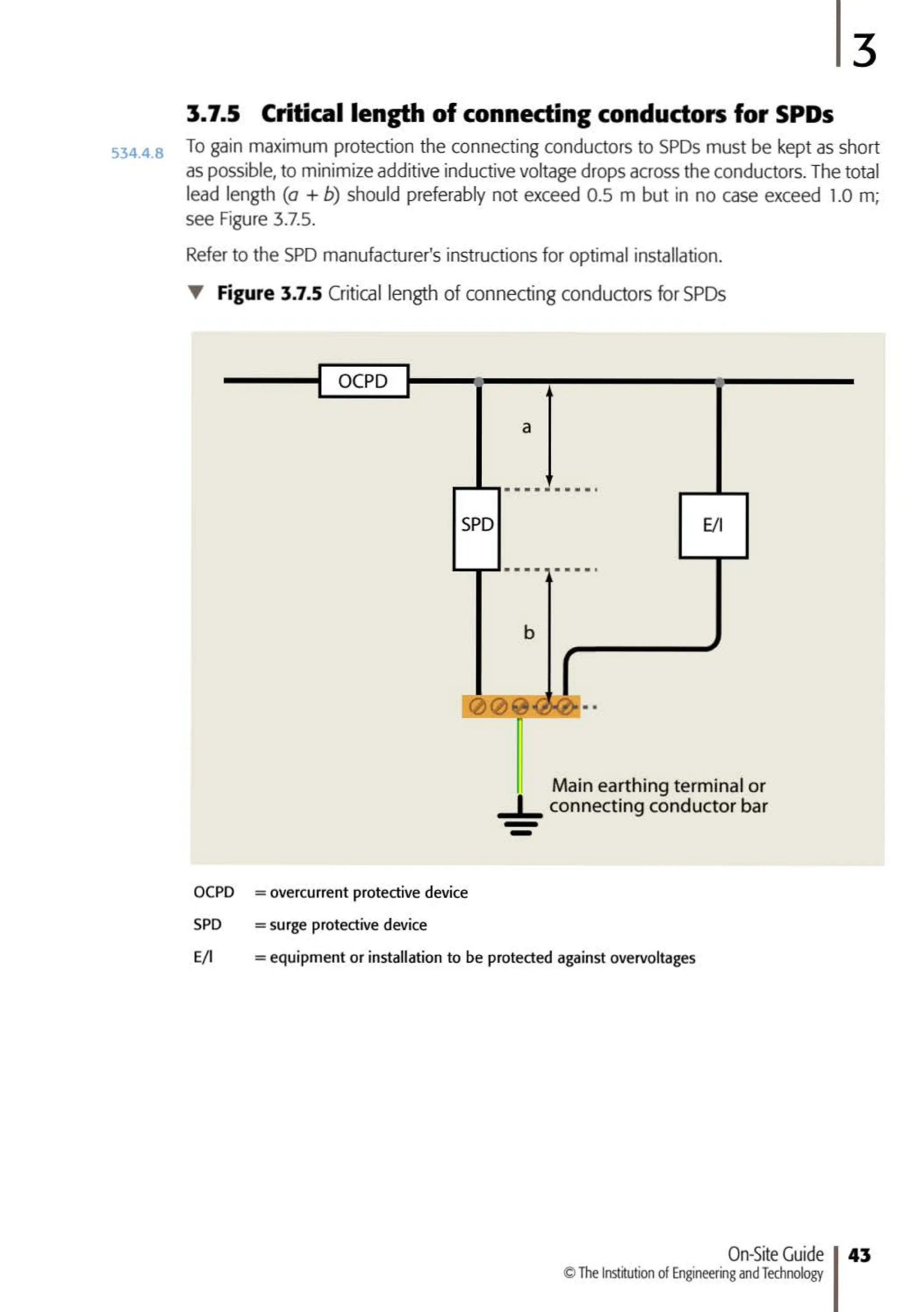
3.7.5 Critical length of connecting condudors for SPDs
To gain maximum protection the connecting conductors to SPDs must be kept as short
as possible, to minimize additive inductive voltage drops across the conductors. The total
lead length (a + b) should preferably not exceed 0.5 m but in no case exceed 1.0 m;
see Figure 3.7.5.
Refer to the SPD manufacturer's instructions for optimal installation.
T Figure 3.7.5 Critical length of connecting conductors for SPDs
OCPD
a
r--~ - ... •••• .
SPD VI
..._r""""' • • • • • ••• '
b
Main earthing terminal or
..L, connecting conductor bar
-
OCPD = overcurrent protective device
SPD =surge protective device
E/1 = equipment or installation to be protected against overvoltages
On-Site Guide 43
©The Institution of Engineering andTechnology
3
3.7.6 Methods of connection
534.4.3 Primarily, the installation of SPDs must follow the manufacturer's instructions but
minimum SPD connections at the origin of the electrical supply are usually made as
those shown in Figure 3.7.6(i) (TN-C-S, TN-S, TI) and Figure 3.7.6(ii) (TI - SPDs
upstream of RCD):
Type 1 SPDs should be installed upstream from any RCD to avoid unwanted tripping.
Where this cannot be avoided, the RCD should be of the time-delayed or S-type.
534.4.7 T Figure 3.7.6(i) SPDs on load side of RCD
OCPD 1
L1
L2
r i:::::JI RCD I --1--l--.----f=~===f==l
1- L3
N
Protective
conductor _._.
OCPD 2
I --- 1- -
I SPC SPC SPC
I
I I
I I
---- ----
-
-
44 On-SiteG
uide
© The Institution of Engineering and Technology
'
-
-
3
5 T Figure 3.7.6(ii) SPDs on supply side of RCD
34.4.7
OCPD1
L1
L2
- L3
RCD
t
•
N
Protective
OCPD2
conductor
,..- -~
- - - I
I
I SPC SPD SPD
I I
I I I
I I
I
"'= ~~
I
I I
-----------
~ ~ ~ >.J
~ ~
- -
- -
Note: See Appendix 16 of BS 7671:2018 for further information regarding the connection of SPDs.
421.1.7 3.8 Arc Fault Detection Devices (AFDD)
537.6 The use of AFDDs is recommended as additional protection against fire in AC final
circuits. Such protection is not offered by circuit-breakers, fuses and RCDs as AFDDs are
designed to detect low level hazardous arcing that circuit breakers, fuses and RCDs are
not designed to detect. AFDDs detect series and parallel arcs which, for instance, can
occur within damaged cables and loose connections.
AFDDs may be provide as :
(a) one single device, comprising an AFD unit and opening means and intended to
be connected in series with a suitable short circuit protective device declared
by the manufacturer complying with one or more of the following standards
BS EN 60898-1, BS EN 61009-1 orBS EN 60269 series.
(b) one single device, comprising an AFD unit integrated in a protective device
complying with one or more of the following standards BS EN 60898-1, BS EN
61008-1, BS EN 61009-1 orBS EN 62423.
(c) an AFD unit (add-on module) and a declared protective device, intended to
be assembled on site.
AFDDs shall be installed at the origin of the circuit to be protected.
On-Site Guide 45
© The Institution of EngineeringandTechnology
3
46 On-Site Guide
e The Institution of Engineering and Technology
4.1 Protective earthing
The purpose of protective earthing is to ensure that, in the event of a fault, such as
between a line conductorand an exposed-conductive-part or circuit protective conductor,
sufficient current flows to operate the protective device, i.e. fuse to blow, circuit-breaker
to operate or RCD to operate, in the required time.
411.4.2 Every exposed-conductive-part (a conductive part of equipment that can be touched
411.5.1 and which is not a live part but which may become live under fault conditions) shall
be connected by a protective conductor to the main earthing terminal and, hence, the
means of earthing for the installation.
ESQCR
512665
ESQCR (NI)
2012
No. 381
4.2 Legal requirements
ESQCR requires that a distributor of electricity makes the supply neutral conductor or
protective conductor available for the connection of the consumer's protective conductor
where it can be reasonably concluded that such a connection is appropriate. Such a
connection may be deemed inappropriate where there is a risk of the loss of the PEN
conductor, for example, where bare overhead low voltage distribution cables supply a
rural building. In such cases, an installation earth electrode must be provided and the
installation will then form part of a TT system.
Essentially, permission to connect the consumer's protective conductor to the
distributor's neutral can be denied to new installations but, where permission is granted,
the distributor has a responsibility to maintain the connection.
Note: For some rural installations supplied by a PME arrangement, it may be pertinent to install an
additional earth electrode to mitigate the effects of a PEN conductor becoming open-circuit;
see lET Guidance Note 5.
4.3 Main protedive bonding
(Figures 2.1(i) to 2.1(iii))
The purpose of protective bonding is to reduce the voltages between the various
exposed-conductive-parts and extraneous-conductive-parts of an installation, during a
fault to earth and in the event of a fault on the distributor's network.
On-Site Guide 47
©The Institution of Engineering and T
echnology
4
411.3.1.2 Main protective bonding conductors are required to connect extraneous-conductive-
Part 2 parts to the main earthing terminal of the installation. An extraneous-conductive-part
is a conductive part, such as a metal pipe, liable to introduce earth potential into the
installation or building. It is common, particularly under certain fault conditions on the
LV supply network, for a potential to exist between true earth, i.e. the conductive mass
of the Earth and the earth of the electrical system. Therefore, buried metallic parts that
enter the building are to be connected to the main earthing terminal of the electrical
installation.
542.3
543.1
Table
54.8
544.1.1
Table
54.8
Examples of extraneous-conductive-parts are:
(a) metallic installation pipes
(b) metallic gas installation pipes
(c) other installation pipework, for example, heating oil
(d) exposed structural steelwork of the building where rising from the ground
(e) lightning protection systems (where required by BSEN 62305).
However, metallic pipes entering the building having an insulating section at their point
of entry need not be connected to the main earthing terminal.
Any internal metallic pipework that may have been buried inthe ground for convenience,
for example, central heating pipeworkcast into the concrete or buried in the floor screed
of a floor at ground level, would normally be considered to be extraneous-conductive-
parts and should be connected to the main earthing terminal.
4.4 Earthing conductor and main protective
bonding condudor cross-sectional areas
The minimum cross-sectional areas (csa) required for the earthing conductor and main
protective bonding conductors are given in Table 4.4(i) and (ii). For TT supplies, refer
to Table 4.4(iii).
T Table 4.4(i) Earthing conductor and main protective bonding conductor sizes
(copper equivalent) for TN-S suplies
CSA Line Conductor mml 6 10 16 25 35 50 70
CSA Earthlnt Conductor 6 10 16 16 16 25 35
CSA Protective Bonding Conductor 6 6 10 10 10 16 25
T Table 4.4(ii) Earthing conductor and main protective bonding conductor sizes
(copper equivalent) for PME (TN-C-S) suplies
CSA Line Conductor mm2 6 10 16 25 35 50 70
CSA Earthlnt Conductor 10 10 16 16 16 25 35
CSA Protective Bonding Conductor 10 10 10 10 10 16 25
48 On-Site Guide
© The Institution of Engineering and Technology
4
Notes:
543.2.4 1 Protective conductors (including earthing and bonding conductors) of 10 mm
2
cross-sectional area
or less shall be copper.
Table 54.7 2 The distributor may require a minimum size of earthing conductor at the origin of the supply of 16
mm
2
copper or greater for TN-Sand TN-C-Ssupplies.
542.3.1 3
Table 54.1
Buried earthing conductors must be at least:
• 25 mm
2
copper if not protected against corrosion
• 50 mm
2
steel if not protected against corrosion
544.1.1
• 16 mm
2
copper if not protected against mechanical damage but protected against corrosion
4
• 16 mm
2
coated steel if not protected against mechanical damage but protected against corrosion.
The distributor should be consulted when in doubt.
'Y Table 4.4(iii) Copper earthing conductor cross-sectional area (csa) for TT supplies
Buried Not buried
Unprotected Protected Protected Unprotected Protected Protected
against against against against
. . .
corros1on corros1on corros1on corros1on
and and
mechanical mechanical
damage damage
2 2 2 2 2 2
mm mm mm mm mm mm
25 16 2.5 4 4 2.5
Notes:
1 Assuming protected against corrosion by a sheath.
2 The main protective bonding conductors shall have a cross-sectional area of not less than half that
required for the earthing conductor and not less than 6 mm
2
.
Note that:
543.2.4 (a) only copper conductors should be used; copper covered aluminium
conductors or aluminium conductors or structural steel can only be used if
special precautions outside the scope of this Guide are taken
544.1.2 (b) where practicable, protective bonding connections to the gas, water, oil, etc.,
service should be within 600 mm of the service meter, or at the point of entry
to the building if the service meter is external and must be on the consumer's
side before any branch pipework and after any insulating section in the service.
The connection must be made to hard pipework, not to soft or flexible meter
connections
542.3.2 (c) the connection must be made using clamps (to BS 951) and be suitably
protected against corrosion at the point of contact.
4.5 Main protedive bonding of plastic services
There is no requirement to main bond an incoming service where the incoming service
pipe is plastic, for example, where yellow is used for natural gas and blue for potable
water.
On-SiteGuide 49
©The Institution of Engineering andTechnology
4
Where there is a plastic incoming service and a metal installation within the premises,
main bonding is recommended unless it has been confirmed that any metallic pipework
within the building is not introducing Earth potential (see 4.3).
411.3.1.2 Metallic pipes entering the building and having an insulating section;
- of no less than 100 mm in length, and
544.2
544.2.3
- within 300 mm of the point of entry
need not be connected to the protective equipotential bonding.
4.6 Supplementary bonding
The purpose of supplementary bonding is to reduce the voltage between the various
exposed-conductive-parts and extraneous-conductive-parts of a location during a fault
to earth.
Note: Where a required disconnection time cannot be achieved, supplementary bonding must
be applied, however, this is outside the scope of this Guide. See Regulation 411.3.2.5 and
Guidance Note l.
The cross-sectional area required for supplementary bonding conductors is given in
Table 4.6.
T Table 4 .6 Supplementary bonding conductors
*
Size of
circuit
protective
conductor
2
(mm)
1.0
1.5
2.5
4.0
6.0
10.0
16.0
Minimum cross-sectional area of supplementary bonding conductor (mm
2
)
Exposed-conductive-part
to extraneous-
conductive-part
mechanically
protected
1
1.0
1.0
1.5
2.5
4.0
6.0
10.0
not
mechanically
protected
4.0
4.0
4.0
4.0
4.0
6.0
10.0
Exposed-conductive-
part to exposed-
conductive-part
mechanically
protected
1.0
1.5
2.5
4.0
6.0
10.0
16.0
not
mechanically
protected
4.0
4.0
4.0
4.0
6.0
10.0
16.0
Extraneous-conductive
-part to extraneous-
conductive-part*
mechanically
protected
5
2.5
2.5
2.5
2.5
2.5
2.5
2.5
not
mechanically
protected
4.0
4.0
4.0
4.0
4.0
4.0
4.0
If one of the extraneous-conductive-parts is connected to an exposed-conductive-
part, the bonding conductor must be no smaller than that required by column 1 or 2.
50 On-Site Guide
© The Institution of Engineering and Technology
4.7 Additional protection- supplementary
equipotential bonding
4
415.2 Supplementary equipotential bonding is required in some of the locations and
installations falling within the scope of Part 7 of BS 7671.
If the installation meets the requirements of BS 7671:2018 for earthing and bonding,
there is no specific requirement for supplementary equipotential bonding of:
.,.. kitchen pipes, sinks or draining boards
.,.. metallic boiler pipework
.,.. metallic furniture in kitchens
.,.. metallic pipes to wash-hand basins and WCs
701.415.2 .,.. locations containing a bath or shower, providing the conditions of Regulation
701.415.2 are met.
Note: Metallic waste pipes deemed to be extraneous-conductive-parts must be connected by main
protective bonding conductors to the main earthing terminal; see also 4.3.
4.8 Supplementary bonding of plastic pipe
installations
Supplementary bonding is not required to metallic parts supplied by plastic pipes, for
example, radiators, kitchen sinks or bathroom taps.
4.9 Earth electrode
542.1.2.3 This is connected to the main earthing terminal by the earthing conductor and provides
part of the earth fault loop path for an installation forming part of a n system; see Figure
2.1 (iii).
Table 41.5 It is recommended that the earth fault loop impedance for an installation forming part of
Note 2 a n system does not exceed 200 0.
542.2.6 Metallic gas orwater utility or other metallic service pipes are not to be used as an earth
electrode, although they must be bonded if they are extraneous-conductive-parts; see
also 4.3.
Note: Regulation 542.2.6 permits the use of privately owned water supply pipework for use as an
earth electrode where precautions are taken against its removal and it has been considered for
such use. This provision will not apply to an installation within a dwelling.
4.10 Types of earth electrode
542.2.3 The following types of earth electrode are recognised:
(a) earth rods or pipes
(b) earth tapes or wires
(c) earth plates
On-Site Guide 51
© The Institution of Engineering andTechnology
4
542.2.5
542.2.5
(d) underground structural metalwork embedded in foundations or other
metalwork installed in the foundations
(e) welded metal reinforcement of concrete embedded in the ground (excluding
pre-stressed concrete)
(f) lead sheaths and metal coverings of cables, which must meet all the following
conditions:
(i) adequate precautions to prevent excessive deterioration by corrosion
(ii) the sheath or covering shall be in effective contact with Earth
(iii) the consent of the owner of the cable shall be obtained
(iv) arrangements shall exist for the owner of the electrical installation to
be warned of any proposed change to the cable which might affect its
suitability as an earth electrode.
4.11 Typical earthing arrangements for various
types of earthing system
Figures 2.1(i) to 2.1(iii) show single-phase arrangements but three-phase arrangements
are similar.
Table 54.7 The protective conductor sizes as shown in Figures 2.1(i) to 2.1(iii) refer to copper
Table 54.8 conductors and are related to the supplier's incoming cable, where 25 mm2
supplier's
544.1.1 tails are installed.
542.3.1 For TT systems protected by an RCD with an earth electrode resistance 1ohm or greater,
543.1.3 the earthing conductor size need not exceed 2.5 mm2
if protected against corrosion by
a sheath and if also protected against mechanical damage; otherwise, see Table 4.4(iii).
542.4.2 The earthing bar is sometimes used as the main earthing terminal, however, means
must be provided in an accessible position for disconnecting the earthing conductor to
facilitate measurement of external earth fault loop impedance, Ze·
Note: For TN-S and TN-C-5 installations, advice about the availability of an earthing facility and the
precise arrangements for connection should be obtained from the distributor or supplier.
52 On-Site Guide
© The Institution of Engineering and Technology
462 5.1 Isolation
132.15.201 5.1.1 Requirement
462.3
462.1
537.3.2.3
Means of isolation should be provided:
(a) at the origin of the installation
A main linked switch or circuit-breaker should be provided as a means of
isolation and of interrupting the supply on load.
For single-phase household and similar installations, the main switch may be
operated by unskilled persons, a double-pole device must be used for both TT
and TN systems.
For a three-phase supply to an installation forming part of a TT system, an
isolator must interrupt the line and neutral conductors. In a TN-S or TN-C-S
system only the line conductors need be interrupted.
(b) for every circuit
Other than at the origin of the installation, every circuit or group of circuits
that may have to be isolated without interrupting the supply to other circuits
should be provided with its own isolating device. The device must switch all
live conductors in a TT system and all line conductors in a TN system.
(c) for every item of equipment
(d) for every motor
Every fixed electric motor should be provided with a readily accessible and
easily operated device to switch off the motor and all associated equipment
including any automatic circuit-breaker. The device must be so placed as to
prevent danger.
(e) for every supply.
5.1.2 The switchgear
The position of the contacts of the isolator must either be externally visible or be clearly,
positively and reliably indicated.
The device must be designed or installed to prevent unintentional or inadvertent closure.
537.2.4
Each device used for isolation must be clearly identified by position or durable marking
to indicate the installation or circuit that it isolates.
On-SiteGuide 53
©The Institutionof Engineering andT
echnology
5
537.3.2.3
514.1.1
If it is installed remotely from the equipment to be isolated, the device must be capable
of being secured in the OPEN position.
Guidance on the selection of devices for isolation is given in Appendix J.
464 5.2 Switching off for mechanical maintenance
464.1
464.2
537.3.2.2
537.3.2.2
537.3.2.3
537.3.2.3
337.3.2.4
464.2
537.3.2.4
537.3.2.2
A means of switching off for mechanical maintenance is required where mechanical
maintenance may involve a risk of injury - for example, from mechanical movement of
machinery or hot items when replacing lamps.
The means of switching off for mechanical maintenance must be able to be made
secureto prevent electrically powered equipment from becoming unintentionally started
during the mechanical maintenance, unless the means of switching off is continuously
under the control of the person performing the maintenance.
Each device for switching off for mechanical maintenance must:
(a) where practicable, be inserted in the main supply circuit
(b) be capable of switching the full load current
(c) be manually operated
(d) have either an externally visible contact gap or a clearly and reliably indicated
OFF position. An indicator light should not be relied upon
(e) be designed and/or installed so as to prevent inadvertent or unintentional
switching on
(f) be installed and durably marked so as to be readily identifiable and convenient
for use.
A plug and socket-outlet or similar device of rating not exceeding 16 A may be used for
switching off for mechanical maintenance.
465 5.3 Emergency switching
465.1
461.2
465.3
537.3.3.3
537.3.3.2
54
An emergency switch is to be provided for any part of an installation where it may be
necessary to control the supply in order to remove an unexpected danger.
Where there is a risk of electric shock the emergency switch is to disconnect all live
conductors, except in three-phase TN-S and TN-C-S systems, where the neutral need
not be switched.
The means of emergency switching must act as directly as possible on the appropriate
supply conductors and the arrangement must be such that one single action only will
interrupt the appropriate supply.
Aplug and socket-outlet or similar device must not be selected as adevice for emergency
switching.
An emergency switch must be:
(a) capable of cutting off the full load current, taking account of stalled motor
currents where appropriate
On-Site Guide
©The Institution of Engineering and Technology
537.3.3.4
537.3.3.5
537.3.3.6
537.3.3.7
537.3.3.6
5
(b) hand operated and directly interrupt the main circuit where practicable
(c) clearly identified, preferably by colour. If a colour is used, this should be red
with a contrasting background
(d) readilyaccessible atthe placewhere dangermightoccurand, where appropriate,
at any additional remote position from which that danger can be removed
(e) of the latching type or capable of being restrained in the 'OFF' or 'STOP'
position, unless both the means of operation and re-energizing are under the
control of the same person. The release of an emergency switching device
must not re-energize the relevant part of the installation; it must be necessary
to take a further action, such as pushing a 'start' button
(f) so placed and durably marked so as to be readily identifiable and convenient
for its intended use.
463 5.4 Functional switching
537.3.1
463.1.1 A switch must be installed in each part of a circuit which may require to be controlled
independently of other parts of the installation.
Switches must not be installed in the neutral conductor alone.
463.1.2
463.1.3 All current-using equipment requiring control shall be controlled by a switch.
537.3.1.1 Off-load isolators, fuses and links must not be used for functional switching.
Note: Table 537.4 of BS 7671:2018 permits the use of circuit-breakers for functional switching
purposes but, in each case, the manufacturer should be consulted to establish suitability.
537.4 5.5 Firefighter's switch
537.4.2 A firefighter's switch must be provided to disconnect the supply to any exterior electrical
installation operating at a voltage exceeding low voltage, for example, a neon sign or any
interior discharge lighting installation operating at a voltage exceeding low voltage.
Note: Such installations are outside the scope of this Guide; see Regulations 537.4.2 to 537.4.4 of BS
7671:2018.
On-Site Guide 55
©The Institution of EngineeringandTechnology
5
56 On-Site Guide
e The Institution of Engineering and Technology
The following durable labels are to be securelyfixed on or adjacentto installed equipment.
6.1 Retention of a dangerous electrical charge
416.2.5 If, behind a barrier or within an enclosure, an item of equipment such as a capacitor is
462.4 installed which may retain a dangerous electrical charge after it has been switched off,
a warning label must be provided. Small capacitors such as those used for arc extinction
and for delaying the response of relays, etc., are not considered dangerous.
514.1.1
514.10.1
Note: Unintentional contact is not considered dangerous if the voltage resulting from static charge
falls below 120 V DC in less than 5 s after disconnection from the power supply.
6.2 Where the operator cannot observe the
operation of switchgear and controlgear
Except where there is no possibility of confusion, a label or other suitable means of
identification must be provided to indicate the purpose of each item of switchgear
and controlgear. Where the operator cannot observe the operation of switchgear and
controlgear and where this might lead to danger, a suitable indicator complying, where
applicable, with BS EN 60073 and BS EN 60447, should be fixed in a position visible to
the operator.
6.3 Unexpected presence of nominal voltage
exceeding 230 V
Where a nominal voltage exceeding 230 V to earth exists and it would not normally be
expected, a warning label stating the maximum voltage present must be provided where
it can be seen before gaining access to live parts.
Note that a TN/TT, i.e. earthed neutral, three-phase system with 400 V between line
conductors will have nominal voltage of 230 V to earth, therefore, a warning notice will
not be required for such systems.
On-Site Guide 57
©The Institution of Engineering and T
echnology
6
514.13.1
514.1.1
514.8.1
6.4 Earthing and bonding connections
A permanent label to BS 951 (Figure 6.4) must be permanently fixed in avisible position
at or near the point of connection of:
(a) every earthing conductor to an earth electrode,
(b) every protective bonding conductor to extraneous-conductive-parts, and
(c) at the main earth terminal, where it is not part of the main switchgear.
T Figure 6.4 Label at connection of earthing and bonding conductors
6.5 Purpose of switchgear and controlgear
Unless there is no possibility of confusion, a label indicating the purpose of each item of
switchgear and controlgear must be fixed on or adjacent to the gear. It may be necessary
to label the item controlled, in addition to its controlgear.
6.6 Identification of protective devices
A protective device, for example, afuse or circuit-breaker, must be arranged and identified
so that the circuit protected may be easily recognised.
6.7 Identification of isolators
537.2.7 Where it is not immediately apparent, all isolating devices must be clearly identified
by position or durable marking. The location of each disconnector or isolator must be
indicated unless there is no possibility of confusion.
514.11.1
58
6.8 Isolation requiring more than one device
A durable warning notice must be permanently fixed in a clearly visible position to
identify the appropriate isolating devices, where equipment or an enclosure contains live
parts which cannot be isolated by a single device.
On-Site Guide
© The Institution of Engineering and Technology
514.12.1
514.9.1
6
6.9 Periodic inspection and testing
A notice of durable material indelibly marked with the words as Figure 6.9 must be fixed
in a prominent position at or near the origin of every installation. The person carrying
out the initial verification must complete the notice and it must be updated after each
periodic inspection.
'Y Figure 6.9 Label for periodic inspection and testing
IMPORTANT
This installation should be periodically inspected and tested and
a report on its condition obtained, as prescribed in the lETWiring
Regulations BS 7671Requirements for Electrical Installations.
Date of last inspection ............................................
Recommended date of next inspection ............................................
6.10 Diagrams
A diagram, chart or schedule must be provided indicating:
(a) the number of points, size and type of cables for each circuit,
(b) the method of providing protection against electric shock,
(c) information to identify devices for protection, isolation and switching, and
(d) any circuit or equipment vulnerable during atypical test, e.g. SELV power supply
units of lighting circuits which could be damaged by an insulation test.
For simple installations, the foregoing information may be given in a schedule, with a
durable copy provided within or adjacent to the distribution board or consumer unit.
On-Site Guide 59
© The Institution of Engineering andTechnology
6
514.12.2
514.14.1
6.11 Residual current devices
Where an installation incorporates an RCD, a notice with the words in Figure 6.11 (and
no smaller than the example shown in BS 7671:2018) must be fixed in a permanent
position at or near the origin of the installation.
T Figure 6.11 Label for the testing of a residual current device
This installation, or part of it, is protected by a device
which automatically switches off the power supply if an
earth fault develops. Test six-monthly by pressing the
button marked 'T' or 'Test'. The device should switch
offthe supply and should be then switched on to
restore the supply. If the device does not switch off the
supply when the button is pressed seek expert advice.
6.12 Warning notice - non-standard colours
If additions or alterations are made to an installation so that some of the wiring complies
with the harmonized colours of Table K1 in Appendix K and there is also wiring in the
earlier colours, a warning notice must be affixed at or near the appropriate distribution
board with the wording in Figure 6.12.
T Figure 6.12 Label advising of wiring colours to two versions of BS 7671
CAUTION
Thisinstallation has wiring colours to
two versions of BS 7671.
Great care should be taken before
undertaking extension, alteration or repair
that all conductors are correctly identified.
60 On-Site Guide
© The Institution of Engineering and Technology
514.15.1
543.7.1.205
6
6.13 Warning notice - alternative supplies
Where an installation includes additional or alternative supplies, such as a PV installation,
which is used as an additional source of supply in parallel with another source, normally
the distributor's supply, warning notices must be affixed at the following locations in the
installation:
(a) at the origin of the installation
(b) at the meter position, if remote from the origin
(c) at the consumer unit or distribution board to which the additional or alternative
supply is connected
(d) at all points of isolation of all sources of supply.
The warning notice must have the wording in Figure 6.13.
T Figure 6.13 Label advising of multiple supplies
WARNING
MULTIPLE SUPPLIES
ISOLATE ALL ELECTRICAL SUPPLIES
BEFORE CARRYING OUT WORK
r-------------------~
ISOLATE MAINS AT
~------r=======~
ISOLATE ALTERNATIVE SUPPLIES AT
6.14 Warning notice - high protective conductor
current
At the distribution board, information must be provided indicating those circuits having
a high protective conductor current. This information must be positioned so as to be
visible to a person who is modifying or extending the circuit (Figure 6.14).
On-Site Guide 61
© The Institution of Engineering andTechnology
6
T Figure 6.14 Label advising of high protective conductor current
WARNING
HIGH PROTECTIVE CONDUCTOR
CURRENT
The following circuits have a high protective
conductor current:
. . . . . . . . . . . . 0 . . 0 . . 0 . . 0 • 0 0 • 0 • • 0 • • 0 0 • • • • • • • • • • • • • • • • • • • • • • • • • • • • • • • • • • • • • • • • • • • • • • • • • • • • • • • • • • 0 •• 0
0 o o o o I o o o o o I o o o o o o o o o o o o o o o o o o o o o o o o o o o o o o o o o o o o o o o o o o o o o o o o o o o o o o o o I o o o o o I o o o o o 0 o o o o 0 o o o o o 0 o + o o
6.15 Warning notice - photovoltaic systems
712.537.2 All junction boxes (PV generator and PV array boxes) must carry a warning label
indicating that parts inside the boxes may still be live after isolation from the PV convertor
(Figure 6.15).
T Figure 6.15 Label advising of live parts within enclosures in a PV system
62 On-Site Guide
WARNING
PVSYSTEM
Parts inside this box or enclosure may still
be live after isolation from the supply.
© The Institution of Engineering and Technology
411.3.2
411.3.3
525.202
Table 4B1
Appx 3
Appx4
Table 41.1
7.1 Final circuits
Table 7.1 (i) has been designed to enable a radial or ring final circuit to be installed
without calculation where the nominal voltage of the supply is at 230 V single-phase or
400 Vthree-phase. For other nominal voltages, the maximum circuit length given in the
table must be corrected by the application of the formula:
where:
LP is the permitted length for voltage U0
Lt is the tabulated length for 230 V
U0 is the nominal voltage of the supply.
The conditions assumed are that
(a) the installation forms part of:
(i) a TN-C-S system with a typical maximum external earth fault loop
impedance, Ze, of 0.35 0, or
(ii) aTN-S system with atypical maximum external earth fault loop impedance,
Ze of 0.8 0 , or
(iii) a TT system with RCDs installed as described in 3.6
(b) the final circuit is connected to a distribution board or consumer unit at the
origin of the installation
(c) the installation method is listed in column 4 of Table 7.1(i)
(d) the ambient temperature throughout the length of the circuit does not exceed
30 °(
(e) the characteristics of protective devices are in accordance with Appendix 3 of
BS 7671
(f) the cable conductors are of copper
(g) for other than lighting circuits, the voltage drop must not exceed 5 per cent
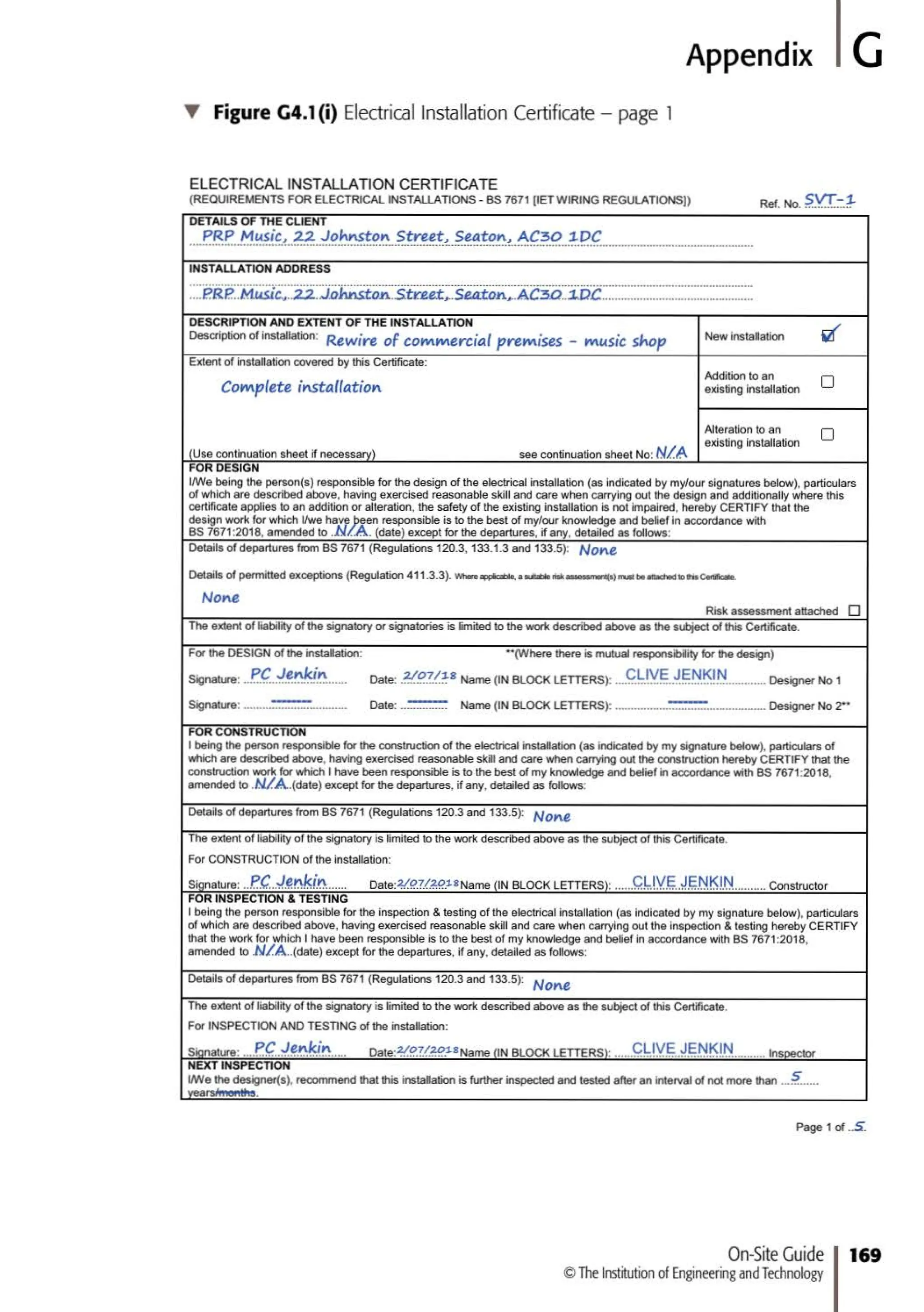
(h) the following disconnection times are applicable:
Ill> 0.4 s for circuits up to and including 63 A
On-Site Guide 63
©The Institution of Engineering and T
echnology
7
(i) Cmin is the mm1mum voltage factor to take account of voltage variations
depending on time and place
.,.. changing of transformer taps and other considerations
Note: For a low voltage supply given in accordance with the Electricity Safety, Quality and
Continuity Regulations 2002, as amended, Cmin is given the value 0.95.
The following maximum loads are assumed per circuit:
Protective device Rating (A) Circuit type Load (A)
853036 30 Ring final circuit 26
-
BS 60898, BS 61009, BS 88-3, BS 88-2 32 Ring final circuit 26
853036 5 Lighting 5
-
BS 60898, BS 61009, BS 88-3, BS 88-2 6 Lighting 5
85 60898, 85 61
009, 85 88-3, 85 88-2 10 Lighting 8
-
BS 60898, BS 61009, BS 88-3, BS 88-2 16 Lighting 12.8
-
85 3036, 85 88-3 5 Radial 5
BS 60898, BS 61009, BS 88-2 6 Radial 5
-
85 60898, 85 61009, 85 88-2 10 Radial 8
-
BS 3036 15 Radial 14.6
-
85 60898, 85 61009, 85 88-2, 85 88-3 16 Radial 14.6
-
BS 60898, BS 61009, BS 3036, BS 88-2, 20 Radial 16
BS 88-3
85 60898, 85 61009, 85 88-2 25 Radial 20
BS 3036 30 Radial 26
85 60898, 85 61009, 85 88-2, 85 88-3 32 Radial 26
BS 60898, BS 61009, BS 88-2 40 Radial 37
64 On-Site Guide
©TheInstitution of Engineering and Technology
@
:;I
"'
:::>
~
::::0.'
c:
c:t.
0
:::>
a
g'
<><>.
:::>
r:::
~
~0
"' :::J
5. 0-l
;;t rtf
n
::r Cl
~ c:
co.:
~ro
"'
""
T Table 7.1{i) Maximum cable length for a 230 V final circuit using 70 oc thermoplastic (PVC) insulated and sheathed flat cable
Protective device Cable size Allowed installation Maximum length (m) (note 1)
Rating (A) Type
(mm2) methods (note 2)
Ze < 0.8 0 TN-S Ze < 0.35 OTN-C-5
RCD 30 No RCD RCD 30 No RCD
rnA rnA
Ring final circuits (5 % voltage drop, load distributed)
L>o BS 30 36 2.5/1.5 100,102, A. c 106 41zs 106 106
BS 3036 4.0/ 1.5
} 100,102, A, 101, 103, C 171 48 171 138zs
32
cb/ RCBO Type B
2.5/1.5
}
106 96zs 106 106
cb/ RCBO Type C 100,102, A. c 106 NPls 106 56zs
cb/ RCBO Type D 106 NPls 106 NPls
- - -
32 BS 88-2 (BS EN 60269-2) 2.5/1.5 100,102, A, C 106vd 32zs 106vd 106vd
- - - -
32 BS 88-2 (BS EN 60269-2) 4.0/1.5 100,10 1,102, 103, A, C 171 38zs 106vd 127zs
- - -
32 BS 88-3 2.5/1.5 100,102, A, C 106vd 19ad 106 95zs
32 BS 88-3 4.0/ 1.5 100,101,102, 103, A, C 171 22zs 171 112zs
- - - -
32
cb/RCBO Type B
}
171vd 114zs 171vd 171vd
cb/RCBO Type C 4.0/ 1.5 100,101,102, 103, A, C 171vd NPzs 171vd 66zs
cb/RCBO Type D 171vd NPzs 171vd NPzs
-...-J
"'
"'
@0
-t :::l
;;;r '
, V>
- ~·
:::J('D
sQ
Sc::
cs·o.:
:::> ro
a
!;'
OQ ,
:::J
r:::
::J,
6il
"'
T Table 7.1{i) continued
Protective device
Rating (A) Type
~ Lighting circuits (3 % voltage drop, load distributed)
9-
:::J
Q.
~
5 BS 3036
5 BS 3036
I 5 BS 88-3
c 5 BS 88-3
cb/RCBOType B
6 cb/RCBOType C
cb/RCBOType D
c 6 BS 88-2 (BS EN 60269-2)
cb/RCBOType B
6 cb/RCBOType C
cb/RCBOType D
c 6 BS 88-2 (BS EN 60269-2)
cb/RCBOType B
10 cb/RCBOType C
cb/RCBOType D
Cable size Allowed installation
(mm2) methods (note 2)
1.0/1.0 } 100,101,102,103, A, C
1.5/1.0 } 100,101,102,103, A, c
1.0/1.0 100,101,102,103, A, C
1.5/1.0 100,101,102,103, A, c
-
1.0/1.0 } 100,101,102,103, A, C
1.0/1.0 100,10 1,102,103, A, c
1.5/1.0 } 100,101,102,103, A, C
1.5/1.0 100,101,102,103, A, c -
1.0/1.0
} 100, 101,102, A, C
'-.1
Maximum length (m) (note 1)
Ze < 0.8 0 TN-S Ze < 0.35 0 TN-C-S
RCD 30 No RCD RCD 30 No RCD
rnA rnA
68 68 68 68
106 106 106 106
68 68 68 68
- - -
106 106 106 106
68 68 68 68
68 65zs 68 68
68 23zs 68 34zs
- - -
68 68 68 68
106 106 106 106
106 78zs 106 91zs
106 28zs 106 41zs
- - -
106 106 106 106
- - - •
42vd 42vd 42vd 42vd
42vd 32zs 42vd 42vd
42vd 23zs 42vd 34zs
T Table 7.1{i) continued
Protective device C ble size Allowed installation Maximum length (m) (note 1)
Rating (A) Type
(mm2) methods (note 2)
Ze < 0.8 0 TN-S Ze < 0.35 0 TN-C-5
RCD 30 No RCD RCD 30 No RCD
rnA rnA
1 2 4 7
cb/RCBOType B
}
65vd 65vd 65vd 65vd
10 cb/RCBOType C 1.5/1.0 100, 101, 102, A, C 65vd 3Bzs 65vd 51zs
cb/RCBOType D 65vd 28zs 65vd 41zs
10 BS 88-2 (BS EN 60269-2) 1.0/1.0 100, 101, 102, A, C 42 42 42 42
10 BS 88-2 (BS EN 60269-2) 1.5/1.0 100, 10 1, 102, A, c 65 65 65 65
cb/RCBOType B
}
34 34 34 34
16 cb/RCBOType C 1.5/1.0 100, 102, c 34 15sc 34 28zs
cb/RCBOType D 34 NPad 34 9zs
@ cb/RCBOType B
}
49 49 49 49
:;I 16 cb/RCBOType C 2.5/1.5 100, 10 1, 102, A, c 49 24zs 49 44zs
"' cb/RCBOType D 49 NPad 49 14zs
:::>
~
::::0.'
I BS 88-2 (BS EN 60269-2) 1.5/1.0
c: 16 100, 102, c 20 20 20 20
c:t.
0
:::>
a I 16 BS 88-2 (BS EN 60269-2) 2.5/1.5 100, 10 1, 102, A, c 49 49 49 49
m
:::>
<><>.
:::>
I
"' 16
"'
::::!
BS 88-3 1.5/1.0 100, 102, c 34 34 34 34
:::>
<><>Q
I 16 BS 88-3 2.5/1.5 100, 10 1, 102, A, c 34 34 34 34
"' :::J
:::> '
Q. Vl
.,-4 - .
Radial final circuits (5% voltage drop, terminal load)
,. ......
nr1>
s Cl
Q. C:
} 100, 10 1, 102, 103, A, c
0 - ·
5 56 56 56 56
~~ BS 3036 1.0/1.0
"' -...-J
....
"'
CD
@0
-t :::l
::r v,
t'tl ...... .
_,.....
:::J('D
s Q
Sc::
cs·o.:
:::> ro
a
!;'
OQ ,
:::J
r:::
::J,
6il
"'
:::J
0..
~
9-
:::J
Q.
~
T Table 7.1{i) continued
Protective device
Rating (A) Type
1 2
I 5 BS 88-3
5 BS 3036
5 BS 88-3
cb/RCBO Type B
6 cb/RCBO Type C
cb/RCBO Type D
6 BS 88-2 (BS EN 60269-2)
cb/RCBO Type B
6 cb/RCBO Type C
cb/RCBO Type D
cb/ RCBO Type B
10 cb/RCBO Type C
cb/RCBO Type D
-
cb/RCBO Type B
10 cb/RCBO Type C
cb/RCBO Type D
10 BS 88-2 (BS EN 60269-2)
C ble size Allowed installation
(mm2) methods (note 2)
3 4
1.0/1.0 100, 101, 102, 103, A, C
1.5/1.0
} 100, 101, 102, 103, A. c
1.5/1.0 100, 101, 102, 103, A, C
-
1.0/ 1.0 } 1001 1011 1021 1031 A. c
1.0/ 1.0 100, 101, 102, 103, A, C
1.5/ 1.0 1001 1011 1021 1031A. c
1.5/1.0 } 100, 101, 102, 103, A, C
1.0/1.0
} 1001 1011 1021A. c
- -
1.5/1.0 } 100, 101, 102, 103, A, C
1.0/1.0 1001 1011 1021A. c
1.5/1.0 100, 101, 102, 103, A. c
'-.1
Maximum length (m) (note 1)
Ze < 0.8 0 TN-S Ze < 0.35 0 TN-C-5
RCD 30 No RCD RCD 30 No RCD
rnA rnA
5 6 7 8
56 56 56 56
88 88 88 88
88 88 88 88
56 56 56 56
56 56 56 56
56 23zs 56 33zs
56 56 56 56
88 88 88 88
88 88 88 88
88 78zs 88 88
88 28zs 88 40zs
35 35 35 36
35 31zs 35 36
35 6zs !Bad 17zs
- - -
52 52 52 52
52 38zs 52 50zs
lOad 8zs 52 20zs
35 35 35 35
52 52 52 52
T Table 7.1(i) continued
Protective device C ble size Allowed installation Maximum length (m) (note 1)
Rating (A) Type
(mm2) methods (note 2)
Ze < 0.8 0 TN-S Ze < 0.35 0 TN-C-5
RCD 30 No RCD RCD 30 No RCD
rnA rnA
1 2 4 7
15 BS 3036 1.0/1.0 NP NP NP NP NP
15 BS 3036 1.5/1.0 NP NP NP NP NP
15 BS 3036 2.5/1.5 1001 1021 c 47 47 47 47
15 BS 3036 4.0/1.5 1001 101I 102, A, c 76 76 76 76
cb/RCBO Type B
}
18 18 18 18
16 cb/RCBO Type C 1.0/1.0 c 18 13zs 18 13
cb/RCBO Type D 18 7 Bad NPad
@ I 16 BS 88-2 (BS EN 60269-2) 1.5/1.0 100, 102, c 27 27 27 27 I
I
- - -
:;I
16 BS 88-2 (BS EN 60269-2) 2.5/1.5 1001 1011 1021 A. c 45 45 45 45
"'
:::>
~
;:::o.·
c:
c-.
I 16 BS 88-2 (BS EN 60269-2) 4.0/1.5 100, 101, 102, 103, A, C 74 74 74 74
0
:::>
I 16 BS 88-3 1.5/1.0 1001 1021c 27 27 27 27
a
m
:::>
I 16 BS 88-3 2.5/1.5 100, 101, 102, A, C 45 45 45 45
<><>.
:::>
"'
"' I
::::!.
16 BS 88-3 4.0/1.5 1001 1011 1021 1031 A. c 74 74 74 74
:::>
<><>Q
"' :::J
:::> ' cb/RCBO Type B
}
27 27 27 27
Q. Vl
.,-4 - .
,. ......
16 cb/RCBO Type C 1.5/1.0 100, 102, c 27 15zs 27 27
n r1>
s Cl cb/RCBO Type D 27 NPad 27 9zs
Q. C:
0 - ·
~~
"' -...-J
loD
....
Q ---J
@0
T Table 7.1 (i) continued
-t :::l
;;;r '
t'tl V'l.
_,.....
:::J('D
sQ
Sc::
cs· o.:
:::> ro
a
Protective device C ble size Allowed installation Maximum length (m) (note 1)
Rating (A) Type
(mm2) methods (note 2)
Ze < 0.8 0 TN-S Ze < 0.35 0 TN-C-5
RCD 30 No RCD RCD 30 No RCD
m
:::J
OQ , rnA rnA
:::J
"'
"'
::J,
::J
OQ
1 2 3 4 5 6 7 8
"'
:::J
cb/ RCBO Type B 45 45 45 45
0..
~ 16 cb/RCBOType C 2.5/1.5 100, 1011 102, A, c 45 24zs 45 43zs
n
;;;r
:::J
cb/RCBOType D 45 NPls 45 14zs
Q.
0
~ I
cb/RCBOType B
} 100, 101, 102, 103, A, C
69 32ad 69 69
16 cb/RCBOType C 4.0/1.5 32ad 16zs 54ad 36zs
cb/RCBOType D NPad NPad !Bad 9zs
- - -
BS 3036 NP NP NP NP
20 cb/RCBO Type B 2.5/1.5
}
100, 101, 102, A 42 42 42 42
cb/RCBO Type C 100, 102, A, C 42 12zs 42 31zs
cb/RCBO Type D 42 NPad 42 Bzs
- - -
BS 3036
}
c 69 43zs 73 66zs
cb/RCBOType B 4.0/1.5 69 69 69 69
20 100, 101' 102, A, c
cb/RCBOType C 69 14zs 69 36zs
cb/RCBOType D 69 NPad 69 9zs
BS 3036
} 100, 102, A, C
105 69zs 105 105
20 cb/RCBOType B 105 107 105 105
6.0/2.5 100, 101, 102, 103, A, c
cb/RCBO Type C 105 23zs 105 58zs
cb/RCBOType D 105 NPls 105 15zs
20 BS 88-2 (BS EN 60269-2) 2.5/1.5 100, 102, A, C 42 42 42 42
20 BS 88-2 (BS EN 60269-2) 4 .0/1.5 100, 1011 102, A, c 69 43zs 69 66zs
20 BS 88-2 (BS EN 60269-2) 6.0/2.5 100, 101, 102, 103, A, C 105 69zs 105 105
20 BS 88-3 2.5/1.5 100, 102, A, C 42 42 42 42
@
:;I
"'
:::>
~
::::0.'
c:
c:t.
0
:::>
a
g'
<><>.
:::>
r:::
~
~0
"':::J
5.0-l
;;t rtf
n
::r Cl
~ c:
co.:
~ro
...
-
T Table 7.1{i) continued
Rating (A)
1
I 20
20
25
25
25
25
25
C 25
30
c 30
l 30
Protective device
Type
2
BS 88-3
BS 88-3
cb/RCBO Type B
cb/RCBO Type C
cb/RCBO Type D
cb/ RCBO Type B
cb/ RCBO Type C
cb/ RCBO Type D
cb/RCBO Type B
cb/RCBO Type C
cb/RCBO Type D
BSS8-2 (BS EN 60269-2)
BSS8-2 (BS EN 60269-2}
BS 3036
BS 3036
BS 3036
C ble size Allowed installation
(mm2) methods (note 2)
3 4
4.0/1.5 100, 101, 102, A, C
-
6.0/2.5 100, 101, 102, 103, A. c
-
2.5/1.5
} c
4.0/1.5
} 100, 102, A. c
6.0/2.5
} 100, 101, 102, A, C
2.5/1.5 c
4.0/1.5 100, 102, A, C
6.0/2.5 100, 101, 102, A. c
4.0/1.5
6.0/2.5 c
10.0/4.0 100, 102, A, C
Maximum length (m) (note 1)
Ze < 0.8 0 TN-S Ze < 0.35 0 TN-C-5
RCD 30 No RCD RCD 30 No RCD
rnA rnA
5 6 7 8
69 56zs 69 69
105 89zs 105 105
33 33 33 33
33 2zs 33 22zs
33 NPad 33 4zs
55 47zs 55 55
55 3zs 55 26sc
55 NPad 55 4zs
83 75zs 83 83
83 5zs 83 43zs
83 NPzs 83 7zs
- - -
31 20zs 31 31
- - -
53 24zs 53 46zs
82 38zs 82 76zs
-
NP NP NP NP
- - -
66 19zs 66 54zs
- - -
110 31zs 110 89zs
I
-...-J
.... ---J
...,
T Table 7.1{i) continued
@0
-t :::l
;;;r '
t'tl V'l.
_,.....
:::J('D
s Q
Sc::
cs· o.:
:::> ro
a
Protective device C ble size Allowed installation Maximum length (m) (note 1)
Rating (A) Type
(mm2) methods (note 2)
Ze < 0.8 0 TN-S Ze < 0.35 0 TN-C-5
RCD 30 No RCD RCD 30 No RCD
m
:::J
OQ , rnA rnA
:::J
"'
"'
::J,
::J
OQ
1 2 3 4 5 6 7 8
"'
:::J
cb/RCBO Type B
}
43 28zs 43 43
0..
~ 32 cb/RCBO Type C 4.0/1.5 c 43 NPad 43 16zs
n
;;;r
:::J
cb/RCBO Type D 43 NPad 43 NPad
Q.
0
~ I
cb/RCBO Type B
}
63 45zs 63 63
32 cb/RCBO Type C 6.0/2.5 100,102, A, 63 NPzs 63 26zs
cb/RCBO Type D c 63 NPzs 63 NPzs
32
cb/RCBO Type B
} 100, 101, 102, 103, A, c
105 74zs 105 105zs
cb/RCBO Type C 10.0/4.0 105 NPad 105 42zs
cb/RCBO Type D 105 NPad 105 NPsc
32 BS 88-2 (BS EN 60269-2) 4.0/1.5 c 43 9zs 43 31zs
32 BS 88-2 (BS EN 60269-2) 6.0/2.5 100, 102, A, C 63 15zs 63 50zs
32 BS 88-2 (BS EN 60269-2) 10/4.0 100, 101, 102, 103, A, C 105 24zs 105 82zs
32 BS 88-3 4.0/1.5 c 43 5zs 43 27zs
32 BS 88-3 6.0/2.5 100, 102, A, C 63 8zs 63 44zs
32 BS 88-3 10/4.0 100, 101, 102, 103, A, c 105 14zs 105 72zs
- - - -
cb/RCBO Type B
}
46 23zs 46 46
40 cb/RCBO Type C 6.0/2.5 c 46 NPzs 46 15zs
cb/RCBO Type D 46 NPzs 46 NPzs
40 cb/RCBO Type B 10.0/4.0
}
72 37zs 72 72
cb/RCBO Type C 100, 102, A, C 72 NPzs 72 25zs
cb/RCBO Type D 72 NPzs 72 NPzs
@
:;I
"'
:::>
~
::::0.'
c:
c:t.
0
:::>
a
g'
<><>.
:::>
r:::
~
~0
"' :::J
5. 0-l
;;t rtf
n
::r Cl
~ c:
co.:
~ro
...
~
T Table 7.1{i) continued
Protective device C ble size Allowed installation
Rating (A) Type
(mm2) methods (note 2)
1 2 4
40
cb/RCBO Type B
}
cb/RCBO Type C 16.0/ 6.0 100, 101, 102, 103, A, C
cb/RCBO Type D
c 40 BS 88-2 (BS EN 60269-2) 6.0/2.5 c
40 BS 88-2 (BS EN 60269-2) 10.0/ 4.0 100, 102, A, C
I
-
40 BS 88-2 (BS EN 60269-2) 16.0/6.0 100, 10 1, 102, 103, A, c
Notes to Table 7.1(i):
1 Voltage drop is the limiting constraint on the circuit cable length unless marked as follows:
11> ad Limited by reduced csa of protective conductor (adiabatic limit)
.,. ol Cable/device/load combination not allowed in any of the installation conditions
11> zs Limited by earth fault loop impedance Zs
11> sc Limited by line to neutral loop impedance (short-circuiQ.
2 The allowed installation methods are listed, see Tables 7.1(ii) and 7.1(iii) for further description.
3 NP - Not Permitted, prohibiting factor as note 1.
4 For application of RCDs and RCBOs, see 3.6.3.
Maximum length (m) (note 1)
Ze < 0.8 0 TN-S Ze < 0.35 0 TN-C-5
RCD 30 No RCD RCD 30 No RCD
rnA rnA
7
118 57zs 118 118
118 NPzs 118 39zs
118 NPzs 118 NPad
- - - - -
46 NPls 46 32zs
- - - -
72 NPzs 72 52zs
- - - - -
118 NPls 118 795
-...-J
7
T Table 7.1(ii) Installation reference methods and cable ratings for 70 oc
thermoplastic (PVC) insulated and sheathed flat cable with protective
conductor
c Clipped direct 16 20 27 37 47 64 85
B* Endosed in conduit ortrunking on 13 16.5 23 30 38 52 69
a wall, etc.
102 In a stud wall with thermal 13 16 21 27 35 47 63
insulation with cable touching the
wall
1
00 In contact with plasterboard 13 16 21 27 34 45 57
ceiling or joists covered bythermal
insulation not exceeding 100 mm
A Endosed
. conduit
.
In In an 11.5 14.5 20 26 32 44 57
insulated wall
101 In contact with plasterboard 10.5 13 17 22 27 36 46
ceiling orjoists covered bythermal
insulation exceeding 100 mm
103 Surrounded by thermal insulation 8 10 13.5 17.5 23.5 32 42.5
induding in a stud wall with
thermal insulation with cable not
touching a wall
Notes:
(a) Cable ratings taken from Table 405 of BS 7671.
(b) B* taken from Table 402A of BS 7671
, see Appendix F.
74 On-Site Guide
© The Institution of Engineering and Technology
'Y Table 7.1(iii) Installation methods specifically for flat twin and earth cables in
thermal insulation
100
101
102
r
103
0
Notes:
Installation methods for flat twin Table 405
and earth cable clipped direct
to a wooden joist, or touching
the plasterboard ceiling surface,
above a plasterboard ceiling with
thermal insulation not exceeding
100 mm in thickness having a
minimum U value of 0.1W/m2
K
Installation methods for flat Table 405
twin and earth cable dipped
direct to a wooden joist. or
touching the plasterboard cemng
surface, above a plaster-board
cemng with thermal insulation
exceeding 100 mm in thickness
having a minimum U value of0.1
Wfm"ly.
Installation methods for flat twin Table 405
and earth cable in a stud wall
with thermal insulation with a
minimum U value of 0.1 W/ m2
K
with the cable touching the inner
wall surface, or touching the
plasterboard ceiling surface, and
the inner skin having a minimum
U value of 10 W/m2
K
Installation methods for flat twin Table 405
and earth cable in a stud wall
with thermal insulation with a
minimum U value of 0.1 W/ m2
K
with the cable not touching the
inner wall surface
7
(a) Wherever practicable, a cable should be fixed in a position such that it will not be covered with
thermal insulation.
(b) Regulation 523.9, for further information, see BS 5803-5:1985 Appendix C'Avoidance of overheating
of electric cables', Building Regulations Approved Document Band Thermal Insulation: avoiding risks,
BR 262, BRE 2001 refer.
On-Site Guide 75
©TheInstitution of Engineering andT
echnology
7
7.2 Standard final circuits
7.2.1 Grouping of circuit cables
The tables assume heating (including water heating) cables are not grouped.
For cables of household or similar installations (heating and water heating excepted), if
the following rules are followed, derating for grouping is not necessary:
(a) Cables are not grouped, that is, they are separated by at least two cable
diameters when installed underthermal insulation, namely installation methods
100, 101, 102 and 103.
(b) Cables clipped direct (including in cement or plaster) are clipped side by side
in one layer and separated by at least one cable diameter.
(c) Cables above ceilings are clipped to joists as per installation methods 100 to
103 of Table 4A2 of BS 7671.
For other groupings, ambient temperatures higher than 30 oc or enclosure in thermal
insulation, cable csa will need to be increased as per Appendix Fof this Guide.
7.2.2 Socket-outlet circuits
The length represents the total ring cable loop length and does not include any spurs.
As a rule of thumb for rings, unfused spur lengths should not exceed 1
/ 8 the cable length
from the spur to the furthest point of the ring.
The total number of fused spurs is unlimited but the number of non-fused spurs is not to
exceed the total number of socket-outlets and items of stationary equipment connected
directly in the circuit.
A non-fused spur feeds only one single or twin socket-outlet or one permanently
connected item of electrical equipment. Such a spur is connected to a circuit at the
terminals of socket-outlets or at junction boxes or at the origin of the circuit in the
distribution board.
A fused spur is connected to the circuit through a fused connection unit, the rating of
the fuse in the unit not exceeding that of the cable forming the spur and, in any event,
not exceeding 13 A. The number of socket-outlets which may be supplied by a fused
spur is unlimited.
The circuit is assumed to have a load of 20 A at the furthest point and the balance to
the rating of the protective device evenly distributed. (For a 32 A device this equates to
a load of 26 A at the furthest point.)
7.2.3 Light.ing circuits
A maximum voltage drop of 3 per cent of the 230 V nominal supply voltage has been
allowed in the circuits; see Appendix F.
The circuit is assumed to have a load equal to the rated current (In) of the circuit
protective device, evenly distributed along the circuit. Where this is not the case, circuit
76 On-Site Guide
©The Institution of Engineering and Technology
7
lengths will need to be reduced where voltage drop is the limiting factor, or halved
where load is all at the extremity.
The most onerous installation condition acceptable for the load and device rating is
presumed when calculating the limiting voltage drop. If the installation conditions are
not the most onerous allowed (see column 4 of Table 7.1(i)) the voltage drop will not
be as great as presumed in the table.
7.2.4 RCDs
Where circuits have residual current protection, the limiting factor is often the maximum
loop impedance that will result in operation of the overcurrent device within 5 seconds
for a short-circuit (line to neutral) fault. (See note 1 to Table 7.1 (i) and limiting factor
sc.)
7.2.5 Requirement for RCDs
RCDs are required:
411.5 (a) where the earth fault loop impedance is too high to provide the required
disconnection, for example, where the distributor does not provide a
connection to the means of earthing- TT earthing arrangement
411.3.3{i) (b) for socket-outlets with a rated current not exceeding 32 A
411.3.4 (c) for lighting circuits in domestic (household) premises
701.411.3.3 (d) for all circuits of locations containing a bath or shower or passing through
zones 1and/or 2 not serving the location
411.3.3{ii) (e) for circuits supplying mobile equipment not exceeding 32 Afor use outdoors
522.6.202 (f) for cables without earthed metallic covering installed in walls or partitions at
a depth of less than 50 mm and not protected by earthed steel conduit or
similar
522.6.203 (g) for cables without earthed metallic covering installed in walls or partitions
411.3.3
with metal parts (not including screws or nails) and not protected by earthed
steel conduit or the like.
Note: Metallic capping does not meet the requirements for mechanical protection as required
by 522.6.204. Metallic capping is used to protect the cables during the installation
process and, once plastered over, does not provide any further protection. Similarly,
metallic capping would not meet the requirements for 522.6.204, (ii) or (iii) and would
not satisfy the requirements of BS 7671 for a protective conductor.
A single layer of steel with a minimum thickness of 3 mm is generally considered to
provide sufficient mechanical protection against penetration by nails, screws and the
like in accordance with Regulation 522.6.204(iv), except where shot-fired nails are
likely to be used.
Omission of RCD protection
(a) in non-domestic premises, RCD additional protection for socket-outlets with
a rated current not exceeding 32 Acan be omitted where a documented risk
assessment determines that such protection is not necessary (i.e. the risk to
users is sufficiently low). This dispensation does not apply for an installation
in a dwelling.
On-Site Guide 77
© The Institution of Engineering andTechnology
7
411.5.2 Cables installed on the surface do not specifically require RCD protection, however, RCD
protection may be required for other reasons, such as, where the installation forms part
of a n system and the earth fault loop impedance values for the overcurrent protective
device cannot be met.
7.1.6 n systems
For TT systems the figures for TN-C-S systems, with RCDs, may be used provided that:
(a) the circuit is protected by an RCD to BS 4293, BS EN 61008, BS EN 61009
or BS EN 62423 with a rated residual operating current not exceeding that
required for its circuit position,
(b) the total earth fault loop impedance is verified as being less than 200 0 , and
(c) a device giving both overload and short-circuit protection is installed in the
circuit. This may be an RCBO or a combination of afuse or circuit-breaker with
an RCCB.
7.1.7 Choice of proted.ive device
The selection of protective device depends upon:
(i) prospective fault current
(ii) circuit load characteristics
(iii) cable current-carrying capacity
(iv) disconnection time limit.
Whilst these factors have generally been allowed for in the standard final circuits in
Table 7.1 (i), the following additional guidance is given:
i Prospective fault current
434.5.1 If a protective device is to operate safely, its rated short-circuit capacity must be not less
than the prospective fault current at the point where it is installed. See Table 7.2.7(i).
313.1 The distributor needs to be consulted as to the prospective fault current at the origin of
the installation. Except for Londonand some other major city centres, the maximum fault
current for 230 V single-phase supplies up to 100 A will not exceed 16 kA. In general,
the fault current is unlikely to exceed 16.5 kA.
78 On-Site Guide
© The Institution of Engineering and Technology
'Y Table 7.2.7(i) Rated short-circuit capacities
Semi-endosed fuse to BS 3036 with
category of duty
Cartridge fuse to BS 1361 type I
type II
General purpose fuse to BS 88-2
(BS EN 60269-2)
BS88-3type l
type II
General purpose fuse to BS 88-6
Circuit-breakers to BS 3871 (replaced
by BS EN 60898)
Circuit-breakers to BS EN 60898* and
RCBOs to BS EN 61009
SlA
S2A
S4A
M 1
M1.5
M3
M4.5
M6
M9
1
2
4
16.5
33.0
50 at 415 V
16
31.5
16.5 at 240 v
80 at 415V
1
1.5
3
4.5
6
9
1
m lcs
1.5 (1.5)
3.0 (3.0)
6 (6.0)
10 (7.5)
15 (7.5)
20 (10.0)
25 (12.5)
*Two short-circuit capacities are defined in BS EN 60898 and BS EN 61009:
Ill> len the rated short-circuit capacity (marked on the device).
Ill> les the service short-circuit capacity.
7
Thedifferencebetween thetwo isthe condition ofthecircuit-breakerafter manufacturer's
testing.
Ill> len is the maximum fault current the breaker can interrupt safely, although the
breaker may no longer be usable.
Ill> les is the maximum fault current the breaker can interrupt safely without loss
of performance.
The 1
01 value (in amperes) is normally marked on the device in a rectangle, for example,
~OOOIA and for the majority of applications the prospective fault current at the terminals
of the circuit-breaker should not exceed this value.
For domestic installations the prospective fault current is unlikely to exceed 6 kA, up to
which value the len will equal lcs.
On-Site Guide 79
© The Institution of Engineering andTechnology
7
533.1.2.3
411.3.2.2
411.3.2.3
411.3.2.4
411.8.3
80
The short-circuitcapacity of devices to BS EN 60947-2 is as specified by the manufacturer.
••
II Circuit load characteristics
(a) Semi-enclosedfuses. Fuses should preferably be of the cartridge type. However,
semi-enclosed fuses to BS 3036 are still permitted for use in domestic and
similar premises if fitted with a fuse element which, in the absence of more
specific advice from the manufacturer, meets the requirements of Table 53.1.
(b) Cartridge fuses to 85 1361 (now withdrawn, replaced by 85 HO 60269-
3:2010/85 88-3:2010). These are for use in domestic and similar premises.
(c) Cartridge fuses to 85 88 series. Three types are specified:
gG fuse links with a full-range breaking capacity for general application
gM fuse links with afull-range breaking capacity for the protection of motor circuits
aM fuse links for the protection of motor circuits.
(d) Circuit-breakers to 85 EN 60898 (or 85 3871-1) and RCBOs to 85 EN 61009.
Guidance on selection is given in Table 7.2.7(ii).
T Table 7.2.7(ii) Application of circuit-breakers
1
B
2
c
3
4
D
2.7 to 41n
3 to 5 In
4 to 71n
Sto 10 In
7to 10 In
10 to so In
10 to 20 In
Domestic and commercial installations having little or no
switching surge
General use in commercial/industrial installations where
the use of fluorescent lighting, small motors, etc., can
produce switching surges that would operate a Type 1 or
B circuit-breaker. Type C or 3 may be necessary in highly
inductive cirruits such as banks of fluorescent lighting
Not suitable for general use
Suitable for transformers,X-ray machines, industrial welding
equipment, etc., where high inrush currents may occur
Note: In is the nominal rating of the circuit-breaker.
iii Cable current-carrying capacities
For guidance on the coordination of device and cable ratings see Appendix F.
iv Disconnection times
The protective device must operate within the required disconnection time as appropriate
for the circuit. Appendix B provides maximum permissible measured earth fault loop
impedances for fuses, circuit-breakers and RCBOs.
On-Site Guide
©The Institution of Engineering and Technology
7
7.3 Installation considerations
7.3.1 Floors and ceilings
522.6.201 Where a low voltage cable is installed under a floor or above a ceiling it must be run in
such a position that it is not liable to be damaged by contact with the floor or ceiling or
the fixings thereof. A cable passing through a joist, under floorboards or ceiling support
must
522.6.201
522.6.204
(i)
522.6.204
(ii)/(iii)
522.6.204
(iv)
414
522.6.204
(v)
(a) be at least 50 mm from the top or bottom, as appropriate, or
(b) have earthed armouring or an earthed metal sheath, or
(c) be enclosed in earthed steel conduit or trunking, or
(d) be provided with mechanical protection sufficient to prevent penetration
of the cable by nails, screws and the like (Note: the requirement to prevent
penetration is difficult to meet), or
(e) form part of a SELV or PELV circuit.
See Figure 7.3.1.
T Figure 7.3.1 Cables through joists
Maximum depth
of notch should be
0.125 x joist depth
Notches on top
in a zone between
0.07 and 0.25 x span
Maximum diameter
of hole should be
0.25 x joist depth
.
.._ ----
,.,-·-
-·
-·
-·
Span
Notes:
Holes on centre line
in a zone between
0.25 and 0.4 x span
(a) Maximum diameter of hole should be 0.25 x joist depth.
(b) Holes on centre line in a zone between 0.25 and 0.4 x span.
(c) Maximum depth of notch should be 0.125 x joist depth.
(d) Notches on top in a zone between 0.07 and 0.25 x span.
(e) Holes in the same joist should be at least 3 diameters apart.
..
On-Site Guide 81
©The Institution of EngineeringandTechnology
7
522.6.202
5226202
522.6.204
(i)
522.6.204
(ii) or(iii)
522.6.204
(iv)
414
522.6.202
522.6.203
522.6.203
5226.202
7.3.2 Walls and partitions
A cable installed in a wall or partition must
(a) buried at least 50 mm from the surface, or
(b) be protected by a 30 mA RCD and installed in a zone either horizontally within
150 mm of the top of the wall or partition or vertically within 150 mm of the
angle formed by two walls, or run horizontally or vertically to an accessory or
consumer unit (see Figure 7.3.2). Where the wall is 100 mm thick or less and
the location of the accessory or consumer unit can be determined from the
reverse side, the zoning arrangement is projected through the wall
(c) have earthed armouring or an earthed metal sheath, or
(d) be enclosed in earthed steel conduit or trunking, or
(e) be provided with mechanical protection sufficient to prevent penetration
of the cable by nails, screws and the like (Note: the requirement to prevent
penetration is difficult to meet), or
(f) form part of a SELV or PELV circuit.
Cables installed in walls or partitions with a metal or part metal construction must:
(i) be protected by a 30 mA RCD and, if they are at a buried depth of less than
50 mm, be installed as (b), or
(ii) be installed as (c), (d), (e) or (f).
~ Figure 7.3.2 Zones prescribed in Regulation 522.6.202(i) (see b above)
,....
150mm
lSOmm
Room 2
Room 1
82 On-Site Guide
©The Institution of Engineering andTechnology
7
528 7.4 Proximity to electrical and other services
528.3 Electrical and all other services must be protected from any harmful mutual effects
foreseen as likely under conditions of normal service. For example, cables should not be
in contact with or run alongside hot pipes.
7.4.1 Segregation of Band Iand Band II circuits
528.1 Band I (extra-low voltage) circuits must not be contained within the same wiring system
Part 2 (for example, trunking) as Band II (low voltage) circuits unless:
(a) every cable is insulated for the highest voltage present, or
(b) each conductor of a multicore cable is insulated for the highest voltage present, or
(c) the cables are installed in separate compartments, or
(d) the cables fixed to a cable tray are separated by a partition, or
(e) for a multicore cable, they are separated by an earthed metal screen of equivalent
current-carrying capacity to that of the largest Band II circuit.
Definitions of voltage bands
.,. Band I circuit: Circuit that is nominally extra-low voltage, i.e. not exceeding
50 V AC or 120 V DC For example, SELV, PELV, telecommunications, data and
signalling
.,. Band II circuit: Circuit that is nominally low voltage, i.e. 51 to 1000 V AC and
121 to 1500 v DC.
528.1, Note: Fire alarm and emergency lighting circuits must be separated from other cables and from
Note 2 each other, in compliance with BS 5839 and BS 5266 respectively.
7.4.1 Proximity to communications cables
528.2 An adequate separation between telecommunication wiring (Band I) and electric
power and lighting (Band II) circuits must be maintained. This is to prevent mains
voltage appearing in telecommunication circuits with consequent danger to personnel.
BS 6701:2004 recommends that the minimum separation distances given in Tables
7.4.2(i) and 7.4.2(ii) should be maintained.
'Y Table 7.4.2(i) External cables
Minimum separation distances between external low voltage electricity supply
cables operating in excess of 50 V AC or 120 V DC to earth, but not exceeding 600 V
AC or 900 V DC to earth (Band II), and telecommunications cables (Band 1).
Voltage to earth Normal separation
distances
Exceeding 50 VAC 50 mm
or 120 VDC, but not
exceeding 600 VAC or
900VDC
Exceptions to normal separation
distances, plus conditions to exception
Below this figure a non-conducting divider
should be inserted between the cables
On-Site Guide 83
© The Institution of EngineeringandTechnology
7
T Table 7.4.2(ii) Internal cables
Minimum separation distances between internal low voltage electricity supply
cables operating in excess of 50 V AC or 120 V DC to earth, but not exceeding 600 V
AC or 900 V DC to earth (Band II), and telecommunications cables (Band 1}.
Voltage to earth
Exceeding SO VAC
or 120 V DC, but not
exceeding 600 VAC or
900VDC
Notes:
Normal separation
distances
SOmm
Exceptions to normal separation
distances, plus conditions to exception
SO mm separation need not be maintained,
provided that
(i) the LV cables are enclosed
in separate conduit which, if
metallic, is earthed in accordance
with BS 7671, OR
(ii) the LV cables are enclosed in
separate trunking which, if
metallic, is earthed in accordance
with BS 7671, OR
(iii) the LV cable is of the mineral
insulated type or is of earthed
armoured construction.
(a) Where the LV cables share the same tray then the normal separation should be mel
(b) Where LV and telecommunications cables are obliged to cross, additional insulation should be
provided at the crossing point; this is not necessary if either cable is armoured.
7.4.3 Separation of gas installation pipework
Gas installation pipes must be spaced:
(a) at least 150 mm away from electricity supply equipment, such as metering
equipment, main service cut-outs or supplier (main) isolation switches and
distribution boards or consumer units;
(b) at least 25 mm away from electrical switches, sockets and electricity supply
and distribution cables. The installation pipework shall not be positioned in a
manner that prevents the operation of any electrical accessory, i.e. a switch or
socket outlet.
See also 2.3 and Figure 2.3.
S28.3.4 The cited distances are quoted within BS 6891:2015. Specification for the installation
Note and maintenance of low pressure gas installation pipework of up to 35 mm (R1V4) on
premises, clause 8.4.2.
7.4.4 lndudion loops
A particular form of harmful effect may occur when an electrical installation shares the
space occupied by a hearing aid induction loop.
84 On-Site Guide
©TheInstitution of Engineering and Technology
7
Under these circumstances, if line and neutral conductors or switch feeds and switch
wires are not run close together, there may be interference with the induction loop.
This can occur when a conventional two-way lighting circuit is installed. This effect can
be reduced by connecting as shown in Figure 7.4.4.
Table 51 T Figure 7.4.4 Circuit for reducing interference with induction loop
switch feed
line
switch
wire
light point
1~--common
>-- cores grouped
>----
together
neutral
circuit shown switched off
Note: Black/grey switch conductors to be identified in accordance with Table K1.
On-Site Guide 85
© The Institution of Engineering andTechnology
7
543.7 7 5
• Earthing requirements for the installation of
equipment having high protective condudor
current
543.7.1.
201
543.7.1.
202
543.7.1.
203
543.7.1.
204
543.7.1.
203
7.5.1 Equipment
Equipment having a protective conductor current exceeding 3.5 rnA but not exceeding
lO rnA must be either permanently connected to the fixed wiring of the installation or
connected by means of an industrial plug and socket complying with BS EN 60309-2.
Equipment having a protective conductor current exceeding lO rnA should be connected
by one of the following methods:
(a) permanently connected to the wiring of the installation, with the protective
conductorselected in accordance with Regulation 543.7.1.203.The permanent
connection to the wiring may be by means of a flexible cable
(b) a flexible cable with an industrial plug and socket to BS EN 60309-2, provided
that either:
(i) the protective conductor of the associated flexible cable is of cross-
sectional area not less than 2.5 mm2
for plugs up to 16 A and not less than
4 mm2
for plugs rated above 16 A, or
(ii) the protective conductor of the associated flexible cable is of cross-
sectional area not less than that of the line conductor
(c) a protective conductor complying with Section 543 with an earth monitoring
system to BS 4444 installed which, in the event of a continuity fault occurring
in the protective conductor, automatically disconnects the supply to the
equipment.
7.5.2 Circuits
The wiring of every final circuit and distribution circuit having a protective conductor
current likely to exceed 10 rnA must have high integrity protective conductor connections
complying with one or more of the following:
(a) a single protective conductor having a cross-sectional area not less than
10 mm2
, complying with Regulations 543.2 and 543.3
(b) a single copper protective conductor having a csa not less than 4 mm2
,
complying with Regulations 543.2 and 543.3, the protective conductor being
enclosed to provide additional protection against mechanical damage, for
example within a flexible conduit
(c) two individual protective conductors, each complying with Section 543, the
ends being terminated independently
(d) earth monitoring or use of double-wound transformer.
543.7.1. Note: Information should be provided at distribution boards to indicate circuits with high
protective conductor currents (see 6.15).
205
86 On-Site Guide
©The Institution of Engineering and Technology
7
7.5.3 Socket-outlet final circuits
543.7.2.201 For afinal circuit with socket-outlets or connection units, where the protective conductor
current in normal service is likely to exceed 10 mA, the following arrangements are
acceptable:
(a) a ring final circuit with a ring protective conductor. Spurs, if provided, require
high integrity protective conductor connections (Figure 7.5.3(i)), or
(b) a radial final circuit with:
(i) a protective conductor connected as a ring (Figure 7.5.3(ii)), or
(ii) an additional protective conductor provided by metal conduit or ducting.
T Figure 7.5.3(i) Ring final circuit supplying socket-outlets
Distribution
board
Separate
connections
PE
• • • • • •
Socket-outlets must have two
terminals for protective conductors
• One terminal to be used for each
• • d
protective con uctor
~...-_ _ _..J Minimum size of 1.5 mffi2
••
-- -. I
•
• • • •
T Figure 7.5.3(ii) Radial final circuit supplying socket-outlets with duplicate protective
conductors
PE Separate
connections
T
Distribution
board
Duplicate protective conductor. Keep close
to circuit conductors to reduce EMC effects
oE
• •
-- -- • • • • • • • • -- --
Socket-outlets must have two terminals for protective conductors
One terminal to be used for each protective conductor
Minimum size of 1.5 mm•
On-Site Guide 87
©The Institution of Engineering andT
echnology
7
7.6 Eledrical supplies to furniture
Where electrical equipment is installed within purpose-built items of furniture, such as
cupboards, shop displays or lecterns, and supplied from a plug and socket arrangement,
no specific standard exists for such installations, therefore guidance is given here which,
essentially, follows the principles of BS 7671. For electrical systems in office furniture and
educational furniture, BS 6396:2008+A1 :2015 currently exists for installations which are
supplied via a 13 A BS 1363 plug.
The following points should be adhered to:
415.1.1 ..,. socket-outlets supplying items of furniture must be protected by an RCD
providing additional protection at 30 mA
..,. cables of Band I and Band II circuits to be kept apart as far as is reasonably
practicable; see also 7.4.1
..,. cables of Band I and Band II circuits, which are often hidden beneath the
desk, should be sufficiently mechanically protected from damage caused by
movement of chairs, storage of materials and the movement of feet and legs
..,. cable management systems or containment, such as conduit or trunking,
should be installed to allow the safe routing, protection and separation of
cables through the equipment
..,. long-term use of multi-gang extension leads should be avoided by installing
a sufficient number of socket-outlets to supply the equipment to be used;
employers should not allow ad hoc solutions to be created by users. See also
BS 6396:2008
..,. ensure that cables are sufficiently protected and cannot become trapped or
damaged where desks are designed to be extended or altered to suit different
activities or users.
543.2.1 There is no general requirement to ensure electrical continuity across the metallic frame
543.2.6 of an item of furniture unless the frame has been designed to be used as a protective
conductor.
559.8
414
415.1
Where luminaires are installed in display stands, one of two methods of protection
against electric shock must be used:
(a) SELV or PELV
(b) protected by a 30 mA RCD
521.10.1 7 7
• Trunking installations
All current-carrying single core non-sheathed cables must be enclosed within conduit,
ducting or trunking having at least the degree of protection IPXXD or IP4X and covers
must only be removable by the use of a tool. It is very important that the IP rating of
IPXXD or IP4X is maintained where site-fabricated joints are utilised.
88 On-Site Guide
© The Institution of Engineering and Technology
7
132.16 7 8
• Additions and alterations
421.1.201
Where an addition oralteration is required, there are a number of issues to keep in mind.
The designer/installer takes responsibility for all aspects of the installation relevant to the
planned work. The following elements must be adequate for the altered circumstances:
(a) the rating of the existing equipment is suitable for the addition or alteration,
including the distributor's equipment and metering equipment
(b) the existing equipment issuitable for continued use, including the distributor's
equipment and metering equipment
(c) earthing and bonding arrangements, if necessary for the protective measure
applied to the addition or alteration, are adequate
Where the work is an addition to an existing circuit, the designer/installer takes
responsibility for the circuit, so far as is reasonably practicable, in addition to the items
a - c above, not just the not just the small addition or alteration they are undertaking.
There is no difference as to whether the addition or alteration is temporary or permanent,
electricity and compliance with BS 7671 must be ensured in all circumstances.
Consumer units in dwellings
With BS 7671:2008+A3:2015, the requirements for non-combustible consumer units
was introduced; see 2.2.6 of this Guide.
Installers adding or amending circuits in dwellings will encounter older consumer
units, i.e. those not complying with Regulation 421.1.201, for many years to come. It
is important that installers do not advise the replacement of consumer units simply
because they don't comply with the current version of BS 7671. To ensure the ongoing
use of such enclosures and assemblies, the installer must ensure the following:
(a) confirmation that ALL conductor connections are correctly located in terminals
and are tight and secure; this mayinvolve seekingthe advice ofthe manufacturer
of the equipment to establish correct torque settings for screwdrivers when
checking terminals. This applies to all conductor/busbar connections within the
consumer unit, not just those relating to the addition or alteration
(b) there are no signs of overheating
(c) all covers, shields and barriers supplied when originally installed are present
and in a good, serviceable condition.
It must be verified for all conductor/ busbar connections:
(i) terminals are not clamping onto insulation
(ii) conductor are not damaged e.g. through "incision" on a solid conductor
during insulation removal, or strands removed
(iii) conductors are correctly placed, for example on the correct side of a
moving plate in a cage-clamp terminal
(iv) the permitted number of conductors per terminal is not exceeded
(v) no undue mechanical strain on the electrical connection, particularly
incoming tails.
On-Site Guide 89
© The Institution of Engineering andTechnology
7
133.1.1
511.1
511.2
So far as is reasonably practicable, confirm that incorporated components such
as a Main Switch, circuit-breakers, RCBOs, RCCBs, etc., are not subject of a
product recall. This could be achieved by direct question to the manufacturer.
7.9 Installation and use of non-standard cables
For the purposes of this guidance publication and ensuring compliance with BS 7671, the
installation and use of non-standard cables, such as SY, CY and YY cables is discouraged.
The letters signify:
S - steel braid
Y -PVC
C- copper braid
To identify:
SY cables -steel braided, usually translucent sheath, PVC insulated flexible conductors
YY cables - usually grey PVC sheath, PVC insulated flexible conductors
CY cables - tinned copper wire braid, usually grey PVC sheath, PVC insulated flexible
conductors
To meet the requirements of BS 7671, every item of equipment must comply with a
British or Harmonized Standard, in the absence of such, reference can be made to IEC
standards or the appropriate standard of another country. SY, YY and CY cables are not
made to British or Harmonised Standards. Some manufacturers state that their cables
"generally" comply with a British Standard; this is not deemed sufficient for the purposes
of BS 7671.
It is important that cables have approval from an independent testing organisation and
installers should ensure that all cables purchased have manufacturers' identification and
a specification reference/standard number printed on the sheath to enable testing, if
necessary, and traceability.
512.1.5 7.10 EMC Directive and compatibility
The designer of the fixed installation shall ensure that the installed fixed equipment,
where relevant, is designed and manufactured in accordance with the EMC Directive
2014/30/EU and, upon request, the responsible person for the fixed installation shall
provide the required documentation.
For straightforward situations, installations composed solely of CE marked apparatus
installed in accordance with the manufacturer's instructions, with the instructions for
installation, use and maintenance being available for inspection, would conform to this
Directive.
90 On-Site Guide
© The Institution of Engineering and Technology
422.2.1
Appx 5
7
7.11 Wiring systems in escape routes
In buildings where evacuation is declared as:
- BD2 (Difficult)
- BD3 (Crowded)
- BD4 (Difficult and crowded)
Cables must not encroach on escape routes unless they meet the recommended
requirements of the relevant part of BS EN 60332-3 series and achieve at least 60 %
light transmittance when tested in accordance with BS EN 61034-2. Cables in escape
routes must be as short as practicable. Cables encroaching on escape routes must notbe
installed within arm's reach unless they are provided with protection against mechanical
damage likely to occur during an evacuation.
Where used, cable management systems must be one or more of the following types:
(i) conduit systems classified as non-flame propagating according to
BS EN 61386;
(ii) cable trunking systems and cable ducting systems classified as non-flame
propagating according to BS EN 50085;
(iii) cable tray and cable ladder systems classified as non-flame propagating
according to BS EN 61537; or
(iv) powertrack systems meeting the requirements of BS EN 61534.
If the cables are completely enclosed and protected by any of the cable management
systems (i) and (ii) above, they do not have to meet the recommended requirements
of the relevant part of BS EN 60332-3 series.
Note: Cables need to satisfy the requirements of the CPR in respect of their reaction to fire.
See BS 7671 Appendix 2, item 17.
Cables that are supplying safety circuits must have a resistance to fire rating of either
the time authorized by regulations for building elements or one hour in the absence of
such a regulation.
On-Site Guide 91
© The Institution of Engineering andTechnology
7
92 On-Site Guide
e The Institution of Engineering and Technology
701
701.411.3.3
701.411.3.3
701.512.3
701.512.2
701.512.3
8.1 Summary of requirements
Due to the presence of water, locations containing a bath or shower are onerous for
equipment and there is an increased danger of electric shock.
The additional requirements can be summarised as follows:
(a) all low voltage circuits serving the location must be protected by 30 mA RCDs
(b) all low voltage circuits passing through zones 1 and 2 but not serving the
location must be protected by 30 mA RCDs
(c) socket-outlets, e.g. BS 1363, are not allowed within 3 metres of zone 1 (the
edge of the bath or shower basin)
(d) protection against ingress of water is specified for equipment within the zones,
see Table 8.1 and Figures 8.1(i) to 8.1(iii)
(e) there are restrictions as to where appliances, switchgear and wiring accessories
may be installed, see Table 8.1 and Figures 8.1(i) to 8.1(iii).
701 Where the space under a bath is accessible by a means of a tool, this is considered to
701.32.3 be outside the zones. Should it be necessary to connect electrical equipment beneath
701.512.3 a bath, e.g. whirlpool units, the connection must comply with Regulation 701.512.3,
meaning that socket-outlets would not be permitted beneath a bath.
701 The inside of an airing cupboard in a bathroom is deemed to be outside the location
and must effectively limit the extent of the location, just as a bathroom door separates
the bathroom as a special location from the rest of the property. However, it is strongly
recommended where an airing cupboard opens into zone 1 or zone 2, circuits supplying
701.32.3
701.512.3
415.1.1
701.415.2
411.3.2.2
701.411.3.3
411.3.1.2
equipment in the airing cupboard are be provided with additional protection by an RCD
rated at 30 mA.
Supplementary bonding of locations containing a bath or shower is required unless all
the following requirements are met:
..,._ all circuits of the location meet the required disconnection times,
..,._ all circuits of the location have additional protection by 30 mA RCDs, and
..,._ all extraneous-conductive parts within the location are effectively connected
by main protective bonding conductors to the main earthing terminal of the
installation.
On-Site Guide 93
©The Institution of Engineering and T
echnology
8
Note: An example of this is where a metallic water service pipe enters the building in the bathroom
and would be connected to the main earthing terminal of the electrical installation by means
of a main bonding conductor.
T Table 8.1 Requirements for equipment (current-usingand accessories) in a location
containing a bath or shower
0
1
2
IPX7
IPX4 (IPXS if
water jets)
IPX4 (IPXS if
water jets)
Only 12 VAC rms or 30 V
ripple-free DC SELV, the safety
source installed outside the
zones.
25 VAC rms or 60V ripple-free
DC SELV or PELV, the safety
source installed outside the
zones. The following mains
voltage fixed, permanently
connected equipment allowed:
whi.tpool units, electric showers,
shower pumps, ventilation
equipment, towel rails, water
heaters, luminaires.
Fixed permanently connected
equipment allowed. General rules
apply.
Outside IPXXB or IP2X General rules apply.
zones
None allowed.
Only 12V AC rms or 30 V
ripple-free DC SELV switches,
the safety source installed
outside the zones.
Only switches and sockets of
SELV circuits allowed, the source
being outside the zones, and
shaver supply units complying
with BS EN 61558·2·5 if fixed
where direct spray is unlikely.
Accessories, SELV socket-outlets
and shaver supply units to
BS EN 61558-2-5 allowed.
Socket-outlets allowed 3 m
horizontally from the boundary
of zone 1.
94 On-Site Guide
©TheInstitution of Engineering and Technology
8
T Figure 8.1 (i) Zone dimensions in a location containing a bath
Section
Zonel Zone2
IW11
ndow recess Zone 2
2.2Sm
ZoneO
The space under the bath is:
Outside Zones
I
j
p '
' .•-
....
Zone 1 if accessible without the use ofa tool
outside the zones if accessible only with the use of
a tool
Plan
•
- -o.om-
ZoneO Zone2 Outside Zones
/ S= thickness of partition
T Figure 8.1 (ii) Zones in a location containing a shower with basin and with
permanent fixed partition
Section
luminaire
Zonel Zone2 Outside Zones
- o.6m--.
Plan
•
ZoneO Zone 2
L
- 0.6 m- Outside Zones
On-Site Guide 95
© TheInstitutionof EngineeringandT
echnology
8
701.753
753.411.3.2
415.1.1
753.411.3.2
415.1.1
753.415.1
701.753
96
T Figure 8.1 (iii) Zones in a location containing a shower without a basin, but with
a partition
Section Plan
•
9:----Fixed water
Zonel Zonel Outside Zones outlet
Outside Zones
Shower
I
2.2S m j
~
. ~'
· -·-·~
.)
= thickness of partition
Y=radial distance from the fixed water outlet to
the inner corner of the partition
8.2 Shower cubicle in a room used for other
purposes
Where a shower cubicle is installed in a room other than a bathroom or shower room the
requirements for bathrooms and shower rooms must be complied with.
8.3 Underfloor heating systems
8.3.1 Locations containing a bath and shower
Underfloor heating installations in locations containing a bath and shower should have
an overall earthed metallic grid or the heating cable should have an earthed metallic
sheath, which must be connected to the protective conductor of the supply circuit.
All underfloor heating installations must have additional protection by an RCD rated at
30 mA.
8.3.2 other areas
In areas other than special locations, Class I heating units which do not have an exposed-
conductive-part, i.e. integrated earth screen or sheath, must have a metallic grid, with
a spacing of not more than 30 mm, installed above the floor heating elements. The
grid must be connected to the protective conductor of the electrical installation and
the heating system protected by an RCD with a rated residual operating current not
exceeding 30 mA.
In areas where occupants are not expected to be completely wet, a circuit supplying
heating equipment of Class II construction or equivalent insulation should be provided
with additional protection by the use of an RCD with a rated residual operating current
not exceeding 30 mA.
On-Site Guide
© The Institution of Engineering and Technology
9.1 Inspection and testing
641.1 Every installation must be inspected and tested during erection and on completion before
being put into service to verify, so far as is reasonably practicable, that the requirements
of the Regulations have been met.
644.4.202
644.1
644.4
Precautions must be taken to avoid danger to persons and to avoid damage to property
and installed equipment during inspection and testing.
If the inspection and tests are satisfactory, a signed Electrical Installation Certificate together
with a Schedule of Inspections and a Schedule of Test Results (as in Appendix G) are to be
given to the person ordering the work.
9.2 Inspection
9.2.1 Procedure and purpose
642.1 Inspection must precede testing and must normally be done with that part of the
installation under inspection disconnected from the supply.
642.2 The purpose of the inspection is to verify that equipment is:
642.3
526
514.3
522.6
433
525
132.14.1
(a) correctly selected and erected in accordance with BS 7671 (and, if appropriate,
its own standard)
(b) not visibly damaged or defective so as to impair safety.
9.2.2 lnspedion checklist
The inspection must include at least the checking of relevant items from the following
checklist
(a) connection of conductors
(b) identification of conductors
(c) routing of cables in safe zones or protection against mechanical damage
(d) selection of conductors for current-carrying capacity and voltage drop, in
accordance with the design
(e) connection of single-pole devices for protection or switching in line conductors
only
On-Site Guide 97
©The Institution of Engineering and T
echnology
9
526
527.2
410.3.3
410.3.3
414
412
(f) correct connection of accessories and equipment (including polarity)
(g) presence of fire barriers, suitable seals and protection against thermal effects
(h) methods of protection against electric shock:
(i) basic protection and fault protection, i.e.
.,. SELV
.,. PELV
.,. double insulation
.,. reinforced insulation
(ii) basic protection, i.e.
416.1 .,. insulation of live parts
416.2 .,. barriers or enclosures
(iii) fault protection
.,. automatic disconnection of supply
411 The following to be confirmed for presence and sized in accordance with
the design:
413
418.3
415.1
132.11
537
445
514
522
132.12
514
514.9
522
9.3
• earthing conductor
• circuit protective conductors
• protective bonding conductors
• earthing arrangements for combined protective and functional
purposes
• presence of adequate arrangements for alternative source(s), where
applicable
• FELV
• choice and setting of protective and monitoring devices (for fault and/
or overcurrent protection)
.,. electrical separation
(iv) additional protection by RCDs
(i) prevention of mutual detrimental influence (refer to 7.4)
(j) presence of appropriate devices for isolation and switching correctly located
(k) presence of undervoltage protective devices (where appropriate)
(I) labelling of protective devices including circuit-breakers, RCDs, fuses, switches
and terminals, main earthing and bonding connections
(m) selection of equipment and protective measures appropriate to external
influences
(n) adequacy of access to switchgear and equipment
(o) presence of danger notices and other warning signs (see Section 6)
(p) presence of diagrams, instructions and similar information
(q) erection methods.
Testing
Testing must include the relevant tests from the following checklist.
643.1 When a test shows a failure to comply, the failure must be corrected. The test must then
be repeated, as must any earlier test that could have been influenced by the failure.
98 On-Site Guide
© The Institution of Engineering and Technology
643.2
643.2.1
(i) & (11)
643.2
643.2.1
(i) & (•i)
643.3
643.6
643.7.2
643.7.3
643.7.3.201
643.10
643.10
643.11
9.3.1 Testing checklist
(a) continuity of conductors:
9
(i) protective conductors including main and supplementary bonding
conductors
(ii) ring final circuit conductors including protective conductors
(b) insulation resistance (between live conductors and between each live
conductor and earth). Where appropriate during this measurement, line and
neutral conductors may be connected together, for example, where many
lighting transformers are installed on a lighting circuit
(c) polarity: this includes checks that single-pole control and protective devices,
for example, switches, circuit-breakers and fuses, are connected in the line
conductor only, that bayonet and Edison screw lampholders (except for El4
and E27 to BS EN 60238) have their outer contacts connected to the neutral
conductor and that wiring has been correctly connected to socket-outlets and
other accessories
(d) earth electrode resistance (TT systems)
(e) earth fault loop impedance (TN systems)
(f) prospective short-circuit current and prospective earth fault current, if not
determined by enquiry of the distributor
(g) functional testing, including:
(i) testing of RCDs
(ii) operation of all switchgear
(h) verification of voltage drop (not normally required during initial verification).
On-Site Guide 99
© The Institution of Engineering andTechnology
9
100 On-Site Guide
e The Institution of Engineering and Technology
10.1 Safety and equipment
HSR25, EWR Electrical testing involves danger. The Electricity at Work Regulations 1989 states that
Regulation 14 working on live conductors is permissible provided that
(a) it is unreasonable in all the circumstances for it to be dead;
(b) reasonable in all the circumstances for the work to be carried out; and
(c) that suitable precautions are taken to prevent injury.
Live testing of electrical installations is, therefore, reasonable as it isa recognised method
of assessing the suitability and safety of an electrical installation; suitable precautions
must be taken by employing the correct test equipment and suitable personal protective
equipment.
Although live testing and diagnosis for fault finding may be justifiable, there could be no
justification for any subsequent repair work to be carried out live.
641.1 It is the test operative's duty to ensure their own safety, and the safety of others, whilst
643.1 working through test procedures. When using test instruments, this is best achieved by
precautions such as:
(a) knowledge and experience of the correct application and use of the test
instrumentation, leads, probes and accessories (is of the greatest importance)
643.1 (b) checking that the test instrumentation is made in accordance with the
appropriate safety standards such as BS EN 61243-3 for two-pole voltage
detectors and BS EN 61010 orBS EN 61557 for instruments
(c) checking before each use that all leads, probes, accessories (including all
devices such as crocodile clips used to attach to conductors) and instruments
including the proving unit are clean, undamaged and functioning; also,
checking that isolation can be safely effected and that any locks or other means
necessary for securing the isolation are available and functional
GS38 (d) observing the safety measures and procedures set out in HSE Guidance Note
GS 38 for all instruments, leads, probes and accessories. Some test instrument
manufacturers advise that their instruments be used in conjunction with fused
test leads and probes. Others advise the use of non-fused leads and probes
when the instrument has in-built electrical protection but it should be noted
that such electrical protection does not extend to the probes and leads.
On-Site Guide 101
©The Institution of Engineering and T
echnology
10
643.1
643.22.1
(i)
643.2.1
(ii)
643.3
643.6
10.2 Sequence of tests
Note: The advice given does not preclude other test methods.
Tests should be carried out in the following sequence:
10.2.1 Before the supply is conneded (i.e. isolated)
(a) continuity of protective conductors, including main and supplementary bonding
(b) continuity of ring final circuit conductors, including protective conductors
(c) insulation resistance
(d) polarity (by continuity method)
643.1.2 (e) earth electrode resistance, using an earth electrode resistance tester (see galso).
GS38
643.7.2
NOTE
643.7.3
643.7.3.
201
643.10
10.2.2 With the supply conneded and energised
(f)
(g)
(h)
(i)
(j)
check polarity of supply, using an approved voltage indicator
earth electrode resistance, using a loop impedance tester
earth fault loop impedance
prospective fault current measurement, if not determined by enquiry of the distributor
functional testing, including RCDs and switchgear.
Results obtained during the various tests should be recorded on the Schedule of
Test Results (Appendix G) for future reference and checked for acceptability against
prescribed criteria.
10.3 Test procedures
643.2.1 10.3.1 Continuity of circuit proted.ive condudors and
protedive bonding condudors (for ring final circuits
see 10.3.2)
Test methods 1 and 2 are alternative ways of testing the continuity of protective
conductors.
Every protective conductor, including circuit protective conductors, the earthing
conductor, main and supplementary bonding conductors, should be tested to verify that
the conductors are electrically sound and correctly connected.
Test method 1 detailed below, in addition to checking the continuity of the protective
conductor, also measures (R1 + R2) which, when added to the external impedance
(Ze), enables the earth fault loop impedance (Zs) to be checked against the design, see
10.3.6.
Note: (R1 + R:i) is the sum of the resistances of the line condudor (R1
) and the circuit protective
conductor (R2) between the point of utilisation and origin of the installation.
102 On-Site Guide
©The Institution of Engineering and Technology
643.2.1
10
Use an ohmmeter capable of measuring a low resistance for these tests.
Test method 1 can only be used to measure (R1+ R2) for an 'all-insulated' installation,
such as an installation wired in 'twin and earth'. Installations incorporating steel conduit,
steel trunking, MICC and PVC/SWA cables will produce parallel paths to protective
conductors. Such installations should be inspected for soundness of construction and
test method 1 or 2 used to prove continuity.
•
I Continuity of circuit protective conductors
Continuity test method 1
Bridge the line conductor to the protective conductor at the distribution board so as to
include all the circuit. Then test between line and earth terminals at each point in the
circuit. The measurement at the circuit's extremity should be recorded and is the value
of (R1 + R2) for the circuit under test (see Figure 10.3.1(i)).
If the instrument does not include an 'auto-null' facility, or this is not used, the resistance
of the test leads should be measured and deducted from the resistance readings
obtained.
'Y Figure 10.3.1 (i) Connections for testing continuity of circuit protective conductors
using test method 1
• •
ceiling rose
at end ofcircuit
test instrument
,...-~__j~
: - +
••
..
••
••
••
:'temporary link
• • • • • • • • • • •
·•.•,. ·.i....f...!--0
• • • • • • • • •
J J J J J J J J J
•
•
N L
• •
L
main switch off,
all fuses removed,
circuit-breakers and RCBOs off
lamps removed
On-Site Guide 103
© The Institution of Engineering andT
echnology
10
Continuity test method2
Connect one terminal of the test instrument to a long test lead and connect this to the
installation main earthing terminal.
Connect the other terminal of the instrument to another test lead and use this to make
contact with the protective conductor at various points on the circuit, such as luminaires,
switches, spur outlets, etc. (see Figure 10.3.1(ii)).
If the instrument does not include an 'auto-null' facility, or this is not used, the resistance
of the test leads should be measured and deducted from the resistance readings
obtained.
The resistance of the protective conductor R2 is recorded on the Schedule of Test
Results; see Appendix G.
T Figure 10.3.1 (ii) Continuity test method 2
ceiling rose
at end ofcircuit
test instrument
long wander
lead
• • • • • • • • • •
•
•
N L
• • • • • • • •
l JJJJJJJJJ
main switch off,
all fuses removed,
circuit-breakers and RCBOs off
ii Continuity of the earthing conductor and protective bonding conductors
Continuity test method2
For main bonding, connect one terminal of the test instrument to a long test lead and
connect this to the installation main earthing terminal. Connect the other terminal of the
instrument to another test lead and use this to make contact with the protective bonding
conductor at its further end, such as at its connection to the incoming metal water, gas
or oil service.
104 On-Site Guide
© The Institution of Engineering and Technology
10
The Continuity and connection verified boxes on the Electrical Installation Certificate
should be ticked if the continuity and connection of the earthing conductor and of
each main bonding conductor are satisfactory. The details of the material and the cross-
sectional areas of the conductors must also be recorded.
643.2.1 10.3.2 Continuity of ring final circuit condudors
A three-step test is required to verify the continuity of the line, neutral and protective
conductors and the correct wiring of a ring final circuit. The test results show if the ring
has been interconnected to create an apparently continuous ring circuit which is in fact
broken, or wrongly wired.
Use a low-resistance ohmmeter for thistest.
Step 1
The line, neutral and protective conductors are identified at the distribution board and
the end-to-end resistance of each is measured separately (see Figure 10.3.2(i)).These
resistances are r1, rn and r2 respectively. A finite reading confirms that there is no open
circuit on the ring conductors under test. The resistance values obtained should be
the same (within 0.05 0) if the conductors are all of the same size. If the protective
conductor has a reduced csa the resistance r2 of the protective conductor loop will be
proportionally higher than that of the line and neutral loops, for example, 1.67 times for
2.5/1.5 mm2 cable. If these relationships are not achieved then either the conductors
are incorrectly identified or there is something wrong at one or more of the accessories.
'Y Figure 10.3.2(i) Step 1:The end-to-end resistances of the line, neutral and protective
conductors are measured separately
test instrument
...............
initial check for continuity
at ends of ring
- - line
= ::l- cpc
- - neutral
On-Site Guide 105
© The Institution of Engineering andTechnology
10
Step 2
The line and neutral conductors are then conneded together at the distribution board
so that the outgoing line condudor is connected to the returning neutral condudor and
vice versa (see Figure 10.3.2(ii)). The resistance between line and neutral condudors
is measured at each socket-outlet. The readings at each of the socket-outlets wired into
the ring will be substantially the same and the value will be approximately one-quarter
of the resistance of the line plus the neutral loop resistances, i.e. (r1 + rn)/4. Any socket-
outlets wired as spurs will have a higher resistance value due to the resistance of the
spur conductors.
Note: Where single-core cables are used, care should be taken to verify that the line and neutral
conductors of opposite ends of the ring circuit are connected together. An error in this respect
will be apparent from the readings taken at the socket-outlets, progressively increasing in value
as readingsare taken towards the midpoint of the ring, then decreasing again towards the other
end of the ring.
T Figure 10.3.2(ii) Step 2: The line and neutral conductorsare cross-connected and the
resistance measured at each socket-outlet
Step 3
- - line
=~ cpc
- - neutral
The above step is then repeated, this time with the line and cpc cross-connected at
the distribution board (see Figure 10.3.2(iii)). The resistance between line and earth
is measured at each socket-outlet. The readings obtained at each of the socket-outlets
wired into the ring will be substantially the same and the value will be approximately
one-quarter of the resistance of the line plus cpc loop resistances, i.e. (r1 + rL)/4. As
before, a higher resistance value will be measured at any socket-outlets wired as spurs.
The highest value recorded represents the maximum (R1 + R2) of the circuit and is
recorded on the Schedule of Test Results.The value can be used to determine the earth
fault loop impedance (Zs) of the circuit to verify compliance with the loop impedance
requirements of BS 7671 (see 10.3.6).
106 On-Site Guide
©The Institution of Engineering and Technology
10
'Y Figure 10.3.l(iii) Step 3: The line conductors and cpc are cross-connected and the
resistance measured at each socket-outlet
connection for taking
readingsof R
1+ R2
at sockets
- - line
=~ cpc
-~ neutral
This sequence of tests also verifies the polarity of each socket-outlet, except that where
the testing has been carried out at the terminals on the reverse of the accessories, a
visual inspection is required to confirm correct polarity connections, and dispenses with
the need for a separate polarity test.
643.3 10.3.3 Insulation resistance
i Pre-test checks
(a) Pilot or indicator lamps and capacitors are disconnected from circuits to prevent
misleading test values from being obtained
(b) If a circuit includes voltage-sensitive electronic devices such as RCCBs, RCBOs
or SRCDs incorporating electronic amplifiers, dimmer switches, touch switches,
delay timers, power controllers, electronic starters or controlgearfor fluorescent
lamps, etc., either:
(i) the devices must be temporarily disconnected, or
(ii) a measurement should be made between the live conductors (line and
neutral) connected together and the protective earth only.
ii Tests
Tests should be carried out using the appropriate DC test voltage specified in Table
10.3.3.
The tests should be made at the distribution board or consumer unit with the main
switch off.
When testing simple installations, i.e. those consisting of one consumer unit only, the
installation could be tested as a whole with all fuses in place, switches and circuit-
On-Site Guide 107
© The Institution of Engineering andTechnology
10
Table 64
breakers closed, lamps removed and other current-using equipment disconnected; see
Figure 10.3.3(i).
T Figure 10.3.3(i) Insulation resistance test of the whole installation
I
. 0 .
main switch
circuit-breakers closed
lamps removed
test instrument
I J
earthing
conductor
I •
0
switch on
main protective
bonding conductor
When testing individual circuits, it is important to remove the fuse or open the circuit-
breaker of that circuit; this ensures that no other circuits at the board influence the result
of the test.
Where the removal of lamps and/or the disconnection of current-using equipment is
impracticable, the local switches controlling such lamps and/or equipment should be
open.
Where a circuit contains two-way switching,the two-way switches must be operated one
at a time and further insulation resistance tests carried out to ensure that all the circuit
wiring is tested.
T Table 10.3.3 Minimum values of insulation resistance
Circuit nominal voltage
SELV and PELV
Up to and induding 500Vwith the exception of SELV
and PELV, but induding FELV
Test voltage
(V DC)
250
500
Minimum insulation
resistance (MO)
0.5
1.0
----------------------------------------------~
Notes:
(a) Insulation resistance measurements are usually much higher than those of Table 10.3.3.
(b) More stringent requirements are applicable for the wiring of fire alarm systems in buildings;
see BS 5839·1.
108 On-Site Guide
©The Institution of Engineering and Technology
10
For an installation operating at 400/230 V, although an insulation resistance value of
only 1MO complies with BS 7671, where the insulation resistance measured is less than
2 MO the possibility of a latent defect exists. In these circumstances, each circuit should
then be tested separately.
Where surge protective devices (SPDs) or other equipment such as electronic devices or
RCDs with amplifiers are likely to influence the results of the test or may suffer damage
from the test voltage, such equipment must be disconnected before carrying out the
insulation resistance test.
643.3.2 Where it is not reasonably practicable to disconnect such equipment, the test voltage
for the particular circuit may be reduced to 250 V DC but the insulation resistance must
be at least 1 MO.
Where the circuit includes electronic devices which are likely to influence the results or
be damaged, only a measurement between the live conductors connected together and
earth should be made and the reading should be not less than the value stated in Table
10.3.3.
iii Insulation resistance between live conductors
Single-phase and three-phase
Test between all the live (line and neutral) conductors at the distribution board
(see Figure 10.3.3(i)).
Figure 10.3.3(ii) shows an insulation resistance test performed between live conductors
of a single circuit.
Resistance readings obtained should be not less than the value stated in Table 10.3.3.
T Figure 10.3.3(ii) Insulation resistance test between live conductors of a circuit
•
I r-...__._
1 ...,
. 0 . . 0 . . 0 .
two-way switches switch on
main switch
circuit-breakers offC:::::::::...-=-orf.---=~~--~+-'
lamps removed
test instrument earthing
conductor
main protective
bonding conductor
Note: The test may initially be carried out on the complete installation.
On-Site Guide 109
©The Institution of Engineering andTechnology
10
iv Insulation resistance to earth
Single-phose
Test between the live conductors (line and neutral) and the circuit protedive condudors
at the distribution board (Figure 10.3.3(iii) illustrates neutral to earth only).
For a circuit containing two-way switching or two-way and intermediate switching, the
switches must be operated one at atime and the circuit subjected to additional insulation
resistance tests.
T Figure 10.3.3(iii) Insulation resistance test between neutral and earth
two-way switches
main switch
circuit-breakers offC:::::===-{----~.....,.=~
lamps removed
test instrument
Notes:
earthing
conductor
(a) The test may initially be carried out on the complete installation.
(b) Earthing and bonding connections are in place.
ceiling rose
main protective
bonding conductor
643.3.1 (c) The earthing conductor must connect the main earthing terminal to the means of earthing whilst
643.4.1
643.4.2
110
testing.
Three-phose
Test to earth from all live conductors (including the neutral) connected together. Where
a low reading is obtained it is necessary to test each conductor separately to earth, after
disconnecting all equipment.
Resistance readings obtained should be not less than the value stated in Table 10.3.3.
v SELV and PELV circuits
Test between SELV and PELV circuits and live parts of other circuits at 500 V DC.
Test between SELV or PELV condudors at 250 V DC and between PELV condudors and
protedive condudors of the PELV circuit at 250 V DC.
Resistance readings obtained should be not less than the value stated in Table 10.3.3.
On-Site Guide
© The Institution of Engineering and Technology
vi FELV circuits
643.3.2 FELV circuits are tested as low voltage circuits at 500 V DC.
10.3.4 Polarity
See Figure 10.3.4.
10
The method of test prior to connecting the supply is the same as test method 1 for
checking the continuity of protective conductors which should have already been
carried out (see 10.3.1). For ring final circuits a visual check may be required (see 10.3.2
following step 3).
It is important to confirm that:
(a) overcurrent devices and single-pole controls are in the line conductor,
(b) except for E14 and E27 lampholders to BS EN 60238, centre contact screw
lampholders have the outer threaded contact connected to the neutral, and
(c) socket-outlet and similar accessory polarities are correct.
GS 38 After connection of the supply, correct polarity must be confirmed using a voltage
indicator or a test lamp (in either case with leads complying with the recommendations
of HSE Guidance Note GS 38).
T Figure 10.3.4 Polarity test on a lighting circuit
• •
•
•
I
I
I
•
•
I
•
• • , # -
• • •
' ... .....
• • •
ceiling rose
at end of circuit
test instrument
• •
•
@II=
~ I.
N l
u •
l
lamps removed
Note: The test may be carried out either at lighting points or switches.
.3 I •
•
.
•
•
••
••
••
••
•·"temporary link
• • • • • • • • •
• • • •
•••!••!•!•••
• • • • • • • • •
11111111J
main switch off
circuit-breakers off
(!)
On-Site Guide 111
© The Institution of EngineeringandTechnology
10
10.3.5 Earth eledrode resistance measurement
10.3.5.1 Loop impedance method
If the electrode under test is being used in conjunction with an RCD protecting an
installation forming part of a n system, the following method of test may be applied.
A loop impedance tester is connected between the line conductor at the origin of the
installation and the earth electrode with the test link open and a test performed. This
impedance reading is treated as the electrode resistance and is then added to the
resistance of the protective conductor for the protected circuits. The test should be
carried out before energising the remainder of the installation.
Table The measured resistance should meet the following criteria and those of 10.3.6 but, in
41.5 any event, should not exceed 200 0.
Note 2
411.5.3 For n systems, the value of the earth electrode resistance RA in ohms multiplied by
the operating current in amperes of the protective device l.c..n should not exceed 50 V.
For example, if RA = 200 0, then the maximum RCD operating current should not
exceed 250 mA.
REMEMBER TO REPLACE THE TEST LINK.
10.3.5.2 Proprietary earth electrode test instrument
The test requires the use of two temporary test spikes (electrodes), and is carried out in
the following manner.
Connection to the earth electrode, E, is made using terminals Cl and Pl of a four-
terminal earth tester. To exclude the resistance of the test leads from the resistance
reading, individual leads should be taken from these terminals and connected separately
to the electrode. If the test lead resistance is insignificant, the two terminals may be
short-circuited at the tester and connection made with a single test lead, the same being
true if using a three-terminal tester. Connection to the temporary spikes is made as
shown in Figure 10.3.5.2. The distance between the test spikes is important. If they are
too close together, their resistance areas will overlap.
In general, reliable results may be expected if the distance between the electrode
under test and the current spike Tl is at least ten times the maximum dimension of
the electrode system, for example, 30 m for a 3 m long rod electrode. With an auxiliary
electrode T2 inserted halfway between the electrode under test E and temporary
electrode Tl, the voltage drop between E and T2 is measured. The resistance of the
electrode is then obtained by the test instrument from the voltage between E and T2
divided by the current flowing between E and Tl, provided that there is no overlap of
the resistance areas.
To confirm that the electrode resistance obtained above is a true value, two further
readings are taken, firstly with electrode T2 moved ::::6 m further from electrode Eand
secondly with electrode T2 moved 6 m closer to electrode E. If the results obtained from
112 On·Site Guide
© The Institution of Engineering and Technology
10
the three tests are substantially the same, the average of the three readings is taken as
the resistance of the earth electrode under test. If the results obtained are significantly
different, the procedure should be repeated with test electrode Tl placed further from
the electrode under test.
~ Figure 10.3.5.2 Earth electrode test
test instrument
Cl, PI
temporary
test electrodes
'
'
''
'
''
•
...
1"2 : :
E ~~~~~~~J~~~~~~4~1~,~'
ele:liCide 3m 3m
15-25m 15- 25m
The instrument output current may be AC or reversed DC to overcome electrolytic
effects. As these types of test instrument employ phase-sensitive detectors (PSD), the
errors associated with stray currents are eliminated. The instrument should be capable
of checking that the resistance of the temporary spikes used for testing is within the
accuracy limits stated in the instrument specification. This may be achieved by an
indicator provided on the instrument, or the instrument should have a sufficiently high
upper range to enable a discrete test to be performed on the spikes. If the temporary
spike resistance is too high, measures to reducethe resistance will be necessary, such as
driving the spikes deeper into the ground.
10.3.6 Earth fault loop impedance
643.7.3 The earth fault loop impedance (Zs) is required to be determined for the furthest point
of each circuit. It may be determined by:
111> direct measurement of Z51 or
111> direct measurement of Ze at the origin and adding (R1+ R2) measured during
the continuity tests (see 10.3.1 and see 10.3.2) {Z5 = Ze+ (R1 + R2)}, or
111> adding (R1 + R2) measured during the continuity tests to the value of Ze
declared by the distributor (see 1.1(d) and 1.3(d)).
On-Site Guide 113
© The Institution of Engineering andTechnology
10
The effectiveness of the distributor's earth must be confirmed by a test.
The external impedance (Ze) may be measured usinga line·earth loop impedance tester.
The main switch is opened and made secure to isolate the installation from the source
of supply. The earthing conductor is disconnected from the main earthing terminal and
the measurement made between line and earth of the supply.
REMEMBER TO RECONNECT THE EARTHING CONDUCTOR TO THE EARTH
TERMINAL AFTER THE TEST.
Direct measurement of Z5 can only be made on a live installation. Neither the connection
with earth nor bonding conductors are disconnected. The reading given by the loop
impedance tester will usually be less than Ze + (R1 + R2.) because of parallel earth return
paths provided by any bonded extraneous-conductive-parts. This must be taken into
account when comparing the results with design data.
641.1 Care should be taken to avoid any shock hazard to the testing personnel and to other
persons on site during the tests.
The value of Z5 determined for eachcircuit should not exceed the value given in Appendix
Bfor the particular overcurrent device and cable.
411.4.204 For TN systems, when protection is afforded by an RCD, the rated residual operating
current in amperes times the earth fault loop impedance in ohms should not exceed 50
V. This test should be carried out before energising other parts of the system.
Note: For further information on the measurement of earth fault loop impedance, refer to lET
Guidance Note 3 - Inspection & Testing.
643J<fi· 10.3.7 Measurement of prospedive fault current
It is not recommended that installation designs are based on measured values of
prospective fault current, as changes to the distribution network subsequent to
completion of the installation may increase fault levels.
Designs should be based on the maximum fault current provided by the distributor (see
7.2.7(i)).
If it is desired to measure prospective fault levels this should be done with all main
bonding in place. Measurements are made at the distribution board between live
conductors and between line conductors and earth.
For three-phase supplies, the maximum possible fault level will be approximately twice
the single-phase to neutral value. (For three-phase to earth faults, neutral and earth path
impedances have no influence.)
10.3.8 Check of phase sequence
643.9 In the case of three-phase circuits, it should be verified that the phase sequence is
maintained.
114 On-Site Guide
©The Institution of Engineering and Technology
10
10.3.9 Fundional testing
643.1o RCDs should be tested as described in Section 11.
Switchgear, controls, etc., should be functionally tested; that is, operated to check that
they work and are properly mounted and installed.
10.3.10 Verification of voltage drop
Note: Verification of voltage drop is not normally required during initial verification.
643.11 Where required, it should be verified that voltage drop does not exceed the limits stated
in relevant product standards of installed equipment.
525.201 Where no such limits are stated, voltage drop should be such that it does not impair the
proper and safe functioning of installed equipment.
Typically, voltage drop will be evaluated using the measured circuit impedances.
The requirements for voltage drop are deemed to be met where the voltage drop
between the origin and the relevant piece of equipment does not exceed the values
stated in Appendix 4 of BS 7671:2018.
Appx 4 Appendix 4, paragraph 6.4, gives maximum values of voltage drop for both lighting and
Table 4Ab other uses and depending upon whether the installation is supplied directly from an L
V
distribution system or from a private LV supply.
It should be remembered that voltage drop may exceed the values stated in
Appendix 4 in situations, such as motor starting periods and where equipment has a
high inrush current, where such events remain within the limits specified in the relevant
product standard or reasonable recommendation by an equipment manufacturer.
On-Site Guide 115
©The Institution of EngineeringandTechnology
10
116 On-Site Guide
e The Institution of Engineering and Technology
Residual current device (RCD) is the generic term for a device that operates when the
residual current in the circuit reaches a predetermined value. An RCD is a protective
device used to automatically disconnect the electrical supply when an imbalance is
detected between the line and neutral conductors. In the case of a single-phase circuit,
see Figure 11.0, the device monitors the difference in currents between the line and
neutral conductors. In a healthy circuit, where there is no earth fault current or protective
conductor current, the sum of the currents in the line and neutral conductors is zero. If a
line to earth fault develops, a portion of the line conductor current will not return through
the neutral conductor. The device monitors this difference, operates and disconnects the
circuit when the residual current reaches a preset limit, the residual operating current
(IL:>n).
T Figure 11.0 RCD operation
Test circuit
L
N
E
Test button ---7
Contacts
Trip coil~
. 1 Toroid
Exposed-conductive-part
On-Site Guide 117
©The Institution of Engineeringand T
echnology
11
643.7 11.1 General test procedure
The tests are made on the load side of the RCD, as near as practicable to its point of
installation and between the line conductor of the protected circuit and the associated
circuit protective conductor. The load supplied should be disconnected during the test.
11.2 General-purpose RCC8s to 85 4293
(a) With a leakage current flowing equivalent to 50 per cent of the rated tripping
current of the RCD, the device should not open.
(b) With a leakage current flowing equivalent to 100 per cent of the rated tripping
current of the RCD, the device should open in less than 200 ms. Where the
RCD incorporates an intentional time delay it should trip within a time range
from '50 % of the rated time delay plus 200 ms' to '100% of the rated time
delay plus 200 ms'.
11.3 General-purpose RCC8s to 85 EN 61008 or
RC80s to 85 EN 61009 and 85 EN 62423
(a) With a leakage current flowing equivalent to 50 per cent of the rated tripping
current of the RCD, the device should not open.
(b) With a leakage current flowing equivalent to 100 per cent of the rated tripping
current of the RCD, the device should open in less than 300 ms unless it is of
'TypeS' (or selective) which incorporates an intentional time delay. In this case,
it should trip within a time range from 130 ms to 500 ms.
11.4 RCD protected socket-outlets to 85 7288
(a) With a leakage current flowing equivalent to 50 per cent of the rated tripping
current of the RCD, the device should not open.
(b) With a leakage current flowing equivalent to 100 per cent of the rated tripping
current of the RCD, the device should open in less than 300 ms.
11.5 Additional protection
643.8 Where an RCD with a rated residual operating current IL!..n not exceeding 30 mA is used
415.1.1 to provide additional protection with a test current of 5 IM the device should open in
less than 40 ms. The maximum test time must not be longer than 40 ms, unless the
protective conductor potential rises by less than 50 V.
118 On-Site Guide
© The Institution of Engineering and Technology
11
11.6 Integral test device
643 10 An integral test device is incorporated in each RCD. This device enables the electrical
and mechanical parts of the RCD to be verified, by pressing the button marked 'T' or
'Test' (Figure 11.0).
Operation of the integral test device does not provide a means of checking:
(a) the continuity of the earthing conductor or the associated circuit protective
conductors
(b) any earth electrode or other means of earthing
(c) any other part of the associated installation earthing.
The test button will only operate the RCD if the device is energised.
Confirm that the notice to test RCDs six-monthly (by pressing the test button) is fixed in
a prominent position (see 6.11).
11.7 Multipole RCDs
As each live conductor of the RCD is incorporated in the magnetic sensing circuit it is
not necessary to perform the test for poles L2 and L3. However, if there is any doubt as
to the authenticity of the device in question - in terms of a fake or counterfeit device -
the advice would be to repeat the test for poles L2 and L3. It goes without saying that
such important devices, designed to protect life and property, should be obtained from
trusted sources and made by reputable manufacturers.
If a decision is made to test the RCD on all three lines, there should be little or no
discernible difference in operating times as each pole is incorporated in the magnetic
sensing circuit. If, for example, the test performed on one pole did not meet the required
disconnection time, yet tests on the other two poles were satisfactory, the device should
be considered faulty and replaced.
On-Site Guide 119
©The Institution of EngineeringandTechnology
11
120 On-Site Guide
e The Institution of Engineering and Technology
311 This appendix provides information on the determination of the maximum demand for
an installation and includes the current demand to be assumed for commonly used
equipment. It also includes some notes on the application of allowances for diversity.
The information and values given in this appendix are intended only for guidance
because it is impossible to specify the appropriate allowances for diversity for every
type of installation and such allowances call for special knowledge and experience. The
values given in Table A2, therefore, may be increased or decreased as decided by the
installation designer concerned. No guidance is given for blocks of residential dwellings,
large hotels, industrial and large commercial premises; such installations should be
assessed on a case-by-case basis.
The current demand of a final circuit is determined by adding the current demands of
all points of utilisation and equipment in the circuit and, where appropriate, making an
allowance for diversity. Typical current demands to be used for this addition are given
in Table Al.
The current demand of an installation consisting of a number of final circuits may be
assessed by using the allowances for diversity given in Table A2 which are applied to
the total current demand of all the equipment supplied by the installation. The current
demand of the installation should not be assessed by adding the current demands of
the individual final circuits obtained as outlined above. In Table A2 the allowances are
expressed either as percentages of the current demand or, where followed by the letters
f.l. (full load), as percentages ofthe rated full load current of the current-using equipment.
The current demand for any final circuit which is a standard circuit arrangement complying
with Appendix H is the rated current of the overcurrent protective device of that circuit.
An alternative method of assessing the current demand of an installation supplying a
number of final circuits is to add the diversified current demands of the individual circuits
and then apply a further allowance for diversity. In this method the allowances given in
Table A2 should not be used, the values to be chosen being the responsibility of the
installation designer.
The use of other methods of determining maximum demand is not precluded where
specified by the installation designer. After the design currents for all the circuits have
been determined, enabling the conductor sizes to be chosen, it is necessary to check
that the limitation on voltage drop is met.
On-Site Guide 121
©The Institution of Engineering and T
echnology
A Appendix
T Table Al Current demand to be assumed for points of utilisation and current-
using equipment
Point of utilisation or current-using
equipment
Socket-outlets other than 2 A socket-outlets
and other than 13 A socket-outlets
See note 1
2 A socket-outlets
Lighting outlet
See note 2
Electric dock, shaver supply unit (complying
with BS EN 61558-2-5), shaver socket-outlet
(complying with BS 4573), bell transformer,
and current-using equipment of a rating not
greaterthan 5 VA
Household cooking appliance
All other stationary equipment
Notes:
Current demand to be assumed
Rated current
At least 0.5 A
Current equivalent to the connected load, with
a minimum of 100 W per lampholder
May be neglected for the purpose of this
assessment
The first 10 A of the rated current plus 30 % of
the remainder of the rated current plus 5 A if a
socket-outlet is incorporated in the control unit
British Standard rated current, or normal current
1 See Appendix H for the design of standard circuits using socket-outlets to BS 1363-2 and BS EN
60309-2 (BS 4343).
2 Final circuits for discharge lighting must be arranged so as to be capable of carrying the total steady
current, viz. that of the lamp(s) and any associated controlgear and also their harmonic currents.
Where more exact information is notavailable, the demand in volt-amperes is taken as the rated lamp
watts multiplied by not less than 1.8. This multiplier is based upon the assumption that the circuit is
corrected to a power factor of not less than 0.85 lagging, and takes into account controlgear losses
and harmonic current.
122 On-Site Guide
©The Institution of Engineering and Technology
@
:;I
"'
:::>
~
::::0.'
c:
c:t.
0
:::>
a
g'
<><>.
:::>
r:::
~
~0
"':::J
5.0-l
;;t rtf
n
::r Cl
~ c:
co.:
~ro
-
...,
~
T Table A2 Allowances for diversity (see opposite for notes *and t)
Purpose of the final circuit
fed from the conductors or
switchgear to which the diversity
a lies
1 Lighting
-
2 Heating and power (but see 3 to 8
below)
3 Cooking appliances
4 Motors (other than lift motors,
which are subjectto special
consideration)
5Water-heaters (instantaneous type)*
6 Water-heaters (thermostatically
controlled)
7 Aoor warming installations
8Thermal storage space heating
installations
Individual household installations
including individual dwellings of
bl k
66 % of total current demand
100 % oftotal current demand up to
10 A+50% of any current demand in
excess of 1oA
10 A+ 30 % f.l. of connected cooking
appliances in excess of 10 A+ 5 Aif
a socket-outlet is incorporated in the
control unit
Not applicable
100% f.l. of largest appliance+100%
f.l. of second largest appliance +25%
f.l. of remaining appliances
No diversity allowablet
-r e of remises
Small shops, stores, offices and
business remises
90% of total current demand
100 % f.l. of largest appliance +75%
f.l. of remaining appliances
100 % f.l. of largest appliance +80%
f.l. of second largest appliance +60%
f.l. of remaining appliances
100 % f.l. of largest motor +80% f.l.
of second largest motor +60% f.l. of
remaining motors
100 % f.l. of largest appliance +100%
f.l. of second largest appliance +25%
f.l. of remaining appliances
Small hotels, boarding houses,
uest houses, etc.
75 % of total current demand
100 % f.l. of largest appliance +80%
f.l. of second largest appliance +60%
f.l. of remaining appliances
100% f.l. of largest appliance +80%
f.l. of second largest appliance +60%
f.l. of remaining appliances
100 % f.l. of largest motor +50% f.l.
of remaining motors
100% f.l. of largest appliance +100%
f.l. of second largest appliance +25%
f.l. of remaining appliances
)>
""0
""0
(I)
::s
c..
-·
><
)>
-
...,
,.,
@0
-t:::l
::r v,
t'tl ...... .
_,.....
:::J('D
s Q
Sc::
cs·o.:
:::> ro
a
!;'
OQ ,
:::J
r:::
::J,
6il
"'
:::J
0..
~
9-
:::J
Q.
~
Purpose of the final circuit
fed from the conductors or
switchgear to which the diversity
applies
9 Standard arrangement of final
circuits in accordance with Appendix
H
10 Socket-outlets (other than those
included in 9 above and stationary
equipment other than those listed
above)
Notes to Table Al:
Individual household installations
including individual dwellings of
bl k
100 Ofo of current demand of largest
circuit +40 Ofo of current demand of
every other circuit
100% of current demand of largest
point of utilisation +40% of current
demand of every other point of
utilisation
T e of remises
Small shops, stores, offices and
business premises
100 Ofo of current demand of largest
circuit +50 Ofo of current demand of
every other circuit
100 % of current demand of largest
point of utilisation +70% of current
demand of every other point of
utilisation
Small hotels, boarding houses,
guest houses, etc.
100 % of current demand of largest
point of utilisation +75% of current
demand of every other point in main
rooms (dining rooms, etc.) +40 % of
current demand of every other point
of utilisation
* In this context an instantaneous water-heater is considered to be awater-heater of any loading which heats water only while the tap is turned on and therefore
uses electricity intermittently.
t It is important to ensure that distribution boards or consumer units are of sufficient rating to take the total load connected to them without the application of any
diversity.
)>
)>
""0
""0
(I)
::s
c..
-·
><
643.7.3
411.4.201
411.4.203
411.3.2.2
411.3.2.3
543.1.3
The tables in this appendix provide maximum permissible measured earth fault loop
impedances (Zs) for compliance with BS 7671 where the standard final circuits of Table
7.1 (i) are used. The values are those that must not be exceeded in the tests carried out
under 10.3.6 at an ambient temperature of 10 oc. Table 88 provides correction factors
for other ambient temperatures.
Where the cables to be used are to Table 3, 4 or 5 of BS 6004, Table 3, 4 or 5 of
BS 7211, Table 8.1 or 8.2 of BS EN 50525-3-41 or are other thermoplastic (PVC) or
thermosetting (low smoke halogen-free - LSHF) cables to these British Standards and
the cable loading is such that the maximum operating temperature is 70 °(, then Tables
81-85 give the maximum earth fault loop impedances for circuits with:
(a) protective conductors of copper and having from 1 mm
2
to 16 mm
2
cross-
sectional area
(b) an overcurrent protective device (i.e. a fuse) to:
(i) BS 3036 (Table 81)
(ii) BS 88-2.2 and BS 88-6 (Table 82)
(iii)BS 88-2 (BS EN 60269-2) (Table 83)
(iv) BS 88-3 (Table 84)
(v) BS 1361 (Table 85).
For each type of fuse, two tables are given:
Ill> where the circuit concerned is a final circuit not exceeding 32 A and the
maximum disconnection time for compliance with Regulation 411 .3.2.2 is 0.4
s for TN systems, and
Ill> where the circuit concerned is a final circuit exceeding 32 A or a distribution
circuit, and the disconnection time for compliance with Regulation 411 .3.2.3 is
5 s for TN systems.
In each table the earth fault loop impedances given correspond to the appropriate
disconnection time from a comparison of the time/current characteristics of the device
concerned and the equation given in Regulation 543.1.3.
The tabulated values apply only when the nominal voltage to Earth (UJ is 230 V.
On-Site Guide 125
©The Institution of Engineering and T
echnology
B Appendix
Table 86 gives the maximum measured Zs for circuits protected by circuit-breakers to
BS 3871-1 and BS EN 60898 and RCBOs to BS EN 61009.
Note: The impedances tabulated in this appendix are lower than those in Tables 41.2, 41.3 and 41.4 of
BS 7671 as the impedances in this appendix are measured values at an assumed conductor
temperature of 10 oc whilst those in BS 7671 are design figures at the conductor maximum
permitted operating temperature. The correction factor (divisor) used is 1.25. For smaller section
conductors the impedance may also be limited by the adiabatic equation of Regulation 543.1.3.
A value of k of 115 from Table 54.3 of BS 7671 is used. This is suitable for PVC insulated and
sheathed cables to Table 4, 7 or 8 of BS 6004 and for thermosetting (LSHF) insulated and
sheathed cables to Table 3, 5, 6 or 7 of BS 7211 . The k value is based on both the thermoplastic
(PVC) and LSHF cables operating at a maximum temperature of 70 oc.
T Table 81 Semi-enclosed fuses. Maximum measured earth fault loop
impedance (in ohms) at ambient temperature where the overcurrent
protective device is a semi-enclosed fuse to BS 3036
i 0.4 second disconnection (final circuits not exceeding 32 A in TN systems)
1.0
~ 1.5
7.3
7.3
1.9
1.9
1.3
1.3
NP
0.83
ii 5 seconds disconnection (final circuits exceeding 32 A and distribution circuits
in TN systems)
1.0 2.3 NP NP NP
1.5 2.91 1.6 NP NP
2.5 2.91 2.0 1.0 NP
4.0 2.91 2.0 1.2 0.85
~ 6.0 2.91 2.0 1.2 0.85
Note: NP means that the combination of the protective conductor and the fuse is Not Permitted.
126 On-Site Guide
©TheInstitution of Engineering and Technology
Appendix B
'Y Table Bl BS 88-2.2 and BS 88-6 fuses. Maximum measured earth fault loop
impedance (in ohms) at ambient temperature where the overcurrent
protective device is a fuse to BS 88-2.2 or BS 88-6
i 0.4 second disconnection (final circuits not exceeding 32 A in TN systems)
1.0
1.5
~ 2.5
6.47
6.47
6.47
3.9
3.9
3.9
2.06
2.06
2.06
1.34
1.34
1.34
1.09
1.09
1.09
0.62
0.79
0.79
ii 5 seconds disconnection (final circuits exceeding 32 A and distribution circuits
in TN systems)
1.0 1.46 1.17 0.62 NP NP NP NP NP
1.5 2.03 1.4 1.0 0.6 NP NP NP NP
2.5 2.21 1.75 1.4 0.81 0.7 0.34 NP NP
4.0 2.21 1.75 1.4 1.03 0.76 0.49 0.24 NP
6.0 2.21 1.75 1.4 1.03 0.79 0.62 0.34 0.19
10.0 2.21 1.75 1.4 1.03 0.79 0.62 0.44 0.29
16.0 2.21 1.75 1.4 1.03 0.79 0.62 0.44 0.32
Note: NP means that the combination of the protective conductor and the fuse is Not Permitted.
On-Site Guide 127
© The Institution of EngineeringandTechnology
B Appendix
T Table 83 BS 88-2 (BS EN 60269-2) fuses. Maximum measured earth fault
loop impedance (in ohms) at ambient temperature where the
overcurrent protective device is a fuse to BS 88-2 (BS EN 60269-2)
i 0.4 second disconnection (final c.ircuits not exceeding 32 A in TN systems)
1.0
1.5
~ 2.5
26.5
26.5
26.5
12.5
125
12.5
6.2
6.2
6.2
3.7
3.7
3.7
1.9
1.9
1.9
1.3
1.3
1.3
1.0
1.0
1.0
0.6
0.8
0.8
ii 5 seconds disconnection (final circuit.s exceeding 32 A and distribution circuits
in TN systems)
1.0 1.46 1.03 0.63 0.55 NP NP NP NP
1.5 213 1.2 0.87 0.83 NP NP NP NP
2.5 2.24 1.7 1.4 1.0 0.5 0.3 NP NP
4.0 2.24 1.7 1.4 1.0 0.76 0.49 0.22 0.12
6.0 2.24 1.7 1.4 1.0 0.79 0.62 0.3 0.19
10.0 2.24 1.7 1.4 1.0 0.79 0.62 0.44 0.32
16.0 2.24 1.7 1.4 1.0 0.79 0.62 0.44 0.34
Note: NP means that the combination of the protective conductor and the fuse is Not Permitted.
128 On-Site Guide
©The Institution of Engineering and Technology
Appendix B
'Y Table 84 BS 88-3 fuses. Maximum measured earth fault loop impedance (in
ohms) at ambient temperature where the overcurrent protective
device is a fuse to BS 88-3
i 0.4 second disconnection (final circuits not exceeding 32 A in TN systems)
1.0 7.9
1.5 to 16 7.9
1.84
1.84
1.55
1.55
0.6
0.73
ii 5 seconds disconnection (final circuits exceeding 32 A and distribution circuits
in TN systems)
1.0 2.13 0.59 NP NP NP NP
1.5 2.57 0.76 NP NP NP NP
2.5 2.57 1.13 0.55 0.24 NP NP
4.0 2.57 1.25 0.76 0.32 0.19 NP
6.0 2.57 1.25 0.76 0.51 0.29 0.16
10.0 2.57 1.25 0.76 0.55 0.4 0.26
16.0 2.57 1.25 0.76 0.55 0.4 0.3
Note: NP means that the combination of the protective conductor and the fuse is Not Permitted.
On-Site Guide 129
©The Institution of Engineering andTechnology
B Appendix
T Table 85 BS 1361 fuses. Maximum measured earth fault loop impedance
(in ohms) at ambient temperature where the overcurrent protective
device is a fuse to BS 1361
i 0.4 second disconnection (final c.ircuits not exceeding 32 A in TN systems)
1.0
1.5 to 16
8
8
2.5
2.5
1.29
1.29
0.7
0.86
ii 5 seconds disconnection (final circuits exceeding 32 A and distribution circuits
in TN systems)
1.0 1.46 0.70 NP NP NP NP
1.5 1.98 0.97 0.30 NP NP NP
2.5 2.13 1.4 0.49 0.20 NP NP
4.0 2.13 1.4 0.67 0.35 0.25 NP
6.0 2.13 1.4 0.73 0.47 0.20 0.12
10.0 2.13 1.4 0.73 0.53 0.38 0.20
16.0 2.13 1.4 0.73 0.53 0.38 0.28
Note: NP means that the combination of the protective conductor and the fuse is Not Permitted.
130 On-Site Guide
©The Institution of Engineering and Technology
@
:;I
"'
:::>
~
::::0.'
c:
c:t.
0
:::>
a
g'
<><>.
:::>
r:::
~
~0
"' :::J
5.0-l
;;t rtf
n
::r Cl
~ c:
co.:
~ro
-
.,.
-
T Table 86 Circuit-breakers. Maximum measured earth fault loop impedance (in ohms) at ambient temperature where the overcurrent
device is a circuit-breaker to BS 3871 orBS EN 60898 or RCBO to BS EN 61009
0.1 to 5 second disconnection times
1
2
-
B
-
3&C
14.56 8.74
8.4 5.0
11.65 7.0
5.82 3.49
7.28
4.2
5.87
2.91
4.4 2.93 2.76 2.2 1.76 1.47 1.38 1.1 0.98 0.88 0.7 0.44
2.5 1.67 1.58 1.25 1.0 0.83 0.79 0.63 0.56 0.5 0.4 0.2
~
3.5 2.3 2.2 1.75 1.4 1.17 1.1 0.88 0.78 0.7 0.56 0.35
1.75 1.16 1.09 0.87 0.7 0.58 0.55 0.44 0.38 0.35 0.27 0.17
Circuit-breakers. Maximum measured earth fault loop impedance (in ohms) at ambient temperature where the overcurrent device is a
circuit-breaker to BS EN 60898 t e D or RCBO to BS EN 61009 t e D
Circuit-breaker
type
D 0.4 sec
05 sec
r:l
1.46
2.91
iii]
0.87
1.75
ml
0.55
1.09
mJ
0.44
0.87
Circuit-breaker rating (amperes)
li'lil
0.35
0.7
~
0.28
0.55
Hi] liD] ~
0.44 0.35 0.28 0.17
Regulation 434.5.2 of BS 7671:2018 requires that the protective conductor csa meets the requirements of BS EN 60898-1, -2 or
BS EN 61009-1, or the minimum quoted by the manufacturer. The sizes given in Table 87 are for energy limiting class 3, Types Band Cdevices
only.
)>
""0
""0
(I)
::s
c..
-·
><
OJ
B Appendix
T Table 87 Minimum protective conductor size (mm)*
Up to and including 16 A <3 1.0 1.5
Up to and including 16 A < 6 2.5 2.5
1-
Over 16 up to and including 32 A < 3 1.5 1.5
Over 16 up to and including 32 A < 6 2.5 2.5
1-
40A < 3 1.5 1.5
40A < 6 2.5 2.5
* For other device types and ratings or higher fault levels, consult
manufacturer's data. See Regulation 434.5.2 and the lET publication
Commentary on the JET Wiring Regulations.
T Table 88 Ambient temperature correction factors
Ambient temperature ec)
0
5
10
20
25
30
Notes:
Correction factor (from 10 °C) (notes 1
and 2)
0.96
0.98
1.00
1.04
1.06
1.08
1 The correction factor is given by: {1 + 0.004 (Ambient temp- 20)}/{1+0.004(10·20)} where 0.004
is the simplified resistance coefficient per oc at 20 oc given by BS EN 60228 for both copper and
aluminium conductors. (Alternatively the correction factor is given by (Ambient temp + 230)/(10 +
230)).
2 The factors are different to those ofTable 12 because Table B8 corrects from 10 ocand Table 12 from
20 oc.
The appropriate ambient correction factor from Table B8 is applied to the earth fault loop
impedances of Tables Bl - B6 if the ambient temperature is other than 10 oc when the
circuit loop impedances are measured.
For example, if the ambient temperature is 25 oc the measured earth fault loop
impedance of a circuit protected by a32 Atype B circuit-breaker to BS EN 60898 should
not exceed 1.1 x 1.06 = 1.17 0.
132 On-Site Guide
© The Institution of Engineering and Technology
52 For compliance with the requirements of Chapter 52 for the selection and erection of
wiring systems in relation to risks of mechanical damage and corrosion, this appendix
lists, in two tables, types of cable for the uses indicated. These tables are not intended
to be exhaustive and other limitations may be imposed by the relevant regulations of
BS 7671, in particular, those concerning maximum permissible operating temperatures.
Information is also included in this appendix on protection against corrosion of exposed
metalwork of wiring systems.
On-SiteGuide 133
©The Institutionof Engineering andT
echnology
C Appendix
T Table Cl Applications of cables for fixed wiring
Thermoplastic (PVC)
or thermosetting
insulated non-
sheathed cable
(BS 7211, BS 7919)
Flat th61moplastlc
(PVC) or
thennosettlnt
Insulated end
sheathed cable
(151004)
Mineral insulated
(BS EN 60702-1)
Theuuwoplestlc
orthetrmose
Insulated. aa1110Ured.
thermoplastic
sheathed (IS 5467,
IS 6346, IS 6n4,
IS 7846)
Notes:
For use in conduits, cable
ducting or trunking
For general indoor use in dry
or damp locations. May be
embedded in plaster
For use on exteriorsurface
walls, boundary walls and
the like
For use as overhead wiring
between buildings
For use underground in
conduits or pipes
For use in building voids or
ductsformedin-situ
General
General
Intermediate support may be required
on long vertical runs
70 oc maximum conductor
temperature for normal wiring grades
including thermosetting types (note 4)
Cables run in PVC conduit should not
operate with a conductor temperature
greater than 70 °C (note 4)
Additional mechanical protection
may be necessary where exposed to
mechanical stresses
Protection from direct sunlight may be
necessary. Black sheath colour is better
for cables exposed to sunlight
May need to be hard drawn (HD)
copper conductors for overhead wiring
(note 6)
Unsuitable for embedding directly in
conaete
Ml cables should have overall PVC
covering where exposed to the
weather or risk of corrosion, or where
installed underground, or in concrete
ducts
Additional protection may be
necessary where exposed to
mechanical stresses
Protection from direct sunlight may be
necessary. Black sheath colour is better
for cables exposed to sunlight
1 The use of cable covers or equivalent mechanical protection is desirable for all underground cables
which might otherwise subsequently be disturbed. Route marker tape should also be installed, buried
just below ground level. Cables should be buried at a sufficient depth.
2 Cables having thermoplastic (PVC) insulation or sheath should preferably not be used where the
ambient temperature is consistently below 0 oc or has been within the preceding 24 hours. Where
they are to be installed during a period of low temperature, precautions should be taken to avoid
risk of mechanical damage during handling. A minimum ambient temperature of 5 oc is advised in
BS 7540:2005 (series) Electric cables - Guide to use for cables with a rated voltage not exceeding
450/750 V for some types of PVC insulated and sheathed cables.
l Cables must be suitable for the maximum ambient temperature, and must be protected from any
excess heat produced by other equipment, including other cables.
4 Thermosetting cable types (to BS 7211 or BS 5467) can operate with aconductor temperature of 90
oc.This must be limited to 70 ocwhere drawn into aconduit, etc., with thermoplastic (PVC) insulated
conductors or connected to electrical equipment (Regulations 512.1.5 and 523.1), or where such
cables are installed in plastic conduit or trunking.
134 On-Site Guide
©The Institution of Engineering and Technology
Appendix C
5 For cables to BS 6004, BS 6007, BS 7211, BS 6346, BS 5467 and BS 6724, further guidance may be
obtained from those standards. Additional advice is given in BS 7540:2005 (series) Guide to use of
cables with a rated voltage not exceeding 450/750 Vfor cables to BS 6004, BS 6007 and BS 7211.
6 Cables for overhead wiring between buildings must be able to support their own weight and any
imposed wind or ice/snow loading. A catenary support is usual but hard drawn copper types may be
used.
7 BS 5467: Electric cables. Thermosetting insulated, armoured cables for voltages of 600/1000 V
and 1900/3300 V
BS 6004: Electric cables. PVC insulated, non-armoured cables for voltages up to and including
450/750 V for electric power, lighting and internal wiring
BS 6346: Electric cables. PVC insulated, armoured cables for voltages of 600/1000 V and
1900/3300 V (withdrawn)
BS 6724: Electric cables. Thermosetting insulated, armoured cables for voltages of 600/1000 V
and 1900/3300 V, having low emission of smoke and corrosive gases when affected by fire
BS 7211: Electric cables. Thermosetting insulated, non-armoured cables for voltages up to and
including 450/750 V, for electric power, lighting and internal wiring, and having low emission of
smoke and corrosive gases when affected by fire
BS 7846: Electric cables. 600/1000 V armoured fire-resistant cables having thermosetting
insulation and low emission of smoke and corrosive gases when affected by fire
BS EN 60702-1: Mineral insulated cables and their terminations with a rated voltage not
exceeding 750 V. Cables
Migration of plasticiser from thermoplastic (PVC)
materials
Thermoplastic (PVC) sheathed cables, including thermosetting insulated with
thermoplastic sheath, e.g. LSHF, must be separated from expanded polystyrene materials
to prevent take-up of the cable plasticiser by the polystyrene as this will reduce the
flexibility of the cables.
Thermal insulation
Thermoplastic (PVC) sheathed cables in roof spaces must be clipped clear of any
insulation made of expanded polystyrene granules.
Cable clips
Thermoplastic (PVC) cable clips are softened by contact with polystyrene. Nylon and
polypropylene are unaffected.
Grommets
Natural rubber grommetscan be softened by contact with thermoplastic (PVC).Synthetic
rubbers are more resistant. Thermoplastic (PVC) grommets are not affected, but could
affect other plastics.
Wood preservatives
Thermoplastic (PVC) sheathed cables should be covered to prevent contact with
preservative fluids during application. After the solvent has evaporated (good ventilation
is necessary) the preservative has no effect.
On-Site Guide 135
©The Institution of Engineering andTechnology
C Appendix
Creosote
Creosote should not be applied to thermoplastic (PVC) sheathed cables because it
causes decomposition, solution, swelling and loss of pliability.
T Table Cl Applications of flexible cablesto BS 6500:2000 and BS 7919:2001
(both superseded by BSEN 50525 Series)
Type of flexible cable Uses
Light thermoplastic (PVC) insulated
and sheathed flexible cable
Ordinary thermoplastic (PVC) insulated
and sheathed flexible cable
60 °( thermosetting (rubber) insulated
braided twin and three-core flexible
cable
60 "C thermosetting (rubber) insulated
and sheathed flexible cable
60 °( thermosetting (rubber) insulated
oil-resisting with flame-retardant
sheath
90 "C thermosetting (rubber) insulated
HOFR sheathed
90 °( heat-resisting thermoplastic
(PVC) insulated and sheathed
150 "C thermosetting (rubber)
insulated and braided
185 °( glass-fibre insulated single-core,
twisted twin and three-core
185 "C glass-fibre insulated braided
circular
Notes:
Indoors in household or commercial premises in dry
situations, for light duty
Indoors in household or commercial premises, including
damp situations, for medium duty
For cooking and heating appliances where not in
contact with hot parts
For outdoor use otherthan in agricultural or industrial
applications
For electrically powered hand tools
Indoors in household or commercial premises where
subject only to low mechanical stresses
Indoors in household or commercial premises where
subject only to low mechanical stresses
Foroccasional use outdoors
Forelectrically powered hand tools
For general use, unless subject to severe mechanical
stresses
For use in fixed installations where protected by conduit
or other enclosure
General, including hot situations, e.g. night storage
heaters, immersion heaters and boilers
General, including hot situations, e.g. for pendant
luminaires
For use at high ambient temperatures
For use in or on luminaires
For internal wiring of luminaires only and then only
where permitted by BS 4533
For dry situations at high ambient temperatures and not
subject to abrasion or undue flexing
Forthe wiring of luminaires
(a) For flexible cables to BS 6007, BS 6141 and BS 6500 further guidance may be obtained from those
standards, or from BS EN 50565-1:2014 Electric cables. Guide to use for cables with a rated voltage
not exceeding 450/750 V (U/U). General guidance
(b) Cables should be suitable for the maximum ambient temperature, and should be protected from any
excess heat produced by other equipment, including other cables.
136 On-Site Guide
©The Institution of Engineering and Technology
522.3
522.5
Appendix C
(c) For flexible cables to BS 6007, BS 6141 and BS 6500 further guidance may be obtained from those
standards, or from BS EN 50565-1:2014 Electric cables. Guide to use for cables with a rated voltage
not exceeding 450/750 V(U/U). General guidance.
(d) Where used as connections to equipment, flexible cables should, where possible, be of the minimum
practicable length to minimize danger. The length of the flexible cable must be such that will permit
correct operation of the protective device.
(e) Where attached to equipment flexible cables should be protected against tension, crushing, abrasion,
torsion and kinking, particularly at the inlet point to the electrical equipment. At such inlet points it
may be necessary to use a device which ensures that the cable is not damaged through bending.
Strain relief, clamping devices or cable guards should not damage the cable.
(f) Flexible cables should not be run under carpets or other floor coverings where furniture or other
equipment may rest on them or where heat dissipation from the cable will be affected. Flexible cables
should not be placed where there is a risk of damage from traffic passing over them, unless suitably
protected.
(g) Flexible cables should not be used in contact with or close to heated surfaces, especially if the surface
approaches the upper thermal limit of the cable.
Protection of exposed metalwork and wiring
systems against corrosion
In damp situations, where metal cable sheaths and armour of cables, metal conduit
and conduit fittings, metal ducting and trunking systems, and associated metal fixings,
are liable to chemical deterioration or electrolytic attack by materials of a structure with
which they may come in contact, it is necessary to take suitable precautions against
.
corros1on.
Materials likely to cause such attack include:
.,.. materials containing magnesium chloride which are used in the construction
of floors and plaster mouldings
.,.. plaster undercoats which may include corrosive salts
.,.. lime, cement and plaster, for example on unpainted walls
.,.. oak and other acidic woods
IJI> dissimilar metals likely to set up electrolytic action.
Application of suitable coatings before erection or prevention of contact by separation
with plastics, are recognized as effective precautions against corrosion.
Special care is required in the choice of materials for clips and other fittings for bare
aluminium sheathed cables and for aluminium conduit, to avoid risk of local corrosion in
damp situations. Examples of suitable materialsfor this purpose are the following:
.,.. porcelain
.,.. plastics
.,.. aluminium
.,.. corrosion-resistant aluminium alloys
.,.. zinc alloys
.,.. iron or steel protected against corrosion by galvanizing, sherardizing, etc.
522.5.2 Contact between bare aluminium sheaths or aluminium conduits and any parts made of
brass or other metal having a high copper content should be especially avoided in damp
On-Site Guide 137
©The Institution of EngineeringandTechnology
C Appendix
situations, unless the parts are suitably plated. If such contact is unavoidable, the joint
should be completely protected against ingress of moisture. Wiped joints in aluminium
sheathed cables should always be protected against moisture by a suitable paint, by an
impervious tape, or by embedding in bitumen.
138 On-Site Guide
© The Institution of Engineering and Technology
522.8 This appendix describes examples of methods of support for cables, conductors
and wiring systems which should satisfy the relevant requirements of Chapter 52 of
BS 7671 . The use of other methods is not precluded where specified by a suitably
qualified electrical engineer.
Cables generally
Items (a) to (h) below are generally applicable to supports on structures which are
subject only to vibration of low severity and a low risk of mechanical impact.
(a) For non-sheathed cables, installation in conduit without further fixing of the cables,
precautions being taken against undue compression or other mechanical stressing
of the insulation at the top of any vertical runs exceeding 5 m in length.
(b) For cables of any type, installation in ducting or trunking without further fixing of
the cables, vertical runs not exceeding 5 m in length without intermediate support.
(c) For sheathed and/or armoured cables installed in accessible positions, support by
clips at spacings not exceeding the appropriate value stated in Table D1.
(d) For cables of any type, resting without fixing in horizontal runs of ducts, conduits,
cable ducting or trunking.
(e) For sheathed and/or armoured cables in horizontal runs which are inaccessible and
unlikely to be disturbed, resting without fixing on part of a building, the surface of
that part being reasonably smooth.
(f) For sheathed-and-armoured cables in vertical runs which are inaccessible and
unlikely to be disturbed, supported at the top of the run by a clip and a rounded
support of a radius not less than the appropriate value stated in Table D5.
(g) For sheathed cables without armour in vertical runs which are inaccessible and
unlikely to be disturbed, supported by the method described in Item f above; the
length of run without intermediate support not exceeding 5 m for a thermosetting
or thermoplasticsheathed cable.
(h) For thermosetting or thermoplastic (PVC) sheathed cables, installation in conduit
without further fixing of the cables, any vertical runs being in conduit of suitable size
and not exceeding 5 m in length.
On-Site Guide 139
©The Institution of Engineering and T
echnology
D Appendix
721.522.8
Particular applications
(i) In caravans, for sheathed cables in inaccessible spaces such as ceiling, wall and
floor spaces, support at intervals not exceeding 0.4 m for vertical runs and 0.25 m
for horizontal runs.
(j) In caravans, for horizontal runs of sheathed cables passing through floor or ceiling
joists in inaccessible floor or ceiling spaces, securely bedded in thermal insulating
material, no further fixing is required.
(k) Forflexiblecables used as pendants, attachment to a ceiling rose orsimilar accessory
by the cable grip or other method of strain relief provided in the accessory.
(I) For temporary installations and installations on construction sites, supports so
arranged that there is no appreciable mechanical strain on any cable termination
or joint.
Overhead wiring
(m)
(n)
(o)
(p)
(q)
For cables sheathed with thermosetting or thermoplastic material, supported by a
separate catenary wire, either continuously bound up with the cable or attached
thereto at intervals, the intervals not exceeding those stated in column 2 of
Table Dl.
Support by a catenary wire incorporated in the cable during manufacture, the
spacings between supports not exceeding those stated by the manufacturer and
the minimum height above ground being in accordance with Table 02.
For spans without intermediate support (e.g. between buildings) of thermoplastic
(PVC) insulated thermoplastic (PVC) sheathed cable, or thermosetting insulated
cable having an oil-resisting and flame-retardant or HOFR sheath, terminal supports
so arranged that:
(i) no undue strain is placed upon the conductors or insulation of the cable,
(ii) adequate precautions are taken against any risk of chafing of the cable
sheath, and
(iii)the minimum height above ground and the length of such spans are in
accordance with the appropriate values indicated in Table 02.
Bare or thermoplastic(PVC) covered conductors of an overhead line for distribution
between a building and a remote point of utilisation (e.g. another building)
supported on insulators, the lengths of span and heights above ground having the
appropriate values indicated in Table 02 or otherwise installed in accordance with
the Electricity Safety, Quality and Continuity R
egulations 2002 (as amended).
For spans without intermediate support (e.g. between buildings) and which are
in situations inaccessible to vehicular traffic, cables installed in heavy gauge steel
condui~ the length of span and height above ground being in accordance with
Table 02.
Conduit and cable trunking
(r)
(s)
Rigid conduit supported in accordance with Table 03.
Cable trunking supported in accordance with Table 04.
(t) Conduit embedded in the material of the building.
(u) Pliable conduit embedded in the material of the building or in the ground, or
supported in accordance with Table 03.
140 On-Site Guide
© The Institution of Engineering and Technology
'Y Table 01 Spacings of supports for cables in accessible positions
Overall diameter of
cable, d. mm
Maximum spacings of clips (mm)
~
d < 9
9< d s 15
15 < d s 20
I 20<d s 40
Non-armoured thermosetting or thermoplastic (PVC)
sheathed cables
Generally In r v n
Horizontal t Vertical t Horizontal t Vertical t
250 400 250 (for all 400 (for all
sizes) sizes)
300 400
350 450
400 550
r.:.u..r.nmt.tit~t4>1
Horizontal t Vertical t
- -
350 450
400 550
450 600
Mineral insulated copper
sheathed or aluminium
sheathed cables
Horizontal t Vertical t
600 800
-
900 1200
-
1500 2000
-
- -
@ Notes:
:;I
"'
:::>
~
::::0.'
c:
c:t.
0
:::>
a
g'
<><>.
:::>
r:::
~
~0
"' :::J
5.0-l
;;t rtf
n
::r Cl
~ c:
co.:
~ro
-
ol:ll
-
For the spacing of supports for cables having an overall diameter exceeding 40 mm, the manufacturer's recommendations should be observed.
*
t
For flat cables taken as the dimension of the major axis.
The spacings stated for horizontal runs may be applied also to runs at an angle of more than 30 o from the vertical. For runs at an angle of 30 o or less from the
vertical, the vertical spacings are applicable.
)>
"'0
"'0
(1)
:::J
0.
-·
><
0
D Appendix
T Table 02 Maximum lengths of span and minimum heights above ground for
overhead wiring between buildings, etc.
*
Type of system
1
Cables sheathed with thermoplastic
(PVC) or having an oil-resisting and
flame-retardant or HOFR sheath,
without intermediate support.
Cables sheathed with thermoplastic
(PVC) or having an oil-resisting and
flame-retardant or HOFR sheath,
in heavy gauge steel conduit of
diameter not less than 20 mm and
not jointed in its span.
Thermoplastic (PVC) covered
overhead lines on insulators without
intermediate support.
Bare overhead lines on insulators
without intermediate support
Cables sheathed with thermoplastic
(PVC) or having an oil-resisting and
flame-retardant or HOFR sheath,
supported by a catenary wire.
Aerial cables incorporating a
catenary wire.
A bare or insulated overhead line for
distribution between buildings and
structures must be installed to the
standard required by the Electricity
Safety, Quality and Continuity
Regulations 2002.
Maximum
length of
span (m)
3
3
30
30
No limit
Subject to
Item 14
Column 5 is not applicable in agricultural premises.
Minimum height of span above
ground (m)t
At road In positions In positions
.
accessible inaccessible
crossmgs
to vehicular to vehicular
traffic, traffic*
other than
.
crossmgs
4
5.8 5.8 3.5
5.8 5.8 3
5.8 5.8 3.5
5.8 5.8 5.2
5.8 5.8 3.5
5.8 5.8 3.5
t In some special cases, such as where cranes are present, it will be necessary to increase the
minimum height of span above ground. It is preferable to use underground cables in such
locations.
142 On-Site Guide
©The Institution of Engineering andTechnology
Appendix D
'Y Table 03 Spacings of supports for conduits
d s 16
16 < d s 25
25 < d s 40
d > 40
Notes:
0.75
1.75
2.0
2.25
1.0
2.0
2.25
2.5
0.75
1.5
1.75
2.0
1.0
1.75
2.0
2.0
0.3
0.4
0.6
0.8
(a) The spacings tabulated allow for maximum fill of cables permitted by the Regulations and the thermal
limits specified in the relevant British Standards. They assume that the conduitis not exposed to other
mechanical stress.
(b) Supports should be positioned within 300 mm of bends or fittings. A flexible conduit should be of
such length that it does not need to be supported in its run.
(c) The inner radius of a conduit bend should be not less than 2.5 times the outside diameter of the
conduit.
'Y Table 04 Spacings of supports for cable trunking
300 < A < 700 0.75 1.0 0.5 0.5
700 < A s 1500 1.25 1.5 0.5 0.5
1500 <A < 2500 1.75 2.0 1.25 1.25
2500 < A s 5000 3.0 3.0 1.5 2.0
A> 5000 3.0 3.0 1.75 2.0
Notes:
(a) The spacings tabulated allow for maximum fill of cables permitted by the Regulations and the thermal
limits specified in the relevant British Standards. They assume that the trunking is not exposed to
other mechanical stress.
(b) The above figures do not applyto lightingsuspension trunking, where the manufacturer's instructions
must be followed, or where special strengthening couplers are used. Supports should be positioned
within 300 mm of bends or fittings.
On-Site Guide 143
©The Institution of EngineeringandTechnology
D Appendix
T Table 05 Minimum internal radii of bends in cables for fixed wiring
*
t
Thermosetting or
thermoplastic (PVC}
(circular, or circular
stranded copper or
aluminium conductors)
Thermosetting or
thermoplastic (PVC)
(solid aluminium
or shaped copper
conductors)
Mineral
Non-armoured d < 10
l O< d < 25
d>25
Armoured Any
Armoured or non- Any
armoured
Copper sheath with Any
or without covering
For flat cables the diameter refers to the major axis.
3(2)
1
4(3)
1
6
6
8
The value in brackets relates to single-core circular conductors of stranded construction installed
in conduit, ducting or trunking.
Mineral insulated cables may be bent to a radius not less than three times the cable diameter over
the copper sheath, provided that the bend is not reworked, i.e. straightened and re-bent.
144 On-Site Guide
©TheInstitution of Engineering andTechnology
A number of variable factors affect any attempt to arrive at a standard method of
assessing the capacity of conduit or trunking.
Some of these are:
..,._ reasonable care (of drawing-in)
..,._ acceptable use of the space available
..,._ tolerance in cable sizes
..,._ tolerance in conduit and trunking.
The following tables can only give guidance on the maximum number of cables which
should be drawn in. The sizes should ensure an easy pull with low risk of damage to the
cables.
Only the ease of drawing-in is taken into account. The electrical effects of
grouping are not. As the number of circuits increases the installed current-
carrying capacity of the cable decreases. Cable sizes have to be increased
with consequent increase in cost of cable and conduit.
It may sometimes be more attractive economically to divide the circuits concerned
between two or more enclosures.
If thermosetting cables are installed in the same conduit or trunking as thermoplastic
(PVC) insulated cables, the conductor operating temperature of any of the cables must
not exceed that for thermoplastic (PVC), i.e. thermosetting cables must be rated as
thermoplastic (PVC).
The following three cases are dealt with. Single-core thermoplastic (PVC) insulated
cables in:
(a) straight runs of conduit not exceeding 3 m in length (Tables El and E2)
(b) straight runs of conduit exceeding 3 m in length, or in runs of any length
incorporating bends or sets (Tables E3 and E4)
(c) trunking (Tables ES and E6).
For cables and/or conduits not covered by this appendix, advice on the number of cables
that can be drawn in should be obtained from the manufacturer.
On-Site Guide 145
©The Institution of Engineering and T
echnology
E Appendix
i Single-core thermoplastic (PVC) insulated cables in
straight runs of conduit not exceeding 3 m in length
For each cable it is intended to use, obtain the appropriate factor from Table El.
Add the cable factors together and compare the total with the conduit factors given in
Table E2.
The minimum conduit size is that having a factor equal to or greater than the sum of the
cable factors.
T Table El Cable factorsfor use in conduit in short straight runs
Type of conductor Conductor cross-sectional area
2
Cable factor
(mm)
Solid 1
1.5
2.5
Stranded 1.5
2.5
4
6
10
16
25
T Table El Conduit factors for use in short straight runs
Conduit diameter (mm) Conduit factor
146 On-Site Guide
16
20
25
32
38
50
63
© The Institution of Engineering andTechnology
290
460
800
1400
1900
3500
5600
22
27
39
31
43
58
88
146
202
385
Appendix E
ii Single-core thermoplastic (PVC) insulated cables in
straight runs of conduit exceeding 3 m in length, or
in runs of any length incorporating bends or sets
For each cable it is intended to use, obtain the appropriate factor from Table E3.
Add the cable factors together and compare the total with the conduit factors given in
Table E4, taking into account the length of run it is intended to use and the number of
bends and sets in that run.
The minimum conduit size is that size having afactor equal to or greater than the sum of
the cable factors. For the larger sizes of conduit, multiplication factors are given relating
them to 32 mm diameter conduit.
'Y Table E3 Cable factors for use in conduit in long straight runs over 3 m, or runs
of any length incorporating bends
Type of conductor
Solid
or
Stranded
Conductor cross-sectional area
2
(mm)
1
1.5
2.5
4
6
10
16
25
Cable factor
16
22
30
43
58
105
145
217
The inner radius of a conduit bend should be not less than 2.5 times the outside
diameter of the conduit.
On-Site Guide 147
© The Institution of Engineering andTechnology
-
..
CD
@0
-t :::l
;;;r '
t'tl V'l.
_,.....
:::J('D
s Q
Sc::
cs· o.:
:::> ro
a
m
:::J
OQ ,
:::J
"'
"'
::J,
::J
OQ
"'
:::J
0..
~
n
;;;r
:::J
Q.
0
~
'Y Table E4 Conduit factors for runs incorporating bends and long straight runs
I 1 188 303
1.5
I 182 294
Covered byTables E1
2 177 286
and E2
I
2.5 171 278
3 167 270
L 3.5 179 290 521 911 162 263
4 177 286 514 900 158 256
4.5 174 282 507 889 154 250
5 171 278 500 878 150 244
6 167 270 487 857 143 233
7 162 263 475 837 136 222
L 8 158 256 463 818 130 213
9 154 250 452 800 125 204
I 10 150 244 442 783 120 196
Additional factors:
.,. For 38 mm diameter use 1.4 x (32 mm factor)
.,. For 50 mm diameter use 2.6 x (32 mm factor)
.,. For 63 mm diameter use 4.2 x (32 mm factor)
543 947 177 286 514 900
528 923 167 270 487 857
514 900 158 256 463 818
500 878 150 244 442 783
487 857 143 233 422 750
475 837 136 222 404 720
463 818 130 213 388 692
452 800 125 204 373 667
442 783 120 196 358 643
422 750 111 182 333 600
404 720 103 169 311 563
388 692 97 159 292 529
373 667 91 149 275 500
358 643 86 141 260 474
m
)>
""0
""0
('D
::::::s
0..
-·
><
158 256 463 818 130 213 388 692
143 233 422 750 111 182 333 600
130 213 388 692 97 159 292 529
120 196 358 643 86 141 260 474
111 182 333 600
103 169 311 563
97 159 292 529
91 149 275 500
86 141 260 474
Appendix E
iii Single-core thermoplastic (PVC) insulated cables in
trunking
For each cable it is intended to use, obtain the appropriate factor from Table ES.
Add the cable factors together and compare the total with the factors for trunking given
in Table E6.
The minimum size of trunking is that size having afactor equal to or greater than the sum
of the cable factors.
..- Table E5 Cable factors for trunking
Type of conductor
Solid
Stranded
Notes:
Conductor cross- PVC BS 6004 Cable
sectional area factor
(mm
2
)
1.5
2.5
1.5
2.5
4
6
10
16
25
8.0
11.9
8.6
12.6
16.6
21.2
35.3
47.8
73.9
Thermosetting
BS 7211 Cable
factor
8.6
11.9
9.6
13.9
18.1
22.9
36.3
50.3
75.4
(a) These factors are for metal trunking and may be optimistic for plastic trunking, where the
cross-sectional area available may be significantly reduced from the nominal by the thickness of the
wall material.
(b) The provision of spare space is advisable; however, any circuits added at a later date must take into
account grouping, Regulation 523.5.
On-Site Guide 149
© The Institution of Engineering andTechnology
E Appendix
T Table E6 Factors for trunking
SO X 38 767 200 X 100
50 X SO 1037 200 X 150
7S X 2S 738 200 X 200
7S x 38 1146 22S X 38
7S X SO 1SSS 22S X SO
7Sx 7S 2371 22S X 7S
100 X 2S 993 22S X 100
100 X 38 1542 225 X 150
100 X SO 2091 22S X 200
100 X 75 3189 225 X 22S
100 X 100 42S2 300 X 38
1S0 X 38 2999 300 X SO
1S0 X SO 3091 300 X 75
150 X 7S 4743 300 X 100
1S0 X 100 6394 300 X 1S0
150 X 1S0 9697 300 X 2()()
200 X 38 3082 300 X 22S
200 X SO 4145 300 X 300
200 X 7S 63S9
Note: Space factor is 45 C¥o with trunking thickness taken into account.
Other sizes and types of cable or trunking
8S72
13001
17429
3474
4671
7167
9662
146S2
19643
22138
4648
6251
9S90
12929
19607
2628S
29624
39428
For sizes and types of cable or trunking other than those given in Tables E5 and E6,
the number of cables installed should be such that the resulting space factor does not
exceed 45 % of the net internal cross-sectional area.
Space factor is the ratio (expressed as a percentage) of the sum of the overall cross-
sectional areas of cables (including insulation and any sheath) to the internal cross-
sectional area of the trunking or other cable enclosure in which they are installed. The
effective overall cross-sectional area of a non-circular cable is taken as that of a circle of
diameter equal to the major axis of the cable.
Care should be taken to use trunking bends etc. which do not impose bending radii on
cables less than those required by Table 05.
150 On-Site Guide
©The Institution of Engineering and Technology
523
435.1
Appx 4, 3
433.1.1
433.1.202
Current-carrying capacity
In this simplified approach the assumption is made that the overcurrent protective device
provides both fault current and overload current protection.
For cables buried in the ground, refer to BS 7671 :2018, Appendix 4.
Procedure
(a) The design current (lb) of the circuit must first be established.
(b) The overcurrent device rating (In) is then selected so that In is greater than or
equal to lb
In ~ lb
The tabulated current-carrying capacity of the selected cable (It) is then given by:
~~ Ca~CiCt
for simultaneously occurring factors.
C is a rating factor to be applied where the installation conditions differ from those for
which values of current-carrying capacity are tabulated in this appendix. The various
rating factors are identified as follows:
Ill> Ca for ambient temperature, see Table F1
Ill> Cg for grouping, see Table F3
Ill> Ci for thermal insulation, see Table F2 (Note: For cables installed in thermal
insulation as described in Tables F4(i), FS(i) and F6, Ci = 1)
Ill> Ct for the type of protective device, i.e.:
- where the protective device is a semi-enclosed fuse to BS 3036,
Ct= 0.725
- for all other devices Ct = 1.
On-Site Guide 151
©The Institution of Engineering and T
echnology
F Appendix
Voltage drop
525
Appx 4,6
Table 4B1
To calculate the voltage drop in volts the tabulated value of voltage drop (mV/A/m) has
to be multiplied by the design current of the circuit Clb), the length of run in metres (L),
and divided by 1000 (to convert to volts):
(mV/A/m)x bx L
voltage drop=
1000
The requirements of BS 7671 are deemed to be satisfied if the voltage drop between
the origin of the installation and a lighting point does not exceed 3 per cent of the
nominal voltage (6.9 V) and for other current-using equipment or socket-outlets does
not exceed 5 per cent (1 1.5 Vsingle-phase).
T Table Fl
Ambient
temperature
(OC)
25
30
35
40
Ratingfactors (Ca) for ambient air temperatures other than 30 oc to
be applied to the current-carrying capacities for cables in free air
Insulation
Mineral
70 °( 90 oc Thermoplastic
thermoplastic thermosetting covered or
1.03
1.00
0.94
0.87
1.02
1.00
0.96
0.91
bare and
exposed to
touch 70 oc
1.07
1.00
0.93
0.85
Bare and not
exposed to
touch 105 oc
1.04
1.00
0.96
0.92
152 On-Site Guide
© The Institution of Engineering and Technology
Appendix F
s23.9 Thermal insulation
Table 52.2
Where a cable is to be run in a space to which thermal insulation is likely to be applied,
the cable should, wherever practicable, be fixed in a position such that it will not be
covered by the thermal insulation. Where fixing in such a position is impracticable, the
cross-sectional area of the cable must be increased appropriately.
For a cable installed in thermal insulation as described in Tables F4(i), FS(i) and F6 no
correction is required.
Note: Reference methods 100, 101 and 102 require the cable to be in contact with the plasterboard
or the joists, see Tables 7.1(ii) and 7.1 (iii) in Section 7.
For a single cable likely to be totally surrounded by thermally insulating material over a
length of more than 0.5 m, the current-carrying capacity should be taken, in the absence
of more precise information, as 0.5 times the current-carrying capacity for that cable
clipped direct to a surface and open (reference method C).
Where a cable istotally surrounded by thermal insulation for less than 0.5 m the current-
carrying capacity of the cable should be reduced appropriately depending on the size of
cable, length in insulation and thermal properties of the insulation. The derating factors
in Table F2 are appropriate to conductor sizes up to 10 mm
2
in thermal insulation having
a thermal conductivity (A.) greater than 0.04 Wm.1
K.1
•
T Table Fl Cable surrounded by thermal insulation
Length in insulation (mm) Derating factor (C)
so
100
200
400
<::: 500
0.88
0.78
0.63
0.51
0.50
On-Site Guide 153
© The Institution of Engineering andTechnology
-
"'
,.,
@0
-t:::l
::r v,
t'tl ...... .
_,.....
:::J('D
s Q
Sc::
cs·o.:
:::> ro
a
!;'
OQ ,
:::J
r:::
::J,
6il
"'
:::J
0..
~
9-
:::J
Q.
~
523.5
T Table F3
Table 4C1
Rating factors (Cg) for one circuit or one multicore cable or for a group of circuits, or a group of multicore cables (to be
used with the current-carrying capacities of Tables F4(i), FS(i) and F6)
Bunched in air, on a surface, embedded 1.0 0.80 0.70 0.65 0.60 0.57 0.54 0.52 0.50 0.45
or enclosed
c -
Single layer on wall or floor 1.0 0.85 0.79 0.75 0.73 0.72 0.72 0.71 0.70 0.70
Single layer multicore on a perforated 1.0 0.88 0.82 0.77 0.75 0.73 0.73 0.72 0.72 0.72
horizontal or vertical cable tray system
Single layer multicore on a cable ladder 1.0 0.87 0.82 0.80 0.80 0.79 0.79 0.78 0.78 0.78
system or cleats, etc.
Notes to Table F3:
(a) These factors are applicable to uniform groups of cables, equally loaded.
(b) Where horizontal clearances between adjacent cables exceed twice their overall diameter, no rating factor need be applied.
(c) The same factors are applied to:
.,. groups of two or three single-core cables
.,. multicore cables.
Ato F
c
E
E
(d) If a group consists of both two- and three-core cables, the total number of cables is taken as the number of circuits, and the corresponding factor is applied to the
tables for two loaded conductors for the two-core cables, and to the tables for three loaded conductors for the three-core cables.
(e) If agroup consists ofn single-core cables it may either be considered as n/2 circuits of two loaded conductors (for single-phase circuits) or n/3 circuits of three loaded
conductors (for three-phase circuits).
(f) The rating factors given have been averaged over the range of conductor sizes and types of installation included in Tables 401
Ato 4J4A of BS 767 1(this includes F4(i),
F5(i) and F6 of this guide) and the overall accuracy of tabulated values is within 5 %.
(g) For some installations and for other methods not provided for in the above table, it may be appropriate to use factors calculated for specific cases, see for example
Tables 4C4 and 4C5 of BS 7671.
(h) Where cables having differing conductor operating temperature are grouped together, the current rating is to be based upon the lowest operating temperature of any
cable in the group.
(i) If, due to known operating conditions, a cable is expected to carry not more than 30 Ofo of its grouped rating, it may be ignored for the purpose of obtaining the rating
factor for the rest of the group. For example, a group of N loaded cables would normally require a group rating factor of Cg applied to the tabulated It· However,
if M cables in the group carry loads which are not greater than 0.3 Cglt amperes the other cables can be sized by using the group rating factor corresponding to
(N minus M) cables.
11
)>
""0
""0
('D
::::::s
0..
-·
><
@
:;I
"'
:::>
~
::::0.'
c:
c:t.
0
:::>
a
m
:::>
<><>.
:::>
"'
"'
::::!.
:::>
<><>Q
"':::J
:::> '
Q. Vl
.,-4 - .
,.,. ......
nr1>
s Cl
Q. C:
0 - ·
~~
-
U'l
U'l
T Table F4{i) Single-core 70 oc thermoplastic (PVC) or thermosetting (note 1) insulated cables, non-armoured, with or
Table 401 A without sheath (copper conductors)
Current-carrying capacity (amperes):
Conductor Reference method Reference method B
cross- A (enclosed in (enclosed in conduit
sectional conduit in thermally on a wall or in
area insulating wall, etc.) trunking, etc.)
2 cables, 3 or4 2 cables, 3 or4
single- cables, single- cables,
phase AC three- phase AC three-
or DC phase or DC phase
AC AC
1 2 3 4 5
l 1 11 10.5 13.5 12
[_
- - -
1.5 14.5 13.5 17.5 15.5
- - - -
l 2.5 20 18 24 21
r - - - -
4 26 24 32 28
I
6 34 31 41 36
L_
- - -
Reference method C
(clipped direct)
2 cables, 3 or4
single- cables,
phase three-
AC or DC phase AC
flat and flat and
touching touching
or trefoil
6 7
15.5 14
- -
20 18
- -
27 25
- -
37 33
47 43
- -
Ambient temperature: 30 oc
Conductor operating temperature: 70 oc
Reference method F
(in free air or on a perforated cable tray horizontal or
vertical)
Touching Spaced by one cable
diameter
2 cables, 3 cables, 3 cables 2 cables single-phas
single- three- three- AC or DC or 3 cables
phase phase AC phase AC three-phase AC flat
AC or DC flat trefoil
flat
horizontal vertical
8 9 10 11 12
)>
"'0
"'0
(1)
:::J
0.
-·
><
11
-
"'
"'
@0
-t:::l
::r v,
t'tl ...... .
_,.....
:::J('D
s Q
Sc::
cs·o.:
:::> ro
a
!;'
OQ ,
:::J
r:::
::J,
6il
"'
:::J
0..
~
9-
:::J
Q.
~
T Table F4(i) continued
Conductor Reference method Reference method B Reference method C Reference method F
cross- A (enclosed in (enclosed in conduit (clipped direct) (in free air or on a perforated cable tray horizontal or
sectional conduit in thermally on a wall or in vertical)
area insulating wall, etc.) trunking, etc.)
2 cables, 3 or 4 2 cables, 3 or 4 2 cables, 3 or 4 Touching Spaced by one cable
single- cables, single- cables, single- cables, diameter
phase AC three- phase AC three- phase three-
2 cables, 3 cables, 3 cables 2 cables single-phase
or DC phase or DC phase AC or DC phase AC
single- three- three- AC or DC or 3 cables
AC AC flat and flat and
phase phase AC phase AC three-phase AC flat
touching touching
AC or DC flat trefoil
or trefoil
flat
horizontal vertical
1 2 3 4 5 6 7 8 9 10 11 12
mm
2
A A A A A A A A A A A
10 46 42 57 50 65 59
- - - - -
16 61 56 76 68 87 79
- - - - - - - - - - -
25 80 73 101 89 114 104 131 114 110 146 1
30
- - - - - - - - - - •
35 99 89 125 110 141 129 162 143 137 181 162
- - - - - - - - - - - -
50 119 108 151 134 182 167 196 174 167 219 197
- - - - - - - - - - -
70 151 136 192 171 234 214 251 225 216 281 254
- - - - - - - - - - -
95 182 164 232 207 284 261 304 275 264 341 311
Notes to Table F4(i):
1 The ratings for cables with thermosetting insulation are applicable for cables connected to equipment or accessories designed to operate with cables which run at a
temperature not exceeding 70 oc. Where conductor operating temperatures up to 90 oc are acceptable the current rating is increased - see Table 4E 1
A of BS 7671.
2 Where the conductor is to be protected by a semi-enclosed fuse to BS 3036, see the introduction to this appendix.
3 The current-carrying capacities in columns 2 to 5 are also applicable to flexible cables to BS 6004 Table 1
(c) and to 90 oc heat-resisting PVC cables to BS 6231
Tables 8 and 9 where the cables are used in fixed installations.
11
)>
""0
""0
(D
::::::s
0..
-·
><
@
:;I
"'
:::>
~
::::0.'
c:
c:t.
0
:::>
a
g'
<><>.
:::>
r:::
~
~0
"' :::J
5. 0-l
;;t rtf
n
::r Cl
~ c:
co.:
~ro
-
~
'Y Table F4{ii) Voltage drop (per ampere per metre) at a conductor operating temperature of 70 oc
Table 4D1B
Conductor 2 cables 2 cables, single-phase AC 3 or 4 cables, three-phase AC
cross- DC
Reference Reference Reference Reference Reference Reference
sectional area
methods A & methods C methods C methods A & methods C & F methods C
B (enclosed & F(clipped & F(clipped B (enclosed (clipped direct, & F (clipped
in conduit or direct on tray direct on tray in conduit or on tray or in free direct, on tray
trunking) or in free air) or in free air) trunking) air) Touching, or in free air)
touching spaced Trefoil Touching, Flat
1 2 3 4 5 6 7 8
mm
2
mV/A/m mV/A/m mV/A/m mV/A/m mV/A/m mV/A/m mV/A/m
1 44 44 44 44 38 38 38
1.5 29 29 29 29 25 25 25
2.5 18 18 18 18 15 15 15
4 11 11 11 11 9.5 9.5 9.5
6 7.3 7.3 7.3 7.3 6.4 6.4 6.4
[ 10 4.4 4.4 4.4 4.4 3.8 3.8 3.8
l 16 2.8 2.8 2.8 2.8 2.4 2.4 2.4
[ zt zt zt zt zt zt
-
25 1.75 1.80 1.75 1.80 1.55 1.50 1.55
Reference
methods C
& F (clipped
direct, on tray
or in free air)
Spaced*, Flat
9
mV/A/m
38
25
15
9.5
6.4
3.8
2.4
zt
1.55
l
[
-
I
35 1.25 1.30 1.25 1.30 1.10 1.10 1.10 1.15
I 50 0.93 1.00 0.95 0.97 0.85 0.82 0.84 0.86
[ 70 0.63 0.72 0.66 0.69 0.61 0.57 0.60 0.63
95 0.46 0.56 0.50 0.54 0.48 0.43 0.47 0.51
* Spacings larger than one cable diameter will result in larger voltage drop.
t The impedance values in Table F4(ii) consist of both the resistive and reactive elements of voltage drop, usually provided separately for 25 mm
2
and above
conductor sizes. For more information, see Appendix 4 of BS 767 1
.
I
I
I
)>
"'0
"'0
(1)
:::J
0.
-·
><
11
-
"'
CD
@0
-t :::l
::r v,
t'tl ...... .
_ ,.....
:::J('D
s Q
Sc::
cs· o.:
:::> ro
a
!;'
OQ ,
:::J
r:::
::J,
6il
"'
:::J
0..
~
9-
:::J
Q.
~
'Y Table FS(i) Multicore cables having thermoplastic (PVC) or thermosetting insulation (note 1), non-armoured (copper conductors)
Table 4D2A
Current-carrying capacity (amperes):
Conductor Reference method A Reference method B
cross- (enclosed in conduit in a (enclosed in conduit on a
sectional area thermally insulating wall, wall or in trunking, etc.)
etc.)
1 two-core 1three-core 1 two-core 1 three-core
cable*, cable* or 1 cable*, cable* or 1
single-phase four-core single-phase four-core
AC or DC cable, three- AC or DC cable, three-
phase AC phase AC
1 2 3 4 5
2
A A A A
mm
l 1 11 10 13 11.5
c 1.5 14 13 16.5 15
l 2.5 18.5 17.5 23 20
c 4 25 23 30 27
l 6 32 29 38 34
c 10 43 39 52 46
I 16 57 52 69 62
I 25 75 68 90 80
Ambient temperature: 30 oc
Conductor operating temperature: 70 oc
Reference method C Reference method E(in
(clipped direct) free air or on a perforated
cable tray, etc. horizontal or
vertical)
1 two-core 1 three-core 1 two-core 1 three-core
cable*, cable* or 1 cable*, cable* or 1
single-phase four-core single-phase four-core
AC or DC cable, three- AC or DC cable, three-
phase AC phase AC
6 7 8 9
A A A A
15 13.5 17 14.5
-
19.5 17.5 22 18.5
-
27 24 30 25
-
36 32 40 34
-
46 41 51 43
-
63 57 70 60
-
85 76 94 80
-
112 96 119 101
11
)>
""0
""0
('D
::::::s
0..
-·
><
@
:;I
"'
:::>
~
::::0.'
c:
c:t.
0
:::>
a
g'
<><>.
:::>
r:::
~
~0
"':::J
5.0-l
;;t rtf
n
::r Cl
~ c:
co.:
~ro
-
U'l
ID
T Table F5{i)
Conductor
cross-
sectional area
1
2
mm
35
50
70
95
continued
Reference method A
(enclosed in conduit in a
thermally insulating wall,
etc.)
1two-core 1 three-core
cable*, cable* or 1
single-phase four-core
AC or DC cable, three-
2
A
92
110
139
167
phase AC
3
A
83
99
125
150
Notes to Table F5(i):
Reference method B
(enclosed in conduit on a
wall or in trunking, etc.)
1two-core
cable*,
single-phase
AC or DC
4
A
111
133
168
201
1three-core
cable* or 1
four-core
cable, three-
phase AC
5
A
99
118
149
179
Reference method C
(clipped direct)
1 two-core
cable*,
single-phase
AC or DC
6
A
138
168
213
258
1three-core
cable* or 1
four-core
cable, three-
phase AC
7
A
119
144
184
223
Reference method E(in
free air or on a perforated
cable tray, etc. horizontal or
vertical)
1two-core
cable*,
single-phase
AC or DC
8
A
148
180
232
282
1 three-core
cable* or 1
four-core
cable, three-
phase AC
9
A
126
153
196
238
(a) The ratings for cables with thermosetting insulation are applicable for cables connected to equipment or accessories designed to operate with cables which run at a
temperature not exceeding 70 oc. Where conductor operating temperatures up to 90 oc are acceptable the current rating is increased - see Table 4E2A of BS 7671.
(b) Where the conductor is to be protected by asemi-enclosed fuse to BS 3036, see the introduction to this appendix.
*With or without protective conductor. Circular conductors are assumed for sizes up to and including 1
6 mm2
. Values for larger sizes relate to shaped conductors and may
safely be applied to circular conductors.
)>
"'0
"'0
(1)
:::J
0.
-·
><
11
F
Table
4026
160
Appendix
T Table FS(ii) Voltage drop (per ampere per metre) at a conductor operating
temperature of 70 oc
Conductor cross-
sectional area
1
2
mm
1
1.5
2.5
4
6
10
16
25
35
50
70
95
Two-core cable,
DC
mV/A/m
44
29
18
11
7.3
4.4
2.8
1.75
1.25
0.93
0.63
0.46
Two-core cable,
single-phase AC
3
mV/A/m
44
29
18
11
7.3
4.4
2.8
zt
1.75
1.25
0.94
0.65
0.50
Three- or four-core
cable, three-phase
4
mV/A/m
38
25
15
9.5
6.4
3.8
2.4
zt
1.50
1.10
0.81
0.57
0.43
t The impedance values in Table FS(ii) consist of both the resistive and reactive elements of voltage
drop, usually provided separately for 25 mm
2
and above conductor sizes. For more information, see
Appendix 4 of BS 7671.
On-Site Guide
©The Institution of Engineering and Technology
@
:;I
"'
:::>
~
::::0.'
c:
c:t.
0
:::>
a
g'
<><>.
:::>
r:::
~
~0
"' :::J
5. 0-l
;;t rtf
n
::r Cl
~ c:
co.:
~ro
-
"'
-
T Table F6
Table 405
70 oc thermoplastic (PVC) insulated and sheathed flat cable with protective conductor (copper conductors)
Current-carrying capacity (amperes) and voltage drop (per ampere per metre):
Conductor cross-
sectional area
C
l
C
l
c
Notes:
1
mm
1
1.5
2.5
4
6
10
16
2
Reference
method 100*
(above a
plasterboard
ceiling covered
by thermal
insulation not
exceeding
100 mm in
thickness)
2
A
13
16
21
27
34
45
57
Reference
method 101 *
(above a
plasterboard
ceiling covered
by thermal
insulation
exceeding
100 mm in
thickness)
3
A
10.5
13
17
22
27
36
46
Reference
method 102*
(in a stud wall
with thermal
insulation with
cable touching
the inner wall
surface)
4
A
13
16
21
27
35
47
63
Reference
method 103
(in a stud wall
with thermal
insulation
with cable
not touching
the inner wall
surface)
5
A
8
1
0
13.5
17.5
23.5
32
42.5
Ambient temperature: 30 oc
Conductor operating temperature: 70 oc
Reference Reference Voltage drop
method C method A
(clipped (enclosed in
direct) conduit in an
insulated wall)
6 7 8
A A mV/A/m
16 11.5 44
20 14.5 29
27 20 18
37 26 11
47 32 7.3
64 44 4.4
85 57 2.8
*Reference methods 1
00, 101and 102 require the cable to be in contact with the plasterboard ceiling, wall or joist, see Tables 7.1
(ii) and 7.1(iii) in Section 7.
(a) Wherever practicable, a cable is to be fixed in aposition such that it will not be covered with thermal insulation.
(b) Regulation 523.9, BS 5803-5: Appendix C: Avoidance of overheating of electric cables, Building Regulations Approved Document Band Thermal insulation: avoiding
risks, BR 262, BRE, 2001 refer.
)>
"'0
"'0
(1)
:::J
0.
-·
><
11
F Appendix
162 On-Site Guide
e The Institution of Engineering and Technology
The certificates and forms are used with the kind permission of BSI.
Ci1 Introduction
Fundamentally, two types of form are recognised by BS 7671, certificates and reports:
Ill> certificates are issued for new installation work
Ill> reports are issued for inspections of existing installations.
Cil Certification
Two types of certificate for new work are recognised by BS 7671:
Ill> Electrical Installation Certificate
Ill> Minor Electrical Installation Works Certificate.
Gl.l Eledrical lnstallat.ion Certificate
The Electrical Installation Certificate is intended to be issued where more significant
installation work is undertaken; examples are:
Ill> a complete installation for a new property
Ill> rewire of an existing installation
Ill> replacement of a consumer unit
Ill> addition of a new circuit from the distribution board or consumer unit.
Gl.l Minor Eledrical lnstallat.ion Works Certificate
The Minor Electrical Installation Works Certificate is intended to be issued for an addition
or alteration to an existing circuit; examples are:
Ill> adding lights to a lighting circuit
Ill> adding socket-outlets to a ring final circuit
Ill> rerouting an existing circuit
Ill> replacing an existing shower with a larger power rating of unit
Ill> replacing circuit-breakers with RCBOs where there is a difference of
overcurrent type, e.g. replacing Type C for Type B.
On-Site Guide 163
©The Institution of Engineering and T
echnology
G Appendix
In each case, the characteristics of the circuit are likely to have been altered, whether it's
the addition of extra load or changes to the original earth fault loop impedance.
Gl.3 Accountability
Certificates call for those responsible for the electrical installation or construction work to
certify that the requirements of the Regulations have been met. Under no circumstances
should a third party issue a certificate for installation work they have not undertaken.
It is common with larger installations for the design to be carried out by one company,
installation or construction by someone else and the inspection and testing to be
undertaken by some other, e.g. a testing organisation working on behalf of the installer;
this is quite acceptable but the company who carries out the installation must issue the
Electrical Installation Certificate.
Ci3 Reporting
G3.1 Eledrical Installation Condition Report
The Electrical Installation Condition Report (EICR) is intended to be issued when a
periodic inspection of an electrical installation has been carried out. The EICR does not
certify anything and, hence, must not be issued to certify new electrical installation work.
The purpose of the EICR is to report on the condition of an existing electrical installation
and, ultimately, present one of two outcomes:
II> SATISFACTORY - the installation is deemed safe for continued use
II> UNSATISFACTORY - one or more issues of safety have been identified.
Where an unsatisfactory result has been recorded, Cl and/or C2 observations will
have been included identifying the reason(s) for the result. Fl (Further Investigation)
may also be recorded where the inspection has revealed an apparent deficiency which
could not, owing to the extent or limitations of the inspection, be fully identified and
further investigation may reveal a code Cl or C2 observation. Once the report has been
issued by the inspector, the onus is then placed on the client to act in response to the
observations recorded.
G3.2 Observations
Observations to be recorded fall into four categories:
ll> Cl - Danger present. Risk of injury. Immediate remedial action required
II> C2 - Potentially dangerous - urgent remedial action required
II> C3 - Improvement recommended
II> Fl - Further investigation required without delay
164 On-Site Guide
© The Institution of Engineering and Technology
Appendix G
Examples of Cl
Where danger currently exists and an immediate issue of safety is apparent
Ji> uninsulated live conductors exposed on broken wiring accessory
Ji> incorrect polarity at socket-outlets, e.g. live/cpc reversal
Ji> item of metalwork that has become live due to a fault.
Examples of C2
Not immediately dangerous but a dangerous condition could occur due to a fault:
Ji> Protective equipotential bonding not installed to extraneous-conductive-parts
Ji> RCD (30 mA for additional protection) fails to operate in the required time
Ji> double-pole fusing (line and neutral)
Ji> no connection to means of earthing at origin
Ji> no cpc for lighting circuit having Class I fittings/accessories with exposed-
conductive-parts
Ji> no RCD (30 mA for additional protection) where socket-outlets are likely to
supply equipment used outdoors.
Examples of C3
Installations complying with older versions of BS 7671:
Ji> no RCD ( 30 mA for additional protection) for socket-outlets used within the
building
Ji> earth leakage circuit-breaker installed at origin of n installation
Ji> no cpc for lighting circuit where only Class II fittings/accessories are installed.
Examples of Fl
Where further investigation may reveal a code C1 or C2:
Ji> a consumer unit is fitted with devices and components of different
manufacture and may not meet the requirements of BS EN 61439-3
Ji> suspected that devices within a consumer unit are subject to a product recall
G3.3 Dangerous situations
Where the inspectordiscovers an extremely dangerous situation, e.g. persons or livestock
are at immediate risk of electric shock or an imminent fire hazard is evident, urgent
action is advised to remove the danger. As the expert, the inspector has been employed
to identify electrical problems and, therefore, should make safe such dangerous issues
while on the premises.
The inspector is advised to exercise judgement to secure the area and inform the client
immediately, followed up in writing. Once permission has been obtained, the danger
should be removed.
On-Site Guide 165
© The Institution of Engineering andTechnology
G Appendix
G3.4 Remedial work
Often the client will ask how much time they have before any necessary remedial work
should be carried out once alerted of the unsatisfactory result of the inspection. There is
no standard answer that can be given as all installations and situations are different from
each other. It is worth informing the client, however, that the installation has been given
an unsatisfactory result as there are issues of electrical safety and a duty of care exists
in law to ensure that employees or members of the public are not placed in a position
of unacceptable risk.
When remedial work has been completed in response to the findings of a periodic
inspection, the work may need to be certified as described in G2.
G3.5 Periodic inspedion and consumer units in dwellings
With BS 7671:2008+A3:2015, the requirement for non-combustible consumer units
was introduced; see 2.2.6 of this Guide. Inspectors of electrical installations in dwellings
will encounter older consumer units, i.e. those not complying with 421.1.201, for many
years to come. To safeguard the ongoing use of such enclosures and assemblies, the
inspector must ensure the following:
..,.. confirmation that ALL conductor connections are correctly located in terminals
and are tight and secure; this mayinvolveseekingthe advice ofthe manufacturer
of the equipment to establish correct torque settings for screwdrivers when
checking terminals. This applies to all terminals conductor/busbar connections
within the consumer unit, not just those relating to the addition or alteration
..,.. there are no signs of overheating
..,.. all covers, shields and barriers supplied when originally installed are present
and in a good, serviceable condition
It must be verified for all conductor/busbar connections:
..,.. not clamping on insulation
..,.. conductor not damaged e.g. through "incision" on a solid conductor during
insulation removal, or strands removed
..,.. conductors are correctly placed, for example, on the correct side of a
moving plate in a cage-clamp terminal
..,.. permitted number of conductors per terminal is not exceeded
..,.. no undue strain on the electrical connection, particularly incoming tails
So far as is reasonably practicable, confirm that incorporated components such as a
Main Switch, circuit-breakers, RCBOs, RCCBs, etc., are not subject of aproduct recall. This
could be achieved by direct question to the manufacturer.
It must not be overlooked that a ferrous enclosure still has the same internal parts and
connections as a non-ferrous enclosure and, as such, a consumer unit with ferrous
enclosure should still be inspected and tested at regular intervals.
It is worth bearing in mind the Note by the Health and Safety Executive in BS 7671 :2018,
which states:
166 On-Site Guide
© The Institution of Engineering and Technology
Appendix G
Existing installations mayhave been designed and installed to conform to the standards
set by earlier editions of 85 7677 or the lEE Wiring Regulations. This does not mean
that they will fail to achieve conformity with the relevant parts ofthe Electricity at Work
Regulations 1989.
G4 lntrodudion to Model Forms from
BS 7671:2018
For convenience, the forms are numbered as below:
Form 1 Electrical Installation Certificate
Form 3 Schedule of Inspections
Form 4 Generic Schedule ofTest Results
Form 5 Minor Electrical Installation Works Certificate
Form 6 Electrical Installation Condition Report
Form 7 Condition Report Inspection Schedule
Appx 6 The introduction to Appendix 6 'Model forms for certification and reporting' of
BS 7671:2018 is reproduced below.
(i) The Electrical Installation Certificate required by Part 6 should be made out and
signed or otherwise authenticated by a skilled person or persons in respect of
the design, construction, inspection and testing of the work.
(ii) The Minor Electrical Installation Works Certificate required by Part 6 should be
made out and signed or otherwise authenticated by a skilled person or persons
in respect of the design, construction, inspection and testing of the minor work.
(iii) The Electrical Installation Condition Report required by Part 6 should be made
out and signed or otherwise authenticated by a skilled person in respect of the
inspection and testing of an installation.
(iv) Skilled persons will, as appropriate to their function under (i), (ii) and (iii)
above, have a sound knowledge and experience relevant to the nature of the
work undertaken and to the technical standards set down in these Regulations,
be fully versed in the inspection and testing procedures contained in these
Regulations and employ adequate testing equipment.
(v) Electrical Installation Certificates will indicate the responsibility for design,
construction, inspection and testing, whether in relation to new work or further
work on an existing installation.
Where the design, construction, inspection and testing are the responsibility of one
person a Certificate with a single-signature declaration in the form shown below may
replace the multiple signatures section of the model form.
On-Site Guide 167
© The Institution of Engineering andTechnology
G Appendix
FOR DESIGN, CONSTRUCTION, INSPECTION & TESTING
I being the person responsible for the Design, Construction, Inspection &
Testing of the electrical installation (as indicated by my signature below),
particulars of which are described above, having exercised reasonable skill
and care when carrying out the Design, Construction, Inspection & Testing,
hereby CERTIFY that the said work for which I have been responsible is to the
best of my knowledge and belief in accordance with BS 7671:2018, amended
to .............(date) except for the departures, if any, detailed as follows.
(vi)
(vii)
(viii)
(ix)
(x)
Ci4.1
A Minor Electrical Installation Works Certificate will indicate the responsibility
for design, construction, inspection and testing of the work described on the
certificate.
An Electrical Installation Condition Report will indicate the responsibility for the
inspection and testing of an existing installation within the extent and limitations
specified on the report.
Schedules of inspection and schedules of test results as required by Part 6
should be issued with the associated Electrical Installation Certificate or
Electrical Installation Condition R
eport.
When making out and signing aform on behalf of a company or other business
entity, individuals should state for whom they are acting.
Additional forms may be required as clarification, if needed by ordinary persons,
or in expansion, for larger or more complex installations.
Eledrical Installation Certificate
Figures G4.1(i)-(v) show a typical completed Electrical Installation Certificate comprising
Forms 1, 3 and 4. It is assumed that the diagrams and documentation required by
Regulation 514.9 are available. The installation is for a music shop, which has SELV
lighting, wiring in close proximity to gas pipes, broadband and data cables, and has
fire sealed trunking through to a store room. R
egarding Form 4, the continuity test has
been carried out using (R1 + R:i) and hence R2 testing is Not Applicable. Different test
instruments will show different displays indicating "out of range", e.g. +299 or >199.
168 On-Site Guide
© The Institution of Engineering and Technology
Appendix G
T Figure G4.1 (i) Electrical Installation Certificate - page 1
ELECTRICAL INSTALLATION CERTIFICATE
(REQUIREMENTS FOR ELECTRICAL INSTAllATIONS - BS 7671 (lET WIRING REGULATIONS)) Ref. No. ~Y.f.::.:Z..
DETAILS OF THE CLIENT
....P.!3:P...M.~.f~.~..~?.:.:!.~.~~.Y...S..~r..e.~~~--?.~.~~r.t.~..A9.?..c>....~P.C..................................................
INSTA LLATION ADDRESS
::::P.&e::M:USlc:;::22:J.OJUi.rto:n:::st:r:.ee:t:::sea:t:;;:n:::A:c3:o::ia.c::::::::::::::::::::::::::::::::::::::::::::::::
DESCRIPTION AND EXTENT OF THE INSTALLATION
it
Description of installation:
Rewire oF coMMercial preMises - Music shop New installation
Extent of installation covered by this Certificate:
Addition to an
0
CoMplete i~tallation existing installation
Alteration to an
0
existing installation
(Use continuation sheet if necessary) see continuation sheet No: N/A
FOR DESIGN
1/We being the person(s) responsible for the design of the electrical installation (as lndieated by my/our signatures below), particulars
of whiCh are described above, having exercised reasonable skill and care when carrying out the design and additionally where this
certificate applies to an addition or alteration, the safety of the existing installation is not impaired, hereby CERTIFY that the
design work for which 1/we have
~en responsible is to the best of my/our knowledge and beliefin accordance with
BS 7671:2018, amended to .N .:A.(date) except for the departures, if any, detailed as follows:
Details ofdepartures from BS 7671 (Regulations 120.3, 133.1.3 and 133.5): None
Details of penmitted exceptions (Regulation 411.3.3). ""'"" "~..........-...- )....._,.,.c.-.
None
Risk assessment attaChed 0
The eldent ofliability of the signatory orsignatories is limited to the work described above as the subject of this Certificate.
For the DESIGN ofthe instaAation: ''(Where there is mutual responsib~ity for the design)
Signature: ..P.C....-!..e.~f.Y....... Date: .2
:!.f?._7_1_1:8 Name (IN BLOCK LETTERS): ....g_~.I_Y.!;}!;.~.!9!::1............. Designer No 1
Signature: ................................. Date: ............... Name (IN BLOCK LETTERS): ................................................ Designer No 2"
FOR CONSTRUCTION
I being the person responsible for the construction of the electrical installation (as indicated by my signature below), particulars of
which are described above, having exercised reasonable sk~l and care when carrying out the construction hereby CERTIFY that the
construction work for which I have been responsible is to the best of my knowiedge and belief in accordance with BS 7671:2018,
amended to .W.A.(date) except for the departures, if any, detailed as follows:
Details ofdepartures from BS 7671 (Regulations 120.3 and 133.5):
None
The extent or liability orthe signatory is limited to the work described above as the subject or this Certificate.
For CONSTRUCTION of the installation:
Signature: ..P..C.....,!.~~ki.r......... Date:~P..?.(¥'.:1.8Name (IN BLOCK LETTERS): ......Q!..!Y..I;..J.I;.t':J.KJ.t':J........... Constructor
FOR INSPECTION & TESTING
I being the person responsible for the inspection & testing or the electrical installation (as Indicated by my signature below), particulars
of which are described above, having exercised reasonable skill and care when carrying out the inspection & testing hereby CERTIFY
that the work for which I have been responsible is to the best of my knowledge and belief in accordance with BS 7671:2018,
amended to .N/A..(date) except for the departures, ifany, detailed as follows:
Details ordepartures from BS 7671 (Regulations 120.3 and 133.5):
None
The extent or liability ofthe signatory is limited to the work described above as the subject or this Certificate.
For INSPECTION AND TESTING of the installation:
SiQnature: ....P.9...d.~.~~~l~..... Date:~().?.(.~_~sName (IN BLOCK LETTERS): ......Q!..!V..
I,;)g.
NK!N..........Inspector
NEXT INSPECTION
Wle the designe<(s), recommend that this instaDation is further inspected and tested after an interval of not more than ...fL....
vearsiPJ~~er • s
..,_, .
Page 1 of ..S.
On-Site Guide 169
©The Institution of Engineering andTechnology
G Appendix
T Figure G4.1(ii) Electrical Installation Certificate - page 2
PARTICULARS OF ''""'""I TO •I .1,...,I. IIV,.. lTE
Designer (No 1)
r. I' E. ~·
"
Name: Company: ..HONLS.I.ER.llliSTALLATIQN..L.TD.
Address: r;>,
( ,qq ~ Tel No: Ol.?"'i:i:..~Z.~
Designer (No 2)
(W applicable)
Name: ......N/.A............................. Corn.pany: ............................................................._................
Address: . . . . 0 •• 0 •• 0 0 ••• 0 ••••• 0 ••••••••••••••••• •• • •• • •• • ••••• • •• • •• • • • ••• • • • ••• • • • •••••••••••••• • •• • •• • •••• •• •••• • •• ••••••••••••••••••••••••••••••••••••• 0 •• 0 •• 0.
~
Name: .... C':l ~ ·~ IN Company: HOllllS.I.ER..INSTALLAT.IQN...L.TD...
Address: '.6. ,,
J(~,~l
...r:A..........t:ii2.......................................................
'q -t Te~Ol.23.4..S6.
7.it.qa
Name: ... C':l v~ .I ::11 Company: HQ.N.!$.JJ;.RJN$.T.A1:,1:,ATI.QN..PJ?..
A~~ ~ - .................................r:A.'i<i.:i
g·;:~!i!i
"i'2
5H7R'iiD
SUPPLY
"" ·~· owvr and IypeO ive ,"' of . , ' uo .., ;o;
" Conductors
TN-C ~ AC ~ DC [ Nominal voltage, U I ':!.•''' v BS (EN) ..8~8..............
TN-$ 1-phase, 2-wire 2-wire Nominal frequency, f''J ... Hz Type .......;l.,..............
TN-C-S I 2-phase, ~wire
~
3-wire Prospective fault current, lpe(2J:J.•.6. kA
TT I 3-phase, ~wire
~
Other External loop impedance, Z.l~::t•Hl Rated current :I.OO..A
IT I ~ 4-wire (Note:(!) by enquiry
I of •11nnlv 0 (2) by enquiryorby meaStKement)
Other sources of •• :as detailed on attached
·ON~
~T OF DTOIN .!:!.E...S~ ![
'o. ~... Maximum Demand
r;t' &.,/' Delete as appropotaoo
Distributor's facility
~of -
.. ~•u•
Installalion earth Type (e.g. rod(s), tape etc) ........WA.....................................................................................
electrode 0 location ...................................................................................................................................
~to . Q
Main L_
conductor Material r:u csa J,.~ .mm2
Connection I verified ~
Main
~
conductors Material ......cu...................csa .....:1.0.........mm
2
Connection I continuity verified
'lo
v ./
ro To gas ~ To oil installation lbJ/ AI TO ~ UN/A
To 0 To other 0 N 'A
....... .........................................................................................
Main II 11~ riRCD
I I c;:'f'I'IV'P. r ,,.... . Current rating "l.IJQ. .A If RCD main
........( .•.A"~ .....:. Fuse I device rating or seHing N./AA Rated residual operating current (1
,.) NI.A.mA
l47.:.'3"""""
BS(EN) Voltage rating .........2.3.0 ................V Rated time delay ..........................................ms
No of ..Z. Measured time .............................ms
HS ON
""EXi'S............ I oovr.l (in the case of an addition or alteration see RA<1o .._ 644.1.2):
.................................................................................................................................................................................................................
.......................NIA...............................................................................................................................................................................
.................................................................................................................................................................................................................
.................................................................................................................................................................................................................
.................................................................................................................................................................................................................
.................................................................................................................................................................................................................
.................................................................................................................................................................................................................
The attached Schedules are part of this documentand this Certificate is valid only when they are altached to it.
......:1..... Schedules of Inspections and .....:1...... Schedules of Test Results are attached.
{E.tlli'W qu&nlli• ot ICNdUIH 11*'*).
Page 2 of ..5 .
170 On-Site Guide
© TheInstitution of Engineering andTechnology
Appendix G
T Figure G4.1 (iii) Schedule of Inspections - Electrical Installation Certificate
-page 3
SCHEDULE OF INSPECTIONS (for new installation work only) for
DOMESTIC AND SIMILAR PREMISES WITH UP TO 100 A SUPPLY
Form 3 No.......?.Y.I:::~../3
NOTE 1: This form is suitable for many types ofsmaller installation, not exclusively domestic.
All items inspected in order to confirm. as appropriate, compliance with the relevant clauses in BS 7671 .
The list ofitems and associated examples where given are not exhaustive.
NOTE 2: lnsen ../to indicate an inspection bas been carried out and the result is satisfactory,
or N/A to indicate that the inspection is not applicable to a panicular item.
ITEM
NO
1.0
1.1
1.2
1.3
1.4
1.5
1.6
2.0
2.1
2.2
3.0
3.1
4.0
4.1
5.0
5.1
6.0
6.1
7.0
7.1
7.2
7.3
7.4
7.5
I DESCRIPTION
EXTERNAL CONDITION OF INT
AKE EQUIPMENT (VISUAL INSPECTION ONLY)
Service cable
Service head
Earthing arrangement
Meter tails
Metering equipment
Isolator (where present)
PARALLEL OR SWITCHED ALTERNATIVE SOURCES OF SUPPLY
Adequate OITllngements where a generating set operates as a sw~ched alternative lo lhe public supply (551.6)
Adequate arrangements where a generating set operates in parallel with the public supply (551.7)
AUTOMATIC DISCONNECTION OF SUPPLY
Presence 11nd adequacy of earthing and protective bonding arrangements:
• lnstalation earth electrode (where applicable) (542.1.2.3)
• Earlhing conductor and connections, including accessibility(542.3; 543.3.2)
• Ma01 protective bondng conductors and connections, incaJding accessibility (411.3. 1.2; 543.3.2: 544.1)
· Provision or safety electrical eartnng I bonding labels at all appropriate locations (514.13)
• RCD(s)provided lor lauHprotection (411.4.204; 411.5.3)
BASIC PROTECTION
Presence and adequacy of measures to provide basic protection (prevention ofcontact with live parts)
within the installation:
• Insulation orlive parts e.g. conductors completely covered with durable insulating malerial (416.1)
• Barriers or enclosures e.g. correct IP rating (416.2)
ADDITIONAL PROTECTION
Presence and effectiveness of additional protection methods:
·RCD(s) not exceeding 30 mAoperating aJrrent (41 5.1; Part 7). see Item 8.14 of this schedule
·Supplementary bonding (41 5.2; Part 7)
OTHER METHODS OF PROTECTION
Presence and effecttveness of methods which give both basic and fault protection:
• SELV system, including the source and associated circu~s (Section 414)
• PELV system, including the source and associated circu~s (Section 414)
• Double or reinforced insulation i.e. Class II or equivalent equipment and associated circuits (Section 412)
• Electrical separation lorone ~em or equipment e.g. shaver supply unit (Section 413)
CONSUMER UNIT($ ) I DISTRIBUTION BOARD(S):
Adequacy or access and woriOng space for items olelectrical ~ment including switchgear (132. 12)
Components are suitable acco<ding to assembly maoolacturer's instructions or ~terature (536.4203)
Presence ollnked main switch(s) (462.1201)
Isolators. lorevery <*cuitor group olarutsand all itemsolequipment (462.2)
Suilabiloty of enclos..-e(s) lorIP and fire ratings (416.2; 421.1.6; 421.1201)
I Outcome I
See Note2
v
v
_'£
_y_
_y_
N/A
N/A
NIA
N/A
v
v
v
N/A
v
v
v
N,A
~
N/A
NIA
NIA
_y_
_y_
_y_
_-£_
_y
Page .3 .. of .S .
On-Site Guide 171
©The Institution of EngineeringandTechnology
G
172
Appendix
T Figure G4.1 (iv) Schedule of Inspections - Electrical Installation Certificate
- page 4
Form 3 No.......?..Y.I:::~../3
ITEM
NO
7.8
7.7
7.8
7.9
7.10
7.11
8.0
8.1
8.2
8.3
8.•
8"5
8.8
8.7
a.a
8 .9
8.10
8.11
8.12
8.13
8.14
8.15
9.0
9.1
9.2
9.3
9.•
10.0
10. 1
11.0
11.1
DESCRIPTION
CONSUMER UNIT(S) I DISTRIBUTION BOARD(S) continued
P'<>IOc:llo" ogelnol-. , . , _ - . - en1e< - · (522.8.1: 522.8.5; 5228.11)
Conflnnation.,_1 ALL conclJdOf COf'nelGiions are C:Oiecd'y kx:ated in terminals ani are tight and secure (528. 1)
AYOidance d hM'firG eftects Where cab6as enter ferromagnetic e:nc;josures e.g. steel (521.5)
Seledion of correct type end ra~
of c:kuit proklctive devkle:s for cwera.Jrrent and fatAl protection (411 .3.2: 411.4:
4 11.5: 01 U : -.o432.433: .3.1.1)
Prnenceof epproptlete circuit eharts, w arning and other notices:
• Provision of circuit cheltll'lchl<lulet: or eqlAvalent forms ol Wtformation (514.9)
• Wamlng nob of I'Mthod of ISOlation wlelra live parts not capable of being isolated by a single device (514.11)
• Periodic Inspection and tea~ notice (514.12.1)
• RCO ab:.rnonthly lost notk:e: where requirad (514.12.2)
• AF OO t ht·monthly tost notlce: where required
• Wamlng notloe of non-standard {mixed) 0010...-s of conductors pt"esent (5 14.14)
Presence orlabels to Indicate the purpose of switchgear and protective devices (514.1.1; 514.8 )
CIRCUITS
Adequacy o f COI'ICIUC10rl for current<arrying capacity with regard to type and nat~.re of the installaUon (Section 523)
Cable installation meltlodl suitable for tM location(s) and e.xlemal influences (Section 522)
Seg._llon/_onltlon al Bond i (ELV) and Band II (LV) cm.;,s.and eleclrical and nOfHIIec:lrical services (528)
Cables oorrodly oroctod onc1 supported Uvoughout wnh protection aga;nst abrasm (Sections 521. 522)
- .."'• ,....... -ng-nls-ne<:<!SSa'Y (527.2)
Non-.,_ll>od- . . -UvoughOul., """'*'ft. d-.g or1nJniOOg(521 .10.I: 526.8)
Cables COIIiCII'ed urder floors. abOve ceilings or in walsfparti6ons. adequately protected against damage (522.&.201:
522.8.202: 522.8.204)
Conduc:Oors OOfTOCIIy- by C:OOO... lettamg"' ~ (Sedioo> 5 14)
PI-e....,.._..,ond oouOd -tion a l p -anluckxs (411.3.1.1; 543. 1)
Cables and c:onduclotl correctly connected. endosed and wilh no I.Mldue mec:hanic:al strain (Section 528)
No beslcln-tlono l a - --endosu<e(526.8)
Sir9• pole drlvicM few IWitchlng or protedion in Ina conduc:tors only (132.14, 1; 530.3..2)
Aa>auorios not clamaQOCS. M<Uroly- ·CO<rodly oonneded. ....,_ I<>< ex1e<na1 .,lblnces (134.1.1: 512.2; Soclion 52e)
Provlalon o f addftk>nal protKtionlrequirements by RCO not exceeding 30 mA.:
• Sodtol-oullets ,.led ot 32Aorte..(4 11.3.3)
• Mobile ~ulprnent with a current rating not exceecHng 32 A for use outdoa's (411.3.3)
• Cab'ea c:onc:ealed In walls at a depth of les.s than 50 nvn {522.6.202: 522.6.203)
• Cal*s c:onoealed In waJis I partitions containing metal parts regardless of depth (522.6.202: 522.6.203)
Presence o f ap proprtat• dlvtcea for isolation and switching correctly located incl uding:
• Means o f switching otf for moctlanlcat maintenance (464. 537.3.3)
• Eme<goncy switching (585.1. 537.3)
• FuneUonal switching. for c:onttOI of parts of the installation and current-using equipment (463.1, 537.3. 1)
• Flroflghto(s swllcnos (537.4)
CURRENT·USING EQUIPMENT (PERMANENTLY CONNECTED)
Equipment not dam8Qid. MCUrely fixed and suitable fa.- e.xtemal influences (134.1.1; 4162 ; 512.2)
Provision of ovettoecl8ndlor ...-.dervoltage protection e.g. for rotating machines. if required (Sections .4.45, 552)
lnstialled to mlnlmlz.e the buii!J.up of heal and restrict the spread of fire (421 .1.4; 559.4.1)
Adoquac:yol~ - · -~ityiO oquipmenl (l32.12: 5 13.1)
LOCATION($) CONTAINING A BATH OR SHOWER (SECTION 701)
30 mARCO ~ lo<al LV c:o<:ub. ......,._.••- I<><the zones. supplanenlary boudiug (whore ._roct)Ole.
OTHER PART 7 SPECIAL INSTALLATIONS OR LOCATIONS
U5t..Clllher apec:W lnl&lladonl or bealb.s pie:saoll if any. (R:ealrd separately the resrAts o1partia:Aar •-c:-rt•· •IPP'ild)
IOutcome I
See Note2
.:£
_
../
./
./
./
NIA
_
../.
~
N/A
NIA
_
../
_<t/
_y
y
./
N/ A
NI A
./
./
_./
_./
./
_
./
./
_
./
NIA
./
NIA
./
NI A
_
../
NI A
f
NI A
./
./
NI A
NI A
Inspected by:
Name (Capilals) ..AN.QY..OO.DD.S Signature .......A...T?..!l4.!:4......... Dare ..Y..<?..!./~!8
Page .~.. of ..$..
On-Site Guide
©TheInstitution of Engineering andTechnology
@
:;I
"'
:::>
~
::::0.'
c:
c:t.
0
:::>
a
g'
<><>.
:::>
r:::
~
~0
"':::J
5.0-l
;;t rtf
n
::r Cl
~ c:
co.:
~ro
-
....
~
T Figure G4.1 (v) Generic schedule of test results- Electrical Installation Certificate- page 5
GENERIC SCHEDULE OF TEST RESULTS
DB referenee no<;_.U....;J:........................."
d
".................. Details of clrcuHs and/orInstalled equipment vulnerable to damage when Details of lestinstruments used (state serial and/or assetnumbers)
Location ...........S..t.!:!r.~.r.I:!I?.~..(.Y.~ ..~t::$.t:(:l.f.r.$) testing ................................................................................................................. Continuity ..........................1.1.6.3.84.:::.7.5................................
Zs at DB (0) ....Q ..1.,4................................................. ..............SELY...e.lec.tr.o.t:iC...tr.a.t:S.fDr.M.er.s.................................. Insulation resistance .........................~~................................................
1¢ at DB (kA) ....1.,,~.................................................... ..............ii':St.a.lled..o.n..Cir..•..Na. .6 ...................................................... Earth faultloop impedance ...............~~................................................
Correct supply polarity confirmed iii( .............................................................................................................................. RCD ..................................................~~................................................
Phase sequence confirmed (where appropriate) JlLA .............................................................................................................................. Earth eledrode resistance ...........NLA...........................................
Tested by: Test results
Name (Capitals) ...P..C...J.~~.K.I.N......................................................................................... ~
Ring final Continuity
·
h> lnSIJiation ?:- z. RCD AFDD Remarks
Signature ......,,.{:;,,::!.~.~.15..(~.............................. Date ..?.!..9..?.!.?.f?..1:.~................... circuk continuky (0) a:: - Resistance ~ (n) (continue on a separate
(R1+R2) ~
(!1) 8- (M
l:l) 0. sheetifnecessary)
CircuH details orR2 ·= ~
.,m
-,;>--
Protectivedevice Conductordetails
~
.5
.. ~
z 1 9.
j
2c
- o :B
E :;J; N' - - = "'
'I§ j_ ~i
=>
g ~
E..,
~ 1; 'E Eal
c: Circuit Description - l:5 .. ~ &' > ..
:z: "'"' E - :.:J UJ => ~
~8
"" .5~ u E
"' - Ei;l cl:!
UJ g> ~ =>
&
~to=
"'c
=> .s
"' + • • § ~
~
lll~ 0
"'
~
t.llll si e~
1: "' ~~ g_ = c:
"' "'
~
a.
"" (,) a;.,
:3 ~ ~
,;:: > >
"' ~
(J z:. .. .Erl
N
::EE
0:: a::::<
" - • N
0:: > :.:J :.:J 0· ;!i..,
~ ~ ~ ~ ~ O::o
1 2
' 4 • • 7
• • 1
0 11
" " • 1
. .. 17 1
. 1
t 20 21 22
"' 24 ,.
;1. Ri"'', shop sockets "~
B 3.2 6 30 :1..3 c .2.5 :1..5 0.6 0.6 o.q7 0.38 NIA 500 ,2ql ,2q 7 P.S? .25 ./ NIA
2 Radial. Water heater ~~oo• B :1.6 6 30 .2.3 c .2.5 :1..5 NIA NIA NIA 0 ..2 NIA 500 +.2q +.2q 7 0.4 .28 ./ NIA
3 Radial, Burgler alarM uoo B :1.6 6 30 .2.3" c .2.5 :1..5 NIA NIA NIA 0,_2q NIA 500 ,2q +.2q 7 ~H .26 ./ NIA
4 R<odit'· '&'i~..,..
OUI' er (I' I'"OOW ..~ B :1.6 6 30 .2.3 c .2.5 :1..5 NIA NIA NIA b.78 NIA 500 +.2q +.2q 7 ~78 .25 ./ NIA
s Radial. Fire alarM uoo B :1.6 6 30 .2.3 c .2.5 :1..5 NIA NIA NIA 0.78 NIA 500 _2ql +.2q ./b.n ,2q .1' NIA
6 ughts, intc-I'NIIr """" m ..rn.r si!Y uoo B 6 6 30 7..28 c :1..5 :L.O NIA NIA NIA 0.5:1. NIA 500 +.2q ,2ql ./b.7:L 3:1. ./ NIA
7 S1>are
8 Spare
Page §.. of ..!i.
Note: One schedule of test results will be issued for every consumer unit or distribution board
)>
"'0
"'0
(1)
:::J
0.
-·
><
C)
G Appendix
G4.2 Eledrical Installation Certificate - Completion
Notes for the person producing the Certificate:
1 The Electrical Installation Certificate is to be used only for the initial certification
of a new installation, for an addition or alteration to an existing installation
where new circuits have been introduced, or the replacement of a consumer
unit/distribution board. It is not to be used for a Periodic Inspection, for which
an Electrical Installation Condition Report form should be used. For an addition
or alteration which does not extend to the introduction of new circuits, a Minor
Electrical Installation Works Certificate may be used.
The "original" Certificate is to be issued to the person ordering the work
(Regulation 644.4). A duplicate should be retained by the contractor.
2 This Certificate is only valid if accompanied by the Schedule of Inspections
and the Schedule(s) of Test Results.
3 The signatures appended are those of the persons authorized by the companies
executing the work of design, construction, inspection and testing respectively.
Asignatory authorized to certify more than one category of work should sign in
each of the appropriate places.
4 The time interval recommended before the first periodic inspection must be
inserted (see lET Guidance Note 3 for guidance).
The proposed date for the next inspection should take into consideration the
frequency and quality of maintenance that the installation can reasonably be
expected to receive during its intended life, and the period should be agreed
between the designer, installer and other relevant parties.
5 The page numbers for each of the Schedule of Inspections and the Schedule(s)
of Test Results should be indicated, together with the total number of sheets
involved.
6 The maximum prospective value of fault current (lpt) recorded should be the
greater of either the prospective value of short-circuit current or the prospective
value of earth fault current.
G4.3 Eledrical Installation Certificate - Guidance for
recipients
(to be appended to the Certificate)
This safety Certificate has been issued to confirm that the electrical installation work to
which it relates has been designed, constructed, inspected and tested in accordance
with British Standard 7671 (the lET Wiring Regulations). You should have received an
"original" Certificate and the contractor should have retained a duplicate. If you were
the person ordering the work, but not the owner of the installation, you should pass this
Certificate, or a full copy of it including the schedules, immediately to the owner.
The "original" Certificate should be retained in a safe place and be shown to any person
inspecting or undertaking further work on the electrical installation in the future. If you
later vacate the property, this Certificate will demonstrate to the new owner that the
electrical installation complied with the requirements of British Standard 7671 at the
time the Certificate was issued. The Construction (Design and Management) Regulations
174 On-Site Guide
©The Institution of Engineering and Technology
Appendix G
2015 require that, for a project covered by those Regulations, a copy of this Certificate,
together with schedules, is included in the project health and safety documentation.
For safety reasons, the electrical installation will need to be inspected at appropriate
intervals by a skilled person or persons competent in such work. The maximum time
interval recommended before the next inspection is stated on Page 1 under "NEXT
INSPECTION".
This Certificate is intended to be issued only for a new electrical installation or for new
work associated with an addition or alteration to an existing installation. It should not
have been issued for the inspection and testing of an existing electrical installation. An
"Electrical Installation Condition Report" should be issued for such an inspection.
This Certificate is only valid if accompanied by the Schedule of Inspections and the
Schedule(s) of Test Results.
Ci4.4 Schedule of Test Results
Notes to the tests and observations required when completing the Schedule of Test
Results:
Ill> Measurement of Z5 at this distribution board to be recorded
Ill> Measurement of lpt at this distribution board to be recorded
Ill> Confirm correct polarity of supply to this distribution board by the use of
approved test instrument
Ill> Confirmation of phase sequence for multi-phase installations
Ill> Identify circuits with equipment which could be damaged if connected when
tests are carried out, e.g. SELV transformers, dimming equipment.
The following tests, where relevant, must be carried out in the given sequence
(see also 10.2):
A - Installation isolated from the supply
1 Continuity
Radial conductors
Continuity of protective
supplementary bonding
conductors, including •
mam and
Every protective conductor, including main and supplementary bonding
conductors, should be tested to verify that it is continuous and correctly
connected.
Test method 1
Where test method 1 is used, enter the measured resistance of the line
conductor plus the circuit protective conductor (R1 + R:2). See 10.3.1. During
the continuity testing (test method 1) the following polarity checks should be
carried out:
On-Site Guide 175
© The Institution of Engineering andTechnology
G Appendix
(a) overcurrent devices and single-pole controls are in the line conductor,
(b) except for E14 and E27 lampholders to BS EN 60238, centre contact screw
lampholders have the outer threaded contact connected to the neutral, and
(c) socket-outlet polarities are correct.
Compliance for each circuit is indicated by a tick in polarity column 17.
(R1 + R2) need not be recorded if R2 is recorded in column 14.
Test method 2
Where test method 2 is used, the maximum value of R2 is recorded in column 14.
Ring final circuit continuity
Each conductor of the ring final circuit must be tested for continuity, including
spurs. An exception is permitted where the cpc is formed by, e.g. metallic conduit
or trunking and is not in the form of a ring. N/A can be recorded here but continuity
of the cpc will be confirmed in either column 13 or 14.
2 Insulation resistance
All voltage sensitive devices to be disconnected or test between live conductors
(line and neutral) connected together and earth.
The insulation resistance between live conductors (line-to-line and line-to-neutral
for three-phase installations and line-to-neutral for single-phase installations) is
inserted in column 15 and between live conductors and earth in column 16.
The minimum insulation resistance values are given in Table 10.3.3 of this Guide.
3 Polarity - by continuity method
A satisfactory polarity test may be indicated by a tick in column 17. Only in a
Schedule of Test Results associated with an Electrical Installation Condition Report
is it acceptable to record incorrect polarity.
B- Installation energised
4 Polarity of supply
The polarity of the supply at the distribution board should be confirmed and
indicated by ticking the box on the Schedule of Test Results.
5 Earth fault loop impedance Z5
This may be determined either by direct measurement at the furthest point of
a live circuit or by adding (R1 + R2) of column 13 to Ze· Ze is determined by
measurement at the origin of the installation.
Z5 = Ze + (R1 + R0
Z5 should not exceed the values given in Appendix B.
176 On-Site Guide
©The Institution of Engineering and Technology
Appendix G
6 Functional testing
The operation of RCDs (including RCBOs) is tested by simulating a fault condition,
independent of any test facility in the device; see Section 11.
When testing an RCD at 1
60, record the operating time in column 19.
RCDs are tested in relation to their function:
• RCDs rated at 30 rnA or less are used to provide additional protection,
these devices are to be tested at 5 1
60
• RCDs rated at 100 rnA or higher where used to provide fault protection
or fire protection, these devices are to be tested at 1
60
with the operating time recorded in column 22.
Effectiveness of the test button must be confirmed and the result recorded in
column 21.
7 Switchgear
All switchgear and controlgear assemblies, controls, etc. must be operated to
ensure that they are properly mounted, adjusted and installed.
8 Earth electrode resistance
The resistance of earth electrodes must be measured. For reliability in service the
resistance of any earth electrode should be below 200 0. Record the value on
Form 1, 2 or 6, as appropriate.
G4.5 Minor Eled.rical Installation Works Certificate
Figure G4.5 shows an example of a completed Minor Electrical Installation Works
Certificate and Table G4.8 gives some notes on how to complete it.
On-Site Guide 177
©The Institution of Engineering andTechnology
G Appendix
T Figure G4.5 Minor Electrical Installation Works Certificate - page 1of 1
MINOR ELECTRICAL INSTALLATION WORKS CERTIFICATE
(REQUIREMENTS FOR ELECTRICAL INSTALLATIONS - BS 7671 [lETWIRING REGULATIONS))
To be used only for minor electrical work which does not include the provision of a new circuit
PART 1: Description of the minor works
1. Deta~s of the Client .P..9P.P..$...~..?.Y.!~:!~($.JER.:Y!~~$........ Date minor works completed .?./..9..?/.6:9..~8
2. Installation location/address ..;:K?..?.~~~(.$.-E.r:.~E!..W().r:~{~~~......................................................
3. Description of the minor worl<.s .~ddit;irm..Rf.~(Eht;Jish#~./H~i~t~.tR..~~..~.>5.(~{~9..ligb.t;i~.t<ir:~t.Ait
4. Details of departures, if any, from BS 7671:2018 for the circuit altered or extended (Regulation 120.3, 133.1.3 and 133.5):
Where applicable, a suitable risk assessrnent(s) must be attached to the Certificate
..........Ng.~f?.....................................................................................................~!ll.~.ll.~ll.~~~m~m.ll.t~,.h~ 0
5. Comments on (including any defects observed in) the existing installation (Regulation 644.1.2):
....Y(s.i~t~..s.i9.~..o.f.:'f.e.~r,..pyq_
~r.!A.~Ic.~Y9../fd...t".'is.s_i~g-.r~-~~r~r.l?.o.t".'..............................
PART 2: Presence and adequacy of Installation earthing and bonding arrangements (Regulation 132.16)
1. System earthing arrangement: TN-S 0 TN-C-S ~TT 0
2. Earth fault loop impedance at distribution board (Z..) supplying the final circuit ...9::3.!..... Cl
3. Presence of adequate main protective conductors:
Earthing conductor [;/"
Main protective bonding conductor(s) to: Water ~as ~~~ 0 Structural steel 0 Other...................... 0
PART 3: Circuit details
DB Reference No.: ...~!.~.~......................... DB Location and type: ..$..t.<>.re.r~~~.....?..7.W~~.~.V..................
Circuit No.: .....~.................. Circuij description: ...L..i&h:t.iY!J...C.~r_~~f.t....................................................
61-00q 8 · 1..0
Circuit overcorrent protective device: BS(EN) .................. Type ................... Rating .............. A
Conductor sizes: Uve ........3c,.$..... mm2 cpc ......:J:,O ..... mm2
PART 4: Test results for the circuit altered or extended (where relevant and ptadicable)
Protective conductor continuity: R,+ R, ..0.4:8..... 0 or R,...N./A... Cl
Continuity of ring final circuit conductors: LIL ...N./A... 0 NJN ...N/A.. Cl cpc/cpc ...N./A.. 0
Insulation resistance: Uve- Live ...+.z.q_
q__ MO Live- Earth ..t2..9..9. MC'l
Polarity satisfactory: tJ" Maximum measured earth fault loop impedance: z• ...
0•.85.... 0
RCD operation: Rated residual operating current (I..,) .........~Q.... rnA
D. ct' t' t 35
•sconne ton 1me a ............... ms
Satisfactory test button operation rsf'
PART 5: Declaration
I certify that the wor1< covered by this certificate does not impair the safety of the existing installation and the wor1<. has
been designed, cqnstructed, Inspected and tested in accordance with BS 7671 :2018 (lET Wiring Regulations)
amended to ..N/.A.... (date) and that to the best of my knowledge and belief, at the time of my inspection,
complied with BS 7671 except as detailed in Part 1 above.
. PC JENKIN
Name. ........................................................................
For and on behalf of: H.f?.~($.t,e,r..!.~'t;~(.(~t.{Q~ Ltd
Address: .....~..fi.r.~~~.~.t::~................................ Signature: .C...J.~~.ki~............................................
Cockerl'Vouth
.................................................................................... Position: .Pf.r.~{;.f.J!.r.................................................
CAqq j.ER Date: ....U07L2.0:t8........................................
178 On-Site Guide
©The Institution of Engineering and Technology
Appendix G
C4.6 Minor Eledrical Installation Works Certificate -
Scope of application
Notes for the person producing the certificate: The Minor Electrical Installation
Works Certificate is intended to be used for additions and alterations to an installation
that do not extend to the provision of a new circuit. Examples include the addition of
socket-outlets or lighting points to an existing circuit, the relocation of a light switch etc.
This Certificate may also be used for the replacement of equipment such as accessories
or luminaires, but not for the replacement of distribution boards or similar items.
Appropriate inspection and testing, however, should always be carried out irrespective
of the extent of the work undertaken.
C4.7 Minor Eledrical Installation Works Certificate -
Guidance for recipients
(to be appended to the Certificate)
This Certificate has been issued to confirm that the electrical installation work to which it
relates has been designed, constructed, inspected and tested in accordance with British
Standard 7671 (the lETWiring Regulations).
You should have received an "original" Certificate and the contractor should have
retained a duplicate. If you were the person ordering the work, but not the owner of
the installation, you should pass this Certificate, or a copy of it, to the owner. A separate
Certificate should have been received for each existing circuit on which minor works
have been carried out. This Certificate is not appropriate if you requested the contractor
to undertake more extensive installation work, for which you should have received an
Electrical Installation Certificate.
The Certificate should be retained in asafe place and be shown to any person inspecting
or undertaking further work on the electrical installation in the future. If you later vacate
the property, this Certificate will demonstrate to the new owner that the minor electrical
installation work carried out complied with the requirements of BS 7671 at the time the
Certificate was issued.
On-Site Guide 179
© The Institution of Engineering andTechnology
G Appendix
G4.8 Notes on completion of the Minor Eledrical
Installation Works Certificate
T Table G4.8 Description of the required information
Part 1: Description of minor works Information to record
1
2
3
4
5
Pert l - Installation details
The person ordering the work to whom the certificate is
issued. The date of issue must be induded.
The address of the installation
Theworktowhich the certificate applies mustbeso described
that the work can be readily identified.
No departures are to be expected except in most unusual
circumstances.See Regulations 120.3, 133.1.3 and 133.5. Any
risk assessment associated with Regulation 411.3.3 must be
attached to the certificate and indicated.
Comments on existing installationThe installer responsible
for the new work should record on the Minor Electrical
Installation Works Certificate any defects found, so far as is
reasonably practicable, in the existing installation.The defects
recorded should not affect the safety of the installation work
to which the certificate applies.
In non-domestic installations where a risk assessment has
been carried out and the findings show that additional
protection by RCD is not necessary, the assessment(s) must
be attached to this Certificate.
1 System earthing arrangement
2 Earth fault loop impedance atthedistribution board supplying
the final circuit being worked on.
3 Declaration of adequacy of earthing and bonding conductors.
Pert 3 - Orcult details Record information
Part 4 -Test results for the circuit Record test results
altered or extended
Pert 5 - Declaration The Certificate must be made out and signed by a skilled
person in respect of the design, construction, inspection and
testing of the work.
180 On-Site Guide
© The Institution of Engineering and Technology
Appendix G
C4.9 Eledrical Installation Condition Report (EICR)
Installations may be divided into two types:
Ji> Domestic and similar installations with up to 100 A single- or three-phase
supply
Ji> Installations with a supply greater than 100 A.
However, this Guide will only consider the Electrical Installation Condition Report for
Domestic and similar installationswith up to 100 A supply. For installations with a supply
greater than 100 A, see lET Guidance Note 3.
For domestic and similar installations with up to 100 A supply, the inspector will be
required to complete a minimum of five pages of information for an EICR.
An Electrical Installation Condition Report (Form 6) is to be issued for all
inspected installations.
Figures G4.9(i)- (v) show a typical completed Electrical Installation Condition Report
comprising Forms 6, 7 and 4. The installation is some 20 years old and has no RCD
fitted.
On-Site Guide 181
© The Institution of Engineering andTechnology
G Appendix
T Figure G4.9(i) Electrical Installation Condition Report - page 1
ELECTRICAL INSTALLATION CONDITION REPORT
Ref. No....tHk~.!.......
THE REPORT
Name ......D.ODDS...& ..B.URN...SERVlC£5.................................................................................................................................
Address ...1.D...Stee.LStr:eet•...Wor.Jcingto.n•..CA9..&..2.PZ.........................................................................................
SECTION B. REASON FOR PRODUCING THIS REPORT .....CJie.n.f?.s..r_.e.que.st..due...ta..burn.ing..SIMelf...................
............................................................K.na.wn..r:o.d.ent..infesto.tio.n•..s.uspec.ted...cable..aa.Ma.ge•..................
~~~
on~wh~ich and was carried out
Occupier .M.r.:..P.•..Ray.MD.r.t.d.....................................
...........
.........................................................................................................................
Address . .Cemeto.r:y...Ladge~..Valf.ey...Vie.
w.,...Lo.mplugh .. ....................................................................................
..................CA9.7....~T....................................................................................................................................................................................
Description oj.!)remises
Domestic ~ Commercial 0 Industrial 0 Other (indude briefdescription) 0 ..............................................................................................
Estimated age of wiring system ..20..::.:.:ryears
Evidence ofadditionsI alterations Yes ~ No0 Not If yes, estimate age ......S .......years
Yes No Date of last ...No.t..kl'O.WY.I.
ANDTESTING
Extentof the electrical installation covered by this report
Visuo.l..inspectian..ta..tj..is.tr:ibu~ars..~q.rAip.MeY.~.t..and..stM.o.r:t..Meter:•..I.Y.I.spection...o.nd.
test..of..canstJ.Mer:...lArut..and..f.lno.J...cJr:.cuits..................................................................................................................
Agreed limitations including lhe reasons (see Regulation 6532) .Na..disMtt¥.ltl~..or...r:emav.a(...af..fitted..kitchen
...............:·..............................................~·........................................IA.r.lits:.o.r:.applian.ce.s......................................................................
Agreed w1th: ..Per:san..ord.erJng...the...wo.r:k..(Sectio.n.A)..............................................................................................
Operational limitations including the reasons (see page no..
N/.A) None........................................................................................................
............................................................................................
...........
....
....
.....
....
....
....
.....
..........................................................................................................
The inspedion and testing detailed in this rePQrt and accompanying schedules have been carried out in accordance with BS 7671:2018 (lET
Wring Regulations) asamended il ......NLA........................
It shOOd be noted that cables concealed wilhil trunkilg and conduits, under floors, il roofspaces,and generally within lhe fabric ofthe buiking or
undetground, have not been inspected unless specificalyageed between lhe cient and inspeck>r prior to the inspedion. An inspection shOOd be
within
THE INSTALLATION
General concition ollhe installation (11 tenns ofeledrical safety) Cab.le...d.a.t:1.o.ge..evident..in..l.aft•..other:wis.e........
..candition..o.f.the..insto.llo.tian..is..aoo.d•..o.ltho.tJ.gh.soMe..signs..af..w.ear...o.nd..tear........
..........................................................................................................
....
....
.....
...................................................................................................................
Overall assessment of the installation in terms of its suitability forcontinued use
SMISfiltSTEIR1-f UNSATISFACTORY' (Delete as appropriate)
been identified.
Where theoverall assessmentol lhe suitability ofthe installation for continued use above isstated as UNSATISFACTORY,1/we recommend that
any observations classified as 'Dangerpresent' (code C1) or 'Potentiallydangerous' (code C2) are acted upon as amatterol urgency.
Investigation without delay isrecommended for observations identified as 'Furtherinvestigation required' (code Fl).
Observations dassified as 'Improvementrecommended'(code C3) should be given due consideration.
1/We, being the person(s) responsible for the Inspection and testing of the electrical installation (as indicated by my/our signatures
below),particulars of which are described above, having exercised reasonable skill and care when carrying out the Inspection and
testing, hereby declare that the Information In this report, including the observations and the attached schedules,provides an accurate
0 ofthls
Name (Capitals) .............,.........':-'·'"':""'"········································
Signature ...............C..
J.e.nkin..................
...............................
For/on behalfof .Ho.nister....lnsto.llo.ti.o.ns...Ltd...
Report authorised for Issue by:
Name (capitals) CUVE.J.ENKIN.......................................
Sgnature ................C..J.e.nkin................................................
Forton behalfof .Hanister:..lnstallo.tians..Ltd...
Position ..............Director:...................................................... Position ..............Dir.e.ctar:......................................................
Address :1...ar.assmaar:~..Cock.e.r.:t11.10uth............. Address ..:1...4.r..assMaar:,..Cacker.mauth..........
Date
are
Page 1 of ••5.
182 On-Site Guide
©The Institution of Engineering and Technology
Appendix G
T Figure G4.9(ii) Electrical Installation Condition Report - page 2
Device
TN.C
TN-S
TN-CS
n
~
AC
1-phase, 2-wire !i'
2-phase, 3-wie 0
3-phase,3-wie 0
DC
2-wire 0
3-wn 0
Other 0
Nomilal voltage, u/ lW'J .......,2.30.......v BS (EN) ..:1.3.l>.j..•..._.._.
Nominal ~ency. j{f) •.......•...•S.O.........Hz Type ...........:1..1.........
..........
.
Prospective lauft Cllll!n~ ~ ....l..4......kA
0
0
External loop impedance, Z.lll al.h n
(Hole: {I) by~
Rated Cllll!nt .•.•..&O........A
IT 4-wile
(1) by~otby~
Distributo(s facility I§( Type ...............N/A.................................................................................................................................................
Installation earth Location .....................................................................................................................................................................
electrode 0 Resistance 1o Earth ................n
conductor Material ........ csa .........l."········mm2 Connection I verified
Material .......CU.............. csa .........;J.O........mm2 Connection I continuityverified
Location Current rating ..........:1.00............... A If RCO main switch
Fuse I device rating orsetting N/A.A Rated residual operating current (14n) ..••NLA.....rnA
BS(EN) ........$..i:~.~................................. Voltage rating ............;zso..............v Rated time delay .................................•..NLA.....ms
............2r.................................. Measured operating time ···········-············NLA.....ms
SECTION K. OBSERVATIONS
Referring to the atlached schedules ofinspection and test results, and subject1o the linitations specified at the Extent andlinVtaOOils ofinspedion
andtesting section
No remecial action is 0 observations are made lit(
CODE
··········································-·················
···-··-·
·····
·····
·····
·····
···-·
··-·
··-·
·····
·····
·····
······
·····
·················································································..······
....1....D.a~M.age...til..c.able...fo.r:..sho.w.e..r::..cir.c.uit..(Cir:•..No....7}..it:L..l.o.F.t•......................................
..........co¥.li.uc.to.r:s...visible.•..a.r..c.ing..e.v.id.e.nt...................................................................................................
.....C:l........
.................................................................................................................................................................................................................
...2....D.atnage...tll..c.able...fo.r:..liaJ.ltiY.I.!J..cir:cuit..(Cir.•..No...".)..in..loft•.....................................
..........co¥.due.tilr:s...v.isible...................................................................................................................................................
.....C:l........
......................................................................................................................................................................................................................
...3 ...No...additio.Ml..p.r.:ote.ctio.n...by..RCD..to..so.c.ke.t::-:o.utle.ts................................................. .....C3.......
................................................................................................................................................................................................................
...4...No..additio.Ml..p.r.:ote.ctio.n...by..RCD..to...lighting..cir.:cuits............................................. .....C3.......
................................................................................................................................................................................................................
...." ..................." .." ..........................." .................................................................................................." .." .." ..................." .." ...............
................................................................................................................................................................................................................
................................................................................................................................................................................................................
..................................................................................................................................................................................................................
...................................................................................................................................................................................................................
.....................................................................................................................................................................................................................
.....................................................................................................................................................................................................................
.........................................................................................................................................................................................................................
has been allocated to each ofthe observations madeabove to indicate to the person(s) responsible for
focnemecial actioo.
Page 2 of ..5 .
On-Site Guide 183
© The Institution of EngineeringandTechnology
G Appendix
T Figure G4.9(iii) Electrical Installation Condition Report- page 3
CONDITION REPORT INSPECTION SCHEDULE FOR Fonn 7 No.•.....$.Y.f.::-.&...n
DOMESTIC AND SIMILAR PREMISES WITH UP TO 100 A SUPPLY
Note: Thisform is suitablefor many types ofsmaffer instaffation, not exclusively domestic.
OUTCOMES
I" ~ 1cf:~2 ~ C3~ Fl lf«llvetilied NN LIM lf«llapplcable NIA
OUTCOME
111 ~·1
(the.......... Provideeddtionll
DESCRPTlON """'"*",.,.,.'""""'"'!e.
NO
Cl, C.,2.~r:""/:'codedlemst1 be••conied
1.0 EXTERNAL CONDITION OF INTAKE EQUIPMENT(VISUAL INSPECTION ONLY)
1.1 SeMce cable v
1.2 SeMcehoad v
1.3 Dislritluto(searthingarrangement v
1.4 Metertails v
1.5 Mete<ing eQUigment v
1.6 Isolator(wherepresent) v
2.0 PRESENCE OF ADEQUATE ARRANGEMENTS FOR OTHERSOURCES SUCH AS
NI A
MICROGENERATORS (551.6- 551.7)
13.0 I~AKiiiiNG/ ml (•11.3; Chap 54)
13.1 und~ 1(542.1.2.1:""" "' v
13.2 und earth eleclrode comec:tionwhere ' (542.1.2.3) NIA
3.3 Pr!Msionol labelsatIll 1.13.1) v
3.4 CoNirmatlonol size1""'~· "'-' • 11 ..
3.5 ·~ ~
,., .,_
1
3.6 111 .,_
1
3.7
~~~.. ~
.3.2;"-'At? .,_
13.8 ,,,..,,,....,,, V'
•.o CONSUMER UNIT(S)I DISTRIBUTION BOARD(S)
4.1 AdeQUacyol-'*'gSl*eollcoessi*ytocansuner...,_board(132.12;513.1) v
4.2 ol 13'.1.1) v
4.3 Condilion ol-ll(s)inlofmS o1P lalin!l etc(416.2) .,_
4.4 Condilion ol-ll(s)In lofmSolh tilingelt(421.1.201,526.5) .,_
4.5 Endoal~enot so asminpai-safety(651.2) V'
4.6 Pl'esenceol mainlini'AidsWid1{as • ~by 461.1.201) v'
4.7 Operationolmain Sldctl {fl.r1ctionalcheck)(643.10) v
4.8 ManJalcperation oldltU~-b<eakets andRCDs k> proYe dismnnection (643.10) v
4.9 Conedldentillcattono1crcu~ details and
. deW:es(514.8.1; 514.9.1) ..
4.10 PlesenceofRCOslx·mon1hlvtes1 noCice atorn""consumermil/dis11i>ution board (514.12.2) C3
4.11 PNsenceoiiOMiandatd(mixed)C8llleoolol6
. rolice atornearoon.....,rt>~it.iislribllion bea-d(514.14) v
4.12 Plesenceofallematlesul)lllyW*'lingnCCiceatornearconsumerunil/dsli>uionboatd(514.15) N/ A
4.13 Plesenceofo1hetreouhd labellilg(pleases • ')(Section514) N/ A
4.14 Cornpa~blllty olp/Otectlve devices. basesand othe<CDn'4Jonomts; correct typeand rating (Nosignso1
./
unacceptable 1hermal damage,arcing orovemeating)(411.3.2:411.4;411.5;411.6; Sections432. 433)
4.15 Sinol&-oole swltchlnaorproleC1lve de>ioesini neoond.-sonly(132.14.1; 530.32) v'
4.16 Protectionagainstmechanicaldamagewhere cables ente<consumerumllistributionboatd(132.14.1;522.8.1)
./
522.8.5• 522.8.111
4.17 Prolecltonagainsteiedromag>eli:elleclswhe<e cablesenlerconsumerunilldislribulionboardlendoslns(521.5.1) v
4.18 RCD(s)Provided lot tau•
. - i><tldes RCBOs (411.4.204;411.5.2; 531.2) C3
4.19 RCD(s) loraddjlonal proteclion/requn.ments•ildudesRCBOs (411.3.3; 415.1) (.3
4.20 Confinnalion allndicallon thatSPO isfundional (651.4) NIA
4.21 Confinnalion that ALLconduc:b'oomoctians,i1duci1goornecltonsk> tusbars, areoorrect1ylocatedin
./
ll!nninalsandaoe~andMCllre(535.1)
4.22 AdeQUate~whe<e a gene.lllog setClpellllesas aswitchedallemalNe to1he~"'* SIJ!lllly(551.6) N/A
4.23 AdeqJole ananget1W1IS.,..• gelwatiIQsetqJeiales inpaiaiEIwill1heJlll*;suppy{551.7) N/A
Page .~.. of ..$..
184 On-Site Guide
©The Institution of Engineering and Technology
Appendix G
T Figure G4.9(iv) Electrical Installation Condition Report- page 4
Form 1 No.•.....~Y.I::-.~..n
OUTCOMES
A=plable
./ ~ Slate ~ Slate Flllhei
A N«veHied NIV WBiion UM Netappli:able N/A
arollilian ardJirl C1 a C2 C3 imtestigation
ITEM
NO
5.0
5.1
5,2
5.3
SA
5.5
5.6
5.7
5.8
5.9
5.10
5.11
5.12
5.13
5.14
5.15
5.16
5.17
5.18
5.19
5.20
5,21
6.0
6.1
6.2
6.3
6.4
6.5
6.6
6.7
6.8
7.0
7.1
OUTCOME
DESCRIPTION
(llsecodts_ _ _
~...~
C1.C2.C3r4Fl<OdtditmJ1Dbo fiWIIed
InSecdonKofthe c.ruw,~
FIIAL CIRCUITS /
ldel-ol~(514.3.1)
v "
Cables COI11dly~ ltvoqloutIIMWM(522.8.5; 522.10.202) v
Condition olr.ulalian oliwl parts(416.1) (.:1.
Non-sheathedcables proleded by etdosurein conduit. ducmg ortrunkilg(521.10.1) N/A
• To inclJdolhe integrityof conduhnd trunl<ing syslems (melaU
i:and plaslic) IN,'A
~of cables lor<UITOIIt-cal!)'ing capadly with regard lorlheljpeand naluiB o1islaU
ation (Section 523)
'
Coordination between conductors and 01erload proledived!Mces (433.1;533.2.1)
'
Ade<JIICY ol proteCIMI devices: l)'pe and rated current lor!alAIproledion (411.3)
"
Presence..,ad""'ecyofcircuitprot-. conduclors (411.3.1)
Wiring system(s) appropiatelorlheljpeand nalureofthe inslalationand externalinfluences (Section 522) L.:l.
Concealed cables installedinpescribed zones (see Section D. ExtentandUmilafions)(522.6202) v
Cables concealed under lloors,~~ oeililgsor in walslparilions, adequatelyprolecled againstda,..(see
Section D. Exton/ondlimifolioos 522.6204) C3
Provision ofadditional requirements for protection byRCDnotexceeding 30mA:
• lorIIsookol-cu11elsof raling 32 Aorless. unless an exCOjlOonispermitted (411.3.3) L-3
• lor1he ~ o1.-~ notexcee<ing 32 Arating loruseoutdoors (411.3.3) r:3
• lor-concealed inwals ala depth olless11m50 mm(522.6.202, 203)
"
• lor-concealed inwals/partiions conlaining metal partsregardlessofdePih (522.6.203)
"
• ,.,......,......,pying............,domesic(OOus<hlli)premises (411.3.4) )(
Provisiolo ollie baniors.~..anglllllllsand protec:lalagamlhetmalel!ecls(Sedion 527)
"
BindI-~ tam Band f-(528.1)
"
Cablles-~lod from<XIMiricalions calii'9(5282)
"'
Cablles_...,_,.., tam11111 e1o cllicalseMces (528.3)
v
Tonmalianol-II-.s-ixi<ale Ollleriol5alll*>ginSe<icnDctllie report(Secion 526)
• ~..soundly modo and llldofII) ..weslain(526.6)
"
• Nobasil:insl.loionolo c:ondloD-outsideeoctosue(526.8)
"
• Ccmocfonsoliwl concllclorsadequaloly. -(526.5)
"
• ~-- ..podd wtly1D-..(glands, bushes ell:.) (522.8.5)
"'
Co-oloa:essorin ~ soc:l:et-<>Ullels.- andjoinlbaxes(6512(v))
"
~ol-lor- inl""""' (512.2)
"
Adoquecyohoorldng lj)OCO/acxessibiily1Deqo.ipment (132.12; 513.1)
"
Singleiiole swbing orprolldMt- in line conclJc1D<s ody (132.14.t. 530.3.2) v
LOCATION(S) CONTAININGA BATH OR SHOWER
Addilianal protection for all low110ilage (LV) circuits byRCD no1exoeeding 30mA(701.411.3.3) (3
Wliefe usedasap-measure, requirements for SELV rx PELVmet(7ll1.414.4.5)
N A
Sha""socl<ets oo~Wih BSEN 61558-2-5 forrneffy BS 3535 (701.512.3) N 'A
Presence ol...,plemenlarybonding conductors, mlessnotrequired by BS 7671:2018 (701.415.2)
low110ilage(e.g. 230 volt) sockot-oullets sitedatleast3m from zone1(701.512.3)
"'A
Suilallilityctequipment forex1emal influenceslorinstalled locationin terms offP rating (701.512.2)
"
Sullalllil)' ctaccessories and con~olgoaretc.lora parlirular zone(701.512.3)
"
Suilalllil)' o1 CUTen~usi'lg equi>ment for par1icularpo&ilion wilhnthe location(701.55)
"
OTHER PART 7SPECIAL INSTALLATION
SOR LOCATIONS
listIIo1herspecial inslala1ionsor Joca1ions 110senl ~any. (Recold separalety the resLIIs ofporia.Ur
NIA
. , . 1
'
lnsp~ted b
r CLIVE JENKIN
Name (Caplla.ls) .........- .....- .............. Sig-
nature Clive Jel'lki~
Page :f...of ..$...
On-Site Guide
©The Institution of EngineeringandTechnology
185
-
CD
"'
@0
-t :::l
::rv,
t'tl ...... .
_,.....
:::J('D
sQ
Sc::
cs·o.:
:::>ro
a
!;'
OQ ,
:::J
r:::
::J,
6il
"'
:::J
0..
~
9-
:::J
Q.
~
T Figure G4.9(v) Generic schedule of test results - Electrical Installation Condition Report - page 5
GENERIC SCHEDULE OF TEST RESULTS
DBreferenee noc,:U.,;J.;,,...............
1
..................fj'.......d Details of circuits and/or installed equipment vulnerable to damage when Details oftest instruments used(state serial and/or asset numbers)
Location ...........!~lt.~h.f!.n..~P..i..f!.r...C.we....P..~.r testing ......:...........:..................;...................·:...................................................... Continuky ............................54.6.3..,.7..9..3..................................
Z.at DB( 0 ) ....Q.~~.i?................................................. ..............D.liMfMll:9..£ qlAlpJilll.eY.I.t..ll:..JO.CAl:9.e................................ Insulation resistance .........................~~................................................
lpt at DB (kA) ....Q,;kf................................................. .............................................................................................................................. Earth fault loop impedance ...............~~................................................
Correct supply polarity confirmed lit( ' "' "" "" "" "" "" "" "" ..."" "" "" "" "" "" ' "'" "" "" "" "" ' "' "" "" "' "' "" ' "' "" "" "" "" "'
RCD ..................................................~~................................................
Phase sequence confinned (where appropriate) J1LA .............................................................................................................................. Earth electrode resistance ...........NIA...........................................
Test resuHs
Tested by:
8
Name (Capitals) ...P.C...J.!;N..KJ.N........................................................................................ c
ConUnuhy ~~ RCD
Ring final Insulation ~ z. AFDD Remarks
Signature .........~.,
-t,~.~kf.~.............................. (0) ~lll
Date ..1:1..9..7.!..~9..'f.~................... circukcontinuky &o Resistance ~ (0) (continueon a separate
(R1 +R,) c >
(0) o- (MO) D..
sheetifnecessary)
CircuHdetails or R2 ·= ~
.,m
'5>-
Protectivedevice Conductordetails
~
c
~
~
- - C:
j
$
~
<(
- 0~
E E .-:3
'f ,::-
~
Q) € Eal ~ Ol!!
-
=>
~ - Eal
g - :3 "' "-8.
c: CircuitDescription - g>&:- _
.. E rr ~3 !'!'"" - c
z - "- E - - UJ
KJ~
<o
"" UJ g> :;z ·c .5§ - E Q)
=>
~ ' ' ·;;: :<! §.S. «>c
a - Q)
lll~ 0 .a!~ Q)
- .s Q) + Q) Q)
-I!!
=>~
& = s. ~~ 88,
... ~
a.
"" (,)
~i!t &~ :3 - ci: rr > > .!!! ~
~.c
(,) .?:- e .5:3 0::
" .:: .: ~
- > :.:J :.:J 0:;:. O::o
1 2
• ' • • 7
• • 10 11
" " " 1$ 1. 17 .. .. ,. 21 '11 7J
" "
:1. Ri"'' sockets dow"staii"S o0848 B 3.2 6 NIA ;1.,3 c .2.5 ;1..5 p.48 0.4B 0,7q0.3;1. NIA 500 +.2q• +.2q ./ 0.48 NIA NIA N/A
2. Ri"'' sockets ""stair'S 0848 B 3.2 6 N/A ;1.,3, c .2.S ;1..5 p .33 0.3~ O.S4 0 ..2.2 NIA 500 +.2q +.2q ./ 0.38 N/A NIA NIA
3 Rinq sockets kitden & utUit <'>0848 B 3.2 6 N/A ;1..3 c .2.S ;1..5 0.7 0.7 ;1., ;1.5 0.46 NIA 500 ,2q• +.2q ./ 0.6.2 NIA NIA NIA
4 Li!Jkts upstairs o0848 B 6 6 NIA ;1.,3, c ;1..0 ;1..0 NIA NIA NIA 3.07 NIA 500 +.2q +.2q ./ 3 ..24 NIA N/A N/A
s L.ights dow...stairs &r utitityl<'>o848 B 6 6 NIA ;1.,3 'l c ;1..0 ;1..0 NIA N/A N/A 3.8 NIA 500 +.2q• +.2q ./ 3.q6 NIA NIA NIA
6 Liqkts qal"aqe <'>0848 B 6 6 N/A ;1.,3 'l c ;1..0 ;1..0 N/A NIA N/A 0.36 NIA 500 +.2q ,2q• ./ 0.5.2 N/A NIA NIA
7 lsJ..ower- (8 kw) <'>0848 B 40 6 N/A ;1..3 c 6.0 .2.S NIA NIA N/A 0. ;1.5 NIA 500 +.2q +.2q ./ 0.3 ;1. NIA N/A N/A
8 Sr>al"e
Page .$... of ..$..
Note: One schedule of test results will be issued for every consumer unit or distribution board
C)
)>
""0
""0
('D
::::::s
0..
- ·
><
Hl Introduction
This appendix gives advice on standard circuit arrangements for household and similar
premises. The circuits provide guidance on the requirements of Chapter 43 for overload
protection and Section 537 of BS 7671 for isolation and switching. Reference must also
be made to Section 7 and Table 7.1(i) for cable csa, length and installation reference
method.
It is the responsibility of the designer and installer when adopting these circuit
arrangements to take the appropriate measures to comply with the requirements of
other chapters or sections which are relevant, such as Chapter 41 'Protection against
electric shock', Chapter 54 'Earthing arrangements and protective conductors' and
Chapter 52 'Selection and erection of wiring systems'.
Circuit arrangements other than those detailed in this appendix are not precluded when
specified by a competent person, in accordance with the general requirements of
Regulation 314.3.
Hl Final circuits using socket-outlets complying
with BS 1363-2 and fused connection units
complying with BS 1363-4
Hl.l General
In this arrangement, a ring or radial circuit, with spurs if any, feeds permanently connected
equipment and a number of socket-outlets and fused connection units.
The floor area served by the circuit is determined by the known or estimated load and
should not exceed the value given in Table H2.1.
On-Site Guide 187
©The Institution of Engineering and T
echnology
H
433.1.204
553.1.7
Appendix
A single 30 A or 32 A ring circuit may serve a floor area of up to 100 m2
. Socket-
outlets for washing machines, tumble dryers and dishwashers should be located so as
to provide reasonable sharing of the load in each leg of the ring, or consideration should
be given to separate circuits.
The number of socket-outlets provided should be such that all equipment can be
supplied from an adjacent accessible socket-outlet, taking account of the length of flex
normally fitted to portable appliances and luminaires. See H7.
Diversity between socket-outlets and permanently connected equipment has already
been taken into account in Table H2.1 and no further diversity should be applied, see
Appendix A of this Guide.
T Table Hl.l Final circuits using BS 1363 socket-outlets and connection units
Overcurrent
protective
device rating
Type of Circuit (A)
1
A1
A2
A3
2
Ring
Radial
Radial
3
30 or 32
30or32
20
Minimum live conductor
cross-sectional area* (mm
2
)
Copper
conductor
thermoplastic or
thermosetting
insulated cables
2.5
4
2.5
Copper
conductor
mineral insulated
cables
1.5
2.5
1.5
Maximum
floor area
served (m
2
)
6
100
75
50
* See Section 7 and Table 7.1(i) for the minimum csa for particular installation reference methods. It
is permitted to reduce the values of condudor cross-sectional area for fused spurs.
Where two or more ring final circuits are installed, the socket-outlets and permanently
connected equipment to be served should be reasonably distributed among the circuits.
H2.2 Circuit protedion
Table H2.1 is applicable for circuits protected by:
"" fuses to BS 3036, BS 1361 and BS 88, and
"" circuit-breakers:
- Types B and Cto BS EN 60898 or BS EN 61009-1
- BS EN 60947-2
- Types 1, 2 and 3 to BS 3871.
188 On-Site Guide
©The Institution of Engineering andTechnology
Appendix H
H2.3 Condudor size
The minimum size of conductor cross-sectional area in the circuit and in non-fused spurs
is given in Table H2.1, however, the actual size of cable is determined by the current-
carrying capacity for the particular method of installation, after applying appropriate
rating factors from Appendix F, see Table 7.1 (i). The as-installed current-carrying capacity
(lz) so calculated must be not less than:
..,. 20 A for ring circuit A1
..,. 30 A or 32 A for radial circuit A2 (i.e. the rating of the overcurrent protective
device)
..,. 20 A for radial circuit A3 (i.e. the rating of the overcurrent protective device).
The conductor size for afused spur is determined from the total current demand served
by that spur, which is limited to a maximum of 13 A.
Where a fused spur serves socket-outlets the minimum conductor size is:
..,. 1.5 mm
2
for cables with thermosetting or thermoplastic (PVC) insulated cables,
copper conductors
..,. 1 mm
2
for mineral insulated cables, copper conductors.
The conductor size for circuits protected by BS 3036 fuses is determined by applying
the 0.725 factor of Regulation 433.1.202, that is the current-carrying capacity must be at
least 27 A for circuits A1 and A3, 41 A for circuit A2.
H2.4 Spurs
The total number of fused spurs is unlimited but the number of non-fused spurs should
not exceed the total number of socket-outlets and items of stationary equipment
connected directly in the circuit.
In an A1 ring final circuit and an A2 radial circuit of Table H2.1 a non-fused spur should
feed only one single or one twin or multiple socket-outlet or one item of permanently
connected equipment. Such a spur should be connected to the circuit at the terminals
of a socket-outlet or junction box, or at the origin of the circuit in the distribution board.
A fused spur should be connected to the circuit through a fused connection unit, the
rating of the fuse in the unit not exceeding that of the cable forming the spur and, in any
event, not exceeding 13 A.
H2.5 Permanently conneded equipment
Permanentlyconnected equipment should be locally protected by afuse complying with
BS 1362 of rating not exceeding 13 A or by a circuit-breaker of rating not exceeding 16 A
and should be controlled by a switch, where needed (see Appendix J). A separate switch
is not required if the circuit-breaker is to be used as a switch.
On-Site Guide 189
© The Institution of Engineering andTechnology
H Appendix
H3 Radial final circuits using 16 A socket-
outlets complying with 85 EN 60309-2
(85 4343)
H3.1 General
Where a radial circuit feeds equipment the maximum demand of which, having allowed
for diversity, is known or estimated not to exceed the rating of the overcurrent protective
device and in any event does not exceed 20 A, the number of socket-outlets is unlimited.
H3.l Circuit protedion
The overcurrent protective device should have a rating not exceeding 20 A.
H3.3 Condudor size
The minimum size of conductor in the circuit is given in Tables H2.1 and 7.1(i). Where
cables are grouped together the limitations of 7.2.1 and Appendix Fapply.
H3.4 Types of socket-outlet
Socket-outlets should have a rated current of 16 A and be of the type appropriate
to the number of phases, circuit voltage and earthing arrangements. Socket-outlets
incorporating pilot contacts are not included.
H4 Cooker circuits in household and similar
•
premases
The circuit supplies a control switch or a cooker unit complying with BS 4177, which may
incorporate a socket-outlet.
The rating of the circuit is determined by the assessment of the current demand of the
cooking appliance(s), and cooker control unit socket-outlet if any, in accordance with
Table A1 of Appendix A. A 30 or 32 A circuit is usually appropriate for household or
similar cookers of rating up to 15 kW.
A circuit of rating exceeding 15 A but not exceeding 50 A may supply two or more
cooking appliances where these are installed in one room. The control switch or cooker
control unit should be placed within 2 m of the appliance, but not directly above it.
Where two stationary cooking appliances are installed in one room, one switch may be
used to control both appliances provided that neither appliance is more than 2 m from
the switch. Attention is drawn to the need to provide selective (discriminative) operation
of protective devices as stated in Regulation 536.3.
190 On-Site Guide
© The Institution of Engineering and Technology
553.1.6
Appendix H
HS Water and space heating
Water heaters fitted to storage vessels in excess of 15 litres capacity, or permanently
connected heatingappliances forming part ofacomprehensive space heatinginstallation,
should be supplied by their own separate circuit.
Immersion heaters should be supplied through a switched cord-outlet connection unit
complying with BS 1363-4.
H6 Height of switches, socket-outlets and
controls
The Building Regulations of England and Wales and of Scotland require switches and
socket-outlets in new dwellings to be installed so that all persons including those whose
reach is limited can easily use them. A way of satisfying the requirement is to install
switches, socket-outlets and controls throughout the dwelling in accessible positions
at a height of between 450 mm and 1200 mm from the finished floor level - see
Figure H6. Because of the sensitivity of circuit-breakers, RCCBs and RCBOs fitted in
consumer units, consumer units should be readily accessible.
(In areas subject to flooding, meters, cut-outs and consumer units should preferably be
fixed above flood water level.)
'Y Figure H6 Height of switches, socket-outlets, etc.
G:B
450 mmf
1200 mm
entry door r---~
phone bell
l l
DWJ
tv aerial telephone
socket socket
•
two-way
switch
l
[!)
maximum
~ minimum
l
socket-
outlet
On-Site Guide 191
© The Institution of Engineering andTechnology
H Appendix
553.1.7
H7 Number of socket-outlets
Sufficient socket-outlets are required to be installed so that all equipment likely to
be used can be supplied from a reasonably accessible socket-outlet, taking account
of the length of flexible cable normally fitted to portable appliances and luminaires.
Table H7 provides guidance on the number of socket-outlets that are likely to meet this
requirement.
In Scotland, mandatory standard 4.6 requires that every building must be designed and
constructed in such a way that electric lighting points and socket-outlets are provided
to ensure the health, safety and convenience of occupants and visitors. The Building
Standards Division of the Scottish Government make recommendations for the number
of socket-outlets that should be installed in a domestic premises in section 4.6.4 of the
domestic technical handbook as follows:
~ kitchen- 6 (at least 3 above worktop height)
~ other habitable rooms - 4
~ plus at least 4 more throughout the property including at least one per
circulation area per storey.
The socket-outlets may be either single or double.
T Table H7 Minimum number of twin socket-outlets to be provided in homes
Room type
Main living room
Dining room
Single bedroom
Double bedroom
Bed-sitting room
Study
Utility room
Kitchen
Garages
Conservatory
Hallways and landings
Loft
Locations containing a bath or
shower
Eledtic vehicle charging
Smaller rooms
(up to 12m2)
4
3
2
3
4
4
3
6
2
3
1
1
Medium rooms
(12-25 m2)
6
4
3
4
5
5
4
8
3
4
2
2
See Note 3
SeeNote4
Larger rooms
(more than 25 m2)
8
5
4
5
6
6
5
10
4
5
3
3
Note: With certain exceptions, all socket-outlets are required to be protcted by a 30mA RCD in
accordance with BS 7671 (lET Wiring Regulations).
Thanks to Electrical Safety First and the Electrical installation Forum.
192 On-Site Guide
©The Institution of Engineering and Technology
Appendix H
Notes to Table H7:
1 KITCHEN - If a socket-outlet is provided in the cooker control unit, this should not be included in the
6 recommended in the table above. Appliances built into kitchen furniture (integrated appliances)
should be connected to a socket-outlet or switch fused connection unit that is accessible when
the appliance is in place and in normal use. Alternatively, where an appliance is supplied from a
socket-outletor a connection unit, these should be controlled by an accessible double pole switch or
switched fused connection unit. It is recommended that wall mounted socket-outlets above a work
surface are spaced at not more than 1 metre intervals along the surface.
2 HOME ENTERTAINMENT - In addition to the number of socket-outlets shown in the table it is
recommended that at least two further double socket-outlets are installed in home entertainment
areas.
3 LOCATIONS CONTAINING A BATH OR SHOWER - Socket-outlets other than SELV socket-outlets
and shaver supply units complying with BS EN 61558-2-5 are prohibited within a distance of 3 m
horizontally from the boundary of zone 1e.g. 230 Vsocket-outlets in abathroom must be installed a
minimum 3 m from the edge of the bath, BS 7671 (lET Wiring Regulations) refers.
4 ELECTRIC VEHICLE CHARGING - Electric vehicle charging should be from a single socket-outlet via a
dedicated circuit provided for the connection to electric vehicles.This dedicated circuit must conform
to the relevant requirements in BS 7671 section 722 "Electric Vehicle Charging Installations", which
includes the specification of socket-outlets and connectors for the charging point. See also lET Code
ofPractice for Electric Vehicle Charging Equipment Installation.
HI LED lighting
Installers will quite correctly select and install energy efficient lighting to comply with
Part L of the Building Regulations, to improve the efficiency of the installation and to
minimise energy costs to the client.
Incandescent lighting was commonly replaced by Compact Fluorescent Lamps (CFLs)
and these in turn are being replaced by Light Emitting Diodes (LED) lamps. The
advantage of LED lamps over CFL lamps is they do not require a warm-up period to
enable full brightness and they are generally more efficient in terms of lumens per watt.
In addition to efficiency, LED lamps are available in various colour temperatures for
different applications and client preference.
Manufacturers of LED lamps will claim a product life of up to 25,000 hours depending
on the manufacturer and model range. Generally, the cost of the lamp will dictate
performance and life expectancy. LED lamps are produced for every type of lampholder,
application and are available for both mains voltages and extra-low voltage (ELV). Lamps
for use on mains voltages will have a small power supply built into the individual lamp
base whilst ELV lamps will be supplied from a separate lamp driver power supply. When
selecting lamps and drivers where dimming is required, it is important to select types
that are specified as dimmable by the manufacturer.
Although manufacturers and suppliers are claiming very long life for their LEOs and
drivers, contractors are reporting very early failures and much shorter product life.
Installers should carefully read the manufacturer's product sheet to ensure that they are
installed in accordance with the manufacturer's specification. Designers and installers
are required to comply with BS 7671 Regulation 134.1.1 which states, "The installation
ofelectrical equipment shall take account of manufacturers' instructionsH
On-Site Guide 193
©The Institution of Engineering andTechnology
H Appendix
One reason for early failure is when drivers and recessed downlighters are installed in
ceilings and are covered with, or touching, thermal or acoustic insulation. This may cause
the driver or lamp to overheat, which leads to early failure. Insulation should be kept clear
of drivers and lamps and installers should consider using proprietary displacement boxes
to achieve this separation.
Another reason for early failure of drivers and LED lamps is that they are not suitable
for the supply voltage prevailing on the installation. Many manufacturers will specify a
maximum operating voltage of 230 Vor 240 V but Appendix 2 of BS 7671:2018 shows
nominal voltage of 230 Vwith permitted tolerances of+10 %I -6 %, meaning that the
supply voltage at the incoming terminals of an electrical supply provided in accordance
with ESQCR can be between the limits of 216.2- 253.0 volts.
194 On-Site Guide
© The Institution of Engineering and Technology
434.5.2
543.1.3
To check compliance with Regulation 434.5.2 and/or Regulation 543.1.3, i.e. to
evaluate the equation 5
2
= l
2
.t/k
2
, it is necessary to establish the impedances of the
circuit conductors to determine the fault current I and hence the protective device
disconnection timet.
Fault current I = Uo/Z5
where:
U0
is the nominal voltage to earth
Zs is the earth fault loop impedance
and
Z5 = Ze + (R1 + R~
where:
Ze is that part of the earth fault loop impedance external to the circuit concerned
R1
is the resistance of the line conductor from the origin of the circuit to the point
of utilization
is the resistance of the protective conductor from the origin of the circuit to the
point of utilization.
Similarly, in order to design circuits for compliance with BS 7671 limiting values of earth
fault loop impedance given in Tables 41.2 to 41.4, it is necessary to establish the relevant
impedances of the circuit conductors concerned at their operating temperature.
Table 11 gives values of (R1
+ R~ per metre for various combinations of conductors up to
and including 35 mm
2
cross-sectional area. It also gives values of resistance (milliohms)
per metre for each size of conductor. These values are at 20 oc.
On-Site Guide 195
©The Institution of Engineering and T
echnology
I Appendix
T Table 11
1
1
1.5
1.5
1.5
2.5
2.5
2.5
2.5
4
4
4
4
6
6
6
6
10
10
10
10
16
16
16
16
25
25
25
25
35
35
35
35
so
so
so
so
196 On-Site Guide
Values of resistance/metre or (R1
+ Rv/metre for copper and
aluminium conductors at 20 oc
18.10
1 36.20
1210
1 30.20
1.5 24.20
7.41
1 25.51
1.5 19.51
2.5 14.82
4.61
1.5 16.71
25 12.02
4 9.22
3.08
25 10.49
4 7.69
6 6.16
1.83
4 6.44
6 4.91
10 3.66
1.15 1.91
6 4.23 -
10 2.98 -
16 2.30 3.82
0.727 1.20
10 2.557 -
16 1.877 -
25 1.454 240
0.524 0.87
16 1.674 2.78
25 1.251 2.07
35 1.048 1.74
0.387 0.64
25 1.114 1.84
35 0.911 1.51
so 0.774 1.28
©The Institution of Engineering and Technology
Appendix I
'Y Table 12 Ambient temperature multipliers to Table 11
'
, Expected ambient temperature ec) Correction factor*
*
5
10
15
20
25
0.94
0.96
0.98
1.00
1.02 I
The correction factor is given by {1 + 0.004(ambient temp - 20 oc)} where 0.004
is the simplified resistance coefficient per oc at 20 oc given by BS EN 60228 for
copper and aluminium conductors.
Verification
For verification purposes the designer will need to give the values of the line and circuit
protective conductor resistances at the ambient temperature expected during the tests.
This may be different from the reference temperature of 20 oc used for Table 11. The
rating factors in Table 12 may be applied to the values to take account of the ambient
temperature (for test purposes only).
Multipliers for conductor operating temperature
Table 41.2 Table 13 gives the multipliers to be applied to the values given in Table 11 for the purpose
Table 41.3 of calculating the resistance at maximum operating temperature of the line conductors
and/or circuit protective conductors in order to determine compliance with, as applicable,
the earth fault loop impedance of Table 41.2, Table 41.3 or Table 41.4 of BS 7671.
Table 41 .4 Where it is known that the actual operating temperature under normal load is less than
the maximum permissible value for the type of cable insulation concerned (as given in
the tables of current-carrying capacity) the multipliers given in Table 13 may be reduced
accordingly.
On-Site Guide 197
© The Institution of Engineering andTechnology
I Appendix
Table54.2
Table54.3
T Table 13 Multipliers to be applied to Table 1
1 to calculate conductor resistance
at maximum operating temperature (note 3) for standard devices
(note 4)
Not incorporated in a cable
and not bunched (note 1)
Incorporated in a cable or
bunched (note 2)
1.04
1.20
1.04 1.04
1.28 1.28
Notes:
1
2
See Table 54.2 of BS 7671, which applies where the protective conductor is not incorporated or
bunched with cables, or for bare protective conductors in contact with cable covering.
See Table 54.3 of BS 7671, which applies where the protective conductor is a core in a cable or is
bunched with cables.
3 The multipliers given in Table 13 for both copper and aluminium conductors are based on a
simplification of the formula given in BS EN 60228, namely that the resistance- temperature
coefficient is 0.004 per oc at 20 oc.
4 Standard devices are those described in Appendix 3 of BS 7671 (fuses to BS 1361, BS 88, BS 3036,
circuit-breakers to BS EN 60898 types B, C, and D) and BS 3871-1.
198 On-Site Guide
© The Institution of Engineering and Technology
Table 537.4 T Table Jl Guidance on the selection of protective, isolation and switching
devices, reproduced from BS 7671
Device Standard
Switching device BS EN 50428
BS EN 60669-1
BS EN 60669-2-1
BS EN 60669-2-2
BS EN 60669-2-3
BS EN 60669-2-4
BS EN 60947-3
BS EN 60947-5-1
Contactor BS EN 60947-4-1
BS EN 61095
Circuit-breaker BS EN 60898
BS EN 60947-2
BS EN 61009-1
RCD BS EN 60947-2
BS EN 61008 series
BS EN 61009 series
Isolating switch BS EN 60669-2-4
BS EN 60947-3
Plug and socket-outlet BSEN 60309
(< 32 A)
Plug and socket-outlet BS EN 60309
(> 32A)
Isolation<•> Emergency
switching<
2
>
No No
No Yes
No No
No Yes
No Yes
(3)
Yes Yes
Yes
(1,3)
Yes
No Yes
Yes(1'3
> Yes
No No
(3)
Yes Yes
Yes(1,3J Yes
Yes<
3
> Yes
Yes(1,3J Yes
Yes(l) Yes
Yes(l) Yes
Yes<
3
> Yes
Yes(1,3J Yes
Yes(l) No
(3)
Yes No
Functional
switching<s>
Yes
Yes
Yes
Yes
Yes
Yes
Yes
Yes
Yes
Yes
Yes
Yes
Yes
Yes
Yes
Yes
Yes
Yes
Yes
No
On-Site Guide 199
©The Institution of Engineering and T
echnology
J Appendix
537.3.3.6
462.2
Device
Device for the
connection of luminaire
Control and protective
switching device for
equipment (CPS)
Fuse
Device with
semiconductors
Luminaire Supporting
Coupler
Plug and unswitched
socket-outlet
Plug and switched
socket-outlet
Plug and socket-outlet
Switched fused
connection unit
Unswitched fused
connection unit
Fuse
Cooker Control Unit
switch
Standard
BS EN 61995-1
BS EN 60947~1
BS EN 60947~2
BS 88 series
BS EN 50428
BS EN 60669-2-1
BS 6972
BS 1363-1
BS 1363-2
BS 1363-1
BS 1363-2
BS 5733
BS 1363-4
BS 1363-4
BS 1362
854177
Yes= Function provided, No = Function not provided
lsolation<
4
> Emergency
Yes(l.l>
YesM
Yes
No
No
Yes<
3
>
Yes(3>
Yes(3>
(3)
Yes
Yes
(3)
Yesro
YesCSJ
Yesro
(Removal of
fuse link)
switching(2)
No
Yes
Yes
No
No
No
No
No
No
No
No
No
Yes
No
No
Yes
Functional
switching<
s
>
No
Yes
Yes
No
Yes
Yes
No
Yes
Yes
Yes
Yes
Yes
Yes
No
No
Yes
<1
) Function provided if the device is suitable and marked with the symbol for isolation (see IEC 60617
identity number500288) __/
1--
(2)
(3)
(4)
(5)
See Regulation 537.3.3.6.
Device is suitable for on-load isolation, i.e. disconnection whilst carrying load current.
In an installation forming part of a nor IT system, isolation requires disconnection of all the live
conductors. See Regulation 462.2
Circuit-breakers and RCDs are primarily circuit protective devices and, as such, they are not
intended for frequent load switching. Infrequent switching of circuit-breakers on-load is admissible
for the purposes of isolation or emergency switching.For a more frequent duty, the number of
operations and load characteristics according to the manufacturer's instructions should be taken
into account or an alternative device from those listed as suitable for functional switching in
Table 537.4 should be employed.
Note 1: An entry of ( l,3) means that the device is suitable for on-load isolation only if it is marked
with the symbol for on-load isolation __/Of-
Note 2: In the above table, the functions provided by the devices for isolation and switching are
summarized, together with an indication of the relevant product standards.
200 On-Site Guide
©The Institution of Engineering and Technology
Kl Introduction
The requirements of BS 7671 were harmonized with the technical intent of CENELEC
Standard HD 384.5.514: Identification, including 514.3: Identification of conductors
(now withdrawn).
Amendment No 2:2004 (AMD 14905) to BS 7671 :2001 implemented the harmonized
cable core colours and the alphanumeric marking of the following standards:
Ill> HD 308 S2:2001 Identification of cores in cables and flexible cords
Ill> BS EN 60445:2017 Basic and safety principles for man- machine interface,
marking and identification ofequipment and terminals and of terminations
This appendix provides guidance on markingatthe interface between old and harmonized
colours, and general guidance on the colours to be used for conductors.
British Standards for fixed and flexible cables have been harmonized (see Table K1).
BS 7671 has been modified to align with these cables but also allows other suitable
methods of marking connections by colours, e.g. tapes, sleeves or discs, or by
alphanumerics, i.e. letters and/or numbers. Methods may be mixed within an installation.
On-Site Guide 201
©The Institution of Engineering and T
echnology
K Appendix
T Table Kl Identification of conductors (Harmonized)
Function Alphanumeric Colour
Protective conductors
Functional earthing conductor
M. pGIWI' drcuit
I
Une of single-phase circuit
Neutral of single- orthree-phase circuit
Une 1of three-phase AC circuit
Une 2 of three-phase AC circuit
Une 3 of three-phase AC circuit
Two-wire unearthed DC power circuit
Positive of two-wire circuit
Negative of two-wire circuit
two-wire earthed DC power drcuit
Positive (of negative earthed) circuit
Negative (of negative earthed) circuit
2
Positive (of positive earthed) circuit
2
Negative (of positive earthed) circuit
Three-wire DC power circuit
Outer positive of two-wire circuit derived from
three-wire system
Outer negative of two-wire circuit derived from
three-wire system
Positive of three-wire circuit
Mid-wire of three-wire circuit2.
3
Negative of three-wire circuit
Control circuits, ELVand other applications
Une conductor
Neutral or mid-wire
4
Notes:
1 Power circuits include lighting circuits.
L
N
L1
L2
L3
L+
L-
L+
M
M
L-
L
+
l-
l+
M
l-
L
NorM
Green-and-Yellow
Cream
Brown
Blue
Brown
Black
Grey
Brown
Grey
Brown
Blue
Blue
Grey
Brown
Grey
Brown
Blue
Grey
Brown, Black, Red,
Orange,Yellow, Violet,
Grey, White, Pink or
Turquoise
Blue
2 M identifies either the mid-wire of athree-wire DC circuit, or the earthed conductor of a two-wire
earthed DC circuit.
3 Only the middle wire of three-wire circuits may be earthed.
4 An earthed PELV conductor is blue.
202 On-SiteGuide
©The Institution of Engineering and Technology
Appendix K
K2 Addition or alteration to an existing
installation
Kl.l Single-phase
An addition or alteration made to a single-phase installation need not be marked at the
interface provided that:
(a) the old cables are correctly identified by the colours red for line and black for
neutral, and
(b) the new cables are correctly identified by the colours brown for line and blue
for neutral.
Kl.l Two- or three-phase installation
Where an addition or alteration is made to a two- or a three-phase installation wired in
the old core colours with cable to the new core colours, unambiguous identification is
required at the interface. Coresshall be marked as follows:
Neutral conductors
Old and new conductors: N
Line conductors
Old and new conductors: Ll, L2, L3
Table JA 'Y Table K2 Example of conductor marking at the interface for additions and
alterations to an AC installation identified with the old cable colours
Line 1of AC Red L1 L1 Brown•
Line 2 of AC Yellow L2 L2 Black4'
Line 3 of AC Blue L3 L3 Grey*
Neutral of AC Black N N Blue
Protective Green-and- Green-and-
conductor Yellow Yellow
* Three single-core cables with insulation of the same colour may be used if identified at
the terminations.
On-Site Guide 203
©The Institution of Engineering andTechnology
K Appendix
K3 Switch wires in a new installation or
an addition or alteration to an existing
installation
Where a two-core cable with cores coloured brown and blue is used as a switch wire,
both conductors being line conductors, the blue conductor should be marked brown or
L at its terminations.
K4 Intermediate and two-way switch wires in a
new installation or an addition or alteration
to an existing installation
Where athree-core cable with cores coloured brown, black and grey is used as a switch
wire, all three conductors being line conductors, the black and grey conductors should
be marked brown or Lat their terminations.
KS Line conductors in a new installation or
an addition or alteration to an existing
installation
Power circuit line conductors should be coloured as in Table Kl. Other line conductors
may be brown, black, red, orange, yellow, violet, grey, white, pink or turquoise.
In a two- or three-phase power circuit, the line conductors may all be of one of the
permitted colours, either identified L1, L2, L3 or marked brown, black, grey at their
terminations.
K& Changes to cable core colour identification
Table 78 T Table K6(i) Cable to BS 6004 (flat cable with bare cpc)
Cable type Old core colours New core colours
Single-core + bare cpc Red or Black Brown or Blue
Two-core + bare cpc Red, Black Brown, Blue
Alt. two-core + bare cpc Red, Red Brown, Brown
Three-core + bare cpc Red, Yellow, Blue Brown, Black, Grey
~----------------------- -------~
204 On-SiteG
uide
© The Institution of Engineering and Technology
Appendix K
Table 7c 'Y Table K6(ii) Standard 600/1000 V armoured cable BS 6346, BS 5467 orBS 6724
'
'
Cable type Old core colours New core colours
Single-core
Two-core
Three-core
Four-core
Five-core
Red or Black
Red, Black
Red, Yellow, Blue
Red, Yellow, Blue. Black
Red, Yellow, Blue, Black,
Green-and-Yellow
Brown or Blue
Brown, Blue
Brown, Black, Grey
Brown, Black, Grey, Blue
Brown, Black, Grey, Blue,
Green-and-Yellow
Table 70 'Y Table K6(iii) Flexible cable to BS 6500
Cable type Old core colours New core colours
Two-core Brown, Blue No change
Three-core Brown, Blue, Green-and- No change
Yellow
Four-core Black, Blue, Brown, Green- Brown, Black, Grey, Green-and-
and-Yellow Yellow
F"we-core Black, Blue, Brown, Black, Brown, Black, Grey, Blue.
Green-and-Yellow Green-and-Yellow
K7 Addition or alteration to a DC installation
Where an addition or alteration is made to a DC installation wired in the old core colours
with cable to the new core colours, unambiguous identification is required at the
interface. Cores should be marked as follows:
Neutral and midpointconductors
Old and new conductors:
Line conductors
Old and new conductors:
M
Brown or Grey, or L+or L
-
On-Site Guide 205
© The Institution of EngineeringandTechnology
K Appendix
Table 7E T Table K7 Example of conductor marking at the interface for additions and
alterations to a DC installation identified with the old cable colours
Two-wire unearthed DC power circuit
Positive of two-wire circuit Red l+ l+ Brown
Negative of two-wire circuit Black l- l- Grey
'IWo-wlre eerthed DC power drcuit
Positive (of negative earthed) circuit Red L+ l+ Brown
Negative (of negative earthed) circuit Black M M Blue
Positive (of positive earthed) circuit Black M M Blue
Negative (of positive earthed) circuit Blue L
- L- Grey
Three-wire DC power circuit
Outer positive of two-wire circuit derived from Red l+ L+ Brown
three-wire system
Outer negative of two-wire circuit derived from Red l- l- Grey
three-wire system
Positive of three-wire circuit Red l+ l+ Brown
Mid-wire of three-wire circuit Black M M Blue
Negative of three-wire circuit Blue l- l- Grey
206 On-Site Guide
© The Institution of Engineering and Technology
The requirements of the IP code are given in BS EN 60529:1992+A2:2013. For more
information see Guidance Note 1: Selection and Erection.
The degree of protection provided by an enclosure is indicated by two numerals followed
by an optional additional letter and/or optional supplementary letter(s) as shown in
Figure Ll.
T Figure Ll IP code format
Code letters
(international protection)
First characteristic numeral
(numerals 0 to 6, or letter X)
Second characteristic numeral
(numerals 0 to 8, or letter X)
Additional letter (optional)
(letters A, B, C, D)
Supplementary letter (optional)
(letters H, M, S, W)
IP 2 3 c H
For the purposes of this Guide, IP codes cited are defined as follows:
IPlX
IPXXB
IPlXC
Penetration by a solid foreign object > 12.5 mm in diameter shall not
be possible.
Access of a finger shall not be possible.
Penetration by a solid foreign object > 12.5 mm in diameter shall not
be possible. Additionally, an inserted 2.5 mm
2
probe of 100 mm in
length shall have adequate clearance from live parts.
On-Site Guide 207
©The Institution of Engineering and Technology
l Appendix
IP4X
IPXXD
IPX4
IPX5
IPX7
208 On-Site Guide
Penetration by a solid foreign object > 1.0 mm in diameter shall not
be possible.
Access by a 100 mm length of wire with CSA of 1.0 mm
2
shall not
be possible.
Water splashed against the enclosure from any direction will not
affect the equipment
Water jets directed against the enclosure from any direction will not
affect the equipment.
Temporarily immersed enclosure, ingress of water shall not cause
harmful effects to the equipment.
© The Institution of Engineering and Technology
A
Additional protection
inspection 9.2.2(h)(iv);
G3.2
omission of additional
protection 3.6.2.2
provision by RCD 2.2.5; 3.1;
3.4.1.1; 7.6;
8.1; 8.3.1;
8.3.2
supplementary
equipotential bonding 4.7
testing 11.5
Additions and alterations 7.8
Alphanumeric
identification of
conductors Table K1
Alternative supplies,
warning notice 6.13
Automatic disconnection
(ADS) 3.4.1; 3.5;
9.2.2(h)(iii);
Table G4.8
8
Bands I and II,
segregation 7.4.1; 7.4.2;
7.6
Basic protection 2.4.1 ; 3.4.1.1;
3.4.3; 9.2.2(h)
Bath/shower 8
additional protection
by supplementary
equipotential
bonding 4.7; 4.8
cubicle not in
bathroom 8.2
general 3.6.1(d); 3.6.3;
7.2.5(d); 8;
Table 3.4.3
protection by RCDs 3.6.1; 3.6.3;
7.2.5(d)
summary of
requirements 8.1; Table 8.1;
underfloor heating 8.3.1
zone diagrams Figs 8.1 (i)-(iii)
Bending radii of cables Table DS
Bonding 4
distributor's
requirement 1.3
general 7.8;8.1;
9.2.2(h)(iii);
9.3.1; 10.2.1;
10.3.1; 10.3.6;
G3.2; G4.4
generator 2.4.3
labelling 6.4
On-Site Guide 209
©The Institutionof Engineering andT
echnology
Index
main protective Circuit protective
equipotential 4.3; 4.4; conductors 10.3.1; Appx B
4.5
continuity test 10.3.1i
supplementary
Circuit-breakers
equipotential
bonding 4.6; application Table 7.2.7(ii)
Table 4.6;
short-circuit capacity Table 7.2.7(i)
4.7; 4.8
BS 1363 socket-outlets 8.1;AppxH Class I and Class II
equipment 2.2.6; 2.4.1;
Building logbook Foreword 8.3.2; G3.2
Building Regulations 1.2 Colours, cable core Appx K
Communications cables 7.4.2
c Competent persons Preface;
Cable Foreword
communications 7.4.2 Conductor cross-sectional
floors and ceilings 7.3.1
area Table 7.1(ii)
. Conduit
groupmg 7.2.1;
Table ES capacities Appx E
note (b)
supports Table D3
in thermal insulation Table 7.1(iii)
Consumer unit 2.2.5; 2.2.6;
lengths, maximum Table 7.1(i) 3.3
current-carrying split Figs 3.6.3
capacity Table 7.1(ii); (ii)/(iii)
Appx F
with RCBOs Fig 3.6.3(i)
selection AppxC
Controlgear 2.2.5; 6.2
separation distances Tables
Cooker circuit H4
7.4.2(i), (ii)
supports/bends Appx D
Corrosion of cable Appx C
walls and partitions 7.3.2
Current-carrying capacity Appx F
Capacities
Cut-out
conduit Appx E
distributor's 1.1(c); 1.3(e);
2.2.1
trunking Appx E
Ceilings, cables above 7.3.1;
D
Tables
7.1(ii), (iii)
Degrees of protection
Certificates 9.1; Appx G (IP code) Appx L
Charge retention, warning Departures 1.4;
label 6.1 Table G4.8
210 On-Site Guide
© The Institution of Engineering and Technology
Devices, selection of
isolation and switching AppxJ
protedive 7.2.7
Diagrams 6.10
Disconnection times 3.5; 7.1(h);
7.2.7iv;
Appx B
Distribution board 3.1; 6.14
Distributor (definition) 1.1
Diversity Appx A
E
Earth electrode 1.1(d); 2.4.3;
4.2; 4.9; 4.10
testing 10.3.5;
Fig 10.3.5.2
Earth fault current
protection 3.3
Earth fault loop
impedance 1.1(d); 1.3(d);
2.2.6; 3.6.1 (a);
4.9; 7.2.5;
7.2.6;
Table 7.1(i)
note 1; Appx B
testing 9.3.1(e);
10.3.6
Earthing and bonding 4
conductor size 4.4
equipotential bonding,
supplementary 4.6;
Table 4.6;
4.7; 4.8
. .
gas serv1ce p1pe,
metallic 4.4
generator reference 2.4.3
high protective
conductor current 7.5
label Fig 6.4
Index
oil service pipe,
metallic 4.4
TN-C-S Fig 2.1(i);
Table 4.4(i)
TN-S Fig 2.1(ii);
Table 4.4(i)
TT Fig 2.1(iii);
Table 4.4(ii)
typical arrangements 4.11
water service pipe,
metallic 4.4
Electric shock, protection
against 3.4; 8.1
Electrical Installation
Certificates 9.1
; Appx G
Electricity at Work
Regulations 10.1
EMC 7.10
Emergency switching off 5.3;
Table J1
Enclosures, IP code for Appx L
Escape routes, wiring
systems in 7.11
External cables and
telecommunications Table 7.4.2(i)
F
Fault current
prospective 1.3(c);
7.2.7i
protedion 3.3
F
ault protection 3.4.1.2
FELV 9.2.2(h)(iii);
10.3.3vi;
Table
10.3.3
Final circuits 7
standard 7.2; Appx H
On-Site Guide 211
© The Institution of Engineering andTechnology
Index
Fire safety requirements 1.2.1 Part B High protective conductor
Firefighter's switch 5.5
current
Flashover 3.7.1
earthing 7.5
Floating earth
labelling at DB Fig 6.14
(portable generator) 2.4.1; HSE Guidance Note GS 38 10.1(d)
Fig 2.4.1
Floors 7.3.1 I
Functional switching 5.4; Identification of
Table J1 conductors Appx K
Functional testing 10.3.9 Immersed equipment Table 3.4.3
Furniture with electrical Immersion heaters H5
supply 7.6
Induction loops (hearing) 7.4.4
Fuses 2.2.5;
Information required
Table 1.3
7.2.7(i) Initial testing 10
distributor's (cut-out) 1.1 (c); Inspection and testing 9
1.3(e); 2.2.1
checklists 9.2.2; 9.3.1
G label for periodic Fig 6.9
Garages report AppxG
1.1(a); 2.2.6; schedules AppxG
Table H7
Installation
Gas installations
2.3; Fig 2.3; considerations 7.3
4.3; 4.4; diagram 6.10
4.5; 4.9;
7.4.3; 10.3.1ii method 7.1(c)
Generators, portable 2.4; Figs Insulation resistance 9.3.1 (b);
2.4.1/2.4.2/ 10.3.3
2.4.3(i), (ii) minimum values Table
Grouping of circuit 10.3.3
cables 7.2.1 Internal cables and
telecommunications Table
H 7.4.2(ii)
Height of overhead wiring Table 02 IP code Appx L
Height of switches, socket- Isolation 5
outlets H6 identification 6.7
multiple devices 6.8
212 On-Site Guide
© The Institution of Engineering and Technology
requirements 5.1.1
switch, Electricity
isolator 2.2.3;
2.2.4; 2.2.5
switchgear 5.1.2;
Table J1
J
Joists/ceilings 7.3.1;
Fig 7.3.1;
Tables
7.1(ii), (iii)
L
Labelling 6
LED lighting H8
Lighting circuits Table 7.1(i);
7.2.3; 7.4.4
Load estimation AppxA
Logbook, building Foreword
Loop impedance see Earth
fault loop impedance
M
Manual,ope~tionand
maintenance Foreword
Maximum demand AppxA
Mechanical maintenance,
switching off for 5.2
Metallic pipes 4.3
Meter 2.2.2
Meter tails 1.3(b); 2.2.1;
2.2.3; 2.2.6
Mineral insulated cable Table
7.4.2(ii);
Table C1
Minor Works Certificate Appx G
Index
N
Nominal voltage 1.1(b); 6.3
Non-sheathed cables 2.2.6;
3.4.1.1
Non-standard colours 6.12
Notices 6
0
Off-peak supplies 1.1(a)
Ohmmeter 10.3.1
Outbuildings 1.1(a);
2.2.6
Overhead wiring AppxD
Overload protection 2.2.5; 3.2
Overvoltages 3.7; 3.7.2
p
Part P 1.2.1
PELV 3.4.3; 7.3.1 (e);
7.3.2(f); 7.6(a);
Table8.1;
9.2.2(h)(i)
10.3.3v;
Table 0.3.3
Periodic inspection AppxG
Phase sequence check 10.3.8
Photovoltaic systems,
warning notice 6.15
Plastic services 4.5; 4.8
Polarity testing 9.3.1(c); 10.2;
10.3.4
Portable generators 2.4
Prospective fault
current 7.2.7i
measurement 9.3.1(f);
10.2.2;
10.3.7
On-Site Guide 213
C The Institution of EngineeringandTechnology
Index
Protective device, testing 11
choice 7.2.7
Reports AppxG
Proximity to
Residual current devices
communications see RCDs
cables 7.4.2
Resistance of conductors Appx I
other services 7.4
Ring circuits Table 7.1 (i);
Appx H
R
7.2.2; H2.4
spurs
Radial circuits Table 7.1(i);
testing 10.3.2
Appx H
testing 10.3.1
s
Rated short-circuit
Schedules 6.10; 9.1;
capacities Table 7.2.7(i)
Appx G
RCBOs 2.2.5; 2.2.6;
3.1; 3.2; 3.6
Scope Preface; 1.1
3.6.3.2; 7.2.6
RCCB 2.2.6
Selection
RCDs 2.2.5; 3.6;
cables AppxC
7.2.4; 7.2.5; devices for isolation,
7.2.6; 7.6; etc. AppxJ
8.3.1; 8.3.2
SELV 3.4.3; 7.3.1 (e);
additional protection 2.2.5; 2.4.2 7.3.2(f);
3.1; 3.4.1.1; 7.4.1; 7.6(a);
7.6; 8.1; Table 8.1;
8.3.1; 8.3.2; 9.2.2(h)(i);
9.2.2(h)(iv); 10.3.3v;
11 .5 Table 10.3.3
diagram of operation Fig 11.0 Separation of gas
disconnection times 3.5.3
pipework 2.3; Fig 2.3; 4.3;
4.4; 4.5; 4.9;
fault protection 2.2.6 7.4.3
integral test device 11.6 Short-circuit capacity Table 7.2.7(i)
labelling 6.11 Short-circuit current
multipole 11.7
protection 3.3
omission of 3.6.2; 3.6.2.2;
Shower 7.2.5(d); 8
7.2.5 Socket-outlets
requirement for 7.2.5 final circuits with high
risk assessment 3.6.2.2
PE current 7.5.3
general 7.2.2; Appx H
214 On-Site Guide
© The Institution of Engineering and Technology
minimum number 1.2.2;
Table H7
protection by RCD 3.6.1 (b)
SPDs 3.7
decision flow-chart Fig 3.7.2.2
conductor critical
length 3.7.5
connection methods 3.7.6
selection
3.7.4; Fig 3.7.4
types 3.7.3
Split consumer unit 2.2.6;
Figs 3.6.3
(ii)/(iii)
Spurs 7.2.2; H2.4
Standard circuits Appx H
Stud walls Tables 7.1 (ii),
7.1(iii), F6
Supplementary
equipotential bonding 4.6; Table 4.6;
4.7; 4.8
Supplier (definition) 1.1
Supply
frequency 1.1(a)
nominal voltage 1.1(b)
Support, methods of Appx D
Surge protective devices
see SPDs
Surges
lightning 3.7.1; 3.7.2
switching 3.7.1
Switchgear 5.1.2; 6.2
Switching 5
Index
T
Tails (consumer) Figs 2.1
(i)-(iii);
2.2.3; 2.2.6
Telecommunications
lines 3.7.1
Testing 9
instruments 10.1
procedures 10.3
results schedule AppxG
sequence 10.2
checklist 9.3.1
Thermal insulation Table 7.1(iii);
Appx C; Appx F
Thermoplastics/
thermosetting,
applications Table C1
TN system 1.1;2.1
disconnection times 3.5.2
TN-Ssystem
earthing arrangement 1.1; 2.1;
Fig 2.1(ii)
typical external
impedance 1.1; 7.1 (a)(ii)
TN-C-S system
earthing arrangement Fig 2.1(i)
typical external
impedance 1.1; 7.1(a)(i)
Trunking 7.7
capacities Appx E
supports Table 04
nsystem
disconnection times 3.5.3
earthing arrangement Fig 2.1(iii)
On-Site Guide 215
© The Institution of Engineering andTechnology
Index
general
metal consumer units
Two-way switching
u
Underfloor heating
Unexpected nominal
voltage, warning of
v
Ventilation
Voltage drop
calculation
general
inspection
verification
w
1.1(d); 7.1;
7.2.5(a); 7.2.6;
10.3.5.1
2.2.6
7.4.4;
Fig 7.4.4
8.3
6.3
1.2.1 Part F
Appx F
7.1(g); 7.2.3;
Table 7.1(i); note 1
9.2.2(d)
10.3.10
Walls and partitions 7.3.2
Water heaters HS
Wiring systems in escape
routes 7.11
z
Zones
baths and showers
cables in walls
8.1
7.3.2(b); 9.2.2(c)
116 On-Site Guide
e The Institution of Engineering and Technology
Symbols
A Sc..::o.a-outlt"': mlntellJdtllg
Wl".ltrument Ot
~
,.,.., f(hed e11ergy meter
s.::xlo.et-out et • ~unctcn
W'l • WJt1 l'lour
d' S'• !ch VArh •Volt
Jl' 2 way 5Wtch,
ampt>r~ re;Jctlle
hour
single pole
X lnterrneodll!te ~ Mo!Of SIJI!• r,
SWllCh ~'I)L•fdl !>'yTnbol
Pull S..'1tch, IX] C,taH1clt.l
eft s•ngle·pole ~.l .lll!._'f
........... HuoH
"S(.:ent
~
fuse,
lum na.re rated curft'nl
lllJOl~
X
tmt T,SMCV
ltrtng 9 Opfl'fatlng
lurl na re (or rl"""e (cool)
-;,~(1.11 (i!"C:Ui!)
SeH<Dntalned
~
•.1.tlte (l")rwtKt,.
~
r11 ·m~t!y :;>en
e-rn~
--st ~1118
r!• air. l31tat..
,J"l nan
.,...,.!'ydosed
@ Pd>httln
I Morualv
~....!- llld!::""~
~-""i .,etared"""""
o~:>
e)c.:x• 6. Tive<-phas<o
.......q. Jclt.l
lfr
Al:,)L:ll(.
...gr.d :.ngdevice y r~
g{'f -..o-,a symbol ......one..w
(OJ!. bell)
-0-=notU5ed
11' Ruzw
on IEC~rds
'i:Y Telephone
han&~ ~ Rect1her
0 M~< rcphone (%1 r.ven.cr
c(J Le>udspeakef -tJ- BMk"V ol
pnrnary or
'r Antenna st..:ot'ldluy cclls
$
0 Mach•ne lr.m..,form~·t
• F'unaion ~·nt•ral ':.yrnbol
M MOIOt' w1
th two wu"':i ngs
C = Cenef(l!Or
@] StJIIC getl(•f,ttOI 10' t •l!o' c.
0 /<>~mete<
10 n~J M
10' lulo k
@ Armleter
10
"'" "'
10 n1:10 u
SGT 2AY
Ttie only guiile to BS 7671 written l>y the Wiring
Regulations experts at the lET, ttie On-Site Guide
contains clear, concise guidance to ttie technical
information contained in the Regulations:
ISBN 978-1-78561-442- 2
9

On-Site Guide (BS 7671_2018) (Electrical Regulations) ( PDFDrive ).pdf

  • 1.
  • 2.
    Published by theInstitution of Engineering and Technology, London, United Kingdom The Institution of Engineering and Technology is registered as a Charity in England & Wales (no. 211014) and Scotland (no. SC038698). The Institution of Engineering and Technology is the institution formed by the joining together of the lEE (The Institution of Electrical Engineers) and the liE (The Institution of Incorporated Engineers). © 1992, 1995, 1998, 2002, 2004 The Institution of Electrical Engineers © 2008, 2011, 2015, 2018 The Institution of Engineering and Technology First published 1992 (0 85296 537 0) Reprinted (with amendments) May 1993 Reprinted (with amendments to Appendix 9) July 1993 Reprinted (with amendments) 1994 Revised edition (incorporating Amendment No. 1 to BS 7671:1992) 1995 Reprinted (with new cover) 1996 Revised edition (incorporating Amendment No.2 to BS 7671:1992) 1998 Second edition (incorporating Amendment No. 1 to BS 7671:2001 ) 2002 (0 85296 987 2) Reprinted (with new cover) 2003 Third edition (incorporating Amendment No.2 to BS 7671:2001 ) 2004 (0 86341 374 9) Fourth edition (incorporating BS 7671:2008) 2008 (978-0-86341-854-9) Reprinted (with amendments) October 2008 Fifth edition (incorporating Amendment No. 1 to BS 7671 :2008) 2011 (978-1-84919-287-3) Reprinted 2012 Reprinted (with minor corrections) 2013 Reprinted 2014 Sixth edition (incorporating Amendment No.3 to BS 7671:2008) 2015 (978-1-84919-887-5) Reprinted (with minor corrections) 2015 Seventh Edition (incorporating 18th Edition to BS 7671:201 8) 2018 (978-1-78561-442-2) This publicationis copyright underthe Berne Conventionand the Universal CopyrightConvention.All rights reserved. Apart from any fair dealing for the purposes of research or private study, or criticism or review, as permitted underthe Copyright, Designs and Patents Act, 1988, this publication may be reproduced, stored or transmitted, in any form or by any means, only with the prior permission in writing of the publishers, or in the case of reprographic reproduction in accordance with the terms of licences issued by the Copyright Licensing Agency. Enquiries concerning reproduction outside those terms should be sent to the publishers at The Institution of Engineering and Technology, Michael Faraday House, Six Hills Way, Stevenage, SGl 2AY, United Kingdom. Copies of this publication may be obtained from: PO Box 96, Stevenage, SGl 2SD, UK Tel: +44 (0)1438 767328 Email: sales@theiet.org www.theiet.org/wiringbooks While the author, publisher and contributors believe that the information and guidance given in this work are correct, all parties must rely upon their own skill and judgement when making use of them. The author, publisher and contributors do not assume any liabifity to anyone for any loss or damage caused by any error or omission in the work, whether such an error or omission is the result of negligence or any other cause. Where reference is made to legislation it is not to be considered as legal advice. Any and all such liability is disclaimed. ISBN 978-1-78561-442-2 (wiro bound) ISBN 978-1-78561-443-9 (electronic) Typeset in the UK by the Institution of Engineering and Technology, Stevenage Printed in the UK by A Mclay and Company Ltd, Longwood Drive, Forest Farm, Cardiff, CF14 7ZB
  • 3.
    Published by theInstitution of Engineering and Technology, London, United Kingdom The Institution of Engineering and Technology is registered as a Charity in England & Wales (no. 211014) and Scotland (no. SC038698). The Institution of Engineering and Technology is the institution formed by the joining together of the lEE (The Institution of Electrical Engineers) and the liE (The Institution of Incorporated Engineers). © 1992, 1995, 1998, 2002, 2004 The Institution of Electrical Engineers © 2008, 2011, 2015, 2018 The Institution of Engineering and Technology First published 1992 (0 85296 537 0) Reprinted (with amendments) May 1993 Reprinted (with amendments to Appendix 9) July 1993 Reprinted (with amendments) 1994 Revised edition (incorporating Amendment No. 1 to BS 7671:1992) 1995 Reprinted (with new cover) 1996 Revised edition (incorporating Amendment No.2 to BS 7671:1992) 1998 Second edition (incorporating Amendment No. 1 to BS 7671:2001 ) 2002 (0 85296 987 2) Reprinted (with new cover) 2003 Third edition (incorporating Amendment No.2 to BS 7671:2001 ) 2004 (0 86341 374 9) Fourth edition (incorporating BS 7671:2008) 2008 (978-0-86341-854-9) Reprinted (with amendments) October 2008 Fifth edition (incorporating Amendment No. 1 to BS 7671 :2008) 2011 (978-1-84919-287-3) Reprinted 2012 Reprinted (with minor corrections) 2013 Reprinted 2014 Sixth edition (incorporating Amendment No.3 to BS 7671:2008) 2015 (978-1-84919-887-5) Reprinted (with minor corrections) 2015 Seventh Edition (incorporating 18th Edition to BS 7671:201 8) 2018 (978-1-78561-442-2) This publicationis copyright underthe Berne Conventionand the Universal CopyrightConvention.All rights reserved. Apart from any fair dealing for the purposes of research or private study, or criticism or review, as permitted underthe Copyright, Designs and Patents Act, 1988, this publication may be reproduced, stored or transmitted, in any form or by any means, only with the prior permission in writing of the publishers, or in the case of reprographic reproduction in accordance with the terms of licences issued by the Copyright Licensing Agency. Enquiries concerning reproduction outside those terms should be sent to the publishers at The Institution of Engineering and Technology, Michael Faraday House, Six Hills Way, Stevenage, SGl 2AY, United Kingdom. Copies of this publication may be obtained from: PO Box 96, Stevenage, SGl 2SD, UK Tel: +44 (0)1438 767328 Email: sales@theiet.org www.theiet.org/wiringbooks While the author, publisher and contributors believe that the information and guidance given in this work are correct, all parties must rely upon their own skill and judgement when making use of them. The author, publisher and contributors do not assume any liabifity to anyone for any loss or damage caused by any error or omission in the work, whether such an error or omission is the result of negligence or any other cause. Where reference is made to legislation it is not to be considered as legal advice. Any and all such liability is disclaimed. ISBN 978-1-78561-442-2 (wiro bound) ISBN 978-1-78561-443-9 (electronic) Typeset in the UK by the Institution of Engineering and Technology, Stevenage Printed in the UK by A Mclay and Company Ltd, Longwood Drive, Forest Farm, Cardiff, CF14 7ZB
  • 4.
    Cooperating organisations 6 Preface7 Foreword 9 Section 1 Introduction 11 1.1 Scope 11 1.2 Building Regulations 12 1.3 Basic information required 15 1.4 Intended departures from BS 7671 15 Section 2 The electrical supply 17 2.1 General layout of equipment 17 2.2 Function of components 19 2.3 Separation of gas installation pipework from the electrical installation 23 2.4 Portable generators 24 Section 3 Protection 31 3.1 Types of protective device 31 3.2 Protection against overload current 31 3.3 Protection against short-circuit current and earth fault current 31 3.4 Protection against electric shock 32 3.5 Automatic disconnection 33 3.6 Residual current devices (RCDs) 34 3.7 Surge protective devices (SPDs) 38 3.8 Arc Fault Detection Devices (AFDD) 45 Section 4 Earthing and bonding 47 4.1 Protective earthing 47 4.2 Legal requirements 47 4.3 Main protective bonding 47 4.4 Earthing conductor and main protective bonding conductor cross-sectional areas 48 4.5 Main protective bonding of plastic services 49 4.6 Supplementary bonding 50 4.7 Additional protection -supplementary equipotential bonding 51 4.8 Supplementary bonding of plastic pipe installations 51 4.9 Earth electrode 51 4.10 Types of earth electrode 51 4.11 Typical earthing arrangements for various types of earthing system 52 On-SiteGuide 3 ©The Institution of Engineering andT echnology
  • 5.
    The Institution ofEngineering and Technology acknowledges the invaluable contribution made by the following individuals in the preparation of the On-Site Guide: Institution of Engineering and Technology J. Bradley BSc CEng FIET FCIBSE S. Devine MIET Eur lng Leon Markwell MSc, BSc(Hons), CEng, MIET, MCIBSE, LCGI G.D. Cranshaw CEng FIET G. Gundry MIET P.E. Donnachie BSc CEng FIET Special thanks to: .,.. A Samad Khan MEng (Hons) CEng MIET, MIEEE PEL 37/1, GEL 81 .,.. John Peckham - Stroma Certification .,.. Bob Cairney - SELECT We would like to thank the following organisations for their continued support: British Cables Association British Electrotechnical &Allied Manufacturers Association Ltd British Gas British Standards Institution Certsure trading as NICEIC and Elecsa Ministry of Housing, Communities &Local Government ECA Electrical Contractors' Association of Scotland t/a SELECT ENA NEC Ltd Revised, compiled and edited ERATechnology Ltd ElectricaI Safety First Health and Safety Executive IHEEM NAPIT The Safety Assessment Federation (SAFed) UHMA Society for PublicArchitecture, Construction, Engineering and Surveying M. Coles BEng(Hons) MIET, The Institution of Engineering and Technology, 2018 6 On-Site Guide ©The Institution of Engineering and Technology
  • 6.
    Section 11 Operationof RCDs 117 11.1 General test procedure 118 11.2 General-purpose RCCBs to BS 4293 118 11.3 General-purpose RCCBs to BS EN 61008 or RCBOs to BS EN 61009 and BS EN 62423 118 11.4 RCD protected socket-outlets to BS 7288 118 11.5 Additional protection 118 11.6 Integral test device 119 11.7 Multipole RCDs 119 Appendix A Maximum demand and diversity 121 Appendix B Maximum permissible measured earth fault loop impedance 125 Appendix C Selection of types of cable for particular uses and external influences 133 Appendix D Methods of support for cables, conductors and wiring systems 139 Appendix E Cable capacities of conduit and trunking 145 Appendix F Current-carrying capacities and voltage drop for copper conductors 151 Appendix G Cert.ification and reporting 163 Appendix H Standard circuit arrangements for household and similar installations 187 Appendix I Resistance of copper and aluminium conductors 195 Appendix J Selection of devices for isolation and switching 199 Appendix K Identification of conductors 201 Appendix L Degrees of protection provided by enclosures (IP code) 207 Index 209 On-Site Guide 5 © The Institution of Engineering andTechnology
  • 7.
    The Institution ofEngineering and Technology acknowledges the invaluable contribution made by the following individuals in the preparation of the On-Site Guide: Institution of Engineering and Technology J. Bradley BSc CEng FIET FCIBSE S. Devine MIET Eur lng Leon Markwell MSc, BSc(Hons), CEng, MIET, MCIBSE, LCGI G.D. Cranshaw CEng FIET G. Gundry MIET P.E. Donnachie BSc CEng FIET Special thanks to: .,.. A Samad Khan MEng (Hons) CEng MIET, MIEEE PEL 37/1, GEL 81 .,.. John Peckham - Stroma Certification .,.. Bob Cairney - SELECT We would like to thank the following organisations for their continued support: British Cables Association British Electrotechnical &Allied Manufacturers Association Ltd British Gas British Standards Institution Certsure trading as NICEIC and Elecsa Ministry of Housing, Communities &Local Government ECA Electrical Contractors' Association of Scotland t/a SELECT ENA NEC Ltd Revised, compiled and edited ERATechnology Ltd ElectricaI Safety First Health and Safety Executive IHEEM NAPIT The Safety Assessment Federation (SAFed) UHMA Society for PublicArchitecture, Construction, Engineering and Surveying M. Coles BEng(Hons) MIET, The Institution of Engineering and Technology, 2018 6 On-Site Guide ©The Institution of Engineering and Technology
  • 8.
    The On-Site Guideis one of a number of publications prepared by the lET to provide guidance on certain aspects of BS 7671 :2018 Requirements for Electrical Installations, lET Wiring Regulations, 18th Edition. BS 7671 is ajoint publication ofthe British Standards Institution and the Institution of Engineering and Technology. 110.1 The scope generally follows that of BS 7671 .The Guide includes material not included in BS 7671, it provides background to the intentions of BS 7671 and gives other sources of information. However, it does not ensure compliance with BS 7671 . It is a simple guide to the requirements of BS 7671; electrical installers should always consult BS 7671 to satisfy themselves of compliance. It is expected that persons carrying out work in accordance with this guide will be competent to do so. HSR25, EWR Electrical installations in the United Kingdom which comply with the lET Wiring Regulation 16 Regulations, BS 7671, must comply with all relevant statutory regulations, such as the Electricity at Work Regulations 1989, the Building Regulations and, where relevant, the Electricity Safety, Quality and Continuity Regulations 2002, as amended. 114.1 It cannot be guaranteed that BS 7671 complies with all relevant statutory regulations. 115.1 It is, therefore, essential to establish which statutory and other appropriate regulations apply and to install accordingly. For example, an installation in licensed premises may have requirements which differ from or are additional to those of BS 7671, and these will take precedence. On-Site Guide 7 ©The Institution of Engineering and T echnology
  • 9.
    8 On-Site Guide eThe Institution of Engineering and Technology
  • 10.
    Part 1 ThisGuide is concerned with limited application of BS 7671 in accordance with paragraph 1.1: Scope. BS 7671 and the On-Site Guide are not design guides. It is essential to prepare a design and/or schedule of the work to be done prior to commencement or alteration of an electrical installation and to provide all necessary information and operating instructions of any equipment supplied to the user on completion. Any specification should set out the detailed design and provide sufficient information to enable competent persons to carry out the installation and commissioning. The specification must provide for all the commissioning procedures that will be required and for the production of any operation and maintenance manual and building logbook. The persons or organisations who may be concerned in the preparation of the specification include the: Ill> Designer(s) Ill> lnstaller(s) Ill> Electricity Distributor Ill> Installation Owner and/or User Ill> Architect Ill> Local Building Control Authority/Standards Division or Approved Inspector Ill> Fire Prevention Officer Ill> CDM Coordinator Ill> BIM Coordinator Ill> Regulatory Authorities Ill> Licensing Authority (where necessary) Ill> Health and Safety Executive. In producing the specification, advice should be sought from the installation owner and/ or user as to the intended use. Often, such as in a speculative building, the detailed intended use is unknown. In those circumstances the specification and/or the operation and maintenance manual and building logbook must set out the basis of use for which the installation is suitable. On-Site Guide 9 ©The Institution of Engineering and T echnology
  • 11.
    Precise details ofeach item of equipment should be obtained from the manufacturer and/or supplier and compliance with appropriate standards confirmed. The operation and maintenance manual must include a description of how the installed system is to operate and must include all commissioning records. The manual should also include manufacturers' technical data for all items of switchgear, luminaires, accessories, etc. and any special instructions that may be needed. Building Regulations 2010, Part L 2013 (Amended 2016) of England, for example, requires that building owners or operators are provided with summary information relating to a new or refurbished building which includes building services information and the maintenance requirements in a buildinglogbook. Information on how to develop and assemble a building logbook can be obtained from CIBSE: Tel.: Website: Address: 020 8675 5211 www.cibse.org CIBSE 222 Balham High Road London SW12 985 The Health and Safety at Work etc. Act 1974 Section 6 and The Construction (Design and Management) Regulations 2015 are concerned with the provision of information. Guidance on the preparation of technical manuals is given in BS EN 82079-1:2012 Preparation of instructions for use. Structuring, content and presentation General principles and detailed requirements and BS 4940 series (1994) Technical information on construction products and services. The size and complexity of the installation will dictate the nature and extent of the manual. 10 On-Site Guide © The Institution of Engineering and Technology
  • 12.
    1.1 Scope This Guideis for installers (for simplicity, the term installer has been used for electricians and electrical installers). It covers the following installations: Part 7 Note: (a) domestic and similar installations, including off-peak supplies, supplies to associated garages, outbuildings and the like; and (b) small industrial and commercial single- and three-phase installations. Special Installations or Locations (Part 7 of BS 7671) are generally excluded from this Guide. Advice, however, is given on installations in locations containing a bath or shower and underfloor heating installations. This Guide is restricted to installations: 313.1 (a) at a supply frequency of 50 Hz (b) at a nominal voltage of 230 V AC single-phase or 400/230 V AC three-phase (c) supplied through a distributor's cut-out having a fuse or fuses rated at 100 A or less to one of the following standards: - BS 88-2 - BS 88-3 - BS 88-6 - BS 1361 Type II Note: BS 1361 was withdrawn in March 2010 and replaced by BS 88-3; BS 88-2.2 and BS 88-6 were withdrawn in March 2010 and replaced by BS 88-2 (BS EN 60269-2) but fuses complying with these withdrawn standards will be found in existing installations for many years to come. (d) typical maximum values of earth fault loop impedance, Ze, for TN earthing arrangements outside the consumer's installation commonly quoted by distributors are as follows: ll> TN-C-S arrangement - 0.35 0, see Figure 2.1 (i) ll> TN-S arrangement - 0.8 0, see Figure 2.1(ii) Note: The values of 0.35 0 and 0.8 0 are typical maximum values as quoted by distributors of electricity upon enquiry which will aid, for example, designs for new-build installations. Table 41.5 For a TT arrangement, 21 0 is the usual stated maximum resistance of the 542.2.4 distributor's earth electrode at the supply transformer. The resistance of the consumer's installation earth electrode should be as low as practicable and an On-Site Guide 11 ©The Institution of Engineering and T echnology
  • 13.
    1 earth electrode resistanceor Ze measurement exceeding 200 0 may not be stable due to environmental changes, i.e. drying out in summer and freezing in winter. Appx E This Guide also contains information which may be required in general installation work, for example, conduit and trunking capacities, bending radii of cables, etc. The Guide introduces the use of standard circuits, which are discussed in Section 7. However, because of simplification, this Guide may not give the most economical result. This Guide is not a replacement for BS 7671, which should always be consulted. Defined terms according to Part 2 of BS 7671 are used. In compliance with the definitions of BS 7671, throughout this Guide the term line conductor is used instead of phase conductorand live part is used to refer to aconductor or conductive part intended to be energised in normal use, includinga neutral conductor. The terminals of electrical equipment are identified by the letters L, N and E(or PE). Further information is available in the series of Guidance Notes published by the lET: Ill> GN 1 Selection &Erection Ill> GN 2 Isolation & Switching Ill> GN 3 Inspection &Testing Ill> GN 4 Protection Against Fire Ill> GN 5 Protection Against Electric Shock Ill> GN 6 Protection Against Overcurrent Ill> GN 7 Special Locations Ill> GN 8 Earthing &Bonding Notes: For clarification: .,. the distributor of electricity is deemed to be the organisation owning or operating the electrical supply equipment, and .,. the supplier of electricity is the organisation from whom electricity is purchased. 1.2 Building Regulations Refer to the lET publication Electrician's Guide to the Building Regulations for more in- depth guidance on electrical installations in dwellings. 1.2.1 England - The Building Regulations 2010 Persons carrying out electrical work in dwellings must comply with the Building Regulations of England, in particular Part P (Electrical safety - dwellings). Persons responsible for work within the scope of Part Pof the Building Regulations may also be responsible for ensuring compliance with other Parts of the Building Regulations, where relevant, particularly if there are no other parties involved with the work. Building Regulations requirements relevant to installers carrying out electrical work include: 12 On-Site Guide © The Institution of Engineering and Technology
  • 15.
    1 1.2.2 The Building(Scotland) Regulations 2004 (as amended) The detailed requirements are given in the Technical Standards for compliance with the Building (Scotland) Regulations. Guidance on how to achieve compliance with these Standards is given in two Scottish Building Standards Technical Handbooks- Domestic and Non-domestic. These handbooks contain recommendations for electrical installations, including the following: - compliance with BS 7671 - minimum number of socket-outlets in dwellings - minimum number of lighting points in dwellings - minimum illumination levels in common areas of domestic buildings, for example, blocks of flats - a range of mounting heights of switches and socket-outlets, etc. - separate switching for concealed socket-outlets, for example, behind white goods in kitchens - conservation of fuel and power in buildings. With regard to electrical installations in Scotland, the requirements of the above are deemed to be satisfied by complying with BS 7671. Note: The handbooks are available in electronic format only from the Building Standards Division of the Scottish Government from website: www.scotland.gov.uk/bsd 1.2.3 The Building Regulations of Northern Ireland The Building Regulations (Northern Ireland) 2000 (as amended) apply. Note: Information can be obtained from the website: www.buildingcontrol-ni.com 1.2.4 The Building Regulations of Wales On 31 December 2011 the power to make building regulations for Wales was transferred to Welsh Ministers. This means Welsh Ministers will make any new building regulations or publish any new building regulations guidance applicable in Wales from that date. The Building Regulations 2010 and related guidance for England and Wales, including approved documents as at that date, will continue to apply in Wales until Welsh Ministers make changes to them. As guidance is reviewed and changes made, Welsh Ministers will publish separate approved documents. 14 On-Site Guide ©The Institution of Engineering and Technology
  • 16.
    1 313.1 1.3 Basicinformation required 544.1 312 Before starting work on an installation which requires a new electrical supply, the installer should establish the following information with the local electricity distributor: (a) the number of live conductors required by the design (b) the distributor's requirement for cross-sectional area and maximum* length of the consumer's tails (c) the maximum prospective fault current (lpf) at the supply terminals (d) the typical maximum earth fault loop impedance (Ze) of the earth fault path outside the consumer's installation (e) the type and rating of the distributor's fusible cut-out or protective device (f) the distributor's requirements regarding the size of main protective bonding conductors (g) the conductor arrangement and system earthing (h) the arrangements for the incoming cable and metering. *Some distributors will specify a maximum permitted length for consumer's tails. The distributor may also apply particular requirements for isolation or protection. 132.16 For additions and alterations to existing installations, installers should satisfy themselves as to the suitability of the supply, the distributor's equipment and the earthing and bonding arrangements. 120.3 1.4 Intended departures from BS 7671 Where the designer decides to depart from the requirements of BS 7671, the resulting degree of safety must not be less thanthat obtained by compliance with the Regulations. The designer is responsible for the safety of the design. Any intended departure from the requirements of BS 7671, although the designer is confident regarding safety, must be recorded on the Electrical Installation Certificate. There is a difference between an intended departure and a non-compliance; points to note: - an intended departure must be recorded on the Electrical Installation Certificate - an intended departure not recorded on the Electrical Installation Certificate is unacceptable, as it is simply a non-compliance and the certificate would, therefore, be worthless. On-Site Guide 15 © The Institution of Engineering andTechnology
  • 17.
    1 16 On-Site Guide eThe Institution of Engineering and Technology
  • 18.
    2.1 General layoutof equipment The general layout of the equipment at the service position is shown in Figures 2.1 (i) to 2.1(iii), including typical protective conductor cross-sectional areas. The following scenarios are considered: ..,._ Figure 2.1 (i) TN-C-S (PME) earthing arrangement ..,._ Figure 2.1 (ii) TN-S earthing arrangement (cable sheath earth) ..,._ Figure 2.1 (iii) TT earthing arrangement (no distributor's earth provided/used) T Figure 2.1 (i) TN-C-S (PME) earthing arrangement •·••••41 kWh consumer's tails isolator switch - ~ n - • main switch circuit protective metal water conductors pipe metal gas pipe LABEL (see Figure 6.5) RCBOs water service pipe / ~ gas service pipe Note: An electricity isolator switch may not always be installed by the distributor. On-Site Guide 17 ©The Institution of Engineeringand T echnology
  • 19.
    2 T Figure 2.1(ii)TN-S earthing arrangement (cable sheath earth) isolator switch consumer's tails . t •I • main switch 16mm2 circuit protective metal water conductors pipe metal gas pipe LABEL (54!e Figure6.5) / lOmm' RCBOs water lOmm' gas meter gas service pipe Note: An electricity isolator switch may not always be installed by the distributor. T Figure 2.1(iii) n earthing arrangement (no distributor's earth provided/used) IOOA circuit protective metal water conductors pipe metal gas pipe consumer's tails " electricity isolator switch RCBOs main switch 16mm' LABEL (see Rgure 6.5) ~ earth decbode LABEL(see Figure 65) / water service pipe IOmm' gas service pipe gas meter Note 1: An electricity isolator switch may not always be installed by the distributor. 542.3.1 Note 2: See Table 4.4{ii) for further information regarding the sizing of the earthing conductor for a TT earthing arrangement. Note 3: See 2.2.6 for requirements for consumer unit enclosures. 18 On-Site Guide ©The Institution of Engineering and Technology
  • 20.
    2.2 Function ofcomponents 2.2.1 Distributor's cut-out 2 This will be sealed to prevent the fuse being withdrawn by unauthorised persons. When the consumer's tails and consumer unit are installed in accordance with the requirements of the distributor, the cut-out may be assumed to provide protedion against fault current up to the consumer's main switch. As the cut-out is the property of the distributor, installers must not cut seals and withdraw cut-out fuses without permission. Where removal of the cut-out for isolation is required, the supplier of electricity should be contacted to arrange disconnection and subsequent reconnection. Note: The supplier of electricity may not be the same organisation as the distributor; see 1.1. 2.2.2 Eledricity meter The terminalswill be sealed by the meter owner to prevent interference by unauthorised persons. 2.2.3 Meter tails 521.10.1 Meter tails fall into two categories, supplier's tails and consumer's tails and there is a need to differentiate between the two. T Figure 2.2.3 Meter tails consumer's tails RCBOs • • supplier's tails electricity isolator main switch - l OOA switch On-Site Guide 19 © The Institution of EngineeringandTechnology
  • 21.
    2 2.2.3.1 Consumer'stails The cablesbetween the electricity meter and the consumer unit, known as the consumer's tails, are part of the consumer's installation and should be insulated and non- metallic sheathed or insulated and enclosed within containment, for example, conduit or trunking. Consumer's tails are provided by the installer and are the responsibility of the owner of the electrical installation. 514.3.1 Polarity should be indicated by the colour of the insulation and the minimum cable size should be 25 mm2 • The distributor may specify the maximum length of tails between the meter and the consumer unit in addition to the minimum cross-sectional area (see 1.3). In some cases, the distributor may require an electricity isolator switch (see 2.2.4). 434.3(iv) Where the consumer's tails are protected against fault current by the distributor's cut-out, the method of installation, maximum length and minimum cross-sectional area of the tails must comply with the requirements of the distributor. 5226202 5526.203 2.2.3.2 Supplier's tails The cables between the supplier's cut-out and the electricity meter, known as the supplier's tails, are part of the supplier's equipment. Where tails are buried in walls or enclosed within the fabric of the building, further protection is required (see 7.3.2). It is important that both supplier's and consumer's tails are sufficiently protected from mechanical damage and disturbance by the use of trunking and/or cable clips; see 2.2.6 of this Guide. 2.2.4 Eledricity isolator switch Distributors may provide and install an electricity isolator switch between the meter and the consumer unit, labelled as Electricity isolator switch in Figures 2.1(i) to 2.1(iii) and 2.2.3. This double-pole switch permits the supply to the installation to be interrupted without withdrawing the distributor's cut-out fuse. 2.2.5 Consumer's cont.rolgear 536.4.201 A consumer unit assembly (to BS EN 61439-3:2012) is for use on single-phase installations up to 100 Aand may include the following components: Jilt- a double-pole isolator Jilt- fuses, circuit-breakers or RCBOs for protection against overload and fault currents Jilt- RCDs for additional protection against electric shock Jilt- RCDs for fault protection. Jilt- Arc Fault Detection Devices (AFDD) for additional protection against fire. Alternatively, a separate main switch and distribution board may be provided. 20 On-Site Guide © The Institution of Engineering and Technology
  • 22.
    421.1.201 421.1.201 531.3.5.3.2. 201 2 All devices andcomponents shall only be those declared suitable according to the assembly manufacturer's instructions or literature. The scope of BS EN 61439-3 includes distribution boards with an incoming rated current not exceeding 250 A and outgoing circuits not exceeding 125 A. They are intended to be operated by ordinary persons.They can be used in domestic and commercial single and three-phase installations up to 100 Awithin the scope of this guide. See lET Guidance Note 1 -Selection and Erection and BEAMA guide Overload protection of an RCCB or switch in an LV assembly to BS EN 61439-3 available at http://www. beama.org.uk/resource-library.html. 2.2.6 Consumer unit assemblies Where a consumer unit assembly is installed in domestic (household) domestic garages and outbuildings, one of the following applies: . prem1 ses, ..,. the enclosure is to be manufactured from non-combustible material; or ..,. the consumer unit is enclosed in a cabinet constructed from non-combustible material. Ferrous metal, i.e. steel, is deemed to be an example of a non-combustible material. Plastic enclosures manufactured from 960 degree glow-wire rated material would not be classified as 'non-combustible' in the context of this regulation. Where a steel consumer unit is installed in an installation forming part of a n system, the earth fault loop impedance, 4, is likely to be much higher than the maximum that is permitted for use of the overcurrent protective device, i.e. cut-out, in order to provide fault protection. Should the consumer's tails become loose or damaged and make contact with the metal enclosure, it is likely that the overcurrent device will not operate within the maximum permitted time of 5 s. The lET's Wiring Regulations Policy Committee, therefore, advises the following: (a) AClass I metal consumer unit is installed and each outgoing circuit is protected by an RCBO (b) A split, Class I metal consumer unit is installed, where the double-pole main switch of the consumer unit should incorporate an S type (time delayed) RCCB, e.g. 100 mA S-type RCCB. Note: In cases where RCBOs protect each outgoing circuit, the risk of the solid busbar (connecting the supply side of each RCBO) making contact with the ferrous enclosure is minimal. In split consumer units, where two or three RCCBs protect multiple circuits through individual circuit-breakers, the risk of the single-insulated conductors (connecting the load side of the double-pole main switch to the supply side of the RCCBs) making contact with the ferrous enclosure due to vibration and/or abrasion or being damaged is far higher. In essence, where the construction and layout of the consumer unit is such that the risk of live conductors making contact with the ferrous enclosure is minimal, then the double-pole main switch need not incorporate an S-type RCCB. On-Site Guide 21 ©The Institution of EngineeringandTechnology
  • 23.
    2 412.2.4.1 531.3.5.3. 2.201 522.8.1 In all cases: (a)the consumer's tails need to meet the requirements for the protective measure of double or reinforced insulation throughout their length. This can be achieved by the use of single-core insulated and non-metallic sheathed cable with the sheath being kept on the right up to the terminals of the incoming device (main switch or RCD) of the consumer unit. (b) the consumer's tails need to be protected to avoid mechanical damage and disturbance at the incoming terminals in the consumer unit in order to avoid the line conductor becoming disconnected and making contact with the metal enclosure. This can be achieved by, for example, clipping or clamping the consumer's tails, or by installing them in trunking and the use of a suitable cable-entry gland. In all cable entry arrangements, the enclosure shall not have sharp edges that could damage cables. T Figure 2.2.6a Example of clipping tails to arrest movement Cables clipped at relevant positions circuit protective metal water to arrest movement ~sumer's tails conductors pipe metal gas pipe LABEL (see Figure 6.5) electricity isolator switch supplier's tails - RCBOs • main switch 16mm2 lOOA~----------==================? water service pipe / gas service pipe (c) The cable installation entry method shall, so far as is reasonably practicable, maintain the fire containment of the enclosure. It is essential that account be taken of the manufacturer's instructions, if any. This can generally xbe achieved by the installer ensuring that cable access holes they make in the enclosure do not to leave gaps greater than: • 1.0 mm for the horizontal top surface and • 2.5 mm for all other surfaces of the enclosure that are accessible after installation. 22 On-Site Guide © The Institution of Engineering and Technology
  • 24.
    522.8.1 521.5.1 2 The installer couldfor example, select as they deem appropriate; trunking, conduit, cable gland or cable entry accessories to minimise the opening around the cables. (d) the consumer's tails also need to be protected to avoid any foreseeable damage and, where entering a ferrous enclosure, do so through the same entry point. A non-combustible enclosure includes base, cover, door and any components, e.g. hinges, covers, screws and catches necessary to maintain fire containment. Devices and blanks are contained within the non-combustible enclosure and, therefore do not have to be manufactured from a non-combustible material, e.g. steel. However, the use of non-combustible blanks is not precluded. Note: Information on consumer units kindly provided by BEAMA. This and more can be found here: http://www.beama.org.uk/en/publications/technical-bulletins.cfm Where the consumer unit is to be located in an external non-habitable building, e.g. a garage or shed, which is not in close proximity to a dwelling, consideration could still be given to installing a consumer unit of non-ferrous construction. The term "not in close proximity" is always a moot point and the decision to install a non-ferrous enclosure must be supported by a documented risk assessment, which must be appended to the Electrical Installation Certificate. 2.3 Separation of gas installation pipework from the electrical installation Where gas installation pipework is not separated from electrical equipment or cables by an insulating enclosure, dividing barrier, trunking, or conduit, the following separation distances shall be followed: (a) at least 150 mm away from electricity supply equipment, such as metering equipment, main service cut-outs or supplier (main) isolation switches and distribution boards or consumer units; (b) at least 25 mm away from electrical switches, sockets and electricity supply and distribution cables. The installation pipeworkshall not be positioned in a manner that prevents the operation of any electrical accessory, i.e. a switch or socket-outlet. Note: Where these spacing requirements are impracticable the pipework should either be sheathed with an electric insulating material rated at 230 V or more, or a panel of electrical insulating material should be interposed. The cited distances are quoted within BS 6891:2015 Specification for the installation and maintenance of low pressure gas installation pipework of up to 35 mm (R1114) on premises, clause 8.4.2. On-Site Guide 23 © The Institution of Engineering andTechnology
  • 25.
    2 T Figure 2.3Separation from the gas installation ' -I '~...- Separation of at least 25 mm from switches, I I I socket-outlets and supply or distribution cables - Supply cable or distribution cable Minimum - distance 150mm Separation of at least 1SO mm from electricity supply equipment, e.g. metering equipment, main service cut outs or supplier (main) isolation switches and distribution boards or consumer units 2.4 Portable generators 551.4.4 It is recognised that generators will be used occasionally as a temporary or short-term means of supplying electricity for use; for example: ll> on a construction site .,.. on stalls at a street market ll> at an external gathering or function attended by the general public, such as a country show. Temporary generators can be divided into two classes, i.e. portable and mobile: ll> portable generators with an electrical output rating of up to 10 kVA are used for small-scale work for short-term use, i.e. less than one day, and .,.. mobile generators are those used for longer periods and can be in excess of 10 kVA output. This Guide considers three scenarios relating to the use of portable generators; see 2.4.1 to 2.4.3. 24 On-Site Guide © The Institution of Engineering and Technology
  • 26.
    2 551 For informationrelating to the permanent use of generators see lET Guidance Notes 5 and 7 and Section 551 of BS 7671:2018. 551.4.4 413 418.3 Where generators are used to supply concession vehicles, such as burger vans, see Section 717 Mobile and Transportable Units of BS 7671:2018 and lET Guidance Note 7. 1.4.1 Portable generator isolated from earth Portable generators ranging in output from 0.2 kVA to 10 kVA single-phase are often isolated from Earth, i.e. there is no connection between the chassis and/or earth connection of socket-outlet(s) of the unit and the neutral of the generator winding and Earth. The ends of the generator winding are brought out to one or more three-pin socket-outlets which should conform to BS EN 60309-2. The earth socket-tube of the socket-outlet(s) is usually connected internally to the frame of the generator only; see Figure 2.4.1. This arrangement is a form of electrical separation, where basic protection is provided by basic insulation of live parts or by barriers and enclosures, and fault protection is provided by simple separation of the separated circuit from other circuits and from Earth. The requirements for electrical separation can be found in Section 413 of BS 7671 where one item of equipment is supplied and Regulation 418.3 where more than one item of equipment is supplied by the separated circuit. However, the requirements of Regulation 418.3 could prove difficult or impracticable to meet in a typical application of a portable generator. It is extremely important to note that a portable generator isolated from earth should only be used to supply equipment in the following permutations: ..,. one or more items of Class II equipment ..,. one item of Class I equipment ..,. one or more items of Class II and one item of Class I equipment. The supply of only Class II equipment, however, is preferable. No more than one item of Class I equipment should be supplied at any time as faults can be presented as voltages and operatives can provide a path for current flowing between exposed-conductive-parts of faulty electrical equipment. On-Site Guide 25 © The Institution of Engineering andTechnology
  • 27.
    2 T Figure 2.4.1Portable generator used with a floating earth Generator ~------~-~~--~ ~------~-~-*--~ Socket-outlet with overcurrent protection Load Current-using equipment 2.4.2 Portable generator used without reference to the condudive mass of the Earth (floating) 551.4.4 Where more than one item of Class I equipment is to be supplied by a single-phase portable generator, it is important to ensure that the earth connections of the socket- outlets at the generator are connected to the neutral of the generator winding in addition to the chassis or frame of the generator. See Figure 2.4.2. Such a configuration will provide a return path for any fault current caused by contact between live parts and exposed-conductive-parts of the connected equipment. Note that neither of the live conductors of the generator are connected to the conductive mass of the Earth. If this method of supply is used, extreme care should be taken to ensure that there is no intended or casual interconnection with any other electrical system, such as extraneous-conductive-parts or exposed-conductive-parts from other electrical systems. R CDs providing additional protection at 30 rnA are required for all circuits supplied in this manner. 26 On-Site Guide © The Institution of Engineering and Technology
  • 28.
    BS 7430: 2011+A1: 2015 Table 54.1 543.3.1 T Figure2.4.2 Generator supplying more than one item of equipment Generator Socket-outlets with overcurrent protection and RCD protection at 30 mA 1.4.3 Portable generator referenced to the condudive mass of the Earth 2 Where there are extraneous-conductive-parts or exposed-conductive-parts of other electrical systems present, generator reference earthing, by means of an earth electrode to the conductive mass of the Earth, should be installed. See Figure 2.4.3(i). Note that this does not create a n system; the system will be TN-Sfrom the generator, the neutral or star point being referenced to the conductive mass of the Earth. Where an earth electrode is supplied it will need to be tested by the standard method using a proprietary earth electrode resistance tester; see 10.3.5.2. Note that an earth fault loop impedance tester cannot be used for this test as the earth electrode is not used as a means of earthing, it is used to reference the portable generator to the conductive mass of the Earth and does not form part of the earth loop. As the earth electrode is used for referencing and not as a means of earthing, its resistance should, ideally, be lessthan 200 0. If buried, generator reference earthing and/or bonding conductors should be sized in accordance with Table 54.1 and suitably protected in accordance with Regulation 543.3.1. For example, a 16 mm 2 conductor would generally be adequate for short-term use where no mechanical protection is provided. On-Site Guide 27 ©The Institution of EngineeringandTechnology
  • 29.
    2 T Figure 2.4.3(i)Generator reference earthing - using earth electrode I I Generator Earth electrode Socket-outlets with overcurrent protection and RCD protection at 30 rnA Where restrictions, such as concreted/paved areas or the portable generator is being used some distance above ground level, make it impossible to install an earth electrode, simultaneously accessible metal parts, i.e. accessible extraneous-conductive-parts and/ or exposed-conductive-partsfrom other electrical systems, may be bonded to the main earthing terminal of the generator. See Figure 2.4.3(ii). 544.1.1 Where separate accessible extraneous-conductive-parts and/or exposed-conductive- parts from other electrical systems are connected together, protective conductors can be sized in accordance with Regulation 544.1.1. For example, a l6mm2 conductor would generally be adequate for short-term use where no mechanical protection is provided. 28 On-Site Guide ©The Institution of Engineering and Technology
  • 30.
    2 Figure 2.4.3(ii) Generatorreference earthing - connection of extraneous- and/or exposed-conductive-parts where the installation of an earth electrode is not possible ' ~ :; ,, :; :; :; .. ~ - " '/ ,, 0 Generator rlll lJ • ~~ .... ....~: ~,- '-._, <- p .. ' · ... ·?~ ... Socket-outlets with overcurrent protection and RCD l~ protection at 30 mA ' On-Site Guide 29 © The Institution of Engineering andTechnology
  • 31.
    2 30 On-Site Guide eThe Institution of Engineering and Technology
  • 32.
    433 434 411.3.2 415.1 421.1.7 3.1 Types ofprotective device The consumer unit (or distribution board) may contain devices providing: (a) protection against overload current (b) protection against short-circuit current and earth fault current (c) automatic disconnection in case of a fault (fault protection) (d) additional protection (electric shock protection): RCD(s) 30 mA. (e) additional protection against fire may also be included (AFDD) Functions (a) and (b) are usually carried out by one device, i.e. a fuse or circuit-breaker. 434 Function (c) is usually carried out by the device performing function (b), except where a high value of earth fault loop impedance makes the use of a fuse or circuit-breaker for function (c) impracticable (such as a TT system), in which case an RCD has to be used. 434 An RCBO, being a unit with a combined circuit-breaker and RCD, will carry out functions 411 (a) to (d). Appx3 3.2 533.1 Protection against overload current Protection against overload current will be provided by the use of any of the following devices: ..,.. fuses to BS 88-2, (BS EN 60269-2) BS 88-3, BS 88-6, BS 1361 and BS 3036 ..,.. miniature circuit-breakers to BS 3871-1 types 1, 2 and 3 ..,.. circuit-breakers to BS EN 60898 types B, C and D, and ..,.. residual current circuit-breakers with integral overcurrent protection (RCBOs) to BS EN 61009 series and BS EN 62423. 3.3 Protection against short-circuit current and earth fault current When a consumer unit to BS EN 61439-3:2012 or BS 5486: Part 13 or a fuseboard having fuselinks to BS 88-2 (BS EN 60269-2) or BS 88-6 or BS 1361 is used, then protection against short-circuit current and earth fault current will be provided by that particular overcurrent protective device. Note: For other protective devices the breaking capacity must be adequate for the prospective fault current at their point of installation. On-Site Guide 31 ©The Institution of Engineering and T echnology
  • 33.
    3 3.4 Protection againstelectric shock 3.4.1 Automatic disconnection of supply 411 Automatic disconnection of supply (ADS ) isthe most the common method of protection 411.1 against electric shock. There are two elements to automatic disconnection of supply, basic protection and fault protection. 411.2 411.1 416 416.1 416.2 521.10.1 415.1.1 415.1.2 3.4.1.1 Basic protection Basic protection is the physical barrier between persons/livestock and a live part. Examples of basic protection are: ..,. electrical insulation ll> enclosures and barriers. It follows that single-core non-sheathed insulated conductors must be protected by conduit or trunking and be terminated within a suitable enclosure. A 30 rnA RCD may be provided to give additional protection against contact with live parts but must not be used as primary protection. 411.3 3.4.1.2 Fault protection 411.1 411.3.1.1 411.3.1.2 411.3.2 Fault protection comprises: ..,. protective earthing, ll> protective equipotential bonding, and ll> automatic disconnection in case of a fault. Fault protection works by limiting the magnitude and duration ofvoltages that may appear under earth fault conditions between simultaneously accessible exposed-conductive- parts of equipment and between them and extraneous-conductive-parts or earth. 3.4.2 other methods of protedion against eledric shock 410.3.3 In addition to automatic disconnection of supply, BS 7671 recognises other methods of protection against electric shock. 414 3.4.3 SELV and PELV 414.3 414.4.1 32 SELV Separated extra-low voltage (SELV) systems: ll> are supplied from isolated safety sources such as a safety isolating transformer to BS EN 61558-2-6 orBSEN 61558-2-8 ll> have no live part connected to earth or the protective conductor of another system ll> have basic insulation from other SELV and PELV circuits ll> have double or reinforced insulation or basic insulation plus earthed metallic screening from LV circuits On-Site Guide © The Institution of Engineering and Technology
  • 34.
    414.4.4 414.4.1 414.4.5 3 ll> have noexposed-conductive-parts connected to earth or to exposed- conductive-parts or protective conductors of another circuit. PELV Protective extra-low voltage (PELV) systems must meet all the requirements for SELV, except that the circuits are not electrically separated from earth. For SELV and PELV systems, basic protection need not be provided if voltages do not exceed those given in Table 3.4.3. T Table 3.4.3 SELV and PEL V basic protection voltage limits Location SELV and PELV Dry areas Immersed equipment Locations containing a bath or shower, swimming pools, saunas Other areas 25 V AC or 60 V DC Further protection required at all voltages Further protection required at all voltages 12VAC or 30V DC 411 3.5 Automatic disconnection 3.5.1 Standard circuits For the standard final circuits given in Section 7 of this Guide, the correct disconnection time is obtained for the protective devices by limiting the maximum circuit lengths. Table 41.1 3.5.2 Disconnection times -TN systems 411.3.2.2 A disconnection time of not more than 0.4 s is required for final circuits: ll> 63 A with one or more socket-outlets ll> 32 A when supplying only fixed equipment 411.3.2.3 A disconnection time of not more than 5 s is permitted for: ll> final circuits exceeding 32 A, and ll> distribution circuits. Table 41.1 3.5.3 Disconnection times- TT systems 411.3.2.2 The required disconnection times for installations forming part of a TT system can, except in the most exceptional circumstances outside the scope of this Guide, only be achieved by protecting every circuit with an RCD, hence, a time of not more than 0.2 s is required for final circuits: ll> 63 A with one or more socket-outlets ll> 32 A when supplying only fixed equipment. On-Site Guide 33 ©The Institution of Engineering andTechnology
  • 35.
    3 411.3.2.4 A disconnectiontime of not more than 1 s is permitted for: 111> final circuits exceeding 32 A, and 411.4 411.5 411.3.3 (i) 411.3.4 701.411. 3.3 701.411. 3.3 411.3.3 (ii) 522.6. 202 522.6. 203 111> distribution circuits. 3.6 Residual current devices (RCDs) RCD is the generic term for a device that operates when the residual current in the circuit reaches a predetermined value. The RCD is, therefore, the main component in an RCCB (residual current operated circuit-breaker without integral overcurrent protection) or one of the functions of an RCBO (residual current operated circuit-breaker with integral overcurrent protection). 3.6.1 Protedion by RCDs R CDs are required for: (a) fault protection where the earth fault loop impedance is too high to meet the required disconnection time, for example, where the distributor does not provide a connection to a means of earthing, i.e. TT earthing arrangement (b) additional protection for socket-outlets not exceeding 32 A (c) additional protection for lighting circuits in domestic (household) premises (d) additional protection for all low voltage circuits serving locations containing a bath or shower (e) additional protection for all low voltage circuits passing through zones 1 and 2 of locations containing a bath or shower but not serving equipment within the location (f) additional protection for circuits supplying mobile equipment not exceeding 32 Afor use outdoors (g) additional protection for cables without earthed metallic covering installed in walls or partitions at a depth of less than 50 mm and not protected by earthed steel conduit, earthed trunking or earthed ducting (h) additional protection for cables without earthed metallic covering installed in walls or partitions with metal parts (not including screws or nails) and not protected by earthed steel conduit or the like. 3.6.2 Omission of RCD protedion 411.3.3 3.6.2.1 Specific cases 411.4 411.5 34 RCDs for additional requirements for socket-outlets can be omitted in non-domestic premises, where a documented risk assessment determines that RCD protection is not necessary. The risk assessment must be appended to the certificate issued for the work. See 3.6.2.2. Cables installed on the surface do not specifically require RCD protection; however, RCD protection may be required for other reasons, for example, for fault protection where the earth fault loop impedance is such that the disconnection time for an overcurrent device cannot be met. On-Site Guide © The Institution of Engineering and Technology
  • 36.
    3 411.3.3 3.6.2.2 Riskassessment and the omission of additional requirements by RCDs for socket-outlets In non-domestic premises, BS 7671:2018 permits RCDs, where usually provided for additional protection to socket-outlets, to be omitted where a documented risk assessment determines that the risk to users and those in the vicinity is sufficiently low and, hence, RCD protection is not necessary. 411.3.3 The Management of Health and Safety at Work Regulations 1999 puts the responsibility Note 2 for carrying out risk assessments onto (as applicable) the persons responsible for the operations or work activity. The risk assessment should consider the frequency of use, the environment, the equipment to be connected, the skill level of the person using the equipment and the socket-outlet and the persons who will have access to the area when the equipment is in operation, amongst many other factors. The intention is that the omission of RCDs for additional protection to socket-outlets should be only as a last resort and certainly notfor implementation in domesticpremises. Note that the risk assessment, like all risk assessments, will need to be revisited at pertinent intervals to assess any change in circumstances, i.e. change of use/change of ownership or when a periodic inspection is undertaken and must be appended to the Electrical Installation Certificate EICR. 3.6.3 Applications of RCDs 314 Installations are required to be divided into circuits to avoid hazards and minimize inconvenience in the event of a fault and to take account of danger that might arise from the failure of a single circuit, such as a lighting circuit. The following scenarios show different methods of providing RCD protection within installations. Note that, for clarity, earthing and bonding connections are not shown. On-Site Guide 35 © The Institution of Engineering andTechnology
  • 37.
    3 3.6.3.1 Examples ofRCDs within installations In each case, refer to 2.2.6 of this Guide. T Figure 3.6.3(i) Consumer unit with RCBOs, suitable for all installations (TN and TT) final circuits • • • .. • 30mARCBOs labelled main switch 'Main switch' (isolator) Single RCBOs protect each outgoing circuit and the risk of the busbar (connecting the supply side of each RCBO) becoming loose and making contact with the ferrous enclosure is minimal. The use of RCBOs will minimize inconvenience in the event of a fault and is applicable to all systems. T Figure 3.6.3(ii) Split consumer unit with separate main switch and two 30 rnA RCCBs final circuits final circuits • • • • main switch 30 mA 30 mA (isolator) RCCB RCCB labelled 'Main switch' 36 On-Site Guide © The Institution of Engineering and Technology
  • 38.
    3 The division ofan installation into two parts with separate 30 mA RCCBs will ensure that part of the installation will remain on supply in the event of a fault. Generally, this is not suitable for an installation forming part of a TT system as there is insufficient fault protection of the single insulated conductors which connect the load side of the double- pole main switch to the supply side of the RCCBs. 'Y Figure 3.6.3(iii) Three-way split consumer unit with separate main switch, two 30 mA RCCBs and circuits without RCD protection ltllltj• kWh specifically labelled circuits e.g. fire alarms, medical equipment final circuits main switch (isolator) labelled 'Main switch' 30mA RCCB final circuits 30mA RCCB The three-way division of an installation can provide ways unprotected by RCDs for, say, fire systems and for two separate 30 mA R CCBs to ensure that part of the installation will remain on supply in the event of a fault. Unprotected circuits will usually need to be installed in earthed metal conduit or wired with earthed metal-sheathed cables. This is not suitable for an installation forming part of a TT system as there is insufficient fault protection of the single insulated conductors which connect the load side of the double- pole main switch to the supply side of the RCCBs. 3.6.3.2 RCBOs The use of RCBOs will minimize inconvenience in the event of a fault and is applicable to all systems. See Figure 3.6.3(i). Such a consumer unit arrangement also easily allows individual circuits, such as to specifically labelled socket-outlets or fire alarms, to be protected by a circuit-breaker without RCD protection. Such circuits will usually need to be installed in earthed metal conduit or wired with earthed metal-sheathed cables. On-Site Guide 37 © The Institution of Engineering andTechnology
  • 39.
    3 3.6.3.3 Split boardwith two 30 rnA RCDs The division of an installation into two parts with separate 30 rnA RCCBs will ensure that part of the installation will remain on supply in the event of a fault, see Figure 3.6.3(ii). 3.6.3.4 Three-way split board with two 30 rnA RCDs The three-way division of an installation can provide ways unprotected by RCDs for, say, fire systems and for two separate 30 rnA RCCBs to ensure that part of the installation will remain on supply in the event of a fault. Unprotected circuits will usually need to be installed in earthed metal conduit or wired with earthed metal-sheathed cables, see Figure 3.6.3(iii). 534 3.7 Surge protective devices (SPDs) 3.7.1 Overview 131.6.2 Electrical installations and connected equipment can be severely affected by lightning activity during thunderstorms or from electrical switching events. GN 1 For more information, see lET Guidance Note 1. 443.6.2 Damage can occur when the surge or transient overvoltage, as the result of lightning or Table electrical switching, exceeds the impulse withstand voltage rating of electrical equipment 443.2 - the levels of which are defined in Table 443.2 of BS 7671:2018. 443 534 Surges from electrical switching events are created when large inductive loads, such as motors or air conditioning units, switch off and release stored energy which dissipates as a transient overvoltage. Switching surges are, in general, not as severe as lightning surges but are more repetitive and can reduce equipment lifespan. Overvoltages of atmospheric origin, i.e. created by lightning events, in particular, can present a risk of fire and electric shock owing to a dangerous flashover. .,. Section 443 of BS 7671:2018 has requirements for the protection of persons, livestock and propertyfrom injury and damage as aconsequence of overvoltage .,. Section 534 has requirements for the selection and installation of surge protective devices. Note: Section 534 applies to AC power circuits only. When the need for power SPDs is identified, additional SPDs on other services such as telecommunications lines and equipment is also recommended. See BS EN 62305 and BS EN 61643. Note: Some electronic equipment may have protection levels lower than Category I of Table 443.2. Note: BS 7671:2018 does not specify requirements for protection against transient overvoltages due to direct or nearby lightning strokes on the structure. For risk management for protection against transient overvoltages due to direct or nearby lightning strokes on the structure, see BS EN 62305-2. 38 On-Site Guide ©The Institution of Engineering and Technology
  • 40.
    3 3.7.2 Arrangements forprotedion against overvoltages 443 Protection according to Section 443 can only be achieved if transient overvoltages are 534 limited to values lower than those given in Table 443.2, requiring the correct selection and installation of suitable SPDs. 443.1 Table 443.2 443.4 443.4 3.7.2.1 Where SPD protection may not be required Protection against overvoltages of atmospheric origin is not required in the following circumstance but the rated impulse withstand voltage of equipment must meet the requirements of Table 443.2 of BS 7671:2018: ll> for single dwelling units where the total value of the installation and equipment therein, does not justify such protection and the consequential losses are tolerable. 3.7.2.2 Where SPD protection is required Protection against transient overvoltages shall be provided where the consequence caused by overvoltage: (a) results in serious injury to, or loss of, human life, (e.g. hospitals, care homes, home dialysis equipment) (b) results in interruption of public services and/or damage to cultural heritage, (e.g. data centres, heritage status buildings like museums and castles) (c) results in interruption of commercial or industrial activity (e.g. banks, hotels, supermarkets, industrial plants, farms) (d) affects a large number of collocated individuals (e.g. offices, universities, schools, residential tower blocks) For all other cases than above a risk assessment to determine the Calculated Risk Level CRL shall be conducted to 443.5 (see Appendix lET Guidance Note 1 for further information). Note: BS EN 62305·2 Protection against lightning risk assessment method must be used for high risk installations such as nuclear or chemical sites where the consequences of transient overvoltages could lead to explosions, harmful chemical or radioactive emissions thus affecting the environment. The flow chart in Figure 3.7.2.2 will aid the decision-making process for electrical installations within the scopeof thisGuide.See lET Guidance Note 1formore information. On-Site Guide 39 © The Institution of Engineering andTechnology
  • 41.
    - Q @0 -t::l ::rv-, ~ - · -- ::::J(1) ;:!:. C) C:c:: :::::r. _, oa.. ::::Jro Q.. g' <>:9. ~ ::::! . ~ "' 5. ~ :::r ::::J !2. ~ 'Y Figure 3.7.2.2 SPD decision flow chart for installations within the scope of this Guide START Olrtct Of ntarbylightning strikeson the structtxe;or structures withrisk of explosion;or where the damage may alsolrwofw the envlrorvnent(e.g. chemic:illorriitcioactivej (443.1.1) NO~ Consequ~es caused by o~Jerwltage teadsto: a) se<louslnjvry 100< loss ofhuman !We b) lnlerrupllon ofpublic services and/ordamage to cultural heritage c) Interruptionofcommercial or industrial activity d) Interruption to an Installation with a large number ofcollocaled Individuals (443A) NO~ Consequences caused by overYOitage for a single dwelling unitwhere an assessment shows the tOUII value of theelectrlcal Installation and connected equipment d~s norne<essltate the cost of SPO protection (443A) NO~ Consequences caused by 011ervoltage leads 1D Interruption to oil other lnstalatlons than detailed above (443A) YES ~ .... YES ~ .... YES ~ .... YES ~ .... R.!for to BSEN 62305 fO< rl!k management to determine specific protectionagainst owrvotagerequirtments ) (443.1.1) _~------ Protectionagainst011ervoltages required- selectedand installedtoSection 534 Where the strudu"' Isequipped with an extemlll ightring protection system LPS 0< protection against theeffects ofdirect ightnlng on ovorhead lines Type I SPDs shal be Installedas dose as possible to tho or'lgln ofthe <lectr1clll lnstalatlon. (534.4.13) Where the structure Is not equipped with an external LPS or does not require protection against theeffects ofdirect lightning,Typo 2 SPDsshall be Installed ascloseas possible to theorigin of the electrical Installation. (534.4.1 A) SPDs Installed closeto sensitiveequipment to further protect against switching transients originating within the building sl>oll beTypo 2 ortype 3. (534.4.1.1) (Nole: SPDs can be combined Type SPDs e.g. Tl+2, Tl+2+3, T2+3 -see Appendix 16of _j 85 7671:2018) '-- ( Prote-ction againstovei''Oitages not required Ifequipment complies with required rated Impulse voltage (Tablo443l) PerfOfm risk assessment to determine Calculated Risk Level CRL value (443.5) YES CRt value k >1000 CRL ~ 1000orif no risk assessmentIs performed YES Check Ifdata, signal and telecom lines require protection to preserve Lightning Protection Zones LPZ concept (443.1.1, 534.1, 534.4.1.2) END l.N
  • 42.
    534.1 534.4 3 3.7.3 Types ofSPD protedion For the protection of AC power circuits, SPDs are allocated a type number: Ji> Type 1 SPDs are only used where there is a risk of direct lightning current and, typically, are installed at the origin of the installation Ji> Type 2 SPDs are used at distribution boards Ji> Type 3 SPDs are used near terminal equipment. See also Table 3.7.3. Appendix Combined Type SPDs are classified with more than one Type, e.g. Type 1 & 2, Type 2 16 & 3, and can provide both lightning current with overvoltage protection in addition to protection between all conductor combinations (or modes of protection) within a single unit. Combined Type SPDs provide high surge current handling combined with better overvoltage protection levels (Up) - the latter being a performance parameter of an SPD. T Table 3.7.3 CSA of conductors and types of SPD protection 534.4.10 534.4.10 Type Name Location CSA conductor Hazard 1 Equipotential Origin of the 16 mm 2 minimum - Protect against bonding or installation length of tails - ideally flashover from direct lightning <0.5 m but no longer lightning strikes to protection/ than 1m structure orto LV current SPD overhead supply 2 <Mrvoltage Origin ofthe 2 6 mm or equal Protect against SPD installation to CSA of circuit overvoltages which can conductoiS overstress the electrical installation T CSA of conductors connecting SPDs and the OCPDs to live conductors 1 2 Type Location CSA conductor Origin of the installation Origin of the installation 16 mm 2 minimum - length of tails - ideally <O.S m but no longer than 1m 6 mm 2 or equal to CSA of circuit conductoiS 3.7.4 Coordination and seledion of surge protedion Where a number of SPDs are required to operate in conjunction with each other they must be coordinated to ensurethe correct type of protection is installed where required; see Figure 3.7.4. SPD protection should be coordinated as follows: Ji> choose the correct type of SPD for the installation and site in the correct location Ji> refer to Regulation 443.6.2 and Table 443.2 of BS 7671 (impulse withstand voltage) On-Site Guide 41 © The Institution of Engineering andTechnology
  • 43.
    3 534.4.4.2 Ill> chooseSPDs with a protection level (Up) sufficiently lower than the impulse withstand voltage or lower than the impulse immunity of the equipment to be protected Ill> choose SPDs of the same make or manufacture. Note: Coordinated SPDs must be of the same make or manufacture unless the designer is satisfied that devices of different makes will coordinate as required. ..- Figure 3.7.4 Typical location of a coordinated set of SPDs Type3 Overvoltage SPD Terminal equipment 1 42 On-Site Guide Type2 Overvoltage SPD Distribution board or consumer unit ©TheInstitution of Engineering and Technology Type 1 Equipotential bonding or lightning protection/current SPD Origin
  • 44.
    534.4.8 3 3.7.5 Critical lengthof connecting condudors for SPDs To gain maximum protection the connecting conductors to SPDs must be kept as short as possible, to minimize additive inductive voltage drops across the conductors. The total lead length (a + b) should preferably not exceed 0.5 m but in no case exceed 1.0 m; see Figure 3.7.5. Refer to the SPD manufacturer's instructions for optimal installation. T Figure 3.7.5 Critical length of connecting conductors for SPDs OCPD a r--~ - ... •••• . SPD VI ..._r""""' • • • • • ••• ' b Main earthing terminal or ..L, connecting conductor bar - OCPD = overcurrent protective device SPD =surge protective device E/1 = equipment or installation to be protected against overvoltages On-Site Guide 43 ©The Institution of Engineering andTechnology
  • 45.
    3 3.7.6 Methods ofconnection 534.4.3 Primarily, the installation of SPDs must follow the manufacturer's instructions but minimum SPD connections at the origin of the electrical supply are usually made as those shown in Figure 3.7.6(i) (TN-C-S, TN-S, TI) and Figure 3.7.6(ii) (TI - SPDs upstream of RCD): Type 1 SPDs should be installed upstream from any RCD to avoid unwanted tripping. Where this cannot be avoided, the RCD should be of the time-delayed or S-type. 534.4.7 T Figure 3.7.6(i) SPDs on load side of RCD OCPD 1 L1 L2 r i:::::JI RCD I --1--l--.----f=~===f==l 1- L3 N Protective conductor _._. OCPD 2 I --- 1- - I SPC SPC SPC I I I I I ---- ---- - - 44 On-SiteG uide © The Institution of Engineering and Technology ' - -
  • 46.
    3 5 T Figure3.7.6(ii) SPDs on supply side of RCD 34.4.7 OCPD1 L1 L2 - L3 RCD t • N Protective OCPD2 conductor ,..- -~ - - - I I I SPC SPD SPD I I I I I I I I "'= ~~ I I I ----------- ~ ~ ~ >.J ~ ~ - - - - Note: See Appendix 16 of BS 7671:2018 for further information regarding the connection of SPDs. 421.1.7 3.8 Arc Fault Detection Devices (AFDD) 537.6 The use of AFDDs is recommended as additional protection against fire in AC final circuits. Such protection is not offered by circuit-breakers, fuses and RCDs as AFDDs are designed to detect low level hazardous arcing that circuit breakers, fuses and RCDs are not designed to detect. AFDDs detect series and parallel arcs which, for instance, can occur within damaged cables and loose connections. AFDDs may be provide as : (a) one single device, comprising an AFD unit and opening means and intended to be connected in series with a suitable short circuit protective device declared by the manufacturer complying with one or more of the following standards BS EN 60898-1, BS EN 61009-1 orBS EN 60269 series. (b) one single device, comprising an AFD unit integrated in a protective device complying with one or more of the following standards BS EN 60898-1, BS EN 61008-1, BS EN 61009-1 orBS EN 62423. (c) an AFD unit (add-on module) and a declared protective device, intended to be assembled on site. AFDDs shall be installed at the origin of the circuit to be protected. On-Site Guide 45 © The Institution of EngineeringandTechnology
  • 47.
    3 46 On-Site Guide eThe Institution of Engineering and Technology
  • 48.
    4.1 Protective earthing Thepurpose of protective earthing is to ensure that, in the event of a fault, such as between a line conductorand an exposed-conductive-part or circuit protective conductor, sufficient current flows to operate the protective device, i.e. fuse to blow, circuit-breaker to operate or RCD to operate, in the required time. 411.4.2 Every exposed-conductive-part (a conductive part of equipment that can be touched 411.5.1 and which is not a live part but which may become live under fault conditions) shall be connected by a protective conductor to the main earthing terminal and, hence, the means of earthing for the installation. ESQCR 512665 ESQCR (NI) 2012 No. 381 4.2 Legal requirements ESQCR requires that a distributor of electricity makes the supply neutral conductor or protective conductor available for the connection of the consumer's protective conductor where it can be reasonably concluded that such a connection is appropriate. Such a connection may be deemed inappropriate where there is a risk of the loss of the PEN conductor, for example, where bare overhead low voltage distribution cables supply a rural building. In such cases, an installation earth electrode must be provided and the installation will then form part of a TT system. Essentially, permission to connect the consumer's protective conductor to the distributor's neutral can be denied to new installations but, where permission is granted, the distributor has a responsibility to maintain the connection. Note: For some rural installations supplied by a PME arrangement, it may be pertinent to install an additional earth electrode to mitigate the effects of a PEN conductor becoming open-circuit; see lET Guidance Note 5. 4.3 Main protedive bonding (Figures 2.1(i) to 2.1(iii)) The purpose of protective bonding is to reduce the voltages between the various exposed-conductive-parts and extraneous-conductive-parts of an installation, during a fault to earth and in the event of a fault on the distributor's network. On-Site Guide 47 ©The Institution of Engineering and T echnology
  • 49.
    4 411.3.1.2 Main protectivebonding conductors are required to connect extraneous-conductive- Part 2 parts to the main earthing terminal of the installation. An extraneous-conductive-part is a conductive part, such as a metal pipe, liable to introduce earth potential into the installation or building. It is common, particularly under certain fault conditions on the LV supply network, for a potential to exist between true earth, i.e. the conductive mass of the Earth and the earth of the electrical system. Therefore, buried metallic parts that enter the building are to be connected to the main earthing terminal of the electrical installation. 542.3 543.1 Table 54.8 544.1.1 Table 54.8 Examples of extraneous-conductive-parts are: (a) metallic installation pipes (b) metallic gas installation pipes (c) other installation pipework, for example, heating oil (d) exposed structural steelwork of the building where rising from the ground (e) lightning protection systems (where required by BSEN 62305). However, metallic pipes entering the building having an insulating section at their point of entry need not be connected to the main earthing terminal. Any internal metallic pipework that may have been buried inthe ground for convenience, for example, central heating pipeworkcast into the concrete or buried in the floor screed of a floor at ground level, would normally be considered to be extraneous-conductive- parts and should be connected to the main earthing terminal. 4.4 Earthing conductor and main protective bonding condudor cross-sectional areas The minimum cross-sectional areas (csa) required for the earthing conductor and main protective bonding conductors are given in Table 4.4(i) and (ii). For TT supplies, refer to Table 4.4(iii). T Table 4.4(i) Earthing conductor and main protective bonding conductor sizes (copper equivalent) for TN-S suplies CSA Line Conductor mml 6 10 16 25 35 50 70 CSA Earthlnt Conductor 6 10 16 16 16 25 35 CSA Protective Bonding Conductor 6 6 10 10 10 16 25 T Table 4.4(ii) Earthing conductor and main protective bonding conductor sizes (copper equivalent) for PME (TN-C-S) suplies CSA Line Conductor mm2 6 10 16 25 35 50 70 CSA Earthlnt Conductor 10 10 16 16 16 25 35 CSA Protective Bonding Conductor 10 10 10 10 10 16 25 48 On-Site Guide © The Institution of Engineering and Technology
  • 50.
    4 Notes: 543.2.4 1 Protectiveconductors (including earthing and bonding conductors) of 10 mm 2 cross-sectional area or less shall be copper. Table 54.7 2 The distributor may require a minimum size of earthing conductor at the origin of the supply of 16 mm 2 copper or greater for TN-Sand TN-C-Ssupplies. 542.3.1 3 Table 54.1 Buried earthing conductors must be at least: • 25 mm 2 copper if not protected against corrosion • 50 mm 2 steel if not protected against corrosion 544.1.1 • 16 mm 2 copper if not protected against mechanical damage but protected against corrosion 4 • 16 mm 2 coated steel if not protected against mechanical damage but protected against corrosion. The distributor should be consulted when in doubt. 'Y Table 4.4(iii) Copper earthing conductor cross-sectional area (csa) for TT supplies Buried Not buried Unprotected Protected Protected Unprotected Protected Protected against against against against . . . corros1on corros1on corros1on corros1on and and mechanical mechanical damage damage 2 2 2 2 2 2 mm mm mm mm mm mm 25 16 2.5 4 4 2.5 Notes: 1 Assuming protected against corrosion by a sheath. 2 The main protective bonding conductors shall have a cross-sectional area of not less than half that required for the earthing conductor and not less than 6 mm 2 . Note that: 543.2.4 (a) only copper conductors should be used; copper covered aluminium conductors or aluminium conductors or structural steel can only be used if special precautions outside the scope of this Guide are taken 544.1.2 (b) where practicable, protective bonding connections to the gas, water, oil, etc., service should be within 600 mm of the service meter, or at the point of entry to the building if the service meter is external and must be on the consumer's side before any branch pipework and after any insulating section in the service. The connection must be made to hard pipework, not to soft or flexible meter connections 542.3.2 (c) the connection must be made using clamps (to BS 951) and be suitably protected against corrosion at the point of contact. 4.5 Main protedive bonding of plastic services There is no requirement to main bond an incoming service where the incoming service pipe is plastic, for example, where yellow is used for natural gas and blue for potable water. On-SiteGuide 49 ©The Institution of Engineering andTechnology
  • 51.
    4 Where there isa plastic incoming service and a metal installation within the premises, main bonding is recommended unless it has been confirmed that any metallic pipework within the building is not introducing Earth potential (see 4.3). 411.3.1.2 Metallic pipes entering the building and having an insulating section; - of no less than 100 mm in length, and 544.2 544.2.3 - within 300 mm of the point of entry need not be connected to the protective equipotential bonding. 4.6 Supplementary bonding The purpose of supplementary bonding is to reduce the voltage between the various exposed-conductive-parts and extraneous-conductive-parts of a location during a fault to earth. Note: Where a required disconnection time cannot be achieved, supplementary bonding must be applied, however, this is outside the scope of this Guide. See Regulation 411.3.2.5 and Guidance Note l. The cross-sectional area required for supplementary bonding conductors is given in Table 4.6. T Table 4 .6 Supplementary bonding conductors * Size of circuit protective conductor 2 (mm) 1.0 1.5 2.5 4.0 6.0 10.0 16.0 Minimum cross-sectional area of supplementary bonding conductor (mm 2 ) Exposed-conductive-part to extraneous- conductive-part mechanically protected 1 1.0 1.0 1.5 2.5 4.0 6.0 10.0 not mechanically protected 4.0 4.0 4.0 4.0 4.0 6.0 10.0 Exposed-conductive- part to exposed- conductive-part mechanically protected 1.0 1.5 2.5 4.0 6.0 10.0 16.0 not mechanically protected 4.0 4.0 4.0 4.0 6.0 10.0 16.0 Extraneous-conductive -part to extraneous- conductive-part* mechanically protected 5 2.5 2.5 2.5 2.5 2.5 2.5 2.5 not mechanically protected 4.0 4.0 4.0 4.0 4.0 4.0 4.0 If one of the extraneous-conductive-parts is connected to an exposed-conductive- part, the bonding conductor must be no smaller than that required by column 1 or 2. 50 On-Site Guide © The Institution of Engineering and Technology
  • 52.
    4.7 Additional protection-supplementary equipotential bonding 4 415.2 Supplementary equipotential bonding is required in some of the locations and installations falling within the scope of Part 7 of BS 7671. If the installation meets the requirements of BS 7671:2018 for earthing and bonding, there is no specific requirement for supplementary equipotential bonding of: .,.. kitchen pipes, sinks or draining boards .,.. metallic boiler pipework .,.. metallic furniture in kitchens .,.. metallic pipes to wash-hand basins and WCs 701.415.2 .,.. locations containing a bath or shower, providing the conditions of Regulation 701.415.2 are met. Note: Metallic waste pipes deemed to be extraneous-conductive-parts must be connected by main protective bonding conductors to the main earthing terminal; see also 4.3. 4.8 Supplementary bonding of plastic pipe installations Supplementary bonding is not required to metallic parts supplied by plastic pipes, for example, radiators, kitchen sinks or bathroom taps. 4.9 Earth electrode 542.1.2.3 This is connected to the main earthing terminal by the earthing conductor and provides part of the earth fault loop path for an installation forming part of a n system; see Figure 2.1 (iii). Table 41.5 It is recommended that the earth fault loop impedance for an installation forming part of Note 2 a n system does not exceed 200 0. 542.2.6 Metallic gas orwater utility or other metallic service pipes are not to be used as an earth electrode, although they must be bonded if they are extraneous-conductive-parts; see also 4.3. Note: Regulation 542.2.6 permits the use of privately owned water supply pipework for use as an earth electrode where precautions are taken against its removal and it has been considered for such use. This provision will not apply to an installation within a dwelling. 4.10 Types of earth electrode 542.2.3 The following types of earth electrode are recognised: (a) earth rods or pipes (b) earth tapes or wires (c) earth plates On-Site Guide 51 © The Institution of Engineering andTechnology
  • 53.
    4 542.2.5 542.2.5 (d) underground structuralmetalwork embedded in foundations or other metalwork installed in the foundations (e) welded metal reinforcement of concrete embedded in the ground (excluding pre-stressed concrete) (f) lead sheaths and metal coverings of cables, which must meet all the following conditions: (i) adequate precautions to prevent excessive deterioration by corrosion (ii) the sheath or covering shall be in effective contact with Earth (iii) the consent of the owner of the cable shall be obtained (iv) arrangements shall exist for the owner of the electrical installation to be warned of any proposed change to the cable which might affect its suitability as an earth electrode. 4.11 Typical earthing arrangements for various types of earthing system Figures 2.1(i) to 2.1(iii) show single-phase arrangements but three-phase arrangements are similar. Table 54.7 The protective conductor sizes as shown in Figures 2.1(i) to 2.1(iii) refer to copper Table 54.8 conductors and are related to the supplier's incoming cable, where 25 mm2 supplier's 544.1.1 tails are installed. 542.3.1 For TT systems protected by an RCD with an earth electrode resistance 1ohm or greater, 543.1.3 the earthing conductor size need not exceed 2.5 mm2 if protected against corrosion by a sheath and if also protected against mechanical damage; otherwise, see Table 4.4(iii). 542.4.2 The earthing bar is sometimes used as the main earthing terminal, however, means must be provided in an accessible position for disconnecting the earthing conductor to facilitate measurement of external earth fault loop impedance, Ze· Note: For TN-S and TN-C-5 installations, advice about the availability of an earthing facility and the precise arrangements for connection should be obtained from the distributor or supplier. 52 On-Site Guide © The Institution of Engineering and Technology
  • 54.
    462 5.1 Isolation 132.15.2015.1.1 Requirement 462.3 462.1 537.3.2.3 Means of isolation should be provided: (a) at the origin of the installation A main linked switch or circuit-breaker should be provided as a means of isolation and of interrupting the supply on load. For single-phase household and similar installations, the main switch may be operated by unskilled persons, a double-pole device must be used for both TT and TN systems. For a three-phase supply to an installation forming part of a TT system, an isolator must interrupt the line and neutral conductors. In a TN-S or TN-C-S system only the line conductors need be interrupted. (b) for every circuit Other than at the origin of the installation, every circuit or group of circuits that may have to be isolated without interrupting the supply to other circuits should be provided with its own isolating device. The device must switch all live conductors in a TT system and all line conductors in a TN system. (c) for every item of equipment (d) for every motor Every fixed electric motor should be provided with a readily accessible and easily operated device to switch off the motor and all associated equipment including any automatic circuit-breaker. The device must be so placed as to prevent danger. (e) for every supply. 5.1.2 The switchgear The position of the contacts of the isolator must either be externally visible or be clearly, positively and reliably indicated. The device must be designed or installed to prevent unintentional or inadvertent closure. 537.2.4 Each device used for isolation must be clearly identified by position or durable marking to indicate the installation or circuit that it isolates. On-SiteGuide 53 ©The Institutionof Engineering andT echnology
  • 55.
    5 537.3.2.3 514.1.1 If it isinstalled remotely from the equipment to be isolated, the device must be capable of being secured in the OPEN position. Guidance on the selection of devices for isolation is given in Appendix J. 464 5.2 Switching off for mechanical maintenance 464.1 464.2 537.3.2.2 537.3.2.2 537.3.2.3 537.3.2.3 337.3.2.4 464.2 537.3.2.4 537.3.2.2 A means of switching off for mechanical maintenance is required where mechanical maintenance may involve a risk of injury - for example, from mechanical movement of machinery or hot items when replacing lamps. The means of switching off for mechanical maintenance must be able to be made secureto prevent electrically powered equipment from becoming unintentionally started during the mechanical maintenance, unless the means of switching off is continuously under the control of the person performing the maintenance. Each device for switching off for mechanical maintenance must: (a) where practicable, be inserted in the main supply circuit (b) be capable of switching the full load current (c) be manually operated (d) have either an externally visible contact gap or a clearly and reliably indicated OFF position. An indicator light should not be relied upon (e) be designed and/or installed so as to prevent inadvertent or unintentional switching on (f) be installed and durably marked so as to be readily identifiable and convenient for use. A plug and socket-outlet or similar device of rating not exceeding 16 A may be used for switching off for mechanical maintenance. 465 5.3 Emergency switching 465.1 461.2 465.3 537.3.3.3 537.3.3.2 54 An emergency switch is to be provided for any part of an installation where it may be necessary to control the supply in order to remove an unexpected danger. Where there is a risk of electric shock the emergency switch is to disconnect all live conductors, except in three-phase TN-S and TN-C-S systems, where the neutral need not be switched. The means of emergency switching must act as directly as possible on the appropriate supply conductors and the arrangement must be such that one single action only will interrupt the appropriate supply. Aplug and socket-outlet or similar device must not be selected as adevice for emergency switching. An emergency switch must be: (a) capable of cutting off the full load current, taking account of stalled motor currents where appropriate On-Site Guide ©The Institution of Engineering and Technology
  • 56.
    537.3.3.4 537.3.3.5 537.3.3.6 537.3.3.7 537.3.3.6 5 (b) hand operatedand directly interrupt the main circuit where practicable (c) clearly identified, preferably by colour. If a colour is used, this should be red with a contrasting background (d) readilyaccessible atthe placewhere dangermightoccurand, where appropriate, at any additional remote position from which that danger can be removed (e) of the latching type or capable of being restrained in the 'OFF' or 'STOP' position, unless both the means of operation and re-energizing are under the control of the same person. The release of an emergency switching device must not re-energize the relevant part of the installation; it must be necessary to take a further action, such as pushing a 'start' button (f) so placed and durably marked so as to be readily identifiable and convenient for its intended use. 463 5.4 Functional switching 537.3.1 463.1.1 A switch must be installed in each part of a circuit which may require to be controlled independently of other parts of the installation. Switches must not be installed in the neutral conductor alone. 463.1.2 463.1.3 All current-using equipment requiring control shall be controlled by a switch. 537.3.1.1 Off-load isolators, fuses and links must not be used for functional switching. Note: Table 537.4 of BS 7671:2018 permits the use of circuit-breakers for functional switching purposes but, in each case, the manufacturer should be consulted to establish suitability. 537.4 5.5 Firefighter's switch 537.4.2 A firefighter's switch must be provided to disconnect the supply to any exterior electrical installation operating at a voltage exceeding low voltage, for example, a neon sign or any interior discharge lighting installation operating at a voltage exceeding low voltage. Note: Such installations are outside the scope of this Guide; see Regulations 537.4.2 to 537.4.4 of BS 7671:2018. On-Site Guide 55 ©The Institution of EngineeringandTechnology
  • 57.
    5 56 On-Site Guide eThe Institution of Engineering and Technology
  • 58.
    The following durablelabels are to be securelyfixed on or adjacentto installed equipment. 6.1 Retention of a dangerous electrical charge 416.2.5 If, behind a barrier or within an enclosure, an item of equipment such as a capacitor is 462.4 installed which may retain a dangerous electrical charge after it has been switched off, a warning label must be provided. Small capacitors such as those used for arc extinction and for delaying the response of relays, etc., are not considered dangerous. 514.1.1 514.10.1 Note: Unintentional contact is not considered dangerous if the voltage resulting from static charge falls below 120 V DC in less than 5 s after disconnection from the power supply. 6.2 Where the operator cannot observe the operation of switchgear and controlgear Except where there is no possibility of confusion, a label or other suitable means of identification must be provided to indicate the purpose of each item of switchgear and controlgear. Where the operator cannot observe the operation of switchgear and controlgear and where this might lead to danger, a suitable indicator complying, where applicable, with BS EN 60073 and BS EN 60447, should be fixed in a position visible to the operator. 6.3 Unexpected presence of nominal voltage exceeding 230 V Where a nominal voltage exceeding 230 V to earth exists and it would not normally be expected, a warning label stating the maximum voltage present must be provided where it can be seen before gaining access to live parts. Note that a TN/TT, i.e. earthed neutral, three-phase system with 400 V between line conductors will have nominal voltage of 230 V to earth, therefore, a warning notice will not be required for such systems. On-Site Guide 57 ©The Institution of Engineering and T echnology
  • 59.
    6 514.13.1 514.1.1 514.8.1 6.4 Earthing andbonding connections A permanent label to BS 951 (Figure 6.4) must be permanently fixed in avisible position at or near the point of connection of: (a) every earthing conductor to an earth electrode, (b) every protective bonding conductor to extraneous-conductive-parts, and (c) at the main earth terminal, where it is not part of the main switchgear. T Figure 6.4 Label at connection of earthing and bonding conductors 6.5 Purpose of switchgear and controlgear Unless there is no possibility of confusion, a label indicating the purpose of each item of switchgear and controlgear must be fixed on or adjacent to the gear. It may be necessary to label the item controlled, in addition to its controlgear. 6.6 Identification of protective devices A protective device, for example, afuse or circuit-breaker, must be arranged and identified so that the circuit protected may be easily recognised. 6.7 Identification of isolators 537.2.7 Where it is not immediately apparent, all isolating devices must be clearly identified by position or durable marking. The location of each disconnector or isolator must be indicated unless there is no possibility of confusion. 514.11.1 58 6.8 Isolation requiring more than one device A durable warning notice must be permanently fixed in a clearly visible position to identify the appropriate isolating devices, where equipment or an enclosure contains live parts which cannot be isolated by a single device. On-Site Guide © The Institution of Engineering and Technology
  • 60.
    514.12.1 514.9.1 6 6.9 Periodic inspectionand testing A notice of durable material indelibly marked with the words as Figure 6.9 must be fixed in a prominent position at or near the origin of every installation. The person carrying out the initial verification must complete the notice and it must be updated after each periodic inspection. 'Y Figure 6.9 Label for periodic inspection and testing IMPORTANT This installation should be periodically inspected and tested and a report on its condition obtained, as prescribed in the lETWiring Regulations BS 7671Requirements for Electrical Installations. Date of last inspection ............................................ Recommended date of next inspection ............................................ 6.10 Diagrams A diagram, chart or schedule must be provided indicating: (a) the number of points, size and type of cables for each circuit, (b) the method of providing protection against electric shock, (c) information to identify devices for protection, isolation and switching, and (d) any circuit or equipment vulnerable during atypical test, e.g. SELV power supply units of lighting circuits which could be damaged by an insulation test. For simple installations, the foregoing information may be given in a schedule, with a durable copy provided within or adjacent to the distribution board or consumer unit. On-Site Guide 59 © The Institution of Engineering andTechnology
  • 61.
    6 514.12.2 514.14.1 6.11 Residual currentdevices Where an installation incorporates an RCD, a notice with the words in Figure 6.11 (and no smaller than the example shown in BS 7671:2018) must be fixed in a permanent position at or near the origin of the installation. T Figure 6.11 Label for the testing of a residual current device This installation, or part of it, is protected by a device which automatically switches off the power supply if an earth fault develops. Test six-monthly by pressing the button marked 'T' or 'Test'. The device should switch offthe supply and should be then switched on to restore the supply. If the device does not switch off the supply when the button is pressed seek expert advice. 6.12 Warning notice - non-standard colours If additions or alterations are made to an installation so that some of the wiring complies with the harmonized colours of Table K1 in Appendix K and there is also wiring in the earlier colours, a warning notice must be affixed at or near the appropriate distribution board with the wording in Figure 6.12. T Figure 6.12 Label advising of wiring colours to two versions of BS 7671 CAUTION Thisinstallation has wiring colours to two versions of BS 7671. Great care should be taken before undertaking extension, alteration or repair that all conductors are correctly identified. 60 On-Site Guide © The Institution of Engineering and Technology
  • 62.
    514.15.1 543.7.1.205 6 6.13 Warning notice- alternative supplies Where an installation includes additional or alternative supplies, such as a PV installation, which is used as an additional source of supply in parallel with another source, normally the distributor's supply, warning notices must be affixed at the following locations in the installation: (a) at the origin of the installation (b) at the meter position, if remote from the origin (c) at the consumer unit or distribution board to which the additional or alternative supply is connected (d) at all points of isolation of all sources of supply. The warning notice must have the wording in Figure 6.13. T Figure 6.13 Label advising of multiple supplies WARNING MULTIPLE SUPPLIES ISOLATE ALL ELECTRICAL SUPPLIES BEFORE CARRYING OUT WORK r-------------------~ ISOLATE MAINS AT ~------r=======~ ISOLATE ALTERNATIVE SUPPLIES AT 6.14 Warning notice - high protective conductor current At the distribution board, information must be provided indicating those circuits having a high protective conductor current. This information must be positioned so as to be visible to a person who is modifying or extending the circuit (Figure 6.14). On-Site Guide 61 © The Institution of Engineering andTechnology
  • 63.
    6 T Figure 6.14Label advising of high protective conductor current WARNING HIGH PROTECTIVE CONDUCTOR CURRENT The following circuits have a high protective conductor current: . . . . . . . . . . . . 0 . . 0 . . 0 . . 0 • 0 0 • 0 • • 0 • • 0 0 • • • • • • • • • • • • • • • • • • • • • • • • • • • • • • • • • • • • • • • • • • • • • • • • • • • • • • • • • • 0 •• 0 0 o o o o I o o o o o I o o o o o o o o o o o o o o o o o o o o o o o o o o o o o o o o o o o o o o o o o o o o o o o o o o o o o o o o I o o o o o I o o o o o 0 o o o o 0 o o o o o 0 o + o o 6.15 Warning notice - photovoltaic systems 712.537.2 All junction boxes (PV generator and PV array boxes) must carry a warning label indicating that parts inside the boxes may still be live after isolation from the PV convertor (Figure 6.15). T Figure 6.15 Label advising of live parts within enclosures in a PV system 62 On-Site Guide WARNING PVSYSTEM Parts inside this box or enclosure may still be live after isolation from the supply. © The Institution of Engineering and Technology
  • 64.
    411.3.2 411.3.3 525.202 Table 4B1 Appx 3 Appx4 Table41.1 7.1 Final circuits Table 7.1 (i) has been designed to enable a radial or ring final circuit to be installed without calculation where the nominal voltage of the supply is at 230 V single-phase or 400 Vthree-phase. For other nominal voltages, the maximum circuit length given in the table must be corrected by the application of the formula: where: LP is the permitted length for voltage U0 Lt is the tabulated length for 230 V U0 is the nominal voltage of the supply. The conditions assumed are that (a) the installation forms part of: (i) a TN-C-S system with a typical maximum external earth fault loop impedance, Ze, of 0.35 0, or (ii) aTN-S system with atypical maximum external earth fault loop impedance, Ze of 0.8 0 , or (iii) a TT system with RCDs installed as described in 3.6 (b) the final circuit is connected to a distribution board or consumer unit at the origin of the installation (c) the installation method is listed in column 4 of Table 7.1(i) (d) the ambient temperature throughout the length of the circuit does not exceed 30 °( (e) the characteristics of protective devices are in accordance with Appendix 3 of BS 7671 (f) the cable conductors are of copper (g) for other than lighting circuits, the voltage drop must not exceed 5 per cent (h) the following disconnection times are applicable: Ill> 0.4 s for circuits up to and including 63 A On-Site Guide 63 ©The Institution of Engineering and T echnology
  • 65.
    7 (i) Cmin isthe mm1mum voltage factor to take account of voltage variations depending on time and place .,.. changing of transformer taps and other considerations Note: For a low voltage supply given in accordance with the Electricity Safety, Quality and Continuity Regulations 2002, as amended, Cmin is given the value 0.95. The following maximum loads are assumed per circuit: Protective device Rating (A) Circuit type Load (A) 853036 30 Ring final circuit 26 - BS 60898, BS 61009, BS 88-3, BS 88-2 32 Ring final circuit 26 853036 5 Lighting 5 - BS 60898, BS 61009, BS 88-3, BS 88-2 6 Lighting 5 85 60898, 85 61 009, 85 88-3, 85 88-2 10 Lighting 8 - BS 60898, BS 61009, BS 88-3, BS 88-2 16 Lighting 12.8 - 85 3036, 85 88-3 5 Radial 5 BS 60898, BS 61009, BS 88-2 6 Radial 5 - 85 60898, 85 61009, 85 88-2 10 Radial 8 - BS 3036 15 Radial 14.6 - 85 60898, 85 61009, 85 88-2, 85 88-3 16 Radial 14.6 - BS 60898, BS 61009, BS 3036, BS 88-2, 20 Radial 16 BS 88-3 85 60898, 85 61009, 85 88-2 25 Radial 20 BS 3036 30 Radial 26 85 60898, 85 61009, 85 88-2, 85 88-3 32 Radial 26 BS 60898, BS 61009, BS 88-2 40 Radial 37 64 On-Site Guide ©TheInstitution of Engineering and Technology
  • 66.
    @ :;I "' :::> ~ ::::0.' c: c:t. 0 :::> a g' <><>. :::> r::: ~ ~0 "' :::J 5. 0-l ;;trtf n ::r Cl ~ c: co.: ~ro "' "" T Table 7.1{i) Maximum cable length for a 230 V final circuit using 70 oc thermoplastic (PVC) insulated and sheathed flat cable Protective device Cable size Allowed installation Maximum length (m) (note 1) Rating (A) Type (mm2) methods (note 2) Ze < 0.8 0 TN-S Ze < 0.35 OTN-C-5 RCD 30 No RCD RCD 30 No RCD rnA rnA Ring final circuits (5 % voltage drop, load distributed) L>o BS 30 36 2.5/1.5 100,102, A. c 106 41zs 106 106 BS 3036 4.0/ 1.5 } 100,102, A, 101, 103, C 171 48 171 138zs 32 cb/ RCBO Type B 2.5/1.5 } 106 96zs 106 106 cb/ RCBO Type C 100,102, A. c 106 NPls 106 56zs cb/ RCBO Type D 106 NPls 106 NPls - - - 32 BS 88-2 (BS EN 60269-2) 2.5/1.5 100,102, A, C 106vd 32zs 106vd 106vd - - - - 32 BS 88-2 (BS EN 60269-2) 4.0/1.5 100,10 1,102, 103, A, C 171 38zs 106vd 127zs - - - 32 BS 88-3 2.5/1.5 100,102, A, C 106vd 19ad 106 95zs 32 BS 88-3 4.0/ 1.5 100,101,102, 103, A, C 171 22zs 171 112zs - - - - 32 cb/RCBO Type B } 171vd 114zs 171vd 171vd cb/RCBO Type C 4.0/ 1.5 100,101,102, 103, A, C 171vd NPzs 171vd 66zs cb/RCBO Type D 171vd NPzs 171vd NPzs -...-J
  • 67.
    "' "' @0 -t :::l ;;;r ' ,V> - ~· :::J('D sQ Sc:: cs·o.: :::> ro a !;' OQ , :::J r::: ::J, 6il "' T Table 7.1{i) continued Protective device Rating (A) Type ~ Lighting circuits (3 % voltage drop, load distributed) 9- :::J Q. ~ 5 BS 3036 5 BS 3036 I 5 BS 88-3 c 5 BS 88-3 cb/RCBOType B 6 cb/RCBOType C cb/RCBOType D c 6 BS 88-2 (BS EN 60269-2) cb/RCBOType B 6 cb/RCBOType C cb/RCBOType D c 6 BS 88-2 (BS EN 60269-2) cb/RCBOType B 10 cb/RCBOType C cb/RCBOType D Cable size Allowed installation (mm2) methods (note 2) 1.0/1.0 } 100,101,102,103, A, C 1.5/1.0 } 100,101,102,103, A, c 1.0/1.0 100,101,102,103, A, C 1.5/1.0 100,101,102,103, A, c - 1.0/1.0 } 100,101,102,103, A, C 1.0/1.0 100,10 1,102,103, A, c 1.5/1.0 } 100,101,102,103, A, C 1.5/1.0 100,101,102,103, A, c - 1.0/1.0 } 100, 101,102, A, C '-.1 Maximum length (m) (note 1) Ze < 0.8 0 TN-S Ze < 0.35 0 TN-C-S RCD 30 No RCD RCD 30 No RCD rnA rnA 68 68 68 68 106 106 106 106 68 68 68 68 - - - 106 106 106 106 68 68 68 68 68 65zs 68 68 68 23zs 68 34zs - - - 68 68 68 68 106 106 106 106 106 78zs 106 91zs 106 28zs 106 41zs - - - 106 106 106 106 - - - • 42vd 42vd 42vd 42vd 42vd 32zs 42vd 42vd 42vd 23zs 42vd 34zs
  • 68.
    T Table 7.1{i)continued Protective device C ble size Allowed installation Maximum length (m) (note 1) Rating (A) Type (mm2) methods (note 2) Ze < 0.8 0 TN-S Ze < 0.35 0 TN-C-5 RCD 30 No RCD RCD 30 No RCD rnA rnA 1 2 4 7 cb/RCBOType B } 65vd 65vd 65vd 65vd 10 cb/RCBOType C 1.5/1.0 100, 101, 102, A, C 65vd 3Bzs 65vd 51zs cb/RCBOType D 65vd 28zs 65vd 41zs 10 BS 88-2 (BS EN 60269-2) 1.0/1.0 100, 101, 102, A, C 42 42 42 42 10 BS 88-2 (BS EN 60269-2) 1.5/1.0 100, 10 1, 102, A, c 65 65 65 65 cb/RCBOType B } 34 34 34 34 16 cb/RCBOType C 1.5/1.0 100, 102, c 34 15sc 34 28zs cb/RCBOType D 34 NPad 34 9zs @ cb/RCBOType B } 49 49 49 49 :;I 16 cb/RCBOType C 2.5/1.5 100, 10 1, 102, A, c 49 24zs 49 44zs "' cb/RCBOType D 49 NPad 49 14zs :::> ~ ::::0.' I BS 88-2 (BS EN 60269-2) 1.5/1.0 c: 16 100, 102, c 20 20 20 20 c:t. 0 :::> a I 16 BS 88-2 (BS EN 60269-2) 2.5/1.5 100, 10 1, 102, A, c 49 49 49 49 m :::> <><>. :::> I "' 16 "' ::::! BS 88-3 1.5/1.0 100, 102, c 34 34 34 34 :::> <><>Q I 16 BS 88-3 2.5/1.5 100, 10 1, 102, A, c 34 34 34 34 "' :::J :::> ' Q. Vl .,-4 - . Radial final circuits (5% voltage drop, terminal load) ,. ...... nr1> s Cl Q. C: } 100, 10 1, 102, 103, A, c 0 - · 5 56 56 56 56 ~~ BS 3036 1.0/1.0 "' -...-J ....
  • 69.
    "' CD @0 -t :::l ::r v, t'tl...... . _,..... :::J('D s Q Sc:: cs·o.: :::> ro a !;' OQ , :::J r::: ::J, 6il "' :::J 0.. ~ 9- :::J Q. ~ T Table 7.1{i) continued Protective device Rating (A) Type 1 2 I 5 BS 88-3 5 BS 3036 5 BS 88-3 cb/RCBO Type B 6 cb/RCBO Type C cb/RCBO Type D 6 BS 88-2 (BS EN 60269-2) 6 BS 88-2 (BS EN 60269-2) cb/RCBO Type B 6 cb/RCBO Type C cb/RCBO Type D cb/ RCBO Type B 10 cb/RCBO Type C cb/RCBO Type D - cb/RCBO Type B 10 cb/RCBO Type C cb/RCBO Type D 10 BS 88-2 (BS EN 60269-2) 10 BS 88-2 (BS EN 60269-2) C ble size Allowed installation (mm2) methods (note 2) 3 4 1.0/1.0 100, 101, 102, 103, A, C 1.5/1.0 } 100, 101, 102, 103, A. c 1.5/1.0 100, 101, 102, 103, A, C - 1.0/ 1.0 } 1001 1011 1021 1031 A. c 1.0/ 1.0 100, 101, 102, 103, A, C 1.5/ 1.0 1001 1011 1021 1031A. c 1.5/1.0 } 100, 101, 102, 103, A, C 1.0/1.0 } 1001 1011 1021A. c - - 1.5/1.0 } 100, 101, 102, 103, A, C 1.0/1.0 1001 1011 1021A. c 1.5/1.0 100, 101, 102, 103, A. c '-.1 Maximum length (m) (note 1) Ze < 0.8 0 TN-S Ze < 0.35 0 TN-C-5 RCD 30 No RCD RCD 30 No RCD rnA rnA 5 6 7 8 56 56 56 56 88 88 88 88 88 88 88 88 56 56 56 56 56 56 56 56 56 23zs 56 33zs 56 56 56 56 88 88 88 88 88 88 88 88 88 78zs 88 88 88 28zs 88 40zs 35 35 35 36 35 31zs 35 36 35 6zs !Bad 17zs - - - 52 52 52 52 52 38zs 52 50zs lOad 8zs 52 20zs 35 35 35 35 52 52 52 52
  • 70.
    T Table 7.1(i)continued Protective device C ble size Allowed installation Maximum length (m) (note 1) Rating (A) Type (mm2) methods (note 2) Ze < 0.8 0 TN-S Ze < 0.35 0 TN-C-5 RCD 30 No RCD RCD 30 No RCD rnA rnA 1 2 4 7 15 BS 3036 1.0/1.0 NP NP NP NP NP 15 BS 3036 1.5/1.0 NP NP NP NP NP 15 BS 3036 2.5/1.5 1001 1021 c 47 47 47 47 15 BS 3036 4.0/1.5 1001 101I 102, A, c 76 76 76 76 cb/RCBO Type B } 18 18 18 18 16 cb/RCBO Type C 1.0/1.0 c 18 13zs 18 13 cb/RCBO Type D 18 7 Bad NPad @ I 16 BS 88-2 (BS EN 60269-2) 1.5/1.0 100, 102, c 27 27 27 27 I I - - - :;I 16 BS 88-2 (BS EN 60269-2) 2.5/1.5 1001 1011 1021 A. c 45 45 45 45 "' :::> ~ ;:::o.· c: c-. I 16 BS 88-2 (BS EN 60269-2) 4.0/1.5 100, 101, 102, 103, A, C 74 74 74 74 0 :::> I 16 BS 88-3 1.5/1.0 1001 1021c 27 27 27 27 a m :::> I 16 BS 88-3 2.5/1.5 100, 101, 102, A, C 45 45 45 45 <><>. :::> "' "' I ::::!. 16 BS 88-3 4.0/1.5 1001 1011 1021 1031 A. c 74 74 74 74 :::> <><>Q "' :::J :::> ' cb/RCBO Type B } 27 27 27 27 Q. Vl .,-4 - . ,. ...... 16 cb/RCBO Type C 1.5/1.0 100, 102, c 27 15zs 27 27 n r1> s Cl cb/RCBO Type D 27 NPad 27 9zs Q. C: 0 - · ~~ "' -...-J loD
  • 71.
    .... Q ---J @0 T Table7.1 (i) continued -t :::l ;;;r ' t'tl V'l. _,..... :::J('D sQ Sc:: cs· o.: :::> ro a Protective device C ble size Allowed installation Maximum length (m) (note 1) Rating (A) Type (mm2) methods (note 2) Ze < 0.8 0 TN-S Ze < 0.35 0 TN-C-5 RCD 30 No RCD RCD 30 No RCD m :::J OQ , rnA rnA :::J "' "' ::J, ::J OQ 1 2 3 4 5 6 7 8 "' :::J cb/ RCBO Type B 45 45 45 45 0.. ~ 16 cb/RCBOType C 2.5/1.5 100, 1011 102, A, c 45 24zs 45 43zs n ;;;r :::J cb/RCBOType D 45 NPls 45 14zs Q. 0 ~ I cb/RCBOType B } 100, 101, 102, 103, A, C 69 32ad 69 69 16 cb/RCBOType C 4.0/1.5 32ad 16zs 54ad 36zs cb/RCBOType D NPad NPad !Bad 9zs - - - BS 3036 NP NP NP NP 20 cb/RCBO Type B 2.5/1.5 } 100, 101, 102, A 42 42 42 42 cb/RCBO Type C 100, 102, A, C 42 12zs 42 31zs cb/RCBO Type D 42 NPad 42 Bzs - - - BS 3036 } c 69 43zs 73 66zs cb/RCBOType B 4.0/1.5 69 69 69 69 20 100, 101' 102, A, c cb/RCBOType C 69 14zs 69 36zs cb/RCBOType D 69 NPad 69 9zs BS 3036 } 100, 102, A, C 105 69zs 105 105 20 cb/RCBOType B 105 107 105 105 6.0/2.5 100, 101, 102, 103, A, c cb/RCBO Type C 105 23zs 105 58zs cb/RCBOType D 105 NPls 105 15zs 20 BS 88-2 (BS EN 60269-2) 2.5/1.5 100, 102, A, C 42 42 42 42 20 BS 88-2 (BS EN 60269-2) 4 .0/1.5 100, 1011 102, A, c 69 43zs 69 66zs 20 BS 88-2 (BS EN 60269-2) 6.0/2.5 100, 101, 102, 103, A, C 105 69zs 105 105 20 BS 88-3 2.5/1.5 100, 102, A, C 42 42 42 42
  • 72.
    @ :;I "' :::> ~ ::::0.' c: c:t. 0 :::> a g' <><>. :::> r::: ~ ~0 "':::J 5.0-l ;;t rtf n ::r Cl ~c: co.: ~ro ... - T Table 7.1{i) continued Rating (A) 1 I 20 20 25 25 25 25 25 C 25 30 c 30 l 30 Protective device Type 2 BS 88-3 BS 88-3 cb/RCBO Type B cb/RCBO Type C cb/RCBO Type D cb/ RCBO Type B cb/ RCBO Type C cb/ RCBO Type D cb/RCBO Type B cb/RCBO Type C cb/RCBO Type D BSS8-2 (BS EN 60269-2) BSS8-2 (BS EN 60269-2} BSS8-2 (BS EN 60269-2} BS 3036 BS 3036 BS 3036 C ble size Allowed installation (mm2) methods (note 2) 3 4 4.0/1.5 100, 101, 102, A, C - 6.0/2.5 100, 101, 102, 103, A. c - 2.5/1.5 } c 4.0/1.5 } 100, 102, A. c 6.0/2.5 } 100, 101, 102, A, C 2.5/1.5 c 4.0/1.5 100, 102, A, C 6.0/2.5 100, 101, 102, A. c 4.0/1.5 6.0/2.5 c 10.0/4.0 100, 102, A, C Maximum length (m) (note 1) Ze < 0.8 0 TN-S Ze < 0.35 0 TN-C-5 RCD 30 No RCD RCD 30 No RCD rnA rnA 5 6 7 8 69 56zs 69 69 105 89zs 105 105 33 33 33 33 33 2zs 33 22zs 33 NPad 33 4zs 55 47zs 55 55 55 3zs 55 26sc 55 NPad 55 4zs 83 75zs 83 83 83 5zs 83 43zs 83 NPzs 83 7zs - - - 31 20zs 31 31 - - - 53 24zs 53 46zs 82 38zs 82 76zs - NP NP NP NP - - - 66 19zs 66 54zs - - - 110 31zs 110 89zs I -...-J
  • 73.
    .... ---J ..., T Table7.1{i) continued @0 -t :::l ;;;r ' t'tl V'l. _,..... :::J('D s Q Sc:: cs· o.: :::> ro a Protective device C ble size Allowed installation Maximum length (m) (note 1) Rating (A) Type (mm2) methods (note 2) Ze < 0.8 0 TN-S Ze < 0.35 0 TN-C-5 RCD 30 No RCD RCD 30 No RCD m :::J OQ , rnA rnA :::J "' "' ::J, ::J OQ 1 2 3 4 5 6 7 8 "' :::J cb/RCBO Type B } 43 28zs 43 43 0.. ~ 32 cb/RCBO Type C 4.0/1.5 c 43 NPad 43 16zs n ;;;r :::J cb/RCBO Type D 43 NPad 43 NPad Q. 0 ~ I cb/RCBO Type B } 63 45zs 63 63 32 cb/RCBO Type C 6.0/2.5 100,102, A, 63 NPzs 63 26zs cb/RCBO Type D c 63 NPzs 63 NPzs 32 cb/RCBO Type B } 100, 101, 102, 103, A, c 105 74zs 105 105zs cb/RCBO Type C 10.0/4.0 105 NPad 105 42zs cb/RCBO Type D 105 NPad 105 NPsc 32 BS 88-2 (BS EN 60269-2) 4.0/1.5 c 43 9zs 43 31zs 32 BS 88-2 (BS EN 60269-2) 6.0/2.5 100, 102, A, C 63 15zs 63 50zs 32 BS 88-2 (BS EN 60269-2) 10/4.0 100, 101, 102, 103, A, C 105 24zs 105 82zs 32 BS 88-3 4.0/1.5 c 43 5zs 43 27zs 32 BS 88-3 6.0/2.5 100, 102, A, C 63 8zs 63 44zs 32 BS 88-3 10/4.0 100, 101, 102, 103, A, c 105 14zs 105 72zs - - - - cb/RCBO Type B } 46 23zs 46 46 40 cb/RCBO Type C 6.0/2.5 c 46 NPzs 46 15zs cb/RCBO Type D 46 NPzs 46 NPzs 40 cb/RCBO Type B 10.0/4.0 } 72 37zs 72 72 cb/RCBO Type C 100, 102, A, C 72 NPzs 72 25zs cb/RCBO Type D 72 NPzs 72 NPzs
  • 74.
    @ :;I "' :::> ~ ::::0.' c: c:t. 0 :::> a g' <><>. :::> r::: ~ ~0 "' :::J 5. 0-l ;;trtf n ::r Cl ~ c: co.: ~ro ... ~ T Table 7.1{i) continued Protective device C ble size Allowed installation Rating (A) Type (mm2) methods (note 2) 1 2 4 40 cb/RCBO Type B } cb/RCBO Type C 16.0/ 6.0 100, 101, 102, 103, A, C cb/RCBO Type D c 40 BS 88-2 (BS EN 60269-2) 6.0/2.5 c 40 BS 88-2 (BS EN 60269-2) 10.0/ 4.0 100, 102, A, C I - 40 BS 88-2 (BS EN 60269-2) 16.0/6.0 100, 10 1, 102, 103, A, c Notes to Table 7.1(i): 1 Voltage drop is the limiting constraint on the circuit cable length unless marked as follows: 11> ad Limited by reduced csa of protective conductor (adiabatic limit) .,. ol Cable/device/load combination not allowed in any of the installation conditions 11> zs Limited by earth fault loop impedance Zs 11> sc Limited by line to neutral loop impedance (short-circuiQ. 2 The allowed installation methods are listed, see Tables 7.1(ii) and 7.1(iii) for further description. 3 NP - Not Permitted, prohibiting factor as note 1. 4 For application of RCDs and RCBOs, see 3.6.3. Maximum length (m) (note 1) Ze < 0.8 0 TN-S Ze < 0.35 0 TN-C-5 RCD 30 No RCD RCD 30 No RCD rnA rnA 7 118 57zs 118 118 118 NPzs 118 39zs 118 NPzs 118 NPad - - - - - 46 NPls 46 32zs - - - - 72 NPzs 72 52zs - - - - - 118 NPls 118 795 -...-J
  • 75.
    7 T Table 7.1(ii)Installation reference methods and cable ratings for 70 oc thermoplastic (PVC) insulated and sheathed flat cable with protective conductor c Clipped direct 16 20 27 37 47 64 85 B* Endosed in conduit ortrunking on 13 16.5 23 30 38 52 69 a wall, etc. 102 In a stud wall with thermal 13 16 21 27 35 47 63 insulation with cable touching the wall 1 00 In contact with plasterboard 13 16 21 27 34 45 57 ceiling or joists covered bythermal insulation not exceeding 100 mm A Endosed . conduit . In In an 11.5 14.5 20 26 32 44 57 insulated wall 101 In contact with plasterboard 10.5 13 17 22 27 36 46 ceiling orjoists covered bythermal insulation exceeding 100 mm 103 Surrounded by thermal insulation 8 10 13.5 17.5 23.5 32 42.5 induding in a stud wall with thermal insulation with cable not touching a wall Notes: (a) Cable ratings taken from Table 405 of BS 7671. (b) B* taken from Table 402A of BS 7671 , see Appendix F. 74 On-Site Guide © The Institution of Engineering and Technology
  • 76.
    'Y Table 7.1(iii)Installation methods specifically for flat twin and earth cables in thermal insulation 100 101 102 r 103 0 Notes: Installation methods for flat twin Table 405 and earth cable clipped direct to a wooden joist, or touching the plasterboard ceiling surface, above a plasterboard ceiling with thermal insulation not exceeding 100 mm in thickness having a minimum U value of 0.1W/m2 K Installation methods for flat Table 405 twin and earth cable dipped direct to a wooden joist. or touching the plasterboard cemng surface, above a plaster-board cemng with thermal insulation exceeding 100 mm in thickness having a minimum U value of0.1 Wfm"ly. Installation methods for flat twin Table 405 and earth cable in a stud wall with thermal insulation with a minimum U value of 0.1 W/ m2 K with the cable touching the inner wall surface, or touching the plasterboard ceiling surface, and the inner skin having a minimum U value of 10 W/m2 K Installation methods for flat twin Table 405 and earth cable in a stud wall with thermal insulation with a minimum U value of 0.1 W/ m2 K with the cable not touching the inner wall surface 7 (a) Wherever practicable, a cable should be fixed in a position such that it will not be covered with thermal insulation. (b) Regulation 523.9, for further information, see BS 5803-5:1985 Appendix C'Avoidance of overheating of electric cables', Building Regulations Approved Document Band Thermal Insulation: avoiding risks, BR 262, BRE 2001 refer. On-Site Guide 75 ©TheInstitution of Engineering andT echnology
  • 77.
    7 7.2 Standard finalcircuits 7.2.1 Grouping of circuit cables The tables assume heating (including water heating) cables are not grouped. For cables of household or similar installations (heating and water heating excepted), if the following rules are followed, derating for grouping is not necessary: (a) Cables are not grouped, that is, they are separated by at least two cable diameters when installed underthermal insulation, namely installation methods 100, 101, 102 and 103. (b) Cables clipped direct (including in cement or plaster) are clipped side by side in one layer and separated by at least one cable diameter. (c) Cables above ceilings are clipped to joists as per installation methods 100 to 103 of Table 4A2 of BS 7671. For other groupings, ambient temperatures higher than 30 oc or enclosure in thermal insulation, cable csa will need to be increased as per Appendix Fof this Guide. 7.2.2 Socket-outlet circuits The length represents the total ring cable loop length and does not include any spurs. As a rule of thumb for rings, unfused spur lengths should not exceed 1 / 8 the cable length from the spur to the furthest point of the ring. The total number of fused spurs is unlimited but the number of non-fused spurs is not to exceed the total number of socket-outlets and items of stationary equipment connected directly in the circuit. A non-fused spur feeds only one single or twin socket-outlet or one permanently connected item of electrical equipment. Such a spur is connected to a circuit at the terminals of socket-outlets or at junction boxes or at the origin of the circuit in the distribution board. A fused spur is connected to the circuit through a fused connection unit, the rating of the fuse in the unit not exceeding that of the cable forming the spur and, in any event, not exceeding 13 A. The number of socket-outlets which may be supplied by a fused spur is unlimited. The circuit is assumed to have a load of 20 A at the furthest point and the balance to the rating of the protective device evenly distributed. (For a 32 A device this equates to a load of 26 A at the furthest point.) 7.2.3 Light.ing circuits A maximum voltage drop of 3 per cent of the 230 V nominal supply voltage has been allowed in the circuits; see Appendix F. The circuit is assumed to have a load equal to the rated current (In) of the circuit protective device, evenly distributed along the circuit. Where this is not the case, circuit 76 On-Site Guide ©The Institution of Engineering and Technology
  • 78.
    7 lengths will needto be reduced where voltage drop is the limiting factor, or halved where load is all at the extremity. The most onerous installation condition acceptable for the load and device rating is presumed when calculating the limiting voltage drop. If the installation conditions are not the most onerous allowed (see column 4 of Table 7.1(i)) the voltage drop will not be as great as presumed in the table. 7.2.4 RCDs Where circuits have residual current protection, the limiting factor is often the maximum loop impedance that will result in operation of the overcurrent device within 5 seconds for a short-circuit (line to neutral) fault. (See note 1 to Table 7.1 (i) and limiting factor sc.) 7.2.5 Requirement for RCDs RCDs are required: 411.5 (a) where the earth fault loop impedance is too high to provide the required disconnection, for example, where the distributor does not provide a connection to the means of earthing- TT earthing arrangement 411.3.3{i) (b) for socket-outlets with a rated current not exceeding 32 A 411.3.4 (c) for lighting circuits in domestic (household) premises 701.411.3.3 (d) for all circuits of locations containing a bath or shower or passing through zones 1and/or 2 not serving the location 411.3.3{ii) (e) for circuits supplying mobile equipment not exceeding 32 Afor use outdoors 522.6.202 (f) for cables without earthed metallic covering installed in walls or partitions at a depth of less than 50 mm and not protected by earthed steel conduit or similar 522.6.203 (g) for cables without earthed metallic covering installed in walls or partitions 411.3.3 with metal parts (not including screws or nails) and not protected by earthed steel conduit or the like. Note: Metallic capping does not meet the requirements for mechanical protection as required by 522.6.204. Metallic capping is used to protect the cables during the installation process and, once plastered over, does not provide any further protection. Similarly, metallic capping would not meet the requirements for 522.6.204, (ii) or (iii) and would not satisfy the requirements of BS 7671 for a protective conductor. A single layer of steel with a minimum thickness of 3 mm is generally considered to provide sufficient mechanical protection against penetration by nails, screws and the like in accordance with Regulation 522.6.204(iv), except where shot-fired nails are likely to be used. Omission of RCD protection (a) in non-domestic premises, RCD additional protection for socket-outlets with a rated current not exceeding 32 Acan be omitted where a documented risk assessment determines that such protection is not necessary (i.e. the risk to users is sufficiently low). This dispensation does not apply for an installation in a dwelling. On-Site Guide 77 © The Institution of Engineering andTechnology
  • 79.
    7 411.5.2 Cables installedon the surface do not specifically require RCD protection, however, RCD protection may be required for other reasons, such as, where the installation forms part of a n system and the earth fault loop impedance values for the overcurrent protective device cannot be met. 7.1.6 n systems For TT systems the figures for TN-C-S systems, with RCDs, may be used provided that: (a) the circuit is protected by an RCD to BS 4293, BS EN 61008, BS EN 61009 or BS EN 62423 with a rated residual operating current not exceeding that required for its circuit position, (b) the total earth fault loop impedance is verified as being less than 200 0 , and (c) a device giving both overload and short-circuit protection is installed in the circuit. This may be an RCBO or a combination of afuse or circuit-breaker with an RCCB. 7.1.7 Choice of proted.ive device The selection of protective device depends upon: (i) prospective fault current (ii) circuit load characteristics (iii) cable current-carrying capacity (iv) disconnection time limit. Whilst these factors have generally been allowed for in the standard final circuits in Table 7.1 (i), the following additional guidance is given: i Prospective fault current 434.5.1 If a protective device is to operate safely, its rated short-circuit capacity must be not less than the prospective fault current at the point where it is installed. See Table 7.2.7(i). 313.1 The distributor needs to be consulted as to the prospective fault current at the origin of the installation. Except for Londonand some other major city centres, the maximum fault current for 230 V single-phase supplies up to 100 A will not exceed 16 kA. In general, the fault current is unlikely to exceed 16.5 kA. 78 On-Site Guide © The Institution of Engineering and Technology
  • 80.
    'Y Table 7.2.7(i)Rated short-circuit capacities Semi-endosed fuse to BS 3036 with category of duty Cartridge fuse to BS 1361 type I type II General purpose fuse to BS 88-2 (BS EN 60269-2) BS88-3type l type II General purpose fuse to BS 88-6 Circuit-breakers to BS 3871 (replaced by BS EN 60898) Circuit-breakers to BS EN 60898* and RCBOs to BS EN 61009 SlA S2A S4A M 1 M1.5 M3 M4.5 M6 M9 1 2 4 16.5 33.0 50 at 415 V 16 31.5 16.5 at 240 v 80 at 415V 1 1.5 3 4.5 6 9 1 m lcs 1.5 (1.5) 3.0 (3.0) 6 (6.0) 10 (7.5) 15 (7.5) 20 (10.0) 25 (12.5) *Two short-circuit capacities are defined in BS EN 60898 and BS EN 61009: Ill> len the rated short-circuit capacity (marked on the device). Ill> les the service short-circuit capacity. 7 Thedifferencebetween thetwo isthe condition ofthecircuit-breakerafter manufacturer's testing. Ill> len is the maximum fault current the breaker can interrupt safely, although the breaker may no longer be usable. Ill> les is the maximum fault current the breaker can interrupt safely without loss of performance. The 1 01 value (in amperes) is normally marked on the device in a rectangle, for example, ~OOOIA and for the majority of applications the prospective fault current at the terminals of the circuit-breaker should not exceed this value. For domestic installations the prospective fault current is unlikely to exceed 6 kA, up to which value the len will equal lcs. On-Site Guide 79 © The Institution of Engineering andTechnology
  • 81.
    7 533.1.2.3 411.3.2.2 411.3.2.3 411.3.2.4 411.8.3 80 The short-circuitcapacity ofdevices to BS EN 60947-2 is as specified by the manufacturer. •• II Circuit load characteristics (a) Semi-enclosedfuses. Fuses should preferably be of the cartridge type. However, semi-enclosed fuses to BS 3036 are still permitted for use in domestic and similar premises if fitted with a fuse element which, in the absence of more specific advice from the manufacturer, meets the requirements of Table 53.1. (b) Cartridge fuses to 85 1361 (now withdrawn, replaced by 85 HO 60269- 3:2010/85 88-3:2010). These are for use in domestic and similar premises. (c) Cartridge fuses to 85 88 series. Three types are specified: gG fuse links with a full-range breaking capacity for general application gM fuse links with afull-range breaking capacity for the protection of motor circuits aM fuse links for the protection of motor circuits. (d) Circuit-breakers to 85 EN 60898 (or 85 3871-1) and RCBOs to 85 EN 61009. Guidance on selection is given in Table 7.2.7(ii). T Table 7.2.7(ii) Application of circuit-breakers 1 B 2 c 3 4 D 2.7 to 41n 3 to 5 In 4 to 71n Sto 10 In 7to 10 In 10 to so In 10 to 20 In Domestic and commercial installations having little or no switching surge General use in commercial/industrial installations where the use of fluorescent lighting, small motors, etc., can produce switching surges that would operate a Type 1 or B circuit-breaker. Type C or 3 may be necessary in highly inductive cirruits such as banks of fluorescent lighting Not suitable for general use Suitable for transformers,X-ray machines, industrial welding equipment, etc., where high inrush currents may occur Note: In is the nominal rating of the circuit-breaker. iii Cable current-carrying capacities For guidance on the coordination of device and cable ratings see Appendix F. iv Disconnection times The protective device must operate within the required disconnection time as appropriate for the circuit. Appendix B provides maximum permissible measured earth fault loop impedances for fuses, circuit-breakers and RCBOs. On-Site Guide ©The Institution of Engineering and Technology
  • 82.
    7 7.3 Installation considerations 7.3.1Floors and ceilings 522.6.201 Where a low voltage cable is installed under a floor or above a ceiling it must be run in such a position that it is not liable to be damaged by contact with the floor or ceiling or the fixings thereof. A cable passing through a joist, under floorboards or ceiling support must 522.6.201 522.6.204 (i) 522.6.204 (ii)/(iii) 522.6.204 (iv) 414 522.6.204 (v) (a) be at least 50 mm from the top or bottom, as appropriate, or (b) have earthed armouring or an earthed metal sheath, or (c) be enclosed in earthed steel conduit or trunking, or (d) be provided with mechanical protection sufficient to prevent penetration of the cable by nails, screws and the like (Note: the requirement to prevent penetration is difficult to meet), or (e) form part of a SELV or PELV circuit. See Figure 7.3.1. T Figure 7.3.1 Cables through joists Maximum depth of notch should be 0.125 x joist depth Notches on top in a zone between 0.07 and 0.25 x span Maximum diameter of hole should be 0.25 x joist depth . .._ ---- ,.,-·- -· -· -· Span Notes: Holes on centre line in a zone between 0.25 and 0.4 x span (a) Maximum diameter of hole should be 0.25 x joist depth. (b) Holes on centre line in a zone between 0.25 and 0.4 x span. (c) Maximum depth of notch should be 0.125 x joist depth. (d) Notches on top in a zone between 0.07 and 0.25 x span. (e) Holes in the same joist should be at least 3 diameters apart. .. On-Site Guide 81 ©The Institution of EngineeringandTechnology
  • 83.
    7 522.6.202 5226202 522.6.204 (i) 522.6.204 (ii) or(iii) 522.6.204 (iv) 414 522.6.202 522.6.203 522.6.203 5226.202 7.3.2 Wallsand partitions A cable installed in a wall or partition must (a) buried at least 50 mm from the surface, or (b) be protected by a 30 mA RCD and installed in a zone either horizontally within 150 mm of the top of the wall or partition or vertically within 150 mm of the angle formed by two walls, or run horizontally or vertically to an accessory or consumer unit (see Figure 7.3.2). Where the wall is 100 mm thick or less and the location of the accessory or consumer unit can be determined from the reverse side, the zoning arrangement is projected through the wall (c) have earthed armouring or an earthed metal sheath, or (d) be enclosed in earthed steel conduit or trunking, or (e) be provided with mechanical protection sufficient to prevent penetration of the cable by nails, screws and the like (Note: the requirement to prevent penetration is difficult to meet), or (f) form part of a SELV or PELV circuit. Cables installed in walls or partitions with a metal or part metal construction must: (i) be protected by a 30 mA RCD and, if they are at a buried depth of less than 50 mm, be installed as (b), or (ii) be installed as (c), (d), (e) or (f). ~ Figure 7.3.2 Zones prescribed in Regulation 522.6.202(i) (see b above) ,.... 150mm lSOmm Room 2 Room 1 82 On-Site Guide ©The Institution of Engineering andTechnology
  • 84.
    7 528 7.4 Proximityto electrical and other services 528.3 Electrical and all other services must be protected from any harmful mutual effects foreseen as likely under conditions of normal service. For example, cables should not be in contact with or run alongside hot pipes. 7.4.1 Segregation of Band Iand Band II circuits 528.1 Band I (extra-low voltage) circuits must not be contained within the same wiring system Part 2 (for example, trunking) as Band II (low voltage) circuits unless: (a) every cable is insulated for the highest voltage present, or (b) each conductor of a multicore cable is insulated for the highest voltage present, or (c) the cables are installed in separate compartments, or (d) the cables fixed to a cable tray are separated by a partition, or (e) for a multicore cable, they are separated by an earthed metal screen of equivalent current-carrying capacity to that of the largest Band II circuit. Definitions of voltage bands .,. Band I circuit: Circuit that is nominally extra-low voltage, i.e. not exceeding 50 V AC or 120 V DC For example, SELV, PELV, telecommunications, data and signalling .,. Band II circuit: Circuit that is nominally low voltage, i.e. 51 to 1000 V AC and 121 to 1500 v DC. 528.1, Note: Fire alarm and emergency lighting circuits must be separated from other cables and from Note 2 each other, in compliance with BS 5839 and BS 5266 respectively. 7.4.1 Proximity to communications cables 528.2 An adequate separation between telecommunication wiring (Band I) and electric power and lighting (Band II) circuits must be maintained. This is to prevent mains voltage appearing in telecommunication circuits with consequent danger to personnel. BS 6701:2004 recommends that the minimum separation distances given in Tables 7.4.2(i) and 7.4.2(ii) should be maintained. 'Y Table 7.4.2(i) External cables Minimum separation distances between external low voltage electricity supply cables operating in excess of 50 V AC or 120 V DC to earth, but not exceeding 600 V AC or 900 V DC to earth (Band II), and telecommunications cables (Band 1). Voltage to earth Normal separation distances Exceeding 50 VAC 50 mm or 120 VDC, but not exceeding 600 VAC or 900VDC Exceptions to normal separation distances, plus conditions to exception Below this figure a non-conducting divider should be inserted between the cables On-Site Guide 83 © The Institution of EngineeringandTechnology
  • 85.
    7 T Table 7.4.2(ii)Internal cables Minimum separation distances between internal low voltage electricity supply cables operating in excess of 50 V AC or 120 V DC to earth, but not exceeding 600 V AC or 900 V DC to earth (Band II), and telecommunications cables (Band 1}. Voltage to earth Exceeding SO VAC or 120 V DC, but not exceeding 600 VAC or 900VDC Notes: Normal separation distances SOmm Exceptions to normal separation distances, plus conditions to exception SO mm separation need not be maintained, provided that (i) the LV cables are enclosed in separate conduit which, if metallic, is earthed in accordance with BS 7671, OR (ii) the LV cables are enclosed in separate trunking which, if metallic, is earthed in accordance with BS 7671, OR (iii) the LV cable is of the mineral insulated type or is of earthed armoured construction. (a) Where the LV cables share the same tray then the normal separation should be mel (b) Where LV and telecommunications cables are obliged to cross, additional insulation should be provided at the crossing point; this is not necessary if either cable is armoured. 7.4.3 Separation of gas installation pipework Gas installation pipes must be spaced: (a) at least 150 mm away from electricity supply equipment, such as metering equipment, main service cut-outs or supplier (main) isolation switches and distribution boards or consumer units; (b) at least 25 mm away from electrical switches, sockets and electricity supply and distribution cables. The installation pipework shall not be positioned in a manner that prevents the operation of any electrical accessory, i.e. a switch or socket outlet. See also 2.3 and Figure 2.3. S28.3.4 The cited distances are quoted within BS 6891:2015. Specification for the installation Note and maintenance of low pressure gas installation pipework of up to 35 mm (R1V4) on premises, clause 8.4.2. 7.4.4 lndudion loops A particular form of harmful effect may occur when an electrical installation shares the space occupied by a hearing aid induction loop. 84 On-Site Guide ©TheInstitution of Engineering and Technology
  • 86.
    7 Under these circumstances,if line and neutral conductors or switch feeds and switch wires are not run close together, there may be interference with the induction loop. This can occur when a conventional two-way lighting circuit is installed. This effect can be reduced by connecting as shown in Figure 7.4.4. Table 51 T Figure 7.4.4 Circuit for reducing interference with induction loop switch feed line switch wire light point 1~--common >-- cores grouped >---- together neutral circuit shown switched off Note: Black/grey switch conductors to be identified in accordance with Table K1. On-Site Guide 85 © The Institution of Engineering andTechnology
  • 87.
    7 543.7 7 5 •Earthing requirements for the installation of equipment having high protective condudor current 543.7.1. 201 543.7.1. 202 543.7.1. 203 543.7.1. 204 543.7.1. 203 7.5.1 Equipment Equipment having a protective conductor current exceeding 3.5 rnA but not exceeding lO rnA must be either permanently connected to the fixed wiring of the installation or connected by means of an industrial plug and socket complying with BS EN 60309-2. Equipment having a protective conductor current exceeding lO rnA should be connected by one of the following methods: (a) permanently connected to the wiring of the installation, with the protective conductorselected in accordance with Regulation 543.7.1.203.The permanent connection to the wiring may be by means of a flexible cable (b) a flexible cable with an industrial plug and socket to BS EN 60309-2, provided that either: (i) the protective conductor of the associated flexible cable is of cross- sectional area not less than 2.5 mm2 for plugs up to 16 A and not less than 4 mm2 for plugs rated above 16 A, or (ii) the protective conductor of the associated flexible cable is of cross- sectional area not less than that of the line conductor (c) a protective conductor complying with Section 543 with an earth monitoring system to BS 4444 installed which, in the event of a continuity fault occurring in the protective conductor, automatically disconnects the supply to the equipment. 7.5.2 Circuits The wiring of every final circuit and distribution circuit having a protective conductor current likely to exceed 10 rnA must have high integrity protective conductor connections complying with one or more of the following: (a) a single protective conductor having a cross-sectional area not less than 10 mm2 , complying with Regulations 543.2 and 543.3 (b) a single copper protective conductor having a csa not less than 4 mm2 , complying with Regulations 543.2 and 543.3, the protective conductor being enclosed to provide additional protection against mechanical damage, for example within a flexible conduit (c) two individual protective conductors, each complying with Section 543, the ends being terminated independently (d) earth monitoring or use of double-wound transformer. 543.7.1. Note: Information should be provided at distribution boards to indicate circuits with high protective conductor currents (see 6.15). 205 86 On-Site Guide ©The Institution of Engineering and Technology
  • 88.
    7 7.5.3 Socket-outlet finalcircuits 543.7.2.201 For afinal circuit with socket-outlets or connection units, where the protective conductor current in normal service is likely to exceed 10 mA, the following arrangements are acceptable: (a) a ring final circuit with a ring protective conductor. Spurs, if provided, require high integrity protective conductor connections (Figure 7.5.3(i)), or (b) a radial final circuit with: (i) a protective conductor connected as a ring (Figure 7.5.3(ii)), or (ii) an additional protective conductor provided by metal conduit or ducting. T Figure 7.5.3(i) Ring final circuit supplying socket-outlets Distribution board Separate connections PE • • • • • • Socket-outlets must have two terminals for protective conductors • One terminal to be used for each • • d protective con uctor ~...-_ _ _..J Minimum size of 1.5 mffi2 •• -- -. I • • • • • T Figure 7.5.3(ii) Radial final circuit supplying socket-outlets with duplicate protective conductors PE Separate connections T Distribution board Duplicate protective conductor. Keep close to circuit conductors to reduce EMC effects oE • • -- -- • • • • • • • • -- -- Socket-outlets must have two terminals for protective conductors One terminal to be used for each protective conductor Minimum size of 1.5 mm• On-Site Guide 87 ©The Institution of Engineering andT echnology
  • 89.
    7 7.6 Eledrical suppliesto furniture Where electrical equipment is installed within purpose-built items of furniture, such as cupboards, shop displays or lecterns, and supplied from a plug and socket arrangement, no specific standard exists for such installations, therefore guidance is given here which, essentially, follows the principles of BS 7671. For electrical systems in office furniture and educational furniture, BS 6396:2008+A1 :2015 currently exists for installations which are supplied via a 13 A BS 1363 plug. The following points should be adhered to: 415.1.1 ..,. socket-outlets supplying items of furniture must be protected by an RCD providing additional protection at 30 mA ..,. cables of Band I and Band II circuits to be kept apart as far as is reasonably practicable; see also 7.4.1 ..,. cables of Band I and Band II circuits, which are often hidden beneath the desk, should be sufficiently mechanically protected from damage caused by movement of chairs, storage of materials and the movement of feet and legs ..,. cable management systems or containment, such as conduit or trunking, should be installed to allow the safe routing, protection and separation of cables through the equipment ..,. long-term use of multi-gang extension leads should be avoided by installing a sufficient number of socket-outlets to supply the equipment to be used; employers should not allow ad hoc solutions to be created by users. See also BS 6396:2008 ..,. ensure that cables are sufficiently protected and cannot become trapped or damaged where desks are designed to be extended or altered to suit different activities or users. 543.2.1 There is no general requirement to ensure electrical continuity across the metallic frame 543.2.6 of an item of furniture unless the frame has been designed to be used as a protective conductor. 559.8 414 415.1 Where luminaires are installed in display stands, one of two methods of protection against electric shock must be used: (a) SELV or PELV (b) protected by a 30 mA RCD 521.10.1 7 7 • Trunking installations All current-carrying single core non-sheathed cables must be enclosed within conduit, ducting or trunking having at least the degree of protection IPXXD or IP4X and covers must only be removable by the use of a tool. It is very important that the IP rating of IPXXD or IP4X is maintained where site-fabricated joints are utilised. 88 On-Site Guide © The Institution of Engineering and Technology
  • 90.
    7 132.16 7 8 •Additions and alterations 421.1.201 Where an addition oralteration is required, there are a number of issues to keep in mind. The designer/installer takes responsibility for all aspects of the installation relevant to the planned work. The following elements must be adequate for the altered circumstances: (a) the rating of the existing equipment is suitable for the addition or alteration, including the distributor's equipment and metering equipment (b) the existing equipment issuitable for continued use, including the distributor's equipment and metering equipment (c) earthing and bonding arrangements, if necessary for the protective measure applied to the addition or alteration, are adequate Where the work is an addition to an existing circuit, the designer/installer takes responsibility for the circuit, so far as is reasonably practicable, in addition to the items a - c above, not just the not just the small addition or alteration they are undertaking. There is no difference as to whether the addition or alteration is temporary or permanent, electricity and compliance with BS 7671 must be ensured in all circumstances. Consumer units in dwellings With BS 7671:2008+A3:2015, the requirements for non-combustible consumer units was introduced; see 2.2.6 of this Guide. Installers adding or amending circuits in dwellings will encounter older consumer units, i.e. those not complying with Regulation 421.1.201, for many years to come. It is important that installers do not advise the replacement of consumer units simply because they don't comply with the current version of BS 7671. To ensure the ongoing use of such enclosures and assemblies, the installer must ensure the following: (a) confirmation that ALL conductor connections are correctly located in terminals and are tight and secure; this mayinvolve seekingthe advice ofthe manufacturer of the equipment to establish correct torque settings for screwdrivers when checking terminals. This applies to all conductor/busbar connections within the consumer unit, not just those relating to the addition or alteration (b) there are no signs of overheating (c) all covers, shields and barriers supplied when originally installed are present and in a good, serviceable condition. It must be verified for all conductor/ busbar connections: (i) terminals are not clamping onto insulation (ii) conductor are not damaged e.g. through "incision" on a solid conductor during insulation removal, or strands removed (iii) conductors are correctly placed, for example on the correct side of a moving plate in a cage-clamp terminal (iv) the permitted number of conductors per terminal is not exceeded (v) no undue mechanical strain on the electrical connection, particularly incoming tails. On-Site Guide 89 © The Institution of Engineering andTechnology
  • 91.
    7 133.1.1 511.1 511.2 So far asis reasonably practicable, confirm that incorporated components such as a Main Switch, circuit-breakers, RCBOs, RCCBs, etc., are not subject of a product recall. This could be achieved by direct question to the manufacturer. 7.9 Installation and use of non-standard cables For the purposes of this guidance publication and ensuring compliance with BS 7671, the installation and use of non-standard cables, such as SY, CY and YY cables is discouraged. The letters signify: S - steel braid Y -PVC C- copper braid To identify: SY cables -steel braided, usually translucent sheath, PVC insulated flexible conductors YY cables - usually grey PVC sheath, PVC insulated flexible conductors CY cables - tinned copper wire braid, usually grey PVC sheath, PVC insulated flexible conductors To meet the requirements of BS 7671, every item of equipment must comply with a British or Harmonized Standard, in the absence of such, reference can be made to IEC standards or the appropriate standard of another country. SY, YY and CY cables are not made to British or Harmonised Standards. Some manufacturers state that their cables "generally" comply with a British Standard; this is not deemed sufficient for the purposes of BS 7671. It is important that cables have approval from an independent testing organisation and installers should ensure that all cables purchased have manufacturers' identification and a specification reference/standard number printed on the sheath to enable testing, if necessary, and traceability. 512.1.5 7.10 EMC Directive and compatibility The designer of the fixed installation shall ensure that the installed fixed equipment, where relevant, is designed and manufactured in accordance with the EMC Directive 2014/30/EU and, upon request, the responsible person for the fixed installation shall provide the required documentation. For straightforward situations, installations composed solely of CE marked apparatus installed in accordance with the manufacturer's instructions, with the instructions for installation, use and maintenance being available for inspection, would conform to this Directive. 90 On-Site Guide © The Institution of Engineering and Technology
  • 92.
    422.2.1 Appx 5 7 7.11 Wiringsystems in escape routes In buildings where evacuation is declared as: - BD2 (Difficult) - BD3 (Crowded) - BD4 (Difficult and crowded) Cables must not encroach on escape routes unless they meet the recommended requirements of the relevant part of BS EN 60332-3 series and achieve at least 60 % light transmittance when tested in accordance with BS EN 61034-2. Cables in escape routes must be as short as practicable. Cables encroaching on escape routes must notbe installed within arm's reach unless they are provided with protection against mechanical damage likely to occur during an evacuation. Where used, cable management systems must be one or more of the following types: (i) conduit systems classified as non-flame propagating according to BS EN 61386; (ii) cable trunking systems and cable ducting systems classified as non-flame propagating according to BS EN 50085; (iii) cable tray and cable ladder systems classified as non-flame propagating according to BS EN 61537; or (iv) powertrack systems meeting the requirements of BS EN 61534. If the cables are completely enclosed and protected by any of the cable management systems (i) and (ii) above, they do not have to meet the recommended requirements of the relevant part of BS EN 60332-3 series. Note: Cables need to satisfy the requirements of the CPR in respect of their reaction to fire. See BS 7671 Appendix 2, item 17. Cables that are supplying safety circuits must have a resistance to fire rating of either the time authorized by regulations for building elements or one hour in the absence of such a regulation. On-Site Guide 91 © The Institution of Engineering andTechnology
  • 93.
    7 92 On-Site Guide eThe Institution of Engineering and Technology
  • 94.
    701 701.411.3.3 701.411.3.3 701.512.3 701.512.2 701.512.3 8.1 Summary ofrequirements Due to the presence of water, locations containing a bath or shower are onerous for equipment and there is an increased danger of electric shock. The additional requirements can be summarised as follows: (a) all low voltage circuits serving the location must be protected by 30 mA RCDs (b) all low voltage circuits passing through zones 1 and 2 but not serving the location must be protected by 30 mA RCDs (c) socket-outlets, e.g. BS 1363, are not allowed within 3 metres of zone 1 (the edge of the bath or shower basin) (d) protection against ingress of water is specified for equipment within the zones, see Table 8.1 and Figures 8.1(i) to 8.1(iii) (e) there are restrictions as to where appliances, switchgear and wiring accessories may be installed, see Table 8.1 and Figures 8.1(i) to 8.1(iii). 701 Where the space under a bath is accessible by a means of a tool, this is considered to 701.32.3 be outside the zones. Should it be necessary to connect electrical equipment beneath 701.512.3 a bath, e.g. whirlpool units, the connection must comply with Regulation 701.512.3, meaning that socket-outlets would not be permitted beneath a bath. 701 The inside of an airing cupboard in a bathroom is deemed to be outside the location and must effectively limit the extent of the location, just as a bathroom door separates the bathroom as a special location from the rest of the property. However, it is strongly recommended where an airing cupboard opens into zone 1 or zone 2, circuits supplying 701.32.3 701.512.3 415.1.1 701.415.2 411.3.2.2 701.411.3.3 411.3.1.2 equipment in the airing cupboard are be provided with additional protection by an RCD rated at 30 mA. Supplementary bonding of locations containing a bath or shower is required unless all the following requirements are met: ..,._ all circuits of the location meet the required disconnection times, ..,._ all circuits of the location have additional protection by 30 mA RCDs, and ..,._ all extraneous-conductive parts within the location are effectively connected by main protective bonding conductors to the main earthing terminal of the installation. On-Site Guide 93 ©The Institution of Engineering and T echnology
  • 95.
    8 Note: An exampleof this is where a metallic water service pipe enters the building in the bathroom and would be connected to the main earthing terminal of the electrical installation by means of a main bonding conductor. T Table 8.1 Requirements for equipment (current-usingand accessories) in a location containing a bath or shower 0 1 2 IPX7 IPX4 (IPXS if water jets) IPX4 (IPXS if water jets) Only 12 VAC rms or 30 V ripple-free DC SELV, the safety source installed outside the zones. 25 VAC rms or 60V ripple-free DC SELV or PELV, the safety source installed outside the zones. The following mains voltage fixed, permanently connected equipment allowed: whi.tpool units, electric showers, shower pumps, ventilation equipment, towel rails, water heaters, luminaires. Fixed permanently connected equipment allowed. General rules apply. Outside IPXXB or IP2X General rules apply. zones None allowed. Only 12V AC rms or 30 V ripple-free DC SELV switches, the safety source installed outside the zones. Only switches and sockets of SELV circuits allowed, the source being outside the zones, and shaver supply units complying with BS EN 61558·2·5 if fixed where direct spray is unlikely. Accessories, SELV socket-outlets and shaver supply units to BS EN 61558-2-5 allowed. Socket-outlets allowed 3 m horizontally from the boundary of zone 1. 94 On-Site Guide ©TheInstitution of Engineering and Technology
  • 96.
    8 T Figure 8.1(i) Zone dimensions in a location containing a bath Section Zonel Zone2 IW11 ndow recess Zone 2 2.2Sm ZoneO The space under the bath is: Outside Zones I j p ' ' .•- .... Zone 1 if accessible without the use ofa tool outside the zones if accessible only with the use of a tool Plan • - -o.om- ZoneO Zone2 Outside Zones / S= thickness of partition T Figure 8.1 (ii) Zones in a location containing a shower with basin and with permanent fixed partition Section luminaire Zonel Zone2 Outside Zones - o.6m--. Plan • ZoneO Zone 2 L - 0.6 m- Outside Zones On-Site Guide 95 © TheInstitutionof EngineeringandT echnology
  • 97.
    8 701.753 753.411.3.2 415.1.1 753.411.3.2 415.1.1 753.415.1 701.753 96 T Figure 8.1(iii) Zones in a location containing a shower without a basin, but with a partition Section Plan • 9:----Fixed water Zonel Zonel Outside Zones outlet Outside Zones Shower I 2.2S m j ~ . ~' · -·-·~ .) = thickness of partition Y=radial distance from the fixed water outlet to the inner corner of the partition 8.2 Shower cubicle in a room used for other purposes Where a shower cubicle is installed in a room other than a bathroom or shower room the requirements for bathrooms and shower rooms must be complied with. 8.3 Underfloor heating systems 8.3.1 Locations containing a bath and shower Underfloor heating installations in locations containing a bath and shower should have an overall earthed metallic grid or the heating cable should have an earthed metallic sheath, which must be connected to the protective conductor of the supply circuit. All underfloor heating installations must have additional protection by an RCD rated at 30 mA. 8.3.2 other areas In areas other than special locations, Class I heating units which do not have an exposed- conductive-part, i.e. integrated earth screen or sheath, must have a metallic grid, with a spacing of not more than 30 mm, installed above the floor heating elements. The grid must be connected to the protective conductor of the electrical installation and the heating system protected by an RCD with a rated residual operating current not exceeding 30 mA. In areas where occupants are not expected to be completely wet, a circuit supplying heating equipment of Class II construction or equivalent insulation should be provided with additional protection by the use of an RCD with a rated residual operating current not exceeding 30 mA. On-Site Guide © The Institution of Engineering and Technology
  • 98.
    9.1 Inspection andtesting 641.1 Every installation must be inspected and tested during erection and on completion before being put into service to verify, so far as is reasonably practicable, that the requirements of the Regulations have been met. 644.4.202 644.1 644.4 Precautions must be taken to avoid danger to persons and to avoid damage to property and installed equipment during inspection and testing. If the inspection and tests are satisfactory, a signed Electrical Installation Certificate together with a Schedule of Inspections and a Schedule of Test Results (as in Appendix G) are to be given to the person ordering the work. 9.2 Inspection 9.2.1 Procedure and purpose 642.1 Inspection must precede testing and must normally be done with that part of the installation under inspection disconnected from the supply. 642.2 The purpose of the inspection is to verify that equipment is: 642.3 526 514.3 522.6 433 525 132.14.1 (a) correctly selected and erected in accordance with BS 7671 (and, if appropriate, its own standard) (b) not visibly damaged or defective so as to impair safety. 9.2.2 lnspedion checklist The inspection must include at least the checking of relevant items from the following checklist (a) connection of conductors (b) identification of conductors (c) routing of cables in safe zones or protection against mechanical damage (d) selection of conductors for current-carrying capacity and voltage drop, in accordance with the design (e) connection of single-pole devices for protection or switching in line conductors only On-Site Guide 97 ©The Institution of Engineering and T echnology
  • 99.
    9 526 527.2 410.3.3 410.3.3 414 412 (f) correct connectionof accessories and equipment (including polarity) (g) presence of fire barriers, suitable seals and protection against thermal effects (h) methods of protection against electric shock: (i) basic protection and fault protection, i.e. .,. SELV .,. PELV .,. double insulation .,. reinforced insulation (ii) basic protection, i.e. 416.1 .,. insulation of live parts 416.2 .,. barriers or enclosures (iii) fault protection .,. automatic disconnection of supply 411 The following to be confirmed for presence and sized in accordance with the design: 413 418.3 415.1 132.11 537 445 514 522 132.12 514 514.9 522 9.3 • earthing conductor • circuit protective conductors • protective bonding conductors • earthing arrangements for combined protective and functional purposes • presence of adequate arrangements for alternative source(s), where applicable • FELV • choice and setting of protective and monitoring devices (for fault and/ or overcurrent protection) .,. electrical separation (iv) additional protection by RCDs (i) prevention of mutual detrimental influence (refer to 7.4) (j) presence of appropriate devices for isolation and switching correctly located (k) presence of undervoltage protective devices (where appropriate) (I) labelling of protective devices including circuit-breakers, RCDs, fuses, switches and terminals, main earthing and bonding connections (m) selection of equipment and protective measures appropriate to external influences (n) adequacy of access to switchgear and equipment (o) presence of danger notices and other warning signs (see Section 6) (p) presence of diagrams, instructions and similar information (q) erection methods. Testing Testing must include the relevant tests from the following checklist. 643.1 When a test shows a failure to comply, the failure must be corrected. The test must then be repeated, as must any earlier test that could have been influenced by the failure. 98 On-Site Guide © The Institution of Engineering and Technology
  • 100.
    643.2 643.2.1 (i) & (11) 643.2 643.2.1 (i)& (•i) 643.3 643.6 643.7.2 643.7.3 643.7.3.201 643.10 643.10 643.11 9.3.1 Testing checklist (a) continuity of conductors: 9 (i) protective conductors including main and supplementary bonding conductors (ii) ring final circuit conductors including protective conductors (b) insulation resistance (between live conductors and between each live conductor and earth). Where appropriate during this measurement, line and neutral conductors may be connected together, for example, where many lighting transformers are installed on a lighting circuit (c) polarity: this includes checks that single-pole control and protective devices, for example, switches, circuit-breakers and fuses, are connected in the line conductor only, that bayonet and Edison screw lampholders (except for El4 and E27 to BS EN 60238) have their outer contacts connected to the neutral conductor and that wiring has been correctly connected to socket-outlets and other accessories (d) earth electrode resistance (TT systems) (e) earth fault loop impedance (TN systems) (f) prospective short-circuit current and prospective earth fault current, if not determined by enquiry of the distributor (g) functional testing, including: (i) testing of RCDs (ii) operation of all switchgear (h) verification of voltage drop (not normally required during initial verification). On-Site Guide 99 © The Institution of Engineering andTechnology
  • 101.
    9 100 On-Site Guide eThe Institution of Engineering and Technology
  • 102.
    10.1 Safety andequipment HSR25, EWR Electrical testing involves danger. The Electricity at Work Regulations 1989 states that Regulation 14 working on live conductors is permissible provided that (a) it is unreasonable in all the circumstances for it to be dead; (b) reasonable in all the circumstances for the work to be carried out; and (c) that suitable precautions are taken to prevent injury. Live testing of electrical installations is, therefore, reasonable as it isa recognised method of assessing the suitability and safety of an electrical installation; suitable precautions must be taken by employing the correct test equipment and suitable personal protective equipment. Although live testing and diagnosis for fault finding may be justifiable, there could be no justification for any subsequent repair work to be carried out live. 641.1 It is the test operative's duty to ensure their own safety, and the safety of others, whilst 643.1 working through test procedures. When using test instruments, this is best achieved by precautions such as: (a) knowledge and experience of the correct application and use of the test instrumentation, leads, probes and accessories (is of the greatest importance) 643.1 (b) checking that the test instrumentation is made in accordance with the appropriate safety standards such as BS EN 61243-3 for two-pole voltage detectors and BS EN 61010 orBS EN 61557 for instruments (c) checking before each use that all leads, probes, accessories (including all devices such as crocodile clips used to attach to conductors) and instruments including the proving unit are clean, undamaged and functioning; also, checking that isolation can be safely effected and that any locks or other means necessary for securing the isolation are available and functional GS38 (d) observing the safety measures and procedures set out in HSE Guidance Note GS 38 for all instruments, leads, probes and accessories. Some test instrument manufacturers advise that their instruments be used in conjunction with fused test leads and probes. Others advise the use of non-fused leads and probes when the instrument has in-built electrical protection but it should be noted that such electrical protection does not extend to the probes and leads. On-Site Guide 101 ©The Institution of Engineering and T echnology
  • 103.
    10 643.1 643.22.1 (i) 643.2.1 (ii) 643.3 643.6 10.2 Sequence oftests Note: The advice given does not preclude other test methods. Tests should be carried out in the following sequence: 10.2.1 Before the supply is conneded (i.e. isolated) (a) continuity of protective conductors, including main and supplementary bonding (b) continuity of ring final circuit conductors, including protective conductors (c) insulation resistance (d) polarity (by continuity method) 643.1.2 (e) earth electrode resistance, using an earth electrode resistance tester (see galso). GS38 643.7.2 NOTE 643.7.3 643.7.3. 201 643.10 10.2.2 With the supply conneded and energised (f) (g) (h) (i) (j) check polarity of supply, using an approved voltage indicator earth electrode resistance, using a loop impedance tester earth fault loop impedance prospective fault current measurement, if not determined by enquiry of the distributor functional testing, including RCDs and switchgear. Results obtained during the various tests should be recorded on the Schedule of Test Results (Appendix G) for future reference and checked for acceptability against prescribed criteria. 10.3 Test procedures 643.2.1 10.3.1 Continuity of circuit proted.ive condudors and protedive bonding condudors (for ring final circuits see 10.3.2) Test methods 1 and 2 are alternative ways of testing the continuity of protective conductors. Every protective conductor, including circuit protective conductors, the earthing conductor, main and supplementary bonding conductors, should be tested to verify that the conductors are electrically sound and correctly connected. Test method 1 detailed below, in addition to checking the continuity of the protective conductor, also measures (R1 + R2) which, when added to the external impedance (Ze), enables the earth fault loop impedance (Zs) to be checked against the design, see 10.3.6. Note: (R1 + R:i) is the sum of the resistances of the line condudor (R1 ) and the circuit protective conductor (R2) between the point of utilisation and origin of the installation. 102 On-Site Guide ©The Institution of Engineering and Technology
  • 104.
    643.2.1 10 Use an ohmmetercapable of measuring a low resistance for these tests. Test method 1 can only be used to measure (R1+ R2) for an 'all-insulated' installation, such as an installation wired in 'twin and earth'. Installations incorporating steel conduit, steel trunking, MICC and PVC/SWA cables will produce parallel paths to protective conductors. Such installations should be inspected for soundness of construction and test method 1 or 2 used to prove continuity. • I Continuity of circuit protective conductors Continuity test method 1 Bridge the line conductor to the protective conductor at the distribution board so as to include all the circuit. Then test between line and earth terminals at each point in the circuit. The measurement at the circuit's extremity should be recorded and is the value of (R1 + R2) for the circuit under test (see Figure 10.3.1(i)). If the instrument does not include an 'auto-null' facility, or this is not used, the resistance of the test leads should be measured and deducted from the resistance readings obtained. 'Y Figure 10.3.1 (i) Connections for testing continuity of circuit protective conductors using test method 1 • • ceiling rose at end ofcircuit test instrument ,...-~__j~ : - + •• .. •• •• •• :'temporary link • • • • • • • • • • • ·•.•,. ·.i....f...!--0 • • • • • • • • • J J J J J J J J J • • N L • • L main switch off, all fuses removed, circuit-breakers and RCBOs off lamps removed On-Site Guide 103 © The Institution of Engineering andT echnology
  • 105.
    10 Continuity test method2 Connectone terminal of the test instrument to a long test lead and connect this to the installation main earthing terminal. Connect the other terminal of the instrument to another test lead and use this to make contact with the protective conductor at various points on the circuit, such as luminaires, switches, spur outlets, etc. (see Figure 10.3.1(ii)). If the instrument does not include an 'auto-null' facility, or this is not used, the resistance of the test leads should be measured and deducted from the resistance readings obtained. The resistance of the protective conductor R2 is recorded on the Schedule of Test Results; see Appendix G. T Figure 10.3.1 (ii) Continuity test method 2 ceiling rose at end ofcircuit test instrument long wander lead • • • • • • • • • • • • N L • • • • • • • • l JJJJJJJJJ main switch off, all fuses removed, circuit-breakers and RCBOs off ii Continuity of the earthing conductor and protective bonding conductors Continuity test method2 For main bonding, connect one terminal of the test instrument to a long test lead and connect this to the installation main earthing terminal. Connect the other terminal of the instrument to another test lead and use this to make contact with the protective bonding conductor at its further end, such as at its connection to the incoming metal water, gas or oil service. 104 On-Site Guide © The Institution of Engineering and Technology
  • 106.
    10 The Continuity andconnection verified boxes on the Electrical Installation Certificate should be ticked if the continuity and connection of the earthing conductor and of each main bonding conductor are satisfactory. The details of the material and the cross- sectional areas of the conductors must also be recorded. 643.2.1 10.3.2 Continuity of ring final circuit condudors A three-step test is required to verify the continuity of the line, neutral and protective conductors and the correct wiring of a ring final circuit. The test results show if the ring has been interconnected to create an apparently continuous ring circuit which is in fact broken, or wrongly wired. Use a low-resistance ohmmeter for thistest. Step 1 The line, neutral and protective conductors are identified at the distribution board and the end-to-end resistance of each is measured separately (see Figure 10.3.2(i)).These resistances are r1, rn and r2 respectively. A finite reading confirms that there is no open circuit on the ring conductors under test. The resistance values obtained should be the same (within 0.05 0) if the conductors are all of the same size. If the protective conductor has a reduced csa the resistance r2 of the protective conductor loop will be proportionally higher than that of the line and neutral loops, for example, 1.67 times for 2.5/1.5 mm2 cable. If these relationships are not achieved then either the conductors are incorrectly identified or there is something wrong at one or more of the accessories. 'Y Figure 10.3.2(i) Step 1:The end-to-end resistances of the line, neutral and protective conductors are measured separately test instrument ............... initial check for continuity at ends of ring - - line = ::l- cpc - - neutral On-Site Guide 105 © The Institution of Engineering andTechnology
  • 107.
    10 Step 2 The lineand neutral conductors are then conneded together at the distribution board so that the outgoing line condudor is connected to the returning neutral condudor and vice versa (see Figure 10.3.2(ii)). The resistance between line and neutral condudors is measured at each socket-outlet. The readings at each of the socket-outlets wired into the ring will be substantially the same and the value will be approximately one-quarter of the resistance of the line plus the neutral loop resistances, i.e. (r1 + rn)/4. Any socket- outlets wired as spurs will have a higher resistance value due to the resistance of the spur conductors. Note: Where single-core cables are used, care should be taken to verify that the line and neutral conductors of opposite ends of the ring circuit are connected together. An error in this respect will be apparent from the readings taken at the socket-outlets, progressively increasing in value as readingsare taken towards the midpoint of the ring, then decreasing again towards the other end of the ring. T Figure 10.3.2(ii) Step 2: The line and neutral conductorsare cross-connected and the resistance measured at each socket-outlet Step 3 - - line =~ cpc - - neutral The above step is then repeated, this time with the line and cpc cross-connected at the distribution board (see Figure 10.3.2(iii)). The resistance between line and earth is measured at each socket-outlet. The readings obtained at each of the socket-outlets wired into the ring will be substantially the same and the value will be approximately one-quarter of the resistance of the line plus cpc loop resistances, i.e. (r1 + rL)/4. As before, a higher resistance value will be measured at any socket-outlets wired as spurs. The highest value recorded represents the maximum (R1 + R2) of the circuit and is recorded on the Schedule of Test Results.The value can be used to determine the earth fault loop impedance (Zs) of the circuit to verify compliance with the loop impedance requirements of BS 7671 (see 10.3.6). 106 On-Site Guide ©The Institution of Engineering and Technology
  • 108.
    10 'Y Figure 10.3.l(iii)Step 3: The line conductors and cpc are cross-connected and the resistance measured at each socket-outlet connection for taking readingsof R 1+ R2 at sockets - - line =~ cpc -~ neutral This sequence of tests also verifies the polarity of each socket-outlet, except that where the testing has been carried out at the terminals on the reverse of the accessories, a visual inspection is required to confirm correct polarity connections, and dispenses with the need for a separate polarity test. 643.3 10.3.3 Insulation resistance i Pre-test checks (a) Pilot or indicator lamps and capacitors are disconnected from circuits to prevent misleading test values from being obtained (b) If a circuit includes voltage-sensitive electronic devices such as RCCBs, RCBOs or SRCDs incorporating electronic amplifiers, dimmer switches, touch switches, delay timers, power controllers, electronic starters or controlgearfor fluorescent lamps, etc., either: (i) the devices must be temporarily disconnected, or (ii) a measurement should be made between the live conductors (line and neutral) connected together and the protective earth only. ii Tests Tests should be carried out using the appropriate DC test voltage specified in Table 10.3.3. The tests should be made at the distribution board or consumer unit with the main switch off. When testing simple installations, i.e. those consisting of one consumer unit only, the installation could be tested as a whole with all fuses in place, switches and circuit- On-Site Guide 107 © The Institution of Engineering andTechnology
  • 109.
    10 Table 64 breakers closed,lamps removed and other current-using equipment disconnected; see Figure 10.3.3(i). T Figure 10.3.3(i) Insulation resistance test of the whole installation I . 0 . main switch circuit-breakers closed lamps removed test instrument I J earthing conductor I • 0 switch on main protective bonding conductor When testing individual circuits, it is important to remove the fuse or open the circuit- breaker of that circuit; this ensures that no other circuits at the board influence the result of the test. Where the removal of lamps and/or the disconnection of current-using equipment is impracticable, the local switches controlling such lamps and/or equipment should be open. Where a circuit contains two-way switching,the two-way switches must be operated one at a time and further insulation resistance tests carried out to ensure that all the circuit wiring is tested. T Table 10.3.3 Minimum values of insulation resistance Circuit nominal voltage SELV and PELV Up to and induding 500Vwith the exception of SELV and PELV, but induding FELV Test voltage (V DC) 250 500 Minimum insulation resistance (MO) 0.5 1.0 ----------------------------------------------~ Notes: (a) Insulation resistance measurements are usually much higher than those of Table 10.3.3. (b) More stringent requirements are applicable for the wiring of fire alarm systems in buildings; see BS 5839·1. 108 On-Site Guide ©The Institution of Engineering and Technology
  • 110.
    10 For an installationoperating at 400/230 V, although an insulation resistance value of only 1MO complies with BS 7671, where the insulation resistance measured is less than 2 MO the possibility of a latent defect exists. In these circumstances, each circuit should then be tested separately. Where surge protective devices (SPDs) or other equipment such as electronic devices or RCDs with amplifiers are likely to influence the results of the test or may suffer damage from the test voltage, such equipment must be disconnected before carrying out the insulation resistance test. 643.3.2 Where it is not reasonably practicable to disconnect such equipment, the test voltage for the particular circuit may be reduced to 250 V DC but the insulation resistance must be at least 1 MO. Where the circuit includes electronic devices which are likely to influence the results or be damaged, only a measurement between the live conductors connected together and earth should be made and the reading should be not less than the value stated in Table 10.3.3. iii Insulation resistance between live conductors Single-phase and three-phase Test between all the live (line and neutral) conductors at the distribution board (see Figure 10.3.3(i)). Figure 10.3.3(ii) shows an insulation resistance test performed between live conductors of a single circuit. Resistance readings obtained should be not less than the value stated in Table 10.3.3. T Figure 10.3.3(ii) Insulation resistance test between live conductors of a circuit • I r-...__._ 1 ..., . 0 . . 0 . . 0 . two-way switches switch on main switch circuit-breakers offC:::::::::...-=-orf.---=~~--~+-' lamps removed test instrument earthing conductor main protective bonding conductor Note: The test may initially be carried out on the complete installation. On-Site Guide 109 ©The Institution of Engineering andTechnology
  • 111.
    10 iv Insulation resistanceto earth Single-phose Test between the live conductors (line and neutral) and the circuit protedive condudors at the distribution board (Figure 10.3.3(iii) illustrates neutral to earth only). For a circuit containing two-way switching or two-way and intermediate switching, the switches must be operated one at atime and the circuit subjected to additional insulation resistance tests. T Figure 10.3.3(iii) Insulation resistance test between neutral and earth two-way switches main switch circuit-breakers offC:::::===-{----~.....,.=~ lamps removed test instrument Notes: earthing conductor (a) The test may initially be carried out on the complete installation. (b) Earthing and bonding connections are in place. ceiling rose main protective bonding conductor 643.3.1 (c) The earthing conductor must connect the main earthing terminal to the means of earthing whilst 643.4.1 643.4.2 110 testing. Three-phose Test to earth from all live conductors (including the neutral) connected together. Where a low reading is obtained it is necessary to test each conductor separately to earth, after disconnecting all equipment. Resistance readings obtained should be not less than the value stated in Table 10.3.3. v SELV and PELV circuits Test between SELV and PELV circuits and live parts of other circuits at 500 V DC. Test between SELV or PELV condudors at 250 V DC and between PELV condudors and protedive condudors of the PELV circuit at 250 V DC. Resistance readings obtained should be not less than the value stated in Table 10.3.3. On-Site Guide © The Institution of Engineering and Technology
  • 112.
    vi FELV circuits 643.3.2FELV circuits are tested as low voltage circuits at 500 V DC. 10.3.4 Polarity See Figure 10.3.4. 10 The method of test prior to connecting the supply is the same as test method 1 for checking the continuity of protective conductors which should have already been carried out (see 10.3.1). For ring final circuits a visual check may be required (see 10.3.2 following step 3). It is important to confirm that: (a) overcurrent devices and single-pole controls are in the line conductor, (b) except for E14 and E27 lampholders to BS EN 60238, centre contact screw lampholders have the outer threaded contact connected to the neutral, and (c) socket-outlet and similar accessory polarities are correct. GS 38 After connection of the supply, correct polarity must be confirmed using a voltage indicator or a test lamp (in either case with leads complying with the recommendations of HSE Guidance Note GS 38). T Figure 10.3.4 Polarity test on a lighting circuit • • • • I I I • • I • • • , # - • • • ' ... ..... • • • ceiling rose at end of circuit test instrument • • • @II= ~ I. N l u • l lamps removed Note: The test may be carried out either at lighting points or switches. .3 I • • . • • •• •• •• •• •·"temporary link • • • • • • • • • • • • • •••!••!•!••• • • • • • • • • • 11111111J main switch off circuit-breakers off (!) On-Site Guide 111 © The Institution of EngineeringandTechnology
  • 113.
    10 10.3.5 Earth eledroderesistance measurement 10.3.5.1 Loop impedance method If the electrode under test is being used in conjunction with an RCD protecting an installation forming part of a n system, the following method of test may be applied. A loop impedance tester is connected between the line conductor at the origin of the installation and the earth electrode with the test link open and a test performed. This impedance reading is treated as the electrode resistance and is then added to the resistance of the protective conductor for the protected circuits. The test should be carried out before energising the remainder of the installation. Table The measured resistance should meet the following criteria and those of 10.3.6 but, in 41.5 any event, should not exceed 200 0. Note 2 411.5.3 For n systems, the value of the earth electrode resistance RA in ohms multiplied by the operating current in amperes of the protective device l.c..n should not exceed 50 V. For example, if RA = 200 0, then the maximum RCD operating current should not exceed 250 mA. REMEMBER TO REPLACE THE TEST LINK. 10.3.5.2 Proprietary earth electrode test instrument The test requires the use of two temporary test spikes (electrodes), and is carried out in the following manner. Connection to the earth electrode, E, is made using terminals Cl and Pl of a four- terminal earth tester. To exclude the resistance of the test leads from the resistance reading, individual leads should be taken from these terminals and connected separately to the electrode. If the test lead resistance is insignificant, the two terminals may be short-circuited at the tester and connection made with a single test lead, the same being true if using a three-terminal tester. Connection to the temporary spikes is made as shown in Figure 10.3.5.2. The distance between the test spikes is important. If they are too close together, their resistance areas will overlap. In general, reliable results may be expected if the distance between the electrode under test and the current spike Tl is at least ten times the maximum dimension of the electrode system, for example, 30 m for a 3 m long rod electrode. With an auxiliary electrode T2 inserted halfway between the electrode under test E and temporary electrode Tl, the voltage drop between E and T2 is measured. The resistance of the electrode is then obtained by the test instrument from the voltage between E and T2 divided by the current flowing between E and Tl, provided that there is no overlap of the resistance areas. To confirm that the electrode resistance obtained above is a true value, two further readings are taken, firstly with electrode T2 moved ::::6 m further from electrode Eand secondly with electrode T2 moved 6 m closer to electrode E. If the results obtained from 112 On·Site Guide © The Institution of Engineering and Technology
  • 114.
    10 the three testsare substantially the same, the average of the three readings is taken as the resistance of the earth electrode under test. If the results obtained are significantly different, the procedure should be repeated with test electrode Tl placed further from the electrode under test. ~ Figure 10.3.5.2 Earth electrode test test instrument Cl, PI temporary test electrodes ' ' '' ' '' • ... 1"2 : : E ~~~~~~~J~~~~~~4~1~,~' ele:liCide 3m 3m 15-25m 15- 25m The instrument output current may be AC or reversed DC to overcome electrolytic effects. As these types of test instrument employ phase-sensitive detectors (PSD), the errors associated with stray currents are eliminated. The instrument should be capable of checking that the resistance of the temporary spikes used for testing is within the accuracy limits stated in the instrument specification. This may be achieved by an indicator provided on the instrument, or the instrument should have a sufficiently high upper range to enable a discrete test to be performed on the spikes. If the temporary spike resistance is too high, measures to reducethe resistance will be necessary, such as driving the spikes deeper into the ground. 10.3.6 Earth fault loop impedance 643.7.3 The earth fault loop impedance (Zs) is required to be determined for the furthest point of each circuit. It may be determined by: 111> direct measurement of Z51 or 111> direct measurement of Ze at the origin and adding (R1+ R2) measured during the continuity tests (see 10.3.1 and see 10.3.2) {Z5 = Ze+ (R1 + R2)}, or 111> adding (R1 + R2) measured during the continuity tests to the value of Ze declared by the distributor (see 1.1(d) and 1.3(d)). On-Site Guide 113 © The Institution of Engineering andTechnology
  • 115.
    10 The effectiveness ofthe distributor's earth must be confirmed by a test. The external impedance (Ze) may be measured usinga line·earth loop impedance tester. The main switch is opened and made secure to isolate the installation from the source of supply. The earthing conductor is disconnected from the main earthing terminal and the measurement made between line and earth of the supply. REMEMBER TO RECONNECT THE EARTHING CONDUCTOR TO THE EARTH TERMINAL AFTER THE TEST. Direct measurement of Z5 can only be made on a live installation. Neither the connection with earth nor bonding conductors are disconnected. The reading given by the loop impedance tester will usually be less than Ze + (R1 + R2.) because of parallel earth return paths provided by any bonded extraneous-conductive-parts. This must be taken into account when comparing the results with design data. 641.1 Care should be taken to avoid any shock hazard to the testing personnel and to other persons on site during the tests. The value of Z5 determined for eachcircuit should not exceed the value given in Appendix Bfor the particular overcurrent device and cable. 411.4.204 For TN systems, when protection is afforded by an RCD, the rated residual operating current in amperes times the earth fault loop impedance in ohms should not exceed 50 V. This test should be carried out before energising other parts of the system. Note: For further information on the measurement of earth fault loop impedance, refer to lET Guidance Note 3 - Inspection & Testing. 643J<fi· 10.3.7 Measurement of prospedive fault current It is not recommended that installation designs are based on measured values of prospective fault current, as changes to the distribution network subsequent to completion of the installation may increase fault levels. Designs should be based on the maximum fault current provided by the distributor (see 7.2.7(i)). If it is desired to measure prospective fault levels this should be done with all main bonding in place. Measurements are made at the distribution board between live conductors and between line conductors and earth. For three-phase supplies, the maximum possible fault level will be approximately twice the single-phase to neutral value. (For three-phase to earth faults, neutral and earth path impedances have no influence.) 10.3.8 Check of phase sequence 643.9 In the case of three-phase circuits, it should be verified that the phase sequence is maintained. 114 On-Site Guide ©The Institution of Engineering and Technology
  • 116.
    10 10.3.9 Fundional testing 643.1oRCDs should be tested as described in Section 11. Switchgear, controls, etc., should be functionally tested; that is, operated to check that they work and are properly mounted and installed. 10.3.10 Verification of voltage drop Note: Verification of voltage drop is not normally required during initial verification. 643.11 Where required, it should be verified that voltage drop does not exceed the limits stated in relevant product standards of installed equipment. 525.201 Where no such limits are stated, voltage drop should be such that it does not impair the proper and safe functioning of installed equipment. Typically, voltage drop will be evaluated using the measured circuit impedances. The requirements for voltage drop are deemed to be met where the voltage drop between the origin and the relevant piece of equipment does not exceed the values stated in Appendix 4 of BS 7671:2018. Appx 4 Appendix 4, paragraph 6.4, gives maximum values of voltage drop for both lighting and Table 4Ab other uses and depending upon whether the installation is supplied directly from an L V distribution system or from a private LV supply. It should be remembered that voltage drop may exceed the values stated in Appendix 4 in situations, such as motor starting periods and where equipment has a high inrush current, where such events remain within the limits specified in the relevant product standard or reasonable recommendation by an equipment manufacturer. On-Site Guide 115 ©The Institution of EngineeringandTechnology
  • 117.
    10 116 On-Site Guide eThe Institution of Engineering and Technology
  • 118.
    Residual current device(RCD) is the generic term for a device that operates when the residual current in the circuit reaches a predetermined value. An RCD is a protective device used to automatically disconnect the electrical supply when an imbalance is detected between the line and neutral conductors. In the case of a single-phase circuit, see Figure 11.0, the device monitors the difference in currents between the line and neutral conductors. In a healthy circuit, where there is no earth fault current or protective conductor current, the sum of the currents in the line and neutral conductors is zero. If a line to earth fault develops, a portion of the line conductor current will not return through the neutral conductor. The device monitors this difference, operates and disconnects the circuit when the residual current reaches a preset limit, the residual operating current (IL:>n). T Figure 11.0 RCD operation Test circuit L N E Test button ---7 Contacts Trip coil~ . 1 Toroid Exposed-conductive-part On-Site Guide 117 ©The Institution of Engineeringand T echnology
  • 119.
    11 643.7 11.1 Generaltest procedure The tests are made on the load side of the RCD, as near as practicable to its point of installation and between the line conductor of the protected circuit and the associated circuit protective conductor. The load supplied should be disconnected during the test. 11.2 General-purpose RCC8s to 85 4293 (a) With a leakage current flowing equivalent to 50 per cent of the rated tripping current of the RCD, the device should not open. (b) With a leakage current flowing equivalent to 100 per cent of the rated tripping current of the RCD, the device should open in less than 200 ms. Where the RCD incorporates an intentional time delay it should trip within a time range from '50 % of the rated time delay plus 200 ms' to '100% of the rated time delay plus 200 ms'. 11.3 General-purpose RCC8s to 85 EN 61008 or RC80s to 85 EN 61009 and 85 EN 62423 (a) With a leakage current flowing equivalent to 50 per cent of the rated tripping current of the RCD, the device should not open. (b) With a leakage current flowing equivalent to 100 per cent of the rated tripping current of the RCD, the device should open in less than 300 ms unless it is of 'TypeS' (or selective) which incorporates an intentional time delay. In this case, it should trip within a time range from 130 ms to 500 ms. 11.4 RCD protected socket-outlets to 85 7288 (a) With a leakage current flowing equivalent to 50 per cent of the rated tripping current of the RCD, the device should not open. (b) With a leakage current flowing equivalent to 100 per cent of the rated tripping current of the RCD, the device should open in less than 300 ms. 11.5 Additional protection 643.8 Where an RCD with a rated residual operating current IL!..n not exceeding 30 mA is used 415.1.1 to provide additional protection with a test current of 5 IM the device should open in less than 40 ms. The maximum test time must not be longer than 40 ms, unless the protective conductor potential rises by less than 50 V. 118 On-Site Guide © The Institution of Engineering and Technology
  • 120.
    11 11.6 Integral testdevice 643 10 An integral test device is incorporated in each RCD. This device enables the electrical and mechanical parts of the RCD to be verified, by pressing the button marked 'T' or 'Test' (Figure 11.0). Operation of the integral test device does not provide a means of checking: (a) the continuity of the earthing conductor or the associated circuit protective conductors (b) any earth electrode or other means of earthing (c) any other part of the associated installation earthing. The test button will only operate the RCD if the device is energised. Confirm that the notice to test RCDs six-monthly (by pressing the test button) is fixed in a prominent position (see 6.11). 11.7 Multipole RCDs As each live conductor of the RCD is incorporated in the magnetic sensing circuit it is not necessary to perform the test for poles L2 and L3. However, if there is any doubt as to the authenticity of the device in question - in terms of a fake or counterfeit device - the advice would be to repeat the test for poles L2 and L3. It goes without saying that such important devices, designed to protect life and property, should be obtained from trusted sources and made by reputable manufacturers. If a decision is made to test the RCD on all three lines, there should be little or no discernible difference in operating times as each pole is incorporated in the magnetic sensing circuit. If, for example, the test performed on one pole did not meet the required disconnection time, yet tests on the other two poles were satisfactory, the device should be considered faulty and replaced. On-Site Guide 119 ©The Institution of EngineeringandTechnology
  • 121.
    11 120 On-Site Guide eThe Institution of Engineering and Technology
  • 122.
    311 This appendixprovides information on the determination of the maximum demand for an installation and includes the current demand to be assumed for commonly used equipment. It also includes some notes on the application of allowances for diversity. The information and values given in this appendix are intended only for guidance because it is impossible to specify the appropriate allowances for diversity for every type of installation and such allowances call for special knowledge and experience. The values given in Table A2, therefore, may be increased or decreased as decided by the installation designer concerned. No guidance is given for blocks of residential dwellings, large hotels, industrial and large commercial premises; such installations should be assessed on a case-by-case basis. The current demand of a final circuit is determined by adding the current demands of all points of utilisation and equipment in the circuit and, where appropriate, making an allowance for diversity. Typical current demands to be used for this addition are given in Table Al. The current demand of an installation consisting of a number of final circuits may be assessed by using the allowances for diversity given in Table A2 which are applied to the total current demand of all the equipment supplied by the installation. The current demand of the installation should not be assessed by adding the current demands of the individual final circuits obtained as outlined above. In Table A2 the allowances are expressed either as percentages of the current demand or, where followed by the letters f.l. (full load), as percentages ofthe rated full load current of the current-using equipment. The current demand for any final circuit which is a standard circuit arrangement complying with Appendix H is the rated current of the overcurrent protective device of that circuit. An alternative method of assessing the current demand of an installation supplying a number of final circuits is to add the diversified current demands of the individual circuits and then apply a further allowance for diversity. In this method the allowances given in Table A2 should not be used, the values to be chosen being the responsibility of the installation designer. The use of other methods of determining maximum demand is not precluded where specified by the installation designer. After the design currents for all the circuits have been determined, enabling the conductor sizes to be chosen, it is necessary to check that the limitation on voltage drop is met. On-Site Guide 121 ©The Institution of Engineering and T echnology
  • 123.
    A Appendix T TableAl Current demand to be assumed for points of utilisation and current- using equipment Point of utilisation or current-using equipment Socket-outlets other than 2 A socket-outlets and other than 13 A socket-outlets See note 1 2 A socket-outlets Lighting outlet See note 2 Electric dock, shaver supply unit (complying with BS EN 61558-2-5), shaver socket-outlet (complying with BS 4573), bell transformer, and current-using equipment of a rating not greaterthan 5 VA Household cooking appliance All other stationary equipment Notes: Current demand to be assumed Rated current At least 0.5 A Current equivalent to the connected load, with a minimum of 100 W per lampholder May be neglected for the purpose of this assessment The first 10 A of the rated current plus 30 % of the remainder of the rated current plus 5 A if a socket-outlet is incorporated in the control unit British Standard rated current, or normal current 1 See Appendix H for the design of standard circuits using socket-outlets to BS 1363-2 and BS EN 60309-2 (BS 4343). 2 Final circuits for discharge lighting must be arranged so as to be capable of carrying the total steady current, viz. that of the lamp(s) and any associated controlgear and also their harmonic currents. Where more exact information is notavailable, the demand in volt-amperes is taken as the rated lamp watts multiplied by not less than 1.8. This multiplier is based upon the assumption that the circuit is corrected to a power factor of not less than 0.85 lagging, and takes into account controlgear losses and harmonic current. 122 On-Site Guide ©The Institution of Engineering and Technology
  • 124.
    @ :;I "' :::> ~ ::::0.' c: c:t. 0 :::> a g' <><>. :::> r::: ~ ~0 "':::J 5.0-l ;;t rtf n ::r Cl ~c: co.: ~ro - ..., ~ T Table A2 Allowances for diversity (see opposite for notes *and t) Purpose of the final circuit fed from the conductors or switchgear to which the diversity a lies 1 Lighting - 2 Heating and power (but see 3 to 8 below) 3 Cooking appliances 4 Motors (other than lift motors, which are subjectto special consideration) 5Water-heaters (instantaneous type)* 6 Water-heaters (thermostatically controlled) 7 Aoor warming installations 8Thermal storage space heating installations Individual household installations including individual dwellings of bl k 66 % of total current demand 100 % oftotal current demand up to 10 A+50% of any current demand in excess of 1oA 10 A+ 30 % f.l. of connected cooking appliances in excess of 10 A+ 5 Aif a socket-outlet is incorporated in the control unit Not applicable 100% f.l. of largest appliance+100% f.l. of second largest appliance +25% f.l. of remaining appliances No diversity allowablet No diversity allowablet No diversity allowablet -r e of remises Small shops, stores, offices and business remises 90% of total current demand 100 % f.l. of largest appliance +75% f.l. of remaining appliances 100 % f.l. of largest appliance +80% f.l. of second largest appliance +60% f.l. of remaining appliances 100 % f.l. of largest motor +80% f.l. of second largest motor +60% f.l. of remaining motors 100 % f.l. of largest appliance +100% f.l. of second largest appliance +25% f.l. of remaining appliances Small hotels, boarding houses, uest houses, etc. 75 % of total current demand 100 % f.l. of largest appliance +80% f.l. of second largest appliance +60% f.l. of remaining appliances 100% f.l. of largest appliance +80% f.l. of second largest appliance +60% f.l. of remaining appliances 100 % f.l. of largest motor +50% f.l. of remaining motors 100% f.l. of largest appliance +100% f.l. of second largest appliance +25% f.l. of remaining appliances )> ""0 ""0 (I) ::s c.. -· >< )>
  • 125.
    - ..., ,., @0 -t:::l ::r v, t'tl ....... _,..... :::J('D s Q Sc:: cs·o.: :::> ro a !;' OQ , :::J r::: ::J, 6il "' :::J 0.. ~ 9- :::J Q. ~ Purpose of the final circuit fed from the conductors or switchgear to which the diversity applies 9 Standard arrangement of final circuits in accordance with Appendix H 10 Socket-outlets (other than those included in 9 above and stationary equipment other than those listed above) Notes to Table Al: Individual household installations including individual dwellings of bl k 100 Ofo of current demand of largest circuit +40 Ofo of current demand of every other circuit 100% of current demand of largest point of utilisation +40% of current demand of every other point of utilisation T e of remises Small shops, stores, offices and business premises 100 Ofo of current demand of largest circuit +50 Ofo of current demand of every other circuit 100 % of current demand of largest point of utilisation +70% of current demand of every other point of utilisation Small hotels, boarding houses, guest houses, etc. 100 % of current demand of largest point of utilisation +75% of current demand of every other point in main rooms (dining rooms, etc.) +40 % of current demand of every other point of utilisation * In this context an instantaneous water-heater is considered to be awater-heater of any loading which heats water only while the tap is turned on and therefore uses electricity intermittently. t It is important to ensure that distribution boards or consumer units are of sufficient rating to take the total load connected to them without the application of any diversity. )> )> ""0 ""0 (I) ::s c.. -· ><
  • 126.
    643.7.3 411.4.201 411.4.203 411.3.2.2 411.3.2.3 543.1.3 The tables inthis appendix provide maximum permissible measured earth fault loop impedances (Zs) for compliance with BS 7671 where the standard final circuits of Table 7.1 (i) are used. The values are those that must not be exceeded in the tests carried out under 10.3.6 at an ambient temperature of 10 oc. Table 88 provides correction factors for other ambient temperatures. Where the cables to be used are to Table 3, 4 or 5 of BS 6004, Table 3, 4 or 5 of BS 7211, Table 8.1 or 8.2 of BS EN 50525-3-41 or are other thermoplastic (PVC) or thermosetting (low smoke halogen-free - LSHF) cables to these British Standards and the cable loading is such that the maximum operating temperature is 70 °(, then Tables 81-85 give the maximum earth fault loop impedances for circuits with: (a) protective conductors of copper and having from 1 mm 2 to 16 mm 2 cross- sectional area (b) an overcurrent protective device (i.e. a fuse) to: (i) BS 3036 (Table 81) (ii) BS 88-2.2 and BS 88-6 (Table 82) (iii)BS 88-2 (BS EN 60269-2) (Table 83) (iv) BS 88-3 (Table 84) (v) BS 1361 (Table 85). For each type of fuse, two tables are given: Ill> where the circuit concerned is a final circuit not exceeding 32 A and the maximum disconnection time for compliance with Regulation 411 .3.2.2 is 0.4 s for TN systems, and Ill> where the circuit concerned is a final circuit exceeding 32 A or a distribution circuit, and the disconnection time for compliance with Regulation 411 .3.2.3 is 5 s for TN systems. In each table the earth fault loop impedances given correspond to the appropriate disconnection time from a comparison of the time/current characteristics of the device concerned and the equation given in Regulation 543.1.3. The tabulated values apply only when the nominal voltage to Earth (UJ is 230 V. On-Site Guide 125 ©The Institution of Engineering and T echnology
  • 127.
    B Appendix Table 86gives the maximum measured Zs for circuits protected by circuit-breakers to BS 3871-1 and BS EN 60898 and RCBOs to BS EN 61009. Note: The impedances tabulated in this appendix are lower than those in Tables 41.2, 41.3 and 41.4 of BS 7671 as the impedances in this appendix are measured values at an assumed conductor temperature of 10 oc whilst those in BS 7671 are design figures at the conductor maximum permitted operating temperature. The correction factor (divisor) used is 1.25. For smaller section conductors the impedance may also be limited by the adiabatic equation of Regulation 543.1.3. A value of k of 115 from Table 54.3 of BS 7671 is used. This is suitable for PVC insulated and sheathed cables to Table 4, 7 or 8 of BS 6004 and for thermosetting (LSHF) insulated and sheathed cables to Table 3, 5, 6 or 7 of BS 7211 . The k value is based on both the thermoplastic (PVC) and LSHF cables operating at a maximum temperature of 70 oc. T Table 81 Semi-enclosed fuses. Maximum measured earth fault loop impedance (in ohms) at ambient temperature where the overcurrent protective device is a semi-enclosed fuse to BS 3036 i 0.4 second disconnection (final circuits not exceeding 32 A in TN systems) 1.0 ~ 1.5 7.3 7.3 1.9 1.9 1.3 1.3 NP 0.83 ii 5 seconds disconnection (final circuits exceeding 32 A and distribution circuits in TN systems) 1.0 2.3 NP NP NP 1.5 2.91 1.6 NP NP 2.5 2.91 2.0 1.0 NP 4.0 2.91 2.0 1.2 0.85 ~ 6.0 2.91 2.0 1.2 0.85 Note: NP means that the combination of the protective conductor and the fuse is Not Permitted. 126 On-Site Guide ©TheInstitution of Engineering and Technology
  • 128.
    Appendix B 'Y TableBl BS 88-2.2 and BS 88-6 fuses. Maximum measured earth fault loop impedance (in ohms) at ambient temperature where the overcurrent protective device is a fuse to BS 88-2.2 or BS 88-6 i 0.4 second disconnection (final circuits not exceeding 32 A in TN systems) 1.0 1.5 ~ 2.5 6.47 6.47 6.47 3.9 3.9 3.9 2.06 2.06 2.06 1.34 1.34 1.34 1.09 1.09 1.09 0.62 0.79 0.79 ii 5 seconds disconnection (final circuits exceeding 32 A and distribution circuits in TN systems) 1.0 1.46 1.17 0.62 NP NP NP NP NP 1.5 2.03 1.4 1.0 0.6 NP NP NP NP 2.5 2.21 1.75 1.4 0.81 0.7 0.34 NP NP 4.0 2.21 1.75 1.4 1.03 0.76 0.49 0.24 NP 6.0 2.21 1.75 1.4 1.03 0.79 0.62 0.34 0.19 10.0 2.21 1.75 1.4 1.03 0.79 0.62 0.44 0.29 16.0 2.21 1.75 1.4 1.03 0.79 0.62 0.44 0.32 Note: NP means that the combination of the protective conductor and the fuse is Not Permitted. On-Site Guide 127 © The Institution of EngineeringandTechnology
  • 129.
    B Appendix T Table83 BS 88-2 (BS EN 60269-2) fuses. Maximum measured earth fault loop impedance (in ohms) at ambient temperature where the overcurrent protective device is a fuse to BS 88-2 (BS EN 60269-2) i 0.4 second disconnection (final c.ircuits not exceeding 32 A in TN systems) 1.0 1.5 ~ 2.5 26.5 26.5 26.5 12.5 125 12.5 6.2 6.2 6.2 3.7 3.7 3.7 1.9 1.9 1.9 1.3 1.3 1.3 1.0 1.0 1.0 0.6 0.8 0.8 ii 5 seconds disconnection (final circuit.s exceeding 32 A and distribution circuits in TN systems) 1.0 1.46 1.03 0.63 0.55 NP NP NP NP 1.5 213 1.2 0.87 0.83 NP NP NP NP 2.5 2.24 1.7 1.4 1.0 0.5 0.3 NP NP 4.0 2.24 1.7 1.4 1.0 0.76 0.49 0.22 0.12 6.0 2.24 1.7 1.4 1.0 0.79 0.62 0.3 0.19 10.0 2.24 1.7 1.4 1.0 0.79 0.62 0.44 0.32 16.0 2.24 1.7 1.4 1.0 0.79 0.62 0.44 0.34 Note: NP means that the combination of the protective conductor and the fuse is Not Permitted. 128 On-Site Guide ©The Institution of Engineering and Technology
  • 130.
    Appendix B 'Y Table84 BS 88-3 fuses. Maximum measured earth fault loop impedance (in ohms) at ambient temperature where the overcurrent protective device is a fuse to BS 88-3 i 0.4 second disconnection (final circuits not exceeding 32 A in TN systems) 1.0 7.9 1.5 to 16 7.9 1.84 1.84 1.55 1.55 0.6 0.73 ii 5 seconds disconnection (final circuits exceeding 32 A and distribution circuits in TN systems) 1.0 2.13 0.59 NP NP NP NP 1.5 2.57 0.76 NP NP NP NP 2.5 2.57 1.13 0.55 0.24 NP NP 4.0 2.57 1.25 0.76 0.32 0.19 NP 6.0 2.57 1.25 0.76 0.51 0.29 0.16 10.0 2.57 1.25 0.76 0.55 0.4 0.26 16.0 2.57 1.25 0.76 0.55 0.4 0.3 Note: NP means that the combination of the protective conductor and the fuse is Not Permitted. On-Site Guide 129 ©The Institution of Engineering andTechnology
  • 131.
    B Appendix T Table85 BS 1361 fuses. Maximum measured earth fault loop impedance (in ohms) at ambient temperature where the overcurrent protective device is a fuse to BS 1361 i 0.4 second disconnection (final c.ircuits not exceeding 32 A in TN systems) 1.0 1.5 to 16 8 8 2.5 2.5 1.29 1.29 0.7 0.86 ii 5 seconds disconnection (final circuits exceeding 32 A and distribution circuits in TN systems) 1.0 1.46 0.70 NP NP NP NP 1.5 1.98 0.97 0.30 NP NP NP 2.5 2.13 1.4 0.49 0.20 NP NP 4.0 2.13 1.4 0.67 0.35 0.25 NP 6.0 2.13 1.4 0.73 0.47 0.20 0.12 10.0 2.13 1.4 0.73 0.53 0.38 0.20 16.0 2.13 1.4 0.73 0.53 0.38 0.28 Note: NP means that the combination of the protective conductor and the fuse is Not Permitted. 130 On-Site Guide ©The Institution of Engineering and Technology
  • 132.
    @ :;I "' :::> ~ ::::0.' c: c:t. 0 :::> a g' <><>. :::> r::: ~ ~0 "' :::J 5.0-l ;;t rtf n ::rCl ~ c: co.: ~ro - .,. - T Table 86 Circuit-breakers. Maximum measured earth fault loop impedance (in ohms) at ambient temperature where the overcurrent device is a circuit-breaker to BS 3871 orBS EN 60898 or RCBO to BS EN 61009 0.1 to 5 second disconnection times 1 2 - B - 3&C 14.56 8.74 8.4 5.0 11.65 7.0 5.82 3.49 7.28 4.2 5.87 2.91 4.4 2.93 2.76 2.2 1.76 1.47 1.38 1.1 0.98 0.88 0.7 0.44 2.5 1.67 1.58 1.25 1.0 0.83 0.79 0.63 0.56 0.5 0.4 0.2 ~ 3.5 2.3 2.2 1.75 1.4 1.17 1.1 0.88 0.78 0.7 0.56 0.35 1.75 1.16 1.09 0.87 0.7 0.58 0.55 0.44 0.38 0.35 0.27 0.17 Circuit-breakers. Maximum measured earth fault loop impedance (in ohms) at ambient temperature where the overcurrent device is a circuit-breaker to BS EN 60898 t e D or RCBO to BS EN 61009 t e D Circuit-breaker type D 0.4 sec 05 sec r:l 1.46 2.91 iii] 0.87 1.75 ml 0.55 1.09 mJ 0.44 0.87 Circuit-breaker rating (amperes) li'lil 0.35 0.7 ~ 0.28 0.55 Hi] liD] ~ 0.44 0.35 0.28 0.17 Regulation 434.5.2 of BS 7671:2018 requires that the protective conductor csa meets the requirements of BS EN 60898-1, -2 or BS EN 61009-1, or the minimum quoted by the manufacturer. The sizes given in Table 87 are for energy limiting class 3, Types Band Cdevices only. )> ""0 ""0 (I) ::s c.. -· >< OJ
  • 133.
    B Appendix T Table87 Minimum protective conductor size (mm)* Up to and including 16 A <3 1.0 1.5 Up to and including 16 A < 6 2.5 2.5 1- Over 16 up to and including 32 A < 3 1.5 1.5 Over 16 up to and including 32 A < 6 2.5 2.5 1- 40A < 3 1.5 1.5 40A < 6 2.5 2.5 * For other device types and ratings or higher fault levels, consult manufacturer's data. See Regulation 434.5.2 and the lET publication Commentary on the JET Wiring Regulations. T Table 88 Ambient temperature correction factors Ambient temperature ec) 0 5 10 20 25 30 Notes: Correction factor (from 10 °C) (notes 1 and 2) 0.96 0.98 1.00 1.04 1.06 1.08 1 The correction factor is given by: {1 + 0.004 (Ambient temp- 20)}/{1+0.004(10·20)} where 0.004 is the simplified resistance coefficient per oc at 20 oc given by BS EN 60228 for both copper and aluminium conductors. (Alternatively the correction factor is given by (Ambient temp + 230)/(10 + 230)). 2 The factors are different to those ofTable 12 because Table B8 corrects from 10 ocand Table 12 from 20 oc. The appropriate ambient correction factor from Table B8 is applied to the earth fault loop impedances of Tables Bl - B6 if the ambient temperature is other than 10 oc when the circuit loop impedances are measured. For example, if the ambient temperature is 25 oc the measured earth fault loop impedance of a circuit protected by a32 Atype B circuit-breaker to BS EN 60898 should not exceed 1.1 x 1.06 = 1.17 0. 132 On-Site Guide © The Institution of Engineering and Technology
  • 134.
    52 For compliancewith the requirements of Chapter 52 for the selection and erection of wiring systems in relation to risks of mechanical damage and corrosion, this appendix lists, in two tables, types of cable for the uses indicated. These tables are not intended to be exhaustive and other limitations may be imposed by the relevant regulations of BS 7671, in particular, those concerning maximum permissible operating temperatures. Information is also included in this appendix on protection against corrosion of exposed metalwork of wiring systems. On-SiteGuide 133 ©The Institutionof Engineering andT echnology
  • 135.
    C Appendix T TableCl Applications of cables for fixed wiring Thermoplastic (PVC) or thermosetting insulated non- sheathed cable (BS 7211, BS 7919) Flat th61moplastlc (PVC) or thennosettlnt Insulated end sheathed cable (151004) Mineral insulated (BS EN 60702-1) Theuuwoplestlc orthetrmose Insulated. aa1110Ured. thermoplastic sheathed (IS 5467, IS 6346, IS 6n4, IS 7846) Notes: For use in conduits, cable ducting or trunking For general indoor use in dry or damp locations. May be embedded in plaster For use on exteriorsurface walls, boundary walls and the like For use as overhead wiring between buildings For use underground in conduits or pipes For use in building voids or ductsformedin-situ General General Intermediate support may be required on long vertical runs 70 oc maximum conductor temperature for normal wiring grades including thermosetting types (note 4) Cables run in PVC conduit should not operate with a conductor temperature greater than 70 °C (note 4) Additional mechanical protection may be necessary where exposed to mechanical stresses Protection from direct sunlight may be necessary. Black sheath colour is better for cables exposed to sunlight May need to be hard drawn (HD) copper conductors for overhead wiring (note 6) Unsuitable for embedding directly in conaete Ml cables should have overall PVC covering where exposed to the weather or risk of corrosion, or where installed underground, or in concrete ducts Additional protection may be necessary where exposed to mechanical stresses Protection from direct sunlight may be necessary. Black sheath colour is better for cables exposed to sunlight 1 The use of cable covers or equivalent mechanical protection is desirable for all underground cables which might otherwise subsequently be disturbed. Route marker tape should also be installed, buried just below ground level. Cables should be buried at a sufficient depth. 2 Cables having thermoplastic (PVC) insulation or sheath should preferably not be used where the ambient temperature is consistently below 0 oc or has been within the preceding 24 hours. Where they are to be installed during a period of low temperature, precautions should be taken to avoid risk of mechanical damage during handling. A minimum ambient temperature of 5 oc is advised in BS 7540:2005 (series) Electric cables - Guide to use for cables with a rated voltage not exceeding 450/750 V for some types of PVC insulated and sheathed cables. l Cables must be suitable for the maximum ambient temperature, and must be protected from any excess heat produced by other equipment, including other cables. 4 Thermosetting cable types (to BS 7211 or BS 5467) can operate with aconductor temperature of 90 oc.This must be limited to 70 ocwhere drawn into aconduit, etc., with thermoplastic (PVC) insulated conductors or connected to electrical equipment (Regulations 512.1.5 and 523.1), or where such cables are installed in plastic conduit or trunking. 134 On-Site Guide ©The Institution of Engineering and Technology
  • 136.
    Appendix C 5 Forcables to BS 6004, BS 6007, BS 7211, BS 6346, BS 5467 and BS 6724, further guidance may be obtained from those standards. Additional advice is given in BS 7540:2005 (series) Guide to use of cables with a rated voltage not exceeding 450/750 Vfor cables to BS 6004, BS 6007 and BS 7211. 6 Cables for overhead wiring between buildings must be able to support their own weight and any imposed wind or ice/snow loading. A catenary support is usual but hard drawn copper types may be used. 7 BS 5467: Electric cables. Thermosetting insulated, armoured cables for voltages of 600/1000 V and 1900/3300 V BS 6004: Electric cables. PVC insulated, non-armoured cables for voltages up to and including 450/750 V for electric power, lighting and internal wiring BS 6346: Electric cables. PVC insulated, armoured cables for voltages of 600/1000 V and 1900/3300 V (withdrawn) BS 6724: Electric cables. Thermosetting insulated, armoured cables for voltages of 600/1000 V and 1900/3300 V, having low emission of smoke and corrosive gases when affected by fire BS 7211: Electric cables. Thermosetting insulated, non-armoured cables for voltages up to and including 450/750 V, for electric power, lighting and internal wiring, and having low emission of smoke and corrosive gases when affected by fire BS 7846: Electric cables. 600/1000 V armoured fire-resistant cables having thermosetting insulation and low emission of smoke and corrosive gases when affected by fire BS EN 60702-1: Mineral insulated cables and their terminations with a rated voltage not exceeding 750 V. Cables Migration of plasticiser from thermoplastic (PVC) materials Thermoplastic (PVC) sheathed cables, including thermosetting insulated with thermoplastic sheath, e.g. LSHF, must be separated from expanded polystyrene materials to prevent take-up of the cable plasticiser by the polystyrene as this will reduce the flexibility of the cables. Thermal insulation Thermoplastic (PVC) sheathed cables in roof spaces must be clipped clear of any insulation made of expanded polystyrene granules. Cable clips Thermoplastic (PVC) cable clips are softened by contact with polystyrene. Nylon and polypropylene are unaffected. Grommets Natural rubber grommetscan be softened by contact with thermoplastic (PVC).Synthetic rubbers are more resistant. Thermoplastic (PVC) grommets are not affected, but could affect other plastics. Wood preservatives Thermoplastic (PVC) sheathed cables should be covered to prevent contact with preservative fluids during application. After the solvent has evaporated (good ventilation is necessary) the preservative has no effect. On-Site Guide 135 ©The Institution of Engineering andTechnology
  • 137.
    C Appendix Creosote Creosote shouldnot be applied to thermoplastic (PVC) sheathed cables because it causes decomposition, solution, swelling and loss of pliability. T Table Cl Applications of flexible cablesto BS 6500:2000 and BS 7919:2001 (both superseded by BSEN 50525 Series) Type of flexible cable Uses Light thermoplastic (PVC) insulated and sheathed flexible cable Ordinary thermoplastic (PVC) insulated and sheathed flexible cable 60 °( thermosetting (rubber) insulated braided twin and three-core flexible cable 60 "C thermosetting (rubber) insulated and sheathed flexible cable 60 °( thermosetting (rubber) insulated oil-resisting with flame-retardant sheath 90 "C thermosetting (rubber) insulated HOFR sheathed 90 °( heat-resisting thermoplastic (PVC) insulated and sheathed 150 "C thermosetting (rubber) insulated and braided 185 °( glass-fibre insulated single-core, twisted twin and three-core 185 "C glass-fibre insulated braided circular Notes: Indoors in household or commercial premises in dry situations, for light duty Indoors in household or commercial premises, including damp situations, for medium duty For cooking and heating appliances where not in contact with hot parts For outdoor use otherthan in agricultural or industrial applications For electrically powered hand tools Indoors in household or commercial premises where subject only to low mechanical stresses Indoors in household or commercial premises where subject only to low mechanical stresses Foroccasional use outdoors Forelectrically powered hand tools For general use, unless subject to severe mechanical stresses For use in fixed installations where protected by conduit or other enclosure General, including hot situations, e.g. night storage heaters, immersion heaters and boilers General, including hot situations, e.g. for pendant luminaires For use at high ambient temperatures For use in or on luminaires For internal wiring of luminaires only and then only where permitted by BS 4533 For dry situations at high ambient temperatures and not subject to abrasion or undue flexing Forthe wiring of luminaires (a) For flexible cables to BS 6007, BS 6141 and BS 6500 further guidance may be obtained from those standards, or from BS EN 50565-1:2014 Electric cables. Guide to use for cables with a rated voltage not exceeding 450/750 V (U/U). General guidance (b) Cables should be suitable for the maximum ambient temperature, and should be protected from any excess heat produced by other equipment, including other cables. 136 On-Site Guide ©The Institution of Engineering and Technology
  • 138.
    522.3 522.5 Appendix C (c) Forflexible cables to BS 6007, BS 6141 and BS 6500 further guidance may be obtained from those standards, or from BS EN 50565-1:2014 Electric cables. Guide to use for cables with a rated voltage not exceeding 450/750 V(U/U). General guidance. (d) Where used as connections to equipment, flexible cables should, where possible, be of the minimum practicable length to minimize danger. The length of the flexible cable must be such that will permit correct operation of the protective device. (e) Where attached to equipment flexible cables should be protected against tension, crushing, abrasion, torsion and kinking, particularly at the inlet point to the electrical equipment. At such inlet points it may be necessary to use a device which ensures that the cable is not damaged through bending. Strain relief, clamping devices or cable guards should not damage the cable. (f) Flexible cables should not be run under carpets or other floor coverings where furniture or other equipment may rest on them or where heat dissipation from the cable will be affected. Flexible cables should not be placed where there is a risk of damage from traffic passing over them, unless suitably protected. (g) Flexible cables should not be used in contact with or close to heated surfaces, especially if the surface approaches the upper thermal limit of the cable. Protection of exposed metalwork and wiring systems against corrosion In damp situations, where metal cable sheaths and armour of cables, metal conduit and conduit fittings, metal ducting and trunking systems, and associated metal fixings, are liable to chemical deterioration or electrolytic attack by materials of a structure with which they may come in contact, it is necessary to take suitable precautions against . corros1on. Materials likely to cause such attack include: .,.. materials containing magnesium chloride which are used in the construction of floors and plaster mouldings .,.. plaster undercoats which may include corrosive salts .,.. lime, cement and plaster, for example on unpainted walls .,.. oak and other acidic woods IJI> dissimilar metals likely to set up electrolytic action. Application of suitable coatings before erection or prevention of contact by separation with plastics, are recognized as effective precautions against corrosion. Special care is required in the choice of materials for clips and other fittings for bare aluminium sheathed cables and for aluminium conduit, to avoid risk of local corrosion in damp situations. Examples of suitable materialsfor this purpose are the following: .,.. porcelain .,.. plastics .,.. aluminium .,.. corrosion-resistant aluminium alloys .,.. zinc alloys .,.. iron or steel protected against corrosion by galvanizing, sherardizing, etc. 522.5.2 Contact between bare aluminium sheaths or aluminium conduits and any parts made of brass or other metal having a high copper content should be especially avoided in damp On-Site Guide 137 ©The Institution of EngineeringandTechnology
  • 139.
    C Appendix situations, unlessthe parts are suitably plated. If such contact is unavoidable, the joint should be completely protected against ingress of moisture. Wiped joints in aluminium sheathed cables should always be protected against moisture by a suitable paint, by an impervious tape, or by embedding in bitumen. 138 On-Site Guide © The Institution of Engineering and Technology
  • 140.
    522.8 This appendixdescribes examples of methods of support for cables, conductors and wiring systems which should satisfy the relevant requirements of Chapter 52 of BS 7671 . The use of other methods is not precluded where specified by a suitably qualified electrical engineer. Cables generally Items (a) to (h) below are generally applicable to supports on structures which are subject only to vibration of low severity and a low risk of mechanical impact. (a) For non-sheathed cables, installation in conduit without further fixing of the cables, precautions being taken against undue compression or other mechanical stressing of the insulation at the top of any vertical runs exceeding 5 m in length. (b) For cables of any type, installation in ducting or trunking without further fixing of the cables, vertical runs not exceeding 5 m in length without intermediate support. (c) For sheathed and/or armoured cables installed in accessible positions, support by clips at spacings not exceeding the appropriate value stated in Table D1. (d) For cables of any type, resting without fixing in horizontal runs of ducts, conduits, cable ducting or trunking. (e) For sheathed and/or armoured cables in horizontal runs which are inaccessible and unlikely to be disturbed, resting without fixing on part of a building, the surface of that part being reasonably smooth. (f) For sheathed-and-armoured cables in vertical runs which are inaccessible and unlikely to be disturbed, supported at the top of the run by a clip and a rounded support of a radius not less than the appropriate value stated in Table D5. (g) For sheathed cables without armour in vertical runs which are inaccessible and unlikely to be disturbed, supported by the method described in Item f above; the length of run without intermediate support not exceeding 5 m for a thermosetting or thermoplasticsheathed cable. (h) For thermosetting or thermoplastic (PVC) sheathed cables, installation in conduit without further fixing of the cables, any vertical runs being in conduit of suitable size and not exceeding 5 m in length. On-Site Guide 139 ©The Institution of Engineering and T echnology
  • 141.
    D Appendix 721.522.8 Particular applications (i)In caravans, for sheathed cables in inaccessible spaces such as ceiling, wall and floor spaces, support at intervals not exceeding 0.4 m for vertical runs and 0.25 m for horizontal runs. (j) In caravans, for horizontal runs of sheathed cables passing through floor or ceiling joists in inaccessible floor or ceiling spaces, securely bedded in thermal insulating material, no further fixing is required. (k) Forflexiblecables used as pendants, attachment to a ceiling rose orsimilar accessory by the cable grip or other method of strain relief provided in the accessory. (I) For temporary installations and installations on construction sites, supports so arranged that there is no appreciable mechanical strain on any cable termination or joint. Overhead wiring (m) (n) (o) (p) (q) For cables sheathed with thermosetting or thermoplastic material, supported by a separate catenary wire, either continuously bound up with the cable or attached thereto at intervals, the intervals not exceeding those stated in column 2 of Table Dl. Support by a catenary wire incorporated in the cable during manufacture, the spacings between supports not exceeding those stated by the manufacturer and the minimum height above ground being in accordance with Table 02. For spans without intermediate support (e.g. between buildings) of thermoplastic (PVC) insulated thermoplastic (PVC) sheathed cable, or thermosetting insulated cable having an oil-resisting and flame-retardant or HOFR sheath, terminal supports so arranged that: (i) no undue strain is placed upon the conductors or insulation of the cable, (ii) adequate precautions are taken against any risk of chafing of the cable sheath, and (iii)the minimum height above ground and the length of such spans are in accordance with the appropriate values indicated in Table 02. Bare or thermoplastic(PVC) covered conductors of an overhead line for distribution between a building and a remote point of utilisation (e.g. another building) supported on insulators, the lengths of span and heights above ground having the appropriate values indicated in Table 02 or otherwise installed in accordance with the Electricity Safety, Quality and Continuity R egulations 2002 (as amended). For spans without intermediate support (e.g. between buildings) and which are in situations inaccessible to vehicular traffic, cables installed in heavy gauge steel condui~ the length of span and height above ground being in accordance with Table 02. Conduit and cable trunking (r) (s) Rigid conduit supported in accordance with Table 03. Cable trunking supported in accordance with Table 04. (t) Conduit embedded in the material of the building. (u) Pliable conduit embedded in the material of the building or in the ground, or supported in accordance with Table 03. 140 On-Site Guide © The Institution of Engineering and Technology
  • 142.
    'Y Table 01Spacings of supports for cables in accessible positions Overall diameter of cable, d. mm Maximum spacings of clips (mm) ~ d < 9 9< d s 15 15 < d s 20 I 20<d s 40 Non-armoured thermosetting or thermoplastic (PVC) sheathed cables Generally In r v n Horizontal t Vertical t Horizontal t Vertical t 250 400 250 (for all 400 (for all sizes) sizes) 300 400 350 450 400 550 r.:.u..r.nmt.tit~t4>1 Horizontal t Vertical t - - 350 450 400 550 450 600 Mineral insulated copper sheathed or aluminium sheathed cables Horizontal t Vertical t 600 800 - 900 1200 - 1500 2000 - - - @ Notes: :;I "' :::> ~ ::::0.' c: c:t. 0 :::> a g' <><>. :::> r::: ~ ~0 "' :::J 5.0-l ;;t rtf n ::r Cl ~ c: co.: ~ro - ol:ll - For the spacing of supports for cables having an overall diameter exceeding 40 mm, the manufacturer's recommendations should be observed. * t For flat cables taken as the dimension of the major axis. The spacings stated for horizontal runs may be applied also to runs at an angle of more than 30 o from the vertical. For runs at an angle of 30 o or less from the vertical, the vertical spacings are applicable. )> "'0 "'0 (1) :::J 0. -· >< 0
  • 143.
    D Appendix T Table02 Maximum lengths of span and minimum heights above ground for overhead wiring between buildings, etc. * Type of system 1 Cables sheathed with thermoplastic (PVC) or having an oil-resisting and flame-retardant or HOFR sheath, without intermediate support. Cables sheathed with thermoplastic (PVC) or having an oil-resisting and flame-retardant or HOFR sheath, in heavy gauge steel conduit of diameter not less than 20 mm and not jointed in its span. Thermoplastic (PVC) covered overhead lines on insulators without intermediate support. Bare overhead lines on insulators without intermediate support Cables sheathed with thermoplastic (PVC) or having an oil-resisting and flame-retardant or HOFR sheath, supported by a catenary wire. Aerial cables incorporating a catenary wire. A bare or insulated overhead line for distribution between buildings and structures must be installed to the standard required by the Electricity Safety, Quality and Continuity Regulations 2002. Maximum length of span (m) 3 3 30 30 No limit Subject to Item 14 Column 5 is not applicable in agricultural premises. Minimum height of span above ground (m)t At road In positions In positions . accessible inaccessible crossmgs to vehicular to vehicular traffic, traffic* other than . crossmgs 4 5.8 5.8 3.5 5.8 5.8 3 5.8 5.8 3.5 5.8 5.8 5.2 5.8 5.8 3.5 5.8 5.8 3.5 t In some special cases, such as where cranes are present, it will be necessary to increase the minimum height of span above ground. It is preferable to use underground cables in such locations. 142 On-Site Guide ©The Institution of Engineering andTechnology
  • 144.
    Appendix D 'Y Table03 Spacings of supports for conduits d s 16 16 < d s 25 25 < d s 40 d > 40 Notes: 0.75 1.75 2.0 2.25 1.0 2.0 2.25 2.5 0.75 1.5 1.75 2.0 1.0 1.75 2.0 2.0 0.3 0.4 0.6 0.8 (a) The spacings tabulated allow for maximum fill of cables permitted by the Regulations and the thermal limits specified in the relevant British Standards. They assume that the conduitis not exposed to other mechanical stress. (b) Supports should be positioned within 300 mm of bends or fittings. A flexible conduit should be of such length that it does not need to be supported in its run. (c) The inner radius of a conduit bend should be not less than 2.5 times the outside diameter of the conduit. 'Y Table 04 Spacings of supports for cable trunking 300 < A < 700 0.75 1.0 0.5 0.5 700 < A s 1500 1.25 1.5 0.5 0.5 1500 <A < 2500 1.75 2.0 1.25 1.25 2500 < A s 5000 3.0 3.0 1.5 2.0 A> 5000 3.0 3.0 1.75 2.0 Notes: (a) The spacings tabulated allow for maximum fill of cables permitted by the Regulations and the thermal limits specified in the relevant British Standards. They assume that the trunking is not exposed to other mechanical stress. (b) The above figures do not applyto lightingsuspension trunking, where the manufacturer's instructions must be followed, or where special strengthening couplers are used. Supports should be positioned within 300 mm of bends or fittings. On-Site Guide 143 ©The Institution of EngineeringandTechnology
  • 145.
    D Appendix T Table05 Minimum internal radii of bends in cables for fixed wiring * t Thermosetting or thermoplastic (PVC} (circular, or circular stranded copper or aluminium conductors) Thermosetting or thermoplastic (PVC) (solid aluminium or shaped copper conductors) Mineral Non-armoured d < 10 l O< d < 25 d>25 Armoured Any Armoured or non- Any armoured Copper sheath with Any or without covering For flat cables the diameter refers to the major axis. 3(2) 1 4(3) 1 6 6 8 The value in brackets relates to single-core circular conductors of stranded construction installed in conduit, ducting or trunking. Mineral insulated cables may be bent to a radius not less than three times the cable diameter over the copper sheath, provided that the bend is not reworked, i.e. straightened and re-bent. 144 On-Site Guide ©TheInstitution of Engineering andTechnology
  • 146.
    A number ofvariable factors affect any attempt to arrive at a standard method of assessing the capacity of conduit or trunking. Some of these are: ..,._ reasonable care (of drawing-in) ..,._ acceptable use of the space available ..,._ tolerance in cable sizes ..,._ tolerance in conduit and trunking. The following tables can only give guidance on the maximum number of cables which should be drawn in. The sizes should ensure an easy pull with low risk of damage to the cables. Only the ease of drawing-in is taken into account. The electrical effects of grouping are not. As the number of circuits increases the installed current- carrying capacity of the cable decreases. Cable sizes have to be increased with consequent increase in cost of cable and conduit. It may sometimes be more attractive economically to divide the circuits concerned between two or more enclosures. If thermosetting cables are installed in the same conduit or trunking as thermoplastic (PVC) insulated cables, the conductor operating temperature of any of the cables must not exceed that for thermoplastic (PVC), i.e. thermosetting cables must be rated as thermoplastic (PVC). The following three cases are dealt with. Single-core thermoplastic (PVC) insulated cables in: (a) straight runs of conduit not exceeding 3 m in length (Tables El and E2) (b) straight runs of conduit exceeding 3 m in length, or in runs of any length incorporating bends or sets (Tables E3 and E4) (c) trunking (Tables ES and E6). For cables and/or conduits not covered by this appendix, advice on the number of cables that can be drawn in should be obtained from the manufacturer. On-Site Guide 145 ©The Institution of Engineering and T echnology
  • 147.
    E Appendix i Single-corethermoplastic (PVC) insulated cables in straight runs of conduit not exceeding 3 m in length For each cable it is intended to use, obtain the appropriate factor from Table El. Add the cable factors together and compare the total with the conduit factors given in Table E2. The minimum conduit size is that having a factor equal to or greater than the sum of the cable factors. T Table El Cable factorsfor use in conduit in short straight runs Type of conductor Conductor cross-sectional area 2 Cable factor (mm) Solid 1 1.5 2.5 Stranded 1.5 2.5 4 6 10 16 25 T Table El Conduit factors for use in short straight runs Conduit diameter (mm) Conduit factor 146 On-Site Guide 16 20 25 32 38 50 63 © The Institution of Engineering andTechnology 290 460 800 1400 1900 3500 5600 22 27 39 31 43 58 88 146 202 385
  • 148.
    Appendix E ii Single-corethermoplastic (PVC) insulated cables in straight runs of conduit exceeding 3 m in length, or in runs of any length incorporating bends or sets For each cable it is intended to use, obtain the appropriate factor from Table E3. Add the cable factors together and compare the total with the conduit factors given in Table E4, taking into account the length of run it is intended to use and the number of bends and sets in that run. The minimum conduit size is that size having afactor equal to or greater than the sum of the cable factors. For the larger sizes of conduit, multiplication factors are given relating them to 32 mm diameter conduit. 'Y Table E3 Cable factors for use in conduit in long straight runs over 3 m, or runs of any length incorporating bends Type of conductor Solid or Stranded Conductor cross-sectional area 2 (mm) 1 1.5 2.5 4 6 10 16 25 Cable factor 16 22 30 43 58 105 145 217 The inner radius of a conduit bend should be not less than 2.5 times the outside diameter of the conduit. On-Site Guide 147 © The Institution of Engineering andTechnology
  • 149.
    - .. CD @0 -t :::l ;;;r ' t'tlV'l. _,..... :::J('D s Q Sc:: cs· o.: :::> ro a m :::J OQ , :::J "' "' ::J, ::J OQ "' :::J 0.. ~ n ;;;r :::J Q. 0 ~ 'Y Table E4 Conduit factors for runs incorporating bends and long straight runs I 1 188 303 1.5 I 182 294 Covered byTables E1 2 177 286 and E2 I 2.5 171 278 3 167 270 L 3.5 179 290 521 911 162 263 4 177 286 514 900 158 256 4.5 174 282 507 889 154 250 5 171 278 500 878 150 244 6 167 270 487 857 143 233 7 162 263 475 837 136 222 L 8 158 256 463 818 130 213 9 154 250 452 800 125 204 I 10 150 244 442 783 120 196 Additional factors: .,. For 38 mm diameter use 1.4 x (32 mm factor) .,. For 50 mm diameter use 2.6 x (32 mm factor) .,. For 63 mm diameter use 4.2 x (32 mm factor) 543 947 177 286 514 900 528 923 167 270 487 857 514 900 158 256 463 818 500 878 150 244 442 783 487 857 143 233 422 750 475 837 136 222 404 720 463 818 130 213 388 692 452 800 125 204 373 667 442 783 120 196 358 643 422 750 111 182 333 600 404 720 103 169 311 563 388 692 97 159 292 529 373 667 91 149 275 500 358 643 86 141 260 474 m )> ""0 ""0 ('D ::::::s 0.. -· >< 158 256 463 818 130 213 388 692 143 233 422 750 111 182 333 600 130 213 388 692 97 159 292 529 120 196 358 643 86 141 260 474 111 182 333 600 103 169 311 563 97 159 292 529 91 149 275 500 86 141 260 474
  • 150.
    Appendix E iii Single-corethermoplastic (PVC) insulated cables in trunking For each cable it is intended to use, obtain the appropriate factor from Table ES. Add the cable factors together and compare the total with the factors for trunking given in Table E6. The minimum size of trunking is that size having afactor equal to or greater than the sum of the cable factors. ..- Table E5 Cable factors for trunking Type of conductor Solid Stranded Notes: Conductor cross- PVC BS 6004 Cable sectional area factor (mm 2 ) 1.5 2.5 1.5 2.5 4 6 10 16 25 8.0 11.9 8.6 12.6 16.6 21.2 35.3 47.8 73.9 Thermosetting BS 7211 Cable factor 8.6 11.9 9.6 13.9 18.1 22.9 36.3 50.3 75.4 (a) These factors are for metal trunking and may be optimistic for plastic trunking, where the cross-sectional area available may be significantly reduced from the nominal by the thickness of the wall material. (b) The provision of spare space is advisable; however, any circuits added at a later date must take into account grouping, Regulation 523.5. On-Site Guide 149 © The Institution of Engineering andTechnology
  • 151.
    E Appendix T TableE6 Factors for trunking SO X 38 767 200 X 100 50 X SO 1037 200 X 150 7S X 2S 738 200 X 200 7S x 38 1146 22S X 38 7S X SO 1SSS 22S X SO 7Sx 7S 2371 22S X 7S 100 X 2S 993 22S X 100 100 X 38 1542 225 X 150 100 X SO 2091 22S X 200 100 X 75 3189 225 X 22S 100 X 100 42S2 300 X 38 1S0 X 38 2999 300 X SO 1S0 X SO 3091 300 X 75 150 X 7S 4743 300 X 100 1S0 X 100 6394 300 X 1S0 150 X 1S0 9697 300 X 2()() 200 X 38 3082 300 X 22S 200 X SO 4145 300 X 300 200 X 7S 63S9 Note: Space factor is 45 C¥o with trunking thickness taken into account. Other sizes and types of cable or trunking 8S72 13001 17429 3474 4671 7167 9662 146S2 19643 22138 4648 6251 9S90 12929 19607 2628S 29624 39428 For sizes and types of cable or trunking other than those given in Tables E5 and E6, the number of cables installed should be such that the resulting space factor does not exceed 45 % of the net internal cross-sectional area. Space factor is the ratio (expressed as a percentage) of the sum of the overall cross- sectional areas of cables (including insulation and any sheath) to the internal cross- sectional area of the trunking or other cable enclosure in which they are installed. The effective overall cross-sectional area of a non-circular cable is taken as that of a circle of diameter equal to the major axis of the cable. Care should be taken to use trunking bends etc. which do not impose bending radii on cables less than those required by Table 05. 150 On-Site Guide ©The Institution of Engineering and Technology
  • 152.
    523 435.1 Appx 4, 3 433.1.1 433.1.202 Current-carryingcapacity In this simplified approach the assumption is made that the overcurrent protective device provides both fault current and overload current protection. For cables buried in the ground, refer to BS 7671 :2018, Appendix 4. Procedure (a) The design current (lb) of the circuit must first be established. (b) The overcurrent device rating (In) is then selected so that In is greater than or equal to lb In ~ lb The tabulated current-carrying capacity of the selected cable (It) is then given by: ~~ Ca~CiCt for simultaneously occurring factors. C is a rating factor to be applied where the installation conditions differ from those for which values of current-carrying capacity are tabulated in this appendix. The various rating factors are identified as follows: Ill> Ca for ambient temperature, see Table F1 Ill> Cg for grouping, see Table F3 Ill> Ci for thermal insulation, see Table F2 (Note: For cables installed in thermal insulation as described in Tables F4(i), FS(i) and F6, Ci = 1) Ill> Ct for the type of protective device, i.e.: - where the protective device is a semi-enclosed fuse to BS 3036, Ct= 0.725 - for all other devices Ct = 1. On-Site Guide 151 ©The Institution of Engineering and T echnology
  • 153.
    F Appendix Voltage drop 525 Appx4,6 Table 4B1 To calculate the voltage drop in volts the tabulated value of voltage drop (mV/A/m) has to be multiplied by the design current of the circuit Clb), the length of run in metres (L), and divided by 1000 (to convert to volts): (mV/A/m)x bx L voltage drop= 1000 The requirements of BS 7671 are deemed to be satisfied if the voltage drop between the origin of the installation and a lighting point does not exceed 3 per cent of the nominal voltage (6.9 V) and for other current-using equipment or socket-outlets does not exceed 5 per cent (1 1.5 Vsingle-phase). T Table Fl Ambient temperature (OC) 25 30 35 40 Ratingfactors (Ca) for ambient air temperatures other than 30 oc to be applied to the current-carrying capacities for cables in free air Insulation Mineral 70 °( 90 oc Thermoplastic thermoplastic thermosetting covered or 1.03 1.00 0.94 0.87 1.02 1.00 0.96 0.91 bare and exposed to touch 70 oc 1.07 1.00 0.93 0.85 Bare and not exposed to touch 105 oc 1.04 1.00 0.96 0.92 152 On-Site Guide © The Institution of Engineering and Technology
  • 154.
    Appendix F s23.9 Thermalinsulation Table 52.2 Where a cable is to be run in a space to which thermal insulation is likely to be applied, the cable should, wherever practicable, be fixed in a position such that it will not be covered by the thermal insulation. Where fixing in such a position is impracticable, the cross-sectional area of the cable must be increased appropriately. For a cable installed in thermal insulation as described in Tables F4(i), FS(i) and F6 no correction is required. Note: Reference methods 100, 101 and 102 require the cable to be in contact with the plasterboard or the joists, see Tables 7.1(ii) and 7.1 (iii) in Section 7. For a single cable likely to be totally surrounded by thermally insulating material over a length of more than 0.5 m, the current-carrying capacity should be taken, in the absence of more precise information, as 0.5 times the current-carrying capacity for that cable clipped direct to a surface and open (reference method C). Where a cable istotally surrounded by thermal insulation for less than 0.5 m the current- carrying capacity of the cable should be reduced appropriately depending on the size of cable, length in insulation and thermal properties of the insulation. The derating factors in Table F2 are appropriate to conductor sizes up to 10 mm 2 in thermal insulation having a thermal conductivity (A.) greater than 0.04 Wm.1 K.1 • T Table Fl Cable surrounded by thermal insulation Length in insulation (mm) Derating factor (C) so 100 200 400 <::: 500 0.88 0.78 0.63 0.51 0.50 On-Site Guide 153 © The Institution of Engineering andTechnology
  • 155.
    - "' ,., @0 -t:::l ::r v, t'tl ....... _,..... :::J('D s Q Sc:: cs·o.: :::> ro a !;' OQ , :::J r::: ::J, 6il "' :::J 0.. ~ 9- :::J Q. ~ 523.5 T Table F3 Table 4C1 Rating factors (Cg) for one circuit or one multicore cable or for a group of circuits, or a group of multicore cables (to be used with the current-carrying capacities of Tables F4(i), FS(i) and F6) Bunched in air, on a surface, embedded 1.0 0.80 0.70 0.65 0.60 0.57 0.54 0.52 0.50 0.45 or enclosed c - Single layer on wall or floor 1.0 0.85 0.79 0.75 0.73 0.72 0.72 0.71 0.70 0.70 Single layer multicore on a perforated 1.0 0.88 0.82 0.77 0.75 0.73 0.73 0.72 0.72 0.72 horizontal or vertical cable tray system Single layer multicore on a cable ladder 1.0 0.87 0.82 0.80 0.80 0.79 0.79 0.78 0.78 0.78 system or cleats, etc. Notes to Table F3: (a) These factors are applicable to uniform groups of cables, equally loaded. (b) Where horizontal clearances between adjacent cables exceed twice their overall diameter, no rating factor need be applied. (c) The same factors are applied to: .,. groups of two or three single-core cables .,. multicore cables. Ato F c E E (d) If a group consists of both two- and three-core cables, the total number of cables is taken as the number of circuits, and the corresponding factor is applied to the tables for two loaded conductors for the two-core cables, and to the tables for three loaded conductors for the three-core cables. (e) If agroup consists ofn single-core cables it may either be considered as n/2 circuits of two loaded conductors (for single-phase circuits) or n/3 circuits of three loaded conductors (for three-phase circuits). (f) The rating factors given have been averaged over the range of conductor sizes and types of installation included in Tables 401 Ato 4J4A of BS 767 1(this includes F4(i), F5(i) and F6 of this guide) and the overall accuracy of tabulated values is within 5 %. (g) For some installations and for other methods not provided for in the above table, it may be appropriate to use factors calculated for specific cases, see for example Tables 4C4 and 4C5 of BS 7671. (h) Where cables having differing conductor operating temperature are grouped together, the current rating is to be based upon the lowest operating temperature of any cable in the group. (i) If, due to known operating conditions, a cable is expected to carry not more than 30 Ofo of its grouped rating, it may be ignored for the purpose of obtaining the rating factor for the rest of the group. For example, a group of N loaded cables would normally require a group rating factor of Cg applied to the tabulated It· However, if M cables in the group carry loads which are not greater than 0.3 Cglt amperes the other cables can be sized by using the group rating factor corresponding to (N minus M) cables. 11 )> ""0 ""0 ('D ::::::s 0.. -· ><
  • 156.
    @ :;I "' :::> ~ ::::0.' c: c:t. 0 :::> a m :::> <><>. :::> "' "' ::::!. :::> <><>Q "':::J :::> ' Q. Vl .,-4- . ,.,. ...... nr1> s Cl Q. C: 0 - · ~~ - U'l U'l T Table F4{i) Single-core 70 oc thermoplastic (PVC) or thermosetting (note 1) insulated cables, non-armoured, with or Table 401 A without sheath (copper conductors) Current-carrying capacity (amperes): Conductor Reference method Reference method B cross- A (enclosed in (enclosed in conduit sectional conduit in thermally on a wall or in area insulating wall, etc.) trunking, etc.) 2 cables, 3 or4 2 cables, 3 or4 single- cables, single- cables, phase AC three- phase AC three- or DC phase or DC phase AC AC 1 2 3 4 5 l 1 11 10.5 13.5 12 [_ - - - 1.5 14.5 13.5 17.5 15.5 - - - - l 2.5 20 18 24 21 r - - - - 4 26 24 32 28 I 6 34 31 41 36 L_ - - - Reference method C (clipped direct) 2 cables, 3 or4 single- cables, phase three- AC or DC phase AC flat and flat and touching touching or trefoil 6 7 15.5 14 - - 20 18 - - 27 25 - - 37 33 47 43 - - Ambient temperature: 30 oc Conductor operating temperature: 70 oc Reference method F (in free air or on a perforated cable tray horizontal or vertical) Touching Spaced by one cable diameter 2 cables, 3 cables, 3 cables 2 cables single-phas single- three- three- AC or DC or 3 cables phase phase AC phase AC three-phase AC flat AC or DC flat trefoil flat horizontal vertical 8 9 10 11 12 )> "'0 "'0 (1) :::J 0. -· >< 11
  • 157.
    - "' "' @0 -t:::l ::r v, t'tl ....... _,..... :::J('D s Q Sc:: cs·o.: :::> ro a !;' OQ , :::J r::: ::J, 6il "' :::J 0.. ~ 9- :::J Q. ~ T Table F4(i) continued Conductor Reference method Reference method B Reference method C Reference method F cross- A (enclosed in (enclosed in conduit (clipped direct) (in free air or on a perforated cable tray horizontal or sectional conduit in thermally on a wall or in vertical) area insulating wall, etc.) trunking, etc.) 2 cables, 3 or 4 2 cables, 3 or 4 2 cables, 3 or 4 Touching Spaced by one cable single- cables, single- cables, single- cables, diameter phase AC three- phase AC three- phase three- 2 cables, 3 cables, 3 cables 2 cables single-phase or DC phase or DC phase AC or DC phase AC single- three- three- AC or DC or 3 cables AC AC flat and flat and phase phase AC phase AC three-phase AC flat touching touching AC or DC flat trefoil or trefoil flat horizontal vertical 1 2 3 4 5 6 7 8 9 10 11 12 mm 2 A A A A A A A A A A A 10 46 42 57 50 65 59 - - - - - 16 61 56 76 68 87 79 - - - - - - - - - - - 25 80 73 101 89 114 104 131 114 110 146 1 30 - - - - - - - - - - • 35 99 89 125 110 141 129 162 143 137 181 162 - - - - - - - - - - - - 50 119 108 151 134 182 167 196 174 167 219 197 - - - - - - - - - - - 70 151 136 192 171 234 214 251 225 216 281 254 - - - - - - - - - - - 95 182 164 232 207 284 261 304 275 264 341 311 Notes to Table F4(i): 1 The ratings for cables with thermosetting insulation are applicable for cables connected to equipment or accessories designed to operate with cables which run at a temperature not exceeding 70 oc. Where conductor operating temperatures up to 90 oc are acceptable the current rating is increased - see Table 4E 1 A of BS 7671. 2 Where the conductor is to be protected by a semi-enclosed fuse to BS 3036, see the introduction to this appendix. 3 The current-carrying capacities in columns 2 to 5 are also applicable to flexible cables to BS 6004 Table 1 (c) and to 90 oc heat-resisting PVC cables to BS 6231 Tables 8 and 9 where the cables are used in fixed installations. 11 )> ""0 ""0 (D ::::::s 0.. -· ><
  • 158.
    @ :;I "' :::> ~ ::::0.' c: c:t. 0 :::> a g' <><>. :::> r::: ~ ~0 "' :::J 5. 0-l ;;trtf n ::r Cl ~ c: co.: ~ro - ~ 'Y Table F4{ii) Voltage drop (per ampere per metre) at a conductor operating temperature of 70 oc Table 4D1B Conductor 2 cables 2 cables, single-phase AC 3 or 4 cables, three-phase AC cross- DC Reference Reference Reference Reference Reference Reference sectional area methods A & methods C methods C methods A & methods C & F methods C B (enclosed & F(clipped & F(clipped B (enclosed (clipped direct, & F (clipped in conduit or direct on tray direct on tray in conduit or on tray or in free direct, on tray trunking) or in free air) or in free air) trunking) air) Touching, or in free air) touching spaced Trefoil Touching, Flat 1 2 3 4 5 6 7 8 mm 2 mV/A/m mV/A/m mV/A/m mV/A/m mV/A/m mV/A/m mV/A/m 1 44 44 44 44 38 38 38 1.5 29 29 29 29 25 25 25 2.5 18 18 18 18 15 15 15 4 11 11 11 11 9.5 9.5 9.5 6 7.3 7.3 7.3 7.3 6.4 6.4 6.4 [ 10 4.4 4.4 4.4 4.4 3.8 3.8 3.8 l 16 2.8 2.8 2.8 2.8 2.4 2.4 2.4 [ zt zt zt zt zt zt - 25 1.75 1.80 1.75 1.80 1.55 1.50 1.55 Reference methods C & F (clipped direct, on tray or in free air) Spaced*, Flat 9 mV/A/m 38 25 15 9.5 6.4 3.8 2.4 zt 1.55 l [ - I 35 1.25 1.30 1.25 1.30 1.10 1.10 1.10 1.15 I 50 0.93 1.00 0.95 0.97 0.85 0.82 0.84 0.86 [ 70 0.63 0.72 0.66 0.69 0.61 0.57 0.60 0.63 95 0.46 0.56 0.50 0.54 0.48 0.43 0.47 0.51 * Spacings larger than one cable diameter will result in larger voltage drop. t The impedance values in Table F4(ii) consist of both the resistive and reactive elements of voltage drop, usually provided separately for 25 mm 2 and above conductor sizes. For more information, see Appendix 4 of BS 767 1 . I I I )> "'0 "'0 (1) :::J 0. -· >< 11
  • 159.
    - "' CD @0 -t :::l ::r v, t'tl...... . _ ,..... :::J('D s Q Sc:: cs· o.: :::> ro a !;' OQ , :::J r::: ::J, 6il "' :::J 0.. ~ 9- :::J Q. ~ 'Y Table FS(i) Multicore cables having thermoplastic (PVC) or thermosetting insulation (note 1), non-armoured (copper conductors) Table 4D2A Current-carrying capacity (amperes): Conductor Reference method A Reference method B cross- (enclosed in conduit in a (enclosed in conduit on a sectional area thermally insulating wall, wall or in trunking, etc.) etc.) 1 two-core 1three-core 1 two-core 1 three-core cable*, cable* or 1 cable*, cable* or 1 single-phase four-core single-phase four-core AC or DC cable, three- AC or DC cable, three- phase AC phase AC 1 2 3 4 5 2 A A A A mm l 1 11 10 13 11.5 c 1.5 14 13 16.5 15 l 2.5 18.5 17.5 23 20 c 4 25 23 30 27 l 6 32 29 38 34 c 10 43 39 52 46 I 16 57 52 69 62 I 25 75 68 90 80 Ambient temperature: 30 oc Conductor operating temperature: 70 oc Reference method C Reference method E(in (clipped direct) free air or on a perforated cable tray, etc. horizontal or vertical) 1 two-core 1 three-core 1 two-core 1 three-core cable*, cable* or 1 cable*, cable* or 1 single-phase four-core single-phase four-core AC or DC cable, three- AC or DC cable, three- phase AC phase AC 6 7 8 9 A A A A 15 13.5 17 14.5 - 19.5 17.5 22 18.5 - 27 24 30 25 - 36 32 40 34 - 46 41 51 43 - 63 57 70 60 - 85 76 94 80 - 112 96 119 101 11 )> ""0 ""0 ('D ::::::s 0.. -· ><
  • 160.
    @ :;I "' :::> ~ ::::0.' c: c:t. 0 :::> a g' <><>. :::> r::: ~ ~0 "':::J 5.0-l ;;t rtf n ::r Cl ~c: co.: ~ro - U'l ID T Table F5{i) Conductor cross- sectional area 1 2 mm 35 50 70 95 continued Reference method A (enclosed in conduit in a thermally insulating wall, etc.) 1two-core 1 three-core cable*, cable* or 1 single-phase four-core AC or DC cable, three- 2 A 92 110 139 167 phase AC 3 A 83 99 125 150 Notes to Table F5(i): Reference method B (enclosed in conduit on a wall or in trunking, etc.) 1two-core cable*, single-phase AC or DC 4 A 111 133 168 201 1three-core cable* or 1 four-core cable, three- phase AC 5 A 99 118 149 179 Reference method C (clipped direct) 1 two-core cable*, single-phase AC or DC 6 A 138 168 213 258 1three-core cable* or 1 four-core cable, three- phase AC 7 A 119 144 184 223 Reference method E(in free air or on a perforated cable tray, etc. horizontal or vertical) 1two-core cable*, single-phase AC or DC 8 A 148 180 232 282 1 three-core cable* or 1 four-core cable, three- phase AC 9 A 126 153 196 238 (a) The ratings for cables with thermosetting insulation are applicable for cables connected to equipment or accessories designed to operate with cables which run at a temperature not exceeding 70 oc. Where conductor operating temperatures up to 90 oc are acceptable the current rating is increased - see Table 4E2A of BS 7671. (b) Where the conductor is to be protected by asemi-enclosed fuse to BS 3036, see the introduction to this appendix. *With or without protective conductor. Circular conductors are assumed for sizes up to and including 1 6 mm2 . Values for larger sizes relate to shaped conductors and may safely be applied to circular conductors. )> "'0 "'0 (1) :::J 0. -· >< 11
  • 161.
    F Table 4026 160 Appendix T Table FS(ii)Voltage drop (per ampere per metre) at a conductor operating temperature of 70 oc Conductor cross- sectional area 1 2 mm 1 1.5 2.5 4 6 10 16 25 35 50 70 95 Two-core cable, DC mV/A/m 44 29 18 11 7.3 4.4 2.8 1.75 1.25 0.93 0.63 0.46 Two-core cable, single-phase AC 3 mV/A/m 44 29 18 11 7.3 4.4 2.8 zt 1.75 1.25 0.94 0.65 0.50 Three- or four-core cable, three-phase 4 mV/A/m 38 25 15 9.5 6.4 3.8 2.4 zt 1.50 1.10 0.81 0.57 0.43 t The impedance values in Table FS(ii) consist of both the resistive and reactive elements of voltage drop, usually provided separately for 25 mm 2 and above conductor sizes. For more information, see Appendix 4 of BS 7671. On-Site Guide ©The Institution of Engineering and Technology
  • 162.
    @ :;I "' :::> ~ ::::0.' c: c:t. 0 :::> a g' <><>. :::> r::: ~ ~0 "' :::J 5. 0-l ;;trtf n ::r Cl ~ c: co.: ~ro - "' - T Table F6 Table 405 70 oc thermoplastic (PVC) insulated and sheathed flat cable with protective conductor (copper conductors) Current-carrying capacity (amperes) and voltage drop (per ampere per metre): Conductor cross- sectional area C l C l c Notes: 1 mm 1 1.5 2.5 4 6 10 16 2 Reference method 100* (above a plasterboard ceiling covered by thermal insulation not exceeding 100 mm in thickness) 2 A 13 16 21 27 34 45 57 Reference method 101 * (above a plasterboard ceiling covered by thermal insulation exceeding 100 mm in thickness) 3 A 10.5 13 17 22 27 36 46 Reference method 102* (in a stud wall with thermal insulation with cable touching the inner wall surface) 4 A 13 16 21 27 35 47 63 Reference method 103 (in a stud wall with thermal insulation with cable not touching the inner wall surface) 5 A 8 1 0 13.5 17.5 23.5 32 42.5 Ambient temperature: 30 oc Conductor operating temperature: 70 oc Reference Reference Voltage drop method C method A (clipped (enclosed in direct) conduit in an insulated wall) 6 7 8 A A mV/A/m 16 11.5 44 20 14.5 29 27 20 18 37 26 11 47 32 7.3 64 44 4.4 85 57 2.8 *Reference methods 1 00, 101and 102 require the cable to be in contact with the plasterboard ceiling, wall or joist, see Tables 7.1 (ii) and 7.1(iii) in Section 7. (a) Wherever practicable, a cable is to be fixed in aposition such that it will not be covered with thermal insulation. (b) Regulation 523.9, BS 5803-5: Appendix C: Avoidance of overheating of electric cables, Building Regulations Approved Document Band Thermal insulation: avoiding risks, BR 262, BRE, 2001 refer. )> "'0 "'0 (1) :::J 0. -· >< 11
  • 163.
    F Appendix 162 On-SiteGuide e The Institution of Engineering and Technology
  • 164.
    The certificates andforms are used with the kind permission of BSI. Ci1 Introduction Fundamentally, two types of form are recognised by BS 7671, certificates and reports: Ill> certificates are issued for new installation work Ill> reports are issued for inspections of existing installations. Cil Certification Two types of certificate for new work are recognised by BS 7671: Ill> Electrical Installation Certificate Ill> Minor Electrical Installation Works Certificate. Gl.l Eledrical lnstallat.ion Certificate The Electrical Installation Certificate is intended to be issued where more significant installation work is undertaken; examples are: Ill> a complete installation for a new property Ill> rewire of an existing installation Ill> replacement of a consumer unit Ill> addition of a new circuit from the distribution board or consumer unit. Gl.l Minor Eledrical lnstallat.ion Works Certificate The Minor Electrical Installation Works Certificate is intended to be issued for an addition or alteration to an existing circuit; examples are: Ill> adding lights to a lighting circuit Ill> adding socket-outlets to a ring final circuit Ill> rerouting an existing circuit Ill> replacing an existing shower with a larger power rating of unit Ill> replacing circuit-breakers with RCBOs where there is a difference of overcurrent type, e.g. replacing Type C for Type B. On-Site Guide 163 ©The Institution of Engineering and T echnology
  • 165.
    G Appendix In eachcase, the characteristics of the circuit are likely to have been altered, whether it's the addition of extra load or changes to the original earth fault loop impedance. Gl.3 Accountability Certificates call for those responsible for the electrical installation or construction work to certify that the requirements of the Regulations have been met. Under no circumstances should a third party issue a certificate for installation work they have not undertaken. It is common with larger installations for the design to be carried out by one company, installation or construction by someone else and the inspection and testing to be undertaken by some other, e.g. a testing organisation working on behalf of the installer; this is quite acceptable but the company who carries out the installation must issue the Electrical Installation Certificate. Ci3 Reporting G3.1 Eledrical Installation Condition Report The Electrical Installation Condition Report (EICR) is intended to be issued when a periodic inspection of an electrical installation has been carried out. The EICR does not certify anything and, hence, must not be issued to certify new electrical installation work. The purpose of the EICR is to report on the condition of an existing electrical installation and, ultimately, present one of two outcomes: II> SATISFACTORY - the installation is deemed safe for continued use II> UNSATISFACTORY - one or more issues of safety have been identified. Where an unsatisfactory result has been recorded, Cl and/or C2 observations will have been included identifying the reason(s) for the result. Fl (Further Investigation) may also be recorded where the inspection has revealed an apparent deficiency which could not, owing to the extent or limitations of the inspection, be fully identified and further investigation may reveal a code Cl or C2 observation. Once the report has been issued by the inspector, the onus is then placed on the client to act in response to the observations recorded. G3.2 Observations Observations to be recorded fall into four categories: ll> Cl - Danger present. Risk of injury. Immediate remedial action required II> C2 - Potentially dangerous - urgent remedial action required II> C3 - Improvement recommended II> Fl - Further investigation required without delay 164 On-Site Guide © The Institution of Engineering and Technology
  • 166.
    Appendix G Examples ofCl Where danger currently exists and an immediate issue of safety is apparent Ji> uninsulated live conductors exposed on broken wiring accessory Ji> incorrect polarity at socket-outlets, e.g. live/cpc reversal Ji> item of metalwork that has become live due to a fault. Examples of C2 Not immediately dangerous but a dangerous condition could occur due to a fault: Ji> Protective equipotential bonding not installed to extraneous-conductive-parts Ji> RCD (30 mA for additional protection) fails to operate in the required time Ji> double-pole fusing (line and neutral) Ji> no connection to means of earthing at origin Ji> no cpc for lighting circuit having Class I fittings/accessories with exposed- conductive-parts Ji> no RCD (30 mA for additional protection) where socket-outlets are likely to supply equipment used outdoors. Examples of C3 Installations complying with older versions of BS 7671: Ji> no RCD ( 30 mA for additional protection) for socket-outlets used within the building Ji> earth leakage circuit-breaker installed at origin of n installation Ji> no cpc for lighting circuit where only Class II fittings/accessories are installed. Examples of Fl Where further investigation may reveal a code C1 or C2: Ji> a consumer unit is fitted with devices and components of different manufacture and may not meet the requirements of BS EN 61439-3 Ji> suspected that devices within a consumer unit are subject to a product recall G3.3 Dangerous situations Where the inspectordiscovers an extremely dangerous situation, e.g. persons or livestock are at immediate risk of electric shock or an imminent fire hazard is evident, urgent action is advised to remove the danger. As the expert, the inspector has been employed to identify electrical problems and, therefore, should make safe such dangerous issues while on the premises. The inspector is advised to exercise judgement to secure the area and inform the client immediately, followed up in writing. Once permission has been obtained, the danger should be removed. On-Site Guide 165 © The Institution of Engineering andTechnology
  • 167.
    G Appendix G3.4 Remedialwork Often the client will ask how much time they have before any necessary remedial work should be carried out once alerted of the unsatisfactory result of the inspection. There is no standard answer that can be given as all installations and situations are different from each other. It is worth informing the client, however, that the installation has been given an unsatisfactory result as there are issues of electrical safety and a duty of care exists in law to ensure that employees or members of the public are not placed in a position of unacceptable risk. When remedial work has been completed in response to the findings of a periodic inspection, the work may need to be certified as described in G2. G3.5 Periodic inspedion and consumer units in dwellings With BS 7671:2008+A3:2015, the requirement for non-combustible consumer units was introduced; see 2.2.6 of this Guide. Inspectors of electrical installations in dwellings will encounter older consumer units, i.e. those not complying with 421.1.201, for many years to come. To safeguard the ongoing use of such enclosures and assemblies, the inspector must ensure the following: ..,.. confirmation that ALL conductor connections are correctly located in terminals and are tight and secure; this mayinvolveseekingthe advice ofthe manufacturer of the equipment to establish correct torque settings for screwdrivers when checking terminals. This applies to all terminals conductor/busbar connections within the consumer unit, not just those relating to the addition or alteration ..,.. there are no signs of overheating ..,.. all covers, shields and barriers supplied when originally installed are present and in a good, serviceable condition It must be verified for all conductor/busbar connections: ..,.. not clamping on insulation ..,.. conductor not damaged e.g. through "incision" on a solid conductor during insulation removal, or strands removed ..,.. conductors are correctly placed, for example, on the correct side of a moving plate in a cage-clamp terminal ..,.. permitted number of conductors per terminal is not exceeded ..,.. no undue strain on the electrical connection, particularly incoming tails So far as is reasonably practicable, confirm that incorporated components such as a Main Switch, circuit-breakers, RCBOs, RCCBs, etc., are not subject of aproduct recall. This could be achieved by direct question to the manufacturer. It must not be overlooked that a ferrous enclosure still has the same internal parts and connections as a non-ferrous enclosure and, as such, a consumer unit with ferrous enclosure should still be inspected and tested at regular intervals. It is worth bearing in mind the Note by the Health and Safety Executive in BS 7671 :2018, which states: 166 On-Site Guide © The Institution of Engineering and Technology
  • 168.
    Appendix G Existing installationsmayhave been designed and installed to conform to the standards set by earlier editions of 85 7677 or the lEE Wiring Regulations. This does not mean that they will fail to achieve conformity with the relevant parts ofthe Electricity at Work Regulations 1989. G4 lntrodudion to Model Forms from BS 7671:2018 For convenience, the forms are numbered as below: Form 1 Electrical Installation Certificate Form 3 Schedule of Inspections Form 4 Generic Schedule ofTest Results Form 5 Minor Electrical Installation Works Certificate Form 6 Electrical Installation Condition Report Form 7 Condition Report Inspection Schedule Appx 6 The introduction to Appendix 6 'Model forms for certification and reporting' of BS 7671:2018 is reproduced below. (i) The Electrical Installation Certificate required by Part 6 should be made out and signed or otherwise authenticated by a skilled person or persons in respect of the design, construction, inspection and testing of the work. (ii) The Minor Electrical Installation Works Certificate required by Part 6 should be made out and signed or otherwise authenticated by a skilled person or persons in respect of the design, construction, inspection and testing of the minor work. (iii) The Electrical Installation Condition Report required by Part 6 should be made out and signed or otherwise authenticated by a skilled person in respect of the inspection and testing of an installation. (iv) Skilled persons will, as appropriate to their function under (i), (ii) and (iii) above, have a sound knowledge and experience relevant to the nature of the work undertaken and to the technical standards set down in these Regulations, be fully versed in the inspection and testing procedures contained in these Regulations and employ adequate testing equipment. (v) Electrical Installation Certificates will indicate the responsibility for design, construction, inspection and testing, whether in relation to new work or further work on an existing installation. Where the design, construction, inspection and testing are the responsibility of one person a Certificate with a single-signature declaration in the form shown below may replace the multiple signatures section of the model form. On-Site Guide 167 © The Institution of Engineering andTechnology
  • 169.
    G Appendix FOR DESIGN,CONSTRUCTION, INSPECTION & TESTING I being the person responsible for the Design, Construction, Inspection & Testing of the electrical installation (as indicated by my signature below), particulars of which are described above, having exercised reasonable skill and care when carrying out the Design, Construction, Inspection & Testing, hereby CERTIFY that the said work for which I have been responsible is to the best of my knowledge and belief in accordance with BS 7671:2018, amended to .............(date) except for the departures, if any, detailed as follows. (vi) (vii) (viii) (ix) (x) Ci4.1 A Minor Electrical Installation Works Certificate will indicate the responsibility for design, construction, inspection and testing of the work described on the certificate. An Electrical Installation Condition Report will indicate the responsibility for the inspection and testing of an existing installation within the extent and limitations specified on the report. Schedules of inspection and schedules of test results as required by Part 6 should be issued with the associated Electrical Installation Certificate or Electrical Installation Condition R eport. When making out and signing aform on behalf of a company or other business entity, individuals should state for whom they are acting. Additional forms may be required as clarification, if needed by ordinary persons, or in expansion, for larger or more complex installations. Eledrical Installation Certificate Figures G4.1(i)-(v) show a typical completed Electrical Installation Certificate comprising Forms 1, 3 and 4. It is assumed that the diagrams and documentation required by Regulation 514.9 are available. The installation is for a music shop, which has SELV lighting, wiring in close proximity to gas pipes, broadband and data cables, and has fire sealed trunking through to a store room. R egarding Form 4, the continuity test has been carried out using (R1 + R:i) and hence R2 testing is Not Applicable. Different test instruments will show different displays indicating "out of range", e.g. +299 or >199. 168 On-Site Guide © The Institution of Engineering and Technology
  • 170.
    Appendix G T FigureG4.1 (i) Electrical Installation Certificate - page 1 ELECTRICAL INSTALLATION CERTIFICATE (REQUIREMENTS FOR ELECTRICAL INSTAllATIONS - BS 7671 (lET WIRING REGULATIONS)) Ref. No. ~Y.f.::.:Z.. DETAILS OF THE CLIENT ....P.!3:P...M.~.f~.~..~?.:.:!.~.~~.Y...S..~r..e.~~~--?.~.~~r.t.~..A9.?..c>....~P.C.................................................. INSTA LLATION ADDRESS ::::P.&e::M:USlc:;::22:J.OJUi.rto:n:::st:r:.ee:t:::sea:t:;;:n:::A:c3:o::ia.c:::::::::::::::::::::::::::::::::::::::::::::::: DESCRIPTION AND EXTENT OF THE INSTALLATION it Description of installation: Rewire oF coMMercial preMises - Music shop New installation Extent of installation covered by this Certificate: Addition to an 0 CoMplete i~tallation existing installation Alteration to an 0 existing installation (Use continuation sheet if necessary) see continuation sheet No: N/A FOR DESIGN 1/We being the person(s) responsible for the design of the electrical installation (as lndieated by my/our signatures below), particulars of whiCh are described above, having exercised reasonable skill and care when carrying out the design and additionally where this certificate applies to an addition or alteration, the safety of the existing installation is not impaired, hereby CERTIFY that the design work for which 1/we have ~en responsible is to the best of my/our knowledge and beliefin accordance with BS 7671:2018, amended to .N .:A.(date) except for the departures, if any, detailed as follows: Details ofdepartures from BS 7671 (Regulations 120.3, 133.1.3 and 133.5): None Details of penmitted exceptions (Regulation 411.3.3). ""'"" "~..........-...- )....._,.,.c.-. None Risk assessment attaChed 0 The eldent ofliability of the signatory orsignatories is limited to the work described above as the subject of this Certificate. For the DESIGN ofthe instaAation: ''(Where there is mutual responsib~ity for the design) Signature: ..P.C....-!..e.~f.Y....... Date: .2 :!.f?._7_1_1:8 Name (IN BLOCK LETTERS): ....g_~.I_Y.!;}!;.~.!9!::1............. Designer No 1 Signature: ................................. Date: ............... Name (IN BLOCK LETTERS): ................................................ Designer No 2" FOR CONSTRUCTION I being the person responsible for the construction of the electrical installation (as indicated by my signature below), particulars of which are described above, having exercised reasonable sk~l and care when carrying out the construction hereby CERTIFY that the construction work for which I have been responsible is to the best of my knowiedge and belief in accordance with BS 7671:2018, amended to .W.A.(date) except for the departures, if any, detailed as follows: Details ofdepartures from BS 7671 (Regulations 120.3 and 133.5): None The extent or liability orthe signatory is limited to the work described above as the subject or this Certificate. For CONSTRUCTION of the installation: Signature: ..P..C.....,!.~~ki.r......... Date:~P..?.(¥'.:1.8Name (IN BLOCK LETTERS): ......Q!..!Y..I;..J.I;.t':J.KJ.t':J........... Constructor FOR INSPECTION & TESTING I being the person responsible for the inspection & testing or the electrical installation (as Indicated by my signature below), particulars of which are described above, having exercised reasonable skill and care when carrying out the inspection & testing hereby CERTIFY that the work for which I have been responsible is to the best of my knowledge and belief in accordance with BS 7671:2018, amended to .N/A..(date) except for the departures, ifany, detailed as follows: Details ordepartures from BS 7671 (Regulations 120.3 and 133.5): None The extent or liability ofthe signatory is limited to the work described above as the subject or this Certificate. For INSPECTION AND TESTING of the installation: SiQnature: ....P.9...d.~.~~~l~..... Date:~().?.(.~_~sName (IN BLOCK LETTERS): ......Q!..!V.. I,;)g. NK!N..........Inspector NEXT INSPECTION Wle the designe<(s), recommend that this instaDation is further inspected and tested after an interval of not more than ...fL.... vearsiPJ~~er • s ..,_, . Page 1 of ..S. On-Site Guide 169 ©The Institution of Engineering andTechnology
  • 171.
    G Appendix T FigureG4.1(ii) Electrical Installation Certificate - page 2 PARTICULARS OF ''""'""I TO •I .1,...,I. IIV,.. lTE Designer (No 1) r. I' E. ~· " Name: Company: ..HONLS.I.ER.llliSTALLATIQN..L.TD. Address: r;>, ( ,qq ~ Tel No: Ol.?"'i:i:..~Z.~ Designer (No 2) (W applicable) Name: ......N/.A............................. Corn.pany: ............................................................._................ Address: . . . . 0 •• 0 •• 0 0 ••• 0 ••••• 0 ••••••••••••••••• •• • •• • •• • ••••• • •• • •• • • • ••• • • • ••• • • • •••••••••••••• • •• • •• • •••• •• •••• • •• ••••••••••••••••••••••••••••••••••••• 0 •• 0 •• 0. ~ Name: .... C':l ~ ·~ IN Company: HOllllS.I.ER..INSTALLAT.IQN...L.TD... Address: '.6. ,, J(~,~l ...r:A..........t:ii2....................................................... 'q -t Te~Ol.23.4..S6. 7.it.qa Name: ... C':l v~ .I ::11 Company: HQ.N.!$.JJ;.RJN$.T.A1:,1:,ATI.QN..PJ?.. A~~ ~ - .................................r:A.'i<i.:i g·;:~!i!i "i'2 5H7R'iiD SUPPLY "" ·~· owvr and IypeO ive ,"' of . , ' uo .., ;o; " Conductors TN-C ~ AC ~ DC [ Nominal voltage, U I ':!.•''' v BS (EN) ..8~8.............. TN-$ 1-phase, 2-wire 2-wire Nominal frequency, f''J ... Hz Type .......;l.,.............. TN-C-S I 2-phase, ~wire ~ 3-wire Prospective fault current, lpe(2J:J.•.6. kA TT I 3-phase, ~wire ~ Other External loop impedance, Z.l~::t•Hl Rated current :I.OO..A IT I ~ 4-wire (Note:(!) by enquiry I of •11nnlv 0 (2) by enquiryorby meaStKement) Other sources of •• :as detailed on attached ·ON~ ~T OF DTOIN .!:!.E...S~ ![ 'o. ~... Maximum Demand r;t' &.,/' Delete as appropotaoo Distributor's facility ~of - .. ~•u• Installalion earth Type (e.g. rod(s), tape etc) ........WA..................................................................................... electrode 0 location ................................................................................................................................... ~to . Q Main L_ conductor Material r:u csa J,.~ .mm2 Connection I verified ~ Main ~ conductors Material ......cu...................csa .....:1.0.........mm 2 Connection I continuity verified 'lo v ./ ro To gas ~ To oil installation lbJ/ AI TO ~ UN/A To 0 To other 0 N 'A ....... ......................................................................................... Main II 11~ riRCD I I c;:'f'I'IV'P. r ,,.... . Current rating "l.IJQ. .A If RCD main ........( .•.A"~ .....:. Fuse I device rating or seHing N./AA Rated residual operating current (1 ,.) NI.A.mA l47.:.'3""""" BS(EN) Voltage rating .........2.3.0 ................V Rated time delay ..........................................ms No of ..Z. Measured time .............................ms HS ON ""EXi'S............ I oovr.l (in the case of an addition or alteration see RA<1o .._ 644.1.2): ................................................................................................................................................................................................................. .......................NIA............................................................................................................................................................................... ................................................................................................................................................................................................................. ................................................................................................................................................................................................................. ................................................................................................................................................................................................................. ................................................................................................................................................................................................................. ................................................................................................................................................................................................................. The attached Schedules are part of this documentand this Certificate is valid only when they are altached to it. ......:1..... Schedules of Inspections and .....:1...... Schedules of Test Results are attached. {E.tlli'W qu&nlli• ot ICNdUIH 11*'*). Page 2 of ..5 . 170 On-Site Guide © TheInstitution of Engineering andTechnology
  • 172.
    Appendix G T FigureG4.1 (iii) Schedule of Inspections - Electrical Installation Certificate -page 3 SCHEDULE OF INSPECTIONS (for new installation work only) for DOMESTIC AND SIMILAR PREMISES WITH UP TO 100 A SUPPLY Form 3 No.......?.Y.I:::~../3 NOTE 1: This form is suitable for many types ofsmaller installation, not exclusively domestic. All items inspected in order to confirm. as appropriate, compliance with the relevant clauses in BS 7671 . The list ofitems and associated examples where given are not exhaustive. NOTE 2: lnsen ../to indicate an inspection bas been carried out and the result is satisfactory, or N/A to indicate that the inspection is not applicable to a panicular item. ITEM NO 1.0 1.1 1.2 1.3 1.4 1.5 1.6 2.0 2.1 2.2 3.0 3.1 4.0 4.1 5.0 5.1 6.0 6.1 7.0 7.1 7.2 7.3 7.4 7.5 I DESCRIPTION EXTERNAL CONDITION OF INT AKE EQUIPMENT (VISUAL INSPECTION ONLY) Service cable Service head Earthing arrangement Meter tails Metering equipment Isolator (where present) PARALLEL OR SWITCHED ALTERNATIVE SOURCES OF SUPPLY Adequate OITllngements where a generating set operates as a sw~ched alternative lo lhe public supply (551.6) Adequate arrangements where a generating set operates in parallel with the public supply (551.7) AUTOMATIC DISCONNECTION OF SUPPLY Presence 11nd adequacy of earthing and protective bonding arrangements: • lnstalation earth electrode (where applicable) (542.1.2.3) • Earlhing conductor and connections, including accessibility(542.3; 543.3.2) • Ma01 protective bondng conductors and connections, incaJding accessibility (411.3. 1.2; 543.3.2: 544.1) · Provision or safety electrical eartnng I bonding labels at all appropriate locations (514.13) • RCD(s)provided lor lauHprotection (411.4.204; 411.5.3) BASIC PROTECTION Presence and adequacy of measures to provide basic protection (prevention ofcontact with live parts) within the installation: • Insulation orlive parts e.g. conductors completely covered with durable insulating malerial (416.1) • Barriers or enclosures e.g. correct IP rating (416.2) ADDITIONAL PROTECTION Presence and effectiveness of additional protection methods: ·RCD(s) not exceeding 30 mAoperating aJrrent (41 5.1; Part 7). see Item 8.14 of this schedule ·Supplementary bonding (41 5.2; Part 7) OTHER METHODS OF PROTECTION Presence and effecttveness of methods which give both basic and fault protection: • SELV system, including the source and associated circu~s (Section 414) • PELV system, including the source and associated circu~s (Section 414) • Double or reinforced insulation i.e. Class II or equivalent equipment and associated circuits (Section 412) • Electrical separation lorone ~em or equipment e.g. shaver supply unit (Section 413) CONSUMER UNIT($ ) I DISTRIBUTION BOARD(S): Adequacy or access and woriOng space for items olelectrical ~ment including switchgear (132. 12) Components are suitable acco<ding to assembly maoolacturer's instructions or ~terature (536.4203) Presence ollnked main switch(s) (462.1201) Isolators. lorevery <*cuitor group olarutsand all itemsolequipment (462.2) Suilabiloty of enclos..-e(s) lorIP and fire ratings (416.2; 421.1.6; 421.1201) I Outcome I See Note2 v v _'£ _y_ _y_ N/A N/A NIA N/A v v v N/A v v v N,A ~ N/A NIA NIA _y_ _y_ _y_ _-£_ _y Page .3 .. of .S . On-Site Guide 171 ©The Institution of EngineeringandTechnology
  • 173.
    G 172 Appendix T Figure G4.1(iv) Schedule of Inspections - Electrical Installation Certificate - page 4 Form 3 No.......?..Y.I:::~../3 ITEM NO 7.8 7.7 7.8 7.9 7.10 7.11 8.0 8.1 8.2 8.3 8.• 8"5 8.8 8.7 a.a 8 .9 8.10 8.11 8.12 8.13 8.14 8.15 9.0 9.1 9.2 9.3 9.• 10.0 10. 1 11.0 11.1 DESCRIPTION CONSUMER UNIT(S) I DISTRIBUTION BOARD(S) continued P'<>IOc:llo" ogelnol-. , . , _ - . - en1e< - · (522.8.1: 522.8.5; 5228.11) Conflnnation.,_1 ALL conclJdOf COf'nelGiions are C:Oiecd'y kx:ated in terminals ani are tight and secure (528. 1) AYOidance d hM'firG eftects Where cab6as enter ferromagnetic e:nc;josures e.g. steel (521.5) Seledion of correct type end ra~ of c:kuit proklctive devkle:s for cwera.Jrrent and fatAl protection (411 .3.2: 411.4: 4 11.5: 01 U : -.o432.433: .3.1.1) Prnenceof epproptlete circuit eharts, w arning and other notices: • Provision of circuit cheltll'lchl<lulet: or eqlAvalent forms ol Wtformation (514.9) • Wamlng nob of I'Mthod of ISOlation wlelra live parts not capable of being isolated by a single device (514.11) • Periodic Inspection and tea~ notice (514.12.1) • RCO ab:.rnonthly lost notk:e: where requirad (514.12.2) • AF OO t ht·monthly tost notlce: where required • Wamlng notloe of non-standard {mixed) 0010...-s of conductors pt"esent (5 14.14) Presence orlabels to Indicate the purpose of switchgear and protective devices (514.1.1; 514.8 ) CIRCUITS Adequacy o f COI'ICIUC10rl for current<arrying capacity with regard to type and nat~.re of the installaUon (Section 523) Cable installation meltlodl suitable for tM location(s) and e.xlemal influences (Section 522) Seg._llon/_onltlon al Bond i (ELV) and Band II (LV) cm.;,s.and eleclrical and nOfHIIec:lrical services (528) Cables oorrodly oroctod onc1 supported Uvoughout wnh protection aga;nst abrasm (Sections 521. 522) - .."'• ,....... -ng-nls-ne<:<!SSa'Y (527.2) Non-.,_ll>od- . . -UvoughOul., """'*'ft. d-.g or1nJniOOg(521 .10.I: 526.8) Cables COIIiCII'ed urder floors. abOve ceilings or in walsfparti6ons. adequately protected against damage (522.&.201: 522.8.202: 522.8.204) Conduc:Oors OOfTOCIIy- by C:OOO... lettamg"' ~ (Sedioo> 5 14) PI-e....,.._..,ond oouOd -tion a l p -anluckxs (411.3.1.1; 543. 1) Cables and c:onduclotl correctly connected. endosed and wilh no I.Mldue mec:hanic:al strain (Section 528) No beslcln-tlono l a - --endosu<e(526.8) Sir9• pole drlvicM few IWitchlng or protedion in Ina conduc:tors only (132.14, 1; 530.3..2) Aa>auorios not clamaQOCS. M<Uroly- ·CO<rodly oonneded. ....,_ I<>< ex1e<na1 .,lblnces (134.1.1: 512.2; Soclion 52e) Provlalon o f addftk>nal protKtionlrequirements by RCO not exceeding 30 mA.: • Sodtol-oullets ,.led ot 32Aorte..(4 11.3.3) • Mobile ~ulprnent with a current rating not exceecHng 32 A for use outdoa's (411.3.3) • Cab'ea c:onc:ealed In walls at a depth of les.s than 50 nvn {522.6.202: 522.6.203) • Cal*s c:onoealed In waJis I partitions containing metal parts regardless of depth (522.6.202: 522.6.203) Presence o f ap proprtat• dlvtcea for isolation and switching correctly located incl uding: • Means o f switching otf for moctlanlcat maintenance (464. 537.3.3) • Eme<goncy switching (585.1. 537.3) • FuneUonal switching. for c:onttOI of parts of the installation and current-using equipment (463.1, 537.3. 1) • Flroflghto(s swllcnos (537.4) CURRENT·USING EQUIPMENT (PERMANENTLY CONNECTED) Equipment not dam8Qid. MCUrely fixed and suitable fa.- e.xtemal influences (134.1.1; 4162 ; 512.2) Provision of ovettoecl8ndlor ...-.dervoltage protection e.g. for rotating machines. if required (Sections .4.45, 552) lnstialled to mlnlmlz.e the buii!J.up of heal and restrict the spread of fire (421 .1.4; 559.4.1) Adoquac:yol~ - · -~ityiO oquipmenl (l32.12: 5 13.1) LOCATION($) CONTAINING A BATH OR SHOWER (SECTION 701) 30 mARCO ~ lo<al LV c:o<:ub. ......,._.••- I<><the zones. supplanenlary boudiug (whore ._roct)Ole. OTHER PART 7 SPECIAL INSTALLATIONS OR LOCATIONS U5t..Clllher apec:W lnl&lladonl or bealb.s pie:saoll if any. (R:ealrd separately the resrAts o1partia:Aar •-c:-rt•· •IPP'ild) IOutcome I See Note2 .:£ _ ../ ./ ./ ./ NIA _ ../. ~ N/A NIA _ ../ _<t/ _y y ./ N/ A NI A ./ ./ _./ _./ ./ _ ./ ./ _ ./ NIA ./ NIA ./ NI A _ ../ NI A f NI A ./ ./ NI A NI A Inspected by: Name (Capilals) ..AN.QY..OO.DD.S Signature .......A...T?..!l4.!:4......... Dare ..Y..<?..!./~!8 Page .~.. of ..$.. On-Site Guide ©TheInstitution of Engineering andTechnology
  • 174.
    @ :;I "' :::> ~ ::::0.' c: c:t. 0 :::> a g' <><>. :::> r::: ~ ~0 "':::J 5.0-l ;;t rtf n ::r Cl ~c: co.: ~ro - .... ~ T Figure G4.1 (v) Generic schedule of test results- Electrical Installation Certificate- page 5 GENERIC SCHEDULE OF TEST RESULTS DB referenee no<;_.U....;J:........................." d ".................. Details of clrcuHs and/orInstalled equipment vulnerable to damage when Details of lestinstruments used (state serial and/or assetnumbers) Location ...........S..t.!:!r.~.r.I:!I?.~..(.Y.~ ..~t::$.t:(:l.f.r.$) testing ................................................................................................................. Continuity ..........................1.1.6.3.84.:::.7.5................................ Zs at DB (0) ....Q ..1.,4................................................. ..............SELY...e.lec.tr.o.t:iC...tr.a.t:S.fDr.M.er.s.................................. Insulation resistance .........................~~................................................ 1¢ at DB (kA) ....1.,,~.................................................... ..............ii':St.a.lled..o.n..Cir..•..Na. .6 ...................................................... Earth faultloop impedance ...............~~................................................ Correct supply polarity confirmed iii( .............................................................................................................................. RCD ..................................................~~................................................ Phase sequence confirmed (where appropriate) JlLA .............................................................................................................................. Earth eledrode resistance ...........NLA........................................... Tested by: Test results Name (Capitals) ...P..C...J.~~.K.I.N......................................................................................... ~ Ring final Continuity · h> lnSIJiation ?:- z. RCD AFDD Remarks Signature ......,,.{:;,,::!.~.~.15..(~.............................. Date ..?.!..9..?.!.?.f?..1:.~................... circuk continuky (0) a:: - Resistance ~ (n) (continue on a separate (R1+R2) ~ (!1) 8- (M l:l) 0. sheetifnecessary) CircuH details orR2 ·= ~ .,m -,;>-- Protectivedevice Conductordetails ~ .5 .. ~ z 1 9. j 2c - o :B E :;J; N' - - = "' 'I§ j_ ~i => g ~ E.., ~ 1; 'E Eal c: Circuit Description - l:5 .. ~ &' > .. :z: "'"' E - :.:J UJ => ~ ~8 "" .5~ u E "' - Ei;l cl:! UJ g> ~ => & ~to= "'c => .s "' + • • § ~ ~ lll~ 0 "' ~ t.llll si e~ 1: "' ~~ g_ = c: "' "' ~ a. "" (,) a;., :3 ~ ~ ,;:: > > "' ~ (J z:. .. .Erl N ::EE 0:: a::::< " - • N 0:: > :.:J :.:J 0· ;!i.., ~ ~ ~ ~ ~ O::o 1 2 ' 4 • • 7 • • 1 0 11 " " • 1 . .. 17 1 . 1 t 20 21 22 "' 24 ,. ;1. Ri"'', shop sockets "~ B 3.2 6 30 :1..3 c .2.5 :1..5 0.6 0.6 o.q7 0.38 NIA 500 ,2ql ,2q 7 P.S? .25 ./ NIA 2 Radial. Water heater ~~oo• B :1.6 6 30 .2.3 c .2.5 :1..5 NIA NIA NIA 0 ..2 NIA 500 +.2q +.2q 7 0.4 .28 ./ NIA 3 Radial, Burgler alarM uoo B :1.6 6 30 .2.3" c .2.5 :1..5 NIA NIA NIA 0,_2q NIA 500 ,2q +.2q 7 ~H .26 ./ NIA 4 R<odit'· '&'i~..,.. OUI' er (I' I'"OOW ..~ B :1.6 6 30 .2.3 c .2.5 :1..5 NIA NIA NIA b.78 NIA 500 +.2q +.2q 7 ~78 .25 ./ NIA s Radial. Fire alarM uoo B :1.6 6 30 .2.3 c .2.5 :1..5 NIA NIA NIA 0.78 NIA 500 _2ql +.2q ./b.n ,2q .1' NIA 6 ughts, intc-I'NIIr """" m ..rn.r si!Y uoo B 6 6 30 7..28 c :1..5 :L.O NIA NIA NIA 0.5:1. NIA 500 +.2q ,2ql ./b.7:L 3:1. ./ NIA 7 S1>are 8 Spare Page §.. of ..!i. Note: One schedule of test results will be issued for every consumer unit or distribution board )> "'0 "'0 (1) :::J 0. -· >< C)
  • 175.
    G Appendix G4.2 EledricalInstallation Certificate - Completion Notes for the person producing the Certificate: 1 The Electrical Installation Certificate is to be used only for the initial certification of a new installation, for an addition or alteration to an existing installation where new circuits have been introduced, or the replacement of a consumer unit/distribution board. It is not to be used for a Periodic Inspection, for which an Electrical Installation Condition Report form should be used. For an addition or alteration which does not extend to the introduction of new circuits, a Minor Electrical Installation Works Certificate may be used. The "original" Certificate is to be issued to the person ordering the work (Regulation 644.4). A duplicate should be retained by the contractor. 2 This Certificate is only valid if accompanied by the Schedule of Inspections and the Schedule(s) of Test Results. 3 The signatures appended are those of the persons authorized by the companies executing the work of design, construction, inspection and testing respectively. Asignatory authorized to certify more than one category of work should sign in each of the appropriate places. 4 The time interval recommended before the first periodic inspection must be inserted (see lET Guidance Note 3 for guidance). The proposed date for the next inspection should take into consideration the frequency and quality of maintenance that the installation can reasonably be expected to receive during its intended life, and the period should be agreed between the designer, installer and other relevant parties. 5 The page numbers for each of the Schedule of Inspections and the Schedule(s) of Test Results should be indicated, together with the total number of sheets involved. 6 The maximum prospective value of fault current (lpt) recorded should be the greater of either the prospective value of short-circuit current or the prospective value of earth fault current. G4.3 Eledrical Installation Certificate - Guidance for recipients (to be appended to the Certificate) This safety Certificate has been issued to confirm that the electrical installation work to which it relates has been designed, constructed, inspected and tested in accordance with British Standard 7671 (the lET Wiring Regulations). You should have received an "original" Certificate and the contractor should have retained a duplicate. If you were the person ordering the work, but not the owner of the installation, you should pass this Certificate, or a full copy of it including the schedules, immediately to the owner. The "original" Certificate should be retained in a safe place and be shown to any person inspecting or undertaking further work on the electrical installation in the future. If you later vacate the property, this Certificate will demonstrate to the new owner that the electrical installation complied with the requirements of British Standard 7671 at the time the Certificate was issued. The Construction (Design and Management) Regulations 174 On-Site Guide ©The Institution of Engineering and Technology
  • 176.
    Appendix G 2015 requirethat, for a project covered by those Regulations, a copy of this Certificate, together with schedules, is included in the project health and safety documentation. For safety reasons, the electrical installation will need to be inspected at appropriate intervals by a skilled person or persons competent in such work. The maximum time interval recommended before the next inspection is stated on Page 1 under "NEXT INSPECTION". This Certificate is intended to be issued only for a new electrical installation or for new work associated with an addition or alteration to an existing installation. It should not have been issued for the inspection and testing of an existing electrical installation. An "Electrical Installation Condition Report" should be issued for such an inspection. This Certificate is only valid if accompanied by the Schedule of Inspections and the Schedule(s) of Test Results. Ci4.4 Schedule of Test Results Notes to the tests and observations required when completing the Schedule of Test Results: Ill> Measurement of Z5 at this distribution board to be recorded Ill> Measurement of lpt at this distribution board to be recorded Ill> Confirm correct polarity of supply to this distribution board by the use of approved test instrument Ill> Confirmation of phase sequence for multi-phase installations Ill> Identify circuits with equipment which could be damaged if connected when tests are carried out, e.g. SELV transformers, dimming equipment. The following tests, where relevant, must be carried out in the given sequence (see also 10.2): A - Installation isolated from the supply 1 Continuity Radial conductors Continuity of protective supplementary bonding conductors, including • mam and Every protective conductor, including main and supplementary bonding conductors, should be tested to verify that it is continuous and correctly connected. Test method 1 Where test method 1 is used, enter the measured resistance of the line conductor plus the circuit protective conductor (R1 + R:2). See 10.3.1. During the continuity testing (test method 1) the following polarity checks should be carried out: On-Site Guide 175 © The Institution of Engineering andTechnology
  • 177.
    G Appendix (a) overcurrentdevices and single-pole controls are in the line conductor, (b) except for E14 and E27 lampholders to BS EN 60238, centre contact screw lampholders have the outer threaded contact connected to the neutral, and (c) socket-outlet polarities are correct. Compliance for each circuit is indicated by a tick in polarity column 17. (R1 + R2) need not be recorded if R2 is recorded in column 14. Test method 2 Where test method 2 is used, the maximum value of R2 is recorded in column 14. Ring final circuit continuity Each conductor of the ring final circuit must be tested for continuity, including spurs. An exception is permitted where the cpc is formed by, e.g. metallic conduit or trunking and is not in the form of a ring. N/A can be recorded here but continuity of the cpc will be confirmed in either column 13 or 14. 2 Insulation resistance All voltage sensitive devices to be disconnected or test between live conductors (line and neutral) connected together and earth. The insulation resistance between live conductors (line-to-line and line-to-neutral for three-phase installations and line-to-neutral for single-phase installations) is inserted in column 15 and between live conductors and earth in column 16. The minimum insulation resistance values are given in Table 10.3.3 of this Guide. 3 Polarity - by continuity method A satisfactory polarity test may be indicated by a tick in column 17. Only in a Schedule of Test Results associated with an Electrical Installation Condition Report is it acceptable to record incorrect polarity. B- Installation energised 4 Polarity of supply The polarity of the supply at the distribution board should be confirmed and indicated by ticking the box on the Schedule of Test Results. 5 Earth fault loop impedance Z5 This may be determined either by direct measurement at the furthest point of a live circuit or by adding (R1 + R2) of column 13 to Ze· Ze is determined by measurement at the origin of the installation. Z5 = Ze + (R1 + R0 Z5 should not exceed the values given in Appendix B. 176 On-Site Guide ©The Institution of Engineering and Technology
  • 178.
    Appendix G 6 Functionaltesting The operation of RCDs (including RCBOs) is tested by simulating a fault condition, independent of any test facility in the device; see Section 11. When testing an RCD at 1 60, record the operating time in column 19. RCDs are tested in relation to their function: • RCDs rated at 30 rnA or less are used to provide additional protection, these devices are to be tested at 5 1 60 • RCDs rated at 100 rnA or higher where used to provide fault protection or fire protection, these devices are to be tested at 1 60 with the operating time recorded in column 22. Effectiveness of the test button must be confirmed and the result recorded in column 21. 7 Switchgear All switchgear and controlgear assemblies, controls, etc. must be operated to ensure that they are properly mounted, adjusted and installed. 8 Earth electrode resistance The resistance of earth electrodes must be measured. For reliability in service the resistance of any earth electrode should be below 200 0. Record the value on Form 1, 2 or 6, as appropriate. G4.5 Minor Eled.rical Installation Works Certificate Figure G4.5 shows an example of a completed Minor Electrical Installation Works Certificate and Table G4.8 gives some notes on how to complete it. On-Site Guide 177 ©The Institution of Engineering andTechnology
  • 179.
    G Appendix T FigureG4.5 Minor Electrical Installation Works Certificate - page 1of 1 MINOR ELECTRICAL INSTALLATION WORKS CERTIFICATE (REQUIREMENTS FOR ELECTRICAL INSTALLATIONS - BS 7671 [lETWIRING REGULATIONS)) To be used only for minor electrical work which does not include the provision of a new circuit PART 1: Description of the minor works 1. Deta~s of the Client .P..9P.P..$...~..?.Y.!~:!~($.JER.:Y!~~$........ Date minor works completed .?./..9..?/.6:9..~8 2. Installation location/address ..;:K?..?.~~~(.$.-E.r:.~E!..W().r:~{~~~...................................................... 3. Description of the minor worl<.s .~ddit;irm..Rf.~(Eht;Jish#~./H~i~t~.tR..~~..~.>5.(~{~9..ligb.t;i~.t<ir:~t.Ait 4. Details of departures, if any, from BS 7671:2018 for the circuit altered or extended (Regulation 120.3, 133.1.3 and 133.5): Where applicable, a suitable risk assessrnent(s) must be attached to the Certificate ..........Ng.~f?.....................................................................................................~!ll.~.ll.~ll.~~~m~m.ll.t~,.h~ 0 5. Comments on (including any defects observed in) the existing installation (Regulation 644.1.2): ....Y(s.i~t~..s.i9.~..o.f.:'f.e.~r,..pyq_ ~r.!A.~Ic.~Y9../fd...t".'is.s_i~g-.r~-~~r~r.l?.o.t".'.............................. PART 2: Presence and adequacy of Installation earthing and bonding arrangements (Regulation 132.16) 1. System earthing arrangement: TN-S 0 TN-C-S ~TT 0 2. Earth fault loop impedance at distribution board (Z..) supplying the final circuit ...9::3.!..... Cl 3. Presence of adequate main protective conductors: Earthing conductor [;/" Main protective bonding conductor(s) to: Water ~as ~~~ 0 Structural steel 0 Other...................... 0 PART 3: Circuit details DB Reference No.: ...~!.~.~......................... DB Location and type: ..$..t.<>.re.r~~~.....?..7.W~~.~.V.................. Circuit No.: .....~.................. Circuij description: ...L..i&h:t.iY!J...C.~r_~~f.t.................................................... 61-00q 8 · 1..0 Circuit overcorrent protective device: BS(EN) .................. Type ................... Rating .............. A Conductor sizes: Uve ........3c,.$..... mm2 cpc ......:J:,O ..... mm2 PART 4: Test results for the circuit altered or extended (where relevant and ptadicable) Protective conductor continuity: R,+ R, ..0.4:8..... 0 or R,...N./A... Cl Continuity of ring final circuit conductors: LIL ...N./A... 0 NJN ...N/A.. Cl cpc/cpc ...N./A.. 0 Insulation resistance: Uve- Live ...+.z.q_ q__ MO Live- Earth ..t2..9..9. MC'l Polarity satisfactory: tJ" Maximum measured earth fault loop impedance: z• ... 0•.85.... 0 RCD operation: Rated residual operating current (I..,) .........~Q.... rnA D. ct' t' t 35 •sconne ton 1me a ............... ms Satisfactory test button operation rsf' PART 5: Declaration I certify that the wor1< covered by this certificate does not impair the safety of the existing installation and the wor1<. has been designed, cqnstructed, Inspected and tested in accordance with BS 7671 :2018 (lET Wiring Regulations) amended to ..N/.A.... (date) and that to the best of my knowledge and belief, at the time of my inspection, complied with BS 7671 except as detailed in Part 1 above. . PC JENKIN Name. ........................................................................ For and on behalf of: H.f?.~($.t,e,r..!.~'t;~(.(~t.{Q~ Ltd Address: .....~..fi.r.~~~.~.t::~................................ Signature: .C...J.~~.ki~............................................ Cockerl'Vouth .................................................................................... Position: .Pf.r.~{;.f.J!.r................................................. CAqq j.ER Date: ....U07L2.0:t8........................................ 178 On-Site Guide ©The Institution of Engineering and Technology
  • 180.
    Appendix G C4.6 MinorEledrical Installation Works Certificate - Scope of application Notes for the person producing the certificate: The Minor Electrical Installation Works Certificate is intended to be used for additions and alterations to an installation that do not extend to the provision of a new circuit. Examples include the addition of socket-outlets or lighting points to an existing circuit, the relocation of a light switch etc. This Certificate may also be used for the replacement of equipment such as accessories or luminaires, but not for the replacement of distribution boards or similar items. Appropriate inspection and testing, however, should always be carried out irrespective of the extent of the work undertaken. C4.7 Minor Eledrical Installation Works Certificate - Guidance for recipients (to be appended to the Certificate) This Certificate has been issued to confirm that the electrical installation work to which it relates has been designed, constructed, inspected and tested in accordance with British Standard 7671 (the lETWiring Regulations). You should have received an "original" Certificate and the contractor should have retained a duplicate. If you were the person ordering the work, but not the owner of the installation, you should pass this Certificate, or a copy of it, to the owner. A separate Certificate should have been received for each existing circuit on which minor works have been carried out. This Certificate is not appropriate if you requested the contractor to undertake more extensive installation work, for which you should have received an Electrical Installation Certificate. The Certificate should be retained in asafe place and be shown to any person inspecting or undertaking further work on the electrical installation in the future. If you later vacate the property, this Certificate will demonstrate to the new owner that the minor electrical installation work carried out complied with the requirements of BS 7671 at the time the Certificate was issued. On-Site Guide 179 © The Institution of Engineering andTechnology
  • 181.
    G Appendix G4.8 Noteson completion of the Minor Eledrical Installation Works Certificate T Table G4.8 Description of the required information Part 1: Description of minor works Information to record 1 2 3 4 5 Pert l - Installation details The person ordering the work to whom the certificate is issued. The date of issue must be induded. The address of the installation Theworktowhich the certificate applies mustbeso described that the work can be readily identified. No departures are to be expected except in most unusual circumstances.See Regulations 120.3, 133.1.3 and 133.5. Any risk assessment associated with Regulation 411.3.3 must be attached to the certificate and indicated. Comments on existing installationThe installer responsible for the new work should record on the Minor Electrical Installation Works Certificate any defects found, so far as is reasonably practicable, in the existing installation.The defects recorded should not affect the safety of the installation work to which the certificate applies. In non-domestic installations where a risk assessment has been carried out and the findings show that additional protection by RCD is not necessary, the assessment(s) must be attached to this Certificate. 1 System earthing arrangement 2 Earth fault loop impedance atthedistribution board supplying the final circuit being worked on. 3 Declaration of adequacy of earthing and bonding conductors. Pert 3 - Orcult details Record information Part 4 -Test results for the circuit Record test results altered or extended Pert 5 - Declaration The Certificate must be made out and signed by a skilled person in respect of the design, construction, inspection and testing of the work. 180 On-Site Guide © The Institution of Engineering and Technology
  • 182.
    Appendix G C4.9 EledricalInstallation Condition Report (EICR) Installations may be divided into two types: Ji> Domestic and similar installations with up to 100 A single- or three-phase supply Ji> Installations with a supply greater than 100 A. However, this Guide will only consider the Electrical Installation Condition Report for Domestic and similar installationswith up to 100 A supply. For installations with a supply greater than 100 A, see lET Guidance Note 3. For domestic and similar installations with up to 100 A supply, the inspector will be required to complete a minimum of five pages of information for an EICR. An Electrical Installation Condition Report (Form 6) is to be issued for all inspected installations. Figures G4.9(i)- (v) show a typical completed Electrical Installation Condition Report comprising Forms 6, 7 and 4. The installation is some 20 years old and has no RCD fitted. On-Site Guide 181 © The Institution of Engineering andTechnology
  • 183.
    G Appendix T FigureG4.9(i) Electrical Installation Condition Report - page 1 ELECTRICAL INSTALLATION CONDITION REPORT Ref. No....tHk~.!....... THE REPORT Name ......D.ODDS...& ..B.URN...SERVlC£5................................................................................................................................. Address ...1.D...Stee.LStr:eet•...Wor.Jcingto.n•..CA9..&..2.PZ......................................................................................... SECTION B. REASON FOR PRODUCING THIS REPORT .....CJie.n.f?.s..r_.e.que.st..due...ta..burn.ing..SIMelf................... ............................................................K.na.wn..r:o.d.ent..infesto.tio.n•..s.uspec.ted...cable..aa.Ma.ge•.................. ~~~ on~wh~ich and was carried out Occupier .M.r.:..P.•..Ray.MD.r.t.d..................................... ........... ......................................................................................................................... Address . .Cemeto.r:y...Ladge~..Valf.ey...Vie. w.,...Lo.mplugh .. .................................................................................... ..................CA9.7....~T.................................................................................................................................................................................... Description oj.!)remises Domestic ~ Commercial 0 Industrial 0 Other (indude briefdescription) 0 .............................................................................................. Estimated age of wiring system ..20..::.:.:ryears Evidence ofadditionsI alterations Yes ~ No0 Not If yes, estimate age ......S .......years Yes No Date of last ...No.t..kl'O.WY.I. ANDTESTING Extentof the electrical installation covered by this report Visuo.l..inspectian..ta..tj..is.tr:ibu~ars..~q.rAip.MeY.~.t..and..stM.o.r:t..Meter:•..I.Y.I.spection...o.nd. test..of..canstJ.Mer:...lArut..and..f.lno.J...cJr:.cuits.................................................................................................................. Agreed limitations including lhe reasons (see Regulation 6532) .Na..disMtt¥.ltl~..or...r:emav.a(...af..fitted..kitchen ...............:·..............................................~·........................................IA.r.lits:.o.r:.applian.ce.s...................................................................... Agreed w1th: ..Per:san..ord.erJng...the...wo.r:k..(Sectio.n.A).............................................................................................. Operational limitations including the reasons (see page no.. N/.A) None........................................................................................................ ............................................................................................ ........... .... .... ..... .... .... .... ..... .......................................................................................................... The inspedion and testing detailed in this rePQrt and accompanying schedules have been carried out in accordance with BS 7671:2018 (lET Wring Regulations) asamended il ......NLA........................ It shOOd be noted that cables concealed wilhil trunkilg and conduits, under floors, il roofspaces,and generally within lhe fabric ofthe buiking or undetground, have not been inspected unless specificalyageed between lhe cient and inspeck>r prior to the inspedion. An inspection shOOd be within THE INSTALLATION General concition ollhe installation (11 tenns ofeledrical safety) Cab.le...d.a.t:1.o.ge..evident..in..l.aft•..other:wis.e........ ..candition..o.f.the..insto.llo.tian..is..aoo.d•..o.ltho.tJ.gh.soMe..signs..af..w.ear...o.nd..tear........ .......................................................................................................... .... .... ..... ................................................................................................................... Overall assessment of the installation in terms of its suitability forcontinued use SMISfiltSTEIR1-f UNSATISFACTORY' (Delete as appropriate) been identified. Where theoverall assessmentol lhe suitability ofthe installation for continued use above isstated as UNSATISFACTORY,1/we recommend that any observations classified as 'Dangerpresent' (code C1) or 'Potentiallydangerous' (code C2) are acted upon as amatterol urgency. Investigation without delay isrecommended for observations identified as 'Furtherinvestigation required' (code Fl). Observations dassified as 'Improvementrecommended'(code C3) should be given due consideration. 1/We, being the person(s) responsible for the Inspection and testing of the electrical installation (as indicated by my/our signatures below),particulars of which are described above, having exercised reasonable skill and care when carrying out the Inspection and testing, hereby declare that the Information In this report, including the observations and the attached schedules,provides an accurate 0 ofthls Name (Capitals) .............,.........':-'·'"':""'"········································ Signature ...............C.. J.e.nkin.................. ............................... For/on behalfof .Ho.nister....lnsto.llo.ti.o.ns...Ltd... Report authorised for Issue by: Name (capitals) CUVE.J.ENKIN....................................... Sgnature ................C..J.e.nkin................................................ Forton behalfof .Hanister:..lnstallo.tians..Ltd... Position ..............Director:...................................................... Position ..............Dir.e.ctar:...................................................... Address :1...ar.assmaar:~..Cock.e.r.:t11.10uth............. Address ..:1...4.r..assMaar:,..Cacker.mauth.......... Date are Page 1 of ••5. 182 On-Site Guide ©The Institution of Engineering and Technology
  • 184.
    Appendix G T FigureG4.9(ii) Electrical Installation Condition Report - page 2 Device TN.C TN-S TN-CS n ~ AC 1-phase, 2-wire !i' 2-phase, 3-wie 0 3-phase,3-wie 0 DC 2-wire 0 3-wn 0 Other 0 Nomilal voltage, u/ lW'J .......,2.30.......v BS (EN) ..:1.3.l>.j..•..._.._. Nominal ~ency. j{f) •.......•...•S.O.........Hz Type ...........:1..1......... .......... . Prospective lauft Cllll!n~ ~ ....l..4......kA 0 0 External loop impedance, Z.lll al.h n (Hole: {I) by~ Rated Cllll!nt .•.•..&O........A IT 4-wile (1) by~otby~ Distributo(s facility I§( Type ...............N/A................................................................................................................................................. Installation earth Location ..................................................................................................................................................................... electrode 0 Resistance 1o Earth ................n conductor Material ........ csa .........l."········mm2 Connection I verified Material .......CU.............. csa .........;J.O........mm2 Connection I continuityverified Location Current rating ..........:1.00............... A If RCO main switch Fuse I device rating orsetting N/A.A Rated residual operating current (14n) ..••NLA.....rnA BS(EN) ........$..i:~.~................................. Voltage rating ............;zso..............v Rated time delay .................................•..NLA.....ms ............2r.................................. Measured operating time ···········-············NLA.....ms SECTION K. OBSERVATIONS Referring to the atlached schedules ofinspection and test results, and subject1o the linitations specified at the Extent andlinVtaOOils ofinspedion andtesting section No remecial action is 0 observations are made lit( CODE ··········································-················· ···-··-· ····· ····· ····· ····· ···-· ··-· ··-· ····· ····· ····· ······ ····· ·················································································..······ ....1....D.a~M.age...til..c.able...fo.r:..sho.w.e..r::..cir.c.uit..(Cir:•..No....7}..it:L..l.o.F.t•...................................... ..........co¥.li.uc.to.r:s...visible.•..a.r..c.ing..e.v.id.e.nt................................................................................................... .....C:l........ ................................................................................................................................................................................................................. ...2....D.atnage...tll..c.able...fo.r:..liaJ.ltiY.I.!J..cir:cuit..(Cir.•..No...".)..in..loft•..................................... ..........co¥.due.tilr:s...v.isible................................................................................................................................................... .....C:l........ ...................................................................................................................................................................................................................... ...3 ...No...additio.Ml..p.r.:ote.ctio.n...by..RCD..to..so.c.ke.t::-:o.utle.ts................................................. .....C3....... ................................................................................................................................................................................................................ ...4...No..additio.Ml..p.r.:ote.ctio.n...by..RCD..to...lighting..cir.:cuits............................................. .....C3....... ................................................................................................................................................................................................................ ...." ..................." .." ..........................." .................................................................................................." .." .." ..................." .." ............... ................................................................................................................................................................................................................ ................................................................................................................................................................................................................ .................................................................................................................................................................................................................. ................................................................................................................................................................................................................... ..................................................................................................................................................................................................................... ..................................................................................................................................................................................................................... ......................................................................................................................................................................................................................... has been allocated to each ofthe observations madeabove to indicate to the person(s) responsible for focnemecial actioo. Page 2 of ..5 . On-Site Guide 183 © The Institution of EngineeringandTechnology
  • 185.
    G Appendix T FigureG4.9(iii) Electrical Installation Condition Report- page 3 CONDITION REPORT INSPECTION SCHEDULE FOR Fonn 7 No.•.....$.Y.f.::-.&...n DOMESTIC AND SIMILAR PREMISES WITH UP TO 100 A SUPPLY Note: Thisform is suitablefor many types ofsmaffer instaffation, not exclusively domestic. OUTCOMES I" ~ 1cf:~2 ~ C3~ Fl lf«llvetilied NN LIM lf«llapplcable NIA OUTCOME 111 ~·1 (the.......... Provideeddtionll DESCRPTlON """'"*",.,.,.'""""'"'!e. NO Cl, C.,2.~r:""/:'codedlemst1 be••conied 1.0 EXTERNAL CONDITION OF INTAKE EQUIPMENT(VISUAL INSPECTION ONLY) 1.1 SeMce cable v 1.2 SeMcehoad v 1.3 Dislritluto(searthingarrangement v 1.4 Metertails v 1.5 Mete<ing eQUigment v 1.6 Isolator(wherepresent) v 2.0 PRESENCE OF ADEQUATE ARRANGEMENTS FOR OTHERSOURCES SUCH AS NI A MICROGENERATORS (551.6- 551.7) 13.0 I~AKiiiiNG/ ml (•11.3; Chap 54) 13.1 und~ 1(542.1.2.1:""" "' v 13.2 und earth eleclrode comec:tionwhere ' (542.1.2.3) NIA 3.3 Pr!Msionol labelsatIll 1.13.1) v 3.4 CoNirmatlonol size1""'~· "'-' • 11 .. 3.5 ·~ ~ ,., .,_ 1 3.6 111 .,_ 1 3.7 ~~~.. ~ .3.2;"-'At? .,_ 13.8 ,,,..,,,....,,, V' •.o CONSUMER UNIT(S)I DISTRIBUTION BOARD(S) 4.1 AdeQUacyol-'*'gSl*eollcoessi*ytocansuner...,_board(132.12;513.1) v 4.2 ol 13'.1.1) v 4.3 Condilion ol-ll(s)inlofmS o1P lalin!l etc(416.2) .,_ 4.4 Condilion ol-ll(s)In lofmSolh tilingelt(421.1.201,526.5) .,_ 4.5 Endoal~enot so asminpai-safety(651.2) V' 4.6 Pl'esenceol mainlini'AidsWid1{as • ~by 461.1.201) v' 4.7 Operationolmain Sldctl {fl.r1ctionalcheck)(643.10) v 4.8 ManJalcperation oldltU~-b<eakets andRCDs k> proYe dismnnection (643.10) v 4.9 Conedldentillcattono1crcu~ details and . deW:es(514.8.1; 514.9.1) .. 4.10 PlesenceofRCOslx·mon1hlvtes1 noCice atorn""consumermil/dis11i>ution board (514.12.2) C3 4.11 PNsenceoiiOMiandatd(mixed)C8llleoolol6 . rolice atornearoon.....,rt>~it.iislribllion bea-d(514.14) v 4.12 Plesenceofallematlesul)lllyW*'lingnCCiceatornearconsumerunil/dsli>uionboatd(514.15) N/ A 4.13 Plesenceofo1hetreouhd labellilg(pleases • ')(Section514) N/ A 4.14 Cornpa~blllty olp/Otectlve devices. basesand othe<CDn'4Jonomts; correct typeand rating (Nosignso1 ./ unacceptable 1hermal damage,arcing orovemeating)(411.3.2:411.4;411.5;411.6; Sections432. 433) 4.15 Sinol&-oole swltchlnaorproleC1lve de>ioesini neoond.-sonly(132.14.1; 530.32) v' 4.16 Protectionagainstmechanicaldamagewhere cables ente<consumerumllistributionboatd(132.14.1;522.8.1) ./ 522.8.5• 522.8.111 4.17 Prolecltonagainsteiedromag>eli:elleclswhe<e cablesenlerconsumerunilldislribulionboardlendoslns(521.5.1) v 4.18 RCD(s)Provided lot tau• . - i><tldes RCBOs (411.4.204;411.5.2; 531.2) C3 4.19 RCD(s) loraddjlonal proteclion/requn.ments•ildudesRCBOs (411.3.3; 415.1) (.3 4.20 Confinnalion allndicallon thatSPO isfundional (651.4) NIA 4.21 Confinnalion that ALLconduc:b'oomoctians,i1duci1goornecltonsk> tusbars, areoorrect1ylocatedin ./ ll!nninalsandaoe~andMCllre(535.1) 4.22 AdeQUate~whe<e a gene.lllog setClpellllesas aswitchedallemalNe to1he~"'* SIJ!lllly(551.6) N/A 4.23 AdeqJole ananget1W1IS.,..• gelwatiIQsetqJeiales inpaiaiEIwill1heJlll*;suppy{551.7) N/A Page .~.. of ..$.. 184 On-Site Guide ©The Institution of Engineering and Technology
  • 186.
    Appendix G T FigureG4.9(iv) Electrical Installation Condition Report- page 4 Form 1 No.•.....~Y.I::-.~..n OUTCOMES A=plable ./ ~ Slate ~ Slate Flllhei A N«veHied NIV WBiion UM Netappli:able N/A arollilian ardJirl C1 a C2 C3 imtestigation ITEM NO 5.0 5.1 5,2 5.3 SA 5.5 5.6 5.7 5.8 5.9 5.10 5.11 5.12 5.13 5.14 5.15 5.16 5.17 5.18 5.19 5.20 5,21 6.0 6.1 6.2 6.3 6.4 6.5 6.6 6.7 6.8 7.0 7.1 OUTCOME DESCRIPTION (llsecodts_ _ _ ~...~ C1.C2.C3r4Fl<OdtditmJ1Dbo fiWIIed InSecdonKofthe c.ruw,~ FIIAL CIRCUITS / ldel-ol~(514.3.1) v " Cables COI11dly~ ltvoqloutIIMWM(522.8.5; 522.10.202) v Condition olr.ulalian oliwl parts(416.1) (.:1. Non-sheathedcables proleded by etdosurein conduit. ducmg ortrunkilg(521.10.1) N/A • To inclJdolhe integrityof conduhnd trunl<ing syslems (melaU i:and plaslic) IN,'A ~of cables lor<UITOIIt-cal!)'ing capadly with regard lorlheljpeand naluiB o1islaU ation (Section 523) ' Coordination between conductors and 01erload proledived!Mces (433.1;533.2.1) ' Ade<JIICY ol proteCIMI devices: l)'pe and rated current lor!alAIproledion (411.3) " Presence..,ad""'ecyofcircuitprot-. conduclors (411.3.1) Wiring system(s) appropiatelorlheljpeand nalureofthe inslalationand externalinfluences (Section 522) L.:l. Concealed cables installedinpescribed zones (see Section D. ExtentandUmilafions)(522.6202) v Cables concealed under lloors,~~ oeililgsor in walslparilions, adequatelyprolecled againstda,..(see Section D. Exton/ondlimifolioos 522.6204) C3 Provision ofadditional requirements for protection byRCDnotexceeding 30mA: • lorIIsookol-cu11elsof raling 32 Aorless. unless an exCOjlOonispermitted (411.3.3) L-3 • lor1he ~ o1.-~ notexcee<ing 32 Arating loruseoutdoors (411.3.3) r:3 • lor-concealed inwals ala depth olless11m50 mm(522.6.202, 203) " • lor-concealed inwals/partiions conlaining metal partsregardlessofdePih (522.6.203) " • ,.,......,......,pying............,domesic(OOus<hlli)premises (411.3.4) )( Provisiolo ollie baniors.~..anglllllllsand protec:lalagamlhetmalel!ecls(Sedion 527) " BindI-~ tam Band f-(528.1) " Cablles-~lod from<XIMiricalions calii'9(5282) "' Cablles_...,_,.., tam11111 e1o cllicalseMces (528.3) v Tonmalianol-II-.s-ixi<ale Ollleriol5alll*>ginSe<icnDctllie report(Secion 526) • ~..soundly modo and llldofII) ..weslain(526.6) " • Nobasil:insl.loionolo c:ondloD-outsideeoctosue(526.8) " • Ccmocfonsoliwl concllclorsadequaloly. -(526.5) " • ~-- ..podd wtly1D-..(glands, bushes ell:.) (522.8.5) "' Co-oloa:essorin ~ soc:l:et-<>Ullels.- andjoinlbaxes(6512(v)) " ~ol-lor- inl""""' (512.2) " Adoquecyohoorldng lj)OCO/acxessibiily1Deqo.ipment (132.12; 513.1) " Singleiiole swbing orprolldMt- in line conclJc1D<s ody (132.14.t. 530.3.2) v LOCATION(S) CONTAININGA BATH OR SHOWER Addilianal protection for all low110ilage (LV) circuits byRCD no1exoeeding 30mA(701.411.3.3) (3 Wliefe usedasap-measure, requirements for SELV rx PELVmet(7ll1.414.4.5) N A Sha""socl<ets oo~Wih BSEN 61558-2-5 forrneffy BS 3535 (701.512.3) N 'A Presence ol...,plemenlarybonding conductors, mlessnotrequired by BS 7671:2018 (701.415.2) low110ilage(e.g. 230 volt) sockot-oullets sitedatleast3m from zone1(701.512.3) "'A Suilallilityctequipment forex1emal influenceslorinstalled locationin terms offP rating (701.512.2) " Sullalllil)' ctaccessories and con~olgoaretc.lora parlirular zone(701.512.3) " Suilalllil)' o1 CUTen~usi'lg equi>ment for par1icularpo&ilion wilhnthe location(701.55) " OTHER PART 7SPECIAL INSTALLATION SOR LOCATIONS listIIo1herspecial inslala1ionsor Joca1ions 110senl ~any. (Recold separalety the resLIIs ofporia.Ur NIA . , . 1 ' lnsp~ted b r CLIVE JENKIN Name (Caplla.ls) .........- .....- .............. Sig- nature Clive Jel'lki~ Page :f...of ..$... On-Site Guide ©The Institution of EngineeringandTechnology 185
  • 187.
    - CD "' @0 -t :::l ::rv, t'tl ....... _,..... :::J('D sQ Sc:: cs·o.: :::>ro a !;' OQ , :::J r::: ::J, 6il "' :::J 0.. ~ 9- :::J Q. ~ T Figure G4.9(v) Generic schedule of test results - Electrical Installation Condition Report - page 5 GENERIC SCHEDULE OF TEST RESULTS DBreferenee noc,:U.,;J.;,,............... 1 ..................fj'.......d Details of circuits and/or installed equipment vulnerable to damage when Details oftest instruments used(state serial and/or asset numbers) Location ...........!~lt.~h.f!.n..~P..i..f!.r...C.we....P..~.r testing ......:...........:..................;...................·:...................................................... Continuky ............................54.6.3..,.7..9..3.................................. Z.at DB( 0 ) ....Q.~~.i?................................................. ..............D.liMfMll:9..£ qlAlpJilll.eY.I.t..ll:..JO.CAl:9.e................................ Insulation resistance .........................~~................................................ lpt at DB (kA) ....Q,;kf................................................. .............................................................................................................................. Earth fault loop impedance ...............~~................................................ Correct supply polarity confirmed lit( ' "' "" "" "" "" "" "" "" ..."" "" "" "" "" "" ' "'" "" "" "" "" ' "' "" "" "' "' "" ' "' "" "" "" "" "' RCD ..................................................~~................................................ Phase sequence confinned (where appropriate) J1LA .............................................................................................................................. Earth electrode resistance ...........NIA........................................... Test resuHs Tested by: 8 Name (Capitals) ...P.C...J.!;N..KJ.N........................................................................................ c ConUnuhy ~~ RCD Ring final Insulation ~ z. AFDD Remarks Signature .........~., -t,~.~kf.~.............................. (0) ~lll Date ..1:1..9..7.!..~9..'f.~................... circukcontinuky &o Resistance ~ (0) (continueon a separate (R1 +R,) c > (0) o- (MO) D.. sheetifnecessary) CircuHdetails or R2 ·= ~ .,m '5>- Protectivedevice Conductordetails ~ c ~ ~ - - C: j $ ~ <( - 0~ E E .-:3 'f ,::- ~ Q) € Eal ~ Ol!! - => ~ - Eal g - :3 "' "-8. c: CircuitDescription - g>&:- _ .. E rr ~3 !'!'"" - c z - "- E - - UJ KJ~ <o "" UJ g> :;z ·c .5§ - E Q) => ~ ' ' ·;;: :<! §.S. «>c a - Q) lll~ 0 .a!~ Q) - .s Q) + Q) Q) -I!! =>~ & = s. ~~ 88, ... ~ a. "" (,) ~i!t &~ :3 - ci: rr > > .!!! ~ ~.c (,) .?:- e .5:3 0:: " .:: .: ~ - > :.:J :.:J 0:;:. O::o 1 2 • ' • • 7 • • 10 11 " " " 1$ 1. 17 .. .. ,. 21 '11 7J " " :1. Ri"'' sockets dow"staii"S o0848 B 3.2 6 NIA ;1.,3 c .2.5 ;1..5 p.48 0.4B 0,7q0.3;1. NIA 500 +.2q• +.2q ./ 0.48 NIA NIA N/A 2. Ri"'' sockets ""stair'S 0848 B 3.2 6 N/A ;1.,3, c .2.S ;1..5 p .33 0.3~ O.S4 0 ..2.2 NIA 500 +.2q +.2q ./ 0.38 N/A NIA NIA 3 Rinq sockets kitden & utUit <'>0848 B 3.2 6 N/A ;1..3 c .2.S ;1..5 0.7 0.7 ;1., ;1.5 0.46 NIA 500 ,2q• +.2q ./ 0.6.2 NIA NIA NIA 4 Li!Jkts upstairs o0848 B 6 6 NIA ;1.,3, c ;1..0 ;1..0 NIA NIA NIA 3.07 NIA 500 +.2q +.2q ./ 3 ..24 NIA N/A N/A s L.ights dow...stairs &r utitityl<'>o848 B 6 6 NIA ;1.,3 'l c ;1..0 ;1..0 NIA N/A N/A 3.8 NIA 500 +.2q• +.2q ./ 3.q6 NIA NIA NIA 6 Liqkts qal"aqe <'>0848 B 6 6 N/A ;1.,3 'l c ;1..0 ;1..0 N/A NIA N/A 0.36 NIA 500 +.2q ,2q• ./ 0.5.2 N/A NIA NIA 7 lsJ..ower- (8 kw) <'>0848 B 40 6 N/A ;1..3 c 6.0 .2.S NIA NIA N/A 0. ;1.5 NIA 500 +.2q +.2q ./ 0.3 ;1. NIA N/A N/A 8 Sr>al"e Page .$... of ..$.. Note: One schedule of test results will be issued for every consumer unit or distribution board C) )> ""0 ""0 ('D ::::::s 0.. - · ><
  • 188.
    Hl Introduction This appendixgives advice on standard circuit arrangements for household and similar premises. The circuits provide guidance on the requirements of Chapter 43 for overload protection and Section 537 of BS 7671 for isolation and switching. Reference must also be made to Section 7 and Table 7.1(i) for cable csa, length and installation reference method. It is the responsibility of the designer and installer when adopting these circuit arrangements to take the appropriate measures to comply with the requirements of other chapters or sections which are relevant, such as Chapter 41 'Protection against electric shock', Chapter 54 'Earthing arrangements and protective conductors' and Chapter 52 'Selection and erection of wiring systems'. Circuit arrangements other than those detailed in this appendix are not precluded when specified by a competent person, in accordance with the general requirements of Regulation 314.3. Hl Final circuits using socket-outlets complying with BS 1363-2 and fused connection units complying with BS 1363-4 Hl.l General In this arrangement, a ring or radial circuit, with spurs if any, feeds permanently connected equipment and a number of socket-outlets and fused connection units. The floor area served by the circuit is determined by the known or estimated load and should not exceed the value given in Table H2.1. On-Site Guide 187 ©The Institution of Engineering and T echnology
  • 189.
    H 433.1.204 553.1.7 Appendix A single 30A or 32 A ring circuit may serve a floor area of up to 100 m2 . Socket- outlets for washing machines, tumble dryers and dishwashers should be located so as to provide reasonable sharing of the load in each leg of the ring, or consideration should be given to separate circuits. The number of socket-outlets provided should be such that all equipment can be supplied from an adjacent accessible socket-outlet, taking account of the length of flex normally fitted to portable appliances and luminaires. See H7. Diversity between socket-outlets and permanently connected equipment has already been taken into account in Table H2.1 and no further diversity should be applied, see Appendix A of this Guide. T Table Hl.l Final circuits using BS 1363 socket-outlets and connection units Overcurrent protective device rating Type of Circuit (A) 1 A1 A2 A3 2 Ring Radial Radial 3 30 or 32 30or32 20 Minimum live conductor cross-sectional area* (mm 2 ) Copper conductor thermoplastic or thermosetting insulated cables 2.5 4 2.5 Copper conductor mineral insulated cables 1.5 2.5 1.5 Maximum floor area served (m 2 ) 6 100 75 50 * See Section 7 and Table 7.1(i) for the minimum csa for particular installation reference methods. It is permitted to reduce the values of condudor cross-sectional area for fused spurs. Where two or more ring final circuits are installed, the socket-outlets and permanently connected equipment to be served should be reasonably distributed among the circuits. H2.2 Circuit protedion Table H2.1 is applicable for circuits protected by: "" fuses to BS 3036, BS 1361 and BS 88, and "" circuit-breakers: - Types B and Cto BS EN 60898 or BS EN 61009-1 - BS EN 60947-2 - Types 1, 2 and 3 to BS 3871. 188 On-Site Guide ©The Institution of Engineering andTechnology
  • 190.
    Appendix H H2.3 Condudorsize The minimum size of conductor cross-sectional area in the circuit and in non-fused spurs is given in Table H2.1, however, the actual size of cable is determined by the current- carrying capacity for the particular method of installation, after applying appropriate rating factors from Appendix F, see Table 7.1 (i). The as-installed current-carrying capacity (lz) so calculated must be not less than: ..,. 20 A for ring circuit A1 ..,. 30 A or 32 A for radial circuit A2 (i.e. the rating of the overcurrent protective device) ..,. 20 A for radial circuit A3 (i.e. the rating of the overcurrent protective device). The conductor size for afused spur is determined from the total current demand served by that spur, which is limited to a maximum of 13 A. Where a fused spur serves socket-outlets the minimum conductor size is: ..,. 1.5 mm 2 for cables with thermosetting or thermoplastic (PVC) insulated cables, copper conductors ..,. 1 mm 2 for mineral insulated cables, copper conductors. The conductor size for circuits protected by BS 3036 fuses is determined by applying the 0.725 factor of Regulation 433.1.202, that is the current-carrying capacity must be at least 27 A for circuits A1 and A3, 41 A for circuit A2. H2.4 Spurs The total number of fused spurs is unlimited but the number of non-fused spurs should not exceed the total number of socket-outlets and items of stationary equipment connected directly in the circuit. In an A1 ring final circuit and an A2 radial circuit of Table H2.1 a non-fused spur should feed only one single or one twin or multiple socket-outlet or one item of permanently connected equipment. Such a spur should be connected to the circuit at the terminals of a socket-outlet or junction box, or at the origin of the circuit in the distribution board. A fused spur should be connected to the circuit through a fused connection unit, the rating of the fuse in the unit not exceeding that of the cable forming the spur and, in any event, not exceeding 13 A. H2.5 Permanently conneded equipment Permanentlyconnected equipment should be locally protected by afuse complying with BS 1362 of rating not exceeding 13 A or by a circuit-breaker of rating not exceeding 16 A and should be controlled by a switch, where needed (see Appendix J). A separate switch is not required if the circuit-breaker is to be used as a switch. On-Site Guide 189 © The Institution of Engineering andTechnology
  • 191.
    H Appendix H3 Radialfinal circuits using 16 A socket- outlets complying with 85 EN 60309-2 (85 4343) H3.1 General Where a radial circuit feeds equipment the maximum demand of which, having allowed for diversity, is known or estimated not to exceed the rating of the overcurrent protective device and in any event does not exceed 20 A, the number of socket-outlets is unlimited. H3.l Circuit protedion The overcurrent protective device should have a rating not exceeding 20 A. H3.3 Condudor size The minimum size of conductor in the circuit is given in Tables H2.1 and 7.1(i). Where cables are grouped together the limitations of 7.2.1 and Appendix Fapply. H3.4 Types of socket-outlet Socket-outlets should have a rated current of 16 A and be of the type appropriate to the number of phases, circuit voltage and earthing arrangements. Socket-outlets incorporating pilot contacts are not included. H4 Cooker circuits in household and similar • premases The circuit supplies a control switch or a cooker unit complying with BS 4177, which may incorporate a socket-outlet. The rating of the circuit is determined by the assessment of the current demand of the cooking appliance(s), and cooker control unit socket-outlet if any, in accordance with Table A1 of Appendix A. A 30 or 32 A circuit is usually appropriate for household or similar cookers of rating up to 15 kW. A circuit of rating exceeding 15 A but not exceeding 50 A may supply two or more cooking appliances where these are installed in one room. The control switch or cooker control unit should be placed within 2 m of the appliance, but not directly above it. Where two stationary cooking appliances are installed in one room, one switch may be used to control both appliances provided that neither appliance is more than 2 m from the switch. Attention is drawn to the need to provide selective (discriminative) operation of protective devices as stated in Regulation 536.3. 190 On-Site Guide © The Institution of Engineering and Technology
  • 192.
    553.1.6 Appendix H HS Waterand space heating Water heaters fitted to storage vessels in excess of 15 litres capacity, or permanently connected heatingappliances forming part ofacomprehensive space heatinginstallation, should be supplied by their own separate circuit. Immersion heaters should be supplied through a switched cord-outlet connection unit complying with BS 1363-4. H6 Height of switches, socket-outlets and controls The Building Regulations of England and Wales and of Scotland require switches and socket-outlets in new dwellings to be installed so that all persons including those whose reach is limited can easily use them. A way of satisfying the requirement is to install switches, socket-outlets and controls throughout the dwelling in accessible positions at a height of between 450 mm and 1200 mm from the finished floor level - see Figure H6. Because of the sensitivity of circuit-breakers, RCCBs and RCBOs fitted in consumer units, consumer units should be readily accessible. (In areas subject to flooding, meters, cut-outs and consumer units should preferably be fixed above flood water level.) 'Y Figure H6 Height of switches, socket-outlets, etc. G:B 450 mmf 1200 mm entry door r---~ phone bell l l DWJ tv aerial telephone socket socket • two-way switch l [!) maximum ~ minimum l socket- outlet On-Site Guide 191 © The Institution of Engineering andTechnology
  • 193.
    H Appendix 553.1.7 H7 Numberof socket-outlets Sufficient socket-outlets are required to be installed so that all equipment likely to be used can be supplied from a reasonably accessible socket-outlet, taking account of the length of flexible cable normally fitted to portable appliances and luminaires. Table H7 provides guidance on the number of socket-outlets that are likely to meet this requirement. In Scotland, mandatory standard 4.6 requires that every building must be designed and constructed in such a way that electric lighting points and socket-outlets are provided to ensure the health, safety and convenience of occupants and visitors. The Building Standards Division of the Scottish Government make recommendations for the number of socket-outlets that should be installed in a domestic premises in section 4.6.4 of the domestic technical handbook as follows: ~ kitchen- 6 (at least 3 above worktop height) ~ other habitable rooms - 4 ~ plus at least 4 more throughout the property including at least one per circulation area per storey. The socket-outlets may be either single or double. T Table H7 Minimum number of twin socket-outlets to be provided in homes Room type Main living room Dining room Single bedroom Double bedroom Bed-sitting room Study Utility room Kitchen Garages Conservatory Hallways and landings Loft Locations containing a bath or shower Eledtic vehicle charging Smaller rooms (up to 12m2) 4 3 2 3 4 4 3 6 2 3 1 1 Medium rooms (12-25 m2) 6 4 3 4 5 5 4 8 3 4 2 2 See Note 3 SeeNote4 Larger rooms (more than 25 m2) 8 5 4 5 6 6 5 10 4 5 3 3 Note: With certain exceptions, all socket-outlets are required to be protcted by a 30mA RCD in accordance with BS 7671 (lET Wiring Regulations). Thanks to Electrical Safety First and the Electrical installation Forum. 192 On-Site Guide ©The Institution of Engineering and Technology
  • 194.
    Appendix H Notes toTable H7: 1 KITCHEN - If a socket-outlet is provided in the cooker control unit, this should not be included in the 6 recommended in the table above. Appliances built into kitchen furniture (integrated appliances) should be connected to a socket-outlet or switch fused connection unit that is accessible when the appliance is in place and in normal use. Alternatively, where an appliance is supplied from a socket-outletor a connection unit, these should be controlled by an accessible double pole switch or switched fused connection unit. It is recommended that wall mounted socket-outlets above a work surface are spaced at not more than 1 metre intervals along the surface. 2 HOME ENTERTAINMENT - In addition to the number of socket-outlets shown in the table it is recommended that at least two further double socket-outlets are installed in home entertainment areas. 3 LOCATIONS CONTAINING A BATH OR SHOWER - Socket-outlets other than SELV socket-outlets and shaver supply units complying with BS EN 61558-2-5 are prohibited within a distance of 3 m horizontally from the boundary of zone 1e.g. 230 Vsocket-outlets in abathroom must be installed a minimum 3 m from the edge of the bath, BS 7671 (lET Wiring Regulations) refers. 4 ELECTRIC VEHICLE CHARGING - Electric vehicle charging should be from a single socket-outlet via a dedicated circuit provided for the connection to electric vehicles.This dedicated circuit must conform to the relevant requirements in BS 7671 section 722 "Electric Vehicle Charging Installations", which includes the specification of socket-outlets and connectors for the charging point. See also lET Code ofPractice for Electric Vehicle Charging Equipment Installation. HI LED lighting Installers will quite correctly select and install energy efficient lighting to comply with Part L of the Building Regulations, to improve the efficiency of the installation and to minimise energy costs to the client. Incandescent lighting was commonly replaced by Compact Fluorescent Lamps (CFLs) and these in turn are being replaced by Light Emitting Diodes (LED) lamps. The advantage of LED lamps over CFL lamps is they do not require a warm-up period to enable full brightness and they are generally more efficient in terms of lumens per watt. In addition to efficiency, LED lamps are available in various colour temperatures for different applications and client preference. Manufacturers of LED lamps will claim a product life of up to 25,000 hours depending on the manufacturer and model range. Generally, the cost of the lamp will dictate performance and life expectancy. LED lamps are produced for every type of lampholder, application and are available for both mains voltages and extra-low voltage (ELV). Lamps for use on mains voltages will have a small power supply built into the individual lamp base whilst ELV lamps will be supplied from a separate lamp driver power supply. When selecting lamps and drivers where dimming is required, it is important to select types that are specified as dimmable by the manufacturer. Although manufacturers and suppliers are claiming very long life for their LEOs and drivers, contractors are reporting very early failures and much shorter product life. Installers should carefully read the manufacturer's product sheet to ensure that they are installed in accordance with the manufacturer's specification. Designers and installers are required to comply with BS 7671 Regulation 134.1.1 which states, "The installation ofelectrical equipment shall take account of manufacturers' instructionsH On-Site Guide 193 ©The Institution of Engineering andTechnology
  • 195.
    H Appendix One reasonfor early failure is when drivers and recessed downlighters are installed in ceilings and are covered with, or touching, thermal or acoustic insulation. This may cause the driver or lamp to overheat, which leads to early failure. Insulation should be kept clear of drivers and lamps and installers should consider using proprietary displacement boxes to achieve this separation. Another reason for early failure of drivers and LED lamps is that they are not suitable for the supply voltage prevailing on the installation. Many manufacturers will specify a maximum operating voltage of 230 Vor 240 V but Appendix 2 of BS 7671:2018 shows nominal voltage of 230 Vwith permitted tolerances of+10 %I -6 %, meaning that the supply voltage at the incoming terminals of an electrical supply provided in accordance with ESQCR can be between the limits of 216.2- 253.0 volts. 194 On-Site Guide © The Institution of Engineering and Technology
  • 196.
    434.5.2 543.1.3 To check compliancewith Regulation 434.5.2 and/or Regulation 543.1.3, i.e. to evaluate the equation 5 2 = l 2 .t/k 2 , it is necessary to establish the impedances of the circuit conductors to determine the fault current I and hence the protective device disconnection timet. Fault current I = Uo/Z5 where: U0 is the nominal voltage to earth Zs is the earth fault loop impedance and Z5 = Ze + (R1 + R~ where: Ze is that part of the earth fault loop impedance external to the circuit concerned R1 is the resistance of the line conductor from the origin of the circuit to the point of utilization is the resistance of the protective conductor from the origin of the circuit to the point of utilization. Similarly, in order to design circuits for compliance with BS 7671 limiting values of earth fault loop impedance given in Tables 41.2 to 41.4, it is necessary to establish the relevant impedances of the circuit conductors concerned at their operating temperature. Table 11 gives values of (R1 + R~ per metre for various combinations of conductors up to and including 35 mm 2 cross-sectional area. It also gives values of resistance (milliohms) per metre for each size of conductor. These values are at 20 oc. On-Site Guide 195 ©The Institution of Engineering and T echnology
  • 197.
    I Appendix T Table11 1 1 1.5 1.5 1.5 2.5 2.5 2.5 2.5 4 4 4 4 6 6 6 6 10 10 10 10 16 16 16 16 25 25 25 25 35 35 35 35 so so so so 196 On-Site Guide Values of resistance/metre or (R1 + Rv/metre for copper and aluminium conductors at 20 oc 18.10 1 36.20 1210 1 30.20 1.5 24.20 7.41 1 25.51 1.5 19.51 2.5 14.82 4.61 1.5 16.71 25 12.02 4 9.22 3.08 25 10.49 4 7.69 6 6.16 1.83 4 6.44 6 4.91 10 3.66 1.15 1.91 6 4.23 - 10 2.98 - 16 2.30 3.82 0.727 1.20 10 2.557 - 16 1.877 - 25 1.454 240 0.524 0.87 16 1.674 2.78 25 1.251 2.07 35 1.048 1.74 0.387 0.64 25 1.114 1.84 35 0.911 1.51 so 0.774 1.28 ©The Institution of Engineering and Technology
  • 198.
    Appendix I 'Y Table12 Ambient temperature multipliers to Table 11 ' , Expected ambient temperature ec) Correction factor* * 5 10 15 20 25 0.94 0.96 0.98 1.00 1.02 I The correction factor is given by {1 + 0.004(ambient temp - 20 oc)} where 0.004 is the simplified resistance coefficient per oc at 20 oc given by BS EN 60228 for copper and aluminium conductors. Verification For verification purposes the designer will need to give the values of the line and circuit protective conductor resistances at the ambient temperature expected during the tests. This may be different from the reference temperature of 20 oc used for Table 11. The rating factors in Table 12 may be applied to the values to take account of the ambient temperature (for test purposes only). Multipliers for conductor operating temperature Table 41.2 Table 13 gives the multipliers to be applied to the values given in Table 11 for the purpose Table 41.3 of calculating the resistance at maximum operating temperature of the line conductors and/or circuit protective conductors in order to determine compliance with, as applicable, the earth fault loop impedance of Table 41.2, Table 41.3 or Table 41.4 of BS 7671. Table 41 .4 Where it is known that the actual operating temperature under normal load is less than the maximum permissible value for the type of cable insulation concerned (as given in the tables of current-carrying capacity) the multipliers given in Table 13 may be reduced accordingly. On-Site Guide 197 © The Institution of Engineering andTechnology
  • 199.
    I Appendix Table54.2 Table54.3 T Table13 Multipliers to be applied to Table 1 1 to calculate conductor resistance at maximum operating temperature (note 3) for standard devices (note 4) Not incorporated in a cable and not bunched (note 1) Incorporated in a cable or bunched (note 2) 1.04 1.20 1.04 1.04 1.28 1.28 Notes: 1 2 See Table 54.2 of BS 7671, which applies where the protective conductor is not incorporated or bunched with cables, or for bare protective conductors in contact with cable covering. See Table 54.3 of BS 7671, which applies where the protective conductor is a core in a cable or is bunched with cables. 3 The multipliers given in Table 13 for both copper and aluminium conductors are based on a simplification of the formula given in BS EN 60228, namely that the resistance- temperature coefficient is 0.004 per oc at 20 oc. 4 Standard devices are those described in Appendix 3 of BS 7671 (fuses to BS 1361, BS 88, BS 3036, circuit-breakers to BS EN 60898 types B, C, and D) and BS 3871-1. 198 On-Site Guide © The Institution of Engineering and Technology
  • 200.
    Table 537.4 TTable Jl Guidance on the selection of protective, isolation and switching devices, reproduced from BS 7671 Device Standard Switching device BS EN 50428 BS EN 60669-1 BS EN 60669-2-1 BS EN 60669-2-2 BS EN 60669-2-3 BS EN 60669-2-4 BS EN 60947-3 BS EN 60947-5-1 Contactor BS EN 60947-4-1 BS EN 61095 Circuit-breaker BS EN 60898 BS EN 60947-2 BS EN 61009-1 RCD BS EN 60947-2 BS EN 61008 series BS EN 61009 series Isolating switch BS EN 60669-2-4 BS EN 60947-3 Plug and socket-outlet BSEN 60309 (< 32 A) Plug and socket-outlet BS EN 60309 (> 32A) Isolation<•> Emergency switching< 2 > No No No Yes No No No Yes No Yes (3) Yes Yes Yes (1,3) Yes No Yes Yes(1'3 > Yes No No (3) Yes Yes Yes(1,3J Yes Yes< 3 > Yes Yes(1,3J Yes Yes(l) Yes Yes(l) Yes Yes< 3 > Yes Yes(1,3J Yes Yes(l) No (3) Yes No Functional switching<s> Yes Yes Yes Yes Yes Yes Yes Yes Yes Yes Yes Yes Yes Yes Yes Yes Yes Yes Yes No On-Site Guide 199 ©The Institution of Engineering and T echnology
  • 201.
    J Appendix 537.3.3.6 462.2 Device Device forthe connection of luminaire Control and protective switching device for equipment (CPS) Fuse Device with semiconductors Luminaire Supporting Coupler Plug and unswitched socket-outlet Plug and switched socket-outlet Plug and socket-outlet Switched fused connection unit Unswitched fused connection unit Fuse Cooker Control Unit switch Standard BS EN 61995-1 BS EN 60947~1 BS EN 60947~2 BS 88 series BS EN 50428 BS EN 60669-2-1 BS 6972 BS 1363-1 BS 1363-2 BS 1363-1 BS 1363-2 BS 5733 BS 1363-4 BS 1363-4 BS 1362 854177 Yes= Function provided, No = Function not provided lsolation< 4 > Emergency Yes(l.l> YesM Yes No No Yes< 3 > Yes(3> Yes(3> (3) Yes Yes (3) Yesro YesCSJ Yesro (Removal of fuse link) switching(2) No Yes Yes No No No No No No No No No Yes No No Yes Functional switching< s > No Yes Yes No Yes Yes No Yes Yes Yes Yes Yes Yes No No Yes <1 ) Function provided if the device is suitable and marked with the symbol for isolation (see IEC 60617 identity number500288) __/ 1-- (2) (3) (4) (5) See Regulation 537.3.3.6. Device is suitable for on-load isolation, i.e. disconnection whilst carrying load current. In an installation forming part of a nor IT system, isolation requires disconnection of all the live conductors. See Regulation 462.2 Circuit-breakers and RCDs are primarily circuit protective devices and, as such, they are not intended for frequent load switching. Infrequent switching of circuit-breakers on-load is admissible for the purposes of isolation or emergency switching.For a more frequent duty, the number of operations and load characteristics according to the manufacturer's instructions should be taken into account or an alternative device from those listed as suitable for functional switching in Table 537.4 should be employed. Note 1: An entry of ( l,3) means that the device is suitable for on-load isolation only if it is marked with the symbol for on-load isolation __/Of- Note 2: In the above table, the functions provided by the devices for isolation and switching are summarized, together with an indication of the relevant product standards. 200 On-Site Guide ©The Institution of Engineering and Technology
  • 202.
    Kl Introduction The requirementsof BS 7671 were harmonized with the technical intent of CENELEC Standard HD 384.5.514: Identification, including 514.3: Identification of conductors (now withdrawn). Amendment No 2:2004 (AMD 14905) to BS 7671 :2001 implemented the harmonized cable core colours and the alphanumeric marking of the following standards: Ill> HD 308 S2:2001 Identification of cores in cables and flexible cords Ill> BS EN 60445:2017 Basic and safety principles for man- machine interface, marking and identification ofequipment and terminals and of terminations This appendix provides guidance on markingatthe interface between old and harmonized colours, and general guidance on the colours to be used for conductors. British Standards for fixed and flexible cables have been harmonized (see Table K1). BS 7671 has been modified to align with these cables but also allows other suitable methods of marking connections by colours, e.g. tapes, sleeves or discs, or by alphanumerics, i.e. letters and/or numbers. Methods may be mixed within an installation. On-Site Guide 201 ©The Institution of Engineering and T echnology
  • 203.
    K Appendix T TableKl Identification of conductors (Harmonized) Function Alphanumeric Colour Protective conductors Functional earthing conductor M. pGIWI' drcuit I Une of single-phase circuit Neutral of single- orthree-phase circuit Une 1of three-phase AC circuit Une 2 of three-phase AC circuit Une 3 of three-phase AC circuit Two-wire unearthed DC power circuit Positive of two-wire circuit Negative of two-wire circuit two-wire earthed DC power drcuit Positive (of negative earthed) circuit Negative (of negative earthed) circuit 2 Positive (of positive earthed) circuit 2 Negative (of positive earthed) circuit Three-wire DC power circuit Outer positive of two-wire circuit derived from three-wire system Outer negative of two-wire circuit derived from three-wire system Positive of three-wire circuit Mid-wire of three-wire circuit2. 3 Negative of three-wire circuit Control circuits, ELVand other applications Une conductor Neutral or mid-wire 4 Notes: 1 Power circuits include lighting circuits. L N L1 L2 L3 L+ L- L+ M M L- L + l- l+ M l- L NorM Green-and-Yellow Cream Brown Blue Brown Black Grey Brown Grey Brown Blue Blue Grey Brown Grey Brown Blue Grey Brown, Black, Red, Orange,Yellow, Violet, Grey, White, Pink or Turquoise Blue 2 M identifies either the mid-wire of athree-wire DC circuit, or the earthed conductor of a two-wire earthed DC circuit. 3 Only the middle wire of three-wire circuits may be earthed. 4 An earthed PELV conductor is blue. 202 On-SiteGuide ©The Institution of Engineering and Technology
  • 204.
    Appendix K K2 Additionor alteration to an existing installation Kl.l Single-phase An addition or alteration made to a single-phase installation need not be marked at the interface provided that: (a) the old cables are correctly identified by the colours red for line and black for neutral, and (b) the new cables are correctly identified by the colours brown for line and blue for neutral. Kl.l Two- or three-phase installation Where an addition or alteration is made to a two- or a three-phase installation wired in the old core colours with cable to the new core colours, unambiguous identification is required at the interface. Coresshall be marked as follows: Neutral conductors Old and new conductors: N Line conductors Old and new conductors: Ll, L2, L3 Table JA 'Y Table K2 Example of conductor marking at the interface for additions and alterations to an AC installation identified with the old cable colours Line 1of AC Red L1 L1 Brown• Line 2 of AC Yellow L2 L2 Black4' Line 3 of AC Blue L3 L3 Grey* Neutral of AC Black N N Blue Protective Green-and- Green-and- conductor Yellow Yellow * Three single-core cables with insulation of the same colour may be used if identified at the terminations. On-Site Guide 203 ©The Institution of Engineering andTechnology
  • 205.
    K Appendix K3 Switchwires in a new installation or an addition or alteration to an existing installation Where a two-core cable with cores coloured brown and blue is used as a switch wire, both conductors being line conductors, the blue conductor should be marked brown or L at its terminations. K4 Intermediate and two-way switch wires in a new installation or an addition or alteration to an existing installation Where athree-core cable with cores coloured brown, black and grey is used as a switch wire, all three conductors being line conductors, the black and grey conductors should be marked brown or Lat their terminations. KS Line conductors in a new installation or an addition or alteration to an existing installation Power circuit line conductors should be coloured as in Table Kl. Other line conductors may be brown, black, red, orange, yellow, violet, grey, white, pink or turquoise. In a two- or three-phase power circuit, the line conductors may all be of one of the permitted colours, either identified L1, L2, L3 or marked brown, black, grey at their terminations. K& Changes to cable core colour identification Table 78 T Table K6(i) Cable to BS 6004 (flat cable with bare cpc) Cable type Old core colours New core colours Single-core + bare cpc Red or Black Brown or Blue Two-core + bare cpc Red, Black Brown, Blue Alt. two-core + bare cpc Red, Red Brown, Brown Three-core + bare cpc Red, Yellow, Blue Brown, Black, Grey ~----------------------- -------~ 204 On-SiteG uide © The Institution of Engineering and Technology
  • 206.
    Appendix K Table 7c'Y Table K6(ii) Standard 600/1000 V armoured cable BS 6346, BS 5467 orBS 6724 ' ' Cable type Old core colours New core colours Single-core Two-core Three-core Four-core Five-core Red or Black Red, Black Red, Yellow, Blue Red, Yellow, Blue. Black Red, Yellow, Blue, Black, Green-and-Yellow Brown or Blue Brown, Blue Brown, Black, Grey Brown, Black, Grey, Blue Brown, Black, Grey, Blue, Green-and-Yellow Table 70 'Y Table K6(iii) Flexible cable to BS 6500 Cable type Old core colours New core colours Two-core Brown, Blue No change Three-core Brown, Blue, Green-and- No change Yellow Four-core Black, Blue, Brown, Green- Brown, Black, Grey, Green-and- and-Yellow Yellow F"we-core Black, Blue, Brown, Black, Brown, Black, Grey, Blue. Green-and-Yellow Green-and-Yellow K7 Addition or alteration to a DC installation Where an addition or alteration is made to a DC installation wired in the old core colours with cable to the new core colours, unambiguous identification is required at the interface. Cores should be marked as follows: Neutral and midpointconductors Old and new conductors: Line conductors Old and new conductors: M Brown or Grey, or L+or L - On-Site Guide 205 © The Institution of EngineeringandTechnology
  • 207.
    K Appendix Table 7ET Table K7 Example of conductor marking at the interface for additions and alterations to a DC installation identified with the old cable colours Two-wire unearthed DC power circuit Positive of two-wire circuit Red l+ l+ Brown Negative of two-wire circuit Black l- l- Grey 'IWo-wlre eerthed DC power drcuit Positive (of negative earthed) circuit Red L+ l+ Brown Negative (of negative earthed) circuit Black M M Blue Positive (of positive earthed) circuit Black M M Blue Negative (of positive earthed) circuit Blue L - L- Grey Three-wire DC power circuit Outer positive of two-wire circuit derived from Red l+ L+ Brown three-wire system Outer negative of two-wire circuit derived from Red l- l- Grey three-wire system Positive of three-wire circuit Red l+ l+ Brown Mid-wire of three-wire circuit Black M M Blue Negative of three-wire circuit Blue l- l- Grey 206 On-Site Guide © The Institution of Engineering and Technology
  • 208.
    The requirements ofthe IP code are given in BS EN 60529:1992+A2:2013. For more information see Guidance Note 1: Selection and Erection. The degree of protection provided by an enclosure is indicated by two numerals followed by an optional additional letter and/or optional supplementary letter(s) as shown in Figure Ll. T Figure Ll IP code format Code letters (international protection) First characteristic numeral (numerals 0 to 6, or letter X) Second characteristic numeral (numerals 0 to 8, or letter X) Additional letter (optional) (letters A, B, C, D) Supplementary letter (optional) (letters H, M, S, W) IP 2 3 c H For the purposes of this Guide, IP codes cited are defined as follows: IPlX IPXXB IPlXC Penetration by a solid foreign object > 12.5 mm in diameter shall not be possible. Access of a finger shall not be possible. Penetration by a solid foreign object > 12.5 mm in diameter shall not be possible. Additionally, an inserted 2.5 mm 2 probe of 100 mm in length shall have adequate clearance from live parts. On-Site Guide 207 ©The Institution of Engineering and Technology
  • 209.
    l Appendix IP4X IPXXD IPX4 IPX5 IPX7 208 On-SiteGuide Penetration by a solid foreign object > 1.0 mm in diameter shall not be possible. Access by a 100 mm length of wire with CSA of 1.0 mm 2 shall not be possible. Water splashed against the enclosure from any direction will not affect the equipment Water jets directed against the enclosure from any direction will not affect the equipment. Temporarily immersed enclosure, ingress of water shall not cause harmful effects to the equipment. © The Institution of Engineering and Technology
  • 210.
    A Additional protection inspection 9.2.2(h)(iv); G3.2 omissionof additional protection 3.6.2.2 provision by RCD 2.2.5; 3.1; 3.4.1.1; 7.6; 8.1; 8.3.1; 8.3.2 supplementary equipotential bonding 4.7 testing 11.5 Additions and alterations 7.8 Alphanumeric identification of conductors Table K1 Alternative supplies, warning notice 6.13 Automatic disconnection (ADS) 3.4.1; 3.5; 9.2.2(h)(iii); Table G4.8 8 Bands I and II, segregation 7.4.1; 7.4.2; 7.6 Basic protection 2.4.1 ; 3.4.1.1; 3.4.3; 9.2.2(h) Bath/shower 8 additional protection by supplementary equipotential bonding 4.7; 4.8 cubicle not in bathroom 8.2 general 3.6.1(d); 3.6.3; 7.2.5(d); 8; Table 3.4.3 protection by RCDs 3.6.1; 3.6.3; 7.2.5(d) summary of requirements 8.1; Table 8.1; underfloor heating 8.3.1 zone diagrams Figs 8.1 (i)-(iii) Bending radii of cables Table DS Bonding 4 distributor's requirement 1.3 general 7.8;8.1; 9.2.2(h)(iii); 9.3.1; 10.2.1; 10.3.1; 10.3.6; G3.2; G4.4 generator 2.4.3 labelling 6.4 On-Site Guide 209 ©The Institutionof Engineering andT echnology
  • 211.
    Index main protective Circuitprotective equipotential 4.3; 4.4; conductors 10.3.1; Appx B 4.5 continuity test 10.3.1i supplementary Circuit-breakers equipotential bonding 4.6; application Table 7.2.7(ii) Table 4.6; short-circuit capacity Table 7.2.7(i) 4.7; 4.8 BS 1363 socket-outlets 8.1;AppxH Class I and Class II equipment 2.2.6; 2.4.1; Building logbook Foreword 8.3.2; G3.2 Building Regulations 1.2 Colours, cable core Appx K Communications cables 7.4.2 c Competent persons Preface; Cable Foreword communications 7.4.2 Conductor cross-sectional floors and ceilings 7.3.1 area Table 7.1(ii) . Conduit groupmg 7.2.1; Table ES capacities Appx E note (b) supports Table D3 in thermal insulation Table 7.1(iii) Consumer unit 2.2.5; 2.2.6; lengths, maximum Table 7.1(i) 3.3 current-carrying split Figs 3.6.3 capacity Table 7.1(ii); (ii)/(iii) Appx F with RCBOs Fig 3.6.3(i) selection AppxC Controlgear 2.2.5; 6.2 separation distances Tables Cooker circuit H4 7.4.2(i), (ii) supports/bends Appx D Corrosion of cable Appx C walls and partitions 7.3.2 Current-carrying capacity Appx F Capacities Cut-out conduit Appx E distributor's 1.1(c); 1.3(e); 2.2.1 trunking Appx E Ceilings, cables above 7.3.1; D Tables 7.1(ii), (iii) Degrees of protection Certificates 9.1; Appx G (IP code) Appx L Charge retention, warning Departures 1.4; label 6.1 Table G4.8 210 On-Site Guide © The Institution of Engineering and Technology
  • 212.
    Devices, selection of isolationand switching AppxJ protedive 7.2.7 Diagrams 6.10 Disconnection times 3.5; 7.1(h); 7.2.7iv; Appx B Distribution board 3.1; 6.14 Distributor (definition) 1.1 Diversity Appx A E Earth electrode 1.1(d); 2.4.3; 4.2; 4.9; 4.10 testing 10.3.5; Fig 10.3.5.2 Earth fault current protection 3.3 Earth fault loop impedance 1.1(d); 1.3(d); 2.2.6; 3.6.1 (a); 4.9; 7.2.5; 7.2.6; Table 7.1(i) note 1; Appx B testing 9.3.1(e); 10.3.6 Earthing and bonding 4 conductor size 4.4 equipotential bonding, supplementary 4.6; Table 4.6; 4.7; 4.8 . . gas serv1ce p1pe, metallic 4.4 generator reference 2.4.3 high protective conductor current 7.5 label Fig 6.4 Index oil service pipe, metallic 4.4 TN-C-S Fig 2.1(i); Table 4.4(i) TN-S Fig 2.1(ii); Table 4.4(i) TT Fig 2.1(iii); Table 4.4(ii) typical arrangements 4.11 water service pipe, metallic 4.4 Electric shock, protection against 3.4; 8.1 Electrical Installation Certificates 9.1 ; Appx G Electricity at Work Regulations 10.1 EMC 7.10 Emergency switching off 5.3; Table J1 Enclosures, IP code for Appx L Escape routes, wiring systems in 7.11 External cables and telecommunications Table 7.4.2(i) F Fault current prospective 1.3(c); 7.2.7i protedion 3.3 F ault protection 3.4.1.2 FELV 9.2.2(h)(iii); 10.3.3vi; Table 10.3.3 Final circuits 7 standard 7.2; Appx H On-Site Guide 211 © The Institution of Engineering andTechnology
  • 213.
    Index Fire safety requirements1.2.1 Part B High protective conductor Firefighter's switch 5.5 current Flashover 3.7.1 earthing 7.5 Floating earth labelling at DB Fig 6.14 (portable generator) 2.4.1; HSE Guidance Note GS 38 10.1(d) Fig 2.4.1 Floors 7.3.1 I Functional switching 5.4; Identification of Table J1 conductors Appx K Functional testing 10.3.9 Immersed equipment Table 3.4.3 Furniture with electrical Immersion heaters H5 supply 7.6 Induction loops (hearing) 7.4.4 Fuses 2.2.5; Information required Table 1.3 7.2.7(i) Initial testing 10 distributor's (cut-out) 1.1 (c); Inspection and testing 9 1.3(e); 2.2.1 checklists 9.2.2; 9.3.1 G label for periodic Fig 6.9 Garages report AppxG 1.1(a); 2.2.6; schedules AppxG Table H7 Installation Gas installations 2.3; Fig 2.3; considerations 7.3 4.3; 4.4; diagram 6.10 4.5; 4.9; 7.4.3; 10.3.1ii method 7.1(c) Generators, portable 2.4; Figs Insulation resistance 9.3.1 (b); 2.4.1/2.4.2/ 10.3.3 2.4.3(i), (ii) minimum values Table Grouping of circuit 10.3.3 cables 7.2.1 Internal cables and telecommunications Table H 7.4.2(ii) Height of overhead wiring Table 02 IP code Appx L Height of switches, socket- Isolation 5 outlets H6 identification 6.7 multiple devices 6.8 212 On-Site Guide © The Institution of Engineering and Technology
  • 214.
    requirements 5.1.1 switch, Electricity isolator2.2.3; 2.2.4; 2.2.5 switchgear 5.1.2; Table J1 J Joists/ceilings 7.3.1; Fig 7.3.1; Tables 7.1(ii), (iii) L Labelling 6 LED lighting H8 Lighting circuits Table 7.1(i); 7.2.3; 7.4.4 Load estimation AppxA Logbook, building Foreword Loop impedance see Earth fault loop impedance M Manual,ope~tionand maintenance Foreword Maximum demand AppxA Mechanical maintenance, switching off for 5.2 Metallic pipes 4.3 Meter 2.2.2 Meter tails 1.3(b); 2.2.1; 2.2.3; 2.2.6 Mineral insulated cable Table 7.4.2(ii); Table C1 Minor Works Certificate Appx G Index N Nominal voltage 1.1(b); 6.3 Non-sheathed cables 2.2.6; 3.4.1.1 Non-standard colours 6.12 Notices 6 0 Off-peak supplies 1.1(a) Ohmmeter 10.3.1 Outbuildings 1.1(a); 2.2.6 Overhead wiring AppxD Overload protection 2.2.5; 3.2 Overvoltages 3.7; 3.7.2 p Part P 1.2.1 PELV 3.4.3; 7.3.1 (e); 7.3.2(f); 7.6(a); Table8.1; 9.2.2(h)(i) 10.3.3v; Table 0.3.3 Periodic inspection AppxG Phase sequence check 10.3.8 Photovoltaic systems, warning notice 6.15 Plastic services 4.5; 4.8 Polarity testing 9.3.1(c); 10.2; 10.3.4 Portable generators 2.4 Prospective fault current 7.2.7i measurement 9.3.1(f); 10.2.2; 10.3.7 On-Site Guide 213 C The Institution of EngineeringandTechnology
  • 215.
    Index Protective device, testing11 choice 7.2.7 Reports AppxG Proximity to Residual current devices communications see RCDs cables 7.4.2 Resistance of conductors Appx I other services 7.4 Ring circuits Table 7.1 (i); Appx H R 7.2.2; H2.4 spurs Radial circuits Table 7.1(i); testing 10.3.2 Appx H testing 10.3.1 s Rated short-circuit Schedules 6.10; 9.1; capacities Table 7.2.7(i) Appx G RCBOs 2.2.5; 2.2.6; 3.1; 3.2; 3.6 Scope Preface; 1.1 3.6.3.2; 7.2.6 RCCB 2.2.6 Selection RCDs 2.2.5; 3.6; cables AppxC 7.2.4; 7.2.5; devices for isolation, 7.2.6; 7.6; etc. AppxJ 8.3.1; 8.3.2 SELV 3.4.3; 7.3.1 (e); additional protection 2.2.5; 2.4.2 7.3.2(f); 3.1; 3.4.1.1; 7.4.1; 7.6(a); 7.6; 8.1; Table 8.1; 8.3.1; 8.3.2; 9.2.2(h)(i); 9.2.2(h)(iv); 10.3.3v; 11 .5 Table 10.3.3 diagram of operation Fig 11.0 Separation of gas disconnection times 3.5.3 pipework 2.3; Fig 2.3; 4.3; 4.4; 4.5; 4.9; fault protection 2.2.6 7.4.3 integral test device 11.6 Short-circuit capacity Table 7.2.7(i) labelling 6.11 Short-circuit current multipole 11.7 protection 3.3 omission of 3.6.2; 3.6.2.2; Shower 7.2.5(d); 8 7.2.5 Socket-outlets requirement for 7.2.5 final circuits with high risk assessment 3.6.2.2 PE current 7.5.3 general 7.2.2; Appx H 214 On-Site Guide © The Institution of Engineering and Technology
  • 216.
    minimum number 1.2.2; TableH7 protection by RCD 3.6.1 (b) SPDs 3.7 decision flow-chart Fig 3.7.2.2 conductor critical length 3.7.5 connection methods 3.7.6 selection 3.7.4; Fig 3.7.4 types 3.7.3 Split consumer unit 2.2.6; Figs 3.6.3 (ii)/(iii) Spurs 7.2.2; H2.4 Standard circuits Appx H Stud walls Tables 7.1 (ii), 7.1(iii), F6 Supplementary equipotential bonding 4.6; Table 4.6; 4.7; 4.8 Supplier (definition) 1.1 Supply frequency 1.1(a) nominal voltage 1.1(b) Support, methods of Appx D Surge protective devices see SPDs Surges lightning 3.7.1; 3.7.2 switching 3.7.1 Switchgear 5.1.2; 6.2 Switching 5 Index T Tails (consumer) Figs 2.1 (i)-(iii); 2.2.3; 2.2.6 Telecommunications lines 3.7.1 Testing 9 instruments 10.1 procedures 10.3 results schedule AppxG sequence 10.2 checklist 9.3.1 Thermal insulation Table 7.1(iii); Appx C; Appx F Thermoplastics/ thermosetting, applications Table C1 TN system 1.1;2.1 disconnection times 3.5.2 TN-Ssystem earthing arrangement 1.1; 2.1; Fig 2.1(ii) typical external impedance 1.1; 7.1 (a)(ii) TN-C-S system earthing arrangement Fig 2.1(i) typical external impedance 1.1; 7.1(a)(i) Trunking 7.7 capacities Appx E supports Table 04 nsystem disconnection times 3.5.3 earthing arrangement Fig 2.1(iii) On-Site Guide 215 © The Institution of Engineering andTechnology
  • 217.
    Index general metal consumer units Two-wayswitching u Underfloor heating Unexpected nominal voltage, warning of v Ventilation Voltage drop calculation general inspection verification w 1.1(d); 7.1; 7.2.5(a); 7.2.6; 10.3.5.1 2.2.6 7.4.4; Fig 7.4.4 8.3 6.3 1.2.1 Part F Appx F 7.1(g); 7.2.3; Table 7.1(i); note 1 9.2.2(d) 10.3.10 Walls and partitions 7.3.2 Water heaters HS Wiring systems in escape routes 7.11 z Zones baths and showers cables in walls 8.1 7.3.2(b); 9.2.2(c) 116 On-Site Guide e The Institution of Engineering and Technology
  • 218.
    Symbols A Sc..::o.a-outlt"': mlntellJdtllg Wl".ltrumentOt ~ ,.,.., f(hed e11ergy meter s.::xlo.et-out et • ~unctcn W'l • WJt1 l'lour d' S'• !ch VArh •Volt Jl' 2 way 5Wtch, ampt>r~ re;Jctlle hour single pole X lnterrneodll!te ~ Mo!Of SIJI!• r, SWllCh ~'I)L•fdl !>'yTnbol Pull S..'1tch, IX] C,taH1clt.l eft s•ngle·pole ~.l .lll!._'f ........... HuoH "S(.:ent ~ fuse, lum na.re rated curft'nl lllJOl~ X tmt T,SMCV ltrtng 9 Opfl'fatlng lurl na re (or rl"""e (cool) -;,~(1.11 (i!"C:Ui!) SeH<Dntalned ~ •.1.tlte (l")rwtKt,. ~ r11 ·m~t!y :;>en e-rn~ --st ~1118 r!• air. l31tat.. ,J"l nan .,...,.!'ydosed @ Pd>httln I Morualv ~....!- llld!::""~ ~-""i .,etared""""" o~:> e)c.:x• 6. Tive<-phas<o .......q. Jclt.l lfr Al:,)L:ll(. ...gr.d :.ngdevice y r~ g{'f -..o-,a symbol ......one..w (OJ!. bell) -0-=notU5ed 11' Ruzw on IEC~rds 'i:Y Telephone han&~ ~ Rect1her 0 M~< rcphone (%1 r.ven.cr c(J Le>udspeakef -tJ- BMk"V ol pnrnary or 'r Antenna st..:ot'ldluy cclls $ 0 Mach•ne lr.m..,form~·t • F'unaion ~·nt•ral ':.yrnbol M MOIOt' w1 th two wu"':i ngs C = Cenef(l!Or @] StJIIC getl(•f,ttOI 10' t •l!o' c. 0 /<>~mete< 10 n~J M 10' lulo k @ Armleter 10 "'" "' 10 n1:10 u SGT 2AY Ttie only guiile to BS 7671 written l>y the Wiring Regulations experts at the lET, ttie On-Site Guide contains clear, concise guidance to ttie technical information contained in the Regulations: ISBN 978-1-78561-442- 2 9