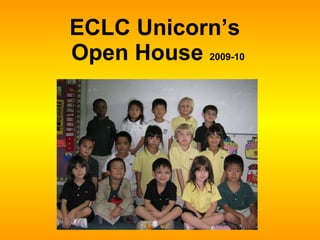
ECLC Unicorn’s  Open House  2009-10
Outline for Tonight Introductions Introduction to ECLC - Daily Schedule  - Curriculum - What we want an ECLC  Child to Be - Communication - Parent Volunteers - Housekeeping Items - Questions?
Meet the ECLC Team?
Introductions Miss Tish Miss Jacky And you….?
Zoe Heggie and Nina Velasco Steve McCallum and Phebe Panganiban
Rosie Knewstubb and Arlette Garcia Krista Plank and Jenny Guinjicna
ESL: Pippa Beetson and Nina Hernandez Learning Support - Rachael Huelskamp
Our Specialists P.E. with  Coach Noli
Music with  Ms. Irene
Art with Ms. Jones
Ms Pierce  CMC Ms. Jen IT
What your child’s day looks like… Calendar  Circle Time Literacy Activities Snack and Recess Numeracy Activities Inquiry Activities, Poetry, Wellness Lunch and Recess Specialist Lesson Inquiry Activities Child Led Play End Of Day Routines
Dispositions   Caring Self Directed Balanced Creative Fair Responsible Trans-disciplinary Skills Communication Critical Thinking & Problem Solving Collaboration Personal Management & Reflection Research
Every Child is Unique
Our Curriculum:  How to Learn vs. What to Learn Empowering Students to be…….
Inquirers
Team Players
Speakers & Listeners
Readers
Writers
Mathematicians
Scientists
Artists
Global Citizens
Parent Volunteers Room Mom ????? How can you help? - Wednesday Reading Mornings  (8:30 - 8:50) - Special Projects - Field Trips
What your child needs to bring each day: Water Bottle Hat Healthy Snack Black Folder Change of Clothes Backpack – not too big please LABEL EVERYTHING!
House Keeping Absent or Late Leaving School Early Birthdays and Invitations  Food (restrictions &  allergies) Class Mascot
House Keeping Cont. Costumes (International Day  /Filipiniana / Character Day) Telephone Tree Junk Materials Pizza Fridays After School Activities
Communication Report Cards (Dec and June ) Parent Conferences (Oct)  Student Led Conferences (Apr) Monthly ECLC Newsletters (first Friday) Class Newsletters (3 rd  Friday) Black Folders E-mail  (cowledj@ismanila.org) In Person
Thanks!!!

Online Version

Editor's Notes

  • #14 Dispositions the ways we expect the students to behave throughout all subject areas. Trans are skills that are needed throughout all subject areas.
  • #15 It is important to remember that all children come to ECLC with different skills and abilities. Children also develop mentally and physically at their own individual pace. A child that is not ready to learn something at the beginning of the year might easily grasp the same concept later in the year. Your child’s growth will be unique to them. ECLC is an exciting year where you will be seeing great progress in your own child.
  • #17 We want students to be good at asking questions, not just good at answering them. Teachers model, with students taking more of a role later. Inquiry Process…tuning in, finding out, sorting out, going further
  • #18 Theory behind class name vs teacher’s name Whole class responsibility School rules 2nd steps Interact and build Friendships Communicate, collaborate and cooperate Apply listening skills Resolve conflicts Take appropriate risks Independence
  • #19 Oral language is woven into all areas of the curriculum. Whether it’s sharing a piece of art that they have created or talking about something they did at home, children are learning to express their ideas and communicate to their peer group. We develop speaking as a tool for sharing and observing our everyday experiences. Making meaning and sense of the world
  • #20 We are trying to develop the following reading skills: -A positive attitude towards reading. -The ability to read with self monitoring skills. -Reading for meaning. -Using letter sound links in reading. -Interpreting pictures and predicting story events. -Sequencing story events beginning, middle and end. -Developing concepts of print such as reading left to right and using proper grammar. HOW DO WE DO THIS? - Shared Reading Experiences (Big Books, Poems, Songs) - Small Group Work - Guided Reading Groups (We will discuss Guided Reading in detail at the Parent Reading Workshop in January) - Independent Practice HOME READING: The most important thing you can do at home to help your child is to make reading with them a daily event. Poetry / Song Books CMC Books (8 Books for Parents) Books from home even in another language
  • #21 We also practice writing to develop self confidence and a positive attitude. Teachers provide direct writing instruction through modeled writing activities. The children work on individual writing, practicing the skills that they have learned. Teachers meet with individual students to discuss the progress of their writing skills and develop writing goals frequently. INVENTED SPELLING Invented spelling is the name for children’s spelling before they know the rules adults use to spell. Research has proven that invented spelling is a developmental stage in children’s learning to spell correctly. Just as a child’s first picture of themselves might be a circle with two stick legs, early drawings are not interpreted as signs of visual, cognitive, or fine motor problems. Why Allow Invented Spellings? * Independence * Children don’t have to ask how to spell every word. * Fluent and Powerful Writing * They can focus more on getting their message across instead of if every word is spelled correctly. * Early Control and Responsibility * Children learn to take risks. * They also internalize what they learn about writing as it becomes more relevant to them
  • #22 Being a mathematician: Students will be working on the following topics throughout the year: * Numbers and Counting * Patterns * Sorting and Classifying * Shapes * Measurement How We Teach Math: * Small Groups * Whole Class * Individual Work Emphasis on - manipulatives, - hands-on activities - games - investigation It is rare that students master something new the first time they encounter it. For this reason many of the key ideas, concepts, and skills are repeated and presented in different ways throughout the year.
  • #23 Encouraging a sense of wonder in the world around
  • #24 Encouraging a sense of wonder in the world around
  • #25 Language-English is not better, just happens to be what we speak at school Importance of 1st language at home Valuing other cultures respecting differences and similarities in others