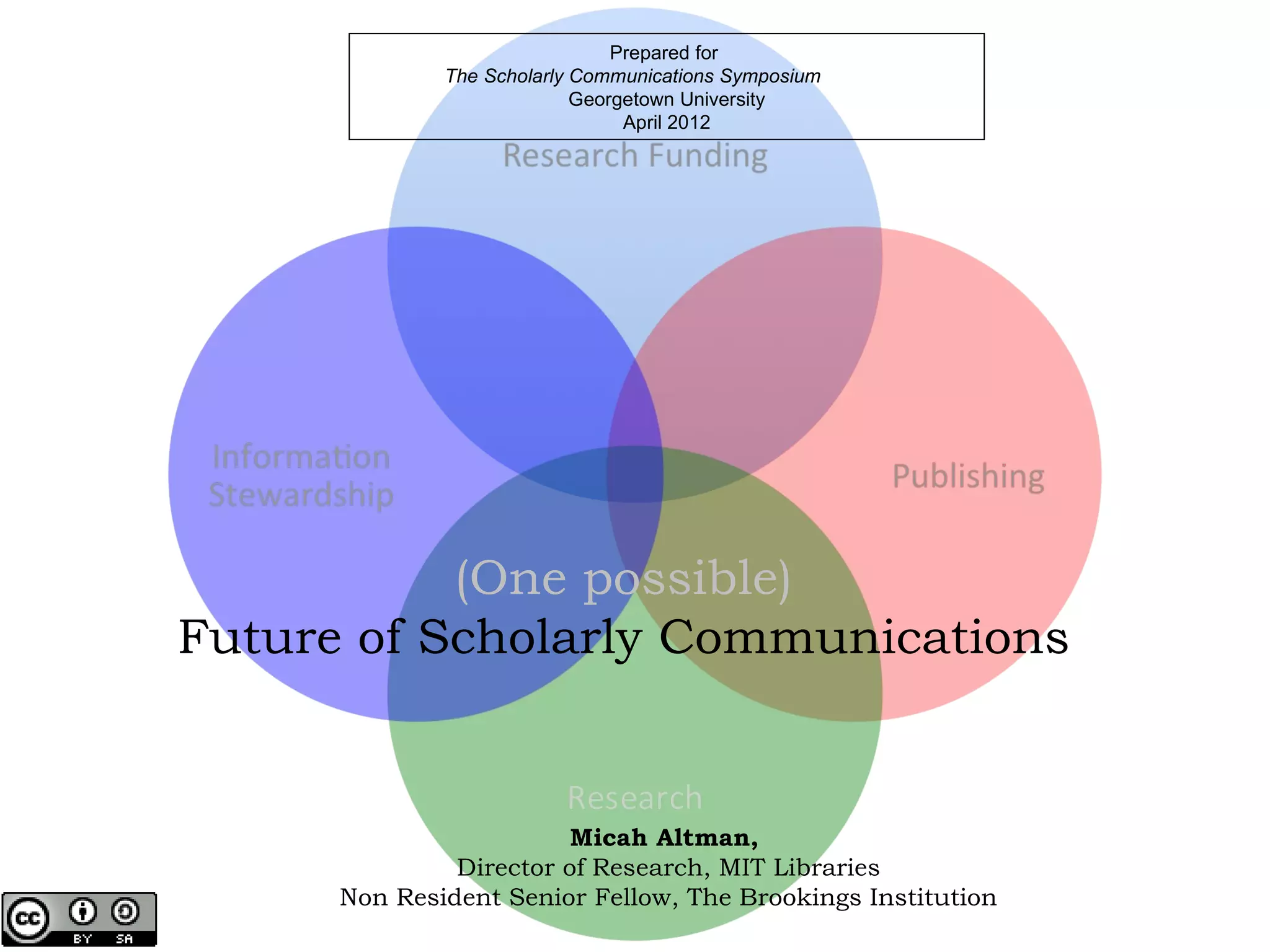
Prepared for
              The Scholarly Communications Symposium
                            Georgetown University
                                 April 2012


           (One possible)
Future of Scholarly Communications


                         Micah Altman,
               Director of Research, MIT Libraries
      Non Resident Senior Fellow, The Brookings Institution
Obligatory Disclaimers
Personal Biases:

Social/Information Scientist, Software
Engineer, Librarian, Archivist

         “It’s tough to make
        predictions, especially
         about the future!”*
*Attributed to Woody Allen, Yogi Berra, Niels Bohr, Vint Cerf, Winston Churchill, Confucius,
Disreali [sic], Freeman Dyson, Cecil B. Demille, Albert Einstein, Enrico Fermi, Edgar R.
Fiedler, Bob Fourer, Sam Goldwyn, Allan Lamport, Groucho Marx, Dan Quayle, George
Bernard Shaw, Casey Stengel, Will Rogers, M. Taub, Mark Twain, Kerr L. White, etc.
                                (One possible) Future of Scholarly
                                                                                         3
                                       Communications
Collaborators*
• Leonid Andreev, Ed Bachman, Adam Buchbinder, Ken
  Bollen, Bryan Beecher, Elana Broch, Steve Burling, John M.
  Caroll, Tom Carsey, Thu-Mai Christian, Patrick Clemins,
  Kevin Condon, Jonathan Crabtree, Merce Crosas, Diane
  Fournier, Jeff Gill, Myron Guttman, Gary King, Patrick
  King, Tom Lipkis, Freeman Lo, Christian Laevert, Jared Lyle,
  Marc Maynard, Michael P. McDonald, Nancy McGovern,
  Emily Ann-Meyers, Kevin Novak, , Thomas Plewes, Andrew
  Reamer, Ken Rogerson, Lois Timms-Ferrarra, Akio Sone,
  Bob Treacy

• Research Support
   Thanks to the Library of Congress, the National Science Foundation,
     IMLS, the Sloan Foundation, the Harvard University Library, the
     Institute for Quantitative Social Science, and the Massachusetts
     Institute of Technology.

                                                            * And co-conspirators
                       (One possible) Future of Scholarly
                                                                           4
                              Communications
Related Work
Reprints available from: micahaltman.com
•   Board on Research Data and Information, Forthcoming, For Attribution: Developing Data
    Attribution and Citation Practices and Standards, National Academies Press.
•   Altman, M., & McDonald, M. P. (2012). Technology for Public Participation in Redistricting. In
    G. Moncrief (Ed.), Redistricting and Reapportionment in the West. Lexington Books.
•   M. Altman, J. Crabtree, “Using the SafeArchive System: TRAC-Based Auditing of LOCKSS”,
    Proceedings of Archiving 2011, Society for Imaging Science and Technology.
•   Novak, K., Altman, M., Broch, E., Carroll, J. M., Clemins, P. J., Fournier, D., Laevart, C., et al.
    (2011). Communicating Science and Engineering Data in the Information Age. Computer Science
    and Telecommunications. National Academies Press.
•   M. Gutmann, with Abrahamson, M, Adams, M.O., Altman, M, Arms, C., Bollen, K., Carlson,
    M., Crabtree, J., Donakowski, D., King, G., Lyle, J., Maynard, M., Pienta, A., Rockwell, R,
    Timms-Ferrara L., Young, ) 2009. "From Preserving the Past to Preserving the Future: The
    Data-PASS Project and the challenges of preserving digital social science data.”, Library Trends
•   M. Altman, Adams, M., Crabtree, J., Donakowski, D., Maynard, M., Pienta, A., & Young, C.
    2009. "Digital preservation through archival collaboration: The Data Preservation Alliance for
    the Social Sciences." The American Archivist. 72(1): 169-182
•   Micah Altman, K. Rogerson. 2008. " Open Research Questions on Information and
    Technology in Global and Domestic Politics -- Beyond 'E-'", PS: Political Science and Politics.
•   M. Altman and G. King. 2007. “A Proposed Standard for the Scholarly Citation of
    Quantitative Data”, D-Lib, 13, 3/4 (March/April).
•   Altman, M., Gill, J., & McDonald, M. (2003). Numerical issues in statistical computing for the
    social scientist. New York: John Wiley & Sons


                                   (One possible) Future of Scholarly
                                                                                                      5
                                          Communications
This Talk

               Disruptions!

Could this be a good thing for science?

        Community initiatives

           Shameless plugs
           (One possible) Future of Scholarly Communications   6
Disruptions!
  "At the risk of stating the obvious, the complex system
  of relationships and products known as scholarly
  communication is under considerable pressure."

  – Ann J. Wolpert*
   Nature 420, 17-18, 2002


* Director, MIT Libraries; Board Chair, MIT Press; my boss

                            (One possible) Future of Scholarly
                                                                 7
                                   Communications
Observations
• Practice of science – researchers, evidence base,
  and publications are all shifting to edges
• Filtering, replication, integration and reuse are
  increasing in importance relative to publication


                   (One possible) Future of Scholarly
                                                        8
                          Communications
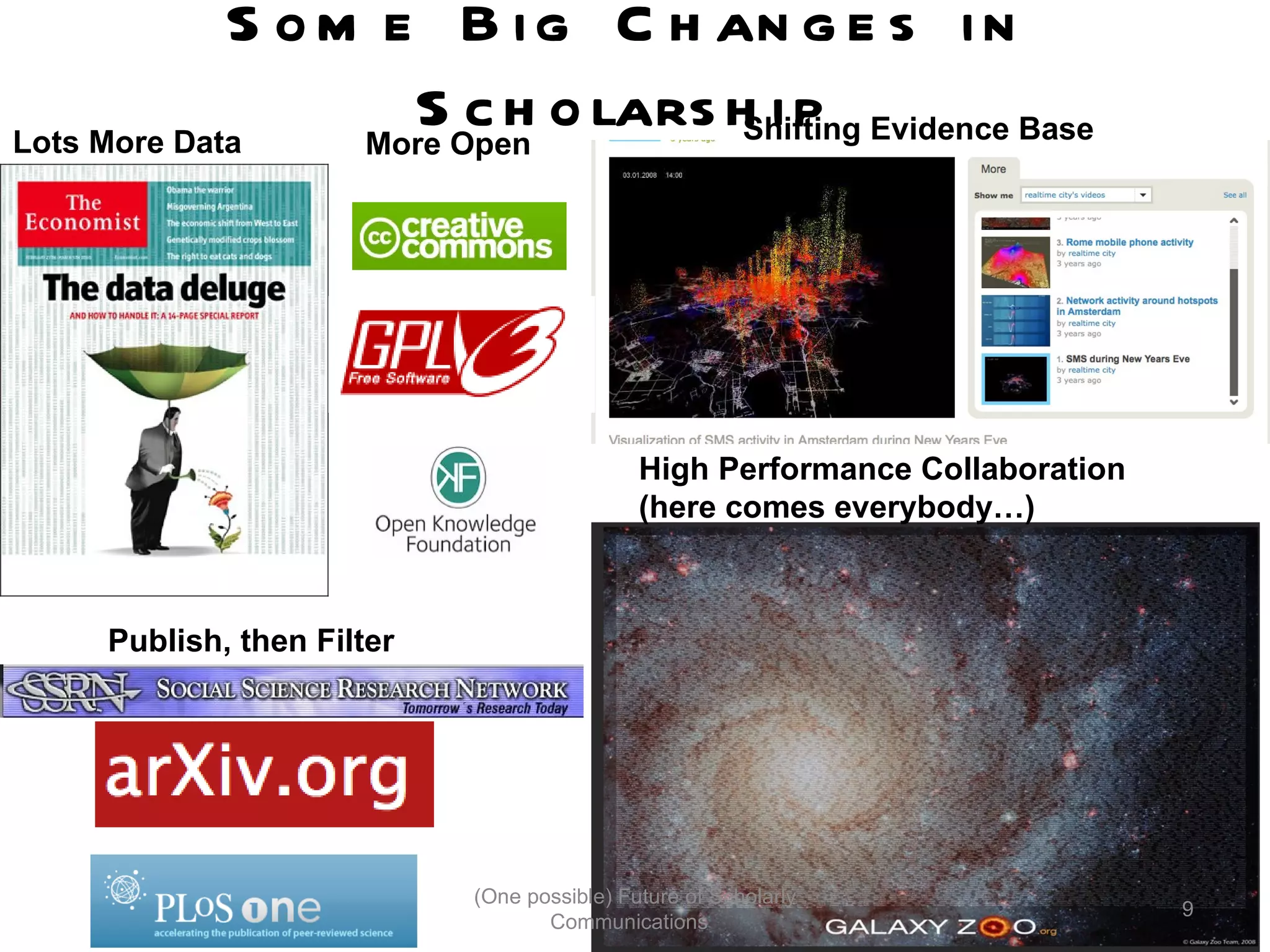
S o m e B i g C h an g e s i n
Lots More Data
                    SOpen o lars h i p Evidence Base
                  More
                       ch         Shifting


                                            High Performance Collaboration
                                            (here comes everybody…)


    Publish, then Filter


                           (One possible) Future of Scholarly
                                                                             9
                                  Communications
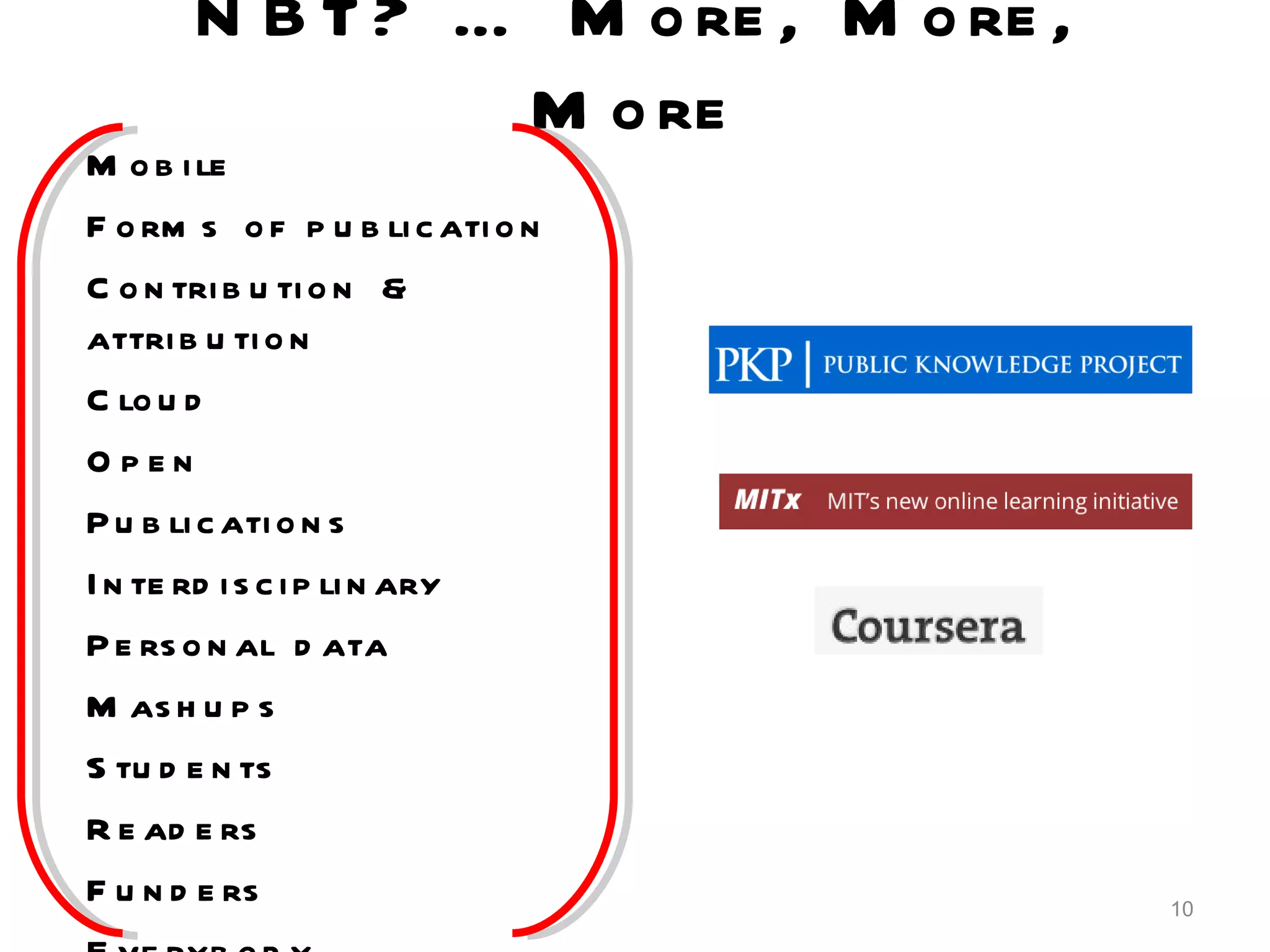
N B T ? … M o re , M o re ,
                M o re
M o b i le
F o rm s o f p u b li c ati o n
C o n tri b u ti o n &
attri b u ti o n
C lo u d
Open
P u b li c ati o n s
I n te rd i s c i p li n ary
P e rs o n al d ata
M as h u p s
S tu d e n ts
R e ad e rs
F u n d e rs                         10
plus ça change, plus c'est la même
                 folie*
(And BTW the regular stuff ain’t necessarily easy, either…)

•Budget constraints
•Invisibility
•Deadlines
•Matching skillsets
•Legacy systems & requirements
•Personalities
•Bureaucracy
•Politics

                        (One possible) Future of Scholarly
                                                              11
                               Communications
Could this be a
 good thing for
    science?

     (One possible) Future of Scholarly
                                          12
            Communications
Observations
• The publication is not the science – it is a
  summary of it
• Much of the record of science and the evidence
  base for it is not well-maintained


                  (One possible) Future of Scholarly
                                                       13
                         Communications
Problems with current
      practice…


       (One possible) Future of Scholarly
                                            14
              Communications
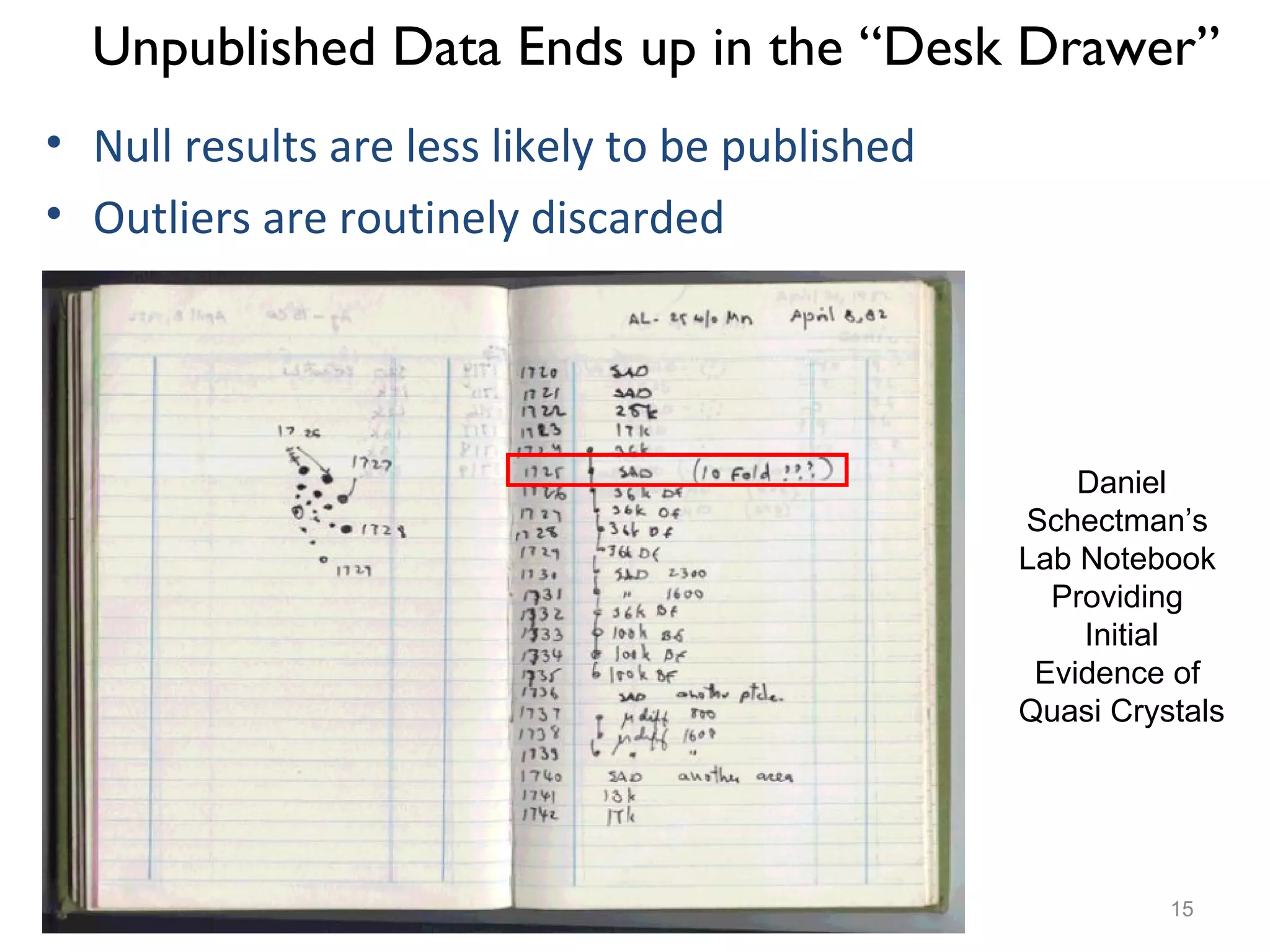
Unpublished Data Ends up in the “Desk Drawer”
• Null results are less likely to be published
• Outliers are routinely discarded


                                                               Daniel
                                                           Schectman’s
                                                           Lab Notebook
                                                             Providing
                                                               Initial
                                                            Evidence of
                                                           Quasi Crystals


                      (One possible) Future of Scholarly
                                                                     15
                             Communications
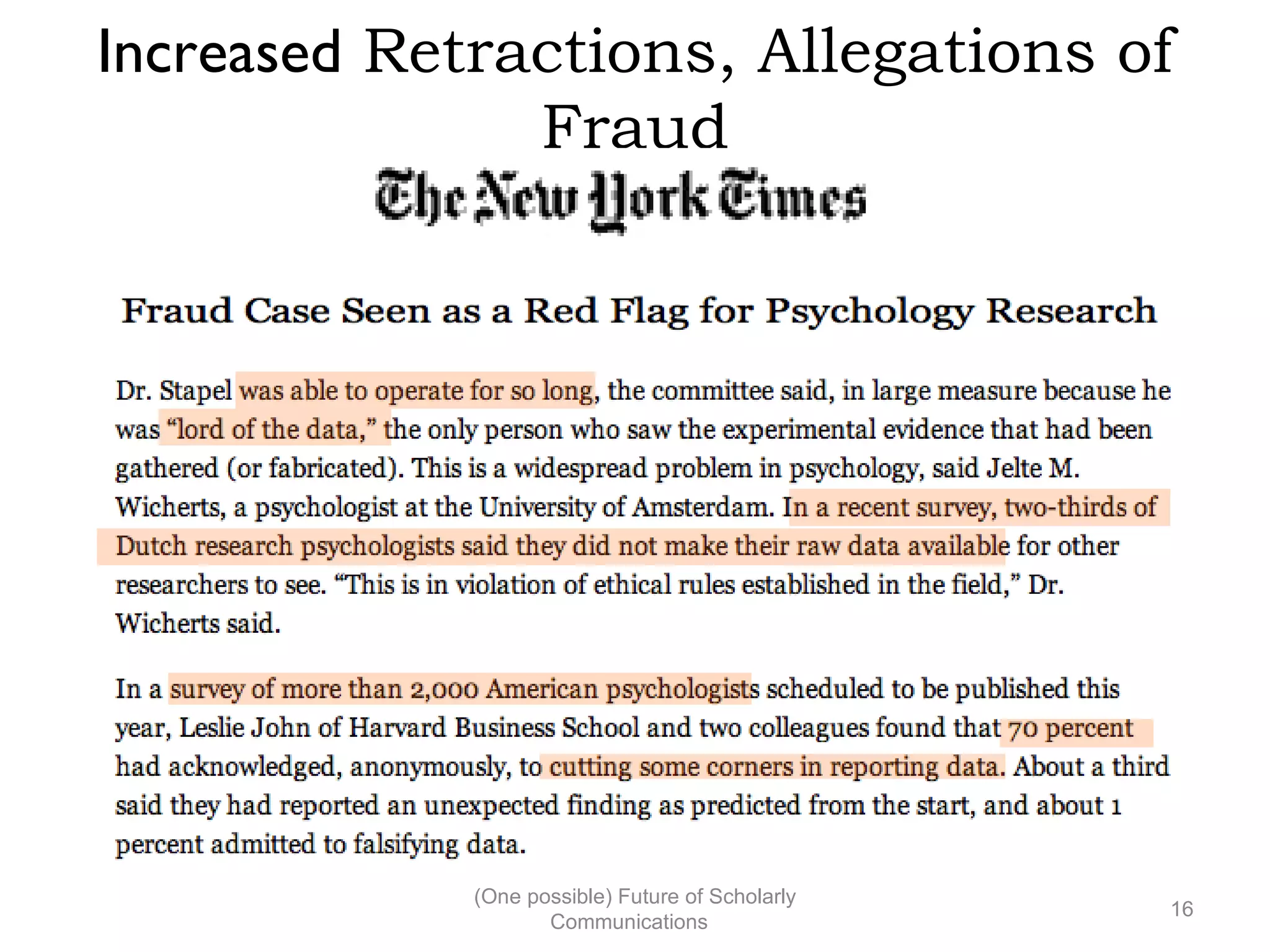
Increased Retractions, Allegations of
               Fraud


            (One possible) Future of Scholarly
                                                 16
                   Communications
Erosion of Evidence Base
• Researchers lack                  Examples

  archiving capability              Intentionally Discarded: “Destroyed, in accord with
                                       [nonexistent] APA 5-year post-publication rule.”
• Incentives for                    Unintentional Hardware Problems “Some data were
  preserving evidence                 collected, but the data file was lost in a technical
                                      malfunction.”

  base are weak                     Acts of Nature The data from the studies were on punched
                                       cards that were destroyed in a flood in the department in
                                       the early 80s.”

                                    Discarded or Lost in a Move “As I retired …. Unfortunately,
                                       I simply didn’t have the room to store these data sets at my
                                       house.”

                                    Obsolescence “Speech recordings stored on a LISP
                                      Machine…, an experimental computer which is long
                                      obsolete.”

                                    Simply Lost “For all I know, they are on a [University] server,
                                       but it has been literally years and years since the research
                                       was done, and my files are long gone.”


                    (One possible) Future of Scholarly
                                                                    Research by:
                                                                                         17
                           Communications
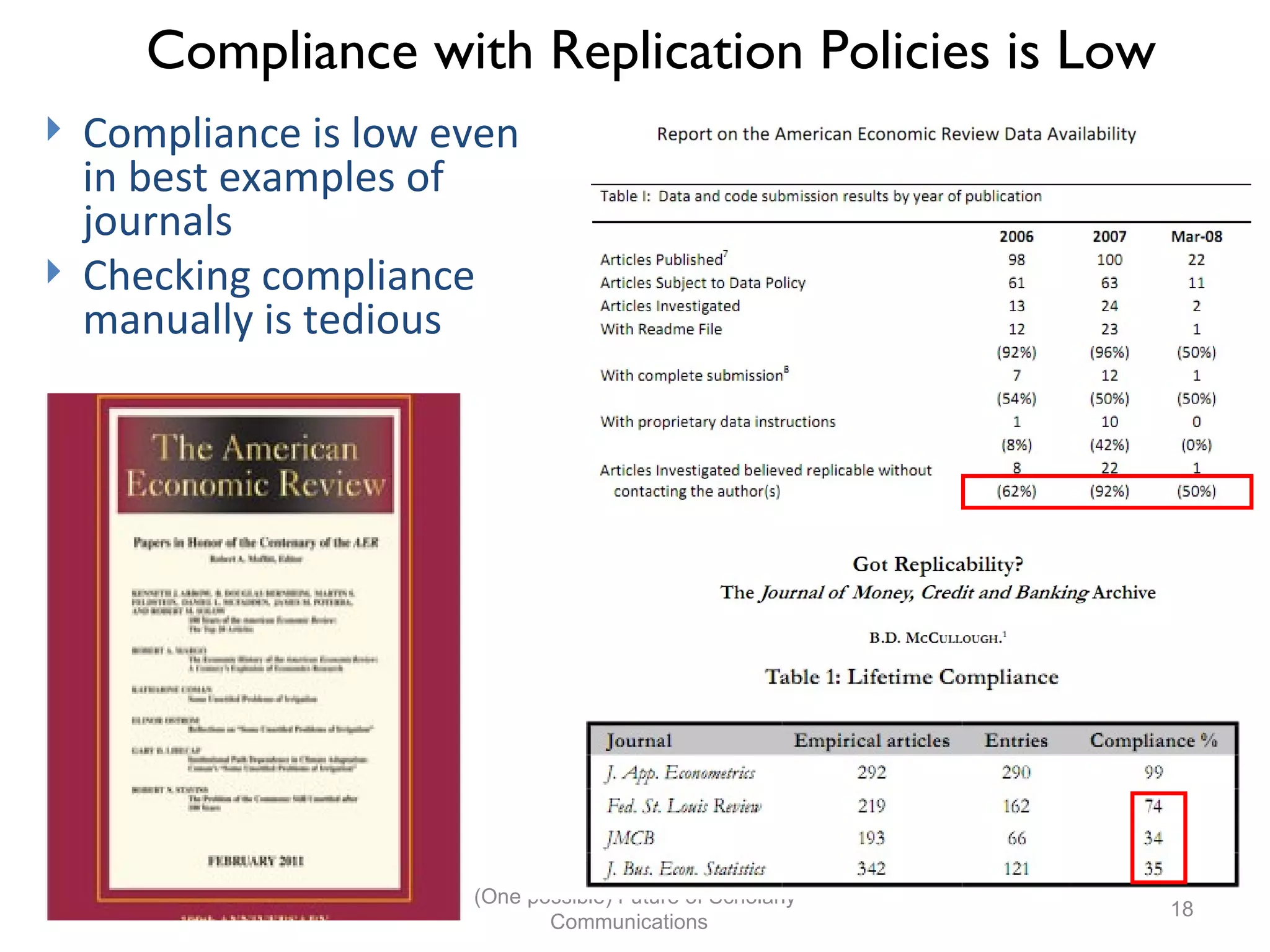
Compliance with Replication Policies is Low
   Compliance is low even
    in best examples of
    journals
   Checking compliance
    manually is tedious


                       (One possible) Future of Scholarly
                                                            18
                              Communications
Some possible
 publication forms of
enhanced publication…


       (One possible) Future of Scholarly
                                            19
              Communications
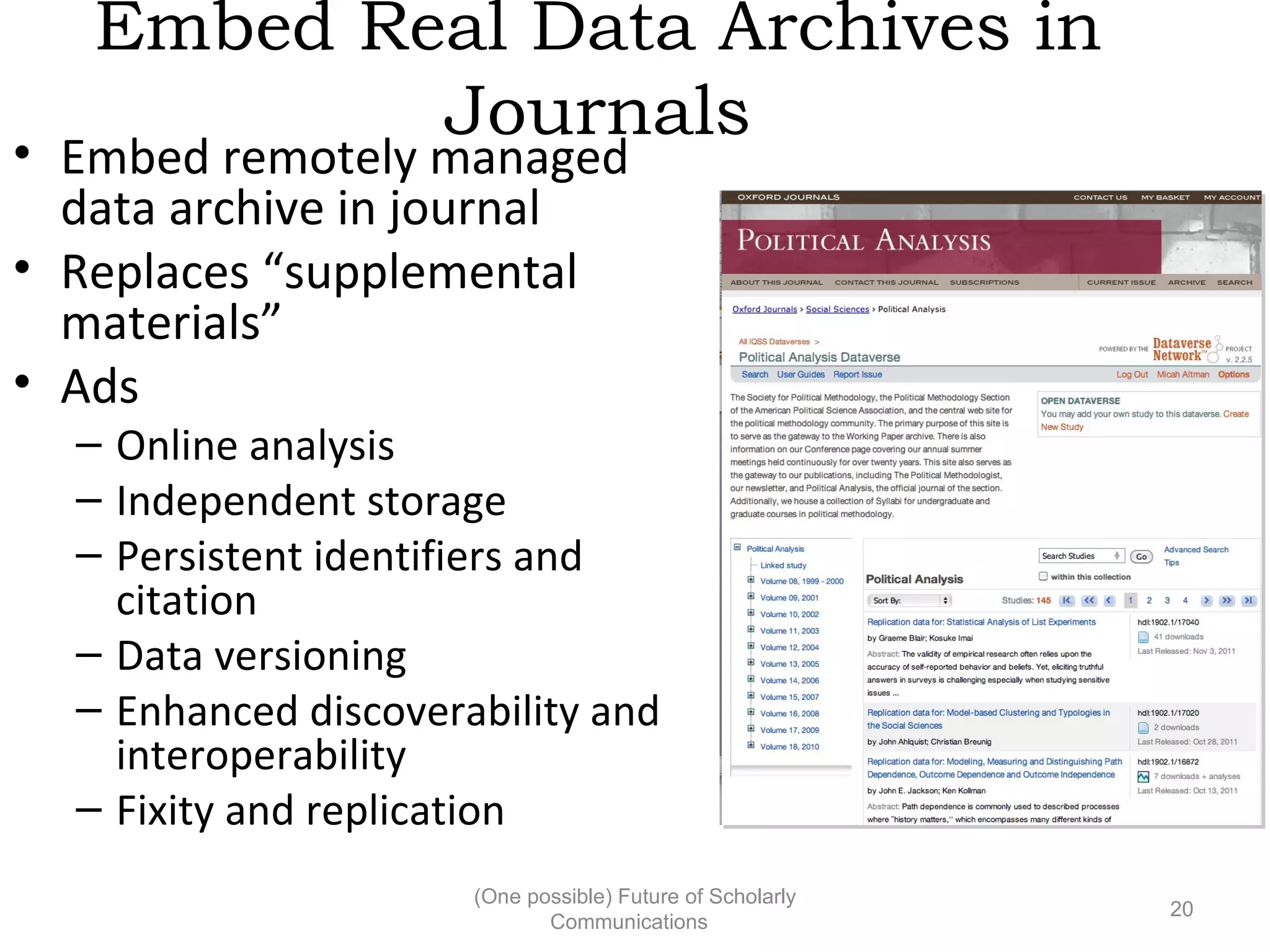
Embed Real Data Archives in
           Journals
• Embed remotely managed
  data archive in journal
• Replaces “supplemental
  materials”
• Ads
  – Online analysis
  – Independent storage
  – Persistent identifiers and
    citation
  – Data versioning
  – Enhanced discoverability and
    interoperability
  – Fixity and replication
                      (One possible) Future of Scholarly
                                                           20
                             Communications
Streamlined “Data Paper”
              Publication
• Data Paper =
  Data + Citation + Abstract + Docs


Tools can help
• Standard templates & metadata
• Data citation and persistent ID
• Reviewer workflow
• Overlay/embed data in journal
  system


                        (One possible) Future of Scholarly
                                                             21
                               Communications
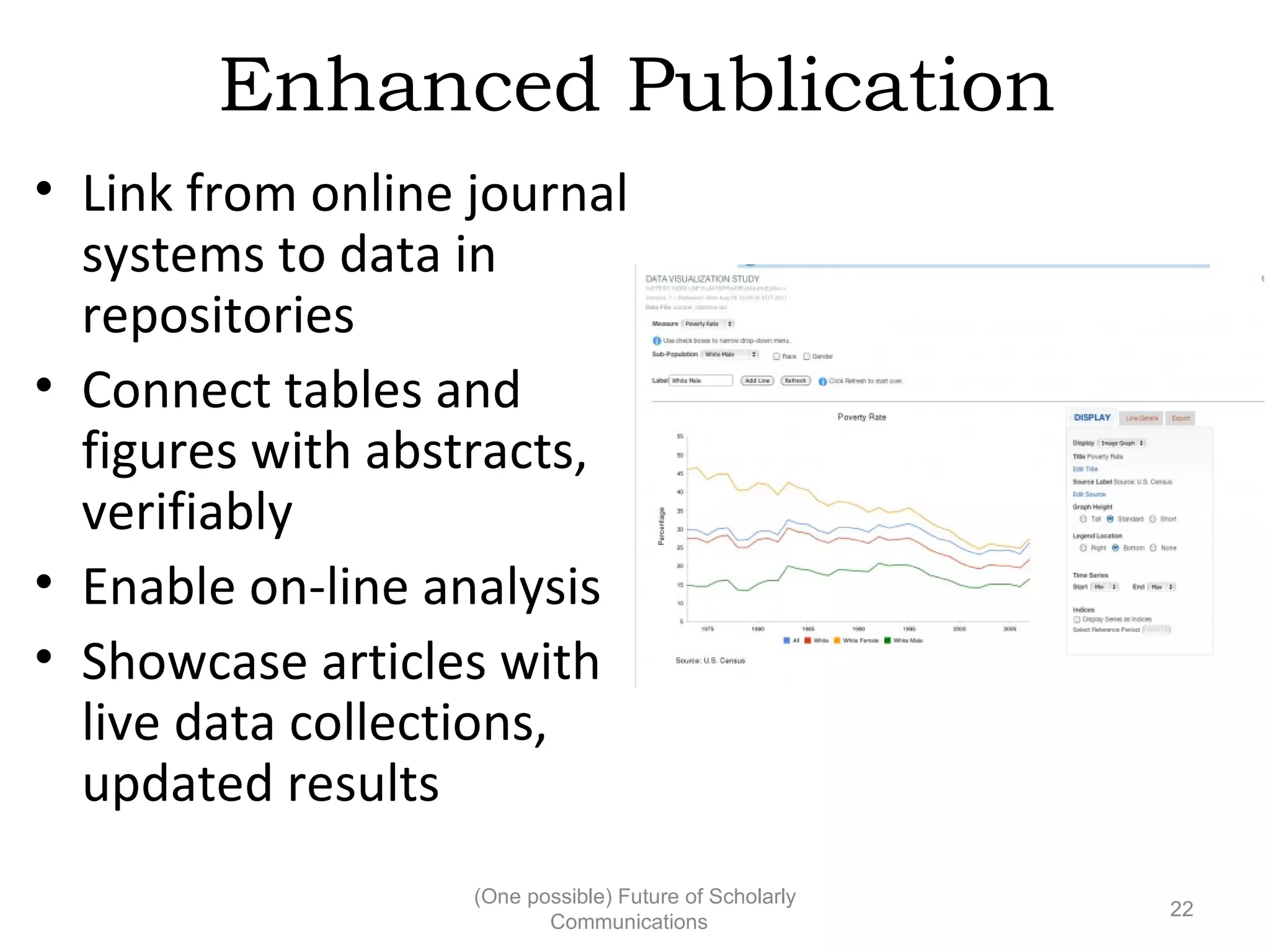
Enhanced Publication
• Link from online journal
  systems to data in
  repositories
• Connect tables and
  figures with abstracts,
  verifiably
• Enable on-line analysis
• Showcase articles with
  live data collections,
  updated results
                   (One possible) Future of Scholarly
                                                        22
                          Communications
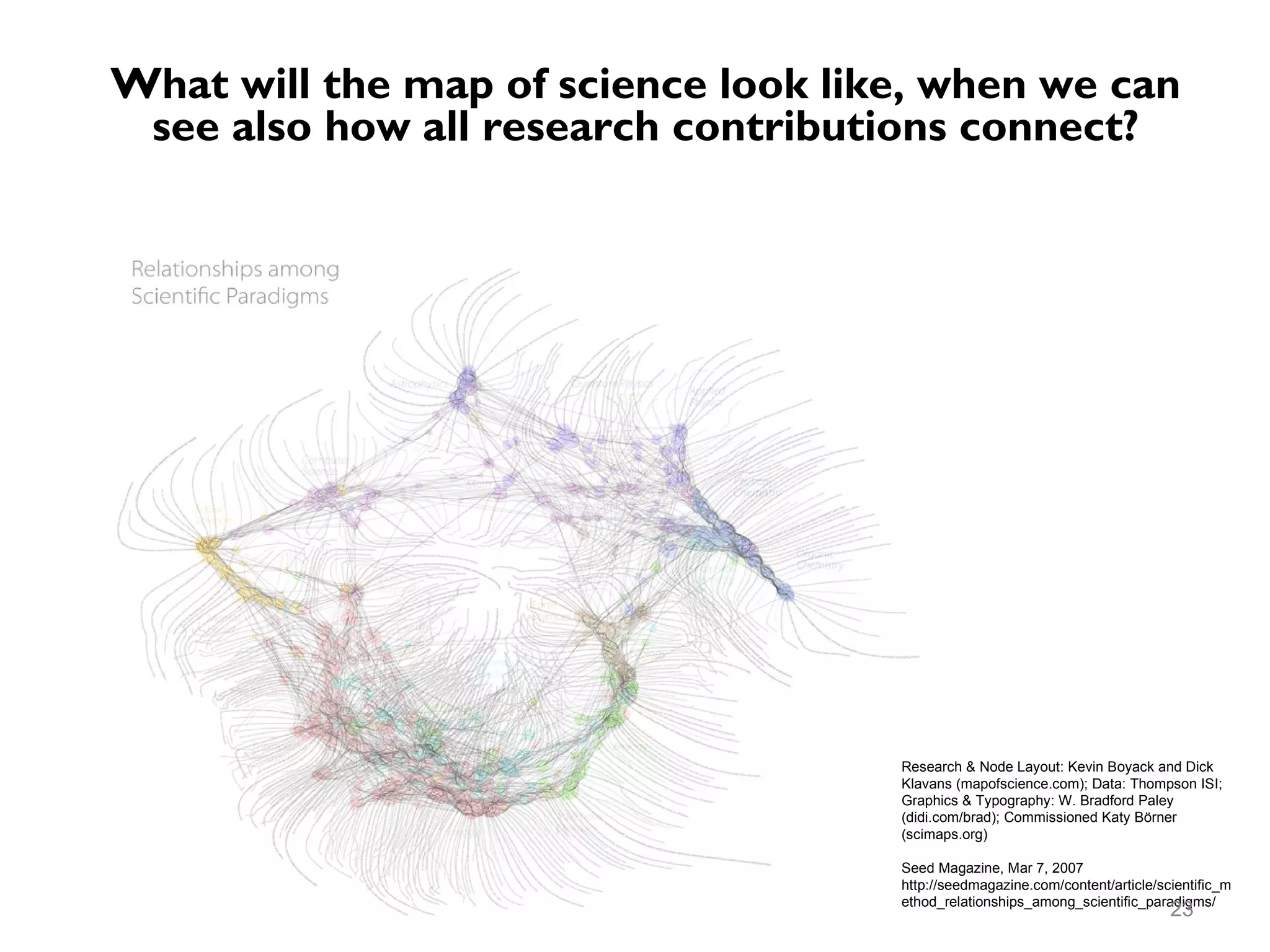
What will the map of science look like, when we can
 see also how all research contributions connect?


                                                      Research & Node Layout: Kevin Boyack and Dick
                                                      Klavans (mapofscience.com); Data: Thompson ISI;
                                                      Graphics & Typography: W. Bradford Paley
                                                      (didi.com/brad); Commissioned Katy Börner
                                                      (scimaps.org)

                                                      Seed Magazine, Mar 7, 2007
                                                      http://seedmagazine.com/content/article/scientific_m
                 (One possible) Future of Scholarly   ethod_relationships_among_scientific_paradigms/
                                                                                                23
                        Communications
Community
       Initiatives
“Never doubt that a small group of thoughtful,
committed citizens can change the world. Indeed, it is
the only thing that ever has.”

-- attributed to Margaret Mead


                       (One possible) Future of Scholarly
                                                            24
                              Communications
Observations
• Since knowledge is not a private good 
  Pure-market approach leads to under-
  provisioning
• Planning for access to scholarly record should
  include planning for long-term access  beyond
  the life of a single institution
• Important problems in scholarly
  communications, information science &
  scholarship increasingly require diverse multi-
  disciplinary approaches.
                   (One possible) Future of Scholarly
                                                        25
                          Communications
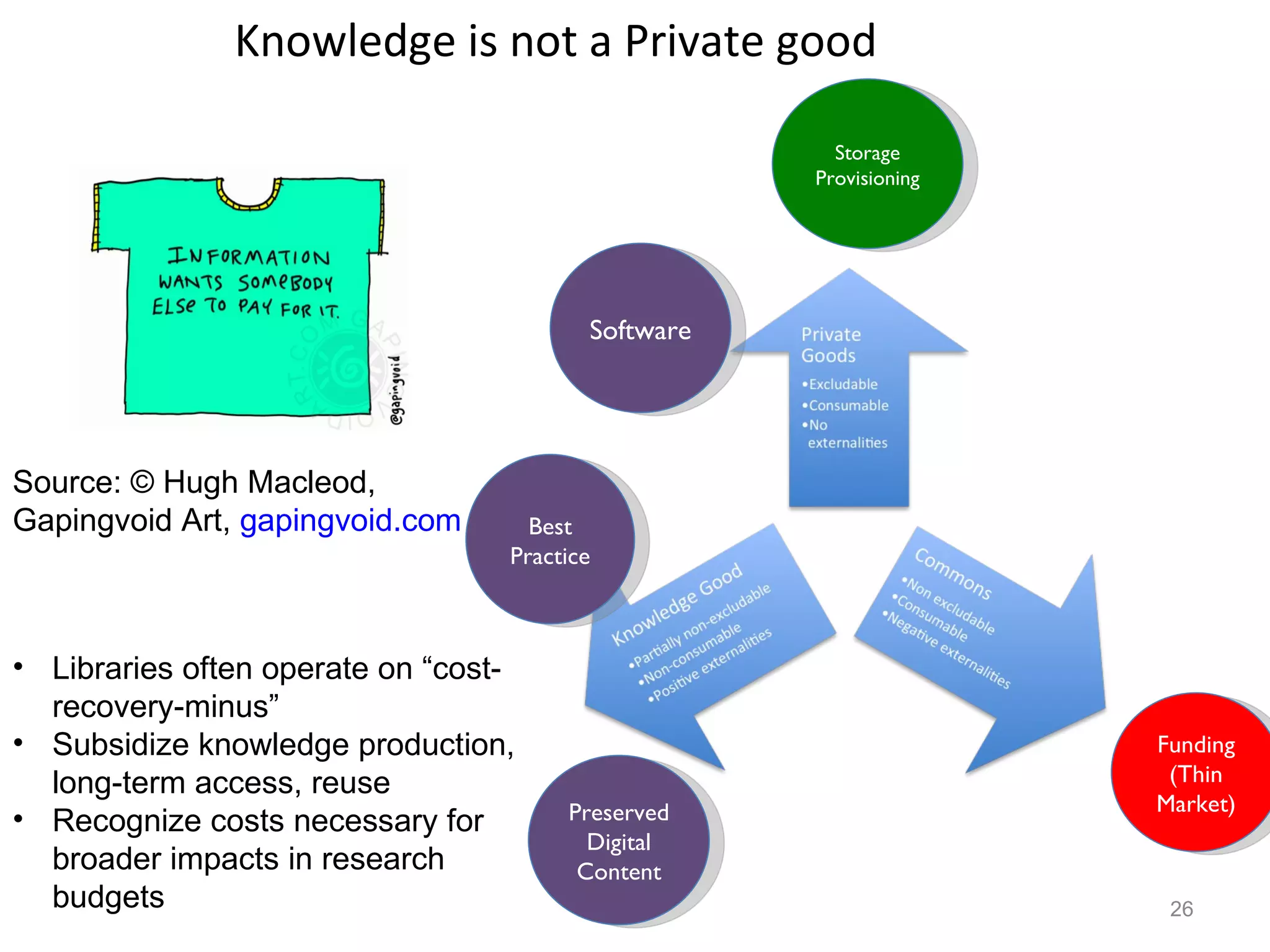
Knowledge is not a Private good

                                                      Storage
                                                    Provisioning


                                         Software


Source: © Hugh Macleod,
Gapingvoid Art, gapingvoid.com      Best
                                  Practice


• Libraries often operate on “cost-
  recovery-minus”
• Subsidize knowledge production,                                  Funding
  long-term access, reuse                                           (Thin
                                       Preserved                   Market)
• Recognize costs necessary for
                                         Digital
  broader impacts in research           Content
  budgets                                                           26
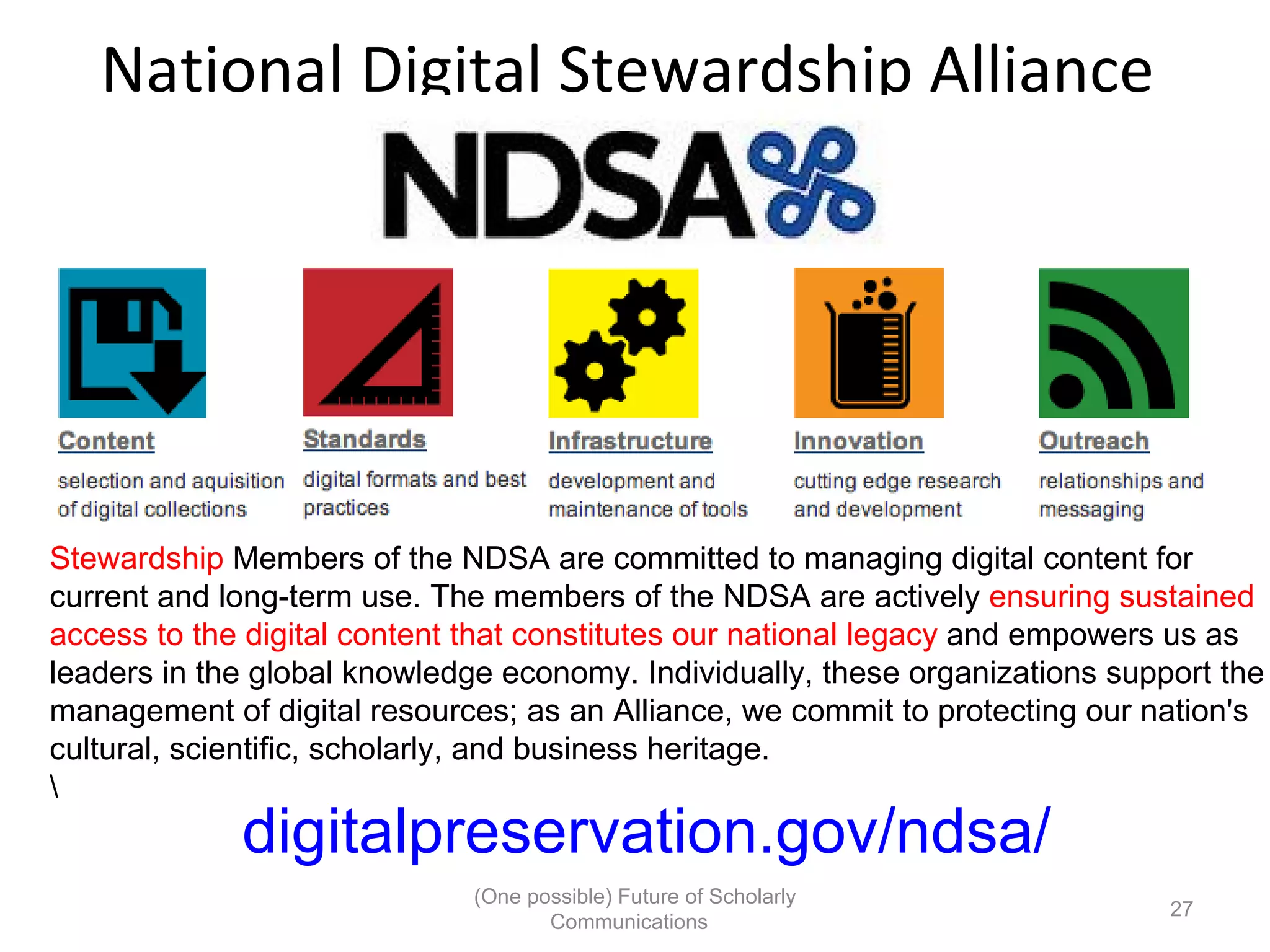
National Digital Stewardship Alliance


Stewardship Members of the NDSA are committed to managing digital content for
current and long-term use. The members of the NDSA are actively ensuring sustained
access to the digital content that constitutes our national legacy and empowers us as
leaders in the global knowledge economy. Individually, these organizations support the
management of digital resources; as an Alliance, we commit to protecting our nation's
cultural, scientific, scholarly, and business heritage.

             digitalpreservation.gov/ndsa/
                              (One possible) Future of Scholarly
                                                                               27
                                     Communications
ORCID


ORCID aims to solve the author/contributor name ambiguity problem in
scholarly communications by creating a central registry of unique identifiers for
individual researchers and an open and transparent linking mechanism
between ORCID and other current author ID schemes. These identifiers, and
the relationships among them, can be linked to the researcher's output to
enhance the scientific discovery process and to improve the efficiency of
research funding and collaboration within the research community.


                                 orcid.org
                            (One possible) Future of Scholarly
                                                                               28
                                   Communications
LOCKSS & PLN Organizations


           lockss.org
lockss.org/community/networks/
         (One possible) Future of Scholarly
                                              29
                Communications
DataCite & CoData


    datacite.org
    codata.org
   (One possible) Future of Scholarly
                                        30
          Communications
Shameless Plugs
“A shill, plant, or stooge is a person who publicly helps a person or
organization without disclosing that he has a close relationship
with that person or organization. Shill typically refers to someone
who purposely gives onlookers the impression that he is an
enthusiastic independent customer of a seller (or marketer of
ideas) for whom he is secretly working.”

-- Wikipedia


                        (One possible) Future of Scholarly
                                                                   31
                               Communications
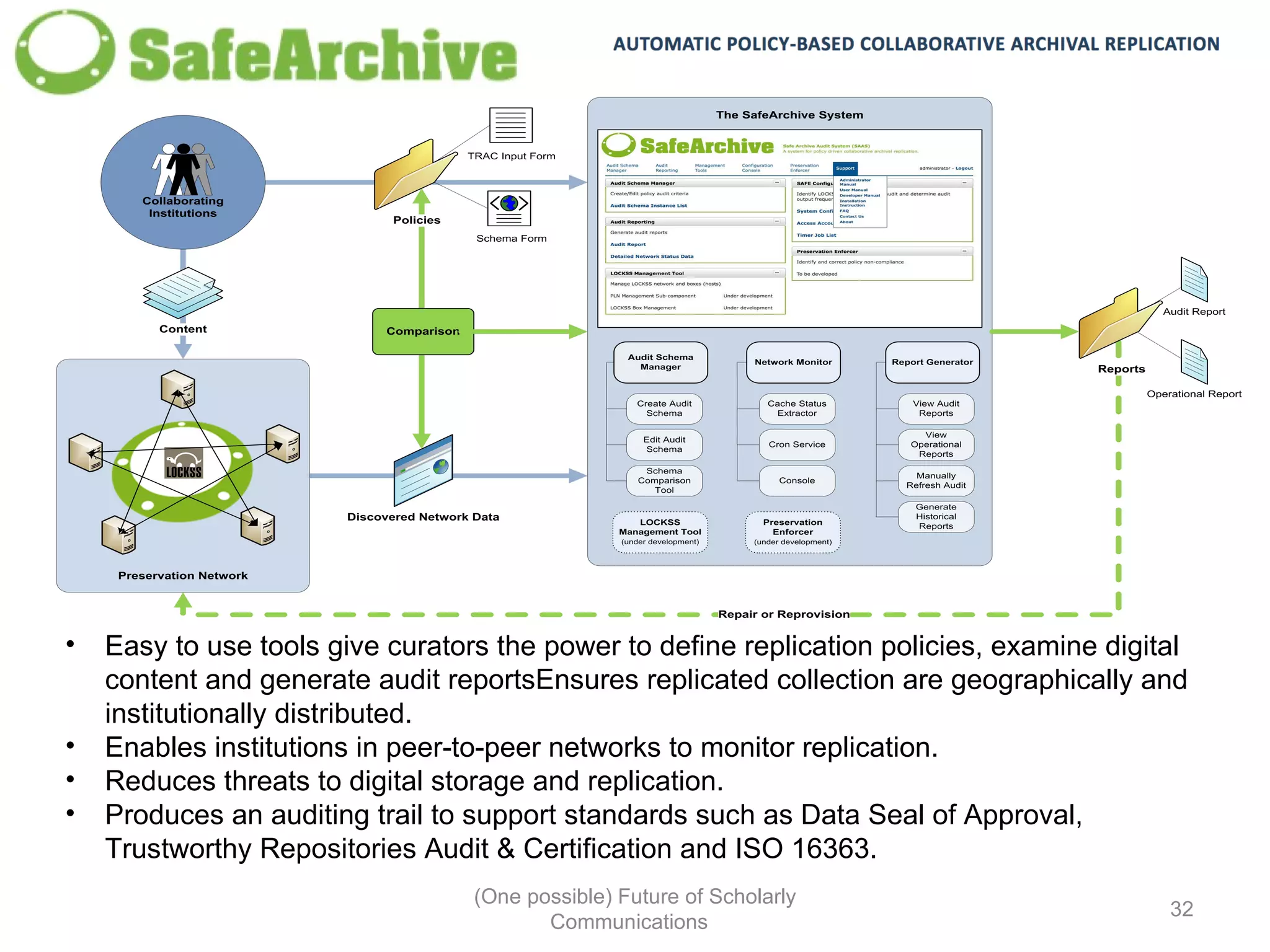
•   Easy to use tools give curators the power to define replication policies, examine digital
    content and generate audit reportsEnsures replicated collection are geographically and
    institutionally distributed.
•   Enables institutions in peer-to-peer networks to monitor replication.
•   Reduces threats to digital storage and replication.
•   Produces an auditing trail to support standards such as Data Seal of Approval,
    Trustworthy Repositories Audit & Certification and ISO 16363.
                                  (One possible) Future of Scholarly
                                                                                           32
                                         Communications
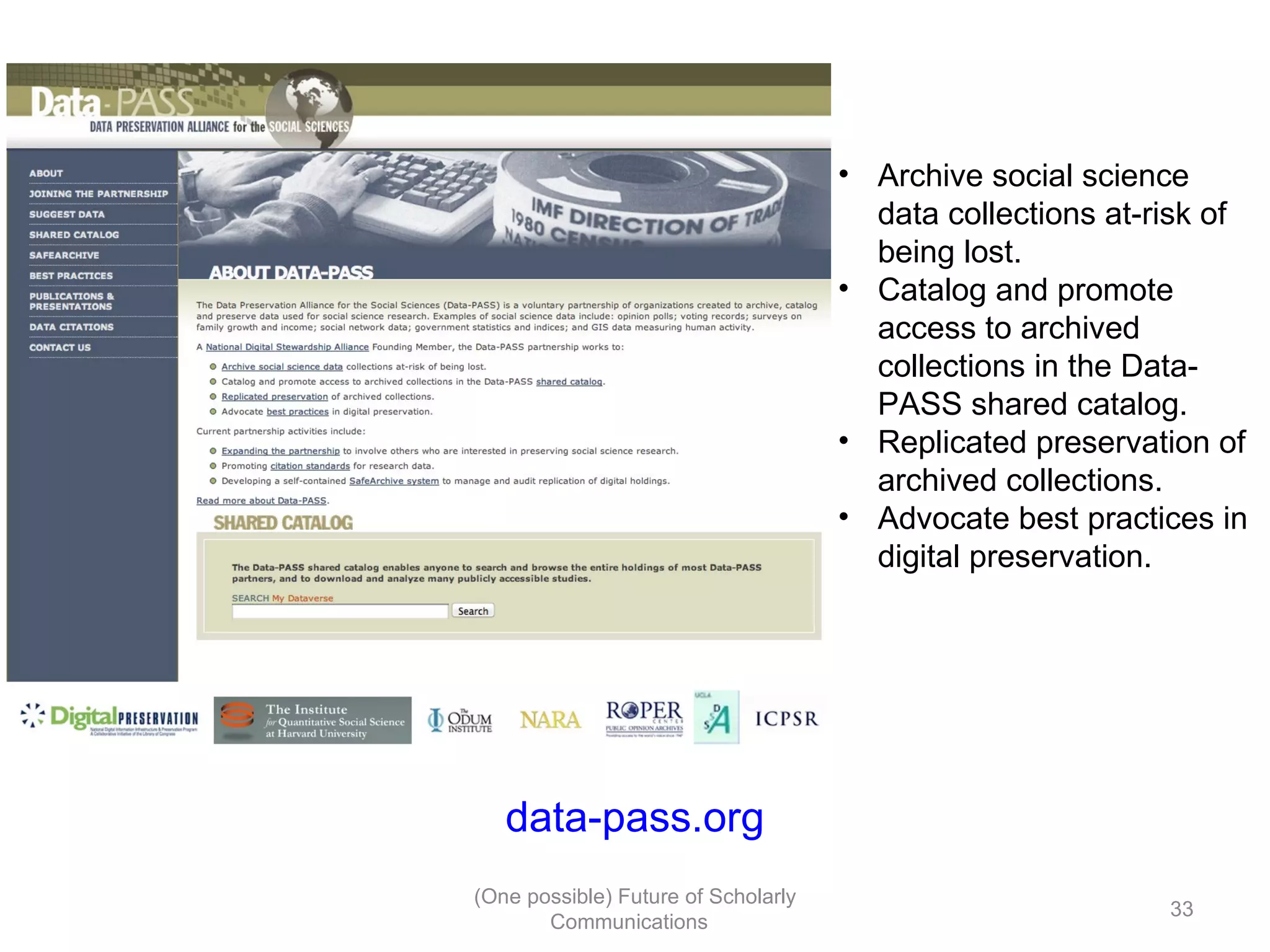
• Archive social science
                                       data collections at-risk of
                                       being lost.
                                     • Catalog and promote
                                       access to archived
                                       collections in the Data-
                                       PASS shared catalog.
                                     • Replicated preservation of
                                       archived collections.
                                     • Advocate best practices in
                                       digital preservation.


   data-pass.org
(One possible) Future of Scholarly
                                                            33
       Communications
Integrated Replication Data Publishing


                                  +

Submission, review, and publication of articles & data together

                            thedata.org
                             pkp.sfu.ca
                       (One possible) Future of Scholarly
                                                             34
                              Communications
Parting
          (Free)
           Advice
“Past returns are not a guarantee of future
                  results.”
               – Niels Bohr (?)
              (One possible) Future of Scholarly
                                                   35
                     Communications
Recap
• Practice of science – researchers, evidence base, and publications are
  all shifting to edges
• Filtering, replication, integration and reuse are increasing in
  importance relative to publication
• The publication is not the science – it is a summary of it
• Much of the record of science and the evidence base for it is not well-
  maintained
• Since knowledge is not a private good 
  Pure-market approach leads to under-provisioning
• Planning for access to scholarly record should include planning for
  long-term access  beyond the life of a single institution
• Important problems in scholarly communications, information science
  & scholarship increasingly require diverse multi-disciplinary
  approaches.
• Understanding scholarly communications requires understanding the
  research information lifecycle

                            (One possible) Future of Scholarly
                                                                        36
                                   Communications
Approaches
• Participate in collaborative multi-institutional
  efforts to improve scholarly communication
• Identify your organization’s core
  competencies at the most abstract level
• Prepare for new opportunities by betting on
  people


                  (One possible) Future of Scholarly
                                                       37
                         Communications
Questions?


E-mail: Micah_altman@alumni.brown.edu
Web: micahaltman.com
Twitter: @drmaltman


           (One possible) Future of Scholarly
                                                38
                  Communications

(One Possible) Future of Scholarly Communication

  • 2.
    Prepared for The Scholarly Communications Symposium Georgetown University April 2012 (One possible) Future of Scholarly Communications Micah Altman, Director of Research, MIT Libraries Non Resident Senior Fellow, The Brookings Institution
  • 3.
    Obligatory Disclaimers Personal Biases: Social/InformationScientist, Software Engineer, Librarian, Archivist “It’s tough to make predictions, especially about the future!”* *Attributed to Woody Allen, Yogi Berra, Niels Bohr, Vint Cerf, Winston Churchill, Confucius, Disreali [sic], Freeman Dyson, Cecil B. Demille, Albert Einstein, Enrico Fermi, Edgar R. Fiedler, Bob Fourer, Sam Goldwyn, Allan Lamport, Groucho Marx, Dan Quayle, George Bernard Shaw, Casey Stengel, Will Rogers, M. Taub, Mark Twain, Kerr L. White, etc. (One possible) Future of Scholarly 3 Communications
  • 4.
    Collaborators* • Leonid Andreev,Ed Bachman, Adam Buchbinder, Ken Bollen, Bryan Beecher, Elana Broch, Steve Burling, John M. Caroll, Tom Carsey, Thu-Mai Christian, Patrick Clemins, Kevin Condon, Jonathan Crabtree, Merce Crosas, Diane Fournier, Jeff Gill, Myron Guttman, Gary King, Patrick King, Tom Lipkis, Freeman Lo, Christian Laevert, Jared Lyle, Marc Maynard, Michael P. McDonald, Nancy McGovern, Emily Ann-Meyers, Kevin Novak, , Thomas Plewes, Andrew Reamer, Ken Rogerson, Lois Timms-Ferrarra, Akio Sone, Bob Treacy • Research Support Thanks to the Library of Congress, the National Science Foundation, IMLS, the Sloan Foundation, the Harvard University Library, the Institute for Quantitative Social Science, and the Massachusetts Institute of Technology. * And co-conspirators (One possible) Future of Scholarly 4 Communications
  • 5.
    Related Work Reprints availablefrom: micahaltman.com • Board on Research Data and Information, Forthcoming, For Attribution: Developing Data Attribution and Citation Practices and Standards, National Academies Press. • Altman, M., & McDonald, M. P. (2012). Technology for Public Participation in Redistricting. In G. Moncrief (Ed.), Redistricting and Reapportionment in the West. Lexington Books. • M. Altman, J. Crabtree, “Using the SafeArchive System: TRAC-Based Auditing of LOCKSS”, Proceedings of Archiving 2011, Society for Imaging Science and Technology. • Novak, K., Altman, M., Broch, E., Carroll, J. M., Clemins, P. J., Fournier, D., Laevart, C., et al. (2011). Communicating Science and Engineering Data in the Information Age. Computer Science and Telecommunications. National Academies Press. • M. Gutmann, with Abrahamson, M, Adams, M.O., Altman, M, Arms, C., Bollen, K., Carlson, M., Crabtree, J., Donakowski, D., King, G., Lyle, J., Maynard, M., Pienta, A., Rockwell, R, Timms-Ferrara L., Young, ) 2009. "From Preserving the Past to Preserving the Future: The Data-PASS Project and the challenges of preserving digital social science data.”, Library Trends • M. Altman, Adams, M., Crabtree, J., Donakowski, D., Maynard, M., Pienta, A., & Young, C. 2009. "Digital preservation through archival collaboration: The Data Preservation Alliance for the Social Sciences." The American Archivist. 72(1): 169-182 • Micah Altman, K. Rogerson. 2008. " Open Research Questions on Information and Technology in Global and Domestic Politics -- Beyond 'E-'", PS: Political Science and Politics. • M. Altman and G. King. 2007. “A Proposed Standard for the Scholarly Citation of Quantitative Data”, D-Lib, 13, 3/4 (March/April). • Altman, M., Gill, J., & McDonald, M. (2003). Numerical issues in statistical computing for the social scientist. New York: John Wiley & Sons (One possible) Future of Scholarly 5 Communications
  • 6.
    This Talk Disruptions! Could this be a good thing for science? Community initiatives Shameless plugs (One possible) Future of Scholarly Communications 6
  • 7.
    Disruptions! "Atthe risk of stating the obvious, the complex system of relationships and products known as scholarly communication is under considerable pressure." – Ann J. Wolpert* Nature 420, 17-18, 2002 * Director, MIT Libraries; Board Chair, MIT Press; my boss (One possible) Future of Scholarly 7 Communications
  • 8.
    Observations • Practice ofscience – researchers, evidence base, and publications are all shifting to edges • Filtering, replication, integration and reuse are increasing in importance relative to publication (One possible) Future of Scholarly 8 Communications
  • 9.
    S o me B i g C h an g e s i n Lots More Data SOpen o lars h i p Evidence Base More ch Shifting High Performance Collaboration (here comes everybody…) Publish, then Filter (One possible) Future of Scholarly 9 Communications
  • 10.
    N B T? … M o re , M o re , M o re M o b i le F o rm s o f p u b li c ati o n C o n tri b u ti o n & attri b u ti o n C lo u d Open P u b li c ati o n s I n te rd i s c i p li n ary P e rs o n al d ata M as h u p s S tu d e n ts R e ad e rs F u n d e rs 10
  • 11.
    plus ça change,plus c'est la même folie* (And BTW the regular stuff ain’t necessarily easy, either…) •Budget constraints •Invisibility •Deadlines •Matching skillsets •Legacy systems & requirements •Personalities •Bureaucracy •Politics (One possible) Future of Scholarly 11 Communications
  • 12.
    Could this bea good thing for science? (One possible) Future of Scholarly 12 Communications
  • 13.
    Observations • The publicationis not the science – it is a summary of it • Much of the record of science and the evidence base for it is not well-maintained (One possible) Future of Scholarly 13 Communications
  • 14.
    Problems with current practice… (One possible) Future of Scholarly 14 Communications
  • 15.
    Unpublished Data Endsup in the “Desk Drawer” • Null results are less likely to be published • Outliers are routinely discarded Daniel Schectman’s Lab Notebook Providing Initial Evidence of Quasi Crystals (One possible) Future of Scholarly 15 Communications
  • 16.
    Increased Retractions, Allegationsof Fraud (One possible) Future of Scholarly 16 Communications
  • 17.
    Erosion of EvidenceBase • Researchers lack Examples archiving capability Intentionally Discarded: “Destroyed, in accord with [nonexistent] APA 5-year post-publication rule.” • Incentives for Unintentional Hardware Problems “Some data were preserving evidence collected, but the data file was lost in a technical malfunction.” base are weak Acts of Nature The data from the studies were on punched cards that were destroyed in a flood in the department in the early 80s.” Discarded or Lost in a Move “As I retired …. Unfortunately, I simply didn’t have the room to store these data sets at my house.” Obsolescence “Speech recordings stored on a LISP Machine…, an experimental computer which is long obsolete.” Simply Lost “For all I know, they are on a [University] server, but it has been literally years and years since the research was done, and my files are long gone.” (One possible) Future of Scholarly Research by: 17 Communications
  • 18.
    Compliance with ReplicationPolicies is Low  Compliance is low even in best examples of journals  Checking compliance manually is tedious (One possible) Future of Scholarly 18 Communications
  • 19.
    Some possible publicationforms of enhanced publication… (One possible) Future of Scholarly 19 Communications
  • 20.
    Embed Real DataArchives in Journals • Embed remotely managed data archive in journal • Replaces “supplemental materials” • Ads – Online analysis – Independent storage – Persistent identifiers and citation – Data versioning – Enhanced discoverability and interoperability – Fixity and replication (One possible) Future of Scholarly 20 Communications
  • 21.
    Streamlined “Data Paper” Publication • Data Paper = Data + Citation + Abstract + Docs Tools can help • Standard templates & metadata • Data citation and persistent ID • Reviewer workflow • Overlay/embed data in journal system (One possible) Future of Scholarly 21 Communications
  • 22.
    Enhanced Publication • Linkfrom online journal systems to data in repositories • Connect tables and figures with abstracts, verifiably • Enable on-line analysis • Showcase articles with live data collections, updated results (One possible) Future of Scholarly 22 Communications
  • 23.
    What will themap of science look like, when we can see also how all research contributions connect? Research & Node Layout: Kevin Boyack and Dick Klavans (mapofscience.com); Data: Thompson ISI; Graphics & Typography: W. Bradford Paley (didi.com/brad); Commissioned Katy Börner (scimaps.org) Seed Magazine, Mar 7, 2007 http://seedmagazine.com/content/article/scientific_m (One possible) Future of Scholarly ethod_relationships_among_scientific_paradigms/ 23 Communications
  • 24.
    Community Initiatives “Never doubt that a small group of thoughtful, committed citizens can change the world. Indeed, it is the only thing that ever has.” -- attributed to Margaret Mead (One possible) Future of Scholarly 24 Communications
  • 25.
    Observations • Since knowledgeis not a private good  Pure-market approach leads to under- provisioning • Planning for access to scholarly record should include planning for long-term access  beyond the life of a single institution • Important problems in scholarly communications, information science & scholarship increasingly require diverse multi- disciplinary approaches. (One possible) Future of Scholarly 25 Communications
  • 26.
    Knowledge is nota Private good Storage Provisioning Software Source: © Hugh Macleod, Gapingvoid Art, gapingvoid.com Best Practice • Libraries often operate on “cost- recovery-minus” • Subsidize knowledge production, Funding long-term access, reuse (Thin Preserved Market) • Recognize costs necessary for Digital broader impacts in research Content budgets 26
  • 27.
    National Digital StewardshipAlliance Stewardship Members of the NDSA are committed to managing digital content for current and long-term use. The members of the NDSA are actively ensuring sustained access to the digital content that constitutes our national legacy and empowers us as leaders in the global knowledge economy. Individually, these organizations support the management of digital resources; as an Alliance, we commit to protecting our nation's cultural, scientific, scholarly, and business heritage. digitalpreservation.gov/ndsa/ (One possible) Future of Scholarly 27 Communications
  • 28.
    ORCID ORCID aims tosolve the author/contributor name ambiguity problem in scholarly communications by creating a central registry of unique identifiers for individual researchers and an open and transparent linking mechanism between ORCID and other current author ID schemes. These identifiers, and the relationships among them, can be linked to the researcher's output to enhance the scientific discovery process and to improve the efficiency of research funding and collaboration within the research community. orcid.org (One possible) Future of Scholarly 28 Communications
  • 29.
    LOCKSS & PLNOrganizations lockss.org lockss.org/community/networks/ (One possible) Future of Scholarly 29 Communications
  • 30.
    DataCite & CoData datacite.org codata.org (One possible) Future of Scholarly 30 Communications
  • 31.
    Shameless Plugs “A shill,plant, or stooge is a person who publicly helps a person or organization without disclosing that he has a close relationship with that person or organization. Shill typically refers to someone who purposely gives onlookers the impression that he is an enthusiastic independent customer of a seller (or marketer of ideas) for whom he is secretly working.” -- Wikipedia (One possible) Future of Scholarly 31 Communications
  • 32.
    Easy to use tools give curators the power to define replication policies, examine digital content and generate audit reportsEnsures replicated collection are geographically and institutionally distributed. • Enables institutions in peer-to-peer networks to monitor replication. • Reduces threats to digital storage and replication. • Produces an auditing trail to support standards such as Data Seal of Approval, Trustworthy Repositories Audit & Certification and ISO 16363. (One possible) Future of Scholarly 32 Communications
  • 33.
    • Archive socialscience data collections at-risk of being lost. • Catalog and promote access to archived collections in the Data- PASS shared catalog. • Replicated preservation of archived collections. • Advocate best practices in digital preservation. data-pass.org (One possible) Future of Scholarly 33 Communications
  • 34.
    Integrated Replication DataPublishing + Submission, review, and publication of articles & data together thedata.org pkp.sfu.ca (One possible) Future of Scholarly 34 Communications
  • 35.
    Parting (Free) Advice “Past returns are not a guarantee of future results.” – Niels Bohr (?) (One possible) Future of Scholarly 35 Communications
  • 36.
    Recap • Practice ofscience – researchers, evidence base, and publications are all shifting to edges • Filtering, replication, integration and reuse are increasing in importance relative to publication • The publication is not the science – it is a summary of it • Much of the record of science and the evidence base for it is not well- maintained • Since knowledge is not a private good  Pure-market approach leads to under-provisioning • Planning for access to scholarly record should include planning for long-term access  beyond the life of a single institution • Important problems in scholarly communications, information science & scholarship increasingly require diverse multi-disciplinary approaches. • Understanding scholarly communications requires understanding the research information lifecycle (One possible) Future of Scholarly 36 Communications
  • 37.
    Approaches • Participate incollaborative multi-institutional efforts to improve scholarly communication • Identify your organization’s core competencies at the most abstract level • Prepare for new opportunities by betting on people (One possible) Future of Scholarly 37 Communications
  • 38.
    Questions? E-mail: Micah_altman@alumni.brown.edu Web: micahaltman.com Twitter:@drmaltman (One possible) Future of Scholarly 38 Communications

Editor's Notes

  • #2 This work by Micah Altman (http://micahaltman.com) , with the exception of images explicitly accompanied by a separate “source” reference, is licensed under the Creative Commons Attribution-Share Alike 3.0 United States License. To view a copy of this license, visit http://creativecommons.org/licenses/by-sa/3.0/us/ or send a letter to Creative Commons, 171 Second Street, Suite 300, San Francisco, California, 94105, USA.
  • #3 This work by Micah Altman (http://micahaltman.com) , with the exception of images explicitly accompanied by a separate “source” reference, is licensed under the Creative Commons Attribution-Share Alike 3.0 United States License. To view a copy of this license, visit http://creativecommons.org/licenses/by-sa/3.0/us/ or send a letter to Creative Commons, 171 Second Street, Suite 300, San Francisco, California, 94105, USA.