Lecture 1
Introduction to Waves, Basic Concepts
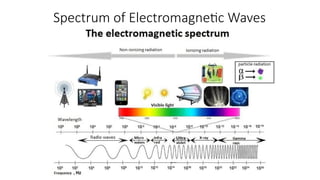
Spectrum of Electromagnetic Waves
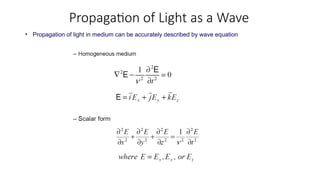
Propagation of Light as a Wave
• Propagation of light in medium can be accurately described by wave equation
Solution of Wave Equation
0
v2
 2
E

1  2
E

 x2
 t
2
In 1-D
The wave equation has the simple solution:
E  x, t   E x 
vt 
where E(t) [an f (u)] can be any twice-differentiable function.
(1)
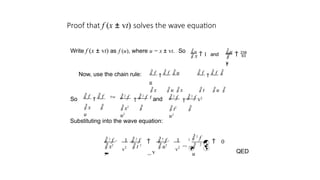
Proof that f (x ± vt) solves the wave equation
Write f (x ± vt) as f (u), where u = x ± vt. So
 x
 u
 1 and 
t
 u
 
v
 f

 f
 x 
u
 2
f

 2
f
 x2

u2
So  and
QED
v2
v2
 x2
 t 2
 u2
2  2
f

 2
f

1  2
f  2
f

1

2

v
 0

u

 
Substituting into the wave equation:
 f

 f  u  f

 f 
u
 x  u  x  t  u 
t
Now, use the chain rule:
 2
f

 2
f
 t2

u2
v2
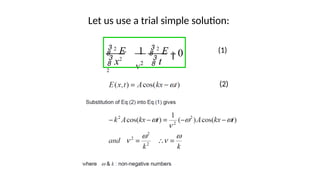
Let us use a trial simple solution:
0
v2
 2
E

1  2
E

 x2
 t
2
(1)
(2)
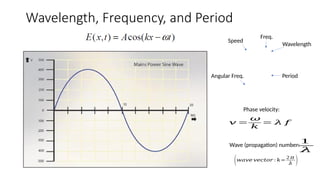
Wavelength, Frequency, and Period
Speed
Freq.
Wavelength
Angular Freq. Period
𝑣 =
𝜔
𝑘
= 𝜆 𝑓
1
𝜆
Phase velocity:
Wave (propagation) number:
(𝑤𝑎𝑣𝑒 𝑣𝑒𝑐𝑡𝑜𝑟 : 𝑘=
2 𝜋
𝜆 )
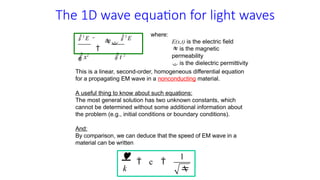
The 1D wave equation for light waves
 2
E
   2
E

 x2
 t 2
0
where:
E(x,t) is the electric field
 is the magnetic
permeability
 is the dielectric permittivity
This is a linear, second-order, homogeneous differential equation
for a propagating EM wave in a nonconducting material.
A useful thing to know about such equations:
The most general solution has two unknown constants, which
cannot be determined without some additional information about
the problem (e.g., initial conditions or boundary conditions).
And:
By comparison, we can deduce that the speed of EM wave in a
material can be written

k
1

 c 
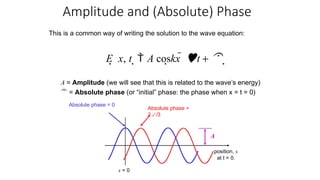
Amplitude and (Absolute) Phase
Absolute phase = 0
A
position, x
at t = 0.
x = 0
Absolute phase =
2/3
This is a common way of writing the solution to the wave equation:
E  x, t   A coskx  t +  
A = Amplitude (we will see that this is related to the wave’s energy)
 = Absolute phase (or “initial” phase: the phase when x = t = 0)
E
x axis
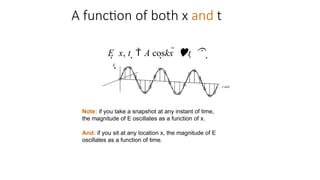
A function of both x and t
E  x, t   A coskx  t   
Note: if you take a snapshot at any instant of time,
the magnitude of E oscillates as a function of x.
And: if you sit at any location x, the magnitude of E
oscillates as a function of time.
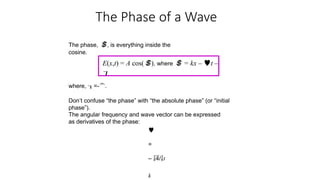
The Phase of a Wave
The phase, , is everything inside the
cosine.
E(x,t) = A cos(), where  = kx – t –

where, =-.
Don’t confuse “the phase” with “the absolute phase” (or “initial
phase”).
The angular frequency and wave vector can be expressed
as derivatives of the phase:

=
– /t
k
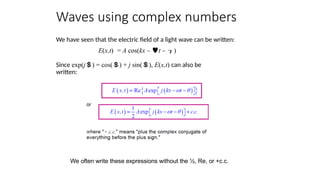
Waves using complex numbers
We often write these expressions without the ½, Re, or +c.c.
We have seen that the electric field of a light wave can be written:
E(x,t) = A cos(kx – t – )
Since exp(j) = cos() + j sin(), E(x,t) can also be
written:
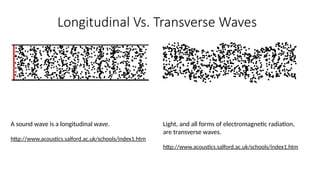
Longitudinal Vs. Transverse Waves
A sound wave is a longitudinal wave.
http://www.acoustics.salford.ac.uk/schools/index1.htm
Light, and all forms of electromagnetic radiation,
are transverse waves.
http://www.acoustics.salford.ac.uk/schools/index1.htm
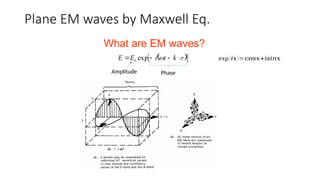
Plane EM waves by Maxwell Eq.
 
 
r
k
t
i
E
E 


 
exp
0
What are EM waves?
Amplitude Phase
exp(𝑖𝑥)=𝑐𝑜𝑠𝑥+𝑖𝑠𝑖𝑛𝑥
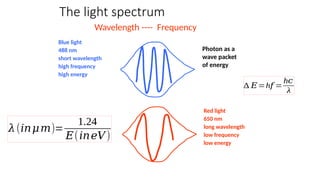
The light spectrum
Wavelength ---- Frequency
Blue light
488 nm
short wavelength
high frequency
high energy
Red light
650 nm
long wavelength
low frequency
low energy
Photon as a
wave packet
of energy
𝜆(𝑖𝑛𝜇𝑚)=
1.24
𝐸(𝑖𝑛𝑒𝑉)
∆ 𝐸=h𝑓 =
h𝑐
λ
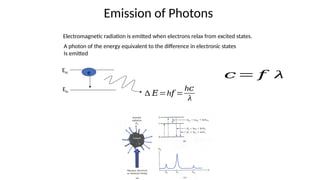
Emission of Photons
Electromagnetic radiation is emitted when electrons relax from excited states.
A photon of the energy equivalent to the difference in electronic states
Is emitted
e
Ehi
Elo
∆ 𝐸=h𝑓 =
h𝑐
λ
𝑐= 𝑓 λ
# of Photons emitted during 1 second
in 1 W of green laser at 500 nm?

Introduction to waves basic concepts.pptx

  • 1.
    Lecture 1 Introduction toWaves, Basic Concepts
  • 2.
  • 3.
    Propagation of Lightas a Wave • Propagation of light in medium can be accurately described by wave equation
  • 4.
    Solution of WaveEquation 0 v2  2 E  1  2 E   x2  t 2 In 1-D The wave equation has the simple solution: E  x, t   E x  vt  where E(t) [an f (u)] can be any twice-differentiable function. (1)
  • 5.
    Proof that f(x ± vt) solves the wave equation Write f (x ± vt) as f (u), where u = x ± vt. So  x  u  1 and  t  u   v  f   f  x  u  2 f   2 f  x2  u2 So  and QED v2 v2  x2  t 2  u2 2  2 f   2 f  1  2 f  2 f  1  2  v  0  u    Substituting into the wave equation:  f   f  u  f   f  u  x  u  x  t  u  t Now, use the chain rule:  2 f   2 f  t2  u2 v2
  • 6.
    Let us usea trial simple solution: 0 v2  2 E  1  2 E   x2  t 2 (1) (2)
  • 7.
    Wavelength, Frequency, andPeriod Speed Freq. Wavelength Angular Freq. Period 𝑣 = 𝜔 𝑘 = 𝜆 𝑓 1 𝜆 Phase velocity: Wave (propagation) number: (𝑤𝑎𝑣𝑒 𝑣𝑒𝑐𝑡𝑜𝑟 : 𝑘= 2 𝜋 𝜆 )
  • 8.
    The 1D waveequation for light waves  2 E    2 E   x2  t 2 0 where: E(x,t) is the electric field  is the magnetic permeability  is the dielectric permittivity This is a linear, second-order, homogeneous differential equation for a propagating EM wave in a nonconducting material. A useful thing to know about such equations: The most general solution has two unknown constants, which cannot be determined without some additional information about the problem (e.g., initial conditions or boundary conditions). And: By comparison, we can deduce that the speed of EM wave in a material can be written  k 1   c 
  • 9.
    Amplitude and (Absolute)Phase Absolute phase = 0 A position, x at t = 0. x = 0 Absolute phase = 2/3 This is a common way of writing the solution to the wave equation: E  x, t   A coskx  t +   A = Amplitude (we will see that this is related to the wave’s energy)  = Absolute phase (or “initial” phase: the phase when x = t = 0)
  • 10.
    E x axis A functionof both x and t E  x, t   A coskx  t    Note: if you take a snapshot at any instant of time, the magnitude of E oscillates as a function of x. And: if you sit at any location x, the magnitude of E oscillates as a function of time.
  • 11.
    The Phase ofa Wave The phase, , is everything inside the cosine. E(x,t) = A cos(), where  = kx – t –  where, =-. Don’t confuse “the phase” with “the absolute phase” (or “initial phase”). The angular frequency and wave vector can be expressed as derivatives of the phase:  = – /t k
  • 12.
    Waves using complexnumbers We often write these expressions without the ½, Re, or +c.c. We have seen that the electric field of a light wave can be written: E(x,t) = A cos(kx – t – ) Since exp(j) = cos() + j sin(), E(x,t) can also be written:
  • 13.
    Longitudinal Vs. TransverseWaves A sound wave is a longitudinal wave. http://www.acoustics.salford.ac.uk/schools/index1.htm Light, and all forms of electromagnetic radiation, are transverse waves. http://www.acoustics.salford.ac.uk/schools/index1.htm
  • 14.
    Plane EM wavesby Maxwell Eq.     r k t i E E      exp 0 What are EM waves? Amplitude Phase exp(𝑖𝑥)=𝑐𝑜𝑠𝑥+𝑖𝑠𝑖𝑛𝑥
  • 15.
    The light spectrum Wavelength---- Frequency Blue light 488 nm short wavelength high frequency high energy Red light 650 nm long wavelength low frequency low energy Photon as a wave packet of energy 𝜆(𝑖𝑛𝜇𝑚)= 1.24 𝐸(𝑖𝑛𝑒𝑉) ∆ 𝐸=h𝑓 = h𝑐 λ
  • 16.
    Emission of Photons Electromagneticradiation is emitted when electrons relax from excited states. A photon of the energy equivalent to the difference in electronic states Is emitted e Ehi Elo ∆ 𝐸=h𝑓 = h𝑐 λ 𝑐= 𝑓 λ
  • 17.
    # of Photonsemitted during 1 second in 1 W of green laser at 500 nm?