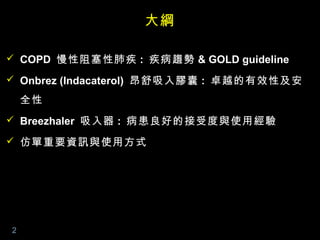
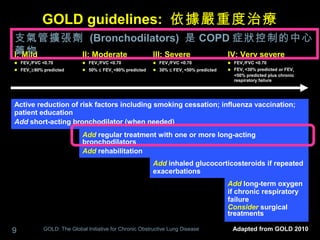
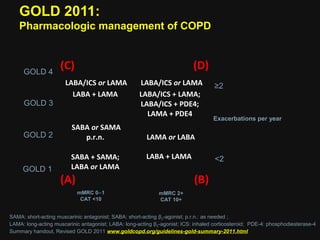
GOLD 2011:
Pharmacologic management of COPD
GOLD 4
(C) (D)
LABA/ICS or LAMA LABA/ICS or LAMA ≥2
LABA + LAMA LABA/ICS + LAMA;
GOLD 3 LABA/ICS + PDE4;
LAMA + PDE4
Exacerbations per year
SABA or SAMA
GOLD 2 p.r.n. LAMA or LABA
SABA + SAMA; LABA + LAMA <2
GOLD 1 LABA or LAMA
(A) (B)
mMRC 0−1 mMRC 2+
CAT <10 CAT 10+
SAMA: short-acting muscarinic antagonist; SABA: short-acting β2-agonist; p.r.n.: as needed ;
LAMA: long-acting muscarinic antagonist; LABA: long-acting β2-agonist; ICS: inhaled corticosteroid; PDE-4: phosphodiesterase-4
Summary handout, Revised GOLD 2011 www.goldcopd.org/guidelines-gold-summary-2011.html
Indacaterol 顯著且持續改善 trough
FEV1
INLIGHT (INdacateroL EffIcacy Evaluation UsinG 150-mg Doses witH COPD PatienTs)
Placebo Indacaterol 150 µg o.d. Salmeterol 50 µg b.i.d.
1.5 †††
*** †††
*** *** ***
***
Trough FEV1 (L)
1.4
***
1.3
1.2
Day 2 Week 12 Week 26
Primary endpoint
Kornmann et al. Eur Respir J 2011;
***p<0.001 vs. placebo; †††
p<0.001 vs. salmeterol Kornmann et al. ACCP 2009
37
39.
Indacaterol 顯著改善呼吸困難
INLIGHT (INdacateroL EffIcacy Evaluation UsinG 150-mg Doses witH COPD PatienTs)
Patients (%) with clinically important
TDI total score versus placebo change (≥1 point) in TDI total score
2.0 Placebo Salmeterol 50 µg b.d. Indacaterol 150 µg o.d.
80
†
1.5 *** ***
1.45 60 60.1%
***
51.4%
1.0 *** 40 39.5%
0.90
0.5 20
0 0
***p<0.001 vs. placebo; ††p<0.01, †p<0.05 vs. salmeterol
Difference of ≥1 = clinically important improvement in the Kornmann et al. Eur Respir J 2011;
Transition Dyspnoea Index (TDI) total score (dotted line) Kornmann et al. ACCP 2009
38
40.
Indacaterol 顯著改善患者生活品質
INLIGHT (INdacateroL EffIcacy Evaluation UsinG 150-mg Doses witH COPD PatienTs)
SGRQ total score versus placebo Patients (%) with clinically important change (≥4 units) in SGRQ score
OR 2.41 p<0.001
OR 1.59 p<0.01
0
***
57.9%
–1
*
–2 46.8%
–3 39.1%
Improving
–4
–4.2
–5 ***
–6
–6.3
–7 Difference ***
−2.1 (p<0.05)
–8
Placebo Salmeterol 50 µg b.i.d. Indacaterol 150 µg o.d.
OR=odds ratio; SGRQ=St George’s Respiratory Questionnaire; ***p<0.001, *p<0.05 vs. placebo
39 CI = confidence interval Kornmann et al. Eur Respir J 2011
41.
50
Indacaterol 長期持續改善 trough FEV1
20
0
15
INDORSE (INdacaterol: Double blind One yeaR Safety Evaluation)
0
FEV1 (mL): differences between
10
indacaterol0and placebo
**
** *
50 * **
*
**
Af *
te
r1
da In
y da
ca
te ** **
ro * *
D l1
ay 50
15 µg **
* **
*
In
W da
ee ca
k te
12 ro
l3
00 **
µg * *
W **
ee
***p<0.001 vs. placebo. k Chapman et al. Chest 2011 (accepted)
26 difference of 120 mL (dotted line)
The study was powered to detect an indacaterol-placebo
40
42.
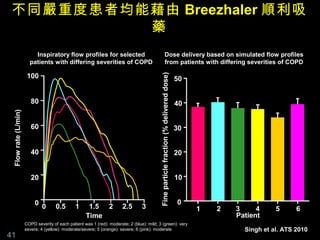
不同嚴重度患者均能藉由 Breezhaler 順利吸
藥
Inspiratory flow profiles for selected Dose delivery based on simulated flow profiles
patients with differing severities of COPD from patients with differing severities of COPD
100
Fine particle fraction (% delivered dose)
50
80 40
Flow rate (L/min)
60 30
40 20
20 10
0 0 0
0.5 1 1.5 2 2.5 3 1 2 3 4 5 6
Time Patient
COPD severity of each patient was 1 (red): moderate; 2 (blue): mild; 3 (green): very
severe; 4 (yellow): moderate/severe; 5 (orange): severe; 6 (pink): moderate Singh et al. ATS 2010
41
43.
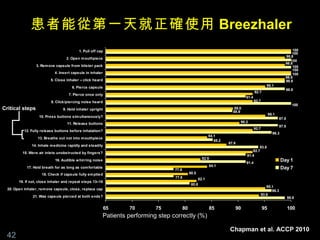
患者能從第一天就正確使用 Breezhaler
1. Pull off cap 100
100
98.8
2. Open m outhpiece
100
98.8
3. Remove capsule from blister pack 100
100
4. Insert capsule in inhaler 100
98.8
5. Close inhaler – click heard 98.8
6. Pierce capsule 95.1
98.8
92.7
7. Pierce once only
91.4
8. Click/piercing noise heard 92.7
100
Critical steps 9. Hold inhaler upright 89.0
88.9
95.1
10. Press buttons sim ultaneously?
97.5
11. Release buttons 90.2
97.5
92.7
12. Fully release buttons before inhalation?
96.3
84.1
13. Breathe out not into mouthpiece
85.2
87.8
14. Inhale m edicine rapidly and steadily 93.8
92.7
15. Were air inlets unobstructed by fingers?
91.4
82.9
16. Audible w hirring noise
91.4
Day 1
84.1
17. Hold breath for as long as com fortable
77.8 Day 7
18. Check if capsule fully em ptied 80.5
77.8 82.1
19. If not, close inhaler and repeat steps 13–18
80.8
95.1
20. Open inhaler, rem ove capsule, close, replace cap 96.3
21. Was capsule pierced at both ends? 93.9
98.8
65 70 75 80 85 90 95 100
Patients performing step correctly (%)
Chapman et al. ACCP 2010
42