Pathogenesis of HCM Types of HCM Signs and symptoms of HCM Diagnosis of HCM Overview of treatment of HCM ZOMETA™ (zoledronic acid for injection) Overview of hypercalcemia  of malignancy (HCM)
Pathogenesis of HCM Mechanisms of HCM 1   Increased bone destruction Increased tubular reabsorption of calcium by the kidney Decreased urinary calcium excretion Decrease in bone formation 1.  Fleisch H.  In:  Bisphosphonates in Bone Disease.   San Diego, California:  Academic Press;  2000;90-92.
Pathogenesis of HCM Factors involved in HCM 1,2 PTHrP Bone-resorbing cytokines (TGFs, TNFs, IL-1) 1,25 (OH) 2  D Prostaglandins 1.  Mundy GR. (ed).  Bone Remodeling and Its Disorders .  2nd ed. London, England: Martin Dunitz Ltd; 1999;107-122.  2.  Mundy GR.  Hosp Pract .   1999;81–94.
Factors involved in HCM Parathyroid hormone-related protein (PTHrP)  Produced by tumor cells 1,2 Stimulates vicious cycle of osteoclastic bone resorption  contributing to HCM 1,2 Also stimulates increased renal tubular calcium resorption 1,3 1. Goltzman D, Kremer R, Rabbani SA.  Molecular basis of the spectrum of skeletal complications of malignancy.  Abstract presented at the Second North American Symposium on Skeletal Complications of Malignancy.  October 15–16, 1999;  Montréal, Canada.  2.  Guise TA.  Molecular mechanisms of osteolytic metastases.  Abstract presented at the Second North American Symposium on Skeletal Complications of Malignancy.  October 15–16, 1999;  Montréal, Canada.  3.  Mundy GR (ed).  Bone Remodeling and Its Disorders .  London, England:  Martin Dunitz Ltd;  1989;113-119.
Factors involved in HCM Bone-resorbing cytokines  Four types exhibit potent bone-resorbing activity Transforming growth factors (TGF-   and TGF-  ) 1 Tumor necrosis factors (TNF-   and TNF-  ) 2,3   Colony-stimulating factors (CSFs) 2 Interleukins 4 1.  Todaro GJ, Fryling D, DeLarco JE.  Proc Natl Acad Sci USA.   1980;77:5258-5262.  2.  Mundy GR (ed).  Bone Remodeling and Its Disorders.  London, England:  Martin Dunitz Ltd; 1989;45-82;  113-119.  3.  Mundy GR.  Endocrinol Metab Clin North Am.   1989;18:795-806.  4.  Kelly PJ, Eisman JA.  Cancer Metastasis Rev.  1989;8:23-52.
Factors involved in HCM 1,25 (OH) 2  D 1 Increased production by tumor cells leads to HCM Increased production leads to increased serum calcium levels via Recruitment of osteoclast precursors Production of osteoclast-stimulating factors from osteoblasts 1.   Mundy GR. (ed).  Bone Remodeling and Its Disorders .  2nd ed. London, England: Martin Dunitz Ltd; 1989;45–82; 113-119.
Factors involved in HCM Prostaglandins  Involved in regulatory functions throughout the body Associated with pain and inflammation Role in HCM is unclear Possible bidirectional effect on osteoclasts 1 transient effect to slow bone resorption sustained effect to increase bone resorption Could be produced by host immune cells in response to tumor 1.  Mundy GR (ed).  Bone Remodeling and Its Disorders . 2nd ed. London, England: Martin Dunitz Ltd; 1999;56-59, 118.
Types of HCM Humoral hypercalcemia of malignancy Local osteolytic hypercalcemia associated with bone metastases Hypercalcemia associated with hematologic malignancies
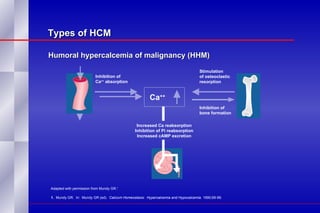
Types of HCM Humoral hypercalcemia of malignancy (HHM) 1.   Mundy GR.  In:  Mundy GR (ed).  Calcium Homeostasis:  Hypercalcemia and Hypocalcemia.  1990;69-99. Adapted with permission from Mundy GR. 1 Increased Ca reabsorption Inhibition of Pi reabsorption Increased cAMP excretion Inhibition of  Ca ++  absorption Stimulation  of osteoclastic  resorption Inhibition of  bone formation Ca ++
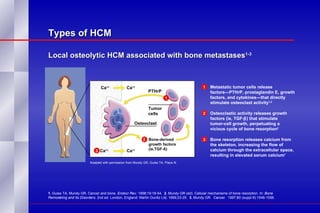
Types of HCM Local osteolytic HCM associated with bone metastases 1-3 1.  Guise TA, Mundy GR. Cancer and bone.  Endocr Rev.  1998;19:18-54.  2.  Mundy GR (ed). Cellular mechanisms of bone resorption. In:  Bone Remodeling and Its Disorders . 2nd ed. London, England: Martin Dunitz Ltd; 1999;23-25.  3.  Mundy GR.  Cancer.   1997;80 (suppl 8):1546-1556. 1 Metastatic tumor cells release  factors—PTHrP, prostaglandin E, growth  factors, and cytokines—that directly  stimulate osteoclast activity 1,2 2 Osteoclastic activity releases growth  factors (ie, TGF-  ) that stimulate  tumor-cell growth, perpetuating a  vicious cycle of bone resorption 2 3 Bone resorption releases calcium from  the skeleton, increasing the flow of  calcium through the extracellular space,  resulting in elevated serum calcium 1 PTHrP Tumor cells Ca ++ Ca ++ Ca ++ Osteoclast 2 Bone-derived  growth factors  (ie,TGF-ß) 3  Ca ++ 1 Adapted with permission from Mundy GR, Guise TA, Place N.
Types of HCM Hypercalcemia associated with hematologic malignancies HCM in multiple myeloma Extensive destruction of bone adjacent to myeloma cells Impaired glomerular filtration and excessive calcium load  exacerbate hypercalcemia HCM in malignant lymphomas and leukemia Possibly mediated by tumor-produced factors that have  bone-resorbing activity
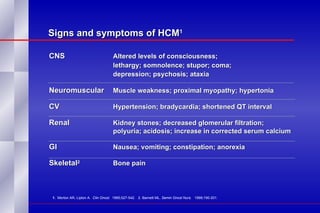
Signs and symptoms of HCM 1 1.   Morton AR, Lipton A.  Clin Oncol.   1995;527-542.  2. Barnett ML.  Semin Oncol Nurs.  1999;190-201. CNS Altered levels of consciousness;  lethargy; somnolence; stupor; coma;  depression; psychosis; ataxia Neuromuscular   Muscle weakness; proximal myopathy; hypertonia CV   Hypertension; bradycardia; shortened QT interval Renal   Kidney stones; decreased glomerular filtration;  polyuria; acidosis; increase in corrected serum calcium GI   Nausea; vomiting; constipation; anorexia Skeletal 2   Bone pain
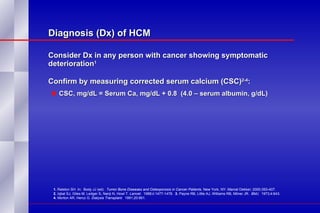
Diagnosis (Dx) of HCM Consider Dx in any person with cancer showing symptomatic deterioration 1 Confirm by measuring corrected serum calcium (CSC) 2-4 : CSC, mg/dL = Serum Ca, mg/dL + 0.8  (4.0 – serum albumin, g/dL) 1.  Ralston SH. In:  Body JJ (ed).  Tumor Bone Diseases and Osteoporosis in Cancer Patients.  New York, NY: Marcel Dekker; 2000;393-407.  2.  Iqbal SJ, Giles M, Ledger S, Nanji N, Howl T.  Lancet .  1988;ii:1477-1478.  3.  Payne RB, Little AJ, Williams RB, Milner JR.  BMJ .  1973;4:643.  4.  Morton AR, Hercz G.  Dialysis Transplant.  1991;20:661.
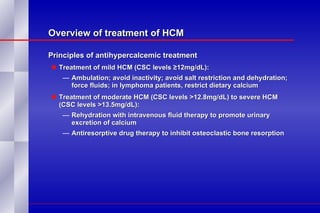
Overview of treatment of HCM Principles of antihypercalcemic treatment Treatment of mild HCM (CSC levels ≥12mg/dL):  Ambulation; avoid inactivity; avoid salt restriction and dehydration; force fluids; in lymphoma patients, restrict dietary calcium Treatment of moderate HCM (CSC levels >12.8mg/dL) to severe HCM (CSC levels >13.5mg/dL):  Rehydration with intravenous fluid therapy to promote urinary excretion of calcium Antiresorptive drug therapy to inhibit osteoclastic bone resorption
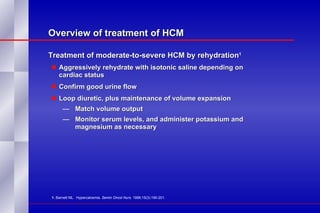
Overview of treatment of HCM Treatment of moderate-to-severe HCM by rehydration 1   Aggressively rehydrate with isotonic saline depending on  cardiac status Confirm good urine flow Loop diuretic, plus maintenance of volume expansion Match volume output Monitor serum levels, and administer potassium and  magnesium as necessary 1.  Barnett ML.  Hypercalcemia.  Semin Oncol Nurs . 1999;15(3):190-201.
Overview of treatment of HCM Treatment of moderate-to-severe HCM by antiresorptive therapy  Salmon calcitonin Gallium nitrate IV bisphosphonate: Pamidronate disodium for injection:  4-to-24-hour infusion ZOMETA™ (zoledronic acid for injection): 15-minute infusion
Treatment of moderate-to-severe HCM by antiresorptive therapy Salmon calcitonin 1   Mechanism of action Antiosteoclast Calciuric effect Dosage/route:  4–8 IU/kg IM or SC q6–12h Side effects  Nausea Vomiting Skin rashes Allergic reactions 1.   Mundy GR, Martin TJ.  Metabolism.   1982;31(12):1247-1277.
Treatment of moderate-to-severe HCM by antiresorptive therapy Gallium nitrate 1   Mechanism of action Stabilizes bone crystal No morphologic cellular changes Dosage/route 200 mg/m 2  body surface/day IV for 5 days Side effects Nephrotoxicity (hydrate, avoid aminoglycosides) Mild alkalosis Contraindications Renal insufficiency 1.  Warrel RP Jr.  Gallium nitrate and bone metastases.  In:  Body JJ (ed).  Tumor Bone Diseases and Osteoporosis in Cancer Patients.  New York, NY:  Marcel Dekker; 2000;483-492.
Treatment of moderate-to-severe HCM by antiresorptive therapy IV bisphosphonates for HCM  The treatment of choice for HCM for reducing or  inhibiting osteoclastic activity Available IV bisphosphonates for HCM: Pamidronate disodium for injection ZOMETA™ (zoledronic acid for injection)
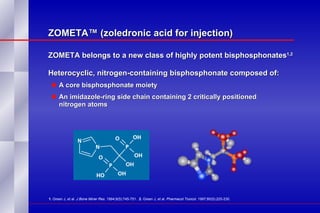
ZOMETA™ (zoledronic acid for injection) ZOMETA belongs to a new class of highly potent bisphosphonates 1,2 Heterocyclic, nitrogen-containing bisphosphonate composed of: A core bisphosphonate moiety  An imidazole-ring side chain containing 2 critically positioned  nitrogen atoms  1.  Green J, et al.  J   Bone Miner Res . 1994;9(5):745-751.  2.  Green J, et al.  Pharmacol Toxicol.  1997;80(5):225-230.
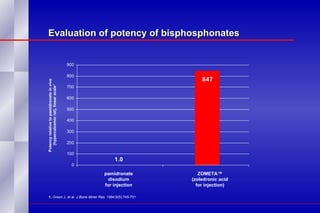
Evaluation of potency of bisphosphonates Potency relative to pamidronate  in vivo   (hypercalcemic rat), linear scale 1 1.  Green J, et al.  J   Bone Miner Res . 1994;9(5):745-751. pamidronate disodium for injection ZOMETA™ (zoledronic acid for injection)
ZOMETA™ (zoledronic acid for injection) — mechanisms of action ZOMETA reduces bone resorption by potently inhibiting  osteoclast hyperactivity Proposed mechanisms of action include: Functional suppression of mature osteoclast 1 Inhibition of osteoclast maturation 2 Inhibition of osteoclast recruitment to the site 2 Reduction in the production of cytokines, eg, IL-1, IL-6 3 Inhibition of tumor-cell invasion and adhesion to  bone matrix 4,5 1.  Green J, et al.  J Bone Miner Res.  1994;9(5):745-751.  2.  Evans CE, Braidman IP.  Bone Miner.  1994;26:95-107.  3.  Derenne S, et al.  J Bone Miner Res.  1999;14:2048-2056.  4.  Boissier S, et al.  Cancer Res.  2000;60:2949-2954.  5.  Marion G, et al.  Bone . 1998;33:S379.
ZOMETA™ (zoledronic acid for injection)— product summary Nitrogen-containing bisphosphonates are more potent inhibitors of bone resorption ZOMETA has 2 nitrogens in an imidazole side-ring and  is the most potent bisphosphonate Zoledronic acid is a 100 to 850 times more potent inhibitor of osteoclasts than pamidronate
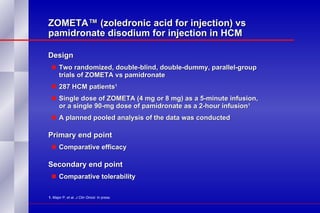
ZOMETA™ (zoledronic acid for injection) vs pamidronate disodium for injection in HCM Design Two randomized, double-blind, double-dummy, parallel-group  trials of ZOMETA vs pamidronate 287 HCM patients 1 Single dose of ZOMETA (4 mg or 8 mg) as a 5-minute infusion,  or a single 90-mg dose of pamidronate as a 2-hour infusion 1 A planned pooled analysis of the data was conducted Primary end point  Comparative efficacy Secondary end point Comparative tolerability 1.  Major P, et al.  J Clin Oncol.  In press.
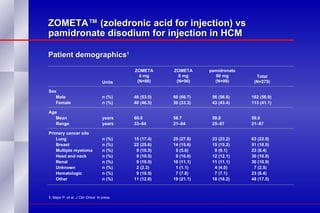
ZOMETA™ (zoledronic acid for injection) vs pamidronate disodium for injection in HCM Patient demographics 1 1.  Major P, et al.  J Clin Oncol.  In press.   Sex Male n (%) 46 (53.5) 60 (66.7) 56 (56.6)  162 (58.9) Female n (%)  40 (46.5) 30 (33.3)  43 (43.4) 113 (41.1)  Age Mean years 60.0  58.7  59.0 59.0 Range years 33–84  21–84  25–87 21–87  Primary cancer site Lung  n (%)  15 (17.4)  25 (27.8)  23 (23.2)  63 (22.9) Breast n (%) 22 (25.6)  14 (15.6)  15 (15.2)  51 (18.5) Multiple myeloma  n (%)    9 (10.5)    5 (5.6)    9 (9.1)  23 (8.4) Head and neck  n (%)    9 (10.5)    9 (10.0)  12 (12.1)  30 (10.9) Renal n (%)   9 (10.5)  10 (11.1)  11 (11.1)  30 (10.9) Unknown  n (%)   2 (2.3)   1 (1.1)    4 (4.0)    7 (2.5) Hematologic  n (%)    9 (10.5)    7 (7.8)   7 (7.1)  23 (8.4) Other n (%) 11 (12.8)  19 (21.1)  18 (18.2)  48 (17.5) ZOMETA 4 mg (N=86) ZOMETA 8 mg (N=90) pamidronate 90 mg (N=99) Total (N=275) Units
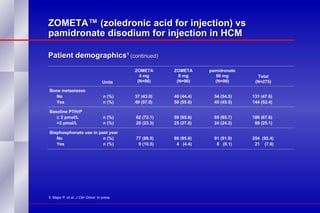
ZOMETA™ (zoledronic acid for injection) vs pamidronate disodium for injection in HCM Patient demographics 1  (continued) 1.  Major P, et al.  J Clin Oncol.  In press.   Bone metastases No n (%) 37 (43.0)  40 (44.4)   54 (54.5)  131 (47.6) Yes n (%)  49 (57.0)  50 (55.6)   45 (45.5)  144 (52.4) Baseline PTHrP    2 pmol/L n (%)   62 (72.1)  59 (65.6)   65 (65.7)  186 (67.6) >2 pmol/L  n (%)   20 (23.3)  25 (27.8)   24 (24.2)    69 (25.1) Bisphosphonate use in past year No n (%)   77 (89.5)  86 (95.6)   91 (91.9)  254  (92.4) Yes  n (%)    9 (10.5)    4  (4.4)    8  (8.1)    21  (7.6) ZOMETA 4 mg (N=86) ZOMETA 8 mg (N=90) pamidronate 90 mg (N=99) Total (N=275) Units
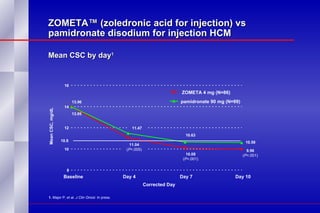
ZOMETA™ (zoledronic acid for injection) vs pamidronate disodium for injection HCM Mean CSC by day 1 1.  Major P, et al.  J Clin Oncol.  In press.   13.95 11.04 ( P =.005) 10.08 ( P =.001) 9.96 ( P =.001) 13.96 11.47 10.63 10.59 8 10 12 14 16 Baseline Day 4 Day 7 Day 10 Corrected Day ZOMETA 4 mg (N=86) pamidronate 90 mg (N=99) 10.8 Mean CSC, mg/dL
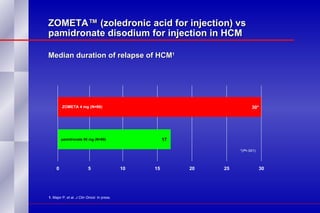
ZOMETA™ (zoledronic acid for injection) vs pamidronate disodium for injection in HCM Median duration of relapse of HCM 1 1.  Major P, et al.  J Clin Oncol.  In press.   *( P =.001) 5 10 15 20 25 0 30 17 pamidronate 90 mg (N=99) 30* ZOMETA 4 mg (N=86)
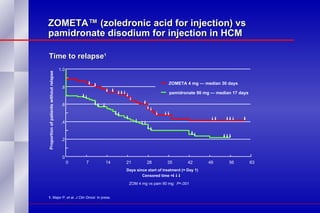
ZOMETA™ (zoledronic acid for injection) vs pamidronate disodium for injection in HCM Time to relapse 1 ZOM 4 mg vs pam 90 mg:  P =.001 0 .2 .4 .6 .8 1.0 Days since start of treatment (= Day 1) Censored time = 0 7 14 21 28 35 42 49 56 63 ZOMETA 4 mg — median 30 days pamidronate 90 mg — median 17 days Proportion of patients without relapse 1.  Major P, et al.  J Clin Oncol.  In press.
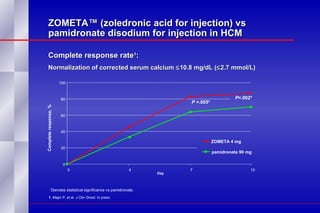
ZOMETA™ (zoledronic acid for injection) vs pamidronate disodium for injection in HCM Complete response rate 1 : Normalization of corrected serum calcium   10.8 mg/dL (  2.7 mmol/L) *  Denotes statistical significance vs pamidronate.  0 20 40 60 80 100 0 4 7 10 Day ZOMETA 4 mg pamidronate 90 mg P =.002* P =.005* Complete response, % 1.  Major P, et al.  J Clin Oncol.  In press.
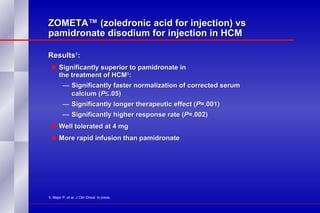
ZOMETA™ (zoledronic acid for injection) vs pamidronate disodium for injection in HCM Results 1 : Significantly superior to pamidronate in the treatment of HCM 1 : Significantly faster normalization of corrected serum calcium ( P  .05)  Significantly longer therapeutic effect ( P =.001) Significantly higher response rate ( P =.002) Well tolerated at 4 mg More rapid infusion than pamidronate 1.  Major P, et al.  J Clin Oncol.  In press.
ZOMETA™ (zoledronic acid for injection) vs pamidronate disodium for injection in HCM Summary—ZOMETA Highly effective in the treatment of HCM ZOMETA 4 mg was more effective than pamidronate 90 mg 4-mg dose is recommended
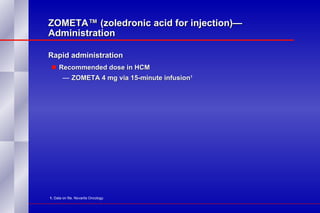
ZOMETA™ (zoledronic acid for injection)— Administration Rapid administration Recommended dose in HCM  ZOMETA 4 mg via 15-minute infusion 1   1.  Data on file. Novartis Oncology.
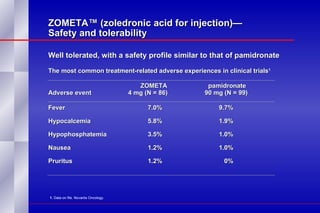
ZOMETA™ (zoledronic acid for injection)— Safety and tolerability Well tolerated, with a safety profile similar to that of pamidronate The most common treatment-related adverse experiences in clinical trials 1   ZOMETA    pamidronate Adverse event  4 mg (N = 86)  90 mg (N = 99) Fever 7.0% 9.7% Hypocalcemia 5.8% 1.9% Hypophosphatemia 3.5% 1.0% Nausea 1.2% 1.0% Pruritus 1.2%   0% 1.  Data on file. Novartis Oncology.
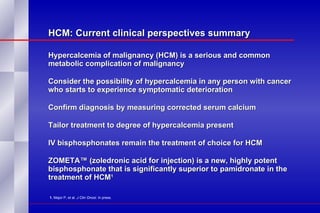
HCM: Current clinical perspectives summary Hypercalcemia of malignancy (HCM) is a serious and common metabolic complication of malignancy Consider the possibility of hypercalcemia in any person with cancer who starts to experience symptomatic deterioration Confirm diagnosis by measuring corrected serum calcium Tailor treatment to degree of hypercalcemia present IV bisphosphonates remain the treatment of choice for HCM ZOMETA™ (zoledronic acid for injection) is a new, highly potent bisphosphonate that is significantly superior to pamidronate in the treatment of HCM 1 1.  Major P, et al.  J Clin Oncol.  In press.

Zometa Hcm Slide Kit

  • 1.
  • 2.
    Pathogenesis of HCMTypes of HCM Signs and symptoms of HCM Diagnosis of HCM Overview of treatment of HCM ZOMETA™ (zoledronic acid for injection) Overview of hypercalcemia of malignancy (HCM)
  • 3.
    Pathogenesis of HCMMechanisms of HCM 1 Increased bone destruction Increased tubular reabsorption of calcium by the kidney Decreased urinary calcium excretion Decrease in bone formation 1. Fleisch H. In: Bisphosphonates in Bone Disease. San Diego, California: Academic Press; 2000;90-92.
  • 4.
    Pathogenesis of HCMFactors involved in HCM 1,2 PTHrP Bone-resorbing cytokines (TGFs, TNFs, IL-1) 1,25 (OH) 2 D Prostaglandins 1. Mundy GR. (ed). Bone Remodeling and Its Disorders . 2nd ed. London, England: Martin Dunitz Ltd; 1999;107-122. 2. Mundy GR. Hosp Pract . 1999;81–94.
  • 5.
    Factors involved inHCM Parathyroid hormone-related protein (PTHrP) Produced by tumor cells 1,2 Stimulates vicious cycle of osteoclastic bone resorption contributing to HCM 1,2 Also stimulates increased renal tubular calcium resorption 1,3 1. Goltzman D, Kremer R, Rabbani SA. Molecular basis of the spectrum of skeletal complications of malignancy. Abstract presented at the Second North American Symposium on Skeletal Complications of Malignancy. October 15–16, 1999; Montréal, Canada. 2. Guise TA. Molecular mechanisms of osteolytic metastases. Abstract presented at the Second North American Symposium on Skeletal Complications of Malignancy. October 15–16, 1999; Montréal, Canada. 3. Mundy GR (ed). Bone Remodeling and Its Disorders . London, England: Martin Dunitz Ltd; 1989;113-119.
  • 6.
    Factors involved inHCM Bone-resorbing cytokines Four types exhibit potent bone-resorbing activity Transforming growth factors (TGF-  and TGF-  ) 1 Tumor necrosis factors (TNF-  and TNF-  ) 2,3 Colony-stimulating factors (CSFs) 2 Interleukins 4 1. Todaro GJ, Fryling D, DeLarco JE. Proc Natl Acad Sci USA. 1980;77:5258-5262. 2. Mundy GR (ed). Bone Remodeling and Its Disorders. London, England: Martin Dunitz Ltd; 1989;45-82; 113-119. 3. Mundy GR. Endocrinol Metab Clin North Am. 1989;18:795-806. 4. Kelly PJ, Eisman JA. Cancer Metastasis Rev. 1989;8:23-52.
  • 7.
    Factors involved inHCM 1,25 (OH) 2 D 1 Increased production by tumor cells leads to HCM Increased production leads to increased serum calcium levels via Recruitment of osteoclast precursors Production of osteoclast-stimulating factors from osteoblasts 1. Mundy GR. (ed). Bone Remodeling and Its Disorders . 2nd ed. London, England: Martin Dunitz Ltd; 1989;45–82; 113-119.
  • 8.
    Factors involved inHCM Prostaglandins Involved in regulatory functions throughout the body Associated with pain and inflammation Role in HCM is unclear Possible bidirectional effect on osteoclasts 1 transient effect to slow bone resorption sustained effect to increase bone resorption Could be produced by host immune cells in response to tumor 1. Mundy GR (ed). Bone Remodeling and Its Disorders . 2nd ed. London, England: Martin Dunitz Ltd; 1999;56-59, 118.
  • 9.
    Types of HCMHumoral hypercalcemia of malignancy Local osteolytic hypercalcemia associated with bone metastases Hypercalcemia associated with hematologic malignancies
  • 10.
    Types of HCMHumoral hypercalcemia of malignancy (HHM) 1. Mundy GR. In: Mundy GR (ed). Calcium Homeostasis: Hypercalcemia and Hypocalcemia. 1990;69-99. Adapted with permission from Mundy GR. 1 Increased Ca reabsorption Inhibition of Pi reabsorption Increased cAMP excretion Inhibition of Ca ++ absorption Stimulation of osteoclastic resorption Inhibition of bone formation Ca ++
  • 11.
    Types of HCMLocal osteolytic HCM associated with bone metastases 1-3 1. Guise TA, Mundy GR. Cancer and bone. Endocr Rev. 1998;19:18-54. 2. Mundy GR (ed). Cellular mechanisms of bone resorption. In: Bone Remodeling and Its Disorders . 2nd ed. London, England: Martin Dunitz Ltd; 1999;23-25. 3. Mundy GR. Cancer. 1997;80 (suppl 8):1546-1556. 1 Metastatic tumor cells release factors—PTHrP, prostaglandin E, growth factors, and cytokines—that directly stimulate osteoclast activity 1,2 2 Osteoclastic activity releases growth factors (ie, TGF-  ) that stimulate tumor-cell growth, perpetuating a vicious cycle of bone resorption 2 3 Bone resorption releases calcium from the skeleton, increasing the flow of calcium through the extracellular space, resulting in elevated serum calcium 1 PTHrP Tumor cells Ca ++ Ca ++ Ca ++ Osteoclast 2 Bone-derived growth factors (ie,TGF-ß) 3 Ca ++ 1 Adapted with permission from Mundy GR, Guise TA, Place N.
  • 12.
    Types of HCMHypercalcemia associated with hematologic malignancies HCM in multiple myeloma Extensive destruction of bone adjacent to myeloma cells Impaired glomerular filtration and excessive calcium load exacerbate hypercalcemia HCM in malignant lymphomas and leukemia Possibly mediated by tumor-produced factors that have bone-resorbing activity
  • 13.
    Signs and symptomsof HCM 1 1. Morton AR, Lipton A. Clin Oncol. 1995;527-542. 2. Barnett ML. Semin Oncol Nurs. 1999;190-201. CNS Altered levels of consciousness; lethargy; somnolence; stupor; coma; depression; psychosis; ataxia Neuromuscular Muscle weakness; proximal myopathy; hypertonia CV Hypertension; bradycardia; shortened QT interval Renal Kidney stones; decreased glomerular filtration; polyuria; acidosis; increase in corrected serum calcium GI Nausea; vomiting; constipation; anorexia Skeletal 2 Bone pain
  • 14.
    Diagnosis (Dx) ofHCM Consider Dx in any person with cancer showing symptomatic deterioration 1 Confirm by measuring corrected serum calcium (CSC) 2-4 : CSC, mg/dL = Serum Ca, mg/dL + 0.8 (4.0 – serum albumin, g/dL) 1. Ralston SH. In: Body JJ (ed). Tumor Bone Diseases and Osteoporosis in Cancer Patients. New York, NY: Marcel Dekker; 2000;393-407. 2. Iqbal SJ, Giles M, Ledger S, Nanji N, Howl T. Lancet . 1988;ii:1477-1478. 3. Payne RB, Little AJ, Williams RB, Milner JR. BMJ . 1973;4:643. 4. Morton AR, Hercz G. Dialysis Transplant. 1991;20:661.
  • 15.
    Overview of treatmentof HCM Principles of antihypercalcemic treatment Treatment of mild HCM (CSC levels ≥12mg/dL): Ambulation; avoid inactivity; avoid salt restriction and dehydration; force fluids; in lymphoma patients, restrict dietary calcium Treatment of moderate HCM (CSC levels >12.8mg/dL) to severe HCM (CSC levels >13.5mg/dL): Rehydration with intravenous fluid therapy to promote urinary excretion of calcium Antiresorptive drug therapy to inhibit osteoclastic bone resorption
  • 16.
    Overview of treatmentof HCM Treatment of moderate-to-severe HCM by rehydration 1 Aggressively rehydrate with isotonic saline depending on cardiac status Confirm good urine flow Loop diuretic, plus maintenance of volume expansion Match volume output Monitor serum levels, and administer potassium and magnesium as necessary 1. Barnett ML. Hypercalcemia. Semin Oncol Nurs . 1999;15(3):190-201.
  • 17.
    Overview of treatmentof HCM Treatment of moderate-to-severe HCM by antiresorptive therapy Salmon calcitonin Gallium nitrate IV bisphosphonate: Pamidronate disodium for injection: 4-to-24-hour infusion ZOMETA™ (zoledronic acid for injection): 15-minute infusion
  • 18.
    Treatment of moderate-to-severeHCM by antiresorptive therapy Salmon calcitonin 1 Mechanism of action Antiosteoclast Calciuric effect Dosage/route: 4–8 IU/kg IM or SC q6–12h Side effects Nausea Vomiting Skin rashes Allergic reactions 1. Mundy GR, Martin TJ. Metabolism. 1982;31(12):1247-1277.
  • 19.
    Treatment of moderate-to-severeHCM by antiresorptive therapy Gallium nitrate 1 Mechanism of action Stabilizes bone crystal No morphologic cellular changes Dosage/route 200 mg/m 2 body surface/day IV for 5 days Side effects Nephrotoxicity (hydrate, avoid aminoglycosides) Mild alkalosis Contraindications Renal insufficiency 1. Warrel RP Jr. Gallium nitrate and bone metastases. In: Body JJ (ed). Tumor Bone Diseases and Osteoporosis in Cancer Patients. New York, NY: Marcel Dekker; 2000;483-492.
  • 20.
    Treatment of moderate-to-severeHCM by antiresorptive therapy IV bisphosphonates for HCM The treatment of choice for HCM for reducing or inhibiting osteoclastic activity Available IV bisphosphonates for HCM: Pamidronate disodium for injection ZOMETA™ (zoledronic acid for injection)
  • 21.
    ZOMETA™ (zoledronic acidfor injection) ZOMETA belongs to a new class of highly potent bisphosphonates 1,2 Heterocyclic, nitrogen-containing bisphosphonate composed of: A core bisphosphonate moiety An imidazole-ring side chain containing 2 critically positioned nitrogen atoms 1. Green J, et al. J Bone Miner Res . 1994;9(5):745-751. 2. Green J, et al. Pharmacol Toxicol. 1997;80(5):225-230.
  • 22.
    Evaluation of potencyof bisphosphonates Potency relative to pamidronate in vivo (hypercalcemic rat), linear scale 1 1. Green J, et al. J Bone Miner Res . 1994;9(5):745-751. pamidronate disodium for injection ZOMETA™ (zoledronic acid for injection)
  • 23.
    ZOMETA™ (zoledronic acidfor injection) — mechanisms of action ZOMETA reduces bone resorption by potently inhibiting osteoclast hyperactivity Proposed mechanisms of action include: Functional suppression of mature osteoclast 1 Inhibition of osteoclast maturation 2 Inhibition of osteoclast recruitment to the site 2 Reduction in the production of cytokines, eg, IL-1, IL-6 3 Inhibition of tumor-cell invasion and adhesion to bone matrix 4,5 1. Green J, et al. J Bone Miner Res. 1994;9(5):745-751. 2. Evans CE, Braidman IP. Bone Miner. 1994;26:95-107. 3. Derenne S, et al. J Bone Miner Res. 1999;14:2048-2056. 4. Boissier S, et al. Cancer Res. 2000;60:2949-2954. 5. Marion G, et al. Bone . 1998;33:S379.
  • 24.
    ZOMETA™ (zoledronic acidfor injection)— product summary Nitrogen-containing bisphosphonates are more potent inhibitors of bone resorption ZOMETA has 2 nitrogens in an imidazole side-ring and is the most potent bisphosphonate Zoledronic acid is a 100 to 850 times more potent inhibitor of osteoclasts than pamidronate
  • 25.
    ZOMETA™ (zoledronic acidfor injection) vs pamidronate disodium for injection in HCM Design Two randomized, double-blind, double-dummy, parallel-group trials of ZOMETA vs pamidronate 287 HCM patients 1 Single dose of ZOMETA (4 mg or 8 mg) as a 5-minute infusion, or a single 90-mg dose of pamidronate as a 2-hour infusion 1 A planned pooled analysis of the data was conducted Primary end point Comparative efficacy Secondary end point Comparative tolerability 1. Major P, et al. J Clin Oncol. In press.
  • 26.
    ZOMETA™ (zoledronic acidfor injection) vs pamidronate disodium for injection in HCM Patient demographics 1 1. Major P, et al. J Clin Oncol. In press. Sex Male n (%) 46 (53.5) 60 (66.7) 56 (56.6) 162 (58.9) Female n (%) 40 (46.5) 30 (33.3) 43 (43.4) 113 (41.1) Age Mean years 60.0 58.7 59.0 59.0 Range years 33–84 21–84 25–87 21–87 Primary cancer site Lung n (%) 15 (17.4) 25 (27.8) 23 (23.2) 63 (22.9) Breast n (%) 22 (25.6) 14 (15.6) 15 (15.2) 51 (18.5) Multiple myeloma n (%) 9 (10.5) 5 (5.6) 9 (9.1) 23 (8.4) Head and neck n (%) 9 (10.5) 9 (10.0) 12 (12.1) 30 (10.9) Renal n (%) 9 (10.5) 10 (11.1) 11 (11.1) 30 (10.9) Unknown n (%) 2 (2.3) 1 (1.1) 4 (4.0) 7 (2.5) Hematologic n (%) 9 (10.5) 7 (7.8) 7 (7.1) 23 (8.4) Other n (%) 11 (12.8) 19 (21.1) 18 (18.2) 48 (17.5) ZOMETA 4 mg (N=86) ZOMETA 8 mg (N=90) pamidronate 90 mg (N=99) Total (N=275) Units
  • 27.
    ZOMETA™ (zoledronic acidfor injection) vs pamidronate disodium for injection in HCM Patient demographics 1 (continued) 1. Major P, et al. J Clin Oncol. In press. Bone metastases No n (%) 37 (43.0) 40 (44.4) 54 (54.5) 131 (47.6) Yes n (%) 49 (57.0) 50 (55.6) 45 (45.5) 144 (52.4) Baseline PTHrP  2 pmol/L n (%) 62 (72.1) 59 (65.6) 65 (65.7) 186 (67.6) >2 pmol/L n (%) 20 (23.3) 25 (27.8) 24 (24.2) 69 (25.1) Bisphosphonate use in past year No n (%) 77 (89.5) 86 (95.6) 91 (91.9) 254 (92.4) Yes n (%) 9 (10.5) 4 (4.4) 8 (8.1) 21 (7.6) ZOMETA 4 mg (N=86) ZOMETA 8 mg (N=90) pamidronate 90 mg (N=99) Total (N=275) Units
  • 28.
    ZOMETA™ (zoledronic acidfor injection) vs pamidronate disodium for injection HCM Mean CSC by day 1 1. Major P, et al. J Clin Oncol. In press. 13.95 11.04 ( P =.005) 10.08 ( P =.001) 9.96 ( P =.001) 13.96 11.47 10.63 10.59 8 10 12 14 16 Baseline Day 4 Day 7 Day 10 Corrected Day ZOMETA 4 mg (N=86) pamidronate 90 mg (N=99) 10.8 Mean CSC, mg/dL
  • 29.
    ZOMETA™ (zoledronic acidfor injection) vs pamidronate disodium for injection in HCM Median duration of relapse of HCM 1 1. Major P, et al. J Clin Oncol. In press. *( P =.001) 5 10 15 20 25 0 30 17 pamidronate 90 mg (N=99) 30* ZOMETA 4 mg (N=86)
  • 30.
    ZOMETA™ (zoledronic acidfor injection) vs pamidronate disodium for injection in HCM Time to relapse 1 ZOM 4 mg vs pam 90 mg: P =.001 0 .2 .4 .6 .8 1.0 Days since start of treatment (= Day 1) Censored time = 0 7 14 21 28 35 42 49 56 63 ZOMETA 4 mg — median 30 days pamidronate 90 mg — median 17 days Proportion of patients without relapse 1. Major P, et al. J Clin Oncol. In press.
  • 31.
    ZOMETA™ (zoledronic acidfor injection) vs pamidronate disodium for injection in HCM Complete response rate 1 : Normalization of corrected serum calcium  10.8 mg/dL (  2.7 mmol/L) * Denotes statistical significance vs pamidronate. 0 20 40 60 80 100 0 4 7 10 Day ZOMETA 4 mg pamidronate 90 mg P =.002* P =.005* Complete response, % 1. Major P, et al. J Clin Oncol. In press.
  • 32.
    ZOMETA™ (zoledronic acidfor injection) vs pamidronate disodium for injection in HCM Results 1 : Significantly superior to pamidronate in the treatment of HCM 1 : Significantly faster normalization of corrected serum calcium ( P  .05) Significantly longer therapeutic effect ( P =.001) Significantly higher response rate ( P =.002) Well tolerated at 4 mg More rapid infusion than pamidronate 1. Major P, et al. J Clin Oncol. In press.
  • 33.
    ZOMETA™ (zoledronic acidfor injection) vs pamidronate disodium for injection in HCM Summary—ZOMETA Highly effective in the treatment of HCM ZOMETA 4 mg was more effective than pamidronate 90 mg 4-mg dose is recommended
  • 34.
    ZOMETA™ (zoledronic acidfor injection)— Administration Rapid administration Recommended dose in HCM ZOMETA 4 mg via 15-minute infusion 1 1. Data on file. Novartis Oncology.
  • 35.
    ZOMETA™ (zoledronic acidfor injection)— Safety and tolerability Well tolerated, with a safety profile similar to that of pamidronate The most common treatment-related adverse experiences in clinical trials 1 ZOMETA pamidronate Adverse event 4 mg (N = 86) 90 mg (N = 99) Fever 7.0% 9.7% Hypocalcemia 5.8% 1.9% Hypophosphatemia 3.5% 1.0% Nausea 1.2% 1.0% Pruritus 1.2% 0% 1. Data on file. Novartis Oncology.
  • 36.
    HCM: Current clinicalperspectives summary Hypercalcemia of malignancy (HCM) is a serious and common metabolic complication of malignancy Consider the possibility of hypercalcemia in any person with cancer who starts to experience symptomatic deterioration Confirm diagnosis by measuring corrected serum calcium Tailor treatment to degree of hypercalcemia present IV bisphosphonates remain the treatment of choice for HCM ZOMETA™ (zoledronic acid for injection) is a new, highly potent bisphosphonate that is significantly superior to pamidronate in the treatment of HCM 1 1. Major P, et al. J Clin Oncol. In press.

Editor's Notes

  • #3 Overview of hypercalcemia of malignancy (HCM) HCM is excess calcium in the blood brought about when a tumor stimulates or releases substances whose activity causes bone resorption to exceed bone synthesis. HCM is a medical emergency associated with metastatic disease, and is one of the most common metabolic complications of malignancy. 1-4 HCM affects approximately 10% to 20% of all cancer patients at some point during the course of disease, and 20% to 40% of patients with advanced disease. 5-8 This segment of the presentation will review the pathogenesis, types, symptoms, and diagnosis of HCM. This will lay the foundation for a greater understanding of the importance of treating HCM—and the new, highly potent bisphosphonate therapy, ZOMETA™ (zoledronic acid for injection). 1. Coleman RE. Skeletal complications of malignancy. Cancer . 1997;80(suppl 8):1588-1594. 2. Rubens RD, Coleman RE. Bone metastases. In: Abeloff MD, Armitage JO, Lichter AS, et al, eds. Clinical Oncology. New York, NY: Churchill Livingstone; 1995;643-648. 3. Morton AR, Lipton A. Hypercalcemia. In: Abeloff MD, Armitage JO, Lichter AS, et al, eds. Clinical Oncology. New York, NY: Churchill Livingstone; 1995;527-542. 4. Ralston SH. In: Body JJ (ed). Tumor Bone Diseases and Osteoporosis in Cancer Patients. New York, NY: Marcel Dekker; 2000;393-407. 5. Mundy GR, Ibbotson KJ, D’Souza SM, et al. The hypercalcemia of cancer: clinical implications and pathogenic mechanisms. N Engl J Med. 1984;310:1718-1727. 6. Vassilopoulou-Sellin R, et al. Incidence of hypercalcemia in patients with malignancy referred to a comprehensive cancer center. Cancer. 1993;71:1309-1312. 7. Watters J, et al. The management of malignant hypercalcemia. Drugs. 1996;52:837-848. 8. CancerNet™. Hypercalcemia (PDQ ® ) Supportive Care-Health Professionals. 2000.
  • #4 Overview of mechanisms of HCM There are four main mechanisms of HCM. While these mechanisms differ, they share an underlying osteoclast activation that triggers bone resorption and its consequent increase in serum calcium. The four main mechanisms involved are 1 : Increased bone destruction , either local or generalized, which brings about a release of calcium from the skeleton and consequently an increase in the flow of calcium through the extracellular space. This mechanism appears to be the main cause of HCM in patients with hematological disorders such as myeloma and in many patients with various metastases. Increased tubular reabsorption of calcium by the kidney , as a result of factors produced by tumor cells. The renal mechanism occurs with solid tumors such as squamous cell carcinoma of the lung and carcinomas of other organs. In many solid tumors with bone metastases, both the osseous and renal mechanisms coexist. Decreased urinary calcium excretion as a result of impaired glomerular filtration rate and dehydration may also contribute to HCM. Less frequent mechanisms include, as in myeloma, a decrease in bone formation, which can contribute to hypercalcemia through the diminished efflux of calcium from the extracellular space to bone. 1. Fleisch H. In: Bisphosphonates in Bone Disease. San Diego, California: Academic Press; 2000:90-92.
  • #5 Factors involved in HCM 1,2 Metastatic tumor cells release factors that are associated with HCM. They are generally grouped into four categories 1,2 : Parathyroid hormone-related protein (PTHrP), which acts on the kidneys and bone Bone-resorbing cytokines, which appear to act directly on bone cells 1,25 (OH) 2 D, the active metabolite of vitamin D Prostaglandins, whose role in HCM remains unclear 1. Mundy GR. (ed). Bone Remodeling and Its Disorders. 2nd ed. London, England: Martin Dunitz Ltd; 1999;107-122. 2. Mundy GR. Bisphosphonates as cancer drugs. Hosp Pract. 1999;81-94.
  • #6 Parathyroid hormone-related protein (PTHrP) PTHrP, one of the factors produced by solid tumors, is the most common mediator of enhanced bone resorption by tumors. 1 PTHrP is a protein that resembles parathyroid hormone (PTH) and stimulates diffuse osteoclastic bone resorption. 2 The subsequent release of transforming growth factor beta (TGF-  ) into the local bone microenvironment further stimulates tumor production of PTHrP. 2 This perpetuates a vicious cycle of bone resorption and destruction that contributes to HCM. 1,2 PTHrP also increases renal tubular calcium reabsorption by stimulating renal production of cyclic adenosine monophosphate (cAMP). 1,3 cAMP increases tubular permeability to water, a factor in increasing reabsorption of water—and therefore of calcium. 3 Thus, the correlation between the production of PTHrP and development of HCM is high. 1. Goltzman D, Kremer R, Rabbani SA. Molecular basis of the spectrum of skeletal complications of malignancy. Abstract presented at the Second North American Symposium on Skeletal Complications of Malignancy. October 15–16, 1999; Montréal, Canada. 2. Guise TA. Molecular mechanisms of osteolytic metastases. Abstract presented at the Second North American Symposium on Skeletal Complications of Malignancy. October 15–16, 1999; Montréal, Canada. 3. Mundy GR (ed). Bone Remodeling and Its Disorders . London, England: Martin Dunitz Ltd; 1989;113-119.
  • #7 Bone-resorbing cytokines Cytokines, protein substances normally released by the immune system, act as intercellular messengers and enhance the immune response. Certain cytokines associated with HCM are released by tumors; in addition, tumors may stimulate the release of cytokines by the immune system. These cytokines are thought to mediate elevated serum calcium by increasing bone resorption. Although research has identified many cytokines, four in particular appear to be associated with bone resorption: Transforming growth factors (TGF-  and TGF-  ) exhibit potent bone-resorbing activity 1 Tumor necrosis factors (TNF-  and TNF-  ) stimulate bone resorption and inhibit bone formation by decreasing collagen synthesis, reducing alkaline phosphatase, and increasing monocyte-macrophage colony stimulating factor (mCSF) 2,3 Colony-stimulating factors (CSFs) increase bone resorption by stimulating osteoclasts, increase development of osteoclast precursors, and stimulate production of interleukins 2 Interleukins increase bone resorption by stimulating osteoclasts 4 1. Todaro GJ, Fryling D, DeLarco JE. Transforming growth factors produced by certain human tumor cells: polypeptides that interact with epidermal growth factor receptors. Proc Natl Acad Sci USA. 1980;77:5258-5262. 2. Mundy GR (ed). Bone Remodeling and Its Disorders. London, England: Martin Dunitz Ltd; 1989;45-82; 113-119. 3. Mundy GR. Hypercalcemic factors other than parathyroid hormone-related protein. Endocrinol Metab Clin North Am. 1989;18:795-806. 4. Kelly PJ, Eisman JA. Hypercalcemia of malignancy. Cancer Metastasis Rev. 1989;8:23-52.
  • #8 1,25 (OH) 2 D 1 Uncontrolled production of 1,25 (OH) 2 D, either by tumor cells directly or by the kidney under the influence of PTHrP, may contribute significantly to the development of HCM. 1,25 (OH) 2 D stimulates bone resorption by recruiting osteoclast precursors and by producing osteoclast stimulating factors from osteoblasts. This mechanism is probably only important in the development of HCM in certain leukemias and lymphomas. 1. Mundy GR (ed). Bone Remodeling and Its Disorders. London, England: Martin Dunitz Ltd; 1989;45-82; 113-119.
  • #9 Prostaglandins Prostaglandins are naturally occurring fatty acids involved in a number of regulatory functions throughout the body. They are also associated with such disease processes as pain and inflammation. The role of prostaglandins in HCM is unclear. Prostaglandins may have a bidirectional effect on osteoclasts — an immediate transient effect to slow or inhibit bone resorption, but a more sustained long-lasting effect to increase osteoclastic bone resorption. 1 At least part of the effects of some of the cytokines on osteoclastic bone resorption in vivo as well as in vitro are mediated through prostaglandin synthesis. 1 It is possible that prostaglandins may exert more direct effects on osteoclastic bone resorption. They are produced by cultured tumor cells in vitro . Whether a similar phenomenon happens in vivo is unknown. One possibility is that prostaglandins, like cytokines such as TNF, could be produced by host immune cells in response to the tumor. 1 1. Mundy GR (ed). Bone Remodeling and Its Disorders. 2nd ed. London, England: Martin Dunitz Ltd; 1999;56-59, 118.
  • #10 Types of hypercalcemia of malignancy (HCM) There are three types of hypercalcemia: humoral hypercalcemia of malignancy; local osteolytic hypercalcemia associated with bone metastases; and hypercalcemia associated with hematologic malignancies. Humoral hypercalcemia and local osteolytic hypercalcemia are the two main mechanisms that contribute to the occurrence of HCM. Humoral and local osteolytic mechanisms may act independently, but usually both mechanisms are involved in malignancy-related hypercalcemia—an increase in osteoclast activity that releases large amounts of calcium. 1 All three types of hypercalcemia have in common an underlying increase in osteoclast activity. 1. Barnett ML. Hypercalcemia. Semin Oncol Nurs . 1999;15(3):190-201.
  • #11 Humoral hypercalcemia of malignancy (HHM) 1 Humoral hypercalcemia of malignancy is caused by the production of circulating humoral factors, such as PTHrP and cytokines, in patients who have solid tumors with or without bone metastases. These factors stimulate osteoclasts and bone resorption, while increasing renal tubular reabsorption of calcium. These actions ultimately raise serum calcium, resulting in HCM. HHM is most commonly associated with squamous cell carcinomas of the lung, head and neck, and is sometimes associated with renal cell carcinoma and genitourinary cancers . 1. Mundy GR. Malignancy and hypercalcemia—Humoral hypercalcemia of malignancy, hypercalcemia associated with osteolytic metastases. In: Mundy GR (ed). Calcium Homeostasis: Hypercalcemia and Hypocalcemia. London, England: Martin Dunitz Ltd; 1990;69-99.
  • #12 Local osteolytic HCM associated with bone metastases 1-3 HCM results from a vicious cycle of tumor-induced osteolysis. 1-3 1. Metastatic tumor cells release factors—PTHrP, prostaglandin E, growth factors, and cytokines—that directly stimulate osteoclast activity 1,2 2. Osteoclastic activity releases growth factors (ie, TGF-  ) that stimulate tumor-cell growth, perpetuating a vicious cycle of bone resorption 2 3. Bone resorption releases calcium from the skeleton, increasing the flow of calcium through the extracellular space, resulting in elevated serum calcium 1 1. Guise TA, Mundy GR. Cancer and bone. Endocr Rev. 1998;19:18-54. 2. Mundy GR (ed). Cellular mechanisms of bone resorption. In: Bone Remodeling and Its Disorders . 2nd ed. London, England: Martin Dunitz Ltd; 1999;23-25. 3. Mundy GR. Cancer. 1997;80 (suppl 8):1546-1556.
  • #13 Hypercalcemia associated with hematologic malignancies Hypercalcemia associated with multiple myeloma is due to extensive destruction of bone adjacent to myeloma cells, in combination with impaired glomerular filtration and an inability of the kidney to excrete the excess calcium. The pathophysiology of this type of hypercalcemia is unique when compared with other types of HCM. Patients with other hematologic malignancies—such as malignant lymphomas and, occasionally, leukemia—also develop hypercalcemia. In these cases, tumor-produced factors may act independently or synergistically to directly increase bone resorption, resulting in worsening hypercalcemia.
  • #14 Signs and symptoms of HCM 1 The clinical presentation of HCM can vary substantially. Symptoms of HCM appear mainly in the nervous, gastrointestinal, cardiovascular, and renal systems. HCM is considered a medical emergency, and since it can be life-threatening it must be dealt with immediately. 1 Clinical features of the hypercalcemic syndrome include: altered levels of consciousness; lethargy; somnolence; stupor; coma; depression; psychosis; ataxia; muscle weakness; proximal myopathy; hypertonia; hypertension; bradycardia; shortened QT interval; kidney stones; decreased glomerular filtration; polyuria; acidosis; nausea; vomiting; constipation; and anorexia. 1 However, symptoms of HCM can be relatively nonspecific and may be easily confused with those of the underlying cancer. 3 1. Morton AR, Lipton A. Clin Oncol. 1995;527-542. 2. Barnett ML. Semin Oncol Nurs . 1999; 190-201. 3. Ralston SH. Treatment of tumor-induced hypercalcemia. In: Body JJ (ed). Tumor Bone Diseases and Osteoporosis in Cancer Patients. New York, NY: Marcel Dekker; 2000;393-407.
  • #15 Diagnosis (Dx) of HCM Because the symptoms of HCM can be confused easily with the symptoms of the underlying cancer, it is important to consider the possibility of hypercalcemia in any person with cancer who starts to experience symptomatic deterioration. 1 While symptoms generally increase in proportion to the degree of hypercalcemia, there is considerable variation between individuals, such that some patients experience severe symptoms with relatively mild hypercalcemia, and vice versa. 1 Hypercalcemia should be confirmed by measurement of total serum calcium levels, but it is important to emphasize that these must be adjusted for serum albumin concentrations. Since hypoalbuminemia is common in persons with cancer, unadjusted total calcium concentrations seriously underestimate the severity of HCM. 2 While no algorithm is 100% sensitive for the detection of all true cases of hypercalcemia, the equation shown has the merits of accuracy and simplicity. 3,4 CSC, mg/dL = Serum Ca, mg/dL + 0.8 (4.0 – serum albumin, g/dL) 1. Ralston SH. Treatment of tumor-induced hypercalcemia. In: Body JJ (ed). Tumor Bone Diseases and Osteoporosis in Cancer Patients. New York, NY: Marcel Dekker; 2000; 393-407. 2. Iqbal SJ, Giles M, Ledger S, Nanji N, Howl T. Need for albumin adjustments of urgent total serum calcium. Lancet . 1988;ii:1477-1478. 3. Payne RB, Little AJ, Williams RB, Milner JR. Interpretation of serum calcium in patients with abnormal serum proteins. BMJ . 1973;4:643. 4. Morton AR, Hercz G. Hypercalcemia in dialysis patients: comparison of diagnostic methods. Dialysis Transplant. 1991;20:661.
  • #16 Principles of antihypercalcemic treatment HCM can be treated successfully in the majority of patients once it is recognized and confirmed by measuring corrected serum calcium. It must be emphasized that the only truly effective way of controlling HCM in the long term is to treat the underlying malignancy. However, in instances in which the hypercalcemia persists, treatment is based predominantly on symptoms and level of patient discomfort. For patients who have mild HCM, therapy should include basic measures, such as ambulation (weight-bearing activities) whenever possible, to decrease the rate of bone resorption—thus retaining calcium in the skeleton. Patients should avoid salt restrictions, which would actually promote volume contraction and renal calcium retention, leading to severe dehydration and worsening HCM. As a standard course of therapy, adequate hydration should be maintained in all patients with HCM. There is no need for restriction of dietary calcium intake, unless the patient has hypercalcemia associated with lymphoma, which is mediated by 1,25 (OH) 2 D. For patients who have moderate-to-severe HCM (corrected serum calcium levels of 12.8 to greater than 13.5 mg/dL), effective treatment consists of essentially two approaches: rehydration with intravenous fluid therapy to promote urinary excretion of calcium; and antiresorptive drug therapy to inhibit osteoclastic bone resorption.
  • #17 Treatment of moderate-to-severe HCM by rehydration 1 Many patients who have HCM become so dehydrated that it may take as much as 2 to 4 liters of extracellular fluid to restore their volume status during the initial 24 hours. During the process of volume depletion, the proximal tubules increase their rate of reabsorption of calcium and sodium. Intravenously administered isotonic saline is recommended for rehydration, which will help promote sodium diuresis, thereby inducing calcium excretion as well. Once rehydration is initiated, the patient must be closely monitored for urinary output and cardiac status, as well as for serum calcium, creatinine and electrolyte concentrations. Rehydration will cause serum calcium levels to decrease and, in a few cases, to fall within the normal range. This decrease is only transient, however, and additional therapy directed at inhibiting active bone resorption must be instituted to maintain the lowered serum calcium levels. In rare cases, a patient who has myeloma may have renal failure and therefore is not a suitable candidate for rehydration. In this situation, hemodialysis or peritoneal dialysis may be used to lower serum calcium levels. Once the patient is rehydrated and volume expansion is achieved, a loop diuretic can be administered to further increase renal excretion of calcium. It is important that the patient be completely rehydrated before instituting this therapy, since loop diuretics may worsen the hypercalcemia by promoting additional depletion of extracellular fluid, which will again cause increased calcium reabsorption. 1. Barnett ML. Hypercalcemia. Semin Oncol Nurs . 1999;15(3):190-201.
  • #18 Treatment of moderate-to-severe HCM by antiresorptive therapy Although rehydration and monitoring of renal function should be the initial therapy for moderate-to-severe HCM, treatment with antiresorptive agents is essential to decrease the rate of bone resorption and to prevent worsening or recurrence of the hypercalcemia. These therapies can often be initiated concurrently with volume expansion, since there is generally a 24-to-48-hour delay in the onset of action. A number of agents are available to reduce bone resorption. These include salmon calcitonin, gallium nitrate, and the IV bisphosphonates pamidronate and ZOMETA™ (zoledronic acid for injection).
  • #19 Salmon calcitonin 1 Calcitonin is an antiresorptive agent that inhibits osteoclastic bone resorption by decreasing the formation of osteoclasts and contracting the cytoplasmic membrane of osteoclasts. It also decreases renal tubular calcium reabsorption. These mechanisms work in concert to produce a rapid lowering of serum calcium levels. Salmon calcitonin is administered intramuscularly or subcutaneously at dosages ranging from 4 to 8 IU/kg every 6 to 12 hours. Salmon calcitonin may cause nausea with or without vomiting, and allergic reactions such as skin rashes. The effects of calcitonin alone are transient and reversible, lasting only 24 to 72 hours. Therefore, its usefulness in long-term management of hypercalcemia is unclear. 1. Mundy GR, Martin TJ. The hypercalcemia of malignancy: pathogenesis and management. Metabolism. 1982;31(12):1247-1277.
  • #20 Gallium nitrate 1 Gallium nitrate is a cytotoxic agent that was first noted to cause hypocalcemia in cancer patients, an observation that prompted investigation of its use in patients who have HCM. It is currently approved for the treatment of HCM. Its mechanism of action is not known, but one hypothesis is that it may stabilize bone crystals. The recommended dosage is 200 mg/m 2 body surface/day for 5 consecutive days, given as a continuous infusion. If serum calcium falls to within the normal range before 5 days, treatment may be discontinued early. Lower dosages of 100 mg/m 2 /day for 5 consecutive days may be effective in patients who have mild hypercalcemia. Gallium nitrate should not be given to patients who have renal insufficiency, because nephrotoxicity has been noted in some patients. To help avoid this toxicity, patients should be adequately hydrated before gallium nitrate is administered. The concurrent use of aminoglycoside antibiotics may increase the risk of nephrotoxicity; therefore their use should be avoided for 48 hours before or after treatment when gallium nitrate is initiated. Some patients have become hypophosphatemic after receiving gallium nitrate. 1. Warrel RP Jr. Gallium nitrate and bone metastases. In: Body JJ (ed). Tumor Bone Diseases and Osteoporosis in Cancer Patients. New York, NY: Marcel Dekker; 2000;483-492.
  • #21 IV bisphosphonate for HCM An IV bisphosphonate, such as pamidronate and ZOMETA™ (zoledronic acid for injection), remains the treatment of choice for HCM. IV bisphosphonates are the most effective drugs available to inhibit osteoclastic activity. Since osteolysis is mainly due to excess osteoclast activity, reducing osteoclast activity can reduce bone destruction and resorption and associated complications such as hypercalcemia. In addition to being very effective in lowering serum calcium, IV bisphosphonates are comparatively nontoxic. Therefore, they can be administered to treat even mild HCM; they are not associated with adverse reactions that could complicate the treatment of underlying cancer or of HCM, or compromise the condition of the patient.
  • #22 ZOMETA ™ (zoledronic acid for injection) ZOMETA belongs to a new class of highly potent bisphosphonates. ZOMETA is a heterocyclic, nitrogen-containing bisphosphonate that is composed of a core bisphosphonate moiety (similar in structure to pyrophosphate) and an imidazole-ring side chain. The imidazole group is a five-member ring containing 2 critically positioned nitrogen atoms. The unique structural features of ZOMETA distinguish it from other bisphosphonates, and in preclinical studies are associated with its increased potency and therapeutic ratio, relative to compounds without the imidazole ring. 1. Green J, Müller K, Jaeggi KA. Preclinical pharmacology of CGP 42’446, a new, potent, heterocyclic bisphosphonate compound. J Bone Miner Res. 1994;9(5):745-751. 2. Green J, Seltenmeyer Y, Jaeggi KA, Widler L. Renal tolerability profile of novel, potent bisphosphonates in two short-term rat models. Pharmacol Toxicol . 1997;80(5):225-230.
  • #23 Evaluation of potency of bisphosphonates 1 In vivo studies were performed to measure the effects of different bisphosphonates on bone resorption. 1 The effect of bisphosphonates in the hypercalcemic rat model is shown here (ED 50 is the dose required to reduce hypercalcemia by 50%). ZOMETA™ (zoledronic acid for injection) is the most potent bisphosphonate, with up to 850 times more activity than conventional bisphosphonates. These data are supported by in vitro studies. The good correlation between the in vitro and in vivo assays confirms that the pharmacodynamic action of ZOMETA is due to direct inhibition of bone resorption in vivo . Thus, ZOMETA is a more potent inhibitor of osteoclasts than are conventional bisphosphonates, being 100 to 850 times more potent than pamidronate as an inhibitor of bone resorption. 1 1. Green J, Müller K, Jaeggi KA. Preclinical pharmacology of CGP 42’446, a new, potent, heterocyclic bisphosphonate compound. J Bone Miner Res. 1994;9(5):745-751.
  • #24 ZOMETA™ (zoledronic acid for injection)—mechanisms of action The structural features of ZOMETA distinguish it from other bisphosphonates. ZOMETA has an imidazole-ring side chain in addition to its core bisphosphonate structure. Preclinical studies have associated its unique structure with its increased potency and therapeutic ratio, in contrast to compounds without the imidazole ring. 1 ZOMETA inhibits the activity of osteoclasts, which play a major role in the development of complications of bone metastases. 1 Proposed mechanisms of action include: Functional suppression of mature osteoclast 1 Inhibition of osteoclast maturation 2 Inhibition of osteoclast recruitment to the site 2 Reduction in the production of cytokines, eg, IL-1, IL-6 3 Inhibition of tumor-cell invasion and adhesion to bone matrix 4,5 Preclinical data suggest that ZOMETA also may have anti-tumor activity. 6 In vitro studies indicate that ZOMETA reduces human tumor-cell proliferation, 7 induces apoptosis 6 and inhibits angiogenesis. The anti-angiogenic effect has been confirmed by in vivo data. These anti-osteoclastic and anti-cancer activities are believed to be related to the unique structure of ZOMETA. Consequently, an important biosynthetic pathway (protein prenylation) is inhibited, disrupting cell function and altering cell survival. 8 1. Green J, Müller K, Jaeggi KA. Preclinical pharmacology of CGP 42’446, a new, potent, heterocyclic bisphosphonate compound. J Bone Miner Res. 1994;9(5):745-751. 2. Evans CE, Braidman IP. Effects of two novel bisphosphonates on bone cells in vitro . Bone Miner . 1994;26:95-107. 3. Derenne S, Amiot M, Barille S, et al. Zoledronate is a potent inhibitor of myeloma cell growth and secretion of IL-6 and MMP-1 by the tumoural environment. J Bone Miner Res. 1999;14:2048-2056. 4. Boissier S, Ferreras M, Peyruchaud O, et al. Bisphosphonates inhibit breast and prostate carcinoma cell invasion, an early event in the formation of bone metastases. Cancer Res. 2000;60:2949-2954. 5. Marion G, Serre CM, Trzeciak MC, et al. Bisphosphonates inhibit the platelet-aggregating activity of tumor cells, a process involved during hematogenous dissemination of metastatic cells (Abstract T330). Bone . 1998;23:S279. 6. Aparicio A, Gardner A, Tu Y, et al. In vitro cytoreductive effects on multiple myeloma cells induced by bisphosphonates. Leukemia. 1998;12:220-229. 7. Fromignè O, Siwek B, Body JJ. Bisphosphonates inhibit breast cancer cell proliferation. Acta Clinica. 1999. Abstract 54-2. 8. Fleisch H. Actions. In: Bisphosphonates in Bone Disease . San Diego, California: Academic Press; 2000;34-55.
  • #25 ZOMETA™ (zoledronic acid for injection)—product summary Nitrogen-containing bisphosphonates are more potent inhibitors of bone resorption than bisphosphonates that do not contain nitrogen Nitrogen-containing bisphosphonates with a nitrogen atom in a heterocyclic ring structure yield further potency ZOMETA is a heterocyclic, nitrogen-containing bisphosphonate—with a core bisphosphonate moiety and an imidazole side-ring containing 2 critically positioned nitrogen atoms ZOMETA is the most potent bisphosphonate ever tested in humans to date: a 100 to 850 times more potent inhibitor of osteoclasts than pamidronate
  • #26 ZOMETA ™ (zoledronic acid for injection) vs pamidronate disodium for injection in HCM These are currently the largest HCM trials ever conducted. The trials were conducted in Europe and North America. 287 patients were enrolled into two randomized, double-blind, double-dummy, parallel-group trials to compare the efficacy and tolerability of a single dose of ZOMETA (4 mg or 8 mg) as a 5-minute infusion vs a single 90-mg dose of pamidronate as a 2-hour infusion in the treatment of HCM. 1 Given the difference in infusion times for the two agents being studied, a double-dummy technique was used. This technique retains the blind when two treatments in a clinical trial cannot be made identical. In such cases, subjects then take two sets of treatment, one being the randomized drug and one being a placebo. In this study, patients were given both a 5-minute infusion and a 2-hour infusion regardless of the group to which they were randomized. A planned pooled analysis of the data was conducted. The primary end-point variable was complete response, defined as corrected serum calcium level <10.8 mg/dL (2.70 mmol/L) by Day 10. Secondary end points included time to relapse and duration of complete response. Patients were followed for 56 days or until their corrected serum calcium level was  11.6 mg/dL (2.90 mmol/L). Any patient who relapsed by Day 56 or was refractory to initial treatment with either ZOMETA or pamidronate was eligible for retreatment with a single dose of ZOMETA 8 mg in a second phase of the trial. 1. Major P, Lortholary A, Hon J, et al. Zoledronic acid is superior to pamidronate in the treatment of hypercalcemia of malignancy—A pooled analysis of two randomized, controlled clinical trials. J Clin Oncol. In press.
  • #27 Patient demographics 1 275 patients with corrected serum calcium (CSC) > 12 mg/dL (3.00 mmol/L) and serum creatinine < 4.5 mg/dL (1.12 mmol/L) were evaluable as per protocol. 1 162 male, 113 female; Mean age 59 years (range 21–87) 144 with bone metastases, 131 without 186 PTHrP  2 pmol/L, 69 PTHrP >2 pmol/L Most common primary cancer sites included lung (22.9%) and breast (18.5%) Baseline corrected serum calcium levels were similar in all three groups; the mean for all patients was 13.86 mg/dL (3.47 mmol/L). 1. Major P, Lortholary A, Hon J, et al. Zoledronic acid is superior to pamidronate in the treatment of hypercalcemia of malignancy—A pooled analysis of two randomized, controlled clinical trials. J Clin Oncol. In press.
  • #28 Patient demographics 1 (continued) Other demographic characteristics were generally similar in the three treatment groups, with a few exceptions. The majority of patients in both ZOMETA groups had bone metastases at baseline, whereas the majority of patients in the pamidronate group did not have bone metastases at baseline. However, the proportion of patients with baseline PTHrP  2 pmol/L or >2 pmol/L was similar in the group of patients with and without bone metastases. Few patients (<11%) in any treatment group had previously been treated with bisphosphonates in the year prior to enrollment in these trials. 1. Major P, Lortholary A, Hon J, et al. Zoledronic acid is superior to pamidronate in the treatment of hypercalcemia of malignancy—A pooled analysis of two randomized, controlled clinical trials. J Clin Oncol. In press.
  • #29 Mean CSC by day Patients treated with ZOMETA had a signficantly faster normalization of corrected serum calcium (CSC) compared with the pamidronate group. 1 Mean CSC levels at Days 4, 7, and 10 were significantly lower ( P  .05) in patients treated with 4 mg of ZOMETA versus pamidronate-treated patients. 1 Data not shown for ZOMETA 8 mg, as this is not the recommended dose in HCM. 1. Major P, Lortholary A, Hon J, et al. Zoledronic acid is superior to pamidronate in the treatment of hypercalcemia of malignancy—A pooled analysis of two randomized, controlled clinical trials. J Clin Oncol. In press.
  • #30 Median duration of relapse of HCM ZOMETA had a significantly longer therapeutic effect than pamidronate. 1 A single dose of ZOMETA 4 mg normalized CSC for 30 days versus 17 days for the pamidronate 90-mg group ( P =.001). 1 Data not shown for ZOMETA 8 mg, as this is not the recommended dose in HCM. 1. Major P, Lortholary A, Hon J, et al. Zoledronic acid is superior to pamidronate in the treatment of hypercalcemia of malignancy—A pooled analysis of two randomized, controlled clinical trials. J Clin Oncol. In press.
  • #31 Time to relapse 1 The pooled analysis of time to relapse demonstrated a statistically significant improvement in median time to relapse for the 4-mg ZOMETA group compared with pamidronate ( P =.001). 1 The median time to relapse was 30 days in the 4-mg ZOMETA group compared with only 17 days in the pamidronate group. 1 Data not shown for ZOMETA 8 mg, as this is not the recommended dose in HCM. 1. Major P, Lortholary A, Hon J, et al. Zoledronic acid is superior to pamidronate in the treatment of hypercalcemia of malignancy—A pooled analysis of two randomized, controlled clinical trials. J Clin Oncol. In press.
  • #32 Complete response rate 1 Complete response rate was defined as the normalization of corrected serum calcium  10.8 mg/dL (2.7 mmol/L) by Day 10. 1 The complete response rate was significantly higher in both ZOMETA groups compared with pamidronate at Days 4, 7 and 10, with the majority of responding patients achieving normal levels of serum calcium within 4 to 7 days. On Day 10, 88% of patients in the 4-mg ZOMETA group had a complete response, compared with only 70% of patients in the pamidronate group ( P =.002). Data not shown for ZOMETA 8 mg, as this is not the recommended dose in HCM. 1. Major P, Lortholary A, Hon J, et al. Zoledronic acid is superior to pamidronate in the treatment of hypercalcemia of malignancy—A pooled analysis of two randomized, controlled clinical trials. J Clin Oncol. In press.
  • #33 Results 1 ZOMETA is superior to pamidronate in the treatment of HCM 1 : Faster normalization of CSC: significantly lower mean CSC levels were reached at Days 4, 7, and 10 vs pamidronate ( P  .05) Significantly longer therapeutic effect: a single dose of ZOMETA 4 mg normalized CSC for 30 days vs 17 days for pamidronate 90 mg ( P =.001) Significantly higher response rate: 82.6% achieved normalization of CSC with ZOMETA 4 mg by Day 7 vs 63.6% for pamidronate 90 mg ( P =.005); 88.4% vs 69.7% by Day 10 ( P =.002) ZOMETA is well tolerated at the 4-mg dose, with a safety profile similar to that of pamidronate ZOMETA is more convenient than pamidronate, offering a more rapid administration 1. Major P, Lortholary A, Hon J, et al. Zoledronic acid is superior to pamidronate in the treatment of hypercalcemia of malignancy—A pooled analysis of two randomized, controlled clinical trials. J Clin Oncol. In press.
  • #34 Summary—ZOMETA™ ZOMETA in single intravenous doses of 4 mg, given as a rapid infusion, was highly effective in the treatment of HCM. ZOMETA 4 mg was more effective than pamidronate 90 mg. Thus, ZOMETA 4 mg is the recommended dose for treatment of HCM.
  • #35 ZOMETA™ (zoledronic acid for injection)—Administration ZOMETA has more rapid administration than that of pamidronate — 15-minute infusion compared to 2-hour infusion for pamidronate. 1 Recommended dose in HCM is 4 mg given as a single 15-minute IV infusion. 1 As a standard course of therapy, adequate hydration should be maintained in all patients with HCM. 1. Data on file. Novartis Oncology.
  • #36 ZOMETA™ (zoledronic acid for injection)—Safety and tolerability Adverse reactions to ZOMETA are usually mild and transient, and similar to those reported for pamidronate. 1 There were no clinically significant differences in the frequency of commonly reported adverse events between ZOMETA 4 mg and pamidronate 90 mg in clinical trials. The most common treatment-related adverse experiences in clinical trials of ZOMETA 4 mg (N = 86) vs pamidronate 90 mg (N = 99) were: fever, 7.0% vs 9.7%; hypocalcemia, 5.8% vs 1.9%; hypophosphatemia, 3.5% vs 1.0%; nausea, 1.2% vs 1.0%; and pruritus, 1.2% vs 0%. 1 In hypercalcemia of malignancy (HCM), ZOMETA has renal tolerability comparable with other bisphosphonates, including pamidronate. 1 In patients requiring repeated administration, serum creatinine must be evaluated prior to each dose; patients with evidence of deterioration of renal function should be appropriately evaluated, and consideration should be given as to whether the potential benefit outweighs the possible risks. 1 As with pamidronate, serum calcium, electrolytes, phosphate, magnesium, creatinine and CBC (differential and hematocrit/hemoglobin) must be closely monitored in patients treated with ZOMETA. 2 ZOMETA is contraindicated in patients with clinically significant hypersensitivity to zoledronic acid or other bisphosphonates, or any of the excipients in the formulation of ZOMETA. 1. Data on file. Novartis Oncology. 2. Major P, Lortholary A, Hon J, et al. J Clin Oncol . In press.
  • #37 HCM: Current clinical perspectives summary Hypercalcemia of malignancy (HCM) is one of the most common metabolic complications of malignancy. The diagnosis of HCM can be difficult, especially since many of the signs and symptoms can be interpreted as related to the underlying cancer or to the therapy used to treat it. It is important to consider the possibility of hypercalcemia in any person with cancer who starts to experience symptomatic deterioration. The diagnosis should be confirmed by measuring corrected serum calcium. Treatment of HCM should be tailored to the degree of hypercalcemia present. IV bisphosphonates, such as ZOMETA™ (zoledronic acid for injection), are the treatment of choice for HCM. They are very effective in lowering serum calcium, and can be used to treat even mild HCM. Unlike other treatments for HCM, IV bisphosphonates are not associated with adverse reactions that could complicate the treatment of underlying cancer or compromise the condition of the patient.