On the Impact of sameAs
on Schema Matching
JOE RAAD ◉ ERMAN ACAR ◉ STEFAN SCHLOBACH
Knowledge Representation & Reasoning Group
KCAP 2019 - November 20, 2019 - Marina del Rey
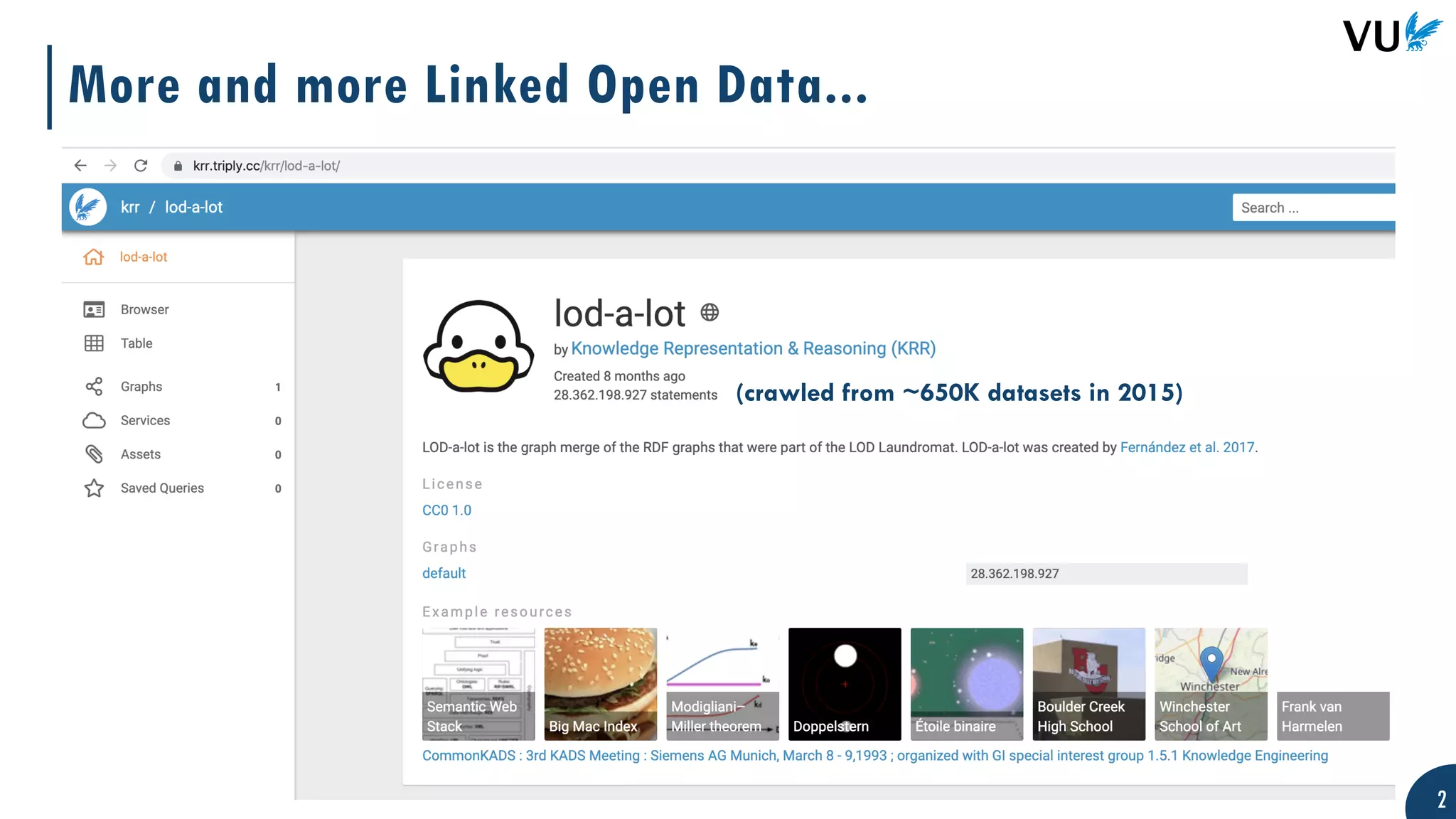
More and more Linked Open Data...
2
(crawled from ~650K datasets in 2015)
...More and more (overlapping) Schemas
3
Schema Matching is Inevitable
4
• It is not possible (neither desired) to have a unique schema covering all domains
• In order to exploit this wealth of available knowledge and enhance knowledge-based
systems (e.g., search engines, virtual assistants, etc.), we need to match these
overlapping schemas
• Schema Matching: finding relationships between entities of different schemas
• equivalence relations
• subsumption
• disjointness
• ....
Schema Matching over the years
5
• Active area of research from several communities, including the SW
• Ontology Alignment Evaluation Initiative (OAEI) ongoing for 15 years
• [Euzenat and Shvaiko, 2013] reviews ~100 schema-matching systems
50%
rely mostly on schema-level information
(i.e. schema-based approaches)
25%
rely mostly on instance-level information
(i.e. instance-based approaches)
25%
rely on schema + instance-level information
(i.e. mixed approaches)
6
Instance-based Schema Matching
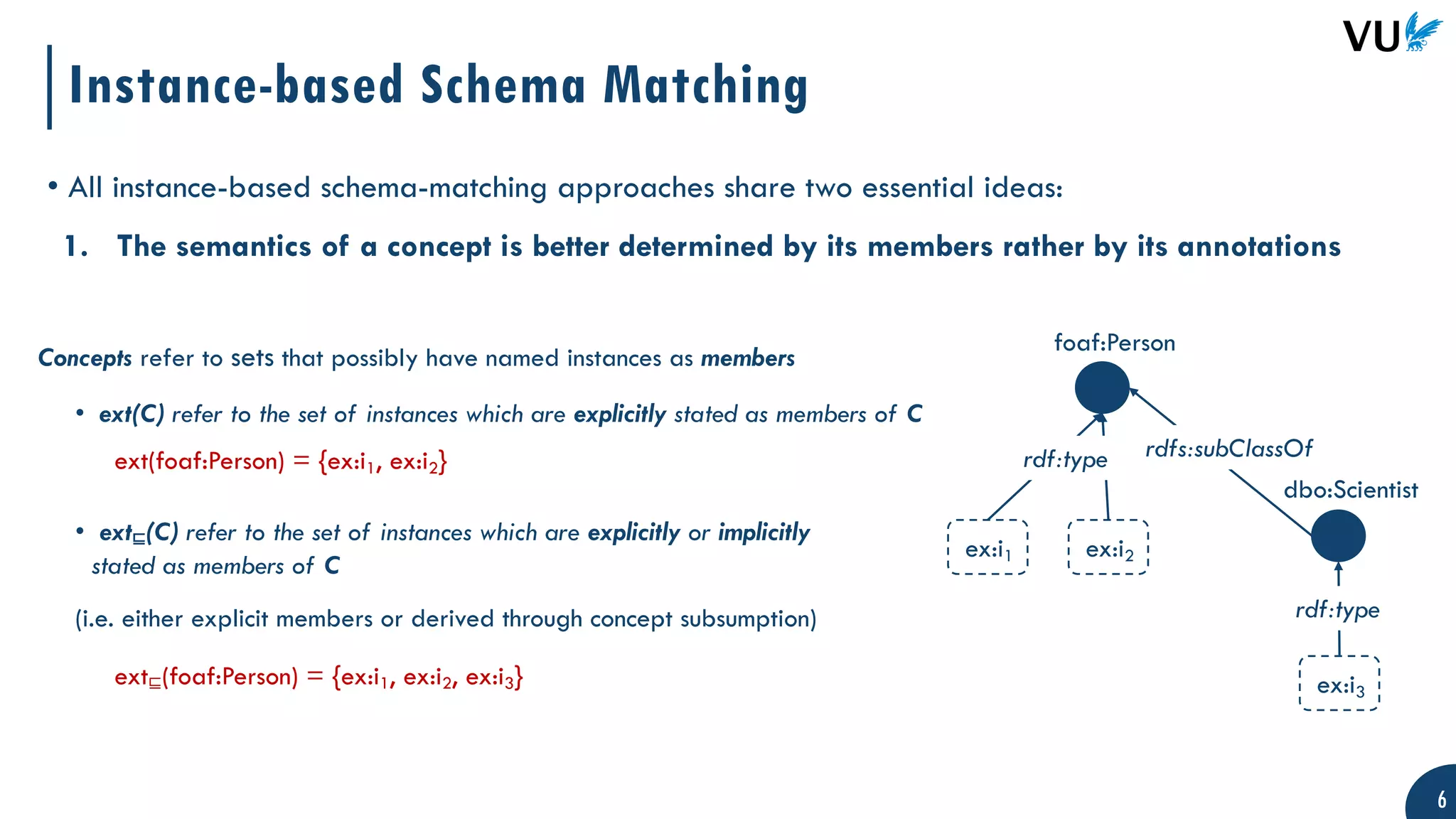
• All instance-based schema-matching approaches share two essential ideas:
1. The semantics of a concept is better determined by its members rather by its annotations
Concepts refer to sets that possibly have named instances as members
• ext(C) refer to the set of instances which are explicitly stated as members of C
ext(foaf:Person) = {ex:i1, ex:i2}
• ext⊑(C) refer to the set of instances which are explicitly or implicitly
stated as members of C
(i.e. either explicit members or derived through concept subsumption)
ext⊑(foaf:Person) = {ex:i1, ex:i2, ex:i3}
foaf:Person
ex:i1 ex:i2
ex:i3
rdf:type
dbo:Scientist
rdfs:subClassOf
rdf:type
7
Instance-based Schema Matching
• All instance-based schema-matching approaches share two essential ideas:
2. The more significant the overlap between two concepts’ members is, the more related
these concepts are
• Multiple techniques to measure the overlap between concepts’ members
• Formal concept analysis techniques
• Machine learning
• Jaccard index
• ....
Instance-based Schema Matching using Jaccard Index
8
• The Jaccard index is a commonly used measure to score the similarity between two sets
• The higher the similarity of two sets is, the greater the Jaccard index
𝐽(𝐴, 𝐵) =
| * ∩ , |
| * ∪ , |
foaf:Person
ex:i1 ex:i2
schema:Person
ex:i3 ex:i4
rdf:type
ex:i5
rdf:type
ext(foaf:Person) = {ex:i1, ex:i2 , ex:i3 , ex:i4}
ext(schema:Person) = {ex:i3, ex:i4, ex:i5}
J(ext(foaf:Person), ext(schema:Person)) =
.
/
= 0.4
Instance-based Schema Matching using Jaccard Index
9
With more than 558 million explicitly asserted owl:sameAs [Beek et al., ESWC 2018]
(or 35 billion after transitive closure), the reality in the Web of Data looks more like this:
𝐽(𝐴, 𝐵) =
| * ∩ , |
| * ∪ , |
owl:sameAs*
ext~(foaf:Person) = {ex:i1, eq{2,5}, ex:i3, ex:i4}
ext~(schema:Person) = {ex:i3, ex:i4, eq{2,5}}
J(ext~(foaf:Person), ext~(schema:Person)) =
3
4
= 0.75
ext(foaf:Person) = {ex:i1, ex:i2 , ex:i3 , ex:i4}
ext(schema:Person) = {ex:i3, ex:i4, ex:i5}
J(ext(foaf:Person), ext(schema:Person)) =
.
/
= 0.4
foaf:Person
ex:i1 ex:i2
schema:Person
ex:i3 ex:i4
rdf:type
ex:i5
rdf:type
Scenario 1 where J increases
Instance-based Schema Matching using Jaccard Index
10
Or possibly like this:
𝐽(𝐴, 𝐵) =
| * ∩ , |
| * ∪ , |
owl:sameAs*
ext~(foaf:Person) = {ex:i1, ex:i2, eq{3,4}}
ext~(schema:Person) = {eq{3,4}, ex:i5}
J(ext~(foaf:Person), ext~(schema:Person)) =
7
4
= 0.25
ext(foaf:Person) = {ex:i1, ex:i2 , ex:i3 , ex:i4}
ext(schema:Person) = {ex:i3, ex:i4, ex:i5}
J(ext(foaf:Person), ext(schema:Person)) =
.
/
= 0.4
foaf:Person
ex:i1 ex:i2
schema:Person
ex:i3 ex:i4
rdf:type
ex:i5
rdf:type
Scenario 2 where J decreases
11
Research Questions
Research Question 1
Does the inclusion of instance-level interlinks positively impact instance-based schema
alignments ?
1. a. Does the inclusion of owl:sameAs increase the Jaccard Index of equivalent concepts?
1. b. Does the inclusion of owl:sameAs increase the Jaccard Index of non-equivalent concepts?
12
Why should we care?
• Providing empirical evidences for schema-matching designers on whether exploiting a large
external collection of instance-level interlinks (e.g. from the LOD Cloud) is beneficial for
improving the accuracy of schema-matching techniques
• Particularly showing the risk/interest of using owl:sameAs after a number of studies suggesting
that a large* number of the existing owl:sameAs links in the Web are actually erroneous
* 3% of evaluated owl:sameAs are erroneous [Hogan et al., JWS 2012]
* 4% of evaluated owl:sameAs are erroneous [Raad et al., ISWC 2018]
* 20% of evaluated owl:sameAs are erroneous [Halpin et al., ISWC 2010]
13
Research Question 2
How does the quality of the instance-level interlinks impact the quality of the resulting
schema-alignments ?
2. a. Does the inclusion of a higher quality subset of owl:sameAs increase the Jaccard
Index of equivalent concepts?
2. b. Does the inclusion of a higher quality subset of owl:sameAs increase the Jaccard
Index of non-equivalent concepts?
14
15
Dataset Description
Dataset
16
(crawled from ~650K datasets in 2015)
Dataset
17
# triples 28,362,198,927
# rdf:type statements 3,321,354,308
# rdfs:subClassOf statements 4,461,717
# owl:equivalentClass statements 1,051,979
# explicit owl:sameAs statements 558,943,116
# implicit owl:sameAs statements 35,201,120,188
# equivalence classes (after closure of owl:sameAs) 48,999,148
# concepts with explicit members |C| 833,232
# concepts with explicit or implicit members |C⊑| 976,674
Size distribution of the Concepts’ members
18
• 23% of the concepts have one explicit member
• 92% of the concepts have ≤ 100 explicit members
• 618 concepts have more than 100M explicit or implicit members
• 5 concepts have more than 100M explicit members
Concepts with more than >100M explicit members
19
Concept Cardinality %
http://purl.org/linked-data/cube#Observation 1,306,389,396 39.3
http://data-gov.tw.rpi.edu/2009/data-gov-twc.rdf#DataEntry 304,878,654 9.2
http://geovocab.org/geometry#Geometry 167,808,111 5
http://knoesis.wright.edu/ssw/ont/ sensorobservation.owl#MeasureData 144,044,989 4.3
http://xmlns.com/foaf/0.1/Person 132,919,327 4
Total 2,056,040,477 61.9
20
Experiments
Research Question 1
Does the inclusion of instance-level interlinks impact positively instance-based schema
alignments ?
1. a. Does the inclusion of owl:sameAs increase the Jaccard Index of equivalent concepts?
1. b. Does the inclusion of owl:sameAs increase the Jaccard Index of non-equivalent concepts?
21
Dataset
22
# triples 28,362,198,927
# rdf:type statements 3,321,354,308
# rdfs:subClassOf statements 4,461,717
# owl:equivalentClass statements 1,051,979
# explicit owl:sameAs statements 558,943,116
# implicit owl:sameAs statements 35,201,120,188
# equivalence classes (after closure of owl:sameAs) 48,999,148
# concepts with explicit members |C| 833,232
# concepts with explicit or implicit members |C⊑| 976,674
1. a. Does the inclusion of owl:sameAs increase the Jaccard
Index of equivalent concepts?
• 1,051,979 owl:equivalentClass statements in the LOD-a-lot
­ Hypothesis: all these statements are correct alignments
­ Only 972 owl:equivalentClass statements where both concepts have explicit members
­ 208 reflexive alignments (C1, owl:equivalentClass, C1)
­ 22 duplicate symmetric alignments (C1, owl:equivalentClass, C2) and (C2, owl:equivalentClass, C1)
­ 742 alignments between 1,357 distinct concepts (i.e. gold standard)
23
1. a. Does the inclusion of owl:sameAs increase the Jaccard
Index of equivalent concepts?
24
Size distribution of the Concepts’ members of our Gold Standard
1. a. Does the inclusion of owl:sameAs increase the Jaccard
Index of equivalent concepts?
25
Jaccard Index distribution for the 742 alignments
Compare
J(ext⊑(C1), ext⊑(C2))
with
J(ext⊑
~(C1), ext⊑
~(C2))
such that
(C1, owl:equivalentClass, C2)
Runtime: <4 hours on 64GB SSD disk
1. a. Does the inclusion of owl:sameAs increase the Jaccard
Index of equivalent concepts?
26
Jaccard Index variation for the 742 alignments
• When owl:sameAs is considered, the Jaccard index
increases for 381/ 742 of the correct alignments (52%)
• Out of these 381 cases, Jaccard increases from 0 to 1 in
44 cases (7%)
• When owl:sameAs is considered, the Jaccard index
decreases for 25/ 742 of the correct alignments (3%)
• Slight drop in impact when only explicit members are
considered
owl:sameAs increases the overlap of two equivalent
concepts in half of the cases
Research Question 1
Does the inclusion of instance-level interlinks impact positively instance-based schema
alignments ?
1. a. Does the inclusion of owl:sameAs increase the Jaccard Index of equivalent concepts?
1. b. Does the inclusion of owl:sameAs increase the Jaccard Index of non-equivalent concepts?
27
Dataset
28
# triples 28,362,198,927
# rdf:type statements 3,321,354,308
# rdfs:subClassOf statements 4,461,717
# owl:equivalentClass statements 1,051,979
# explicit owl:sameAs statements 558,943,116
# implicit owl:sameAs statements 35,201,120,188
# equivalence classes (after closure of owl:sameAs) 48,999,148
# concepts with explicit members |C| 833,232
# concepts with explicit or implicit members |C⊑| 976,674
1. b. Does the inclusion of owl:sameAs increase the Jaccard
Index of non-equivalent concepts?
• 833,232 concepts with explicit members in the LOD-a-lot
­ Created a random alignment for each concept such that each concept is paired only once
­ Hypothesis: all these random alignments are erroneous
­ 416,616 random alignments
29
1. b. Does the inclusion of owl:sameAs increase the Jaccard
Index of non-equivalent concepts?
30
Jaccard Index variation for the 416,616 random alignments
• When owl:sameAs is considered, the Jaccard index increases
for only 94 / 416,616 of the random alignments (0.02%)
• When owl:sameAs is considered, the Jaccard index
decreases for 3 / 416,616 of the random alignments (~0%)
owl:sameAs rarely increases the overlap of two non-
equivalent concepts
Research Question 2
How does the quality of the instance-level interlinks affect the quality of the resulting
schema-alignments ?
2. a. Does the inclusion of a higher quality subset of owl:sameAs increase the Jaccard
Index of equivalent concepts?
2. b. Does the inclusion of a higher quality subset of owl:sameAs increase the Jaccard
Index of non-equivalent concepts?
31
Dataset
32
# triples 28,362,198,927
# rdf:type statements 3,321,354,308
# rdfs:subClassOf statements 4,461,717
# owl:equivalentClass statements 1,051,979
# explicit owl:sameAs statements 558,943,116
# implicit owl:sameAs statements 35,201,120,188
# equivalence classes (after closure of owl:sameAs) 48,999,148
# concepts with explicit members |C| 833,232
# concepts with explicit or implicit members |C⊑| 976,674
2. a. Does the inclusion of a higher quality subset of owl:sameAs
increase the Jaccard Index of equivalent concepts?
33
owl:sameAs quality indicator:
• [Raad et al., ISWC 2018] computed an error degree for each owl:sameAs link
• Error degree [0.0, 1.0] based on the community structure of the owl:sameAs network
and the symmetry of the links
• Manual evaluation shows that owl:sameAs links with error degree >0.99 have high
probability of being erroneous
• Manual evaluation shows that owl:sameAs links with error degree ≤0.4 have high
probability of being correct
• Transitive closure (a): after discarding the ~1M owl:sameAs link with error degree >0.99
• Transitive closure (b): after discarding the ~150M owl:sameAs link with error degree >0.4
2. a. Does the inclusion of owl:sameAs increase the Jaccard
Index of equivalent concepts?
34
Jaccard Index variation for the 742 alignments
• When owl:sameAs with error degree >0.99 are discarded, there is
a slight decrease in performance:
• Jaccard increases in 51% of the cases (instead of 52%)
• Jaccard increases from 0 to 1 in 37 cases (instead of 44)
• When owl:sameAs with error degree >0.4 are discarded, there is
a big decrease in performance:
• Jaccard increases in only 13% of the cases (instead of 52%)
• Jaccard increases from 0 to 1 in two cases (instead of 44)
• Jaccard decreases in 39 cases (instead of 25)
Research Question 2
How does the quality of the instance-level interlinks affect the quality of the resulting
schema-alignments ?
2. a. Does the inclusion of a higher quality subset of owl:sameAs increase the Jaccard
Index of equivalent concepts?
2. b. Does the inclusion of a higher quality subset of owl:sameAs increase the Jaccard
Index of non-equivalent concepts?
35
2. b. Does the inclusion of owl:sameAs increase the Jaccard
Index of non-equivalent concepts?
36
Jaccard Index variation for the 416,616 random alignments
• When owl:sameAs with error degree >0.99 are discarded,
there is an increase in performance:
• Jaccard increases in 27 of the cases (instead of 94)
• When owl:sameAs with error degree >0.4 are discarded,
there is an important increase in performance:
• Jaccard increases in 2 of the cases (instead of 94)
37
Take away message
Take away message
This work provides an empirical study on the impact of including instance-level interlinks
on the overlap between concepts members
• Including instance-level interlinks can enhance the performance of instance-based schema alignments
­ Increases the overlap for 52% of the existing alignments in the LOD-a-lot
­ Increases the overlap for less than 0.3% of randomly created alignments
• Inference does positively impact instance-based schema alignments
­ Considering also the implicit members enhances the results on the Gold Standard by 3 pp
• Discarding only isolated owl:sameAs links in the network can increase the quality of instance-based schema
alignments (owl:sameAs links are probably not as bad as we first thought)
­ Reduces the cases where Jaccard index increases for non-equivalent concepts by 71%
38
Future Work
• Use a larger gold standard to validate the here presented results
• Investigate alternative better-tailored instance-based measures to detect new schema
alignments at the scale of the Web of data, exploiting:
­ the higher quality subset of the owl:sameAs links;
­ the concepts’ both explicit and implicit
39
On the Impact of sameAs
on Schema Matching
JOE RAAD ◉ ERMAN ACAR ◉ STEFAN SCHLOBACH
Knowledge Representation & Reasoning Group
Thank you for your attention...
@joeraad_
Code + Results
https://github.com/raadjoe/impact-sameAs-schema-matching

On the Impact of sameAs on Schema Matching

  • 1.
    On the Impactof sameAs on Schema Matching JOE RAAD ◉ ERMAN ACAR ◉ STEFAN SCHLOBACH Knowledge Representation & Reasoning Group KCAP 2019 - November 20, 2019 - Marina del Rey
  • 2.
    More and moreLinked Open Data... 2 (crawled from ~650K datasets in 2015)
  • 3.
    ...More and more(overlapping) Schemas 3
  • 4.
    Schema Matching isInevitable 4 • It is not possible (neither desired) to have a unique schema covering all domains • In order to exploit this wealth of available knowledge and enhance knowledge-based systems (e.g., search engines, virtual assistants, etc.), we need to match these overlapping schemas • Schema Matching: finding relationships between entities of different schemas • equivalence relations • subsumption • disjointness • ....
  • 5.
    Schema Matching overthe years 5 • Active area of research from several communities, including the SW • Ontology Alignment Evaluation Initiative (OAEI) ongoing for 15 years • [Euzenat and Shvaiko, 2013] reviews ~100 schema-matching systems 50% rely mostly on schema-level information (i.e. schema-based approaches) 25% rely mostly on instance-level information (i.e. instance-based approaches) 25% rely on schema + instance-level information (i.e. mixed approaches)
  • 6.
    6 Instance-based Schema Matching •All instance-based schema-matching approaches share two essential ideas: 1. The semantics of a concept is better determined by its members rather by its annotations Concepts refer to sets that possibly have named instances as members • ext(C) refer to the set of instances which are explicitly stated as members of C ext(foaf:Person) = {ex:i1, ex:i2} • ext⊑(C) refer to the set of instances which are explicitly or implicitly stated as members of C (i.e. either explicit members or derived through concept subsumption) ext⊑(foaf:Person) = {ex:i1, ex:i2, ex:i3} foaf:Person ex:i1 ex:i2 ex:i3 rdf:type dbo:Scientist rdfs:subClassOf rdf:type
  • 7.
    7 Instance-based Schema Matching •All instance-based schema-matching approaches share two essential ideas: 2. The more significant the overlap between two concepts’ members is, the more related these concepts are • Multiple techniques to measure the overlap between concepts’ members • Formal concept analysis techniques • Machine learning • Jaccard index • ....
  • 8.
    Instance-based Schema Matchingusing Jaccard Index 8 • The Jaccard index is a commonly used measure to score the similarity between two sets • The higher the similarity of two sets is, the greater the Jaccard index 𝐽(𝐴, 𝐵) = | * ∩ , | | * ∪ , | foaf:Person ex:i1 ex:i2 schema:Person ex:i3 ex:i4 rdf:type ex:i5 rdf:type ext(foaf:Person) = {ex:i1, ex:i2 , ex:i3 , ex:i4} ext(schema:Person) = {ex:i3, ex:i4, ex:i5} J(ext(foaf:Person), ext(schema:Person)) = . / = 0.4
  • 9.
    Instance-based Schema Matchingusing Jaccard Index 9 With more than 558 million explicitly asserted owl:sameAs [Beek et al., ESWC 2018] (or 35 billion after transitive closure), the reality in the Web of Data looks more like this: 𝐽(𝐴, 𝐵) = | * ∩ , | | * ∪ , | owl:sameAs* ext~(foaf:Person) = {ex:i1, eq{2,5}, ex:i3, ex:i4} ext~(schema:Person) = {ex:i3, ex:i4, eq{2,5}} J(ext~(foaf:Person), ext~(schema:Person)) = 3 4 = 0.75 ext(foaf:Person) = {ex:i1, ex:i2 , ex:i3 , ex:i4} ext(schema:Person) = {ex:i3, ex:i4, ex:i5} J(ext(foaf:Person), ext(schema:Person)) = . / = 0.4 foaf:Person ex:i1 ex:i2 schema:Person ex:i3 ex:i4 rdf:type ex:i5 rdf:type Scenario 1 where J increases
  • 10.
    Instance-based Schema Matchingusing Jaccard Index 10 Or possibly like this: 𝐽(𝐴, 𝐵) = | * ∩ , | | * ∪ , | owl:sameAs* ext~(foaf:Person) = {ex:i1, ex:i2, eq{3,4}} ext~(schema:Person) = {eq{3,4}, ex:i5} J(ext~(foaf:Person), ext~(schema:Person)) = 7 4 = 0.25 ext(foaf:Person) = {ex:i1, ex:i2 , ex:i3 , ex:i4} ext(schema:Person) = {ex:i3, ex:i4, ex:i5} J(ext(foaf:Person), ext(schema:Person)) = . / = 0.4 foaf:Person ex:i1 ex:i2 schema:Person ex:i3 ex:i4 rdf:type ex:i5 rdf:type Scenario 2 where J decreases
  • 11.
  • 12.
    Research Question 1 Doesthe inclusion of instance-level interlinks positively impact instance-based schema alignments ? 1. a. Does the inclusion of owl:sameAs increase the Jaccard Index of equivalent concepts? 1. b. Does the inclusion of owl:sameAs increase the Jaccard Index of non-equivalent concepts? 12
  • 13.
    Why should wecare? • Providing empirical evidences for schema-matching designers on whether exploiting a large external collection of instance-level interlinks (e.g. from the LOD Cloud) is beneficial for improving the accuracy of schema-matching techniques • Particularly showing the risk/interest of using owl:sameAs after a number of studies suggesting that a large* number of the existing owl:sameAs links in the Web are actually erroneous * 3% of evaluated owl:sameAs are erroneous [Hogan et al., JWS 2012] * 4% of evaluated owl:sameAs are erroneous [Raad et al., ISWC 2018] * 20% of evaluated owl:sameAs are erroneous [Halpin et al., ISWC 2010] 13
  • 14.
    Research Question 2 Howdoes the quality of the instance-level interlinks impact the quality of the resulting schema-alignments ? 2. a. Does the inclusion of a higher quality subset of owl:sameAs increase the Jaccard Index of equivalent concepts? 2. b. Does the inclusion of a higher quality subset of owl:sameAs increase the Jaccard Index of non-equivalent concepts? 14
  • 15.
  • 16.
  • 17.
    Dataset 17 # triples 28,362,198,927 #rdf:type statements 3,321,354,308 # rdfs:subClassOf statements 4,461,717 # owl:equivalentClass statements 1,051,979 # explicit owl:sameAs statements 558,943,116 # implicit owl:sameAs statements 35,201,120,188 # equivalence classes (after closure of owl:sameAs) 48,999,148 # concepts with explicit members |C| 833,232 # concepts with explicit or implicit members |C⊑| 976,674
  • 18.
    Size distribution ofthe Concepts’ members 18 • 23% of the concepts have one explicit member • 92% of the concepts have ≤ 100 explicit members • 618 concepts have more than 100M explicit or implicit members • 5 concepts have more than 100M explicit members
  • 19.
    Concepts with morethan >100M explicit members 19 Concept Cardinality % http://purl.org/linked-data/cube#Observation 1,306,389,396 39.3 http://data-gov.tw.rpi.edu/2009/data-gov-twc.rdf#DataEntry 304,878,654 9.2 http://geovocab.org/geometry#Geometry 167,808,111 5 http://knoesis.wright.edu/ssw/ont/ sensorobservation.owl#MeasureData 144,044,989 4.3 http://xmlns.com/foaf/0.1/Person 132,919,327 4 Total 2,056,040,477 61.9
  • 20.
  • 21.
    Research Question 1 Doesthe inclusion of instance-level interlinks impact positively instance-based schema alignments ? 1. a. Does the inclusion of owl:sameAs increase the Jaccard Index of equivalent concepts? 1. b. Does the inclusion of owl:sameAs increase the Jaccard Index of non-equivalent concepts? 21
  • 22.
    Dataset 22 # triples 28,362,198,927 #rdf:type statements 3,321,354,308 # rdfs:subClassOf statements 4,461,717 # owl:equivalentClass statements 1,051,979 # explicit owl:sameAs statements 558,943,116 # implicit owl:sameAs statements 35,201,120,188 # equivalence classes (after closure of owl:sameAs) 48,999,148 # concepts with explicit members |C| 833,232 # concepts with explicit or implicit members |C⊑| 976,674
  • 23.
    1. a. Doesthe inclusion of owl:sameAs increase the Jaccard Index of equivalent concepts? • 1,051,979 owl:equivalentClass statements in the LOD-a-lot ­ Hypothesis: all these statements are correct alignments ­ Only 972 owl:equivalentClass statements where both concepts have explicit members ­ 208 reflexive alignments (C1, owl:equivalentClass, C1) ­ 22 duplicate symmetric alignments (C1, owl:equivalentClass, C2) and (C2, owl:equivalentClass, C1) ­ 742 alignments between 1,357 distinct concepts (i.e. gold standard) 23
  • 24.
    1. a. Doesthe inclusion of owl:sameAs increase the Jaccard Index of equivalent concepts? 24 Size distribution of the Concepts’ members of our Gold Standard
  • 25.
    1. a. Doesthe inclusion of owl:sameAs increase the Jaccard Index of equivalent concepts? 25 Jaccard Index distribution for the 742 alignments Compare J(ext⊑(C1), ext⊑(C2)) with J(ext⊑ ~(C1), ext⊑ ~(C2)) such that (C1, owl:equivalentClass, C2) Runtime: <4 hours on 64GB SSD disk
  • 26.
    1. a. Doesthe inclusion of owl:sameAs increase the Jaccard Index of equivalent concepts? 26 Jaccard Index variation for the 742 alignments • When owl:sameAs is considered, the Jaccard index increases for 381/ 742 of the correct alignments (52%) • Out of these 381 cases, Jaccard increases from 0 to 1 in 44 cases (7%) • When owl:sameAs is considered, the Jaccard index decreases for 25/ 742 of the correct alignments (3%) • Slight drop in impact when only explicit members are considered owl:sameAs increases the overlap of two equivalent concepts in half of the cases
  • 27.
    Research Question 1 Doesthe inclusion of instance-level interlinks impact positively instance-based schema alignments ? 1. a. Does the inclusion of owl:sameAs increase the Jaccard Index of equivalent concepts? 1. b. Does the inclusion of owl:sameAs increase the Jaccard Index of non-equivalent concepts? 27
  • 28.
    Dataset 28 # triples 28,362,198,927 #rdf:type statements 3,321,354,308 # rdfs:subClassOf statements 4,461,717 # owl:equivalentClass statements 1,051,979 # explicit owl:sameAs statements 558,943,116 # implicit owl:sameAs statements 35,201,120,188 # equivalence classes (after closure of owl:sameAs) 48,999,148 # concepts with explicit members |C| 833,232 # concepts with explicit or implicit members |C⊑| 976,674
  • 29.
    1. b. Doesthe inclusion of owl:sameAs increase the Jaccard Index of non-equivalent concepts? • 833,232 concepts with explicit members in the LOD-a-lot ­ Created a random alignment for each concept such that each concept is paired only once ­ Hypothesis: all these random alignments are erroneous ­ 416,616 random alignments 29
  • 30.
    1. b. Doesthe inclusion of owl:sameAs increase the Jaccard Index of non-equivalent concepts? 30 Jaccard Index variation for the 416,616 random alignments • When owl:sameAs is considered, the Jaccard index increases for only 94 / 416,616 of the random alignments (0.02%) • When owl:sameAs is considered, the Jaccard index decreases for 3 / 416,616 of the random alignments (~0%) owl:sameAs rarely increases the overlap of two non- equivalent concepts
  • 31.
    Research Question 2 Howdoes the quality of the instance-level interlinks affect the quality of the resulting schema-alignments ? 2. a. Does the inclusion of a higher quality subset of owl:sameAs increase the Jaccard Index of equivalent concepts? 2. b. Does the inclusion of a higher quality subset of owl:sameAs increase the Jaccard Index of non-equivalent concepts? 31
  • 32.
    Dataset 32 # triples 28,362,198,927 #rdf:type statements 3,321,354,308 # rdfs:subClassOf statements 4,461,717 # owl:equivalentClass statements 1,051,979 # explicit owl:sameAs statements 558,943,116 # implicit owl:sameAs statements 35,201,120,188 # equivalence classes (after closure of owl:sameAs) 48,999,148 # concepts with explicit members |C| 833,232 # concepts with explicit or implicit members |C⊑| 976,674
  • 33.
    2. a. Doesthe inclusion of a higher quality subset of owl:sameAs increase the Jaccard Index of equivalent concepts? 33 owl:sameAs quality indicator: • [Raad et al., ISWC 2018] computed an error degree for each owl:sameAs link • Error degree [0.0, 1.0] based on the community structure of the owl:sameAs network and the symmetry of the links • Manual evaluation shows that owl:sameAs links with error degree >0.99 have high probability of being erroneous • Manual evaluation shows that owl:sameAs links with error degree ≤0.4 have high probability of being correct • Transitive closure (a): after discarding the ~1M owl:sameAs link with error degree >0.99 • Transitive closure (b): after discarding the ~150M owl:sameAs link with error degree >0.4
  • 34.
    2. a. Doesthe inclusion of owl:sameAs increase the Jaccard Index of equivalent concepts? 34 Jaccard Index variation for the 742 alignments • When owl:sameAs with error degree >0.99 are discarded, there is a slight decrease in performance: • Jaccard increases in 51% of the cases (instead of 52%) • Jaccard increases from 0 to 1 in 37 cases (instead of 44) • When owl:sameAs with error degree >0.4 are discarded, there is a big decrease in performance: • Jaccard increases in only 13% of the cases (instead of 52%) • Jaccard increases from 0 to 1 in two cases (instead of 44) • Jaccard decreases in 39 cases (instead of 25)
  • 35.
    Research Question 2 Howdoes the quality of the instance-level interlinks affect the quality of the resulting schema-alignments ? 2. a. Does the inclusion of a higher quality subset of owl:sameAs increase the Jaccard Index of equivalent concepts? 2. b. Does the inclusion of a higher quality subset of owl:sameAs increase the Jaccard Index of non-equivalent concepts? 35
  • 36.
    2. b. Doesthe inclusion of owl:sameAs increase the Jaccard Index of non-equivalent concepts? 36 Jaccard Index variation for the 416,616 random alignments • When owl:sameAs with error degree >0.99 are discarded, there is an increase in performance: • Jaccard increases in 27 of the cases (instead of 94) • When owl:sameAs with error degree >0.4 are discarded, there is an important increase in performance: • Jaccard increases in 2 of the cases (instead of 94)
  • 37.
  • 38.
    Take away message Thiswork provides an empirical study on the impact of including instance-level interlinks on the overlap between concepts members • Including instance-level interlinks can enhance the performance of instance-based schema alignments ­ Increases the overlap for 52% of the existing alignments in the LOD-a-lot ­ Increases the overlap for less than 0.3% of randomly created alignments • Inference does positively impact instance-based schema alignments ­ Considering also the implicit members enhances the results on the Gold Standard by 3 pp • Discarding only isolated owl:sameAs links in the network can increase the quality of instance-based schema alignments (owl:sameAs links are probably not as bad as we first thought) ­ Reduces the cases where Jaccard index increases for non-equivalent concepts by 71% 38
  • 39.
    Future Work • Usea larger gold standard to validate the here presented results • Investigate alternative better-tailored instance-based measures to detect new schema alignments at the scale of the Web of data, exploiting: ­ the higher quality subset of the owl:sameAs links; ­ the concepts’ both explicit and implicit 39
  • 40.
    On the Impactof sameAs on Schema Matching JOE RAAD ◉ ERMAN ACAR ◉ STEFAN SCHLOBACH Knowledge Representation & Reasoning Group Thank you for your attention... @joeraad_ Code + Results https://github.com/raadjoe/impact-sameAs-schema-matching