On Open Innovation
Lars Iversen
@Larski
Partner, Springfellow International
Microsoft acquires Mojang
for 2,5 billion USD - to be
compared with Geely
acquiring Volvo for 1,3
billion USD.
A new breed of companies who harnesses the
power of exponential technology will haunt
traditional business as we know it – and rule
the world!
• Digitized (information driven)
• Deceptive (Exponential growth)
• Disrupted (Business Models)
• Dematerialized (GPS, camera, radio, as-a-service etc.)
• Demonetized (Uber, AirBnB, classifieds, etc.)
• Democratized (No need to be Coca Cola to serve the
planet)
New breed of companies are coming..
40% of existing Fortune 500 companies will not survive 2040
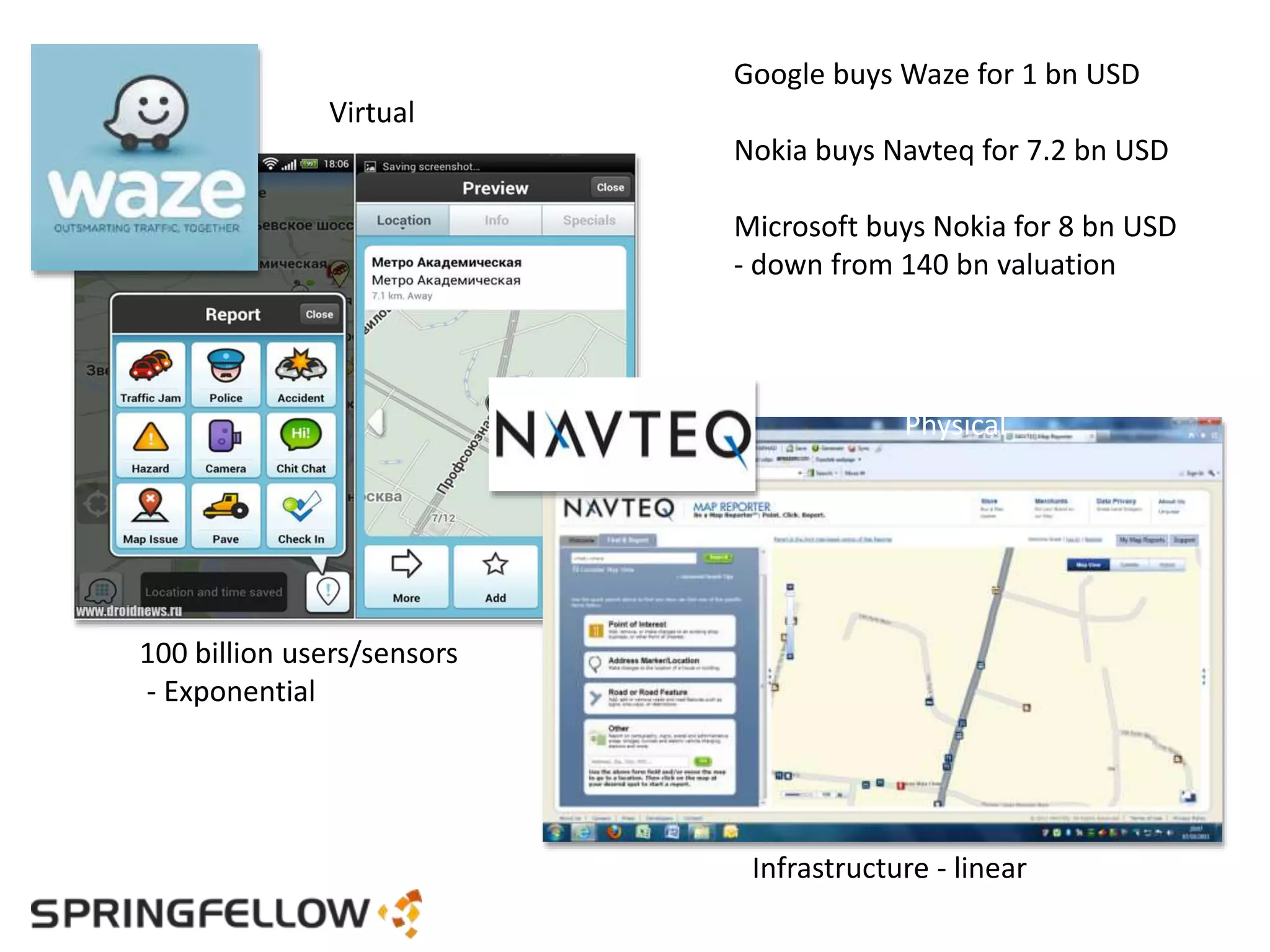
Google buys Waze for 1 bn USD
Nokia buys Navteq for 7.2 bn USD
Microsoft buys Nokia for 8 bn USD
- down from 140 bn valuation
Virtual
Physical
100 billion users/sensors
- Exponential
Infrastructure - linear
• Top down and hierarchical
• R&D system is way too costly to maintain
• Rely on “structured” innovation processes that can’t deliver the
agility and speed need
• Driven by financial outcomes
• Linear, sequential thinking
• Do innovation in secret R&D labs rather than opening up the
innovation process and harnessing the creativity of all their
employees, customers, and partners.
• Strategic planning based on the past
• Risk intolerance
• Process inflexibility
• Still believe that “knowledge is power”
• Large number of employees
• Control over own assets
Traditional, incremental innovation
Then what?
Unilevers target is to have 70% of pipeline projects with a significant input from Open
Innovation. Their 2013 result was 58%, up from 38% in 2011. Rather than simply characterising
innovation as closed or open, Unilever are aiming for a “seamless” approach. This involves
moving from arms length, cost-driven old style projects to long-term partnerships, integrating
strongly with internal operations.
400 000 designers and innovators (Aros inventor got 280 000 USD so far…)
670 000 users in their innovation network
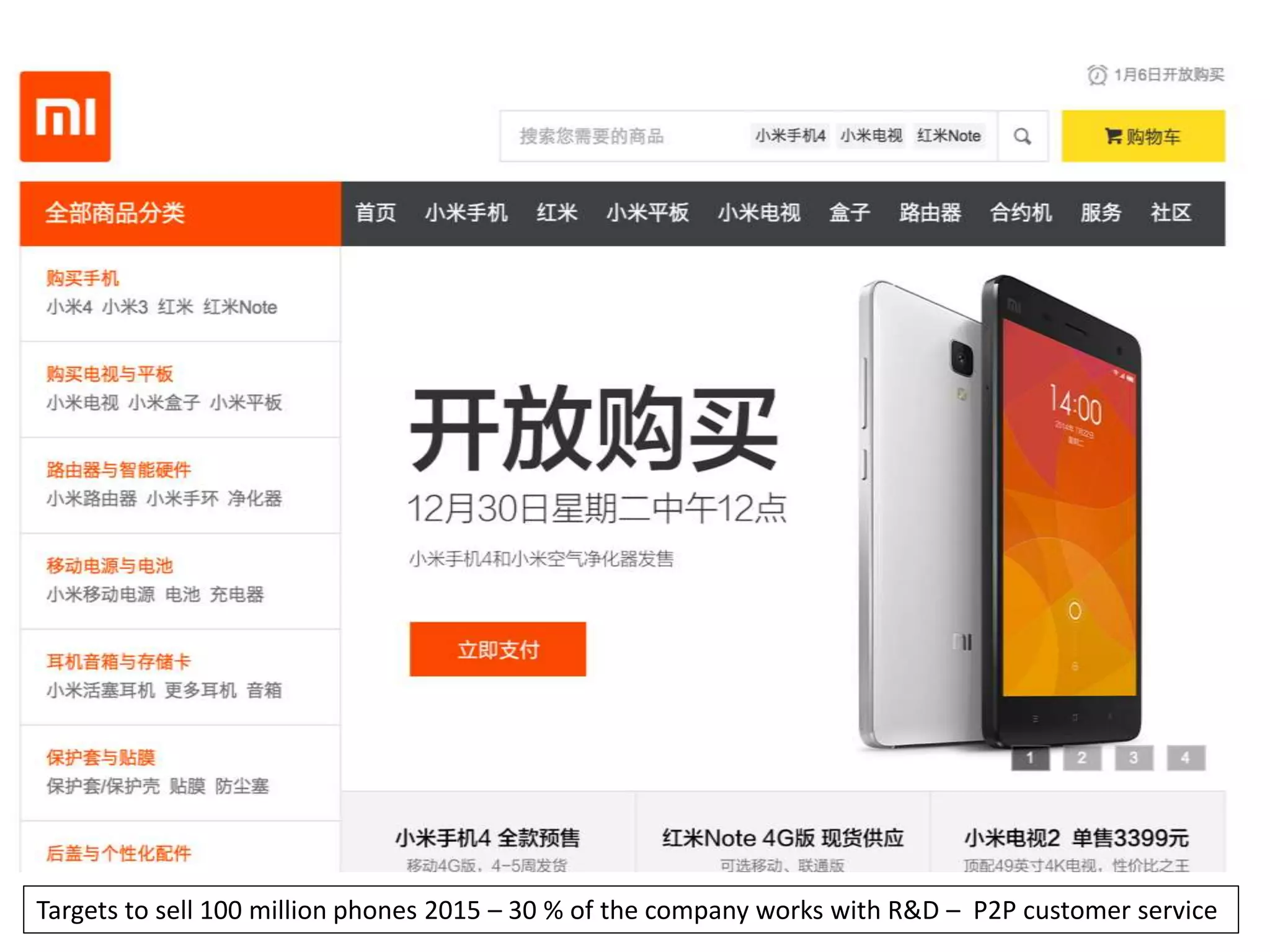
Targets to sell 100 million phones 2015 – 30 % of the company works with R&D – P2P customer service
Thank You!
@Larski
WeChat: Larski73
Linkedin.com/larsiversen
Lars.iversen@springfellow.com

On innovation

  • 1.
    On Open Innovation LarsIversen @Larski Partner, Springfellow International
  • 2.
    Microsoft acquires Mojang for2,5 billion USD - to be compared with Geely acquiring Volvo for 1,3 billion USD.
  • 3.
    A new breedof companies who harnesses the power of exponential technology will haunt traditional business as we know it – and rule the world!
  • 4.
    • Digitized (informationdriven) • Deceptive (Exponential growth) • Disrupted (Business Models) • Dematerialized (GPS, camera, radio, as-a-service etc.) • Demonetized (Uber, AirBnB, classifieds, etc.) • Democratized (No need to be Coca Cola to serve the planet) New breed of companies are coming..
  • 6.
    40% of existingFortune 500 companies will not survive 2040
  • 7.
    Google buys Wazefor 1 bn USD Nokia buys Navteq for 7.2 bn USD Microsoft buys Nokia for 8 bn USD - down from 140 bn valuation Virtual Physical 100 billion users/sensors - Exponential Infrastructure - linear
  • 8.
    • Top downand hierarchical • R&D system is way too costly to maintain • Rely on “structured” innovation processes that can’t deliver the agility and speed need • Driven by financial outcomes • Linear, sequential thinking • Do innovation in secret R&D labs rather than opening up the innovation process and harnessing the creativity of all their employees, customers, and partners. • Strategic planning based on the past • Risk intolerance • Process inflexibility • Still believe that “knowledge is power” • Large number of employees • Control over own assets Traditional, incremental innovation
  • 9.
    Then what? Unilevers targetis to have 70% of pipeline projects with a significant input from Open Innovation. Their 2013 result was 58%, up from 38% in 2011. Rather than simply characterising innovation as closed or open, Unilever are aiming for a “seamless” approach. This involves moving from arms length, cost-driven old style projects to long-term partnerships, integrating strongly with internal operations.
  • 12.
    400 000 designersand innovators (Aros inventor got 280 000 USD so far…)
  • 13.
    400 000 designersand innovators (Aros inventor got 280 000 USD so far…)
  • 14.
    670 000 usersin their innovation network
  • 15.
    Targets to sell100 million phones 2015 – 30 % of the company works with R&D – P2P customer service
  • 16.

Editor's Notes

  • #2 Minecraft vs Volvo Meta innovation
  • #4 To big to fail??
  • #5 Minecraft vs Volvo The motto “innovate or die” held true for firms in the 20th century. In the 21st century, “innovate faster, better, and cheaper—or die” will be your new mantra. Indeed, in today’s hyper-competitive, über-connected, and globally integrated economy, you need to crank out new products faster than you can spell “R&D,” or else your customers will switch their allegiance to more agile rivals. Plus, your products need to deliver more value to customers—value no longer being defined by the bells and whistles in your product, but by the experience customers get from using your product. In sum, you need to innovate faster, better, and cheaper. Sadly, most of todays corporations is just not equipped to do that. Why not? For three simple reasons: 1) Most firms’ R&D system is way too costly to maintain at a time when both financial and natural resources are getting scarce; 2) firms rely on “structured” innovation processes like Six Sigma that can’t deliver the agility and speed companies need in a fast-paced and volatile world; 3) Many firms continue to believe that “knowledge is power”—hence they do innovation in secret R&D labs rather than opening up the innovation process and harnessing the creativity of all their employees, customers, and partners. Due to these limiting factors, companies across industries—ranging from pharmaceuticals and automotive to consumer goods, electronics, and retail—have seen their innovation performance steadily decline over the last decade. But there is hope...if firms are willing to trade profligacy, rigidity, and elitism—which characterize their current innovation model—for frugality, flexibility, and inclusivity. To make this shift, however, firms must embrace a new mindset—a frugal and flexible mindset that sees opportunity in adversity and enables you to do more with less. This is the mindset of MacGyver, the secret agent in the popular TV series of the late 1980s who carries no gun and relies purely on his ingenuity to fix complex problems using the limited resources he has at hand—usually duct tape and a Swiss Army knife. Corporations needs more MacGyvers to regain its “innovation mojo” and achieve faster results in today’s unpredictable environment.
  • #6 1% doubling 7 times is 100% - 50 billion connected devices in 2025 to 1 trillion in 2035 (Dette tilsvarer én billion, 1 000 000 000 000, evt. 10 I 12e )
  • #9 Minecraft vs Volvo The motto “innovate or die” held true for firms in the 20th century. In the 21st century, “innovate faster, better, and cheaper—or die” will be your new mantra. Indeed, in today’s hyper-competitive, über-connected, and globally integrated economy, you need to crank out new products faster than you can spell “R&D,” or else your customers will switch their allegiance to more agile rivals. Plus, your products need to deliver more value to customers—value no longer being defined by the bells and whistles in your product, but by the experience customers get from using your product. In sum, you need to innovate faster, better, and cheaper. Sadly, most of todays corporations is just not equipped to do that. Why not? For three simple reasons: 1) Most firms’ R&D system is way too costly to maintain at a time when both financial and natural resources are getting scarce; 2) firms rely on “structured” innovation processes like Six Sigma that can’t deliver the agility and speed companies need in a fast-paced and volatile world; 3) Many firms continue to believe that “knowledge is power”—hence they do innovation in secret R&D labs rather than opening up the innovation process and harnessing the creativity of all their employees, customers, and partners. Due to these limiting factors, companies across industries—ranging from pharmaceuticals and automotive to consumer goods, electronics, and retail—have seen their innovation performance steadily decline over the last decade. But there is hope...if firms are willing to trade profligacy, rigidity, and elitism—which characterize their current innovation model—for frugality, flexibility, and inclusivity. To make this shift, however, firms must embrace a new mindset—a frugal and flexible mindset that sees opportunity in adversity and enables you to do more with less. This is the mindset of MacGyver, the secret agent in the popular TV series of the late 1980s who carries no gun and relies purely on his ingenuity to fix complex problems using the limited resources he has at hand—usually duct tape and a Swiss Army knife. Corporations needs more MacGyvers to regain its “innovation mojo” and achieve faster results in today’s unpredictable environment.
  • #10 Electrolux (40 million appliances, 152 markets, brand, crm sysem – well that’s a platform – but no services) – a platform iTella – postal services as a platform