Omega-3 Fatty Acids :
Naming, sources, intakes, metabolism
         and health benefits
                Philip Calder
     Professor of Nutritional Immunology
          University of Southampton
This lecture will cover

Fatty acid structure, nomenclature, sources, and
intakes
Metabolic relationship between α -linolenic acid and
long chain omega-3 fatty acids
Omega-3 fatty acids and cardiovascular health
Omega-3 fatty acids and visual and brain
development
Recommendations for omega-3 fatty acid intake
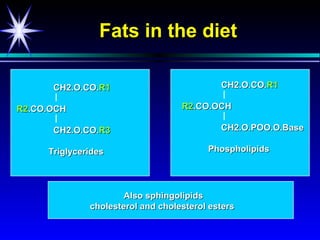
Fats in the diet

      CH2.O.CO.R1                           CH2.O.CO.R1

R2.CO.OCH                          R2.CO.OCH

      CH2.O.CO.R3                           CH2.O.POO.O.Base

     Triglycerides                       Phospholipids


                      Also sphingolipids
              cholesterol and cholesterol esters
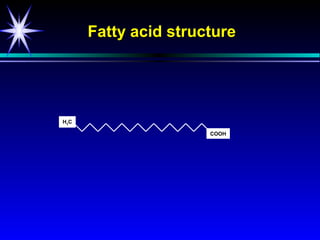
Fatty acid structure


H3C

                      COOH
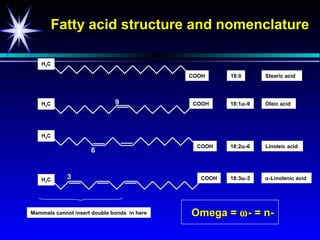
Fatty acid structure and nomenclature

   H3C

                                             COOH     18:0      Stearic acid


   H3C                        9              COOH     18:1ω-9   Oleic acid


   H3C
                                              COOH    18:2ω-6   Linoleic acid
                     6


   H3C       3                                 COOH   18:3ω-3   α-Linolenic acid


Mammals cannot insert double bonds in here   Omega = ω - = n-
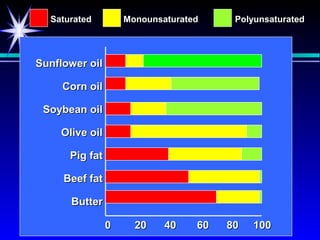
Saturated         Monounsaturated     Polyunsaturated


Sunflower oil

     Corn oil

 Soybean oil

    Olive oil

      Pig fat

     Beef fat

      Butter

                0     20    40    60   80   100
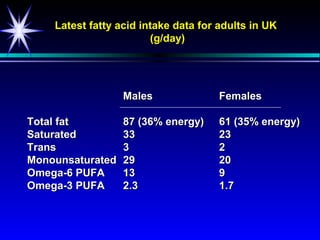
Latest fatty acid intake data for adults in UK
                        (g/day)


                  Males              Females

Total fat         87 (36% energy)    61 (35% energy)
Saturated         33                 23
Trans             3                  2
Monounsaturated   29                 20
Omega-6 PUFA      13                 9
Omega-3 PUFA      2.3                1.7
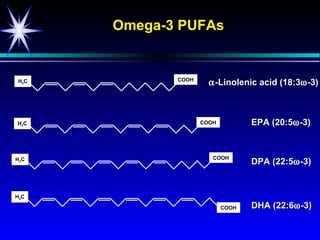
Omega-3 PUFAs


H3C          COOH
                      α -Linolenic acid (18:3ω -3)


H3C                 COOH          EPA (20:5ω -3)


                       COOH
H3C
                                  DPA (22:5ω -3)


H3C

                           COOH   DHA (22:6ω -3)
These have different dietary sources

                and

    their intake differs markedly
α -Linolenic acid (18:3ω -3)


Found in green plant tissues
Found in some vegetable oils (e.g. soybean,
rapeseed)
Found in some nuts (e.g. walnut)
Found in linseed (flaxseed) and linseed oil
Contributes 85 to 95% of ω -3 PUFA intake in
UK adults (ca. 2.1 g/day in males; 1.5 g/day in
females)
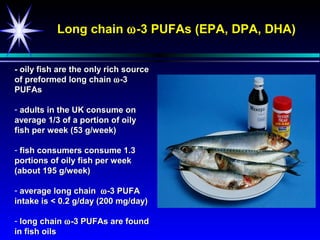
Long chain ω -3 PUFAs (EPA, DPA, DHA)


- oily fish are the only rich source
of preformed long chain ω -3
PUFAs

- adults in the UK consume on
average 1/3 of a portion of oily
fish per week (53 g/week)

- fish consumers consume 1.3
portions of oily fish per week
(about 195 g/week)

- average long chain ω -3 PUFA
intake is < 0.2 g/day (200 mg/day)

- long chain ω -3 PUFAs are found
in fish oils
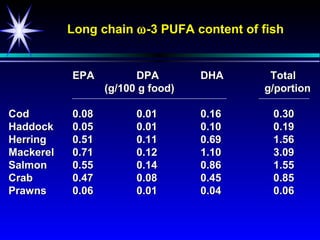
Long chain ω -3 PUFA content of fish


           EPA          DPA        DHA      Total
                  (g/100 g food)           g/portion

Cod        0.08         0.01       0.16      0.30
Haddock    0.05         0.01       0.10      0.19
Herring    0.51         0.11       0.69      1.56
Mackerel   0.71         0.12       1.10      3.09
Salmon     0.55         0.14       0.86      1.55
Crab       0.47         0.08       0.45      0.85
Prawns     0.06         0.01       0.04      0.06
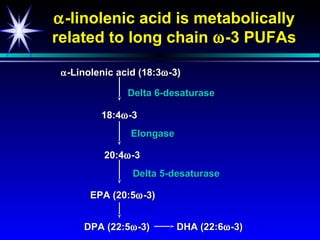
α -linolenic acid is metabolically
related to long chain ω -3 PUFAs

 α -Linolenic acid (18:3ω -3)

                Delta 6-desaturase

          18:4ω -3
                 Elongase

           20:4ω -3
                 Delta 5-desaturase

       EPA (20:5ω -3)


      DPA (22:5ω -3)        DHA (22:6ω -3)
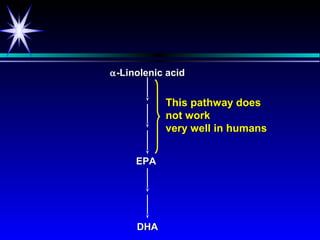
α -Linolenic acid


            This pathway does
            not work
            very well in humans


     EPA


      DHA
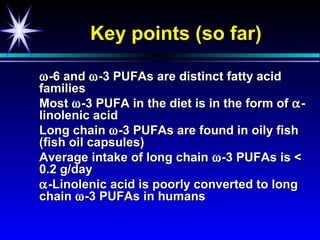
Key points (so far)

ω -6 and ω -3 PUFAs are distinct fatty acid
families
Most ω -3 PUFA in the diet is in the form of α -
linolenic acid
Long chain ω -3 PUFAs are found in oily fish
(fish oil capsules)
Average intake of long chain ω -3 PUFAs is <
0.2 g/day
α -Linolenic acid is poorly converted to long
chain ω -3 PUFAs in humans
Omega-3 PUFAs and human health
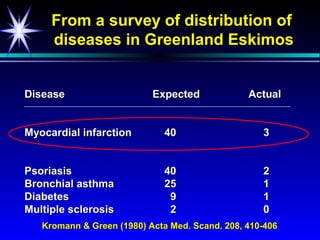
From a survey of distribution of
     diseases in Greenland Eskimos


Disease                    Expected             Actual


Myocardial infarction         40                   3


Psoriasis                     40                   2
Bronchial asthma              25                   1
Diabetes                       9                   1
Multiple sclerosis             2                   0
   Kromann & Green (1980) Acta Med. Scand. 208, 410-406
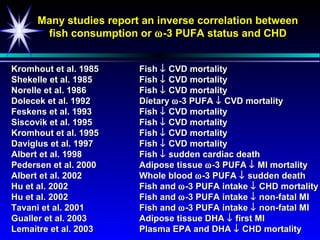
Many studies report an inverse correlation between
      fish consumption or ω-3 PUFA status and CHD


Kromhout et al. 1985    Fish ↓ CVD mortality
Shekelle et al. 1985    Fish ↓ CVD mortality
Norelle et al. 1986     Fish ↓ CVD mortality
Dolecek et al. 1992     Dietary ω -3 PUFA ↓ CVD mortality
Feskens et al. 1993     Fish ↓ CVD mortality
Siscovik et al. 1995    Fish ↓ CVD mortality
Kromhout et al. 1995    Fish ↓ CVD mortality
Daviglus et al. 1997    Fish ↓ CVD mortality
Albert et al. 1998      Fish ↓ sudden cardiac death
Pedersen et al. 2000    Adipose tissue ω -3 PUFA ↓ MI mortality
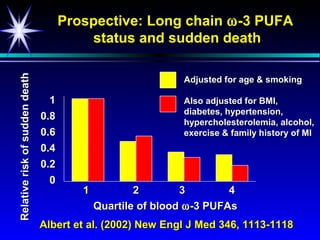
Albert et al. 2002      Whole blood ω -3 PUFA ↓ sudden death
Hu et al. 2002          Fish and ω -3 PUFA intake ↓ CHD mortality
Hu et al. 2002          Fish and ω -3 PUFA intake ↓ non-fatal MI
Tavani et al. 2001      Fish and ω -3 PUFA intake ↓ non-fatal MI
Gualler et al. 2003     Adipose tissue DHA ↓ first MI
Lemaitre et al. 2003    Plasma EPA and DHA ↓ CHD mortality
Prospective: Long chain ω -3 PUFA
                                          status and sudden death
Relative risk of sudden death


                                                              Adjusted for age & smoking

                                  1                           Also adjusted for BMI,
                                                              diabetes, hypertension,
                                0.8
                                                              hypercholesterolemia, alcohol,
                                0.6                           exercise & family history of MI
                                0.4
                                0.2
                                  0
                                         1           2        3         4
                                             Quartile of blood ω -3 PUFAs
                                Albert et al. (2002) New Engl J Med 346, 1113-1118
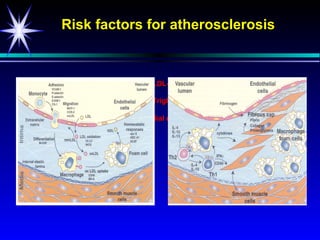
Risk factors for atherosclerosis


                         LDL-cholesterol
 Elevated blood lipids                     Hypertension
                         Triglycerides

                 Endothelial dysfunction


                             Inflammation
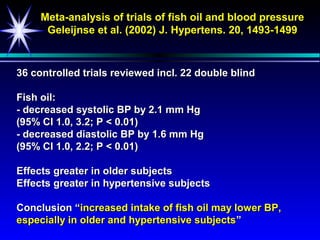
Meta-analysis of trials of fish oil and blood pressure
      Geleijnse et al. (2002) J. Hypertens. 20, 1493-1499


36 controlled trials reviewed incl. 22 double blind

Fish oil:
- decreased systolic BP by 2.1 mm Hg
(95% CI 1.0, 3.2; P < 0.01)
- decreased diastolic BP by 1.6 mm Hg
(95% CI 1.0, 2.2; P < 0.01)

Effects greater in older subjects
Effects greater in hypertensive subjects

Conclusion “increased intake of fish oil may lower BP,
especially in older and hypertensive subjects”
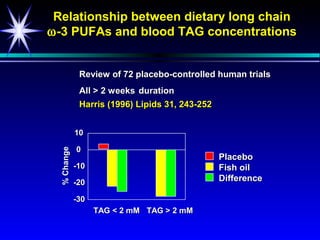
Relationship between dietary long chain
ω -3 PUFAs and blood TAG concentrations


              Review of 72 placebo-controlled human trials
              All > 2 weeks duration
              Harris (1996) Lipids 31, 243-252


             10

             0
  % Change


                                                 Placebo
             -10                                 Fish oil
             -20                                 Difference

             -30
                   TAG < 2 mM TAG > 2 mM
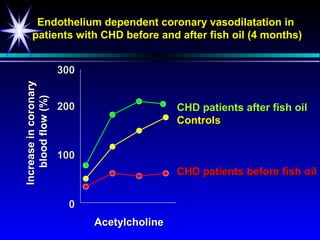
Endothelium dependent coronary vasodilatation in
      patients with CHD before and after fish oil (4 months)


                       300
Increase in coronary
   blood flow (%)


                       200                   CHD patients after fish oil
                                             Controls


                       100
                                             CHD patients before fish oil


                        0
                             Acetylcholine
Fish oil and an inflammatory marker
                (sVCAM-1)

Healthy subjects aged >                                       Pre
55 y                                                          Post
Supplemented diet with
                                             1000
a moderate amount of


                           sVCAM-1 (ng/ml)
                                             800               *
fish oil (= 1.2 g
                                             600
EPA+DHA/day) for 12
                                             400
weeks                                        200
Plasma soluble VCAM-1                         0
concentrations                                      Placebo   FO
measured
      Miles et al. (2001) Clinical Science 100, 91-100
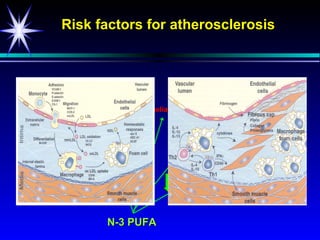
Risk factors for atherosclerosis


 Elevated blood TAG                    Hypertension

                 Endothelial dysfunction


                             Inflammation


          N-3 PUFA
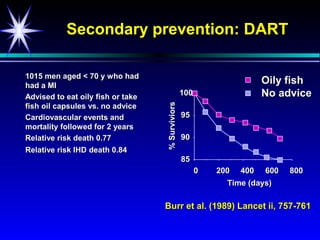
Secondary prevention: DART

1015 men aged < 70 y who had
had a MI
                                                                     Oily fish
Advised to eat oily fish or take
                                                  100                No advice
fish oil capsules vs. no advice


                                   % Surviviors
Cardiovascular events and                         95
mortality followed for 2 years
Relative risk death 0.77                          90
Relative risk IHD death 0.84
                                                  85
                                                        0   200 400 600     800
                                                              Time (days)

                                   Burr et al. (1989) Lancet ii, 757-761
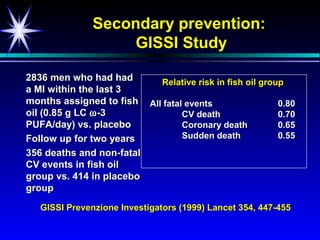
Secondary prevention:
                    GISSI Study

2836 men who had had       Relative risk in fish oil group
a MI within the last 3
months assigned to fish All fatal events                 0.80
oil (0.85 g LC ω -3              CV death                0.70
PUFA/day) vs. placebo            Coronary death          0.65
Follow up for two years          Sudden death            0.55
356 deaths and non-fatal
CV events in fish oil
group vs. 414 in placebo
group
   GISSI Prevenzione Investigators (1999) Lancet 354, 447-455
There are also non-cardiovascular
 actions of long chain ω -3 PUFAs
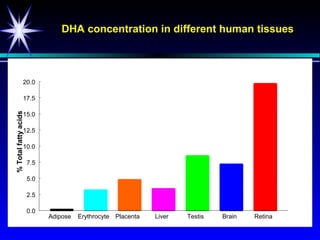
DHA concentration in different human tissues


                 20.0

                 17.5
% Total fatty acids


                 15.0

                 12.5

                 10.0

                      7.5

                      5.0

                      2.5

                      0.0
                            Adipose   Erythrocyte Placenta   Liver   Testis   Brain   Retina
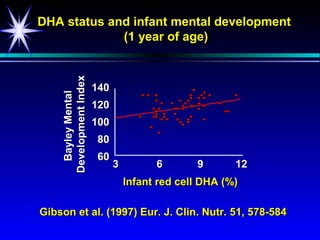
DHA status and infant mental development
             (1 year of age)


    Development Index
                        140
      Bayley Mental


                        120
                        100
                        80
                        60
                              3         6       9       12
                                  Infant red cell DHA (%)

Gibson et al. (1997) Eur. J. Clin. Nutr. 51, 578-584
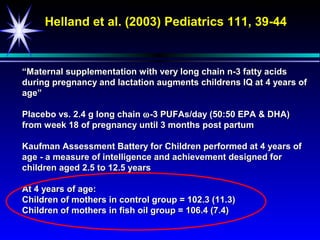
Helland et al. (2003) Pediatrics 111, 39-44


“Maternal supplementation with very long chain n-3 fatty acids
during pregnancy and lactation augments childrens IQ at 4 years of
age”

Placebo vs. 2.4 g long chain ω -3 PUFAs/day (50:50 EPA & DHA)
from week 18 of pregnancy until 3 months post partum

Kaufman Assessment Battery for Children performed at 4 years of
age - a measure of intelligence and achievement designed for
children aged 2.5 to 12.5 years

At 4 years of age:
Children of mothers in control group = 102.3 (11.3)
Children of mothers in fish oil group = 106.4 (7.4)
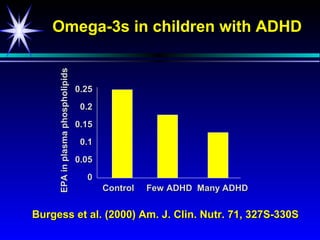
Omega-3s in children with ADHD

     EPA in plasma phospholipids

                                   0.25
                                    0.2
                                   0.15
                                    0.1
                                   0.05
                                     0
                                          Control   Few ADHD Many ADHD


Burgess et al. (2000) Am. J. Clin. Nutr. 71, 327S-330S
The Durham Trial


A randomised controlled trial of fish oil
supplementation (vs. placebo) in children (5 –
12 years old) with developmental co-ordination
disorder (n = 117)

Placebo vs. 550 mg EPA + 175 mg DHA/day for
3 months

Then all onto EPA + DHA for a further 3 months
   Richardson & Montgomery (2005) Pediatrics 115, 1360-1366
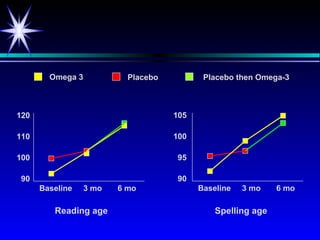
Omega 3            Placebo          Placebo then Omega-3


120                                  105

110                                  100

100                                  95

90                                   90
      Baseline    3 mo   6 mo              Baseline   3 mo    6 mo

         Reading age                           Spelling age
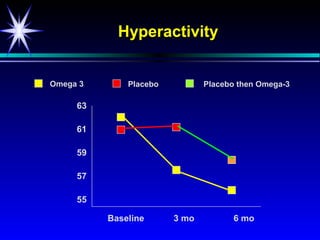
Hyperactivity


Omega 3       Placebo          Placebo then Omega-3

     63

     61

     59

     57

     55

          Baseline      3 mo         6 mo
Long chain ω -3 PUFAs are important in:

- membrane structure
- brain and visual development
- maintenance of cognitive and neurological function
(during development & with aging)
- regulation of
       - blood pressure
       - platelet function, thrombosis, fibrinolysis
        - blood lipid concentrations
       - vascular function
       - cardiac rhythmn
       - inflammation
       - immune response
       - bone health
       - insulin sensitivity
Long chain ω -3 PUFAs promote


- optimal brain growth
- optimal visual and neural function
Long chain ω -3 PUFAs are (or may be)
                protective against

- hypertension
- hypertriglyceridemia
- thrombosis
- vascular dysfunction
- cardiac arrhythmias
- cardiovascular disease
- inflammatory conditions
- allergic conditions
- immune dysfunction
- insulin resistance
- psychiatric and neurological diseases of children and adults
- neurodegenerative diseases of ageing
- bone loss
- some cancers
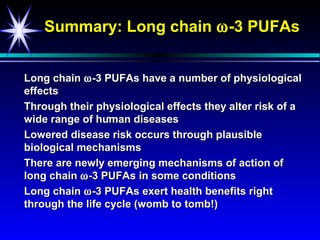
Summary: Long chain ω -3 PUFAs


Long chain ω -3 PUFAs have a number of physiological
effects
Through their physiological effects they alter risk of a
                 -
wide range of human diseases
Lowered disease risk occurs through plausible
biological mechanisms
There are newly emerging mechanisms of action of
long chain ω -3 PUFAs in some conditions
Long chain ω -3 PUFAs exert health benefits right
through the life cycle (womb to tomb!)
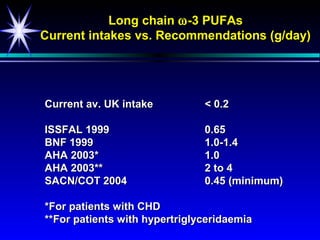
Long chain ω -3 PUFAs
Current intakes vs. Recommendations (g/day)


Current av. UK intake          < 0.2

ISSFAL 1999                    0.65
BNF 1999                       1.0-1.4
AHA 2003*                      1.0
AHA 2003**                     2 to 4
SACN/COT 2004                  0.45 (minimum)

*For patients with CHD
**For patients with hypertriglyceridaemia
What about α -linolenic acid?
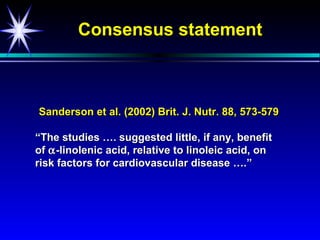
Consensus statement


Sanderson et al. (2002) Brit. J. Nutr. 88, 573-579

“The studies …. suggested little, if any, benefit
of α -linolenic acid, relative to linoleic acid, on
risk factors for cardiovascular disease ….”
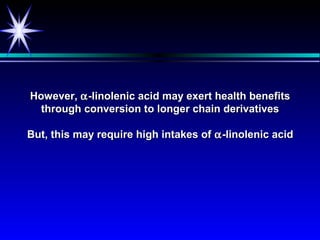
However, α -linolenic acid may exert health benefits
  through conversion to longer chain derivatives

But, this may require high intakes of α -linolenic acid

Omega 3overview-professorphilipcalder-121230045819-phpapp01

  • 1.
    Omega-3 Fatty Acids: Naming, sources, intakes, metabolism and health benefits Philip Calder Professor of Nutritional Immunology University of Southampton
  • 2.
    This lecture willcover Fatty acid structure, nomenclature, sources, and intakes Metabolic relationship between α -linolenic acid and long chain omega-3 fatty acids Omega-3 fatty acids and cardiovascular health Omega-3 fatty acids and visual and brain development Recommendations for omega-3 fatty acid intake
  • 3.
    Fats in thediet CH2.O.CO.R1 CH2.O.CO.R1 R2.CO.OCH R2.CO.OCH CH2.O.CO.R3 CH2.O.POO.O.Base Triglycerides Phospholipids Also sphingolipids cholesterol and cholesterol esters
  • 4.
  • 5.
    Fatty acid structureand nomenclature H3C COOH 18:0 Stearic acid H3C 9 COOH 18:1ω-9 Oleic acid H3C COOH 18:2ω-6 Linoleic acid 6 H3C 3 COOH 18:3ω-3 α-Linolenic acid Mammals cannot insert double bonds in here Omega = ω - = n-
  • 6.
    Saturated Monounsaturated Polyunsaturated Sunflower oil Corn oil Soybean oil Olive oil Pig fat Beef fat Butter 0 20 40 60 80 100
  • 7.
    Latest fatty acidintake data for adults in UK (g/day) Males Females Total fat 87 (36% energy) 61 (35% energy) Saturated 33 23 Trans 3 2 Monounsaturated 29 20 Omega-6 PUFA 13 9 Omega-3 PUFA 2.3 1.7
  • 8.
    Omega-3 PUFAs H3C COOH α -Linolenic acid (18:3ω -3) H3C COOH EPA (20:5ω -3) COOH H3C DPA (22:5ω -3) H3C COOH DHA (22:6ω -3)
  • 9.
    These have differentdietary sources and their intake differs markedly
  • 10.
    α -Linolenic acid(18:3ω -3) Found in green plant tissues Found in some vegetable oils (e.g. soybean, rapeseed) Found in some nuts (e.g. walnut) Found in linseed (flaxseed) and linseed oil Contributes 85 to 95% of ω -3 PUFA intake in UK adults (ca. 2.1 g/day in males; 1.5 g/day in females)
  • 11.
    Long chain ω-3 PUFAs (EPA, DPA, DHA) - oily fish are the only rich source of preformed long chain ω -3 PUFAs - adults in the UK consume on average 1/3 of a portion of oily fish per week (53 g/week) - fish consumers consume 1.3 portions of oily fish per week (about 195 g/week) - average long chain ω -3 PUFA intake is < 0.2 g/day (200 mg/day) - long chain ω -3 PUFAs are found in fish oils
  • 12.
    Long chain ω-3 PUFA content of fish EPA DPA DHA Total (g/100 g food) g/portion Cod 0.08 0.01 0.16 0.30 Haddock 0.05 0.01 0.10 0.19 Herring 0.51 0.11 0.69 1.56 Mackerel 0.71 0.12 1.10 3.09 Salmon 0.55 0.14 0.86 1.55 Crab 0.47 0.08 0.45 0.85 Prawns 0.06 0.01 0.04 0.06
  • 13.
    α -linolenic acidis metabolically related to long chain ω -3 PUFAs α -Linolenic acid (18:3ω -3) Delta 6-desaturase 18:4ω -3 Elongase 20:4ω -3 Delta 5-desaturase EPA (20:5ω -3) DPA (22:5ω -3) DHA (22:6ω -3)
  • 14.
    α -Linolenic acid This pathway does not work very well in humans EPA DHA
  • 15.
    Key points (sofar) ω -6 and ω -3 PUFAs are distinct fatty acid families Most ω -3 PUFA in the diet is in the form of α - linolenic acid Long chain ω -3 PUFAs are found in oily fish (fish oil capsules) Average intake of long chain ω -3 PUFAs is < 0.2 g/day α -Linolenic acid is poorly converted to long chain ω -3 PUFAs in humans
  • 16.
    Omega-3 PUFAs andhuman health
  • 18.
    From a surveyof distribution of diseases in Greenland Eskimos Disease Expected Actual Myocardial infarction 40 3 Psoriasis 40 2 Bronchial asthma 25 1 Diabetes 9 1 Multiple sclerosis 2 0 Kromann & Green (1980) Acta Med. Scand. 208, 410-406
  • 19.
    Many studies reportan inverse correlation between fish consumption or ω-3 PUFA status and CHD Kromhout et al. 1985 Fish ↓ CVD mortality Shekelle et al. 1985 Fish ↓ CVD mortality Norelle et al. 1986 Fish ↓ CVD mortality Dolecek et al. 1992 Dietary ω -3 PUFA ↓ CVD mortality Feskens et al. 1993 Fish ↓ CVD mortality Siscovik et al. 1995 Fish ↓ CVD mortality Kromhout et al. 1995 Fish ↓ CVD mortality Daviglus et al. 1997 Fish ↓ CVD mortality Albert et al. 1998 Fish ↓ sudden cardiac death Pedersen et al. 2000 Adipose tissue ω -3 PUFA ↓ MI mortality Albert et al. 2002 Whole blood ω -3 PUFA ↓ sudden death Hu et al. 2002 Fish and ω -3 PUFA intake ↓ CHD mortality Hu et al. 2002 Fish and ω -3 PUFA intake ↓ non-fatal MI Tavani et al. 2001 Fish and ω -3 PUFA intake ↓ non-fatal MI Gualler et al. 2003 Adipose tissue DHA ↓ first MI Lemaitre et al. 2003 Plasma EPA and DHA ↓ CHD mortality
  • 20.
    Prospective: Long chainω -3 PUFA status and sudden death Relative risk of sudden death Adjusted for age & smoking 1 Also adjusted for BMI, diabetes, hypertension, 0.8 hypercholesterolemia, alcohol, 0.6 exercise & family history of MI 0.4 0.2 0 1 2 3 4 Quartile of blood ω -3 PUFAs Albert et al. (2002) New Engl J Med 346, 1113-1118
  • 21.
    Risk factors foratherosclerosis LDL-cholesterol Elevated blood lipids Hypertension Triglycerides Endothelial dysfunction Inflammation
  • 22.
    Meta-analysis of trialsof fish oil and blood pressure Geleijnse et al. (2002) J. Hypertens. 20, 1493-1499 36 controlled trials reviewed incl. 22 double blind Fish oil: - decreased systolic BP by 2.1 mm Hg (95% CI 1.0, 3.2; P < 0.01) - decreased diastolic BP by 1.6 mm Hg (95% CI 1.0, 2.2; P < 0.01) Effects greater in older subjects Effects greater in hypertensive subjects Conclusion “increased intake of fish oil may lower BP, especially in older and hypertensive subjects”
  • 23.
    Relationship between dietarylong chain ω -3 PUFAs and blood TAG concentrations Review of 72 placebo-controlled human trials All > 2 weeks duration Harris (1996) Lipids 31, 243-252 10 0 % Change Placebo -10 Fish oil -20 Difference -30 TAG < 2 mM TAG > 2 mM
  • 24.
    Endothelium dependent coronaryvasodilatation in patients with CHD before and after fish oil (4 months) 300 Increase in coronary blood flow (%) 200 CHD patients after fish oil Controls 100 CHD patients before fish oil 0 Acetylcholine
  • 25.
    Fish oil andan inflammatory marker (sVCAM-1) Healthy subjects aged > Pre 55 y Post Supplemented diet with 1000 a moderate amount of sVCAM-1 (ng/ml) 800 * fish oil (= 1.2 g 600 EPA+DHA/day) for 12 400 weeks 200 Plasma soluble VCAM-1 0 concentrations Placebo FO measured Miles et al. (2001) Clinical Science 100, 91-100
  • 26.
    Risk factors foratherosclerosis Elevated blood TAG Hypertension Endothelial dysfunction Inflammation N-3 PUFA
  • 27.
    Secondary prevention: DART 1015men aged < 70 y who had had a MI Oily fish Advised to eat oily fish or take 100 No advice fish oil capsules vs. no advice % Surviviors Cardiovascular events and 95 mortality followed for 2 years Relative risk death 0.77 90 Relative risk IHD death 0.84 85 0 200 400 600 800 Time (days) Burr et al. (1989) Lancet ii, 757-761
  • 28.
    Secondary prevention: GISSI Study 2836 men who had had Relative risk in fish oil group a MI within the last 3 months assigned to fish All fatal events 0.80 oil (0.85 g LC ω -3 CV death 0.70 PUFA/day) vs. placebo Coronary death 0.65 Follow up for two years Sudden death 0.55 356 deaths and non-fatal CV events in fish oil group vs. 414 in placebo group GISSI Prevenzione Investigators (1999) Lancet 354, 447-455
  • 29.
    There are alsonon-cardiovascular actions of long chain ω -3 PUFAs
  • 30.
    DHA concentration indifferent human tissues 20.0 17.5 % Total fatty acids 15.0 12.5 10.0 7.5 5.0 2.5 0.0 Adipose Erythrocyte Placenta Liver Testis Brain Retina
  • 31.
    DHA status andinfant mental development (1 year of age) Development Index 140 Bayley Mental 120 100 80 60 3 6 9 12 Infant red cell DHA (%) Gibson et al. (1997) Eur. J. Clin. Nutr. 51, 578-584
  • 32.
    Helland et al.(2003) Pediatrics 111, 39-44 “Maternal supplementation with very long chain n-3 fatty acids during pregnancy and lactation augments childrens IQ at 4 years of age” Placebo vs. 2.4 g long chain ω -3 PUFAs/day (50:50 EPA & DHA) from week 18 of pregnancy until 3 months post partum Kaufman Assessment Battery for Children performed at 4 years of age - a measure of intelligence and achievement designed for children aged 2.5 to 12.5 years At 4 years of age: Children of mothers in control group = 102.3 (11.3) Children of mothers in fish oil group = 106.4 (7.4)
  • 33.
    Omega-3s in childrenwith ADHD EPA in plasma phospholipids 0.25 0.2 0.15 0.1 0.05 0 Control Few ADHD Many ADHD Burgess et al. (2000) Am. J. Clin. Nutr. 71, 327S-330S
  • 34.
    The Durham Trial Arandomised controlled trial of fish oil supplementation (vs. placebo) in children (5 – 12 years old) with developmental co-ordination disorder (n = 117) Placebo vs. 550 mg EPA + 175 mg DHA/day for 3 months Then all onto EPA + DHA for a further 3 months Richardson & Montgomery (2005) Pediatrics 115, 1360-1366
  • 35.
    Omega 3 Placebo Placebo then Omega-3 120 105 110 100 100 95 90 90 Baseline 3 mo 6 mo Baseline 3 mo 6 mo Reading age Spelling age
  • 36.
    Hyperactivity Omega 3 Placebo Placebo then Omega-3 63 61 59 57 55 Baseline 3 mo 6 mo
  • 37.
    Long chain ω-3 PUFAs are important in: - membrane structure - brain and visual development - maintenance of cognitive and neurological function (during development & with aging) - regulation of - blood pressure - platelet function, thrombosis, fibrinolysis - blood lipid concentrations - vascular function - cardiac rhythmn - inflammation - immune response - bone health - insulin sensitivity
  • 38.
    Long chain ω-3 PUFAs promote - optimal brain growth - optimal visual and neural function
  • 39.
    Long chain ω-3 PUFAs are (or may be) protective against - hypertension - hypertriglyceridemia - thrombosis - vascular dysfunction - cardiac arrhythmias - cardiovascular disease - inflammatory conditions - allergic conditions - immune dysfunction - insulin resistance - psychiatric and neurological diseases of children and adults - neurodegenerative diseases of ageing - bone loss - some cancers
  • 40.
    Summary: Long chainω -3 PUFAs Long chain ω -3 PUFAs have a number of physiological effects Through their physiological effects they alter risk of a - wide range of human diseases Lowered disease risk occurs through plausible biological mechanisms There are newly emerging mechanisms of action of long chain ω -3 PUFAs in some conditions Long chain ω -3 PUFAs exert health benefits right through the life cycle (womb to tomb!)
  • 41.
    Long chain ω-3 PUFAs Current intakes vs. Recommendations (g/day) Current av. UK intake < 0.2 ISSFAL 1999 0.65 BNF 1999 1.0-1.4 AHA 2003* 1.0 AHA 2003** 2 to 4 SACN/COT 2004 0.45 (minimum) *For patients with CHD **For patients with hypertriglyceridaemia
  • 42.
    What about α-linolenic acid?
  • 43.
    Consensus statement Sanderson etal. (2002) Brit. J. Nutr. 88, 573-579 “The studies …. suggested little, if any, benefit of α -linolenic acid, relative to linoleic acid, on risk factors for cardiovascular disease ….”
  • 44.
    However, α -linolenicacid may exert health benefits through conversion to longer chain derivatives But, this may require high intakes of α -linolenic acid