Nōku te Whenua
Sustainable and Efficient Land and Water-
use in the Face of a Changing climate
1
Outline today
• 9:30am Mihi
• 9:45 a.m. Introduction – Karamea Insley
• 10:00 a.m. Research Overview - NIWA
• 10:15 a.m. Technology infrastructure
» Evolution Networks; and
» Cucumber
• 10:30 a.m. Training and Education Strategy (Science and students)
» Toi Ohomai
• 10:45 a.m. Demonstrate Online Weather dashboard
» NIWA
• 11:00 a.m. Site visits
» Ray Sharps Kiwifruit orchard (Aunty Kura’s) – Soil moisture sensors
» Wharawhara 13 land block – Weather station, stream sensors
» Wharawhara 5 and 15b Soil moisture sensors
• 1:00pm Kai (Te Kaha Resort)
• 1:45pm Wrap-up and Next steps
2
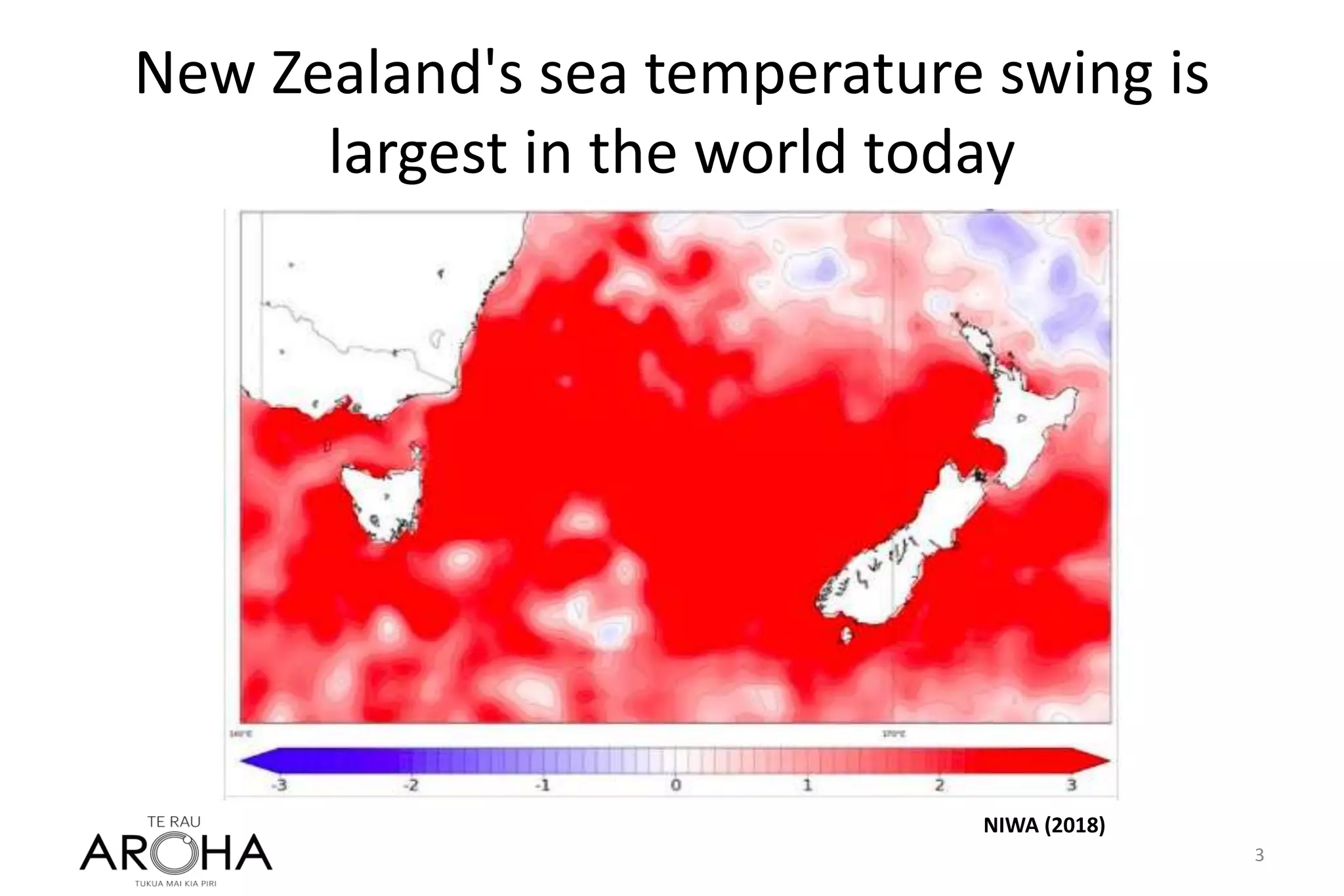
New Zealand's sea temperature swing is
largest in the world today
3
NIWA (2018)
Bay of Plenty
4
Omaio Modeled Sea-Level Rise
5
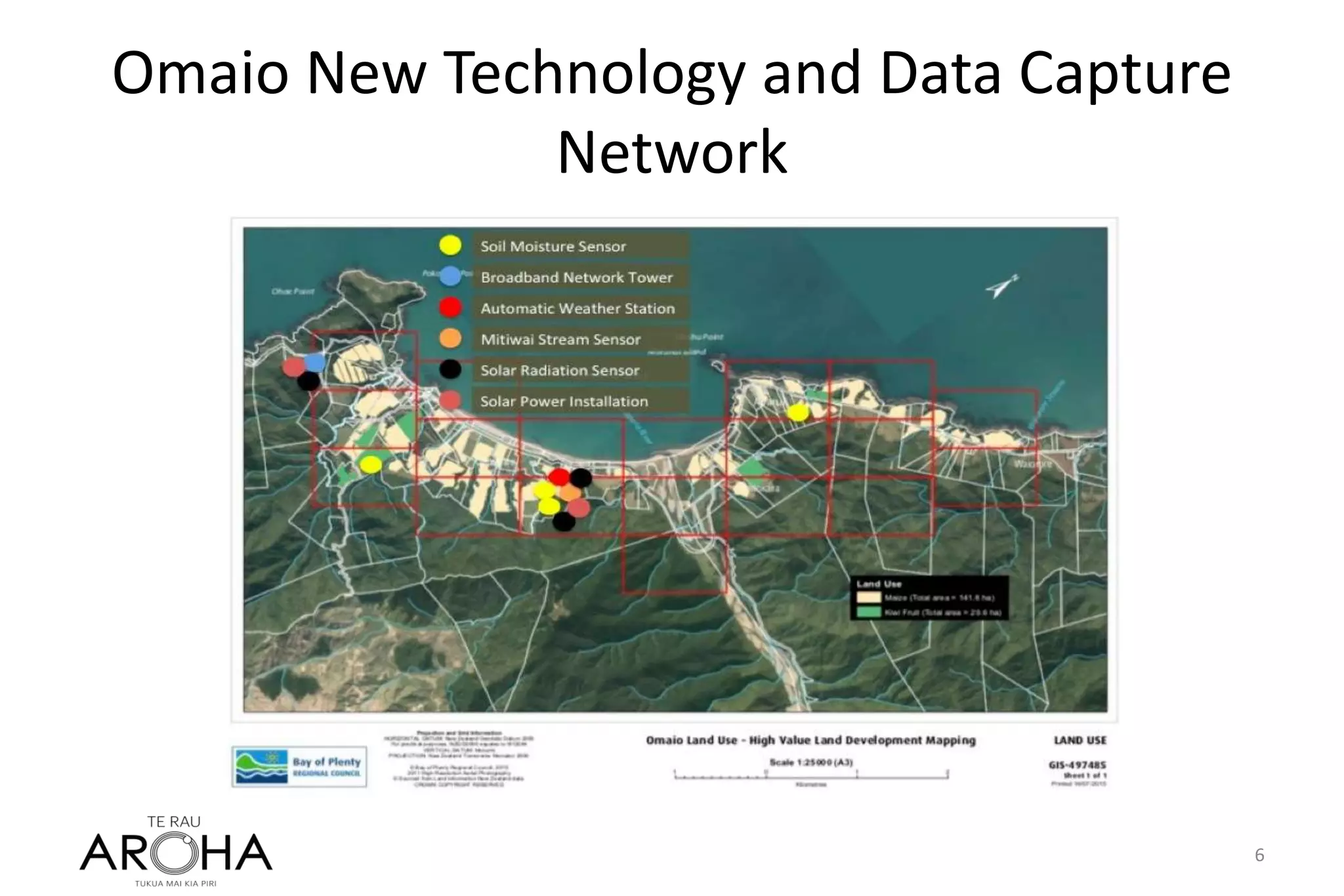
Omaio New Technology and Data Capture
Network
6
Acknowledgements
Science, Research and Innovation
– National Science Challenges, The Deep
South;
– NIWA
– Plant and Food NZ
– Manaaki Whenua Landcare
– Massey University (Food Innovation
Institute)
– Victoria University (School of Science
and Engineering)
– Evolution Networks
– Cucumber Limited
– Toi Ohomai
– Te Whanau a Apanui Area School
Government (local, regional and central)
– Opotiki District Council
– Bay of Plenty Regional council
– Bay of Connections
– Toi EDA
– Department of Conservation (Nga
Whenua Rahui)
– Ministry of Business Innovation and
Employment
– Ministry of Maori Development
– Ministry of Foreign Affairs and Trade
– New Zealand Trade and Enterprise
– Ministry of Education
– Ministry of Primary Industries
7
Acknowledgements
Our Land Blocks
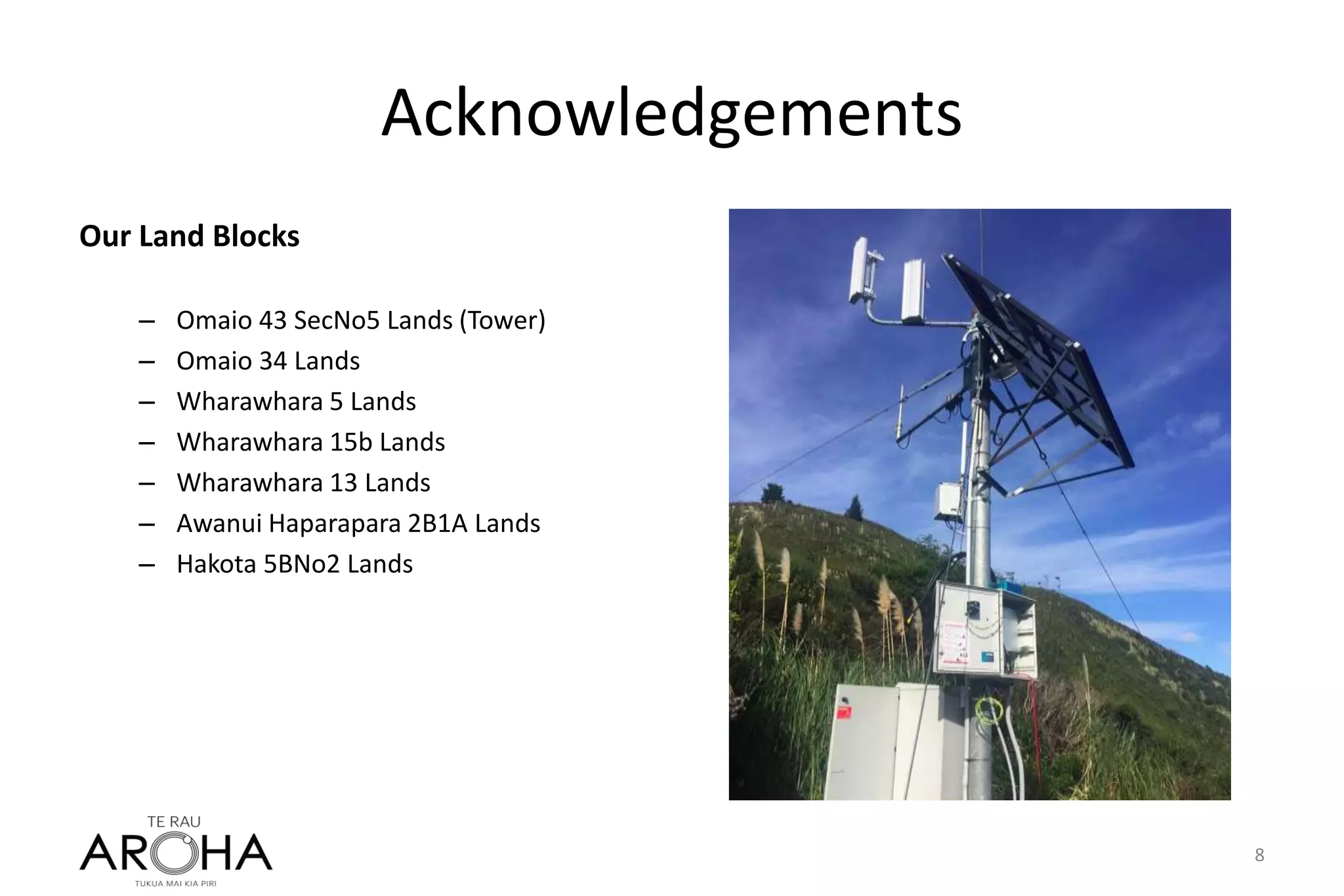
– Omaio 43 SecNo5 Lands (Tower)
– Omaio 34 Lands
– Wharawhara 5 Lands
– Wharawhara 15b Lands
– Wharawhara 13 Lands
– Awanui Haparapara 2B1A Lands
– Hakota 5BNo2 Lands
8
Omaio 43 Tower
9
• Evolution installed a relay site and now
provides high speed Internet to Omaio
• Installed a LORA IoT transmitter for NIWA
• Currently installing SigFox transmitter for IoT
• Enables accurate climate modelling tools
specific to Omaio
• Enables development of new high tech
orchards in Omaio
• Local businesses will be more competitive
• More skilled jobs will be generated
• New businesses will emerge
• This will encourage more people to return to
their lands
• Communities will be more prosperous
1 Month Rainfall in Omaio
10
Changing with our Climate
The New Zealand climate adaptation landscape is dynamic and evolving rapidly. The Zero Carbon Bill has been opened for
consultation, on how New Zealand will make its contribution to mitigating climate change, and which also aims to ensure the
country has a plan for how we adapt to the effects of climate change. The Climate Commission is to be established, and is
expected to facilitate a national climate change risk assessment, develop a national adaptation plan and have adaptation
reporting power.
At the same time, the recent report by the Climate Change Adaptation Technical Working Group (CCATWG) identified three
conditions which will enable New Zealanders to adapt, manage risk and thrive in a changing climate: being informed, being
organized, and taking dynamic action.
The Deep South Challenge is strategically positioned to provide research that can contribute to and underpin this national-
scale work. In our second phase, 2019-2024, driven by our new climate projection capabilities and our increased
understanding of stakeholder and Māori needs, we will narrow our focus more firmly on:
• Improving our knowledge of five key climate impacts (climate extremes, changes in temperature and rainfall, droughts,
floods and sea-level rise); and on
• Understanding the implications of these climate impacts across four social domains (communities, Māori communities,
the national economy and national infrastructure).
11
Dr. Mike Williams (Deep South Challenge)
Transition to a Low-emission Economy
Our Submission
Guiding Principles
– Honour the Treaty of Waitangi;
– Policy Fairness and Equity;
– Act with a sense of Urgency;
– Political Independence; and
– Include all sectors and all gases
12
Transition to a Low-emission Economy
Our Policy recommendations
Mitigation (2) to reduce emissions
– Getting emissions pricing right ($NZ50 to $NZ350 per tonne by 2020) to send the right signals to motivate
investment in low-emissions technologies and processes; and
– Domestic abatement a priority ahead of international unit trading.
Adaptation (6) to a changing climate
– New afforestation (mixed species) and high value horticulture as a priority targeting underutilized Maori
lands;
– Unlocking the significant barriers to private and banking investment on Maori lands as a priority;
– Growing the Maori Governance Capability and Capacity through targeted education and training for Trusts
and Incorporations towards strong and timely decision making as set out in the Omaio Case-study;
– Harnessing and targeting the full potential of science, innovation and supporting investment into low-
emissions activities and technologies with Maori as set out in the Omaio Case-study;
– Through an Independent Climate Body, create integrated laws, policies and institutions that monitor and
measure performance and endure over time and act as a commitment device for future Governments; and
– Ensuring other supportive regulations and policies are in place (including to encourage an inclusive
transition).
13
Agribusiness Researcher Opportunity
14
As part of our Agribusiness Development Program we are looking for a
recent Apanui Graduate who wants to do a Masters Degree in social,
economic, food processing and/or growing disciplines.
The research is to study a berry crop idea that will investigate growing,
harvesting, distribution, marketing and selling of the berries.
Equally the research could investigate to social opportunities and
impacts from such a crop.
It all needs researching and could be led and studied usefully from any
of these angles.
If you think this is you, please contact me to discuss further.
Karamea Insley
Chairman, Te Rau Aroha Trust
Phone: +64 21 972 782
Email: karamea@ngakaupoi.com

Omaio Science Open Day Opening Presentation

  • 1.
    Nōku te Whenua Sustainableand Efficient Land and Water- use in the Face of a Changing climate 1
  • 2.
    Outline today • 9:30amMihi • 9:45 a.m. Introduction – Karamea Insley • 10:00 a.m. Research Overview - NIWA • 10:15 a.m. Technology infrastructure » Evolution Networks; and » Cucumber • 10:30 a.m. Training and Education Strategy (Science and students) » Toi Ohomai • 10:45 a.m. Demonstrate Online Weather dashboard » NIWA • 11:00 a.m. Site visits » Ray Sharps Kiwifruit orchard (Aunty Kura’s) – Soil moisture sensors » Wharawhara 13 land block – Weather station, stream sensors » Wharawhara 5 and 15b Soil moisture sensors • 1:00pm Kai (Te Kaha Resort) • 1:45pm Wrap-up and Next steps 2
  • 3.
    New Zealand's seatemperature swing is largest in the world today 3 NIWA (2018)
  • 4.
  • 5.
  • 6.
    Omaio New Technologyand Data Capture Network 6
  • 7.
    Acknowledgements Science, Research andInnovation – National Science Challenges, The Deep South; – NIWA – Plant and Food NZ – Manaaki Whenua Landcare – Massey University (Food Innovation Institute) – Victoria University (School of Science and Engineering) – Evolution Networks – Cucumber Limited – Toi Ohomai – Te Whanau a Apanui Area School Government (local, regional and central) – Opotiki District Council – Bay of Plenty Regional council – Bay of Connections – Toi EDA – Department of Conservation (Nga Whenua Rahui) – Ministry of Business Innovation and Employment – Ministry of Maori Development – Ministry of Foreign Affairs and Trade – New Zealand Trade and Enterprise – Ministry of Education – Ministry of Primary Industries 7
  • 8.
    Acknowledgements Our Land Blocks –Omaio 43 SecNo5 Lands (Tower) – Omaio 34 Lands – Wharawhara 5 Lands – Wharawhara 15b Lands – Wharawhara 13 Lands – Awanui Haparapara 2B1A Lands – Hakota 5BNo2 Lands 8
  • 9.
    Omaio 43 Tower 9 •Evolution installed a relay site and now provides high speed Internet to Omaio • Installed a LORA IoT transmitter for NIWA • Currently installing SigFox transmitter for IoT • Enables accurate climate modelling tools specific to Omaio • Enables development of new high tech orchards in Omaio • Local businesses will be more competitive • More skilled jobs will be generated • New businesses will emerge • This will encourage more people to return to their lands • Communities will be more prosperous
  • 10.
    1 Month Rainfallin Omaio 10
  • 11.
    Changing with ourClimate The New Zealand climate adaptation landscape is dynamic and evolving rapidly. The Zero Carbon Bill has been opened for consultation, on how New Zealand will make its contribution to mitigating climate change, and which also aims to ensure the country has a plan for how we adapt to the effects of climate change. The Climate Commission is to be established, and is expected to facilitate a national climate change risk assessment, develop a national adaptation plan and have adaptation reporting power. At the same time, the recent report by the Climate Change Adaptation Technical Working Group (CCATWG) identified three conditions which will enable New Zealanders to adapt, manage risk and thrive in a changing climate: being informed, being organized, and taking dynamic action. The Deep South Challenge is strategically positioned to provide research that can contribute to and underpin this national- scale work. In our second phase, 2019-2024, driven by our new climate projection capabilities and our increased understanding of stakeholder and Māori needs, we will narrow our focus more firmly on: • Improving our knowledge of five key climate impacts (climate extremes, changes in temperature and rainfall, droughts, floods and sea-level rise); and on • Understanding the implications of these climate impacts across four social domains (communities, Māori communities, the national economy and national infrastructure). 11 Dr. Mike Williams (Deep South Challenge)
  • 12.
    Transition to aLow-emission Economy Our Submission Guiding Principles – Honour the Treaty of Waitangi; – Policy Fairness and Equity; – Act with a sense of Urgency; – Political Independence; and – Include all sectors and all gases 12
  • 13.
    Transition to aLow-emission Economy Our Policy recommendations Mitigation (2) to reduce emissions – Getting emissions pricing right ($NZ50 to $NZ350 per tonne by 2020) to send the right signals to motivate investment in low-emissions technologies and processes; and – Domestic abatement a priority ahead of international unit trading. Adaptation (6) to a changing climate – New afforestation (mixed species) and high value horticulture as a priority targeting underutilized Maori lands; – Unlocking the significant barriers to private and banking investment on Maori lands as a priority; – Growing the Maori Governance Capability and Capacity through targeted education and training for Trusts and Incorporations towards strong and timely decision making as set out in the Omaio Case-study; – Harnessing and targeting the full potential of science, innovation and supporting investment into low- emissions activities and technologies with Maori as set out in the Omaio Case-study; – Through an Independent Climate Body, create integrated laws, policies and institutions that monitor and measure performance and endure over time and act as a commitment device for future Governments; and – Ensuring other supportive regulations and policies are in place (including to encourage an inclusive transition). 13
  • 14.
    Agribusiness Researcher Opportunity 14 Aspart of our Agribusiness Development Program we are looking for a recent Apanui Graduate who wants to do a Masters Degree in social, economic, food processing and/or growing disciplines. The research is to study a berry crop idea that will investigate growing, harvesting, distribution, marketing and selling of the berries. Equally the research could investigate to social opportunities and impacts from such a crop. It all needs researching and could be led and studied usefully from any of these angles. If you think this is you, please contact me to discuss further. Karamea Insley Chairman, Te Rau Aroha Trust Phone: +64 21 972 782 Email: karamea@ngakaupoi.com

Editor's Notes

  • #4 Notes: The water temperature in the Tasman Sea is well above normal, 6degC more than average for the start of December. The increase has been driven by a La Nina climate system, and scientists say a continued warming of our ocean could permanently damage our fisheries and lead to tropical cyclones.