Olive Irrigation
Management Project –
Setting the Scene
V. Nangia, M. Karrou and T. Oweis
Acknowledgements
• The study was presented by the International Olives
Council (IOC) to the Common Fund for Commodities
(CFC) for funding and was drawn up at the IOC
Executive Secretariat in cooperation with the
Instituto de Agricultura Sostenible (IAS-CSIC),
Spain, and the Instituto per i Sistemi Agricoli e
Forestali del Mediterraneo (CNR-ISAFoM), Italy. CFC
is an intergovernmental financial institution
established within the framework of the United
Nations, headquartered in Amsterdam, the
Netherlands.
Study sites
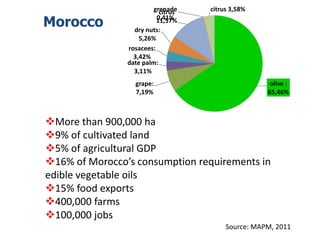
More than 900,000 ha
9% of cultivated land
5% of agricultural GDP
16% of Morocco’s consumption requirements in
edible vegetable oils
15% food exports
400,000 farms
100,000 jobs
Source: MAPM, 2011
olive :
65,46%
grape:
7,19%
date palm:
3,11%
rosacees:
3,42%
dry nuts:
5,26%
citrus
11,57%
grenade
0,41%
citrus 3,58%
Morocco
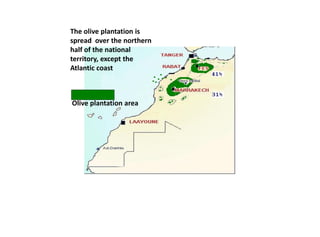
Olive plantation area
The olive plantation is
spread over the northern
half of the national
territory, except the
Atlantic coast
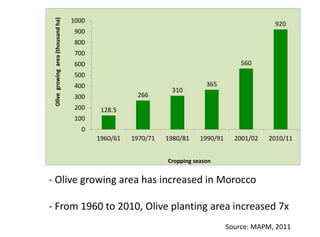
128.5
266
310
365
560
920
0
100
200
300
400
500
600
700
800
900
1000
1960/61 1970/71 1980/81 1990/91 2001/02 2010/11
Olivegrowingarea(thousandha)
Cropping season
- Olive growing area has increased in Morocco
- From 1960 to 2010, Olive planting area increased 7x
Source: MAPM, 2011
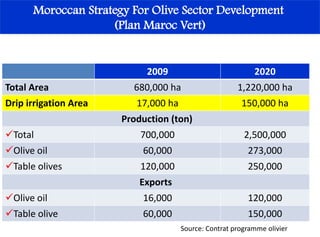
Moroccan Strategy For Olive Sector Development
(Plan Maroc Vert)
2009 2020
Total Area 680,000 ha 1,220,000 ha
Drip irrigation Area 17,000 ha 150,000 ha
Production (ton)
Total 700,000 2,500,000
Olive oil 60,000 273,000
Table olives 120,000 250,000
Exports
Olive oil 16,000 120,000
Table olive 60,000 150,000
Source: Contrat programme olivier
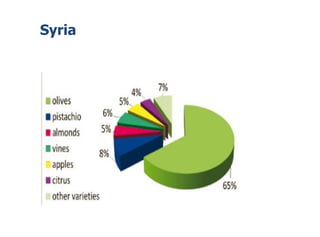
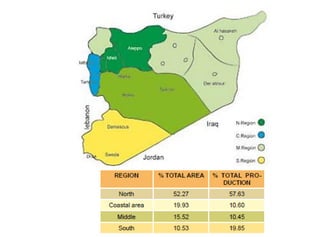
Syria
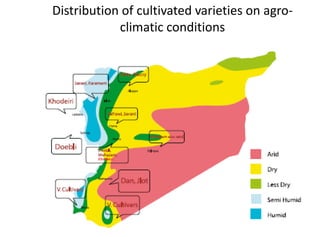
Distribution of cultivated varieties on agro-
climatic conditions
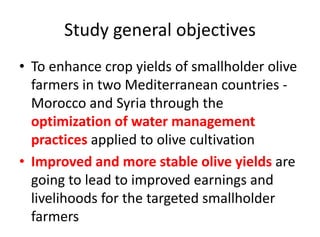
Study general objectives
• To enhance crop yields of smallholder olive
farmers in two Mediterranean countries -
Morocco and Syria through the
optimization of water management
practices applied to olive cultivation
• Improved and more stable olive yields are
going to lead to improved earnings and
livelihoods for the targeted smallholder
farmers
Specific objectives
• To increase yield of olive groves in the
target areas by using advanced strategies
• To minimize yearly fluctuations in yield,
and securing more stable farm income
• To increase water productivity of irrigated
olive
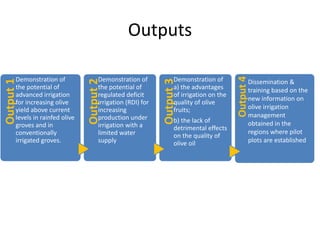
Outputs
Output1
Demonstration of
the potential of
advanced irrigation
for increasing olive
yield above current
levels in rainfed olive
groves and in
conventionally
irrigated groves.
Output2
Demonstration of
the potential of
regulated deficit
irrigation (RDI) for
increasing
production under
irrigation with a
limited water
supply
Output3
Demonstration of
a) the advantages
of irrigation on the
quality of olive
fruits;
b) the lack of
detrimental effects
on the quality of
olive oil
Output4
Dissemination &
training based on the
new information on
olive irrigation
management
obtained in the
regions where pilot
plots are established
THANK YOU
v.nangia@cgiar.org

Olive Irrigation Management Project – Setting the Scene

  • 1.
    Olive Irrigation Management Project– Setting the Scene V. Nangia, M. Karrou and T. Oweis
  • 2.
    Acknowledgements • The studywas presented by the International Olives Council (IOC) to the Common Fund for Commodities (CFC) for funding and was drawn up at the IOC Executive Secretariat in cooperation with the Instituto de Agricultura Sostenible (IAS-CSIC), Spain, and the Instituto per i Sistemi Agricoli e Forestali del Mediterraneo (CNR-ISAFoM), Italy. CFC is an intergovernmental financial institution established within the framework of the United Nations, headquartered in Amsterdam, the Netherlands.
  • 3.
  • 4.
    More than 900,000ha 9% of cultivated land 5% of agricultural GDP 16% of Morocco’s consumption requirements in edible vegetable oils 15% food exports 400,000 farms 100,000 jobs Source: MAPM, 2011 olive : 65,46% grape: 7,19% date palm: 3,11% rosacees: 3,42% dry nuts: 5,26% citrus 11,57% grenade 0,41% citrus 3,58% Morocco
  • 5.
    Olive plantation area Theolive plantation is spread over the northern half of the national territory, except the Atlantic coast
  • 6.
    128.5 266 310 365 560 920 0 100 200 300 400 500 600 700 800 900 1000 1960/61 1970/71 1980/811990/91 2001/02 2010/11 Olivegrowingarea(thousandha) Cropping season - Olive growing area has increased in Morocco - From 1960 to 2010, Olive planting area increased 7x Source: MAPM, 2011
  • 7.
    Moroccan Strategy ForOlive Sector Development (Plan Maroc Vert) 2009 2020 Total Area 680,000 ha 1,220,000 ha Drip irrigation Area 17,000 ha 150,000 ha Production (ton) Total 700,000 2,500,000 Olive oil 60,000 273,000 Table olives 120,000 250,000 Exports Olive oil 16,000 120,000 Table olive 60,000 150,000 Source: Contrat programme olivier
  • 8.
  • 10.
    Distribution of cultivatedvarieties on agro- climatic conditions
  • 11.
    Study general objectives •To enhance crop yields of smallholder olive farmers in two Mediterranean countries - Morocco and Syria through the optimization of water management practices applied to olive cultivation • Improved and more stable olive yields are going to lead to improved earnings and livelihoods for the targeted smallholder farmers
  • 12.
    Specific objectives • Toincrease yield of olive groves in the target areas by using advanced strategies • To minimize yearly fluctuations in yield, and securing more stable farm income • To increase water productivity of irrigated olive
  • 13.
    Outputs Output1 Demonstration of the potentialof advanced irrigation for increasing olive yield above current levels in rainfed olive groves and in conventionally irrigated groves. Output2 Demonstration of the potential of regulated deficit irrigation (RDI) for increasing production under irrigation with a limited water supply Output3 Demonstration of a) the advantages of irrigation on the quality of olive fruits; b) the lack of detrimental effects on the quality of olive oil Output4 Dissemination & training based on the new information on olive irrigation management obtained in the regions where pilot plots are established
  • 14.