Tali Mass & Jeana Drake
     January 30, 2013
Focus on climate change
1. Changing ocean temperatures
    2 - 4oC (3.6 - 7.2oF) global average increase by year
      2100
2. Changing sea level
    1.5 – 10 mm/year (0.06 – 0.4 inches/year) global
      average increase to year 2100
3. Changing ocean pH
    Average surface ocean pH decrease from 8.2 to 7.8
     by year 2100
Conditions preferred by corals
•  Temperature: 23-25°C;
•  Light: for photosynthesis;
•  Salinity required;
•  Clean, clear water, sediment free;
•  Well oxygenated water produced by
   strong wave action
Coral’s ideal environment
Coral reefs are concentrated in a band around
the equator between 30°N and 30°S latitude.
Types of Reefs
•  Fringing reef – reef that is directly attached to a
   shore or borders it with an intervening shallow
   channel or lagoon.
•  Barrier reef – reef separated from a mainland or
   island shore by a deep lagoon.
•  Atoll reef – a more or less circular or continuous
   barrier reef extending all the way around a lagoon
   without a central island.
Darwin’s Theory of Reefs
Class: Scyphozoa                     Class: Hydrozoa


                   Class: Anthozoa
   Ahermatypic       Sea anemone        Hermatypic
Types of Corals
Hard corals (hermatypic): secrete a
  limestone (CaCO3) exoskeleton around
  itself as protection. This exoskeleton
  remains even after the organism dies.


Soft corals (ahermatypic): tree-like and
  flexible with a skeleton within their bodies
  giving them shape but allowing movement
  with the waves
Growth forms
Basic structure

z                  •  Polyps = basis of life on reef.

                   •  Produce calcium carbonate
                      skeleton as they grow.

                   •  Polyp growth = symbiotic
                      relationship between the
                      coral animal and
                      zooxanthellae (algae).

                   •  Zooxanthellae
                      photosynthesize and give
                      sugars and fats to polyp.


    Veron (1986)
Communication, allocation and
      Colonial coral polyps
 translocation between polyps
•  Corals feed on zooplankton

•  Tentacles help capture food

•  Tentacles contain stinging cells
Symbiotic relationship with
               zooxanthellae


  Algae in the coral polyp
 produce oxygen and
 organic products for the
 polyp

  Coral polyps produce
 carbon dioxide for the
 algae and give protection
Reproduction
Corals reproduce either asexually by budding or by
 sexually releasing gametes (sperm and eggs).
    Sexual reproduction               Asexual reproduction

  Fertilization can occur within     Budding occurs when a new
   a coral known as “brooding”     zygote grows onto another one
   or outside of a coral known         and remains attached,
         as “broadcasting”          separating only when mature.
 .
SEX ON THE REEF: Broadcast spawning
Morphology and physiology:
        adaptation to local environment
         1. Water depth            2. Water movement


5m


50m
         Photo by Shai Einbinder

      Mass et al. MEPS, 2007       Veron & Pichon, 1976
Seawater Carbonate System
                                                            pH , total
CO2 + H2O      CH2O + O2    photosynthesis                  alkalinity-
                                                            unchanged

                                                            pH , total
CH2O + O2      CO2 + H2O    respiration
                                                            alkalinity-
                                                            unchanged
Ca2+ +2HCO-3      CaCO3 + CO2 + H2O calcification
                                                            pH , total
                                                            alkalinity-
                                                            changed


                               Bjerrum plot (Zeebe, 1999)
A Study of a Mesophotic Coral
          Ecosystem


5m                                      5m


60 m    Photo by Shai Einbinder       50 m   Photo by Shai Einbinder


                     Stylophora pistillata
Study Objectives
•  Coral metabolism and calcification due to:
      Light acclimation

•  What response variables to measure (3 things):
      1. Oxygen
      2. pH
      3. Alkalinity
•  Things to vary (i.e.; when/where would these be different?):
      1. Day/Night
      2. Depth
•  Hypotheses:
      1. Calcification rates higher during the day than at night.
      2. Shallower coral have higher maximum photosynthesis
       but lower pigment concentration than deeper corals.
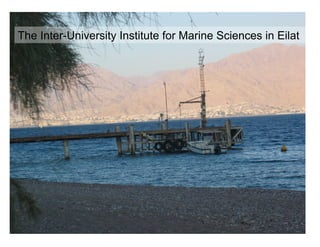
The Inter-University Institute for Marine Sciences in Eilat


                                                       21
Methods
Methods
•  The deep water colonies were carried inside
   black bags to the experiment site (~5 m depth)
•  We placed the colonies at a light level of the
   origin growth place.
                               PAR (%) ~ noon
                      0   20    40       60     80   100
                  0
                 10
                 20
                 30
    Depth (m)


                 40
                                                           July
                 50
                 60                                        Feb
                 70
                 80
                 90
                100
Methods

•  Tissue analysis:
       Pigment (chlorophyll a & c)
        concentration
•  Diel cycles of photosynthesis
   and calcification were studied
   using a submersible
                                      Stylophora pistillata
   respirometer (AIMS, Australia).
Results & Discussion
Photoacclimation - Pigments


                        Stylophora pistillata
Results & Discussion
                 Photoacclimation - Max. Photosynthetic
                                  Rate
                          Maximum Photosynthetic Rate
                                    P max
                                   µmole o2 cm-2 h-1

             0.00   .02     .04   .06       .08    .10    .12    .14       .16


             5


            10


            50
Depth (m)


                                                                  July
                                                                  Feb
            65
                                        n=3, Kruskal Wallis ANOVA p<0.05
Results & Discussion
        Photoacclimation - Dark Respiration
                             Dark Respiration
                             µmole o2 cm-2 h-1

                 0.0   -.2               -.4     -.6


             5


            10


            50
Depth (m)


                                                       July
                                                       Feb
            65
Results & Discussion
                                      Calcification
                            Day & night calcification (µmol CaCO3 cm-2 h-1)
                 -4    -2         0       2        4       6       8          10           12


             5


            10


            50
Depth (m)


                                                                              July day
                                                                              July night
            65                                                                Feb day
                                                                              Feb night

                                                                  24h experiment, n=3
Summary
•  Photosynthesis and calcification are light
   dependent
•  Photo-acclimation of endosymbiotic algae with
   depth
   –  Pigment Concentration
   –  Maximum Photosynthetic Rate
   –  Respiration
•  Light enhances calcification, calcification rates:
   –  Diel Cycle - Night vs. Day
   –  Depth - Deep vs. Shallow
Corals in the Future
Given what we learned in this study, how do
  you think coral calcification might be
  affected by:
1. increasing temperature?

2. sea level rise?

3. decreasing surface ocean pH?

East Coast MARE Ocean Lecture Jan 30, 2013 - Corals: Changes with Climate

  • 1.
    Tali Mass &Jeana Drake January 30, 2013
  • 2.
    Focus on climatechange 1. Changing ocean temperatures 2 - 4oC (3.6 - 7.2oF) global average increase by year 2100 2. Changing sea level 1.5 – 10 mm/year (0.06 – 0.4 inches/year) global average increase to year 2100 3. Changing ocean pH Average surface ocean pH decrease from 8.2 to 7.8 by year 2100
  • 3.
    Conditions preferred bycorals •  Temperature: 23-25°C; •  Light: for photosynthesis; •  Salinity required; •  Clean, clear water, sediment free; •  Well oxygenated water produced by strong wave action
  • 4.
    Coral’s ideal environment Coralreefs are concentrated in a band around the equator between 30°N and 30°S latitude.
  • 5.
    Types of Reefs • Fringing reef – reef that is directly attached to a shore or borders it with an intervening shallow channel or lagoon. •  Barrier reef – reef separated from a mainland or island shore by a deep lagoon. •  Atoll reef – a more or less circular or continuous barrier reef extending all the way around a lagoon without a central island.
  • 6.
  • 7.
    Class: Scyphozoa Class: Hydrozoa Class: Anthozoa Ahermatypic Sea anemone Hermatypic
  • 8.
    Types of Corals Hardcorals (hermatypic): secrete a limestone (CaCO3) exoskeleton around itself as protection. This exoskeleton remains even after the organism dies. Soft corals (ahermatypic): tree-like and flexible with a skeleton within their bodies giving them shape but allowing movement with the waves
  • 9.
  • 10.
    Basic structure z •  Polyps = basis of life on reef. •  Produce calcium carbonate skeleton as they grow. •  Polyp growth = symbiotic relationship between the coral animal and zooxanthellae (algae). •  Zooxanthellae photosynthesize and give sugars and fats to polyp. Veron (1986)
  • 11.
    Communication, allocation and Colonial coral polyps translocation between polyps
  • 12.
    •  Corals feedon zooplankton •  Tentacles help capture food •  Tentacles contain stinging cells
  • 13.
    Symbiotic relationship with zooxanthellae   Algae in the coral polyp produce oxygen and organic products for the polyp   Coral polyps produce carbon dioxide for the algae and give protection
  • 14.
    Reproduction Corals reproduce eitherasexually by budding or by sexually releasing gametes (sperm and eggs). Sexual reproduction Asexual reproduction Fertilization can occur within Budding occurs when a new a coral known as “brooding” zygote grows onto another one or outside of a coral known and remains attached, as “broadcasting” separating only when mature. .
  • 15.
    SEX ON THEREEF: Broadcast spawning
  • 16.
    Morphology and physiology: adaptation to local environment 1. Water depth 2. Water movement 5m 50m Photo by Shai Einbinder Mass et al. MEPS, 2007 Veron & Pichon, 1976
  • 17.
    Seawater Carbonate System pH , total CO2 + H2O CH2O + O2 photosynthesis alkalinity- unchanged pH , total CH2O + O2 CO2 + H2O respiration alkalinity- unchanged Ca2+ +2HCO-3 CaCO3 + CO2 + H2O calcification pH , total alkalinity- changed Bjerrum plot (Zeebe, 1999)
  • 18.
    A Study ofa Mesophotic Coral Ecosystem 5m 5m 60 m Photo by Shai Einbinder 50 m Photo by Shai Einbinder Stylophora pistillata
  • 19.
    Study Objectives •  Coralmetabolism and calcification due to:   Light acclimation •  What response variables to measure (3 things):   1. Oxygen   2. pH   3. Alkalinity •  Things to vary (i.e.; when/where would these be different?):   1. Day/Night   2. Depth •  Hypotheses:   1. Calcification rates higher during the day than at night.   2. Shallower coral have higher maximum photosynthesis but lower pigment concentration than deeper corals.
  • 21.
    The Inter-University Institutefor Marine Sciences in Eilat 21
  • 22.
  • 23.
    Methods •  The deepwater colonies were carried inside black bags to the experiment site (~5 m depth) •  We placed the colonies at a light level of the origin growth place. PAR (%) ~ noon 0 20 40 60 80 100 0 10 20 30 Depth (m) 40 July 50 60 Feb 70 80 90 100
  • 24.
    Methods •  Tissue analysis:   Pigment (chlorophyll a & c) concentration •  Diel cycles of photosynthesis and calcification were studied using a submersible Stylophora pistillata respirometer (AIMS, Australia).
  • 26.
    Results & Discussion Photoacclimation- Pigments Stylophora pistillata
  • 27.
    Results & Discussion Photoacclimation - Max. Photosynthetic Rate Maximum Photosynthetic Rate P max µmole o2 cm-2 h-1 0.00 .02 .04 .06 .08 .10 .12 .14 .16 5 10 50 Depth (m) July Feb 65 n=3, Kruskal Wallis ANOVA p<0.05
  • 28.
    Results & Discussion Photoacclimation - Dark Respiration Dark Respiration µmole o2 cm-2 h-1 0.0 -.2 -.4 -.6 5 10 50 Depth (m) July Feb 65
  • 29.
    Results & Discussion Calcification Day & night calcification (µmol CaCO3 cm-2 h-1) -4 -2 0 2 4 6 8 10 12 5 10 50 Depth (m) July day July night 65 Feb day Feb night 24h experiment, n=3
  • 30.
    Summary •  Photosynthesis andcalcification are light dependent •  Photo-acclimation of endosymbiotic algae with depth –  Pigment Concentration –  Maximum Photosynthetic Rate –  Respiration •  Light enhances calcification, calcification rates: –  Diel Cycle - Night vs. Day –  Depth - Deep vs. Shallow
  • 31.
    Corals in theFuture Given what we learned in this study, how do you think coral calcification might be affected by: 1. increasing temperature? 2. sea level rise? 3. decreasing surface ocean pH?