Digital literacy in Norway and
beyond (2006-2015)
Ola Erstad
Structure
1. Shifts in overall discourse
2. ‘Knowledge promotion’ and beyond
3. Diversity and challenges
4. Recent developments
5. The next ten years
1. Shifts in overall discourse
• From technology to pedagogy
• Standardization (testing, curriculum perspective) vs Digital
generation (youth perspective)
• Knowledge society challenges
– DeSeCo vs PISA
• The problem of the school system (MOOCs++)
2. ‘Knowledge promotion’ and beyond
• An important change for Norway
– Focus on use and implications for learning
– How did the Ministry see this in 2005-6 vs the community?
• Also, The Programme for Digital Competence 2004-2008. Too
ambitious?
• Norway on the international map. (EU, internat.)
• Focus on skills, less on more complex competencies
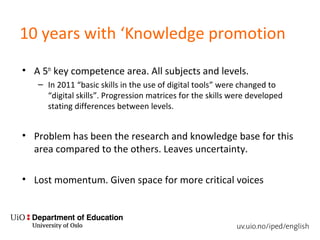
10 years with ‘Knowledge promotion
• A 5th
key competence area. All subjects and levels.
– In 2011 “basic skills in the use of digital tools” were changed to
“digital skills”. Progression matrices for the skills were developed
stating differences between levels.
• Problem has been the research and knowledge base for this
area compared to the others. Leaves uncertainty.
• Lost momentum. Given space for more critical voices
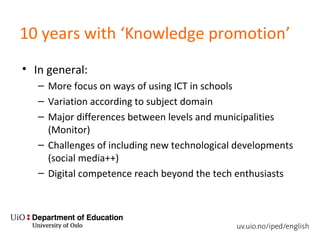
10 years with ‘Knowledge promotion’
• In general:
– More focus on ways of using ICT in schools
– Variation according to subject domain
– Major differences between levels and municipalities
(Monitor)
– Challenges of including new technological developments
(social media++)
– Digital competence reach beyond the tech enthusiasts
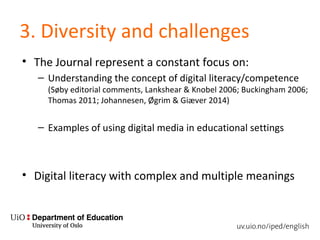
3. Diversity and challenges
• The Journal represent a constant focus on:
– Understanding the concept of digital literacy/competence
(Søby editorial comments, Lankshear & Knobel 2006; Buckingham 2006;
Thomas 2011; Johannesen, Øgrim & Giæver 2014)
– Examples of using digital media in educational settings
• Digital literacy with complex and multiple meanings
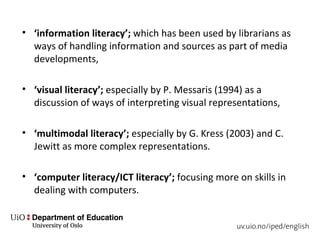
• ‘information literacy’; which has been used by librarians as
ways of handling information and sources as part of media
developments,
• ‘visual literacy’; especially by P. Messaris (1994) as a
discussion of ways of interpreting visual representations,
• ‘multimodal literacy’; especially by G. Kress (2003) and C.
Jewitt as more complex representations.
• ‘computer literacy/ICT literacy’; focusing more on skills in
dealing with computers.
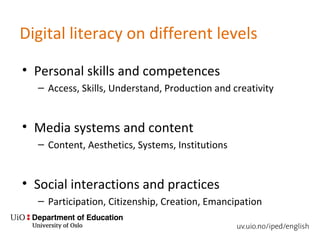
Digital literacy on different levels
• Personal skills and competences
– Access, Skills, Understand, Production and creativity
• Media systems and content
– Content, Aesthetics, Systems, Institutions
• Social interactions and practices
– Participation, Citizenship, Creation, Emancipation
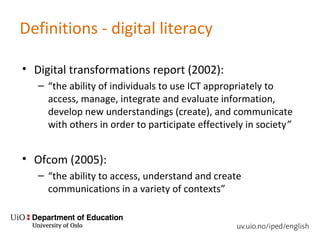
Definitions - digital literacy
• Digital transformations report (2002):
– “the ability of individuals to use ICT appropriately to
access, manage, integrate and evaluate information,
develop new understandings (create), and communicate
with others in order to participate effectively in society”
• Ofcom (2005):
– “the ability to access, understand and create
communications in a variety of contexts”
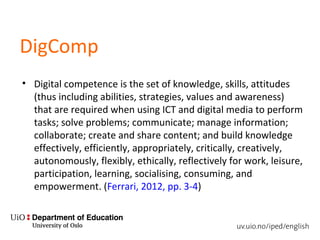
DigComp
• Digital competence is the set of knowledge, skills, attitudes
(thus including abilities, strategies, values and awareness)
that are required when using ICT and digital media to perform
tasks; solve problems; communicate; manage information;
collaborate; create and share content; and build knowledge
effectively, efficiently, appropriately, critically, creatively,
autonomously, flexibly, ethically, reflectively for work, leisure,
participation, learning, socialising, consuming, and
empowerment. (Ferrari, 2012, pp. 3-4)
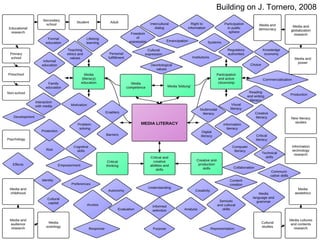
Building on J. Tornero, 2008
The Journal as an expression of developments
• Diversity in approaches reflecting the term
– Multimodality, transformative digital literacy…
• Literacy studied as social practices
• Norway in a Nordic and international perspective
• National and international surveys/tests (Monitor, ICILS)
• Still, many of the same issues in 2006 are still valid
Core challenges
• In connecting policy – research – practices
• To grasp the multi-level aspects of digital competence
• Assessment system
• Teacher education.
• The research base.
– In subject domains and digital learning resources (ARK&App)
– Systematic reviews.
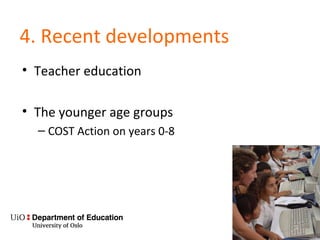
4. Recent developments
• Teacher education
• The younger age groups
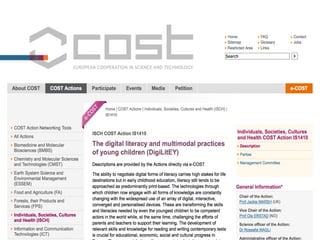
– COST Action on years 0-8
4. Recent developments
• Teacher education
• COST Action on years 0-8
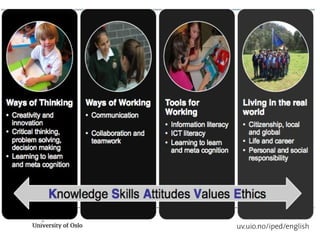
• Related to 21st
century skills
4. Recent developments
• Teacher education
• COST Action on years 0-8
• Related to 21st
century skills
• In and out of school, digital generation
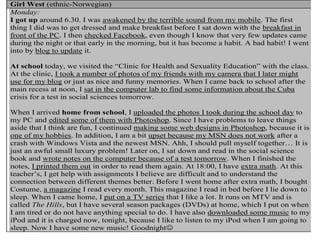
Girl West (ethnic-Norwegian)
Monday:
I got up around 6.30. I was awakened by the terrible sound from my mobile. The first
thing I did was to get dressed and make breakfast before I sat down with the breakfast in
front of the PC. I then checked Facebook, even though I know that very few updates came
during the night or that early in the morning, but it has become a habit. A bad habit! I went
into by blog to update it.
At school today, we visited the “Clinic for Health and Sexuality Education” with the class.
At the clinic, I took a number of photos of my friends with my camera that I later might
use for my blog or just as nice and funny memories. When I came back to school after the
main recess at noon, I sat in the computer lab to find some information about the Cuba
crisis for a test in social sciences tomorrow.
When I arrived home from school, I uploaded the photos I took during the school day to
my PC and edited some of them with Photoshop. Since I have problems to leave things
aside that I think are fun, I continued making some web designs in Photoshop, because it is
one of my hobbies. In addition, I am a bit upset because my MSN does not work after a
crash with Windows Vista and the newest MSN. Ahh, I should pull myself together… It is
just an awful small luxury problem! Later on, I sat down and read in the social science
book and wrote notes on the computer because of a test tomorrow. When I finished the
notes, I printed them out in order to read them again. At 18:00, I have extra math. At this
teacher’s, I get help with assignments I believe are difficult and to understand the
connection between different themes better. Before I went home after extra math, I bought
Costume, a magazine I read every month. This magazine I read in bed before I lie down to
sleep. When I came home, I put on a TV series that I like a lot. It runs on MTV and is
called The Hills, but I have several season packages (DVDs) at home, which I put on when
I am tired or do not have anything special to do. I have also downloaded some music to my
iPod and it is charged now, tonight, because I like to listen to my iPod when I am going to
sleep. Now I have some new music! Goodnight
5. The next ten years
• Continuing development of perspectives/terminology, studies of
digital literacy on different levels and more systematic
knowledge base
• A new interdisciplinary field (Søby 2015)
– Inclusive media literacy (Drotner & Erstad 2014)
– Different methodologies
• How digital literacy links to other issues and domains (21st
century competencies)
– Green Paper on School of the Future (Ludvigsen-committee)

Ola Erstad

  • 1.
    Digital literacy inNorway and beyond (2006-2015) Ola Erstad
  • 2.
    Structure 1. Shifts inoverall discourse 2. ‘Knowledge promotion’ and beyond 3. Diversity and challenges 4. Recent developments 5. The next ten years
  • 3.
    1. Shifts inoverall discourse • From technology to pedagogy • Standardization (testing, curriculum perspective) vs Digital generation (youth perspective) • Knowledge society challenges – DeSeCo vs PISA • The problem of the school system (MOOCs++)
  • 4.
    2. ‘Knowledge promotion’and beyond • An important change for Norway – Focus on use and implications for learning – How did the Ministry see this in 2005-6 vs the community? • Also, The Programme for Digital Competence 2004-2008. Too ambitious? • Norway on the international map. (EU, internat.) • Focus on skills, less on more complex competencies
  • 5.
    10 years with‘Knowledge promotion • A 5th key competence area. All subjects and levels. – In 2011 “basic skills in the use of digital tools” were changed to “digital skills”. Progression matrices for the skills were developed stating differences between levels. • Problem has been the research and knowledge base for this area compared to the others. Leaves uncertainty. • Lost momentum. Given space for more critical voices
  • 6.
    10 years with‘Knowledge promotion’ • In general: – More focus on ways of using ICT in schools – Variation according to subject domain – Major differences between levels and municipalities (Monitor) – Challenges of including new technological developments (social media++) – Digital competence reach beyond the tech enthusiasts
  • 7.
    3. Diversity andchallenges • The Journal represent a constant focus on: – Understanding the concept of digital literacy/competence (Søby editorial comments, Lankshear & Knobel 2006; Buckingham 2006; Thomas 2011; Johannesen, Øgrim & Giæver 2014) – Examples of using digital media in educational settings • Digital literacy with complex and multiple meanings
  • 8.
    • ‘information literacy’;which has been used by librarians as ways of handling information and sources as part of media developments, • ‘visual literacy’; especially by P. Messaris (1994) as a discussion of ways of interpreting visual representations, • ‘multimodal literacy’; especially by G. Kress (2003) and C. Jewitt as more complex representations. • ‘computer literacy/ICT literacy’; focusing more on skills in dealing with computers.
  • 9.
    Digital literacy ondifferent levels • Personal skills and competences – Access, Skills, Understand, Production and creativity • Media systems and content – Content, Aesthetics, Systems, Institutions • Social interactions and practices – Participation, Citizenship, Creation, Emancipation
  • 10.
    Definitions - digitalliteracy • Digital transformations report (2002): – “the ability of individuals to use ICT appropriately to access, manage, integrate and evaluate information, develop new understandings (create), and communicate with others in order to participate effectively in society” • Ofcom (2005): – “the ability to access, understand and create communications in a variety of contexts”
  • 11.
    DigComp • Digital competenceis the set of knowledge, skills, attitudes (thus including abilities, strategies, values and awareness) that are required when using ICT and digital media to perform tasks; solve problems; communicate; manage information; collaborate; create and share content; and build knowledge effectively, efficiently, appropriately, critically, creatively, autonomously, flexibly, ethically, reflectively for work, leisure, participation, learning, socialising, consuming, and empowerment. (Ferrari, 2012, pp. 3-4)
  • 12.
    Building on J.Tornero, 2008
  • 13.
    The Journal asan expression of developments • Diversity in approaches reflecting the term – Multimodality, transformative digital literacy… • Literacy studied as social practices • Norway in a Nordic and international perspective • National and international surveys/tests (Monitor, ICILS) • Still, many of the same issues in 2006 are still valid
  • 14.
    Core challenges • Inconnecting policy – research – practices • To grasp the multi-level aspects of digital competence • Assessment system • Teacher education. • The research base. – In subject domains and digital learning resources (ARK&App) – Systematic reviews.
  • 15.
    4. Recent developments •Teacher education • The younger age groups – COST Action on years 0-8
  • 17.
    4. Recent developments •Teacher education • COST Action on years 0-8 • Related to 21st century skills
  • 19.
    4. Recent developments •Teacher education • COST Action on years 0-8 • Related to 21st century skills • In and out of school, digital generation
  • 20.
    Girl West (ethnic-Norwegian) Monday: Igot up around 6.30. I was awakened by the terrible sound from my mobile. The first thing I did was to get dressed and make breakfast before I sat down with the breakfast in front of the PC. I then checked Facebook, even though I know that very few updates came during the night or that early in the morning, but it has become a habit. A bad habit! I went into by blog to update it. At school today, we visited the “Clinic for Health and Sexuality Education” with the class. At the clinic, I took a number of photos of my friends with my camera that I later might use for my blog or just as nice and funny memories. When I came back to school after the main recess at noon, I sat in the computer lab to find some information about the Cuba crisis for a test in social sciences tomorrow. When I arrived home from school, I uploaded the photos I took during the school day to my PC and edited some of them with Photoshop. Since I have problems to leave things aside that I think are fun, I continued making some web designs in Photoshop, because it is one of my hobbies. In addition, I am a bit upset because my MSN does not work after a crash with Windows Vista and the newest MSN. Ahh, I should pull myself together… It is just an awful small luxury problem! Later on, I sat down and read in the social science book and wrote notes on the computer because of a test tomorrow. When I finished the notes, I printed them out in order to read them again. At 18:00, I have extra math. At this teacher’s, I get help with assignments I believe are difficult and to understand the connection between different themes better. Before I went home after extra math, I bought Costume, a magazine I read every month. This magazine I read in bed before I lie down to sleep. When I came home, I put on a TV series that I like a lot. It runs on MTV and is called The Hills, but I have several season packages (DVDs) at home, which I put on when I am tired or do not have anything special to do. I have also downloaded some music to my iPod and it is charged now, tonight, because I like to listen to my iPod when I am going to sleep. Now I have some new music! Goodnight
  • 21.
    5. The nextten years • Continuing development of perspectives/terminology, studies of digital literacy on different levels and more systematic knowledge base • A new interdisciplinary field (Søby 2015) – Inclusive media literacy (Drotner & Erstad 2014) – Different methodologies • How digital literacy links to other issues and domains (21st century competencies) – Green Paper on School of the Future (Ludvigsen-committee)