OGD, ICT and the
Global eGovernance
    of Migration
International movements of
  people are one of the greatest
  forces that shape and are
  shaped by global
  development
       •   Migrants Counts: 5 Steps Toward Better Migration Data
Human movement responds to
 and shapes environmental
 change; it responds to and
 shapes political change; it
 responds to and shapes the
 needs and lives of families— it is
 the human face of globalization
        •   Migrants Counts: 5 Steps Toward Better Migration Data
Over the last 25 years, the total number of
international migrants doubled... this growth trend
will be amplified over the next 50 years.

 By the middle of the 21 century,                               st

 our societies will be more diverse
 than ever before. The global
 community will be connected in a
 manner not experienced since our
 evolutionary origins in Africa.
 Ian Goldin, Geoffrey Cameron and Meera Balrajan “Execptional People: How Migration Shaped Our
 World and Will Define Our Future” (Princeton U Press, 2011)
SUPPLY-SIDE FACTORS
persistent inter-country inequality and wage
 disparities
economic growth in the poorest countries
rural displacement and urbanization;
rising education standards in developing
 countries
SUPPLY-SIDE FACTORS - cont
growing working age population in developing
  countries
environmental stress
DEMAND SIDE FACTORS
population decline and population aging
growing demand for low-skilled labor
national competitiveness and mobile skilled
  labor
With more people on the move than even before,
 new approaches to managing migration are
 needed in order to maximize its benefits.


The 20th century assumption that
 migration is strictly a national problem
 is no longer valid.
CURRENT STATE
despite the inherently trans-boundary
 nature of international migration &
 the interdependence of states’
 migration policies, there is no
 formal multilateral institutional
 framework regulating states’
 responses to international
 migration.
Alxander Betts “Global Migration Governance” GEG Working Paper 2008/43
Yet this is not to say that there is no
 global migration governance.
What exists is a complex and
 fragmented tapestry of
 overlapping, parallel and nested
 institutions.
global migration governance has two
  defining characteristics.
1) embedded
regulated by areas of global
  governance that are not explicitly
  labelled as ‘int'l migration’ which
  nonetheless regulate states’
  responses to int'l migration.
global migration governance has two
defining characteristics.
2) multi-level
involving a range of institutions
at the bilateral, regional, inter-
regional, and informal networks
of states and other actors.
CONSEQUENCE
reinforces the centrality of power in the
  int'l politics of migration
allowing relatively powerful states to
  engage in forum-shopping
choosing between different institutions
  that selectively include and exclude
  partner states from cooperation on a
  pragmatic basis.
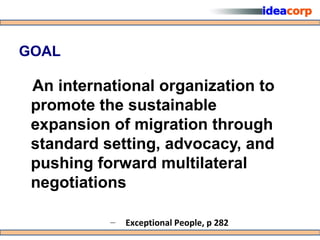
GOAL

 An international organization to
 promote the sustainable
 expansion of migration through
 standard setting, advocacy, and
 pushing forward multilateral
 negotiations

           –   Exceptional People, p 282
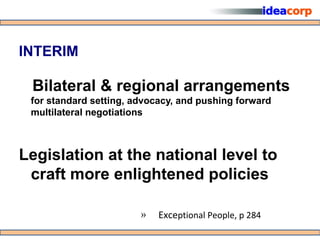
INTERIM

 Bilateral & regional arrangements
 for standard setting, advocacy, and pushing forward
 multilateral negotiations


Legislation at the national level to
 craft more enlightened policies

                        »   Exceptional People, p 284
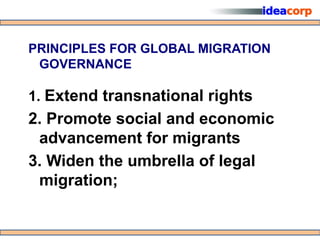
PRINCIPLES FOR GLOBAL MIGRATION
 GOVERNANCE

1. Extend transnational rights
2. Promote social and economic
 advancement for migrants
3. Widen the umbrella of legal
 migration;
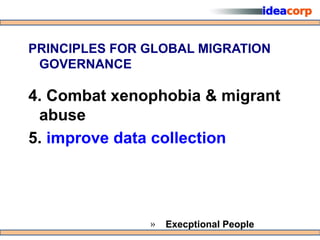
PRINCIPLES FOR GLOBAL MIGRATION
 GOVERNANCE

4. Combat xenophobia & migrant
 abuse
5. improve data collection


               »   Execptional People
The data on international migration
 that countries now collect and
 publish are so limited... that we
 know much less about how much
 and what kind of migration is
 happening in today’s world than
 we know about international trade
 and investment flows.
               » Migrants Count
CONSEQUENCE

The poor state of migration data has
 limited analysis of how to maximize
 the benefits and minimize the costs
 of migration for sending and
 receiving countries and, as a result,
 has stunted global understanding
 and domestic political discourse on
 a critical development issue .
5 Recommendations on Migration Data
Commission on International Migration Data for Development Research and
  Policy, March 2009


1. Ask basic census questions, &
  make the tabulated answers
  publicly available
2. Compile and release existing
  administrative data
3. Centralize Labor Force Surveys
5 Recommendations on Migration Data
Commission on International Migration Data for Development Research and
  Policy, March 2009


4. Provide access to microdata,
  not just tabulations
5. Include migration modules on
  more existing household
  surveys
OPEN DATA
is non-personally identifiable data
produced in the course of an
organisation’s ordinary business,
which has been released under an
unrestricted licence (like the Open
Government Licence).

        • http://linkedgov.org/what-is-open-data/
OPEN GOVERNMENT DATA
data and information produced or
commissioned by government or
government controlled entities that
is free for anyone to use, re-use and
re-distribute.
OPEN GOVERNMENT DATA
  Implies changing the default
assumption regarding public
information so that the prevailing
norm is that the data available to the
public is complete, rather than
selective, and withholding
information is the exception rather
than the role
OPEN GOVERNMENT DATA
  necessitates shift from making
information available in response to
a specific request, known as
'reactive disclosure', to
preemptively releasing information,
commonly referred to as 'proactive
disclosure'
OPEN GOVERNMENT DATA
 Requires more than accessibility in
theory, but also in practice,
measured by its usability.
   Discoverability
   Data in forms that facilitates its
   use with minimum barriers – open
   file formats, machine readable
   files, etc.
OPEN GOVERNMENT DATA
  Central to Open Government Data
is the idea that citizens should be
able to use and reuse data through
sharing it in its original form and/or
create new forms with minimal
limitations.
OPEN GOVERNMENT DATA
N.B.
The existence of machine-
readable formats dictates the
extent to which data can be
manipulated used and reused
THE PROJECT
SEMINAR ON OGD, ICT and
GLOBAL eGOVERNANCE of
MIGRATION
●
 challenges faced by sending
countries in adopting OGD on
migration
●
 role of ICT in bilateral, regional and
global cooperation on migration
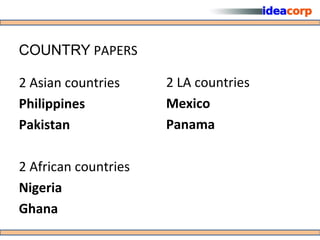
COUNTRY PAPERS

2 Asian countries     2 LA countries
Philippines           Mexico
Pakistan              Panama

2 African countries
Nigeria
Ghana
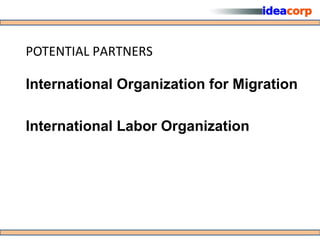
POTENTIAL PARTNERS

International Organization for Migration

International Labor Organization

Ogd, ict and ge gm

  • 1.
    OGD, ICT andthe Global eGovernance of Migration
  • 2.
    International movements of people are one of the greatest forces that shape and are shaped by global development • Migrants Counts: 5 Steps Toward Better Migration Data
  • 3.
    Human movement respondsto and shapes environmental change; it responds to and shapes political change; it responds to and shapes the needs and lives of families— it is the human face of globalization • Migrants Counts: 5 Steps Toward Better Migration Data
  • 4.
    Over the last25 years, the total number of international migrants doubled... this growth trend will be amplified over the next 50 years. By the middle of the 21 century, st our societies will be more diverse than ever before. The global community will be connected in a manner not experienced since our evolutionary origins in Africa. Ian Goldin, Geoffrey Cameron and Meera Balrajan “Execptional People: How Migration Shaped Our World and Will Define Our Future” (Princeton U Press, 2011)
  • 5.
    SUPPLY-SIDE FACTORS persistent inter-countryinequality and wage disparities economic growth in the poorest countries rural displacement and urbanization; rising education standards in developing countries
  • 6.
    SUPPLY-SIDE FACTORS -cont growing working age population in developing countries environmental stress
  • 7.
    DEMAND SIDE FACTORS populationdecline and population aging growing demand for low-skilled labor national competitiveness and mobile skilled labor
  • 8.
    With more peopleon the move than even before, new approaches to managing migration are needed in order to maximize its benefits. The 20th century assumption that migration is strictly a national problem is no longer valid.
  • 9.
    CURRENT STATE despite theinherently trans-boundary nature of international migration & the interdependence of states’ migration policies, there is no formal multilateral institutional framework regulating states’ responses to international migration. Alxander Betts “Global Migration Governance” GEG Working Paper 2008/43
  • 10.
    Yet this isnot to say that there is no global migration governance. What exists is a complex and fragmented tapestry of overlapping, parallel and nested institutions.
  • 11.
    global migration governancehas two defining characteristics. 1) embedded regulated by areas of global governance that are not explicitly labelled as ‘int'l migration’ which nonetheless regulate states’ responses to int'l migration.
  • 12.
    global migration governancehas two defining characteristics. 2) multi-level involving a range of institutions at the bilateral, regional, inter- regional, and informal networks of states and other actors.
  • 13.
    CONSEQUENCE reinforces the centralityof power in the int'l politics of migration allowing relatively powerful states to engage in forum-shopping choosing between different institutions that selectively include and exclude partner states from cooperation on a pragmatic basis.
  • 14.
    GOAL An internationalorganization to promote the sustainable expansion of migration through standard setting, advocacy, and pushing forward multilateral negotiations – Exceptional People, p 282
  • 15.
    INTERIM Bilateral &regional arrangements for standard setting, advocacy, and pushing forward multilateral negotiations Legislation at the national level to craft more enlightened policies » Exceptional People, p 284
  • 16.
    PRINCIPLES FOR GLOBALMIGRATION GOVERNANCE 1. Extend transnational rights 2. Promote social and economic advancement for migrants 3. Widen the umbrella of legal migration;
  • 17.
    PRINCIPLES FOR GLOBALMIGRATION GOVERNANCE 4. Combat xenophobia & migrant abuse 5. improve data collection » Execptional People
  • 18.
    The data oninternational migration that countries now collect and publish are so limited... that we know much less about how much and what kind of migration is happening in today’s world than we know about international trade and investment flows. » Migrants Count
  • 19.
    CONSEQUENCE The poor stateof migration data has limited analysis of how to maximize the benefits and minimize the costs of migration for sending and receiving countries and, as a result, has stunted global understanding and domestic political discourse on a critical development issue .
  • 20.
    5 Recommendations onMigration Data Commission on International Migration Data for Development Research and Policy, March 2009 1. Ask basic census questions, & make the tabulated answers publicly available 2. Compile and release existing administrative data 3. Centralize Labor Force Surveys
  • 21.
    5 Recommendations onMigration Data Commission on International Migration Data for Development Research and Policy, March 2009 4. Provide access to microdata, not just tabulations 5. Include migration modules on more existing household surveys
  • 22.
    OPEN DATA is non-personallyidentifiable data produced in the course of an organisation’s ordinary business, which has been released under an unrestricted licence (like the Open Government Licence). • http://linkedgov.org/what-is-open-data/
  • 23.
    OPEN GOVERNMENT DATA dataand information produced or commissioned by government or government controlled entities that is free for anyone to use, re-use and re-distribute.
  • 24.
    OPEN GOVERNMENT DATA Implies changing the default assumption regarding public information so that the prevailing norm is that the data available to the public is complete, rather than selective, and withholding information is the exception rather than the role
  • 25.
    OPEN GOVERNMENT DATA necessitates shift from making information available in response to a specific request, known as 'reactive disclosure', to preemptively releasing information, commonly referred to as 'proactive disclosure'
  • 26.
    OPEN GOVERNMENT DATA Requires more than accessibility in theory, but also in practice, measured by its usability. Discoverability Data in forms that facilitates its use with minimum barriers – open file formats, machine readable files, etc.
  • 27.
    OPEN GOVERNMENT DATA Central to Open Government Data is the idea that citizens should be able to use and reuse data through sharing it in its original form and/or create new forms with minimal limitations.
  • 28.
    OPEN GOVERNMENT DATA N.B. Theexistence of machine- readable formats dictates the extent to which data can be manipulated used and reused
  • 29.
    THE PROJECT SEMINAR ONOGD, ICT and GLOBAL eGOVERNANCE of MIGRATION ● challenges faced by sending countries in adopting OGD on migration ● role of ICT in bilateral, regional and global cooperation on migration
  • 30.
    COUNTRY PAPERS 2 Asiancountries 2 LA countries Philippines Mexico Pakistan Panama 2 African countries Nigeria Ghana
  • 31.
    POTENTIAL PARTNERS International Organizationfor Migration International Labor Organization