International Migration Outlook Sopemi Oecd
download
https://ebookbell.com/product/international-migration-outlook-
sopemi-oecd-6780722
Explore and download more ebooks at ebookbell.com
Here are some recommended products that we believe you will be
interested in. You can click the link to download.
International Migration Outlook Sopemi 2008 Edition Oecd
https://ebookbell.com/product/international-migration-outlook-
sopemi-2008-edition-oecd-6769702
International Migration Outlook Sopemi 2011 Oecd
https://ebookbell.com/product/international-migration-outlook-
sopemi-2011-oecd-6770558
International Migration Outlook Sopemi 2006 Edition Oecd
https://ebookbell.com/product/international-migration-outlook-
sopemi-2006-edition-oecd-6780686
International Migration Outlook 2011 Sopemi 50 Anv Oecd
https://ebookbell.com/product/international-migration-
outlook-2011-sopemi-50-anv-oecd-2449812
International Migration Outlook 2017 41st Ed 2017 Organization For
Economic Cooperation And Development
https://ebookbell.com/product/international-migration-
outlook-2017-41st-ed-2017-organization-for-economic-cooperation-and-
development-6685938
International Migration Outlook 2015 Oecd
https://ebookbell.com/product/international-migration-
outlook-2015-oecd-6768244
International Migration Outlook 2015 Oecd
https://ebookbell.com/product/international-migration-
outlook-2015-oecd-6768346
International Migration Outlook 2014 Oecd
https://ebookbell.com/product/international-migration-
outlook-2014-oecd-6768638
International Migration Outlook 2010 Oecd
https://ebookbell.com/product/international-migration-
outlook-2010-oecd-6769706
www.oecd.org/publishing
International Migration Outlook
International migration has jumped up the policy agenda in OECD countries. This annual publication
analyses recent developments in migration movements and policies in these countries. It underlines
the growing importance of inflows of highly qualified workers, temporary workers and students. It
highlights the increased immigration from India, China, Eastern Europe and Africa, and confirms the
tendency towards the feminisation of this movement. This edition also focuses on the employment
situation and the participation rate of immigrants, particularly in the services sector.
This publication also explores policies to improve the management of migration flows, especially those
aiming to increase the selection of immigrant workers to respond to labour market needs. It describes
measures taken to facilitate the integration of immigrants from their arrival up until they gain full
citizenship. International co-operation to improve border control and to combat irregular immigration
is analysed in detail. In addition, the report evaluates the impact of the enlargement of the European
Union on the flow of immigrant workers into OECD countries. It highlights the growing attention
given to the links between migration and development, notably in the context of regional economic
integration.
The reader will also find in this book:
• Two special chapters on topical issues. The first addresses the challenge of matching immigrants’
education with employment, with the aim of adding value to human capital. The second analyses,
for the first time, the importance of the presence of immigrants in the health sector of OECD
countries. It also describes the migration policies put in place in OECD countries to recruit this
highly qualified labour force.
• Country notes, together with standardised tables, describing recent developments in migration
movements and policies.
• A statistical annex containing the latest data on foreign and foreign-born population, migration
flows and naturalisations.
FURTHER READING
Jobs for Immigrants (Vol. 1): Labour Market Integration in Australia, Denmark, Germany and Sweden
SOPEMI
2007
International
Migration
Outlook
ISBN 978-92-64-03285-9
81 2007 12 1 P
-:HSTCQE=UXW]Z^:
International
Migration
Outlook
SOPEMI 2007
SOPEMI 2007
The full text of this book is available on line via these links:
www.sourceoecd.org/emergingeconomies/9789264032859
www.sourceoecd.org/socialissues/9789264032859
www.sourceoecd.org/transitioneconomies/9789264032859
Those with access to all OECD books on line should use this link:
www.sourceoecd.org/9789264032859
SourceOECD is the OECD’s online library of books, periodicals and statistical databases.
For more information about this award-winning service and free trials ask your librarian, or write to us
at SourceOECD@oecd.org.
ORGANISATION FOR ECONOMIC CO-OPERATION AND DEVELOPMENT
International Migration
Outlook
Annual Report
2007 Edition
IM-Outlook07.fm Page 1 Thursday, June 7, 2007 4:53 PM
ORGANISATION FOR ECONOMIC CO-OPERATION
AND DEVELOPMENT
The OECD is a unique forum where the governments of 30 democracies work together to
address the economic, social and environmental challenges of globalisation. The OECD is also at
the forefront of efforts to understand and to help governments respond to new developments and
concerns, such as corporate governance, the information economy and the challenges of an
ageing population. The Organisation provides a setting where governments can compare policy
experiences, seek answers to common problems, identify good practice and work to co-ordinate
domestic and international policies.
The OECD member countries are: Australia, Austria, Belgium, Canada, the Czech Republic,
Denmark, Finland, France, Germany, Greece, Hungary, Iceland, Ireland, Italy, Japan, Korea,
Luxembourg, Mexico, the Netherlands, New Zealand, Norway, Poland, Portugal, the Slovak Republic,
Spain, Sweden, Switzerland, Turkey, the United Kingdom and the United States. The Commission of
the European Communities takes part in the work of the OECD.
OECD Publishing disseminates widely the results of the Organisation’s statistics gathering and
research on economic, social and environmental issues, as well as the conventions, guidelines and
standards agreed by its members.
Also available in French under the title:
Perspectives des migrations internationales
RAPPORT ANNUEL 2007
© OECD 2007
The Chapter III has been produced with the financial assistance of the European Union
No reproduction, copy, transmission or translation of this publication may be made without written permission. Applications should be sent to
OECD Publishing rights@oecd.org or by fax 33 1 45 24 99 30. Permission to photocopy a portion of this work should be addressed to the Centre français
d’exploitation du droit de copie (CFC), 20, rue des Grands-Augustins, 75006 Paris, France, fax 33 1 46 34 67 19, contact@cfcopies.com or (for US only) to
Copyright Clearance Center (CCC), 222 Rosewood Drive Danvers, MA 01923, USA, fax 1 978 646 8600, info@copyright.com.
This work is published on the responsibility of the Secretary-General of the OECD. The
opinions expressed and arguments employed herein do not necessarily reflect the official
views of the Organisation or of the governments of its member countries.
IM-Outlook07.fm Page 2 Thursday, June 7, 2007 4:53 PM
FOREWORD
INTERNATIONAL MIGRATION OUTLOOK: SOPEMI 2007 EDITION – ISBN 978-92-64-03285-9 – © OECD 2007 3
Foreword
This publication constitutes the thirty first report of the OECD's Continuous Reporting System on
migration (known by its French acronym SOPEMI). Formerly published as Trends in International
Migration, the title was changed last year to the International Migration Outlook and, at the
same time, its analytical scope broadened. This year's edition is a consolidation of the changes
introduced last year, in particular with respect to standardised statistics on inflows and migration
notes on individual countries.
The report is divided into four parts plus a statistical annex. Part I contains three subsections.
The first of these provides a broad overview of trends in international migration movements,
including a historical overview of migration over the last half century and a look at potential
movements in response to future declines in the working age population. Net migration into OECD
countries has tripled since the early seventies, with movements often driven by historical events such
as the fall of the Iron Curtain. Asylum seeking is at a historical low since the early nineties, while the
accession of the new members of the European Union in 2004 has resulted in a substantial increase
in movements within Europe. Significant labour migration into southern Europe continues, most of it
from outside OECD countries. The integration of immigrants and their children continues to be an
issue of concern in many countries and the labour market section two provides for the first time an
overview of labour force outcomes for children of immigrants in ten OECD countries for which data
were available. The final section of Part I contains an overview of recent developments in migration
policies, which includes a review of changes in migration restrictions with regard to EU enlargement
countries, new measures to facilitate the migration of the highly skilled and the growing importance
of migration issues in international relatio.
Parts II and III are devoted to special topics. The first examines the issue of overqualification
among immigrant workers, namely the holding of jobs whose skill requirements are below their
formal qualifications, and the possible reasons for this phenomenon. The second special chapter
focuses on the international mobility of health professionals to OECD countries and presents the first
broad based empirical results on this phenomenon, with implications for policy.
Part IV presents succinct country specific notes and statistics on developments in international
migration movements and policies in OECD countries in recent years. Finally the statistical annex
includes a broad selection of recent and historical statistics on immigrant flows, the foreign and
foreign born populations, naturalisations and migrant workers.
IM-Outlook07.fm Page 3 Thursday, June 7, 2007 4:53 PM
#E LIVRE CONTIENT DES
éѾÑâÆËÈÐ2
!CCÏDEZ AUX lCHIERS %XCEL¥
Ì PARTIR DES LIVRES IMPRIMÏS 
%N BAS Ì DROITE DES TABLEAUX OU GRAPHIQUES DE CET OUVRAGE VOUS TROUVEREZ DES 3TAT,INKS
0OUR TÏLÏCHARGER LE lCHIER %XCEL¥ CORRESPONDANT IL VOUS SUFlT DE RETRANSCRIRE DANS VOTRE
NAVIGATEUR )NTERNET LE LIEN COMMEN ANT PAR  HTTPDXDOIORG
3I VOUS LISEZ LA VERSION 0$ DE LOUVRAGE ET QUE VOTRE ORDINATEUR EST CONNECTÏ Ì )NTERNET
IL VOUS SUFlT DE CLIQUER SUR LE LIEN
,ES 3TAT,INKS SONT DE PLUS EN PLUS RÏPANDUS DANS LES PUBLICATIONS DE L/#$%
IM-Outlook07.fm Page 4 Thursday, June 7, 2007 4:53 PM
TABLE OF CONTENTS
INTERNATIONAL MIGRATION OUTLOOK: SOPEMI 2007 EDITION – ISBN 978-92-64-03285-9 – © OECD 2007 5
Table of Contents
Editorial: The Medical Brain Drain: Myths and Realities . . . . . . . . . . . . . . . . 17
Introduction . . . . . . . . . . . . . . . . . . . . . . . . . . . . . . . . . . . . . . . . . 21
Part I
RECENT TRENDS IN INTERNATIONAL MIGRATION
A. Developments in Migration Flows . . . . . . . . . . . . . . . . . . . . . . . . . . . 28
1. A half-century of international migration . . . . . . . . . . . . . . . . . . . . . 28
2. Population ageing, the working-age population and international migration . 30
3. International migration in 2005 . . . . . . . . . . . . . . . . . . . . . . . . . . . 33
4. Regional aspects of international migration towards OECD countries . . . . . 38
5. Recent trends in migration from new European Union members. . . . . . . . 40
6. Indian and Chinese immigrants in OECD countries. . . . . . . . . . . . . . . . 44
7. Africa and international migration . . . . . . . . . . . . . . . . . . . . . . . . . 45
8. Unauthorised immigration . . . . . . . . . . . . . . . . . . . . . . . . . . . . . 47
9. Permanent settlement . . . . . . . . . . . . . . . . . . . . . . . . . . . . . . . . 49
10. Temporary workers. . . . . . . . . . . . . . . . . . . . . . . . . . . . . . . . . . 51
11. International students . . . . . . . . . . . . . . . . . . . . . . . . . . . . . . . . 53
12. Arrivals of asylum seekers. . . . . . . . . . . . . . . . . . . . . . . . . . . . . . 55
13. Changes in status . . . . . . . . . . . . . . . . . . . . . . . . . . . . . . . . . . . 56
14. The immigrant population . . . . . . . . . . . . . . . . . . . . . . . . . . . . . . . . . 59
15. Migration of the highly educated in perspective . . . . . . . . . . . . . . . . . . . . 60
B. Immigrants and the Labour Market . . . . . . . . . . . . . . . . . . . . . . . . . . 62
1. The situation of foreigners and immigrants in the labour market
in OECD countries . . . . . . . . . . . . . . . . . . . . . . . . . . . . . . . . . . . . . 62
2. The integration of the children of immigrants . . . . . . . . . . . . . . . . . . 77
C. Migration Policies. . . . . . . . . . . . . . . . . . . . . . . . . . . . . . . . . . . . . 96
1. Attract, receive and integrate: Domestic immigration policies . . . . . . . . . 96
2. Immigration at the heart of international relations. . . . . . . . . . . . . . . . 115
Notes . . . . . . . . . . . . . . . . . . . . . . . . . . . . . . . . . . . . . . . . . . . . . . . 124
Bibliography . . . . . . . . . . . . . . . . . . . . . . . . . . . . . . . . . . . . . . . . . . . 127
IM-Outlook07.fm Page 5 Thursday, June 7, 2007 4:53 PM
TABLE OF CONTENTS
INTERNATIONAL MIGRATION OUTLOOK: SOPEMI 2007 EDITION – ISBN 978-92-64-03285-9 – © OECD 2007
6
Part II
MATCHING EDUCATIONAL BACKGROUND AND EMPLOYMENT:
A CHALLENGE FOR IMMIGRANTS IN HOST COUNTRIES
Introduction . . . . . . . . . . . . . . . . . . . . . . . . . . . . . . . . . . . . . . . . . . 132
1. Education: A labour market access factor which immigrants do not always
benefit from . . . . . . . . . . . . . . . . . . . . . . . . . . . . . . . . . . . . . . 132
2. Occupational over-qualification: A variety of approaches . . . . . . . . . . . . 134
3. An evaluation of immigrants’ risk of occupational over-qualification . . . . . 136
4. Interpretation of over-qualification by levels of literacy . . . . . . . . . . . . . 143
Conclusion . . . . . . . . . . . . . . . . . . . . . . . . . . . . . . . . . . . . . . . . . . . 149
Notes . . . . . . . . . . . . . . . . . . . . . . . . . . . . . . . . . . . . . . . . . . . . . . . 150
Bibliography . . . . . . . . . . . . . . . . . . . . . . . . . . . . . . . . . . . . . . . . . . . 151
Annex II.A1. Employment and Unemployment Rates of Native- and Foreign-born
Populations by Level of Education, 2003-2004. . . . . . . . . . . . . . . . . 154
Annex II.A2. Measuring Competencies by Educational Level and Job Classification. . . 155
Annex II.A3. Over-qualification Defined by Wages . . . . . . . . . . . . . . . . . . . . . 157
Part III
IMMIGRANT HEALTH WORKERS IN OECD COUNTRIES
IN THE BROADER CONTEXT OF HIGHLY SKILLED MIGRATION
Introduction . . . . . . . . . . . . . . . . . . . . . . . . . . . . . . . . . . . . . . . . . . 162
Main findings . . . . . . . . . . . . . . . . . . . . . . . . . . . . . . . . . . . . . . . . . 162
1. Foreign-born and foreign-trained health professionals in OECD countries . . 164
2. Recent trends in migration movements of health professionals . . . . . . . . 179
3. International recruitment of health professionals and migration policies
in OECD countries. . . . . . . . . . . . . . . . . . . . . . . . . . . . . . . . . . . 190
Conclusion . . . . . . . . . . . . . . . . . . . . . . . . . . . . . . . . . . . . . . . . . . . 199
Notes . . . . . . . . . . . . . . . . . . . . . . . . . . . . . . . . . . . . . . . . . . . . . . . 200
Bibliography . . . . . . . . . . . . . . . . . . . . . . . . . . . . . . . . . . . . . . . . . . . 203
Annex III.A1. Origin-destination of Immigrant Health Professionals in OECD Countries,
Circa 2000 . . . . . . . . . . . . . . . . . . . . . . . . . . . . . . . . . . . . . . . 208
Annex III.A2. Expatriation Rates for Doctors and Nurses, Circa 2000 . . . . . . . . . . . 212
Annex III.A3. Migration Policies and Recognition of Foreign Qualifications for Health
Professionals . . . . . . . . . . . . . . . . . . . . . . . . . . . . . . . . . . . . . 217
IM-Outlook07.fm Page 6 Thursday, June 7, 2007 4:53 PM
TABLE OF CONTENTS
INTERNATIONAL MIGRATION OUTLOOK: SOPEMI 2007 EDITION – ISBN 978-92-64-03285-9 – © OECD 2007 7
Part IV
RECENT CHANGES IN MIGRATION MOVEMENTS AND POLICIES
(COUNTRY NOTES)
How to Read the Tables of Part IV . . . . . . . . . . . . . . . . . . . . . . . . . . . . . . 294
How to Read the Chart . . . . . . . . . . . . . . . . . . . . . . . . . . . . . . . . . . . . 295
STATISTICAL ANNEX
Introduction . . . . . . . . . . . . . . . . . . . . . . . . . . . . . . . . . . . . . . . . . . 297
Inflows and Outflows of Foreign Population . . . . . . . . . . . . . . . . . . . . . . . . 299
Inflows of Asylum Seekers . . . . . . . . . . . . . . . . . . . . . . . . . . . . . . . . . . 320
Stocks of Foreign and Foreign-born Population . . . . . . . . . . . . . . . . . . . . . . 328
Acquisition of Nationality . . . . . . . . . . . . . . . . . . . . . . . . . . . . . . . . . . 358
Inflows of Foreign Workers . . . . . . . . . . . . . . . . . . . . . . . . . . . . . . . . . 371
Stocks of Foreign and Foreign-Born Labour . . . . . . . . . . . . . . . . . . . . . . . . 375
List of Sopemi Correspondents . . . . . . . . . . . . . . . . . . . . . . . . . . . . . . . 397
List of OECD Secretariat Members Involved in the Preparation of this Report . . . . 399
Australia . . . . . . . . . . . . . . . . 230
Austria. . . . . . . . . . . . . . . . . . 232
Belgium . . . . . . . . . . . . . . . . . 234
Bulgaria . . . . . . . . . . . . . . . . . 236
Canada . . . . . . . . . . . . . . . . . 238
Czech Republic . . . . . . . . . . . . . 240
Denmark . . . . . . . . . . . . . . . . 242
Finland . . . . . . . . . . . . . . . . . 244
France . . . . . . . . . . . . . . . . . . 246
Germany . . . . . . . . . . . . . . . . 248
Greece . . . . . . . . . . . . . . . . . . 250
Hungary . . . . . . . . . . . . . . . . . 252
Ireland. . . . . . . . . . . . . . . . . . 254
Italy . . . . . . . . . . . . . . . . . . . 256
Japan. . . . . . . . . . . . . . . . . . . 258
Korea . . . . . . . . . . . . . . . . . . 260
Lithuania . . . . . . . . . . . . . . . . 262
Luxembourg . . . . . . . . . . . . . . 264
Mexico. . . . . . . . . . . . . . . . . . 266
Netherlands. . . . . . . . . . . . . . . 268
New Zealand . . . . . . . . . . . . . . 270
Norway . . . . . . . . . . . . . . . . . 272
Poland . . . . . . . . . . . . . . . . . . 274
Portugal . . . . . . . . . . . . . . . . . 276
Romania. . . . . . . . . . . . . . . . . 278
Slovak Republic. . . . . . . . . . . . . 280
Spain. . . . . . . . . . . . . . . . . . . 282
Sweden . . . . . . . . . . . . . . . . . 284
Switzerland . . . . . . . . . . . . . . . 286
Turkey . . . . . . . . . . . . . . . . . . 288
United Kingdom . . . . . . . . . . . . 290
United States . . . . . . . . . . . . . . 292
IM-Outlook07.fm Page 7 Thursday, June 7, 2007 4:53 PM
TABLE OF CONTENTS
INTERNATIONAL MIGRATION OUTLOOK: SOPEMI 2007 EDITION – ISBN 978-92-64-03285-9 – © OECD 2007
8
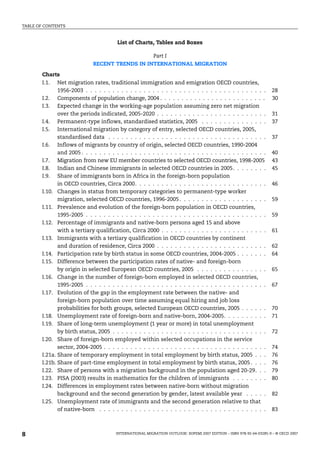
List of Charts, Tables and Boxes
Part I
RECENT TRENDS IN INTERNATIONAL MIGRATION
Charts
I.1. Net migration rates, traditional immigration and emigration OECD countries,
1956-2003 . . . . . . . . . . . . . . . . . . . . . . . . . . . . . . . . . . . . . . . . . 28
I.2. Components of population change, 2004 . . . . . . . . . . . . . . . . . . . . . . . . . 30
I.3. Expected change in the working-age population assuming zero net migration
over the periods indicated, 2005-2020 . . . . . . . . . . . . . . . . . . . . . . . . . 31
I.4. Permanent-type inflows, standardised statistics, 2005 . . . . . . . . . . . . . . . 37
I.5. International migration by category of entry, selected OECD countries, 2005,
standardised data . . . . . . . . . . . . . . . . . . . . . . . . . . . . . . . . . . . . 37
I.6. Inflows of migrants by country of origin, selected OECD countries, 1990-2004
and 2005 . . . . . . . . . . . . . . . . . . . . . . . . . . . . . . . . . . . . . . . . . . 40
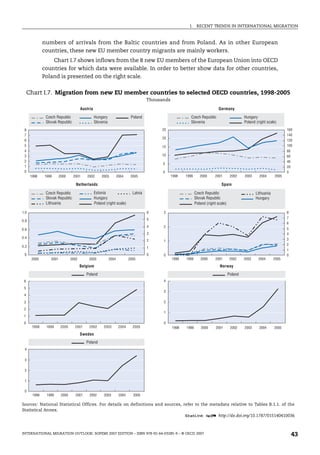
I.7. Migration from new EU member countries to selected OECD countries, 1998-2005 43
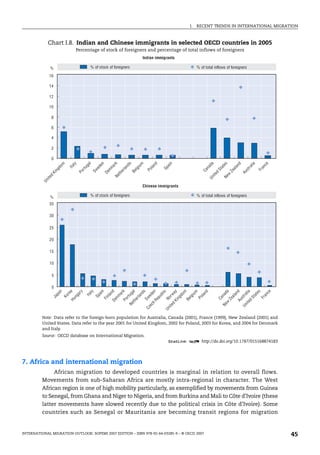
I.8. Indian and Chinese immigrants in selected OECD countries in 2005. . . . . . . . 45
I.9. Share of immigrants born in Africa in the foreign-born population
in OECD countries, Circa 2000. . . . . . . . . . . . . . . . . . . . . . . . . . . . . . 46
I.10. Changes in status from temporary categories to permanent-type worker
migration, selected OECD countries, 1996-2005. . . . . . . . . . . . . . . . . . . . 59
I.11. Prevalence and evolution of the foreign-born population in OECD countries,
1995-2005 . . . . . . . . . . . . . . . . . . . . . . . . . . . . . . . . . . . . . . . . . 59
I.12. Percentage of immigrants and native-born persons aged 15 and above
with a tertiary qualification, Circa 2000 . . . . . . . . . . . . . . . . . . . . . . . . 61
I.13. Immigrants with a tertiary qualification in OECD countries by continent
and duration of residence, Circa 2000 . . . . . . . . . . . . . . . . . . . . . . . . . 62
I.14. Participation rate by birth status in some OECD countries, 2004-2005 . . . . . . . 64
I.15. Difference between the participation rates of native- and foreign-born
by origin in selected European OECD countries, 2005 . . . . . . . . . . . . . . . . 65
I.16. Change in the number of foreign-born employed in selected OECD countries,
1995-2005 . . . . . . . . . . . . . . . . . . . . . . . . . . . . . . . . . . . . . . . . . 67
I.17. Evolution of the gap in the employment rate between the native- and
foreign-born population over time assuming equal hiring and job loss
probabilities for both groups, selected European OECD countries, 2005 . . . . . . 70
I.18. Unemployment rate of foreign-born and native-born, 2004-2005. . . . . . . . . . 71
I.19. Share of long-term unemployment (1 year or more) in total unemployment
by birth status, 2005 . . . . . . . . . . . . . . . . . . . . . . . . . . . . . . . . . . . 72
I.20. Share of foreign-born employed within selected occupations in the service
sector, 2004-2005 . . . . . . . . . . . . . . . . . . . . . . . . . . . . . . . . . . . . . 74
I.21a. Share of temporary employment in total employment by birth status, 2005 . . . 76
I.21b. Share of part-time employment in total employment by birth status, 2005 . . . . 76
I.22. Share of persons with a migration background in the population aged 20-29. . . 79
I.23. PISA (2003) results in mathematics for the children of immigrants . . . . . . . . 80
I.24. Differences in employment rates between native-born without migration
background and the second generation by gender, latest available year . . . . . 82
I.25. Unemployment rate of immigrants and the second generation relative to that
of native-born . . . . . . . . . . . . . . . . . . . . . . . . . . . . . . . . . . . . . . 83
IM-Outlook07.fm Page 8 Thursday, June 7, 2007 4:53 PM
TABLE OF CONTENTS
INTERNATIONAL MIGRATION OUTLOOK: SOPEMI 2007 EDITION – ISBN 978-92-64-03285-9 – © OECD 2007 9
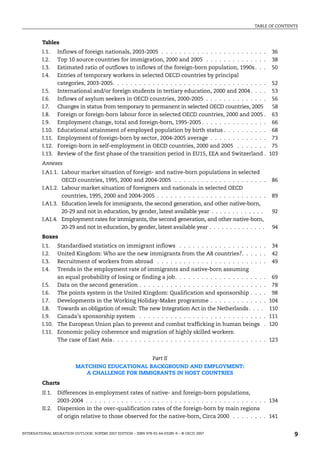
Tables
I.1. Inflows of foreign nationals, 2003-2005 . . . . . . . . . . . . . . . . . . . . . . . . 36
I.2. Top 10 source countries for immigration, 2000 and 2005 . . . . . . . . . . . . . . 38
I.3. Estimated ratio of outflows to inflows of the foreign-born population, 1990s. . . 50
I.4. Entries of temporary workers in selected OECD countries by principal
categories, 2003-2005. . . . . . . . . . . . . . . . . . . . . . . . . . . . . . . . . . . 52
I.5. International and/or foreign students in tertiary education, 2000 and 2004 . . . . 53
I.6. Inflows of asylum seekers in OECD countries, 2000-2005 . . . . . . . . . . . . . . 56
I.7. Changes in status from temporary to permanent in selected OECD countries, 2005 58
I.8. Foreign or foreign-born labour force in selected OECD countries, 2000 and 2005 . 63
I.9. Employment change, total and foreign-born, 1995-2005 . . . . . . . . . . . . . . . 66
I.10. Educational attainment of employed population by birth status . . . . . . . . . . 68
I.11. Employment of foreign-born by sector, 2004-2005 average . . . . . . . . . . . . . 73
I.12. Foreign-born in self-employment in OECD countries, 2000 and 2005 . . . . . . . 75
I.13. Review of the first phase of the transition period in EU15, EEA and Switzerland . 103
Annexes
I.A1.1. Labour market situation of foreign- and native-born populations in selected
OECD countries, 1995, 2000 and 2004-2005 . . . . . . . . . . . . . . . . . . . . . 86
I.A1.2. Labour market situation of foreigners and nationals in selected OECD
countries, 1995, 2000 and 2004-2005 . . . . . . . . . . . . . . . . . . . . . . . . . 89
I.A1.3. Education levels for immigrants, the second generation, and other native-born,
20-29 and not in education, by gender, latest available year . . . . . . . . . . . . . 92
I.A1.4. Employment rates for immigrants, the second generation, and other native-born,
20-29 and not in education, by gender, latest available year . . . . . . . . . . . . . . 94
Boxes
I.1. Standardised statistics on immigrant inflows . . . . . . . . . . . . . . . . . . . . 34
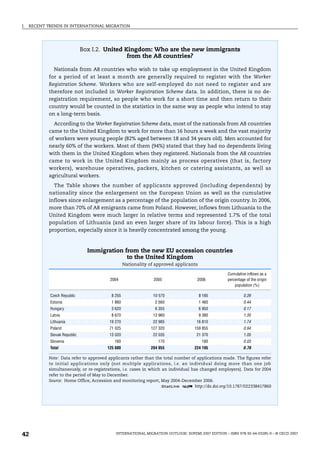
I.2. United Kingdom: Who are the new immigrants from the A8 countries?. . . . . . 42
I.3. Recruitment of workers from abroad . . . . . . . . . . . . . . . . . . . . . . . . . 49
I.4. Trends in the employment rate of immigrants and native-born assuming
an equal probability of losing or finding a job. . . . . . . . . . . . . . . . . . . . . 69
I.5. Data on the second generation . . . . . . . . . . . . . . . . . . . . . . . . . . . . . 78
I.6. The points system in the United Kingdom: Qualification and sponsorship . . . . 98
I.7. Developments in the Working Holiday-Maker programme . . . . . . . . . . . . . 104
I.8. Towards an obligation of result: The new Integration Act in the Netherlands. . . . 110
I.9. Canada’s sponsorship system . . . . . . . . . . . . . . . . . . . . . . . . . . . . . 111
I.10. The European Union plan to prevent and combat trafficking in human beings . 120
I.11. Economic policy coherence and migration of highly skilled workers:
The case of East Asia. . . . . . . . . . . . . . . . . . . . . . . . . . . . . . . . . . . 123
Part II
MATCHING EDUCATIONAL BACKGROUND AND EMPLOYMENT:
A CHALLENGE FOR IMMIGRANTS IN HOST COUNTRIES
Charts
II.1. Differences in employment rates of native- and foreign-born populations,
2003-2004 . . . . . . . . . . . . . . . . . . . . . . . . . . . . . . . . . . . . . . . . . 134
II.2. Dispersion in the over-qualification rates of the foreign-born by main regions
of origin relative to those observed for the native-born, Circa 2000 . . . . . . . . 141
IM-Outlook07.fm Page 9 Thursday, June 7, 2007 4:53 PM
TABLE OF CONTENTS
INTERNATIONAL MIGRATION OUTLOOK: SOPEMI 2007 EDITION – ISBN 978-92-64-03285-9 – © OECD 2007
10
II.3. Over-qualification rate by level of quantitative literacy and country of birth
in Europe and in Australia, Circa 1995 . . . . . . . . . . . . . . . . . . . . . . . . . 144
Annexes
II.A3.1. Overeducation rates for individuals with higher education in Germany, 2003-2004 157
Tables
II.1. Education level of foreign- and native-born populations aged 25 to 64 in OECD
countries, 2003-2004 . . . . . . . . . . . . . . . . . . . . . . . . . . . . . . . . . . . 133
II.2. Over-qualification rates of native- and foreign-born populations in some OECD
countries . . . . . . . . . . . . . . . . . . . . . . . . . . . . . . . . . . . . . . . . . 137
II.3. Over-qualification rate of native- and foreign-born populations by gender
in some OECD countries, 2003-2004 . . . . . . . . . . . . . . . . . . . . . . . . . . 139
II.4. Over-qualification rate of the foreign-born population according to their
duration of stay in some OECD countries, 2003-2004. . . . . . . . . . . . . . . . . 140
II.5. Over-qualification rate of immigrants by country of birth and destination
country, Circa 2000 . . . . . . . . . . . . . . . . . . . . . . . . . . . . . . . . . . . . 142
II.6. Logistic model of the probability of over-qualification (Australia) . . . . . . . . . 145
II.7. Logistic model of the probability of over-qualification (Europe) . . . . . . . . . . 147
Annexes
II.A1.1. Employment and unemployment rates of native- and foreign-born populations
by level of education, 2003-2004 . . . . . . . . . . . . . . . . . . . . . . . . . . . 154
II.A2.1. Conversion of ISCO-88 9 categories to 3 categories . . . . . . . . . . . . . . . . . 156
II.A2.2. Conversion from ISCED 7 categories to 3 categories . . . . . . . . . . . . . . . . 156
II.A2.3. Correspondence between ISCED education level and ISCO employment level . 156
II.A3.1. Wage-based over-qualification rate of native- and foreign-born by level
of education in some OECD countries, 2003-2004. . . . . . . . . . . . . . . . . . 158
Boxes
II.1. Different approaches to the over-qualification problem. . . . . . . . . . . . . . . 135
II.2. The “Box and Whiskers Plot” . . . . . . . . . . . . . . . . . . . . . . . . . . . . . . 141
II.3. International Adult Literacy Survey, IALS . . . . . . . . . . . . . . . . . . . . . . . 144
Part III
IMMIGRANT HEALTH WORKERS IN OECD COUNTRIES
IN THE BROADER CONTEXT OF HIGHLY SKILLED MIGRATION
Charts
III.1. Share of foreign-born among practicing doctors, dentists and pharmacists
in selected OECD countries, Circa 2000 . . . . . . . . . . . . . . . . . . . . . . . . 166
III.2a.Percentage of foreign-born doctors and nurses compared to the percentage
of foreign born in highly skilled occupations in selected OECD countries, Circa 2000 171
III.2b.Percentage of foreign-born doctors compared to the percentage
of foreign-born among people employed and holding a PhD in selected
OECD countries, Circa 2000 . . . . . . . . . . . . . . . . . . . . . . . . . . . . . . . 171
III.3. Distribution of foreign-born doctors and nurses by country of residence
in the OECD area, Circa 2000 . . . . . . . . . . . . . . . . . . . . . . . . . . . . . . 172
III.4. Distribution of foreign-born doctors and nurses by main regions of origin
in OECD countries, Circa 2000. . . . . . . . . . . . . . . . . . . . . . . . . . . . . . 173
IM-Outlook07.fm Page 10 Thursday, June 7, 2007 4:53 PM
TABLE OF CONTENTS
INTERNATIONAL MIGRATION OUTLOOK: SOPEMI 2007 EDITION – ISBN 978-92-64-03285-9 – © OECD 2007 11
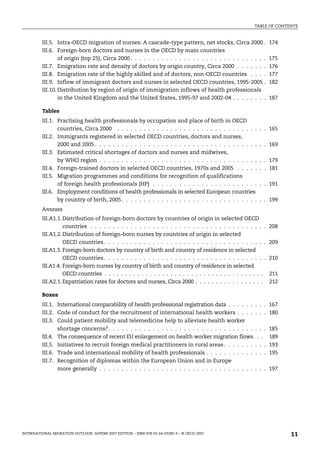
III.5. Intra-OECD migration of nurses: A cascade-type pattern, net stocks, Circa 2000 . 174
III.6. Foreign-born doctors and nurses in the OECD by main countries
of origin (top 25), Circa 2000. . . . . . . . . . . . . . . . . . . . . . . . . . . . . . . 175
III.7. Emigration rate and density of doctors by origin country, Circa 2000 . . . . . . . 176
III.8. Emigration rate of the highly skilled and of doctors, non-OECD countries . . . . 177
III.9. Inflow of immigrant doctors and nurses in selected OECD countries, 1995-2005 . 182
III.10. Distribution by region of origin of immigration inflows of health professionals
in the United Kingdom and the United States, 1995-97 and 2002-04 . . . . . . . . 187
Tables
III.1. Practising health professionals by occupation and place of birth in OECD
countries, Circa 2000 . . . . . . . . . . . . . . . . . . . . . . . . . . . . . . . . . . 165
III.2. Immigrants registered in selected OECD countries, doctors and nurses,
2000 and 2005 . . . . . . . . . . . . . . . . . . . . . . . . . . . . . . . . . . . . . . . 169
III.3. Estimated critical shortages of doctors and nurses and midwives,
by WHO region . . . . . . . . . . . . . . . . . . . . . . . . . . . . . . . . . . . . . . 179
III.4. Foreign-trained doctors in selected OECD countries, 1970s and 2005 . . . . . . . 181
III.5. Migration programmes and conditions for recognition of qualifications
of foreign health professionals (HP) . . . . . . . . . . . . . . . . . . . . . . . . . . 191
III.6. Employment conditions of health professionals in selected European countries
by country of birth, 2005. . . . . . . . . . . . . . . . . . . . . . . . . . . . . . . . . 199
Annexes
III.A1.1.Distribution of foreign-born doctors by countries of origin in selected OECD
countries . . . . . . . . . . . . . . . . . . . . . . . . . . . . . . . . . . . . . . . . 208
III.A1.2.Distribution of foreign-born nurses by countries of origin in selected
OECD countries. . . . . . . . . . . . . . . . . . . . . . . . . . . . . . . . . . . . . 209
III.A1.3. Foreign-born doctors by country of birth and country of residence in selected
OECD countries. . . . . . . . . . . . . . . . . . . . . . . . . . . . . . . . . . . . . 210
III.A1.4. Foreign-born nurses by country of birth and country of residence in selected
OECD countries . . . . . . . . . . . . . . . . . . . . . . . . . . . . . . . . . . . . . . . 211
III.A2.1.Expatriation rates for doctors and nurses, Circa 2000 . . . . . . . . . . . . . . . . . 212
Boxes
III.1. International comparability of health professional registration data . . . . . . . . . 167
III.2. Code of conduct for the recruitment of international health workers . . . . . . . 180
III.3. Could patient mobility and telemedicine help to alleviate health worker
shortage concerns?. . . . . . . . . . . . . . . . . . . . . . . . . . . . . . . . . . . . 185
III.4. The consequence of recent EU enlargement on health worker migration flows. . . 189
III.5. Initiatives to recruit foreign medical practitioners in rural areas . . . . . . . . . . 193
III.6. Trade and international mobility of health professionals . . . . . . . . . . . . . . 195
III.7. Recognition of diplomas within the European Union and in Europe
more generally . . . . . . . . . . . . . . . . . . . . . . . . . . . . . . . . . . . . . . 197
IM-Outlook07.fm Page 11 Thursday, June 7, 2007 4:53 PM
TABLE OF CONTENTS
INTERNATIONAL MIGRATION OUTLOOK: SOPEMI 2007 EDITION – ISBN 978-92-64-03285-9 – © OECD 2007
12
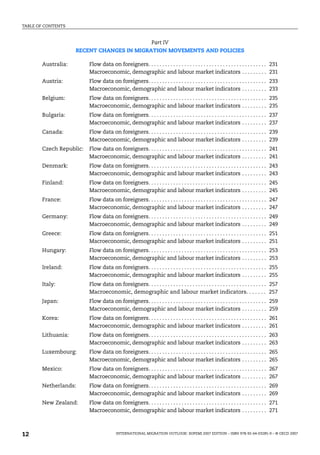
Part IV
RECENT CHANGES IN MIGRATION MOVEMENTS AND POLICIES
Australia: Flow data on foreigners. . . . . . . . . . . . . . . . . . . . . . . . . . . . . . . . . . . . . . . . . . . 231
Macroeconomic, demographic and labour market indicators . . . . . . . . . 231
Austria: Flow data on foreigners. . . . . . . . . . . . . . . . . . . . . . . . . . . . . . . . . . . . . . . . . . . 233
Macroeconomic, demographic and labour market indicators . . . . . . . . . 233
Belgium: Flow data on foreigners. . . . . . . . . . . . . . . . . . . . . . . . . . . . . . . . . . . . . . . . . . . 235
Macroeconomic, demographic and labour market indicators . . . . . . . . . 235
Bulgaria: Flow data on foreigners. . . . . . . . . . . . . . . . . . . . . . . . . . . . . . . . . . . . . . . . . . . 237
Macroeconomic, demographic and labour market indicators . . . . . . . . . 237
Canada: Flow data on foreigners. . . . . . . . . . . . . . . . . . . . . . . . . . . . . . . . . . . . . . . . . . . 239
Macroeconomic, demographic and labour market indicators . . . . . . . . . 239
Czech Republic: Flow data on foreigners. . . . . . . . . . . . . . . . . . . . . . . . . . . . . . . . . . . . . . . . . . . 241
Macroeconomic, demographic and labour market indicators . . . . . . . . . 241
Denmark: Flow data on foreigners. . . . . . . . . . . . . . . . . . . . . . . . . . . . . . . . . . . . . . . . . . . 243
Macroeconomic, demographic and labour market indicators . . . . . . . . . 243
Finland: Flow data on foreigners. . . . . . . . . . . . . . . . . . . . . . . . . . . . . . . . . . . . . . . . . . . 245
Macroeconomic, demographic and labour market indicators . . . . . . . . . 245
France: Flow data on foreigners. . . . . . . . . . . . . . . . . . . . . . . . . . . . . . . . . . . . . . . . . . . 247
Macroeconomic, demographic and labour market indicators . . . . . . . . . 247
Germany: Flow data on foreigners. . . . . . . . . . . . . . . . . . . . . . . . . . . . . . . . . . . . . . . . . . . 249
Macroeconomic, demographic and labour market indicators . . . . . . . . . 249
Greece: Flow data on foreigners. . . . . . . . . . . . . . . . . . . . . . . . . . . . . . . . . . . . . . . . . . . 251
Macroeconomic, demographic and labour market indicators . . . . . . . . . 251
Hungary: Flow data on foreigners. . . . . . . . . . . . . . . . . . . . . . . . . . . . . . . . . . . . . . . . . . . 253
Macroeconomic, demographic and labour market indicators . . . . . . . . . 253
Ireland: Flow data on foreigners. . . . . . . . . . . . . . . . . . . . . . . . . . . . . . . . . . . . . . . . . . . 255
Macroeconomic, demographic and labour market indicators . . . . . . . . . 255
Italy: Flow data on foreigners. . . . . . . . . . . . . . . . . . . . . . . . . . . . . . . . . . . . . . . . . . . 257
Macroeconomic, demographic and labour market indicators. . . . . . . 257
Japan: Flow data on foreigners. . . . . . . . . . . . . . . . . . . . . . . . . . . . . . . . . . . . . . . . . . . 259
Macroeconomic, demographic and labour market indicators . . . . . . . . . 259
Korea: Flow data on foreigners. . . . . . . . . . . . . . . . . . . . . . . . . . . . . . . . . . . . . . . . . . . 261
Macroeconomic, demographic and labour market indicators . . . . . . . . . 261
Lithuania: Flow data on foreigners. . . . . . . . . . . . . . . . . . . . . . . . . . . . . . . . . . . . . . . . . . . 263
Macroeconomic, demographic and labour market indicators . . . . . . . . . 263
Luxembourg: Flow data on foreigners. . . . . . . . . . . . . . . . . . . . . . . . . . . . . . . . . . . . . . . . . . . 265
Macroeconomic, demographic and labour market indicators . . . . . . . . . 265
Mexico: Flow data on foreigners. . . . . . . . . . . . . . . . . . . . . . . . . . . . . . . . . . . . . . . . . . . 267
Macroeconomic, demographic and labour market indicators . . . . . . . . . 267
Netherlands: Flow data on foreigners. . . . . . . . . . . . . . . . . . . . . . . . . . . . . . . . . . . . . . . . . . . 269
Macroeconomic, demographic and labour market indicators . . . . . . . . . 269
New Zealand: Flow data on foreigners. . . . . . . . . . . . . . . . . . . . . . . . . . . . . . . . . . . . . . . . . . . 271
Macroeconomic, demographic and labour market indicators . . . . . . . . . 271
IM-Outlook07.fm Page 12 Thursday, June 7, 2007 4:53 PM
TABLE OF CONTENTS
INTERNATIONAL MIGRATION OUTLOOK: SOPEMI 2007 EDITION – ISBN 978-92-64-03285-9 – © OECD 2007 13
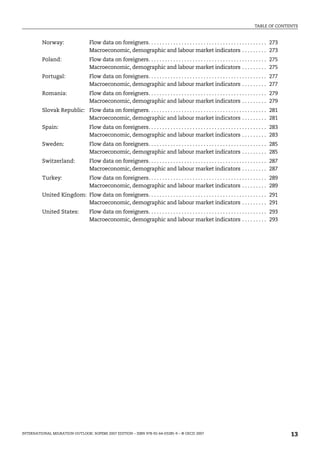
Norway: Flow data on foreigners. . . . . . . . . . . . . . . . . . . . . . . . . . . . . . . . . . . . . . . . . . . 273
Macroeconomic, demographic and labour market indicators . . . . . . . . . 273
Poland: Flow data on foreigners. . . . . . . . . . . . . . . . . . . . . . . . . . . . . . . . . . . . . . . . . . . 275
Macroeconomic, demographic and labour market indicators . . . . . . . . . 275
Portugal: Flow data on foreigners. . . . . . . . . . . . . . . . . . . . . . . . . . . . . . . . . . . . . . . . . . . 277
Macroeconomic, demographic and labour market indicators . . . . . . . . . 277
Romania: Flow data on foreigners. . . . . . . . . . . . . . . . . . . . . . . . . . . . . . . . . . . . . . . . . . . 279
Macroeconomic, demographic and labour market indicators . . . . . . . . . 279
Slovak Republic: Flow data on foreigners. . . . . . . . . . . . . . . . . . . . . . . . . . . . . . . . . . . . . . . . . . . 281
Macroeconomic, demographic and labour market indicators . . . . . . . . . 281
Spain: Flow data on foreigners. . . . . . . . . . . . . . . . . . . . . . . . . . . . . . . . . . . . . . . . . . . 283
Macroeconomic, demographic and labour market indicators . . . . . . . . . 283
Sweden: Flow data on foreigners. . . . . . . . . . . . . . . . . . . . . . . . . . . . . . . . . . . . . . . . . . . 285
Macroeconomic, demographic and labour market indicators . . . . . . . . . 285
Switzerland: Flow data on foreigners. . . . . . . . . . . . . . . . . . . . . . . . . . . . . . . . . . . . . . . . . . . 287
Macroeconomic, demographic and labour market indicators . . . . . . . . . 287
Turkey: Flow data on foreigners. . . . . . . . . . . . . . . . . . . . . . . . . . . . . . . . . . . . . . . . . . . 289
Macroeconomic, demographic and labour market indicators . . . . . . . . . 289
United Kingdom: Flow data on foreigners. . . . . . . . . . . . . . . . . . . . . . . . . . . . . . . . . . . . . . . . . . . 291
Macroeconomic, demographic and labour market indicators . . . . . . . . . 291
United States: Flow data on foreigners. . . . . . . . . . . . . . . . . . . . . . . . . . . . . . . . . . . . . . . . . . . 293
Macroeconomic, demographic and labour market indicators . . . . . . . . . 293
IM-Outlook07.fm Page 13 Thursday, June 7, 2007 4:53 PM
TABLE OF CONTENTS
INTERNATIONAL MIGRATION OUTLOOK: SOPEMI 2007 EDITION – ISBN 978-92-64-03285-9 – © OECD 2007
14
STATISTICAL ANNEX
Inflows and Outflows of Foreign Population . . . . . . . . . . . . . . . . . . . . . . . . . . . . . . . . . . . . . . 299
A.1.1. Inflows of foreign population into selected OECD countries . . . . . . . . . . . . . . . . . 301
A.1.2. Outflows of foreign population from selected OECD countries . . . . . . . . . . . . . . . 302
B.1.1. AUSTRALIA . . . . . . . . . . . . . . . . . 303
B.1.1. AUSTRIA . . . . . . . . . . . . . . . . . . . 303
B.1.1. BELGIUM . . . . . . . . . . . . . . . . . . . 304
B.1.1. CANADA . . . . . . . . . . . . . . . . . . . 304
B.1.1. CZECH REPUBLIC . . . . . . . . . . . . 305
B.1.1. DENMARK . . . . . . . . . . . . . . . . . . 305
B.1.1. FINLAND . . . . . . . . . . . . . . . . . . . 306
B.1.1. FRANCE . . . . . . . . . . . . . . . . . . . . 306
B.1.1. GERMANY . . . . . . . . . . . . . . . . . . 307
B.1.1. GREECE . . . . . . . . . . . . . . . . . . . . 307
B.1.1. HUNGARY . . . . . . . . . . . . . . . . . . 308
B.1.1. IRELAND . . . . . . . . . . . . . . . . . . . 308
B.1.1. ITALY . . . . . . . . . . . . . . . . . . . . . . 309
B.1.1. JAPAN. . . . . . . . . . . . . . . . . . . . . . 309
B.1.1. LUXEMBOURG. . . . . . . . . . . . . . . 310
B.1.1. NETHERLANDS . . . . . . . . . . . . . . 310
B.1.1. NEW ZEALAND. . . . . . . . . . . . . . 311
B.1.1. NORWAY. . . . . . . . . . . . . . . . . . . 311
B.1.1. POLAND. . . . . . . . . . . . . . . . . . . . 312
B.1.1. PORTUGAL . . . . . . . . . . . . . . . . . 312
B.1.1. SLOVAK REPUBLIC . . . . . . . . . . . 313
B.1.1. SPAIN . . . . . . . . . . . . . . . . . . . . . . 313
B.1.1. SWEDEN . . . . . . . . . . . . . . . . . . . 314
B.1.1. SWITZERLAND . . . . . . . . . . . . . . 314
B.1.1. TURKEY . . . . . . . . . . . . . . . . . . . . 315
B.1.1. UNITED KINGDOM. . . . . . . . . . . 315
B.1.1. UNITED STATES . . . . . . . . . . . . . 316
Metadata related to Tables A.1.1, A.1.2. and B.1.1. Migration flows in selected
OECD countries . . . . . . . . . . . . . . . . . . . . . . . . . . . . . . . . . . . . . . . . . . . . . . . . . . . . . . . . . . . . . 317
Inflows of Asylum Seekers . . . . . . . . . . . . . . . . . . . . . . . . . . . . . . . . . . . . . . . . . . . . . . . . . . . . 320
A.1.3. Inflows of asylum seekers into OECD countries . . . . . . . . . . . . . . . . . . . . . . . . . . . . 321
B.1.3. AUSTRIA . . . . . . . . . . . . . . . . . . . 322
B.1.3. BELGIUM . . . . . . . . . . . . . . . . . . . 322
B.1.3. CANADA . . . . . . . . . . . . . . . . . . . 323
B.1.3. FRANCE . . . . . . . . . . . . . . . . . . . . 323
B.1.3. GERMANY . . . . . . . . . . . . . . . . . . 324
B.1.3. NETHERLANDS . . . . . . . . . . . . . . 324
B.1.3. SWEDEN . . . . . . . . . . . . . . . . . . . 325
B.1.3. SWITZERLAND . . . . . . . . . . . . . . 325
B.1.3. UNITED KINGDOM. . . . . . . . . . . 326
B.1.3. UNITED STATES . . . . . . . . . . . . . 326
Metadata related to Tables A.1.3. and B.1.3. Inflows of asylum seekers. . . . . . . . . . . . . . 327
Stocks of Foreign and Foreign-born Population. . . . . . . . . . . . . . . . . . . . . . . . . . . . . . . . . . . . 328
A.1.4. Stocks of foreign-born population in selected OECD countries . . . . . . . . . . . . . . . 330
B.1.4. AUSTRALIA . . . . . . . . . . . . . . . . . 331
B.1.4. AUSTRIA . . . . . . . . . . . . . . . . . . . 331
B.1.4. BELGIUM . . . . . . . . . . . . . . . . . . . 332
B.1.4. CANADA . . . . . . . . . . . . . . . . . . . 332
B.1.4. DENMARK . . . . . . . . . . . . . . . . . . 333
B.1.4. FINLAND . . . . . . . . . . . . . . . . . . . 333
B.1.4. FRANCE . . . . . . . . . . . . . . . . . . . . 334
B.1.4. GREECE . . . . . . . . . . . . . . . . . . . . 334
B.1.4. HUNGARY . . . . . . . . . . . . . . . . . . 335
B.1.4. IRELAND . . . . . . . . . . . . . . . . . . . 335
B.1.4. LUXEMBOURG. . . . . . . . . . . . . . . 336
B.1.4. NETHERLANDS . . . . . . . . . . . . . . 336
B.1.4. NEW ZEALAND. . . . . . . . . . . . . . 337
B.1.4. NORWAY. . . . . . . . . . . . . . . . . . . 337
B.1.4. POLAND. . . . . . . . . . . . . . . . . . . . 338
B.1.4. PORTUGAL . . . . . . . . . . . . . . . . . 338
B.1.4. SLOVAK REPUBLIC . . . . . . . . . . . 339
B.1.4. SWEDEN . . . . . . . . . . . . . . . . . . . 339
B.1.4. TURKEY . . . . . . . . . . . . . . . . . . . . 340
B.1.4. UNITED KINGDOM. . . . . . . . . . . 340
B.1.4. UNITED STATES . . . . . . . . . . . . . 341
Metadata related to Tables A.1.4. and B.1.4. Foreign-born population . . . . . . . . . . . . . . . 342
IM-Outlook07.fm Page 14 Thursday, June 7, 2007 4:53 PM
TABLE OF CONTENTS
INTERNATIONAL MIGRATION OUTLOOK: SOPEMI 2007 EDITION – ISBN 978-92-64-03285-9 – © OECD 2007 15
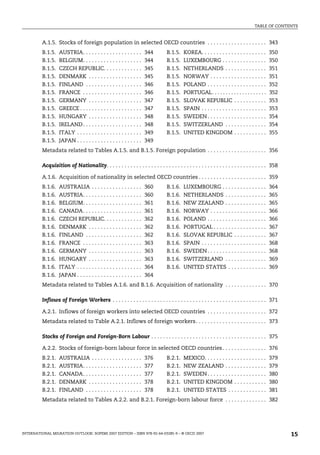
A.1.5. Stocks of foreign population in selected OECD countries . . . . . . . . . . . . . . . . . . . . 343
B.1.5. AUSTRIA. . . . . . . . . . . . . . . . . . . . 344
B.1.5. BELGIUM. . . . . . . . . . . . . . . . . . . . 344
B.1.5. CZECH REPUBLIC. . . . . . . . . . . . . 345
B.1.5. DENMARK . . . . . . . . . . . . . . . . . . 345
B.1.5. FINLAND . . . . . . . . . . . . . . . . . . . 346
B.1.5. FRANCE . . . . . . . . . . . . . . . . . . . . 346
B.1.5. GERMANY . . . . . . . . . . . . . . . . . . 347
B.1.5. GREECE . . . . . . . . . . . . . . . . . . . . . 347
B.1.5. HUNGARY . . . . . . . . . . . . . . . . . . 348
B.1.5. IRELAND. . . . . . . . . . . . . . . . . . . . 348
B.1.5. ITALY . . . . . . . . . . . . . . . . . . . . . . 349
B.1.5. JAPAN . . . . . . . . . . . . . . . . . . . . . . 349
B.1.5. KOREA. . . . . . . . . . . . . . . . . . . . . . 350
B.1.5. LUXEMBOURG . . . . . . . . . . . . . . . 350
B.1.5. NETHERLANDS . . . . . . . . . . . . . . 351
B.1.5. NORWAY . . . . . . . . . . . . . . . . . . . 351
B.1.5. POLAND . . . . . . . . . . . . . . . . . . . . 352
B.1.5. PORTUGAL. . . . . . . . . . . . . . . . . . . . 352
B.1.5. SLOVAK REPUBLIC . . . . . . . . . . . 353
B.1.5. SPAIN . . . . . . . . . . . . . . . . . . . . . . 353
B.1.5. SWEDEN . . . . . . . . . . . . . . . . . . . . 354
B.1.5. SWITZERLAND . . . . . . . . . . . . . . 354
B.1.5. UNITED KINGDOM . . . . . . . . . . . 355
Metadata related to Tables A.1.5. and B.1.5. Foreign population . . . . . . . . . . . . . . . . . . . . 356
Acquisition of Nationality. . . . . . . . . . . . . . . . . . . . . . . . . . . . . . . . . . . . . . . . . . . . . . . . . . . . . . 358
A.1.6. Acquisition of nationality in selected OECD countries . . . . . . . . . . . . . . . . . . . . . . . 359
B.1.6. AUSTRALIA . . . . . . . . . . . . . . . . . 360
B.1.6. AUSTRIA. . . . . . . . . . . . . . . . . . . . 360
B.1.6. BELGIUM. . . . . . . . . . . . . . . . . . . . 361
B.1.6. CANADA. . . . . . . . . . . . . . . . . . . . 361
B.1.6. CZECH REPUBLIC. . . . . . . . . . . . . 362
B.1.6. DENMARK . . . . . . . . . . . . . . . . . . 362
B.1.6. FINLAND . . . . . . . . . . . . . . . . . . . 362
B.1.6. FRANCE . . . . . . . . . . . . . . . . . . . . 363
B.1.6. GERMANY . . . . . . . . . . . . . . . . . . 363
B.1.6. HUNGARY . . . . . . . . . . . . . . . . . . 363
B.1.6. ITALY . . . . . . . . . . . . . . . . . . . . . . 364
B.1.6. JAPAN . . . . . . . . . . . . . . . . . . . . . . 364
B.1.6. LUXEMBOURG . . . . . . . . . . . . . . . 364
B.1.6. NETHERLANDS . . . . . . . . . . . . . . 365
B.1.6. NEW ZEALAND . . . . . . . . . . . . . . 365
B.1.6. NORWAY . . . . . . . . . . . . . . . . . . . 366
B.1.6. POLAND . . . . . . . . . . . . . . . . . . . . 366
B.1.6. PORTUGAL . . . . . . . . . . . . . . . . . . 367
B.1.6. SLOVAK REPUBLIC . . . . . . . . . . . 367
B.1.6. SPAIN . . . . . . . . . . . . . . . . . . . . . . 368
B.1.6. SWEDEN . . . . . . . . . . . . . . . . . . . . 368
B.1.6. SWITZERLAND . . . . . . . . . . . . . . 369
B.1.6. UNITED STATES . . . . . . . . . . . . . 369
Metadata related to Tables A.1.6. and B.1.6. Acquisition of nationality . . . . . . . . . . . . . . 370
Inflows of Foreign Workers . . . . . . . . . . . . . . . . . . . . . . . . . . . . . . . . . . . . . . . . . . . . . . . . . . . . 371
A.2.1. Inflows of foreign workers into selected OECD countries . . . . . . . . . . . . . . . . . . . . 372
Metadata related to Table A.2.1. Inflows of foreign workers. . . . . . . . . . . . . . . . . . . . . . . . 373
Stocks of Foreign and Foreign-Born Labour . . . . . . . . . . . . . . . . . . . . . . . . . . . . . . . . . . . . . . . 375
A.2.2. Stocks of foreign-born labour force in selected OECD countries. . . . . . . . . . . . . . . 376
B.2.1. AUSTRALIA . . . . . . . . . . . . . . . . . 376
B.2.1. AUSTRIA. . . . . . . . . . . . . . . . . . . . 377
B.2.1. CANADA. . . . . . . . . . . . . . . . . . . . 377
B.2.1. DENMARK . . . . . . . . . . . . . . . . . . 378
B.2.1. FINLAND . . . . . . . . . . . . . . . . . . . 378
B.2.1. MEXICO. . . . . . . . . . . . . . . . . . . . . 379
B.2.1. NEW ZEALAND . . . . . . . . . . . . . . 379
B.2.1. SWEDEN . . . . . . . . . . . . . . . . . . . . 380
B.2.1. UNITED KINGDOM . . . . . . . . . . . 380
B.2.1. UNITED STATES . . . . . . . . . . . . . 381
Metadata related to Tables A.2.2. and B.2.1. Foreign-born labour force . . . . . . . . . . . . . . 382
IM-Outlook07.fm Page 15 Thursday, June 7, 2007 4:53 PM
TABLE OF CONTENTS
INTERNATIONAL MIGRATION OUTLOOK: SOPEMI 2007 EDITION – ISBN 978-92-64-03285-9 – © OECD 2007
16
A.2.3. Stocks of foreign labour force in selected OECD countries . . . . . . . . . . . . . . . . . . . 383
B.2.2. AUSTRIA . . . . . . . . . . . . . . . . . . . 384
B.2.2. BELGIUM . . . . . . . . . . . . . . . . . . . 384
B.2.2. CZECH REPUBLIC . . . . . . . . . . . . 385
B.2.2. DENMARK . . . . . . . . . . . . . . . . . . 385
B.2.2. FINLAND . . . . . . . . . . . . . . . . . . . 386
B.2.2. FRANCE . . . . . . . . . . . . . . . . . . . . 386
B.2.2. GERMANY . . . . . . . . . . . . . . . . . . 387
B.2.2. GREECE . . . . . . . . . . . . . . . . . . . . 387
B.2.2. HUNGARY . . . . . . . . . . . . . . . . . . 388
B.2.2. IRELAND . . . . . . . . . . . . . . . . . . . 388
B.2.2. ITALY . . . . . . . . . . . . . . . . . . . . . . 389
B.2.2. JAPAN. . . . . . . . . . . . . . . . . . . . . . 389
B.2.2. KOREA . . . . . . . . . . . . . . . . . . . . . 390
B.2.2. LUXEMBOURG. . . . . . . . . . . . . . . 390
B.2.2. NETHERLANDS . . . . . . . . . . . . . . 391
B.2.2. NORWAY. . . . . . . . . . . . . . . . . . . 391
B.2.2. PORTUGAL . . . . . . . . . . . . . . . . . 392
B.2.2. SLOVAK REPUBLIC . . . . . . . . . . . 392
B.2.2. SPAIN . . . . . . . . . . . . . . . . . . . . . . 393
B.2.2. SWEDEN . . . . . . . . . . . . . . . . . . . 393
B.2.2. SWITZERLAND . . . . . . . . . . . . . . 394
B.2.2. UNITED KINGDOM. . . . . . . . . . . 394
Metadata related to Tables A.2.3. and B.2.2. Foreign labour force . . . . . . . . . . . . . . . . . . 395
IM-Outlook07.fm Page 16 Thursday, June 7, 2007 4:53 PM
ISBN 978-92-64-03285-9
International Migration Outlook
Sopemi 2007 Edition
© OECD 2007
INTERNATIONAL MIGRATION OUTLOOK: SOPEMI 2007 EDITION – ISBN 978-92-64-03285-9 – © OECD 2007 17
Editorial
The Medical Brain Drain: Myths and Realities
IM-Outlook07.fm Page 17 Thursday, June 7, 2007 4:53 PM
THE MEDICAL BRAIN DRAIN: MYTHS AND REALITIES
INTERNATIONAL MIGRATION OUTLOOK: SOPEMI 2007 EDITION – ISBN 978-92-64-03285-9 – © OECD 2007
18
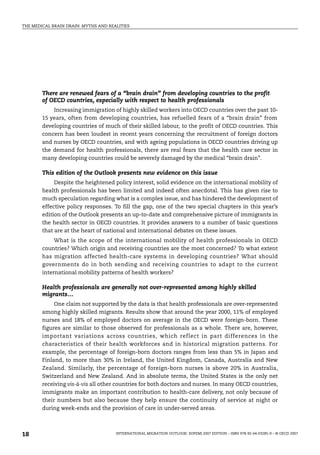
There are renewed fears of a “brain drain” from developing countries to the profit
of OECD countries, especially with respect to health professionals
Increasing immigration of highly skilled workers into OECD countries over the past 10-
15 years, often from developing countries, has refuelled fears of a “brain drain” from
developing countries of much of their skilled labour, to the profit of OECD countries. This
concern has been loudest in recent years concerning the recruitment of foreign doctors
and nurses by OECD countries, and with ageing populations in OECD countries driving up
the demand for health professionals, there are real fears that the health care sector in
many developing countries could be severely damaged by the medical “brain drain”.
This edition of the Outlook presents new evidence on this issue
Despite the heightened policy interest, solid evidence on the international mobility of
health professionals has been limited and indeed often anecdotal. This has given rise to
much speculation regarding what is a complex issue, and has hindered the development of
effective policy responses. To fill the gap, one of the two special chapters in this year’s
edition of the Outlook presents an up-to-date and comprehensive picture of immigrants in
the health sector in OECD countries. It provides answers to a number of basic questions
that are at the heart of national and international debates on these issues.
What is the scope of the international mobility of health professionals in OECD
countries? Which origin and receiving countries are the most concerned? To what extent
has migration affected health-care systems in developing countries? What should
governments do in both sending and receiving countries to adapt to the current
international mobility patterns of health workers?
Health professionals are generally not over-represented among highly skilled
migrants…
One claim not supported by the data is that health professionals are over-represented
among highly skilled migrants. Results show that around the year 2000, 11% of employed
nurses and 18% of employed doctors on average in the OECD were foreign-born. These
figures are similar to those observed for professionals as a whole. There are, however,
important variations across countries, which reflect in part differences in the
characteristics of their health workforces and in historical migration patterns. For
example, the percentage of foreign-born doctors ranges from less than 5% in Japan and
Finland, to more than 30% in Ireland, the United Kingdom, Canada, Australia and New
Zealand. Similarly, the percentage of foreign-born nurses is above 20% in Australia,
Switzerland and New Zealand. And in absolute terms, the United States is the only net
receiving vis-à-vis all other countries for both doctors and nurses. In many OECD countries,
immigrants make an important contribution to health-care delivery, not only because of
their numbers but also because they help ensure the continuity of service at night or
during week-ends and the provision of care in under-served areas.
IM-Outlook07.fm Page 18 Thursday, June 7, 2007 4:53 PM
THE MEDICAL BRAIN DRAIN: MYTHS AND REALITIES
INTERNATIONAL MIGRATION OUTLOOK: SOPEMI 2007 EDITION – ISBN 978-92-64-03285-9 – © OECD 2007 19
… and in large origin countries, such as India, China and the Philippines, the number
of health professionals working abroad is low relative to the domestic supply
Some origin countries, such as the Philippines for nurses, or India for doctors, play a
prominent role in providing health care workers to OECD countries. But intra-OECD
mobility is also significant, particularly from the United Kingdom and Germany. And, there
are important South-South migrations of health professionals, in particular from Africa
and Asia to the Middle East and South Africa. Caribbean countries and a number of African
countries have particularly high emigration rates of doctors. In some cases, relatively few
doctors remain behind, making it difficult to deliver basic health care to the population.
But for large origin countries such as India or China, the number of health professionals
working overseas, although high, is low relative to the domestic supply and the number of
doctors per person has not been strongly affected.
Stopping the outflows of doctors and nurses from low income countries would not
solve the shortage of health professionals these countries face
The chapter also shows that the number of immigrant health workers in OECD
countries represents only a small fraction of health sector needs for human resources in
lower income countries, as estimated by the WHO (around 12% for Africa for example). In
short, although stopping the flow, if this were indeed possible, would alleviate the problem,
it would not by itself solve the shortage issue.
The rise in the immigration of health-care workers has occurred, even if there are no
targeted recruitment programmes
Thus far, few OECD countries have specific migration programmes targeting health
professionals, and bilateral agreements do not play an important role. Despite this, there
has been an upward shift in immigration trends observed over the past five years, in
parallel with that observed for the highly skilled in general. In addition to the continuing
role played by the main origin countries (India, China and the Philippines), there have been
increasing flows from smaller African countries and from Central and Eastern Europe.
To better mobilize the skills and competencies of foreign doctors and nurses and to
ensure high-quality health care, OECD countries are emphasizing the recognition of
qualifications
OECD countries are trying to mobilize the skills and competencies of newly arrived
foreign doctors and nurses while ensuring high standards and quality in health-care
delivery. A key issue concerns the recognition of foreign medical qualifications for health
professionals. OECD countries have put in place a panoply of measures to address the
skills’ recognition question, among them theoretical and practical exams, language tests
and most often, supervised periods of practice, but some countries are stricter than others.
Several countries have also developed programmes to attract back into the health sector
foreign-trained health professionals who are already settled in the country but work in
other jobs.
The recent acceleration in flows calls for increased co-operation between origin and
receiving countries to better share the benefits of the international mobility of health
professionals
The fact that international migration has so far played a limited role in the current
crisis for health human resources in developing countries, should not divert the attention
IM-Outlook07.fm Page 19 Thursday, June 7, 2007 4:53 PM
THE MEDICAL BRAIN DRAIN: MYTHS AND REALITIES
INTERNATIONAL MIGRATION OUTLOOK: SOPEMI 2007 EDITION – ISBN 978-92-64-03285-9 – © OECD 2007
20
of the international community, nor weaken its commitments towards better health for all.
Because health is an international public good, because the health-related objectives of the
Millennium Development Goals are key elements of international solidarity and because,
above all, access to health can be considered as a basic right, origin and receiving countries
need to work together towards providing health professionals with opportunities to use
efficiently their skills where they are the most needed, while guaranteeing the individual
right to move.
There is no unique response to the challenges posed by the international mobility of
health care workers, but data are now available to ensure a more accurate diagnosis of
what is at stake. In addition, a number of sound policy proposals to better share the
benefits of the international mobility of the health workers have been made. The increase
in Official Development Assistance to health and the current efforts devoted by the WHO
to develop a global code of practice governing the international recruitment of health
workers go in the right direction. However, these measures need to be accompanied, in
both sending and receiving countries, by policies aimed at increasing domestic training
capacity, improving retention, developing skill mix and coordinated care, and increasing
productivity.
John P. Martin
Director for Employment, Labour and Social Affairs
IM-Outlook07.fm Page 20 Thursday, June 7, 2007 4:53 PM
ISBN 978-92-64-03285-9
International Migration Outlook
Sopemi 2007 Edition
© OECD 2007
INTERNATIONAL MIGRATION OUTLOOK: SOPEMI 2007 EDITION – ISBN 978-92-64-03285-9 – © OECD 2007 21
Introduction
IM-Outlook07.fm Page 21 Thursday, June 7, 2007 4:53 PM
INTRODUCTION
INTERNATIONAL MIGRATION OUTLOOK: SOPEMI 2007 EDITION – ISBN 978-92-64-03285-9 – © OECD 2007
22
2007 Edition of International Migration Outlook
shows an increase in migration flows to the
OECD…
International migration of both permanent and temporary immigrants continued to
increase in 2005. Overall, for the seventeen countries for which there exist comparable data
on “permanent-type” legal immigration, inflows increased by about 11% in 2005 relative
to 2004. Among the other OECD countries, there was an increase of about 10% between 2004
and 2005, largely due to greater inflows in Spain. At the same time, high temporary
movements were observed in countries such as Australia, Canada, New Zealand,
Switzerland and the United Kingdom, countries in which permanent migration is also high.
... notably in family migration and migration
for employment…
Family migration continues to dominate among the inflows of permanent-type
immigrants. Although it represents only one third of all permanent-type migration in
Japan and the United Kingdom, it reaches a high of 70% in the United States, whose
migration regime is heavily family-based. Many European countries, among them Austria,
Belgium, Denmark, Germany, Portugal, Sweden and the United Kingdom, appear as
important labour migration countries, with some 30 to 40% of permanent-type immigrants
arriving for work-related reasons.
... while, the number of asylum seekers continues
to decline
The number of asylum seekers continued to decline in OECD countries in 2005, falling by
15% overall. The 2005 level has almost halved compared to the number observed in 2000
and currently stands below 300 000. Absolute levels of asylum requests were at about
50 000 in France, followed by Germany and the United Kingdom at about 30 000 each, and
Austria, Canada and the United States in the 20 000 to 25 000 range. However, relative to
the population, it was Austria that received the most requests at more than
2 700 per million persons in the population.
There are increasing inflows of international
students
The number of foreign students in OECD countries has increased by more than 40%
since 2000, with especially large increases in New Zealand, the Czech Republic and Korea.
Other countries which have seen large increases (exceeding 50%) include the countries of
IM-Outlook07.fm Page 22 Thursday, June 7, 2007 4:53 PM
INTRODUCTION
INTERNATIONAL MIGRATION OUTLOOK: SOPEMI 2007 EDITION – ISBN 978-92-64-03285-9 – © OECD 2007 23
southern Europe, Ireland, Australia, France, the Netherlands and Japan. The increase in the
number of international students is most likely a response to signals which many OECD
countries have been sending in recent years, concerning possibilities for work and
residence following the completion of their education.
There are more immigrants from central
and eastern Europe, China and India…
In 2005, the major origin countries of migration remained relatively stable, with
geographical proximity still being a major determinant in the choice of destination
country. A change in origin countries is nevertheless evident in Europe, where movements
have been largely influenced by the increase in flows from central and eastern European
countries as a consequence of the enlargement of the European Union (May 2004) and the
recent adhesion of Bulgaria and Romania (January 2007). Outside of Europe, in North
America, Oceania, Japan and Korea, migrants from Asia are still dominant, with a
significant growth in numbers of those from India and China.
… and destination countries for sub-Saharan
African migration have begun to diversify
Migration from Africa to OECD countries concerns mostly European countries due to
historical links and geographic proximity. In Europe, North African migration is more
frequent than migration from sub-Saharan Africa. Destination countries for African
migration have begun to diversify, however, and Southern European countries have
become an attractive destination as a result of new employment opportunities combined
with geographical proximity. For instance, flows from Senegal and Nigeria to Spain
increased on average by about 25 and 15% per year, respectively, over the past five years.
Africans also emigrate to North America, especially those from English-speaking countries
like Nigeria, Ghana and Kenya. In the United States, the number of persons from Africa
obtaining legal permanent resident status increased by 30% in 2005 to reach 85 000.
The integration of immigrants into the labour
market is improving…
During the last 5 to 10 years, differences in participation rates between the native-born
population and immigrants declined in most countries. This, however, conceals large
differences regarding groups of origin and gender. Between 1995 and 2005, there was
strong growth in employment in most OECD countries to which immigrants greatly
contributed. In 15 out of the 18 countries for which data are available, the percentage of
immigrants in net job creation between 1995 and 2005 was higher than the proportion of
immigrants in the working population in 2005.
… but immigrants continue to be over-represented
among the unemployed
In 2004-2005, in all OECD countries, with the exception of Poland, Hungary and the United
States, the unemployment rate of immigrants was higher than that of the native
IM-Outlook07.fm Page 23 Thursday, June 7, 2007 4:53 PM
INTRODUCTION
INTERNATIONAL MIGRATION OUTLOOK: SOPEMI 2007 EDITION – ISBN 978-92-64-03285-9 – © OECD 2007
24
population. In the Nordic countries, Austria, Belgium, the Netherlands and Switzerland,
immigrants are over-represented among the unemployed by a factor of at least two
compared to their share in the labour force.
The report this year focuses on the labour market
integration of the children of immigrants…
Altogether, persons with a migration background account for more than 30% of the
20-29 year old in Australia, Canada and Switzerland (in descending order); between 30 and
20% in Sweden, the United States, the Netherlands, Germany, France and the United
Kingdom; and around 15% in Denmark and Norway.
… which tends to be less favourable than for
the children of the native-born
A first glance at the employment rates of the children of immigrants reveals significant
gaps for most countries. Although the second generation generally has a higher
employment probability than young immigrants, the gaps vis-à-vis the children of the
native-born are still large in European OECD countries. There is, however, a relatively
strong improvement for second generation women. The large gaps in the employment
rates of the second generation are partly due to the lower educational attainment of the
former. In Denmark, for example, the gap would diminish by about half if the second
generation had the same educational attainment as other natives. Nevertheless, even at
given education levels, gaps remain large in all European countries with the exception of
Switzerland.
This year’s report provides a new approach
to migration policies
The report provides a new approach to presenting migration policies. A distinction is made
between domestic policy issues such as the recruitment, reception and integration of
immigrants on the one hand, and the international dimension of migration policies on the
other hand. The domestic issues concern changes in migration policies which aim at
responding to labour market needs (including in the context of EU enlargement), the
introduction of more restrictive measures for family reunification, policies to enhance the
human capital of immigrants, and recent changes in integration policies including a
redefinition of responsibility sharing. This part also highlights recent regularisation
programmes in OECD countries. The second more international set of issues deal with
measures to combat irregular migration, the international co-operation for reinforcing
border control and policies aiming at enhancing the links between international migration
and development of origin countries.
Two special chapters deal with topical issues
The increase in the migration of highly skilled workers is one of the salient features of
recent international migration trends in OECD countries. In this context, questions arise
IM-Outlook07.fm Page 24 Thursday, June 7, 2007 4:53 PM
INTRODUCTION
INTERNATIONAL MIGRATION OUTLOOK: SOPEMI 2007 EDITION – ISBN 978-92-64-03285-9 – © OECD 2007 25
concerning the transferability and use of foreign skills in receiving countries’ labour
markets, and the impact of the international mobility of the highly skilled on origin
countries.
The first chapter addresses the question
of the mismatch between qualifications and jobs
of immigrants in OECD countries…
Regardless of the definition used and the country concerned, immigrants are more likely
than the native-born to hold jobs for which they are over-qualified. Foreign-born women
seem to be at an even greater disadvantage. The analysis underlines the crucial
importance of the place of education. This variable may translate differences in terms of
the content and quality of schooling (at a given level of education), but it may also serve to
distort employers’ interpretation of education levels, given the lack of information
available to them. In any case, the fact that in all of the countries considered, at least 25%
(on average almost 50%) of skilled immigrants are inactive, unemployed or confined to jobs
for which they are over-qualified, poses the question of finding ways to use more
effectively on the human resources of skilled immigrants.
… and the second chapter presents an up-to-date
and comprehensive picture of immigrants
in the health sector in OECD countries
On average, around the year 2000, 11% of nurses and 18% of doctors employed in the OECD
area were foreign-born. There are large variations in the size of the foreign-born health
workforce across OECD countries, partly reflecting general migration patterns, notably of
the highly skilled. In general, however, health professionals are not over-represented
among highly skilled migrants. While there is a legitimate concern about the consequences
of migration on origin countries, stopping the outflows of doctors and nurses especially
from low income countries – if this were indeed possible – would by itself not solve the
global health workforce crisis these countries face. The Chapter also emphasises the
necessity to recognise that, in the long run, active international recruitment can hardly
compensate for domestic solutions, especially when there is large pool of human resources
that could be mobilised.
IM-Outlook07.fm Page 25 Thursday, June 7, 2007 4:53 PM
IM-Outlook07.fm Page 26 Thursday, June 7, 2007 4:53 PM
ISBN 978-92-64-03285-9
International Migration Outlook
Sopemi 2007 Edition
© OECD 2007
INTERNATIONAL MIGRATION OUTLOOK: SOPEMI 2007 EDITION – ISBN 978-92-64-03285-9 – © OECD 2007 27
PART I
Recent Trends in International
Migration
IM-Outlook07.fm Page 27 Thursday, June 7, 2007 4:53 PM
I. RECENT TRENDS IN INTERNATIONAL MIGRATION
INTERNATIONAL MIGRATION OUTLOOK: SOPEMI 2007 EDITION – ISBN 978-92-64-03285-9 – © OECD 2007
28
A. Developments in Migration Flows
1. A half-century of international migration
The increases in international migration to OECD countries observed in recent years
are part of a trend that is interesting to view in a broader, historical context, dating from
the post-war era to the present. There have been a number of developments during this
period that have influenced international migration movements, among them post-war
reconstruction, the end of the colonial era, the oil crisis in 1973, the rise and fall of the Iron
Curtain, the ageing of the baby-boom generation, not to mention general demographic and
economic imbalances between more and less developed countries. What has been the
underlying trend in international migration over this period and how have specific events
affected the scale and nature of movements within the OECD world?
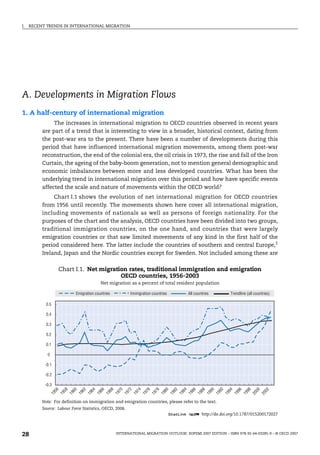
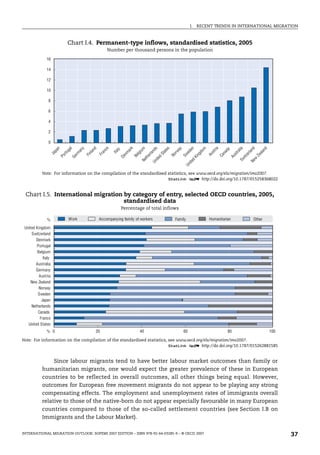
Chart I.1 shows the evolution of net international migration for OECD countries
from 1956 until recently. The movements shown here cover all international migration,
including movements of nationals as well as persons of foreign nationality. For the
purposes of the chart and the analysis, OECD countries have been divided into two groups,
traditional immigration countries, on the one hand, and countries that were largely
emigration countries or that saw limited movements of any kind in the first half of the
period considered here. The latter include the countries of southern and central Europe,1
Ireland, Japan and the Nordic countries except for Sweden. Not included among these are
Chart I.1. Net migration rates, traditional immigration and emigration
OECD countries, 1956-2003
Net migration as a percent of total resident population
Note: For definition on immigration and emigration countries, please refer to the text.
Source: Labour Force Statistics, OECD, 2006.
1 2 http://dx.doi.org/10.1787/015200172027
-0.3
-0.2
-0.1
0
0.1
0.2
0.3
0.4
0.5
1
9
5
6
1
9
5
8
1
9
6
0
1
9
6
2
1
9
6
4
1
9
6
6
1
9
6
8
1
9
7
0
1
9
7
2
1
9
7
4
1
9
7
6
1
9
7
8
1
9
8
0
1
9
8
2
1
9
8
4
1
9
8
6
1
9
8
8
1
9
9
0
1
9
9
2
1
9
9
4
1
9
9
6
1
9
9
8
2
0
0
0
2
0
0
2
Emigration countries Immigration countries All countries Trendline (all countries)
IM-Outlook07.fm Page 28 Thursday, June 7, 2007 4:53 PM
I. RECENT TRENDS IN INTERNATIONAL MIGRATION
INTERNATIONAL MIGRATION OUTLOOK: SOPEMI 2007 EDITION – ISBN 978-92-64-03285-9 – © OECD 2007 29
Korea, Mexico and Turkey, all of which would qualify as former or current emigration
countries but for which net migration data are sparse or non-existent. All other OECD
countries are categorised as immigration countries. Some of these, such as Germany, New
Zealand and the United Kingdom have seen significant outflows of nationals as well over
past decades, but they have been categorised here as immigration countries, because
priority has been accorded to immigration and these countries already had significant
immigrant populations in 1990 or earlier.
By definition, net migration within each country group is in principle zero, essentially
because in-migration from any country in the group to any other country of the same group
is cancelled out by the corresponding out-migration observed in the origin country. Thus
the net migration rates shown for each group represent the net effect of movements
between the group and the rest of the world. For the immigration country group, the net
migration rate reflects the impact of movements to and from the emigration country group
and the non-OECD world. Likewise, net migration within the all-country OECD group
represents the net effect of movements to and from countries outside the OECD. Note that
the absence of net migration data for Korea, Mexico and Turkey means that they are
statistically considered to be part of the non-OECD world for the purposes of this analysis.
The trend net international migration rate for current OECD countries (that is,
excluding Korea, Mexico and Turkey) was approximately 1 person per 1 000 persons in the
population from 1956 until about the oil crisis or somewhat thereafter. This was the period
of the so-called “guest workers”, but the OECD net migration rate seems to have been
relatively stable over this period, although with a number of peaks and troughs due to
particular events (see below). The stable net rate masks considerable movements that were
occurring within the OECD area, from “emigration” to “immigration” countries.
Since about the oil crisis, however, the net migration rate within the OECD has been
increasing, with international migration contributing more and more to population
growth, compared to natural increase (the excess of births over deaths) with each passing
year (see Chart I.2 for the situation as of 2004). The increases in international migration
during the nineties therefore would appear to be part of a broader underlying trend that
dates back to the late seventies and early eighties.
Over the period considered, net migration from outside the OECD to OECD countries
averaged 790 000 persons per year from 1956 to 1976, 1.24 million per year from 1977
to 1990 and 2.65 million per year thereafter up to 2003.
The net migration movements shown in Chart I.1 are also characterised by a number
of peaks and troughs, which generally correspond to well-defined historical events or
developments. The 1962 peak in the immigration countries series corresponds to the end
of the Algerian War and the massive return of French citizens from Algeria; the 1969-1971
hump to the height of the “guest workers” era; the late seventies and early eighties
increase to the migration of the boat-people; the late eighties and early nineties upswell to
the appearance for the first time in United States statistics of large unauthorised
movements from Mexico2
as well as the general increase in movements following the fall
of the Iron Curtain.3
Emigration countries show a steady increase over the period in the net migration rate
that is perturbed in the mid-seventies by a combination of three events and their
associated migration movements: the 1974 Portuguese revolution and the subsequent
independence of the Portuguese colonies; the end of the Greek military junta in 1974 and
IM-Outlook07.fm Page 29 Thursday, June 7, 2007 4:53 PM
I. RECENT TRENDS IN INTERNATIONAL MIGRATION
INTERNATIONAL MIGRATION OUTLOOK: SOPEMI 2007 EDITION – ISBN 978-92-64-03285-9 – © OECD 2007
30
the death of Franco in 1975. All of these were associated with significant returns of citizens
of the three countries concerned to their homeland, especially of Portuguese colonials.
Immigration countries appear to have actually undergone a decline in the net
migration rate from the mid-fifties to the first oil-crisis, which witnessed a reversal despite
the closing of borders to labour migration in many European countries. The general
increase among emigration countries over the 1956-2003 period has accelerated since the
turn of the century, to the point that the net migration rate of former emigration countries
now exceeds that of traditional immigration countries.
2. Population ageing, the working-age population and international migration
Over the next few years OECD countries will be beginning to feel, if they have not done
so already, the first consequences on the size of the working-age population of the fall in
birth rates following the baby-boom period. The impact this is likely to have on
international migration initially is as yet unclear, not only because there exist in every
country sources of unutilised labour supply that can be mobilised in response to demand
pressures, but also because entry and stay restrictions continue to exist in many countries
and despite high levels of unauthorised migration in some, migration policy continues to
have a significant impact on the magnitude of flows. Whether restrictive policies will and
can continue into the future in the present of persistent labour shortages, however remains
to be seen.
In 2005, the first cohort of baby-boomers born after World War II was entering its 60th
year. Some of these persons had already retired from the workforce before 2005 and more
have retired since then or will do so in the near future, to be followed by ever larger cohorts
over the next fifteen years. Over time these cohorts will be larger than those entering the
working-age population (15-64). In practice this means that without positive net migration,
the working-age population at some stage will begin to decline. However, this
Chart I.2. Components of population change, 2004,
per thousand persons in the population
Note: Data for Japan are for 2000.
Source: Labour Force Statistics, OECD, 2006.
1 2 http://dx.doi.org/10.1787/015231465384
-5
0
5
10
15
20
25
Net migration Natural increase
U
n
i
t
e
d
K
i
n
g
d
o
m
C
a
n
a
d
a
N
o
r
w
a
y
N
e
t
h
e
r
l
a
n
d
s
L
u
x
e
m
b
o
u
r
g
F
r
a
n
c
e
U
n
i
t
e
d
S
t
a
t
e
s
A
u
s
t
r
a
l
i
a
N
e
w
Z
e
a
l
a
n
d
I
c
e
l
a
n
d
I
r
e
l
a
n
d
T
u
r
k
e
y
H
u
n
g
a
r
y
G
e
r
m
a
n
y
C
z
e
c
h
R
e
p
u
b
l
i
c
P
o
l
a
n
d
I
t
a
l
y
S
l
o
v
a
k
R
e
p
u
b
l
i
c
A
u
s
t
r
i
a
P
o
r
t
u
g
a
l
J
a
p
a
n
S
w
e
d
e
n
D
e
n
m
a
r
k
S
w
i
t
z
e
r
l
a
n
d
F
i
n
l
a
n
d
IM-Outlook07.fm Page 30 Thursday, June 7, 2007 4:53 PM
I. RECENT TRENDS IN INTERNATIONAL MIGRATION
INTERNATIONAL MIGRATION OUTLOOK: SOPEMI 2007 EDITION – ISBN 978-92-64-03285-9 – © OECD 2007 31
phenomenon in itself cannot be considered a new and drastic change. OECD countries
have been witnessing declines in the growth rate of the working-age population over the
recent past and the crossing of the zero line does not introduce in itself anything
fundamentally new. It is rather the fact that this decline will be occurring in the presence
of continuing demand for goods and services, from both the growing number of retired
persons who will continue to consume, albeit at reduced levels because of lower retirement
incomes, and from the rest of the world. Satisfying this demand can be achieved in part
through increases in productivity or by outsourcing production to other countries but may
also require the recruitment of workers in certain sectors and occupations.
Chart I.3 shows the expected change in the working-age population, assuming zero
net migration of persons in this group, over five-year periods beginning in 2005, expressed
as a percentage of the working-age population in 2005. Note, first of all, that the size of the
working-age population for 2005 used in estimating change in the chart reflects the impact
of past migration, but that all estimated changes shown after that date reflect only the
ageing of persons already resident in the country. Thus the working-age population 15-64
for the year 2010 was estimated by taking the population 10-59 observed in 2005 and
ageing it five years under the assumption of no deaths and no net international migration.
Of course, there is and there will be migration of persons of working-age even in the
absence of labour migration, because of movements of persons arriving for family
reunification and formation and for asylum, as well as movements of persons under a free
circulation regime. But for most countries, these will be insufficient to compensate for the
expected decline.
For the period, 2005-2010, only Japan, Germany, Italy, Spain, Greece, Portugal and the
Czech Republic are expected to show a decrease or a marginal increase in the working-age
population with no net migration. For some of these countries, migration over the 1995
Chart I.3. Expected change in the working-age population assuming zero net
migration over the periods indicated, 2005-2020
As a percent of the 2005 population
Source: Eurostat, except for Belgium, Italy and non-European countries where data refer to the United Nations
Population Division.
1 2 http://dx.doi.org/10.1787/015240680655
2005-2010 2010-2015 2015-2020
-15
-10
-5
0
5
10
15
J
a
p
a
n
C
z
e
c
h
R
e
p
u
b
l
i
c
I
t
a
l
y
H
u
n
g
a
r
y
G
e
r
m
a
n
y
F
i
n
l
a
n
d
G
r
e
e
c
e
S
w
i
t
z
e
r
l
a
n
d
S
w
e
d
e
n
P
o
r
t
u
g
a
l
S
p
a
i
n
A
u
s
t
r
i
a
B
e
l
g
i
u
m
P
o
l
a
n
d
D
e
n
m
a
r
k
S
l
o
v
a
k
R
e
p
u
b
l
i
c
C
a
n
a
d
a
N
e
t
h
e
r
l
a
n
d
s
U
n
i
t
e
d
K
i
n
g
d
o
m
F
r
a
n
c
e
L
u
x
e
m
b
o
u
r
g
N
o
r
w
a
y
A
u
s
t
r
a
l
i
a
K
o
r
e
a
U
n
i
t
e
d
S
t
a
t
e
s
N
e
w
Z
e
a
l
a
n
d
I
r
e
l
a
n
d
I
c
e
l
a
n
d
IM-Outlook07.fm Page 31 Thursday, June 7, 2007 4:53 PM
I. RECENT TRENDS IN INTERNATIONAL MIGRATION
INTERNATIONAL MIGRATION OUTLOOK: SOPEMI 2007 EDITION – ISBN 978-92-64-03285-9 – © OECD 2007
32
to 2005 period has already compensated at least in part for what would have been large
declines or moderate increases in the working-age population over the 1995 to 2005 period.
For example, in 1995 the decline from 1995 to 2005 in the working-age population in
Germany was projected to be over 1.1 million, but as a result of international migration, the
decline was about 700 000. In Italy the expected decline was over 1.2 million, but the
working-age population actually declined by about 70 000 over the period. In Spain the
working-age population was expected to increase by about one half million from 1995-2005;
as a result of international migration, it actually increased by about 2.8 million in a period
of strong economic growth.
For Japan over the 2005-2010 period, the decline in the working-age population is
expected to be about 3%, for Germany and Italy over 1% and for the other countries shown,
close to zero. To offset these declines, if that were indeed a sensible objective, would
require a net migration of persons in the working-age population of about 500 000 per year
for Japan, 150 000 for Germany and 100 000 for Italy. Net migration levels, however, are
currently not zero and have been positive in most countries for some time.4
For the total
population in Japan, that is including children and older immigrants, for example, net
migration has exceeded 100 000 only once since the year 2000. In Germany, it has declined
strongly in recent years and is currently under 100 000. Italy, on the other hand, has seen
net migration levels increase from around 180 000 in the year 2000 to apparently more
than half a million in recent years.5
Situations thus differ considerably across countries and it is clear that demographic
evolutions by themselves have not up to now always asserted a strong draw on migration
flows, especially in the presence of migration policies which restrict possibilities for entry
and stay as well as under conditions of weak economic growth. However, in the countries
of southern Europe, where demographic ageing is more advanced than in many other
European countries, control of illegal employment is weaker and the underground
economy significant, employers have resorted to substantial hirings of unauthorised
immigrants over the past decade to fill their needs. Japan, on the other hand, is currently
undergoing a strong decline in its working-age population, without as yet a move in favour
of freeing up possibilities for entry. If unemployment rates continue to decrease, however,
pressures on wages may begin to operate, unless there is a significant mobilisation of
unused domestic labour supply or other compensating factors (for example, the transfer of
jobs overseas). There are indeed signs that participation rates in Japan are beginning to
increase, although whether this is just a cyclical phenomenon or will continue is not clear.
Over the 2010-2015 period, the decline in the current stock of the working-age
population will continue in the countries cited above, which will be joined by a further
group, including in particular Finland, Sweden, Hungary, Switzerland and Belgium. The
expected declines assuming zero net migration would average about 0.3 to 0.6% of the
working-age population per year over the period for these countries. By way of comparison,
actual net migration for the total population over the 2001-2005 period stood at about 0.3%
in Sweden and at almost 0.6% in Switzerland, but at less than 0.15% in the other three
countries (see Chart I.3). Thus some countries would appear to already be at immigration
levels that ensure maintenance of the working-age population at current levels, while
others would need to at least double or triple their current intake to achieve this objective.6
Finally between 2015 and 2020, all but six OECD countries can be expected to show
declines in the working-age population without positive net migration.7 Over the
IM-Outlook07.fm Page 32 Thursday, June 7, 2007 4:53 PM
I. RECENT TRENDS IN INTERNATIONAL MIGRATION
INTERNATIONAL MIGRATION OUTLOOK: SOPEMI 2007 EDITION – ISBN 978-92-64-03285-9 – © OECD 2007 33
entire 2005-2020 period, the declines in the working-age population for some countries are
expected to be as large as 5% or more and for many others in the vicinity of 3%, relative to
the working-age population in 2005.
The size of the working-age population, however, is not the only element at play with
respect to future labour force levels. A further issue is that of labour force participation. For
some countries such as Belgium or Spain, the participation rate of younger women
entering the workforce is significantly higher than those of older cohorts moving into
retirement and this additional participation can be expected to counteract in part the
effect of the decline in the cohort size. But in countries where women’s participation has
been high for some time, such as the Nordic countries, there is no countervailing effect and
the decline in cohort sizes can be expected to exert its full effect on the size of the workforce.
3. International migration in 2005
In this context international migration of both permanent and temporary immigrants
continued to increase in 2005. Overall, for the seventeen countries for which there exist
reasonably comparable data on “permanent-type” legal immigration for both 2004 and
2005 (see Box I.1), inflows increased by about 11% in 2005 relative to 2004, following a
relative increase of about 16% in 2004 (see Table I.1). Among countries for which national
statistics are still being used, there was an increase of about 10% between 2004 and 2005,
following a 25% increase in 2004, largely due to greater inflows in Spain.
The total additions to the legal permanent resident population amount to
approximately 3.5 to 4 million persons over all OECD countries. However, these figures are
incomplete because, with the exception of Spain, they only cover authorised movements
and for some countries, in particular Italy, do not include persons who received work and
residence permits under the 2002 regularisation procedure. Unauthorised migration for the
United States alone, for example, is estimated to have been on the order of approximately
620 000 persons per year over the 2000 to 2004 period (Hoefer et al., 2006). In Italy applications
for work permits in 2006 numbered 490 000 and based on past experience, a certain
proportion of these undoubtedly concerned unauthorised immigrants already working in
Italy who had entered in previous years. Table I.1 also does not include statistics for Greece,
which do not exist even for legal movements, not to mention the large unauthorised
movements which have characterised migration to that country over the last decade.
The largest increases in legal permanent-type immigration were observed in the
United States (+164 000), the United Kingdom (+55 000) and Italy (+31 000). In relative
terms, it was in the United Kingdom, Italy, and New Zealand that legal permanent-type
immigrants increased the most. There was relative stability, on the other hand, in the
magnitude of movements in France, Switzerland, Austria and Norway and a significant
decline in Portugal. For countries where national statistics are being used, Ireland and
Korea showed large increases in movements, as a result of developments related to EU
enlargement in Ireland and of the introduction of a work permit system for less skilled
migrants in Korea.
The extent of permanent-type immigration varies considerably, from less or close to
two per thousand population in Japan, Portugal, Germany and Finland to close to eight in
Australia and Canada, over ten in Switzerland and more than fourteen in New Zealand
(See Chart I.4). Except for Switzerland, these latter three countries all have an active
settlement migration policy with immigrants being selected on the basis of certain
IM-Outlook07.fm Page 33 Thursday, June 7, 2007 4:53 PM
I. RECENT TRENDS IN INTERNATIONAL MIGRATION
INTERNATIONAL MIGRATION OUTLOOK: SOPEMI 2007 EDITION – ISBN 978-92-64-03285-9 – © OECD 2007
34
Box I.1. Standardised statistics on immigrant inflows
This year, for the second time, the International Migration Outlook presents statistics on immigrant inflows
for a large number of OECD countries on the basis of a standardised definition. An immigrant, by this
definition, is a person of foreign nationality who enters the permanently resident population either from
outside the country or by changing from a temporary to a permanent status in the country. This has generally
been measured from statistics on residence permits by excluding situations in which a permit is granted that
is not renewable or only renewable on a limited basis. Often persons in these situations also do not have the
right to social security benefits. Persons arriving under a free movement regime with the intention of staying
for a long period are also counted as permanent immigrants, although admittedly in such cases, the
intentions of the persons concerned may not always be transparent.
More specifically, the categories of migrants that are not counted as “permanent immigrants” are generally
familiar ones and considered as temporary by destination countries, namely international students, trainees,
au pairs, seasonal and contract workers, persons on exchange programmes, in short any category of
immigrants which the receiving country expects will be returning to their home country following the end of
their stay authorization. Note that this does not preclude the possibility that an immigrant on a temporary
status applies for permanent-type status and thus enters the population of interest. Such movements in
general are not physical flows, however, but changes in status. They are, however, counted as permanent
immigrants in the statistics presented here, because they need to be counted somewhere, if they are not at the
actual time of entry.
Note that the definition given here does not correspond to the official international definition given in the
UN recommendations on international migration statistics (UN, 1998). The reason is that, thus far, few
countries have applied this definition and it is rarely possible to standardise publicly available national
immigration data on the basis of the international definition. There are initiatives currently under way to
encourage international data provision according to this definition, but progress on this front has been
exceedingly slow.
The rationale for the approach adopted here is that it seems possible currently to arrive at reasonably
comparable statistics on the basis of the concept of “permanent immigration” for a significant number of
countries. Essentially, almost all countries distinguish between movements of persons who are expected to
return to their home country after a limited stay and those who will be staying in the host country for the
longer term. Immigration permit systems do not necessarily make this an easy matter to determine, however,
because in many countries, especially in Europe, even permanent-type immigrants receive permits of limited
duration upon entry, sometimes as short as one year. Indeed, certain forms of temporary migration, for
example international study, may provide for permits of duration comparable to those given to “permanent”
immigrants.
Because migration regulations and permit durations tend to differ from country to country, even for the
same category of migration, a definition of a “permanent migrant” on the basis of an easily applicable
objective criterion such as a duration is not possible. Still, the notion of “permanent migration” is one which is
broadly understood and meaningful and it is clearly of interest to know how many persons in a given year are
being admitted “for good”, even in practice a certain fraction of these may eventually change their minds and
leave the country or may not satisfy the conditions for a renewal of their permit.
The measures of immigrant inflows according to this definition generally differ from usual national
statistics, essentially because they tend to exclude certain shorter term movements that are counted as
immigration in many national data sources. These may include, in particular, international students and
trainees and even contract or seasonal workers in some countries where persons entering even for relatively
short periods are counted as immigrants. This is not to imply that national statistics are in any sense
“incorrect” or “biased”: they are simply based on a different definition, the rationale for which is equally
defendable. Internationally comparable statistics require that a choice be made and inevitably, that choice will
not always coincide with that made nationally for some countries.
IM-Outlook07.fm Page 34 Thursday, June 7, 2007 4:53 PM
I. RECENT TRENDS IN INTERNATIONAL MIGRATION
INTERNATIONAL MIGRATION OUTLOOK: SOPEMI 2007 EDITION – ISBN 978-92-64-03285-9 – © OECD 2007 35
characteristics (age, educational attainment, work experience, etc.) which are awarded
points, with candidates having more than a threshold value being invited to immigrate.
Switzerland, by contrast, has signed a free circulation agreement with the European Union,
which was implemented in 2004. It now exercises no discretionary authority with respect
to immigrants from the European Union (with the temporary exception of citizens of the
new accession states), and now receives most of its labour migrants, both low- and high-
skilled from the European Union. The chart does not include several significant
immigration countries over the past decade, namely, Greece, Ireland and Spain, because
statistics of legal immigration on a standardised basis are not yet available for these
countries.
Family migration continues to dominate among the inflows of permanent-type
immigrants (see Chart I.5) in 2005. This consists of family reunification and family
formation (marriage), as well as the accompanying family of immigrant workers. Family
migration represents as little as one third of all permanent-type migration in Japan and the
United Kingdom but as high as 70% in the United States, whose migration regime is heavily
Box I.1. Standardised statistics on immigrant inflows (cont.)
In this chapter, the statistics on inflows by nationality continue to make use of official national data,
because statistics by nationality on the basis of a standardized definition do not yet exist.
For the sake of comparison, the Table below presents the statistics based on the standardised definition
and those commonly used at the national level.
Inflows of foreign nationals in selected OECD countries, 2005
Standardised and official statistics
Standardised flows 2005
Usually published
statistics 2005
Difference
Percent difference relative to
usually published statistics
Japan 81 300 372 300 –291 000 –78
Germany 198 600 579 300 –380 700 –66
Belgium 35 900 77 400 –41 500 –54
Portugal 13 300 28 100 –14 800 –53
Austria 56 800 101 500 –44 700 –44
United Kingdom 362 400 473 800 –111 400 –24
Norway 25 800 31 400 –5 600 –18
Switzerland 78 800 94 400 –15 600 –17
Netherlands 60 700 63 400 –2 700 –4
Canada 262 200 262 200 0 0
Finland 12 700 12 700 0 0
United States 1 122 400 1 122 400 0 0
Sweden 53 800 51 300 2 500 5
Australia 179 800 167 300 12 500 7
New Zealand 59 400 54 100 5 300 10
France 168 600 134 800 33 800 25
Italy 184 300 n.a. n.a. n.a.
Denmark 18 000 n.a. n.a. n.a.
Total (less Denmark and Italy) 2 772 500 3 626 400 –853 900 –24
“n.a.” means not available.
Source: For information on the compilation of the standardised statistics, see www.oecd.org/els/migration/imo2007.
1 2 http://dx.doi.org/10.1787/022288760708
IM-Outlook07.fm Page 35 Thursday, June 7, 2007 4:53 PM
I. RECENT TRENDS IN INTERNATIONAL MIGRATION
INTERNATIONAL MIGRATION OUTLOOK: SOPEMI 2007 EDITION – ISBN 978-92-64-03285-9 – © OECD 2007
36
family-based. In general, however, it accounts for between 45 and 60% of all permanent-
type migration in most countries.
Many European countries, among them Austria, Belgium, Denmark, Germany,
Portugal, Sweden and the United Kingdom, appear as important labour migration
countries, with some 30 to 40% of permanent-type immigrants arriving for work-related
reasons. This is larger than the percentages of labour migrants from some pro-active
migration countries such as Canada and New Zealand. However, from half to three
quarters of labour migration in many European countries consists of the free movement of
citizens of the European Union. The proportion would be even higher if one were to include
longer term movements of persons from the new accession countries, whose movements
are not entirely unrestricted in many EU countries. Labour immigration from the rest of the
world tends to be limited in EU countries except in the countries of southern Europe.
Table I.1. Inflows of foreign nationals, 2003-2005
Permanent-type migration (standardised statistics)
2003 2004 2005 2004-2005 Per cent change
Portugal 12 900 15 900 13 300 –2 500 –16
Germany 221 900 212 400 198 600 –13 800 –6
France 168 900 173 900 168 600 –5 200 –3
Switzerland 79 700 80 700 78 800 –2 000 –2
Austria 51 900 57 100 56 800 –300 –1
Norway n.a. 24 900 25 800 900 4
Netherlands 60 800 57 000 60 700 3 800 7
Australia 150 000 167 300 179 800 12 500 7
Japan 72 100 75 300 81 300 6 000 8
Sweden 47 900 49 100 53 800 4 700 10
Denmark 17 400 16 400 18 000 1 700 10
Finland 9 400 11 500 12 700 1 200 10
Canada 221 400 235 800 262 200 26 400 11
United States 703 500 957 900 1 122 400 164 500 17
United Kingdom 258 200 307 300 362 400 55 100 18
Italy 120 100 153 100 184 300 31 200 20
New Zealand 48 400 41 600 59 400 17 700 43
Belgium n.a. n.a. 35 900 n.a. –
Total (less Belgium and Norway) 2 244 500 2 614 300 2 915 100 300 800 12
Total (less Belgium) – 2 637 200 2 938 900 301 700 11
Inflows according to national definitions (usually published statistics)
2003 2004 2005 2004-2005 Per cent change
Turkey 152 200 155 500 131 600 –23 900 –15
Hungary 19 400 22 200 18 800 –3 400 –15
Slovak Republic 4 600 7 900 7 700 –300 –4
Poland 30 300 36 800 38 500 1 700 5
Spain 429 500 645 800 682 700 36 900 6
Luxembourg 11 500 12 500 13 500 1 000 8
Czech Republic 57 400 50 800 58 600 7 800 15
Korea 178 300 188 800 266 300 77 400 41
Ireland 33 000 33 200 51 000 17 800 54
Total 916 200 1 153 500 1 268 700 115 000 10
Note: Estimates exclude unauthorised migration (except for Spain) and large-scale regularisations.
Source: For information on the compilation of the standardised statistics, see www.oecd.org/els/migration/imo2007.
1 2 http://dx.doi.org/10.1787/022360657748
IM-Outlook07.fm Page 36 Thursday, June 7, 2007 4:53 PM
I. RECENT TRENDS IN INTERNATIONAL MIGRATION
INTERNATIONAL MIGRATION OUTLOOK: SOPEMI 2007 EDITION – ISBN 978-92-64-03285-9 – © OECD 2007 37
Since labour migrants tend to have better labour market outcomes than family or
humanitarian migrants, one would expect the greater prevalence of these in European
countries to be reflected in overall outcomes, all other things being equal. However,
outcomes for European free movement migrants do not appear to be playing any strong
compensating effects. The employment and unemployment rates of immigrants overall
relative to those of the native-born do not appear especially favourable in many European
countries compared to those of the so-called settlement countries (see Section I.B on
Immigrants and the Labour Market).
Chart I.4. Permanent-type inflows, standardised statistics, 2005
Number per thousand persons in the population
Note: For information on the compilation of the standardised statistics, see www.oecd.org/els/migration/imo2007.
1 2 http://dx.doi.org/10.1787/015258368022
0
2
4
6
8
10
12
14
16
J
a
p
a
n
P
o
r
t
u
g
a
l
G
e
r
m
a
n
y
F
i
n
l
a
n
d
F
r
a
n
c
e
I
t
a
l
y
D
e
n
m
a
r
k
B
e
l
g
i
u
m
N
e
t
h
e
r
l
a
n
d
s
U
n
i
t
e
d
S
t
a
t
e
s
N
o
r
w
a
y
S
w
e
d
e
n
U
n
i
t
e
d
K
i
n
g
d
o
m
A
u
s
t
r
i
a
C
a
n
a
d
a
A
u
s
t
r
a
l
i
a
S
w
i
t
z
e
r
l
a
n
d
N
e
w
Z
e
a
l
a
n
d
Chart I.5. International migration by category of entry, selected OECD countries, 2005,
standardised data
Percentage of total inflows
Note: For information on the compilation of the standardised statistics, see www.oecd.org/els/migration/imo2007.
1 2 http://dx.doi.org/10.1787/015262881585
%
0 20 40 60 80 100
%
United States
France
Canada
Netherlands
Japan
Sweden
Norway
New Zealand
Austria
Germany
Australia
Italy
Belgium
Portugal
Denmark
Switzerland
United Kingdom
Work Accompanying family of workers Family Humanitarian Other
IM-Outlook07.fm Page 37 Thursday, June 7, 2007 4:53 PM
I. RECENT TRENDS IN INTERNATIONAL MIGRATION
INTERNATIONAL MIGRATION OUTLOOK: SOPEMI 2007 EDITION – ISBN 978-92-64-03285-9 – © OECD 2007
38
Humanitarian migration (resettled refugees and asylum seekers recognised as refugees)
accounts for between 15 and 20% of total movements in the United Kingdom, Norway, Sweden
and Canada and almost 30% in the Netherlands. Elsewhere it is less important. Ethnic-based
migration remains important in Japan and Germany (it appears under “other”) and retirees and
other persons of independent means in France and Portugal.
4. Regional aspects of international migration towards OECD countries
In 2005, the major origin countries of migration remained relatively stable, with
geographical proximity still a major determinant in the choice of destination country in
both OECD European countries and in those outside Europe.
A change in origin countries is nevertheless evident in Europe, where movements
have been largely influenced by the increase in flows from eastern European countries as a
consequence of the enlargement of the European Union or upcoming membership in the
case of Bulgaria and Romania. Poland and Romania became by far the two main origin
countries in 2005, even if they were already in the top 10 in 2000 (see Table I.2). The United
Kingdom, Germany, Italy, Ireland and Austria were the main destination countries for
Polish citizens (see next section).
Table I.2. Top 10 source countries for immigration, 2000 and 2005
OECD Europe
Thousands
2000 2005
Morocco 96 Poland 324
Ecuador 95 Romania 202
Poland 94 Morocco 128
Bulgaria 81 Bulgaria 82
Turkey 79 Germany 77
Romania 76 Ukraine 70
United States 64 Turkey 66
Germany 61 United Kingdom 65
France 60 Russian Federation 54
Italy 56 France 49
OECD outside of Europe
Thousands
2000 2005
China 238 China 297
Mexico 175 Mexico 164
Philippines 145 Philippines 158
India 78 India 134
Korea 49 United Kingdom 69
United States 47 Korea 57
Brazil 46 United States 53
United Kingdom 43 Viet Nam 52
Viet Nam 42 Russian Federation 39
Russian Federation 35 Cuba 36
Note: Data are not standardised and statistics for some countries may include many short-term flows. Data refer to
the year 2003 for Korea and to 2004 for Denmark and Italy.
Source: See Table A1.1 in the Statistical Annex.
1 2 http://dx.doi.org/10.1787/022377568357
IM-Outlook07.fm Page 38 Thursday, June 7, 2007 4:53 PM
I. RECENT TRENDS IN INTERNATIONAL MIGRATION
INTERNATIONAL MIGRATION OUTLOOK: SOPEMI 2007 EDITION – ISBN 978-92-64-03285-9 – © OECD 2007 39
Flows from Romania are highly concentred in Europe with 90% of movements towards
three destination countries, namely Spain, Italy and Germany.
The United Kingdom, Ukraine and the Russian Federation figure among the top
10 origin countries in 2005. A large part of the flows from the United Kingdom are towards
Spain and consist largely of retirees. Ukraine and the Russian Federation have appeared
since the beginning of 2000 as major source countries for the Czech Republic, Germany but
also for Italy and Spain.
Outside of Europe, in North America, Oceania, Japan and Korea, the top source
countries were relatively stable with only one replacement (Brazil by Cuba) between 2000
and 2005. Migrants from Asia are still dominant, with a significant growth in those from
India and China.
The United Kingdom is an exception to the rule of geographic proximity in the choice
of destination country as its outflows are equally distributed between European and non-
European OECD countries.
Chart I.6. illustrates for selected OECD countries the relative frequency of migration
flows by country of origin, contrasting average inflows (dotted lines) over the 1990-2004
period with those (in blue) observed in 2005. For example, although Mexico continues to be
the leading source country of immigration for the United States, the share of Mexicans in
overall authorised flows has fallen from an average of 25% between 1990 and 2004 to less
than 15% in 2005. Origin countries for legal migration have thus become more diverse in
the United States.
Inflows from eastern Europe increased in 2005 following the enlargement of the
European Union, with Poland being by far the top source country. Poland shows an increase
in the share of inflows in 2005 compared to 1990-2004 for most of OECD countries, the
change among countries shown in the chart being particularly large in Germany (from
13 to 26% in 2005), in the Netherlands and Norway (from 2 to 9 and 10%, respectively) and
in Belgium and Sweden (from 2.5 to 6 and 7%, respectively).
High-growth Asian countries saw a further increase in their share of inflows in most
OECD countries in 2005. With the increase in levels of education among young Asian
adults, this trend is likely to continue in coming years.
Two countries are particularly prominent in the flows, namely China and India.
Chinese inflows among the total entries in Canada increased from 10% for the average
1990-2004 to 16% in 2005, from 21 to 28% in Japan, and from 3 to 7% among total inflows for
the United Kingdom (see Chart I.6). Migration from India increased as well in 2005 and
accounted for almost 8% of total inflows in Australia compared to 5% for the period
1990-2004, for 13% in Canada compared to 8% previously, and for 8% in the United States
compared to 5% previously.
Within European OECD countries, the situation is varied and origin countries are
diverse. Movements depend, among other factors, on geography, linguistic proximity and
historical links (see Chart I.6).
IM-Outlook07.fm Page 39 Thursday, June 7, 2007 4:53 PM
I. RECENT TRENDS IN INTERNATIONAL MIGRATION
INTERNATIONAL MIGRATION OUTLOOK: SOPEMI 2007 EDITION – ISBN 978-92-64-03285-9 – © OECD 2007
40
5. Recent trends in migration from new European Union members
Central and eastern Europe countries are traditional emigration countries and this
characteristic was intensified by the inclusion of these countries in the European Union in
May 2004. Ireland, Sweden and the United Kingdom, allowed workers from the new
accession countries immediate access to their labour market and in the summer of 2006,
Greece, Portugal, Finland and Spain also decided to open their labour market to the ten
accession countries (see Section I.C on Migration Policies).
Ireland showed an increase of 50% in entries of foreign nationals, which reached
51 000 persons in 2005. This was largely attributable to citizens from the new EU108
Chart I.6. Inflows of migrants by country of origin, selected OECD countries,
1990-2004 and 2005
2005 top ten countries of origin as percentage of total inflows
1 2 http://dx.doi.org/10.1787/015267228642
0 5 10 15 20 25
62.6 58.9
84.8 85.6
0 5 10 15 20
62.6 61.3
0 5 10 15 20
46.3 33.0
0 5 10 15 20
55.1 40.7
86.3 76.4
0 5 10 15 20
56.6 48.4 77.9 78.5
55.7 49.6
0 10 20 30 40
0 10 20 30 40
0 5 10 15 20 25 30
0 10 20 30 40 50 60 0 5 10 15 20 25 30
77.8 78.6
0
47.5 42.1 78.1 65.8
0
0 5 10 15 20 25 30 35 40 5 10 15 5 10 15 20 25 30 35
Germany
Serbia and Montenegro
Turkey
Poland
Romania
Bosnia and Herzegovina
Slovak Republic
Hungary
Croatia
Italy
France
Netherland
Morocco
Poland
Turkey
Germany
Italy
United States
Romania
United Kingdom
China
India
Philippines
Pakistan
United States
Colombia
United Kingdom
Korea
Iran
France
1990-2004 annual average 2005
Austria
Czech Republic
Belgium
Denmark (2004)
Canada
Romania
Ukraine
Serbia and Montenegro
China
Germany
Slovak Republic
United States
Viet Nam
United Kingdom
France
Romania
Albania
Morocco
Poland
Ukraine
China
United States
Brazil
Serbia and Montenegro
Tunisia
China
Philippines
Brazil
Korea
United States
Indonesia
Thailand
Viet Nam
United Kingdom
Russian Federation
Hungary Italy (2004) Japan
China
United States
Russian Federation
Philippines
Indonesia
Japan
Thailand
Uzbekistan
Viet Nam
Canada
Germany
Poland
United Kingdom
Turkey
China
United States
Morocco
France
Belgium
Italy
United Kingdom
China
South Africa
India
Samoa
Fiji
United States
Korea
Tonga
Philippines
Korea (2003) Netherlands New Zealand
Germany
Ukraine
Slovak Republic
Viet Nam
Russian Federation
Moldova
Germany
United States
Poland
Mongolia
Bulgaria
China
Norway
Iceland
Germany
Sweden
Poland
United Kingdom
United States
Ukraine
Lithuania
Poland
Turkey
Romania
Russian Federation
Hungary
Italy
Serbia and Montenegro
United States
France
Ukraine
Share
of total
for top 10
countries
IM-Outlook07.fm Page 40 Thursday, June 7, 2007 4:53 PM
I. RECENT TRENDS IN INTERNATIONAL MIGRATION
INTERNATIONAL MIGRATION OUTLOOK: SOPEMI 2007 EDITION – ISBN 978-92-64-03285-9 – © OECD 2007 41
countries (26 400 persons, of which most of were Polish citizens). The United Kingdom is
the country which has seen the largest increase in movements (see Box I.2).
Among the Nordic countries, Sweden showed a large increase in new EU8 country
arrivals. In 2005, inflows from these countries increased by almost 30% compared to the
previous year and rose further while remaining modest at 8 900 persons in 2006 (of which
three quarters were Polish citizens).
Between 2004 and 2005, Norway showed an increase of 80% in inflows of EU8 citizens
to 4 700 persons and Iceland granted 2 800 works permits to EU8 citizens. Note that these
movements do not include shorter-term movements, for example for seasonal work.
Polish citizens dominate in the flows, in particular in Iceland, Sweden and Norway,
whereas in Finland the main origin country is Estonia. Denmark has approximately equal
Chart I.6. Inflows of migrants by country of origin, selected OECD countries,
1990-2004 and 2005 (cont.)
2005 top ten countries of origin as percentage of total inflows
Note: The top 10 source countries are presented in decreasing order of the number of immigrants in 2005. Data for Canada, New Zealand
and the United States refer to inflows of permanent settlers by country of birth, for Italy and Portugal to issues of certain types of
permits. For the United Kingdom, the data are from the International Passenger Survey. For all other countries, figures are from
Population registers or Registers of foreigners. The figures for the Netherlands, Norway and especially Germany include substantial
numbers of asylum seekers. Annual average flows for the period 1990-2004 except for Austria, Poland, Spain (1998-2005), Italy (1998-
2002), Portugal (2001-2004), the Slovak Republic (2003-2004), the United Kingdom (1990-2000) and Korea (2000-2002).
Sources: National Statistical Offices. For details on definitions and sources, refer to the metadata relative to Tables B.1.1. of the Statistical
Annex.
1 2 http://dx.doi.org/10.1787/015267228642
50.9 46.0
66.5 62.8
70.5 64.5
52.1 49.4
77.3 78.4
64.8 56.7 59.8 49.9 48.9 54.6
46.6 40.0
0 5 10 15 0 5 10 15 20 25 30 0 5 10 15 20 25 30 35
0 5 10 15 20 0 5 10 15 20 0 5 10 15
0 5 10 15 20 25 0 5 10 15 0 5 10 15 20 25 30
Poland
Sweden
Germany
Denmark
Iraq
Russian Federation
Thailand
Somalia
United Kingdom
Philippines
Ukraine
Germany
Belarus
Viet Nam
Russian Federation
Armenia
France
United Kingdom
United States
India
Brazil
Cape Verde
Moldova
Ukraine
Angola
Guinea-Bissau
United Kingdom
Romania
Sao Tome and Principe
Russian Federation
1990-2004 annual average 2005
Norway
Slovak Republic
Poland
Spain
Portugal
Germany
Portugal
France
Italy
Serbia and Montenegro
United Kingdom
United States
Turkey
Austria
Spain
Australia
China
France
Germany
India
South Africa
United States
Philippines
New Zealand
Pakistan
Mexico
India
China
Philippines
Cuba
Viet Nam
Dominican Republic
Korea
Colombia
Ukraine
Switzerland United Kingdom (2001) United States
Sweden
Czech Republic
Germany
Ukraine
Poland
Austria
Hungary
Korea
France
United States
Russian Federation
Romania
Morocco
United Kingdom
Bolivia
Argentina
Brazil
Colombia
Peru
Bulgaria
China
Denmark
Poland
Iraq
Finland
Norway
Thailand
Germany
China
Somalia
Turkey
IM-Outlook07.fm Page 41 Thursday, June 7, 2007 4:53 PM
I. RECENT TRENDS IN INTERNATIONAL MIGRATION
INTERNATIONAL MIGRATION OUTLOOK: SOPEMI 2007 EDITION – ISBN 978-92-64-03285-9 – © OECD 2007
42
Box I.2. United Kingdom: Who are the new immigrants
from the A8 countries?
Nationals from A8 countries who wish to take up employment in the United Kingdom
for a period of at least a month are generally required to register with the Worker
Registration Scheme. Workers who are self-employed do not need to register and are
therefore not included in Worker Registration Scheme data. In addition, there is no de-
registration requirement, so people who work for a short time and then return to their
country would be counted in the statistics in the same way as people who intend to stay
on a long-term basis.
According to the Worker Registration Scheme data, most of the nationals from A8 countries
came to the United Kingdom to work for more than 16 hours a week and the vast majority
of workers were young people (82% aged between 18 and 34 years old). Men accounted for
nearly 60% of the workers. Most of them (94%) stated that they had no dependents living
with them in the United Kingdom when they registered. Nationals from the A8 countries
came to work in the United Kingdom mainly as process operatives (that is, factory
workers), warehouse operatives, packers, kitchen or catering assistants, as well as
agricultural workers.
The Table shows the number of applicants approved (including dependents) by
nationality since the enlargement on the European Union as well as the cumulative
inflows since enlargement as a percentage of the population of the origin country. In 2006,
more than 70% of A8 emigrants came from Poland. However, inflows from Lithuania to the
United Kingdom were much larger in relative terms and represented 1.7% of the total
population of Lithuania (and an even larger share of its labour force). This is a high
proportion, especially since it is heavily concentrated among the young.
Immigration from the new EU accession countries
to the United Kingdom
Nationality of approved applicants
2004 2005 2006
Cumulative inflows as a
percentage of the origin
population (%)
Czech Republic 8 255 10 570 8 185 0.26
Estonia 1 860 2 560 1 460 0.44
Hungary 3 620 6 355 6 950 0.17
Latvia 8 670 12 960 9 380 1.35
Lithuania 19 270 22 985 16 810 1.74
Poland 71 025 127 320 159 855 0.94
Slovak Republic 13 020 22 035 21 370 1.05
Slovenia 160 170 180 0.03
Total 125 880 204 955 224 195 0.76
Note: Data refer to approved applicants rather than the total number of applications made. The figures refer
to initial applications only (not multiple applications, i.e. an individual doing more than one job
simultaneously, or re-registrations, i.e. cases in which an individual has changed employers). Data for 2004
refer to the period of May to December.
Source: Home Office, Accession and monitoring report, May 2004-December 2006.
1 2 http://dx.doi.org/10.1787/022338417860
IM-Outlook07.fm Page 42 Thursday, June 7, 2007 4:53 PM
I. RECENT TRENDS IN INTERNATIONAL MIGRATION
INTERNATIONAL MIGRATION OUTLOOK: SOPEMI 2007 EDITION – ISBN 978-92-64-03285-9 – © OECD 2007 43
numbers of arrivals from the Baltic countries and from Poland. As in other European
countries, these new EU member country migrants are mainly workers.
Chart I.7 shows inflows from the 8 new EU members of the European Union into OECD
countries for which data were available. In order to better show data for other countries,
Poland is presented on the right scale.
Chart I.7. Migration from new EU member countries to selected OECD countries, 1998-2005
Thousands
Sources: National Statistical Offices. For details on definitions and sources, refer to the metadata relative to Tables B.1.1. of the
Statistical Annex.
1 2 http://dx.doi.org/10.1787/015140410036
0
1
2
3
4
5
6
7
8
1998 1999 2000 2001 2002 2003 2004 2005
0
20
40
60
80
100
120
140
160
0
5
10
15
20
25
1998 1999 2000 2001 2002 2003 2004 2005
0
0.2
0.4
0.6
0.8
1.0
2000 2001 2002 2003 2004 2005
0
1
2
3
4
5
6
0
1
2
3
4
5
6
7
8
0
1
2
3
1998 1999 2000 2001 2002 2003 2004 2005
0
1
2
3
4
5
6
1998 1999 2000 2001 2002 2003 2004 2005
0
1
2
3
4
1998 1999 2000 2001 2002 2003 2004 2005
0
1
2
3
4
1998 1999 2000 2001 2002 2003 2004 2005
Austria Germany
Netherlands Spain
Belgium
Sweden
Norway
Latvia
Poland
Poland
Poland
Poland
Poland (right scale)
Hungary
Slovenia
Czech Republic
Slovak Republic
Hungary
Poland (right scale)
Slovenia
Czech Republic
Hungary
Lithuania
Poland (right scale)
Czech Republic
Slovak Republic
Hungary
Estonia
Czech Republic
Slovak Republic
Lithuania
IM-Outlook07.fm Page 43 Thursday, June 7, 2007 4:53 PM
I. RECENT TRENDS IN INTERNATIONAL MIGRATION
INTERNATIONAL MIGRATION OUTLOOK: SOPEMI 2007 EDITION – ISBN 978-92-64-03285-9 – © OECD 2007
44
These flows also include significant number of persons coming for short periods and
returning thereafter to their countries of origin. In Austria for example, of permits granted
to EU8 nationals in 2004, about 87% were issued for less than 6 months, and a similar
situation was observed in 2005. In Italy 71% of the authorisations for work permits for
A8 citizens were given to seasonal workers in 2005, proportions similar to those in France.
The increase in inflows from new EU members countries concerns not only countries
which allowed them free access to their labour market but also other countries as well,
among them Belgium, Norway, the Netherlands and Germany.
6. Indian and Chinese immigrants in OECD countries
At the time of the 2000 round of censuses, about 2 million migrants (aged 15 and
above) from China and a roughly equal number of migrants from India lived in OECD
countries. Immigrants from these two countries accounted for about 5.5% of immigrants in
OECD countries at that time.
Chart I.8 illustrates the share of Chinese and Indian citizens in the stock of foreigners
(blue bars) as well as their share in total inflows in 2005 (pink diamond). Note that the
relative frequency of Chinese and Indians is higher in the flows than in the stocks of most
OECD countries. This illustrates the recent increasing migration from these two countries.
In the traditional settlement countries (Canada, Australia, the United States and New
Zealand), immigration from China and India accounts for a significant and growing part of
overall immigration. In Canada, China and India have been by far the most important origin
countries of immigration in the past decade. In the United States and Australia, China and
India are now the second and third most important origin countries of immigration (after
Mexico in the United States and after the United Kingdom and New Zealand in Australia). In
Japan, immigrants from China account for almost one-fourth of new arrivals.
Despite some increase in recent years, immigration from China and India to Europe
still accounts for a relatively small part of overall immigration into the region, except for
the United Kingdom where strong historical links exist.
A particular characteristic of Chinese and Indian immigrants is the fact that they are
relatively highly educated. This is especially the case of Indians, who are among the most
qualified immigrants in the OECD, with more than half of Indian immigrants having at
least tertiary education (according to the OECD Database on the Foreign-born and Expatriates).
For example in the United Kingdom in 2005, India was the first nationality of applications
approved among the Highly Skilled Migrant Programme, followed by Pakistan, and accounted
for 40% of all approvals (with 6 716 persons). In Australia, Chinese and Indians accounted
for about 30% of the General Skilled Migration Programme in 2005.
Chinese and Indians also account for an important part of foreign students studying
abroad. China is the top origin country of foreign students in OECD countries (more than
15%). India is the second most important origin country (6%). Chinese and Indian foreign
students are particularly present in Australia, the United States, Japan, Korea, New Zealand
and the United Kingdom.
There are also significant populations of Indian emigrants in non-OECD countries,
notably in the Persian Gulf region. The same is true for the Chinese, most recently
in some African countries, accompanying the important flows of investment funds and the
execution of large infrastructure projects. The new airport in Algiers, for example, was
built by Chinese contractors.
IM-Outlook07.fm Page 44 Thursday, June 7, 2007 4:53 PM
I. RECENT TRENDS IN INTERNATIONAL MIGRATION
INTERNATIONAL MIGRATION OUTLOOK: SOPEMI 2007 EDITION – ISBN 978-92-64-03285-9 – © OECD 2007 45
7. Africa and international migration
African migration to developed countries is marginal in relation to overall flows.
Movements from sub-Saharan Africa are mostly intra-regional in character. The West
African region is one of high mobility particularly, as exemplified by movements from Guinea
to Senegal, from Ghana and Niger to Nigeria, and from Burkina and Mali to Côte d’Ivoire (these
latter movements have slowed recently due to the political crisis in Côte d’Ivoire). Some
countries such as Senegal or Mauritania are becoming transit regions for migration
Chart I.8. Indian and Chinese immigrants in selected OECD countries in 2005
Percentage of stock of foreigners and percentage of total inflows of foreigners
Note: Data refer to the foreign-born population for Australia, Canada (2001), France (1999), New Zealand (2001) and
United States. Data refer to the year 2001 for United Kingdom, 2002 for Poland, 2003 for Korea, and 2004 for Denmark
and Italy.
Source: OECD database on International Migration.
1 2 http://dx.doi.org/10.1787/015168874183
0
2
4
6
8
10
12
14
16
0
5
10
15
20
25
30
35
%
%
Indian immigrants
U
n
i
t
e
d
K
i
n
g
d
o
m
I
t
a
l
y
P
o
r
t
u
g
a
l
S
w
e
d
e
n
D
e
n
m
a
r
k
N
e
t
h
e
r
l
a
n
d
s
B
e
l
g
i
u
m
P
o
l
a
n
d
S
p
a
i
n
C
a
n
a
d
a
U
n
i
t
e
d
S
t
a
t
e
s
N
e
w
Z
e
a
l
a
n
d
A
u
s
t
r
a
l
i
a
F
r
a
n
c
e
% of stock of foreigners % of total inflows of foreigners
Chinese immigrants
% of stock of foreigners % of total inflows of foreigners
J
a
p
a
n
K
o
r
e
a
H
u
n
g
a
r
y
I
t
a
l
y
S
p
a
i
n
F
i
n
l
a
n
d
D
e
n
m
a
r
k
P
o
r
t
u
g
a
l
N
e
t
h
e
r
l
a
n
d
s
S
w
e
d
e
n
C
z
e
c
h
R
e
p
u
b
l
i
c
U
n
i
t
e
d
K
i
n
g
d
o
m
N
o
r
w
a
y
B
e
l
g
i
u
m
P
o
l
a
n
d
C
a
n
a
d
a
N
e
w
Z
e
a
l
a
n
d
A
u
s
t
r
a
l
i
a
U
n
i
t
e
d
S
t
a
t
e
s
F
r
a
n
c
e
IM-Outlook07.fm Page 45 Thursday, June 7, 2007 4:53 PM
I. RECENT TRENDS IN INTERNATIONAL MIGRATION
INTERNATIONAL MIGRATION OUTLOOK: SOPEMI 2007 EDITION – ISBN 978-92-64-03285-9 – © OECD 2007
46
towards Europe or America. The transit migrants are mainly workers, refugees and persons
displaced by conflicts or climatic crises. By contrast with West Africa, migration toward
developed countries is more significant in North Africa than are intraregional movements.
Recent African migration flows towards OECD countries
Migration from Africa to OECD countries concerns mostly European countries due to
historical links and geographic proximity. In Europe, North African migration is more
frequent than migration from sub-Saharan Africa in general. Among countries for which
African inflows are significant, flows from Maghreb countries are higher than those from
sub-Saharan Africa in France, Belgium, Spain, Italy and the Netherlands, whereas the
opposite is true for the United Kingdom and Portugal. This is related to movements from
former British and Portuguese colonies.
Traditional migration flows such as those from Senegal, Mali and Côte d’Ivoire to
France, from Nigeria and Ghana to the United Kingdom, and from Angola and Cape Verde
to Portugal have remained stable in recent years. Destination countries for African
migration have begun to diversify, however, and southern European countries have become
an attractive destination as a result of their geographical location and employment
opportunities. Thus flows from Senegal and Nigeria to Spain increased on average by about
25 and 15% per year, respectively for the past five years to reach 5 700 and 5 300 persons
in 2005. To a lesser extent migration from Senegal increased in Italy as well.
Africans also emigrate to North America, especially those from English-speaking
countries like Nigeria, Ghana and Kenya. In United States, the number of persons from
Africa obtaining legal permanent resident status increased by 30% in 2005 to reach 85 000.
Among Maghreb countries, Morocco is by far the most important origin country in
Europe, especially in Spain where inflows have increased for several years to reach 70 000
Chart I.9. Share of immigrants born in Africa in the foreign-born population
in OECD countries, Circa 2000
Note: OECD27 refers to countries mentioned in the chart.
Source: OECD database on Foreign-born and Expatriates; for more information, please refer to www.oecd.org/els/
migration/censusdatabase.
1 2 http://dx.doi.org/10.1787/015186845138
0
5
10
15
20
25
30
35
40
45
50
55
% % of the foreign-born population born in North Africa % of the foreign-born population born in Sub-Saharan Africa
P
o
r
t
u
g
a
l
F
r
a
n
c
e
B
e
l
g
i
u
m
S
p
a
i
n
N
e
t
h
e
r
l
a
n
d
s
U
n
i
t
e
d
K
i
n
g
d
o
m
N
o
r
w
a
y
D
e
n
m
a
r
k
O
E
C
D
2
7
F
i
n
l
a
n
d
S
w
e
d
e
n
I
r
e
l
a
n
d
C
a
n
a
d
a
N
e
w
Z
e
a
l
a
n
d
G
r
e
e
c
e
A
u
s
t
r
a
l
i
a
S
w
i
t
z
e
r
l
a
n
d
L
u
x
e
m
b
o
u
r
g
U
n
i
t
e
d
S
t
a
t
e
s
A
u
s
t
r
i
a
G
e
r
m
a
n
y
T
u
r
k
e
y
H
u
n
g
a
r
y
C
z
e
c
h
R
e
p
u
b
l
i
c
J
a
p
a
n
P
o
l
a
n
d
S
l
o
v
a
k
R
e
p
u
b
l
i
c
M
e
x
i
c
o
IM-Outlook07.fm Page 46 Thursday, June 7, 2007 4:53 PM
I. RECENT TRENDS IN INTERNATIONAL MIGRATION
INTERNATIONAL MIGRATION OUTLOOK: SOPEMI 2007 EDITION – ISBN 978-92-64-03285-9 – © OECD 2007 47
in 2005. Stable levels are observed in France, Belgium and Germany for 2005 whereas the
Netherlands shows a significant decrease of 50% in flows from Morocco in 2005 compared
to levels observed at the beginning of the century.
Among a total inflow of 297 700 asylum seekers in OECD countries in 2005, 23% came
from an African country, France and the United Kingdom being the main destinations.
From Africa the first origin country of asylum seekers is the Democratic Republic of the
Congo which totalised 4 400 requests in France and the United Kingdom, followed by
Somalia in the United Kingdom and the Netherlands, which accounted for 3 400 requests.
Chart I.9 based on census population data illustrates the share of immigrants born
from Africa in OECD countries as well as the breakdown between North African and Sub-
Saharan countries. Africa accounts for a relatively small part of the total foreign-born
population in OECD countries (9% for the 27 countries shown in the chart) with significant
variation across countries, from as high as 54% of the foreign-born in Portugal to 0.2% in
Mexico. Among the 7 millions immigrants born in Africa and living in OECD countries
nearly half are from North Africa and reside essentially in France, Belgium, Spain and the
Netherlands.
8. Unauthorised immigration
As noted above, the standardized statistics presented only cover legal migration,
which strongly underestimates the total level of immigration for some countries, in
particular the United States and southern Europe. For most other countries, it is difficult to
assess the impact of the omission of unauthorised immigrants on the statistics. Certainly,
in Australia and Japan, where there exist reliable estimates of the total unauthorised
population,9
the stock of irregular immigrants is relatively small. In Australia, the stock of
unauthorised immigrants stands at less than one third of the annual inflows of
permanent-type immigration. In Japan, the stock of unauthorised overstayers has been
declining in recent years and at end-2005 amounted to 194 000, somewhat more than twice
the number of legal permanent-type inflows. Expulsions of unauthorised immigrants
in 2005 were some 57 000 which, with the decline in the stock of about 14 000, suggests a
level of unauthorised (overstay) immigration for 2005 of approximately 43 000, a level
approximately half that of permanent-type immigration.
In Europe, information on the level of unauthorised immigration is spotty, but semi-
official estimates suggest cumulative numbers in the vicinity of about 1% of the domestic
population or less in a number of countries (see the 2006 edition of this publication for
estimates for the Netherlands and Switzerland). The levels would appear to be increasing,
but they remain largely under those observed in southern Europe and in particular the
United States in recent years, where almost 4% of the total population consists of
unauthorised immigrants.
Although illegal entry, whether in overcrowded boats making their way to a landing
point or across land borders at night with the aid of paid “smugglers”, tends to attract the
most media attention, this is not the only form of unauthorised immigration and indeed
may not even be the most common one. Fraudulent entry with falsified documents is
another means. But perhaps the most common form in many countries may be legal entry,
whether as an asylum seeker, tourist or family visitor, followed by overstaying beyond the
allowed period specified by law or on the entry visa. Most cases of unauthorised migration
in European countries appear to be of this type. Even for the United States, which has a
IM-Outlook07.fm Page 47 Thursday, June 7, 2007 4:53 PM
I. RECENT TRENDS IN INTERNATIONAL MIGRATION
INTERNATIONAL MIGRATION OUTLOOK: SOPEMI 2007 EDITION – ISBN 978-92-64-03285-9 – © OECD 2007
48
long land border with Mexico, it has been estimated that more than one-third of
unauthorised immigrants in January 2000 were overstayers (GAO, 2003).10
In Spain, for the
most recent regularisation, almost 40% of applicants were from Latin America, who clearly
entered Spain either directly by air or by various other means after entering another
Schengen country. Many other entries from other parts of the world were likely of the same
type. In Italy, in 2005, unauthorised immigrants apprehended were 60% overstayers, 25%
persons having entered fraudulently (with false documents) and 14% sea landings in
southern Italy. Corresponding percentages based on data from the 2002 regularisation were
75, 15 and 10%, respectively (MDI, 2006).
Indeed OECD countries generally issue visas and allow entry to persons from any
country satisfying a number of conditions, in particular they must have a round-trip ticket
and a plausible reason for visiting the country, they can demonstrate means of support
during their stay and in some cases, they can supply the name and address of someone
they are visiting. Opportunities for legal entry by means of a visa are significant. Italy, for
example, granted almost 1.1 million entry visas in 2005. Some of these were for reasons of
settlement, such as family reunification, adoption or some labour migrants, but over half
a million were for tourism, almost 139 000 for business and 46 000 for study (MAE, 2006). In
France, there were over 1.9 million short-term visas granted in 2005, of which about
1.3 million were for visits (tourism and family) to France, 500 000 for professional
(business) reasons and 77 000 for study (HCI, 2007). France and Italy are fairly typical
among OECD countries in this respect in granting significant numbers of visas for short-
term stays unrelated to work.
Asylum seeking, whether legitimate or not, also provides possibilities for entry and
stay because under the Geneva Convention, the dossier of the asylum seeker must be
examined on the soil of the country where the asylum request is made, a process which in
some cases takes many months and where a negative decision can be appealed, prolonging
the stay even further. With high refusal rates and often long delays in the consideration of
requests, the possibilities for possible employer/job seeker matching are heightened.
Because of the numerous possibilities for legal entry and overstay, what distinguishes
countries with high levels of unauthorised migration from countries where the levels
appear to be more limited may thus be less the efficacy of border control measures11
or of
strong repatriation measures for identified unauthorised immigrants or asylum seekers
who are turned down than a more limited availability of jobs for potential immigrants or of
employers willing and/or able to hire an immigrant without a work or residence permit
(See Box I.3). The prospect of a regularisation downstream is a likely drawing card as well,
but the holding of a job has generally been a precondition for an unauthorised immigrant
to be regularised. Indeed it is characteristic of countries which have had high levels of
unauthorised migration that employment growth has been high and employment rates of
immigrants have tended to be higher than those of the native-born. This is true in all
countries of southern Europe and in the United States. In addition, southern European
countries are also among those generally considered to have large underground economies
and the United States to have a growing one (OECD, 2004).
Whatever the merits of regularisations, which have been common in southern Europe,
the process itself does allow the movements due to unauthorised entry or overstay to enter
the immigration statistics and thus to provide some idea of the scale of movements. The
Spanish regularisation procedure of 2005, for example, elicited some 692 000 applications,
IM-Outlook07.fm Page 48 Thursday, June 7, 2007 4:53 PM
Exploring the Variety of Random
Documents with Different Content
payments must be paid within 60 days following each date on
which you prepare (or are legally required to prepare) your
periodic tax returns. Royalty payments should be clearly marked
as such and sent to the Project Gutenberg Literary Archive
Foundation at the address specified in Section 4, “Information
about donations to the Project Gutenberg Literary Archive
Foundation.”
• You provide a full refund of any money paid by a user who
notifies you in writing (or by e-mail) within 30 days of receipt
that s/he does not agree to the terms of the full Project
Gutenberg™ License. You must require such a user to return or
destroy all copies of the works possessed in a physical medium
and discontinue all use of and all access to other copies of
Project Gutenberg™ works.
• You provide, in accordance with paragraph 1.F.3, a full refund of
any money paid for a work or a replacement copy, if a defect in
the electronic work is discovered and reported to you within 90
days of receipt of the work.
• You comply with all other terms of this agreement for free
distribution of Project Gutenberg™ works.
1.E.9. If you wish to charge a fee or distribute a Project
Gutenberg™ electronic work or group of works on different
terms than are set forth in this agreement, you must obtain
permission in writing from the Project Gutenberg Literary
Archive Foundation, the manager of the Project Gutenberg™
trademark. Contact the Foundation as set forth in Section 3
below.
1.F.
1.F.1. Project Gutenberg volunteers and employees expend
considerable effort to identify, do copyright research on,
transcribe and proofread works not protected by U.S. copyright
law in creating the Project Gutenberg™ collection. Despite these
efforts, Project Gutenberg™ electronic works, and the medium
on which they may be stored, may contain “Defects,” such as,
but not limited to, incomplete, inaccurate or corrupt data,
transcription errors, a copyright or other intellectual property
infringement, a defective or damaged disk or other medium, a
computer virus, or computer codes that damage or cannot be
read by your equipment.
1.F.2. LIMITED WARRANTY, DISCLAIMER OF DAMAGES - Except
for the “Right of Replacement or Refund” described in
paragraph 1.F.3, the Project Gutenberg Literary Archive
Foundation, the owner of the Project Gutenberg™ trademark,
and any other party distributing a Project Gutenberg™ electronic
work under this agreement, disclaim all liability to you for
damages, costs and expenses, including legal fees. YOU AGREE
THAT YOU HAVE NO REMEDIES FOR NEGLIGENCE, STRICT
LIABILITY, BREACH OF WARRANTY OR BREACH OF CONTRACT
EXCEPT THOSE PROVIDED IN PARAGRAPH 1.F.3. YOU AGREE
THAT THE FOUNDATION, THE TRADEMARK OWNER, AND ANY
DISTRIBUTOR UNDER THIS AGREEMENT WILL NOT BE LIABLE
TO YOU FOR ACTUAL, DIRECT, INDIRECT, CONSEQUENTIAL,
PUNITIVE OR INCIDENTAL DAMAGES EVEN IF YOU GIVE
NOTICE OF THE POSSIBILITY OF SUCH DAMAGE.
1.F.3. LIMITED RIGHT OF REPLACEMENT OR REFUND - If you
discover a defect in this electronic work within 90 days of
receiving it, you can receive a refund of the money (if any) you
paid for it by sending a written explanation to the person you
received the work from. If you received the work on a physical
medium, you must return the medium with your written
explanation. The person or entity that provided you with the
defective work may elect to provide a replacement copy in lieu
of a refund. If you received the work electronically, the person
or entity providing it to you may choose to give you a second
opportunity to receive the work electronically in lieu of a refund.
If the second copy is also defective, you may demand a refund
in writing without further opportunities to fix the problem.
1.F.4. Except for the limited right of replacement or refund set
forth in paragraph 1.F.3, this work is provided to you ‘AS-IS’,
WITH NO OTHER WARRANTIES OF ANY KIND, EXPRESS OR
IMPLIED, INCLUDING BUT NOT LIMITED TO WARRANTIES OF
MERCHANTABILITY OR FITNESS FOR ANY PURPOSE.
1.F.5. Some states do not allow disclaimers of certain implied
warranties or the exclusion or limitation of certain types of
damages. If any disclaimer or limitation set forth in this
agreement violates the law of the state applicable to this
agreement, the agreement shall be interpreted to make the
maximum disclaimer or limitation permitted by the applicable
state law. The invalidity or unenforceability of any provision of
this agreement shall not void the remaining provisions.
1.F.6. INDEMNITY - You agree to indemnify and hold the
Foundation, the trademark owner, any agent or employee of the
Foundation, anyone providing copies of Project Gutenberg™
electronic works in accordance with this agreement, and any
volunteers associated with the production, promotion and
distribution of Project Gutenberg™ electronic works, harmless
from all liability, costs and expenses, including legal fees, that
arise directly or indirectly from any of the following which you
do or cause to occur: (a) distribution of this or any Project
Gutenberg™ work, (b) alteration, modification, or additions or
deletions to any Project Gutenberg™ work, and (c) any Defect
you cause.
Section 2. Information about the Mission
of Project Gutenberg™
Project Gutenberg™ is synonymous with the free distribution of
electronic works in formats readable by the widest variety of
computers including obsolete, old, middle-aged and new
computers. It exists because of the efforts of hundreds of
volunteers and donations from people in all walks of life.
Volunteers and financial support to provide volunteers with the
assistance they need are critical to reaching Project
Gutenberg™’s goals and ensuring that the Project Gutenberg™
collection will remain freely available for generations to come. In
2001, the Project Gutenberg Literary Archive Foundation was
created to provide a secure and permanent future for Project
Gutenberg™ and future generations. To learn more about the
Project Gutenberg Literary Archive Foundation and how your
efforts and donations can help, see Sections 3 and 4 and the
Foundation information page at www.gutenberg.org.
Section 3. Information about the Project
Gutenberg Literary Archive Foundation
The Project Gutenberg Literary Archive Foundation is a non-
profit 501(c)(3) educational corporation organized under the
laws of the state of Mississippi and granted tax exempt status
by the Internal Revenue Service. The Foundation’s EIN or
federal tax identification number is 64-6221541. Contributions
to the Project Gutenberg Literary Archive Foundation are tax
deductible to the full extent permitted by U.S. federal laws and
your state’s laws.
The Foundation’s business office is located at 809 North 1500
West, Salt Lake City, UT 84116, (801) 596-1887. Email contact
links and up to date contact information can be found at the
Foundation’s website and official page at
www.gutenberg.org/contact
Section 4. Information about Donations to
the Project Gutenberg Literary Archive
Foundation
Project Gutenberg™ depends upon and cannot survive without
widespread public support and donations to carry out its mission
of increasing the number of public domain and licensed works
that can be freely distributed in machine-readable form
accessible by the widest array of equipment including outdated
equipment. Many small donations ($1 to $5,000) are particularly
important to maintaining tax exempt status with the IRS.
The Foundation is committed to complying with the laws
regulating charities and charitable donations in all 50 states of
the United States. Compliance requirements are not uniform
and it takes a considerable effort, much paperwork and many
fees to meet and keep up with these requirements. We do not
solicit donations in locations where we have not received written
confirmation of compliance. To SEND DONATIONS or determine
the status of compliance for any particular state visit
www.gutenberg.org/donate.
While we cannot and do not solicit contributions from states
where we have not met the solicitation requirements, we know
of no prohibition against accepting unsolicited donations from
donors in such states who approach us with offers to donate.
International donations are gratefully accepted, but we cannot
make any statements concerning tax treatment of donations
received from outside the United States. U.S. laws alone swamp
our small staff.
Please check the Project Gutenberg web pages for current
donation methods and addresses. Donations are accepted in a
number of other ways including checks, online payments and
credit card donations. To donate, please visit:
www.gutenberg.org/donate.
Section 5. General Information About
Project Gutenberg™ electronic works
Professor Michael S. Hart was the originator of the Project
Gutenberg™ concept of a library of electronic works that could
be freely shared with anyone. For forty years, he produced and
distributed Project Gutenberg™ eBooks with only a loose
network of volunteer support.
Project Gutenberg™ eBooks are often created from several
printed editions, all of which are confirmed as not protected by
copyright in the U.S. unless a copyright notice is included. Thus,
we do not necessarily keep eBooks in compliance with any
particular paper edition.
Most people start at our website which has the main PG search
facility: www.gutenberg.org.
This website includes information about Project Gutenberg™,
including how to make donations to the Project Gutenberg
Literary Archive Foundation, how to help produce our new
eBooks, and how to subscribe to our email newsletter to hear
about new eBooks.
Welcome to our website – the perfect destination for book lovers and
knowledge seekers. We believe that every book holds a new world,
offering opportunities for learning, discovery, and personal growth.
That’s why we are dedicated to bringing you a diverse collection of
books, ranging from classic literature and specialized publications to
self-development guides and children's books.
More than just a book-buying platform, we strive to be a bridge
connecting you with timeless cultural and intellectual values. With an
elegant, user-friendly interface and a smart search system, you can
quickly find the books that best suit your interests. Additionally,
our special promotions and home delivery services help you save time
and fully enjoy the joy of reading.
Join us on a journey of knowledge exploration, passion nurturing, and
personal growth every day!
ebookbell.com

International Migration Outlook Sopemi Oecd

  • 1.
    International Migration OutlookSopemi Oecd download https://ebookbell.com/product/international-migration-outlook- sopemi-oecd-6780722 Explore and download more ebooks at ebookbell.com
  • 2.
    Here are somerecommended products that we believe you will be interested in. You can click the link to download. International Migration Outlook Sopemi 2008 Edition Oecd https://ebookbell.com/product/international-migration-outlook- sopemi-2008-edition-oecd-6769702 International Migration Outlook Sopemi 2011 Oecd https://ebookbell.com/product/international-migration-outlook- sopemi-2011-oecd-6770558 International Migration Outlook Sopemi 2006 Edition Oecd https://ebookbell.com/product/international-migration-outlook- sopemi-2006-edition-oecd-6780686 International Migration Outlook 2011 Sopemi 50 Anv Oecd https://ebookbell.com/product/international-migration- outlook-2011-sopemi-50-anv-oecd-2449812
  • 3.
    International Migration Outlook2017 41st Ed 2017 Organization For Economic Cooperation And Development https://ebookbell.com/product/international-migration- outlook-2017-41st-ed-2017-organization-for-economic-cooperation-and- development-6685938 International Migration Outlook 2015 Oecd https://ebookbell.com/product/international-migration- outlook-2015-oecd-6768244 International Migration Outlook 2015 Oecd https://ebookbell.com/product/international-migration- outlook-2015-oecd-6768346 International Migration Outlook 2014 Oecd https://ebookbell.com/product/international-migration- outlook-2014-oecd-6768638 International Migration Outlook 2010 Oecd https://ebookbell.com/product/international-migration- outlook-2010-oecd-6769706
  • 5.
    www.oecd.org/publishing International Migration Outlook Internationalmigration has jumped up the policy agenda in OECD countries. This annual publication analyses recent developments in migration movements and policies in these countries. It underlines the growing importance of inflows of highly qualified workers, temporary workers and students. It highlights the increased immigration from India, China, Eastern Europe and Africa, and confirms the tendency towards the feminisation of this movement. This edition also focuses on the employment situation and the participation rate of immigrants, particularly in the services sector. This publication also explores policies to improve the management of migration flows, especially those aiming to increase the selection of immigrant workers to respond to labour market needs. It describes measures taken to facilitate the integration of immigrants from their arrival up until they gain full citizenship. International co-operation to improve border control and to combat irregular immigration is analysed in detail. In addition, the report evaluates the impact of the enlargement of the European Union on the flow of immigrant workers into OECD countries. It highlights the growing attention given to the links between migration and development, notably in the context of regional economic integration. The reader will also find in this book: • Two special chapters on topical issues. The first addresses the challenge of matching immigrants’ education with employment, with the aim of adding value to human capital. The second analyses, for the first time, the importance of the presence of immigrants in the health sector of OECD countries. It also describes the migration policies put in place in OECD countries to recruit this highly qualified labour force. • Country notes, together with standardised tables, describing recent developments in migration movements and policies. • A statistical annex containing the latest data on foreign and foreign-born population, migration flows and naturalisations. FURTHER READING Jobs for Immigrants (Vol. 1): Labour Market Integration in Australia, Denmark, Germany and Sweden SOPEMI 2007 International Migration Outlook ISBN 978-92-64-03285-9 81 2007 12 1 P -:HSTCQE=UXW]Z^: International Migration Outlook SOPEMI 2007 SOPEMI 2007 The full text of this book is available on line via these links: www.sourceoecd.org/emergingeconomies/9789264032859 www.sourceoecd.org/socialissues/9789264032859 www.sourceoecd.org/transitioneconomies/9789264032859 Those with access to all OECD books on line should use this link: www.sourceoecd.org/9789264032859 SourceOECD is the OECD’s online library of books, periodicals and statistical databases. For more information about this award-winning service and free trials ask your librarian, or write to us at SourceOECD@oecd.org.
  • 7.
    ORGANISATION FOR ECONOMICCO-OPERATION AND DEVELOPMENT International Migration Outlook Annual Report 2007 Edition IM-Outlook07.fm Page 1 Thursday, June 7, 2007 4:53 PM
  • 8.
    ORGANISATION FOR ECONOMICCO-OPERATION AND DEVELOPMENT The OECD is a unique forum where the governments of 30 democracies work together to address the economic, social and environmental challenges of globalisation. The OECD is also at the forefront of efforts to understand and to help governments respond to new developments and concerns, such as corporate governance, the information economy and the challenges of an ageing population. The Organisation provides a setting where governments can compare policy experiences, seek answers to common problems, identify good practice and work to co-ordinate domestic and international policies. The OECD member countries are: Australia, Austria, Belgium, Canada, the Czech Republic, Denmark, Finland, France, Germany, Greece, Hungary, Iceland, Ireland, Italy, Japan, Korea, Luxembourg, Mexico, the Netherlands, New Zealand, Norway, Poland, Portugal, the Slovak Republic, Spain, Sweden, Switzerland, Turkey, the United Kingdom and the United States. The Commission of the European Communities takes part in the work of the OECD. OECD Publishing disseminates widely the results of the Organisation’s statistics gathering and research on economic, social and environmental issues, as well as the conventions, guidelines and standards agreed by its members. Also available in French under the title: Perspectives des migrations internationales RAPPORT ANNUEL 2007 © OECD 2007 The Chapter III has been produced with the financial assistance of the European Union No reproduction, copy, transmission or translation of this publication may be made without written permission. Applications should be sent to OECD Publishing rights@oecd.org or by fax 33 1 45 24 99 30. Permission to photocopy a portion of this work should be addressed to the Centre français d’exploitation du droit de copie (CFC), 20, rue des Grands-Augustins, 75006 Paris, France, fax 33 1 46 34 67 19, contact@cfcopies.com or (for US only) to Copyright Clearance Center (CCC), 222 Rosewood Drive Danvers, MA 01923, USA, fax 1 978 646 8600, info@copyright.com. This work is published on the responsibility of the Secretary-General of the OECD. The opinions expressed and arguments employed herein do not necessarily reflect the official views of the Organisation or of the governments of its member countries. IM-Outlook07.fm Page 2 Thursday, June 7, 2007 4:53 PM
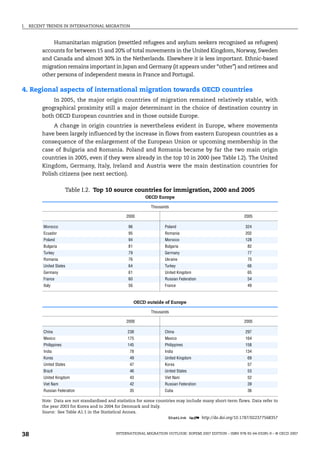
  • 9.
    FOREWORD INTERNATIONAL MIGRATION OUTLOOK:SOPEMI 2007 EDITION – ISBN 978-92-64-03285-9 – © OECD 2007 3 Foreword This publication constitutes the thirty first report of the OECD's Continuous Reporting System on migration (known by its French acronym SOPEMI). Formerly published as Trends in International Migration, the title was changed last year to the International Migration Outlook and, at the same time, its analytical scope broadened. This year's edition is a consolidation of the changes introduced last year, in particular with respect to standardised statistics on inflows and migration notes on individual countries. The report is divided into four parts plus a statistical annex. Part I contains three subsections. The first of these provides a broad overview of trends in international migration movements, including a historical overview of migration over the last half century and a look at potential movements in response to future declines in the working age population. Net migration into OECD countries has tripled since the early seventies, with movements often driven by historical events such as the fall of the Iron Curtain. Asylum seeking is at a historical low since the early nineties, while the accession of the new members of the European Union in 2004 has resulted in a substantial increase in movements within Europe. Significant labour migration into southern Europe continues, most of it from outside OECD countries. The integration of immigrants and their children continues to be an issue of concern in many countries and the labour market section two provides for the first time an overview of labour force outcomes for children of immigrants in ten OECD countries for which data were available. The final section of Part I contains an overview of recent developments in migration policies, which includes a review of changes in migration restrictions with regard to EU enlargement countries, new measures to facilitate the migration of the highly skilled and the growing importance of migration issues in international relatio. Parts II and III are devoted to special topics. The first examines the issue of overqualification among immigrant workers, namely the holding of jobs whose skill requirements are below their formal qualifications, and the possible reasons for this phenomenon. The second special chapter focuses on the international mobility of health professionals to OECD countries and presents the first broad based empirical results on this phenomenon, with implications for policy. Part IV presents succinct country specific notes and statistics on developments in international migration movements and policies in OECD countries in recent years. Finally the statistical annex includes a broad selection of recent and historical statistics on immigrant flows, the foreign and foreign born populations, naturalisations and migrant workers. IM-Outlook07.fm Page 3 Thursday, June 7, 2007 4:53 PM
  • 10.
    #E LIVRE CONTIENTDES éѾÑâÆËÈÐ2 !CCÏDEZ AUX lCHIERS %XCEL¥ Ì PARTIR DES LIVRES IMPRIMÏS %N BAS Ì DROITE DES TABLEAUX OU GRAPHIQUES DE CET OUVRAGE VOUS TROUVEREZ DES 3TAT,INKS 0OUR TÏLÏCHARGER LE lCHIER %XCEL¥ CORRESPONDANT IL VOUS SUFlT DE RETRANSCRIRE DANS VOTRE NAVIGATEUR )NTERNET LE LIEN COMMEN ANT PAR HTTPDXDOIORG 3I VOUS LISEZ LA VERSION 0$ DE LOUVRAGE ET QUE VOTRE ORDINATEUR EST CONNECTÏ Ì )NTERNET IL VOUS SUFlT DE CLIQUER SUR LE LIEN ,ES 3TAT,INKS SONT DE PLUS EN PLUS RÏPANDUS DANS LES PUBLICATIONS DE L/#$% IM-Outlook07.fm Page 4 Thursday, June 7, 2007 4:53 PM
  • 11.
    TABLE OF CONTENTS INTERNATIONALMIGRATION OUTLOOK: SOPEMI 2007 EDITION – ISBN 978-92-64-03285-9 – © OECD 2007 5 Table of Contents Editorial: The Medical Brain Drain: Myths and Realities . . . . . . . . . . . . . . . . 17 Introduction . . . . . . . . . . . . . . . . . . . . . . . . . . . . . . . . . . . . . . . . . 21 Part I RECENT TRENDS IN INTERNATIONAL MIGRATION A. Developments in Migration Flows . . . . . . . . . . . . . . . . . . . . . . . . . . . 28 1. A half-century of international migration . . . . . . . . . . . . . . . . . . . . . 28 2. Population ageing, the working-age population and international migration . 30 3. International migration in 2005 . . . . . . . . . . . . . . . . . . . . . . . . . . . 33 4. Regional aspects of international migration towards OECD countries . . . . . 38 5. Recent trends in migration from new European Union members. . . . . . . . 40 6. Indian and Chinese immigrants in OECD countries. . . . . . . . . . . . . . . . 44 7. Africa and international migration . . . . . . . . . . . . . . . . . . . . . . . . . 45 8. Unauthorised immigration . . . . . . . . . . . . . . . . . . . . . . . . . . . . . 47 9. Permanent settlement . . . . . . . . . . . . . . . . . . . . . . . . . . . . . . . . 49 10. Temporary workers. . . . . . . . . . . . . . . . . . . . . . . . . . . . . . . . . . 51 11. International students . . . . . . . . . . . . . . . . . . . . . . . . . . . . . . . . 53 12. Arrivals of asylum seekers. . . . . . . . . . . . . . . . . . . . . . . . . . . . . . 55 13. Changes in status . . . . . . . . . . . . . . . . . . . . . . . . . . . . . . . . . . . 56 14. The immigrant population . . . . . . . . . . . . . . . . . . . . . . . . . . . . . . . . . 59 15. Migration of the highly educated in perspective . . . . . . . . . . . . . . . . . . . . 60 B. Immigrants and the Labour Market . . . . . . . . . . . . . . . . . . . . . . . . . . 62 1. The situation of foreigners and immigrants in the labour market in OECD countries . . . . . . . . . . . . . . . . . . . . . . . . . . . . . . . . . . . . . 62 2. The integration of the children of immigrants . . . . . . . . . . . . . . . . . . 77 C. Migration Policies. . . . . . . . . . . . . . . . . . . . . . . . . . . . . . . . . . . . . 96 1. Attract, receive and integrate: Domestic immigration policies . . . . . . . . . 96 2. Immigration at the heart of international relations. . . . . . . . . . . . . . . . 115 Notes . . . . . . . . . . . . . . . . . . . . . . . . . . . . . . . . . . . . . . . . . . . . . . . 124 Bibliography . . . . . . . . . . . . . . . . . . . . . . . . . . . . . . . . . . . . . . . . . . . 127 IM-Outlook07.fm Page 5 Thursday, June 7, 2007 4:53 PM
  • 12.
    TABLE OF CONTENTS INTERNATIONALMIGRATION OUTLOOK: SOPEMI 2007 EDITION – ISBN 978-92-64-03285-9 – © OECD 2007 6 Part II MATCHING EDUCATIONAL BACKGROUND AND EMPLOYMENT: A CHALLENGE FOR IMMIGRANTS IN HOST COUNTRIES Introduction . . . . . . . . . . . . . . . . . . . . . . . . . . . . . . . . . . . . . . . . . . 132 1. Education: A labour market access factor which immigrants do not always benefit from . . . . . . . . . . . . . . . . . . . . . . . . . . . . . . . . . . . . . . 132 2. Occupational over-qualification: A variety of approaches . . . . . . . . . . . . 134 3. An evaluation of immigrants’ risk of occupational over-qualification . . . . . 136 4. Interpretation of over-qualification by levels of literacy . . . . . . . . . . . . . 143 Conclusion . . . . . . . . . . . . . . . . . . . . . . . . . . . . . . . . . . . . . . . . . . . 149 Notes . . . . . . . . . . . . . . . . . . . . . . . . . . . . . . . . . . . . . . . . . . . . . . . 150 Bibliography . . . . . . . . . . . . . . . . . . . . . . . . . . . . . . . . . . . . . . . . . . . 151 Annex II.A1. Employment and Unemployment Rates of Native- and Foreign-born Populations by Level of Education, 2003-2004. . . . . . . . . . . . . . . . . 154 Annex II.A2. Measuring Competencies by Educational Level and Job Classification. . . 155 Annex II.A3. Over-qualification Defined by Wages . . . . . . . . . . . . . . . . . . . . . 157 Part III IMMIGRANT HEALTH WORKERS IN OECD COUNTRIES IN THE BROADER CONTEXT OF HIGHLY SKILLED MIGRATION Introduction . . . . . . . . . . . . . . . . . . . . . . . . . . . . . . . . . . . . . . . . . . 162 Main findings . . . . . . . . . . . . . . . . . . . . . . . . . . . . . . . . . . . . . . . . . 162 1. Foreign-born and foreign-trained health professionals in OECD countries . . 164 2. Recent trends in migration movements of health professionals . . . . . . . . 179 3. International recruitment of health professionals and migration policies in OECD countries. . . . . . . . . . . . . . . . . . . . . . . . . . . . . . . . . . . 190 Conclusion . . . . . . . . . . . . . . . . . . . . . . . . . . . . . . . . . . . . . . . . . . . 199 Notes . . . . . . . . . . . . . . . . . . . . . . . . . . . . . . . . . . . . . . . . . . . . . . . 200 Bibliography . . . . . . . . . . . . . . . . . . . . . . . . . . . . . . . . . . . . . . . . . . . 203 Annex III.A1. Origin-destination of Immigrant Health Professionals in OECD Countries, Circa 2000 . . . . . . . . . . . . . . . . . . . . . . . . . . . . . . . . . . . . . . . 208 Annex III.A2. Expatriation Rates for Doctors and Nurses, Circa 2000 . . . . . . . . . . . 212 Annex III.A3. Migration Policies and Recognition of Foreign Qualifications for Health Professionals . . . . . . . . . . . . . . . . . . . . . . . . . . . . . . . . . . . . . 217 IM-Outlook07.fm Page 6 Thursday, June 7, 2007 4:53 PM
  • 13.
    TABLE OF CONTENTS INTERNATIONALMIGRATION OUTLOOK: SOPEMI 2007 EDITION – ISBN 978-92-64-03285-9 – © OECD 2007 7 Part IV RECENT CHANGES IN MIGRATION MOVEMENTS AND POLICIES (COUNTRY NOTES) How to Read the Tables of Part IV . . . . . . . . . . . . . . . . . . . . . . . . . . . . . . 294 How to Read the Chart . . . . . . . . . . . . . . . . . . . . . . . . . . . . . . . . . . . . 295 STATISTICAL ANNEX Introduction . . . . . . . . . . . . . . . . . . . . . . . . . . . . . . . . . . . . . . . . . . 297 Inflows and Outflows of Foreign Population . . . . . . . . . . . . . . . . . . . . . . . . 299 Inflows of Asylum Seekers . . . . . . . . . . . . . . . . . . . . . . . . . . . . . . . . . . 320 Stocks of Foreign and Foreign-born Population . . . . . . . . . . . . . . . . . . . . . . 328 Acquisition of Nationality . . . . . . . . . . . . . . . . . . . . . . . . . . . . . . . . . . 358 Inflows of Foreign Workers . . . . . . . . . . . . . . . . . . . . . . . . . . . . . . . . . 371 Stocks of Foreign and Foreign-Born Labour . . . . . . . . . . . . . . . . . . . . . . . . 375 List of Sopemi Correspondents . . . . . . . . . . . . . . . . . . . . . . . . . . . . . . . 397 List of OECD Secretariat Members Involved in the Preparation of this Report . . . . 399 Australia . . . . . . . . . . . . . . . . 230 Austria. . . . . . . . . . . . . . . . . . 232 Belgium . . . . . . . . . . . . . . . . . 234 Bulgaria . . . . . . . . . . . . . . . . . 236 Canada . . . . . . . . . . . . . . . . . 238 Czech Republic . . . . . . . . . . . . . 240 Denmark . . . . . . . . . . . . . . . . 242 Finland . . . . . . . . . . . . . . . . . 244 France . . . . . . . . . . . . . . . . . . 246 Germany . . . . . . . . . . . . . . . . 248 Greece . . . . . . . . . . . . . . . . . . 250 Hungary . . . . . . . . . . . . . . . . . 252 Ireland. . . . . . . . . . . . . . . . . . 254 Italy . . . . . . . . . . . . . . . . . . . 256 Japan. . . . . . . . . . . . . . . . . . . 258 Korea . . . . . . . . . . . . . . . . . . 260 Lithuania . . . . . . . . . . . . . . . . 262 Luxembourg . . . . . . . . . . . . . . 264 Mexico. . . . . . . . . . . . . . . . . . 266 Netherlands. . . . . . . . . . . . . . . 268 New Zealand . . . . . . . . . . . . . . 270 Norway . . . . . . . . . . . . . . . . . 272 Poland . . . . . . . . . . . . . . . . . . 274 Portugal . . . . . . . . . . . . . . . . . 276 Romania. . . . . . . . . . . . . . . . . 278 Slovak Republic. . . . . . . . . . . . . 280 Spain. . . . . . . . . . . . . . . . . . . 282 Sweden . . . . . . . . . . . . . . . . . 284 Switzerland . . . . . . . . . . . . . . . 286 Turkey . . . . . . . . . . . . . . . . . . 288 United Kingdom . . . . . . . . . . . . 290 United States . . . . . . . . . . . . . . 292 IM-Outlook07.fm Page 7 Thursday, June 7, 2007 4:53 PM
  • 14.
    TABLE OF CONTENTS INTERNATIONALMIGRATION OUTLOOK: SOPEMI 2007 EDITION – ISBN 978-92-64-03285-9 – © OECD 2007 8 List of Charts, Tables and Boxes Part I RECENT TRENDS IN INTERNATIONAL MIGRATION Charts I.1. Net migration rates, traditional immigration and emigration OECD countries, 1956-2003 . . . . . . . . . . . . . . . . . . . . . . . . . . . . . . . . . . . . . . . . . 28 I.2. Components of population change, 2004 . . . . . . . . . . . . . . . . . . . . . . . . . 30 I.3. Expected change in the working-age population assuming zero net migration over the periods indicated, 2005-2020 . . . . . . . . . . . . . . . . . . . . . . . . . 31 I.4. Permanent-type inflows, standardised statistics, 2005 . . . . . . . . . . . . . . . 37 I.5. International migration by category of entry, selected OECD countries, 2005, standardised data . . . . . . . . . . . . . . . . . . . . . . . . . . . . . . . . . . . . 37 I.6. Inflows of migrants by country of origin, selected OECD countries, 1990-2004 and 2005 . . . . . . . . . . . . . . . . . . . . . . . . . . . . . . . . . . . . . . . . . . 40 I.7. Migration from new EU member countries to selected OECD countries, 1998-2005 43 I.8. Indian and Chinese immigrants in selected OECD countries in 2005. . . . . . . . 45 I.9. Share of immigrants born in Africa in the foreign-born population in OECD countries, Circa 2000. . . . . . . . . . . . . . . . . . . . . . . . . . . . . . 46 I.10. Changes in status from temporary categories to permanent-type worker migration, selected OECD countries, 1996-2005. . . . . . . . . . . . . . . . . . . . 59 I.11. Prevalence and evolution of the foreign-born population in OECD countries, 1995-2005 . . . . . . . . . . . . . . . . . . . . . . . . . . . . . . . . . . . . . . . . . 59 I.12. Percentage of immigrants and native-born persons aged 15 and above with a tertiary qualification, Circa 2000 . . . . . . . . . . . . . . . . . . . . . . . . 61 I.13. Immigrants with a tertiary qualification in OECD countries by continent and duration of residence, Circa 2000 . . . . . . . . . . . . . . . . . . . . . . . . . 62 I.14. Participation rate by birth status in some OECD countries, 2004-2005 . . . . . . . 64 I.15. Difference between the participation rates of native- and foreign-born by origin in selected European OECD countries, 2005 . . . . . . . . . . . . . . . . 65 I.16. Change in the number of foreign-born employed in selected OECD countries, 1995-2005 . . . . . . . . . . . . . . . . . . . . . . . . . . . . . . . . . . . . . . . . . 67 I.17. Evolution of the gap in the employment rate between the native- and foreign-born population over time assuming equal hiring and job loss probabilities for both groups, selected European OECD countries, 2005 . . . . . . 70 I.18. Unemployment rate of foreign-born and native-born, 2004-2005. . . . . . . . . . 71 I.19. Share of long-term unemployment (1 year or more) in total unemployment by birth status, 2005 . . . . . . . . . . . . . . . . . . . . . . . . . . . . . . . . . . . 72 I.20. Share of foreign-born employed within selected occupations in the service sector, 2004-2005 . . . . . . . . . . . . . . . . . . . . . . . . . . . . . . . . . . . . . 74 I.21a. Share of temporary employment in total employment by birth status, 2005 . . . 76 I.21b. Share of part-time employment in total employment by birth status, 2005 . . . . 76 I.22. Share of persons with a migration background in the population aged 20-29. . . 79 I.23. PISA (2003) results in mathematics for the children of immigrants . . . . . . . . 80 I.24. Differences in employment rates between native-born without migration background and the second generation by gender, latest available year . . . . . 82 I.25. Unemployment rate of immigrants and the second generation relative to that of native-born . . . . . . . . . . . . . . . . . . . . . . . . . . . . . . . . . . . . . . 83 IM-Outlook07.fm Page 8 Thursday, June 7, 2007 4:53 PM
  • 15.
    TABLE OF CONTENTS INTERNATIONALMIGRATION OUTLOOK: SOPEMI 2007 EDITION – ISBN 978-92-64-03285-9 – © OECD 2007 9 Tables I.1. Inflows of foreign nationals, 2003-2005 . . . . . . . . . . . . . . . . . . . . . . . . 36 I.2. Top 10 source countries for immigration, 2000 and 2005 . . . . . . . . . . . . . . 38 I.3. Estimated ratio of outflows to inflows of the foreign-born population, 1990s. . . 50 I.4. Entries of temporary workers in selected OECD countries by principal categories, 2003-2005. . . . . . . . . . . . . . . . . . . . . . . . . . . . . . . . . . . 52 I.5. International and/or foreign students in tertiary education, 2000 and 2004 . . . . 53 I.6. Inflows of asylum seekers in OECD countries, 2000-2005 . . . . . . . . . . . . . . 56 I.7. Changes in status from temporary to permanent in selected OECD countries, 2005 58 I.8. Foreign or foreign-born labour force in selected OECD countries, 2000 and 2005 . 63 I.9. Employment change, total and foreign-born, 1995-2005 . . . . . . . . . . . . . . . 66 I.10. Educational attainment of employed population by birth status . . . . . . . . . . 68 I.11. Employment of foreign-born by sector, 2004-2005 average . . . . . . . . . . . . . 73 I.12. Foreign-born in self-employment in OECD countries, 2000 and 2005 . . . . . . . 75 I.13. Review of the first phase of the transition period in EU15, EEA and Switzerland . 103 Annexes I.A1.1. Labour market situation of foreign- and native-born populations in selected OECD countries, 1995, 2000 and 2004-2005 . . . . . . . . . . . . . . . . . . . . . 86 I.A1.2. Labour market situation of foreigners and nationals in selected OECD countries, 1995, 2000 and 2004-2005 . . . . . . . . . . . . . . . . . . . . . . . . . 89 I.A1.3. Education levels for immigrants, the second generation, and other native-born, 20-29 and not in education, by gender, latest available year . . . . . . . . . . . . . 92 I.A1.4. Employment rates for immigrants, the second generation, and other native-born, 20-29 and not in education, by gender, latest available year . . . . . . . . . . . . . . 94 Boxes I.1. Standardised statistics on immigrant inflows . . . . . . . . . . . . . . . . . . . . 34 I.2. United Kingdom: Who are the new immigrants from the A8 countries?. . . . . . 42 I.3. Recruitment of workers from abroad . . . . . . . . . . . . . . . . . . . . . . . . . 49 I.4. Trends in the employment rate of immigrants and native-born assuming an equal probability of losing or finding a job. . . . . . . . . . . . . . . . . . . . . 69 I.5. Data on the second generation . . . . . . . . . . . . . . . . . . . . . . . . . . . . . 78 I.6. The points system in the United Kingdom: Qualification and sponsorship . . . . 98 I.7. Developments in the Working Holiday-Maker programme . . . . . . . . . . . . . 104 I.8. Towards an obligation of result: The new Integration Act in the Netherlands. . . . 110 I.9. Canada’s sponsorship system . . . . . . . . . . . . . . . . . . . . . . . . . . . . . 111 I.10. The European Union plan to prevent and combat trafficking in human beings . 120 I.11. Economic policy coherence and migration of highly skilled workers: The case of East Asia. . . . . . . . . . . . . . . . . . . . . . . . . . . . . . . . . . . 123 Part II MATCHING EDUCATIONAL BACKGROUND AND EMPLOYMENT: A CHALLENGE FOR IMMIGRANTS IN HOST COUNTRIES Charts II.1. Differences in employment rates of native- and foreign-born populations, 2003-2004 . . . . . . . . . . . . . . . . . . . . . . . . . . . . . . . . . . . . . . . . . 134 II.2. Dispersion in the over-qualification rates of the foreign-born by main regions of origin relative to those observed for the native-born, Circa 2000 . . . . . . . . 141 IM-Outlook07.fm Page 9 Thursday, June 7, 2007 4:53 PM
  • 16.
    TABLE OF CONTENTS INTERNATIONALMIGRATION OUTLOOK: SOPEMI 2007 EDITION – ISBN 978-92-64-03285-9 – © OECD 2007 10 II.3. Over-qualification rate by level of quantitative literacy and country of birth in Europe and in Australia, Circa 1995 . . . . . . . . . . . . . . . . . . . . . . . . . 144 Annexes II.A3.1. Overeducation rates for individuals with higher education in Germany, 2003-2004 157 Tables II.1. Education level of foreign- and native-born populations aged 25 to 64 in OECD countries, 2003-2004 . . . . . . . . . . . . . . . . . . . . . . . . . . . . . . . . . . . 133 II.2. Over-qualification rates of native- and foreign-born populations in some OECD countries . . . . . . . . . . . . . . . . . . . . . . . . . . . . . . . . . . . . . . . . . 137 II.3. Over-qualification rate of native- and foreign-born populations by gender in some OECD countries, 2003-2004 . . . . . . . . . . . . . . . . . . . . . . . . . . 139 II.4. Over-qualification rate of the foreign-born population according to their duration of stay in some OECD countries, 2003-2004. . . . . . . . . . . . . . . . . 140 II.5. Over-qualification rate of immigrants by country of birth and destination country, Circa 2000 . . . . . . . . . . . . . . . . . . . . . . . . . . . . . . . . . . . . 142 II.6. Logistic model of the probability of over-qualification (Australia) . . . . . . . . . 145 II.7. Logistic model of the probability of over-qualification (Europe) . . . . . . . . . . 147 Annexes II.A1.1. Employment and unemployment rates of native- and foreign-born populations by level of education, 2003-2004 . . . . . . . . . . . . . . . . . . . . . . . . . . . 154 II.A2.1. Conversion of ISCO-88 9 categories to 3 categories . . . . . . . . . . . . . . . . . 156 II.A2.2. Conversion from ISCED 7 categories to 3 categories . . . . . . . . . . . . . . . . 156 II.A2.3. Correspondence between ISCED education level and ISCO employment level . 156 II.A3.1. Wage-based over-qualification rate of native- and foreign-born by level of education in some OECD countries, 2003-2004. . . . . . . . . . . . . . . . . . 158 Boxes II.1. Different approaches to the over-qualification problem. . . . . . . . . . . . . . . 135 II.2. The “Box and Whiskers Plot” . . . . . . . . . . . . . . . . . . . . . . . . . . . . . . 141 II.3. International Adult Literacy Survey, IALS . . . . . . . . . . . . . . . . . . . . . . . 144 Part III IMMIGRANT HEALTH WORKERS IN OECD COUNTRIES IN THE BROADER CONTEXT OF HIGHLY SKILLED MIGRATION Charts III.1. Share of foreign-born among practicing doctors, dentists and pharmacists in selected OECD countries, Circa 2000 . . . . . . . . . . . . . . . . . . . . . . . . 166 III.2a.Percentage of foreign-born doctors and nurses compared to the percentage of foreign born in highly skilled occupations in selected OECD countries, Circa 2000 171 III.2b.Percentage of foreign-born doctors compared to the percentage of foreign-born among people employed and holding a PhD in selected OECD countries, Circa 2000 . . . . . . . . . . . . . . . . . . . . . . . . . . . . . . . 171 III.3. Distribution of foreign-born doctors and nurses by country of residence in the OECD area, Circa 2000 . . . . . . . . . . . . . . . . . . . . . . . . . . . . . . 172 III.4. Distribution of foreign-born doctors and nurses by main regions of origin in OECD countries, Circa 2000. . . . . . . . . . . . . . . . . . . . . . . . . . . . . . 173 IM-Outlook07.fm Page 10 Thursday, June 7, 2007 4:53 PM
  • 17.
    TABLE OF CONTENTS INTERNATIONALMIGRATION OUTLOOK: SOPEMI 2007 EDITION – ISBN 978-92-64-03285-9 – © OECD 2007 11 III.5. Intra-OECD migration of nurses: A cascade-type pattern, net stocks, Circa 2000 . 174 III.6. Foreign-born doctors and nurses in the OECD by main countries of origin (top 25), Circa 2000. . . . . . . . . . . . . . . . . . . . . . . . . . . . . . . 175 III.7. Emigration rate and density of doctors by origin country, Circa 2000 . . . . . . . 176 III.8. Emigration rate of the highly skilled and of doctors, non-OECD countries . . . . 177 III.9. Inflow of immigrant doctors and nurses in selected OECD countries, 1995-2005 . 182 III.10. Distribution by region of origin of immigration inflows of health professionals in the United Kingdom and the United States, 1995-97 and 2002-04 . . . . . . . . 187 Tables III.1. Practising health professionals by occupation and place of birth in OECD countries, Circa 2000 . . . . . . . . . . . . . . . . . . . . . . . . . . . . . . . . . . 165 III.2. Immigrants registered in selected OECD countries, doctors and nurses, 2000 and 2005 . . . . . . . . . . . . . . . . . . . . . . . . . . . . . . . . . . . . . . . 169 III.3. Estimated critical shortages of doctors and nurses and midwives, by WHO region . . . . . . . . . . . . . . . . . . . . . . . . . . . . . . . . . . . . . . 179 III.4. Foreign-trained doctors in selected OECD countries, 1970s and 2005 . . . . . . . 181 III.5. Migration programmes and conditions for recognition of qualifications of foreign health professionals (HP) . . . . . . . . . . . . . . . . . . . . . . . . . . 191 III.6. Employment conditions of health professionals in selected European countries by country of birth, 2005. . . . . . . . . . . . . . . . . . . . . . . . . . . . . . . . . 199 Annexes III.A1.1.Distribution of foreign-born doctors by countries of origin in selected OECD countries . . . . . . . . . . . . . . . . . . . . . . . . . . . . . . . . . . . . . . . . 208 III.A1.2.Distribution of foreign-born nurses by countries of origin in selected OECD countries. . . . . . . . . . . . . . . . . . . . . . . . . . . . . . . . . . . . . 209 III.A1.3. Foreign-born doctors by country of birth and country of residence in selected OECD countries. . . . . . . . . . . . . . . . . . . . . . . . . . . . . . . . . . . . . 210 III.A1.4. Foreign-born nurses by country of birth and country of residence in selected OECD countries . . . . . . . . . . . . . . . . . . . . . . . . . . . . . . . . . . . . . . . 211 III.A2.1.Expatriation rates for doctors and nurses, Circa 2000 . . . . . . . . . . . . . . . . . 212 Boxes III.1. International comparability of health professional registration data . . . . . . . . . 167 III.2. Code of conduct for the recruitment of international health workers . . . . . . . 180 III.3. Could patient mobility and telemedicine help to alleviate health worker shortage concerns?. . . . . . . . . . . . . . . . . . . . . . . . . . . . . . . . . . . . 185 III.4. The consequence of recent EU enlargement on health worker migration flows. . . 189 III.5. Initiatives to recruit foreign medical practitioners in rural areas . . . . . . . . . . 193 III.6. Trade and international mobility of health professionals . . . . . . . . . . . . . . 195 III.7. Recognition of diplomas within the European Union and in Europe more generally . . . . . . . . . . . . . . . . . . . . . . . . . . . . . . . . . . . . . . 197 IM-Outlook07.fm Page 11 Thursday, June 7, 2007 4:53 PM
  • 18.
    TABLE OF CONTENTS INTERNATIONALMIGRATION OUTLOOK: SOPEMI 2007 EDITION – ISBN 978-92-64-03285-9 – © OECD 2007 12 Part IV RECENT CHANGES IN MIGRATION MOVEMENTS AND POLICIES Australia: Flow data on foreigners. . . . . . . . . . . . . . . . . . . . . . . . . . . . . . . . . . . . . . . . . . . 231 Macroeconomic, demographic and labour market indicators . . . . . . . . . 231 Austria: Flow data on foreigners. . . . . . . . . . . . . . . . . . . . . . . . . . . . . . . . . . . . . . . . . . . 233 Macroeconomic, demographic and labour market indicators . . . . . . . . . 233 Belgium: Flow data on foreigners. . . . . . . . . . . . . . . . . . . . . . . . . . . . . . . . . . . . . . . . . . . 235 Macroeconomic, demographic and labour market indicators . . . . . . . . . 235 Bulgaria: Flow data on foreigners. . . . . . . . . . . . . . . . . . . . . . . . . . . . . . . . . . . . . . . . . . . 237 Macroeconomic, demographic and labour market indicators . . . . . . . . . 237 Canada: Flow data on foreigners. . . . . . . . . . . . . . . . . . . . . . . . . . . . . . . . . . . . . . . . . . . 239 Macroeconomic, demographic and labour market indicators . . . . . . . . . 239 Czech Republic: Flow data on foreigners. . . . . . . . . . . . . . . . . . . . . . . . . . . . . . . . . . . . . . . . . . . 241 Macroeconomic, demographic and labour market indicators . . . . . . . . . 241 Denmark: Flow data on foreigners. . . . . . . . . . . . . . . . . . . . . . . . . . . . . . . . . . . . . . . . . . . 243 Macroeconomic, demographic and labour market indicators . . . . . . . . . 243 Finland: Flow data on foreigners. . . . . . . . . . . . . . . . . . . . . . . . . . . . . . . . . . . . . . . . . . . 245 Macroeconomic, demographic and labour market indicators . . . . . . . . . 245 France: Flow data on foreigners. . . . . . . . . . . . . . . . . . . . . . . . . . . . . . . . . . . . . . . . . . . 247 Macroeconomic, demographic and labour market indicators . . . . . . . . . 247 Germany: Flow data on foreigners. . . . . . . . . . . . . . . . . . . . . . . . . . . . . . . . . . . . . . . . . . . 249 Macroeconomic, demographic and labour market indicators . . . . . . . . . 249 Greece: Flow data on foreigners. . . . . . . . . . . . . . . . . . . . . . . . . . . . . . . . . . . . . . . . . . . 251 Macroeconomic, demographic and labour market indicators . . . . . . . . . 251 Hungary: Flow data on foreigners. . . . . . . . . . . . . . . . . . . . . . . . . . . . . . . . . . . . . . . . . . . 253 Macroeconomic, demographic and labour market indicators . . . . . . . . . 253 Ireland: Flow data on foreigners. . . . . . . . . . . . . . . . . . . . . . . . . . . . . . . . . . . . . . . . . . . 255 Macroeconomic, demographic and labour market indicators . . . . . . . . . 255 Italy: Flow data on foreigners. . . . . . . . . . . . . . . . . . . . . . . . . . . . . . . . . . . . . . . . . . . 257 Macroeconomic, demographic and labour market indicators. . . . . . . 257 Japan: Flow data on foreigners. . . . . . . . . . . . . . . . . . . . . . . . . . . . . . . . . . . . . . . . . . . 259 Macroeconomic, demographic and labour market indicators . . . . . . . . . 259 Korea: Flow data on foreigners. . . . . . . . . . . . . . . . . . . . . . . . . . . . . . . . . . . . . . . . . . . 261 Macroeconomic, demographic and labour market indicators . . . . . . . . . 261 Lithuania: Flow data on foreigners. . . . . . . . . . . . . . . . . . . . . . . . . . . . . . . . . . . . . . . . . . . 263 Macroeconomic, demographic and labour market indicators . . . . . . . . . 263 Luxembourg: Flow data on foreigners. . . . . . . . . . . . . . . . . . . . . . . . . . . . . . . . . . . . . . . . . . . 265 Macroeconomic, demographic and labour market indicators . . . . . . . . . 265 Mexico: Flow data on foreigners. . . . . . . . . . . . . . . . . . . . . . . . . . . . . . . . . . . . . . . . . . . 267 Macroeconomic, demographic and labour market indicators . . . . . . . . . 267 Netherlands: Flow data on foreigners. . . . . . . . . . . . . . . . . . . . . . . . . . . . . . . . . . . . . . . . . . . 269 Macroeconomic, demographic and labour market indicators . . . . . . . . . 269 New Zealand: Flow data on foreigners. . . . . . . . . . . . . . . . . . . . . . . . . . . . . . . . . . . . . . . . . . . 271 Macroeconomic, demographic and labour market indicators . . . . . . . . . 271 IM-Outlook07.fm Page 12 Thursday, June 7, 2007 4:53 PM
  • 19.
    TABLE OF CONTENTS INTERNATIONALMIGRATION OUTLOOK: SOPEMI 2007 EDITION – ISBN 978-92-64-03285-9 – © OECD 2007 13 Norway: Flow data on foreigners. . . . . . . . . . . . . . . . . . . . . . . . . . . . . . . . . . . . . . . . . . . 273 Macroeconomic, demographic and labour market indicators . . . . . . . . . 273 Poland: Flow data on foreigners. . . . . . . . . . . . . . . . . . . . . . . . . . . . . . . . . . . . . . . . . . . 275 Macroeconomic, demographic and labour market indicators . . . . . . . . . 275 Portugal: Flow data on foreigners. . . . . . . . . . . . . . . . . . . . . . . . . . . . . . . . . . . . . . . . . . . 277 Macroeconomic, demographic and labour market indicators . . . . . . . . . 277 Romania: Flow data on foreigners. . . . . . . . . . . . . . . . . . . . . . . . . . . . . . . . . . . . . . . . . . . 279 Macroeconomic, demographic and labour market indicators . . . . . . . . . 279 Slovak Republic: Flow data on foreigners. . . . . . . . . . . . . . . . . . . . . . . . . . . . . . . . . . . . . . . . . . . 281 Macroeconomic, demographic and labour market indicators . . . . . . . . . 281 Spain: Flow data on foreigners. . . . . . . . . . . . . . . . . . . . . . . . . . . . . . . . . . . . . . . . . . . 283 Macroeconomic, demographic and labour market indicators . . . . . . . . . 283 Sweden: Flow data on foreigners. . . . . . . . . . . . . . . . . . . . . . . . . . . . . . . . . . . . . . . . . . . 285 Macroeconomic, demographic and labour market indicators . . . . . . . . . 285 Switzerland: Flow data on foreigners. . . . . . . . . . . . . . . . . . . . . . . . . . . . . . . . . . . . . . . . . . . 287 Macroeconomic, demographic and labour market indicators . . . . . . . . . 287 Turkey: Flow data on foreigners. . . . . . . . . . . . . . . . . . . . . . . . . . . . . . . . . . . . . . . . . . . 289 Macroeconomic, demographic and labour market indicators . . . . . . . . . 289 United Kingdom: Flow data on foreigners. . . . . . . . . . . . . . . . . . . . . . . . . . . . . . . . . . . . . . . . . . . 291 Macroeconomic, demographic and labour market indicators . . . . . . . . . 291 United States: Flow data on foreigners. . . . . . . . . . . . . . . . . . . . . . . . . . . . . . . . . . . . . . . . . . . 293 Macroeconomic, demographic and labour market indicators . . . . . . . . . 293 IM-Outlook07.fm Page 13 Thursday, June 7, 2007 4:53 PM
  • 20.
    TABLE OF CONTENTS INTERNATIONALMIGRATION OUTLOOK: SOPEMI 2007 EDITION – ISBN 978-92-64-03285-9 – © OECD 2007 14 STATISTICAL ANNEX Inflows and Outflows of Foreign Population . . . . . . . . . . . . . . . . . . . . . . . . . . . . . . . . . . . . . . 299 A.1.1. Inflows of foreign population into selected OECD countries . . . . . . . . . . . . . . . . . 301 A.1.2. Outflows of foreign population from selected OECD countries . . . . . . . . . . . . . . . 302 B.1.1. AUSTRALIA . . . . . . . . . . . . . . . . . 303 B.1.1. AUSTRIA . . . . . . . . . . . . . . . . . . . 303 B.1.1. BELGIUM . . . . . . . . . . . . . . . . . . . 304 B.1.1. CANADA . . . . . . . . . . . . . . . . . . . 304 B.1.1. CZECH REPUBLIC . . . . . . . . . . . . 305 B.1.1. DENMARK . . . . . . . . . . . . . . . . . . 305 B.1.1. FINLAND . . . . . . . . . . . . . . . . . . . 306 B.1.1. FRANCE . . . . . . . . . . . . . . . . . . . . 306 B.1.1. GERMANY . . . . . . . . . . . . . . . . . . 307 B.1.1. GREECE . . . . . . . . . . . . . . . . . . . . 307 B.1.1. HUNGARY . . . . . . . . . . . . . . . . . . 308 B.1.1. IRELAND . . . . . . . . . . . . . . . . . . . 308 B.1.1. ITALY . . . . . . . . . . . . . . . . . . . . . . 309 B.1.1. JAPAN. . . . . . . . . . . . . . . . . . . . . . 309 B.1.1. LUXEMBOURG. . . . . . . . . . . . . . . 310 B.1.1. NETHERLANDS . . . . . . . . . . . . . . 310 B.1.1. NEW ZEALAND. . . . . . . . . . . . . . 311 B.1.1. NORWAY. . . . . . . . . . . . . . . . . . . 311 B.1.1. POLAND. . . . . . . . . . . . . . . . . . . . 312 B.1.1. PORTUGAL . . . . . . . . . . . . . . . . . 312 B.1.1. SLOVAK REPUBLIC . . . . . . . . . . . 313 B.1.1. SPAIN . . . . . . . . . . . . . . . . . . . . . . 313 B.1.1. SWEDEN . . . . . . . . . . . . . . . . . . . 314 B.1.1. SWITZERLAND . . . . . . . . . . . . . . 314 B.1.1. TURKEY . . . . . . . . . . . . . . . . . . . . 315 B.1.1. UNITED KINGDOM. . . . . . . . . . . 315 B.1.1. UNITED STATES . . . . . . . . . . . . . 316 Metadata related to Tables A.1.1, A.1.2. and B.1.1. Migration flows in selected OECD countries . . . . . . . . . . . . . . . . . . . . . . . . . . . . . . . . . . . . . . . . . . . . . . . . . . . . . . . . . . . . . 317 Inflows of Asylum Seekers . . . . . . . . . . . . . . . . . . . . . . . . . . . . . . . . . . . . . . . . . . . . . . . . . . . . 320 A.1.3. Inflows of asylum seekers into OECD countries . . . . . . . . . . . . . . . . . . . . . . . . . . . . 321 B.1.3. AUSTRIA . . . . . . . . . . . . . . . . . . . 322 B.1.3. BELGIUM . . . . . . . . . . . . . . . . . . . 322 B.1.3. CANADA . . . . . . . . . . . . . . . . . . . 323 B.1.3. FRANCE . . . . . . . . . . . . . . . . . . . . 323 B.1.3. GERMANY . . . . . . . . . . . . . . . . . . 324 B.1.3. NETHERLANDS . . . . . . . . . . . . . . 324 B.1.3. SWEDEN . . . . . . . . . . . . . . . . . . . 325 B.1.3. SWITZERLAND . . . . . . . . . . . . . . 325 B.1.3. UNITED KINGDOM. . . . . . . . . . . 326 B.1.3. UNITED STATES . . . . . . . . . . . . . 326 Metadata related to Tables A.1.3. and B.1.3. Inflows of asylum seekers. . . . . . . . . . . . . . 327 Stocks of Foreign and Foreign-born Population. . . . . . . . . . . . . . . . . . . . . . . . . . . . . . . . . . . . 328 A.1.4. Stocks of foreign-born population in selected OECD countries . . . . . . . . . . . . . . . 330 B.1.4. AUSTRALIA . . . . . . . . . . . . . . . . . 331 B.1.4. AUSTRIA . . . . . . . . . . . . . . . . . . . 331 B.1.4. BELGIUM . . . . . . . . . . . . . . . . . . . 332 B.1.4. CANADA . . . . . . . . . . . . . . . . . . . 332 B.1.4. DENMARK . . . . . . . . . . . . . . . . . . 333 B.1.4. FINLAND . . . . . . . . . . . . . . . . . . . 333 B.1.4. FRANCE . . . . . . . . . . . . . . . . . . . . 334 B.1.4. GREECE . . . . . . . . . . . . . . . . . . . . 334 B.1.4. HUNGARY . . . . . . . . . . . . . . . . . . 335 B.1.4. IRELAND . . . . . . . . . . . . . . . . . . . 335 B.1.4. LUXEMBOURG. . . . . . . . . . . . . . . 336 B.1.4. NETHERLANDS . . . . . . . . . . . . . . 336 B.1.4. NEW ZEALAND. . . . . . . . . . . . . . 337 B.1.4. NORWAY. . . . . . . . . . . . . . . . . . . 337 B.1.4. POLAND. . . . . . . . . . . . . . . . . . . . 338 B.1.4. PORTUGAL . . . . . . . . . . . . . . . . . 338 B.1.4. SLOVAK REPUBLIC . . . . . . . . . . . 339 B.1.4. SWEDEN . . . . . . . . . . . . . . . . . . . 339 B.1.4. TURKEY . . . . . . . . . . . . . . . . . . . . 340 B.1.4. UNITED KINGDOM. . . . . . . . . . . 340 B.1.4. UNITED STATES . . . . . . . . . . . . . 341 Metadata related to Tables A.1.4. and B.1.4. Foreign-born population . . . . . . . . . . . . . . . 342 IM-Outlook07.fm Page 14 Thursday, June 7, 2007 4:53 PM
  • 21.
    TABLE OF CONTENTS INTERNATIONALMIGRATION OUTLOOK: SOPEMI 2007 EDITION – ISBN 978-92-64-03285-9 – © OECD 2007 15 A.1.5. Stocks of foreign population in selected OECD countries . . . . . . . . . . . . . . . . . . . . 343 B.1.5. AUSTRIA. . . . . . . . . . . . . . . . . . . . 344 B.1.5. BELGIUM. . . . . . . . . . . . . . . . . . . . 344 B.1.5. CZECH REPUBLIC. . . . . . . . . . . . . 345 B.1.5. DENMARK . . . . . . . . . . . . . . . . . . 345 B.1.5. FINLAND . . . . . . . . . . . . . . . . . . . 346 B.1.5. FRANCE . . . . . . . . . . . . . . . . . . . . 346 B.1.5. GERMANY . . . . . . . . . . . . . . . . . . 347 B.1.5. GREECE . . . . . . . . . . . . . . . . . . . . . 347 B.1.5. HUNGARY . . . . . . . . . . . . . . . . . . 348 B.1.5. IRELAND. . . . . . . . . . . . . . . . . . . . 348 B.1.5. ITALY . . . . . . . . . . . . . . . . . . . . . . 349 B.1.5. JAPAN . . . . . . . . . . . . . . . . . . . . . . 349 B.1.5. KOREA. . . . . . . . . . . . . . . . . . . . . . 350 B.1.5. LUXEMBOURG . . . . . . . . . . . . . . . 350 B.1.5. NETHERLANDS . . . . . . . . . . . . . . 351 B.1.5. NORWAY . . . . . . . . . . . . . . . . . . . 351 B.1.5. POLAND . . . . . . . . . . . . . . . . . . . . 352 B.1.5. PORTUGAL. . . . . . . . . . . . . . . . . . . . 352 B.1.5. SLOVAK REPUBLIC . . . . . . . . . . . 353 B.1.5. SPAIN . . . . . . . . . . . . . . . . . . . . . . 353 B.1.5. SWEDEN . . . . . . . . . . . . . . . . . . . . 354 B.1.5. SWITZERLAND . . . . . . . . . . . . . . 354 B.1.5. UNITED KINGDOM . . . . . . . . . . . 355 Metadata related to Tables A.1.5. and B.1.5. Foreign population . . . . . . . . . . . . . . . . . . . . 356 Acquisition of Nationality. . . . . . . . . . . . . . . . . . . . . . . . . . . . . . . . . . . . . . . . . . . . . . . . . . . . . . 358 A.1.6. Acquisition of nationality in selected OECD countries . . . . . . . . . . . . . . . . . . . . . . . 359 B.1.6. AUSTRALIA . . . . . . . . . . . . . . . . . 360 B.1.6. AUSTRIA. . . . . . . . . . . . . . . . . . . . 360 B.1.6. BELGIUM. . . . . . . . . . . . . . . . . . . . 361 B.1.6. CANADA. . . . . . . . . . . . . . . . . . . . 361 B.1.6. CZECH REPUBLIC. . . . . . . . . . . . . 362 B.1.6. DENMARK . . . . . . . . . . . . . . . . . . 362 B.1.6. FINLAND . . . . . . . . . . . . . . . . . . . 362 B.1.6. FRANCE . . . . . . . . . . . . . . . . . . . . 363 B.1.6. GERMANY . . . . . . . . . . . . . . . . . . 363 B.1.6. HUNGARY . . . . . . . . . . . . . . . . . . 363 B.1.6. ITALY . . . . . . . . . . . . . . . . . . . . . . 364 B.1.6. JAPAN . . . . . . . . . . . . . . . . . . . . . . 364 B.1.6. LUXEMBOURG . . . . . . . . . . . . . . . 364 B.1.6. NETHERLANDS . . . . . . . . . . . . . . 365 B.1.6. NEW ZEALAND . . . . . . . . . . . . . . 365 B.1.6. NORWAY . . . . . . . . . . . . . . . . . . . 366 B.1.6. POLAND . . . . . . . . . . . . . . . . . . . . 366 B.1.6. PORTUGAL . . . . . . . . . . . . . . . . . . 367 B.1.6. SLOVAK REPUBLIC . . . . . . . . . . . 367 B.1.6. SPAIN . . . . . . . . . . . . . . . . . . . . . . 368 B.1.6. SWEDEN . . . . . . . . . . . . . . . . . . . . 368 B.1.6. SWITZERLAND . . . . . . . . . . . . . . 369 B.1.6. UNITED STATES . . . . . . . . . . . . . 369 Metadata related to Tables A.1.6. and B.1.6. Acquisition of nationality . . . . . . . . . . . . . . 370 Inflows of Foreign Workers . . . . . . . . . . . . . . . . . . . . . . . . . . . . . . . . . . . . . . . . . . . . . . . . . . . . 371 A.2.1. Inflows of foreign workers into selected OECD countries . . . . . . . . . . . . . . . . . . . . 372 Metadata related to Table A.2.1. Inflows of foreign workers. . . . . . . . . . . . . . . . . . . . . . . . 373 Stocks of Foreign and Foreign-Born Labour . . . . . . . . . . . . . . . . . . . . . . . . . . . . . . . . . . . . . . . 375 A.2.2. Stocks of foreign-born labour force in selected OECD countries. . . . . . . . . . . . . . . 376 B.2.1. AUSTRALIA . . . . . . . . . . . . . . . . . 376 B.2.1. AUSTRIA. . . . . . . . . . . . . . . . . . . . 377 B.2.1. CANADA. . . . . . . . . . . . . . . . . . . . 377 B.2.1. DENMARK . . . . . . . . . . . . . . . . . . 378 B.2.1. FINLAND . . . . . . . . . . . . . . . . . . . 378 B.2.1. MEXICO. . . . . . . . . . . . . . . . . . . . . 379 B.2.1. NEW ZEALAND . . . . . . . . . . . . . . 379 B.2.1. SWEDEN . . . . . . . . . . . . . . . . . . . . 380 B.2.1. UNITED KINGDOM . . . . . . . . . . . 380 B.2.1. UNITED STATES . . . . . . . . . . . . . 381 Metadata related to Tables A.2.2. and B.2.1. Foreign-born labour force . . . . . . . . . . . . . . 382 IM-Outlook07.fm Page 15 Thursday, June 7, 2007 4:53 PM
  • 22.
    TABLE OF CONTENTS INTERNATIONALMIGRATION OUTLOOK: SOPEMI 2007 EDITION – ISBN 978-92-64-03285-9 – © OECD 2007 16 A.2.3. Stocks of foreign labour force in selected OECD countries . . . . . . . . . . . . . . . . . . . 383 B.2.2. AUSTRIA . . . . . . . . . . . . . . . . . . . 384 B.2.2. BELGIUM . . . . . . . . . . . . . . . . . . . 384 B.2.2. CZECH REPUBLIC . . . . . . . . . . . . 385 B.2.2. DENMARK . . . . . . . . . . . . . . . . . . 385 B.2.2. FINLAND . . . . . . . . . . . . . . . . . . . 386 B.2.2. FRANCE . . . . . . . . . . . . . . . . . . . . 386 B.2.2. GERMANY . . . . . . . . . . . . . . . . . . 387 B.2.2. GREECE . . . . . . . . . . . . . . . . . . . . 387 B.2.2. HUNGARY . . . . . . . . . . . . . . . . . . 388 B.2.2. IRELAND . . . . . . . . . . . . . . . . . . . 388 B.2.2. ITALY . . . . . . . . . . . . . . . . . . . . . . 389 B.2.2. JAPAN. . . . . . . . . . . . . . . . . . . . . . 389 B.2.2. KOREA . . . . . . . . . . . . . . . . . . . . . 390 B.2.2. LUXEMBOURG. . . . . . . . . . . . . . . 390 B.2.2. NETHERLANDS . . . . . . . . . . . . . . 391 B.2.2. NORWAY. . . . . . . . . . . . . . . . . . . 391 B.2.2. PORTUGAL . . . . . . . . . . . . . . . . . 392 B.2.2. SLOVAK REPUBLIC . . . . . . . . . . . 392 B.2.2. SPAIN . . . . . . . . . . . . . . . . . . . . . . 393 B.2.2. SWEDEN . . . . . . . . . . . . . . . . . . . 393 B.2.2. SWITZERLAND . . . . . . . . . . . . . . 394 B.2.2. UNITED KINGDOM. . . . . . . . . . . 394 Metadata related to Tables A.2.3. and B.2.2. Foreign labour force . . . . . . . . . . . . . . . . . . 395 IM-Outlook07.fm Page 16 Thursday, June 7, 2007 4:53 PM
  • 23.
    ISBN 978-92-64-03285-9 International MigrationOutlook Sopemi 2007 Edition © OECD 2007 INTERNATIONAL MIGRATION OUTLOOK: SOPEMI 2007 EDITION – ISBN 978-92-64-03285-9 – © OECD 2007 17 Editorial The Medical Brain Drain: Myths and Realities IM-Outlook07.fm Page 17 Thursday, June 7, 2007 4:53 PM
  • 24.
    THE MEDICAL BRAINDRAIN: MYTHS AND REALITIES INTERNATIONAL MIGRATION OUTLOOK: SOPEMI 2007 EDITION – ISBN 978-92-64-03285-9 – © OECD 2007 18 There are renewed fears of a “brain drain” from developing countries to the profit of OECD countries, especially with respect to health professionals Increasing immigration of highly skilled workers into OECD countries over the past 10- 15 years, often from developing countries, has refuelled fears of a “brain drain” from developing countries of much of their skilled labour, to the profit of OECD countries. This concern has been loudest in recent years concerning the recruitment of foreign doctors and nurses by OECD countries, and with ageing populations in OECD countries driving up the demand for health professionals, there are real fears that the health care sector in many developing countries could be severely damaged by the medical “brain drain”. This edition of the Outlook presents new evidence on this issue Despite the heightened policy interest, solid evidence on the international mobility of health professionals has been limited and indeed often anecdotal. This has given rise to much speculation regarding what is a complex issue, and has hindered the development of effective policy responses. To fill the gap, one of the two special chapters in this year’s edition of the Outlook presents an up-to-date and comprehensive picture of immigrants in the health sector in OECD countries. It provides answers to a number of basic questions that are at the heart of national and international debates on these issues. What is the scope of the international mobility of health professionals in OECD countries? Which origin and receiving countries are the most concerned? To what extent has migration affected health-care systems in developing countries? What should governments do in both sending and receiving countries to adapt to the current international mobility patterns of health workers? Health professionals are generally not over-represented among highly skilled migrants… One claim not supported by the data is that health professionals are over-represented among highly skilled migrants. Results show that around the year 2000, 11% of employed nurses and 18% of employed doctors on average in the OECD were foreign-born. These figures are similar to those observed for professionals as a whole. There are, however, important variations across countries, which reflect in part differences in the characteristics of their health workforces and in historical migration patterns. For example, the percentage of foreign-born doctors ranges from less than 5% in Japan and Finland, to more than 30% in Ireland, the United Kingdom, Canada, Australia and New Zealand. Similarly, the percentage of foreign-born nurses is above 20% in Australia, Switzerland and New Zealand. And in absolute terms, the United States is the only net receiving vis-à-vis all other countries for both doctors and nurses. In many OECD countries, immigrants make an important contribution to health-care delivery, not only because of their numbers but also because they help ensure the continuity of service at night or during week-ends and the provision of care in under-served areas. IM-Outlook07.fm Page 18 Thursday, June 7, 2007 4:53 PM
  • 25.
    THE MEDICAL BRAINDRAIN: MYTHS AND REALITIES INTERNATIONAL MIGRATION OUTLOOK: SOPEMI 2007 EDITION – ISBN 978-92-64-03285-9 – © OECD 2007 19 … and in large origin countries, such as India, China and the Philippines, the number of health professionals working abroad is low relative to the domestic supply Some origin countries, such as the Philippines for nurses, or India for doctors, play a prominent role in providing health care workers to OECD countries. But intra-OECD mobility is also significant, particularly from the United Kingdom and Germany. And, there are important South-South migrations of health professionals, in particular from Africa and Asia to the Middle East and South Africa. Caribbean countries and a number of African countries have particularly high emigration rates of doctors. In some cases, relatively few doctors remain behind, making it difficult to deliver basic health care to the population. But for large origin countries such as India or China, the number of health professionals working overseas, although high, is low relative to the domestic supply and the number of doctors per person has not been strongly affected. Stopping the outflows of doctors and nurses from low income countries would not solve the shortage of health professionals these countries face The chapter also shows that the number of immigrant health workers in OECD countries represents only a small fraction of health sector needs for human resources in lower income countries, as estimated by the WHO (around 12% for Africa for example). In short, although stopping the flow, if this were indeed possible, would alleviate the problem, it would not by itself solve the shortage issue. The rise in the immigration of health-care workers has occurred, even if there are no targeted recruitment programmes Thus far, few OECD countries have specific migration programmes targeting health professionals, and bilateral agreements do not play an important role. Despite this, there has been an upward shift in immigration trends observed over the past five years, in parallel with that observed for the highly skilled in general. In addition to the continuing role played by the main origin countries (India, China and the Philippines), there have been increasing flows from smaller African countries and from Central and Eastern Europe. To better mobilize the skills and competencies of foreign doctors and nurses and to ensure high-quality health care, OECD countries are emphasizing the recognition of qualifications OECD countries are trying to mobilize the skills and competencies of newly arrived foreign doctors and nurses while ensuring high standards and quality in health-care delivery. A key issue concerns the recognition of foreign medical qualifications for health professionals. OECD countries have put in place a panoply of measures to address the skills’ recognition question, among them theoretical and practical exams, language tests and most often, supervised periods of practice, but some countries are stricter than others. Several countries have also developed programmes to attract back into the health sector foreign-trained health professionals who are already settled in the country but work in other jobs. The recent acceleration in flows calls for increased co-operation between origin and receiving countries to better share the benefits of the international mobility of health professionals The fact that international migration has so far played a limited role in the current crisis for health human resources in developing countries, should not divert the attention IM-Outlook07.fm Page 19 Thursday, June 7, 2007 4:53 PM
  • 26.
    THE MEDICAL BRAINDRAIN: MYTHS AND REALITIES INTERNATIONAL MIGRATION OUTLOOK: SOPEMI 2007 EDITION – ISBN 978-92-64-03285-9 – © OECD 2007 20 of the international community, nor weaken its commitments towards better health for all. Because health is an international public good, because the health-related objectives of the Millennium Development Goals are key elements of international solidarity and because, above all, access to health can be considered as a basic right, origin and receiving countries need to work together towards providing health professionals with opportunities to use efficiently their skills where they are the most needed, while guaranteeing the individual right to move. There is no unique response to the challenges posed by the international mobility of health care workers, but data are now available to ensure a more accurate diagnosis of what is at stake. In addition, a number of sound policy proposals to better share the benefits of the international mobility of the health workers have been made. The increase in Official Development Assistance to health and the current efforts devoted by the WHO to develop a global code of practice governing the international recruitment of health workers go in the right direction. However, these measures need to be accompanied, in both sending and receiving countries, by policies aimed at increasing domestic training capacity, improving retention, developing skill mix and coordinated care, and increasing productivity. John P. Martin Director for Employment, Labour and Social Affairs IM-Outlook07.fm Page 20 Thursday, June 7, 2007 4:53 PM
  • 27.
    ISBN 978-92-64-03285-9 International MigrationOutlook Sopemi 2007 Edition © OECD 2007 INTERNATIONAL MIGRATION OUTLOOK: SOPEMI 2007 EDITION – ISBN 978-92-64-03285-9 – © OECD 2007 21 Introduction IM-Outlook07.fm Page 21 Thursday, June 7, 2007 4:53 PM
  • 28.
    INTRODUCTION INTERNATIONAL MIGRATION OUTLOOK:SOPEMI 2007 EDITION – ISBN 978-92-64-03285-9 – © OECD 2007 22 2007 Edition of International Migration Outlook shows an increase in migration flows to the OECD… International migration of both permanent and temporary immigrants continued to increase in 2005. Overall, for the seventeen countries for which there exist comparable data on “permanent-type” legal immigration, inflows increased by about 11% in 2005 relative to 2004. Among the other OECD countries, there was an increase of about 10% between 2004 and 2005, largely due to greater inflows in Spain. At the same time, high temporary movements were observed in countries such as Australia, Canada, New Zealand, Switzerland and the United Kingdom, countries in which permanent migration is also high. ... notably in family migration and migration for employment… Family migration continues to dominate among the inflows of permanent-type immigrants. Although it represents only one third of all permanent-type migration in Japan and the United Kingdom, it reaches a high of 70% in the United States, whose migration regime is heavily family-based. Many European countries, among them Austria, Belgium, Denmark, Germany, Portugal, Sweden and the United Kingdom, appear as important labour migration countries, with some 30 to 40% of permanent-type immigrants arriving for work-related reasons. ... while, the number of asylum seekers continues to decline The number of asylum seekers continued to decline in OECD countries in 2005, falling by 15% overall. The 2005 level has almost halved compared to the number observed in 2000 and currently stands below 300 000. Absolute levels of asylum requests were at about 50 000 in France, followed by Germany and the United Kingdom at about 30 000 each, and Austria, Canada and the United States in the 20 000 to 25 000 range. However, relative to the population, it was Austria that received the most requests at more than 2 700 per million persons in the population. There are increasing inflows of international students The number of foreign students in OECD countries has increased by more than 40% since 2000, with especially large increases in New Zealand, the Czech Republic and Korea. Other countries which have seen large increases (exceeding 50%) include the countries of IM-Outlook07.fm Page 22 Thursday, June 7, 2007 4:53 PM
  • 29.
    INTRODUCTION INTERNATIONAL MIGRATION OUTLOOK:SOPEMI 2007 EDITION – ISBN 978-92-64-03285-9 – © OECD 2007 23 southern Europe, Ireland, Australia, France, the Netherlands and Japan. The increase in the number of international students is most likely a response to signals which many OECD countries have been sending in recent years, concerning possibilities for work and residence following the completion of their education. There are more immigrants from central and eastern Europe, China and India… In 2005, the major origin countries of migration remained relatively stable, with geographical proximity still being a major determinant in the choice of destination country. A change in origin countries is nevertheless evident in Europe, where movements have been largely influenced by the increase in flows from central and eastern European countries as a consequence of the enlargement of the European Union (May 2004) and the recent adhesion of Bulgaria and Romania (January 2007). Outside of Europe, in North America, Oceania, Japan and Korea, migrants from Asia are still dominant, with a significant growth in numbers of those from India and China. … and destination countries for sub-Saharan African migration have begun to diversify Migration from Africa to OECD countries concerns mostly European countries due to historical links and geographic proximity. In Europe, North African migration is more frequent than migration from sub-Saharan Africa. Destination countries for African migration have begun to diversify, however, and Southern European countries have become an attractive destination as a result of new employment opportunities combined with geographical proximity. For instance, flows from Senegal and Nigeria to Spain increased on average by about 25 and 15% per year, respectively, over the past five years. Africans also emigrate to North America, especially those from English-speaking countries like Nigeria, Ghana and Kenya. In the United States, the number of persons from Africa obtaining legal permanent resident status increased by 30% in 2005 to reach 85 000. The integration of immigrants into the labour market is improving… During the last 5 to 10 years, differences in participation rates between the native-born population and immigrants declined in most countries. This, however, conceals large differences regarding groups of origin and gender. Between 1995 and 2005, there was strong growth in employment in most OECD countries to which immigrants greatly contributed. In 15 out of the 18 countries for which data are available, the percentage of immigrants in net job creation between 1995 and 2005 was higher than the proportion of immigrants in the working population in 2005. … but immigrants continue to be over-represented among the unemployed In 2004-2005, in all OECD countries, with the exception of Poland, Hungary and the United States, the unemployment rate of immigrants was higher than that of the native IM-Outlook07.fm Page 23 Thursday, June 7, 2007 4:53 PM
  • 30.
    INTRODUCTION INTERNATIONAL MIGRATION OUTLOOK:SOPEMI 2007 EDITION – ISBN 978-92-64-03285-9 – © OECD 2007 24 population. In the Nordic countries, Austria, Belgium, the Netherlands and Switzerland, immigrants are over-represented among the unemployed by a factor of at least two compared to their share in the labour force. The report this year focuses on the labour market integration of the children of immigrants… Altogether, persons with a migration background account for more than 30% of the 20-29 year old in Australia, Canada and Switzerland (in descending order); between 30 and 20% in Sweden, the United States, the Netherlands, Germany, France and the United Kingdom; and around 15% in Denmark and Norway. … which tends to be less favourable than for the children of the native-born A first glance at the employment rates of the children of immigrants reveals significant gaps for most countries. Although the second generation generally has a higher employment probability than young immigrants, the gaps vis-à-vis the children of the native-born are still large in European OECD countries. There is, however, a relatively strong improvement for second generation women. The large gaps in the employment rates of the second generation are partly due to the lower educational attainment of the former. In Denmark, for example, the gap would diminish by about half if the second generation had the same educational attainment as other natives. Nevertheless, even at given education levels, gaps remain large in all European countries with the exception of Switzerland. This year’s report provides a new approach to migration policies The report provides a new approach to presenting migration policies. A distinction is made between domestic policy issues such as the recruitment, reception and integration of immigrants on the one hand, and the international dimension of migration policies on the other hand. The domestic issues concern changes in migration policies which aim at responding to labour market needs (including in the context of EU enlargement), the introduction of more restrictive measures for family reunification, policies to enhance the human capital of immigrants, and recent changes in integration policies including a redefinition of responsibility sharing. This part also highlights recent regularisation programmes in OECD countries. The second more international set of issues deal with measures to combat irregular migration, the international co-operation for reinforcing border control and policies aiming at enhancing the links between international migration and development of origin countries. Two special chapters deal with topical issues The increase in the migration of highly skilled workers is one of the salient features of recent international migration trends in OECD countries. In this context, questions arise IM-Outlook07.fm Page 24 Thursday, June 7, 2007 4:53 PM
  • 31.
    INTRODUCTION INTERNATIONAL MIGRATION OUTLOOK:SOPEMI 2007 EDITION – ISBN 978-92-64-03285-9 – © OECD 2007 25 concerning the transferability and use of foreign skills in receiving countries’ labour markets, and the impact of the international mobility of the highly skilled on origin countries. The first chapter addresses the question of the mismatch between qualifications and jobs of immigrants in OECD countries… Regardless of the definition used and the country concerned, immigrants are more likely than the native-born to hold jobs for which they are over-qualified. Foreign-born women seem to be at an even greater disadvantage. The analysis underlines the crucial importance of the place of education. This variable may translate differences in terms of the content and quality of schooling (at a given level of education), but it may also serve to distort employers’ interpretation of education levels, given the lack of information available to them. In any case, the fact that in all of the countries considered, at least 25% (on average almost 50%) of skilled immigrants are inactive, unemployed or confined to jobs for which they are over-qualified, poses the question of finding ways to use more effectively on the human resources of skilled immigrants. … and the second chapter presents an up-to-date and comprehensive picture of immigrants in the health sector in OECD countries On average, around the year 2000, 11% of nurses and 18% of doctors employed in the OECD area were foreign-born. There are large variations in the size of the foreign-born health workforce across OECD countries, partly reflecting general migration patterns, notably of the highly skilled. In general, however, health professionals are not over-represented among highly skilled migrants. While there is a legitimate concern about the consequences of migration on origin countries, stopping the outflows of doctors and nurses especially from low income countries – if this were indeed possible – would by itself not solve the global health workforce crisis these countries face. The Chapter also emphasises the necessity to recognise that, in the long run, active international recruitment can hardly compensate for domestic solutions, especially when there is large pool of human resources that could be mobilised. IM-Outlook07.fm Page 25 Thursday, June 7, 2007 4:53 PM
  • 32.
    IM-Outlook07.fm Page 26Thursday, June 7, 2007 4:53 PM
  • 33.
    ISBN 978-92-64-03285-9 International MigrationOutlook Sopemi 2007 Edition © OECD 2007 INTERNATIONAL MIGRATION OUTLOOK: SOPEMI 2007 EDITION – ISBN 978-92-64-03285-9 – © OECD 2007 27 PART I Recent Trends in International Migration IM-Outlook07.fm Page 27 Thursday, June 7, 2007 4:53 PM
  • 34.
    I. RECENT TRENDSIN INTERNATIONAL MIGRATION INTERNATIONAL MIGRATION OUTLOOK: SOPEMI 2007 EDITION – ISBN 978-92-64-03285-9 – © OECD 2007 28 A. Developments in Migration Flows 1. A half-century of international migration The increases in international migration to OECD countries observed in recent years are part of a trend that is interesting to view in a broader, historical context, dating from the post-war era to the present. There have been a number of developments during this period that have influenced international migration movements, among them post-war reconstruction, the end of the colonial era, the oil crisis in 1973, the rise and fall of the Iron Curtain, the ageing of the baby-boom generation, not to mention general demographic and economic imbalances between more and less developed countries. What has been the underlying trend in international migration over this period and how have specific events affected the scale and nature of movements within the OECD world? Chart I.1 shows the evolution of net international migration for OECD countries from 1956 until recently. The movements shown here cover all international migration, including movements of nationals as well as persons of foreign nationality. For the purposes of the chart and the analysis, OECD countries have been divided into two groups, traditional immigration countries, on the one hand, and countries that were largely emigration countries or that saw limited movements of any kind in the first half of the period considered here. The latter include the countries of southern and central Europe,1 Ireland, Japan and the Nordic countries except for Sweden. Not included among these are Chart I.1. Net migration rates, traditional immigration and emigration OECD countries, 1956-2003 Net migration as a percent of total resident population Note: For definition on immigration and emigration countries, please refer to the text. Source: Labour Force Statistics, OECD, 2006. 1 2 http://dx.doi.org/10.1787/015200172027 -0.3 -0.2 -0.1 0 0.1 0.2 0.3 0.4 0.5 1 9 5 6 1 9 5 8 1 9 6 0 1 9 6 2 1 9 6 4 1 9 6 6 1 9 6 8 1 9 7 0 1 9 7 2 1 9 7 4 1 9 7 6 1 9 7 8 1 9 8 0 1 9 8 2 1 9 8 4 1 9 8 6 1 9 8 8 1 9 9 0 1 9 9 2 1 9 9 4 1 9 9 6 1 9 9 8 2 0 0 0 2 0 0 2 Emigration countries Immigration countries All countries Trendline (all countries) IM-Outlook07.fm Page 28 Thursday, June 7, 2007 4:53 PM
  • 35.
    I. RECENT TRENDSIN INTERNATIONAL MIGRATION INTERNATIONAL MIGRATION OUTLOOK: SOPEMI 2007 EDITION – ISBN 978-92-64-03285-9 – © OECD 2007 29 Korea, Mexico and Turkey, all of which would qualify as former or current emigration countries but for which net migration data are sparse or non-existent. All other OECD countries are categorised as immigration countries. Some of these, such as Germany, New Zealand and the United Kingdom have seen significant outflows of nationals as well over past decades, but they have been categorised here as immigration countries, because priority has been accorded to immigration and these countries already had significant immigrant populations in 1990 or earlier. By definition, net migration within each country group is in principle zero, essentially because in-migration from any country in the group to any other country of the same group is cancelled out by the corresponding out-migration observed in the origin country. Thus the net migration rates shown for each group represent the net effect of movements between the group and the rest of the world. For the immigration country group, the net migration rate reflects the impact of movements to and from the emigration country group and the non-OECD world. Likewise, net migration within the all-country OECD group represents the net effect of movements to and from countries outside the OECD. Note that the absence of net migration data for Korea, Mexico and Turkey means that they are statistically considered to be part of the non-OECD world for the purposes of this analysis. The trend net international migration rate for current OECD countries (that is, excluding Korea, Mexico and Turkey) was approximately 1 person per 1 000 persons in the population from 1956 until about the oil crisis or somewhat thereafter. This was the period of the so-called “guest workers”, but the OECD net migration rate seems to have been relatively stable over this period, although with a number of peaks and troughs due to particular events (see below). The stable net rate masks considerable movements that were occurring within the OECD area, from “emigration” to “immigration” countries. Since about the oil crisis, however, the net migration rate within the OECD has been increasing, with international migration contributing more and more to population growth, compared to natural increase (the excess of births over deaths) with each passing year (see Chart I.2 for the situation as of 2004). The increases in international migration during the nineties therefore would appear to be part of a broader underlying trend that dates back to the late seventies and early eighties. Over the period considered, net migration from outside the OECD to OECD countries averaged 790 000 persons per year from 1956 to 1976, 1.24 million per year from 1977 to 1990 and 2.65 million per year thereafter up to 2003. The net migration movements shown in Chart I.1 are also characterised by a number of peaks and troughs, which generally correspond to well-defined historical events or developments. The 1962 peak in the immigration countries series corresponds to the end of the Algerian War and the massive return of French citizens from Algeria; the 1969-1971 hump to the height of the “guest workers” era; the late seventies and early eighties increase to the migration of the boat-people; the late eighties and early nineties upswell to the appearance for the first time in United States statistics of large unauthorised movements from Mexico2 as well as the general increase in movements following the fall of the Iron Curtain.3 Emigration countries show a steady increase over the period in the net migration rate that is perturbed in the mid-seventies by a combination of three events and their associated migration movements: the 1974 Portuguese revolution and the subsequent independence of the Portuguese colonies; the end of the Greek military junta in 1974 and IM-Outlook07.fm Page 29 Thursday, June 7, 2007 4:53 PM
  • 36.
    I. RECENT TRENDSIN INTERNATIONAL MIGRATION INTERNATIONAL MIGRATION OUTLOOK: SOPEMI 2007 EDITION – ISBN 978-92-64-03285-9 – © OECD 2007 30 the death of Franco in 1975. All of these were associated with significant returns of citizens of the three countries concerned to their homeland, especially of Portuguese colonials. Immigration countries appear to have actually undergone a decline in the net migration rate from the mid-fifties to the first oil-crisis, which witnessed a reversal despite the closing of borders to labour migration in many European countries. The general increase among emigration countries over the 1956-2003 period has accelerated since the turn of the century, to the point that the net migration rate of former emigration countries now exceeds that of traditional immigration countries. 2. Population ageing, the working-age population and international migration Over the next few years OECD countries will be beginning to feel, if they have not done so already, the first consequences on the size of the working-age population of the fall in birth rates following the baby-boom period. The impact this is likely to have on international migration initially is as yet unclear, not only because there exist in every country sources of unutilised labour supply that can be mobilised in response to demand pressures, but also because entry and stay restrictions continue to exist in many countries and despite high levels of unauthorised migration in some, migration policy continues to have a significant impact on the magnitude of flows. Whether restrictive policies will and can continue into the future in the present of persistent labour shortages, however remains to be seen. In 2005, the first cohort of baby-boomers born after World War II was entering its 60th year. Some of these persons had already retired from the workforce before 2005 and more have retired since then or will do so in the near future, to be followed by ever larger cohorts over the next fifteen years. Over time these cohorts will be larger than those entering the working-age population (15-64). In practice this means that without positive net migration, the working-age population at some stage will begin to decline. However, this Chart I.2. Components of population change, 2004, per thousand persons in the population Note: Data for Japan are for 2000. Source: Labour Force Statistics, OECD, 2006. 1 2 http://dx.doi.org/10.1787/015231465384 -5 0 5 10 15 20 25 Net migration Natural increase U n i t e d K i n g d o m C a n a d a N o r w a y N e t h e r l a n d s L u x e m b o u r g F r a n c e U n i t e d S t a t e s A u s t r a l i a N e w Z e a l a n d I c e l a n d I r e l a n d T u r k e y H u n g a r y G e r m a n y C z e c h R e p u b l i c P o l a n d I t a l y S l o v a k R e p u b l i c A u s t r i a P o r t u g a l J a p a n S w e d e n D e n m a r k S w i t z e r l a n d F i n l a n d IM-Outlook07.fm Page 30 Thursday, June 7, 2007 4:53 PM
  • 37.
    I. RECENT TRENDSIN INTERNATIONAL MIGRATION INTERNATIONAL MIGRATION OUTLOOK: SOPEMI 2007 EDITION – ISBN 978-92-64-03285-9 – © OECD 2007 31 phenomenon in itself cannot be considered a new and drastic change. OECD countries have been witnessing declines in the growth rate of the working-age population over the recent past and the crossing of the zero line does not introduce in itself anything fundamentally new. It is rather the fact that this decline will be occurring in the presence of continuing demand for goods and services, from both the growing number of retired persons who will continue to consume, albeit at reduced levels because of lower retirement incomes, and from the rest of the world. Satisfying this demand can be achieved in part through increases in productivity or by outsourcing production to other countries but may also require the recruitment of workers in certain sectors and occupations. Chart I.3 shows the expected change in the working-age population, assuming zero net migration of persons in this group, over five-year periods beginning in 2005, expressed as a percentage of the working-age population in 2005. Note, first of all, that the size of the working-age population for 2005 used in estimating change in the chart reflects the impact of past migration, but that all estimated changes shown after that date reflect only the ageing of persons already resident in the country. Thus the working-age population 15-64 for the year 2010 was estimated by taking the population 10-59 observed in 2005 and ageing it five years under the assumption of no deaths and no net international migration. Of course, there is and there will be migration of persons of working-age even in the absence of labour migration, because of movements of persons arriving for family reunification and formation and for asylum, as well as movements of persons under a free circulation regime. But for most countries, these will be insufficient to compensate for the expected decline. For the period, 2005-2010, only Japan, Germany, Italy, Spain, Greece, Portugal and the Czech Republic are expected to show a decrease or a marginal increase in the working-age population with no net migration. For some of these countries, migration over the 1995 Chart I.3. Expected change in the working-age population assuming zero net migration over the periods indicated, 2005-2020 As a percent of the 2005 population Source: Eurostat, except for Belgium, Italy and non-European countries where data refer to the United Nations Population Division. 1 2 http://dx.doi.org/10.1787/015240680655 2005-2010 2010-2015 2015-2020 -15 -10 -5 0 5 10 15 J a p a n C z e c h R e p u b l i c I t a l y H u n g a r y G e r m a n y F i n l a n d G r e e c e S w i t z e r l a n d S w e d e n P o r t u g a l S p a i n A u s t r i a B e l g i u m P o l a n d D e n m a r k S l o v a k R e p u b l i c C a n a d a N e t h e r l a n d s U n i t e d K i n g d o m F r a n c e L u x e m b o u r g N o r w a y A u s t r a l i a K o r e a U n i t e d S t a t e s N e w Z e a l a n d I r e l a n d I c e l a n d IM-Outlook07.fm Page 31 Thursday, June 7, 2007 4:53 PM
  • 38.
    I. RECENT TRENDSIN INTERNATIONAL MIGRATION INTERNATIONAL MIGRATION OUTLOOK: SOPEMI 2007 EDITION – ISBN 978-92-64-03285-9 – © OECD 2007 32 to 2005 period has already compensated at least in part for what would have been large declines or moderate increases in the working-age population over the 1995 to 2005 period. For example, in 1995 the decline from 1995 to 2005 in the working-age population in Germany was projected to be over 1.1 million, but as a result of international migration, the decline was about 700 000. In Italy the expected decline was over 1.2 million, but the working-age population actually declined by about 70 000 over the period. In Spain the working-age population was expected to increase by about one half million from 1995-2005; as a result of international migration, it actually increased by about 2.8 million in a period of strong economic growth. For Japan over the 2005-2010 period, the decline in the working-age population is expected to be about 3%, for Germany and Italy over 1% and for the other countries shown, close to zero. To offset these declines, if that were indeed a sensible objective, would require a net migration of persons in the working-age population of about 500 000 per year for Japan, 150 000 for Germany and 100 000 for Italy. Net migration levels, however, are currently not zero and have been positive in most countries for some time.4 For the total population in Japan, that is including children and older immigrants, for example, net migration has exceeded 100 000 only once since the year 2000. In Germany, it has declined strongly in recent years and is currently under 100 000. Italy, on the other hand, has seen net migration levels increase from around 180 000 in the year 2000 to apparently more than half a million in recent years.5 Situations thus differ considerably across countries and it is clear that demographic evolutions by themselves have not up to now always asserted a strong draw on migration flows, especially in the presence of migration policies which restrict possibilities for entry and stay as well as under conditions of weak economic growth. However, in the countries of southern Europe, where demographic ageing is more advanced than in many other European countries, control of illegal employment is weaker and the underground economy significant, employers have resorted to substantial hirings of unauthorised immigrants over the past decade to fill their needs. Japan, on the other hand, is currently undergoing a strong decline in its working-age population, without as yet a move in favour of freeing up possibilities for entry. If unemployment rates continue to decrease, however, pressures on wages may begin to operate, unless there is a significant mobilisation of unused domestic labour supply or other compensating factors (for example, the transfer of jobs overseas). There are indeed signs that participation rates in Japan are beginning to increase, although whether this is just a cyclical phenomenon or will continue is not clear. Over the 2010-2015 period, the decline in the current stock of the working-age population will continue in the countries cited above, which will be joined by a further group, including in particular Finland, Sweden, Hungary, Switzerland and Belgium. The expected declines assuming zero net migration would average about 0.3 to 0.6% of the working-age population per year over the period for these countries. By way of comparison, actual net migration for the total population over the 2001-2005 period stood at about 0.3% in Sweden and at almost 0.6% in Switzerland, but at less than 0.15% in the other three countries (see Chart I.3). Thus some countries would appear to already be at immigration levels that ensure maintenance of the working-age population at current levels, while others would need to at least double or triple their current intake to achieve this objective.6 Finally between 2015 and 2020, all but six OECD countries can be expected to show declines in the working-age population without positive net migration.7 Over the IM-Outlook07.fm Page 32 Thursday, June 7, 2007 4:53 PM
  • 39.
    I. RECENT TRENDSIN INTERNATIONAL MIGRATION INTERNATIONAL MIGRATION OUTLOOK: SOPEMI 2007 EDITION – ISBN 978-92-64-03285-9 – © OECD 2007 33 entire 2005-2020 period, the declines in the working-age population for some countries are expected to be as large as 5% or more and for many others in the vicinity of 3%, relative to the working-age population in 2005. The size of the working-age population, however, is not the only element at play with respect to future labour force levels. A further issue is that of labour force participation. For some countries such as Belgium or Spain, the participation rate of younger women entering the workforce is significantly higher than those of older cohorts moving into retirement and this additional participation can be expected to counteract in part the effect of the decline in the cohort size. But in countries where women’s participation has been high for some time, such as the Nordic countries, there is no countervailing effect and the decline in cohort sizes can be expected to exert its full effect on the size of the workforce. 3. International migration in 2005 In this context international migration of both permanent and temporary immigrants continued to increase in 2005. Overall, for the seventeen countries for which there exist reasonably comparable data on “permanent-type” legal immigration for both 2004 and 2005 (see Box I.1), inflows increased by about 11% in 2005 relative to 2004, following a relative increase of about 16% in 2004 (see Table I.1). Among countries for which national statistics are still being used, there was an increase of about 10% between 2004 and 2005, following a 25% increase in 2004, largely due to greater inflows in Spain. The total additions to the legal permanent resident population amount to approximately 3.5 to 4 million persons over all OECD countries. However, these figures are incomplete because, with the exception of Spain, they only cover authorised movements and for some countries, in particular Italy, do not include persons who received work and residence permits under the 2002 regularisation procedure. Unauthorised migration for the United States alone, for example, is estimated to have been on the order of approximately 620 000 persons per year over the 2000 to 2004 period (Hoefer et al., 2006). In Italy applications for work permits in 2006 numbered 490 000 and based on past experience, a certain proportion of these undoubtedly concerned unauthorised immigrants already working in Italy who had entered in previous years. Table I.1 also does not include statistics for Greece, which do not exist even for legal movements, not to mention the large unauthorised movements which have characterised migration to that country over the last decade. The largest increases in legal permanent-type immigration were observed in the United States (+164 000), the United Kingdom (+55 000) and Italy (+31 000). In relative terms, it was in the United Kingdom, Italy, and New Zealand that legal permanent-type immigrants increased the most. There was relative stability, on the other hand, in the magnitude of movements in France, Switzerland, Austria and Norway and a significant decline in Portugal. For countries where national statistics are being used, Ireland and Korea showed large increases in movements, as a result of developments related to EU enlargement in Ireland and of the introduction of a work permit system for less skilled migrants in Korea. The extent of permanent-type immigration varies considerably, from less or close to two per thousand population in Japan, Portugal, Germany and Finland to close to eight in Australia and Canada, over ten in Switzerland and more than fourteen in New Zealand (See Chart I.4). Except for Switzerland, these latter three countries all have an active settlement migration policy with immigrants being selected on the basis of certain IM-Outlook07.fm Page 33 Thursday, June 7, 2007 4:53 PM
  • 40.
    I. RECENT TRENDSIN INTERNATIONAL MIGRATION INTERNATIONAL MIGRATION OUTLOOK: SOPEMI 2007 EDITION – ISBN 978-92-64-03285-9 – © OECD 2007 34 Box I.1. Standardised statistics on immigrant inflows This year, for the second time, the International Migration Outlook presents statistics on immigrant inflows for a large number of OECD countries on the basis of a standardised definition. An immigrant, by this definition, is a person of foreign nationality who enters the permanently resident population either from outside the country or by changing from a temporary to a permanent status in the country. This has generally been measured from statistics on residence permits by excluding situations in which a permit is granted that is not renewable or only renewable on a limited basis. Often persons in these situations also do not have the right to social security benefits. Persons arriving under a free movement regime with the intention of staying for a long period are also counted as permanent immigrants, although admittedly in such cases, the intentions of the persons concerned may not always be transparent. More specifically, the categories of migrants that are not counted as “permanent immigrants” are generally familiar ones and considered as temporary by destination countries, namely international students, trainees, au pairs, seasonal and contract workers, persons on exchange programmes, in short any category of immigrants which the receiving country expects will be returning to their home country following the end of their stay authorization. Note that this does not preclude the possibility that an immigrant on a temporary status applies for permanent-type status and thus enters the population of interest. Such movements in general are not physical flows, however, but changes in status. They are, however, counted as permanent immigrants in the statistics presented here, because they need to be counted somewhere, if they are not at the actual time of entry. Note that the definition given here does not correspond to the official international definition given in the UN recommendations on international migration statistics (UN, 1998). The reason is that, thus far, few countries have applied this definition and it is rarely possible to standardise publicly available national immigration data on the basis of the international definition. There are initiatives currently under way to encourage international data provision according to this definition, but progress on this front has been exceedingly slow. The rationale for the approach adopted here is that it seems possible currently to arrive at reasonably comparable statistics on the basis of the concept of “permanent immigration” for a significant number of countries. Essentially, almost all countries distinguish between movements of persons who are expected to return to their home country after a limited stay and those who will be staying in the host country for the longer term. Immigration permit systems do not necessarily make this an easy matter to determine, however, because in many countries, especially in Europe, even permanent-type immigrants receive permits of limited duration upon entry, sometimes as short as one year. Indeed, certain forms of temporary migration, for example international study, may provide for permits of duration comparable to those given to “permanent” immigrants. Because migration regulations and permit durations tend to differ from country to country, even for the same category of migration, a definition of a “permanent migrant” on the basis of an easily applicable objective criterion such as a duration is not possible. Still, the notion of “permanent migration” is one which is broadly understood and meaningful and it is clearly of interest to know how many persons in a given year are being admitted “for good”, even in practice a certain fraction of these may eventually change their minds and leave the country or may not satisfy the conditions for a renewal of their permit. The measures of immigrant inflows according to this definition generally differ from usual national statistics, essentially because they tend to exclude certain shorter term movements that are counted as immigration in many national data sources. These may include, in particular, international students and trainees and even contract or seasonal workers in some countries where persons entering even for relatively short periods are counted as immigrants. This is not to imply that national statistics are in any sense “incorrect” or “biased”: they are simply based on a different definition, the rationale for which is equally defendable. Internationally comparable statistics require that a choice be made and inevitably, that choice will not always coincide with that made nationally for some countries. IM-Outlook07.fm Page 34 Thursday, June 7, 2007 4:53 PM
  • 41.
    I. RECENT TRENDSIN INTERNATIONAL MIGRATION INTERNATIONAL MIGRATION OUTLOOK: SOPEMI 2007 EDITION – ISBN 978-92-64-03285-9 – © OECD 2007 35 characteristics (age, educational attainment, work experience, etc.) which are awarded points, with candidates having more than a threshold value being invited to immigrate. Switzerland, by contrast, has signed a free circulation agreement with the European Union, which was implemented in 2004. It now exercises no discretionary authority with respect to immigrants from the European Union (with the temporary exception of citizens of the new accession states), and now receives most of its labour migrants, both low- and high- skilled from the European Union. The chart does not include several significant immigration countries over the past decade, namely, Greece, Ireland and Spain, because statistics of legal immigration on a standardised basis are not yet available for these countries. Family migration continues to dominate among the inflows of permanent-type immigrants (see Chart I.5) in 2005. This consists of family reunification and family formation (marriage), as well as the accompanying family of immigrant workers. Family migration represents as little as one third of all permanent-type migration in Japan and the United Kingdom but as high as 70% in the United States, whose migration regime is heavily Box I.1. Standardised statistics on immigrant inflows (cont.) In this chapter, the statistics on inflows by nationality continue to make use of official national data, because statistics by nationality on the basis of a standardized definition do not yet exist. For the sake of comparison, the Table below presents the statistics based on the standardised definition and those commonly used at the national level. Inflows of foreign nationals in selected OECD countries, 2005 Standardised and official statistics Standardised flows 2005 Usually published statistics 2005 Difference Percent difference relative to usually published statistics Japan 81 300 372 300 –291 000 –78 Germany 198 600 579 300 –380 700 –66 Belgium 35 900 77 400 –41 500 –54 Portugal 13 300 28 100 –14 800 –53 Austria 56 800 101 500 –44 700 –44 United Kingdom 362 400 473 800 –111 400 –24 Norway 25 800 31 400 –5 600 –18 Switzerland 78 800 94 400 –15 600 –17 Netherlands 60 700 63 400 –2 700 –4 Canada 262 200 262 200 0 0 Finland 12 700 12 700 0 0 United States 1 122 400 1 122 400 0 0 Sweden 53 800 51 300 2 500 5 Australia 179 800 167 300 12 500 7 New Zealand 59 400 54 100 5 300 10 France 168 600 134 800 33 800 25 Italy 184 300 n.a. n.a. n.a. Denmark 18 000 n.a. n.a. n.a. Total (less Denmark and Italy) 2 772 500 3 626 400 –853 900 –24 “n.a.” means not available. Source: For information on the compilation of the standardised statistics, see www.oecd.org/els/migration/imo2007. 1 2 http://dx.doi.org/10.1787/022288760708 IM-Outlook07.fm Page 35 Thursday, June 7, 2007 4:53 PM
  • 42.
    I. RECENT TRENDSIN INTERNATIONAL MIGRATION INTERNATIONAL MIGRATION OUTLOOK: SOPEMI 2007 EDITION – ISBN 978-92-64-03285-9 – © OECD 2007 36 family-based. In general, however, it accounts for between 45 and 60% of all permanent- type migration in most countries. Many European countries, among them Austria, Belgium, Denmark, Germany, Portugal, Sweden and the United Kingdom, appear as important labour migration countries, with some 30 to 40% of permanent-type immigrants arriving for work-related reasons. This is larger than the percentages of labour migrants from some pro-active migration countries such as Canada and New Zealand. However, from half to three quarters of labour migration in many European countries consists of the free movement of citizens of the European Union. The proportion would be even higher if one were to include longer term movements of persons from the new accession countries, whose movements are not entirely unrestricted in many EU countries. Labour immigration from the rest of the world tends to be limited in EU countries except in the countries of southern Europe. Table I.1. Inflows of foreign nationals, 2003-2005 Permanent-type migration (standardised statistics) 2003 2004 2005 2004-2005 Per cent change Portugal 12 900 15 900 13 300 –2 500 –16 Germany 221 900 212 400 198 600 –13 800 –6 France 168 900 173 900 168 600 –5 200 –3 Switzerland 79 700 80 700 78 800 –2 000 –2 Austria 51 900 57 100 56 800 –300 –1 Norway n.a. 24 900 25 800 900 4 Netherlands 60 800 57 000 60 700 3 800 7 Australia 150 000 167 300 179 800 12 500 7 Japan 72 100 75 300 81 300 6 000 8 Sweden 47 900 49 100 53 800 4 700 10 Denmark 17 400 16 400 18 000 1 700 10 Finland 9 400 11 500 12 700 1 200 10 Canada 221 400 235 800 262 200 26 400 11 United States 703 500 957 900 1 122 400 164 500 17 United Kingdom 258 200 307 300 362 400 55 100 18 Italy 120 100 153 100 184 300 31 200 20 New Zealand 48 400 41 600 59 400 17 700 43 Belgium n.a. n.a. 35 900 n.a. – Total (less Belgium and Norway) 2 244 500 2 614 300 2 915 100 300 800 12 Total (less Belgium) – 2 637 200 2 938 900 301 700 11 Inflows according to national definitions (usually published statistics) 2003 2004 2005 2004-2005 Per cent change Turkey 152 200 155 500 131 600 –23 900 –15 Hungary 19 400 22 200 18 800 –3 400 –15 Slovak Republic 4 600 7 900 7 700 –300 –4 Poland 30 300 36 800 38 500 1 700 5 Spain 429 500 645 800 682 700 36 900 6 Luxembourg 11 500 12 500 13 500 1 000 8 Czech Republic 57 400 50 800 58 600 7 800 15 Korea 178 300 188 800 266 300 77 400 41 Ireland 33 000 33 200 51 000 17 800 54 Total 916 200 1 153 500 1 268 700 115 000 10 Note: Estimates exclude unauthorised migration (except for Spain) and large-scale regularisations. Source: For information on the compilation of the standardised statistics, see www.oecd.org/els/migration/imo2007. 1 2 http://dx.doi.org/10.1787/022360657748 IM-Outlook07.fm Page 36 Thursday, June 7, 2007 4:53 PM
  • 43.
    I. RECENT TRENDSIN INTERNATIONAL MIGRATION INTERNATIONAL MIGRATION OUTLOOK: SOPEMI 2007 EDITION – ISBN 978-92-64-03285-9 – © OECD 2007 37 Since labour migrants tend to have better labour market outcomes than family or humanitarian migrants, one would expect the greater prevalence of these in European countries to be reflected in overall outcomes, all other things being equal. However, outcomes for European free movement migrants do not appear to be playing any strong compensating effects. The employment and unemployment rates of immigrants overall relative to those of the native-born do not appear especially favourable in many European countries compared to those of the so-called settlement countries (see Section I.B on Immigrants and the Labour Market). Chart I.4. Permanent-type inflows, standardised statistics, 2005 Number per thousand persons in the population Note: For information on the compilation of the standardised statistics, see www.oecd.org/els/migration/imo2007. 1 2 http://dx.doi.org/10.1787/015258368022 0 2 4 6 8 10 12 14 16 J a p a n P o r t u g a l G e r m a n y F i n l a n d F r a n c e I t a l y D e n m a r k B e l g i u m N e t h e r l a n d s U n i t e d S t a t e s N o r w a y S w e d e n U n i t e d K i n g d o m A u s t r i a C a n a d a A u s t r a l i a S w i t z e r l a n d N e w Z e a l a n d Chart I.5. International migration by category of entry, selected OECD countries, 2005, standardised data Percentage of total inflows Note: For information on the compilation of the standardised statistics, see www.oecd.org/els/migration/imo2007. 1 2 http://dx.doi.org/10.1787/015262881585 % 0 20 40 60 80 100 % United States France Canada Netherlands Japan Sweden Norway New Zealand Austria Germany Australia Italy Belgium Portugal Denmark Switzerland United Kingdom Work Accompanying family of workers Family Humanitarian Other IM-Outlook07.fm Page 37 Thursday, June 7, 2007 4:53 PM
  • 44.
    I. RECENT TRENDSIN INTERNATIONAL MIGRATION INTERNATIONAL MIGRATION OUTLOOK: SOPEMI 2007 EDITION – ISBN 978-92-64-03285-9 – © OECD 2007 38 Humanitarian migration (resettled refugees and asylum seekers recognised as refugees) accounts for between 15 and 20% of total movements in the United Kingdom, Norway, Sweden and Canada and almost 30% in the Netherlands. Elsewhere it is less important. Ethnic-based migration remains important in Japan and Germany (it appears under “other”) and retirees and other persons of independent means in France and Portugal. 4. Regional aspects of international migration towards OECD countries In 2005, the major origin countries of migration remained relatively stable, with geographical proximity still a major determinant in the choice of destination country in both OECD European countries and in those outside Europe. A change in origin countries is nevertheless evident in Europe, where movements have been largely influenced by the increase in flows from eastern European countries as a consequence of the enlargement of the European Union or upcoming membership in the case of Bulgaria and Romania. Poland and Romania became by far the two main origin countries in 2005, even if they were already in the top 10 in 2000 (see Table I.2). The United Kingdom, Germany, Italy, Ireland and Austria were the main destination countries for Polish citizens (see next section). Table I.2. Top 10 source countries for immigration, 2000 and 2005 OECD Europe Thousands 2000 2005 Morocco 96 Poland 324 Ecuador 95 Romania 202 Poland 94 Morocco 128 Bulgaria 81 Bulgaria 82 Turkey 79 Germany 77 Romania 76 Ukraine 70 United States 64 Turkey 66 Germany 61 United Kingdom 65 France 60 Russian Federation 54 Italy 56 France 49 OECD outside of Europe Thousands 2000 2005 China 238 China 297 Mexico 175 Mexico 164 Philippines 145 Philippines 158 India 78 India 134 Korea 49 United Kingdom 69 United States 47 Korea 57 Brazil 46 United States 53 United Kingdom 43 Viet Nam 52 Viet Nam 42 Russian Federation 39 Russian Federation 35 Cuba 36 Note: Data are not standardised and statistics for some countries may include many short-term flows. Data refer to the year 2003 for Korea and to 2004 for Denmark and Italy. Source: See Table A1.1 in the Statistical Annex. 1 2 http://dx.doi.org/10.1787/022377568357 IM-Outlook07.fm Page 38 Thursday, June 7, 2007 4:53 PM
  • 45.
    I. RECENT TRENDSIN INTERNATIONAL MIGRATION INTERNATIONAL MIGRATION OUTLOOK: SOPEMI 2007 EDITION – ISBN 978-92-64-03285-9 – © OECD 2007 39 Flows from Romania are highly concentred in Europe with 90% of movements towards three destination countries, namely Spain, Italy and Germany. The United Kingdom, Ukraine and the Russian Federation figure among the top 10 origin countries in 2005. A large part of the flows from the United Kingdom are towards Spain and consist largely of retirees. Ukraine and the Russian Federation have appeared since the beginning of 2000 as major source countries for the Czech Republic, Germany but also for Italy and Spain. Outside of Europe, in North America, Oceania, Japan and Korea, the top source countries were relatively stable with only one replacement (Brazil by Cuba) between 2000 and 2005. Migrants from Asia are still dominant, with a significant growth in those from India and China. The United Kingdom is an exception to the rule of geographic proximity in the choice of destination country as its outflows are equally distributed between European and non- European OECD countries. Chart I.6. illustrates for selected OECD countries the relative frequency of migration flows by country of origin, contrasting average inflows (dotted lines) over the 1990-2004 period with those (in blue) observed in 2005. For example, although Mexico continues to be the leading source country of immigration for the United States, the share of Mexicans in overall authorised flows has fallen from an average of 25% between 1990 and 2004 to less than 15% in 2005. Origin countries for legal migration have thus become more diverse in the United States. Inflows from eastern Europe increased in 2005 following the enlargement of the European Union, with Poland being by far the top source country. Poland shows an increase in the share of inflows in 2005 compared to 1990-2004 for most of OECD countries, the change among countries shown in the chart being particularly large in Germany (from 13 to 26% in 2005), in the Netherlands and Norway (from 2 to 9 and 10%, respectively) and in Belgium and Sweden (from 2.5 to 6 and 7%, respectively). High-growth Asian countries saw a further increase in their share of inflows in most OECD countries in 2005. With the increase in levels of education among young Asian adults, this trend is likely to continue in coming years. Two countries are particularly prominent in the flows, namely China and India. Chinese inflows among the total entries in Canada increased from 10% for the average 1990-2004 to 16% in 2005, from 21 to 28% in Japan, and from 3 to 7% among total inflows for the United Kingdom (see Chart I.6). Migration from India increased as well in 2005 and accounted for almost 8% of total inflows in Australia compared to 5% for the period 1990-2004, for 13% in Canada compared to 8% previously, and for 8% in the United States compared to 5% previously. Within European OECD countries, the situation is varied and origin countries are diverse. Movements depend, among other factors, on geography, linguistic proximity and historical links (see Chart I.6). IM-Outlook07.fm Page 39 Thursday, June 7, 2007 4:53 PM
  • 46.
    I. RECENT TRENDSIN INTERNATIONAL MIGRATION INTERNATIONAL MIGRATION OUTLOOK: SOPEMI 2007 EDITION – ISBN 978-92-64-03285-9 – © OECD 2007 40 5. Recent trends in migration from new European Union members Central and eastern Europe countries are traditional emigration countries and this characteristic was intensified by the inclusion of these countries in the European Union in May 2004. Ireland, Sweden and the United Kingdom, allowed workers from the new accession countries immediate access to their labour market and in the summer of 2006, Greece, Portugal, Finland and Spain also decided to open their labour market to the ten accession countries (see Section I.C on Migration Policies). Ireland showed an increase of 50% in entries of foreign nationals, which reached 51 000 persons in 2005. This was largely attributable to citizens from the new EU108 Chart I.6. Inflows of migrants by country of origin, selected OECD countries, 1990-2004 and 2005 2005 top ten countries of origin as percentage of total inflows 1 2 http://dx.doi.org/10.1787/015267228642 0 5 10 15 20 25 62.6 58.9 84.8 85.6 0 5 10 15 20 62.6 61.3 0 5 10 15 20 46.3 33.0 0 5 10 15 20 55.1 40.7 86.3 76.4 0 5 10 15 20 56.6 48.4 77.9 78.5 55.7 49.6 0 10 20 30 40 0 10 20 30 40 0 5 10 15 20 25 30 0 10 20 30 40 50 60 0 5 10 15 20 25 30 77.8 78.6 0 47.5 42.1 78.1 65.8 0 0 5 10 15 20 25 30 35 40 5 10 15 5 10 15 20 25 30 35 Germany Serbia and Montenegro Turkey Poland Romania Bosnia and Herzegovina Slovak Republic Hungary Croatia Italy France Netherland Morocco Poland Turkey Germany Italy United States Romania United Kingdom China India Philippines Pakistan United States Colombia United Kingdom Korea Iran France 1990-2004 annual average 2005 Austria Czech Republic Belgium Denmark (2004) Canada Romania Ukraine Serbia and Montenegro China Germany Slovak Republic United States Viet Nam United Kingdom France Romania Albania Morocco Poland Ukraine China United States Brazil Serbia and Montenegro Tunisia China Philippines Brazil Korea United States Indonesia Thailand Viet Nam United Kingdom Russian Federation Hungary Italy (2004) Japan China United States Russian Federation Philippines Indonesia Japan Thailand Uzbekistan Viet Nam Canada Germany Poland United Kingdom Turkey China United States Morocco France Belgium Italy United Kingdom China South Africa India Samoa Fiji United States Korea Tonga Philippines Korea (2003) Netherlands New Zealand Germany Ukraine Slovak Republic Viet Nam Russian Federation Moldova Germany United States Poland Mongolia Bulgaria China Norway Iceland Germany Sweden Poland United Kingdom United States Ukraine Lithuania Poland Turkey Romania Russian Federation Hungary Italy Serbia and Montenegro United States France Ukraine Share of total for top 10 countries IM-Outlook07.fm Page 40 Thursday, June 7, 2007 4:53 PM
  • 47.
    I. RECENT TRENDSIN INTERNATIONAL MIGRATION INTERNATIONAL MIGRATION OUTLOOK: SOPEMI 2007 EDITION – ISBN 978-92-64-03285-9 – © OECD 2007 41 countries (26 400 persons, of which most of were Polish citizens). The United Kingdom is the country which has seen the largest increase in movements (see Box I.2). Among the Nordic countries, Sweden showed a large increase in new EU8 country arrivals. In 2005, inflows from these countries increased by almost 30% compared to the previous year and rose further while remaining modest at 8 900 persons in 2006 (of which three quarters were Polish citizens). Between 2004 and 2005, Norway showed an increase of 80% in inflows of EU8 citizens to 4 700 persons and Iceland granted 2 800 works permits to EU8 citizens. Note that these movements do not include shorter-term movements, for example for seasonal work. Polish citizens dominate in the flows, in particular in Iceland, Sweden and Norway, whereas in Finland the main origin country is Estonia. Denmark has approximately equal Chart I.6. Inflows of migrants by country of origin, selected OECD countries, 1990-2004 and 2005 (cont.) 2005 top ten countries of origin as percentage of total inflows Note: The top 10 source countries are presented in decreasing order of the number of immigrants in 2005. Data for Canada, New Zealand and the United States refer to inflows of permanent settlers by country of birth, for Italy and Portugal to issues of certain types of permits. For the United Kingdom, the data are from the International Passenger Survey. For all other countries, figures are from Population registers or Registers of foreigners. The figures for the Netherlands, Norway and especially Germany include substantial numbers of asylum seekers. Annual average flows for the period 1990-2004 except for Austria, Poland, Spain (1998-2005), Italy (1998- 2002), Portugal (2001-2004), the Slovak Republic (2003-2004), the United Kingdom (1990-2000) and Korea (2000-2002). Sources: National Statistical Offices. For details on definitions and sources, refer to the metadata relative to Tables B.1.1. of the Statistical Annex. 1 2 http://dx.doi.org/10.1787/015267228642 50.9 46.0 66.5 62.8 70.5 64.5 52.1 49.4 77.3 78.4 64.8 56.7 59.8 49.9 48.9 54.6 46.6 40.0 0 5 10 15 0 5 10 15 20 25 30 0 5 10 15 20 25 30 35 0 5 10 15 20 0 5 10 15 20 0 5 10 15 0 5 10 15 20 25 0 5 10 15 0 5 10 15 20 25 30 Poland Sweden Germany Denmark Iraq Russian Federation Thailand Somalia United Kingdom Philippines Ukraine Germany Belarus Viet Nam Russian Federation Armenia France United Kingdom United States India Brazil Cape Verde Moldova Ukraine Angola Guinea-Bissau United Kingdom Romania Sao Tome and Principe Russian Federation 1990-2004 annual average 2005 Norway Slovak Republic Poland Spain Portugal Germany Portugal France Italy Serbia and Montenegro United Kingdom United States Turkey Austria Spain Australia China France Germany India South Africa United States Philippines New Zealand Pakistan Mexico India China Philippines Cuba Viet Nam Dominican Republic Korea Colombia Ukraine Switzerland United Kingdom (2001) United States Sweden Czech Republic Germany Ukraine Poland Austria Hungary Korea France United States Russian Federation Romania Morocco United Kingdom Bolivia Argentina Brazil Colombia Peru Bulgaria China Denmark Poland Iraq Finland Norway Thailand Germany China Somalia Turkey IM-Outlook07.fm Page 41 Thursday, June 7, 2007 4:53 PM
  • 48.
    I. RECENT TRENDSIN INTERNATIONAL MIGRATION INTERNATIONAL MIGRATION OUTLOOK: SOPEMI 2007 EDITION – ISBN 978-92-64-03285-9 – © OECD 2007 42 Box I.2. United Kingdom: Who are the new immigrants from the A8 countries? Nationals from A8 countries who wish to take up employment in the United Kingdom for a period of at least a month are generally required to register with the Worker Registration Scheme. Workers who are self-employed do not need to register and are therefore not included in Worker Registration Scheme data. In addition, there is no de- registration requirement, so people who work for a short time and then return to their country would be counted in the statistics in the same way as people who intend to stay on a long-term basis. According to the Worker Registration Scheme data, most of the nationals from A8 countries came to the United Kingdom to work for more than 16 hours a week and the vast majority of workers were young people (82% aged between 18 and 34 years old). Men accounted for nearly 60% of the workers. Most of them (94%) stated that they had no dependents living with them in the United Kingdom when they registered. Nationals from the A8 countries came to work in the United Kingdom mainly as process operatives (that is, factory workers), warehouse operatives, packers, kitchen or catering assistants, as well as agricultural workers. The Table shows the number of applicants approved (including dependents) by nationality since the enlargement on the European Union as well as the cumulative inflows since enlargement as a percentage of the population of the origin country. In 2006, more than 70% of A8 emigrants came from Poland. However, inflows from Lithuania to the United Kingdom were much larger in relative terms and represented 1.7% of the total population of Lithuania (and an even larger share of its labour force). This is a high proportion, especially since it is heavily concentrated among the young. Immigration from the new EU accession countries to the United Kingdom Nationality of approved applicants 2004 2005 2006 Cumulative inflows as a percentage of the origin population (%) Czech Republic 8 255 10 570 8 185 0.26 Estonia 1 860 2 560 1 460 0.44 Hungary 3 620 6 355 6 950 0.17 Latvia 8 670 12 960 9 380 1.35 Lithuania 19 270 22 985 16 810 1.74 Poland 71 025 127 320 159 855 0.94 Slovak Republic 13 020 22 035 21 370 1.05 Slovenia 160 170 180 0.03 Total 125 880 204 955 224 195 0.76 Note: Data refer to approved applicants rather than the total number of applications made. The figures refer to initial applications only (not multiple applications, i.e. an individual doing more than one job simultaneously, or re-registrations, i.e. cases in which an individual has changed employers). Data for 2004 refer to the period of May to December. Source: Home Office, Accession and monitoring report, May 2004-December 2006. 1 2 http://dx.doi.org/10.1787/022338417860 IM-Outlook07.fm Page 42 Thursday, June 7, 2007 4:53 PM
  • 49.
    I. RECENT TRENDSIN INTERNATIONAL MIGRATION INTERNATIONAL MIGRATION OUTLOOK: SOPEMI 2007 EDITION – ISBN 978-92-64-03285-9 – © OECD 2007 43 numbers of arrivals from the Baltic countries and from Poland. As in other European countries, these new EU member country migrants are mainly workers. Chart I.7 shows inflows from the 8 new EU members of the European Union into OECD countries for which data were available. In order to better show data for other countries, Poland is presented on the right scale. Chart I.7. Migration from new EU member countries to selected OECD countries, 1998-2005 Thousands Sources: National Statistical Offices. For details on definitions and sources, refer to the metadata relative to Tables B.1.1. of the Statistical Annex. 1 2 http://dx.doi.org/10.1787/015140410036 0 1 2 3 4 5 6 7 8 1998 1999 2000 2001 2002 2003 2004 2005 0 20 40 60 80 100 120 140 160 0 5 10 15 20 25 1998 1999 2000 2001 2002 2003 2004 2005 0 0.2 0.4 0.6 0.8 1.0 2000 2001 2002 2003 2004 2005 0 1 2 3 4 5 6 0 1 2 3 4 5 6 7 8 0 1 2 3 1998 1999 2000 2001 2002 2003 2004 2005 0 1 2 3 4 5 6 1998 1999 2000 2001 2002 2003 2004 2005 0 1 2 3 4 1998 1999 2000 2001 2002 2003 2004 2005 0 1 2 3 4 1998 1999 2000 2001 2002 2003 2004 2005 Austria Germany Netherlands Spain Belgium Sweden Norway Latvia Poland Poland Poland Poland Poland (right scale) Hungary Slovenia Czech Republic Slovak Republic Hungary Poland (right scale) Slovenia Czech Republic Hungary Lithuania Poland (right scale) Czech Republic Slovak Republic Hungary Estonia Czech Republic Slovak Republic Lithuania IM-Outlook07.fm Page 43 Thursday, June 7, 2007 4:53 PM
  • 50.
    I. RECENT TRENDSIN INTERNATIONAL MIGRATION INTERNATIONAL MIGRATION OUTLOOK: SOPEMI 2007 EDITION – ISBN 978-92-64-03285-9 – © OECD 2007 44 These flows also include significant number of persons coming for short periods and returning thereafter to their countries of origin. In Austria for example, of permits granted to EU8 nationals in 2004, about 87% were issued for less than 6 months, and a similar situation was observed in 2005. In Italy 71% of the authorisations for work permits for A8 citizens were given to seasonal workers in 2005, proportions similar to those in France. The increase in inflows from new EU members countries concerns not only countries which allowed them free access to their labour market but also other countries as well, among them Belgium, Norway, the Netherlands and Germany. 6. Indian and Chinese immigrants in OECD countries At the time of the 2000 round of censuses, about 2 million migrants (aged 15 and above) from China and a roughly equal number of migrants from India lived in OECD countries. Immigrants from these two countries accounted for about 5.5% of immigrants in OECD countries at that time. Chart I.8 illustrates the share of Chinese and Indian citizens in the stock of foreigners (blue bars) as well as their share in total inflows in 2005 (pink diamond). Note that the relative frequency of Chinese and Indians is higher in the flows than in the stocks of most OECD countries. This illustrates the recent increasing migration from these two countries. In the traditional settlement countries (Canada, Australia, the United States and New Zealand), immigration from China and India accounts for a significant and growing part of overall immigration. In Canada, China and India have been by far the most important origin countries of immigration in the past decade. In the United States and Australia, China and India are now the second and third most important origin countries of immigration (after Mexico in the United States and after the United Kingdom and New Zealand in Australia). In Japan, immigrants from China account for almost one-fourth of new arrivals. Despite some increase in recent years, immigration from China and India to Europe still accounts for a relatively small part of overall immigration into the region, except for the United Kingdom where strong historical links exist. A particular characteristic of Chinese and Indian immigrants is the fact that they are relatively highly educated. This is especially the case of Indians, who are among the most qualified immigrants in the OECD, with more than half of Indian immigrants having at least tertiary education (according to the OECD Database on the Foreign-born and Expatriates). For example in the United Kingdom in 2005, India was the first nationality of applications approved among the Highly Skilled Migrant Programme, followed by Pakistan, and accounted for 40% of all approvals (with 6 716 persons). In Australia, Chinese and Indians accounted for about 30% of the General Skilled Migration Programme in 2005. Chinese and Indians also account for an important part of foreign students studying abroad. China is the top origin country of foreign students in OECD countries (more than 15%). India is the second most important origin country (6%). Chinese and Indian foreign students are particularly present in Australia, the United States, Japan, Korea, New Zealand and the United Kingdom. There are also significant populations of Indian emigrants in non-OECD countries, notably in the Persian Gulf region. The same is true for the Chinese, most recently in some African countries, accompanying the important flows of investment funds and the execution of large infrastructure projects. The new airport in Algiers, for example, was built by Chinese contractors. IM-Outlook07.fm Page 44 Thursday, June 7, 2007 4:53 PM
  • 51.
    I. RECENT TRENDSIN INTERNATIONAL MIGRATION INTERNATIONAL MIGRATION OUTLOOK: SOPEMI 2007 EDITION – ISBN 978-92-64-03285-9 – © OECD 2007 45 7. Africa and international migration African migration to developed countries is marginal in relation to overall flows. Movements from sub-Saharan Africa are mostly intra-regional in character. The West African region is one of high mobility particularly, as exemplified by movements from Guinea to Senegal, from Ghana and Niger to Nigeria, and from Burkina and Mali to Côte d’Ivoire (these latter movements have slowed recently due to the political crisis in Côte d’Ivoire). Some countries such as Senegal or Mauritania are becoming transit regions for migration Chart I.8. Indian and Chinese immigrants in selected OECD countries in 2005 Percentage of stock of foreigners and percentage of total inflows of foreigners Note: Data refer to the foreign-born population for Australia, Canada (2001), France (1999), New Zealand (2001) and United States. Data refer to the year 2001 for United Kingdom, 2002 for Poland, 2003 for Korea, and 2004 for Denmark and Italy. Source: OECD database on International Migration. 1 2 http://dx.doi.org/10.1787/015168874183 0 2 4 6 8 10 12 14 16 0 5 10 15 20 25 30 35 % % Indian immigrants U n i t e d K i n g d o m I t a l y P o r t u g a l S w e d e n D e n m a r k N e t h e r l a n d s B e l g i u m P o l a n d S p a i n C a n a d a U n i t e d S t a t e s N e w Z e a l a n d A u s t r a l i a F r a n c e % of stock of foreigners % of total inflows of foreigners Chinese immigrants % of stock of foreigners % of total inflows of foreigners J a p a n K o r e a H u n g a r y I t a l y S p a i n F i n l a n d D e n m a r k P o r t u g a l N e t h e r l a n d s S w e d e n C z e c h R e p u b l i c U n i t e d K i n g d o m N o r w a y B e l g i u m P o l a n d C a n a d a N e w Z e a l a n d A u s t r a l i a U n i t e d S t a t e s F r a n c e IM-Outlook07.fm Page 45 Thursday, June 7, 2007 4:53 PM
  • 52.
    I. RECENT TRENDSIN INTERNATIONAL MIGRATION INTERNATIONAL MIGRATION OUTLOOK: SOPEMI 2007 EDITION – ISBN 978-92-64-03285-9 – © OECD 2007 46 towards Europe or America. The transit migrants are mainly workers, refugees and persons displaced by conflicts or climatic crises. By contrast with West Africa, migration toward developed countries is more significant in North Africa than are intraregional movements. Recent African migration flows towards OECD countries Migration from Africa to OECD countries concerns mostly European countries due to historical links and geographic proximity. In Europe, North African migration is more frequent than migration from sub-Saharan Africa in general. Among countries for which African inflows are significant, flows from Maghreb countries are higher than those from sub-Saharan Africa in France, Belgium, Spain, Italy and the Netherlands, whereas the opposite is true for the United Kingdom and Portugal. This is related to movements from former British and Portuguese colonies. Traditional migration flows such as those from Senegal, Mali and Côte d’Ivoire to France, from Nigeria and Ghana to the United Kingdom, and from Angola and Cape Verde to Portugal have remained stable in recent years. Destination countries for African migration have begun to diversify, however, and southern European countries have become an attractive destination as a result of their geographical location and employment opportunities. Thus flows from Senegal and Nigeria to Spain increased on average by about 25 and 15% per year, respectively for the past five years to reach 5 700 and 5 300 persons in 2005. To a lesser extent migration from Senegal increased in Italy as well. Africans also emigrate to North America, especially those from English-speaking countries like Nigeria, Ghana and Kenya. In United States, the number of persons from Africa obtaining legal permanent resident status increased by 30% in 2005 to reach 85 000. Among Maghreb countries, Morocco is by far the most important origin country in Europe, especially in Spain where inflows have increased for several years to reach 70 000 Chart I.9. Share of immigrants born in Africa in the foreign-born population in OECD countries, Circa 2000 Note: OECD27 refers to countries mentioned in the chart. Source: OECD database on Foreign-born and Expatriates; for more information, please refer to www.oecd.org/els/ migration/censusdatabase. 1 2 http://dx.doi.org/10.1787/015186845138 0 5 10 15 20 25 30 35 40 45 50 55 % % of the foreign-born population born in North Africa % of the foreign-born population born in Sub-Saharan Africa P o r t u g a l F r a n c e B e l g i u m S p a i n N e t h e r l a n d s U n i t e d K i n g d o m N o r w a y D e n m a r k O E C D 2 7 F i n l a n d S w e d e n I r e l a n d C a n a d a N e w Z e a l a n d G r e e c e A u s t r a l i a S w i t z e r l a n d L u x e m b o u r g U n i t e d S t a t e s A u s t r i a G e r m a n y T u r k e y H u n g a r y C z e c h R e p u b l i c J a p a n P o l a n d S l o v a k R e p u b l i c M e x i c o IM-Outlook07.fm Page 46 Thursday, June 7, 2007 4:53 PM
  • 53.
    I. RECENT TRENDSIN INTERNATIONAL MIGRATION INTERNATIONAL MIGRATION OUTLOOK: SOPEMI 2007 EDITION – ISBN 978-92-64-03285-9 – © OECD 2007 47 in 2005. Stable levels are observed in France, Belgium and Germany for 2005 whereas the Netherlands shows a significant decrease of 50% in flows from Morocco in 2005 compared to levels observed at the beginning of the century. Among a total inflow of 297 700 asylum seekers in OECD countries in 2005, 23% came from an African country, France and the United Kingdom being the main destinations. From Africa the first origin country of asylum seekers is the Democratic Republic of the Congo which totalised 4 400 requests in France and the United Kingdom, followed by Somalia in the United Kingdom and the Netherlands, which accounted for 3 400 requests. Chart I.9 based on census population data illustrates the share of immigrants born from Africa in OECD countries as well as the breakdown between North African and Sub- Saharan countries. Africa accounts for a relatively small part of the total foreign-born population in OECD countries (9% for the 27 countries shown in the chart) with significant variation across countries, from as high as 54% of the foreign-born in Portugal to 0.2% in Mexico. Among the 7 millions immigrants born in Africa and living in OECD countries nearly half are from North Africa and reside essentially in France, Belgium, Spain and the Netherlands. 8. Unauthorised immigration As noted above, the standardized statistics presented only cover legal migration, which strongly underestimates the total level of immigration for some countries, in particular the United States and southern Europe. For most other countries, it is difficult to assess the impact of the omission of unauthorised immigrants on the statistics. Certainly, in Australia and Japan, where there exist reliable estimates of the total unauthorised population,9 the stock of irregular immigrants is relatively small. In Australia, the stock of unauthorised immigrants stands at less than one third of the annual inflows of permanent-type immigration. In Japan, the stock of unauthorised overstayers has been declining in recent years and at end-2005 amounted to 194 000, somewhat more than twice the number of legal permanent-type inflows. Expulsions of unauthorised immigrants in 2005 were some 57 000 which, with the decline in the stock of about 14 000, suggests a level of unauthorised (overstay) immigration for 2005 of approximately 43 000, a level approximately half that of permanent-type immigration. In Europe, information on the level of unauthorised immigration is spotty, but semi- official estimates suggest cumulative numbers in the vicinity of about 1% of the domestic population or less in a number of countries (see the 2006 edition of this publication for estimates for the Netherlands and Switzerland). The levels would appear to be increasing, but they remain largely under those observed in southern Europe and in particular the United States in recent years, where almost 4% of the total population consists of unauthorised immigrants. Although illegal entry, whether in overcrowded boats making their way to a landing point or across land borders at night with the aid of paid “smugglers”, tends to attract the most media attention, this is not the only form of unauthorised immigration and indeed may not even be the most common one. Fraudulent entry with falsified documents is another means. But perhaps the most common form in many countries may be legal entry, whether as an asylum seeker, tourist or family visitor, followed by overstaying beyond the allowed period specified by law or on the entry visa. Most cases of unauthorised migration in European countries appear to be of this type. Even for the United States, which has a IM-Outlook07.fm Page 47 Thursday, June 7, 2007 4:53 PM
  • 54.
    I. RECENT TRENDSIN INTERNATIONAL MIGRATION INTERNATIONAL MIGRATION OUTLOOK: SOPEMI 2007 EDITION – ISBN 978-92-64-03285-9 – © OECD 2007 48 long land border with Mexico, it has been estimated that more than one-third of unauthorised immigrants in January 2000 were overstayers (GAO, 2003).10 In Spain, for the most recent regularisation, almost 40% of applicants were from Latin America, who clearly entered Spain either directly by air or by various other means after entering another Schengen country. Many other entries from other parts of the world were likely of the same type. In Italy, in 2005, unauthorised immigrants apprehended were 60% overstayers, 25% persons having entered fraudulently (with false documents) and 14% sea landings in southern Italy. Corresponding percentages based on data from the 2002 regularisation were 75, 15 and 10%, respectively (MDI, 2006). Indeed OECD countries generally issue visas and allow entry to persons from any country satisfying a number of conditions, in particular they must have a round-trip ticket and a plausible reason for visiting the country, they can demonstrate means of support during their stay and in some cases, they can supply the name and address of someone they are visiting. Opportunities for legal entry by means of a visa are significant. Italy, for example, granted almost 1.1 million entry visas in 2005. Some of these were for reasons of settlement, such as family reunification, adoption or some labour migrants, but over half a million were for tourism, almost 139 000 for business and 46 000 for study (MAE, 2006). In France, there were over 1.9 million short-term visas granted in 2005, of which about 1.3 million were for visits (tourism and family) to France, 500 000 for professional (business) reasons and 77 000 for study (HCI, 2007). France and Italy are fairly typical among OECD countries in this respect in granting significant numbers of visas for short- term stays unrelated to work. Asylum seeking, whether legitimate or not, also provides possibilities for entry and stay because under the Geneva Convention, the dossier of the asylum seeker must be examined on the soil of the country where the asylum request is made, a process which in some cases takes many months and where a negative decision can be appealed, prolonging the stay even further. With high refusal rates and often long delays in the consideration of requests, the possibilities for possible employer/job seeker matching are heightened. Because of the numerous possibilities for legal entry and overstay, what distinguishes countries with high levels of unauthorised migration from countries where the levels appear to be more limited may thus be less the efficacy of border control measures11 or of strong repatriation measures for identified unauthorised immigrants or asylum seekers who are turned down than a more limited availability of jobs for potential immigrants or of employers willing and/or able to hire an immigrant without a work or residence permit (See Box I.3). The prospect of a regularisation downstream is a likely drawing card as well, but the holding of a job has generally been a precondition for an unauthorised immigrant to be regularised. Indeed it is characteristic of countries which have had high levels of unauthorised migration that employment growth has been high and employment rates of immigrants have tended to be higher than those of the native-born. This is true in all countries of southern Europe and in the United States. In addition, southern European countries are also among those generally considered to have large underground economies and the United States to have a growing one (OECD, 2004). Whatever the merits of regularisations, which have been common in southern Europe, the process itself does allow the movements due to unauthorised entry or overstay to enter the immigration statistics and thus to provide some idea of the scale of movements. The Spanish regularisation procedure of 2005, for example, elicited some 692 000 applications, IM-Outlook07.fm Page 48 Thursday, June 7, 2007 4:53 PM
  • 55.
    Exploring the Varietyof Random Documents with Different Content
  • 56.
    payments must bepaid within 60 days following each date on which you prepare (or are legally required to prepare) your periodic tax returns. Royalty payments should be clearly marked as such and sent to the Project Gutenberg Literary Archive Foundation at the address specified in Section 4, “Information about donations to the Project Gutenberg Literary Archive Foundation.” • You provide a full refund of any money paid by a user who notifies you in writing (or by e-mail) within 30 days of receipt that s/he does not agree to the terms of the full Project Gutenberg™ License. You must require such a user to return or destroy all copies of the works possessed in a physical medium and discontinue all use of and all access to other copies of Project Gutenberg™ works. • You provide, in accordance with paragraph 1.F.3, a full refund of any money paid for a work or a replacement copy, if a defect in the electronic work is discovered and reported to you within 90 days of receipt of the work. • You comply with all other terms of this agreement for free distribution of Project Gutenberg™ works. 1.E.9. If you wish to charge a fee or distribute a Project Gutenberg™ electronic work or group of works on different terms than are set forth in this agreement, you must obtain permission in writing from the Project Gutenberg Literary Archive Foundation, the manager of the Project Gutenberg™ trademark. Contact the Foundation as set forth in Section 3 below. 1.F. 1.F.1. Project Gutenberg volunteers and employees expend considerable effort to identify, do copyright research on, transcribe and proofread works not protected by U.S. copyright
  • 57.
    law in creatingthe Project Gutenberg™ collection. Despite these efforts, Project Gutenberg™ electronic works, and the medium on which they may be stored, may contain “Defects,” such as, but not limited to, incomplete, inaccurate or corrupt data, transcription errors, a copyright or other intellectual property infringement, a defective or damaged disk or other medium, a computer virus, or computer codes that damage or cannot be read by your equipment. 1.F.2. LIMITED WARRANTY, DISCLAIMER OF DAMAGES - Except for the “Right of Replacement or Refund” described in paragraph 1.F.3, the Project Gutenberg Literary Archive Foundation, the owner of the Project Gutenberg™ trademark, and any other party distributing a Project Gutenberg™ electronic work under this agreement, disclaim all liability to you for damages, costs and expenses, including legal fees. YOU AGREE THAT YOU HAVE NO REMEDIES FOR NEGLIGENCE, STRICT LIABILITY, BREACH OF WARRANTY OR BREACH OF CONTRACT EXCEPT THOSE PROVIDED IN PARAGRAPH 1.F.3. YOU AGREE THAT THE FOUNDATION, THE TRADEMARK OWNER, AND ANY DISTRIBUTOR UNDER THIS AGREEMENT WILL NOT BE LIABLE TO YOU FOR ACTUAL, DIRECT, INDIRECT, CONSEQUENTIAL, PUNITIVE OR INCIDENTAL DAMAGES EVEN IF YOU GIVE NOTICE OF THE POSSIBILITY OF SUCH DAMAGE. 1.F.3. LIMITED RIGHT OF REPLACEMENT OR REFUND - If you discover a defect in this electronic work within 90 days of receiving it, you can receive a refund of the money (if any) you paid for it by sending a written explanation to the person you received the work from. If you received the work on a physical medium, you must return the medium with your written explanation. The person or entity that provided you with the defective work may elect to provide a replacement copy in lieu of a refund. If you received the work electronically, the person or entity providing it to you may choose to give you a second opportunity to receive the work electronically in lieu of a refund.
  • 58.
    If the secondcopy is also defective, you may demand a refund in writing without further opportunities to fix the problem. 1.F.4. Except for the limited right of replacement or refund set forth in paragraph 1.F.3, this work is provided to you ‘AS-IS’, WITH NO OTHER WARRANTIES OF ANY KIND, EXPRESS OR IMPLIED, INCLUDING BUT NOT LIMITED TO WARRANTIES OF MERCHANTABILITY OR FITNESS FOR ANY PURPOSE. 1.F.5. Some states do not allow disclaimers of certain implied warranties or the exclusion or limitation of certain types of damages. If any disclaimer or limitation set forth in this agreement violates the law of the state applicable to this agreement, the agreement shall be interpreted to make the maximum disclaimer or limitation permitted by the applicable state law. The invalidity or unenforceability of any provision of this agreement shall not void the remaining provisions. 1.F.6. INDEMNITY - You agree to indemnify and hold the Foundation, the trademark owner, any agent or employee of the Foundation, anyone providing copies of Project Gutenberg™ electronic works in accordance with this agreement, and any volunteers associated with the production, promotion and distribution of Project Gutenberg™ electronic works, harmless from all liability, costs and expenses, including legal fees, that arise directly or indirectly from any of the following which you do or cause to occur: (a) distribution of this or any Project Gutenberg™ work, (b) alteration, modification, or additions or deletions to any Project Gutenberg™ work, and (c) any Defect you cause. Section 2. Information about the Mission of Project Gutenberg™
  • 59.
    Project Gutenberg™ issynonymous with the free distribution of electronic works in formats readable by the widest variety of computers including obsolete, old, middle-aged and new computers. It exists because of the efforts of hundreds of volunteers and donations from people in all walks of life. Volunteers and financial support to provide volunteers with the assistance they need are critical to reaching Project Gutenberg™’s goals and ensuring that the Project Gutenberg™ collection will remain freely available for generations to come. In 2001, the Project Gutenberg Literary Archive Foundation was created to provide a secure and permanent future for Project Gutenberg™ and future generations. To learn more about the Project Gutenberg Literary Archive Foundation and how your efforts and donations can help, see Sections 3 and 4 and the Foundation information page at www.gutenberg.org. Section 3. Information about the Project Gutenberg Literary Archive Foundation The Project Gutenberg Literary Archive Foundation is a non- profit 501(c)(3) educational corporation organized under the laws of the state of Mississippi and granted tax exempt status by the Internal Revenue Service. The Foundation’s EIN or federal tax identification number is 64-6221541. Contributions to the Project Gutenberg Literary Archive Foundation are tax deductible to the full extent permitted by U.S. federal laws and your state’s laws. The Foundation’s business office is located at 809 North 1500 West, Salt Lake City, UT 84116, (801) 596-1887. Email contact links and up to date contact information can be found at the Foundation’s website and official page at www.gutenberg.org/contact
  • 60.
    Section 4. Informationabout Donations to the Project Gutenberg Literary Archive Foundation Project Gutenberg™ depends upon and cannot survive without widespread public support and donations to carry out its mission of increasing the number of public domain and licensed works that can be freely distributed in machine-readable form accessible by the widest array of equipment including outdated equipment. Many small donations ($1 to $5,000) are particularly important to maintaining tax exempt status with the IRS. The Foundation is committed to complying with the laws regulating charities and charitable donations in all 50 states of the United States. Compliance requirements are not uniform and it takes a considerable effort, much paperwork and many fees to meet and keep up with these requirements. We do not solicit donations in locations where we have not received written confirmation of compliance. To SEND DONATIONS or determine the status of compliance for any particular state visit www.gutenberg.org/donate. While we cannot and do not solicit contributions from states where we have not met the solicitation requirements, we know of no prohibition against accepting unsolicited donations from donors in such states who approach us with offers to donate. International donations are gratefully accepted, but we cannot make any statements concerning tax treatment of donations received from outside the United States. U.S. laws alone swamp our small staff. Please check the Project Gutenberg web pages for current donation methods and addresses. Donations are accepted in a number of other ways including checks, online payments and
  • 61.
    credit card donations.To donate, please visit: www.gutenberg.org/donate. Section 5. General Information About Project Gutenberg™ electronic works Professor Michael S. Hart was the originator of the Project Gutenberg™ concept of a library of electronic works that could be freely shared with anyone. For forty years, he produced and distributed Project Gutenberg™ eBooks with only a loose network of volunteer support. Project Gutenberg™ eBooks are often created from several printed editions, all of which are confirmed as not protected by copyright in the U.S. unless a copyright notice is included. Thus, we do not necessarily keep eBooks in compliance with any particular paper edition. Most people start at our website which has the main PG search facility: www.gutenberg.org. This website includes information about Project Gutenberg™, including how to make donations to the Project Gutenberg Literary Archive Foundation, how to help produce our new eBooks, and how to subscribe to our email newsletter to hear about new eBooks.
  • 62.
    Welcome to ourwebsite – the perfect destination for book lovers and knowledge seekers. We believe that every book holds a new world, offering opportunities for learning, discovery, and personal growth. That’s why we are dedicated to bringing you a diverse collection of books, ranging from classic literature and specialized publications to self-development guides and children's books. More than just a book-buying platform, we strive to be a bridge connecting you with timeless cultural and intellectual values. With an elegant, user-friendly interface and a smart search system, you can quickly find the books that best suit your interests. Additionally, our special promotions and home delivery services help you save time and fully enjoy the joy of reading. Join us on a journey of knowledge exploration, passion nurturing, and personal growth every day! ebookbell.com