OFFICE WORKSTATION
DESIGN
A N ERG O N O MI CS PRO JECT O N TO PI C,
SUBMITTED TO: PROF. MANJIT KAUR CHAUHAN
SUBMITTED BY: KRITIKA VATS
SUBJECT: ERGONOMICS IN EVERYDAY LIFE
CLASS: JNR. M.SC RM & ID
BATCH: 2021-2023
CONTENTS
1. Introduction to Office Ergonomics
2. A brief historic review
3. Basic office ergonomic principle
4. Factors affecting good work environment
5. Possible impact of poor office work station
6. List of components of office work station
INDEX 2
The Monitor
The computer
Special software
The keyboard
The chair
The desk
The mouse
Additional resources
FR
INTRO TO OFFICE ERGONOMICS 3
INTRODUCTION TO OFFICE
ERGONOMICS
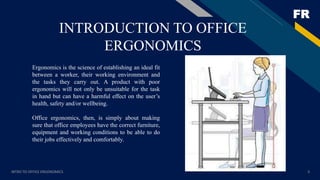
Ergonomics is the science of establishing an ideal fit
between a worker, their working environment and
the tasks they carry out. A product with poor
ergonomics will not only be unsuitable for the task
in hand but can have a harmful effect on the user’s
health, safety and/or wellbeing.
Office ergonomics, then, is simply about making
sure that office employees have the correct furniture,
equipment and working conditions to be able to do
their jobs effectively and comfortably.
FR
A BRIEF HISTORIC REVIEW 4
A BRIEF HISTORIC REVIEW
In the1970’s, in the global office
environments, computers were
rare, and musculoskeletal pain
was misunderstood or dismissed.
In the 1980’s, punch cards were
introduced followed by the
massive framed data entry
computers. Large groups of
secretarial staff worked 8-10 hour
days in fixed body positions with
limited breaks, inadequate
lighting, poor office arrangement,
and “Taylor trained” managers.
Many workers started to
complain of aches and pains.
Modern office ergonomics the
sole purpose of all ergonomic
office furniture is to make the
working environment as
comfortable and efficient as
possible so workers can be
productive without jeopardizing
their health
FR
Basic Office Ergonomics Principle
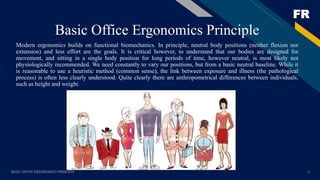
Modern ergonomics builds on functional biomechanics. In principle, neutral body positions (neither flexion nor
extension) and less effort are the goals. It is critical however, to understand that our bodies are designed for
movement, and sitting in a single body position for long periods of time, however neutral, is most likely not
physiologically recommended. We need constantly to vary our positions, but from a basic neutral baseline. While it
is reasonable to use a heuristic method (common sense), the link between exposure and illness (the pathological
process) is often less clearly understood. Quite clearly there are anthropometrical differences between individuals,
such as height and weight.
BASIC OFFICE ERGONOMICS PRINCIPLE 5
FR
FACTORS FOR GOOD WORK ENVIRONMENT 6
Mental
load
Work
overload
Good
leadership
Varied and
interesting
work
Appropriate
support
Plan and
influence
over work
Physical
Load/
Strain
Input
devices
close to
keyboard Rest
forearms on
work
surface
Take micro
breaks
Adjust
work
station
Vary sitting
standing
positions
Adjustable
room
temperature
Climate
Minimal
technical
equipment
in room
Don’t use
space under
work desk
for storage
Lighting
Flicker free
Shielded
Coordinated
with work
place design
Vision
Ergonomics
Regular
vision
check-ups
Monitor
height well
adjusted
Monitor
shouldn’t be
against
window
No light
reflexes
Guide to a good work environment according to the Swedish Work
Environment Authority
FR
POSSIBLE IMPACTS OF POOR OFFICE WORK-STATION 7
POSSIBLE IMPACTS OF POOR OFFICE WORK-STATION
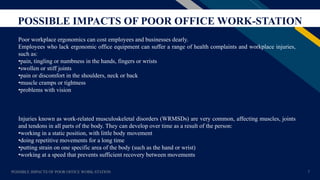
Poor workplace ergonomics can cost employees and businesses dearly.
Employees who lack ergonomic office equipment can suffer a range of health complaints and workplace injuries,
such as:
•pain, tingling or numbness in the hands, fingers or wrists
•swollen or stiff joints
•pain or discomfort in the shoulders, neck or back
•muscle cramps or tightness
•problems with vision
Injuries known as work-related musculoskeletal disorders (WRMSDs) are very common, affecting muscles, joints
and tendons in all parts of the body. They can develop over time as a result of the person:
•working in a static position, with little body movement
•doing repetitive movements for a long time
•putting strain on one specific area of the body (such as the hand or wrist)
•working at a speed that prevents sufficient recovery between movements
FR
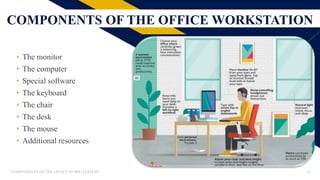
• The monitor
• The computer
• Special software
• The keyboard
• The chair
• The desk
• The mouse
• Additional resources
COMPONENTS OF THE OFFICE WORKSTATION
COMPONENTS OF THE OFFICE WORK-STATION 8
FR
COMPONENTS OF WORK STATION
THE MONITOR
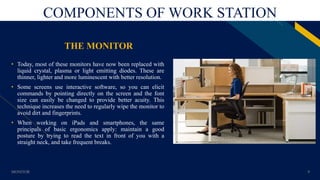
• Today, most of these monitors have now been replaced with
liquid crystal, plasma or light emitting diodes. These are
thinner, lighter and more luminescent with better resolution.
• Some screens use interactive software, so you can elicit
commands by pointing directly on the screen and the font
size can easily be changed to provide better acuity. This
technique increases the need to regularly wipe the monitor to
avoid dirt and fingerprints.
• When working on iPads and smartphones, the same
principals of basic ergonomics apply: maintain a good
posture by trying to read the text in front of you with a
straight neck, and take frequent breaks.
MONITOR 9
FR
COMPONENTS OF WORK STATION
THE COMPUTER
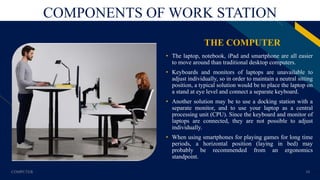
• The laptop, notebook, iPad and smartphone are all easier
to move around than traditional desktop computers.
• Keyboards and monitors of laptops are unavailable to
adjust individually, so in order to maintain a neutral sitting
position, a typical solution would be to place the laptop on
a stand at eye level and connect a separate keyboard.
• Another solution may be to use a docking station with a
separate monitor, and to use your laptop as a central
processing unit (CPU). Since the keyboard and monitor of
laptops are connected, they are not possible to adjust
individually.
• When using smartphones for playing games for long time
periods, a horizontal position (laying in bed) may
probably be recommended from an ergonomics
standpoint.
COMPUTER 10
FR
COMPONENTS OF WORK STATION
THE KEYBOARD
• Hands-free computing through speech recognition
software is quickly gaining market and has the
advantage of letting the computer do the typing. It is
however, still problematic to use for creating tables,
designing and drawing.
SPECIAL SOFTWARE AND THE KEYBOARD 11
SPECIAL SOFTWARE
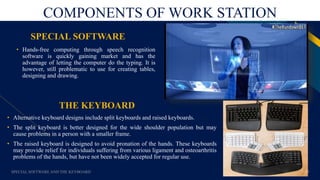
• Alternative keyboard designs include split keyboards and raised keyboards.
• The split keyboard is better designed for the wide shoulder population but may
cause problems in a person with a smaller frame.
• The raised keyboard is designed to avoid pronation of the hands. These keyboards
may provide relief for individuals suffering from various ligament and osteoarthritis
problems of the hands, but have not been widely accepted for regular use.
FR
COMPONENTS OF WORK STATION
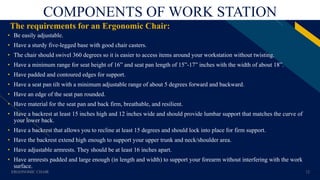
The requirements for an Ergonomic Chair:
• Be easily adjustable.
• Have a sturdy five-legged base with good chair casters.
• The chair should swivel 360 degrees so it is easier to access items around your workstation without twisting.
• Have a minimum range for seat height of 16” and seat pan length of 15”-17” inches with the width of about 18”.
• Have padded and contoured edges for support.
• Have a seat pan tilt with a minimum adjustable range of about 5 degrees forward and backward.
• Have an edge of the seat pan rounded.
• Have material for the seat pan and back firm, breathable, and resilient.
• Have a backrest at least 15 inches high and 12 inches wide and should provide lumbar support that matches the curve of
your lower back.
• Have a backrest that allows you to recline at least 15 degrees and should lock into place for firm support.
• Have the backrest extend high enough to support your upper trunk and neck/shoulder area.
• Have adjustable armrests. They should be at least 16 inches apart.
• Have armrests padded and large enough (in length and width) to support your forearm without interfering with the work
surface.
ERGONOMIC CHAIR 12
FR
COMPONENTS OF WORK STATION
THE DESK
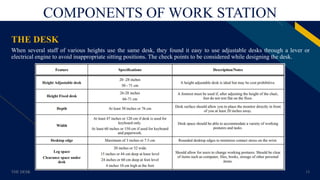
When several staff of various heights use the same desk, they found it easy to use adjustable desks through a lever or
electrical engine to avoid inappropriate sitting positions. The check points to be considered while designing the desk.
THE DESK 13
FR
COMPONENTS OF WORK STATION
ADDITIONAL RESOURCES
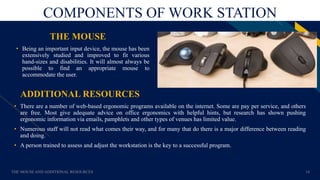
• Being an important input device, the mouse has been
extensively studied and improved to fit various
hand-sizes and disabilities. It will almost always be
possible to find an appropriate mouse to
accommodate the user.
THE MOUSE AND ADDITIONAL RESOURCES 14
THE MOUSE
• There are a number of web-based ergonomic programs available on the internet. Some are pay per service, and others
are free. Most give adequate advice on office ergonomics with helpful hints, but research has shown pushing
ergonomic information via emails, pamphlets and other types of venues has limited value.
• Numerous staff will not read what comes their way, and for many that do there is a major difference between reading
and doing.
• A person trained to assess and adjust the workstation is the key to a successful program.
Thank You
FR
16
References
• file:///C:/Msc%20sem1/Ergonomics%20in%20everyday%20life/The_Changing_Face_of_Office_Ergonomics.pdf
• http://www.ieomsociety.org/singapore2021/papers/182.pdf
• https://www.researchgate.net/publication/277672834_The_Changing_Face_of_Office_Ergonomics
• https://www.cmd-ltd.com/advice-centre/ergonomics/office-ergonomics/

Office work station Design.pptx

  • 1.
    OFFICE WORKSTATION DESIGN A NERG O N O MI CS PRO JECT O N TO PI C, SUBMITTED TO: PROF. MANJIT KAUR CHAUHAN SUBMITTED BY: KRITIKA VATS SUBJECT: ERGONOMICS IN EVERYDAY LIFE CLASS: JNR. M.SC RM & ID BATCH: 2021-2023
  • 2.
    CONTENTS 1. Introduction toOffice Ergonomics 2. A brief historic review 3. Basic office ergonomic principle 4. Factors affecting good work environment 5. Possible impact of poor office work station 6. List of components of office work station INDEX 2 The Monitor The computer Special software The keyboard The chair The desk The mouse Additional resources
  • 3.
    FR INTRO TO OFFICEERGONOMICS 3 INTRODUCTION TO OFFICE ERGONOMICS Ergonomics is the science of establishing an ideal fit between a worker, their working environment and the tasks they carry out. A product with poor ergonomics will not only be unsuitable for the task in hand but can have a harmful effect on the user’s health, safety and/or wellbeing. Office ergonomics, then, is simply about making sure that office employees have the correct furniture, equipment and working conditions to be able to do their jobs effectively and comfortably.
  • 4.
    FR A BRIEF HISTORICREVIEW 4 A BRIEF HISTORIC REVIEW In the1970’s, in the global office environments, computers were rare, and musculoskeletal pain was misunderstood or dismissed. In the 1980’s, punch cards were introduced followed by the massive framed data entry computers. Large groups of secretarial staff worked 8-10 hour days in fixed body positions with limited breaks, inadequate lighting, poor office arrangement, and “Taylor trained” managers. Many workers started to complain of aches and pains. Modern office ergonomics the sole purpose of all ergonomic office furniture is to make the working environment as comfortable and efficient as possible so workers can be productive without jeopardizing their health
  • 5.
    FR Basic Office ErgonomicsPrinciple Modern ergonomics builds on functional biomechanics. In principle, neutral body positions (neither flexion nor extension) and less effort are the goals. It is critical however, to understand that our bodies are designed for movement, and sitting in a single body position for long periods of time, however neutral, is most likely not physiologically recommended. We need constantly to vary our positions, but from a basic neutral baseline. While it is reasonable to use a heuristic method (common sense), the link between exposure and illness (the pathological process) is often less clearly understood. Quite clearly there are anthropometrical differences between individuals, such as height and weight. BASIC OFFICE ERGONOMICS PRINCIPLE 5
  • 6.
    FR FACTORS FOR GOODWORK ENVIRONMENT 6 Mental load Work overload Good leadership Varied and interesting work Appropriate support Plan and influence over work Physical Load/ Strain Input devices close to keyboard Rest forearms on work surface Take micro breaks Adjust work station Vary sitting standing positions Adjustable room temperature Climate Minimal technical equipment in room Don’t use space under work desk for storage Lighting Flicker free Shielded Coordinated with work place design Vision Ergonomics Regular vision check-ups Monitor height well adjusted Monitor shouldn’t be against window No light reflexes Guide to a good work environment according to the Swedish Work Environment Authority
  • 7.
    FR POSSIBLE IMPACTS OFPOOR OFFICE WORK-STATION 7 POSSIBLE IMPACTS OF POOR OFFICE WORK-STATION Poor workplace ergonomics can cost employees and businesses dearly. Employees who lack ergonomic office equipment can suffer a range of health complaints and workplace injuries, such as: •pain, tingling or numbness in the hands, fingers or wrists •swollen or stiff joints •pain or discomfort in the shoulders, neck or back •muscle cramps or tightness •problems with vision Injuries known as work-related musculoskeletal disorders (WRMSDs) are very common, affecting muscles, joints and tendons in all parts of the body. They can develop over time as a result of the person: •working in a static position, with little body movement •doing repetitive movements for a long time •putting strain on one specific area of the body (such as the hand or wrist) •working at a speed that prevents sufficient recovery between movements
  • 8.
    FR • The monitor •The computer • Special software • The keyboard • The chair • The desk • The mouse • Additional resources COMPONENTS OF THE OFFICE WORKSTATION COMPONENTS OF THE OFFICE WORK-STATION 8
  • 9.
    FR COMPONENTS OF WORKSTATION THE MONITOR • Today, most of these monitors have now been replaced with liquid crystal, plasma or light emitting diodes. These are thinner, lighter and more luminescent with better resolution. • Some screens use interactive software, so you can elicit commands by pointing directly on the screen and the font size can easily be changed to provide better acuity. This technique increases the need to regularly wipe the monitor to avoid dirt and fingerprints. • When working on iPads and smartphones, the same principals of basic ergonomics apply: maintain a good posture by trying to read the text in front of you with a straight neck, and take frequent breaks. MONITOR 9
  • 10.
    FR COMPONENTS OF WORKSTATION THE COMPUTER • The laptop, notebook, iPad and smartphone are all easier to move around than traditional desktop computers. • Keyboards and monitors of laptops are unavailable to adjust individually, so in order to maintain a neutral sitting position, a typical solution would be to place the laptop on a stand at eye level and connect a separate keyboard. • Another solution may be to use a docking station with a separate monitor, and to use your laptop as a central processing unit (CPU). Since the keyboard and monitor of laptops are connected, they are not possible to adjust individually. • When using smartphones for playing games for long time periods, a horizontal position (laying in bed) may probably be recommended from an ergonomics standpoint. COMPUTER 10
  • 11.
    FR COMPONENTS OF WORKSTATION THE KEYBOARD • Hands-free computing through speech recognition software is quickly gaining market and has the advantage of letting the computer do the typing. It is however, still problematic to use for creating tables, designing and drawing. SPECIAL SOFTWARE AND THE KEYBOARD 11 SPECIAL SOFTWARE • Alternative keyboard designs include split keyboards and raised keyboards. • The split keyboard is better designed for the wide shoulder population but may cause problems in a person with a smaller frame. • The raised keyboard is designed to avoid pronation of the hands. These keyboards may provide relief for individuals suffering from various ligament and osteoarthritis problems of the hands, but have not been widely accepted for regular use.
  • 12.
    FR COMPONENTS OF WORKSTATION The requirements for an Ergonomic Chair: • Be easily adjustable. • Have a sturdy five-legged base with good chair casters. • The chair should swivel 360 degrees so it is easier to access items around your workstation without twisting. • Have a minimum range for seat height of 16” and seat pan length of 15”-17” inches with the width of about 18”. • Have padded and contoured edges for support. • Have a seat pan tilt with a minimum adjustable range of about 5 degrees forward and backward. • Have an edge of the seat pan rounded. • Have material for the seat pan and back firm, breathable, and resilient. • Have a backrest at least 15 inches high and 12 inches wide and should provide lumbar support that matches the curve of your lower back. • Have a backrest that allows you to recline at least 15 degrees and should lock into place for firm support. • Have the backrest extend high enough to support your upper trunk and neck/shoulder area. • Have adjustable armrests. They should be at least 16 inches apart. • Have armrests padded and large enough (in length and width) to support your forearm without interfering with the work surface. ERGONOMIC CHAIR 12
  • 13.
    FR COMPONENTS OF WORKSTATION THE DESK When several staff of various heights use the same desk, they found it easy to use adjustable desks through a lever or electrical engine to avoid inappropriate sitting positions. The check points to be considered while designing the desk. THE DESK 13
  • 14.
    FR COMPONENTS OF WORKSTATION ADDITIONAL RESOURCES • Being an important input device, the mouse has been extensively studied and improved to fit various hand-sizes and disabilities. It will almost always be possible to find an appropriate mouse to accommodate the user. THE MOUSE AND ADDITIONAL RESOURCES 14 THE MOUSE • There are a number of web-based ergonomic programs available on the internet. Some are pay per service, and others are free. Most give adequate advice on office ergonomics with helpful hints, but research has shown pushing ergonomic information via emails, pamphlets and other types of venues has limited value. • Numerous staff will not read what comes their way, and for many that do there is a major difference between reading and doing. • A person trained to assess and adjust the workstation is the key to a successful program.
  • 15.
  • 16.
    FR 16 References • file:///C:/Msc%20sem1/Ergonomics%20in%20everyday%20life/The_Changing_Face_of_Office_Ergonomics.pdf • http://www.ieomsociety.org/singapore2021/papers/182.pdf •https://www.researchgate.net/publication/277672834_The_Changing_Face_of_Office_Ergonomics • https://www.cmd-ltd.com/advice-centre/ergonomics/office-ergonomics/