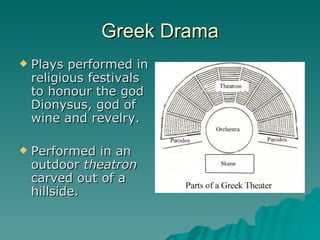
Greek Drama Plays performed in religious festivals to honour the god Dionysus, god of wine and revelry. Performed in an outdoor  theatron  carved out of a hillside.
Panoramic view of the Greek theater at Epidaurus
Mythology Polytheistic.  Gods interact with humans and often “play” with humans for their own amusement. They are capricious and unpredictable. Gods interbreed with humans.  The gods themselves are subject to the Fates.  Apollo, the  god of healing, prophecy (oracles), the arts -- especially music -- and archery.
History of  Oedipus Sophocles’  Theban plays include  Oedipus Rex ,  Oedipus at Colonus , and  Antigone  Family curse passed generation to generation.
The Oracle of Delphi Delphi  - the “centre of the world” or Omphalos The Temple of Apollo at Delphi attracts pilgrims who come to seek the advice of the  Pythia . The prophecies must be decoded and interpreted. Fate is inescapable.
The Riddle of the Sphinx What goes on four legs in the morning, on two legs at noon  and on three legs in the evening?
The Double Edge of Irony Knowledge of background story creates DRAMATIC IRONY Note also, SITUATIONAL IRONY
Tragedy Some Features of Greek Tragedy Three Unities (time, place and action) Violence and death offstage.  Frequent use of messengers to relate information.  Stories based on myth or history, but varied interpretations of events. Focus is on psychological and ethical attributes of characters.
Conventions Three actors on stage Masks All male cast Chorus Offer background and summary material. Comment on the themes. Express things the characters cannot say such as fears or secrets. Interact with characters and offer advice. “ Strophe” (movement) and “antistrophe” (countermovement).
Conventions cont.  Form The play opened with a  prologue,  the action before the entrance of the chorus.  Then came the  parados , the entering lyric of the chorus.  This was followed by the alternating  episodes , of the actors and the choral odes.  The play ended with the  exodos , the action after the last choral ode.
Aristotle’s Definition Every tragedy must include Plot, Character, Diction, Thought, Spectacle and Melody. The plot must be complex. The plot must represent what is fearful or pitiful. We must sympathize with the character and realize that the character falls into misfortune due not to wickedness, but due to a tragic flaw.
 

Oedipus

  • 1.
    Greek Drama Playsperformed in religious festivals to honour the god Dionysus, god of wine and revelry. Performed in an outdoor theatron carved out of a hillside.
  • 2.
    Panoramic view ofthe Greek theater at Epidaurus
  • 3.
    Mythology Polytheistic. Gods interact with humans and often “play” with humans for their own amusement. They are capricious and unpredictable. Gods interbreed with humans. The gods themselves are subject to the Fates. Apollo, the god of healing, prophecy (oracles), the arts -- especially music -- and archery.
  • 4.
    History of Oedipus Sophocles’ Theban plays include Oedipus Rex , Oedipus at Colonus , and Antigone Family curse passed generation to generation.
  • 5.
    The Oracle ofDelphi Delphi - the “centre of the world” or Omphalos The Temple of Apollo at Delphi attracts pilgrims who come to seek the advice of the Pythia . The prophecies must be decoded and interpreted. Fate is inescapable.
  • 6.
    The Riddle ofthe Sphinx What goes on four legs in the morning, on two legs at noon and on three legs in the evening?
  • 7.
    The Double Edgeof Irony Knowledge of background story creates DRAMATIC IRONY Note also, SITUATIONAL IRONY
  • 8.
    Tragedy Some Featuresof Greek Tragedy Three Unities (time, place and action) Violence and death offstage. Frequent use of messengers to relate information. Stories based on myth or history, but varied interpretations of events. Focus is on psychological and ethical attributes of characters.
  • 9.
    Conventions Three actorson stage Masks All male cast Chorus Offer background and summary material. Comment on the themes. Express things the characters cannot say such as fears or secrets. Interact with characters and offer advice. “ Strophe” (movement) and “antistrophe” (countermovement).
  • 10.
    Conventions cont. Form The play opened with a prologue, the action before the entrance of the chorus. Then came the parados , the entering lyric of the chorus. This was followed by the alternating episodes , of the actors and the choral odes. The play ended with the exodos , the action after the last choral ode.
  • 11.
    Aristotle’s Definition Everytragedy must include Plot, Character, Diction, Thought, Spectacle and Melody. The plot must be complex. The plot must represent what is fearful or pitiful. We must sympathize with the character and realize that the character falls into misfortune due not to wickedness, but due to a tragic flaw.
  • 12.