



LEAN
MANUFACTURING
TOOLS
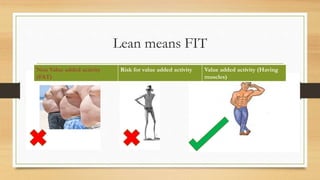
Lean means FIT
Non Value added activity
(FAT)
Risk for value added activity Value added activity (Having
muscles)
What is Lean Manufacturing ?
• Lean manufacturing is a manufacturing method which aims to reduce
wastage.
• Example of companies who are working Lean Manufacturing tools :
• Toyota
• Intel
• John Deere
• Nike
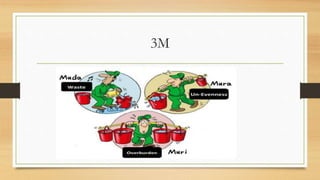
3M
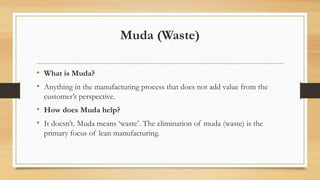
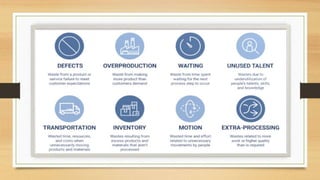
Muda (Waste)
• What is Muda?
• Anything in the manufacturing process that does not add value from the
customer’s perspective.
• How does Muda help?
• It doesn’t. Muda means ‘waste’. The elimination of muda (waste) is the
primary focus of lean manufacturing.
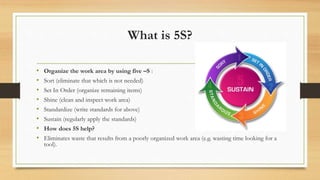
What is 5S?
• Organize the work area by using five –S :
• Sort (eliminate that which is not needed)
• Set In Order (organize remaining items)
• Shine (clean and inspect work area)
• Standardize (write standards for above)
• Sustain (regularly apply the standards)
• How does 5S help?
• Eliminates waste that results from a poorly organized work area (e.g. wasting time looking for a
tool).
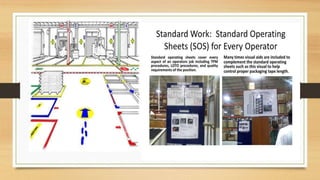
Visual Factory
• What is Visual Factory?
• Visual indicators, displays and controls used throughout manufacturing
plants to improve communication of information.
• How does Visual Factory help?
• Makes the state and condition of manufacturing processes easily accessible
and very clear – to everyone.
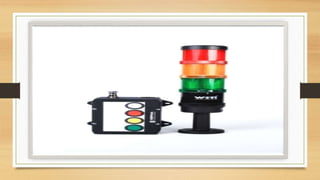
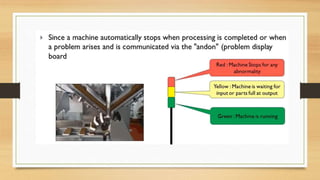
Andon
• What is Andon?
• Visual feedback system for the plant floor that indicates production status,
alerts when assistance is needed, and empowers operators to stop the
production process.
• How does Andon help?
• Acts as a real-time communication tool for the plant floor that brings
immediate attention to problems as they occur – so they can be instantly
addressed.
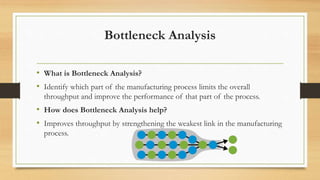
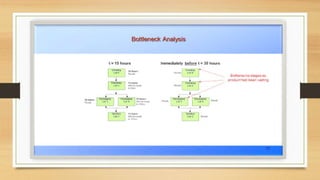
Bottleneck Analysis
• What is Bottleneck Analysis?
• Identify which part of the manufacturing process limits the overall
throughput and improve the performance of that part of the process.
• How does Bottleneck Analysis help?
• Improves throughput by strengthening the weakest link in the manufacturing
process.
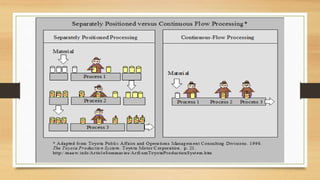
Continuous Flow
• What is Continuous Flow?
• Manufacturing where work-in-process smoothly flows through production
with minimal (or no) buffers between steps of the manufacturing process.
• How does Continuous Flow help?
• Eliminates many forms of waste (e.g. inventory, waiting time, and transport).
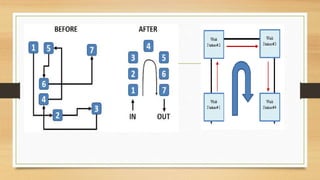
Cellular Manufacturing
• Cellular manufacturing supports continuous flow by calling on teams to
arrange workstations based on the parts they produce in order to minimize
travel time for those parts and allow for rapid feedback across stations about
any issues. Together, these two Lean manufacturing tools also enable teams
to produce smaller, more efficient batches. Organizations typically achieve
cellular manufacturing by arranging workstations in a “U” formation.
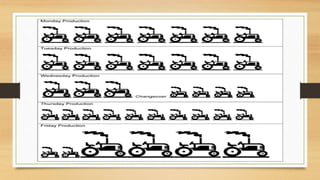
Heijunka (Level Scheduling)
• What is Heijunka?
• A form of production scheduling that purposely manufactures in much
smaller batches by sequencing (mixing) product variants within the same
process.
• How does Heijunka help?
• Reduces lead times (since each product or variant is manufactured more
frequently) and inventory (since batches are smaller).
Gemba (The Real Place)
• What is Gemba?
• A philosophy that reminds us to get out of our offices and spend time on
the plant floor – the place where real action occurs.
• How does Gemba help?
• Promotes a deep and thorough understanding of real-world manufacturing
issues – by first-hand observation and by talking with plant floor employees.
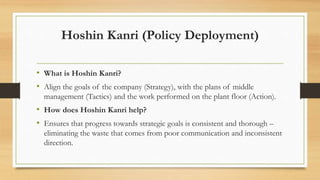
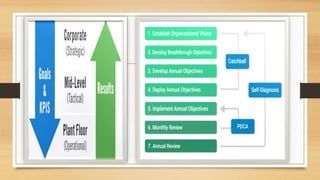
Hoshin Kanri (Policy Deployment)
• What is Hoshin Kanri?
• Align the goals of the company (Strategy), with the plans of middle
management (Tactics) and the work performed on the plant floor (Action).
• How does Hoshin Kanri help?
• Ensures that progress towards strategic goals is consistent and thorough –
eliminating the waste that comes from poor communication and inconsistent
direction.
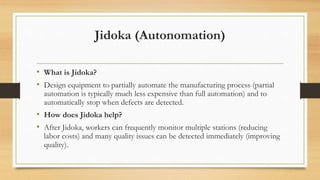
Jidoka (Autonomation)
• What is Jidoka?
• Design equipment to partially automate the manufacturing process (partial
automation is typically much less expensive than full automation) and to
automatically stop when defects are detected.
• How does Jidoka help?
• After Jidoka, workers can frequently monitor multiple stations (reducing
labor costs) and many quality issues can be detected immediately (improving
quality).
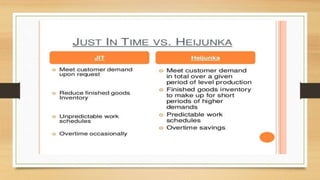
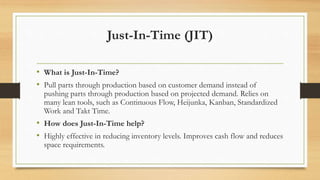
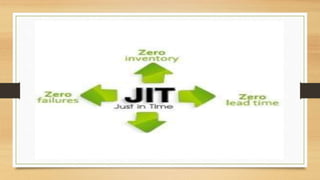
Just-In-Time (JIT)
• What is Just-In-Time?
• Pull parts through production based on customer demand instead of
pushing parts through production based on projected demand. Relies on
many lean tools, such as Continuous Flow, Heijunka, Kanban, Standardized
Work and Takt Time.
• How does Just-In-Time help?
• Highly effective in reducing inventory levels. Improves cash flow and reduces
space requirements.
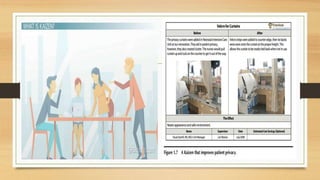
Kaizen (Continuous Improvement)
• What is Kaizen?
• A strategy where employees work together proactively to achieve regular,
incremental improvements in the manufacturing process.
• How does Kaizen help?
• Combines the collective talents of a company to create an engine for
continually eliminating waste from manufacturing processes.
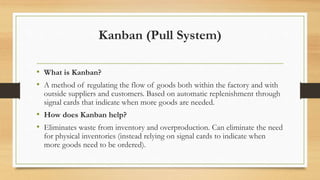
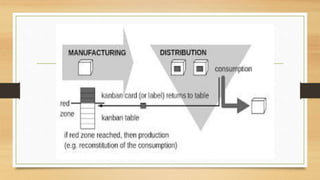
Kanban (Pull System)
• What is Kanban?
• A method of regulating the flow of goods both within the factory and with
outside suppliers and customers. Based on automatic replenishment through
signal cards that indicate when more goods are needed.
• How does Kanban help?
• Eliminates waste from inventory and overproduction. Can eliminate the need
for physical inventories (instead relying on signal cards to indicate when
more goods need to be ordered).
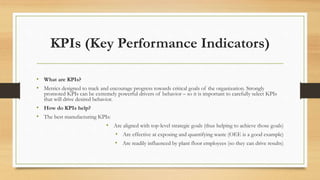
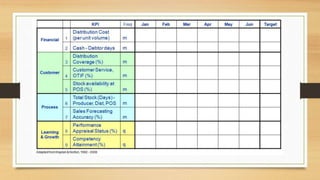
KPIs (Key Performance Indicators)
• What are KPIs?
• Metrics designed to track and encourage progress towards critical goals of the organization. Strongly
promoted KPIs can be extremely powerful drivers of behavior – so it is important to carefully select KPIs
that will drive desired behavior.
• How do KPIs help?
• The best manufacturing KPIs:
• Are aligned with top-level strategic goals (thus helping to achieve those goals)
• Are effective at exposing and quantifying waste (OEE is a good example)
• Are readily influenced by plant floor employees (so they can drive results)
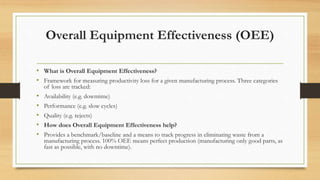
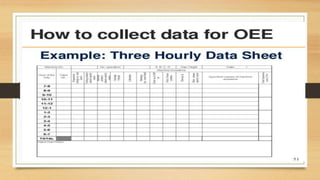
Overall Equipment Effectiveness (OEE)
• What is Overall Equipment Effectiveness?
• Framework for measuring productivity loss for a given manufacturing process. Three categories
of loss are tracked:
• Availability (e.g. downtime)
• Performance (e.g. slow cycles)
• Quality (e.g. rejects)
• How does Overall Equipment Effectiveness help?
• Provides a benchmark/baseline and a means to track progress in eliminating waste from a
manufacturing process. 100% OEE means perfect production (manufacturing only good parts, as
fast as possible, with no downtime).
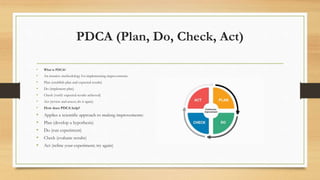
PDCA (Plan, Do, Check, Act)
• What is PDCA?
• An iterative methodology for implementing improvements:
• Plan (establish plan and expected results)
• Do (implement plan)
• Check (verify expected results achieved)
• Act (review and assess; do it again)
• How does PDCA help?
• Applies a scientific approach to making improvements:
• Plan (develop a hypothesis)
• Do (run experiment)
• Check (evaluate results)
• Act (refine your experiment; try again)
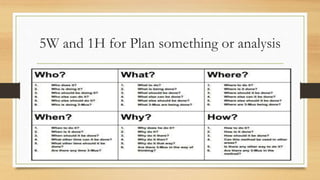
5W and 1H for Plan something or analysis
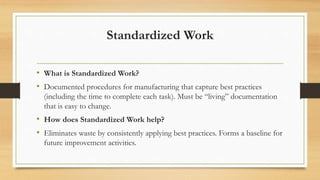
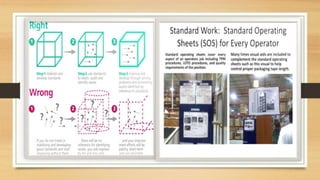
Standardized Work
• What is Standardized Work?
• Documented procedures for manufacturing that capture best practices
(including the time to complete each task). Must be “living” documentation
that is easy to change.
• How does Standardized Work help?
• Eliminates waste by consistently applying best practices. Forms a baseline for
future improvement activities.
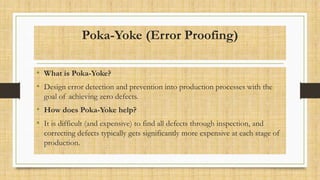
Poka-Yoke (Error Proofing)
• What is Poka-Yoke?
• Design error detection and prevention into production processes with the
goal of achieving zero defects.
• How does Poka-Yoke help?
• It is difficult (and expensive) to find all defects through inspection, and
correcting defects typically gets significantly more expensive at each stage of
production.
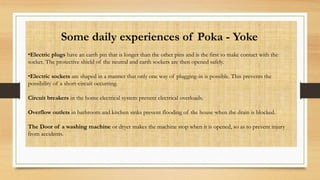
Some daily experiences of Poka - Yoke
•Electric plugs have an earth pin that is longer than the other pins and is the first to make contact with the
socket. The protective shield of the neutral and earth sockets are then opened safely.
•Electric sockets are shaped in a manner that only one way of plugging-in is possible. This prevents the
possibility of a short-circuit occurring.
Circuit breakers in the home electrical system prevent electrical overloads.
Overflow outlets in bathroom and kitchen sinks prevent flooding of the house when the drain is blocked.
The Door of a washing machine or dryer makes the machine stop when it is opened, so as to prevent injury
from accidents.
Mistake proofing in Auto mobile
• Radar and video cameras in new vehicle models are able to tell the distance and speed of
other road users. This helps them prevent collisions in case of sudden stops.
• Lane-keeping assist alerts the driver that he is about to deviate from his lane. If the driver is
not responsive, the vehicle intervenes and returns to the correct lane on its own.
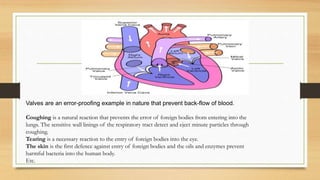
Valves are an error-proofing example in nature that prevent back-flow of blood.
Coughing is a natural reaction that prevents the error of foreign bodies from entering into the
lungs. The sensitive wall linings of the respiratory tract detect and eject minute particles through
coughing.
Tearing is a necessary reaction to the entry of foreign bodies into the eye.
The skin is the first defence against entry of foreign bodies and the oils and enzymes prevent
harmful bacteria into the human body.
Etc.
Mistake-Proofing of Products
• Safety concerns necessitate the use of mistake proofing techniques on the
final product in order to prevent harm to the final consumer.
• It also provides ease of use to the product so as to enable the final
consumers to be able to solve their problems effectively.
• Adding user-friendly features to a product aims at solving safety as well as
convenience concerns and makes it almost impossible to use the product in
the wrong way.
Root Cause Analysis
• What is Root Cause Analysis?
• A problem solving methodology that focuses on resolving the underlying
problem instead of applying quick fixes that only treat immediate symptoms
of the problem. A common approach is to ask why five times – each time
moving a step closer to discovering the true underlying problem.
• How does Root Cause Analysis help?
• Helps to ensure that a problem is truly eliminated by applying corrective
action to the “root cause” of the problem.
5 WHY
• The Five Whys is another one of several Lean manufacturing tools used to
identify the root cause of a problem. Quite simply, it requires participants to
continually ask “why?” questions (typically five or fewer times) to peel back
the layers. This questioning allows teams to diagnose problems without any
statistical analysis and often identifies multiple root causes and the
relationships between them.
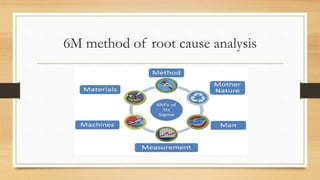
6M method of root cause analysis
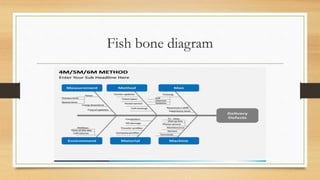
Fish bone diagram
Single-Minute Exchange of Dies (SMED)
• What is Single-Minute Exchange of Dies?
• Reduce setup (changeover) time to less than 10 minutes. Techniques include:
• Convert setup steps to be external (performed while the process is running)
• Simplify internal setup (e.g. replace bolts with knobs and levers)
• Eliminate non-essential operations
• Create Standardized Work instructions
• How does Single-Minute Exchange of Dies help?
• Enables manufacturing in smaller lots, reduces inventory, and improves customer responsiveness.
Six Big Losses
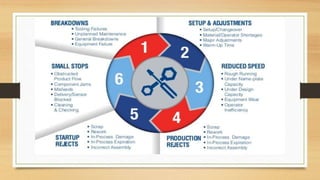
What is Six Big Losses?
Six categories of productivity loss that are almost universally experienced in manufacturing:
• Breakdowns
• Setup/Adjustments
• Small Stops
• Reduced Speed
• Startup Rejects
• Production Rejects
How does Six Big Losses help?
• Provides a framework for attacking the most common causes of waste in manufacturing.
SMART Goals
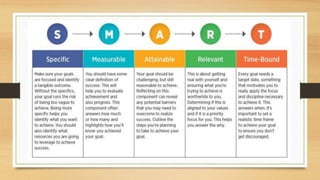
What are SMART Goals?
• Goals that are: Specific, Measurable, Attainable, Relevant, and Time-Specific.
How do SMART Goals help?
• Helps to ensure that goals are effective.
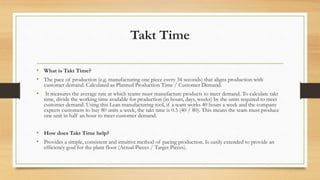
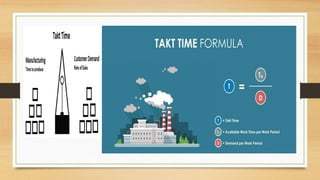
Takt Time
• What is Takt Time?
• The pace of production (e.g. manufacturing one piece every 34 seconds) that aligns production with
customer demand. Calculated as Planned Production Time / Customer Demand.
• It measures the average rate at which teams must manufacture products to meet demand. To calculate takt
time, divide the working time available for production (in hours, days, weeks) by the units required to meet
customer demand. Using this Lean manufacturing tool, if a team works 40 hours a week and the company
expects customers to buy 80 units a week, the takt time is 0.5 (40 / 80). This means the team must produce
one unit in half an hour to meet customer demand.
• How does Takt Time help?
• Provides a simple, consistent and intuitive method of pacing production. Is easily extended to provide an
efficiency goal for the plant floor (Actual Pieces / Target Pieces).
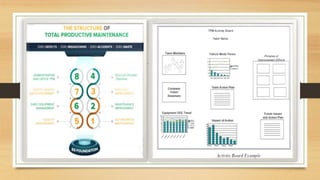
Total Productive Maintenance (TPM)
• What is Total Productive Maintenance?
• A holistic approach to maintenance that focuses on proactive and preventative
maintenance to maximize the operational time of equipment. TPM blurs the
distinction between maintenance and production by placing a strong emphasis on
empowering operators to help maintain their equipment.
• How does Total Productive Maintenance help?
• Creates a shared responsibility for equipment that encourages greater involvement
by plant floor workers. In the right environment this can be very effective in
improving productivity (increasing up time, reducing cycle times, and eliminating
defects).
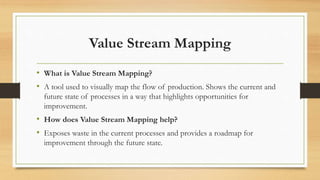
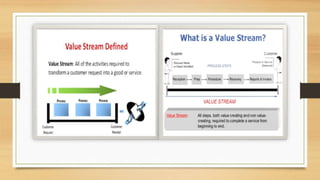
Value Stream Mapping
• What is Value Stream Mapping?
• A tool used to visually map the flow of production. Shows the current and
future state of processes in a way that highlights opportunities for
improvement.
• How does Value Stream Mapping help?
• Exposes waste in the current processes and provides a roadmap for
improvement through the future state.
Lean manufacturing tools By Er. Manish Dwivedi

Lean manufacturing tools By Er. Manish Dwivedi

  • 1.
  • 2.
    Lean means FIT NonValue added activity (FAT) Risk for value added activity Value added activity (Having muscles)
  • 6.
    What is LeanManufacturing ? • Lean manufacturing is a manufacturing method which aims to reduce wastage. • Example of companies who are working Lean Manufacturing tools : • Toyota • Intel • John Deere • Nike
  • 7.
  • 8.
    Muda (Waste) • Whatis Muda? • Anything in the manufacturing process that does not add value from the customer’s perspective. • How does Muda help? • It doesn’t. Muda means ‘waste’. The elimination of muda (waste) is the primary focus of lean manufacturing.
  • 10.
    What is 5S? •Organize the work area by using five –S : • Sort (eliminate that which is not needed) • Set In Order (organize remaining items) • Shine (clean and inspect work area) • Standardize (write standards for above) • Sustain (regularly apply the standards) • How does 5S help? • Eliminates waste that results from a poorly organized work area (e.g. wasting time looking for a tool).
  • 11.
    Visual Factory • Whatis Visual Factory? • Visual indicators, displays and controls used throughout manufacturing plants to improve communication of information. • How does Visual Factory help? • Makes the state and condition of manufacturing processes easily accessible and very clear – to everyone.
  • 13.
    Andon • What isAndon? • Visual feedback system for the plant floor that indicates production status, alerts when assistance is needed, and empowers operators to stop the production process. • How does Andon help? • Acts as a real-time communication tool for the plant floor that brings immediate attention to problems as they occur – so they can be instantly addressed.
  • 15.
    Bottleneck Analysis • Whatis Bottleneck Analysis? • Identify which part of the manufacturing process limits the overall throughput and improve the performance of that part of the process. • How does Bottleneck Analysis help? • Improves throughput by strengthening the weakest link in the manufacturing process.
  • 17.
    Continuous Flow • Whatis Continuous Flow? • Manufacturing where work-in-process smoothly flows through production with minimal (or no) buffers between steps of the manufacturing process. • How does Continuous Flow help? • Eliminates many forms of waste (e.g. inventory, waiting time, and transport).
  • 19.
    Cellular Manufacturing • Cellularmanufacturing supports continuous flow by calling on teams to arrange workstations based on the parts they produce in order to minimize travel time for those parts and allow for rapid feedback across stations about any issues. Together, these two Lean manufacturing tools also enable teams to produce smaller, more efficient batches. Organizations typically achieve cellular manufacturing by arranging workstations in a “U” formation.
  • 21.
    Heijunka (Level Scheduling) •What is Heijunka? • A form of production scheduling that purposely manufactures in much smaller batches by sequencing (mixing) product variants within the same process. • How does Heijunka help? • Reduces lead times (since each product or variant is manufactured more frequently) and inventory (since batches are smaller).
  • 24.
    Gemba (The RealPlace) • What is Gemba? • A philosophy that reminds us to get out of our offices and spend time on the plant floor – the place where real action occurs. • How does Gemba help? • Promotes a deep and thorough understanding of real-world manufacturing issues – by first-hand observation and by talking with plant floor employees.
  • 26.
    Hoshin Kanri (PolicyDeployment) • What is Hoshin Kanri? • Align the goals of the company (Strategy), with the plans of middle management (Tactics) and the work performed on the plant floor (Action). • How does Hoshin Kanri help? • Ensures that progress towards strategic goals is consistent and thorough – eliminating the waste that comes from poor communication and inconsistent direction.
  • 28.
    Jidoka (Autonomation) • Whatis Jidoka? • Design equipment to partially automate the manufacturing process (partial automation is typically much less expensive than full automation) and to automatically stop when defects are detected. • How does Jidoka help? • After Jidoka, workers can frequently monitor multiple stations (reducing labor costs) and many quality issues can be detected immediately (improving quality).
  • 30.
    Just-In-Time (JIT) • Whatis Just-In-Time? • Pull parts through production based on customer demand instead of pushing parts through production based on projected demand. Relies on many lean tools, such as Continuous Flow, Heijunka, Kanban, Standardized Work and Takt Time. • How does Just-In-Time help? • Highly effective in reducing inventory levels. Improves cash flow and reduces space requirements.
  • 32.
    Kaizen (Continuous Improvement) •What is Kaizen? • A strategy where employees work together proactively to achieve regular, incremental improvements in the manufacturing process. • How does Kaizen help? • Combines the collective talents of a company to create an engine for continually eliminating waste from manufacturing processes.
  • 34.
    Kanban (Pull System) •What is Kanban? • A method of regulating the flow of goods both within the factory and with outside suppliers and customers. Based on automatic replenishment through signal cards that indicate when more goods are needed. • How does Kanban help? • Eliminates waste from inventory and overproduction. Can eliminate the need for physical inventories (instead relying on signal cards to indicate when more goods need to be ordered).
  • 36.
    KPIs (Key PerformanceIndicators) • What are KPIs? • Metrics designed to track and encourage progress towards critical goals of the organization. Strongly promoted KPIs can be extremely powerful drivers of behavior – so it is important to carefully select KPIs that will drive desired behavior. • How do KPIs help? • The best manufacturing KPIs: • Are aligned with top-level strategic goals (thus helping to achieve those goals) • Are effective at exposing and quantifying waste (OEE is a good example) • Are readily influenced by plant floor employees (so they can drive results)
  • 38.
    Overall Equipment Effectiveness(OEE) • What is Overall Equipment Effectiveness? • Framework for measuring productivity loss for a given manufacturing process. Three categories of loss are tracked: • Availability (e.g. downtime) • Performance (e.g. slow cycles) • Quality (e.g. rejects) • How does Overall Equipment Effectiveness help? • Provides a benchmark/baseline and a means to track progress in eliminating waste from a manufacturing process. 100% OEE means perfect production (manufacturing only good parts, as fast as possible, with no downtime).
  • 40.
    PDCA (Plan, Do,Check, Act) • What is PDCA? • An iterative methodology for implementing improvements: • Plan (establish plan and expected results) • Do (implement plan) • Check (verify expected results achieved) • Act (review and assess; do it again) • How does PDCA help? • Applies a scientific approach to making improvements: • Plan (develop a hypothesis) • Do (run experiment) • Check (evaluate results) • Act (refine your experiment; try again)
  • 41.
    5W and 1Hfor Plan something or analysis
  • 42.
    Standardized Work • Whatis Standardized Work? • Documented procedures for manufacturing that capture best practices (including the time to complete each task). Must be “living” documentation that is easy to change. • How does Standardized Work help? • Eliminates waste by consistently applying best practices. Forms a baseline for future improvement activities.
  • 45.
    Poka-Yoke (Error Proofing) •What is Poka-Yoke? • Design error detection and prevention into production processes with the goal of achieving zero defects. • How does Poka-Yoke help? • It is difficult (and expensive) to find all defects through inspection, and correcting defects typically gets significantly more expensive at each stage of production.
  • 46.
    Some daily experiencesof Poka - Yoke •Electric plugs have an earth pin that is longer than the other pins and is the first to make contact with the socket. The protective shield of the neutral and earth sockets are then opened safely. •Electric sockets are shaped in a manner that only one way of plugging-in is possible. This prevents the possibility of a short-circuit occurring. Circuit breakers in the home electrical system prevent electrical overloads. Overflow outlets in bathroom and kitchen sinks prevent flooding of the house when the drain is blocked. The Door of a washing machine or dryer makes the machine stop when it is opened, so as to prevent injury from accidents.
  • 47.
    Mistake proofing inAuto mobile • Radar and video cameras in new vehicle models are able to tell the distance and speed of other road users. This helps them prevent collisions in case of sudden stops. • Lane-keeping assist alerts the driver that he is about to deviate from his lane. If the driver is not responsive, the vehicle intervenes and returns to the correct lane on its own.
  • 48.
    Valves are anerror-proofing example in nature that prevent back-flow of blood. Coughing is a natural reaction that prevents the error of foreign bodies from entering into the lungs. The sensitive wall linings of the respiratory tract detect and eject minute particles through coughing. Tearing is a necessary reaction to the entry of foreign bodies into the eye. The skin is the first defence against entry of foreign bodies and the oils and enzymes prevent harmful bacteria into the human body. Etc.
  • 49.
    Mistake-Proofing of Products •Safety concerns necessitate the use of mistake proofing techniques on the final product in order to prevent harm to the final consumer. • It also provides ease of use to the product so as to enable the final consumers to be able to solve their problems effectively. • Adding user-friendly features to a product aims at solving safety as well as convenience concerns and makes it almost impossible to use the product in the wrong way.
  • 50.
    Root Cause Analysis •What is Root Cause Analysis? • A problem solving methodology that focuses on resolving the underlying problem instead of applying quick fixes that only treat immediate symptoms of the problem. A common approach is to ask why five times – each time moving a step closer to discovering the true underlying problem. • How does Root Cause Analysis help? • Helps to ensure that a problem is truly eliminated by applying corrective action to the “root cause” of the problem.
  • 51.
    5 WHY • TheFive Whys is another one of several Lean manufacturing tools used to identify the root cause of a problem. Quite simply, it requires participants to continually ask “why?” questions (typically five or fewer times) to peel back the layers. This questioning allows teams to diagnose problems without any statistical analysis and often identifies multiple root causes and the relationships between them.
  • 52.
    6M method ofroot cause analysis
  • 53.
  • 54.
    Single-Minute Exchange ofDies (SMED) • What is Single-Minute Exchange of Dies? • Reduce setup (changeover) time to less than 10 minutes. Techniques include: • Convert setup steps to be external (performed while the process is running) • Simplify internal setup (e.g. replace bolts with knobs and levers) • Eliminate non-essential operations • Create Standardized Work instructions • How does Single-Minute Exchange of Dies help? • Enables manufacturing in smaller lots, reduces inventory, and improves customer responsiveness.
  • 55.
    Six Big Losses Whatis Six Big Losses? Six categories of productivity loss that are almost universally experienced in manufacturing: • Breakdowns • Setup/Adjustments • Small Stops • Reduced Speed • Startup Rejects • Production Rejects How does Six Big Losses help? • Provides a framework for attacking the most common causes of waste in manufacturing.
  • 57.
    SMART Goals What areSMART Goals? • Goals that are: Specific, Measurable, Attainable, Relevant, and Time-Specific. How do SMART Goals help? • Helps to ensure that goals are effective.
  • 59.
    Takt Time • Whatis Takt Time? • The pace of production (e.g. manufacturing one piece every 34 seconds) that aligns production with customer demand. Calculated as Planned Production Time / Customer Demand. • It measures the average rate at which teams must manufacture products to meet demand. To calculate takt time, divide the working time available for production (in hours, days, weeks) by the units required to meet customer demand. Using this Lean manufacturing tool, if a team works 40 hours a week and the company expects customers to buy 80 units a week, the takt time is 0.5 (40 / 80). This means the team must produce one unit in half an hour to meet customer demand. • How does Takt Time help? • Provides a simple, consistent and intuitive method of pacing production. Is easily extended to provide an efficiency goal for the plant floor (Actual Pieces / Target Pieces).
  • 61.
    Total Productive Maintenance(TPM) • What is Total Productive Maintenance? • A holistic approach to maintenance that focuses on proactive and preventative maintenance to maximize the operational time of equipment. TPM blurs the distinction between maintenance and production by placing a strong emphasis on empowering operators to help maintain their equipment. • How does Total Productive Maintenance help? • Creates a shared responsibility for equipment that encourages greater involvement by plant floor workers. In the right environment this can be very effective in improving productivity (increasing up time, reducing cycle times, and eliminating defects).
  • 63.
    Value Stream Mapping •What is Value Stream Mapping? • A tool used to visually map the flow of production. Shows the current and future state of processes in a way that highlights opportunities for improvement. • How does Value Stream Mapping help? • Exposes waste in the current processes and provides a roadmap for improvement through the future state.