MZCET/EEE/VII Sem/OCH353_ET/Unit 5
OCH353 – ENERGY TECHNOLOGY
UNIT 5 – ENERGY CONSERVATION
R.RAMANATHAN
ASSISTANT PROFESSOR/EEE
MOUNT ZION COLLEGE OF ENGINEERING AND TECHNOLOGY
MZCET/EEE/VII Sem/OCH353_ET/Unit 5
Outline
• 5.1 – Energy conservation in chemical process plants
• 5.2 – Energy audit, energy saving in heat exchangers
• 5.3 – distillation columns, dryers
• 5.4 - ovens and furnaces
• 5.5 - boilers, steam
• 5.6 - economy in chemical plants,
• 5.7 - energy conservation.
MZCET/EEE/VII Sem/OCH353_ET/Unit 5
Course Outcome
CO 1: Understanding Biomass Fundamentals:
CO 2: Knowledge of Biomass Conversion Technologies
CO 3: Assessment of Biomass Resources:
 CO 4: Environmental and Economic Impacts:
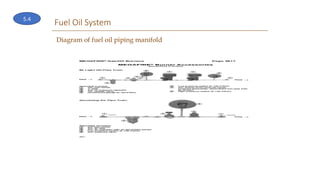
CO 5: Policy and Regulatory Framework
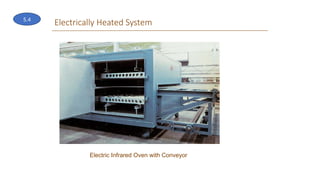
CO 6: Design and Implementation:
CO 7: Critical Thinking and Problem Solving
CO 8: Communication and Collaboration
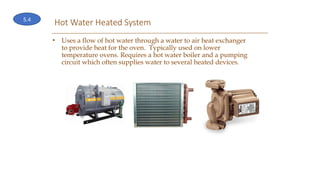
MZCET/EEE/VII Sem/OCH353_ET/Unit 5
PREVIOUS SESSION TODAYS SESSION
5.3 – distillation columns, dryers 5.4 - ovens and furnaces
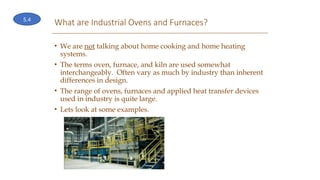
What are Industrial Ovens and Furnaces?
• We are not talking about home cooking and home heating
systems.
• The terms oven, furnace, and kiln are used somewhat
interchangeably. Often vary as much by industry than inherent
differences in design.
• The range of ovens, furnaces and applied heat transfer devices
used in industry is quite large.
• Lets look at some examples.
5.4
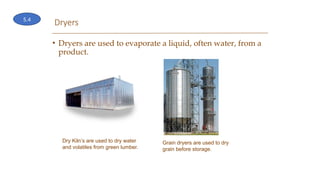
Dryers
• Dryers are used to evaporate a liquid, often water, from a
product.
Dry Kiln’s are used to dry water
and volatiles from green lumber.
Grain dryers are used to dry
grain before storage.
5.4
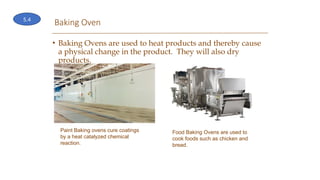
Baking Oven
• Baking Ovens are used to heat products and thereby cause
a physical change in the product. They will also dry
products.
Paint Baking ovens cure coatings
by a heat catalyzed chemical
reaction.
Food Baking Ovens are used to
cook foods such as chicken and
bread.
5.4
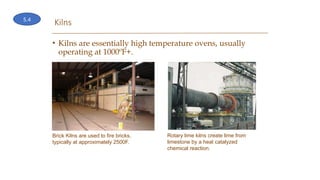
Kilns
• Kilns are essentially high temperature ovens, usually
operating at 1000ºF+.
Brick Kilns are used to fire bricks,
typically at approximately 2500F.
Rotary lime kilns create lime from
limestone by a heat catalyzed
chemical reaction.
5.4
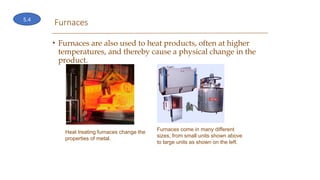
Furnaces
• Furnaces are also used to heat products, often at higher
temperatures, and thereby cause a physical change in the
product.
Heat treating furnaces change the
properties of metal.
Furnaces come in many different
sizes, from small units shown above
to large units as shown on the left.
5.4
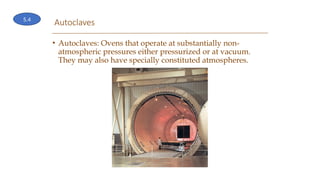
Autoclaves
• Autoclaves: Ovens that operate at substantially non-
atmospheric pressures either pressurized or at vacuum.
They may also have specially constituted atmospheres.
5.4
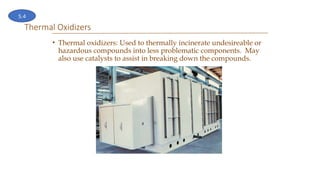
Thermal Oxidizers
• Thermal oxidizers: Used to thermally incinerate undesireable or
hazardous compounds into less problematic components. May
also use catalysts to assist in breaking down the compounds.
5.4
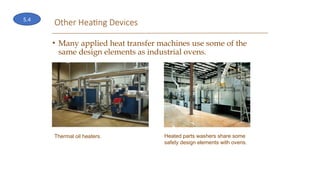
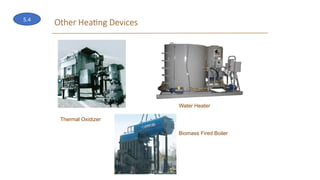
Other Heating Devices
• Many applied heat transfer machines use some of the
same design elements as industrial ovens.
Thermal oil heaters. Heated parts washers share some
safety design elements with ovens.
5.4
Other Heating Devices
Thermal Oxidizer
Water Heater
Biomass Fired Boiler
5.4
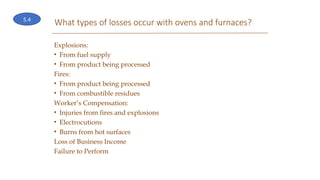
What types of losses occur with ovens and furnaces?
Explosions:
• From fuel supply
• From product being processed
Fires:
• From product being processed
• From combustible residues
Worker’s Compensation:
• Injuries from fires and explosions
• Electrocutions
• Burns from hot surfaces
Loss of Business Income
Failure to Perform
5.4
What defines the correct way to design, build, and
operate ovens and furnaces?
• Codes and Standards:
Codes have been written in a format suitable for adoption into law
independent of other codes and standards. An example is the
International Fire Code.
Standards are documents containing mandatory provisions using the word
“shall” to indicate a requirement. They are written in a form such that
their provisions become mandatory when referenced by another code or
standard. An example is NPFA 86: Standard for Ovens and Furnaces.
• Good Engineering Practice
• Design Guides
• Normal Practices / State of the Art
5.4
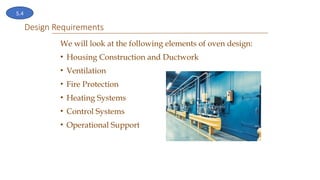
Design Requirements
We will look at the following elements of oven design:
• Housing Construction and Ductwork
• Ventilation
• Fire Protection
• Heating Systems
• Control Systems
• Operational Support
5.4
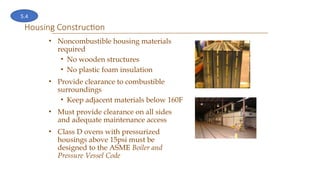
Housing Construction
• Noncombustible housing materials
required
• No wooden structures
• No plastic foam insulation
• Provide clearance to combustible
surroundings
• Keep adjacent materials below 160F
• Must provide clearance on all sides
and adequate maintenance access
• Class D ovens with pressurized
housings above 15psi must be
designed to the ASME Boiler and
Pressure Vessel Code
5.4
Housing Construction
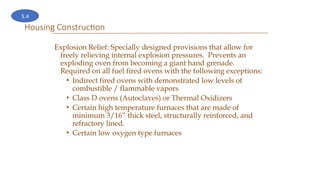
Explosion Relief: Specially designed provisions that allow for
freely relieving internal explosion pressures. Prevents an
exploding oven from becoming a giant hand grenade.
Required on all fuel fired ovens with the following exceptions:
• Indirect fired ovens with demonstrated low levels of
combustible / flammable vapors
• Class D ovens (Autoclaves) or Thermal Oxidizers
• Certain high temperature furnaces that are made of
minimum 3/16” thick steel, structurally reinforced, and
refractory lined.
• Certain low oxygen type furnaces
5.4
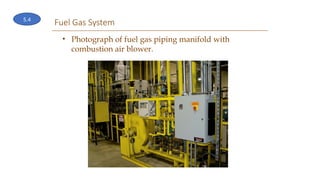
Fuel Gas System
• Photograph of fuel gas piping manifold with
combustion air blower.
5.4
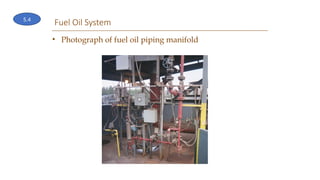
Fuel Oil System
• Photograph of fuel oil piping manifold
5.4
Fuel Oil System
Diagram of fuel oil piping manifold
5.4
Electrically Heated System
Electric Infrared Oven with Conveyor
5.4
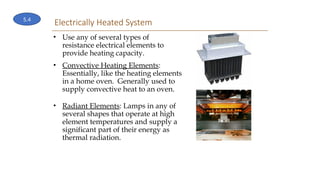
Electrically Heated System
• Use any of several types of
resistance electrical elements to
provide heating capacity.
• Convective Heating Elements:
Essentially, like the heating elements
in a home oven. Generally used to
supply convective heat to an oven.
• Radiant Elements: Lamps in any of
several shapes that operate at high
element temperatures and supply a
significant part of their energy as
thermal radiation.
5.4
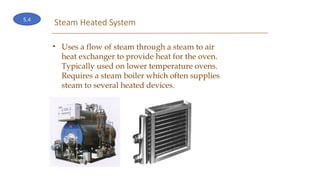
Steam Heated System
• Uses a flow of steam through a steam to air
heat exchanger to provide heat for the oven.
Typically used on lower temperature ovens.
Requires a steam boiler which often supplies
steam to several heated devices.
5.4
Hot Water Heated System
• Uses a flow of hot water through a water to air heat exchanger
to provide heat for the oven. Typically used on lower
temperature ovens. Requires a hot water boiler and a pumping
circuit which often supplies water to several heated devices.
5.4
MZCET/EEE/VII Sem/OCH353_ET/Unit 5
Summary Energy Conservation :
1.Energy Audits: Identify energy waste and inefficiencies.
2.Process Integration: Use techniques like heat integration and energy recovery to reduce external
energy demand.
3.Renewable Energy: Incorporate renewable sources like solar and wind to reduce dependence on
fossil fuels.
4.Energy Management Systems (EMS): Implement real-time monitoring and control of energy use
for better decision-making.
5.Equipment Upgrades & Maintenance: Replace outdated or inefficient equipment and ensure
regular maintenance to improve energy efficiency.
6.Waste Heat Recovery: Capture and reuse waste heat from processes to lower external energy
requirements.
7.Heat Transfer Optimization: Improve heat exchanger performance to minimize energy use in
heating and cooling processes.
5.4
MZCET/EEE/VII Sem/OCH353_ET/Unit 5
REFERENCE
• https://www.princeton.edu/~ota/disk3/1977/7703/770308.PDF
• https://www.yokogawa.com/us/library/resources/references/energy-
efficiency-in-the-chemical-and-refining-industries-with-visualmesa/
• https://nexocode.com/blog/posts/energy-efficiency-in-chemical-indus
try-with-ai/
• https://www.nae.edu/14927/ImprovingEnergyEfficiencyintheChemica
lIndustry
• https://www.roi-international.com/management-consulting/referenc
es/chemicals/energy-efficiency-in-chemical-companies-and-plants

OCH353 - unit 5.4.pptx POWER POINT PRESENTATION

  • 1.
    MZCET/EEE/VII Sem/OCH353_ET/Unit 5 OCH353– ENERGY TECHNOLOGY UNIT 5 – ENERGY CONSERVATION R.RAMANATHAN ASSISTANT PROFESSOR/EEE MOUNT ZION COLLEGE OF ENGINEERING AND TECHNOLOGY
  • 2.
    MZCET/EEE/VII Sem/OCH353_ET/Unit 5 Outline •5.1 – Energy conservation in chemical process plants • 5.2 – Energy audit, energy saving in heat exchangers • 5.3 – distillation columns, dryers • 5.4 - ovens and furnaces • 5.5 - boilers, steam • 5.6 - economy in chemical plants, • 5.7 - energy conservation.
  • 3.
    MZCET/EEE/VII Sem/OCH353_ET/Unit 5 CourseOutcome CO 1: Understanding Biomass Fundamentals: CO 2: Knowledge of Biomass Conversion Technologies CO 3: Assessment of Biomass Resources:  CO 4: Environmental and Economic Impacts: CO 5: Policy and Regulatory Framework CO 6: Design and Implementation: CO 7: Critical Thinking and Problem Solving CO 8: Communication and Collaboration
  • 4.
    MZCET/EEE/VII Sem/OCH353_ET/Unit 5 PREVIOUSSESSION TODAYS SESSION 5.3 – distillation columns, dryers 5.4 - ovens and furnaces
  • 5.
    What are IndustrialOvens and Furnaces? • We are not talking about home cooking and home heating systems. • The terms oven, furnace, and kiln are used somewhat interchangeably. Often vary as much by industry than inherent differences in design. • The range of ovens, furnaces and applied heat transfer devices used in industry is quite large. • Lets look at some examples. 5.4
  • 6.
    Dryers • Dryers areused to evaporate a liquid, often water, from a product. Dry Kiln’s are used to dry water and volatiles from green lumber. Grain dryers are used to dry grain before storage. 5.4
  • 7.
    Baking Oven • BakingOvens are used to heat products and thereby cause a physical change in the product. They will also dry products. Paint Baking ovens cure coatings by a heat catalyzed chemical reaction. Food Baking Ovens are used to cook foods such as chicken and bread. 5.4
  • 8.
    Kilns • Kilns areessentially high temperature ovens, usually operating at 1000ºF+. Brick Kilns are used to fire bricks, typically at approximately 2500F. Rotary lime kilns create lime from limestone by a heat catalyzed chemical reaction. 5.4
  • 9.
    Furnaces • Furnaces arealso used to heat products, often at higher temperatures, and thereby cause a physical change in the product. Heat treating furnaces change the properties of metal. Furnaces come in many different sizes, from small units shown above to large units as shown on the left. 5.4
  • 10.
    Autoclaves • Autoclaves: Ovensthat operate at substantially non- atmospheric pressures either pressurized or at vacuum. They may also have specially constituted atmospheres. 5.4
  • 11.
    Thermal Oxidizers • Thermaloxidizers: Used to thermally incinerate undesireable or hazardous compounds into less problematic components. May also use catalysts to assist in breaking down the compounds. 5.4
  • 12.
    Other Heating Devices •Many applied heat transfer machines use some of the same design elements as industrial ovens. Thermal oil heaters. Heated parts washers share some safety design elements with ovens. 5.4
  • 13.
    Other Heating Devices ThermalOxidizer Water Heater Biomass Fired Boiler 5.4
  • 14.
    What types oflosses occur with ovens and furnaces? Explosions: • From fuel supply • From product being processed Fires: • From product being processed • From combustible residues Worker’s Compensation: • Injuries from fires and explosions • Electrocutions • Burns from hot surfaces Loss of Business Income Failure to Perform 5.4
  • 15.
    What defines thecorrect way to design, build, and operate ovens and furnaces? • Codes and Standards: Codes have been written in a format suitable for adoption into law independent of other codes and standards. An example is the International Fire Code. Standards are documents containing mandatory provisions using the word “shall” to indicate a requirement. They are written in a form such that their provisions become mandatory when referenced by another code or standard. An example is NPFA 86: Standard for Ovens and Furnaces. • Good Engineering Practice • Design Guides • Normal Practices / State of the Art 5.4
  • 16.
    Design Requirements We willlook at the following elements of oven design: • Housing Construction and Ductwork • Ventilation • Fire Protection • Heating Systems • Control Systems • Operational Support 5.4
  • 17.
    Housing Construction • Noncombustiblehousing materials required • No wooden structures • No plastic foam insulation • Provide clearance to combustible surroundings • Keep adjacent materials below 160F • Must provide clearance on all sides and adequate maintenance access • Class D ovens with pressurized housings above 15psi must be designed to the ASME Boiler and Pressure Vessel Code 5.4
  • 18.
    Housing Construction Explosion Relief:Specially designed provisions that allow for freely relieving internal explosion pressures. Prevents an exploding oven from becoming a giant hand grenade. Required on all fuel fired ovens with the following exceptions: • Indirect fired ovens with demonstrated low levels of combustible / flammable vapors • Class D ovens (Autoclaves) or Thermal Oxidizers • Certain high temperature furnaces that are made of minimum 3/16” thick steel, structurally reinforced, and refractory lined. • Certain low oxygen type furnaces 5.4
  • 19.
    Fuel Gas System •Photograph of fuel gas piping manifold with combustion air blower. 5.4
  • 20.
    Fuel Oil System •Photograph of fuel oil piping manifold 5.4
  • 21.
    Fuel Oil System Diagramof fuel oil piping manifold 5.4
  • 22.
    Electrically Heated System ElectricInfrared Oven with Conveyor 5.4
  • 23.
    Electrically Heated System •Use any of several types of resistance electrical elements to provide heating capacity. • Convective Heating Elements: Essentially, like the heating elements in a home oven. Generally used to supply convective heat to an oven. • Radiant Elements: Lamps in any of several shapes that operate at high element temperatures and supply a significant part of their energy as thermal radiation. 5.4
  • 24.
    Steam Heated System •Uses a flow of steam through a steam to air heat exchanger to provide heat for the oven. Typically used on lower temperature ovens. Requires a steam boiler which often supplies steam to several heated devices. 5.4
  • 25.
    Hot Water HeatedSystem • Uses a flow of hot water through a water to air heat exchanger to provide heat for the oven. Typically used on lower temperature ovens. Requires a hot water boiler and a pumping circuit which often supplies water to several heated devices. 5.4
  • 26.
    MZCET/EEE/VII Sem/OCH353_ET/Unit 5 SummaryEnergy Conservation : 1.Energy Audits: Identify energy waste and inefficiencies. 2.Process Integration: Use techniques like heat integration and energy recovery to reduce external energy demand. 3.Renewable Energy: Incorporate renewable sources like solar and wind to reduce dependence on fossil fuels. 4.Energy Management Systems (EMS): Implement real-time monitoring and control of energy use for better decision-making. 5.Equipment Upgrades & Maintenance: Replace outdated or inefficient equipment and ensure regular maintenance to improve energy efficiency. 6.Waste Heat Recovery: Capture and reuse waste heat from processes to lower external energy requirements. 7.Heat Transfer Optimization: Improve heat exchanger performance to minimize energy use in heating and cooling processes. 5.4
  • 27.
    MZCET/EEE/VII Sem/OCH353_ET/Unit 5 REFERENCE •https://www.princeton.edu/~ota/disk3/1977/7703/770308.PDF • https://www.yokogawa.com/us/library/resources/references/energy- efficiency-in-the-chemical-and-refining-industries-with-visualmesa/ • https://nexocode.com/blog/posts/energy-efficiency-in-chemical-indus try-with-ai/ • https://www.nae.edu/14927/ImprovingEnergyEfficiencyintheChemica lIndustry • https://www.roi-international.com/management-consulting/referenc es/chemicals/energy-efficiency-in-chemical-companies-and-plants

Editor's Notes

  • #5 I always like to ask this question before I begin any talk. It’s not rhetorical so go ahead and answer. I’ve got a very basic answer to the question for myself…
  • #6 The reason I do what I do is that I want to do whatever I can to help save lives and reduce property losses due to fires. The real bottom line is we want to keep it from happening again. If you go to the history of fire codes and standards you will see that most of them were developed based on historical experience. Something bad happened, there was a large property loss or worse a loss of life and we decided we needed to come up with some codes and standards to keep it from happening again. So investigations are data for the development of new or improved codes and standards. If we don’t come to the correct conclusion of the cause of fires and explosions it’s going to be hard to correct or develop good codes and standards.
  • #7 The reason I do what I do is that I want to do whatever I can to help save lives and reduce property losses due to fires. The real bottom line is we want to keep it from happening again. If you go to the history of fire codes and standards you will see that most of them were developed based on historical experience. Something bad happened, there was a large property loss or worse a loss of life and we decided we needed to come up with some codes and standards to keep it from happening again. So investigations are data for the development of new or improved codes and standards. If we don’t come to the correct conclusion of the cause of fires and explosions it’s going to be hard to correct or develop good codes and standards.
  • #8 The reason I do what I do is that I want to do whatever I can to help save lives and reduce property losses due to fires. The real bottom line is we want to keep it from happening again. If you go to the history of fire codes and standards you will see that most of them were developed based on historical experience. Something bad happened, there was a large property loss or worse a loss of life and we decided we needed to come up with some codes and standards to keep it from happening again. So investigations are data for the development of new or improved codes and standards. If we don’t come to the correct conclusion of the cause of fires and explosions it’s going to be hard to correct or develop good codes and standards.
  • #9 The reason I do what I do is that I want to do whatever I can to help save lives and reduce property losses due to fires. The real bottom line is we want to keep it from happening again. If you go to the history of fire codes and standards you will see that most of them were developed based on historical experience. Something bad happened, there was a large property loss or worse a loss of life and we decided we needed to come up with some codes and standards to keep it from happening again. So investigations are data for the development of new or improved codes and standards. If we don’t come to the correct conclusion of the cause of fires and explosions it’s going to be hard to correct or develop good codes and standards.
  • #10 The reason I do what I do is that I want to do whatever I can to help save lives and reduce property losses due to fires. The real bottom line is we want to keep it from happening again. If you go to the history of fire codes and standards you will see that most of them were developed based on historical experience. Something bad happened, there was a large property loss or worse a loss of life and we decided we needed to come up with some codes and standards to keep it from happening again. So investigations are data for the development of new or improved codes and standards. If we don’t come to the correct conclusion of the cause of fires and explosions it’s going to be hard to correct or develop good codes and standards.
  • #11 The reason I do what I do is that I want to do whatever I can to help save lives and reduce property losses due to fires. The real bottom line is we want to keep it from happening again. If you go to the history of fire codes and standards you will see that most of them were developed based on historical experience. Something bad happened, there was a large property loss or worse a loss of life and we decided we needed to come up with some codes and standards to keep it from happening again. So investigations are data for the development of new or improved codes and standards. If we don’t come to the correct conclusion of the cause of fires and explosions it’s going to be hard to correct or develop good codes and standards.
  • #12 The reason I do what I do is that I want to do whatever I can to help save lives and reduce property losses due to fires. The real bottom line is we want to keep it from happening again. If you go to the history of fire codes and standards you will see that most of them were developed based on historical experience. Something bad happened, there was a large property loss or worse a loss of life and we decided we needed to come up with some codes and standards to keep it from happening again. So investigations are data for the development of new or improved codes and standards. If we don’t come to the correct conclusion of the cause of fires and explosions it’s going to be hard to correct or develop good codes and standards.
  • #13 The reason I do what I do is that I want to do whatever I can to help save lives and reduce property losses due to fires. The real bottom line is we want to keep it from happening again. If you go to the history of fire codes and standards you will see that most of them were developed based on historical experience. Something bad happened, there was a large property loss or worse a loss of life and we decided we needed to come up with some codes and standards to keep it from happening again. So investigations are data for the development of new or improved codes and standards. If we don’t come to the correct conclusion of the cause of fires and explosions it’s going to be hard to correct or develop good codes and standards.
  • #14 Some examples of where we see physical explosions are: Compressed gas cylinders Boilers Tires BLEVE’s or boiling liquid expanding vapor explosions
  • #15 Some examples of where we see physical explosions are: Compressed gas cylinders Boilers Tires BLEVE’s or boiling liquid expanding vapor explosions