Sanjivani Rural Education Society’s
Sanjivani College of Engineering, Kopargaon-423 603
(An Autonomous Institute, Affiliated to Savitribai Phule Pune University, Pune)
NAAC ‘A’ Grade Accredited, ISO 9001:2015 Certified
Department of Electrical Engineering
Ocean-Thermal Energy Conversion (OTEC) :
Methods and Benefits
Roll No. Name PRN No.
40 Rushikesh Kshirsagar UEE22M1039
42 Prem Mule UEE22M1044
43 Aditya Naikwade UEE22M1045
44 Shrihari Pakhale UEE22M1046
Guided By -
Name – Prof. P.S. Chobe
Designation – Asst. Professor
Course – RES (EE305A)
Presented By – Group No: 07
DEPARTMENT OF ELECTRICAL ENGINEERING, Sanjivani COE, Kopargaon
Self Learning Activity
Introduction to OTEC
2
❑ Ocean-Thermal Energy Conversion (OTEC) is a renewable energy technology that utilizes the
temperature difference between the warmer surface waters of the ocean and the colder deep
waters to generate electricity.
❑ OTEC can operate continuously, providing base-load power unlike intermittent sources such as
wind or solar. The temperature difference required is usually about 20 degree Celsius or more,
which occurs in tropical regions.
❑ OTEC is firm power (24/7), a clean energy source, environmentally sustainable and capable of
providing massive levels of energy.
DEPARTMENT OF ELECTRICAL ENGINEERING, Sanjivani COE, Kopargaon
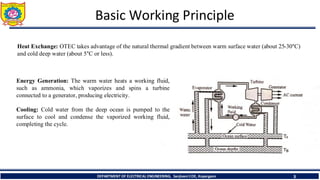
Heat Exchange: OTEC takes advantage of the natural thermal gradient between warm surface water (about 25-30°C)
and cold deep water (about 5°C or less).
3
Basic Working Principle
DEPARTMENT OF ELECTRICAL ENGINEERING, Sanjivani COE, Kopargaon
Energy Generation: The warm water heats a working fluid,
such as ammonia, which vaporizes and spins a turbine
connected to a generator, producing electricity.
Cooling: Cold water from the deep ocean is pumped to the
surface to cool and condense the vaporized working fluid,
completing the cycle.
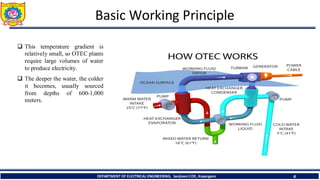
❑ This temperature gradient is
relatively small, so OTEC plants
require large volumes of water
to produce electricity.
❑ The deeper the water, the colder
it becomes, usually sourced
from depths of 600-1,000
meters.
4
Basic Working Principle
DEPARTMENT OF ELECTRICAL ENGINEERING, Sanjivani COE, Kopargaon
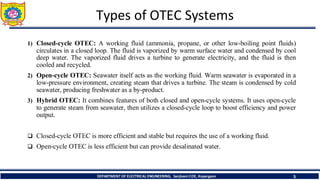
Types of OTEC Systems
1) Closed-cycle OTEC: A working fluid (ammonia, propane, or other low-boiling point fluids)
circulates in a closed loop. The fluid is vaporized by warm surface water and condensed by cool
deep water. The vaporized fluid drives a turbine to generate electricity, and the fluid is then
cooled and recycled.
2) Open-cycle OTEC: Seawater itself acts as the working fluid. Warm seawater is evaporated in a
low-pressure environment, creating steam that drives a turbine. The steam is condensed by cold
seawater, producing freshwater as a by-product.
3) Hybrid OTEC: It combines features of both closed and open-cycle systems. It uses open-cycle
to generate steam from seawater, then utilizes a closed-cycle loop to boost efficiency and power
output.
❑ Closed-cycle OTEC is more efficient and stable but requires the use of a working fluid.
❑ Open-cycle OTEC is less efficient but can provide desalinated water.
5
DEPARTMENT OF ELECTRICAL ENGINEERING, Sanjivani COE, Kopargaon
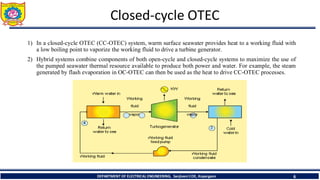
Closed-cycle OTEC
1) In a closed‐cycle OTEC (CC‐OTEC) system, warm surface seawater provides heat to a working fluid with
a low boiling point to vaporize the working fluid to drive a turbine generator.
2) Hybrid systems combine components of both open‐cycle and closed‐cycle systems to maximize the use of
the pumped seawater thermal resource available to produce both power and water. For example, the steam
generated by flash evaporation in OC‐OTEC can then be used as the heat to drive CC‐OTEC processes.
6
DEPARTMENT OF ELECTRICAL ENGINEERING, Sanjivani COE, Kopargaon
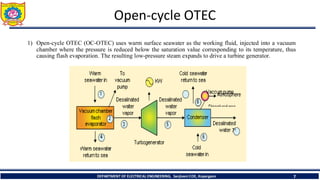
Open-cycle OTEC
1) Open‐cycle OTEC (OC‐OTEC) uses warm surface seawater as the working fluid, injected into a vacuum
chamber where the pressure is reduced below the saturation value corresponding to its temperature, thus
causing flash evaporation. The resulting low‐pressure steam expands to drive a turbine generator.
7
DEPARTMENT OF ELECTRICAL ENGINEERING, Sanjivani COE, Kopargaon
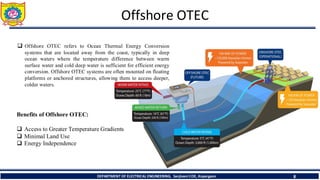
❑ Offshore OTEC refers to Ocean Thermal Energy Conversion
systems that are located away from the coast, typically in deep
ocean waters where the temperature difference between warm
surface water and cold deep water is sufficient for efficient energy
conversion. Offshore OTEC systems are often mounted on floating
platforms or anchored structures, allowing them to access deeper,
colder waters.
8
Offshore OTEC
DEPARTMENT OF ELECTRICAL ENGINEERING, Sanjivani COE, Kopargaon
Benefits of Offshore OTEC:
❑ Access to Greater Temperature Gradients
❑ Minimal Land Use
❑ Energy Independence
Benefits of OTEC
❑ Immense Resource
❑ Baseload Power
❑ Dispatchable Power
❑ Security
❑ Renewable
❑ Low Risk
❑ Clean Energy
❑ Offshore
9
DEPARTMENT OF ELECTRICAL ENGINEERING, Sanjivani COE, Kopargaon
Environmental and Economic Impact
1) Minimal Environmental Footprint: OTEC plants have a low impact on marine ecosystems
when designed properly. They avoid harmful emissions and do not require fuel.
2) Energy for Remote Locations: OTEC is particularly useful for tropical islands and coastal
regions that lack access to traditional energy grids.
3) Economic Development: By reducing reliance on fossil fuels, OTEC can help island nations
and tropical countries achieve energy independence, lowering import costs.
❑ The potential environmental effects, such as altering ocean currents or affecting marine life, are
minimal if designed with care.
❑ OTEC can diversify energy sources, making economies more resilient to energy price
fluctuations.
10
DEPARTMENT OF ELECTRICAL ENGINEERING, Sanjivani COE, Kopargaon
Challenges of OTEC
1) High Initial Costs.
2) Location Constraints.
3) Energy Efficiency.
4) Technological Barriers.
❑ OTEC technology is still in the developmental phase, and commercial viability depends on
overcoming technical challenges and improving efficiency.
11
DEPARTMENT OF ELECTRICAL ENGINEERING, Sanjivani COE, Kopargaon
Conclusion
❑ OTEC represents a promising renewable energy technology, particularly for tropical regions,
offering both energy production and desalinated water.
❑ While there are challenges, such as high costs and technical barriers, ongoing research and pilot
projects show that OTEC has significant potential to contribute to global sustainability efforts.
12
DEPARTMENT OF ELECTRICAL ENGINEERING, Sanjivani COE, Kopargaon
References
1) A. Hossain, A. Azhim, A. B. Jaafar, M. N. Musa, S. A. Zaki and D. N. Fazreen, "Ocean thermal energy
conversion: The promise of a clean future," 2013 IEEE Conference on Clean Energy and Technology
(CEAT), Langkawi, Malaysia, 2013, pp. 23-26, doi: 10.1109/CEAT.2013.6775593.
2) 2) L. Meegahapola, L. Udawatta and S. Witharana, "The Ocean Thermal Energy Conversion strategies and
analysis of current challenges," 2007 International Conference on Industrial and Information Systems,
Peradeniya, Sri Lanka, 2007, pp. 123-128, doi: 10.1109/ICIINFS.2007.4579160.
3) 3) S. K. Wang and T. C. Hung, "Renewable energy from the sea - organic Rankine Cycle using ocean
thermal energy conversion," Proceedings of the International Conference on Energy and Sustainable
Development: Issues and Strategies (ESD 2010), Chiang Mai, Thailand, 2010, pp. 1-8, doi:
10.1109/ESD.2010.5598775.
4) 4) A. Najafi, S. Rezaee and F. Torabi, "Sensitivity analysis of a closed cycle ocean thermal energy
conversion power plant," 2012 Second Iranian Conference on Renewable Energy and Distributed
Generation, Tehran, Iran, 2012, pp. 1-6, doi: 10.1109/ICREDG.2012.6190461.
5) 5) Bimal K. Bose, "OCEAN AND GEOTHERMAL RENEWABLE ENERGY SYSTEMS," in Power
Electronics in Renewable Energy Systems and Smart Grid: Technology and Applications , IEEE, 2019,
pp.391-441, doi: 10.1002/9781119515661.ch8.
13
DEPARTMENT OF ELECTRICAL ENGINEERING, Sanjivani COE, Kopargaon
DEPARTMENT OF ELECTRICAL ENGINEERING, Sanjivani COE, Kopargaon 14
THANK
YOU…!

Ocean Thermal Energy Conversion (OTEC) : Methods & Benefits.

  • 1.
    Sanjivani Rural EducationSociety’s Sanjivani College of Engineering, Kopargaon-423 603 (An Autonomous Institute, Affiliated to Savitribai Phule Pune University, Pune) NAAC ‘A’ Grade Accredited, ISO 9001:2015 Certified Department of Electrical Engineering Ocean-Thermal Energy Conversion (OTEC) : Methods and Benefits Roll No. Name PRN No. 40 Rushikesh Kshirsagar UEE22M1039 42 Prem Mule UEE22M1044 43 Aditya Naikwade UEE22M1045 44 Shrihari Pakhale UEE22M1046 Guided By - Name – Prof. P.S. Chobe Designation – Asst. Professor Course – RES (EE305A) Presented By – Group No: 07 DEPARTMENT OF ELECTRICAL ENGINEERING, Sanjivani COE, Kopargaon Self Learning Activity
  • 2.
    Introduction to OTEC 2 ❑Ocean-Thermal Energy Conversion (OTEC) is a renewable energy technology that utilizes the temperature difference between the warmer surface waters of the ocean and the colder deep waters to generate electricity. ❑ OTEC can operate continuously, providing base-load power unlike intermittent sources such as wind or solar. The temperature difference required is usually about 20 degree Celsius or more, which occurs in tropical regions. ❑ OTEC is firm power (24/7), a clean energy source, environmentally sustainable and capable of providing massive levels of energy. DEPARTMENT OF ELECTRICAL ENGINEERING, Sanjivani COE, Kopargaon
  • 3.
    Heat Exchange: OTECtakes advantage of the natural thermal gradient between warm surface water (about 25-30°C) and cold deep water (about 5°C or less). 3 Basic Working Principle DEPARTMENT OF ELECTRICAL ENGINEERING, Sanjivani COE, Kopargaon Energy Generation: The warm water heats a working fluid, such as ammonia, which vaporizes and spins a turbine connected to a generator, producing electricity. Cooling: Cold water from the deep ocean is pumped to the surface to cool and condense the vaporized working fluid, completing the cycle.
  • 4.
    ❑ This temperaturegradient is relatively small, so OTEC plants require large volumes of water to produce electricity. ❑ The deeper the water, the colder it becomes, usually sourced from depths of 600-1,000 meters. 4 Basic Working Principle DEPARTMENT OF ELECTRICAL ENGINEERING, Sanjivani COE, Kopargaon
  • 5.
    Types of OTECSystems 1) Closed-cycle OTEC: A working fluid (ammonia, propane, or other low-boiling point fluids) circulates in a closed loop. The fluid is vaporized by warm surface water and condensed by cool deep water. The vaporized fluid drives a turbine to generate electricity, and the fluid is then cooled and recycled. 2) Open-cycle OTEC: Seawater itself acts as the working fluid. Warm seawater is evaporated in a low-pressure environment, creating steam that drives a turbine. The steam is condensed by cold seawater, producing freshwater as a by-product. 3) Hybrid OTEC: It combines features of both closed and open-cycle systems. It uses open-cycle to generate steam from seawater, then utilizes a closed-cycle loop to boost efficiency and power output. ❑ Closed-cycle OTEC is more efficient and stable but requires the use of a working fluid. ❑ Open-cycle OTEC is less efficient but can provide desalinated water. 5 DEPARTMENT OF ELECTRICAL ENGINEERING, Sanjivani COE, Kopargaon
  • 6.
    Closed-cycle OTEC 1) Ina closed‐cycle OTEC (CC‐OTEC) system, warm surface seawater provides heat to a working fluid with a low boiling point to vaporize the working fluid to drive a turbine generator. 2) Hybrid systems combine components of both open‐cycle and closed‐cycle systems to maximize the use of the pumped seawater thermal resource available to produce both power and water. For example, the steam generated by flash evaporation in OC‐OTEC can then be used as the heat to drive CC‐OTEC processes. 6 DEPARTMENT OF ELECTRICAL ENGINEERING, Sanjivani COE, Kopargaon
  • 7.
    Open-cycle OTEC 1) Open‐cycleOTEC (OC‐OTEC) uses warm surface seawater as the working fluid, injected into a vacuum chamber where the pressure is reduced below the saturation value corresponding to its temperature, thus causing flash evaporation. The resulting low‐pressure steam expands to drive a turbine generator. 7 DEPARTMENT OF ELECTRICAL ENGINEERING, Sanjivani COE, Kopargaon
  • 8.
    ❑ Offshore OTECrefers to Ocean Thermal Energy Conversion systems that are located away from the coast, typically in deep ocean waters where the temperature difference between warm surface water and cold deep water is sufficient for efficient energy conversion. Offshore OTEC systems are often mounted on floating platforms or anchored structures, allowing them to access deeper, colder waters. 8 Offshore OTEC DEPARTMENT OF ELECTRICAL ENGINEERING, Sanjivani COE, Kopargaon Benefits of Offshore OTEC: ❑ Access to Greater Temperature Gradients ❑ Minimal Land Use ❑ Energy Independence
  • 9.
    Benefits of OTEC ❑Immense Resource ❑ Baseload Power ❑ Dispatchable Power ❑ Security ❑ Renewable ❑ Low Risk ❑ Clean Energy ❑ Offshore 9 DEPARTMENT OF ELECTRICAL ENGINEERING, Sanjivani COE, Kopargaon
  • 10.
    Environmental and EconomicImpact 1) Minimal Environmental Footprint: OTEC plants have a low impact on marine ecosystems when designed properly. They avoid harmful emissions and do not require fuel. 2) Energy for Remote Locations: OTEC is particularly useful for tropical islands and coastal regions that lack access to traditional energy grids. 3) Economic Development: By reducing reliance on fossil fuels, OTEC can help island nations and tropical countries achieve energy independence, lowering import costs. ❑ The potential environmental effects, such as altering ocean currents or affecting marine life, are minimal if designed with care. ❑ OTEC can diversify energy sources, making economies more resilient to energy price fluctuations. 10 DEPARTMENT OF ELECTRICAL ENGINEERING, Sanjivani COE, Kopargaon
  • 11.
    Challenges of OTEC 1)High Initial Costs. 2) Location Constraints. 3) Energy Efficiency. 4) Technological Barriers. ❑ OTEC technology is still in the developmental phase, and commercial viability depends on overcoming technical challenges and improving efficiency. 11 DEPARTMENT OF ELECTRICAL ENGINEERING, Sanjivani COE, Kopargaon
  • 12.
    Conclusion ❑ OTEC representsa promising renewable energy technology, particularly for tropical regions, offering both energy production and desalinated water. ❑ While there are challenges, such as high costs and technical barriers, ongoing research and pilot projects show that OTEC has significant potential to contribute to global sustainability efforts. 12 DEPARTMENT OF ELECTRICAL ENGINEERING, Sanjivani COE, Kopargaon
  • 13.
    References 1) A. Hossain,A. Azhim, A. B. Jaafar, M. N. Musa, S. A. Zaki and D. N. Fazreen, "Ocean thermal energy conversion: The promise of a clean future," 2013 IEEE Conference on Clean Energy and Technology (CEAT), Langkawi, Malaysia, 2013, pp. 23-26, doi: 10.1109/CEAT.2013.6775593. 2) 2) L. Meegahapola, L. Udawatta and S. Witharana, "The Ocean Thermal Energy Conversion strategies and analysis of current challenges," 2007 International Conference on Industrial and Information Systems, Peradeniya, Sri Lanka, 2007, pp. 123-128, doi: 10.1109/ICIINFS.2007.4579160. 3) 3) S. K. Wang and T. C. Hung, "Renewable energy from the sea - organic Rankine Cycle using ocean thermal energy conversion," Proceedings of the International Conference on Energy and Sustainable Development: Issues and Strategies (ESD 2010), Chiang Mai, Thailand, 2010, pp. 1-8, doi: 10.1109/ESD.2010.5598775. 4) 4) A. Najafi, S. Rezaee and F. Torabi, "Sensitivity analysis of a closed cycle ocean thermal energy conversion power plant," 2012 Second Iranian Conference on Renewable Energy and Distributed Generation, Tehran, Iran, 2012, pp. 1-6, doi: 10.1109/ICREDG.2012.6190461. 5) 5) Bimal K. Bose, "OCEAN AND GEOTHERMAL RENEWABLE ENERGY SYSTEMS," in Power Electronics in Renewable Energy Systems and Smart Grid: Technology and Applications , IEEE, 2019, pp.391-441, doi: 10.1002/9781119515661.ch8. 13 DEPARTMENT OF ELECTRICAL ENGINEERING, Sanjivani COE, Kopargaon
  • 14.
    DEPARTMENT OF ELECTRICALENGINEERING, Sanjivani COE, Kopargaon 14 THANK YOU…!