Home and Community Occupations
Home Modifications Guidelines
1. Assessment (a)
The OT should consider:
- Ownership of the property needs to be considered
- The person’s physical limitations – current and reasonably
expected in the future.
- The person’s longer term plans for where and how they will live.
- Others using the modified area and their needs.
- Any available support people and their abilities and level of
commitment to assisting the person.
- The land surrounding the home, size, direction of any slope.
1. Assessment (b)
- The current access to the home, front and back, most workable
option.
- The most appropriate point to access the house (It may not be the
front door).
- Outdoor lighting, colors of finishes and materials, shape of door
handles, weather protection, security.
- The current condition and dimensions of the building.
- The current home environment (including any equipment used at
home).
- The current access to the area proposed to be modified.
1. Assessment (c)
- The current characteristics of the problem area
- Financial resources available for the project.
- Any additional equipment that may be required
- Doesn’t fund items considered to be maintenance issues, eg.
Replacement of rotten steps, verandah posts, ramp matting, leaking
taps/showers, etc.
- Ensure that you discuss the outcome of your assessment with all
relevant parties.
- A good home modification prescription (design brief) arrived at
with consultation and agreement of the client considers not only
the structural modifications but clearly defines how it is expected
the client will use the modified environment and with what
equipment and assistance/support.
- This is then used by the OT, the architect and builder as a detailed
guide as they work together in the process of designing and
building the modification.
2. Preparing the application
- Ensure you’re aware of which aspects are eligible for funding, how
much of the home modifications subsidy is still available to the
client, and the source of gap funding (if required).
- Remember that the maximum subsidy available to an individual
applies to the total home modifications they receive in their lifetime,
i.e. it is not per home modification type or application.
- The OT should be aware that some home modifications do not
attract GST.
- Check with the fund provider by phone or email if you’re unsure of
the client/proposed modification’s eligibility for funding.
2. Preparing the application (b)
- Complete Home Modification Prescription Form.
- Check quotes and any plans supplied to support the application to
ensure that the design and building work proposed reflects the
design brief. (Quotes should be current and make reference to the
Architecture Center Plan)
- All the Fund provider Home Modification documentation (i.e.
schedules, agreements, plan, quote and Certificate of Completion)
needs to be signed off by the Home owner, not the client, and
agreements should be between the home owner and the builder.
- NOTE: the home owner is the person who has their name on the
house title or council rates notice.
2. Preparing the application (b)
- In the case of a rental property, the OT should ensure that the
owner is willing to sign.
- Consider peer review/discussion of the application, prior to
submission to fund provider
3. During Construction
It is recommended that the prescribing OT:
- Ensures that suitable arrangements are in place for during the
construction phase, e.g. toilet access, respite.
- Arranges to be informed when construction starts and concludes.
- Ensures that all parties are aware that the OT needs to be
consulted during the construction phase if any problems arise.
(Architects and builders may need advice to ensure that any
changes to the design preserve the desired functionality for the
client).
- Ensure the builder is aware that OT, home owner and Archi center
sign-off is required at completion.
4. Signing Off
The prescribing OT should:
- Inspect the completed home modification to ensure that it meets the
functional needs of the client.
- Sign off on the completed modification with the home owner and
architect (if Archicentre has been used) to ensure it meets the
functional and technical requirements for the client.
- The signed Certificate of Completion and the Archicentre Works
Inspection Report should be forwarded to fund provider to allow
release of payment as appropriate. If there are any problems the
OT should inform the fund provider and take action as appropriate
to resolve the issue.
- Ensure that the client is aware of what is happening with
documentation.
Considerations
- Ownership of the property needs to be considered. The home owner
is the person who has their name on the house title or council rates
notice.
- As per DHS guidelines “home modifications are not available for
people living in dwellings owned or operated by non-profit
organizations, business, trust fund or any other type of
organization” – this includes Office of Housing homes.
- Government Owned Properties Modifications to these properties
are not funded
Rented Properties
- A Deed of Release needs to be completed by the landlord and is
required for modification of rented properties.
- Careful consideration should be given to the appropriateness of
substantial permanent modification to rented properties. Alternate
housing may be more appropriate in the long term.
- In regard to rental and other properties, financial arrangements
must be made between client and builder.
- Payment of any top-up/gap funding should be negotiated between
tenant and landlord.
Compliance with Australian Standards
When do the Australian Standards apply?
- Building Code of Australia (BCA) details the requirements for new
construction or renovations of various classes of buildings and the
requirements for compliance with the various relevant Australian
Standards.
- Private homes are classified as “Class 1a buildings – a single
dwelling being (i) a detached house or (ii) one of a group of two or
more attached dwellings each being a building, separated by a fire
resisting wall, including a row house, terrace house, town house or
villa unit”.
Compliance with Australian Standards
When do the Australian Standards apply?
Alterations to Class 1a buildings are not required to comply with:
 Disability (Access to Premises – Buildings) Standards 2010 ;
 Australian Standard AS1428.1- 2009 Design for Access and
Mobility;
- Remember that these standards are relevant to the “average” adult.
They also do not include information specific to people with larger
sized mobility aids, e.g. powered wheelchairs, scooters, bariatric
equipment.
- However these documents should be used as a guide for best
practice in the design and implementation for home modifications
for people with disability.
Compliance with Australian Standards
When do the Australian Standards apply?
- A home modifications prescription that is not compliant with the
above standards should include a statement as to the nature of the
non-compliance and an explanation of the circumstances and
clinical reasoning behind the decision to propose a non-compliant
solution.
Client Characteristics which may impact on prescription
Skin integrity
- Refer to the pressure care prescribers manual for further
information
Cognitive/personality issues Consider:
- The person’s ability to adjust to change.
- Whether the person’s ability to predict or understand functional
tasks is affected by their environment.
- The level of personal support required initially or ongoing to
facilitate the person’s adjustment.
Specifications of a modification for this client group may include:
 Thermostats
 Style of taps
 Color contrasts of fixtures and fittings.
Client Characteristics which may impact on prescription
Behaviors of Concern
- There are government regulations that guide the use of restraints.
- The issue of restraint is generally more relevant to the available
equipment categories, rather than home modifications.
Consider a modification that:
- Offers an environment that is as free from hazards and as
predictable, controllable and as understandable as possible for the
person.
- Provides cues that support desirable behavior, e.g. a rail to hold
onto to wait for someone or a place to sit.
- Enhances visual access if unobtrusive supervision would be
helpful.
Children and adolescents
- In general the standards describe access for average sized adults.
AS 1428.3-1992 Design for access and mobility - Requirements for
children and adolescents with physical disabilities provides
guidelines for access for children aged 6-18 years.
- Consider the impact of smaller stature, smaller reach distance and
altered sight lines for your child client.
- Understand the needs and plans of families currently, and in the
future, including where they plan to live and how they plan to assist
and support their child.
Bariatric clients
- Archicentre can assist in identifying appropriate solutions for
clients in this demographic
Consider:
 Wider doors
 Larger circulation spaces
 Weight capacity of hoists and slings
 Weight capacity of floors, ramps, rails
 Durability of finishes, hinges and fittings
 Smooth transitions between floor surfaces
Underweight
Consider:
 Fatigue and energy conservation
 Weight of doors
 Distances and places to rest
 Smooth transitions between floor surfaces.
Underweight
Consider:
 Fatigue and energy conservation
 Weight of doors
 Distances and places to rest
 Smooth transitions between floor surfaces.
Rapidly changing conditions
Consider the ways that the proposed modification will accommodate
the following:
 Rate of change
 Fluctuations in function
 Weight change – loss or gain
 Change in cognitive ability
 Change in physical ability
 Change in mental health.
Living alone
Consider whether the design brief is for a person living independently
or with assistance.
Relevant Support Person Characteristics
Consider:
 What the support person is able to do, how often and for how long.
 The safety of the support person in the design.
 Short and long term options if the support person is unavailable.
Cultural requirements
Consider:
 Cultural factors that influence the design of a home modification
and the way the person wishes to be assisted
Key life transition
Consider:
 Whether the person, or their key supports, are planning or in the
process of a life transition, e.g. starting/finishing school, beginning
tertiary education, beginning/ returning to work, moving out of
home, entering/leaving a cohabiting relationship, retiring, moving
into aged residential support.
 Whether all relevant parties are on the same page in terms of
support, finances and plans
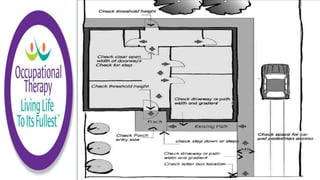
Existing Conditions
A continuous step-free path of travel is required from the entry of the
property to all areas of the house to eliminate barriers to access.
The following site assessment should be made to determine the level of
modifications required:
 Measure changes in level and gradients of paths and driveways;
 Measure path/driveway widths to ensure there is a continuous path
of sufficient width to travel to the street and unload from the car
onto a path. Assess the surface material;
 Measure porch entry size and door side clearances;
 Check corridor widths;
 Determine clear opening width of doorways;
 Note any step downs throughout the property, even if they seem
small, as these may require threshold ramps;
 Check that the letter box is next to the path and is of an appropriate
type;
 Check damp proof membrane location.
Walkways
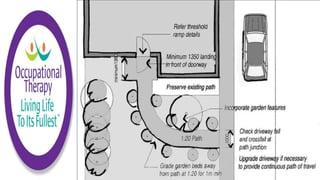
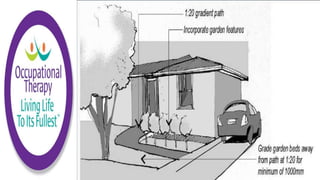
 Walkways are an ideal means of providing access to a residence
when there is not a great height difference between the house and
point of entry to the property;
 Walkways and landings should have an unobstructed width of 1000
mm and an unobstructed vertical clearance of 2000 mm;
 Walkways with gradients of up to 1 in 20 may be used for access for
persons with disabilities;
 Walkways may be constructed with concrete with a wood float
finish;
 Walkway surrounds shall be graded to the natural surface at
1 in 20 gradient for a minimum of 600 mm each side. Handrails
are not required.
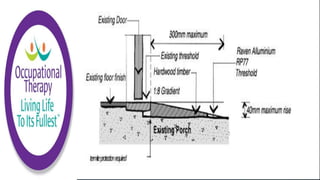
Ramped Threshold
 Ramped thresholds are to eliminate small steps with a maximum of
40 mm rise;
 Ramped thresholds at external doorways shall be a hardwood or
aluminum wedge to the full width of the doorway.
 For a raised door threshold a ramp will be required on both sides.
Gradient shall not be steeper than 1:8, and length shall not exceed
450 mm;
 Brass angles shall be used at doorway thresholds where changes of
levels occur between tiles and other floor finishes;
 To prevent damage to doors and doorjambs from wheelchairs, a
protective surface may be applied to vertical surfaces to a height of
300 mm above the plane of the finished floor.
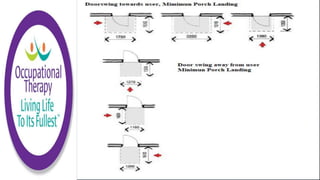
Landings
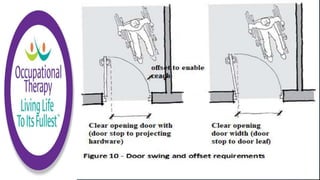
 Landings provide the user with a safe level platform to open a door;
 The length of landings at walkways and ramps shall be not less
than 1200 mm and at step ramps not less than 1330 mm;
 The overall dimensions of landings shall be determined by the
swing of doors either toward or away from the user and the
approach either from the latch side, hinge side or front on.
Typically front entry doors will have a screen door;
 Landing dimensions outside of these parameters should be
discussed with Renewal State, Housing State
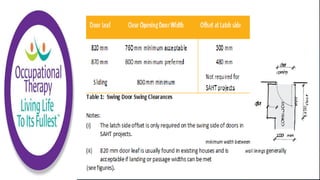
Doors and Doorways
 The minimum clear opening of all doorways including the open
door shall be 760 mm;
 Circulation and turning space should be considered where doors
are being altered, to determine if sliding doors or concertina doors
are more appropriate. However swing doors are the preferred
option for maintenance, draught exclusion and acoustic reasons;
 Lever handles to doors are preferred with the center of the handle
located between 900 mm and 1100 mm above the floors;
 If door glazing is used, the glass used shall be safety glass in
accordance with AS 2208 Safety glazing materials in buildings;
 Frameless or fully glazed doors shall have a 75 mm wide safety
strip fitted, located 900 mm above floor level.
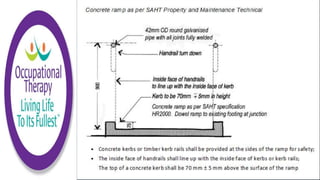
Handrails
 Handrails shall be fitted to both sides of ramps to steady users for
safety:
 Refer to the SAHT Property and Maintenance Technical
Specification for fabrication details of external grab and hand
rails:
 The tops of handrails shall be not less than 865 mm or more than
1000 mm above finished floor of the walkway or ramp:
 All handrails shall be securely fixed and rigid:
 The clearance between a handrail and adjacent wall surface shall
be not less than 50 mm;
 Handrails should be constructed and fixed so that there is no
obstruction to the passage of a hand.
.
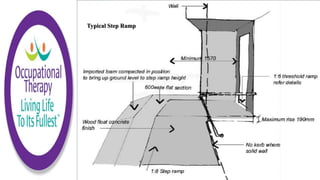
Step Ramps
 Step ramps may be provided for changes of levels of up to 190 mm;
 The step ramps shall be a maximum of 1520 mm long and a
minimum of 1000 mm wide with a maximum gradient of 1 in 8;
 Step ramps shall have a wood float finish in the case of concrete or
approved non slip paint finish in the case of timber ramps;
 Landings at the top of ramps shall be 1330 mm minimum clearance
from any obstructions
 Refer to the SAHT Property and Maintenance Technical
Specification for specified slip resistant finishes and other technical
details for steps, ramps and stepless entry
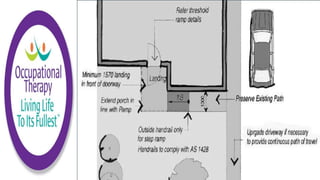
Typical Step Ramp
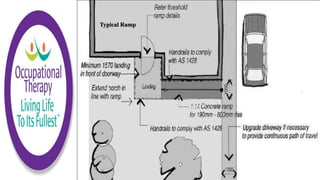
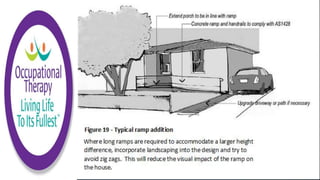
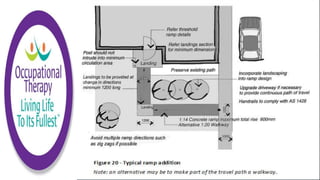
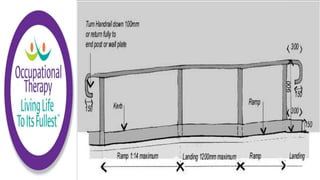
Ramps
 Ramps will be required if the height difference exceeds 190 mm
and step ramps cannot be used;
 The maximum gradient of a ramp shall be 1:8 unless it exceeds
1900 mm in length and in that case shall be 1:14;
 Landings shall be provided at the top and bottom of the ramps at
intervals not exceeding 9.0 meters;
 Ramps shall be constructed from concrete (up to 600 mm high) or
treated timber (600 mm - 1000 mm high) with a wood float finish to
the concrete surface or approved non slip paint finish in the case of
timber ramps;
 Ramps shall have a maximum camber or cross fall of 1 in 40;
 Where the ramp requirement is to be temporary consideration
should be given to modular temporary ramps. Discuss this option
with Renewal State and/or Housing State
Typical Ramp
p
p
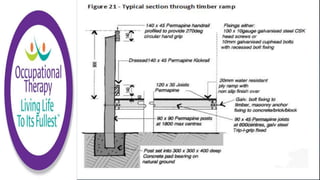
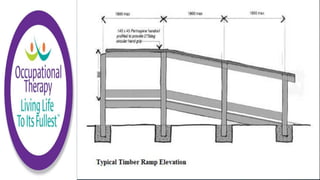
Timber Ramps
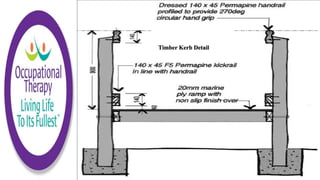
 Timber ramps are to have plywood deck with approved non slip
paint finish.
- Timber ramps are to be considered when the site rise is above 600
mm, or when the existing building is of a timber construction, and
when the sites are steeply sloping;
 Generally timber is to be used only when it is the most economical
solution.
Timber Kerb Detail
Common Concerns
Ramps
Consider:
 The existing driveway, access to and parking for cars.
 Drainage and the location of services, e.g. HWS, A/C units.
 Storage and access to bins.
 Pedestrian access from the street to the house.
Ensure completion of a Ramp Release Form (client) and Ramp
Therapist Form (OT) if your recommendation is for a ramp that does
not comply with AS 1428.1 (2009)
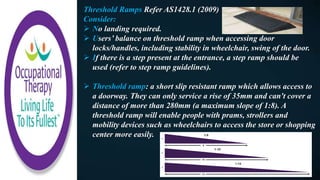
Threshold Ramps Refer AS1428.1 (2009)
Consider:
 No landing required.
 Users’ balance on threshold ramp when accessing door
locks/handles, including stability in wheelchair, swing of the door.
 If there is a step present at the entrance, a step ramp should be
used (refer to step ramp guidelines).
 Threshold ramp: a short slip resistant ramp which allows access to
a doorway. They can only service a rise of 35mm and can't cover a
distance of more than 280mm (a maximum slope of 1:8). A
threshold ramp will enable people with prams, strollers and
mobility devices such as wheelchairs to access the store or shopping
center more easily.
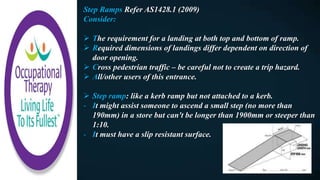
Step Ramps Refer AS1428.1 (2009)
Consider:
 The requirement for a landing at both top and bottom of ramp.
 Required dimensions of landings differ dependent on direction of
door opening.
 Cross pedestrian traffic – be careful not to create a trip hazard.
 All/other users of this entrance.
 Step ramp: like a kerb ramp but not attached to a kerb.
- It might assist someone to ascend a small step (no more than
190mm) in a store but can't be longer than 1900mm or steeper than
1:10.
- It must have a slip resistant surface.
Kerb Ramps Refer AS1428.1 (2009)
Ramped section of pedestrian footpath
Remember:
 Only eligible for subsidy if located within the client’s property and
essential for access to the home.
 All ramps including threshold/step/kerb ramps require regular
cleaning, sweeping, checking for slip hazards, eg. moss and mold,
maintenance of loose bolts or rotten boards.
 Kerb ramp: as the name implies, a kerb ramp is a ramp that gives
access from a footpath to a roadway.
- Kerb ramps are usually the responsibility of the local council and
must have a slope of no more than 1:8 and a slip resistant surface.
Platform steps/step landings
Remember that platform steps:
 are not steps but a series of landings
 are not covered in AS1428.1(2009) or the BCA
 may take up a fair amount of room
 are not necessarily cheaper than a ramp
 may not be the best functional option.
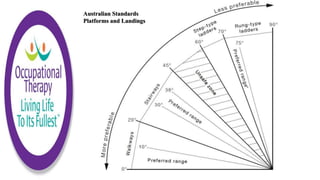
 For a level platforms or landings it should have a maximum slope
in any direction between 0° to 3°.
 Sloping walkway with an angle nominally between 3° and 20° in
the direction of travel and no more 0° to 3° perpendicular to the
direction of travel. (It is possible to have cross slop up to 7° for
specific applications)
 Where the angle of slope of the walking surface is between 10° and
20°, cleats are required to be fitted to the walkway. Cleats shall be
of metal, not less than 10 mm × 10 mm and evenly spaced.
Australian Standards
Platforms and Landings
Possible alternatives to platform steps:
 Additional gait aid at top/bottom of steps

 Use/modify alternate entrance
 Ramp
 Platform lift/stair lift.
Elements to consider:
Person
 Ability to manage a step.
 Height of step they can manage (BCA: steps min 115mm max
190mm).
 Footprint of the person and mobility aid.
 Reliance on use of rail(s) or aid on the step.
 Ability of person or carer to lift the mobility aid up a rise.
 The height rise that the person/carer can lift the mobility aid.
 Likelihood of future decline in mobility..
Environment
 Availability of sufficient space to fit required number of steps
(dependent on footprint and total rise).
 Steps must be consistent in dimensions, i.e. height, depth and width
 Steps should have nosing.
 Materials should be slip resistant.
 Position and exposure to the elements.
 Ongoing maintenance.
 Avoid making a trip hazard for client, others in the house or others
using this entrance
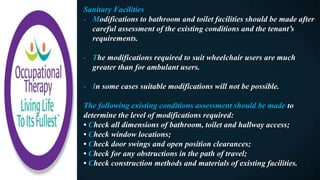
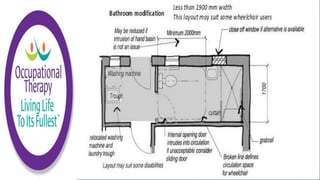
Sanitary Facilities
- Modifications to bathroom and toilet facilities should be made after
careful assessment of the existing conditions and the tenant’s
requirements.
- The modifications required to suit wheelchair users are much
greater than for ambulant users.
- In some cases suitable modifications will not be possible.
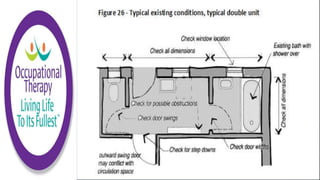
The following existing conditions assessment should be made to
determine the level of modifications required:
• Check all dimensions of bathroom, toilet and hallway access;
• Check window locations;
• Check door swings and open position clearances;
• Check for any obstructions in the path of travel;
• Check construction methods and materials of existing facilities.
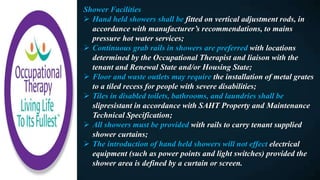
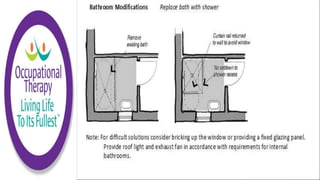
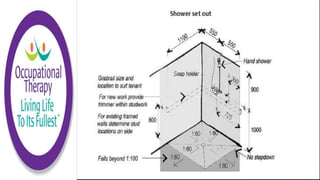
Shower Facilities
 Hand held showers shall be fitted on vertical adjustment rods, in
accordance with manufacturer’s recommendations, to mains
pressure hot water services;
 Continuous grab rails in showers are preferred with locations
determined by the Occupational Therapist and liaison with the
tenant and Renewal State and/or Housing State;
 Floor and waste outlets may require the installation of metal grates
to a tiled recess for people with severe disabilities;
 Tiles in disabled toilets, bathrooms, and laundries shall be
slipresistant in accordance with SAHT Property and Maintenance
Technical Specification;
 All showers must be provided with rails to carry tenant supplied
shower curtains;
 The introduction of hand held showers will not effect electrical
equipment (such as power points and light switches) provided the
shower area is defined by a curtain or screen.
.
.
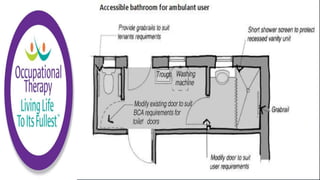
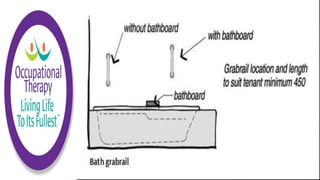
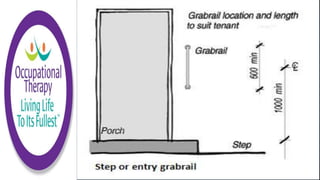
Grabrails for Ambulant Users
 Contractor to ensure that grabrail is located to suit the tenant;
 Grab rails shall be
- A minimum 450 mm long (typical lengths are 450 mm, 600 mm and
900 mm)
- 32 mm in diameter
- A minimum of 1.2 mm wall thickness and shall be either stainless
steel 304 or white powder coated ripple finish aluminium with
stainless steel fixings appropriate to the substrate i.e. masonry,
timber.
- For details in relation to fixing options for grab rails refer to the
SAHT Property and Maintenance Technical Specification.
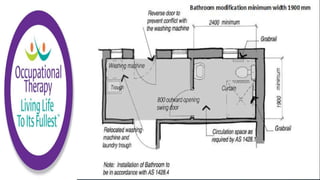
Toilet Modifications
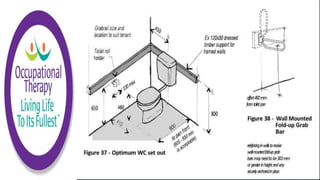
 Water closet (WC) pans should be located 800 mm from the front of
the pan to the rear wall if requested by an occupational therapist
otherwise the existing position is to remain;
 Raised toilet pans, with a rim 460 mm above floor level, compliant
with AS 1428.1 Design for access and Mobility – General
Requirements for Access – New Building Work should be
considered when requested by an occupational therapist and a
height increasing aid is unacceptable. Otherwise an ordinary toilet
pan with a rim 400 mm above floor level is acceptable;
 The center of the pan should preferably be located 450 mm from
the sidewall;
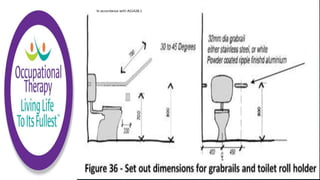
 Toilet roll holders shall be located a maximum of 700 mm above
floor level and within 330 mm from the front of the pan;
Toilet Modifications
 Cisterns shall be located a maximum of 1000 mm to the top from
the floor;
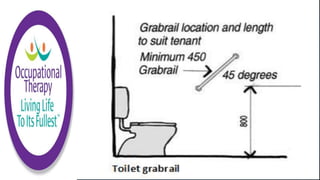
 Grab rail length and locations will be determined in consultation
with the tenant and occupational therapist/health professional or
as shown below;
 Fold-up grabrails may be used if required and where fixing
arrangements can be established to comply with suppliers
specification (refer diagram below);
 Confirm that the WC door is acceptable or alternatively modify
Doorway Modifications
 Doors of insufficient width may need to be modified. This can be
achieved without altering the wall opening by changing the door
and lining type;
 Consider painting doors and architraves in contrasting colors to
aid sight impaired persons.
.
.
.
Washbasins
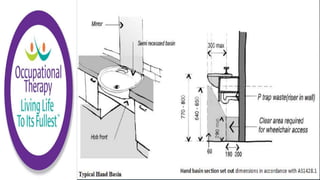
 Wash basins shall be fitted with Raymor flared lever action taps
and have a clear space of 650 mm beneath the basin including
outlet pipes;
 Mirrors not less than 350 mm wide shall be centered over the wash
basin and shall extend from a height of not more than 900 mm
above the floor to not less than 1850 mm above the floor;
 Where shelves are provided they shall be securely fixed within the
height range of 900 mm to 1100 mm above the finished floor;
 New shaving cabinets, soap holders and towel rails shall be fitted
within the same dimensions as shelves..
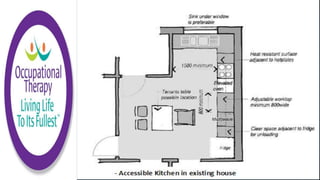
Kitchen Facilities
 The extent of kitchen modifications will vary depending on the
existing conditions and needs of the user.
 The following modifications range from the minimum to the
preferred but not essential.
 Allow a minimum of 800 in length open bench space at a level
suitable for a wheel chair user
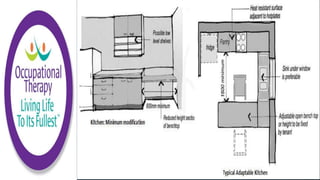
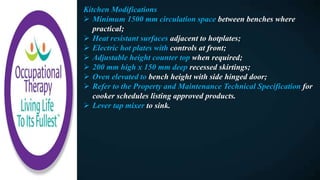
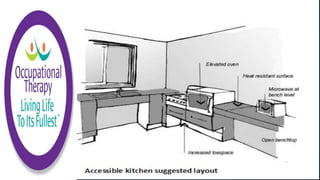
Kitchen Modifications
 Minimum 1500 mm circulation space between benches where
practical;
 Heat resistant surfaces adjacent to hotplates;
 Electric hot plates with controls at front;
 Adjustable height counter top when required;
 200 mm high x 150 mm deep recessed skirtings;
 Oven elevated to bench height with side hinged door;
 Refer to the Property and Maintenance Technical Specification for
cooker schedules listing approved products.
 Lever tap mixer to sink.
Occupational Therapy Home Modifications Guidelines

Occupational Therapy Home Modifications Guidelines

  • 1.
    Home and CommunityOccupations Home Modifications Guidelines
  • 2.
    1. Assessment (a) TheOT should consider: - Ownership of the property needs to be considered - The person’s physical limitations – current and reasonably expected in the future. - The person’s longer term plans for where and how they will live. - Others using the modified area and their needs. - Any available support people and their abilities and level of commitment to assisting the person. - The land surrounding the home, size, direction of any slope.
  • 3.
    1. Assessment (b) -The current access to the home, front and back, most workable option. - The most appropriate point to access the house (It may not be the front door). - Outdoor lighting, colors of finishes and materials, shape of door handles, weather protection, security. - The current condition and dimensions of the building. - The current home environment (including any equipment used at home). - The current access to the area proposed to be modified.
  • 4.
    1. Assessment (c) -The current characteristics of the problem area - Financial resources available for the project. - Any additional equipment that may be required - Doesn’t fund items considered to be maintenance issues, eg. Replacement of rotten steps, verandah posts, ramp matting, leaking taps/showers, etc.
  • 5.
    - Ensure thatyou discuss the outcome of your assessment with all relevant parties. - A good home modification prescription (design brief) arrived at with consultation and agreement of the client considers not only the structural modifications but clearly defines how it is expected the client will use the modified environment and with what equipment and assistance/support. - This is then used by the OT, the architect and builder as a detailed guide as they work together in the process of designing and building the modification.
  • 6.
    2. Preparing theapplication - Ensure you’re aware of which aspects are eligible for funding, how much of the home modifications subsidy is still available to the client, and the source of gap funding (if required). - Remember that the maximum subsidy available to an individual applies to the total home modifications they receive in their lifetime, i.e. it is not per home modification type or application. - The OT should be aware that some home modifications do not attract GST. - Check with the fund provider by phone or email if you’re unsure of the client/proposed modification’s eligibility for funding.
  • 7.
    2. Preparing theapplication (b) - Complete Home Modification Prescription Form. - Check quotes and any plans supplied to support the application to ensure that the design and building work proposed reflects the design brief. (Quotes should be current and make reference to the Architecture Center Plan) - All the Fund provider Home Modification documentation (i.e. schedules, agreements, plan, quote and Certificate of Completion) needs to be signed off by the Home owner, not the client, and agreements should be between the home owner and the builder. - NOTE: the home owner is the person who has their name on the house title or council rates notice.
  • 8.
    2. Preparing theapplication (b) - In the case of a rental property, the OT should ensure that the owner is willing to sign. - Consider peer review/discussion of the application, prior to submission to fund provider
  • 9.
    3. During Construction Itis recommended that the prescribing OT: - Ensures that suitable arrangements are in place for during the construction phase, e.g. toilet access, respite. - Arranges to be informed when construction starts and concludes. - Ensures that all parties are aware that the OT needs to be consulted during the construction phase if any problems arise. (Architects and builders may need advice to ensure that any changes to the design preserve the desired functionality for the client). - Ensure the builder is aware that OT, home owner and Archi center sign-off is required at completion.
  • 10.
    4. Signing Off Theprescribing OT should: - Inspect the completed home modification to ensure that it meets the functional needs of the client. - Sign off on the completed modification with the home owner and architect (if Archicentre has been used) to ensure it meets the functional and technical requirements for the client. - The signed Certificate of Completion and the Archicentre Works Inspection Report should be forwarded to fund provider to allow release of payment as appropriate. If there are any problems the OT should inform the fund provider and take action as appropriate to resolve the issue. - Ensure that the client is aware of what is happening with documentation.
  • 11.
    Considerations - Ownership ofthe property needs to be considered. The home owner is the person who has their name on the house title or council rates notice. - As per DHS guidelines “home modifications are not available for people living in dwellings owned or operated by non-profit organizations, business, trust fund or any other type of organization” – this includes Office of Housing homes. - Government Owned Properties Modifications to these properties are not funded
  • 12.
    Rented Properties - ADeed of Release needs to be completed by the landlord and is required for modification of rented properties. - Careful consideration should be given to the appropriateness of substantial permanent modification to rented properties. Alternate housing may be more appropriate in the long term. - In regard to rental and other properties, financial arrangements must be made between client and builder. - Payment of any top-up/gap funding should be negotiated between tenant and landlord.
  • 13.
    Compliance with AustralianStandards When do the Australian Standards apply? - Building Code of Australia (BCA) details the requirements for new construction or renovations of various classes of buildings and the requirements for compliance with the various relevant Australian Standards. - Private homes are classified as “Class 1a buildings – a single dwelling being (i) a detached house or (ii) one of a group of two or more attached dwellings each being a building, separated by a fire resisting wall, including a row house, terrace house, town house or villa unit”.
  • 14.
    Compliance with AustralianStandards When do the Australian Standards apply? Alterations to Class 1a buildings are not required to comply with:  Disability (Access to Premises – Buildings) Standards 2010 ;  Australian Standard AS1428.1- 2009 Design for Access and Mobility; - Remember that these standards are relevant to the “average” adult. They also do not include information specific to people with larger sized mobility aids, e.g. powered wheelchairs, scooters, bariatric equipment. - However these documents should be used as a guide for best practice in the design and implementation for home modifications for people with disability.
  • 15.
    Compliance with AustralianStandards When do the Australian Standards apply? - A home modifications prescription that is not compliant with the above standards should include a statement as to the nature of the non-compliance and an explanation of the circumstances and clinical reasoning behind the decision to propose a non-compliant solution.
  • 16.
    Client Characteristics whichmay impact on prescription Skin integrity - Refer to the pressure care prescribers manual for further information Cognitive/personality issues Consider: - The person’s ability to adjust to change. - Whether the person’s ability to predict or understand functional tasks is affected by their environment. - The level of personal support required initially or ongoing to facilitate the person’s adjustment. Specifications of a modification for this client group may include:  Thermostats  Style of taps  Color contrasts of fixtures and fittings.
  • 17.
    Client Characteristics whichmay impact on prescription Behaviors of Concern - There are government regulations that guide the use of restraints. - The issue of restraint is generally more relevant to the available equipment categories, rather than home modifications. Consider a modification that: - Offers an environment that is as free from hazards and as predictable, controllable and as understandable as possible for the person. - Provides cues that support desirable behavior, e.g. a rail to hold onto to wait for someone or a place to sit. - Enhances visual access if unobtrusive supervision would be helpful.
  • 18.
    Children and adolescents -In general the standards describe access for average sized adults. AS 1428.3-1992 Design for access and mobility - Requirements for children and adolescents with physical disabilities provides guidelines for access for children aged 6-18 years. - Consider the impact of smaller stature, smaller reach distance and altered sight lines for your child client. - Understand the needs and plans of families currently, and in the future, including where they plan to live and how they plan to assist and support their child.
  • 19.
    Bariatric clients - Archicentrecan assist in identifying appropriate solutions for clients in this demographic Consider:  Wider doors  Larger circulation spaces  Weight capacity of hoists and slings  Weight capacity of floors, ramps, rails  Durability of finishes, hinges and fittings  Smooth transitions between floor surfaces Underweight Consider:  Fatigue and energy conservation  Weight of doors  Distances and places to rest  Smooth transitions between floor surfaces.
  • 20.
    Underweight Consider:  Fatigue andenergy conservation  Weight of doors  Distances and places to rest  Smooth transitions between floor surfaces.
  • 21.
    Rapidly changing conditions Considerthe ways that the proposed modification will accommodate the following:  Rate of change  Fluctuations in function  Weight change – loss or gain  Change in cognitive ability  Change in physical ability  Change in mental health. Living alone Consider whether the design brief is for a person living independently or with assistance.
  • 22.
    Relevant Support PersonCharacteristics Consider:  What the support person is able to do, how often and for how long.  The safety of the support person in the design.  Short and long term options if the support person is unavailable. Cultural requirements Consider:  Cultural factors that influence the design of a home modification and the way the person wishes to be assisted
  • 23.
    Key life transition Consider: Whether the person, or their key supports, are planning or in the process of a life transition, e.g. starting/finishing school, beginning tertiary education, beginning/ returning to work, moving out of home, entering/leaving a cohabiting relationship, retiring, moving into aged residential support.  Whether all relevant parties are on the same page in terms of support, finances and plans
  • 24.
    Existing Conditions A continuousstep-free path of travel is required from the entry of the property to all areas of the house to eliminate barriers to access. The following site assessment should be made to determine the level of modifications required:  Measure changes in level and gradients of paths and driveways;  Measure path/driveway widths to ensure there is a continuous path of sufficient width to travel to the street and unload from the car onto a path. Assess the surface material;  Measure porch entry size and door side clearances;  Check corridor widths;  Determine clear opening width of doorways;  Note any step downs throughout the property, even if they seem small, as these may require threshold ramps;  Check that the letter box is next to the path and is of an appropriate type;  Check damp proof membrane location.
  • 26.
    Walkways  Walkways arean ideal means of providing access to a residence when there is not a great height difference between the house and point of entry to the property;  Walkways and landings should have an unobstructed width of 1000 mm and an unobstructed vertical clearance of 2000 mm;  Walkways with gradients of up to 1 in 20 may be used for access for persons with disabilities;  Walkways may be constructed with concrete with a wood float finish;  Walkway surrounds shall be graded to the natural surface at 1 in 20 gradient for a minimum of 600 mm each side. Handrails are not required.
  • 29.
    Ramped Threshold  Rampedthresholds are to eliminate small steps with a maximum of 40 mm rise;  Ramped thresholds at external doorways shall be a hardwood or aluminum wedge to the full width of the doorway.  For a raised door threshold a ramp will be required on both sides. Gradient shall not be steeper than 1:8, and length shall not exceed 450 mm;  Brass angles shall be used at doorway thresholds where changes of levels occur between tiles and other floor finishes;  To prevent damage to doors and doorjambs from wheelchairs, a protective surface may be applied to vertical surfaces to a height of 300 mm above the plane of the finished floor.
  • 31.
    Landings  Landings providethe user with a safe level platform to open a door;  The length of landings at walkways and ramps shall be not less than 1200 mm and at step ramps not less than 1330 mm;  The overall dimensions of landings shall be determined by the swing of doors either toward or away from the user and the approach either from the latch side, hinge side or front on. Typically front entry doors will have a screen door;  Landing dimensions outside of these parameters should be discussed with Renewal State, Housing State
  • 33.
    Doors and Doorways The minimum clear opening of all doorways including the open door shall be 760 mm;  Circulation and turning space should be considered where doors are being altered, to determine if sliding doors or concertina doors are more appropriate. However swing doors are the preferred option for maintenance, draught exclusion and acoustic reasons;  Lever handles to doors are preferred with the center of the handle located between 900 mm and 1100 mm above the floors;  If door glazing is used, the glass used shall be safety glass in accordance with AS 2208 Safety glazing materials in buildings;  Frameless or fully glazed doors shall have a 75 mm wide safety strip fitted, located 900 mm above floor level.
  • 36.
    Handrails  Handrails shallbe fitted to both sides of ramps to steady users for safety:  Refer to the SAHT Property and Maintenance Technical Specification for fabrication details of external grab and hand rails:  The tops of handrails shall be not less than 865 mm or more than 1000 mm above finished floor of the walkway or ramp:  All handrails shall be securely fixed and rigid:  The clearance between a handrail and adjacent wall surface shall be not less than 50 mm;  Handrails should be constructed and fixed so that there is no obstruction to the passage of a hand.
  • 37.
  • 38.
    Step Ramps  Stepramps may be provided for changes of levels of up to 190 mm;  The step ramps shall be a maximum of 1520 mm long and a minimum of 1000 mm wide with a maximum gradient of 1 in 8;  Step ramps shall have a wood float finish in the case of concrete or approved non slip paint finish in the case of timber ramps;  Landings at the top of ramps shall be 1330 mm minimum clearance from any obstructions  Refer to the SAHT Property and Maintenance Technical Specification for specified slip resistant finishes and other technical details for steps, ramps and stepless entry
  • 40.
  • 41.
    Ramps  Ramps willbe required if the height difference exceeds 190 mm and step ramps cannot be used;  The maximum gradient of a ramp shall be 1:8 unless it exceeds 1900 mm in length and in that case shall be 1:14;  Landings shall be provided at the top and bottom of the ramps at intervals not exceeding 9.0 meters;  Ramps shall be constructed from concrete (up to 600 mm high) or treated timber (600 mm - 1000 mm high) with a wood float finish to the concrete surface or approved non slip paint finish in the case of timber ramps;  Ramps shall have a maximum camber or cross fall of 1 in 40;  Where the ramp requirement is to be temporary consideration should be given to modular temporary ramps. Discuss this option with Renewal State and/or Housing State
  • 42.
  • 43.
  • 44.
  • 45.
    Timber Ramps  Timberramps are to have plywood deck with approved non slip paint finish. - Timber ramps are to be considered when the site rise is above 600 mm, or when the existing building is of a timber construction, and when the sites are steeply sloping;  Generally timber is to be used only when it is the most economical solution.
  • 49.
  • 50.
    Common Concerns Ramps Consider:  Theexisting driveway, access to and parking for cars.  Drainage and the location of services, e.g. HWS, A/C units.  Storage and access to bins.  Pedestrian access from the street to the house. Ensure completion of a Ramp Release Form (client) and Ramp Therapist Form (OT) if your recommendation is for a ramp that does not comply with AS 1428.1 (2009)
  • 51.
    Threshold Ramps ReferAS1428.1 (2009) Consider:  No landing required.  Users’ balance on threshold ramp when accessing door locks/handles, including stability in wheelchair, swing of the door.  If there is a step present at the entrance, a step ramp should be used (refer to step ramp guidelines).  Threshold ramp: a short slip resistant ramp which allows access to a doorway. They can only service a rise of 35mm and can't cover a distance of more than 280mm (a maximum slope of 1:8). A threshold ramp will enable people with prams, strollers and mobility devices such as wheelchairs to access the store or shopping center more easily.
  • 52.
    Step Ramps ReferAS1428.1 (2009) Consider:  The requirement for a landing at both top and bottom of ramp.  Required dimensions of landings differ dependent on direction of door opening.  Cross pedestrian traffic – be careful not to create a trip hazard.  All/other users of this entrance.  Step ramp: like a kerb ramp but not attached to a kerb. - It might assist someone to ascend a small step (no more than 190mm) in a store but can't be longer than 1900mm or steeper than 1:10. - It must have a slip resistant surface.
  • 53.
    Kerb Ramps ReferAS1428.1 (2009) Ramped section of pedestrian footpath Remember:  Only eligible for subsidy if located within the client’s property and essential for access to the home.  All ramps including threshold/step/kerb ramps require regular cleaning, sweeping, checking for slip hazards, eg. moss and mold, maintenance of loose bolts or rotten boards.  Kerb ramp: as the name implies, a kerb ramp is a ramp that gives access from a footpath to a roadway. - Kerb ramps are usually the responsibility of the local council and must have a slope of no more than 1:8 and a slip resistant surface.
  • 54.
    Platform steps/step landings Rememberthat platform steps:  are not steps but a series of landings  are not covered in AS1428.1(2009) or the BCA  may take up a fair amount of room  are not necessarily cheaper than a ramp  may not be the best functional option.  For a level platforms or landings it should have a maximum slope in any direction between 0° to 3°.  Sloping walkway with an angle nominally between 3° and 20° in the direction of travel and no more 0° to 3° perpendicular to the direction of travel. (It is possible to have cross slop up to 7° for specific applications)  Where the angle of slope of the walking surface is between 10° and 20°, cleats are required to be fitted to the walkway. Cleats shall be of metal, not less than 10 mm × 10 mm and evenly spaced.
  • 55.
  • 56.
    Possible alternatives toplatform steps:  Additional gait aid at top/bottom of steps   Use/modify alternate entrance  Ramp  Platform lift/stair lift.
  • 57.
    Elements to consider: Person Ability to manage a step.  Height of step they can manage (BCA: steps min 115mm max 190mm).  Footprint of the person and mobility aid.  Reliance on use of rail(s) or aid on the step.  Ability of person or carer to lift the mobility aid up a rise.  The height rise that the person/carer can lift the mobility aid.  Likelihood of future decline in mobility..
  • 58.
    Environment  Availability ofsufficient space to fit required number of steps (dependent on footprint and total rise).  Steps must be consistent in dimensions, i.e. height, depth and width  Steps should have nosing.  Materials should be slip resistant.  Position and exposure to the elements.  Ongoing maintenance.  Avoid making a trip hazard for client, others in the house or others using this entrance
  • 59.
    Sanitary Facilities - Modificationsto bathroom and toilet facilities should be made after careful assessment of the existing conditions and the tenant’s requirements. - The modifications required to suit wheelchair users are much greater than for ambulant users. - In some cases suitable modifications will not be possible. The following existing conditions assessment should be made to determine the level of modifications required: • Check all dimensions of bathroom, toilet and hallway access; • Check window locations; • Check door swings and open position clearances; • Check for any obstructions in the path of travel; • Check construction methods and materials of existing facilities.
  • 64.
    Shower Facilities  Handheld showers shall be fitted on vertical adjustment rods, in accordance with manufacturer’s recommendations, to mains pressure hot water services;  Continuous grab rails in showers are preferred with locations determined by the Occupational Therapist and liaison with the tenant and Renewal State and/or Housing State;  Floor and waste outlets may require the installation of metal grates to a tiled recess for people with severe disabilities;  Tiles in disabled toilets, bathrooms, and laundries shall be slipresistant in accordance with SAHT Property and Maintenance Technical Specification;  All showers must be provided with rails to carry tenant supplied shower curtains;  The introduction of hand held showers will not effect electrical equipment (such as power points and light switches) provided the shower area is defined by a curtain or screen.
  • 65.
  • 66.
  • 67.
    Grabrails for AmbulantUsers  Contractor to ensure that grabrail is located to suit the tenant;  Grab rails shall be - A minimum 450 mm long (typical lengths are 450 mm, 600 mm and 900 mm) - 32 mm in diameter - A minimum of 1.2 mm wall thickness and shall be either stainless steel 304 or white powder coated ripple finish aluminium with stainless steel fixings appropriate to the substrate i.e. masonry, timber. - For details in relation to fixing options for grab rails refer to the SAHT Property and Maintenance Technical Specification.
  • 71.
    Toilet Modifications  Watercloset (WC) pans should be located 800 mm from the front of the pan to the rear wall if requested by an occupational therapist otherwise the existing position is to remain;  Raised toilet pans, with a rim 460 mm above floor level, compliant with AS 1428.1 Design for access and Mobility – General Requirements for Access – New Building Work should be considered when requested by an occupational therapist and a height increasing aid is unacceptable. Otherwise an ordinary toilet pan with a rim 400 mm above floor level is acceptable;  The center of the pan should preferably be located 450 mm from the sidewall;  Toilet roll holders shall be located a maximum of 700 mm above floor level and within 330 mm from the front of the pan;
  • 72.
    Toilet Modifications  Cisternsshall be located a maximum of 1000 mm to the top from the floor;  Grab rail length and locations will be determined in consultation with the tenant and occupational therapist/health professional or as shown below;  Fold-up grabrails may be used if required and where fixing arrangements can be established to comply with suppliers specification (refer diagram below);  Confirm that the WC door is acceptable or alternatively modify
  • 75.
    Doorway Modifications  Doorsof insufficient width may need to be modified. This can be achieved without altering the wall opening by changing the door and lining type;  Consider painting doors and architraves in contrasting colors to aid sight impaired persons.
  • 76.
  • 77.
  • 78.
  • 79.
    Washbasins  Wash basinsshall be fitted with Raymor flared lever action taps and have a clear space of 650 mm beneath the basin including outlet pipes;  Mirrors not less than 350 mm wide shall be centered over the wash basin and shall extend from a height of not more than 900 mm above the floor to not less than 1850 mm above the floor;  Where shelves are provided they shall be securely fixed within the height range of 900 mm to 1100 mm above the finished floor;  New shaving cabinets, soap holders and towel rails shall be fitted within the same dimensions as shelves..
  • 81.
    Kitchen Facilities  Theextent of kitchen modifications will vary depending on the existing conditions and needs of the user.  The following modifications range from the minimum to the preferred but not essential.  Allow a minimum of 800 in length open bench space at a level suitable for a wheel chair user
  • 83.
    Kitchen Modifications  Minimum1500 mm circulation space between benches where practical;  Heat resistant surfaces adjacent to hotplates;  Electric hot plates with controls at front;  Adjustable height counter top when required;  200 mm high x 150 mm deep recessed skirtings;  Oven elevated to bench height with side hinged door;  Refer to the Property and Maintenance Technical Specification for cooker schedules listing approved products.  Lever tap mixer to sink.