OCC101 Workbooks
Structured and Personalised
Anita Hamilton, Shontal Gray and Hayley
Stephens
“I feel as the content could have been taught
through modules or guided notes etc. Some
weeks there was a lot of content to learn, and I
feel as though I didn't need to focus on some of
the information” (OCC101 eValu8, 2018)
Photo by Michail Sapiton on Unsplash
OCC101 eValu8 feedback
Self-Determination Theory
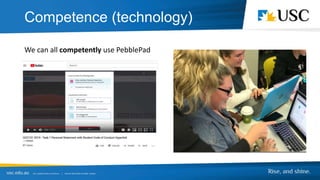
Competence (technology)
We can all competently use PebblePad
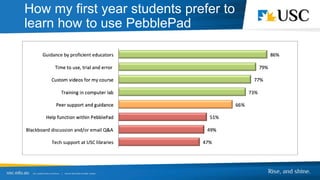
How my first year students prefer to
learn how to use PebblePad
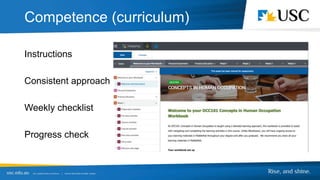
Competence (curriculum)
Instructions
Consistent approach
Weekly checklist
Progress check
Relatedness
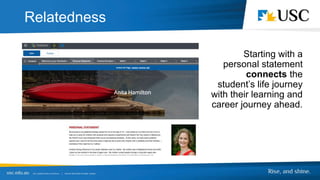
Starting with a
personal statement
connects the
student’s life journey
with their learning and
career journey ahead.
Relatedness
"The act of reflecting and writing the [personal
statement for the] ePortfolio, gave me greater
insight into myself and what was behind my
motivation in choosing Occupational Therapy”
(First year student, OCC101, Sem 1, 2018)
Relatedness
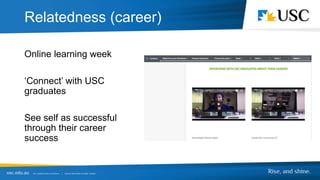
Relatedness (career)
Online learning week
‘Connect’ with USC
graduates
See self as successful
through their career
success
Let’s hear from our
current students
Shontal Gray and Hayley Stephens

OCC101 PebblePad workbook 2019

Editor's Notes

  • #2 We are currently in the second year of a three-year development cycle for our Foundation Occupational Therapy Course “Concepts in Human Occupation”. In the first year I adopted a new Australian OT text and adapted the lectures and tutorials to align with the new focus.
  • #4 Any academic endeavour should be supported by a sound theoretical approach. Self-Determination Theory (SDT) (Ryan & Deci, 2000) outlines three psychological needs that facilitate intrinsic motivation; competence, relatedness, and autonomy (Ryan & Deci, 2000). I developed the curriculum to relate learning to the profession and built a workbook that offered structure (build competence through increased structure and decreased cognitive load) and offered autonomy by providing students with the opportunity to individualise their workbooks.  
  • #5 Competence with using the technology Provide Support: Over the years using PebblePad, and through our focus group research with students and staff, we have found that students, and staff, needed to have ready access to support to troubleshoot technical issues. This helps maintain both educators’ and students’ confidence in the process and the product. The supports we developed included: 1. Customised videos specific to courses 2. In-class support and troubleshooting of technical difficulties.
  • #6 I ask the students how they prefer to learn so that I can provide optimal “just in time” support.
  • #7 Competence with the curriculum
  • #9 Students were shown how to create their first ‘Asset’ in PebblePad - a Personal Statement about their reasons for choosing occupational therapy. This was then submitted as their first assessment.