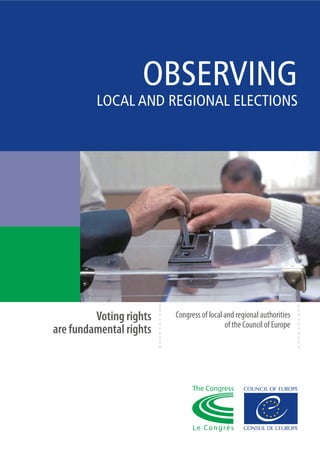
OBSERVING
LOCAL AND REGIONAL ELECTIONS
Congress of local and regional authorities
of the Council of Europe
Voting rights
are fundamental rights
2
The Council of Europe began
to observe elections after the
fall of the Berlin wall in 1989
as part of the process for the
accession of a certain number
of new democracies. With
the aim of supplementing the
Parliamentary Assembly’s work
on national parliamentary
and presidential elections, the
Congress – as the guarantor of
local and regional democracy -
was given the task of observing
local and regional elections.
The right of citizens to exercise
their democratic choice by uni-
versal,equal,freeanddirectsuf-
frage and by secret ballot is the
basis for political participation
at local and regional level and
is enshrined in the preamble of
the Additional Protocol to the
European Charter of Local Self-
Government.
Election observation enhances
the integrity of elections, on
the one hand by deterring
and exposing irregularities and
fraud, and on the other by
producing recommendations
for improving electoral pro-
cedures.
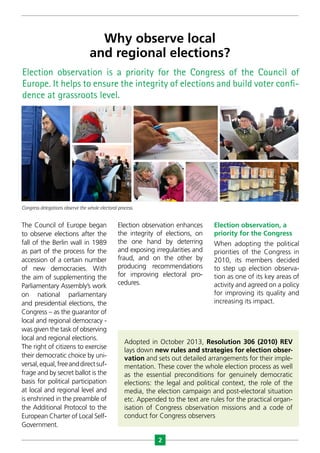
Congress delegations observe the whole electoral process.
Election observation is a priority for the Congress of the Council of
Europe. It helps to ensure the integrity of elections and build voter confi-
dence at grassroots level.
Why observe local
and regional elections?
Adopted in October 2013, Resolution 306 (2010) REV
lays down new rules and strategies for election obser-
vation and sets out detailed arrangements for their imple-
mentation. These cover the whole election process as well
as the essential preconditions for genuinely democratic
elections: the legal and political context, the role of the
media, the election campaign and post-electoral situation
etc. Appended to the text are rules for the practical organ-
isation of Congress observation missions and a code of
conduct for Congress observers
Election observation, a
priority for the Congress
When adopting the political
priorities of the Congress in
2010, its members decided
to step up election observa-
tion as one of its key areas of
activity and agreed on a policy
for improving its quality and
increasing its impact.
3
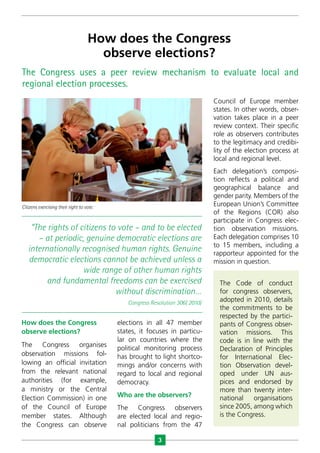
Citizens exercising their right to vote.
How does the Congress
observe elections?
The Congress uses a peer review mechanism to evaluate local and
regional election processes.
How does the Congress
observe elections?
The Congress organises
observation missions fol-
lowing an official invitation
from the relevant national
authorities (for example,
a ministry or the Central
Election Commission) in one
of the Council of Europe
member states. Although
the Congress can observe
elections in all 47 member
states, it focuses in particu-
lar on countries where the
political monitoring process
has brought to light shortco-
mings and/or concerns with
regard to local and regional
democracy.
Who are the observers?
The Congress observers
are elected local and regio-
nal politicians from the 47
Council of Europe member
states. In other words, obser-
vation takes place in a peer
review context. Their specific
role as observers contributes
to the legitimacy and credibi-
lity of the election process at
local and regional level.
Each delegation’s composi-
tion reflects a political and
geographical balance and
gender parity. Members of the
European Union’s Committee
of the Regions (COR) also
participate in Congress elec-
tion observation missions.
Each delegation comprises 10
to 15 members, including a
rapporteur appointed for the
mission in question.
“The rights of citizens to vote – and to be elected
– at periodic, genuine democratic elections are
internationally recognised human rights. Genuine
democratic elections cannot be achieved unless a
wide range of other human rights
and fundamental freedoms can be exercised
without discrimination…
Congress Resolution 306( 2010)
The Code of conduct
for congress observers,
adopted in 2010, details
the commitments to be
respected by the partici-
pants of Congress obser-
vation missions. This
code is in line with the
Declaration of Principles
for International Elec-
tion Observation devel-
oped under UN aus-
pices and endorsed by
more than twenty inter­
national organisations
since 2005, among which
is the Congress.
4
In the interest of a consolidated assessment, the Congress widened the
scope of observation examining the whole process as well as key factors
for the functioning of democracy.
The Congress training local election observers …
The Congress organises workshops for its members to better understand this activity and raise
awareness of its importance. Several training materials have been developed in this context,
notably a video presenting each step of an observation mission.
Stages in the observation process
Run-up to the election
All observation missions are
preceded by pre-election
visits conducted by a three-
to five-member delegation a
few weeks before the election
itself. The delegation’s task is
to assess the overall political
situation in the country, the
election campaign and the
legal framework in which the
election is taking place.
Polling day
During the mission itself,
various meetings are held to
evaluate the state of electoral
democracy before polling day.
Governmental bodies, local
and regional elected repre-
sentatives, the public authori-
ties (election commissions),
political parties (majority and
opposition), the media, dip-
lomatic circles and civil soci-
ety are represented at these
meetings.
Observers are then deployed
countrywide to observe poll-
ing day.
Recommendations
After each observation mission,
the Congress delegation pub-
lishes a preliminary declaration,
which is usually presented at a
press conference held on the
spot. The Congress member
appointed as rapporteur for
the mission subsequently drafts
a report.
The report covers not only
election procedures and the
observations made on election
day, particularly during voting
and vote-counting, but also
the overall political situation in
the country, including aspects
relating to human rights and
fundamental freedoms, the
climate in which the election
campaign took place and the
progress of democracy.
The report is submitted to the
Bureau of the Congress. It is
then examined and adopted
in plenary session. A recom-
mendation (addressed to the
national authorities) and a
resolution mark the end of the
observation process.
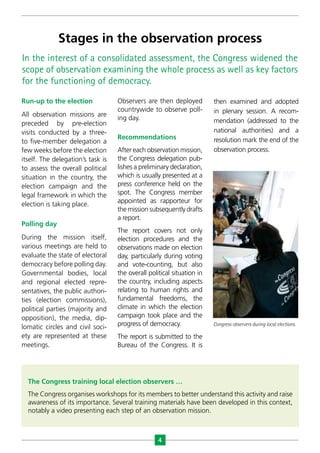
Congress observers during local elections.
5
Follow-up
to recommendations
To ensure appropriate follow-
up to its recommendations and
the implementation of tangible
results, the Congress puts in
place a post-election assis-
tance procedure. This involves
mandating the relevant
Congress bodies, in particular
the Institutional Committee,
to supervise the implemen-
tation of specific measures.
If there is no improvement, the
Congress may refer the mat-
ter to other Council of Europe
bodies and, for example,
request an opinion from the
Venice Commission or ask the
Parliamentary Assembly to look
into the question as part of the
monitoring process.
The Congress also sets up co-
operation programmes with
the national, regional and
local authorities to address the
issues identified during obser-
vation missions.
These programmes involve not
only local and regional elected
representatives in the countries
concerned but also local and
regional elected representatives
from other European countries
who are willing to share their
experience and expertise as
part of a peer exchange pro-
cess.
Partnerships…
… with the EU Committee
of the Regions
As part of its co-operation acti-
vities with the European Union,
the Congress invites the mem-
bers of the COR to join its dele-
gation on observation missions.
When the report is presented,
representatives of both insti-
tutions are invited in order to
ensure reciprocity.
… with national associa-
tions of local authorities.
The Congress has also inten-
sified its co-operation with
the national associations by
organising training sessions
for their members on election
observation and giving them
the opportunity to participate
in Congress missions.
… with the OSCE
If it is not the only international
institution observing local or
regional elections in a particular
country, the Congress may join
with the other institutions to
form an international election
observation mission (IEOM).
Polling is followed by a joint
press conference and a prelimi-
nary declaration. The Congress
co-operates closely with OSCE/
ODIHR in this context.
The Congress follows up its recommendations by putting in place
specific programmes and partnerships with key institutions working for
genuinely democratic local and regional elections all over Europe.
Partnerships to ensure progress
in electoral matters
Presentation of joint preliminary findings by OSCE/ODFIR and the Congress in framework of the local elections (Albania, May 2011).
Secretariat of the Congress
of the Council of Europe
Avenue de l’Europe – F-67075 Strasbourg Cedex
Tel. : +33 (0)3 88 41 21 10 congress.web@coe.int
Fax : +33 (0)3 88 41 37 47 www.coe.int/congress
Publication: May 2016 /Text: Congress of Local and Regional Authorities of the Council of Europe
Graphic design / Photos: Council of Europe, Cover photos: ©Gamma
www.coe.int/congress-elections
CONTACT
The Congress, a political assembly
of local and regional elected representatives
The voice of cities and regions in Europe
The Congress is a political assembly composed of 648 elec-
ted representatives – mayors, governors, councillors etc –
representing more than 200 000 local and regional authori-
ties in the 47 Council of Europe member states. It acts as
European advocate for all of these elected representatives.
The Congress promotes devolution through the transfer of
political powers and financial resources to municipalities
and regions. It reinforces local and regional democracy by
permanently monitoring the due application of the
European Charter of Local Self-Government; observing
local and regional elections, and issuing recommendations
to the governments of the 47 Council of Europe member
states. It maintains an ongoing dialogue with the member
States in the Committee of Ministers , as well as with other
institutions of the Council of Europe such as the
Parliamentary Assembly. It ensures that policy decisions are
made at the level closest to the citizen and strives for a
vibrant grassroots democracy in an increasingly globali-
sed world.
The Congress upholds local and regional self-­
government, democracy and human rights at local level.
20 years of observation
 To date, over 100 missions
election observation
missions have been carried
out by the Congress.
 25 countries have been
visited (amongst them,
also some non-member
states such as Israel in
2008).
 Pending on the member
states’ election schedules,
the Congress is invited to
observe between three
and five local/regional
elections each year.
 Over 200 Congress
members have already
participated in one of its
observation missions.
 The first Congress
observation mission was
carried out in the Czech
Republic in 1990.
Facts and figures....
PREMS074716

Observing local and regional elections (2016)

  • 1.
    OBSERVING LOCAL AND REGIONALELECTIONS Congress of local and regional authorities of the Council of Europe Voting rights are fundamental rights
  • 2.
    2 The Council ofEurope began to observe elections after the fall of the Berlin wall in 1989 as part of the process for the accession of a certain number of new democracies. With the aim of supplementing the Parliamentary Assembly’s work on national parliamentary and presidential elections, the Congress – as the guarantor of local and regional democracy - was given the task of observing local and regional elections. The right of citizens to exercise their democratic choice by uni- versal,equal,freeanddirectsuf- frage and by secret ballot is the basis for political participation at local and regional level and is enshrined in the preamble of the Additional Protocol to the European Charter of Local Self- Government. Election observation enhances the integrity of elections, on the one hand by deterring and exposing irregularities and fraud, and on the other by producing recommendations for improving electoral pro- cedures. Congress delegations observe the whole electoral process. Election observation is a priority for the Congress of the Council of Europe. It helps to ensure the integrity of elections and build voter confi- dence at grassroots level. Why observe local and regional elections? Adopted in October 2013, Resolution 306 (2010) REV lays down new rules and strategies for election obser- vation and sets out detailed arrangements for their imple- mentation. These cover the whole election process as well as the essential preconditions for genuinely democratic elections: the legal and political context, the role of the media, the election campaign and post-electoral situation etc. Appended to the text are rules for the practical organ- isation of Congress observation missions and a code of conduct for Congress observers Election observation, a priority for the Congress When adopting the political priorities of the Congress in 2010, its members decided to step up election observa- tion as one of its key areas of activity and agreed on a policy for improving its quality and increasing its impact.
  • 3.
    3 Citizens exercising theirright to vote. How does the Congress observe elections? The Congress uses a peer review mechanism to evaluate local and regional election processes. How does the Congress observe elections? The Congress organises observation missions fol- lowing an official invitation from the relevant national authorities (for example, a ministry or the Central Election Commission) in one of the Council of Europe member states. Although the Congress can observe elections in all 47 member states, it focuses in particu- lar on countries where the political monitoring process has brought to light shortco- mings and/or concerns with regard to local and regional democracy. Who are the observers? The Congress observers are elected local and regio- nal politicians from the 47 Council of Europe member states. In other words, obser- vation takes place in a peer review context. Their specific role as observers contributes to the legitimacy and credibi- lity of the election process at local and regional level. Each delegation’s composi- tion reflects a political and geographical balance and gender parity. Members of the European Union’s Committee of the Regions (COR) also participate in Congress elec- tion observation missions. Each delegation comprises 10 to 15 members, including a rapporteur appointed for the mission in question. “The rights of citizens to vote – and to be elected – at periodic, genuine democratic elections are internationally recognised human rights. Genuine democratic elections cannot be achieved unless a wide range of other human rights and fundamental freedoms can be exercised without discrimination… Congress Resolution 306( 2010) The Code of conduct for congress observers, adopted in 2010, details the commitments to be respected by the partici- pants of Congress obser- vation missions. This code is in line with the Declaration of Principles for International Elec- tion Observation devel- oped under UN aus- pices and endorsed by more than twenty inter­ national organisations since 2005, among which is the Congress.
  • 4.
    4 In the interestof a consolidated assessment, the Congress widened the scope of observation examining the whole process as well as key factors for the functioning of democracy. The Congress training local election observers … The Congress organises workshops for its members to better understand this activity and raise awareness of its importance. Several training materials have been developed in this context, notably a video presenting each step of an observation mission. Stages in the observation process Run-up to the election All observation missions are preceded by pre-election visits conducted by a three- to five-member delegation a few weeks before the election itself. The delegation’s task is to assess the overall political situation in the country, the election campaign and the legal framework in which the election is taking place. Polling day During the mission itself, various meetings are held to evaluate the state of electoral democracy before polling day. Governmental bodies, local and regional elected repre- sentatives, the public authori- ties (election commissions), political parties (majority and opposition), the media, dip- lomatic circles and civil soci- ety are represented at these meetings. Observers are then deployed countrywide to observe poll- ing day. Recommendations After each observation mission, the Congress delegation pub- lishes a preliminary declaration, which is usually presented at a press conference held on the spot. The Congress member appointed as rapporteur for the mission subsequently drafts a report. The report covers not only election procedures and the observations made on election day, particularly during voting and vote-counting, but also the overall political situation in the country, including aspects relating to human rights and fundamental freedoms, the climate in which the election campaign took place and the progress of democracy. The report is submitted to the Bureau of the Congress. It is then examined and adopted in plenary session. A recom- mendation (addressed to the national authorities) and a resolution mark the end of the observation process. Congress observers during local elections.
  • 5.
    5 Follow-up to recommendations To ensureappropriate follow- up to its recommendations and the implementation of tangible results, the Congress puts in place a post-election assis- tance procedure. This involves mandating the relevant Congress bodies, in particular the Institutional Committee, to supervise the implemen- tation of specific measures. If there is no improvement, the Congress may refer the mat- ter to other Council of Europe bodies and, for example, request an opinion from the Venice Commission or ask the Parliamentary Assembly to look into the question as part of the monitoring process. The Congress also sets up co- operation programmes with the national, regional and local authorities to address the issues identified during obser- vation missions. These programmes involve not only local and regional elected representatives in the countries concerned but also local and regional elected representatives from other European countries who are willing to share their experience and expertise as part of a peer exchange pro- cess. Partnerships… … with the EU Committee of the Regions As part of its co-operation acti- vities with the European Union, the Congress invites the mem- bers of the COR to join its dele- gation on observation missions. When the report is presented, representatives of both insti- tutions are invited in order to ensure reciprocity. … with national associa- tions of local authorities. The Congress has also inten- sified its co-operation with the national associations by organising training sessions for their members on election observation and giving them the opportunity to participate in Congress missions. … with the OSCE If it is not the only international institution observing local or regional elections in a particular country, the Congress may join with the other institutions to form an international election observation mission (IEOM). Polling is followed by a joint press conference and a prelimi- nary declaration. The Congress co-operates closely with OSCE/ ODIHR in this context. The Congress follows up its recommendations by putting in place specific programmes and partnerships with key institutions working for genuinely democratic local and regional elections all over Europe. Partnerships to ensure progress in electoral matters Presentation of joint preliminary findings by OSCE/ODFIR and the Congress in framework of the local elections (Albania, May 2011).
  • 6.
    Secretariat of theCongress of the Council of Europe Avenue de l’Europe – F-67075 Strasbourg Cedex Tel. : +33 (0)3 88 41 21 10 congress.web@coe.int Fax : +33 (0)3 88 41 37 47 www.coe.int/congress Publication: May 2016 /Text: Congress of Local and Regional Authorities of the Council of Europe Graphic design / Photos: Council of Europe, Cover photos: ©Gamma www.coe.int/congress-elections CONTACT The Congress, a political assembly of local and regional elected representatives The voice of cities and regions in Europe The Congress is a political assembly composed of 648 elec- ted representatives – mayors, governors, councillors etc – representing more than 200 000 local and regional authori- ties in the 47 Council of Europe member states. It acts as European advocate for all of these elected representatives. The Congress promotes devolution through the transfer of political powers and financial resources to municipalities and regions. It reinforces local and regional democracy by permanently monitoring the due application of the European Charter of Local Self-Government; observing local and regional elections, and issuing recommendations to the governments of the 47 Council of Europe member states. It maintains an ongoing dialogue with the member States in the Committee of Ministers , as well as with other institutions of the Council of Europe such as the Parliamentary Assembly. It ensures that policy decisions are made at the level closest to the citizen and strives for a vibrant grassroots democracy in an increasingly globali- sed world. The Congress upholds local and regional self-­ government, democracy and human rights at local level. 20 years of observation  To date, over 100 missions election observation missions have been carried out by the Congress.  25 countries have been visited (amongst them, also some non-member states such as Israel in 2008).  Pending on the member states’ election schedules, the Congress is invited to observe between three and five local/regional elections each year.  Over 200 Congress members have already participated in one of its observation missions.  The first Congress observation mission was carried out in the Czech Republic in 1990. Facts and figures.... PREMS074716