DONE BY: SHIVANG
CLASS :9
SCHOOL: OAKRIDGE
INTERNATIONAL
SCHOOL
Election
Introduction
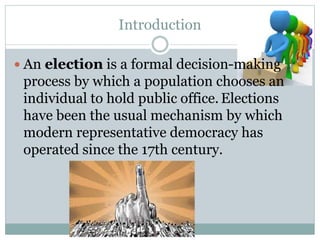
 An election is a formal decision-making
process by which a population chooses an
individual to hold public office. Elections
have been the usual mechanism by which
modern representative democracy has
operated since the 17th century.
Political Campaign
 A political campaign is an organized effort which
seeks to influence the decision making process
within a specific group. In democracies, political
campaigns often refer to electoral campaigns,
wherein representatives are chosen or referendums
are decided. In modern politics, the most high profile
political campaigns are focused on candidates
for head of state or head of government, often
a president or prime minister.
Polling Day
 Poll is the most important event in the election
process. It is through the poll that the electors
express their choice of the candidate to represent
them in Parliament or State Legislature.
 The day of poll, if it does not fall on a Sunday or
other holiday, will be generally declared as a holiday
for all Government offices and public sector
undertakings within the constituency.
 All private, commercial and industrial
establishments and factories within the constituency
will also be asked by the appropriate authorities of
the State Government to observe the day of poll as a
closed holiday in lieu of the usual weekly holidays or
at least to grant leave of absence for sufficient period
to enable workers to cast their votes.
Counting Day
 Q 1. Who is responsible for the counting of
votes and declaration of result of an election?
Ans. According to Sec. 64 of the R. P. Act, 1951, votes
are counted by or under the supervision / direction of
the Returning Officer of the Constituency. When the
counting is completed, the Returning officer declares
the result as per provisions of Sec. 66 of R. P. Act, 1951.
 Q 2. After the declaration of results in all
constituencies, which authority will
constitute the new Lok Sabha – President or
the Election Commission?
Ans. According to Sec. 73 of the R. P. Act, 1951, after
the results of all Parliamentary constituencies are
declared, the Election Commission will constitute the
new Lok Sabha by notifying in the official gazette, the
names of the elected members.
Election Commission
 The Election Commission of India (ECI) is a
constitutional body responsible for administering
elections in India according to the rules and
regulations mentioned in the Constitution of India.
It was established on January 25, 1950 with an aim
to define and control the process for elections
conducted at various levels: Parliament, State
Legislatures, and the offices of the President and
Vice President of India. In other words, the ECI
ensures smooth and successful functioning of the
democracy.
Role Of Election Commission
 In its assigned role, the most crucial challenge before
the Election Commission of India is to implement
norms and the Model Code of Conduct to ensure free
and fair elections in the country. Its existence and
independence are necessitated by history, which has
shown that democratic elections are not free from
sabotage. Towards this end, it has been empowered
to oversee political parties and candidates and take
appropriate action in case of violations.
Functions of ECI
The main functions of the ECI are as follows:
 The Election Commission of India is considered the
custodian of free and fair elections.
 It issues the Model Code of Conduct in every election
for political parties and candidates so that the
dignity of democracy is maintained.
 It regulates political parties and registers them for
being eligible to contest elections.
 It publishes the allowed limits of campaign
expenditure per candidate to all the political parties,
and also monitors the same.
 The political parties must submit their annual
reports to the ECI for getting tax benefit on
contributions.
 It ensures that all the political parties regularly
submit their audited financial reports.
Powers of ECI
Some of the powers wielded by the ECI are as
follows:
 The Commission can suppress the results of opinion
polls if it deems such an action fit for the cause of
democracy.
 The Commission can advise for disqualification of
members after the elections if it thinks they have
violated certain guidelines.
 In case, a candidate is found guilty of
corrupt practices during the elections,
the Supreme Court and High Courts
consult the Commission.
 The Commission can suspend
candidates who fail to submit their
election expense accounts timely.
Agendas: Political
 The political agenda is the set of issues that are the
subject of decision making and debate within a given
political system at any one time. Significant research
specifically on the topic of agenda setting, as opposed
to decision making, dates mostly from the 1960s.
Early studies of agenda setting were quite
controversial because they were often presented as
critiques of the pluralist studies of the 1950s and
1960s.
What do people want from their leader?
 Good laws
 Less crime
 Low loans
 Care of farmers
 Good relationship from other countries
 Maintained rally
 Nice schemes for the people and India
Election
Election

Election

  • 1.
    DONE BY: SHIVANG CLASS:9 SCHOOL: OAKRIDGE INTERNATIONAL SCHOOL Election
  • 2.
    Introduction  An electionis a formal decision-making process by which a population chooses an individual to hold public office. Elections have been the usual mechanism by which modern representative democracy has operated since the 17th century.
  • 3.
    Political Campaign  Apolitical campaign is an organized effort which seeks to influence the decision making process within a specific group. In democracies, political campaigns often refer to electoral campaigns, wherein representatives are chosen or referendums are decided. In modern politics, the most high profile political campaigns are focused on candidates for head of state or head of government, often a president or prime minister.
  • 5.
    Polling Day  Pollis the most important event in the election process. It is through the poll that the electors express their choice of the candidate to represent them in Parliament or State Legislature.  The day of poll, if it does not fall on a Sunday or other holiday, will be generally declared as a holiday for all Government offices and public sector undertakings within the constituency.
  • 6.
     All private,commercial and industrial establishments and factories within the constituency will also be asked by the appropriate authorities of the State Government to observe the day of poll as a closed holiday in lieu of the usual weekly holidays or at least to grant leave of absence for sufficient period to enable workers to cast their votes.
  • 7.
    Counting Day  Q1. Who is responsible for the counting of votes and declaration of result of an election? Ans. According to Sec. 64 of the R. P. Act, 1951, votes are counted by or under the supervision / direction of the Returning Officer of the Constituency. When the counting is completed, the Returning officer declares the result as per provisions of Sec. 66 of R. P. Act, 1951.
  • 8.
     Q 2.After the declaration of results in all constituencies, which authority will constitute the new Lok Sabha – President or the Election Commission? Ans. According to Sec. 73 of the R. P. Act, 1951, after the results of all Parliamentary constituencies are declared, the Election Commission will constitute the new Lok Sabha by notifying in the official gazette, the names of the elected members.
  • 10.
    Election Commission  TheElection Commission of India (ECI) is a constitutional body responsible for administering elections in India according to the rules and regulations mentioned in the Constitution of India. It was established on January 25, 1950 with an aim to define and control the process for elections conducted at various levels: Parliament, State Legislatures, and the offices of the President and Vice President of India. In other words, the ECI ensures smooth and successful functioning of the democracy.
  • 11.
    Role Of ElectionCommission  In its assigned role, the most crucial challenge before the Election Commission of India is to implement norms and the Model Code of Conduct to ensure free and fair elections in the country. Its existence and independence are necessitated by history, which has shown that democratic elections are not free from sabotage. Towards this end, it has been empowered to oversee political parties and candidates and take appropriate action in case of violations.
  • 12.
    Functions of ECI Themain functions of the ECI are as follows:  The Election Commission of India is considered the custodian of free and fair elections.  It issues the Model Code of Conduct in every election for political parties and candidates so that the dignity of democracy is maintained.  It regulates political parties and registers them for being eligible to contest elections.
  • 13.
     It publishesthe allowed limits of campaign expenditure per candidate to all the political parties, and also monitors the same.  The political parties must submit their annual reports to the ECI for getting tax benefit on contributions.  It ensures that all the political parties regularly submit their audited financial reports.
  • 14.
    Powers of ECI Someof the powers wielded by the ECI are as follows:  The Commission can suppress the results of opinion polls if it deems such an action fit for the cause of democracy.  The Commission can advise for disqualification of members after the elections if it thinks they have violated certain guidelines.
  • 15.
     In case,a candidate is found guilty of corrupt practices during the elections, the Supreme Court and High Courts consult the Commission.  The Commission can suspend candidates who fail to submit their election expense accounts timely.
  • 16.
    Agendas: Political  Thepolitical agenda is the set of issues that are the subject of decision making and debate within a given political system at any one time. Significant research specifically on the topic of agenda setting, as opposed to decision making, dates mostly from the 1960s. Early studies of agenda setting were quite controversial because they were often presented as critiques of the pluralist studies of the 1950s and 1960s.
  • 17.
    What do peoplewant from their leader?  Good laws  Less crime  Low loans  Care of farmers  Good relationship from other countries  Maintained rally  Nice schemes for the people and India