Observation Medicine:
Nursing Considerations
Mark Flitcraft RN MSN
Director Department of Nursing
Ronald Reagan UCLA Medical Center
Chicago September 2013
This speaker has no financial or other disclosure and is solely
responsible for the content herein.
Welcome!!
UCLA Health System
Ronald Reagan UCLA MC
Of the more than 100 academic medical centers and their
nearly 200 affiliated hospitals that are members of the
nationwide University Health System Consortium, Ronald
Reagan UCLA Medical Center is a leader in the U.S. for patient
satisfaction among those institutions that reported their
patient-satisfaction scores.

Ninety-six percent of our patients say they would
recommend us to a friend or family member.
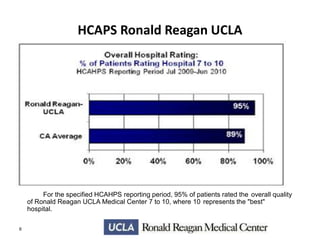
HCAPS Ronald Reagan UCLA

For the specified HCAHPS reporting period, 95% of patients rated the overall quality
of Ronald Reagan UCLA Medical Center 7 to 10, where 10 represents the "best"
hospital.
6
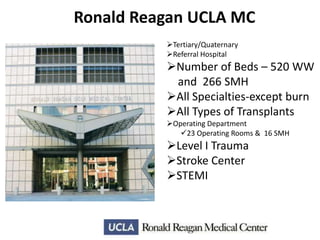
Ronald Reagan UCLA MC
Tertiary/Quaternary
Referral Hospital

Number of Beds – 520 WW
and 266 SMH
All Specialties-except burn
All Types of Transplants
Operating Department
23 Operating Rooms & 16 SMH

Level I Trauma
Stroke Center
STEMI
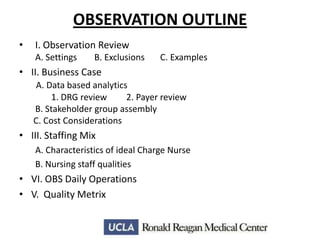
OBSERVATION OUTLINE
•

I. Observation Review
A. Settings

B. Exclusions

C. Examples

• II. Business Case
A. Data based analytics
1. DRG review
2. Payer review
B. Stakeholder group assembly
C. Cost Considerations

• III. Staffing Mix
A. Characteristics of ideal Charge Nurse
B. Nursing staff qualities

• VI. OBS Daily Operations
• V. Quality Metrix
OBSERVATION STATUS
Observation
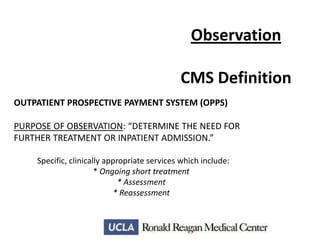
CMS Definition
OUTPATIENT PROSPECTIVE PAYMENT SYSTEM (OPPS)
PURPOSE OF OBSERVATION: “DETERMINE THE NEED FOR
FURTHER TREATMENT OR INPATIENT ADMISSION.”
Specific, clinically appropriate services which include:
* Ongoing short treatment
* Assessment
* Reassessment
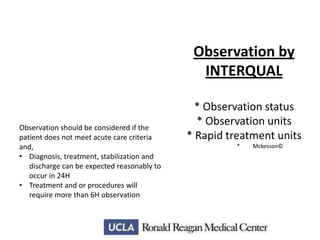
Observation by
INTERQUAL

Observation should be considered if the
patient does not meet acute care criteria
and,
• Diagnosis, treatment, stabilization and
discharge can be expected reasonably to
occur in 24H
• Treatment and or procedures will
require more than 6H observation

* Observation status
* Observation units
* Rapid treatment units
*

Mckesson©
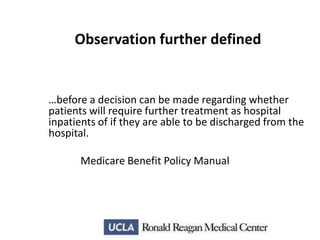
Observation further defined

…before a decision can be made regarding whether
patients will require further treatment as hospital
inpatients of if they are able to be discharged from the
hospital.
Medicare Benefit Policy Manual
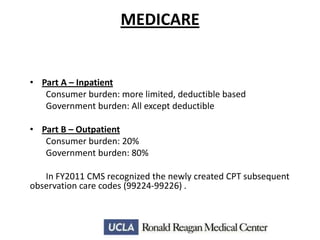
MEDICARE

• Part A – Inpatient
Consumer burden: more limited, deductible based
Government burden: All except deductible
• Part B – Outpatient
Consumer burden: 20%
Government burden: 80%
In FY2011 CMS recognized the newly created CPT subsequent
observation care codes (99224-99226) .
OBSERVATION CAVEAT
• Under current Medicare rules, the program pays more for
Part A inpatient stays than for Part B "observation" stays.
Moreover, beneficiaries must be admitted for inpatient care
for at least three days to qualify for follow-up care in a
nursing home.

• When an auditor determines that a hospital inpatient stay
should have been classified as an observation stay, the
hospital generally loses the full Medicare payment for the
stay. As such, many hospitals err on the side of caution to
avoid losing full payments and classify patients as
"observation."
Non-Covered
Observation
Services which are not reasonable or necessary for the
diagnosis or treatment of the Observation patient.
Services provided for the convenience of the patient, patient’s
family, physician.
Examples of services which are part of another Part B service
such as recovery room, pre-procedure prep, chemotherapy.
Medicare Benefit Policy Manual
Observation
Who can admit a patient to Observation status?
“Observation services are covered only when provided
by the order of a physician or another individual
authorized by State licensure law and hospital staff bylaws
to admit patients to the hospital or to order outpatient
tests.”
Medicare Benefit Policy Manual
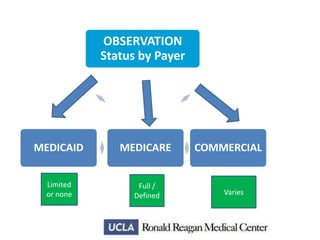
OBSERVATION
Status by Payer

MEDICAID

MEDICARE

Limited
or none

Full /
Defined

COMMERCIAL

Varies
Covered Observation Services

All hospital observation services that are
medically reasonable and necessary are
covered by Medicare
Medicare Benefit Policy Manual
• Consider: Who will manage the medical care
and oversight of Observation patients?
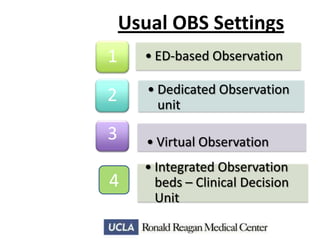
Usual OBS Settings
1

• ED-based Observation

2

• Dedicated Observation
unit

3

• Virtual Observation

4

• Integrated Observation
beds – Clinical Decision
Unit
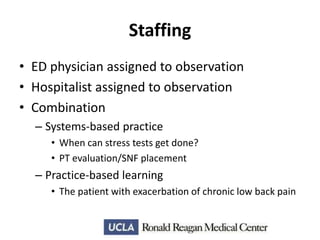
Staffing
• ED physician assigned to observation
• Hospitalist assigned to observation
• Combination
– Systems-based practice
• When can stress tests get done?
• PT evaluation/SNF placement

– Practice-based learning
• The patient with exacerbation of chronic low back pain
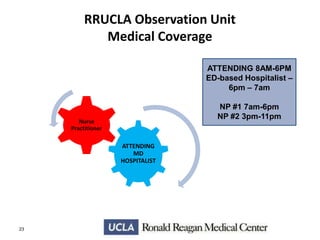
RRUCLA Observation Unit
Medical Coverage
ATTENDING 8AM-6PM
ED-based Hospitalist –
6pm – 7am
NP #1 7am-6pm
NP #2 3pm-11pm

Nurse
Practitioner

ATTENDING
MD
HOSPITALIST

23
• Management of the medical care and
oversight of Observation patients is
influenced heavily by geographic location and
hospital flow and is a fundamental
determination for an effective patient care
area.
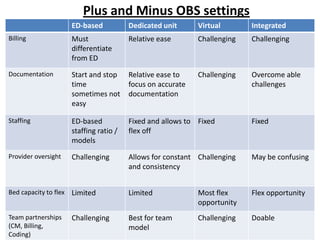
Plus and Minus OBS settings
ED-based

Dedicated unit

Virtual

Integrated

Billing

Must
differentiate
from ED

Relative ease

Challenging

Challenging

Documentation

Start and stop
time
sometimes not
easy

Relative ease to
focus on accurate
documentation

Challenging

Overcome able
challenges

Staffing

ED-based
staffing ratio /
models

Fixed and allows to Fixed
flex off

Fixed

Provider oversight

Challenging

Allows for constant Challenging
and consistency

May be confusing

Bed capacity to flex

Limited

Limited

Most flex
opportunity

Flex opportunity

Team partnerships
(CM, Billing,
Coding)

Challenging

Best for team
model

Challenging

Doable
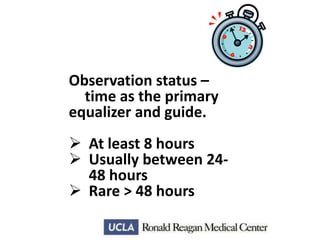
Observation status –
time as the primary
equalizer and guide.
 At least 8 hours
 Usually between 2448 hours
 Rare > 48 hours
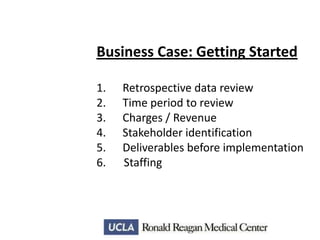
Business Case: Getting Started
1.
2.
3.
4.
5.
6.

Retrospective data review
Time period to review
Charges / Revenue
Stakeholder identification
Deliverables before implementation
Staffing
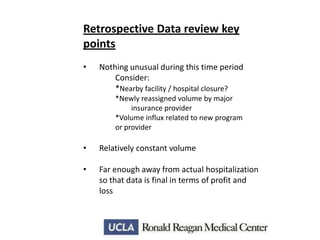
Retrospective Data review key
points
•

Nothing unusual during this time period
Consider:
*Nearby facility / hospital closure?
*Newly reassigned volume by major
insurance provider
*Volume influx related to new program
or provider

•

Relatively constant volume

•

Far enough away from actual hospitalization
so that data is final in terms of profit and
loss
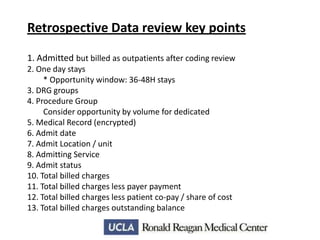
Retrospective Data review key points
1. Admitted but billed as outpatients after coding review
2. One day stays
* Opportunity window: 36-48H stays
3. DRG groups
4. Procedure Group
Consider opportunity by volume for dedicated
5. Medical Record (encrypted)
6. Admit date
7. Admit Location / unit
8. Admitting Service
9. Admit status
10. Total billed charges
11. Total billed charges less payer payment
12. Total billed charges less patient co-pay / share of cost
13. Total billed charges outstanding balance
Payer Review Key Points
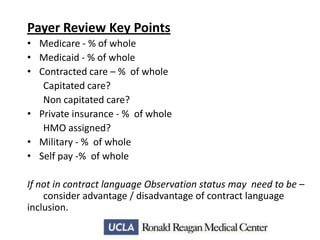
• Medicare - % of whole
• Medicaid - % of whole
• Contracted care – % of whole
Capitated care?
Non capitated care?
• Private insurance - % of whole
HMO assigned?
• Military - % of whole
• Self pay -% of whole
If not in contract language Observation status may need to be –
consider advantage / disadvantage of contract language
inclusion.
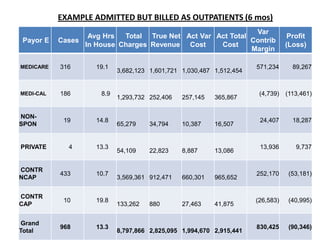
EXAMPLE ADMITTED BUT BILLED AS OUTPATIENTS (6 mos)
Payor E

Var
Avg Hrs
Total True Net Act Var Act Total
Cases
Contrib
In House Charges Revenue Cost
Cost
Margin

MEDICARE

316

19.1

MEDI-CAL

186

8.9

19

14.8

4

13.3

CONTR
NCAP

433

10.7

CONTR
CAP

10

19.8

968

13.3

NONSPON

PRIVATE

Grand
Total

3,682,123 1,601,721 1,030,487 1,512,454

1,293,732 252,406

257,145

365,867

65,279

34,794

10,387

16,507

54,109

22,823

8,887

13,086

3,569,361 912,471

660,301

965,652

133,262

27,463

41,875

880

8,797,866 2,825,095 1,994,670 2,915,441

Profit
(Loss)

571,234

89,267

(4,739)

(113,461)

24,407

18,287

13,936

9,737

252,170

(53,181)

(26,583)

(40,995)

830,425

(90,346)
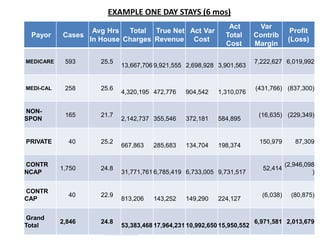
EXAMPLE ONE DAY STAYS (6 mos)
Payor

Avg Hrs
Total True Net Act Var
Cases
In House Charges Revenue Cost

MEDICARE

593

25.5

MEDI-CAL

258

25.6

NONSPON

165

21.7

40

25.2

CONTR
NCAP

1,750

24.8

CONTR
CAP

40

22.9

2,846

24.8

PRIVATE

Grand
Total

Act
Total
Cost

13,667,706 9,921,555 2,698,928 3,901,563

4,320,195 472,776

904,542

1,310,076

2,142,737 355,546

372,181

584,895

667,863

134,704

198,374

285,683

31,771,761 6,785,419 6,733,005 9,731,517

813,206

143,252

149,290

224,127

53,383,468 17,964,231 10,992,650 15,950,552

Var
Contrib
Margin

Profit
(Loss)

7,222,627 6,019,992

(431,766) (837,300)

(16,635) (229,349)

150,979

87,309

52,414

(2,946,098
)

(6,038)

(80,875)

6,971,581 2,013,679
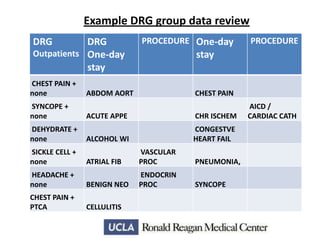
Example DRG group data review
DRG

DRG
Outpatients One-day
stay
CHEST PAIN +
none
SYNCOPE +
none

DEHYDRATE +
none
SICKLE CELL +
none

PROCEDURE One-day

PROCEDURE

stay

ABDOM AORT

CHEST PAIN

ACUTE APPE

CHR ISCHEM

ALCOHOL WI

CONGESTVE
HEART FAIL

ATRIAL FIB

VASCULAR
PROC

PNEUMONIA,

HEADACHE +
none

BENIGN NEO

ENDOCRIN
PROC

SYNCOPE

CHEST PAIN +
PTCA

CELLULITIS

AICD /
CARDIAC CATH
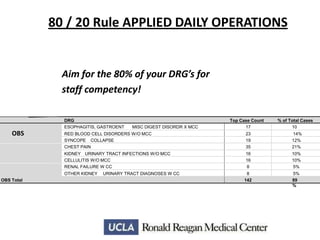
80 / 20 Rule APPLIED DAILY OPERATIONS

Aim for the 80% of your DRG’s for
staff competency!
DRG
ESOPHAGITIS, GASTROENT

OBS

MISC DIGEST DISORDR X MCC

Top Case Count
17

% of Total Cases
10

RED BLOOD CELL DISORDERS W/O MCC
SYNCOPE COLLAPSE
CHEST PAIN

23
19
35

14%
12%
21%

KIDNEY URINARY TRACT INFECTIONS W/O MCC
CELLULITIS W/O MCC
RENAL FAILURE W CC

16
16
8

10%
10%
5%

8
142

5%
89
%

OTHER KIDNEY
OBS Total

URINARY TRACT DIAGNOSES W CC
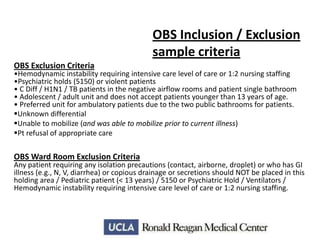
OBS Inclusion / Exclusion
sample criteria
OBS Exclusion Criteria

•Hemodynamic instability requiring intensive care level of care or 1:2 nursing staffing
•Psychiatric holds (5150) or violent patients
• C Diff / H1N1 / TB patients in the negative airflow rooms and patient single bathroom
• Adolescent / adult unit and does not accept patients younger than 13 years of age.
• Preferred unit for ambulatory patients due to the two public bathrooms for patients.
Unknown differential
Unable to mobilize (and was able to mobilize prior to current illness)
Pt refusal of appropriate care

OBS Ward Room Exclusion Criteria

Any patient requiring any isolation precautions (contact, airborne, droplet) or who has GI
illness (e.g., N, V, diarrhea) or copious drainage or secretions should NOT be placed in this
holding area / Pediatric patient (< 13 years) / 5150 or Psychiatric Hold / Ventilators /
Hemodynamic instability requiring intensive care level of care or 1:2 nursing staffing.
Stakeholder assembly

• Getting the right people on the
team from the get-go!
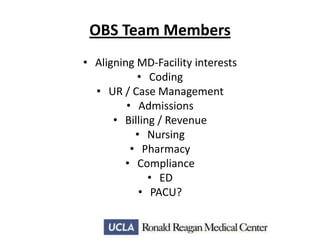
OBS Team Members
• Aligning MD-Facility interests
• Coding
• UR / Case Management
• Admissions
• Billing / Revenue
• Nursing
• Pharmacy
• Compliance
• ED
• PACU?
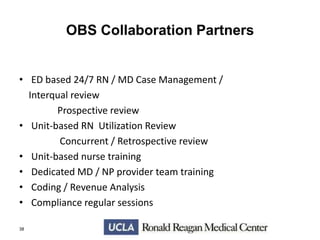
OBS Collaboration Partners
• ED based 24/7 RN / MD Case Management /
Interqual review
Prospective review
• Unit-based RN Utilization Review
Concurrent / Retrospective review
• Unit-based nurse training
• Dedicated MD / NP provider team training
• Coding / Revenue Analysis
• Compliance regular sessions
38
Obtaining Buy-In:
ED Physicians
• Improving “the numbers”
– ED length of stay
• Time from triage to disposition for specific diagnoses

– Number of patients Leaving Without Being Seen
– % of time ED closed due to “saturation”

• Utilization of Resources
– Improved Hospital throughput
• Less ED MD and RN time and resources spent on
“boarders”
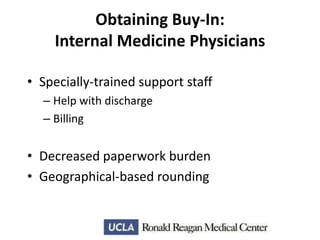
Obtaining Buy-In:
Internal Medicine Physicians
• Specially-trained support staff
– Help with discharge
– Billing

• Decreased paperwork burden
• Geographical-based rounding
Academic Hospitalists:
New Educational Opportunities
• Focus on “bread and butter medicine”
• Focus on bedside physical diagnostics rather
than multiple imaging studies
• Education on cost of care
• Research opportunities on treatment
algorithms, patient safety, patient education
Best Practice Units
• Focus on guideline based provision of care,
patient safety, and clinical outcomes
• Specially trained staff
• Focus on patient education
Collaboration with Stake Holders
•

Consider: The relationship with Patient Business Services (PBS) at
the outset.

•

Connecting at the billing and charging level for
Infusion/Hydration/IV Push as well as blood transfusions and
vaccine administration injections for patients – can be a
relationship
and communication strength.

•

Reasons for this special connection are how the charges from an
OBS area originate and are moved through the revenue cycle and
billed to payors.
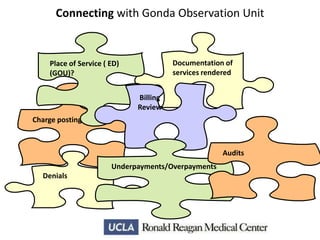
Connecting with Gonda Observation Unit

Documentation of
services rendered

Place of Service ( ED)
(GOU)?
Billing
Review
Charge posting

Audits
Underpayments/Overpayments
Denials
Consider: Observation status has multiple areas of Revenue Cycle
connection points to Billing. Best Practice: Begin education and
training on how to document and charge in these areas to reduce
risk in over/under CPT coding and claims adjudication-denials or
overpayments;
Develop a comprehensive program with Billing and Clinical staff
starting with the Revenue Cycle to give a “big picture” on how
charges generate onto a claim;
Nursing Staff drill down to documentation guidelines and CPT coding
the services rendered;
Maintain a dialogue on a concurrent (pre-bill) review asking
questions between Clinical staff and Billing staff to ensure that
documentation and CPT coding coincide with the services
performed.
Consider: System generated and/or custom built pre-billing edits on
claims for which we would expect the components of
Infusion/Hydration/IV Push and blood transfusion charges to meet
required billing criteria:
Example: There is a blood product charged but a missing
transfusion charge
Example: There is a vaccine charge but there is a missing vaccine
administration charge
Example- There are two (2) “initial” charges same day for an
Infusion or Hydration (this is a good trigger that there was an
IV started in the ER and both units are charging for the initial
Infusion or Hydration)
CHARGES / REVENUE
• Keep it clean – have one rule for nursing / clinical OBS staff
and use time as the equalizer.
• Risk: RAC/ OIG or charge inflation by payer!
• Correct billing / documentation / patient care the first time!

• Recommended Best Practice: One rule for all OBS patients
and do not consider payer.
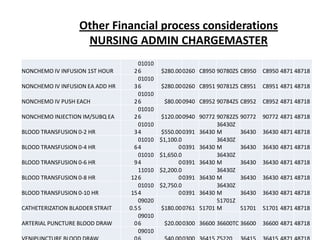
Other Financial process considerations
NURSING ADMIN CHARGEMASTER
NONCHEMO IV INFUSION 1ST HOUR
NONCHEMO IV INFUSION EA ADD HR

NONCHEMO IV PUSH EACH
NONCHEMO INJECTION IM/SUBQ EA
BLOOD TRANSFUSION 0-2 HR
BLOOD TRANSFUSION 0-4 HR
BLOOD TRANSFUSION 0-6 HR
BLOOD TRANSFUSION 0-8 HR
BLOOD TRANSFUSION 0-10 HR
CATHETERIZATION BLADDER STRAIT
ARTERIAL PUNCTURE BLOOD DRAW

01010
26
01010
36
01010
26
01010
26
01010
34
01010
64
01010
94
11010
12 6
01010
15 4
09020
0.5 5
09010
06
09010

$280.000260 C8950 90780ZS C8950

C8950 4871 48718

$280.000260 C8951 90781ZS C8951

C8951 4871 48718

$80.000940 C8952 90784ZS C8952

C8952 4871 48718

$120.000940 90772 90782ZS
36430Z
$550.000391 36430 M
$1,100.0
36430Z
00391 36430 M
$1,650.0
36430Z
00391 36430 M
$2,200.0
36430Z
00391 36430 M
$2,750.0
36430Z
00391 36430 M
51701Z
$180.000761 51701 M

90772

90772 4871 48718

36430

36430 4871 48718

36430

36430 4871 48718

36430

36430 4871 48718

36430

36430 4871 48718

36430

36430 4871 48718

51701

51701 4871 48718

$20.000300 36600 36600TC 36600

36600 4871 48718
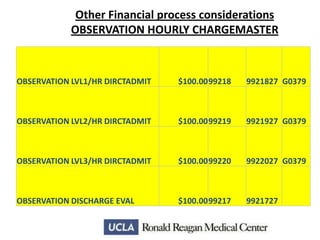
Other Financial process considerations
OBSERVATION HOURLY CHARGEMASTER

OBSERVATION LVL1/HR DIRCTADMIT

$100.0099218

9921827 G0379

OBSERVATION LVL2/HR DIRCTADMIT

$100.0099219

9921927 G0379

OBSERVATION LVL3/HR DIRCTADMIT

$100.0099220

9922027 G0379

OBSERVATION DISCHARGE EVAL

$100.0099217

9921727
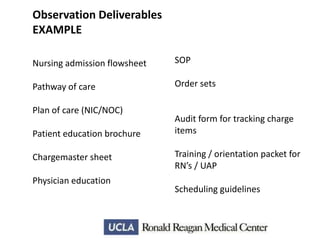
Observation Deliverables
EXAMPLE
Nursing admission flowsheet

SOP

Pathway of care

Order sets

Plan of care (NIC/NOC)
Patient education brochure
Chargemaster sheet
Physician education

Audit form for tracking charge
items
Training / orientation packet for
RN’s / UAP

Scheduling guidelines
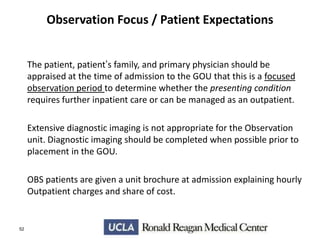
Observation Focus / Patient Expectations
The patient, patient’s family, and primary physician should be
appraised at the time of admission to the GOU that this is a focused
observation period to determine whether the presenting condition
requires further inpatient care or can be managed as an outpatient.
Extensive diagnostic imaging is not appropriate for the Observation
unit. Diagnostic imaging should be completed when possible prior to
placement in the GOU.
OBS patients are given a unit brochure at admission explaining hourly
Outpatient charges and share of cost.

52
Staffing
Considerations:
Getting Started
The Right People, with the Right Mindset,
Doing the Right Work,…Selection Points
Consider: Nursing Philosophy Model and Vision
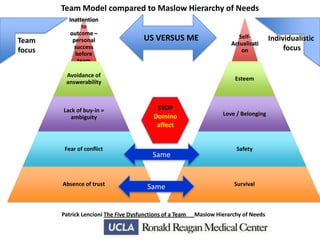
Team Model compared to Maslow Hierarchy of Needs

Team
focus

Inattention
to
outcome –
personal
success
before
team
success
Avoidance of
answerability

Lack of buy-in =
ambiguity

Fear of conflict

Absence of trust

US VERSUS ME

SelfActualizati
on

Esteem

STOP
Domino
affect

Same

Same

Patrick Lencioni The Five Dysfunctions of a Team

Love / Belonging

Safety

Survival

Maslow Hierarchy of Needs

Individualistic
focus
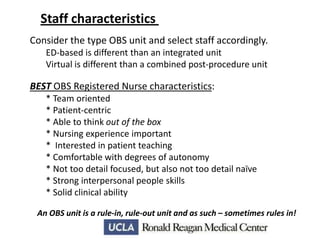
Staff characteristics
Consider the type OBS unit and select staff accordingly.
ED-based is different than an integrated unit
Virtual is different than a combined post-procedure unit

BEST OBS Registered Nurse characteristics:
* Team oriented
* Patient-centric
* Able to think out of the box
* Nursing experience important
* Interested in patient teaching
* Comfortable with degrees of autonomy
* Not too detail focused, but also not too detail naïve
* Strong interpersonal people skills
* Solid clinical ability
An OBS unit is a rule-in, rule-out unit and as such – sometimes rules in!
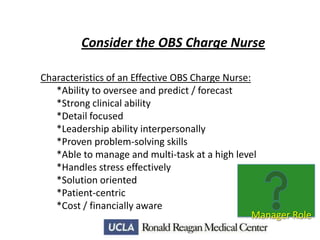
Consider the OBS Charge Nurse
Characteristics of an Effective OBS Charge Nurse:
*Ability to oversee and predict / forecast
*Strong clinical ability
*Detail focused
*Leadership ability interpersonally
*Proven problem-solving skills
*Able to manage and multi-task at a high level
*Handles stress effectively
*Solution oriented
*Patient-centric
*Cost / financially aware
Manager Role
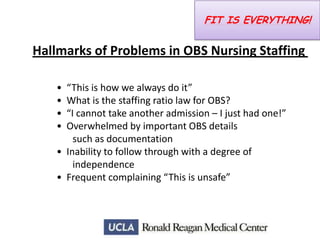
FIT IS EVERYTHING!

Hallmarks of Problems in OBS Nursing Staffing
•
•
•
•

“This is how we always do it”
What is the staffing ratio law for OBS?
“I cannot take another admission – I just had one!”
Overwhelmed by important OBS details
such as documentation
• Inability to follow through with a degree of
independence
• Frequent complaining “This is unsafe”
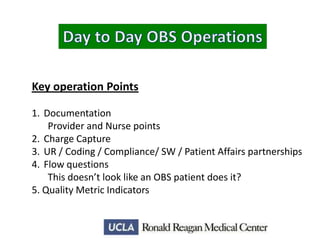
Key operation Points
1. Documentation
Provider and Nurse points
2. Charge Capture
3. UR / Coding / Compliance/ SW / Patient Affairs partnerships
4. Flow questions
This doesn’t look like an OBS patient does it?
5. Quality Metric Indicators
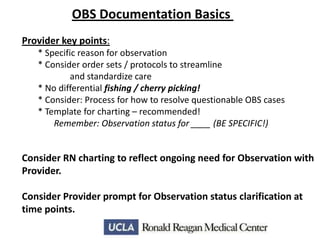
OBS Documentation Basics
Provider key points:
* Specific reason for observation
* Consider order sets / protocols to streamline
and standardize care
* No differential fishing / cherry picking!
* Consider: Process for how to resolve questionable OBS cases
* Template for charting – recommended!
Remember: Observation status for ____ (BE SPECIFIC!)

Consider RN charting to reflect ongoing need for Observation with
Provider.
Consider Provider prompt for Observation status clarification at
time points.
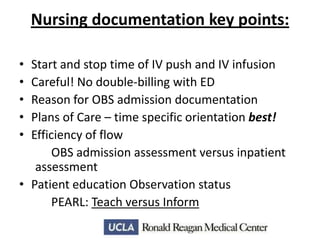
Nursing documentation key points:
•
•
•
•
•

Start and stop time of IV push and IV infusion
Careful! No double-billing with ED
Reason for OBS admission documentation
Plans of Care – time specific orientation best!
Efficiency of flow
OBS admission assessment versus inpatient
assessment
• Patient education Observation status
PEARL: Teach versus Inform
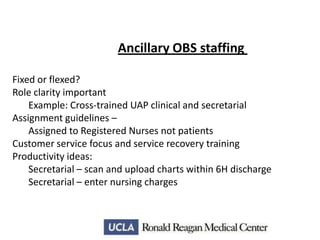
Ancillary OBS staffing
Fixed or flexed?
Role clarity important
Example: Cross-trained UAP clinical and secretarial
Assignment guidelines –
Assigned to Registered Nurses not patients
Customer service focus and service recovery training
Productivity ideas:
Secretarial – scan and upload charts within 6H discharge
Secretarial – enter nursing charges
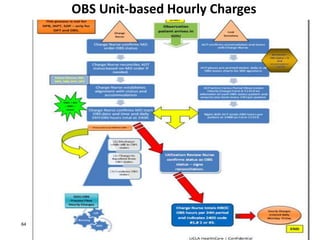
Sample daily charge capture flow chart
OBS Unit-based Hourly Charges

64
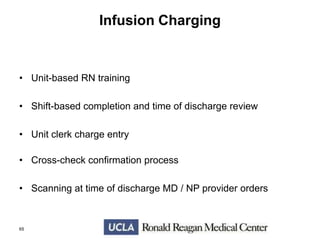
Infusion Charging

• Unit-based RN training
• Shift-based completion and time of discharge review
• Unit clerk charge entry
• Cross-check confirmation process
• Scanning at time of discharge MD / NP provider orders

65
Observation Quality Metrix
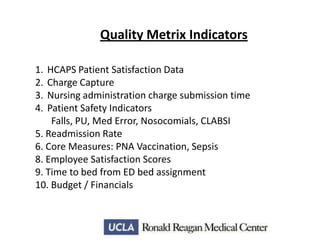
Quality Metrix Indicators
1.
2.
3.
4.

HCAPS Patient Satisfaction Data
Charge Capture
Nursing administration charge submission time
Patient Safety Indicators
Falls, PU, Med Error, Nosocomials, CLABSI
5. Readmission Rate
6. Core Measures: PNA Vaccination, Sepsis
8. Employee Satisfaction Scores
9. Time to bed from ED bed assignment
10. Budget / Financials
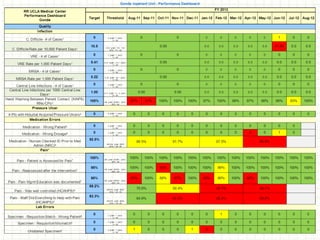
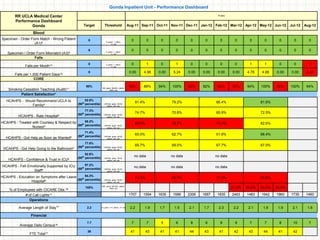
Gonda Inpatient Unit - Performance Dashboard
RR UCLA Medical Center
Performance Dashboard
Gonda

FY 2013

Target

Threshold

Aug-11 Sep-11 Oct-11 Nov-11 Dec-11 Jan-12 Feb-12 Mar-12 Apr-12 May-12 Jun-12

Jul-12

Aug-12

Blood
Specimen - Order Form Match - Wrong Patient
(A1)9
Specimen / Order Form Mismatch (A3)9
Falls
Falls per Month10
Falls per 1,000 Patient Days10
CORE
Smoking Cessation Teaching (Audit)11
Patient Satisfaction*
HCAHPS - Would Recommend UCLA to
Family6
HCAHPS - Rate Hospital6

0
0

0

HCAHPS - Got Help Going to the Bathroom6
HCAHPS - Confidence & Trust in ICU6

0: green; 1: yellow
1+: red

0

90%

82.6%
(90th percentile)
77.3%
(90th percentile)

88.2%
HCAHPS - Treated with Courtesy & Respect by
(90th percentile)
6
Nurses

HCAHPS - Got Help as Soon as Wanted6

0: green; 1: yellow
1+: red

71.4%
(90th percentile)
77.6%
(90th percentile)
92.9%
(90th percentile)

>90: green; 85-90%: yellow;
<85%: red

0

0

0

0

0

0

0

0

0

0

0

0

0

0

0

0

0

0

0

0

0

0

0

0

0

0

0

1

0

1

0

0

0

0

1

1

0

0

1

0.00

0: green; 1: yellow
1+: red

4.98

0.00

5.24

0.00

0.00

0.00

0.00

4.78

4.88

0.00

0.00

4.42

58%

86%

94%

100%

83%

92%

82%

80%

94%

100%

56%

100%

94%

81.4%

79.2%

86.4%

81.6%

74.7%

70.8%

85.9%

72.5%

80.5%

78.7%

75.9%

82.6%

65.0%

62.7%

61.9%

68.4%

69.7%

69.0%

67.7%

67.5%

no data

no data

no data

no data

no data

no data

74.3%

66.7%

77.5%

>90%tile: green; 89-50:
yellow; <49: red

>90%tile: green; 89-50:
yellow; <49: red

>90%tile: green; 89-50:
yellow; <49: red

>90%tile: green; 89-50:
yellow; <49: red

>90%tile: green; 89-50:
yellow; <49: red

>90%tile: green; 89-50:
yellow; <49: red

97.2%
HCAHPS - Felt Emotionally Supported by ICU
(90th percentile)
Staff6

>90%tile: green; 89-50:
yellow; <49: red

94.3%
HCAHPS - Education on Symptoms after Leave
(90th percentile)
Hospital6

>90%tile: green; 89-50:
yellow; <49: red

% of Employees with CICARE Obs.18
# of Call Lights12
Operations
Average Length of Stay14

100%

90%: green; 89-50%: yellow;
<50%: red

80.6%

21.0%

24.0%

33.0%

26.0%

1707

1594

1635

1586

2306

1687

1835

2463

1483

1942

1960

1735

1460

2.2

1.9

1.7

1.5

2.1

1.7

2.3

2.2

2.1

1.9

1.9

2.1

1.8

7.7

7

7

5

6

8

6

8

9

7

7

8

10

7

38

41

43

41

41

44

43

41

42

43

44

41

42

2.2

<3: green; 3-4: yellow; >4: red

Financial
Average Daily Census16
FTE Total17
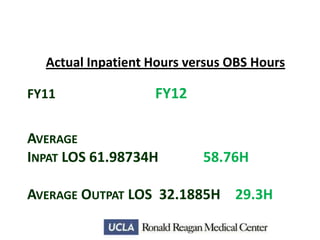
Actual Inpatient Hours versus OBS Hours
FY11

FY12

AVERAGE
INPAT LOS 61.98734H

58.76H

AVERAGE OUTPAT LOS 32.1885H 29.3H
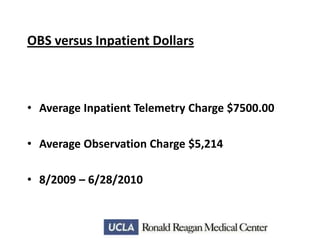
OBS versus Inpatient Dollars

• Average Inpatient Telemetry Charge $7500.00
• Average Observation Charge $5,214
• 8/2009 – 6/28/2010
OBS Controlled Substance Discharge RX
• Consider: Controlled substance prescriptions
are issued for a limited period only (Recc: 3-7
days only.
• Patient notice of this OBS unit rule is given
through the Patient Education Brochure.
• Adherence to pain EBP medication regimens is
required.
72
Obs “Hall of Fame”
Was this pt REALLY admitted to the
Observation Unit?
• 19yo with nausea and vomiting for several
weeks
• 30lb wt loss
• Admitted to obs…? For PO intolerance.
• Diagnosis: widely metastatic testicular cancer
Obs “Hall of Fame”
•
•
•
•
•

100yo man
Hgb 7.0
INR 4.5
New massive flank hematoma
Admit to GOU for “transfusion support”
Obs “Hall of Fame”
• 24yo woman
• h/o L hip dysplasia and chronic pain (on
chronic oral opioids)
• Has severe worsening of L leg and foot pain
• New bluish discoloration of L foot
• “admit to obs for pain control”
Final Thoughts

• “If you could get all the people in an
organization rowing in the same direction, you
could dominate any industry, in any market,
against any competition, at any time.”
Author Unknown
On Flexibility and Fluidity…
Contact Information

Contact information

Mark Flitcraft RN
MSN

Mflitcraft@mednet.ucla.edu
# 310 267 9529
• Lencioni, P. (2002). The
five dysfunctions of a
team: a leadership fable,
San Francisco, CA: JosseyBass.
Resources
• http://www.cms.gov/Regulations-andGuidance/Guidance/Transmittals/downloads/R2282CP.pdf
• http://www.advisory.com/Daily-Briefing/2012/08/13/Wouldrelaxing-payment-rules-improve-patient-care
• http://www.aha.org/advocacy-issues/rac/contractors.shtml
• http://www.medicare.gov/cost/
• http://www.scha.org/files/documents/medicare_inpatient_only_pr
ocedures_2012.pdf
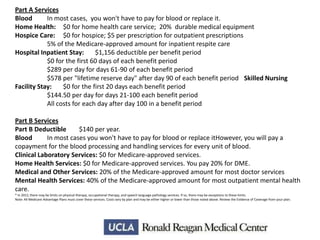
Part A Services
Blood
In most cases, you won't have to pay for blood or replace it.
Home Health: $0 for home health care service; 20% durable medical equipment
Hospice Care: $0 for hospice; $5 per prescription for outpatient prescriptions
5% of the Medicare-approved amount for inpatient respite care
Hospital Inpatient Stay:
$1,156 deductible per benefit period
$0 for the first 60 days of each benefit period
$289 per day for days 61-90 of each benefit period
$578 per "lifetime reserve day" after day 90 of each benefit period 
Skilled Nursing
Facility Stay:
$0 for the first 20 days each benefit period
$144.50 per day for days 21-100 each benefit period
All costs for each day after day 100 in a benefit period
Part B Services
Part B Deductible
$140 per year.
Blood
In most cases you won't have to pay for blood or replace itHowever, you will pay a
copayment for the blood processing and handling services for every unit of blood.
Clinical Laboratory Services: $0 for Medicare-approved services.
Home Health Services: $0 for Medicare-approved services. You pay 20% for DME.
Medical and Other Services: 20% of the Medicare-approved amount for most doctor services
Mental Health Services: 40% of the Medicare-approved amount for most outpatient mental health
care.
* In 2012, there may be limits on physical therapy, occupational therapy, and speech language pathology services. If so, there may be exceptions to these limits.
Note: All Medicare Advantage Plans must cover these services. Costs vary by plan and may be either higher or lower than those noted above. Review the Evidence of Coverage from your plan.
• Appendix RRUCLA examples
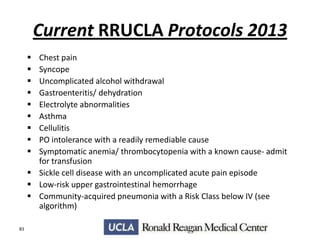
Current RRUCLA Protocols 2013










Chest pain
Syncope
Uncomplicated alcohol withdrawal
Gastroenteritis/ dehydration
Electrolyte abnormalities
Asthma
Cellulitis
PO intolerance with a readily remediable cause
Symptomatic anemia/ thrombocytopenia with a known cause- admit
for transfusion
 Sickle cell disease with an uncomplicated acute pain episode
 Low-risk upper gastrointestinal hemorrhage
 Community-acquired pneumonia with a Risk Class below IV (see
algorithm)
83
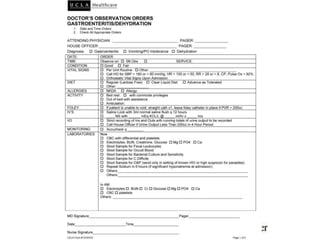
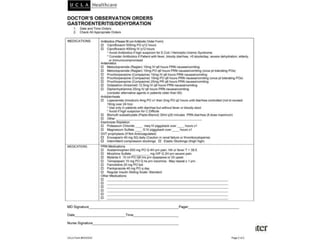
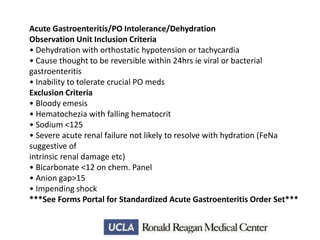
Acute Gastroenteritis/PO Intolerance/Dehydration
Observation Unit Inclusion Criteria
• Dehydration with orthostatic hypotension or tachycardia
• Cause thought to be reversible within 24hrs ie viral or bacterial
gastroenteritis
• Inability to tolerate crucial PO meds
Exclusion Criteria
• Bloody emesis
• Hematochezia with falling hematocrit
• Sodium <125
• Severe acute renal failure not likely to resolve with hydration (FeNa
suggestive of
intrinsic renal damage etc)
• Bicarbonate <12 on chem. Panel
• Anion gap>15
• Impending shock
***See Forms Portal for Standardized Acute Gastroenteritis Order Set***
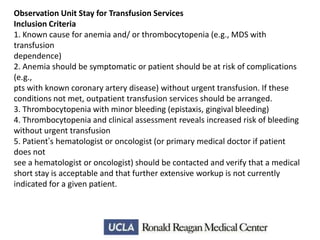
Observation Unit Stay for Transfusion Services
Inclusion Criteria
1. Known cause for anemia and/ or thrombocytopenia (e.g., MDS with
transfusion
dependence)
2. Anemia should be symptomatic or patient should be at risk of complications
(e.g.,
pts with known coronary artery disease) without urgent transfusion. If these
conditions not met, outpatient transfusion services should be arranged.
3. Thrombocytopenia with minor bleeding (epistaxis, gingival bleeding)
4. Thrombocytopenia and clinical assessment reveals increased risk of bleeding
without urgent transfusion
5. Patient’s hematologist or oncologist (or primary medical doctor if patient
does not
see a hematologist or oncologist) should be contacted and verify that a medical
short stay is acceptable and that further extensive workup is not currently
indicated for a given patient.
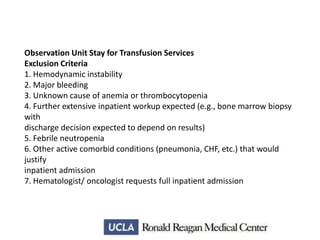
Observation Unit Stay for Transfusion Services
Exclusion Criteria
1. Hemodynamic instability
2. Major bleeding
3. Unknown cause of anemia or thrombocytopenia
4. Further extensive inpatient workup expected (e.g., bone marrow biopsy
with
discharge decision expected to depend on results)
5. Febrile neutropenia
6. Other active comorbid conditions (pneumonia, CHF, etc.) that would
justify
inpatient admission
7. Hematologist/ oncologist requests full inpatient admission
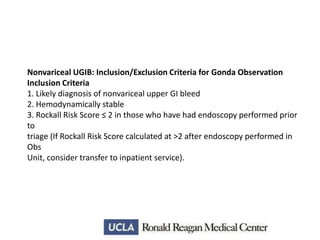
Nonvariceal UGIB: Inclusion/Exclusion Criteria for Gonda Observation
Inclusion Criteria
1. Likely diagnosis of nonvariceal upper GI bleed
2. Hemodynamically stable
3. Rockall Risk Score ≤ 2 in those who have had endoscopy performed prior
to
triage (If Rockall Risk Score calculated at >2 after endoscopy performed in
Obs
Unit, consider transfer to inpatient service).
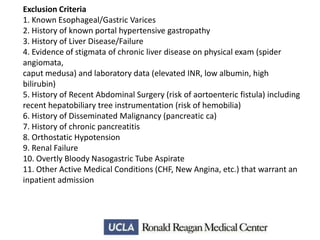
Exclusion Criteria
1. Known Esophageal/Gastric Varices
2. History of known portal hypertensive gastropathy
3. History of Liver Disease/Failure
4. Evidence of stigmata of chronic liver disease on physical exam (spider
angiomata,
caput medusa) and laboratory data (elevated INR, low albumin, high
bilirubin)
5. History of Recent Abdominal Surgery (risk of aortoenteric fistula) including
recent hepatobiliary tree instrumentation (risk of hemobilia)
6. History of Disseminated Malignancy (pancreatic ca)
7. History of chronic pancreatitis
8. Orthostatic Hypotension
9. Renal Failure
10. Overtly Bloody Nasogastric Tube Aspirate
11. Other Active Medical Conditions (CHF, New Angina, etc.) that warrant an
inpatient admission
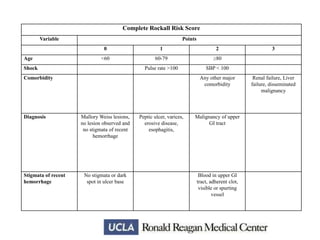
Complete Rockall Risk Score
Variable

Points
0

Age

1

2

<60

60-79

80

Pulse rate >100

SBP < 100

Shock
Comorbidity

Diagnosis

Stigmata of recent
hemorrhage

Any other major
comorbidity

Mallory Weiss lesions,
no lesion observed and
no stigmata of recent
hemorrhage

No stigmata or dark
spot in ulcer base

Peptic ulcer, varices,
erosive disease,
esophagitis,

Malignancy of upper
GI tract

Blood in upper GI
tract, adherent clot,
visible or spurting
vessel

3

Renal failure, Liver
failure, disseminated
malignancy
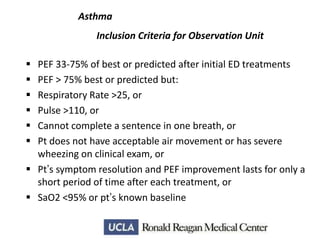
Asthma
Inclusion Criteria for Observation Unit







PEF 33-75% of best or predicted after initial ED treatments
PEF > 75% best or predicted but:
Respiratory Rate >25, or
Pulse >110, or
Cannot complete a sentence in one breath, or
Pt does not have acceptable air movement or has severe
wheezing on clinical exam, or
 Pt’s symptom resolution and PEF improvement lasts for only a
short period of time after each treatment, or
 SaO2 <95% or pt’s known baseline
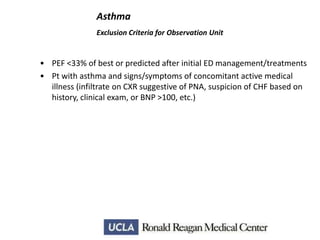
Asthma
Exclusion Criteria for Observation Unit

• PEF <33% of best or predicted after initial ED management/treatments
• Pt with asthma and signs/symptoms of concomitant active medical
illness (infiltrate on CXR suggestive of PNA, suspicion of CHF based on
history, clinical exam, or BNP >100, etc.)
Asthma
Exclusion Criteria for Observation Unit

• Any features of life-threatening asthma including:
– SpO2<90% on room air
– Silent chest
– Cyanosis
– Signs of fatigue/ poor respiratory effort
– Bradycardia
– Arrhythmia
– Relative hypotension
– Exhaustion, confusion, or coma
– PaCO2 >42mm Hg (note: ABG not required before admission in clinically
stable pts)
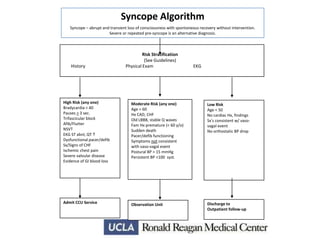
Syncope Algorithm
Syncope – abrupt and transient loss of consciousness with spontaneous recovery without intervention.
Severe or repeated pre-syncope is an alternative diagnosis.

History

Risk Stratification
(See Guidelines)
Physical Exam

EKG

High Risk (any one)
Bradycardia < 40
Pauses > 3 sec.
Trifascicular block
Afib/Flutter
NSVT
EKG ST abnl, QT h
Dysfunctional pacer/defib
Sx/Signs of CHF
Ischemic chest pain
Severe valvular disease
Evidence of GI blood loss

Moderate Risk (any one)
Age > 60
Hx CAD, CHF
Old LBBB, stable Q waves
Fam Hx premature (< 60 y/o)
Sudden death
Pacer/defib functioning
Symptoms not consistent
with vaso-vagal event
Postural BP > 15 mmHg
Persistent BP <100 syst.

Low Risk
Age < 50
No cardiac Hx, findings
Sx’s consistent w/ vasovagal event
No orthostatic BP drop

Admit CCU Service

Observation Unit

Discharge to
Outpatient follow-up
Alcohol Withdrawal Inclusion Criteria
• Clear diagnosis of alcohol withdrawal or acute
alcohol intoxication after a complete history and
physical examination
• Has an objective medical reason for observation
(abnormal vital signs, altered level of consciousness
needing repeat neuro checks, hypoglycemia, marked
electrolyte abnormalities, etc.)
• High probability of response to treatment and
discharge from hospital within 48hours
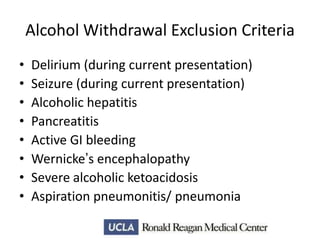
Alcohol Withdrawal Exclusion Criteria
•
•
•
•
•
•
•
•

Delirium (during current presentation)
Seizure (during current presentation)
Alcoholic hepatitis
Pancreatitis
Active GI bleeding
Wernicke’s encephalopathy
Severe alcoholic ketoacidosis
Aspiration pneumonitis/ pneumonia
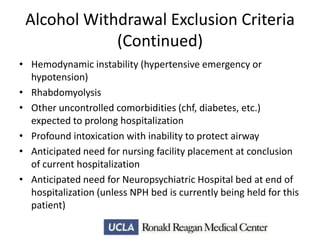
Alcohol Withdrawal Exclusion Criteria
(Continued)
• Hemodynamic instability (hypertensive emergency or
hypotension)
• Rhabdomyolysis
• Other uncontrolled comorbidities (chf, diabetes, etc.)
expected to prolong hospitalization
• Profound intoxication with inability to protect airway
• Anticipated need for nursing facility placement at conclusion
of current hospitalization
• Anticipated need for Neuropsychiatric Hospital bed at end of
hospitalization (unless NPH bed is currently being held for this
patient)
Cellulitis Obs Inclusion Criteria
• Clear or probable diagnosis of cellulitis after
complete history and physical examination
• High probability of response to treatment and
discharge from hospital within 48hours
Obs Unit Exclusion Criteria for Cellulitis
•
•
•
•
•

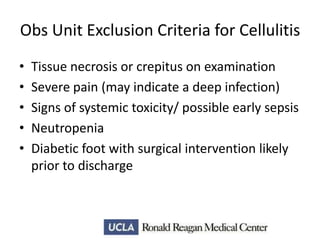
Tissue necrosis or crepitus on examination
Severe pain (may indicate a deep infection)
Signs of systemic toxicity/ possible early sepsis
Neutropenia
Diabetic foot with surgical intervention likely
prior to discharge
Risk Factors for Slow Response of Cellulitis to
Treatment
•
•
•
•
•
•
•
•
•
•
•

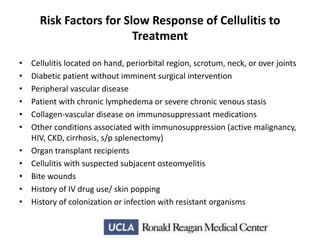
Cellulitis located on hand, periorbital region, scrotum, neck, or over joints
Diabetic patient without imminent surgical intervention
Peripheral vascular disease
Patient with chronic lymphedema or severe chronic venous stasis
Collagen-vascular disease on immunosuppressant medications
Other conditions associated with immunosuppression (active malignancy,
HIV, CKD, cirrhosis, s/p splenectomy)
Organ transplant recipients
Cellulitis with suspected subjacent osteomyelitis
Bite wounds
History of IV drug use/ skin popping
History of colonization or infection with resistant organisms
Common “Off Protocol” Admissions
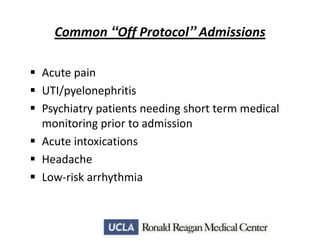
 Acute pain
 UTI/pyelonephritis
 Psychiatry patients needing short term medical
monitoring prior to admission
 Acute intoxications
 Headache
 Low-risk arrhythmia

Observation medicine nursing considerations

  • 1.
    Observation Medicine: Nursing Considerations MarkFlitcraft RN MSN Director Department of Nursing Ronald Reagan UCLA Medical Center Chicago September 2013
  • 2.
    This speaker hasno financial or other disclosure and is solely responsible for the content herein.
  • 3.
  • 4.
  • 5.
    Of the morethan 100 academic medical centers and their nearly 200 affiliated hospitals that are members of the nationwide University Health System Consortium, Ronald Reagan UCLA Medical Center is a leader in the U.S. for patient satisfaction among those institutions that reported their patient-satisfaction scores. Ninety-six percent of our patients say they would recommend us to a friend or family member.
  • 6.
    HCAPS Ronald ReaganUCLA For the specified HCAHPS reporting period, 95% of patients rated the overall quality of Ronald Reagan UCLA Medical Center 7 to 10, where 10 represents the "best" hospital. 6
  • 7.
    Ronald Reagan UCLAMC Tertiary/Quaternary Referral Hospital Number of Beds – 520 WW and 266 SMH All Specialties-except burn All Types of Transplants Operating Department 23 Operating Rooms & 16 SMH Level I Trauma Stroke Center STEMI
  • 8.
    OBSERVATION OUTLINE • I. ObservationReview A. Settings B. Exclusions C. Examples • II. Business Case A. Data based analytics 1. DRG review 2. Payer review B. Stakeholder group assembly C. Cost Considerations • III. Staffing Mix A. Characteristics of ideal Charge Nurse B. Nursing staff qualities • VI. OBS Daily Operations • V. Quality Metrix
  • 10.
  • 11.
    Observation CMS Definition OUTPATIENT PROSPECTIVEPAYMENT SYSTEM (OPPS) PURPOSE OF OBSERVATION: “DETERMINE THE NEED FOR FURTHER TREATMENT OR INPATIENT ADMISSION.” Specific, clinically appropriate services which include: * Ongoing short treatment * Assessment * Reassessment
  • 12.
    Observation by INTERQUAL Observation shouldbe considered if the patient does not meet acute care criteria and, • Diagnosis, treatment, stabilization and discharge can be expected reasonably to occur in 24H • Treatment and or procedures will require more than 6H observation * Observation status * Observation units * Rapid treatment units * Mckesson©
  • 13.
    Observation further defined …beforea decision can be made regarding whether patients will require further treatment as hospital inpatients of if they are able to be discharged from the hospital. Medicare Benefit Policy Manual
  • 14.
    MEDICARE • Part A– Inpatient Consumer burden: more limited, deductible based Government burden: All except deductible • Part B – Outpatient Consumer burden: 20% Government burden: 80% In FY2011 CMS recognized the newly created CPT subsequent observation care codes (99224-99226) .
  • 15.
    OBSERVATION CAVEAT • Undercurrent Medicare rules, the program pays more for Part A inpatient stays than for Part B "observation" stays. Moreover, beneficiaries must be admitted for inpatient care for at least three days to qualify for follow-up care in a nursing home. • When an auditor determines that a hospital inpatient stay should have been classified as an observation stay, the hospital generally loses the full Medicare payment for the stay. As such, many hospitals err on the side of caution to avoid losing full payments and classify patients as "observation."
  • 16.
    Non-Covered Observation Services which arenot reasonable or necessary for the diagnosis or treatment of the Observation patient. Services provided for the convenience of the patient, patient’s family, physician. Examples of services which are part of another Part B service such as recovery room, pre-procedure prep, chemotherapy. Medicare Benefit Policy Manual
  • 17.
    Observation Who can admita patient to Observation status? “Observation services are covered only when provided by the order of a physician or another individual authorized by State licensure law and hospital staff bylaws to admit patients to the hospital or to order outpatient tests.” Medicare Benefit Policy Manual
  • 18.
    OBSERVATION Status by Payer MEDICAID MEDICARE Limited ornone Full / Defined COMMERCIAL Varies
  • 19.
    Covered Observation Services Allhospital observation services that are medically reasonable and necessary are covered by Medicare Medicare Benefit Policy Manual
  • 20.
    • Consider: Whowill manage the medical care and oversight of Observation patients?
  • 21.
    Usual OBS Settings 1 •ED-based Observation 2 • Dedicated Observation unit 3 • Virtual Observation 4 • Integrated Observation beds – Clinical Decision Unit
  • 22.
    Staffing • ED physicianassigned to observation • Hospitalist assigned to observation • Combination – Systems-based practice • When can stress tests get done? • PT evaluation/SNF placement – Practice-based learning • The patient with exacerbation of chronic low back pain
  • 23.
    RRUCLA Observation Unit MedicalCoverage ATTENDING 8AM-6PM ED-based Hospitalist – 6pm – 7am NP #1 7am-6pm NP #2 3pm-11pm Nurse Practitioner ATTENDING MD HOSPITALIST 23
  • 24.
    • Management ofthe medical care and oversight of Observation patients is influenced heavily by geographic location and hospital flow and is a fundamental determination for an effective patient care area.
  • 25.
    Plus and MinusOBS settings ED-based Dedicated unit Virtual Integrated Billing Must differentiate from ED Relative ease Challenging Challenging Documentation Start and stop time sometimes not easy Relative ease to focus on accurate documentation Challenging Overcome able challenges Staffing ED-based staffing ratio / models Fixed and allows to Fixed flex off Fixed Provider oversight Challenging Allows for constant Challenging and consistency May be confusing Bed capacity to flex Limited Limited Most flex opportunity Flex opportunity Team partnerships (CM, Billing, Coding) Challenging Best for team model Challenging Doable
  • 26.
    Observation status – timeas the primary equalizer and guide.  At least 8 hours  Usually between 2448 hours  Rare > 48 hours
  • 27.
    Business Case: GettingStarted 1. 2. 3. 4. 5. 6. Retrospective data review Time period to review Charges / Revenue Stakeholder identification Deliverables before implementation Staffing
  • 28.
    Retrospective Data reviewkey points • Nothing unusual during this time period Consider: *Nearby facility / hospital closure? *Newly reassigned volume by major insurance provider *Volume influx related to new program or provider • Relatively constant volume • Far enough away from actual hospitalization so that data is final in terms of profit and loss
  • 29.
    Retrospective Data reviewkey points 1. Admitted but billed as outpatients after coding review 2. One day stays * Opportunity window: 36-48H stays 3. DRG groups 4. Procedure Group Consider opportunity by volume for dedicated 5. Medical Record (encrypted) 6. Admit date 7. Admit Location / unit 8. Admitting Service 9. Admit status 10. Total billed charges 11. Total billed charges less payer payment 12. Total billed charges less patient co-pay / share of cost 13. Total billed charges outstanding balance
  • 30.
    Payer Review KeyPoints • Medicare - % of whole • Medicaid - % of whole • Contracted care – % of whole Capitated care? Non capitated care? • Private insurance - % of whole HMO assigned? • Military - % of whole • Self pay -% of whole If not in contract language Observation status may need to be – consider advantage / disadvantage of contract language inclusion.
  • 31.
    EXAMPLE ADMITTED BUTBILLED AS OUTPATIENTS (6 mos) Payor E Var Avg Hrs Total True Net Act Var Act Total Cases Contrib In House Charges Revenue Cost Cost Margin MEDICARE 316 19.1 MEDI-CAL 186 8.9 19 14.8 4 13.3 CONTR NCAP 433 10.7 CONTR CAP 10 19.8 968 13.3 NONSPON PRIVATE Grand Total 3,682,123 1,601,721 1,030,487 1,512,454 1,293,732 252,406 257,145 365,867 65,279 34,794 10,387 16,507 54,109 22,823 8,887 13,086 3,569,361 912,471 660,301 965,652 133,262 27,463 41,875 880 8,797,866 2,825,095 1,994,670 2,915,441 Profit (Loss) 571,234 89,267 (4,739) (113,461) 24,407 18,287 13,936 9,737 252,170 (53,181) (26,583) (40,995) 830,425 (90,346)
  • 32.
    EXAMPLE ONE DAYSTAYS (6 mos) Payor Avg Hrs Total True Net Act Var Cases In House Charges Revenue Cost MEDICARE 593 25.5 MEDI-CAL 258 25.6 NONSPON 165 21.7 40 25.2 CONTR NCAP 1,750 24.8 CONTR CAP 40 22.9 2,846 24.8 PRIVATE Grand Total Act Total Cost 13,667,706 9,921,555 2,698,928 3,901,563 4,320,195 472,776 904,542 1,310,076 2,142,737 355,546 372,181 584,895 667,863 134,704 198,374 285,683 31,771,761 6,785,419 6,733,005 9,731,517 813,206 143,252 149,290 224,127 53,383,468 17,964,231 10,992,650 15,950,552 Var Contrib Margin Profit (Loss) 7,222,627 6,019,992 (431,766) (837,300) (16,635) (229,349) 150,979 87,309 52,414 (2,946,098 ) (6,038) (80,875) 6,971,581 2,013,679
  • 33.
    Example DRG groupdata review DRG DRG Outpatients One-day stay CHEST PAIN + none SYNCOPE + none DEHYDRATE + none SICKLE CELL + none PROCEDURE One-day PROCEDURE stay ABDOM AORT CHEST PAIN ACUTE APPE CHR ISCHEM ALCOHOL WI CONGESTVE HEART FAIL ATRIAL FIB VASCULAR PROC PNEUMONIA, HEADACHE + none BENIGN NEO ENDOCRIN PROC SYNCOPE CHEST PAIN + PTCA CELLULITIS AICD / CARDIAC CATH
  • 34.
    80 / 20Rule APPLIED DAILY OPERATIONS Aim for the 80% of your DRG’s for staff competency! DRG ESOPHAGITIS, GASTROENT OBS MISC DIGEST DISORDR X MCC Top Case Count 17 % of Total Cases 10 RED BLOOD CELL DISORDERS W/O MCC SYNCOPE COLLAPSE CHEST PAIN 23 19 35 14% 12% 21% KIDNEY URINARY TRACT INFECTIONS W/O MCC CELLULITIS W/O MCC RENAL FAILURE W CC 16 16 8 10% 10% 5% 8 142 5% 89 % OTHER KIDNEY OBS Total URINARY TRACT DIAGNOSES W CC
  • 35.
    OBS Inclusion /Exclusion sample criteria OBS Exclusion Criteria •Hemodynamic instability requiring intensive care level of care or 1:2 nursing staffing •Psychiatric holds (5150) or violent patients • C Diff / H1N1 / TB patients in the negative airflow rooms and patient single bathroom • Adolescent / adult unit and does not accept patients younger than 13 years of age. • Preferred unit for ambulatory patients due to the two public bathrooms for patients. Unknown differential Unable to mobilize (and was able to mobilize prior to current illness) Pt refusal of appropriate care OBS Ward Room Exclusion Criteria Any patient requiring any isolation precautions (contact, airborne, droplet) or who has GI illness (e.g., N, V, diarrhea) or copious drainage or secretions should NOT be placed in this holding area / Pediatric patient (< 13 years) / 5150 or Psychiatric Hold / Ventilators / Hemodynamic instability requiring intensive care level of care or 1:2 nursing staffing.
  • 36.
    Stakeholder assembly • Gettingthe right people on the team from the get-go!
  • 37.
    OBS Team Members •Aligning MD-Facility interests • Coding • UR / Case Management • Admissions • Billing / Revenue • Nursing • Pharmacy • Compliance • ED • PACU?
  • 38.
    OBS Collaboration Partners •ED based 24/7 RN / MD Case Management / Interqual review Prospective review • Unit-based RN Utilization Review Concurrent / Retrospective review • Unit-based nurse training • Dedicated MD / NP provider team training • Coding / Revenue Analysis • Compliance regular sessions 38
  • 39.
    Obtaining Buy-In: ED Physicians •Improving “the numbers” – ED length of stay • Time from triage to disposition for specific diagnoses – Number of patients Leaving Without Being Seen – % of time ED closed due to “saturation” • Utilization of Resources – Improved Hospital throughput • Less ED MD and RN time and resources spent on “boarders”
  • 40.
    Obtaining Buy-In: Internal MedicinePhysicians • Specially-trained support staff – Help with discharge – Billing • Decreased paperwork burden • Geographical-based rounding
  • 41.
    Academic Hospitalists: New EducationalOpportunities • Focus on “bread and butter medicine” • Focus on bedside physical diagnostics rather than multiple imaging studies • Education on cost of care • Research opportunities on treatment algorithms, patient safety, patient education
  • 42.
    Best Practice Units •Focus on guideline based provision of care, patient safety, and clinical outcomes • Specially trained staff • Focus on patient education
  • 43.
    Collaboration with StakeHolders • Consider: The relationship with Patient Business Services (PBS) at the outset. • Connecting at the billing and charging level for Infusion/Hydration/IV Push as well as blood transfusions and vaccine administration injections for patients – can be a relationship and communication strength. • Reasons for this special connection are how the charges from an OBS area originate and are moved through the revenue cycle and billed to payors.
  • 44.
    Connecting with GondaObservation Unit Documentation of services rendered Place of Service ( ED) (GOU)? Billing Review Charge posting Audits Underpayments/Overpayments Denials
  • 45.
    Consider: Observation statushas multiple areas of Revenue Cycle connection points to Billing. Best Practice: Begin education and training on how to document and charge in these areas to reduce risk in over/under CPT coding and claims adjudication-denials or overpayments; Develop a comprehensive program with Billing and Clinical staff starting with the Revenue Cycle to give a “big picture” on how charges generate onto a claim; Nursing Staff drill down to documentation guidelines and CPT coding the services rendered; Maintain a dialogue on a concurrent (pre-bill) review asking questions between Clinical staff and Billing staff to ensure that documentation and CPT coding coincide with the services performed.
  • 46.
    Consider: System generatedand/or custom built pre-billing edits on claims for which we would expect the components of Infusion/Hydration/IV Push and blood transfusion charges to meet required billing criteria: Example: There is a blood product charged but a missing transfusion charge Example: There is a vaccine charge but there is a missing vaccine administration charge Example- There are two (2) “initial” charges same day for an Infusion or Hydration (this is a good trigger that there was an IV started in the ER and both units are charging for the initial Infusion or Hydration)
  • 47.
  • 48.
    • Keep itclean – have one rule for nursing / clinical OBS staff and use time as the equalizer. • Risk: RAC/ OIG or charge inflation by payer! • Correct billing / documentation / patient care the first time! • Recommended Best Practice: One rule for all OBS patients and do not consider payer.
  • 49.
    Other Financial processconsiderations NURSING ADMIN CHARGEMASTER NONCHEMO IV INFUSION 1ST HOUR NONCHEMO IV INFUSION EA ADD HR NONCHEMO IV PUSH EACH NONCHEMO INJECTION IM/SUBQ EA BLOOD TRANSFUSION 0-2 HR BLOOD TRANSFUSION 0-4 HR BLOOD TRANSFUSION 0-6 HR BLOOD TRANSFUSION 0-8 HR BLOOD TRANSFUSION 0-10 HR CATHETERIZATION BLADDER STRAIT ARTERIAL PUNCTURE BLOOD DRAW 01010 26 01010 36 01010 26 01010 26 01010 34 01010 64 01010 94 11010 12 6 01010 15 4 09020 0.5 5 09010 06 09010 $280.000260 C8950 90780ZS C8950 C8950 4871 48718 $280.000260 C8951 90781ZS C8951 C8951 4871 48718 $80.000940 C8952 90784ZS C8952 C8952 4871 48718 $120.000940 90772 90782ZS 36430Z $550.000391 36430 M $1,100.0 36430Z 00391 36430 M $1,650.0 36430Z 00391 36430 M $2,200.0 36430Z 00391 36430 M $2,750.0 36430Z 00391 36430 M 51701Z $180.000761 51701 M 90772 90772 4871 48718 36430 36430 4871 48718 36430 36430 4871 48718 36430 36430 4871 48718 36430 36430 4871 48718 36430 36430 4871 48718 51701 51701 4871 48718 $20.000300 36600 36600TC 36600 36600 4871 48718
  • 50.
    Other Financial processconsiderations OBSERVATION HOURLY CHARGEMASTER OBSERVATION LVL1/HR DIRCTADMIT $100.0099218 9921827 G0379 OBSERVATION LVL2/HR DIRCTADMIT $100.0099219 9921927 G0379 OBSERVATION LVL3/HR DIRCTADMIT $100.0099220 9922027 G0379 OBSERVATION DISCHARGE EVAL $100.0099217 9921727
  • 51.
    Observation Deliverables EXAMPLE Nursing admissionflowsheet SOP Pathway of care Order sets Plan of care (NIC/NOC) Patient education brochure Chargemaster sheet Physician education Audit form for tracking charge items Training / orientation packet for RN’s / UAP Scheduling guidelines
  • 52.
    Observation Focus /Patient Expectations The patient, patient’s family, and primary physician should be appraised at the time of admission to the GOU that this is a focused observation period to determine whether the presenting condition requires further inpatient care or can be managed as an outpatient. Extensive diagnostic imaging is not appropriate for the Observation unit. Diagnostic imaging should be completed when possible prior to placement in the GOU. OBS patients are given a unit brochure at admission explaining hourly Outpatient charges and share of cost. 52
  • 53.
    Staffing Considerations: Getting Started The RightPeople, with the Right Mindset, Doing the Right Work,…Selection Points
  • 54.
  • 55.
    Team Model comparedto Maslow Hierarchy of Needs Team focus Inattention to outcome – personal success before team success Avoidance of answerability Lack of buy-in = ambiguity Fear of conflict Absence of trust US VERSUS ME SelfActualizati on Esteem STOP Domino affect Same Same Patrick Lencioni The Five Dysfunctions of a Team Love / Belonging Safety Survival Maslow Hierarchy of Needs Individualistic focus
  • 56.
    Staff characteristics Consider thetype OBS unit and select staff accordingly. ED-based is different than an integrated unit Virtual is different than a combined post-procedure unit BEST OBS Registered Nurse characteristics: * Team oriented * Patient-centric * Able to think out of the box * Nursing experience important * Interested in patient teaching * Comfortable with degrees of autonomy * Not too detail focused, but also not too detail naïve * Strong interpersonal people skills * Solid clinical ability An OBS unit is a rule-in, rule-out unit and as such – sometimes rules in!
  • 57.
    Consider the OBSCharge Nurse Characteristics of an Effective OBS Charge Nurse: *Ability to oversee and predict / forecast *Strong clinical ability *Detail focused *Leadership ability interpersonally *Proven problem-solving skills *Able to manage and multi-task at a high level *Handles stress effectively *Solution oriented *Patient-centric *Cost / financially aware Manager Role
  • 58.
    FIT IS EVERYTHING! Hallmarksof Problems in OBS Nursing Staffing • • • • “This is how we always do it” What is the staffing ratio law for OBS? “I cannot take another admission – I just had one!” Overwhelmed by important OBS details such as documentation • Inability to follow through with a degree of independence • Frequent complaining “This is unsafe”
  • 59.
    Key operation Points 1.Documentation Provider and Nurse points 2. Charge Capture 3. UR / Coding / Compliance/ SW / Patient Affairs partnerships 4. Flow questions This doesn’t look like an OBS patient does it? 5. Quality Metric Indicators
  • 60.
    OBS Documentation Basics Providerkey points: * Specific reason for observation * Consider order sets / protocols to streamline and standardize care * No differential fishing / cherry picking! * Consider: Process for how to resolve questionable OBS cases * Template for charting – recommended! Remember: Observation status for ____ (BE SPECIFIC!) Consider RN charting to reflect ongoing need for Observation with Provider. Consider Provider prompt for Observation status clarification at time points.

  • 61.
    Nursing documentation keypoints: • • • • • Start and stop time of IV push and IV infusion Careful! No double-billing with ED Reason for OBS admission documentation Plans of Care – time specific orientation best! Efficiency of flow OBS admission assessment versus inpatient assessment • Patient education Observation status PEARL: Teach versus Inform
  • 62.
    Ancillary OBS staffing Fixedor flexed? Role clarity important Example: Cross-trained UAP clinical and secretarial Assignment guidelines – Assigned to Registered Nurses not patients Customer service focus and service recovery training Productivity ideas: Secretarial – scan and upload charts within 6H discharge Secretarial – enter nursing charges
  • 63.
    Sample daily chargecapture flow chart
  • 64.
  • 65.
    Infusion Charging • Unit-basedRN training • Shift-based completion and time of discharge review • Unit clerk charge entry • Cross-check confirmation process • Scanning at time of discharge MD / NP provider orders 65
  • 66.
  • 67.
    Quality Metrix Indicators 1. 2. 3. 4. HCAPSPatient Satisfaction Data Charge Capture Nursing administration charge submission time Patient Safety Indicators Falls, PU, Med Error, Nosocomials, CLABSI 5. Readmission Rate 6. Core Measures: PNA Vaccination, Sepsis 8. Employee Satisfaction Scores 9. Time to bed from ED bed assignment 10. Budget / Financials
  • 69.
    Gonda Inpatient Unit- Performance Dashboard RR UCLA Medical Center Performance Dashboard Gonda FY 2013 Target Threshold Aug-11 Sep-11 Oct-11 Nov-11 Dec-11 Jan-12 Feb-12 Mar-12 Apr-12 May-12 Jun-12 Jul-12 Aug-12 Blood Specimen - Order Form Match - Wrong Patient (A1)9 Specimen / Order Form Mismatch (A3)9 Falls Falls per Month10 Falls per 1,000 Patient Days10 CORE Smoking Cessation Teaching (Audit)11 Patient Satisfaction* HCAHPS - Would Recommend UCLA to Family6 HCAHPS - Rate Hospital6 0 0 0 HCAHPS - Got Help Going to the Bathroom6 HCAHPS - Confidence & Trust in ICU6 0: green; 1: yellow 1+: red 0 90% 82.6% (90th percentile) 77.3% (90th percentile) 88.2% HCAHPS - Treated with Courtesy & Respect by (90th percentile) 6 Nurses HCAHPS - Got Help as Soon as Wanted6 0: green; 1: yellow 1+: red 71.4% (90th percentile) 77.6% (90th percentile) 92.9% (90th percentile) >90: green; 85-90%: yellow; <85%: red 0 0 0 0 0 0 0 0 0 0 0 0 0 0 0 0 0 0 0 0 0 0 0 0 0 0 0 1 0 1 0 0 0 0 1 1 0 0 1 0.00 0: green; 1: yellow 1+: red 4.98 0.00 5.24 0.00 0.00 0.00 0.00 4.78 4.88 0.00 0.00 4.42 58% 86% 94% 100% 83% 92% 82% 80% 94% 100% 56% 100% 94% 81.4% 79.2% 86.4% 81.6% 74.7% 70.8% 85.9% 72.5% 80.5% 78.7% 75.9% 82.6% 65.0% 62.7% 61.9% 68.4% 69.7% 69.0% 67.7% 67.5% no data no data no data no data no data no data 74.3% 66.7% 77.5% >90%tile: green; 89-50: yellow; <49: red >90%tile: green; 89-50: yellow; <49: red >90%tile: green; 89-50: yellow; <49: red >90%tile: green; 89-50: yellow; <49: red >90%tile: green; 89-50: yellow; <49: red >90%tile: green; 89-50: yellow; <49: red 97.2% HCAHPS - Felt Emotionally Supported by ICU (90th percentile) Staff6 >90%tile: green; 89-50: yellow; <49: red 94.3% HCAHPS - Education on Symptoms after Leave (90th percentile) Hospital6 >90%tile: green; 89-50: yellow; <49: red % of Employees with CICARE Obs.18 # of Call Lights12 Operations Average Length of Stay14 100% 90%: green; 89-50%: yellow; <50%: red 80.6% 21.0% 24.0% 33.0% 26.0% 1707 1594 1635 1586 2306 1687 1835 2463 1483 1942 1960 1735 1460 2.2 1.9 1.7 1.5 2.1 1.7 2.3 2.2 2.1 1.9 1.9 2.1 1.8 7.7 7 7 5 6 8 6 8 9 7 7 8 10 7 38 41 43 41 41 44 43 41 42 43 44 41 42 2.2 <3: green; 3-4: yellow; >4: red Financial Average Daily Census16 FTE Total17
  • 70.
    Actual Inpatient Hoursversus OBS Hours FY11 FY12 AVERAGE INPAT LOS 61.98734H 58.76H AVERAGE OUTPAT LOS 32.1885H 29.3H
  • 71.
    OBS versus InpatientDollars • Average Inpatient Telemetry Charge $7500.00 • Average Observation Charge $5,214 • 8/2009 – 6/28/2010
  • 72.
    OBS Controlled SubstanceDischarge RX • Consider: Controlled substance prescriptions are issued for a limited period only (Recc: 3-7 days only. • Patient notice of this OBS unit rule is given through the Patient Education Brochure. • Adherence to pain EBP medication regimens is required. 72
  • 73.
    Obs “Hall ofFame” Was this pt REALLY admitted to the Observation Unit? • 19yo with nausea and vomiting for several weeks • 30lb wt loss • Admitted to obs…? For PO intolerance. • Diagnosis: widely metastatic testicular cancer
  • 74.
    Obs “Hall ofFame” • • • • • 100yo man Hgb 7.0 INR 4.5 New massive flank hematoma Admit to GOU for “transfusion support”
  • 75.
    Obs “Hall ofFame” • 24yo woman • h/o L hip dysplasia and chronic pain (on chronic oral opioids) • Has severe worsening of L leg and foot pain • New bluish discoloration of L foot • “admit to obs for pain control”
  • 76.
    Final Thoughts • “Ifyou could get all the people in an organization rowing in the same direction, you could dominate any industry, in any market, against any competition, at any time.” Author Unknown
  • 77.
    On Flexibility andFluidity…
  • 78.
    Contact Information Contact information MarkFlitcraft RN MSN Mflitcraft@mednet.ucla.edu # 310 267 9529
  • 79.
    • Lencioni, P.(2002). The five dysfunctions of a team: a leadership fable, San Francisco, CA: JosseyBass.
  • 80.
    Resources • http://www.cms.gov/Regulations-andGuidance/Guidance/Transmittals/downloads/R2282CP.pdf • http://www.advisory.com/Daily-Briefing/2012/08/13/Wouldrelaxing-payment-rules-improve-patient-care •http://www.aha.org/advocacy-issues/rac/contractors.shtml • http://www.medicare.gov/cost/ • http://www.scha.org/files/documents/medicare_inpatient_only_pr ocedures_2012.pdf
  • 81.
    Part A Services Blood Inmost cases, you won't have to pay for blood or replace it. Home Health: $0 for home health care service; 20% durable medical equipment Hospice Care: $0 for hospice; $5 per prescription for outpatient prescriptions 5% of the Medicare-approved amount for inpatient respite care Hospital Inpatient Stay: $1,156 deductible per benefit period $0 for the first 60 days of each benefit period $289 per day for days 61-90 of each benefit period $578 per "lifetime reserve day" after day 90 of each benefit period 
Skilled Nursing Facility Stay: $0 for the first 20 days each benefit period $144.50 per day for days 21-100 each benefit period All costs for each day after day 100 in a benefit period Part B Services Part B Deductible $140 per year. Blood In most cases you won't have to pay for blood or replace itHowever, you will pay a copayment for the blood processing and handling services for every unit of blood. Clinical Laboratory Services: $0 for Medicare-approved services. Home Health Services: $0 for Medicare-approved services. You pay 20% for DME. Medical and Other Services: 20% of the Medicare-approved amount for most doctor services Mental Health Services: 40% of the Medicare-approved amount for most outpatient mental health care. * In 2012, there may be limits on physical therapy, occupational therapy, and speech language pathology services. If so, there may be exceptions to these limits. Note: All Medicare Advantage Plans must cover these services. Costs vary by plan and may be either higher or lower than those noted above. Review the Evidence of Coverage from your plan.
  • 82.
  • 83.
    Current RRUCLA Protocols2013          Chest pain Syncope Uncomplicated alcohol withdrawal Gastroenteritis/ dehydration Electrolyte abnormalities Asthma Cellulitis PO intolerance with a readily remediable cause Symptomatic anemia/ thrombocytopenia with a known cause- admit for transfusion  Sickle cell disease with an uncomplicated acute pain episode  Low-risk upper gastrointestinal hemorrhage  Community-acquired pneumonia with a Risk Class below IV (see algorithm) 83
  • 87.
    Acute Gastroenteritis/PO Intolerance/Dehydration ObservationUnit Inclusion Criteria • Dehydration with orthostatic hypotension or tachycardia • Cause thought to be reversible within 24hrs ie viral or bacterial gastroenteritis • Inability to tolerate crucial PO meds Exclusion Criteria • Bloody emesis • Hematochezia with falling hematocrit • Sodium <125 • Severe acute renal failure not likely to resolve with hydration (FeNa suggestive of intrinsic renal damage etc) • Bicarbonate <12 on chem. Panel • Anion gap>15 • Impending shock ***See Forms Portal for Standardized Acute Gastroenteritis Order Set***
  • 88.
    Observation Unit Stayfor Transfusion Services Inclusion Criteria 1. Known cause for anemia and/ or thrombocytopenia (e.g., MDS with transfusion dependence) 2. Anemia should be symptomatic or patient should be at risk of complications (e.g., pts with known coronary artery disease) without urgent transfusion. If these conditions not met, outpatient transfusion services should be arranged. 3. Thrombocytopenia with minor bleeding (epistaxis, gingival bleeding) 4. Thrombocytopenia and clinical assessment reveals increased risk of bleeding without urgent transfusion 5. Patient’s hematologist or oncologist (or primary medical doctor if patient does not see a hematologist or oncologist) should be contacted and verify that a medical short stay is acceptable and that further extensive workup is not currently indicated for a given patient.
  • 89.
    Observation Unit Stayfor Transfusion Services Exclusion Criteria 1. Hemodynamic instability 2. Major bleeding 3. Unknown cause of anemia or thrombocytopenia 4. Further extensive inpatient workup expected (e.g., bone marrow biopsy with discharge decision expected to depend on results) 5. Febrile neutropenia 6. Other active comorbid conditions (pneumonia, CHF, etc.) that would justify inpatient admission 7. Hematologist/ oncologist requests full inpatient admission
  • 90.
    Nonvariceal UGIB: Inclusion/ExclusionCriteria for Gonda Observation Inclusion Criteria 1. Likely diagnosis of nonvariceal upper GI bleed 2. Hemodynamically stable 3. Rockall Risk Score ≤ 2 in those who have had endoscopy performed prior to triage (If Rockall Risk Score calculated at >2 after endoscopy performed in Obs Unit, consider transfer to inpatient service).
  • 91.
    Exclusion Criteria 1. KnownEsophageal/Gastric Varices 2. History of known portal hypertensive gastropathy 3. History of Liver Disease/Failure 4. Evidence of stigmata of chronic liver disease on physical exam (spider angiomata, caput medusa) and laboratory data (elevated INR, low albumin, high bilirubin) 5. History of Recent Abdominal Surgery (risk of aortoenteric fistula) including recent hepatobiliary tree instrumentation (risk of hemobilia) 6. History of Disseminated Malignancy (pancreatic ca) 7. History of chronic pancreatitis 8. Orthostatic Hypotension 9. Renal Failure 10. Overtly Bloody Nasogastric Tube Aspirate 11. Other Active Medical Conditions (CHF, New Angina, etc.) that warrant an inpatient admission
  • 92.
    Complete Rockall RiskScore Variable Points 0 Age 1 2 <60 60-79 80 Pulse rate >100 SBP < 100 Shock Comorbidity Diagnosis Stigmata of recent hemorrhage Any other major comorbidity Mallory Weiss lesions, no lesion observed and no stigmata of recent hemorrhage No stigmata or dark spot in ulcer base Peptic ulcer, varices, erosive disease, esophagitis, Malignancy of upper GI tract Blood in upper GI tract, adherent clot, visible or spurting vessel 3 Renal failure, Liver failure, disseminated malignancy
  • 93.
    Asthma Inclusion Criteria forObservation Unit       PEF 33-75% of best or predicted after initial ED treatments PEF > 75% best or predicted but: Respiratory Rate >25, or Pulse >110, or Cannot complete a sentence in one breath, or Pt does not have acceptable air movement or has severe wheezing on clinical exam, or  Pt’s symptom resolution and PEF improvement lasts for only a short period of time after each treatment, or  SaO2 <95% or pt’s known baseline
  • 94.
    Asthma Exclusion Criteria forObservation Unit • PEF <33% of best or predicted after initial ED management/treatments • Pt with asthma and signs/symptoms of concomitant active medical illness (infiltrate on CXR suggestive of PNA, suspicion of CHF based on history, clinical exam, or BNP >100, etc.)
  • 95.
    Asthma Exclusion Criteria forObservation Unit • Any features of life-threatening asthma including: – SpO2<90% on room air – Silent chest – Cyanosis – Signs of fatigue/ poor respiratory effort – Bradycardia – Arrhythmia – Relative hypotension – Exhaustion, confusion, or coma – PaCO2 >42mm Hg (note: ABG not required before admission in clinically stable pts)
  • 96.
    Syncope Algorithm Syncope –abrupt and transient loss of consciousness with spontaneous recovery without intervention. Severe or repeated pre-syncope is an alternative diagnosis. History Risk Stratification (See Guidelines) Physical Exam EKG High Risk (any one) Bradycardia < 40 Pauses > 3 sec. Trifascicular block Afib/Flutter NSVT EKG ST abnl, QT h Dysfunctional pacer/defib Sx/Signs of CHF Ischemic chest pain Severe valvular disease Evidence of GI blood loss Moderate Risk (any one) Age > 60 Hx CAD, CHF Old LBBB, stable Q waves Fam Hx premature (< 60 y/o) Sudden death Pacer/defib functioning Symptoms not consistent with vaso-vagal event Postural BP > 15 mmHg Persistent BP <100 syst. Low Risk Age < 50 No cardiac Hx, findings Sx’s consistent w/ vasovagal event No orthostatic BP drop Admit CCU Service Observation Unit Discharge to Outpatient follow-up
  • 97.
    Alcohol Withdrawal InclusionCriteria • Clear diagnosis of alcohol withdrawal or acute alcohol intoxication after a complete history and physical examination • Has an objective medical reason for observation (abnormal vital signs, altered level of consciousness needing repeat neuro checks, hypoglycemia, marked electrolyte abnormalities, etc.) • High probability of response to treatment and discharge from hospital within 48hours
  • 98.
    Alcohol Withdrawal ExclusionCriteria • • • • • • • • Delirium (during current presentation) Seizure (during current presentation) Alcoholic hepatitis Pancreatitis Active GI bleeding Wernicke’s encephalopathy Severe alcoholic ketoacidosis Aspiration pneumonitis/ pneumonia
  • 99.
    Alcohol Withdrawal ExclusionCriteria (Continued) • Hemodynamic instability (hypertensive emergency or hypotension) • Rhabdomyolysis • Other uncontrolled comorbidities (chf, diabetes, etc.) expected to prolong hospitalization • Profound intoxication with inability to protect airway • Anticipated need for nursing facility placement at conclusion of current hospitalization • Anticipated need for Neuropsychiatric Hospital bed at end of hospitalization (unless NPH bed is currently being held for this patient)
  • 100.
    Cellulitis Obs InclusionCriteria • Clear or probable diagnosis of cellulitis after complete history and physical examination • High probability of response to treatment and discharge from hospital within 48hours
  • 101.
    Obs Unit ExclusionCriteria for Cellulitis • • • • • Tissue necrosis or crepitus on examination Severe pain (may indicate a deep infection) Signs of systemic toxicity/ possible early sepsis Neutropenia Diabetic foot with surgical intervention likely prior to discharge
  • 102.
    Risk Factors forSlow Response of Cellulitis to Treatment • • • • • • • • • • • Cellulitis located on hand, periorbital region, scrotum, neck, or over joints Diabetic patient without imminent surgical intervention Peripheral vascular disease Patient with chronic lymphedema or severe chronic venous stasis Collagen-vascular disease on immunosuppressant medications Other conditions associated with immunosuppression (active malignancy, HIV, CKD, cirrhosis, s/p splenectomy) Organ transplant recipients Cellulitis with suspected subjacent osteomyelitis Bite wounds History of IV drug use/ skin popping History of colonization or infection with resistant organisms
  • 103.
    Common “Off Protocol”Admissions  Acute pain  UTI/pyelonephritis  Psychiatry patients needing short term medical monitoring prior to admission  Acute intoxications  Headache  Low-risk arrhythmia