Oblivious Neural Network
Predictions via MiniONN
Transformations
Presented by: Sherif Abdelfattah
Liu, J., Juuti, M., Lu, Y., & Asokan, N. (2017, October). Oblivious neural network predictions via minionn
transformations. In Proceedings of the 2017 ACM SIGSAC Conference on Computer and Communications
Security (pp. 619-631). ACM. (121 citation)
1
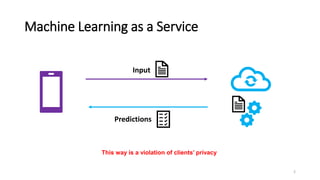
Machine Learning as a Service
Input
Predictions
This way is a violation of clients’ privacy
2
Running predictions on client-side
• A naive solution is to have clients download the model and run the
prediction phase on client-side.
Model
• It becomes more difficult for service providers to update their models.
• For security applications (e.g., spam or malware detection services), an adversary can use
the model as an oracle to develop strategies for evading detection.
• If the training data contains sensitive information (such as patient records from a
hospital) revealing the model may compromise privacy of the training data.
3
Oblivious Neural Networks (ONN)
The solution is using make the neural network oblivious
• The server learns nothing about the client’s input.
• The clients learn nothing about the model.
4
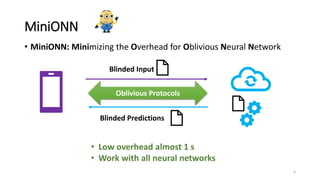
MiniONN
Blinded Input
Blinded Predictions
Oblivious Protocols
• Low overhead almost 1 s
• Work with all neural networks
• MiniONN: Minimizing the Overhead for Oblivious Neural Network
6
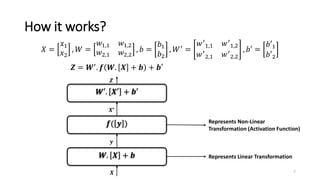
How it works?
𝑋 =
𝑥1
𝑥2
, 𝑊 =
𝑤1,1 𝑤1,2
𝑤2,1 𝑤2,2
, 𝑏 =
𝑏1
𝑏2
, 𝑊′ =
𝑤′
1,1 𝑤′
1,2
𝑤′
2,1 𝑤′
2,2
, 𝑏′ =
𝑏′1
𝑏′2
𝑾′. 𝑿′ + 𝒃′
𝒇( 𝒚 )
𝑾. 𝑿 + 𝒃
𝑿
𝒚
𝑿’
𝒁
Represents Linear Transformation
Represents Non-Linear
Transformation (Activation Function)
𝒁 = 𝑾′. 𝒇 𝑾. 𝑿 + 𝒃 + 𝒃′
7
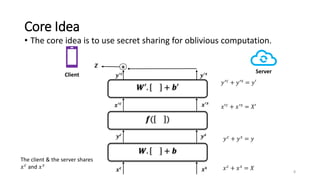
Core Idea
• The core idea is to use secret sharing for oblivious computation.
𝑾′. + 𝒃′
𝒇( )
𝑾. + 𝒃
𝒚𝒄
𝒙′𝒄
𝒙𝐜 𝒙𝐬
𝒚𝒔
𝒙′𝒔
Client
Server
𝒚′𝒄
𝒚′𝒔
𝒁
𝑥𝑐
+ 𝑥𝑠
= 𝑋
𝑦𝑐
+ 𝑦𝑠
= 𝑦
𝑥′𝑐 + 𝑥′𝑠 = 𝑋′
𝑦′𝑐
+ 𝑦′𝑠
= 𝑦′
The client & the server shares
𝑥𝑐
and 𝑥𝑠
8
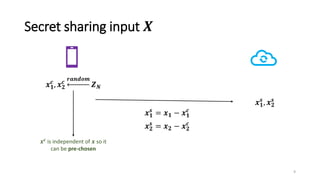
Secret sharing input 𝑿
𝒙𝟏
𝒄
, 𝒙𝟐
𝒄
𝒓𝒂𝒏𝒅𝒐𝒎
𝒁𝑵
𝒙𝟏
𝒔
= 𝒙𝟏 − 𝒙𝟏
𝒄
𝒙𝟐
𝒔
= 𝒙𝟐 − 𝒙𝟐
𝒄
𝒙𝟏
𝒔
, 𝒙𝟐
𝒔
𝒙𝒄
is independent of 𝒙 so it
can be pre-chosen
9
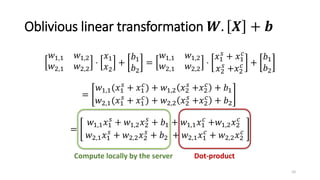
Oblivious linear transformation 𝑾. 𝑿 + 𝒃
𝑤1,1 𝑤1,2
𝑤2,1 𝑤2,2
⋅
𝑥1
𝑥2
+
𝑏1
𝑏2
=
𝑤1,1 𝑤1,2
𝑤2,1 𝑤2,2
⋅
𝑥1
𝑠
+ 𝑥1
𝑐
𝑥2
𝑠
+𝑥2
𝑐 +
𝑏1
𝑏2
=
𝑤1,1(𝑥1
𝑠
+ 𝑥1
𝑐
) + 𝑤1,2 𝑥2
𝑠
+𝑥2
𝑐
+ 𝑏1
𝑤2,1(𝑥1
𝑠
+ 𝑥1
𝑐
) + 𝑤2,2 𝑥2
𝑠
+𝑥2
𝑐
+ 𝑏2
=
𝑤1,1𝑥1
𝑠
+ 𝑤1,2𝑥2
𝑠
+ 𝑏1 + 𝑤1,1𝑥1
𝑐
+𝑤1,2𝑥2
𝑐
𝑤2,1𝑥1
𝑠
+ 𝑤2,2𝑥2
𝑠
+ 𝑏2 + 𝑤2,1𝑥1
𝑐
+ 𝑤2,2𝑥2
𝑐
Compute locally by the server Dot-product
10
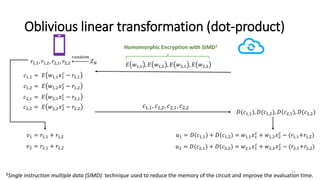
Oblivious linear transformation (dot-product)
𝑟1,1, 𝑟1,2, 𝑟2,1, 𝑟2,2
𝑟𝑎𝑛𝑑𝑜𝑚
𝑍𝑁 𝐸 𝑤1,1 , 𝐸 𝑤1,2 , 𝐸 𝑤2,1 , 𝐸 𝑤2,2
Homomorphic Encryption with SIMD1
1Single instruction multiple data (SIMD): technique used to reduce the memory of the circuit and improve the evaluation time.
𝑐1,1 = 𝐸 𝑤1,1𝑥1
𝑐
− 𝑟1,1
𝑐1,2 = 𝐸 𝑤1,2𝑥2
𝑐
− 𝑟1,2
𝑐2,1 = 𝐸 𝑤2,1𝑥1
𝑐
− 𝑟2,1
𝑐2,2 = 𝐸 𝑤2,2𝑥2
𝑐
− 𝑟2,2 𝑐1,1, 𝑐1,2, 𝑐2,1, 𝑐2,2
𝐷(𝑐1,1), 𝐷(𝑐1,2), 𝐷(𝑐2,1), 𝐷(𝑐2,2)
𝑢1 = 𝐷(𝑐1,1) + 𝐷(𝑐1,2) = 𝑤1,1𝑥1
𝑐
+ 𝑤1,2𝑥2
𝑐
− (𝑟1,1+𝑟1,2)
𝑢2 = 𝐷(𝑐2,1) + 𝐷(𝑐2,2) = 𝑤2,1𝑥1
𝑐
+ 𝑤2,2𝑥2
𝑐
− (𝑟2,1+𝑟2,2)
𝑣1 = 𝑟1,1 + 𝑟1,2
𝑣2 = 𝑟2,1 + 𝑟2,2
11
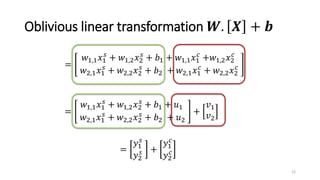
Oblivious linear transformation 𝑾. 𝑿 + 𝒃
=
𝑤1,1𝑥1
𝑠
+ 𝑤1,2𝑥2
𝑠
+ 𝑏1 + 𝑤1,1𝑥1
𝑐
+𝑤1,2𝑥2
𝑐
𝑤2,1𝑥1
𝑠
+ 𝑤2,2𝑥2
𝑠
+ 𝑏2 + 𝑤2,1𝑥1
𝑐
+ 𝑤2,2𝑥2
𝑐
=
𝑤1,1𝑥1
𝑠
+ 𝑤1,2𝑥2
𝑠
+ 𝑏1 + 𝑢1
𝑤2,1𝑥1
𝑠
+ 𝑤2,2𝑥2
𝑠
+ 𝑏2 + 𝑢2
+
𝑣1
𝑣2
=
𝑦1
𝑠
𝑦2
𝑠 +
𝑦1
𝑐
𝑦2
𝑐
12
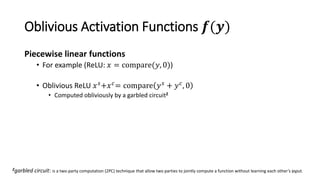
Oblivious Activation Functions 𝒇(𝒚)
Piecewise linear functions
• For example (ReLU: 𝑥 = compare(𝑦, 0))
• Oblivious ReLU 𝑥𝑠+𝑥𝑐= compare 𝑦𝑠 + 𝑦𝑐, 0
• Computed obliviously by a garbled circuit2
2garbled circuit: is a two-party computation (2PC) technique that allow two parties to jointly compute a function without learning each other’s input.
13
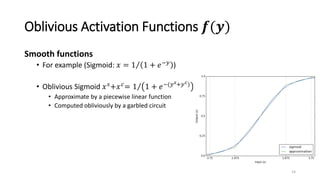
Oblivious Activation Functions 𝒇(𝒚)
Smooth functions
• For example (Sigmoid: 𝑥 = Τ
1 1 + 𝑒−𝑦 )
• Oblivious Sigmoid 𝑥𝑠+𝑥𝑐= Τ
1 1 + 𝑒−(𝑦𝑠+𝑦𝑐)
• Approximate by a piecewise linear function
• Computed obliviously by a garbled circuit
14
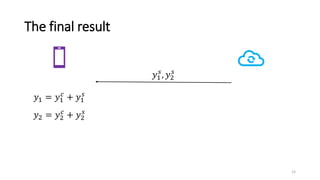
The final result
𝑦1
𝑠
, 𝑦2
𝑠
𝑦1 = 𝑦1
𝑐
+ 𝑦1
𝑠
𝑦2 = 𝑦2
𝑐
+ 𝑦2
𝑠
15
Performance
1. MNIST (60 000 training images and 10 000 test images)
• Handwriting recognition
• CNN model
• ReLU activation function
2. CIFAR-10 (50 000 training images and 10 000 test images)
• Image classification
• CNN model
• ReLU activation function
3. Penn Treebank (PTB) (929 000 training words, 73 000 validation words, and 82 000 test words.)
• language modeling: predicting next words given the previous words
• Long Short Term Memory (LSTM): commonly used for language modeling
• Sigmoidal activation function
16
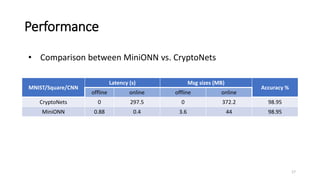
Performance
MNIST/Square/CNN
Latency (s) Msg sizes (MB)
Accuracy %
offline online offline online
CryptoNets 0 297.5 0 372.2 98.95
MiniONN 0.88 0.4 3.6 44 98.95
• Comparison between MiniONN vs. CryptoNets
17
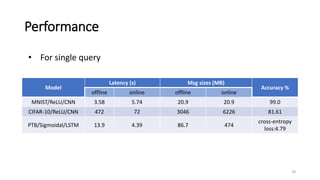
Performance
Model
Latency (s) Msg sizes (MB)
Accuracy %
offline online offline online
MNIST/ReLU/CNN 3.58 5.74 20.9 20.9 99.0
CIFAR-10/ReLU/CNN 472 72 3046 6226 81.61
PTB/Sigmoidal/LSTM 13.9 4.39 86.7 474
cross-entropy
loss:4.79
• For single query
18
Thank You
19

Oblivious Neural Network Predictions via MiniONN Transformations

  • 1.
    Oblivious Neural Network Predictionsvia MiniONN Transformations Presented by: Sherif Abdelfattah Liu, J., Juuti, M., Lu, Y., & Asokan, N. (2017, October). Oblivious neural network predictions via minionn transformations. In Proceedings of the 2017 ACM SIGSAC Conference on Computer and Communications Security (pp. 619-631). ACM. (121 citation) 1
  • 2.
    Machine Learning asa Service Input Predictions This way is a violation of clients’ privacy 2
  • 3.
    Running predictions onclient-side • A naive solution is to have clients download the model and run the prediction phase on client-side. Model • It becomes more difficult for service providers to update their models. • For security applications (e.g., spam or malware detection services), an adversary can use the model as an oracle to develop strategies for evading detection. • If the training data contains sensitive information (such as patient records from a hospital) revealing the model may compromise privacy of the training data. 3
  • 4.
    Oblivious Neural Networks(ONN) The solution is using make the neural network oblivious • The server learns nothing about the client’s input. • The clients learn nothing about the model. 4
  • 5.
    MiniONN Blinded Input Blinded Predictions ObliviousProtocols • Low overhead almost 1 s • Work with all neural networks • MiniONN: Minimizing the Overhead for Oblivious Neural Network 6
  • 6.
    How it works? 𝑋= 𝑥1 𝑥2 , 𝑊 = 𝑤1,1 𝑤1,2 𝑤2,1 𝑤2,2 , 𝑏 = 𝑏1 𝑏2 , 𝑊′ = 𝑤′ 1,1 𝑤′ 1,2 𝑤′ 2,1 𝑤′ 2,2 , 𝑏′ = 𝑏′1 𝑏′2 𝑾′. 𝑿′ + 𝒃′ 𝒇( 𝒚 ) 𝑾. 𝑿 + 𝒃 𝑿 𝒚 𝑿’ 𝒁 Represents Linear Transformation Represents Non-Linear Transformation (Activation Function) 𝒁 = 𝑾′. 𝒇 𝑾. 𝑿 + 𝒃 + 𝒃′ 7
  • 7.
    Core Idea • Thecore idea is to use secret sharing for oblivious computation. 𝑾′. + 𝒃′ 𝒇( ) 𝑾. + 𝒃 𝒚𝒄 𝒙′𝒄 𝒙𝐜 𝒙𝐬 𝒚𝒔 𝒙′𝒔 Client Server 𝒚′𝒄 𝒚′𝒔 𝒁 𝑥𝑐 + 𝑥𝑠 = 𝑋 𝑦𝑐 + 𝑦𝑠 = 𝑦 𝑥′𝑐 + 𝑥′𝑠 = 𝑋′ 𝑦′𝑐 + 𝑦′𝑠 = 𝑦′ The client & the server shares 𝑥𝑐 and 𝑥𝑠 8
  • 8.
    Secret sharing input𝑿 𝒙𝟏 𝒄 , 𝒙𝟐 𝒄 𝒓𝒂𝒏𝒅𝒐𝒎 𝒁𝑵 𝒙𝟏 𝒔 = 𝒙𝟏 − 𝒙𝟏 𝒄 𝒙𝟐 𝒔 = 𝒙𝟐 − 𝒙𝟐 𝒄 𝒙𝟏 𝒔 , 𝒙𝟐 𝒔 𝒙𝒄 is independent of 𝒙 so it can be pre-chosen 9
  • 9.
    Oblivious linear transformation𝑾. 𝑿 + 𝒃 𝑤1,1 𝑤1,2 𝑤2,1 𝑤2,2 ⋅ 𝑥1 𝑥2 + 𝑏1 𝑏2 = 𝑤1,1 𝑤1,2 𝑤2,1 𝑤2,2 ⋅ 𝑥1 𝑠 + 𝑥1 𝑐 𝑥2 𝑠 +𝑥2 𝑐 + 𝑏1 𝑏2 = 𝑤1,1(𝑥1 𝑠 + 𝑥1 𝑐 ) + 𝑤1,2 𝑥2 𝑠 +𝑥2 𝑐 + 𝑏1 𝑤2,1(𝑥1 𝑠 + 𝑥1 𝑐 ) + 𝑤2,2 𝑥2 𝑠 +𝑥2 𝑐 + 𝑏2 = 𝑤1,1𝑥1 𝑠 + 𝑤1,2𝑥2 𝑠 + 𝑏1 + 𝑤1,1𝑥1 𝑐 +𝑤1,2𝑥2 𝑐 𝑤2,1𝑥1 𝑠 + 𝑤2,2𝑥2 𝑠 + 𝑏2 + 𝑤2,1𝑥1 𝑐 + 𝑤2,2𝑥2 𝑐 Compute locally by the server Dot-product 10
  • 10.
    Oblivious linear transformation(dot-product) 𝑟1,1, 𝑟1,2, 𝑟2,1, 𝑟2,2 𝑟𝑎𝑛𝑑𝑜𝑚 𝑍𝑁 𝐸 𝑤1,1 , 𝐸 𝑤1,2 , 𝐸 𝑤2,1 , 𝐸 𝑤2,2 Homomorphic Encryption with SIMD1 1Single instruction multiple data (SIMD): technique used to reduce the memory of the circuit and improve the evaluation time. 𝑐1,1 = 𝐸 𝑤1,1𝑥1 𝑐 − 𝑟1,1 𝑐1,2 = 𝐸 𝑤1,2𝑥2 𝑐 − 𝑟1,2 𝑐2,1 = 𝐸 𝑤2,1𝑥1 𝑐 − 𝑟2,1 𝑐2,2 = 𝐸 𝑤2,2𝑥2 𝑐 − 𝑟2,2 𝑐1,1, 𝑐1,2, 𝑐2,1, 𝑐2,2 𝐷(𝑐1,1), 𝐷(𝑐1,2), 𝐷(𝑐2,1), 𝐷(𝑐2,2) 𝑢1 = 𝐷(𝑐1,1) + 𝐷(𝑐1,2) = 𝑤1,1𝑥1 𝑐 + 𝑤1,2𝑥2 𝑐 − (𝑟1,1+𝑟1,2) 𝑢2 = 𝐷(𝑐2,1) + 𝐷(𝑐2,2) = 𝑤2,1𝑥1 𝑐 + 𝑤2,2𝑥2 𝑐 − (𝑟2,1+𝑟2,2) 𝑣1 = 𝑟1,1 + 𝑟1,2 𝑣2 = 𝑟2,1 + 𝑟2,2 11
  • 11.
    Oblivious linear transformation𝑾. 𝑿 + 𝒃 = 𝑤1,1𝑥1 𝑠 + 𝑤1,2𝑥2 𝑠 + 𝑏1 + 𝑤1,1𝑥1 𝑐 +𝑤1,2𝑥2 𝑐 𝑤2,1𝑥1 𝑠 + 𝑤2,2𝑥2 𝑠 + 𝑏2 + 𝑤2,1𝑥1 𝑐 + 𝑤2,2𝑥2 𝑐 = 𝑤1,1𝑥1 𝑠 + 𝑤1,2𝑥2 𝑠 + 𝑏1 + 𝑢1 𝑤2,1𝑥1 𝑠 + 𝑤2,2𝑥2 𝑠 + 𝑏2 + 𝑢2 + 𝑣1 𝑣2 = 𝑦1 𝑠 𝑦2 𝑠 + 𝑦1 𝑐 𝑦2 𝑐 12
  • 12.
    Oblivious Activation Functions𝒇(𝒚) Piecewise linear functions • For example (ReLU: 𝑥 = compare(𝑦, 0)) • Oblivious ReLU 𝑥𝑠+𝑥𝑐= compare 𝑦𝑠 + 𝑦𝑐, 0 • Computed obliviously by a garbled circuit2 2garbled circuit: is a two-party computation (2PC) technique that allow two parties to jointly compute a function without learning each other’s input. 13
  • 13.
    Oblivious Activation Functions𝒇(𝒚) Smooth functions • For example (Sigmoid: 𝑥 = Τ 1 1 + 𝑒−𝑦 ) • Oblivious Sigmoid 𝑥𝑠+𝑥𝑐= Τ 1 1 + 𝑒−(𝑦𝑠+𝑦𝑐) • Approximate by a piecewise linear function • Computed obliviously by a garbled circuit 14
  • 14.
    The final result 𝑦1 𝑠 ,𝑦2 𝑠 𝑦1 = 𝑦1 𝑐 + 𝑦1 𝑠 𝑦2 = 𝑦2 𝑐 + 𝑦2 𝑠 15
  • 15.
    Performance 1. MNIST (60000 training images and 10 000 test images) • Handwriting recognition • CNN model • ReLU activation function 2. CIFAR-10 (50 000 training images and 10 000 test images) • Image classification • CNN model • ReLU activation function 3. Penn Treebank (PTB) (929 000 training words, 73 000 validation words, and 82 000 test words.) • language modeling: predicting next words given the previous words • Long Short Term Memory (LSTM): commonly used for language modeling • Sigmoidal activation function 16
  • 16.
    Performance MNIST/Square/CNN Latency (s) Msgsizes (MB) Accuracy % offline online offline online CryptoNets 0 297.5 0 372.2 98.95 MiniONN 0.88 0.4 3.6 44 98.95 • Comparison between MiniONN vs. CryptoNets 17
  • 17.
    Performance Model Latency (s) Msgsizes (MB) Accuracy % offline online offline online MNIST/ReLU/CNN 3.58 5.74 20.9 20.9 99.0 CIFAR-10/ReLU/CNN 472 72 3046 6226 81.61 PTB/Sigmoidal/LSTM 13.9 4.39 86.7 474 cross-entropy loss:4.79 • For single query 18
  • 18.