Objective-C
                          A Beginner’s Dive


Saturday, March 9, 13
I Assume

                        • A Background in Java or C++
                        • An understanding of OOP
                        • A basic understanding of C


Saturday, March 9, 13
What is Objective-C?

                        • Superset of C
                        • Smalltalk style Object-Oriented
                        • The Official Language for iOS and OS X


Saturday, March 9, 13
Cool!
                        But before we dive in...


Saturday, March 9, 13
Hello World!
                 //
                 //     main.m

                 #include <stdio.h>
                 #include <Foundation/Foundation.h>

                 int main(int argc, const char **argv)
                 {
                     NSString *message = @"Hello World!";

                        printf("%sn", [message cString]);

                        return 0;
                 }


Saturday, March 9, 13
Hello World!
                        •   Objective-C String Literal

                            •   @”Hello World!”          //
                                                         //   main.m

                        •   C Function                   #include <stdio.h>
                                                         #include <Foundation/Foundation.h>


                            •   printf()                 int main(int argc, const char **argv)
                                                         {
                                                             NSString *message = @"Hello World!";


                            •   main()                        printf("%sn", [message cString]);

                                                              return 0;

                        •
                                                         }
                            Objective-C message

                            •   [message cString]


Saturday, March 9, 13
Ok.
                        Now, on to the teaching!


Saturday, March 9, 13
Objective-C Features
                        • C Functions
                        • C Structs
                        • C Unions
                        • C Pointers
                        • C Arrays
                        • C Everything Else
Saturday, March 9, 13
Objective-C Features
                        • Objects       • Data and Collections
                        • Methods       • Object Literals
                        • Inheritance   • Object Subscripts
                        • Properties    • Forin loops
                        • Protocols     • Blocks and Closures
                        • Categories    • ARC
Saturday, March 9, 13
You Will Learn About

                        • Making and Using Objects
                        • Using Foundation Framework Data Types
                        • Automatic Reference Counting (ARC)


Saturday, March 9, 13
Writing Objects
                           A Quick Run-Through


Saturday, March 9, 13
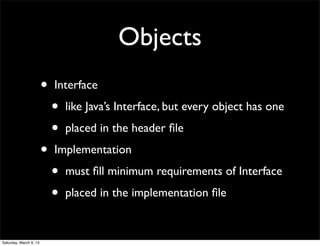
Objects
                        •   Interface

                            •   like Java’s Interface, but every object has one

                            •   placed in the header file

                        •   Implementation

                            •   must fill minimum requirements of Interface

                            •   placed in the implementation file


Saturday, March 9, 13
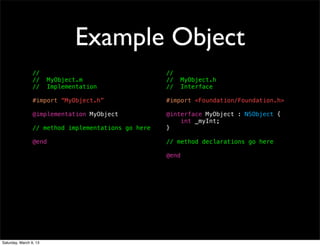
Example Object
                 //                                  //
                 //     MyObject.m                   //     MyObject.h
                 //     Implementation               //     Interface

                 #import “MyObject.h”                #import <Foundation/Foundation.h>

                 @implementation MyObject            @interface MyObject : NSObject {
                                                         int _myInt;
                 // method implementations go here   }

                 @end                                // method declarations go here

                                                     @end


Saturday, March 9, 13
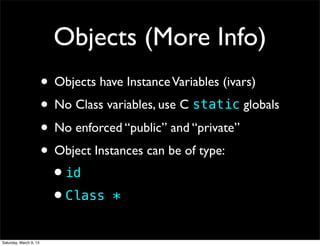
Objects (More Info)
                        • Objects have Instance Variables (ivars)
                        • No Class variables, use C static globals
                        • No enforced “public” and “private”
                        • Object Instances can be of type:
                         •id
                         •Class *
Saturday, March 9, 13
Object Methods

                        • Class Method or Instance Method
                        • Variables are “named” in the method’s
                          signature (fancy word for method name)
                        • Default return and variable type is id


Saturday, March 9, 13
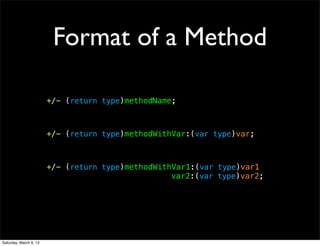
Format of a Method

                        +/- (return type)methodName;


                        +/- (return type)methodWithVar:(var type)var;


                        +/- (return type)methodWithVar1:(var type)var1
                        ! ! ! ! ! ! ! !            var2:(var type)var2;


Saturday, March 9, 13
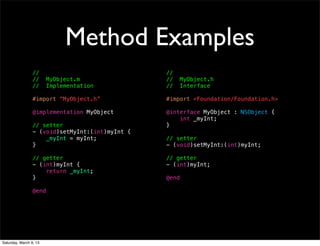
Method Examples
                 //                              //
                 //     MyObject.m               //     MyObject.h
                 //     Implementation           //     Interface

                 #import “MyObject.h”            #import <Foundation/Foundation.h>

                 @implementation MyObject        @interface MyObject : NSObject {
                                                     int _myInt;
                 // setter                       }
                 - (void)setMyInt:(int)myInt {
                     _myInt = myInt;             // setter
                 }                               - (void)setMyInt:(int)myInt;

                 // getter                       // getter
                 - (int)myInt {                  - (int)myInt;
                     return _myInt;
                 }                               @end

                 @end


Saturday, March 9, 13
Object Method Calling
                        • Not like C, C++, or Java
                        • Based on Smalltalk message passing
                        • The Square Brackets [] are your friend!
                          [object method];
                          [object methodWithVar:value];
                          [object methodWithVar1:val1
                          ! ! ! ! ! ! ! ! var2:val2];


Saturday, March 9, 13
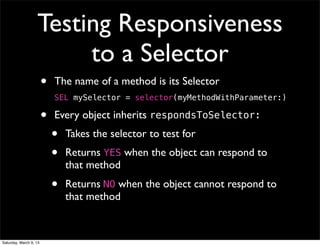
Testing Responsiveness
                        to a Selector
                        •   The name of a method is its Selector
                            SEL mySelector = selector(myMethodWithParameter:)

                        •   Every object inherits respondsToSelector:
                            •   Takes the selector to test for
                            •   Returns YES when the object can respond to
                                that method
                            •   Returns NO when the object cannot respond to
                                that method


Saturday, March 9, 13
Object Constructor

                        • Not a special method (unlike Java)
                        • Just an instance method to set up the
                          Object’s Instance Variables
                        • Generally named init


Saturday, March 9, 13
Generic Constructor

                 - (id)init {
                     if (self = [super init]) {
                         // initialize variables
                     }
                     return self;
                 }


Saturday, March 9, 13
Constructor Example
                   // default constructor
                 - (id)init {
                     // calls my custom constructor
                     return [self initWithInt:0];
                 }

                 // custom constructor
                 - (id)initWithInt:(int)myInt {
                     if (self = [super init]) {
                         _myInt = myInt;
                     }
                     return self;
                 }


Saturday, March 9, 13
Inheritance

                        • Single Inheritance from Objects
                        • Method Overloading Supported
                        • Superclass defined in the Interface
                        • Super class referenced with super

Saturday, March 9, 13
Inheritance Example
                 //                               //
                 //     MyObject.m                //     MyObject.h
                 //     Implementation            //     Interface

                 #import “MyObject.h”             #import <Foundation/Foundation.h>

                 @implementation MyObject         @interface MyObject : NSObject {
                                                      int _myInt;
                 - (id)init {                     }
                     if (self = [super init]) {
                         _myInt = 5;              - (id)init;
                     }
                     return self;                 @end
                 }

                 @end


Saturday, March 9, 13
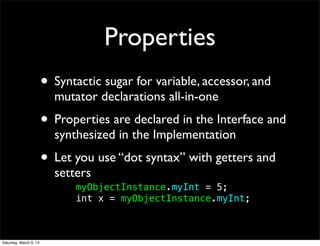
Properties
                        • Syntactic sugar for variable, accessor, and
                          mutator declarations all-in-one
                        • Properties are declared in the Interface and
                          synthesized in the Implementation
                        • Let you use “dot syntax” with getters and
                          setters
                          !   myObjectInstance.myInt = 5;
                          !   int x = myObjectInstance.myInt;


Saturday, March 9, 13
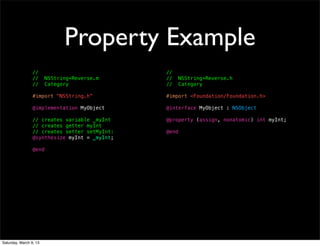
Property Example
                 //                            //
                 //     NSString+Reverse.m     //     NSString+Reverse.h
                 //     Category               //     Category

                 #import "NSString.h"          #import <Foundation/Foundation.h>

                 @implementation MyObject      @interface MyObject : NSObject

                 // creates variable _myInt    @property (assign, nonatomic) int myInt;
                 // creates getter myInt
                 // creates setter setMyInt:   @end
                 @synthesize myInt = _myInt;

                 @end


Saturday, March 9, 13
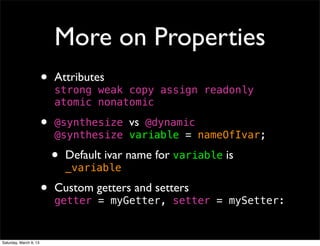
More on Properties
                        •   Attributes
                            strong weak copy assign readonly
                            atomic nonatomic

                        •   	

                            @synthesize vs @dynamic
                            !synthesize variable = nameOfIvar;
                            @

                            •   Default ivar name for variable is
                                _variable

                        •   Custom getters and setters
                            getter = myGetter, setter = mySetter:


Saturday, March 9, 13
Protocols

                        • Like an Objective-C Interface
                        • Similar to Java Interfaces
                        • Can implement multiple Protocols
                        • Protocols can ‘inherit’ other Protocols

Saturday, March 9, 13
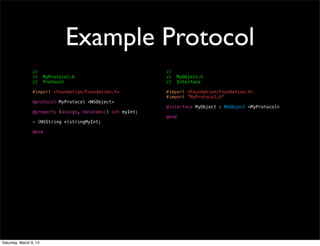
Example Protocol
                 //                                         //
                 //     MyProtocol.h                        //     MyObject.h
                 //     Protocol                            //     Interface

                 #import <Foundation/Foundation.h>          #import <Foundation/Foundation.h>
                                                            #import "MyProtocol.h"
                 @protocol MyProtocol <NSObject>
                                                            @interface MyObject : NSObject <MyProtocol>
                 @property (assign, nonatomic) int myInt;
                                                            @end
                 - (NSString *)stringMyInt;

                 @end


Saturday, March 9, 13
Categories
                        • The ability to add new methods to an
                          Object
                        • Changes apply to all instances of the object
                        • Overwrites any methods that already exist
                          in the class
                        • Cannot add Properties and ivars
                        • Can be dangerous
Saturday, March 9, 13
Example Category
                 //                                                     //
                 //     NSString+Reverse.m                              //     NSString+Reverse.h
                 //     Category                                        //     Category

                 #import "NSString+Reverse.h"                           #import <Foundation/Foundation.h>
                 #import <stdlib.h>
                                                                        @interface NSString (Reverse)
                 @implementation NSString (Reverse)
                                                                        - (NSString *)reverse;
                 - (NSString *)reverse {
                     int length = [self length];                        @end
                     char *newString =
                 ! !      calloc(length+1, sizeof(char));
                     int current = 0;

                        const char *cstr = [self cString];
                        for (int i=length-1; i >= 0; i--) {
                            newString[current] = cstr[i];
                            current++;
                        }

                         NSString *new =
                 !      !     [NSString stringWithCString:newString];
                         free(newString);

                        return new;
                 }

                 @end


Saturday, March 9, 13
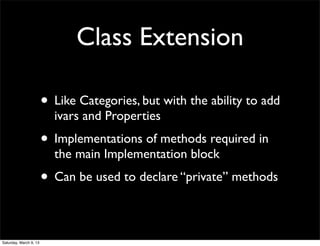
Class Extension

                        • Like Categories, but with the ability to add
                          ivars and Properties
                        • Implementations of methods required in
                          the main Implementation block
                        • Can be used to declare “private” methods

Saturday, March 9, 13
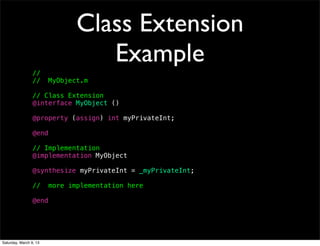
Class Extension
                                  Example
                 //
                 //     MyObject.m

                 // Class Extension
                 @interface MyObject ()

                 @property (assign) int myPrivateInt;

                 @end

                 // Implementation
                 @implementation MyObject

                 @synthesize myPrivateInt = _myPrivateInt;

                 //     more implementation here

                 @end


Saturday, March 9, 13
Ok.
                        Now, lets take a look at MyObject


Saturday, March 9, 13
MyObject
                 //                                                      //
                 //     MyObject.m                                       //     MyObject.h

                 #import "MyObject.h"                                    #import <Foundation/Foundation.h>
                                                                         #import "MyProtocol.h"
                 @interface MyObject ()
                 @property (assign, nonatomic) int myPrivateInt;         @interface MyObject : NSObject <MyProtocol>
                 @end
                                                                         @property (assign, nonatomic) int myInt;
                 @implementation MyObject
                                                                         // default constructor
                 @synthesize myInt = _myInt;                             - (id)init;
                 @synthesize myPrivateInt = _myPrivateInt;
                                                                         // custom constructor
                 - (id)init {                                            - (id)initWithInt:(int)myInt;
                     return [self initWithInt:0];
                 }                                                       @end

                 - (id)initWithInt:(int)myInt {
                     if (self = [super init]) {
                         _myInt = myInt;
                 !   !     _myPrivateInt = 5;
                     }
                     return self;
                 }

                 - (NSString *)stringMyInt {
                     return [NSString stringWithFormat:@"%d", _myInt];
                 }

                 @end


Saturday, March 9, 13
Great
                        But how do I use it?


Saturday, March 9, 13
Using MyObject
                 MyObject *obj = [[MyObject alloc] init];
                 obj.myInt = 5;
                 NSLog(@"%in", obj.myInt);


                 MyObject *other = [MyObject alloc];
                 other = [other initWithInt:5];
                 [other setMyInt:10];
                 NSLog(@"%in", [obj myInt]);


Saturday, March 9, 13
Using MyObject
                        •   alloc class method


                        •   use of init and
                            initWithInt: methods         MyObject *obj = [[MyObject alloc] init];
                                                         obj.myInt = 5;

                        •
                                                         NSLog(@"%in", obj.myInt);
                            splitting up the alloc and
                            init method calls
                                                         MyObject *other = [MyObject alloc];
                                                         other = [other initWithInt:5];

                        •   use of dot syntax and        [other setMyInt:10];
                                                         NSLog(@"%in", [obj myInt]);
                            generated methods

                        •   NSLog() for printing
                            messages to the console


Saturday, March 9, 13
One More Thing
                        Imports and Forward Declarations


Saturday, March 9, 13
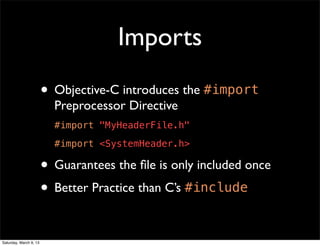
Imports
                        • Objective-C introduces the #import
                          Preprocessor Directive
                          #import "MyHeaderFile.h"
                          #import <SystemHeader.h>

                        • Guarantees the file is only included once
                        • Better Practice than C’s #include

Saturday, March 9, 13
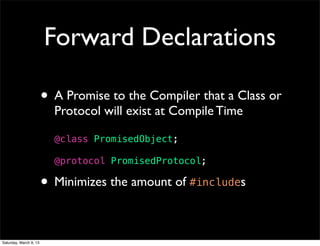
Forward Declarations

                        • A Promise to the Compiler that a Class or
                          Protocol will exist at Compile Time

                          @class PromisedObject;

                          @protocol PromisedProtocol;

                        • Minimizes the amount of #includes

Saturday, March 9, 13
Objective-C Data
                        What you get with the Foundation Framework


Saturday, March 9, 13
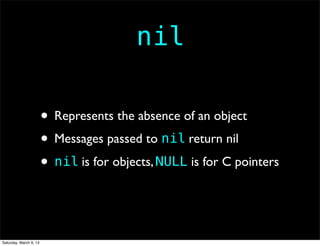
nil

                        • Represents the absence of an object
                        • Messages passed to nil return nil
                        • nil is for objects, NULL is for C pointers


Saturday, March 9, 13
YES and NO

                        • Boolean type BOOL for “true” and “false”
                        • Use BOOL with YES and NO
                        • Dont use _Bool or bool with true and
                          false from stdbool.h


Saturday, March 9, 13
NSNumber

                 • Object Representation for Integers,
                        Booleans, Floats, Doubles, Characters, etc.
                 • Object Literal Syntax
                        @1   @1.0    @YES   @NO    @(1+2)   @'a'


Saturday, March 9, 13
NSString

                 • Immutable string
                 • NSMutableString for mutable strings
                 • Object Literal Syntax
                        @"Hello World!"   @("Hello World!")


Saturday, March 9, 13
NSArray
                 • Immutable object array
                 • NSMutableArray for mutable arrays
                 • Object Literal Syntax
                        @[object1, object2, ..., objectN];

                 • Object Subscripting Syntax
                        array[0] = object;
                        id object = array[0];


Saturday, March 9, 13
NSDictionary
                 • Immutable object dictionary
                 • NSMutableDictionary for mutable
                 • Object Literal Syntax
                        @{key1:value1, key2:value2, ...};

                 • Object Subscripting Syntax
                        dictionary[key] = object;
                        id object = dictionary[key];


Saturday, March 9, 13
Implementing
                            Array Subscripting
                        • Accessing Objects
                          objectAtIndexedSubscript:

                        • Setting Objects
                          setObject:atIndexedSubscript:

                        • The index subscript must be an integral

Saturday, March 9, 13
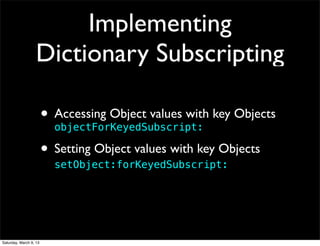
Implementing
                   Dictionary Subscripting

                        • Accessing Object values with key Objects
                          objectForKeyedSubscript:

                        • Setting Object values with key Objects
                          setObject:forKeyedSubscript:


Saturday, March 9, 13
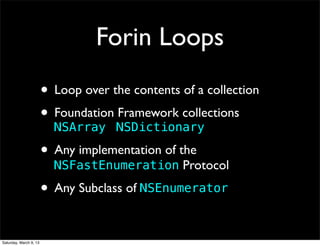
Forin Loops
                        • Loop over the contents of a collection
                        • Foundation NSDictionary
                          NSArray
                                     Framework collections


                        • Any implementation of the
                          NSFastEnumeration Protocol

                        • Any Subclass of NSEnumerator

Saturday, March 9, 13
Forin Loops Example

                 NSArray *array = @[@1, @2, @3, @4, @5];

                 for (NSNumber *num in array) {
                     NSLog(@"%@", num);
                 }

                 for (id num in [array reverseObjectEnumerator]) {
                     NSLog(@"%@", num);
                 }


Saturday, March 9, 13
Objective-C Blocks

                        • Functions you can declare within functions
                        • Can close-over variables for later use
                        • Can pass block functions around like data


Saturday, March 9, 13
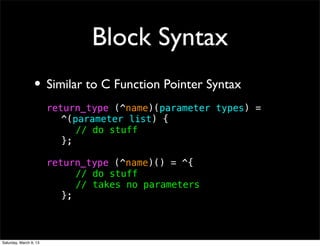
Block Syntax
                 • Similar to C Function Pointer Syntax
                        return_type (^name)(parameter types) =
                        ! ^(parameter list) {
                        ! ! // do stuff
                        ! };

                        return_type (^name)() = ^{
                        ! ! // do stuff
                        ! ! // takes no parameters
                        ! };


Saturday, March 9, 13
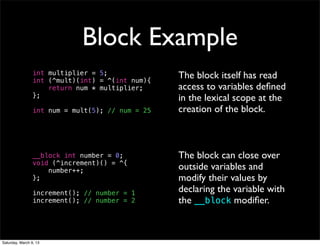
Block Example
                 int multiplier = 5;              The block itself has read
                 int (^mult)(int) = ^(int num){
                     return num * multiplier;     access to variables defined
                 };                               in the lexical scope at the
                 int num = mult(5); // num = 25   creation of the block.


                 __block int number = 0;          The block can close over
                 void (^increment)() = ^{
                     number++;                    outside variables and
                 };                               modify their values by
                 increment(); // number = 1       declaring the variable with
                 increment(); // number = 2       the __block modifier.


Saturday, March 9, 13
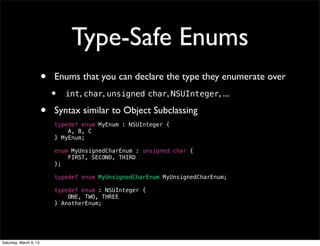
Type-Safe Enums
                        •   Enums that you can declare the type they enumerate over
                            •   int, char, unsigned char, NSUInteger, ...

                        •   Syntax similar to Object Subclassing
                            typedef enum MyEnum : NSUInteger {
                                A, B, C
                            } MyEnum;

                            enum MyUnsignedCharEnum : unsigned char {
                                FIRST, SECOND, THIRD
                            };

                            typedef enum MyUnsignedCharEnum MyUnsignedCharEnum;

                            typedef enum : NSUInteger {
                                ONE, TWO, THREE
                            } AnotherEnum;


Saturday, March 9, 13
Automatic Reference
                            Counting
                          What it is, and what it means to you


Saturday, March 9, 13
Referencing Counting
                        •   Nearly-Manual Memory Management

                        •   Objects have a counter showing how many
                            references are using them

                        •   Retain Objects when you receive them
                            [object retain];

                        •   Release Objects when you’re done using them
                            [object release];

                        •   Objects deallocate themselves when their retain
                            count reaches 0


Saturday, March 9, 13
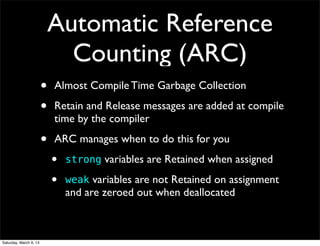
Automatic Reference
                              Counting (ARC)
                        •   Almost Compile Time Garbage Collection

                        •   Retain and Release messages are added at compile
                            time by the compiler

                        •   ARC manages when to do this for you
                            •   strong variables are Retained when assigned

                            •   weak variables are not Retained on assignment
                                and are zeroed out when deallocated


Saturday, March 9, 13
Retain Cycle

                        • Two Objects Reference Each Other
                         • Their retain counts can never reach 0
                        • Set one of the references to weak to
                          prevent one of the objects from retaining
                          the other and causing a cycle


Saturday, March 9, 13
So there you have it
                            Objective-C thrown at you


Saturday, March 9, 13
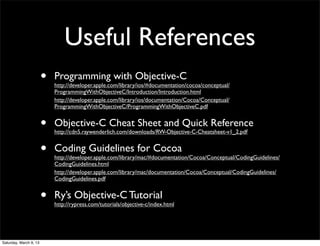
Useful References
                        •   Programming with Objective-C
                            http://developer.apple.com/library/ios/#documentation/cocoa/conceptual/
                            ProgrammingWithObjectiveC/Introduction/Introduction.html
                            http://developer.apple.com/library/ios/documentation/Cocoa/Conceptual/
                            ProgrammingWithObjectiveC/ProgrammingWithObjectiveC.pdf


                        •   Objective-C Cheat Sheet and Quick Reference
                            http://cdn5.raywenderlich.com/downloads/RW-Objective-C-Cheatsheet-v1_2.pdf


                        •   Coding Guidelines for Cocoa
                            http://developer.apple.com/library/mac/#documentation/Cocoa/Conceptual/CodingGuidelines/
                            CodingGuidelines.html
                            http://developer.apple.com/library/mac/documentation/Cocoa/Conceptual/CodingGuidelines/
                            CodingGuidelines.pdf


                        •   Ry’s Objective-C Tutorial
                            http://rypress.com/tutorials/objective-c/index.html


Saturday, March 9, 13

Objective-C A Beginner's Dive

  • 1.
    Objective-C A Beginner’s Dive Saturday, March 9, 13
  • 2.
    I Assume • A Background in Java or C++ • An understanding of OOP • A basic understanding of C Saturday, March 9, 13
  • 3.
    What is Objective-C? • Superset of C • Smalltalk style Object-Oriented • The Official Language for iOS and OS X Saturday, March 9, 13
  • 4.
    Cool! But before we dive in... Saturday, March 9, 13
  • 5.
    Hello World! // // main.m #include <stdio.h> #include <Foundation/Foundation.h> int main(int argc, const char **argv) { NSString *message = @"Hello World!"; printf("%sn", [message cString]); return 0; } Saturday, March 9, 13
  • 6.
    Hello World! • Objective-C String Literal • @”Hello World!” // // main.m • C Function #include <stdio.h> #include <Foundation/Foundation.h> • printf() int main(int argc, const char **argv) { NSString *message = @"Hello World!"; • main() printf("%sn", [message cString]); return 0; • } Objective-C message • [message cString] Saturday, March 9, 13
  • 7.
    Ok. Now, on to the teaching! Saturday, March 9, 13
  • 8.
    Objective-C Features • C Functions • C Structs • C Unions • C Pointers • C Arrays • C Everything Else Saturday, March 9, 13
  • 9.
    Objective-C Features • Objects • Data and Collections • Methods • Object Literals • Inheritance • Object Subscripts • Properties • Forin loops • Protocols • Blocks and Closures • Categories • ARC Saturday, March 9, 13
  • 10.
    You Will LearnAbout • Making and Using Objects • Using Foundation Framework Data Types • Automatic Reference Counting (ARC) Saturday, March 9, 13
  • 11.
    Writing Objects A Quick Run-Through Saturday, March 9, 13
  • 12.
    Objects • Interface • like Java’s Interface, but every object has one • placed in the header file • Implementation • must fill minimum requirements of Interface • placed in the implementation file Saturday, March 9, 13
  • 13.
    Example Object // // // MyObject.m // MyObject.h // Implementation // Interface #import “MyObject.h” #import <Foundation/Foundation.h> @implementation MyObject @interface MyObject : NSObject { int _myInt; // method implementations go here } @end // method declarations go here @end Saturday, March 9, 13
  • 14.
    Objects (More Info) • Objects have Instance Variables (ivars) • No Class variables, use C static globals • No enforced “public” and “private” • Object Instances can be of type: •id •Class * Saturday, March 9, 13
  • 15.
    Object Methods • Class Method or Instance Method • Variables are “named” in the method’s signature (fancy word for method name) • Default return and variable type is id Saturday, March 9, 13
  • 16.
    Format of aMethod +/- (return type)methodName; +/- (return type)methodWithVar:(var type)var; +/- (return type)methodWithVar1:(var type)var1 ! ! ! ! ! ! ! ! var2:(var type)var2; Saturday, March 9, 13
  • 17.
    Method Examples // // // MyObject.m // MyObject.h // Implementation // Interface #import “MyObject.h” #import <Foundation/Foundation.h> @implementation MyObject @interface MyObject : NSObject { int _myInt; // setter } - (void)setMyInt:(int)myInt { _myInt = myInt; // setter } - (void)setMyInt:(int)myInt; // getter // getter - (int)myInt { - (int)myInt; return _myInt; } @end @end Saturday, March 9, 13
  • 18.
    Object Method Calling • Not like C, C++, or Java • Based on Smalltalk message passing • The Square Brackets [] are your friend! [object method]; [object methodWithVar:value]; [object methodWithVar1:val1 ! ! ! ! ! ! ! ! var2:val2]; Saturday, March 9, 13
  • 19.
    Testing Responsiveness to a Selector • The name of a method is its Selector SEL mySelector = selector(myMethodWithParameter:) • Every object inherits respondsToSelector: • Takes the selector to test for • Returns YES when the object can respond to that method • Returns NO when the object cannot respond to that method Saturday, March 9, 13
  • 20.
    Object Constructor • Not a special method (unlike Java) • Just an instance method to set up the Object’s Instance Variables • Generally named init Saturday, March 9, 13
  • 21.
    Generic Constructor - (id)init { if (self = [super init]) { // initialize variables } return self; } Saturday, March 9, 13
  • 22.
    Constructor Example // default constructor - (id)init { // calls my custom constructor return [self initWithInt:0]; } // custom constructor - (id)initWithInt:(int)myInt { if (self = [super init]) { _myInt = myInt; } return self; } Saturday, March 9, 13
  • 23.
    Inheritance • Single Inheritance from Objects • Method Overloading Supported • Superclass defined in the Interface • Super class referenced with super Saturday, March 9, 13
  • 24.
    Inheritance Example // // // MyObject.m // MyObject.h // Implementation // Interface #import “MyObject.h” #import <Foundation/Foundation.h> @implementation MyObject @interface MyObject : NSObject { int _myInt; - (id)init { } if (self = [super init]) { _myInt = 5; - (id)init; } return self; @end } @end Saturday, March 9, 13
  • 25.
    Properties • Syntactic sugar for variable, accessor, and mutator declarations all-in-one • Properties are declared in the Interface and synthesized in the Implementation • Let you use “dot syntax” with getters and setters ! myObjectInstance.myInt = 5; ! int x = myObjectInstance.myInt; Saturday, March 9, 13
  • 26.
    Property Example // // // NSString+Reverse.m // NSString+Reverse.h // Category // Category #import "NSString.h" #import <Foundation/Foundation.h> @implementation MyObject @interface MyObject : NSObject // creates variable _myInt @property (assign, nonatomic) int myInt; // creates getter myInt // creates setter setMyInt: @end @synthesize myInt = _myInt; @end Saturday, March 9, 13
  • 27.
    More on Properties • Attributes strong weak copy assign readonly atomic nonatomic • @synthesize vs @dynamic !synthesize variable = nameOfIvar; @ • Default ivar name for variable is _variable • Custom getters and setters getter = myGetter, setter = mySetter: Saturday, March 9, 13
  • 28.
    Protocols • Like an Objective-C Interface • Similar to Java Interfaces • Can implement multiple Protocols • Protocols can ‘inherit’ other Protocols Saturday, March 9, 13
  • 29.
    Example Protocol // // // MyProtocol.h // MyObject.h // Protocol // Interface #import <Foundation/Foundation.h> #import <Foundation/Foundation.h> #import "MyProtocol.h" @protocol MyProtocol <NSObject> @interface MyObject : NSObject <MyProtocol> @property (assign, nonatomic) int myInt; @end - (NSString *)stringMyInt; @end Saturday, March 9, 13
  • 30.
    Categories • The ability to add new methods to an Object • Changes apply to all instances of the object • Overwrites any methods that already exist in the class • Cannot add Properties and ivars • Can be dangerous Saturday, March 9, 13
  • 31.
    Example Category // // // NSString+Reverse.m // NSString+Reverse.h // Category // Category #import "NSString+Reverse.h" #import <Foundation/Foundation.h> #import <stdlib.h> @interface NSString (Reverse) @implementation NSString (Reverse) - (NSString *)reverse; - (NSString *)reverse { int length = [self length]; @end char *newString = ! ! calloc(length+1, sizeof(char)); int current = 0; const char *cstr = [self cString]; for (int i=length-1; i >= 0; i--) { newString[current] = cstr[i]; current++; } NSString *new = ! ! [NSString stringWithCString:newString]; free(newString); return new; } @end Saturday, March 9, 13
  • 32.
    Class Extension • Like Categories, but with the ability to add ivars and Properties • Implementations of methods required in the main Implementation block • Can be used to declare “private” methods Saturday, March 9, 13
  • 33.
    Class Extension Example // // MyObject.m // Class Extension @interface MyObject () @property (assign) int myPrivateInt; @end // Implementation @implementation MyObject @synthesize myPrivateInt = _myPrivateInt; // more implementation here @end Saturday, March 9, 13
  • 34.
    Ok. Now, lets take a look at MyObject Saturday, March 9, 13
  • 35.
    MyObject // // // MyObject.m // MyObject.h #import "MyObject.h" #import <Foundation/Foundation.h> #import "MyProtocol.h" @interface MyObject () @property (assign, nonatomic) int myPrivateInt; @interface MyObject : NSObject <MyProtocol> @end @property (assign, nonatomic) int myInt; @implementation MyObject // default constructor @synthesize myInt = _myInt; - (id)init; @synthesize myPrivateInt = _myPrivateInt; // custom constructor - (id)init { - (id)initWithInt:(int)myInt; return [self initWithInt:0]; } @end - (id)initWithInt:(int)myInt { if (self = [super init]) { _myInt = myInt; ! ! _myPrivateInt = 5; } return self; } - (NSString *)stringMyInt { return [NSString stringWithFormat:@"%d", _myInt]; } @end Saturday, March 9, 13
  • 36.
    Great But how do I use it? Saturday, March 9, 13
  • 37.
    Using MyObject MyObject *obj = [[MyObject alloc] init]; obj.myInt = 5; NSLog(@"%in", obj.myInt); MyObject *other = [MyObject alloc]; other = [other initWithInt:5]; [other setMyInt:10]; NSLog(@"%in", [obj myInt]); Saturday, March 9, 13
  • 38.
    Using MyObject • alloc class method • use of init and initWithInt: methods MyObject *obj = [[MyObject alloc] init]; obj.myInt = 5; • NSLog(@"%in", obj.myInt); splitting up the alloc and init method calls MyObject *other = [MyObject alloc]; other = [other initWithInt:5]; • use of dot syntax and [other setMyInt:10]; NSLog(@"%in", [obj myInt]); generated methods • NSLog() for printing messages to the console Saturday, March 9, 13
  • 39.
    One More Thing Imports and Forward Declarations Saturday, March 9, 13
  • 40.
    Imports • Objective-C introduces the #import Preprocessor Directive #import "MyHeaderFile.h" #import <SystemHeader.h> • Guarantees the file is only included once • Better Practice than C’s #include Saturday, March 9, 13
  • 41.
    Forward Declarations • A Promise to the Compiler that a Class or Protocol will exist at Compile Time @class PromisedObject; @protocol PromisedProtocol; • Minimizes the amount of #includes Saturday, March 9, 13
  • 42.
    Objective-C Data What you get with the Foundation Framework Saturday, March 9, 13
  • 43.
    nil • Represents the absence of an object • Messages passed to nil return nil • nil is for objects, NULL is for C pointers Saturday, March 9, 13
  • 44.
    YES and NO • Boolean type BOOL for “true” and “false” • Use BOOL with YES and NO • Dont use _Bool or bool with true and false from stdbool.h Saturday, March 9, 13
  • 45.
    NSNumber • Object Representation for Integers, Booleans, Floats, Doubles, Characters, etc. • Object Literal Syntax @1 @1.0 @YES @NO @(1+2) @'a' Saturday, March 9, 13
  • 46.
    NSString • Immutable string • NSMutableString for mutable strings • Object Literal Syntax @"Hello World!" @("Hello World!") Saturday, March 9, 13
  • 47.
    NSArray • Immutable object array • NSMutableArray for mutable arrays • Object Literal Syntax @[object1, object2, ..., objectN]; • Object Subscripting Syntax array[0] = object; id object = array[0]; Saturday, March 9, 13
  • 48.
    NSDictionary • Immutable object dictionary • NSMutableDictionary for mutable • Object Literal Syntax @{key1:value1, key2:value2, ...}; • Object Subscripting Syntax dictionary[key] = object; id object = dictionary[key]; Saturday, March 9, 13
  • 49.
    Implementing Array Subscripting • Accessing Objects objectAtIndexedSubscript: • Setting Objects setObject:atIndexedSubscript: • The index subscript must be an integral Saturday, March 9, 13
  • 50.
    Implementing Dictionary Subscripting • Accessing Object values with key Objects objectForKeyedSubscript: • Setting Object values with key Objects setObject:forKeyedSubscript: Saturday, March 9, 13
  • 51.
    Forin Loops • Loop over the contents of a collection • Foundation NSDictionary NSArray Framework collections • Any implementation of the NSFastEnumeration Protocol • Any Subclass of NSEnumerator Saturday, March 9, 13
  • 52.
    Forin Loops Example NSArray *array = @[@1, @2, @3, @4, @5]; for (NSNumber *num in array) { NSLog(@"%@", num); } for (id num in [array reverseObjectEnumerator]) { NSLog(@"%@", num); } Saturday, March 9, 13
  • 53.
    Objective-C Blocks • Functions you can declare within functions • Can close-over variables for later use • Can pass block functions around like data Saturday, March 9, 13
  • 54.
    Block Syntax • Similar to C Function Pointer Syntax return_type (^name)(parameter types) = ! ^(parameter list) { ! ! // do stuff ! }; return_type (^name)() = ^{ ! ! // do stuff ! ! // takes no parameters ! }; Saturday, March 9, 13
  • 55.
    Block Example int multiplier = 5; The block itself has read int (^mult)(int) = ^(int num){ return num * multiplier; access to variables defined }; in the lexical scope at the int num = mult(5); // num = 25 creation of the block. __block int number = 0; The block can close over void (^increment)() = ^{ number++; outside variables and }; modify their values by increment(); // number = 1 declaring the variable with increment(); // number = 2 the __block modifier. Saturday, March 9, 13
  • 56.
    Type-Safe Enums • Enums that you can declare the type they enumerate over • int, char, unsigned char, NSUInteger, ... • Syntax similar to Object Subclassing typedef enum MyEnum : NSUInteger { A, B, C } MyEnum; enum MyUnsignedCharEnum : unsigned char { FIRST, SECOND, THIRD }; typedef enum MyUnsignedCharEnum MyUnsignedCharEnum; typedef enum : NSUInteger { ONE, TWO, THREE } AnotherEnum; Saturday, March 9, 13
  • 57.
    Automatic Reference Counting What it is, and what it means to you Saturday, March 9, 13
  • 58.
    Referencing Counting • Nearly-Manual Memory Management • Objects have a counter showing how many references are using them • Retain Objects when you receive them [object retain]; • Release Objects when you’re done using them [object release]; • Objects deallocate themselves when their retain count reaches 0 Saturday, March 9, 13
  • 59.
    Automatic Reference Counting (ARC) • Almost Compile Time Garbage Collection • Retain and Release messages are added at compile time by the compiler • ARC manages when to do this for you • strong variables are Retained when assigned • weak variables are not Retained on assignment and are zeroed out when deallocated Saturday, March 9, 13
  • 60.
    Retain Cycle • Two Objects Reference Each Other • Their retain counts can never reach 0 • Set one of the references to weak to prevent one of the objects from retaining the other and causing a cycle Saturday, March 9, 13
  • 61.
    So there youhave it Objective-C thrown at you Saturday, March 9, 13
  • 62.
    Useful References • Programming with Objective-C http://developer.apple.com/library/ios/#documentation/cocoa/conceptual/ ProgrammingWithObjectiveC/Introduction/Introduction.html http://developer.apple.com/library/ios/documentation/Cocoa/Conceptual/ ProgrammingWithObjectiveC/ProgrammingWithObjectiveC.pdf • Objective-C Cheat Sheet and Quick Reference http://cdn5.raywenderlich.com/downloads/RW-Objective-C-Cheatsheet-v1_2.pdf • Coding Guidelines for Cocoa http://developer.apple.com/library/mac/#documentation/Cocoa/Conceptual/CodingGuidelines/ CodingGuidelines.html http://developer.apple.com/library/mac/documentation/Cocoa/Conceptual/CodingGuidelines/ CodingGuidelines.pdf • Ry’s Objective-C Tutorial http://rypress.com/tutorials/objective-c/index.html Saturday, March 9, 13