An Objective View of MEAPs
Neudesic Mobility Research


                             1
Agenda
 Objective Overview of MEAPs (Mobile Enterprise Application Platforms)
       Where did the acronym come from, and who are the players?
       How do you define a MEAP?
       What problems are they trying to address?
 Potential issues with MEAPs
       Potential issues to watch out for when considering a MEAP
 Conclusion
       An alternative approach to MEAPs


                                                                          2
Overview of MEAPs


                    3
Where did the Acronym come from?
 MEAP (Mobile Enterprise Application Platform)
      Acronym coined by Gartner in 2008 Magic Quadrant report
 MEAP Definition
      Comprehensive suite of products and services that enable development of
       mobile applications
      Typically comprising of a mobile middleware server and a mobile client
       application
      Mobile clients can be native applications or HTML-based, depending on the
       vendor offering


                                                                                   4
Who is Playing in this Space?
 MEAP Vendors
      As listed in Gartner’s 2011 MEAP Magic Quadrant
         Antenna, IBM (Worklight), Kony, Pyxis, RhoMobile, Sybase, Syclo
      Not mentioned, but same category
         Red Foundry, Appcelerator
 Neudesic Experience
      Red Foundry, RhoMobile, Pyxis (analysis or previous use with customers)


                                                                                 5
What are MEAPs Trying to Solve?
 Write once, run on virtually any device
        Write application in single language and re-compile for native platform
 Take advantage of device hardware
        Provide abstraction layer to take advantage of the device hardware
 Integrate with different data sources
        Set of adapters for XML, databases, Web services, SAP, Siebel, etc.
 Deployment of application
        Hosting of application, manage updates, and analyze usage
 Management of devices
        Asset management for devices, and restrictions for trusted devices


                                                                                   6
Haven’t we been here before?
 The History of Cross Platform Development
       Late 90’s provided for multiple cross platform solutions
       http://en.wikipedia.org/wiki/List_of_rapid_application_development_tools
       Embarcadero/Delphi, Smartface, Panther, FoxPro, VisualWorks, XPower
       All had many of the promises of MEAPs


                                                                                   7
Potential Issues with MEAPs


                              8
Language Abstraction
                        Be wary of MEAPs that offer a language
                         abstraction

                        New language for developers to learn
                        Even if “based on Java/JavaScript” it will
                         still introduce new libraries unfamiliar to
                         developers
                        Developers generally shy away from this
                         approach

                        Example: Force.com / APEX


                                                                  9
Language Limitations
  Understand the limitations imposed by
   abstracting multiple languages

  Abstracting multiple languages to a
   single language will always reduce in a
   LCD (Lowest Common Denominator)
  Methods and properties will become LCD
   artifacts
  Especially true in “v1.0” MEAPs where all
   of the controls are not covered

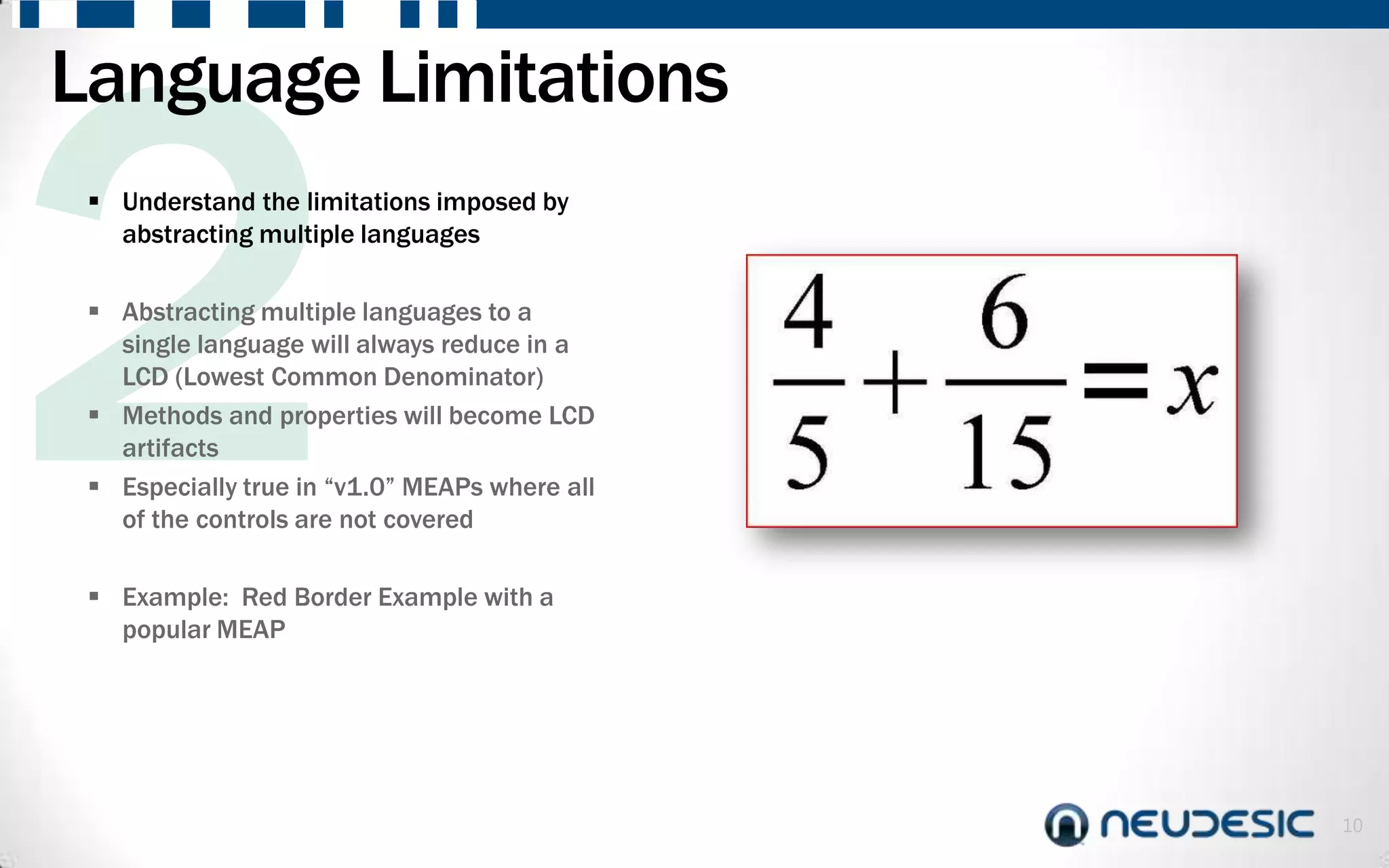
  Example: Red Border Example with a
   popular MEAP


                                               10
Platform Limitations
                        Understand what platform limitations
                         might arise when using a MEAP

                        What happens if things change
                         underneath?
                           New devices?
                           New OS upgrade?
                           New version of the SDK?
                        Often have to wait for the MEAP vendor to
                         catch up in order to use these features

                        Example: Bluetooth 4 profile in iOS 5.1


                                                                   11
UI Abstraction
  Does the MEAP vendor force you into
   abstracting UI controls and components?

  Often stuck with cookie cutter themes
   supplied by the MEAP vendor
     Demo well, but can be difficult to
       change
  What happens when one platform
   supports a UI nuance that the others
   don’t?

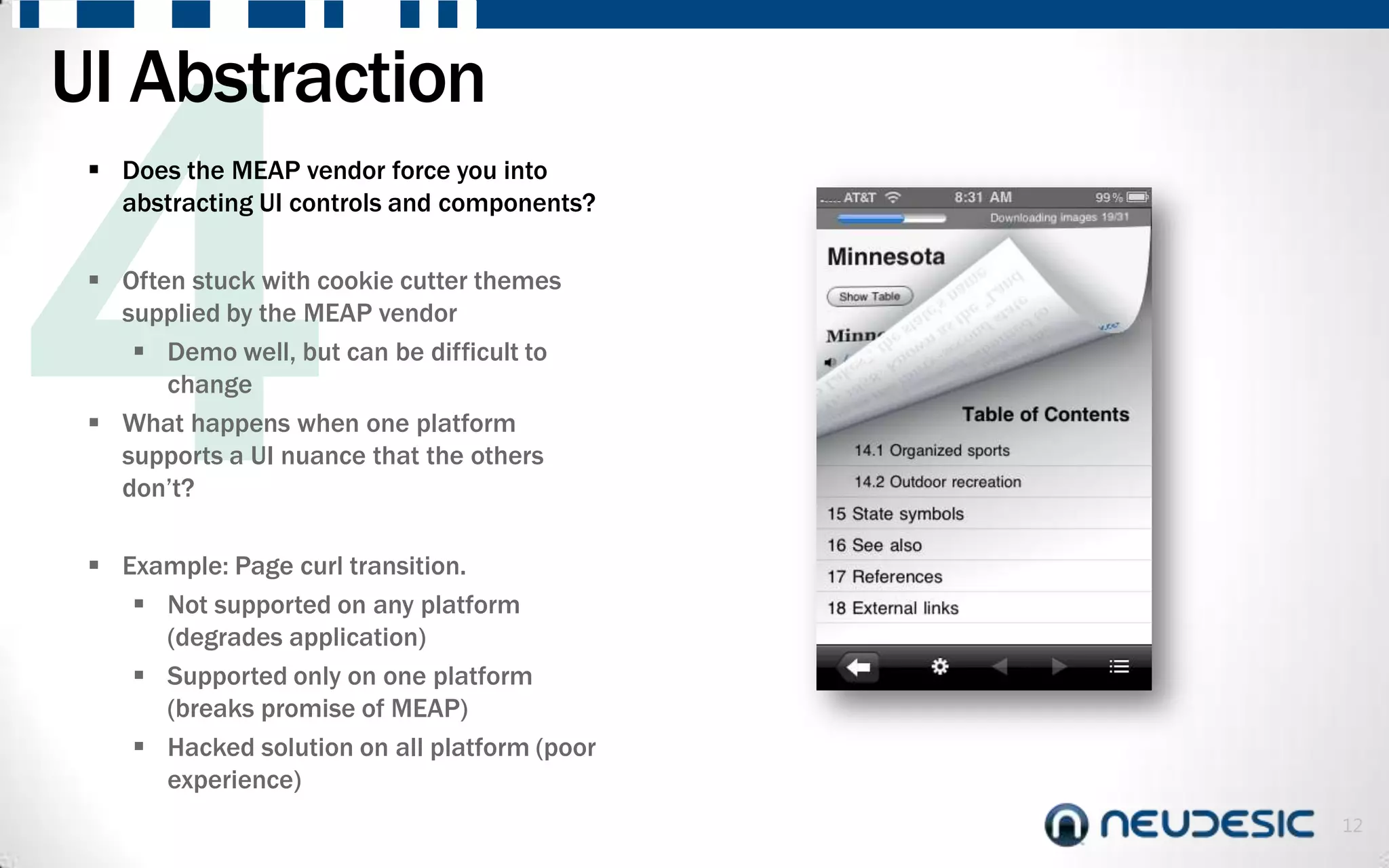
  Example: Page curl transition.
     Not supported on any platform
      (degrades application)
     Supported only on one platform
      (breaks promise of MEAP)
     Hacked solution on all platform (poor
      experience)
                                              12
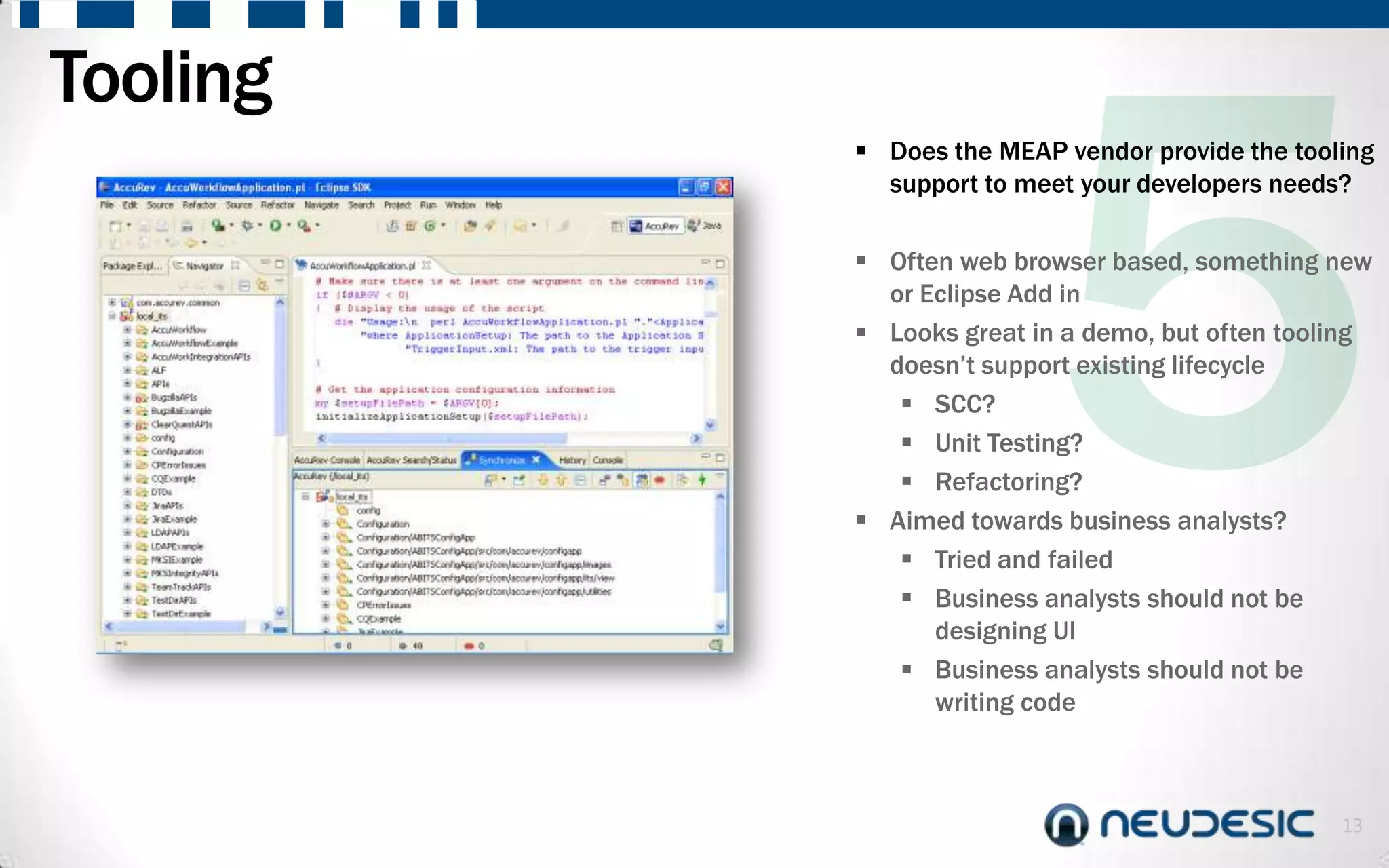
Tooling
           Does the MEAP vendor provide the tooling
            support to meet your developers needs?

           Often web browser based, something new
            or Eclipse Add in
           Looks great in a demo, but often tooling
            doesn’t support existing lifecycle
              SCC?
              Unit Testing?
              Refactoring?
           Aimed towards business analysts?
              Tried and failed
              Business analysts should not be
                designing UI
              Business analysts should not be
                writing code


                                                 13
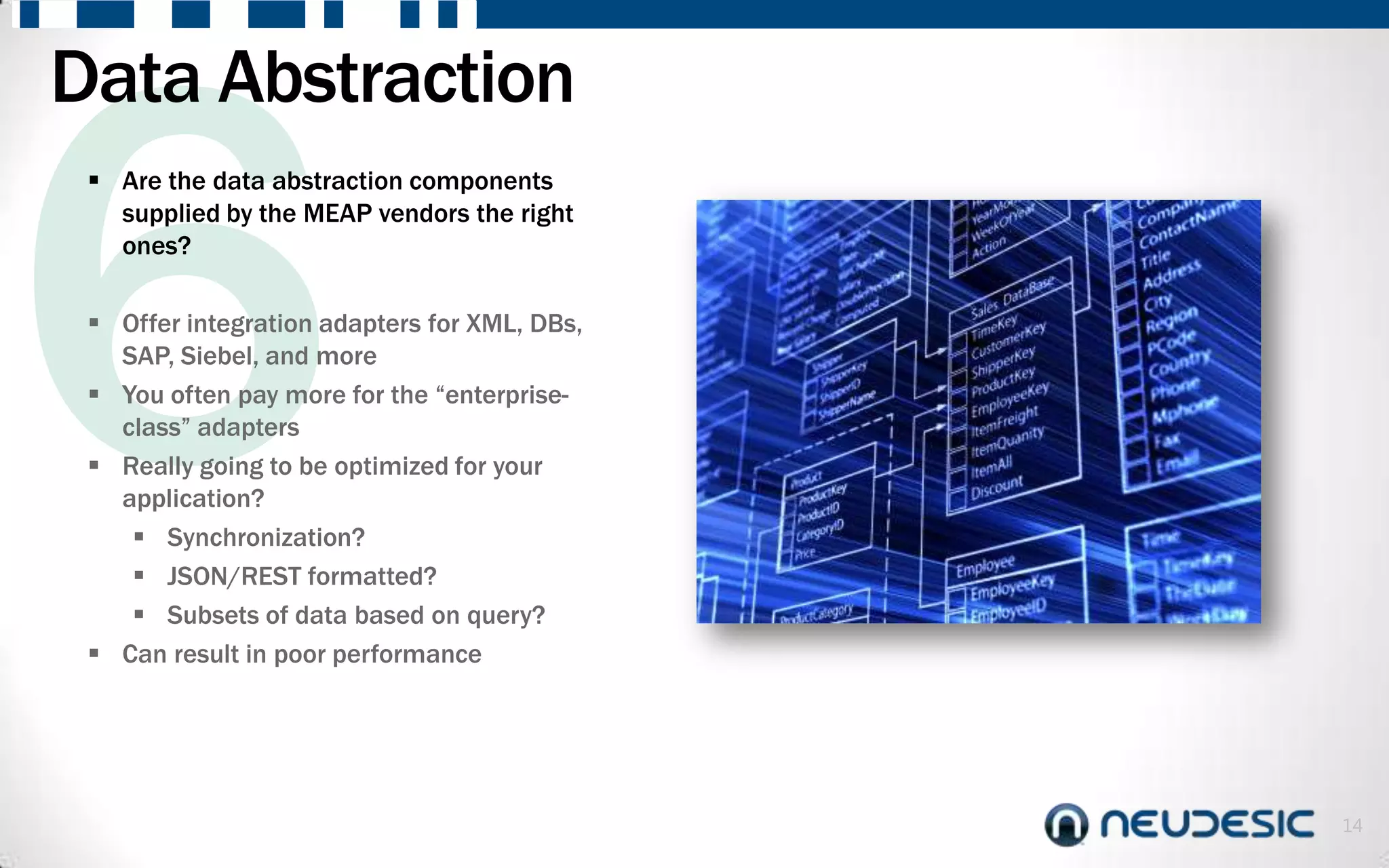
Data Abstraction
  Are the data abstraction components
   supplied by the MEAP vendors the right
   ones?

  Offer integration adapters for XML, DBs,
   SAP, Siebel, and more
  You often pay more for the “enterprise-
   class” adapters
  Really going to be optimized for your
   application?
     Synchronization?
     JSON/REST formatted?
     Subsets of data based on query?
  Can result in poor performance


                                              14
Debugging
             What happens when things go wrong with
              your MEAP application?

             The application crashes 1 time in 10 – or
              one of those difficult to fix bugs?
                Apple/Google going to help?
                Ask other developers on forums?
                Pay MEAP vendor to look into the
                  problem, to hopefully diagnose and
                  debug the issue for you
             What happens in you deploy your
              application to the AppStore and it gets
              rejected?
                Only the MEAP vendor can help you
                  resolve the issue

             Don’t underestimate the importance of
              developer support in the community

                                                      15
Difficult to Extend
  Does the MEAP enable you to easily
   extend applications with non-MEAP code?

  Found a new JavaScript library
  Or a native control/component that’s
   really going to help your application
  Is this supported?
     Wait until the MEAP vendor supports
        it?
     Use a bridge to native code?
  What happens if you acquire a mobile
   application from another department or
   company?
     Is this going to use the same MEAP?


                                             16
Vendor Lock In
 MEAPs Potentially Lock In You and Your Developers
      Language, Platform, and Tooling is no longer in your control, and often miss
       out on language and device specific features
      Developers locked into the MEAP platform using reduced toolset
 MEAPs Can Be Expensive
      Initial platform costs
      “Value Add” costs for additional controls and adapters
      Service and support costs when things need changing
 MEAP Hosting Models May Not Flexible
      Often don’t offer on premise and cloud based offering
      You “give” your application to them to be hosted


                                                                                      17
An Alternative Approach


                          18
Reviewing the Potential
 Write once, run on virtually any device
        Write application in single language and re-compile for native platform
 Take advantage of device hardware
        Provide abstraction layer to take advantage of the device hardware
 Integrate with different data sources
        Set of adapters for XML, databases, Web services, SAP, Siebel, etc.
 Deployment of application
        Hosting of application, manage updates, and analyze usage
 Management of devices
        Asset management for devices, and restrictions for trusted devices


                                                                                   19
Write Once, Run on Virtually Any Device
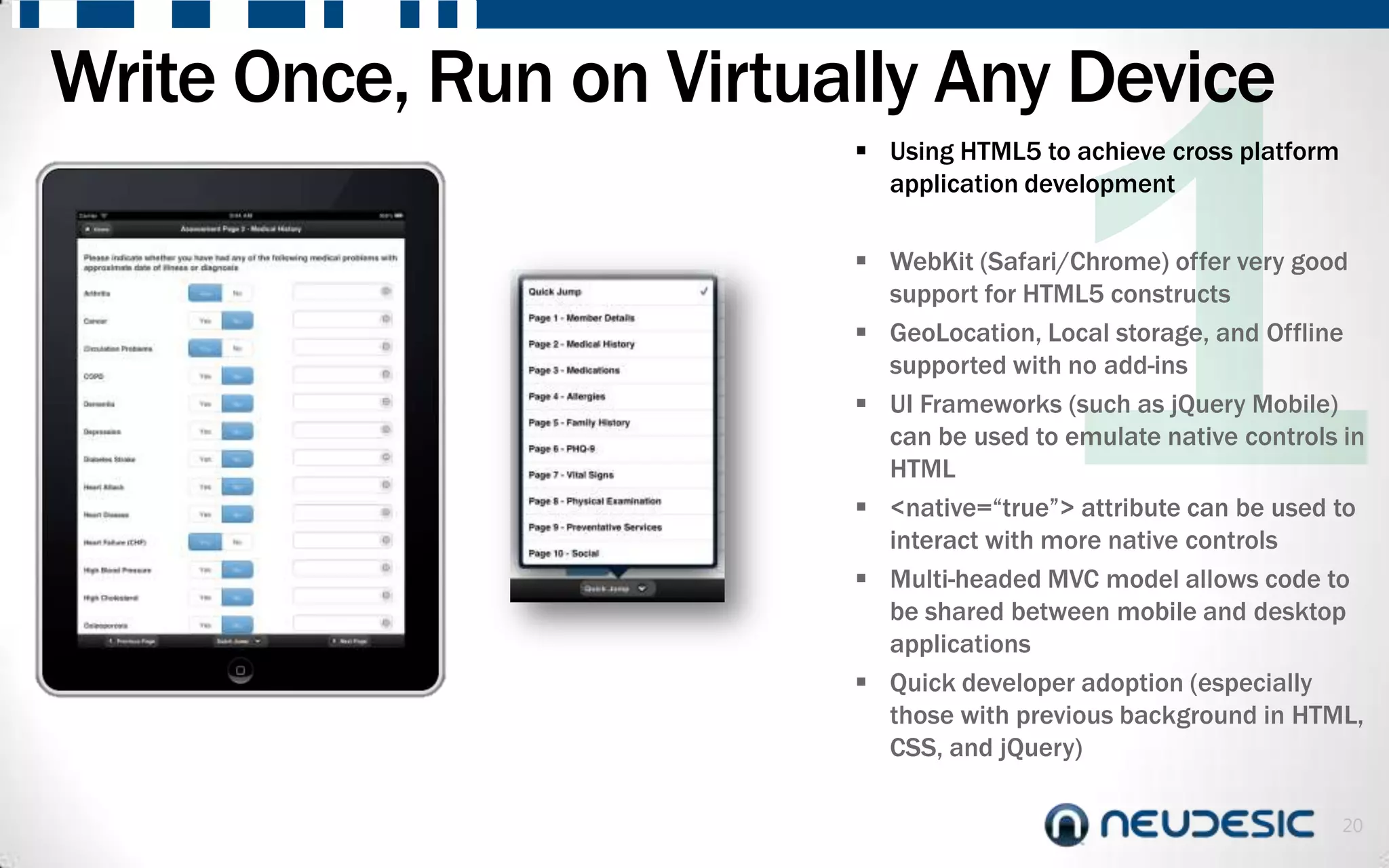
                          Using HTML5 to achieve cross platform
                           application development

                          WebKit (Safari/Chrome) offer very good
                           support for HTML5 constructs
                          GeoLocation, Local storage, and Offline
                           supported with no add-ins
                          UI Frameworks (such as jQuery Mobile)
                           can be used to emulate native controls in
                           HTML
                          <native=“true”> attribute can be used to
                           interact with more native controls
                          Multi-headed MVC model allows code to
                           be shared between mobile and desktop
                           applications
                          Quick developer adoption (especially
                           those with previous background in HTML,
                           CSS, and jQuery)

                                                                   20
Take Advantage of Device Hardware
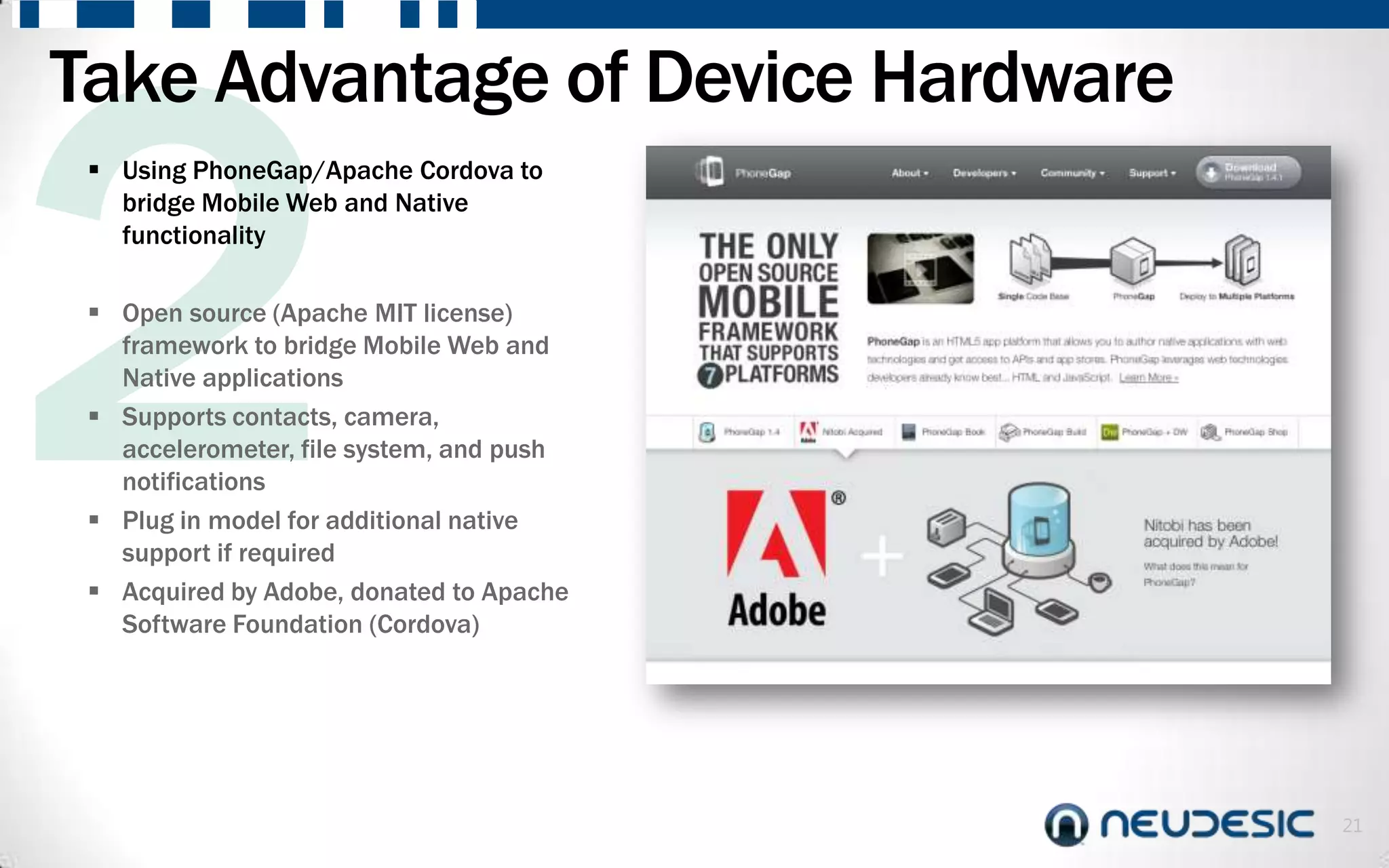
  Using PhoneGap/Apache Cordova to
   bridge Mobile Web and Native
   functionality

  Open source (Apache MIT license)
   framework to bridge Mobile Web and
   Native applications
  Supports contacts, camera,
   accelerometer, file system, and push
   notifications
  Plug in model for additional native
   support if required
  Acquired by Adobe, donated to Apache
   Software Foundation (Cordova)


                                          21
Integrate with Different Data Sources
                          Moving to REST/JSON middle out
                           approach

                          Unless exception case, standardize on
                           REST/JSON/HTTP(S) for all mobile
                           communications
                          Standard and lightweight, and well
                           supported by mobile SDKs and/or
                           jQuery/XHR
                          Widely supported by server, cloud
                           platforms, and server-side products
                          Two important patterns: Synchronization
                           (to support offline) and Asynchronous
                           (e.g. lists in native application)


                                                                22
Deployment of Application
  Considering best deployment approach
   for each application

  HTML5 applications require no
   deployment
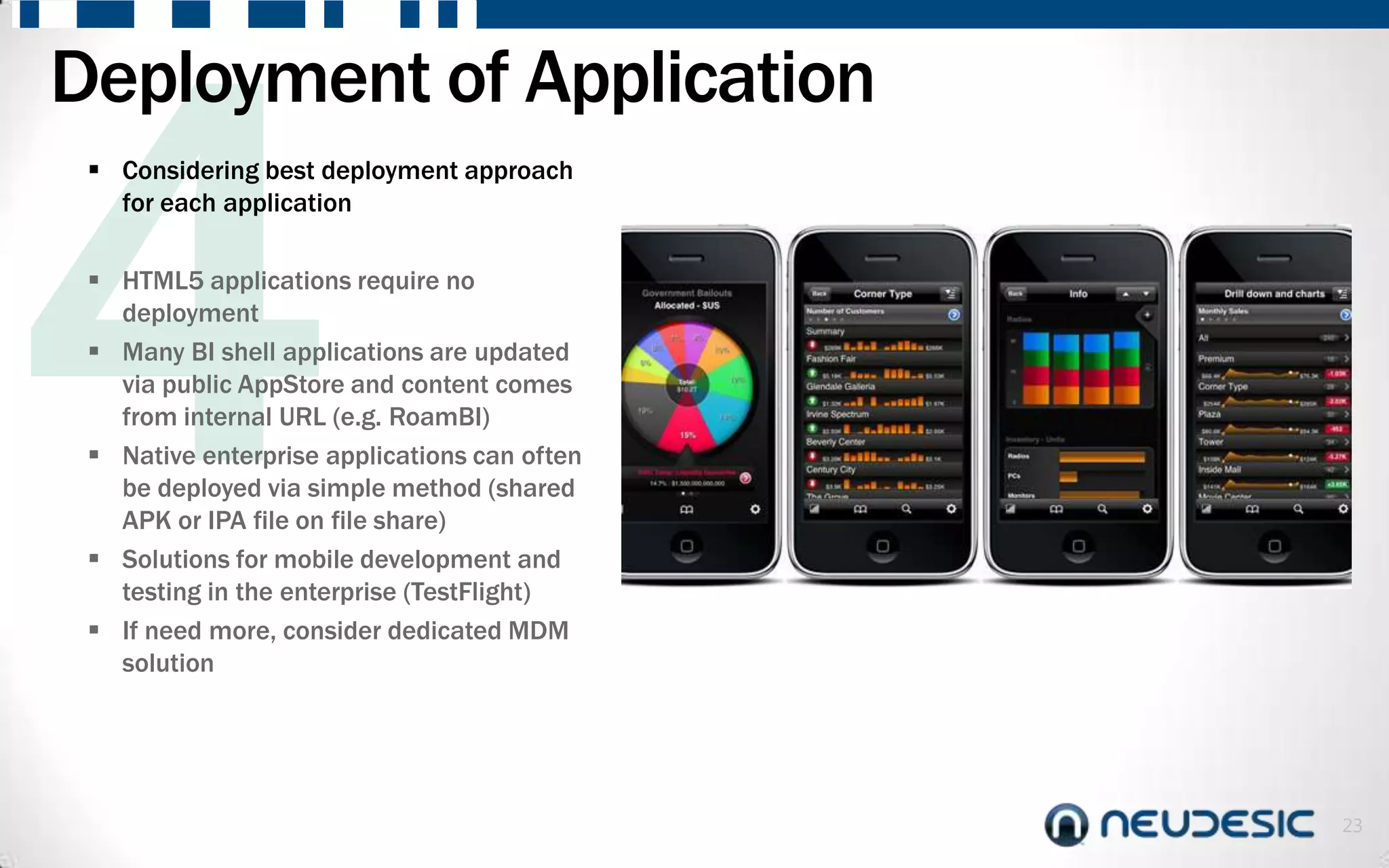
  Many BI shell applications are updated
   via public AppStore and content comes
   from internal URL (e.g. RoamBI)
  Native enterprise applications can often
   be deployed via simple method (shared
   APK or IPA file on file share)
  Solutions for mobile development and
   testing in the enterprise (TestFlight)
  If need more, consider dedicated MDM
   solution


                                              23
Management of Devices
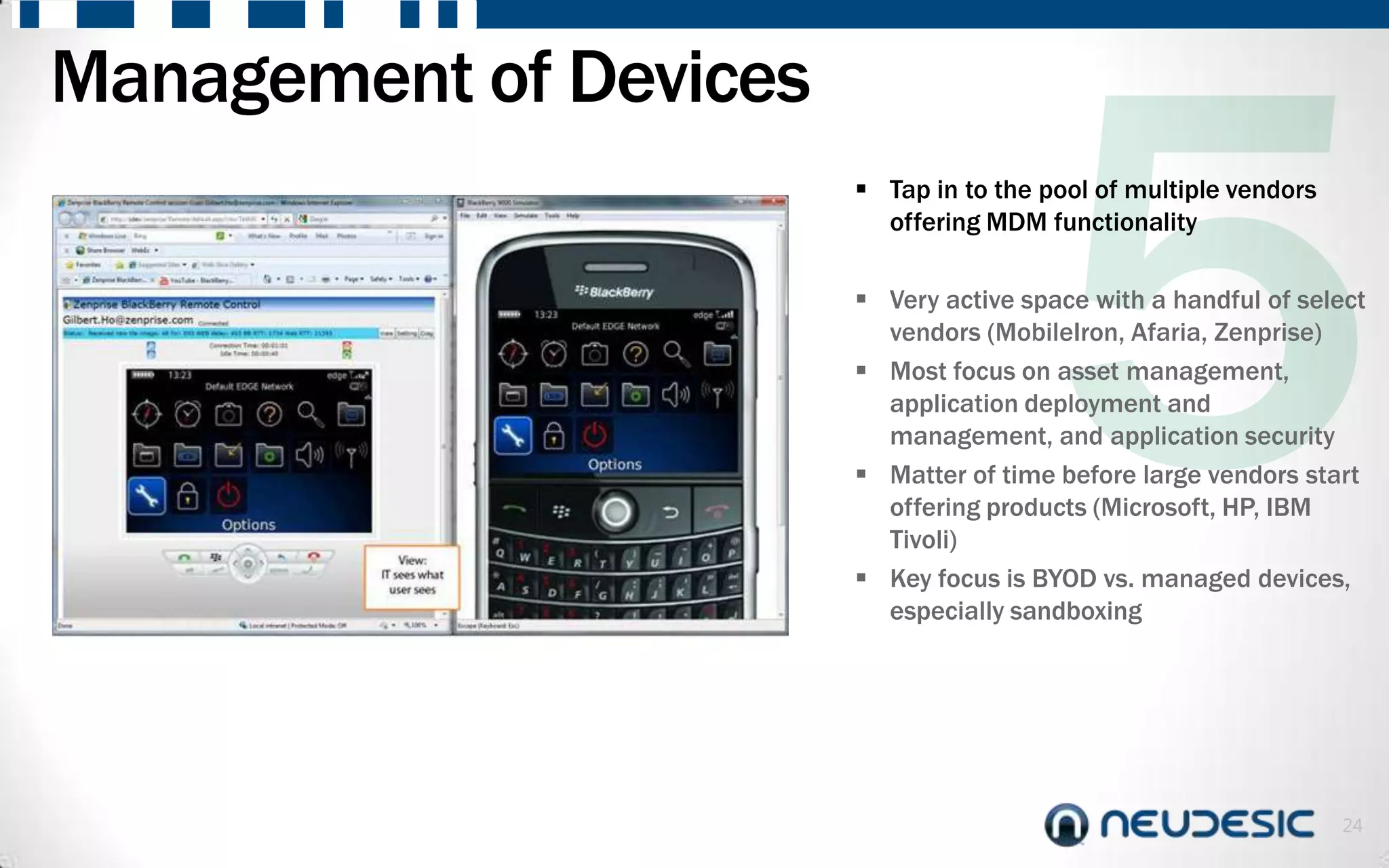
                         Tap in to the pool of multiple vendors
                          offering MDM functionality

                         Very active space with a handful of select
                          vendors (MobileIron, Afaria, Zenprise)
                         Most focus on asset management,
                          application deployment and
                          management, and application security
                         Matter of time before large vendors start
                          offering products (Microsoft, HP, IBM
                          Tivoli)
                         Key focus is BYOD vs. managed devices,
                          especially sandboxing


                                                                   24
Conclusion


             25
Conclusion
 MEAPs are early in the hype cycle, offering to quickly solve five key problems
  with mobile application development
 While the problems hold true, be very wary of vendor lock in and taking your
  organization down a path with limited future options
 Consider alternatives, including HTML5 and Hybrid model for development,
  while solving deployment and management with dedicated products


                                                                              26
Thank You
       Simon Guest
Director, Mobility Solutions
      Neudesic, LLC

simon.guest@neudesic.com
      @simonguest
                               27

Objective View of MEAPs

  • 1.
    An Objective Viewof MEAPs Neudesic Mobility Research 1
  • 2.
    Agenda  Objective Overviewof MEAPs (Mobile Enterprise Application Platforms)  Where did the acronym come from, and who are the players?  How do you define a MEAP?  What problems are they trying to address?  Potential issues with MEAPs  Potential issues to watch out for when considering a MEAP  Conclusion  An alternative approach to MEAPs 2
  • 3.
  • 4.
    Where did theAcronym come from?  MEAP (Mobile Enterprise Application Platform)  Acronym coined by Gartner in 2008 Magic Quadrant report  MEAP Definition  Comprehensive suite of products and services that enable development of mobile applications  Typically comprising of a mobile middleware server and a mobile client application  Mobile clients can be native applications or HTML-based, depending on the vendor offering 4
  • 5.
    Who is Playingin this Space?  MEAP Vendors  As listed in Gartner’s 2011 MEAP Magic Quadrant  Antenna, IBM (Worklight), Kony, Pyxis, RhoMobile, Sybase, Syclo  Not mentioned, but same category  Red Foundry, Appcelerator  Neudesic Experience  Red Foundry, RhoMobile, Pyxis (analysis or previous use with customers) 5
  • 6.
    What are MEAPsTrying to Solve?  Write once, run on virtually any device  Write application in single language and re-compile for native platform  Take advantage of device hardware  Provide abstraction layer to take advantage of the device hardware  Integrate with different data sources  Set of adapters for XML, databases, Web services, SAP, Siebel, etc.  Deployment of application  Hosting of application, manage updates, and analyze usage  Management of devices  Asset management for devices, and restrictions for trusted devices 6
  • 7.
    Haven’t we beenhere before?  The History of Cross Platform Development  Late 90’s provided for multiple cross platform solutions  http://en.wikipedia.org/wiki/List_of_rapid_application_development_tools  Embarcadero/Delphi, Smartface, Panther, FoxPro, VisualWorks, XPower  All had many of the promises of MEAPs 7
  • 8.
  • 9.
    Language Abstraction  Be wary of MEAPs that offer a language abstraction  New language for developers to learn  Even if “based on Java/JavaScript” it will still introduce new libraries unfamiliar to developers  Developers generally shy away from this approach  Example: Force.com / APEX 9
  • 10.
    Language Limitations Understand the limitations imposed by abstracting multiple languages  Abstracting multiple languages to a single language will always reduce in a LCD (Lowest Common Denominator)  Methods and properties will become LCD artifacts  Especially true in “v1.0” MEAPs where all of the controls are not covered  Example: Red Border Example with a popular MEAP 10
  • 11.
    Platform Limitations  Understand what platform limitations might arise when using a MEAP  What happens if things change underneath?  New devices?  New OS upgrade?  New version of the SDK?  Often have to wait for the MEAP vendor to catch up in order to use these features  Example: Bluetooth 4 profile in iOS 5.1 11
  • 12.
    UI Abstraction Does the MEAP vendor force you into abstracting UI controls and components?  Often stuck with cookie cutter themes supplied by the MEAP vendor  Demo well, but can be difficult to change  What happens when one platform supports a UI nuance that the others don’t?  Example: Page curl transition.  Not supported on any platform (degrades application)  Supported only on one platform (breaks promise of MEAP)  Hacked solution on all platform (poor experience) 12
  • 13.
    Tooling  Does the MEAP vendor provide the tooling support to meet your developers needs?  Often web browser based, something new or Eclipse Add in  Looks great in a demo, but often tooling doesn’t support existing lifecycle  SCC?  Unit Testing?  Refactoring?  Aimed towards business analysts?  Tried and failed  Business analysts should not be designing UI  Business analysts should not be writing code 13
  • 14.
    Data Abstraction Are the data abstraction components supplied by the MEAP vendors the right ones?  Offer integration adapters for XML, DBs, SAP, Siebel, and more  You often pay more for the “enterprise- class” adapters  Really going to be optimized for your application?  Synchronization?  JSON/REST formatted?  Subsets of data based on query?  Can result in poor performance 14
  • 15.
    Debugging  What happens when things go wrong with your MEAP application?  The application crashes 1 time in 10 – or one of those difficult to fix bugs?  Apple/Google going to help?  Ask other developers on forums?  Pay MEAP vendor to look into the problem, to hopefully diagnose and debug the issue for you  What happens in you deploy your application to the AppStore and it gets rejected?  Only the MEAP vendor can help you resolve the issue  Don’t underestimate the importance of developer support in the community 15
  • 16.
    Difficult to Extend  Does the MEAP enable you to easily extend applications with non-MEAP code?  Found a new JavaScript library  Or a native control/component that’s really going to help your application  Is this supported?  Wait until the MEAP vendor supports it?  Use a bridge to native code?  What happens if you acquire a mobile application from another department or company?  Is this going to use the same MEAP? 16
  • 17.
    Vendor Lock In MEAPs Potentially Lock In You and Your Developers  Language, Platform, and Tooling is no longer in your control, and often miss out on language and device specific features  Developers locked into the MEAP platform using reduced toolset  MEAPs Can Be Expensive  Initial platform costs  “Value Add” costs for additional controls and adapters  Service and support costs when things need changing  MEAP Hosting Models May Not Flexible  Often don’t offer on premise and cloud based offering  You “give” your application to them to be hosted 17
  • 18.
  • 19.
    Reviewing the Potential Write once, run on virtually any device  Write application in single language and re-compile for native platform  Take advantage of device hardware  Provide abstraction layer to take advantage of the device hardware  Integrate with different data sources  Set of adapters for XML, databases, Web services, SAP, Siebel, etc.  Deployment of application  Hosting of application, manage updates, and analyze usage  Management of devices  Asset management for devices, and restrictions for trusted devices 19
  • 20.
    Write Once, Runon Virtually Any Device  Using HTML5 to achieve cross platform application development  WebKit (Safari/Chrome) offer very good support for HTML5 constructs  GeoLocation, Local storage, and Offline supported with no add-ins  UI Frameworks (such as jQuery Mobile) can be used to emulate native controls in HTML  <native=“true”> attribute can be used to interact with more native controls  Multi-headed MVC model allows code to be shared between mobile and desktop applications  Quick developer adoption (especially those with previous background in HTML, CSS, and jQuery) 20
  • 21.
    Take Advantage ofDevice Hardware  Using PhoneGap/Apache Cordova to bridge Mobile Web and Native functionality  Open source (Apache MIT license) framework to bridge Mobile Web and Native applications  Supports contacts, camera, accelerometer, file system, and push notifications  Plug in model for additional native support if required  Acquired by Adobe, donated to Apache Software Foundation (Cordova) 21
  • 22.
    Integrate with DifferentData Sources  Moving to REST/JSON middle out approach  Unless exception case, standardize on REST/JSON/HTTP(S) for all mobile communications  Standard and lightweight, and well supported by mobile SDKs and/or jQuery/XHR  Widely supported by server, cloud platforms, and server-side products  Two important patterns: Synchronization (to support offline) and Asynchronous (e.g. lists in native application) 22
  • 23.
    Deployment of Application  Considering best deployment approach for each application  HTML5 applications require no deployment  Many BI shell applications are updated via public AppStore and content comes from internal URL (e.g. RoamBI)  Native enterprise applications can often be deployed via simple method (shared APK or IPA file on file share)  Solutions for mobile development and testing in the enterprise (TestFlight)  If need more, consider dedicated MDM solution 23
  • 24.
    Management of Devices  Tap in to the pool of multiple vendors offering MDM functionality  Very active space with a handful of select vendors (MobileIron, Afaria, Zenprise)  Most focus on asset management, application deployment and management, and application security  Matter of time before large vendors start offering products (Microsoft, HP, IBM Tivoli)  Key focus is BYOD vs. managed devices, especially sandboxing 24
  • 25.
  • 26.
    Conclusion  MEAPs areearly in the hype cycle, offering to quickly solve five key problems with mobile application development  While the problems hold true, be very wary of vendor lock in and taking your organization down a path with limited future options  Consider alternatives, including HTML5 and Hybrid model for development, while solving deployment and management with dedicated products 26
  • 27.
    Thank You Simon Guest Director, Mobility Solutions Neudesic, LLC simon.guest@neudesic.com @simonguest 27