OBJECT TYPE
  CASTING
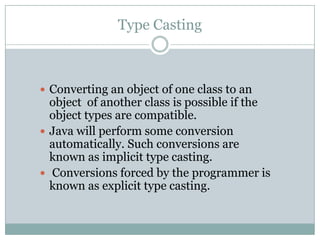
Type Casting


 Converting an object of one class to an
  object of another class is possible if the
  object types are compatible.
 Java will perform some conversion
  automatically. Such conversions are
  known as implicit type casting.
 Conversions forced by the programmer is
  known as explicit type casting.
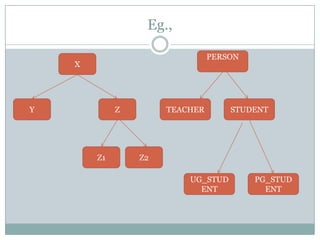
Eg.,

                                PERSON
    X


Y            Z        TEACHER       STUDENT


        Z1       Z2

                          UG_STUD        PG_STUD
                            ENT            ENT
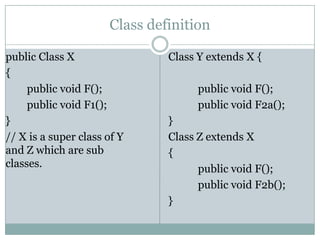
Class definition

public Class X                 Class Y extends X {
{
     public void F();                public void F();
     public void F1();               public void F2a();
}                              }
// X is a super class of Y     Class Z extends X
and Z which are sub            {
classes.                             public void F();
                                     public void F2b();
                               }
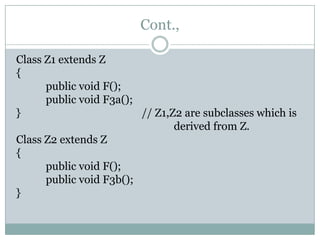
Cont.,

Class Z1 extends Z
{
      public void F();
      public void F3a();
}                        // Z1,Z2 are subclasses which is
                                derived from Z.
Class Z2 extends Z
{
      public void F();
      public void F3b();
}
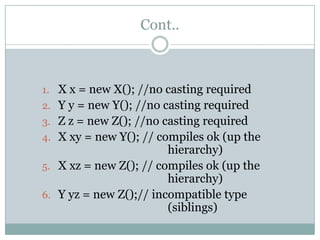
Cont..


1. X x = new X(); //no casting required
2. Y y = new Y(); //no casting required
3. Z z = new Z(); //no casting required
4. X xy = new Y(); // compiles ok (up the
                        hierarchy)
5. X xz = new Z(); // compiles ok (up the
                        hierarchy)
6. Y yz = new Z();// incompatible type
                        (siblings)
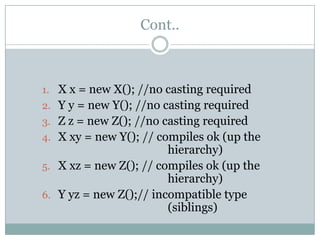
Cont..


1. X x = new X(); //no casting required
2. Y y = new Y(); //no casting required
3. Z z = new Z(); //no casting required
4. X xy = new Y(); // compiles ok (up the
                        hierarchy)
5. X xz = new Z(); // compiles ok (up the
                        hierarchy)
6. Y yz = new Z();// incompatible type
                        (siblings)
Cont..


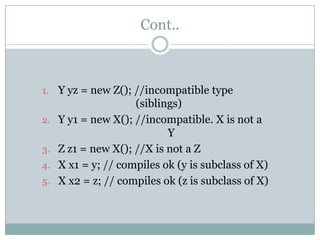
1. Y yz = new Z(); //incompatible type
                     (siblings)
2.   Y y1 = new X(); //incompatible. X is not a
                            Y
3.   Z z1 = new X(); //X is not a Z
4.   X x1 = y; // compiles ok (y is subclass of X)
5.   X x2 = z; // compiles ok (z is subclass of X)
Object type Casting


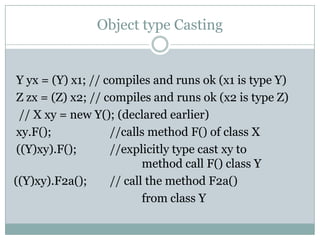
 Y yx = (Y) x1; // compiles and runs ok (x1 is type Y)
 Z zx = (Z) x2; // compiles and runs ok (x2 is type Z)
  // X xy = new Y(); (declared earlier)
 xy.F();            //calls method F() of class X
 ((Y)xy).F();       //explicitly type cast xy to
                           method call F() class Y
((Y)xy).F2a();      // call the method F2a()
                           from class Y
Object Type Casting.,

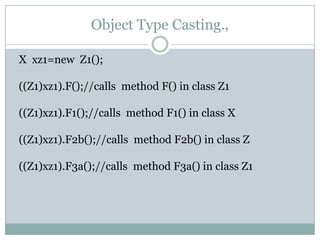
X xz1=new Z1();

((Z1)xz1).F();//calls method F() in class Z1

((Z1)xz1).F1();//calls method F1() in class X

((Z1)xz1).F2b();//calls method F2b() in class Z

((Z1)xz1).F3a();//calls method F3a() in class Z1
THANK YOU!

Object type casting

  • 1.
    OBJECT TYPE CASTING
  • 2.
    Type Casting  Convertingan object of one class to an object of another class is possible if the object types are compatible.  Java will perform some conversion automatically. Such conversions are known as implicit type casting.  Conversions forced by the programmer is known as explicit type casting.
  • 3.
    Eg., PERSON X Y Z TEACHER STUDENT Z1 Z2 UG_STUD PG_STUD ENT ENT
  • 4.
    Class definition public ClassX Class Y extends X { { public void F(); public void F(); public void F1(); public void F2a(); } } // X is a super class of Y Class Z extends X and Z which are sub { classes. public void F(); public void F2b(); }
  • 5.
    Cont., Class Z1 extendsZ { public void F(); public void F3a(); } // Z1,Z2 are subclasses which is derived from Z. Class Z2 extends Z { public void F(); public void F3b(); }
  • 6.
    Cont.. 1. X x= new X(); //no casting required 2. Y y = new Y(); //no casting required 3. Z z = new Z(); //no casting required 4. X xy = new Y(); // compiles ok (up the hierarchy) 5. X xz = new Z(); // compiles ok (up the hierarchy) 6. Y yz = new Z();// incompatible type (siblings)
  • 7.
    Cont.. 1. X x= new X(); //no casting required 2. Y y = new Y(); //no casting required 3. Z z = new Z(); //no casting required 4. X xy = new Y(); // compiles ok (up the hierarchy) 5. X xz = new Z(); // compiles ok (up the hierarchy) 6. Y yz = new Z();// incompatible type (siblings)
  • 8.
    Cont.. 1. Y yz= new Z(); //incompatible type (siblings) 2. Y y1 = new X(); //incompatible. X is not a Y 3. Z z1 = new X(); //X is not a Z 4. X x1 = y; // compiles ok (y is subclass of X) 5. X x2 = z; // compiles ok (z is subclass of X)
  • 9.
    Object type Casting Y yx = (Y) x1; // compiles and runs ok (x1 is type Y) Z zx = (Z) x2; // compiles and runs ok (x2 is type Z) // X xy = new Y(); (declared earlier) xy.F(); //calls method F() of class X ((Y)xy).F(); //explicitly type cast xy to method call F() class Y ((Y)xy).F2a(); // call the method F2a() from class Y
  • 10.
    Object Type Casting., Xxz1=new Z1(); ((Z1)xz1).F();//calls method F() in class Z1 ((Z1)xz1).F1();//calls method F1() in class X ((Z1)xz1).F2b();//calls method F2b() in class Z ((Z1)xz1).F3a();//calls method F3a() in class Z1
  • 11.