POWER : ITS USES AND ABUSES IN ORGANIZATIONS Ben Karp & Alexandra Anastos  10/26/2011
POWER: Its Uses and Abuses in Organizations Influence : A Basic Organizational Process Individual Power : Sources and Uses Empowerment : Sharing Power with Employees The Power of  Organizational Groups Sexual Harassment : A Serious Abuse of Power Organizational Politics : Selfish Uses of Power Power : The capacity to exert influence over others.
POWER: Its Uses and Abuses in Organizations Define the nature of influence in organizations and its major forms. Distinguish between various forms of individual power in organizations. Define empowerment and indicate how it operates among individuals and in teams. ANASTOS
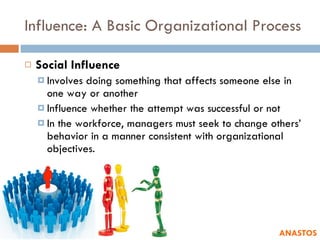
Influence: A Basic Organizational Process Social Influence Involves doing something that affects someone else in one way or another Influence whether the attempt was successful or not In the workforce, managers must seek to change others’ behavior in a manner consistent with organizational objectives. ANASTOS
Influence: A Basic Organizational Process Tactics  for Exerting Influence Rational persuasion Inspirational appeals Collaboration Consultation Integration: getting the target to do what you want by putting him/her in a good mood or getting him/her to like you Exchange Personal Appeal Coalition-building Legitimating Pressuring *Outside of the organization, corporations use these tactics, but they will use other tactics.  ANASTOS
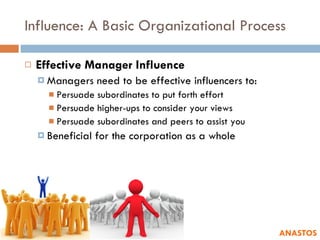
Influence: A Basic Organizational Process Effective Manager Influence Managers need to be effective influencers to: Persuade subordinates to put forth effort Persuade higher-ups to consider your views Persuade subordinates and peers to assist you Beneficial for the corporation as a whole ANASTOS
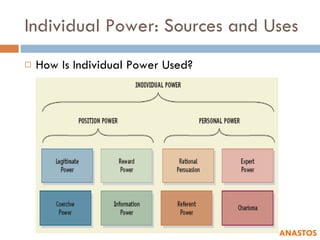
Individual Power: Sources and Uses Power: The capacity to exert influence over others. Two Sources of  Individual  Power: Position Power:  Power deriving from job or title within the organization. Personal Power:  Power deriving from a person’s unique qualities or characteristics. ANASTOS
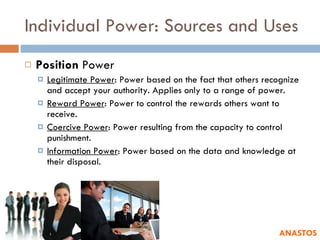
Individual Power: Sources and Uses Position  Power Legitimate Power : Power based on the fact that others recognize and accept your authority. Applies only to a range of power. Reward Power : Power to control the rewards others want to receive. Coercive Power : Power resulting from the capacity to control punishment.  Information Power : Power based on the data and knowledge at their disposal.  ANASTOS
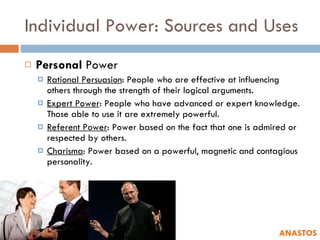
Individual Power: Sources and Uses Personal  Power Rational Persuasion : People who are effective at influencing others through the strength of their logical arguments. Expert Power : People who have advanced or expert knowledge. Those able to use it are extremely powerful. Referent Power : Power based on the fact that one is admired or respected by others. Charisma : Power based on a powerful, magnetic and contagious personality.  ANASTOS
Individual Power: Sources and Uses How Is Individual Power Used? ANASTOS
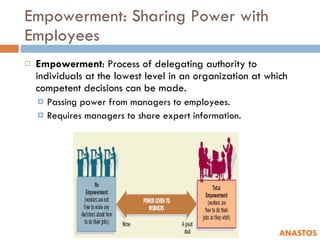
Empowerment: Sharing Power with Employees Empowerment : Process of delegating authority to individuals at the lowest level in an organization at which competent decisions can be made. Passing power from managers to employees. Requires managers to share expert information. ANASTOS
Empowerment: Sharing Power with Employees Central Steps  to Empowerment: Information sharing : Providing potentially sensitive information on costs, productivity, quality, and financial performance to employees throughout the organization. Autonomy through boundaries : Using organizational practices that encourage self-ruling action by employees, including work procedures, areas of responsibility, and goals. Team accountability : Ensuring that both decision-making authority and performance accountability reside in teams. ANASTOS
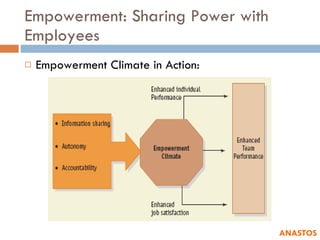
Empowerment: Sharing Power with Employees Empowerment in  Teams Empowerment climate : A relatively enduring atmosphere in the workplace that is supportive of empowerment.  More strongly organizations encourage holding teams accountable, information sharing, etc. = higher empowerment climate. High empowerment climate = increased importance of team performance.  ANASTOS
Empowerment: Sharing Power with Employees Empowerment Climate in Action: ANASTOS
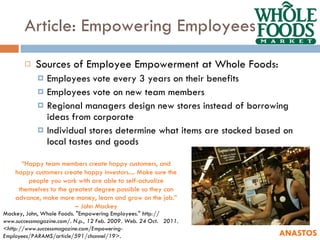
Article: Empowering Employees Sources of Employee Empowerment at Whole Foods: Employees vote every 3 years on their benefits Employees vote on new team members Regional managers design new stores instead of borrowing ideas from corporate Individual stores determine what items are stocked based on local tastes and goods ANASTOS Mackey, John, Whole Foods. &quot;Empowering Employees.&quot;  http:// www.successmagazine.com/. N.p., 12 Feb. 2009. Web. 24 Oct.  2011. <http://www.successmagazine.com/Empowering- Employees/PARAMS/article/591/channel/19>.  “ Happy team members create happy customers, and happy customers create happy investors.... Make sure the people you work with are able to self-actualize themselves to the greatest degree possible so they can advance, make more money, learn and grow on the job.” – John Mackey
POWER: Its Uses and Abuses in Organizations Describe the models that explain the nature of power between organizational units. Describe how sexual harassment constitutes an abuse of organizational power and ways of reducing its occurrence. Describe when and where organizational politics occur and the forms such behavior takes. KARP
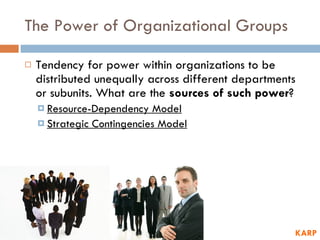
The Power of Organizational Groups Tendency for power within organizations to be distributed unequally across different departments or subunits. What are the  sources of such power ? Resource-Dependency Model Strategic Contingencies Model KARP
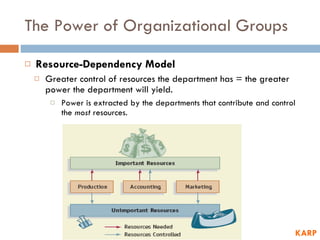
The Power of Organizational Groups Resource-Dependency Model Greater control of resources the department has = the greater power the department will yield.  Power is extracted by the departments that contribute and control the  most  resources. KARP
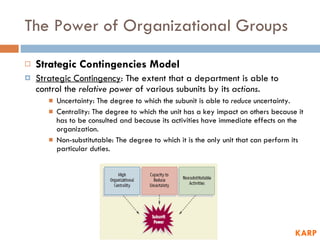
The Power of Organizational Groups Strategic Contingencies Model Strategic Contingency : The extent that a department is able to control the  relative power  of various subunits by its  actions .  Uncertainty: The degree to which the subunit is able to  reduce  uncertainty. Centrality: The degree to which the unit has a key impact on others because it has to be consulted and because its activities have immediate effects on the organization. Non-substitutable: The degree to which it is the only unit that can perform its particular duties. KARP
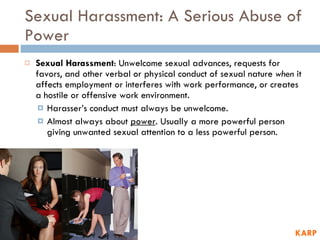
Sexual Harassment: A Serious Abuse of Power Sexual Harassment : Unwelcome sexual advances, requests for favors, and other verbal or physical conduct of sexual nature  when  it affects employment or interferes with work performance, or creates a hostile or offensive work environment.  Harasser’s conduct must always be unwelcome. Almost always about  power . Usually a more powerful person giving unwanted sexual attention to a less powerful person.  KARP
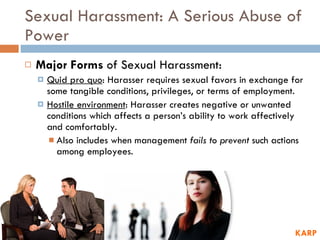
Sexual Harassment: A Serious Abuse of Power Major Forms  of Sexual Harassment: Quid pro quo : Harasser requires sexual favors in exchange for some tangible conditions, privileges, or terms of employment.  Hostile environment : Harasser creates negative or unwanted conditions which affects a person’s ability to work affectively and comfortably.  Also includes when management  fails to prevent  such actions among employees. KARP
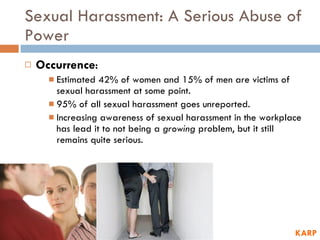
Sexual Harassment: A Serious Abuse of Power Occurrence : Estimated 42% of women and 15% of men are victims of sexual harassment at some point. 95% of all sexual harassment goes unreported. Increasing awareness of sexual harassment in the workplace has lead it to not being a  growing  problem, but it still remains quite serious. KARP
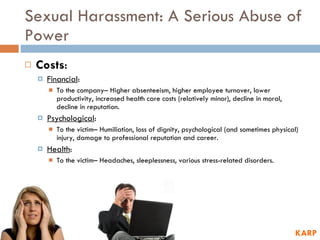
Sexual Harassment: A Serious Abuse of Power Costs : Financial : To the company– Higher absenteeism, higher employee turnover, lower productivity, increased health care costs (relatively minor), decline in moral, decline in reputation.  Psychological : To the victim– Humiliation, loss of dignity, psychological (and sometimes physical) injury, damage to professional reputation and career.  Health : To the victim– Headaches, sleeplessness, various stress-related disorders. KARP
Sexual Harassment: A Serious Abuse of Power How to Manage :  As a manager, it’s beneficial to take steps to prevent sexual harassment. Ways to prevent: Have a clear policy on sexual harassment Train employees about what constitutes inappropriate behavior towards others Make sure there’s an effective complaint procedure Take immediate steps to stop harassment if/when it does occur to ensure it doesn’t reoccur Contribute personally to a positive and supportive environment KARP
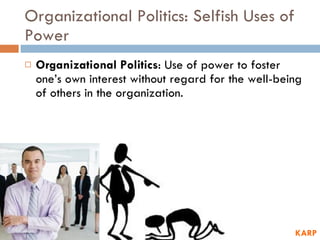
Organizational Politics: Selfish Uses of Power Organizational Politics : Use of power to foster one’s own interest without regard for the well-being of others in the organization. KARP
Organizational Politics: Selfish Uses of Power Political Behavior Forms Gaining control over selective use of information Cultivating a favorable impression Building powerful coalitions *Blaming and attacking others Associating with powerful others Creating obligations KARP
Organizational Politics: Selfish Uses of Power Factors Influencing Politics Personal Determinants Organizational Determinants Human Resource Management Activities Large Multinational Corporations KARP
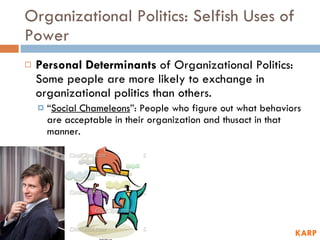
Organizational Politics: Selfish Uses of Power Personal Determinants  of Organizational Politics: Some people are more likely to exchange in organizational politics than others.  “ Social Chameleons ”: People who figure out what behaviors are acceptable in their organization and thusact in that manner.  KARP
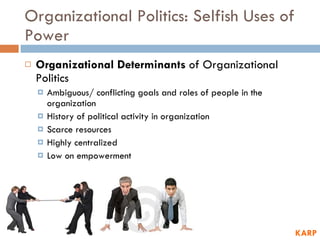
Organizational Politics: Selfish Uses of Power Organizational Determinants  of Organizational Politics Ambiguous/ conflicting goals and roles of people in the organization History of political activity in organization Scarce resources Highly centralized Low on empowerment KARP
Organizational Politics: Selfish Uses of Power Politics in  Human Resource Management Performance appraisal Personnel selection Compensation decisions Pay raise decisions KARP
Organizational Politics: Selfish Uses of Power Impact  of Organizational Politics Benefits the individual but negatively affects other people and the organization itself. Job satisfaction down Job commitment down Voluntary turnover rate up Employees feel less supported KARP
Article:  KARP

Ob12 karp&anastos 1

  • 1.
    POWER : ITSUSES AND ABUSES IN ORGANIZATIONS Ben Karp & Alexandra Anastos 10/26/2011
  • 2.
    POWER: Its Usesand Abuses in Organizations Influence : A Basic Organizational Process Individual Power : Sources and Uses Empowerment : Sharing Power with Employees The Power of Organizational Groups Sexual Harassment : A Serious Abuse of Power Organizational Politics : Selfish Uses of Power Power : The capacity to exert influence over others.
  • 3.
    POWER: Its Usesand Abuses in Organizations Define the nature of influence in organizations and its major forms. Distinguish between various forms of individual power in organizations. Define empowerment and indicate how it operates among individuals and in teams. ANASTOS
  • 4.
    Influence: A BasicOrganizational Process Social Influence Involves doing something that affects someone else in one way or another Influence whether the attempt was successful or not In the workforce, managers must seek to change others’ behavior in a manner consistent with organizational objectives. ANASTOS
  • 5.
    Influence: A BasicOrganizational Process Tactics for Exerting Influence Rational persuasion Inspirational appeals Collaboration Consultation Integration: getting the target to do what you want by putting him/her in a good mood or getting him/her to like you Exchange Personal Appeal Coalition-building Legitimating Pressuring *Outside of the organization, corporations use these tactics, but they will use other tactics. ANASTOS
  • 6.
    Influence: A BasicOrganizational Process Effective Manager Influence Managers need to be effective influencers to: Persuade subordinates to put forth effort Persuade higher-ups to consider your views Persuade subordinates and peers to assist you Beneficial for the corporation as a whole ANASTOS
  • 7.
    Individual Power: Sourcesand Uses Power: The capacity to exert influence over others. Two Sources of Individual Power: Position Power: Power deriving from job or title within the organization. Personal Power: Power deriving from a person’s unique qualities or characteristics. ANASTOS
  • 8.
    Individual Power: Sourcesand Uses Position Power Legitimate Power : Power based on the fact that others recognize and accept your authority. Applies only to a range of power. Reward Power : Power to control the rewards others want to receive. Coercive Power : Power resulting from the capacity to control punishment. Information Power : Power based on the data and knowledge at their disposal. ANASTOS
  • 9.
    Individual Power: Sourcesand Uses Personal Power Rational Persuasion : People who are effective at influencing others through the strength of their logical arguments. Expert Power : People who have advanced or expert knowledge. Those able to use it are extremely powerful. Referent Power : Power based on the fact that one is admired or respected by others. Charisma : Power based on a powerful, magnetic and contagious personality. ANASTOS
  • 10.
    Individual Power: Sourcesand Uses How Is Individual Power Used? ANASTOS
  • 11.
    Empowerment: Sharing Powerwith Employees Empowerment : Process of delegating authority to individuals at the lowest level in an organization at which competent decisions can be made. Passing power from managers to employees. Requires managers to share expert information. ANASTOS
  • 12.
    Empowerment: Sharing Powerwith Employees Central Steps to Empowerment: Information sharing : Providing potentially sensitive information on costs, productivity, quality, and financial performance to employees throughout the organization. Autonomy through boundaries : Using organizational practices that encourage self-ruling action by employees, including work procedures, areas of responsibility, and goals. Team accountability : Ensuring that both decision-making authority and performance accountability reside in teams. ANASTOS
  • 13.
    Empowerment: Sharing Powerwith Employees Empowerment in Teams Empowerment climate : A relatively enduring atmosphere in the workplace that is supportive of empowerment. More strongly organizations encourage holding teams accountable, information sharing, etc. = higher empowerment climate. High empowerment climate = increased importance of team performance. ANASTOS
  • 14.
    Empowerment: Sharing Powerwith Employees Empowerment Climate in Action: ANASTOS
  • 15.
    Article: Empowering EmployeesSources of Employee Empowerment at Whole Foods: Employees vote every 3 years on their benefits Employees vote on new team members Regional managers design new stores instead of borrowing ideas from corporate Individual stores determine what items are stocked based on local tastes and goods ANASTOS Mackey, John, Whole Foods. &quot;Empowering Employees.&quot; http:// www.successmagazine.com/. N.p., 12 Feb. 2009. Web. 24 Oct. 2011. <http://www.successmagazine.com/Empowering- Employees/PARAMS/article/591/channel/19>. “ Happy team members create happy customers, and happy customers create happy investors.... Make sure the people you work with are able to self-actualize themselves to the greatest degree possible so they can advance, make more money, learn and grow on the job.” – John Mackey
  • 16.
    POWER: Its Usesand Abuses in Organizations Describe the models that explain the nature of power between organizational units. Describe how sexual harassment constitutes an abuse of organizational power and ways of reducing its occurrence. Describe when and where organizational politics occur and the forms such behavior takes. KARP
  • 17.
    The Power ofOrganizational Groups Tendency for power within organizations to be distributed unequally across different departments or subunits. What are the sources of such power ? Resource-Dependency Model Strategic Contingencies Model KARP
  • 18.
    The Power ofOrganizational Groups Resource-Dependency Model Greater control of resources the department has = the greater power the department will yield. Power is extracted by the departments that contribute and control the most resources. KARP
  • 19.
    The Power ofOrganizational Groups Strategic Contingencies Model Strategic Contingency : The extent that a department is able to control the relative power of various subunits by its actions . Uncertainty: The degree to which the subunit is able to reduce uncertainty. Centrality: The degree to which the unit has a key impact on others because it has to be consulted and because its activities have immediate effects on the organization. Non-substitutable: The degree to which it is the only unit that can perform its particular duties. KARP
  • 20.
    Sexual Harassment: ASerious Abuse of Power Sexual Harassment : Unwelcome sexual advances, requests for favors, and other verbal or physical conduct of sexual nature when it affects employment or interferes with work performance, or creates a hostile or offensive work environment. Harasser’s conduct must always be unwelcome. Almost always about power . Usually a more powerful person giving unwanted sexual attention to a less powerful person. KARP
  • 21.
    Sexual Harassment: ASerious Abuse of Power Major Forms of Sexual Harassment: Quid pro quo : Harasser requires sexual favors in exchange for some tangible conditions, privileges, or terms of employment. Hostile environment : Harasser creates negative or unwanted conditions which affects a person’s ability to work affectively and comfortably. Also includes when management fails to prevent such actions among employees. KARP
  • 22.
    Sexual Harassment: ASerious Abuse of Power Occurrence : Estimated 42% of women and 15% of men are victims of sexual harassment at some point. 95% of all sexual harassment goes unreported. Increasing awareness of sexual harassment in the workplace has lead it to not being a growing problem, but it still remains quite serious. KARP
  • 23.
    Sexual Harassment: ASerious Abuse of Power Costs : Financial : To the company– Higher absenteeism, higher employee turnover, lower productivity, increased health care costs (relatively minor), decline in moral, decline in reputation. Psychological : To the victim– Humiliation, loss of dignity, psychological (and sometimes physical) injury, damage to professional reputation and career. Health : To the victim– Headaches, sleeplessness, various stress-related disorders. KARP
  • 24.
    Sexual Harassment: ASerious Abuse of Power How to Manage : As a manager, it’s beneficial to take steps to prevent sexual harassment. Ways to prevent: Have a clear policy on sexual harassment Train employees about what constitutes inappropriate behavior towards others Make sure there’s an effective complaint procedure Take immediate steps to stop harassment if/when it does occur to ensure it doesn’t reoccur Contribute personally to a positive and supportive environment KARP
  • 25.
    Organizational Politics: SelfishUses of Power Organizational Politics : Use of power to foster one’s own interest without regard for the well-being of others in the organization. KARP
  • 26.
    Organizational Politics: SelfishUses of Power Political Behavior Forms Gaining control over selective use of information Cultivating a favorable impression Building powerful coalitions *Blaming and attacking others Associating with powerful others Creating obligations KARP
  • 27.
    Organizational Politics: SelfishUses of Power Factors Influencing Politics Personal Determinants Organizational Determinants Human Resource Management Activities Large Multinational Corporations KARP
  • 28.
    Organizational Politics: SelfishUses of Power Personal Determinants of Organizational Politics: Some people are more likely to exchange in organizational politics than others. “ Social Chameleons ”: People who figure out what behaviors are acceptable in their organization and thusact in that manner. KARP
  • 29.
    Organizational Politics: SelfishUses of Power Organizational Determinants of Organizational Politics Ambiguous/ conflicting goals and roles of people in the organization History of political activity in organization Scarce resources Highly centralized Low on empowerment KARP
  • 30.
    Organizational Politics: SelfishUses of Power Politics in Human Resource Management Performance appraisal Personnel selection Compensation decisions Pay raise decisions KARP
  • 31.
    Organizational Politics: SelfishUses of Power Impact of Organizational Politics Benefits the individual but negatively affects other people and the organization itself. Job satisfaction down Job commitment down Voluntary turnover rate up Employees feel less supported KARP
  • 32.