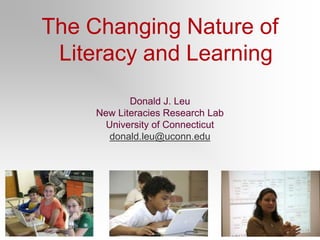
The Changing Nature of Literacy and LearningDonald J. LeuNew Literacies Research LabUniversity of Connecticutdonald.leu@uconn.edu
The New Literacies Research Team
Important Funding and Support From:Ray and Carole Neag
The Carnegie Corporation of New York
IES, U.S. Department of Education
The National Science Foundation
North Central Educational Research Lab
PBS
The Annenberg Foundation
William and Flora Hewlett Foundation
Bill and Melinda Gates Foundation
Australian Council of Educational Research
OECD
Schools and teachers around the world.The Big IdeasThe World is Flat: Changes in a global economy require concomitant changes in educationThe Internet is this generation’s defining technology for learning and reading.Recent research: The Internet requires new literacies -- additional online reading comprehension skills.Recent research: Internet Reciprocal Teaching: Teaching online reading comprehension in subject areas. Current public policies may actually increase reading achievement gaps.
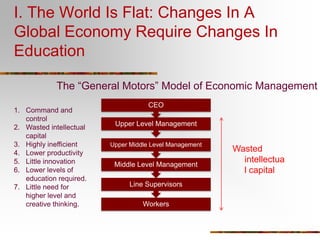
I. The World Is Flat: Changes In A Global Economy Require Changes In EducationThe “General Motors” Model of Economic Management Command and controlWasted intellectual capitalHighly inefficientLower productivityLittle innovationLower levels of education required.Little need for higher level and creative thinking.Wasted intellectual capital
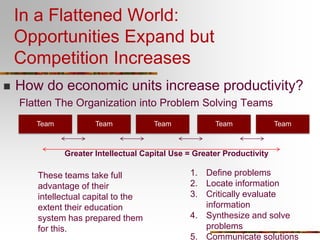
In a Flattened World:  Opportunities Expand butCompetition IncreasesHow do economic units increase productivity?Flatten The Organization into Problem Solving TeamsGreater Intellectual Capital Use = Greater ProductivityDefine problemsLocate informationCritically evaluate informationSynthesize and solve problemsCommunicate solutions	These teams take full advantage of their intellectual capital to the extent their education system has prepared them for this.
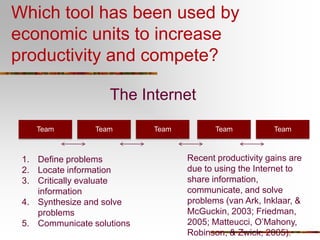
Which tool has been used by economic units to increase productivity and compete?The InternetRecent productivity gains are due to using the Internet to share information, communicate, and solve problems (van Ark, Inklaar, & McGuckin, 2003; Friedman, 2005; Matteucci, O’Mahony, Robinson, & Zwick, 2005).Define problemsLocate informationCritically evaluate informationSynthesize and solve problemsCommunicate solutions
Implications For Education?Problem based learning essentialEffective online information and communication skills required.Internet literacies have become central.In short: fundamental change.
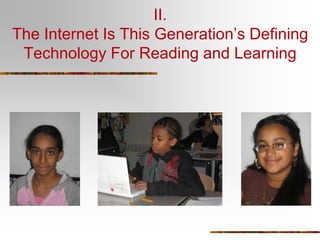
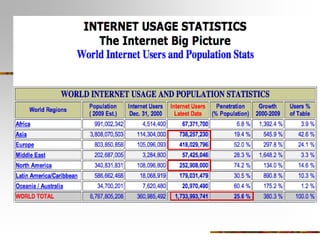
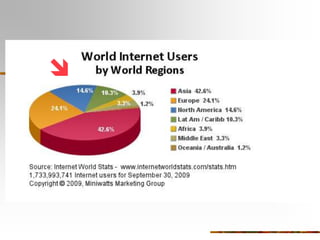
II. The Internet Is This Generation’s Defining Technology For Reading and Learning

The Workplace Has ChangedRecent productivity gains are due to using the Internet to share information, communicate, and solve problems (van Ark, Inklaar, & McGuckin, 2003; Friedman, 2005; Matteucci, O’Mahony, Robinson, & Zwick, 2005).This generation’s defining technology for reading.
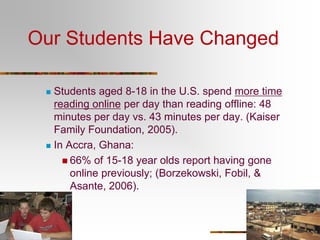
Our Students Have ChangedStudents aged 8-18 in the U.S. spend more time reading online per day than reading offline: 48 minutes per day vs. 43 minutes per day. (Kaiser Family Foundation, 2005).In Accra, Ghana: 66% of 15-18 year olds report having gone online previously; (Borzekowski, Fobil, & Asante, 2006).
The World Has Changed: Public Policies To Prepare Citizens for Work in an Information EconomyThe lesson from Ireland about investing in human capital.This generation’s defining technology for reading.
Finland provides all teachers with 5 weeks of paid, release time professional development at integrating the Internet into the classroom, using a national training model (Svedlin, Personal Correspondence).Japan has broadband in nearly every home that is 16 times faster than the broadband in US homes for $22 per month. (Bleha, 2005)This generation’s defining technology for reading.
Mexico is following e-Mexico, a policy designed to provide every citizen and every school with an Internet connection (Ludlow, 2006).This generation’s defining technology for reading.
OECD Assessment Initiatives2009 PISAInternational Assessment of Reading – Digital LiteraciesProgramme for the International Assessment of Adult Competencies (PIAAC) – Problem Solving in Technologically Rich EvironmentsThis generation’s defining technology for reading.
The U.S. situation.Not a single state in the U.S. measures......students’ ability to read search engine results during state reading assessments.  ...students’ ability to critically evaluate information that is found online to determine its reliability.This generation’s defining technology for reading.
Not a single state measures......students’ ability to compose clear and effective email messages in their state writing assessment.all students to use a word processor on their state writing assessment.* *See Russell & Plati, 1999; 2000; 2001. They report effect sizes of .57 – 1.25 for word processor use on MCAS.  See also Russell & Tao, 2004 who report 19% more 4th gradestudents classified as “Needs Improvement” would move up tothe “Proficient” performance level with word processors.
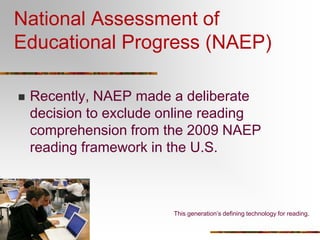
National Assessment of Educational Progress (NAEP)Recently, NAEP made a deliberate decision to exclude online reading comprehension from the 2009 NAEP reading framework in the U.S.This generation’s defining technology for reading.
What Can We Conclude?The Internet is this generation’s defining technology for reading.Some states and nations place their students at risk by continued inaction or poorly informed public policies.
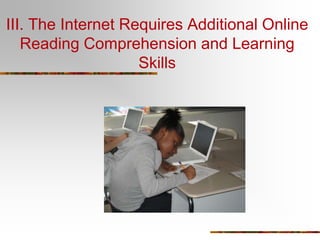
III. The Internet Requires Additional Online Reading Comprehension and Learning Skills
The new literacies of online reading comprehension“… the Internet…requires readers to have novel literacy skills, and little is known about how to analyze or teach those skills.” (RAND Reading Research Study Group, 2002. p. 4). The new literacies of online reading comprehension
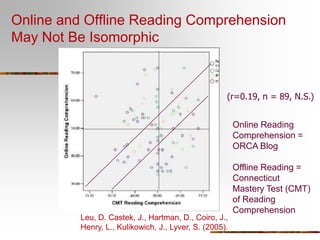
Online and Offline Reading Comprehension May Not Be Isomorphic(r=0.19, n = 89, N.S.)Online ReadingComprehension = ORCA BlogOffline Reading = Connecticut Mastery Test (CMT)of Reading ComprehensionLeu, D. Castek, J., Hartman, D., Coiro, J., Henry, L., Kulikowich, J., Lyver, S. (2005).
This, and other, work has led to the TICA Project, an IES-funded grant to study online reading comprehension instruction in 1-1 laptop classrooms.The new literacies of online reading comprehension
The TICA Project:Funded by the Institute of Education Sciences, U.S. Department of EducationGoals:Identify online reading comprehension skills and strategies through verbal protocol analysis of think alouds.Develop pilot model of Internet Reciprocal TeachingConduct an initial experiment, randomization at the school and teacher level, of IRT at the 7th grade level in urban and rural poor districts (CT and SC).
Preliminary Taxonomy Of Online Reading Comprehension Skills and StrategiesSee Leu, D. J.,  Coiro, J.,  Castek, J., Hartman, D., Henry, L.A., & Reinking, D. (2008).Research on instruction and assessment in the new literacies of online reading comprehension. In Cathy Collins Block, Sherri Parris, & Peter Afflerbach (Eds.). Comprehension instruction: Research-based best practices.  New York: Guilford Press. Available online at: http://www.newliteracies.uconn.edu/pub_files/instruction.pdfThe new literacies of online reading comprehension
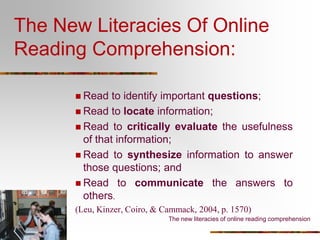
The New Literacies Of Online Reading Comprehension: Read to identify important questions; Read to locate information; Read to critically evaluate the usefulness of that information;Read to synthesize information to answer those questions; andRead to communicate the answers to others. (Leu, Kinzer, Coiro, & Cammack, 2004, p. 1570)The new literacies of online reading comprehension
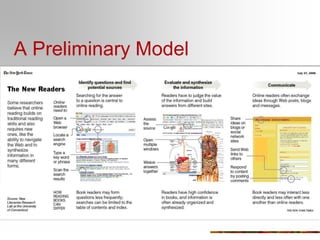
A Preliminary Model
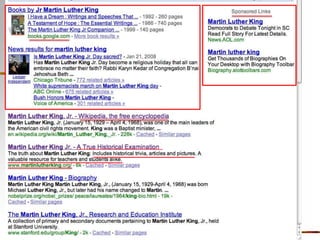
An Example of Online Reading ComprehensionReading About Martin Luther KingThe new literacies of online reading comprehension
Other examplesLocating informationCritical evaluation of informationWhy are these especially important during online reading comprehension?
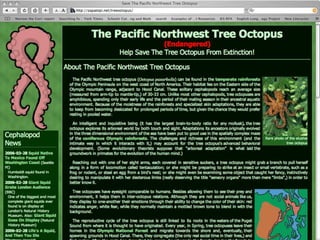
Locating information, Part I: “the .com strategy”[13:38 … highlights address bar, types in www.savethepacificnorthwesttreeoctopus.com  …, presses enter and waits]…[15:22 …types in www.savethenorthwesttreeoctopus.com (deletes pacific), presses enter and waits][16:01 … http://www.savethenorthwestoctopus.com (deletes tree) and waits]S: I wonder why it’s not coming up.  [long pause] [indecipherable] [long pause][17:10 …  types in savethepacificnorthwestoctopus (adds pacific) …The new literacies of online reading comprehension
Locating Information, Part II:the “click and look” strategyIn our entire population, of those who obtained a page of search engine results, approximately 50% did not read them.“Click and Look” strategies usedThe new literacies of online reading comprehension
Critical evaluation100% percent (42 out of 42), thought the site. Save the Pacific Northwest Tree Octopus, was reliable; 56% reported it to be “very reliable.” Data from five students were missing.
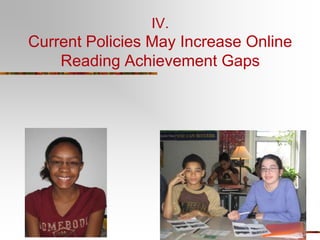
IV.Current Policies May Increase Online Reading Achievement Gaps
The Hidden, Compound Reading Achievement GapThose who require our support the most with online reading comprehension, those without home access, actually receive our support the least in schools.Current policies may increase achievement gaps
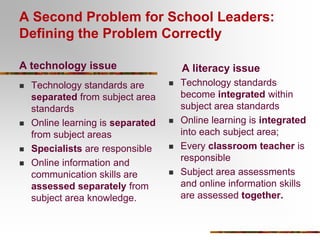
A Second Problem for School Leaders:Defining the Problem CorrectlyA technology issueA literacy issueTechnology standards become integrated within subject area standards Online learning is integrated into each subject area; Every classroom teacher is responsibleSubject area assessments and online information skills are assessed together.Technology standards are separated from subject area standards Online learning is separated from subject areasSpecialists are responsibleOnline information and communication skills are assessed separately from subject area knowledge.
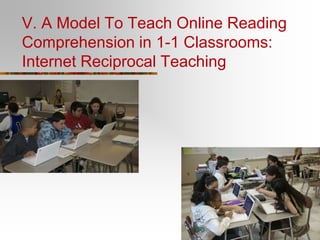
V. A Model To Teach Online Reading Comprehension in 1-1 Classrooms:  Internet Reciprocal Teaching
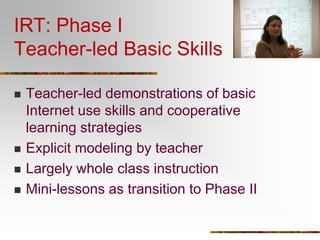
IRT: Phase ITeacher-led Basic SkillsTeacher-led demonstrations of basic Internet use skills and cooperative learning strategiesExplicit modeling by teacherLargely whole class instructionMini-lessons as transition to Phase II
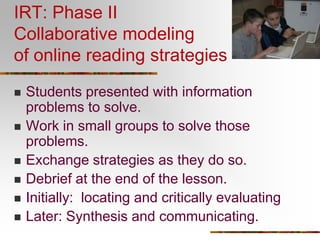
IRT: Phase IICollaborative modeling of online reading strategiesStudents presented with information problems to solve.Work in small groups to solve those problems.Exchange strategies as they do so.Debrief at the end of the lesson.Initially:  locating and critically evaluatingLater: Synthesis and communicating.
A Phase II Task
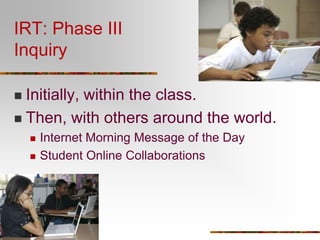
IRT: Phase IIIInquiryInitially, within the class.Then, with others around the world.Internet Morning Message of the DayStudent Online Collaborations
Inquiry Projects (local or global)Define the question.Locate informationEvaluate informationSynthesize to answer the questionCommunicate the learning experience.
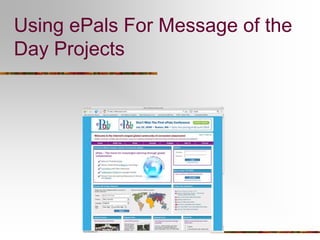
Using ePals For Message of the Day Projects
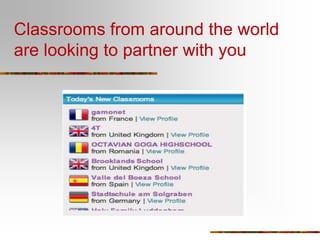
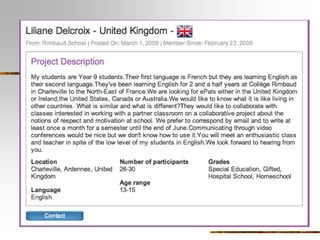
Classrooms from around the world are looking to partner with you

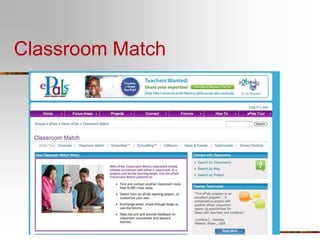
NYC Talk

  • 1.
    The Changing Natureof Literacy and LearningDonald J. LeuNew Literacies Research LabUniversity of Connecticutdonald.leu@uconn.edu
  • 2.
    The New LiteraciesResearch Team
  • 3.
    Important Funding andSupport From:Ray and Carole Neag
  • 4.
  • 5.
  • 6.
  • 7.
  • 8.
  • 9.
  • 10.
    William and FloraHewlett Foundation
  • 11.
    Bill and MelindaGates Foundation
  • 12.
    Australian Council ofEducational Research
  • 13.
  • 14.
    Schools and teachersaround the world.The Big IdeasThe World is Flat: Changes in a global economy require concomitant changes in educationThe Internet is this generation’s defining technology for learning and reading.Recent research: The Internet requires new literacies -- additional online reading comprehension skills.Recent research: Internet Reciprocal Teaching: Teaching online reading comprehension in subject areas. Current public policies may actually increase reading achievement gaps.
  • 15.
    I. The WorldIs Flat: Changes In A Global Economy Require Changes In EducationThe “General Motors” Model of Economic Management Command and controlWasted intellectual capitalHighly inefficientLower productivityLittle innovationLower levels of education required.Little need for higher level and creative thinking.Wasted intellectual capital
  • 16.
    In a FlattenedWorld: Opportunities Expand butCompetition IncreasesHow do economic units increase productivity?Flatten The Organization into Problem Solving TeamsGreater Intellectual Capital Use = Greater ProductivityDefine problemsLocate informationCritically evaluate informationSynthesize and solve problemsCommunicate solutions These teams take full advantage of their intellectual capital to the extent their education system has prepared them for this.
  • 17.
    Which tool hasbeen used by economic units to increase productivity and compete?The InternetRecent productivity gains are due to using the Internet to share information, communicate, and solve problems (van Ark, Inklaar, & McGuckin, 2003; Friedman, 2005; Matteucci, O’Mahony, Robinson, & Zwick, 2005).Define problemsLocate informationCritically evaluate informationSynthesize and solve problemsCommunicate solutions
  • 18.
    Implications For Education?Problembased learning essentialEffective online information and communication skills required.Internet literacies have become central.In short: fundamental change.
  • 19.
    II. The InternetIs This Generation’s Defining Technology For Reading and Learning
  • 21.
  • 22.
    The Workplace HasChangedRecent productivity gains are due to using the Internet to share information, communicate, and solve problems (van Ark, Inklaar, & McGuckin, 2003; Friedman, 2005; Matteucci, O’Mahony, Robinson, & Zwick, 2005).This generation’s defining technology for reading.
  • 23.
    Our Students HaveChangedStudents aged 8-18 in the U.S. spend more time reading online per day than reading offline: 48 minutes per day vs. 43 minutes per day. (Kaiser Family Foundation, 2005).In Accra, Ghana: 66% of 15-18 year olds report having gone online previously; (Borzekowski, Fobil, & Asante, 2006).
  • 24.
    The World HasChanged: Public Policies To Prepare Citizens for Work in an Information EconomyThe lesson from Ireland about investing in human capital.This generation’s defining technology for reading.
  • 25.
    Finland provides allteachers with 5 weeks of paid, release time professional development at integrating the Internet into the classroom, using a national training model (Svedlin, Personal Correspondence).Japan has broadband in nearly every home that is 16 times faster than the broadband in US homes for $22 per month. (Bleha, 2005)This generation’s defining technology for reading.
  • 26.
    Mexico is followinge-Mexico, a policy designed to provide every citizen and every school with an Internet connection (Ludlow, 2006).This generation’s defining technology for reading.
  • 27.
    OECD Assessment Initiatives2009PISAInternational Assessment of Reading – Digital LiteraciesProgramme for the International Assessment of Adult Competencies (PIAAC) – Problem Solving in Technologically Rich EvironmentsThis generation’s defining technology for reading.
  • 28.
    The U.S. situation.Nota single state in the U.S. measures......students’ ability to read search engine results during state reading assessments. ...students’ ability to critically evaluate information that is found online to determine its reliability.This generation’s defining technology for reading.
  • 29.
    Not a singlestate measures......students’ ability to compose clear and effective email messages in their state writing assessment.all students to use a word processor on their state writing assessment.* *See Russell & Plati, 1999; 2000; 2001. They report effect sizes of .57 – 1.25 for word processor use on MCAS. See also Russell & Tao, 2004 who report 19% more 4th gradestudents classified as “Needs Improvement” would move up tothe “Proficient” performance level with word processors.
  • 30.
    National Assessment ofEducational Progress (NAEP)Recently, NAEP made a deliberate decision to exclude online reading comprehension from the 2009 NAEP reading framework in the U.S.This generation’s defining technology for reading.
  • 31.
    What Can WeConclude?The Internet is this generation’s defining technology for reading.Some states and nations place their students at risk by continued inaction or poorly informed public policies.
  • 32.
    III. The InternetRequires Additional Online Reading Comprehension and Learning Skills
  • 33.
    The new literaciesof online reading comprehension“… the Internet…requires readers to have novel literacy skills, and little is known about how to analyze or teach those skills.” (RAND Reading Research Study Group, 2002. p. 4). The new literacies of online reading comprehension
  • 34.
    Online and OfflineReading Comprehension May Not Be Isomorphic(r=0.19, n = 89, N.S.)Online ReadingComprehension = ORCA BlogOffline Reading = Connecticut Mastery Test (CMT)of Reading ComprehensionLeu, D. Castek, J., Hartman, D., Coiro, J., Henry, L., Kulikowich, J., Lyver, S. (2005).
  • 35.
    This, and other,work has led to the TICA Project, an IES-funded grant to study online reading comprehension instruction in 1-1 laptop classrooms.The new literacies of online reading comprehension
  • 36.
    The TICA Project:Fundedby the Institute of Education Sciences, U.S. Department of EducationGoals:Identify online reading comprehension skills and strategies through verbal protocol analysis of think alouds.Develop pilot model of Internet Reciprocal TeachingConduct an initial experiment, randomization at the school and teacher level, of IRT at the 7th grade level in urban and rural poor districts (CT and SC).
  • 37.
    Preliminary Taxonomy OfOnline Reading Comprehension Skills and StrategiesSee Leu, D. J., Coiro, J., Castek, J., Hartman, D., Henry, L.A., & Reinking, D. (2008).Research on instruction and assessment in the new literacies of online reading comprehension. In Cathy Collins Block, Sherri Parris, & Peter Afflerbach (Eds.). Comprehension instruction: Research-based best practices. New York: Guilford Press. Available online at: http://www.newliteracies.uconn.edu/pub_files/instruction.pdfThe new literacies of online reading comprehension
  • 38.
    The New LiteraciesOf Online Reading Comprehension: Read to identify important questions; Read to locate information; Read to critically evaluate the usefulness of that information;Read to synthesize information to answer those questions; andRead to communicate the answers to others. (Leu, Kinzer, Coiro, & Cammack, 2004, p. 1570)The new literacies of online reading comprehension
  • 39.
  • 40.
    An Example ofOnline Reading ComprehensionReading About Martin Luther KingThe new literacies of online reading comprehension
  • 44.
    Other examplesLocating informationCriticalevaluation of informationWhy are these especially important during online reading comprehension?
  • 47.
    Locating information, PartI: “the .com strategy”[13:38 … highlights address bar, types in www.savethepacificnorthwesttreeoctopus.com …, presses enter and waits]…[15:22 …types in www.savethenorthwesttreeoctopus.com (deletes pacific), presses enter and waits][16:01 … http://www.savethenorthwestoctopus.com (deletes tree) and waits]S: I wonder why it’s not coming up. [long pause] [indecipherable] [long pause][17:10 … types in savethepacificnorthwestoctopus (adds pacific) …The new literacies of online reading comprehension
  • 48.
    Locating Information, PartII:the “click and look” strategyIn our entire population, of those who obtained a page of search engine results, approximately 50% did not read them.“Click and Look” strategies usedThe new literacies of online reading comprehension
  • 49.
    Critical evaluation100% percent(42 out of 42), thought the site. Save the Pacific Northwest Tree Octopus, was reliable; 56% reported it to be “very reliable.” Data from five students were missing.
  • 50.
    IV.Current Policies MayIncrease Online Reading Achievement Gaps
  • 51.
    The Hidden, CompoundReading Achievement GapThose who require our support the most with online reading comprehension, those without home access, actually receive our support the least in schools.Current policies may increase achievement gaps
  • 52.
    A Second Problemfor School Leaders:Defining the Problem CorrectlyA technology issueA literacy issueTechnology standards become integrated within subject area standards Online learning is integrated into each subject area; Every classroom teacher is responsibleSubject area assessments and online information skills are assessed together.Technology standards are separated from subject area standards Online learning is separated from subject areasSpecialists are responsibleOnline information and communication skills are assessed separately from subject area knowledge.
  • 53.
    V. A ModelTo Teach Online Reading Comprehension in 1-1 Classrooms: Internet Reciprocal Teaching
  • 54.
    IRT: Phase ITeacher-ledBasic SkillsTeacher-led demonstrations of basic Internet use skills and cooperative learning strategiesExplicit modeling by teacherLargely whole class instructionMini-lessons as transition to Phase II
  • 55.
    IRT: Phase IICollaborativemodeling of online reading strategiesStudents presented with information problems to solve.Work in small groups to solve those problems.Exchange strategies as they do so.Debrief at the end of the lesson.Initially: locating and critically evaluatingLater: Synthesis and communicating.
  • 56.
  • 57.
    IRT: Phase IIIInquiryInitially,within the class.Then, with others around the world.Internet Morning Message of the DayStudent Online Collaborations
  • 58.
    Inquiry Projects (localor global)Define the question.Locate informationEvaluate informationSynthesize to answer the questionCommunicate the learning experience.
  • 59.
    Using ePals ForMessage of the Day Projects
  • 60.
    Classrooms from aroundthe world are looking to partner with you
  • 62.
  • 63.
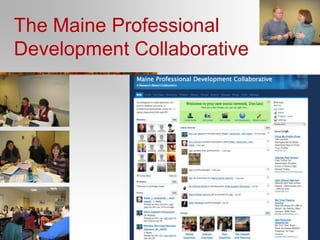
    The Maine ProfessionalDevelopment Collaborative
  • 64.
    The Summer Institutein New Literacies
  • 65.
    The New LiteraciesResearch Team: Three Areas Of Our WorkIRT (Internet Reciprocal Teaching): A research-based instructional modelORCA (Online Reading Comprehension Assessment): Practical, valid, and reliable assessments for schools to use.MPDM (Maine Professional Development Model) NLTI: Professional development models for IRT based on teachers as professionals
  • 66.
  • 67.
    The Changes AheadResearchInstructionCurriculumProfessional DevelopmentRevisions to National StandardsReading AssessmentsSchool Leadership and VisionNational Funding for 1-1 computingThe Reading/Literacy Communities
  • 68.
    I Welcome Conversation:TheWorld is Flat: Changes in a global economy require concomitant changes in educationThe Internet is this generation’s defining technology for learning and reading.Recent research: The Internet requires new literacies -- additional online reading comprehension skills.Recent research: Internet Reciprocal Teaching: Teaching online reading comprehension in subject areas. Current public policies may actually increase reading achievement gaps.
  • 69.
    The Changing Natureof Literacy and LearningDonald J. LeuNew Literacies Research LabUniversity of Connecticutdonald.leu@uconn.edu