Central Issues In The New Literacies Of Online
Reading Comprehension: Shifting
Conceptions Of Reading Comprehension,
Instructional Practices, And Assessments
Donald J. Leu
New Literacies Research Lab
University of Connecticut
What Prompts Changing
Conceptions of:
Reading comprehension?
Instructional Practices?
Assessment?

A Central Issue:
How Do We Frame The Problem?
Needed: Broadly Conceived New
Theories and Constructs, Collaboratively
Constructed, Sensitive to Continuous
Change.
Digital Literacies?
21st Century Literacies?
Web 2.0 Literacies?
New Literacies?
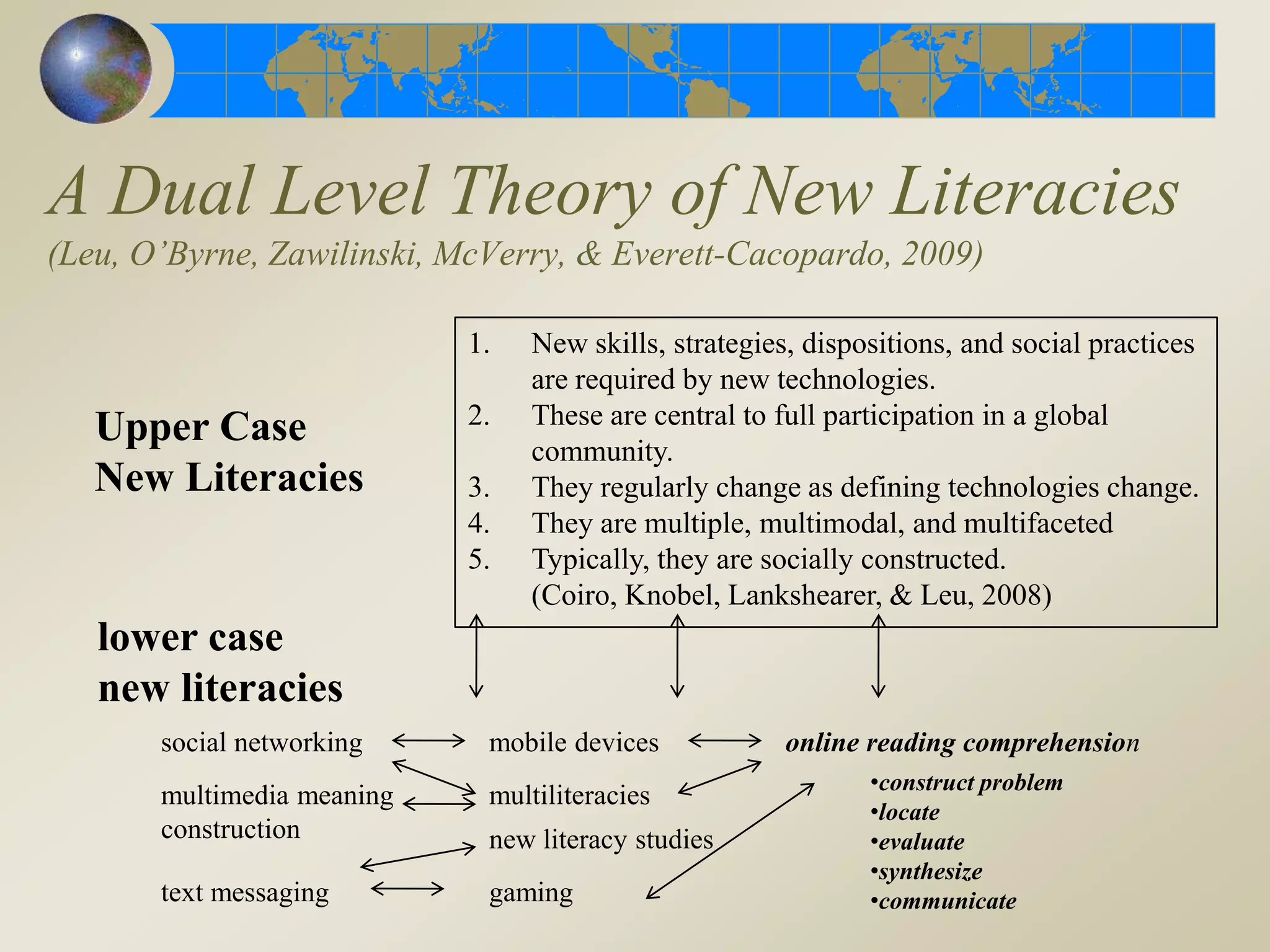
A Dual Level Theory of New Literacies
(Leu, O’Byrne, Zawilinski, McVerry, & Everett-Cacopardo, 2009)
Upper Case
New Literacies
1. New skills, strategies, dispositions, and social practices
are required by new technologies.
2. These are central to full participation in a global
community.
3. They regularly change as defining technologies change.
4. They are multiple, multimodal, and multifaceted
5. Typically, they are socially constructed.
(Coiro, Knobel, Lankshearer, & Leu, 2008)
social networking
multimedia meaning
construction
lower case
new literacies
multiliteracies
text messaging gaming
online reading comprehensionmobile devices
•construct problem
•locate
•evaluate
•synthesize
•communicate
new literacy studies
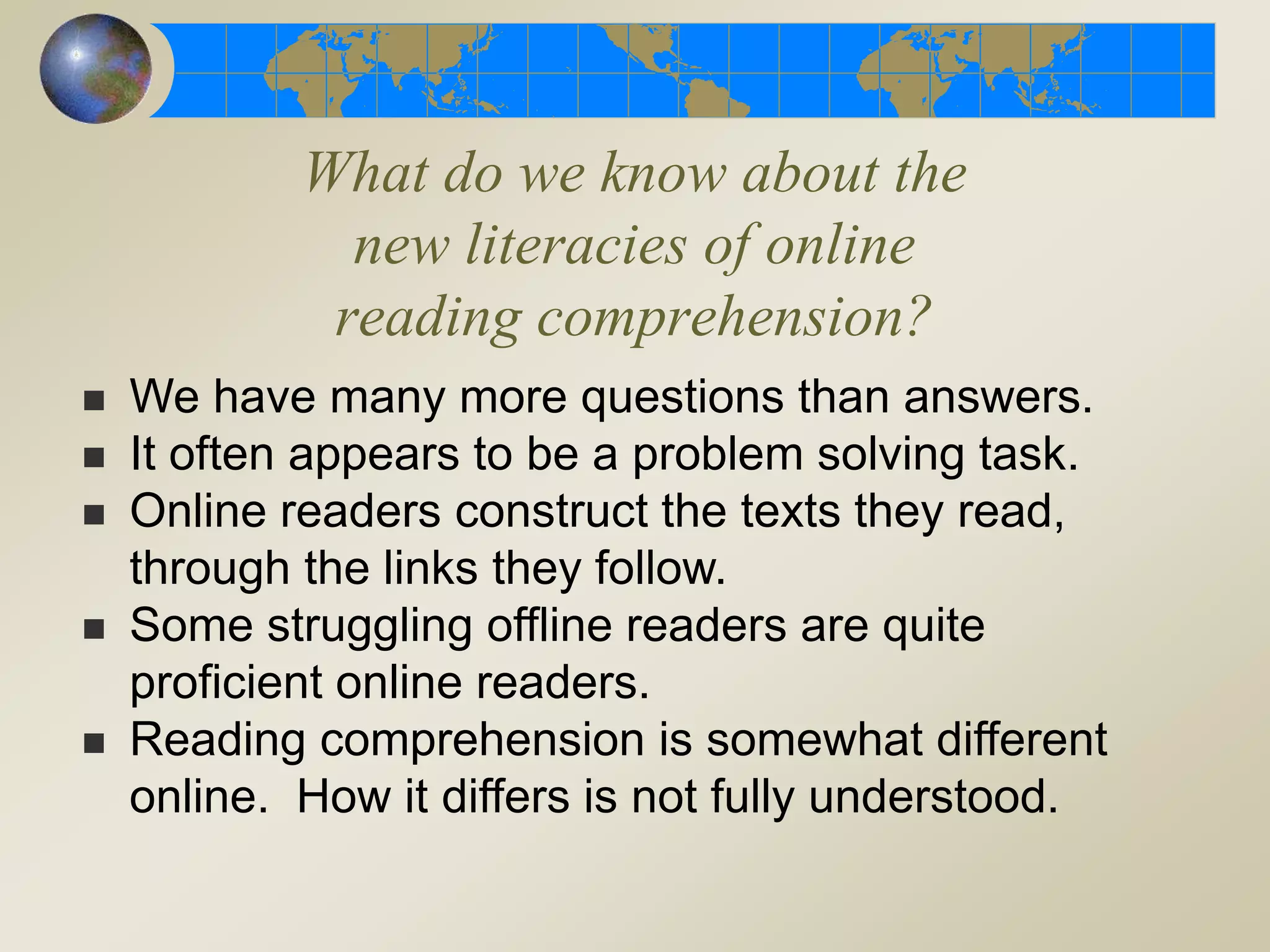
What do we know about the
new literacies of online
reading comprehension?
 We have many more questions than answers.
 It often appears to be a problem solving task.
 Online readers construct the texts they read,
through the links they follow.
 Some struggling offline readers are quite
proficient online readers.
 Reading comprehension is somewhat different
online. How it differs is not fully understood.
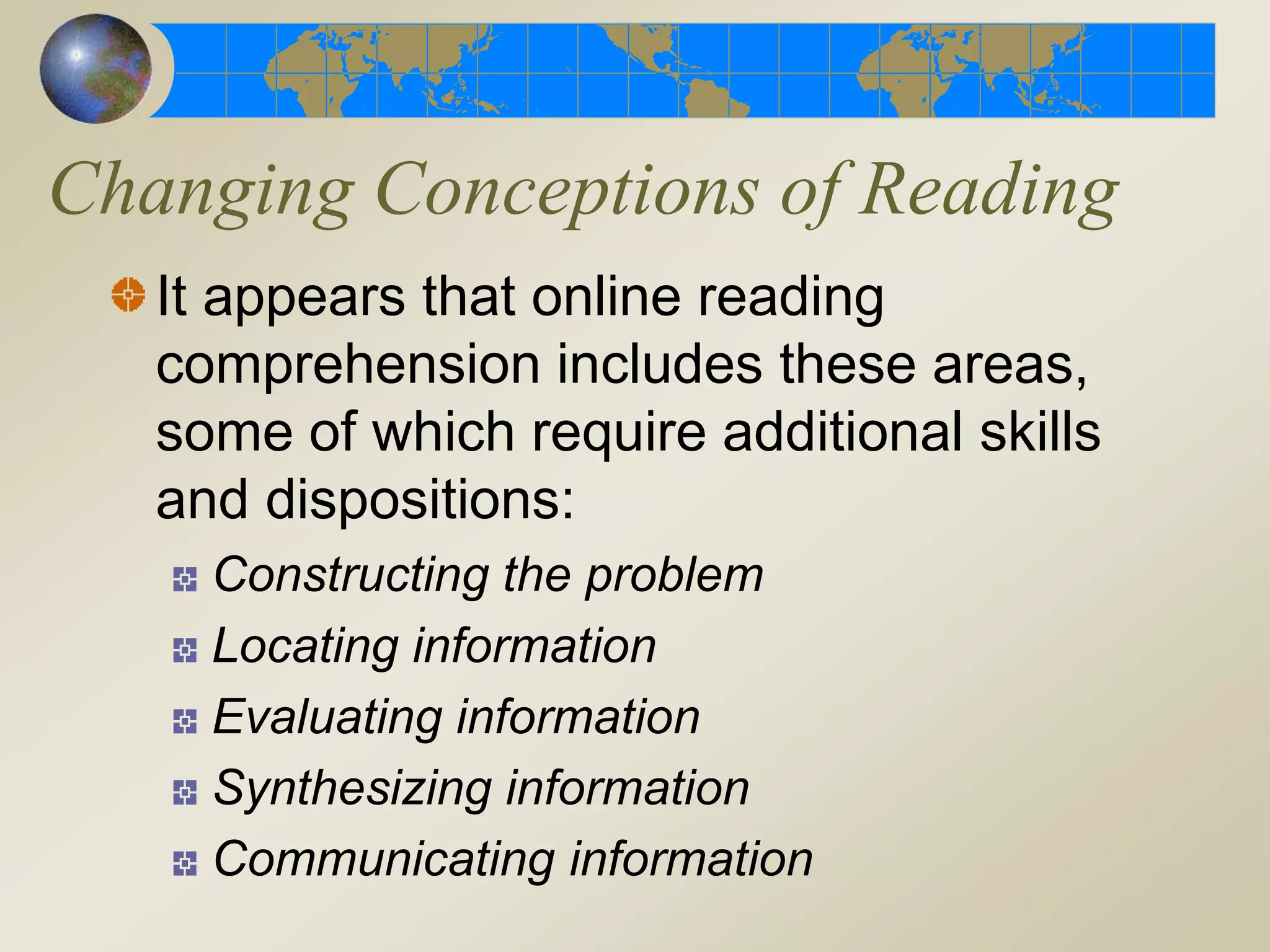
Changing Conceptions of Reading
It appears that online reading
comprehension includes these areas,
some of which require additional skills
and dispositions:
Constructing the problem
Locating information
Evaluating information
Synthesizing information
Communicating information
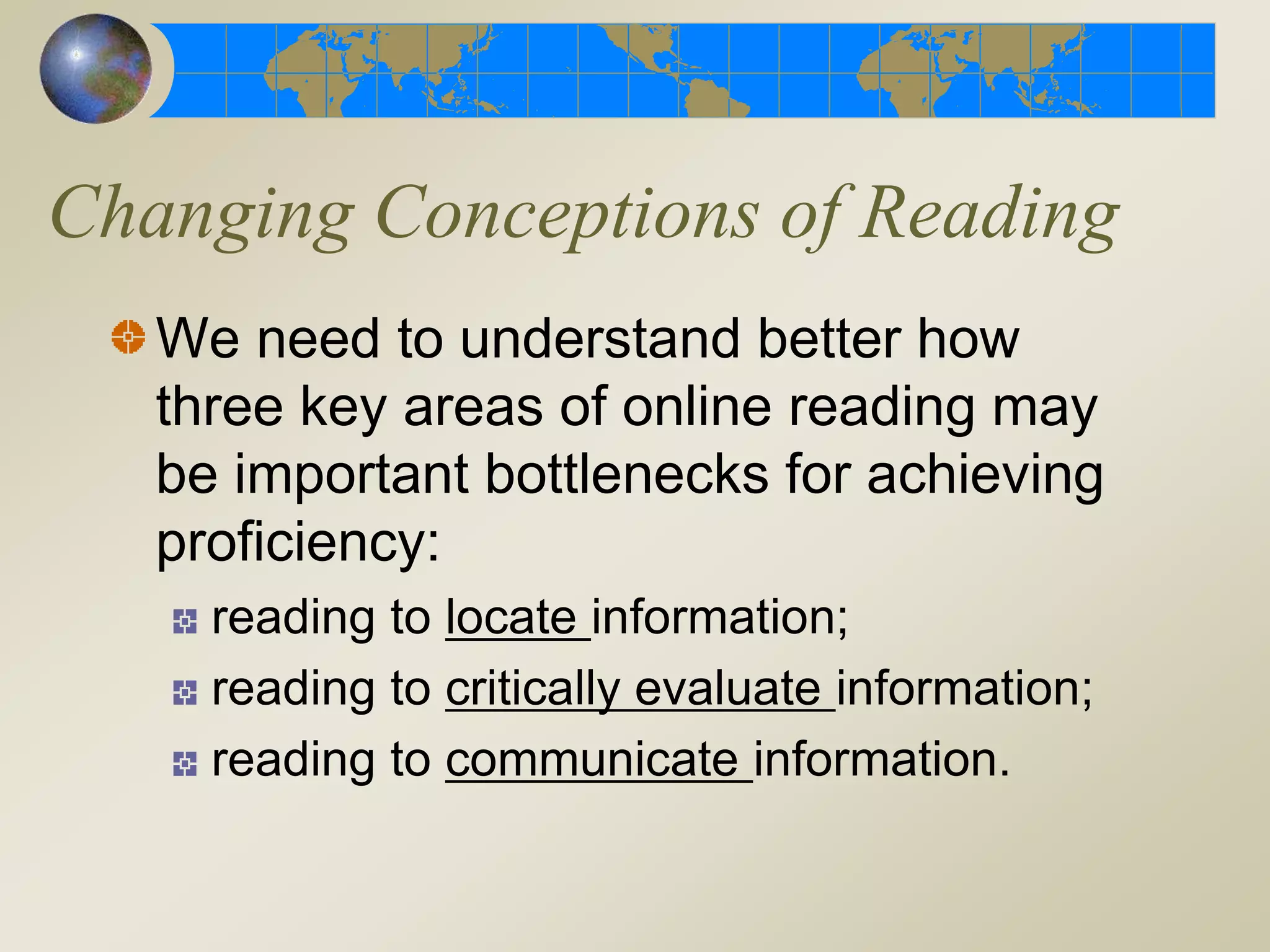
We need to understand better how
three key areas of online reading may
be important bottlenecks for achieving
proficiency:
reading to locate information;
reading to critically evaluate information;
reading to communicate information.
Changing Conceptions of Reading
Changing Conceptions of
Reading
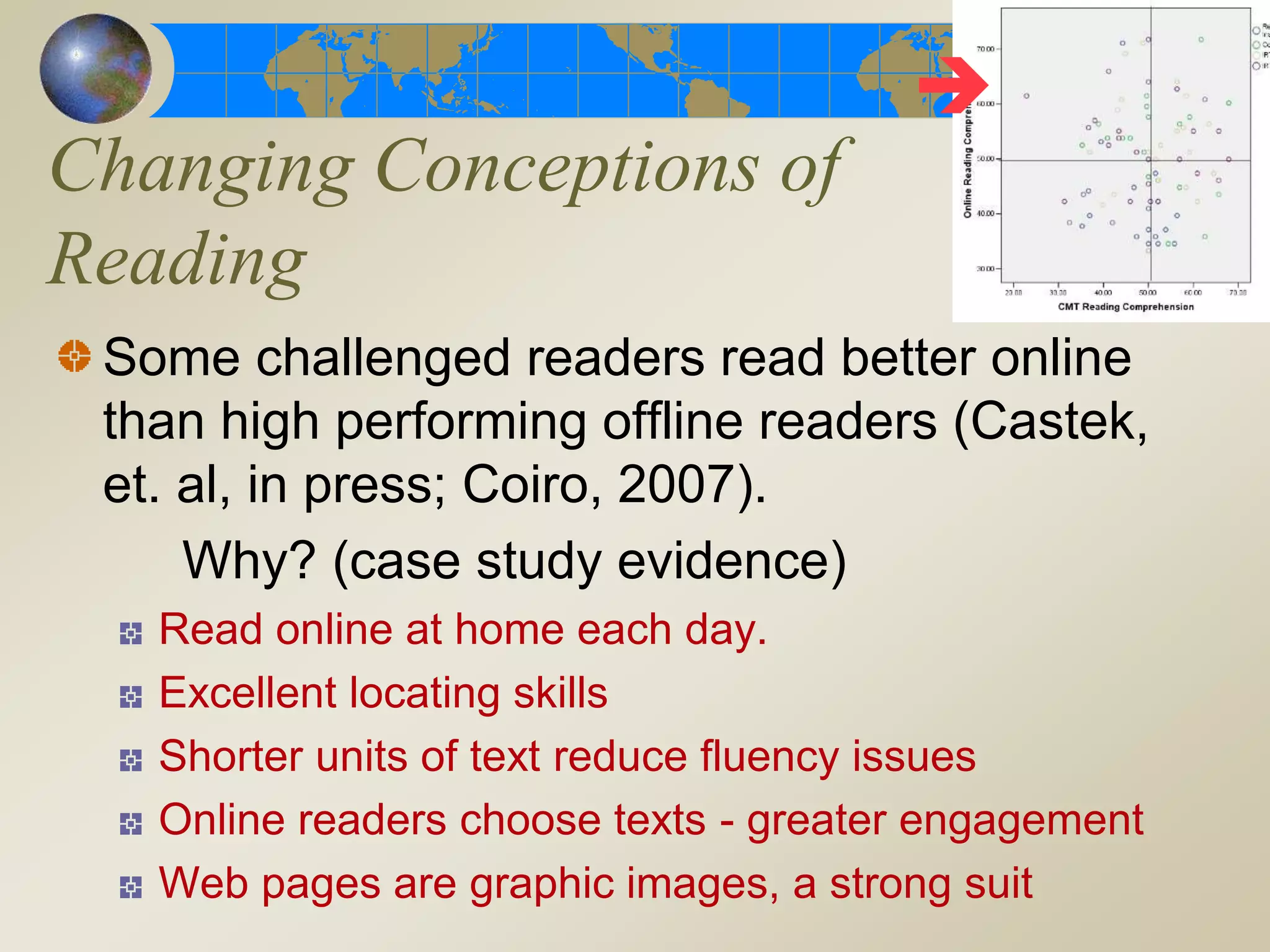
Some challenged readers read better online
than high performing offline readers (Castek,
et. al, in press; Coiro, 2007).
Why? (case study evidence)
Read online at home each day.
Excellent locating skills
Shorter units of text reduce fluency issues
Online readers choose texts - greater engagement
Web pages are graphic images, a strong suit

Changing Conceptions of Practice
We will move quickly to 1:1 computing
contexts in classrooms
1-1 computing contexts fundamentally
change instructional opportunities and
constraints.
Collaborative, problem based learning
models: Internet Reciprocal Teaching
Students as teachers
Teachers monitor and distribute skills with
new tools like Apple Remote Desktop.
Changing Conceptions of Practice
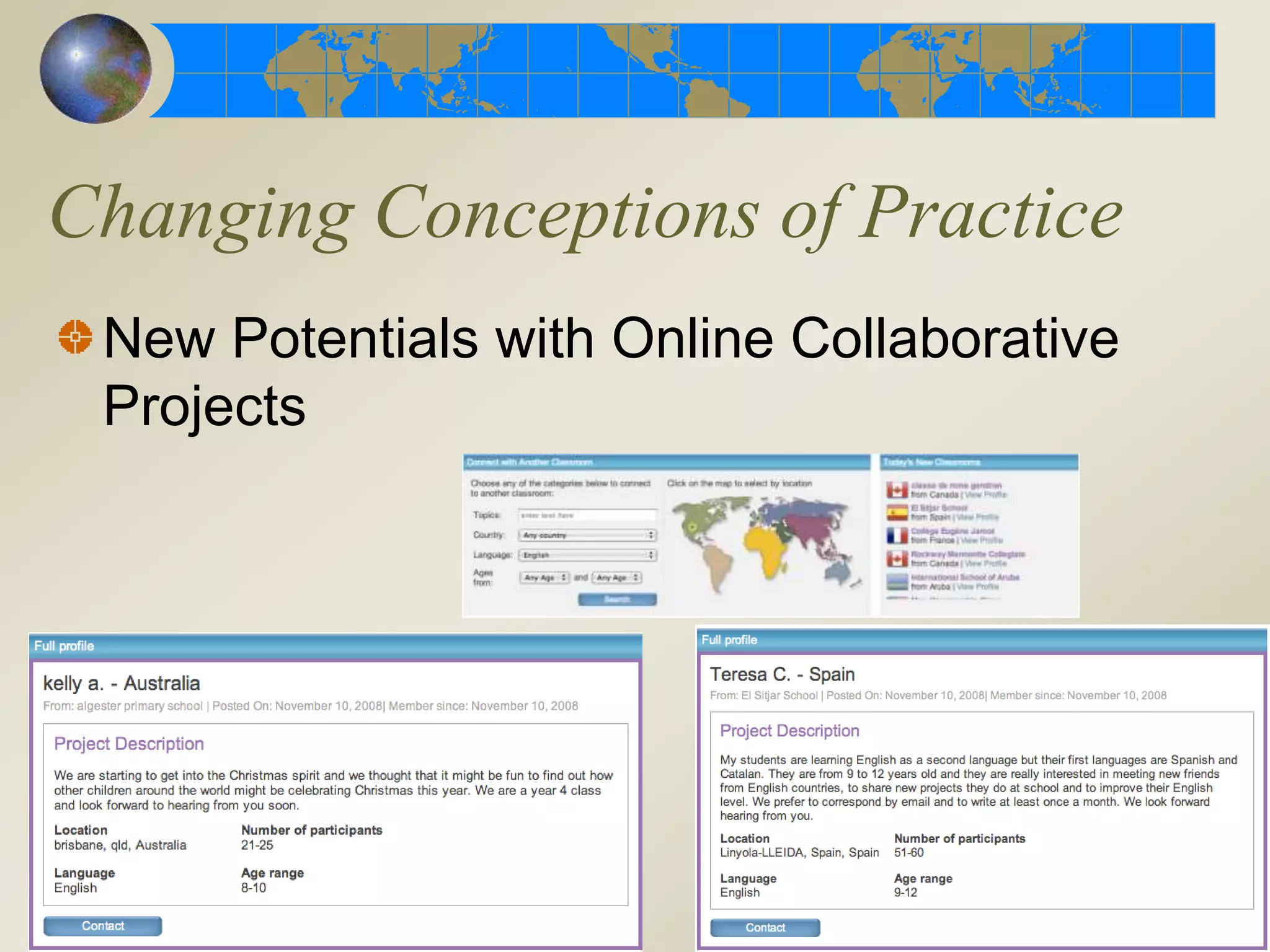
New Potentials with Online Collaborative
Projects
Changing Conceptions of Practice:
Professional Development
These new contexts will require
extraordinary amounts of professional
development, delivered in new ways,
with new technologies.
Whether we have the leadership, the
resources, the models, is open to doubt.
Changing Conceptions of
Assessment
. Not a single state assessment
measures the ability to…
critically read online information to evaluate
source reliability.
… read search engine results to select the
best link for an information problem.
Nor, indeed, any aspect of reading online to
solve information problems.
Changing Conceptions of
Assessment
NAEP decided to exclude online
reading comprehension from the 2009
NAEP reading framework.
Little evidence of any online reading
comprehension skills in the preliminary
National Core Standards.
Changing Conceptions of Assessment
Needed: Assessments that include the
assessment of online reading
comprehension skills that are reliable,
valid, easy to score, and easy to
interpret. (Examples: ORCAs, PISA
Digital Literacies, PIACC).
Our Future?
Central Issues In The New Literacies Of Online
Reading Comprehension: Shifting
Conceptions Of Reading, Instructional
Practices, And Assessments
Donald J. Leu
New Literacies Research Lab
University of Connecticut

NRC 2009

  • 1.
    Central Issues InThe New Literacies Of Online Reading Comprehension: Shifting Conceptions Of Reading Comprehension, Instructional Practices, And Assessments Donald J. Leu New Literacies Research Lab University of Connecticut
  • 2.
    What Prompts Changing Conceptionsof: Reading comprehension? Instructional Practices? Assessment?
  • 3.
  • 4.
    A Central Issue: HowDo We Frame The Problem? Needed: Broadly Conceived New Theories and Constructs, Collaboratively Constructed, Sensitive to Continuous Change. Digital Literacies? 21st Century Literacies? Web 2.0 Literacies? New Literacies?
  • 5.
    A Dual LevelTheory of New Literacies (Leu, O’Byrne, Zawilinski, McVerry, & Everett-Cacopardo, 2009) Upper Case New Literacies 1. New skills, strategies, dispositions, and social practices are required by new technologies. 2. These are central to full participation in a global community. 3. They regularly change as defining technologies change. 4. They are multiple, multimodal, and multifaceted 5. Typically, they are socially constructed. (Coiro, Knobel, Lankshearer, & Leu, 2008) social networking multimedia meaning construction lower case new literacies multiliteracies text messaging gaming online reading comprehensionmobile devices •construct problem •locate •evaluate •synthesize •communicate new literacy studies
  • 6.
    What do weknow about the new literacies of online reading comprehension?  We have many more questions than answers.  It often appears to be a problem solving task.  Online readers construct the texts they read, through the links they follow.  Some struggling offline readers are quite proficient online readers.  Reading comprehension is somewhat different online. How it differs is not fully understood.
  • 7.
    Changing Conceptions ofReading It appears that online reading comprehension includes these areas, some of which require additional skills and dispositions: Constructing the problem Locating information Evaluating information Synthesizing information Communicating information
  • 8.
    We need tounderstand better how three key areas of online reading may be important bottlenecks for achieving proficiency: reading to locate information; reading to critically evaluate information; reading to communicate information. Changing Conceptions of Reading
  • 9.
    Changing Conceptions of Reading Somechallenged readers read better online than high performing offline readers (Castek, et. al, in press; Coiro, 2007). Why? (case study evidence) Read online at home each day. Excellent locating skills Shorter units of text reduce fluency issues Online readers choose texts - greater engagement Web pages are graphic images, a strong suit 
  • 10.
    Changing Conceptions ofPractice We will move quickly to 1:1 computing contexts in classrooms 1-1 computing contexts fundamentally change instructional opportunities and constraints. Collaborative, problem based learning models: Internet Reciprocal Teaching Students as teachers Teachers monitor and distribute skills with new tools like Apple Remote Desktop.
  • 11.
    Changing Conceptions ofPractice New Potentials with Online Collaborative Projects
  • 12.
    Changing Conceptions ofPractice: Professional Development These new contexts will require extraordinary amounts of professional development, delivered in new ways, with new technologies. Whether we have the leadership, the resources, the models, is open to doubt.
  • 13.
    Changing Conceptions of Assessment .Not a single state assessment measures the ability to… critically read online information to evaluate source reliability. … read search engine results to select the best link for an information problem. Nor, indeed, any aspect of reading online to solve information problems.
  • 14.
    Changing Conceptions of Assessment NAEPdecided to exclude online reading comprehension from the 2009 NAEP reading framework. Little evidence of any online reading comprehension skills in the preliminary National Core Standards.
  • 15.
    Changing Conceptions ofAssessment Needed: Assessments that include the assessment of online reading comprehension skills that are reliable, valid, easy to score, and easy to interpret. (Examples: ORCAs, PISA Digital Literacies, PIACC).
  • 16.
  • 17.
    Central Issues InThe New Literacies Of Online Reading Comprehension: Shifting Conceptions Of Reading, Instructional Practices, And Assessments Donald J. Leu New Literacies Research Lab University of Connecticut