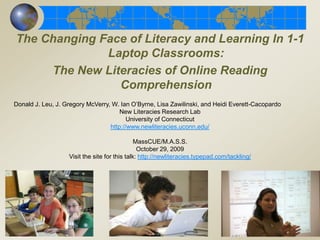
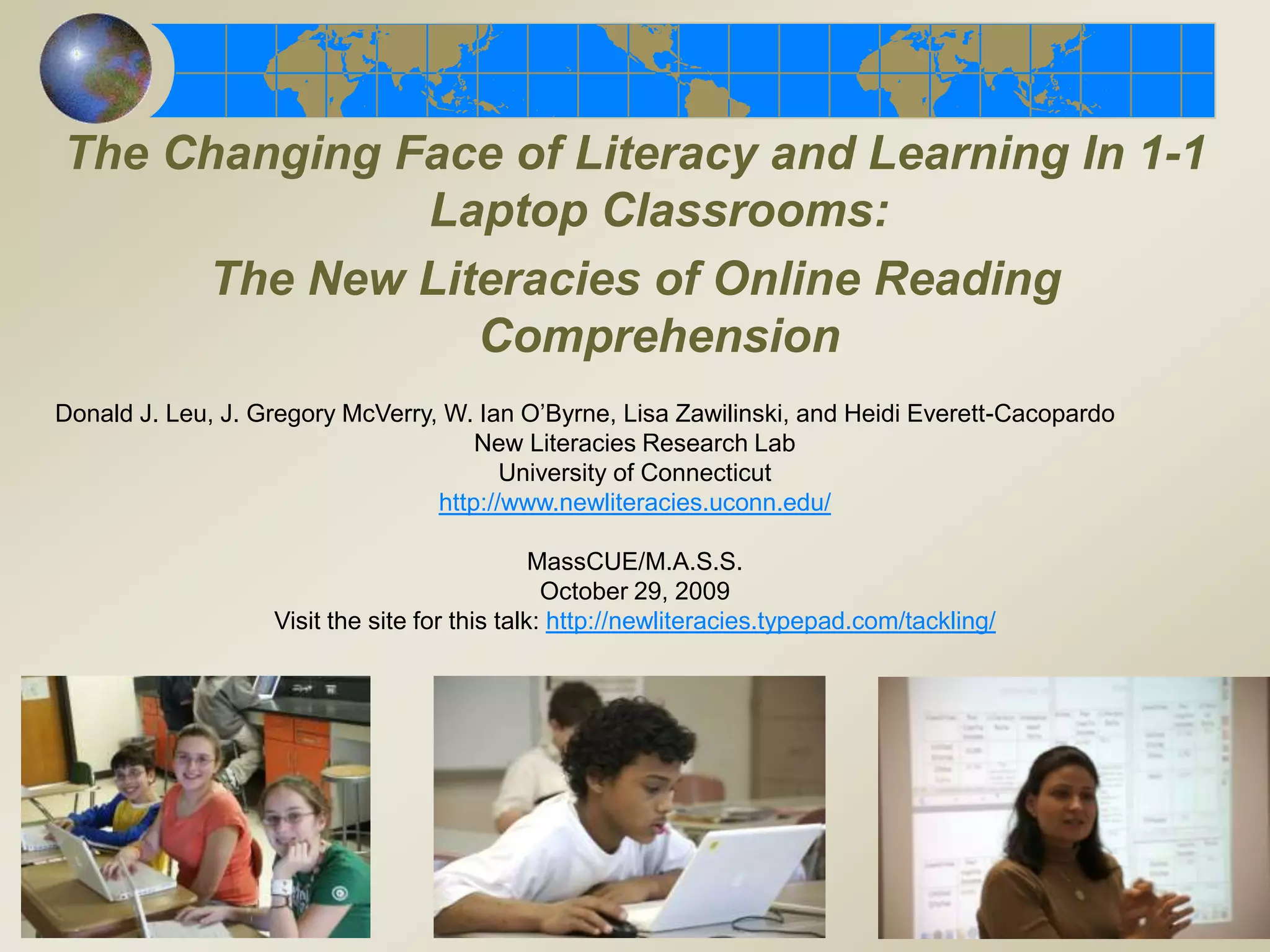
The Changing Face of Literacy and Learning In 1-1 Laptop Classrooms:  The New Literacies of Online Reading Comprehension Donald J. Leu, J. Gregory McVerry, W. Ian O’Byrne, Lisa Zawilinski, and Heidi Everett-CacopardoNew Literacies Research LabUniversity of Connecticuthttp://www.newliteracies.uconn.edu/MassCUE/M.A.S.S.October 29, 2009Visit the site for this talk: http://newliteracies.typepad.com/tackling/keynote.html
Teamwork!
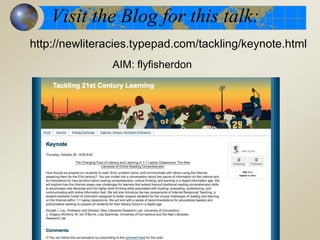
Visit the Blog for this talk:http://newliteracies.typepad.com/tackling/keynote.htmlAIM: flyfisherdon
Important Funding and Support From:Ray and Carole Neag
The Carnegie Corporation of New York
IES, U.S. Department of Education
The National Science Foundation
North Central Educational Research Lab
PBS
The Annenberg Foundation
William and Flora Hewlett Foundation
Bill and Melinda Gates Foundation
Australian Council of Educational Research
OECD
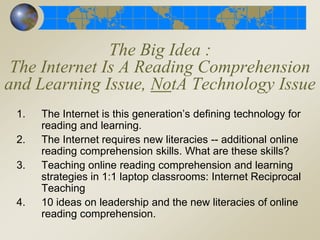
Schools and teachers around the world.The Big Idea :The Internet Is A Reading Comprehension and Learning Issue, NotA Technology IssueThe Internet is this generation’s defining technology for reading and learning.The Internet requires new literacies -- additional online reading comprehension skills. What are these skills? Teaching online reading comprehension and learning strategies in 1:1 laptop classrooms: Internet Reciprocal Teaching10 ideas on leadership and the new literacies of online reading comprehension.
I. The Internet Is This Generation’s Defining Technology For Reading and Learning
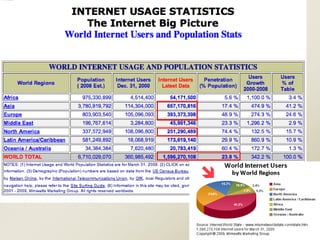
A New Literacies QuizHow many individuals currently have access to the Internet and regularly read, write, and communicate online?511 million253 million754 million1.6 billion1.6 billion individuals;1 out of 4 people in the world!(Internet World Stats)

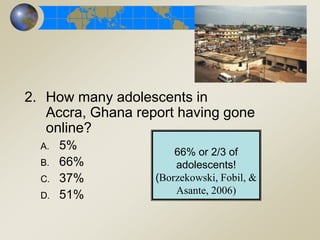
How many adolescents in Accra, Ghana report having gone online?5%66%37%51%66% or 2/3 of adolescents!(Borzekowski, Fobil, & Asante, 2006)
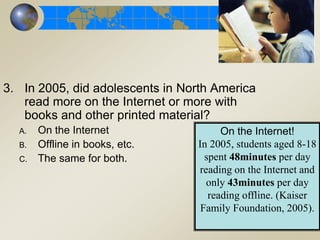
In 2005, did adolescents in North America read more on the Internet or more with books and other printed material?On the Internet Offline in books, etc.The same for both.On the Internet!In 2005, students aged 8-18 spent 48minutes per day reading on the Internet and only 43minutes per day reading offline. (Kaiser Family Foundation, 2005).
Which nation manufactures the most software in the world?The U.S.IndonesiaIndiaIrelandIreland! (Organization for Economic Development and Cooperation, 2004)
5.	Which nation, in North America, is implementing a plan to ensure Internet access to every home and every school to prepare its citizens for the 21st century?CanadaMexicoThe U.S.Mexico!Mexico is implementing its eMexico plan right now. See http://www.e-mexico.gob.mx/
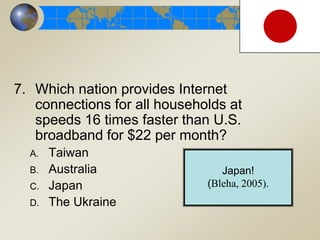
6.	Which nation provides Internet connections for all households at speeds 16 times faster than U.S. broadband for $22 per month?TaiwanAustraliaJapanThe UkraineJapan!(Bleha, 2005).
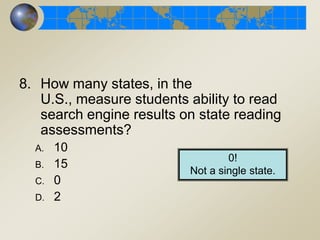
7.	How many states, in the U.S., measure students ability to read search engine results on state reading assessments?1015020!Not a single state.
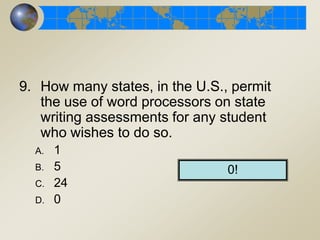
8.	How many states, in the U.S., permit the use of word processors on state writing assessments for any student who wishes to do so.152400!
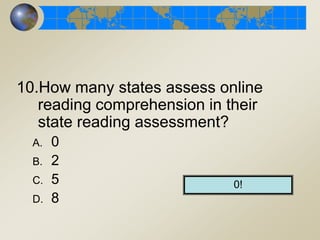
9.	How many states assess online reading comprehension in their state reading assessment?02580!
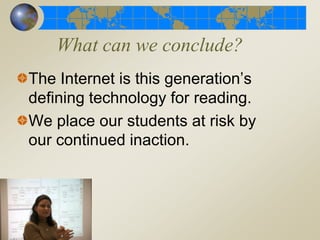
What can we conclude?The Internet is this generation’s defining technology for reading.We place our students at risk by our continued inaction.
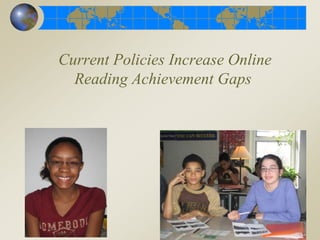
Current Policies Increase Online Reading Achievement Gaps
The Hidden, Compound Reading Achievement GapThose who require our support the most with online reading comprehension, those without home access, actually receive our support the least in schools.Current policies may increase achievement gaps
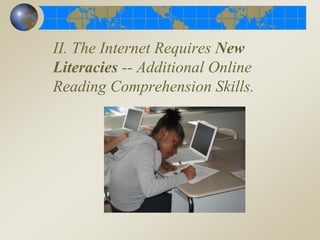
II. The Internet Requires New Literacies -- Additional Online Reading Comprehension Skills.
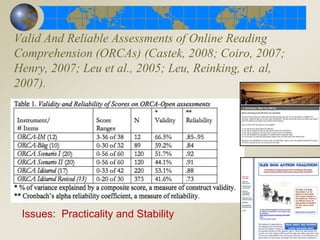
Valid And Reliable Assessments of Online Reading Comprehension (ORCAs) (Castek, 2008; Coiro, 2007; Henry, 2007; Leu et al., 2005; Leu, Reinking, et. al, 2007).Issues:  Practicality and Stability
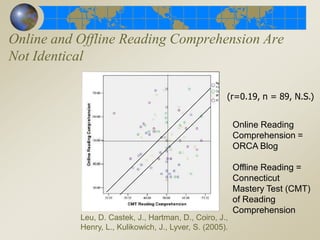
Online and Offline Reading Comprehension Are Not Identical(r=0.19, n = 89, N.S.)Online ReadingComprehension = ORCA BlogOffline Reading = Connecticut Mastery Test (CMT)of Reading ComprehensionLeu, D. Castek, J., Hartman, D., Coiro, J., Henry, L., Kulikowich, J., Lyver, S. (2005).
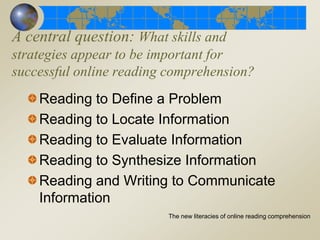
A Central Question: What skills and strategies appear to be important for successful online reading comprehension? Reading to Define a ProblemReading to Locate InformationReading to Evaluate InformationReading to Synthesize InformationReading and Writing to Communicate InformationThe new literacies of online reading comprehension
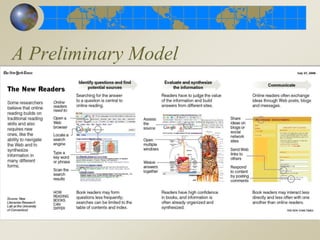
A Preliminary Model
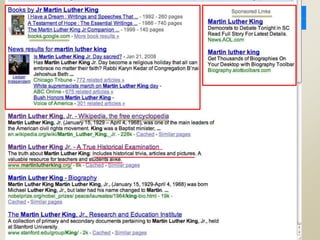
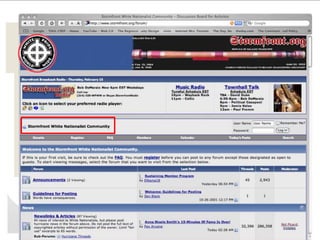
An Example of Online Reading ComprehensionReading About Martin Luther KingThe new literacies of online reading comprehension
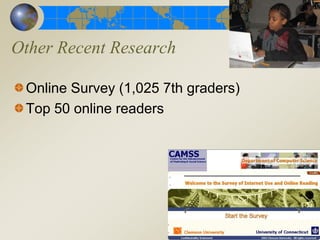
Other Recent ResearchOnline Survey (1,025 7th graders)Top 50 online readers
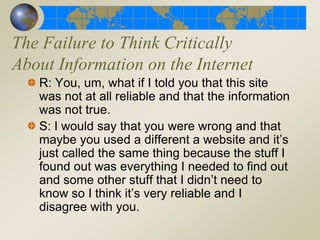
The Failure to Think Critically About Information on the InternetR: You, um, what if I told you that this site was not at all reliable and that the information was not true.S: I would say that you were wrong and that maybe you used a different a website and it’s just called the same thing because the stuff I found out was everything I needed to find out and some other stuff that I didn’t need to know so I think it’s very reliable and I disagree with you.
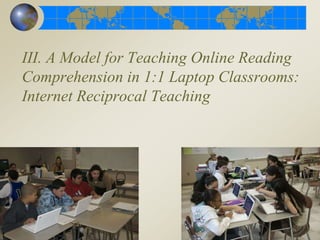
III. A Model for Teaching Online Reading Comprehension in 1:1 Laptop Classrooms:  Internet Reciprocal Teaching
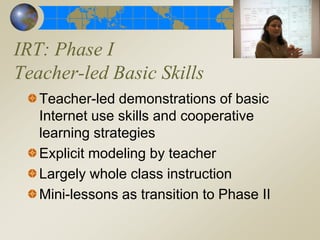
IRT: Phase ITeacher-led Basic SkillsTeacher-led demonstrations of basic Internet use skills and cooperative learning strategiesExplicit modeling by teacherLargely whole class instructionMini-lessons as transition to Phase II
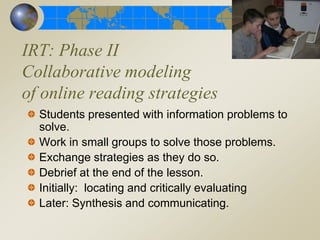
IRT: Phase IICollaborative modeling of online reading strategiesStudents presented with information problems to solve.Work in small groups to solve those problems.Exchange strategies as they do so.Debrief at the end of the lesson.Initially:  locating and critically evaluatingLater: Synthesis and communicating.
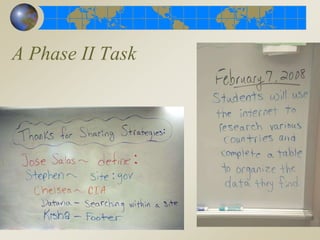
A Phase II Task
Phase III of IRT	Begin Phase III when “Most of the students and all of the groups in my class know how to…(Phase II skills on the checklist)
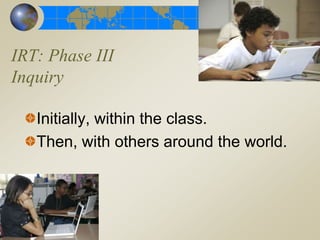
IRT: Phase IIIInquiryInitially, within the class.Then, with others around the world.
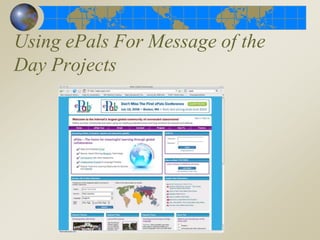
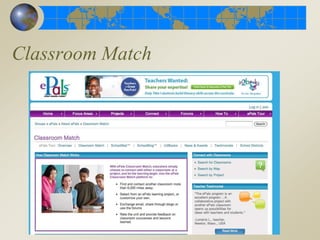
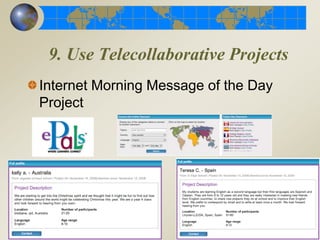
Using ePals For Message of the Day Projects
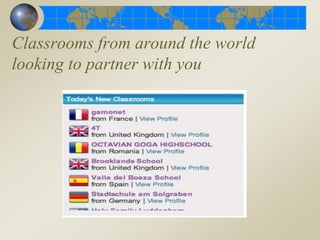
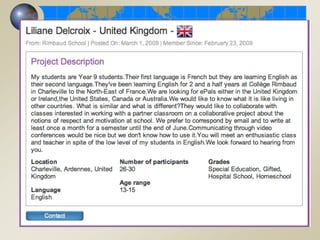
Classrooms from around the world looking to partner with you
Classroom Match
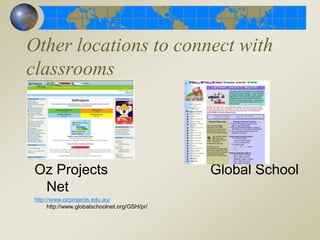
Other locations to connect with classroomsOz Projects    Global School Nethttp://www.ozprojects.edu.au/http://www.globalschoolnet.org/GSH/pr/
Lessons we Have Learned:Keep in mind this will be new and will take time to learn. Patience. Go slow. KISS.
 Be VERY clear about dates, times, obligations.
Plan far ahead.
Be flexible.
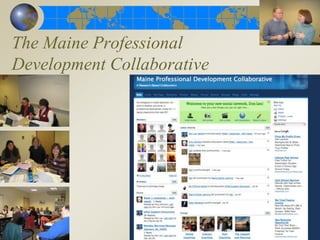
Keep good partners.  Drop bad partners.The Maine Professional Development Collaborative
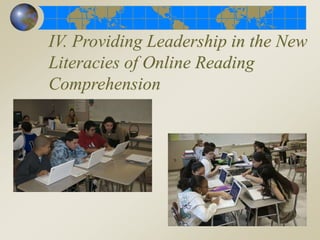
IV. Providing Leadership in the New Literacies of Online Reading Comprehension
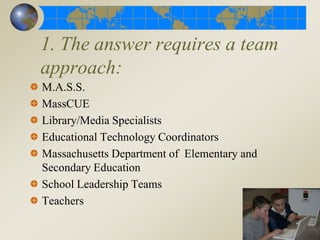
1. The Answer Requires A Team Approach:M.A.S.S.MassCUELibrary/Media SpecialistsEducational Technology CoordinatorsMassachusetts Department of  Elementary and Secondary EducationSchool Leadership TeamsTeachers
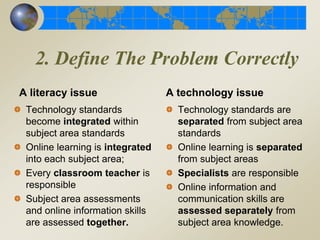
2. Define The Problem CorrectlyA literacy issueA technology issueTechnology standards become integrated within subject area standards Online learning is integrated into each subject area; Every classroom teacher is responsibleSubject area assessments and online information skills are assessed together.Technology standards are separated from subject area standards Online learning is separated from subject areasSpecialists are responsibleOnline information and communication skills are assessed separately from subject area knowledge.
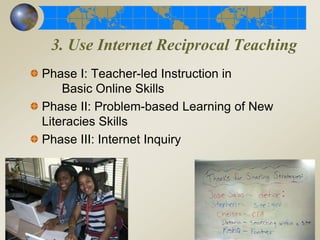
3. Use Internet Reciprocal TeachingPhase I: Teacher-led Instruction in 			Basic Online SkillsPhase II: Problem-based Learning of New Literacies SkillsPhase III: Internet Inquiry
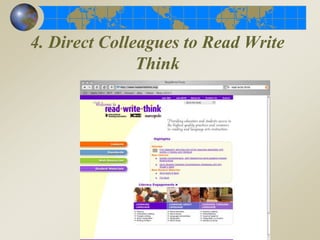
4. Direct Colleagues to Read Write Think
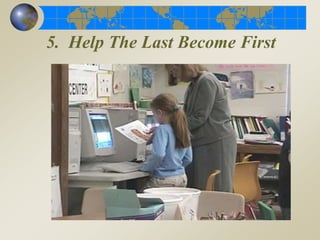
5.  Help The Last Become First
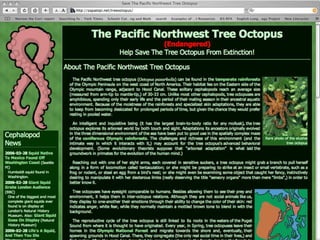
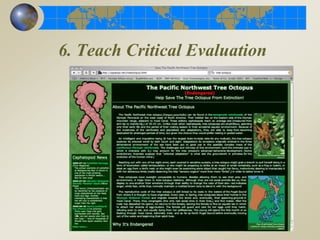
6. Teach Critical Evaluation

MassCUE Keynote

  • 1.
    The Changing Faceof Literacy and Learning In 1-1 Laptop Classrooms: The New Literacies of Online Reading Comprehension Donald J. Leu, J. Gregory McVerry, W. Ian O’Byrne, Lisa Zawilinski, and Heidi Everett-CacopardoNew Literacies Research LabUniversity of Connecticuthttp://www.newliteracies.uconn.edu/MassCUE/M.A.S.S.October 29, 2009Visit the site for this talk: http://newliteracies.typepad.com/tackling/keynote.html
  • 2.
  • 3.
    Visit the Blogfor this talk:http://newliteracies.typepad.com/tackling/keynote.htmlAIM: flyfisherdon
  • 4.
    Important Funding andSupport From:Ray and Carole Neag
  • 5.
  • 6.
  • 7.
  • 8.
  • 9.
  • 10.
  • 11.
    William and FloraHewlett Foundation
  • 12.
    Bill and MelindaGates Foundation
  • 13.
    Australian Council ofEducational Research
  • 14.
  • 15.
    Schools and teachersaround the world.The Big Idea :The Internet Is A Reading Comprehension and Learning Issue, NotA Technology IssueThe Internet is this generation’s defining technology for reading and learning.The Internet requires new literacies -- additional online reading comprehension skills. What are these skills? Teaching online reading comprehension and learning strategies in 1:1 laptop classrooms: Internet Reciprocal Teaching10 ideas on leadership and the new literacies of online reading comprehension.
  • 16.
    I. The InternetIs This Generation’s Defining Technology For Reading and Learning
  • 17.
    A New LiteraciesQuizHow many individuals currently have access to the Internet and regularly read, write, and communicate online?511 million253 million754 million1.6 billion1.6 billion individuals;1 out of 4 people in the world!(Internet World Stats)
  • 18.
  • 19.
    How many adolescentsin Accra, Ghana report having gone online?5%66%37%51%66% or 2/3 of adolescents!(Borzekowski, Fobil, & Asante, 2006)
  • 20.
    In 2005, didadolescents in North America read more on the Internet or more with books and other printed material?On the Internet Offline in books, etc.The same for both.On the Internet!In 2005, students aged 8-18 spent 48minutes per day reading on the Internet and only 43minutes per day reading offline. (Kaiser Family Foundation, 2005).
  • 21.
    Which nation manufacturesthe most software in the world?The U.S.IndonesiaIndiaIrelandIreland! (Organization for Economic Development and Cooperation, 2004)
  • 22.
    5. Which nation, inNorth America, is implementing a plan to ensure Internet access to every home and every school to prepare its citizens for the 21st century?CanadaMexicoThe U.S.Mexico!Mexico is implementing its eMexico plan right now. See http://www.e-mexico.gob.mx/
  • 23.
    6. Which nation providesInternet connections for all households at speeds 16 times faster than U.S. broadband for $22 per month?TaiwanAustraliaJapanThe UkraineJapan!(Bleha, 2005).
  • 24.
    7. How many states,in the U.S., measure students ability to read search engine results on state reading assessments?1015020!Not a single state.
  • 25.
    8. How many states,in the U.S., permit the use of word processors on state writing assessments for any student who wishes to do so.152400!
  • 26.
    9. How many statesassess online reading comprehension in their state reading assessment?02580!
  • 27.
    What can weconclude?The Internet is this generation’s defining technology for reading.We place our students at risk by our continued inaction.
  • 28.
    Current Policies IncreaseOnline Reading Achievement Gaps
  • 29.
    The Hidden, CompoundReading Achievement GapThose who require our support the most with online reading comprehension, those without home access, actually receive our support the least in schools.Current policies may increase achievement gaps
  • 30.
    II. The InternetRequires New Literacies -- Additional Online Reading Comprehension Skills.
  • 31.
    Valid And ReliableAssessments of Online Reading Comprehension (ORCAs) (Castek, 2008; Coiro, 2007; Henry, 2007; Leu et al., 2005; Leu, Reinking, et. al, 2007).Issues: Practicality and Stability
  • 32.
    Online and OfflineReading Comprehension Are Not Identical(r=0.19, n = 89, N.S.)Online ReadingComprehension = ORCA BlogOffline Reading = Connecticut Mastery Test (CMT)of Reading ComprehensionLeu, D. Castek, J., Hartman, D., Coiro, J., Henry, L., Kulikowich, J., Lyver, S. (2005).
  • 33.
    A Central Question:What skills and strategies appear to be important for successful online reading comprehension? Reading to Define a ProblemReading to Locate InformationReading to Evaluate InformationReading to Synthesize InformationReading and Writing to Communicate InformationThe new literacies of online reading comprehension
  • 34.
  • 35.
    An Example ofOnline Reading ComprehensionReading About Martin Luther KingThe new literacies of online reading comprehension
  • 39.
    Other Recent ResearchOnlineSurvey (1,025 7th graders)Top 50 online readers
  • 41.
    The Failure toThink Critically About Information on the InternetR: You, um, what if I told you that this site was not at all reliable and that the information was not true.S: I would say that you were wrong and that maybe you used a different a website and it’s just called the same thing because the stuff I found out was everything I needed to find out and some other stuff that I didn’t need to know so I think it’s very reliable and I disagree with you.
  • 42.
    III. A Modelfor Teaching Online Reading Comprehension in 1:1 Laptop Classrooms: Internet Reciprocal Teaching
  • 43.
    IRT: Phase ITeacher-ledBasic SkillsTeacher-led demonstrations of basic Internet use skills and cooperative learning strategiesExplicit modeling by teacherLargely whole class instructionMini-lessons as transition to Phase II
  • 44.
    IRT: Phase IICollaborativemodeling of online reading strategiesStudents presented with information problems to solve.Work in small groups to solve those problems.Exchange strategies as they do so.Debrief at the end of the lesson.Initially: locating and critically evaluatingLater: Synthesis and communicating.
  • 45.
  • 46.
    Phase III ofIRT Begin Phase III when “Most of the students and all of the groups in my class know how to…(Phase II skills on the checklist)
  • 47.
    IRT: Phase IIIInquiryInitially,within the class.Then, with others around the world.
  • 48.
    Using ePals ForMessage of the Day Projects
  • 49.
    Classrooms from aroundthe world looking to partner with you
  • 51.
  • 52.
    Other locations toconnect with classroomsOz Projects Global School Nethttp://www.ozprojects.edu.au/http://www.globalschoolnet.org/GSH/pr/
  • 53.
    Lessons we HaveLearned:Keep in mind this will be new and will take time to learn. Patience. Go slow. KISS.
  • 54.
    Be VERYclear about dates, times, obligations.
  • 55.
  • 56.
  • 57.
    Keep good partners. Drop bad partners.The Maine Professional Development Collaborative
  • 58.
    IV. Providing Leadershipin the New Literacies of Online Reading Comprehension
  • 59.
    1. The AnswerRequires A Team Approach:M.A.S.S.MassCUELibrary/Media SpecialistsEducational Technology CoordinatorsMassachusetts Department of Elementary and Secondary EducationSchool Leadership TeamsTeachers
  • 60.
    2. Define TheProblem CorrectlyA literacy issueA technology issueTechnology standards become integrated within subject area standards Online learning is integrated into each subject area; Every classroom teacher is responsibleSubject area assessments and online information skills are assessed together.Technology standards are separated from subject area standards Online learning is separated from subject areasSpecialists are responsibleOnline information and communication skills are assessed separately from subject area knowledge.
  • 61.
    3. Use InternetReciprocal TeachingPhase I: Teacher-led Instruction in Basic Online SkillsPhase II: Problem-based Learning of New Literacies SkillsPhase III: Internet Inquiry
  • 62.
    4. Direct Colleaguesto Read Write Think
  • 63.
    5. HelpThe Last Become First
  • 64.